
multi-agentic AI
Instead of one chatbot doing everything, multi-agentic AI uses several AI helpers that each handle a piece of the job. For car shopping, that can mean it helps you compare cars and also helps with steps like scheduling a test drive.
Chat Concierge
Chat Concierge is an AI chat tool that helps you shop for a car and move things along. Instead of just answering questions, it can help set up a test drive and guide you toward financing and trade-in numbers.
live API checks
Live API checks means the system looks up up-to-date information from other services while you’re chatting. That helps it avoid guessing and can make the car-shopping steps more accurate.
pre-approved for financing
Pre-approval for financing is when a lender checks your credit and gives you a tentative loan offer. It helps you know what you can afford before you pick the car and start negotiating.

D9 Denzer
The D9 is a big van-like electric family vehicle (an MPV). It’s mentioned because the market is getting more competitive and the model is being updated. These kinds of vehicles are usually about carrying people comfortably.
ultra-long test drives
Ultra-long test drives are when companies let people drive an EV for a long time. The goal is to prove the car works well in real life—like range and comfort—so buyers feel more confident.
Auto China show
Auto China is a big car show in Beijing. Companies use it to announce new EVs and tech, so it’s a good place to spot what’s coming next in China.
Harmony Intelligent Mobility Alliance
This is a group of companies working together around car software and smart features. It matters because it can affect how the car’s system works—like navigation, apps, and other “smart” functions.
Huawei
Huawei is a big tech company from China. When it shows up in EV news, it usually means the cars may get advanced software and smart features.
2 million yuan segment
“2 million yuan segment” means the car is aimed at a certain price level in China. That price range usually determines what kind of features and luxury buyers will expect.

Volkswagen Jetta
The transcript says “Others use the show to reset plans, like Volkswagen's Jetta,” and then clarifies it’s a brand/nameplate in China. Jetta is Volkswagen’s mass-market nameplate, and relaunching it in China typically signals a renewed product strategy—often tied to electrification and software/connected-car upgrades.

Leapmotor A10
Leapmotor’s A10 is a new EV model they’re selling in China. The hosts point out that it sold a huge number of orders very quickly, showing strong customer interest.
battery swapping
Battery swapping means you trade your empty battery for a full one at a station. It’s meant to be faster than charging, so the car can get back on the road sooner.
BAIC
BAIC is a big Chinese car company. Here, they’re working on battery swapping and related services, so their cars can use shared battery infrastructure.
ChocoSwap
ChocoSwap is BAIC’s system for swapping EV batteries. The point is that more models can use the same swapping stations, making the feature more practical.
ArcFox X3
Arcfox X3 is an EV model that the hosts say already works with BAIC’s battery-swapping setup. They’re using it as an example of where swapping is starting before it expands.
Arcfox S3
Arcfox S3 is another EV model mentioned as already supported by the battery-swapping program. It’s part of the “starting lineup” before the feature expands to more cars.

Audi S3
The Audi S3 is a compact car in a sport-focused trim. It’s meant to drive more aggressively than the regular version. In this podcast, it’s mentioned because it’s included in a list of models being discussed.

Audi S6
The Audi S6 is a faster, more performance-focused version of the Audi A6. It’s designed for people who want a bigger car but with stronger driving feel. In this episode, it’s listed as part of a group of models being discussed.

Audi S5
The Audi S5 is a sportier version of an Audi passenger car. It’s meant to feel quicker and more performance-oriented than the standard model. In this podcast, it’s mentioned as part of a set of models being discussed.
900-volt architectures
900-volt architecture means the car’s electrical system runs at a higher voltage. That can help the car charge faster because the system can deliver more power efficiently.
OnSemi
Onsemi is a company that makes chips used in EV power systems. The hosts connect their expansion to faster, higher-voltage EV designs.
autonomous driving
Autonomous driving is the umbrella term for cars that can steer, accelerate, and brake with computer help. In this segment, they’re focusing on how quickly these systems are being rolled out in real vehicles.
Momenta
Momenta is a company working on self-driving technology. The hosts are saying it’s being installed in large numbers quickly, which suggests the tech is moving from experiments to real production.

Buick Electra E7
BAIC’s Electra E7 is a new midsize SUV that uses a plug-in hybrid setup. That means you can charge it, but it also has an engine for longer trips or when the battery is low.
BYD C-Lion 06
The BYD C-Lion 06 is another EV-related SUV that the hosts say BAIC is competing against. It’s included to show what buyers in China might compare the Electra E7 to.

Buick Electra E7
The Buick Electra E7 is a Buick SUV that’s sold in different versions. It can run on electricity, and it also uses a small gas engine setup to help keep things going when the battery isn’t enough. The episode also mentions it has a lot of sensors for driving assistance.
Zhenlong plug-in hybrid system
This is the name of the Electra E7’s plug-in hybrid setup. It means the car can drive on battery power, but it also has a gas engine that can help generate electricity so you’re not stranded if the battery runs low.
range extender
A range extender is a small gas engine that helps the car keep going. Instead of powering the wheels directly, it mainly helps make electricity so the battery doesn’t run out.
battery pack
The battery pack is the car’s big rechargeable battery. Different pack sizes store different amounts of energy, which affects how far the car can go on electricity before it needs help from the hybrid system.
LiDAR
LiDAR is a sensor that uses lasers to “see” the road and objects in 3D. It helps the car understand distances more precisely, which can improve advanced driver-assistance systems.
Denza D9
The Denza D9 is a big family van (MPV). In this episode they’re talking about the newer version and how it’s built for lots of passengers, with hybrid or electric options and a high-tech, screen-filled cabin.
DMI system
DMI is the name BYD uses for the Denza D9’s plug-in hybrid setup. It combines a gas engine with electric motors so you can drive on electricity sometimes, and still have a gas backup when needed.
blade battery 2.0
Blade battery 2.0 is BYD’s newer battery design. The idea is to make the battery safer and better packaged, while also supporting faster charging.
flash charging 2.0
Flash charging 2.0 is BYD’s upgraded fast-charging system. It’s meant to charge the battery quickly, but how fast it actually goes can vary with the charger and temperature.
AI smart cockpit
An AI smart cockpit is a cabin computing system that uses artificial intelligence to manage infotainment, voice interactions, and driver/passenger personalization. The hosts connect it to the vehicle’s autonomy and the large screen layout to emphasize a more software-defined interior.
autonomy
The segment claims “loads of autonomy,” meaning advanced driver-assistance and semi-automated driving features. In EVs and modern MPVs, autonomy is typically delivered through sensor suites, compute hardware, and software updates rather than just one single feature.
dedicated hybrid platform
A dedicated hybrid platform means the car is built specifically to fit hybrid parts and batteries in a smart way. In this case, it helps create more room for luggage.
NFC seat control
NFC seat control lets you adjust seat settings by tapping your phone or a card near the car. It’s meant to make it quick to set up your preferred seating position.
temperature controlled storage box
A temperature controlled storage box is essentially a built-in cooler/heater compartment, often marketed like a “fridge” for drinks and snacks. The hosts note it can both cool and heat, which is especially useful for long trips with passengers.
turbo engine
A turbo engine is a gas engine that uses a device to push extra air into the engine. That helps it make more power and can be more efficient, especially when the car needs help beyond the electric motors.
China cycle
“China cycle” is the test method used to calculate an EV’s claimed range. If you compare range across countries, you have to remember the test rules can be different.
CATL
CATL is one of the biggest companies making EV batteries. In this segment, they’re pushing sodium-ion batteries, aiming to make them at scale and cheaper than some alternatives.
sodium ion batteries
Sodium-ion batteries are a different kind of EV battery that doesn’t rely on lithium. They’re being promoted as cheaper and potentially safer, and they can work better when it’s very cold.
HyperStrong
HyperStrong is a company working on large energy storage systems. In this story, they’re teaming up with CATL to use sodium-ion batteries in bigger real-world projects.
energy density
Energy density is basically “how much battery energy you get” for the size and weight of the battery. Higher energy density usually helps an EV go farther without adding more battery mass.
long-duration energy storage
Long-duration energy storage means saving electricity for a long time so the grid can use it later. The segment suggests sodium-ion batteries could make these big storage systems cheaper and simpler.

Aito M6
The Ito M6 is an SUV that HEMA launched. The point of the mention is that HEMA is covering multiple vehicle categories.
Shang-Jie Z7
The Shang-Jie Z7 is an EV from China that’s being marketed as “lots of tech for the money.” They’re pointing out features like advanced sensors and a high-voltage electrical system, plus different battery options for longer trips.

Xiaomi SU7
The Xiaomi SU7 is an electric car made by Xiaomi. The podcast mentions it because it sold a lot of orders early on, which suggests people are interested. That kind of early demand can affect how quickly the company scales up.
Shang-Jie Z7T
The Shang-Jie Z7T is basically a different body style version of the Z7—more like a sporty wagon. The point here is that buyers are ordering it in huge numbers, not just the standard model.
800-volt architecture
800-volt architecture means the car’s electrical system is designed to move energy more efficiently. That can help the car charge faster and feel more responsive when using high power.
air suspension
Air suspension uses air-filled springs instead of steel springs. It can raise or lower the car for comfort, better handling, or easier entry/exit.
0-62 miles an hour
0–62 mph is just a stopwatch test for acceleration. It tells you how quickly the car can get up to highway speed from a stop.
ultra all-wheel drive
All-wheel drive means power goes to both the front and rear wheels. The “ultra” part usually means the system is tuned to send torque to the wheels that need it most for better grip.

Aito M6
The Ito M6 is a smaller SUV that’s positioned as a more affordable EV option. They also mention an “e-rev” version, which usually means it can use a generator to help extend range.
e-rev
“e-rev” usually means the car drives like an EV, but it can also generate electricity to help you go farther. Think of it as an EV with a built-in backup power source.

Aito M9
The Ito M9 is the bigger, more expensive model in this lineup. They’re emphasizing that it comes with more advanced tech—especially sensors and driver-assistance features.
ADS-5
ADS-5 is a label for the car’s driver-assistance system. It’s the software and computing behind features like lane keeping and traffic driving assistance.
Luxead V9 MPV
The Luxead V9 is a minivan/MPV that’s using a Huawei range-extender system. They also mention steering on the rear axle, which can make a big vehicle easier to handle in tight spaces.
rear axle steering
Rear axle steering means the back wheels can steer too. That can help a big car turn more easily and feel steadier when you’re driving faster.
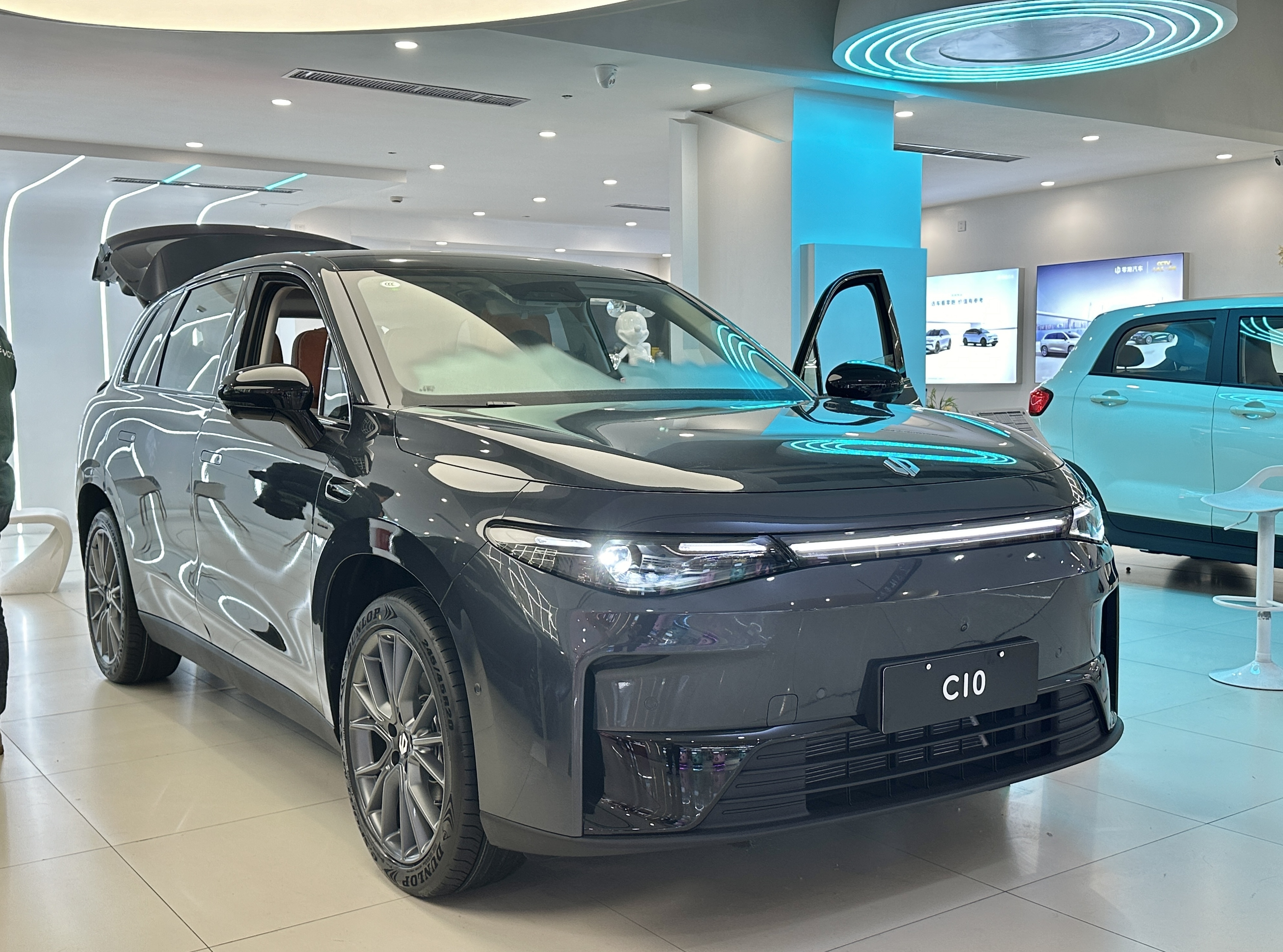
C10 Leapmoto
The C10 is a car model name mentioned in the podcast. The episode doesn’t provide enough detail here to say exactly what it is, but it’s part of the news being discussed. It may be included because of something happening with the model or the company behind it.
SpinQuest
SpinQuest is mentioned as the sponsor for a segment break, offering online casino-style games with cash prizes. It’s not automotive-related, but it’s a notable brand reference in the episode’s ad content.
Capital One
Capital One is using AI to make buying a car easier. The idea is that the system can help you find a car and even help with steps like test drives and financing.
estimate trading value
Trading value is what your current car could be worth when you trade it in. Estimates are usually based on similar cars and your vehicle’s details, and they can change the deal price.

LeapMotor
LeapMotor is a Chinese EV maker, and the hosts say it plans to launch a new more premium brand. The goal is to sell higher-priced cars through a separate sales setup.
independent sales network
An “independent sales network” means the premium brand would be sold through a separate set of dealerships or retail channels rather than using the existing LeapMotor retail base. This is often used to reposition a brand’s image and customer experience at higher price tiers.
Mercedes-Benz
Mercedes-Benz is rolling out a longer version of the GLC SUV for China. The idea is to tailor the car to local preferences, especially rear-seat space.

Mercedes-Benz GLC
The segment says Mercedes-Benz debuted an all-new long-wheelbase version of the GLC for China. Long-wheelbase variants typically prioritize rear-seat space and comfort, which is a common demand in many Chinese markets.
long-wheelbase
Long-wheelbase just means the car is stretched longer between the wheels. That usually makes more room for passengers in the back seats.

Toyota A90
The Toyota Supra is a sports car made for driving fast and handling well. In this podcast, it’s mentioned as a comparison point, not as the main EV topic. The goal is to show how different designs and layouts can be used in new vehicles.

Mercedes-Benz Sclass
The Mercedes-Benz S-Class is a top-end luxury car. In this episode, it’s brought up because Mercedes is using advanced engineering ideas from the S-Class to help an electric model go farther and charge faster. The focus is on making the car feel stable and well-built.
Envo L80
The Envo L80 is a big, practical electric SUV. They’re emphasizing how much stuff you can carry, including a very large front trunk (frunk) and lots of storage areas.
frunk
A frunk is like a trunk in the front of the car. Since EVs don’t need an engine up front, manufacturers can use that space for extra storage.
Dong Feng
Dong Feng is an automaker. In this partnership, they’re helping create the EV brand and likely handle the vehicle side of building and producing it.
Yijing X9
The Yijing X9 is a large, premium SUV meant to carry people comfortably. They’re focusing on extra space—especially for passengers in the back rows.
Voyeur Taishan X8
This is a big SUV from Dongfeng’s premium EV brand called the Voyeur Taishan X8. You can get it either as a plug-in hybrid (gas engine plus electric motors) or as a fully electric version. The electric version uses two motors and drives all four wheels.
CLTC range
CLTC range is the driving-range number measured using China’s test method. It’s useful for comparing cars in that same system, but it may not translate directly to how far you’ll get under other testing rules.
BEV
BEV means the vehicle is fully electric. It runs only on electricity stored in a battery, not on a gas engine.
66-hour test drive campaign
BYD is running a limited-time test drive where you can keep the car for about 2.5 days. The idea is to let you live with it and see if it works for your routine, not just drive it briefly.

Byd Seal
The BYD Seal is an electric sedan. In this podcast, it’s mentioned because BYD is selling different versions of it in Japan, including newly launched variants. The point is that the same basic car can come in different trims.

Sealion Cline 7
The Sealion 7 is an electric vehicle from BYD. The podcast mentions it because BYD is letting people test-drive vehicles during a long event in Japan. It’s included as part of the broader lineup being offered there.
stock shortages
Stock shortages mean limited inventory at dealerships, often driven by supply constraints or high demand. When shortages happen, buyers may face longer waits, fewer choices, and more pressure to act quickly once a car becomes available.
subsidy environment
A subsidy environment is how government incentives make some cars cheaper or easier to buy. If incentives favor certain brands or EV types, buyers will naturally lean that way.