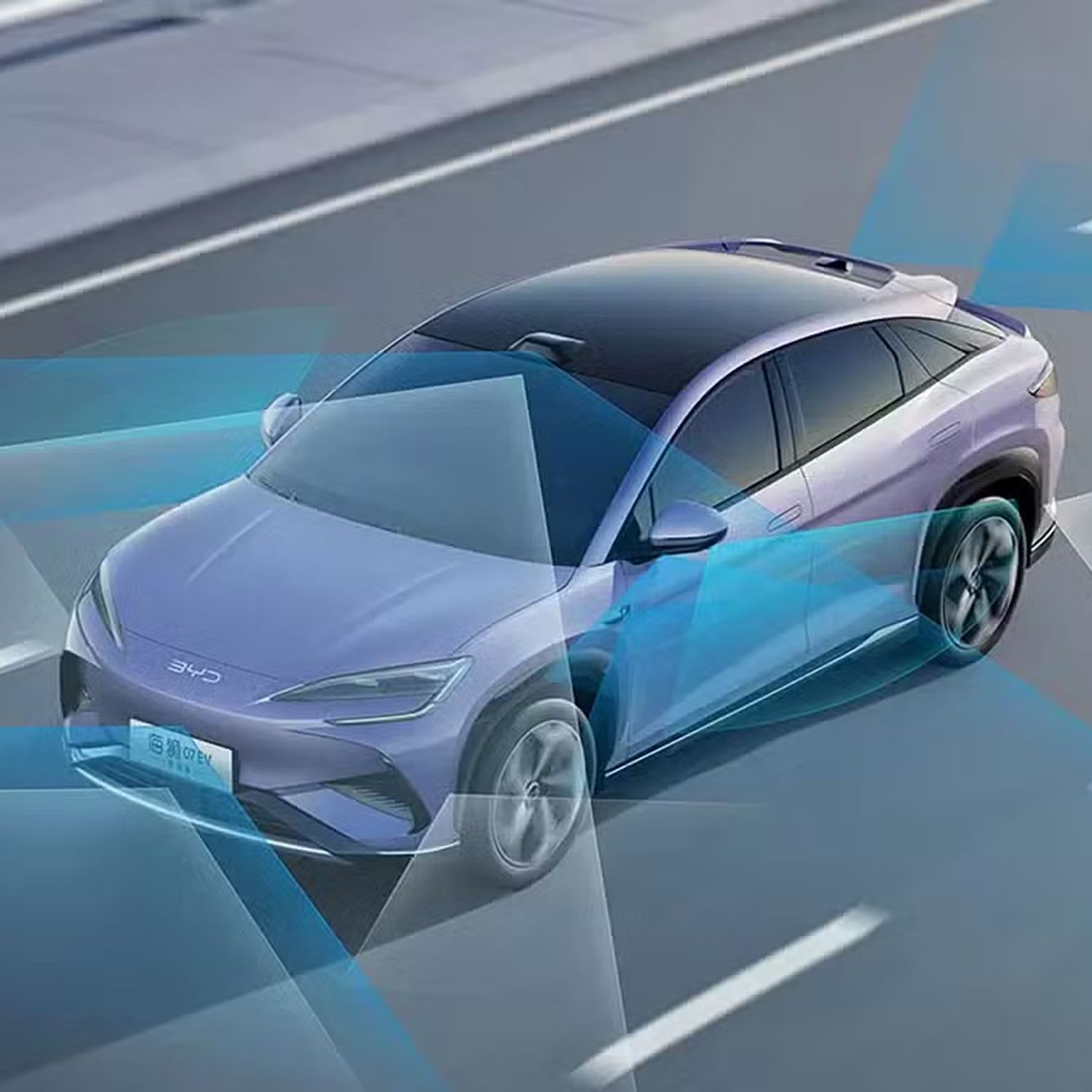
CHINA: BYD Rolls Out God’s Eye 5.0, Battery Makers Turn To Sodium and China Scrubs Online Attacks | 30 Jan 2026
EV News Daily - Technology and Business of EVs
CHINA: BYD Rolls Out God’s Eye 5.0, Battery Makers Turn To Sodium and China Scrubs Online Attacks | 30 Jan 2026EV News Daily - Technology and Business of EVs · Jan 30, 2026
Annotations will appear as you listen
0:00
16:56
Car
BYD i5
The BYD i5 is an electric car made by a Chinese company called BYD. They are known for making electric vehicles and batteries, and the i5 is one of their models.
Range is how far an electric car can go before it needs to be recharged. It's an important thing for people to think about when buying an electric car.
Battery champions are companies that are really good at making batteries, especially for electric cars. They help improve how long cars can run on a charge.
Batteries in cars store energy to power the vehicle. In electric cars, they are especially important because they provide the electricity needed to run the car.
Chips are tiny computer parts that help control various functions in cars, like the engine and entertainment systems. They are very important for modern vehicles, especially electric ones.
Cherry is a car company from China that makes different types of vehicles, including electric cars. They are trying to sell their cars in other countries.
Battery-electric models are cars that run only on electricity, so they don't use gas at all. They are better for the environment because they don't produce pollution from a tailpipe.
Plug-in hybrids are cars that can use both electricity and gas. You can charge them at home, and they can drive on electricity for a while before needing gas.
Four-wheel steering means that not just the front wheels, but also the back wheels can turn, which helps the car handle better when turning or parking.
Four-wheel electronic steering means that not just the front wheels, but also the back wheels can turn. This helps the car turn more easily and stay stable while driving.
Steer-by-wire means that instead of a physical connection between the steering wheel and the wheels, everything is controlled electronically. This can make steering easier and more responsive.
Integrated chassis control means that different parts of the car, like the steering and brakes, work together to make the car handle better and be safer to drive.
The Xiaomi Su7 Ultra is a new electric car made by Xiaomi, a company known for electronics. It's part of a trend where tech companies are starting to make cars, especially electric ones.
An electric vehicle, or EV, is a car that runs on electricity instead of gasoline. They are popular because they are better for the environment and can save money on fuel.
Car
BYD Yang Wang U9 Extreme
The BYD Yang Wang U9 Extreme is a powerful electric car made by BYD, a major Chinese car company. It's known for its performance and represents the advancements in electric vehicle technology.
LIVE
Five years ago, I was paying $65 a month for my subscriptions.
Today, those same subscriptions cost $111, and I don't even use half of them anymore.
That's why now I use RocketMoney to manage my subscriptions for me.
The app gives you a list of all of your subscriptions and reminds you of upcoming payments,
so you're not hit with any surprise charges.
On top of that, it also sends you alerts when subscription prices go up,
so you always know the price you're paying.
If you decide you no longer want a subscription, you can cancel it right from the app.
No customer service needed, and the best part is RocketMoney even reaches out
and tries to get you refunded for some of the money you lost.
On average, people that cancel their subscriptions with RocketMoney save $378 a year,
and overall RocketMoney has saved its members $880 million in canceled subscriptions.
Stop wasting money on things you don't use.
Go to rocketmoney.com slash cancel to get started.
but if you've forgotten to get that special someone in your life a gift,
well, Mint Mobile is extending their holiday offer of half-off unlimited wireless,
so here's the idea. You get it now.
You call it an early present for next year.
What do you have to lose?
Give it a try at mintmobile.com slash switch.
Limited time, 50% off regular price for new customers,
up-front payment required $45 for three months, $90 for six months,
or $180 for 12-month plan.
Taxes and fees extra.
Speeds may slow after 50 gigabytes per month when network is busy.
See terms.
I didn't realize I was wasting $415 a month until I downloaded RocketMoney.
I thought I had my finances under control until the app laid out all my spending
and categorized it for me.
Takeout, shopping, and unused subscriptions were quietly draining my account.
And as a result, my savings took a backseat,
but RocketMoney doesn't just tell you what you're wasting money on.
It takes action to save you money.
First, the app looks at your income and monthly expenses
and calculates how much you can safely spend each day to stay under budget.
RocketMoney also finds and cancels unwanted subscriptions for you
and even negotiates better rates on your bills,
so you have more money in your pocket.
On average, RocketMoney members can save up to $740 a year
when using all the app's premium features.
Users love the app with over 186,000 five-star ratings.
It's time to simplify your finances and take control of your money.
Go to rocketmoney.com slash cancel to get started.
That's rocketmoney.com slash cancel.
Rocketmoney.com slash cancel.
If you're an HVAC technician and a call comes in,
Granger knows that you need a partner that helps you find the right product,
fast and hassle-free.
And you know that when the first problem of the day is a clanking blower motor,
there's no need to break a sweat.
With Granger's easy-to-use website and product details,
you're confident you'll soon have everything humming right along.
Call 1-800-GRANGER, click Granger.com or just stop by.
Granger, for the ones who get it done.
Welcome back to EV News, China.
Today, BYD rolls out God's i5,
battery makers turn to sodium
and China scrubs online attacks plus they tune
because later in the show, I'll tell you how China's EVs
are even showing up on Gran Turismo,
ready for your next gaming session.
Welcome to EV News, China, the podcast dedicated
to the world's largest EV market.
Every day, I bring you the latest headlines,
insights and analysis from the heart of China's booming EV industry
and decode how fast moving developments in the East
shape the global EV landscape.
We'll start with BYD,
rolled out its fifth version of its driver assistance stack,
God's i5 after seeding earlier iterations
across 2.3 million cars on Chinese roads.
That fleet gives the firm a store of real-world data
that their rivals lack.
The new system leans on reinforcement learning
and what BYD calls a closed-loop assisted driving architecture.
In practice, the software learns from journeys,
feeds back into its pipeline,
trains itself and ships new updates over the air.
Each trip uses and trains the product.
Advanced drive resistance has become one of the few clear ways
to stand out in China's bruising EV market.
Local brands are all chasing the same urban,
tech-aware buyers who now weigh software and autonomy
as closely as range and price.
But with 2.3 million vehicles running God's i in some form,
BYD can iterate faster.
The likes of Tesla, their competitors,
are still not allowed to run their systems on Chinese roads.
Reinforcement learning also shows how Chinese regulators
and car makers may split from Western peers.
China already allows use of over-the-air updates
and large-scale data collection on domestic roads,
giving firms like BYD the scope to tune its behavior in dents.
Let's call it unruly traffic that stretches any algorithm.
All right, let's move on, but stay with BYD.
We'll run more of its blade battery buses on European roads,
also in Singapore and Australia this year.
The Chinese group keeps pushing its cell-to-chassis design
from its home turf into other markets,
shaping the global bus procurement market.
And that's the crazy thing.
So many Western car makers, let's call them established
because legacy is almost an insult,
then they can't even get their head around
cell-to-pack technology or cell-to-chassis technology.
They're working no doubt really hard with their suppliers
and cell makers,
but so many battery packs are still done the old-fashioned way,
made into modules, put inside a big, heavy casing,
more weight, less efficiency, more cost.
The average, I mean, it's hard, isn't it?
Industry average is 6 to 800 euros for the stuff
that goes around it in terms of making a pack.
The Chinese just put in the battery,
the cells straight into the chassis.
Well, it matters for two reasons.
Cell-to-chassis turns the battery structural,
which cuts weight, improves packaging in a segment
where duty cycles like commercial vehicles
and total cost of ownership decide who wins the tender,
lighter chassis with more efficiency, undercuts diesel.
Second, each new fleet outside China gives BYD even more data,
more visibility, and more political leverage.
The buses use BYD's blade, battery built into the chassis,
not done the old-fashioned way.
BYD are doing this with something as niche as buses
and we can't even get our cars doing that.
Well, I mean Volvo kind of with the EX-60
reinvented how they're doing it,
but they're a Chinese company.
Transit agencies for their part care less about labels
and the cell-to-chassis technology
that we get excited about.
They care about range, uptime, and depot integration.
Wider deployment in Europe, Singapore and Australia
shows that operators and regulators now trust the chemistry,
the design, and the support now work enough.
Let's talk a little bit about China's battery champions
of falling hard for sodium.
It's the hot new thing.
And well, it's not the cold new thing
because they're doing it really cold weather testing as well
and it's holding up fine.
CATL and BYD have both decided to fast track their plans
to put sodium ion batteries into Chinese EVs.
A Changang Oshan passenger vehicle
is carrying CATL's new cells
and heading into its winter testing.
Sodium ion is moving off the lab benches,
has done for a while now,
and out of test packs and into the mass market.
The chemistry promises much lower costs
and easier raw material supply than lithium ion phosphate.
But with lower energy density as a trade-off,
putting it into a mainstream passenger model
even on trial shows Chinese carmakers
and their battery suppliers are close to commercial use.
China sets the pace in terms of EV batteries
when it's two biggest cell makers shift focus.
Carmakers and suppliers everywhere
have got to pay attention.
Sodium cells have a lower material cost,
a supply chain that's not tied to lithium, nickel, and cobalt.
They also suit cheaper, shorter range vehicles
that do dominate in some parts of China.
CATL and BYD both have sodium ion technology ready to go
and have spoken before.
Sometimes about mixed packs
that pair sodium with lithium cells.
Rising lithium prices also give them an economic case
to move from pilot lines to volume use.
The appeal is strongest for small city EVs
and commercial vehicles
where every yuan shaved off a pack
brings down the sticker price.
And the shift also fits Beijing's aims
as well as a more diverse battery mix,
reducing exposure to any kind of swings in global markets
where miners and refiners outside of China still matter.
Greater use of sodium,
sourced from abundant salt,
tightens China's grip on the mid to low end of the EV market
as Western rivals fret about dependence on Chinese batteries.
For now, if CATL's naxtra pack holds up just fine
in extreme low temperatures,
they'll look more attractive for small, cheap city cars,
ride-hailing fleets, entry-level crossovers,
the Chang'an Oshan,
a volume brand aimed at cost-conscious buyers,
is a natural early test bed.
Let's talk about China scrubbing online attacks.
Chinese sensors have removed what they call
large-scale defamatory content aimed at EV makers.
And they've punished the accounts
that have been publishing this stuff,
just as EVs pass a symbolic marker,
more than half of all new car sales in China are EVs now.
And the timing matters,
Beijing has made the EV sector a pillar
of its industrial policy in a shop window for the world
to see how it can innovate with high tech.
Yet as local brands crowd the market,
there's been an online pile-on.
Rumors and campaigns can move share prices,
unsettle buyers,
and for those that have slightly more nefarious reasons
to post this stuff,
it can really affect car makers.
Regulators say they've now deleted large volumes of posts
that smear EV brands
and have issued penalties against the individuals
that ran those networks.
They claim to target disinformation
rather than fair criticism
because the car makers are being more criticized
and take Xiaomi as an example,
had a couple of crashes and fires.
The fires this week or last week,
it was recent, I didn't report on it on this podcast,
were announced by Xiaomi.
And so they're not trying to hide it.
They're trying to have a more open dialogue with their buyers.
And in the past, people have been posting stuff online
that just makes people think twice
about buying things, getting out of cars,
the door handles that don't work
when there's a power cut in an accident,
things like that.
China's habit of fusing industrial strategy
with strict control of public speech
probably plays into the story here as well.
For investors and foreign rivals,
China wants its EV industry to grow
with less unruly digital chitchat,
which has so far been how the market's been playing out.
Whether that brings a more transparent market
or a quieter one, we'll find out.
Now, HEFE aims to lift annual output of EVs
and intelligent connected vehicles
to 1.5 million units a year by next year.
It wants EV industrial scale to reach 500 billion yuan
and the wider car sector to hit a trillion.
The targets rest on a base that matters in China,
NIO, BYD, Volkswagen and Nui,
and JAC all run operations in the city.
Their plants anchor a supply chain
that runs from batteries to complete vehicles
and all the services that surround them.
City officials in HEFE plan to speed up
the building of world-class EVs, they say.
They want more high-end resources
in the new energy and intelligent car sectors
to gather in the area.
They talk of regional innovation,
software, parts, infrastructure and services,
and policy underpins the plan.
Local officials call for more work
on core technologies in batteries and chips for vehicles.
The strategy backs the rollout of charging
and swapping networks in the area too.
Now, let's talk about cherry expanding overseas.
This time here to Great Britain,
cherry commercial vehicles will open
its first European headquarters
in the city of Liverpool.
That is in the north of England,
if you don't know, if you need a cultural shorthand.
But that'd be the home of the Beatles,
amongst many other things as well.
Everton and Liverpool football clubs
and things like that,
tying its continental truck ambitions
to a British historic port city
better known for, well, shipping,
I would say, than lorries.
The site will handle R&D,
engineering, innovation, biz dev,
and is expected to create
more than 50 jobs in phase one.
For Britain, the move offers,
okay, it's a modest,
but it's at least a concrete slice
of Chinese investment may be more of a signal
than the actual first 50 jobs.
The general manager of the plant says
the firm will build a local business
that operates locally,
hire British staff,
and work with local institutions.
That's all very nice.
But hey, don't worry, we're not as,
we're not too precious over here.
You haven't, I mean, that's a nice line.
Oh, we're gonna, you know,
we're gonna be in Britain,
but employing Brits, don't worry.
We're not quite as flag wavy over here.
Don't worry.
I mean, you know, just employ the good,
the good people,
whatever their nationality,
get the best people, right?
Whatever shape and size they are.
Cherry cites Liverpool's port,
transport links and the existing automotive base
as the pool factors,
local officials present the deal
as an example of China, UK in a week
when our prime minister,
Sir Keir Starmer,
has been with the premier of China,
Xi Jinping talking about trade
and joining the economies.
The headquarters follow Cherry's passenger foray
into our market in 2024,
Omoda and JQ brands arrived
with plug-in hybrids and battery-electric models,
building a dealer network of 70 outlets.
The commercial arm has grown quickly at home in 2025.
It's monthly heavy-duty truck sales
over a thousand units,
mini truck volumes near the top of the segment as well.
And Cherry commercial vehicles
wants one million units sold a year by 2030
becoming a leader in the area.
Okay, let's talk.
Okay, no, let's take a break actually
and we'll talk China and Denmark coming together
this time on the water for EVs
and DD and GAC with purpose-built robo taxis back in a mo.
I didn't even realize
I was wasting $415 a month
until I downloaded rocket money.
I thought I had my finances under control
until the app laid out all my spending
and categorized it for me.
Takeout, shopping and unused subscriptions
were quietly draining my account
and as a result, my savings took a backseat.
But rocket money doesn't just tell you
what you're wasting money on.
It takes action to save you money.
First, the app looks at your income and monthly expenses
and calculates how much you can safely spend
each day to stay on your budget.
Rocket money also finds and cancels
unwanted subscriptions for you
and even negotiates better rates on your bills
so you have more money in your pocket.
On average, rocket money members can save
up to $740 a year
when using all the app's premium features.
Users love the app with over 186,000 5-star ratings.
It's time to simplify your finances
and take control of your money.
Go to rocketmoney.com slash cancel to get started.
That's rocketmoney.com slash cancel.
Rocketmoney.com slash cancel.
If you're the purchasing manager
at a manufacturing plant,
you know having a trusted partner
makes all the difference.
That's why hands down,
you count on Granger for auto-reordering.
With on-time restocks,
your team will have the cut-resistant gloves
they need at the start of their shift.
And you can end your day
knowing they've got safety well in hand.
Call 1-800-GRANGER, click Granger.com
or just stop by.
Granger for the ones who get it done.
The number one resolution for people last year
was to save more money,
but nearly half gave up by February.
Don't let that be you.
Download rocket money
to reach your financial goals this year.
Track your spending,
cut waste,
and automate savings in one simple app.
Rocketmoney shows you all your expenses
and categorizes them
so you know exactly where your money is going
and where you're overspending.
From there, the app cuts waste
by canceling your unused subscriptions
and lowering your bills.
No customer service needed.
With that money freed up,
the app will automatically set some cash aside
for your goals,
whether it's an emergency fund,
paying off debt,
or saving for vacation.
Rocketmoney's got you covered.
Users love the app with over 186,000 five-star ratings.
And on average,
users can save up to $740 a year
when using all of the app's premium features.
Make saving money a priority this year.
Go to rocketmoney.com
slash cancel to get started.
That's rocketmoney.com
slash cancel.
Rocketmoney.com
slash cancel.
If you're an HVAC technician
and a call comes in,
Granger knows that you need a partner
that helps you find the right product,
fast and hassle-free.
And you know that when the first problem of the day
is a clanking blower motor,
there's no need to break a sweat.
With Granger's easy-to-use website and product details,
you're confident you'll soon have everything humming right along.
Call 1-800-GRANGER, click Granger.com, or just stop by.
Granger, for the ones who get it done.
All right, welcome back to the podcast.
China and Denmark have renewed a green pack
that ties Beijing's industrial policy
to Copenhagen's know-how in shipping.
The deal extends a long-running alliance
between the world's big shipbuilding nation,
the home of MERSC,
and container lines pushing hard into green fuels.
The agreement is about efficiency, clean fuel,
and digital oversight.
Chinese shipyards and makers
are going to work with the Danish firms
on zero-emission propulsion,
onboard systems that either cut fuel use or pure EV.
Both sides also pledge to ease adoption of fuels,
things like green methanol and ammonia,
and of course, pure electric transport as well.
For China, it fits in with their move up the value chain
in terms of high-tech zero-emission green shipping
rather than just turning out some cheap hulls.
For Denmark, it brings deeper reach into the only big market
still adding shipyard capacity at scale in the world.
Now, DD has begun taking delivery of its first jointly-developed
robot taxi with GAC Ion.
Less than a year after the pair unveiled their pact in April
last year, the initial fleet has cleared the first hurdles
of regulation for road testing in Guangzhou.
The move marks a step in China's homegrown autonomy
ride-hailing platforms,
built around the domestic brand's DD,
is the long-dominant Chinese ride-hailing service
Think Uber, and it's now gaining a purpose-built
robot taxi rather than an off-the-shelf car
that then gets retrofit.
GAC's Ion, one of the faster-growing EV brands,
gains a big customer and a nice showcase as well
for autonomy.
Regulators in Guangzhou have signed off on the first batch
of vehicles for public road testing,
underscoring how local governments continue to back commercial
pilots with local names.
That contrasts with a more hesitant stance
in western cities where approvals arrive more slowly
and often with tighter constraints.
The joint robot taxi also shows how China's EV makers
are using partnerships to lock in demand
at a time of fierce price competition just selling
their normal cars to retail customers for GAC Ion,
baking its platform into DD's robot taxi strategy
with perhaps steady things in every choppy market.
Now, China's latest arms race is how cars
turn left and right.
SAIC's premium EV brand, IM Motors,
has been showing off their new flagship,
the LS9 Hyper, a production SUV
with four-wheel electronic steering.
Now, this matters.
Four-wheel steering has appeared before
on low-volume or very, very high-end models.
IM pitches the system as fully electronic
and ready for series production on a family SUV.
A segment Chinese buyers still favour.
If the firm delivers a scale,
it'll be a benchmark for chassis technology
in a crowded market
where software and gadgetry now matter more.
SAIC has form in EV hardware.
IM, its joint venture premium brand,
sits above the group's mass market offerings
and it competes with the likes of Neo,
X-Pang and Tesla.
LS9 Hyper's four-wheel electronic steering
shows that SAIC wants to push beyond range
and charging specs into something new,
this time handling.
Parking is a big one, right?
Active safety.
All areas that the regulators are now starting
to pay a lot of attention to.
Sure, a tight turning circle is good,
but you have to have it safe as well.
The claim of the world's first SUV
with four-wheel electronic steering
has drawn scrutiny
and rivals are working on steer-by-wire
and integrated chassis control as well.
Global automakers have talked up similar systems,
but now the regulators will want to make sure
that they know exactly what's going on.
And finally, Gran Turismo 7
will host its first Chinese EV,
Xiaomi's Su7 Ultra.
We'll join the PlayStation gang
with BYD's Yang Wang, U9 Extreme, then following.
The deal gives two of China's flashiest electric brands
a shop window away from home roads.
Sony's driving game remains
one of the few digital stages
where car makers actually genuinely jostle
for a place.
Chinese firms now dominate globally the volumes,
but they haven't dominated our screens yet.
Well, Xiaomi uses the Su7 Ultra
as the sharp end of its push
from smartphones to smart cars.
Dropping it into Gran Turismo 7
shows the firm wants to be alongside established brands.
BYD, through its Yang Wang label
and the U9 Extreme,
is doing much the same at the high end.
Virtual exposure doesn't do anything for tariffs
or anything like that.
Data rules, safety politics,
but those who like to do a bit of gaming
will now be exposed to a couple of new Chinese brands
they may not have heard of before.
And that's your podcast for today.
Thanks for listening.
See you on Monday as we're back with EV News China.
Tap one you don't use and cancel it.
That's money back every month.
Step three, create a financial goal.
$50 every paycheck
or let the app automatically move small amounts of cash
when you can afford it.
In a week, you'll forget you set it up.
In a month, you'll see real dollars piling up.
In a year, you'll be shocked at how much money you've saved.
Bonus challenge, upload an internet or phone bill
and let Rocket Money try to lower it.
You only pay if they find you savings.
On average, Rocket Money members can save up to $740 a year
when using all the app's premium features.
Users love the app with over 186,000 five-star ratings.
Make saving money the resolution you actually keep.
Start the 60-second savings challenge
at rocketmoney.com slash cancel.
That's rocketmoney.com slash cancel.
Rocketmoney.com slash cancel.
If you're an HVAC technician and a call comes in,
Granger knows that you need a partner
that helps you find the right product, fast and hassle-free.
And you know that when the first problem of the day
is a clanking blower motor, there's no need to break a sweat.
With Granger's easy-to-use website and product details,
you're confident you'll soon have everything humming right along.
Call 1-800-GRANGER, click Granger.com or just stop by.
Granger, for the ones who get it done.
About this episode
BYD has launched its latest driver assistance system, God's i5, leveraging data from 2.3 million vehicles to enhance its autonomous driving capabilities. The episode also explores the shift towards sodium-ion batteries by major Chinese manufacturers like CATL and BYD, promising lower costs and reduced reliance on lithium. Additionally, it discusses China's efforts to control online narratives about its EV market and highlights the expansion of Chinese brands like Cherry into Europe. The episode wraps up with insights on new technologies in EVs and their representation in gaming.
Welcome to EV News China — the podcast dedicated to the world’s largest electric vehicle market. Each day, I bring you the latest headlines, insights, and analysis from the heart of China’s booming EV industry — and decode how fast-moving developments in the east are shaping the global EV landscape.
Can you help me make more podcasts? Consider supporting me on Patreon as the service is 100% funded by you: https://EVne.ws/patreon