CHINA: EV Prices Rise As Cheap BEVs Fade, Chinese Brands Cautious In Canada and NIO Gen 5 Swap Stations | 15 May 2026
EV News Daily - Technology and Business of EVs
CHINA: EV Prices Rise As Cheap BEVs Fade, Chinese Brands Cautious In Canada and NIO Gen 5 Swap Stations | 15 May 2026EV News Daily - Technology and Business of EVs · May 15, 2026
An EREV is mostly an electric car, but it also has a small engine that helps make electricity when the battery runs low. That can reduce “range anxiety” compared with a pure battery-electric car.
ADAS are driver-assist features that help with things like staying in the lane or maintaining distance from the car ahead. An “ADAS option” means you may have to pay extra to get those features.
The Xiaomi SU7 is an all-electric car made by Xiaomi. It’s a sedan, meaning it’s designed more like a traditional passenger car with a trunk. The podcast mentions it because it recently launched and its pricing is being discussed.
Volkswagen’s ID cars are their electric models. The hosts say Volkswagen is increasing prices because it’s getting more expensive to build EVs and making less profit per car.
Battery-grade lithium carbonate is the lithium chemical that goes into making EV batteries. If its price jumps, EV batteries cost more, which can force car prices up too.
Automotive-grade chips are computer chips made to survive in cars reliably. The hosts say AI demand is stealing chip supply from cars, so car-chip prices rise and availability gets worse.
A supply chain nightmare means it’s hard for companies to get the parts they need, and those parts cost more. The hosts are saying EV makers can’t just “eat” the extra costs because the shortages are too severe.
The China Passenger Car Association is a group that monitors China’s car industry. The hosts quote it to show that car makers’ profit margins are very low right now.
DSMA is a company that helps Chinese EV brands talk to Canadian car dealers. Think of it like a matchmaking or consulting group for getting cars sold in Canada.
The Xiaomi YU7 GT is Xiaomi’s “sporty” SUV version. The big idea here is that it’s meant to feel fast and capable for everyday driving over long distances, not built only for track days.
They’re comparing the Xiaomi YU7 GT to a faster version of the Tesla Model Y. That comparison is meant to show what kind of performance Xiaomi is aiming for.
They also compare the Xiaomi YU7 GT to the Porsche Cayenne Turbo GT. That Porsche is a high-performance SUV, so it’s a serious yardstick for what Xiaomi wants to achieve.
Nürburgring Nordschleife is a famous German race track. Car companies use it to test and fine-tune how a car handles, because it’s challenging and reveals problems quickly.
“Development and calibration” refers to the process of tuning a vehicle’s systems—like steering feel, suspension response, and power delivery—so they behave consistently across real-world conditions. Using a track like the Nordschleife helps engineers adjust settings based on measured behavior and driver feedback.
These are sporty seats that use Alcantara (a soft, grippy fabric) and carbon fiber parts. The goal is usually a lighter feel and a more performance-oriented interior.
“Fifth gen” here refers to NEO’s next-generation battery-swap station hardware and software design. The excerpt mentions exterior shell panel changes and a larger swap bay, which implies the station is being redesigned to fit more vehicles and improve throughput.
NEO is the organization behind the battery-swapping stations discussed here. They’re building a newer station version and testing it before it’s officially launched.
Debugging mode means the system is being tested and checked by engineers, not used normally by customers yet. It’s a sign the station isn’t fully ready for the public.
A swap bay is the specific area at the station where the car lines up for the battery exchange. Making it larger can help the station fit more car sizes.
This is a feature that helps you park the car in the right spot at a battery-swap station. It uses guidance to make the swap process easier and more accurate.
This is a parking help feature where the car does part of the steering or positioning. The idea is to get the car lined up correctly for the battery swap.
Over-the-air updates are software updates that download to the car over the internet. In this case, the update changes the car’s performance by increasing motor output.
The podcast mentions an “X9,” but it doesn’t say what company makes it or what type of EV it is. It sounds like it’s just one of the cars being talked about in the episode. If you share more of the transcript around it, I can explain it more clearly.
This means the EV uses a higher-voltage electrical system. Higher voltage can help the car charge faster at the right kind of fast charger.
Car
X-Pung G6
The X-Pung G6 is an EV the hosts say can charge fast. They credit that speed to its high-voltage charging system, which helps it pull more power at the charger.
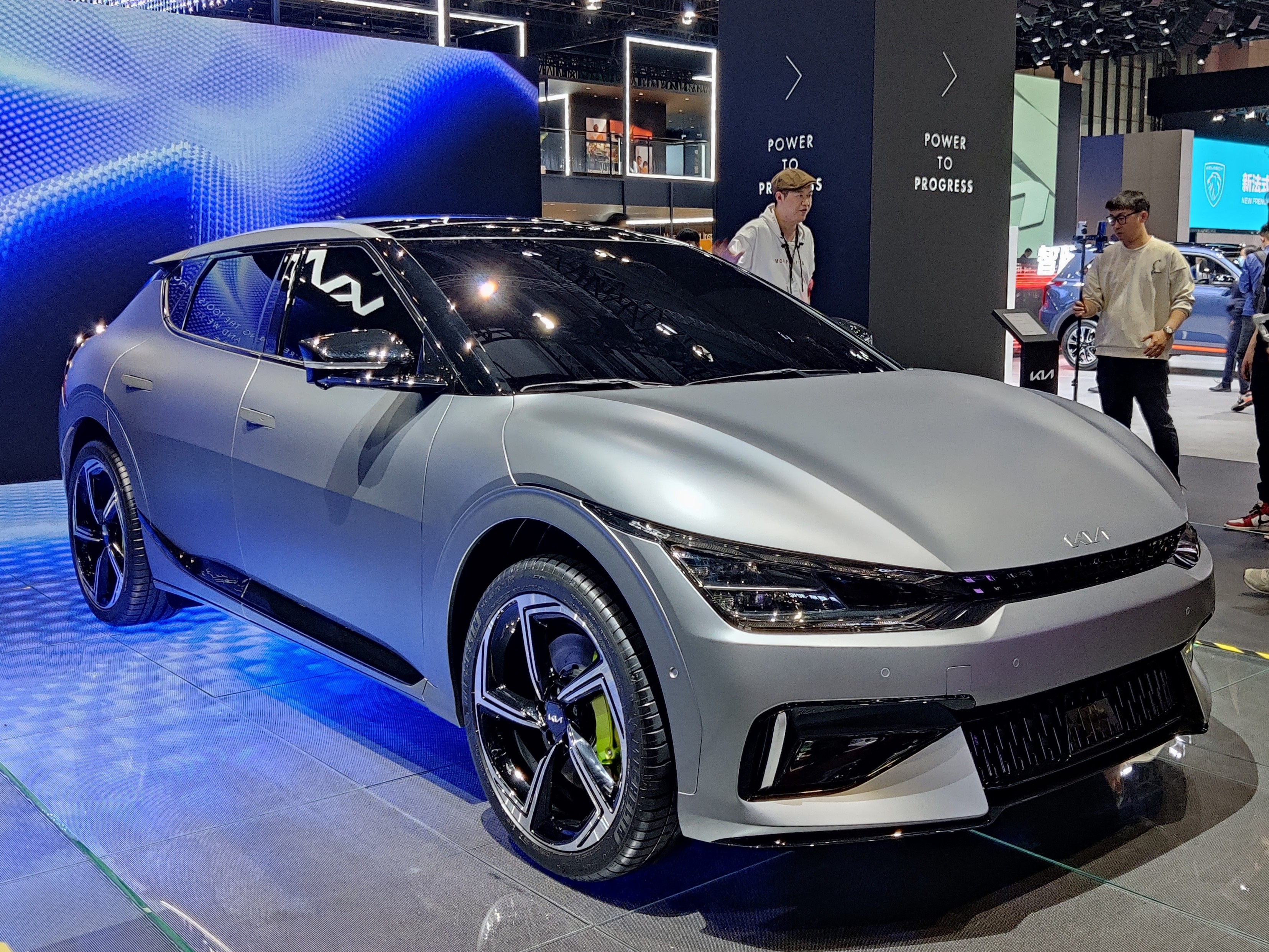
The Kia EV6 is an all-electric car made by Kia. It’s built to drive like a normal crossover, but it runs on electricity instead of gasoline. It’s mentioned because it’s one of the more well-known electric Kia models.
The BYD Dolphin G is a small plug-in hybrid that BYD plans to sell in Europe. It’s expected to pair a small gas engine with a battery pack so you can drive electrically sometimes and still have gas backup.
A plug-in hybrid is a car you can charge at home or at a charger. It uses both electricity and a gas engine, so you can drive on electric for some trips and switch to gas when needed.
The BYD Atto 2 is mentioned because the Dolphin G is expected to use a similar powertrain. They say it combines a small gas engine with a battery pack.
Total range is the overall distance the car claims it can go before you run out of energy. It may include more than just the battery-only driving number.
Single-wheel lift means the car can raise one wheel so it’s not touching the ground. That can make tasks like changing a tire easier because you don’t necessarily need to jack the whole car up.
Ultra suspension is BYD’s advanced suspension setup. In this context, it’s meant to let the car lift a wheel and handle tire-change/recovery situations.
Three-wheel driving mode is when the car tries to keep moving using only three wheels. It’s meant for emergencies, such as after a flat, so you can get to safety or a better spot.
Term
nine tons of lifting force
“Nine tons of lifting force” is how strong the lifting action is. They’re using it to show the system can raise the car/wheel with enough power to do a tire swap.
A fully active hydraulic suspension is a suspension setup that can actively control what each wheel is doing. Instead of just absorbing bumps, it can adjust quickly to help the car stay stable when driving over rough ground or obstacles.
An anti-roll bar is a part that helps keep the car from leaning too much when turning. If a car doesn’t use one, it usually depends on its suspension controls to keep the body level.
The Yangwang U7 is an electric car made by BYD’s higher-end brand. It uses an advanced suspension system that actively controls how the wheels move, which is meant to improve how smooth and stable the car feels. The podcast brings it up because its suspension technology is a major feature.
LIVE
You know what? It sucks to be bored, but when I get on my phone and play real casino games on spinquest.com,
the time flies by. That two-hour wait at the DMV seems like 10 minutes.
Play your favorite spots, live blackjack, live preps, with a live dealer. New players $30 coin packs are on sale for 10 bucks.
Play spinquest.com, and you'll never be bored again.
SpinQuest is a free-to-play social casino. Voidware prohibited. Visit spinquest.com for more details.
Capital One's tech team isn't just talking about multi-agentic AI. They are already deployed one.
It's called Chat Concierge, and it's simplifying car shopping. Using self-reflection and layered reasoning with live API checks,
it doesn't just help buyers find a car they love. It helps schedule a test drive, get pre-approved for financing, and estimate trading value.
Advanced, intuitive, and deployed. That's how they stack. That's technology at Capital One.
You know what? It sucks to be bored.
But when I get on my phone and play real casino games on spinquest.com,
the time flies by. That two-hour wait at the DMV seems like 10 minutes.
Play your favorite spots, live blackjack, live preps, with a live dealer. New players $30 coin packs are on sale for 10 bucks.
Play spinquest.com, and you'll never be bored again.
SpinQuest is a free-to-play social casino. Voidware prohibited. Visit spinquest.com for more details.
Capital One's tech team isn't just talking about multi-agentic AI. They already deployed one.
It's called Chat Concierge, and it's simplifying car shopping. Using self-reflection and layered reasoning with live API checks,
it doesn't just help buyers find a car they love. It helps schedule a test drive, get pre-approved for financing, and estimate trading value.
Advanced, intuitive, and deployed. That's how they stack. That's technology at Capital One.
Welcome back to EV News China. Today, EV prices rise as cheap EVs fade.
Chinese brands cautious in Canada and the Neo Gen 5 swap stations, plus they tuned.
Later in the show, I'll tell you why the latest battle to be noticed comes on three wheels.
Hey, welcome to EV News China. This is the podcast all about the world's largest EV market.
And every day, I try and bring you headlines, insights, analysis from the heart of China's booming EV industry,
and decode how fast moving developments in the east shape the global EV landscape. Let's get into it.
China's passenger car market grew dearer last month in April. The passenger car association
said the average EV transaction price was up 5.1% year on year.
Average EV transaction price now $165,000 RMB. That's $22,500. That's roughly $8,000 RMB or $1,100 more than April last year.
Think about that. That's huge. Average selling price $1,000 more for an EV on an average selling price of $22,500.
The shift, if you're wondering, came at the bottom end of the market.
Ask many people who don't listen to this podcast and they might think that Chinese EVs are small, cheap, urban run-arounds.
And probably five years ago, I was telling you on the main podcast before we launched EV News China,
all about cheap, tiny Chinese cars that were costing $6,000, $7,000, $8,000.
So much has changed. And you know that because you listen to this, but I reckon there's a lot of people out there
who don't know what's actually happening in China right now. Sales in the sub 50,000 RMB bracket.
So that's under $7,000 US dollars fell 44% year on year.
That pulled low cost cars out of the mix and pushed the EV market towards higher priced vehicles.
Within EVs, EREVs are at the top of the price ladder. Their average transaction price is $239,000 RMB.
That's almost $33,000. Pure battery electric cars averaged $20,000.
That's the cheapest powertrain type within China's NEV definition.
So as I always say, driving an EV is just cheaper.
Sure, you can go buy the EREV version, but you'll end up paying a lot more.
And do you really need a massive battery and an engine? Well, maybe some people do.
Honestly, with the battery sizes in EREVs of 50, 60, 70, 80 kilowatt hours in some EREVs,
just get the full bed version unless you absolutely really,
really love queuing up at the petrol pumps. Maybe someone does.
Let's move on. More than 15 major Chinese car makers, BYD, Xiaomi, GAC, VW, Toyota China,
and more have all raised prices across their EV models and trims lately.
The move marks a break from years and years of price war discounting.
BYD lifted the price of their ADAS option, God's IB, by just over a thousand pounds,
almost 10,000 RMB. The option spans their Dynasty Ocean and Fang Ting Bao series.
The new price took effect on the 1st of May. Others have followed.
Chang'en Nevo raised the price of their Intelligent Laser Edition by £330.
GAC ION lifted prices on models, including the ION Y Younger and ION S Plus, between £300 and £600.
Xiaomi applied a flat rise of £440, about $600, across all of their Su7s.
The Su7 launched the new one in March this year.
Volkswagen raising prices of their ID cars between £400 and £700, that's up to about
$1,000 USD because costs are rising and margins are thinning.
Battery grade lithium carbonate has climbed 170% in under a year.
Chip costs have moved the wrong way as well.
The AI boom has pulled chip production towards servers,
which has tightened supply of automotive grade chips.
Prices for those chips have risen by 180% in the last three months.
It's a supply chain nightmare, and there's no room to absorb the hit.
The China Passenger Car Association said the domestic auto industry's profit margin
is 3.2%. Yes, it is still brutal.
Prices are going up in China, but it's still utterly brutal to be successful.
And a lot of stuff is being forged in that heat, which is very good,
and will impact the global EV market.
But you know that and I know that, and we're working this stuff out together,
aren't we here on EV News China?
There's a lot of people, I think even EV fans, that still have no idea what's coming out of China
and what is going to hit the rest of the world.
And it already is in some places over the next 3510 years.
And well, frankly, the challenge that non-Chinese car makers have got.
Let's move on.
Let's talk a little bit about the Canadian plans.
BYD, Cherry and Geely have moved early to get a foothold in Canada.
Now all three are cutting back their expansion plans.
The DSMA, an advisory firm that brokers talks between Chinese brands
and Canadian dealers, says those three groups have shifted to a more conservative approach,
at which they're calling the phase one approach, like maybe one or two dealerships
in every major market, but not coast to coast and not dealerships everywhere.
The reset follows the import quota in Canada introduced in January as part of the new China
trade deal, scrapping the 100% tariff or surtax.
But now a cap on volume of 49,000 vehicles made in China in one year.
That ceiling covers China brands, but other brands, Tesla, Polestar, Volvo,
if they make their vehicles in China.
And the permits go on a first come first serve basis,
and they're doing it in two chunks, the first six months and the second six months.
Some of the Chinese brands are just being a little cautious
over whether they'll actually get a lot of vehicles into the country,
compared to those companies that have already got their ducks in a row, if you like.
Let's move on.
Stellantis and Dongfeng have agreed a $1.18 billion deal to expand production
of Peugeot and Jeep in China.
They have a plant in Wuhan.
The expanded plant will serve the domestic Chinese market.
Stellantis will contribute 130 million euros or 146 million dollars to the investment.
Dongfeng providing most of the capital.
Production will start at the facility in 2027.
The Wuhan plant will build two all new Peugeot EVs from 2027.
The design coming from the inspiration of the Peugeot Concept 6 and Concept 8,
which made their debut at the Beijing Auto Show.
The plant will launch two Jeep branded off-roaders next year as well.
Stellantis and Dongfeng says they could be for global markets.
Now Xiaomi are getting ready for the YU7 GT.
The YU7 is their big seller.
The GT version is going to be launching at the end of May according to the CEO Lei Jun.
The performance SUV will debut in its first exterior color.
That'll be Crimson Red with a bespoke interior theme that has red trim as well.
Xiaomi presents the YU7 GT not as the Ultra, like they have the SU7 Ultra,
but a long distance, high performance SUV, not a track car.
It benchmarked the car against the Tesla Model Y performance
and the Porsche Cayenne Turbo GT.
It carried out development and calibration at the Nürburgring Nordschleife.
Inside, the track red cabin uses black and red color schemes,
red contrast stitching running across the door panels and seat belts.
Colored red add to the aggressive theme.
GT badge in is embroidered into the front seats and the passenger dashboard.
Xiaomi also fits low to carbon fiber Alcantara sport seats and a carbon fiber steering wheel.
Xiaomi says Chinese and European engineers have tuned the chassis,
the firm using the German Nürburgring Nordschleife as its testing ground,
but not to make a track day car.
It does show though where Xiaomi wants to be known for with the GT.
Fast, expensive and highly usable.
What about pricing?
We don't know because the vehicle is out at the end of this month.
They're drip feeding us some photos aren't they to get us all excited.
Pricing probably between maybe 52 and 58,000 pounds.
That's 66 and 73,000 dollars equivalent.
So well above a standard YU7 which came out last June.
Now let's talk battery swapping.
NEO has installed its first fifth gen battery swap station in Kunshan.
The site now sits in debugging mode and internal staff testing mode.
Not an official launch.
A Weibo user reported the sighting in Kunshan.
The post pointed to changes in the exterior shell panels
and suggested a larger swap bay than the fourth gen model.
If so, that is part of the reason for the delay.
They're redesigning these things.
It's the first physical deployment of gen 5 swap stations
and they've been developing it for well over a year.
The timeline slipped from the end of 2025 to Q1.
Now it's Q2.
Now they're looking at mass deployment up to the end of August.
William Lee said a fundamental redesign is what has caused the delay.
NEO needed the new station to handle a lot of vehicles actually.
I want to say a lot of vehicles not a sheer amount
but just the wheel bases, the NEO brands, the gen 5 stations
are going to have to serve all the NEOs, all the envos and now Firefly.
The smallest battery pack is 42.1 kilowatt hours.
NEO also make 150 kilowatt hour pack.
That marks a clear break from the fourth gen system
which has been out a couple of years now.
Gen 4 can hold 23 batteries, a three minute swap time,
but it couldn't do all of the different batteries from all of the sub brands.
Talking of which, we'll finish off before a halfway break with NEO's Firefly sub-brand
rolling out their new operating system called Aster 1.5.0 in China.
They're doing that to get ready for the new battery swapping.
Also a battery swap parking assist function preparing Firefly models for NEO's fifth gen swapping.
The process is simple.
The driver places a swap order for a battery,
you park in your designated bay and you tap the button on screen.
That will start a semi-autonomous assisted parking procedure.
Firefly also offers manual attendance at every station.
That matters because Firefly has so far been outside of NEO's battery swapping network.
The fourth gen stations don't supply,
don't support the smallest of the packs, 42.1 kilowatt hours.
Also this over-the-air updates increases the motor power from 105 to 120 kilowatts in the Firefly.
Let's take a break.
We'll come back to X-Pong and BYD and more.
Stick around.
What's up, baby?
It's Bretzky and I'm here to tell you that SpinQuest.com is giving out free sweet coins.
All you gotta do is purchase a $10 coin pack and guess what?
They're gonna give you the coins from a $30 coin pack.
That lets you play all your favorite games like Blackjack, Want It Dead or Wild,
and we're talking real cash prizes, baby.
SpinQuest.com.
SpinQuest is a free-to-play social casino.
Visit SpinQuest.com for more details.
That's technology at Capital One.
Capital One's tech team isn't just talking about multi-agentic AI.
They are already deployed one.
It's called Chat Concierge and it's simplifying car shopping.
Using self-reflection and layered reasoning with live API checks,
it doesn't just help buyers find a car they love.
It helps schedule a test drive, get pre-approved for financing,
an estimate trading value, advanced, intuitive, and deployed.
That's how they stack.
That's technology at Capital One.
TeslaBjörn or Björn Newland who does 1,000 kilometer challenges in,
it has done for years, hundreds, probably thousands of EVs now.
This one, the X-Pung G6, did its own 1,000 kilometer challenge in the UK
in eight hours, well about eight hours 30, actually eight and a half hours.
It did it on the 7th of May last week at Milbrook Proving Ground.
That included the charging stop time and it used a standard customer
unmodified UK spec G6 long range rear wheel drive.
A team of test drivers from the UTAC completed the run.
The test covered 312 laps of Milbrook.
That's a 3.2 kilometer bowl by the way.
Ambience temperatures this time of year in the UK between eight and 16 degrees Celsius.
Yes, it's not particularly warm.
It's still jumper weather most of the time and we're in May already.
The car has a 66 kilowatt hour battery.
Rear wheel drive variant is a WLTP official 354 miles, 570 kilometer range car.
It did stop to charge more than once but the stops were only 13 minutes and 20 seconds on average.
So that allows a driver swap and then the car got back on the circuit.
That points to the main advantage of the X-Pung's 800 volt architecture rapid charging.
You know what the 18 minutes on the Korean cars, on the Onyx and the EV6s and stuff.
That's quick but an X-Pung G6 12 minute charge which is what it will do in optimum conditions
is pretty much heroic.
X-Pung UK sales director Johnny Miller said that they were showing off the G6's real world usability.
Let's get on to a really interesting car actually and this is the BYD Dolphin G.
Now it's an overseas car as well as a Chinese car I believe.
The Dolphin G is a plug-in hybrid but it's in a very small segment vehicle
and now spy shots from Chinese social media show the car being tested.
The mule carries the Dolphin G badging and more to the point an exhaust pipe.
BYD plans to launch the Dolphin G in June.
The firm describes it as its first model developed for the European market and that
matters because that means overseas is no longer a side project for BYD or something to bolster
their export sales but it's more like a direct answer to the European cars on sale.
So Dolphin G is going to have the powertrain from the Atto 2.
So the Atto 2 DMI is a 1.5 litre engine and an LFP battery pack.
BYD says 90 kilometres of electric range and a thousand kilometres of total range.
The Dolphin G keeps a five-door compact hatchback form a high belt line and semi-recessed mechanical
door handles. The European small car segment has a few I'm going to say not many though.
Affordable plug-in hybrid options and certainly nothing I think at this small form factor
because it's much cheaper for the car makers just to go and make a bland mild hybrid with a
motors maybe maybe dual motors in some forms and a heavy battery as well and so
a lot of them just shy away from that but BYD testing the water Dolphin G
looks interesting 90 kilometres of electric range that's interesting what 50 555 miles
of electric range in a really small urban car that's interesting now finally we'll finish off
today with the latest weapon to get your attention if you're a Chinese premium SUV buyer you expect
more and more all the time to have three rows six or seven seats isn't enough to have the screen that
folds down from the roof for the kids in the back that's not enough to have the fridge slash heated
compartment sometimes two that's not enough to have sometimes seats that in the back and the
passenger they call it the queen seat interesting name but you know but that will go completely
flat absolutely but how can you stand out well more and more companies are trying to do it with
their suspension systems and one of the party tricks is to lift one of the wheels clear of the
ground so you can swap a tire without even using a jack so you can level the body over crazy
undulations and even drive the car on three wheels BYD has pushed the idea the furthest at
an off-road proving ground it debuted the denser b8 flash charge edition with the Dysus or Dysus P
ultra suspension so a single wheel lift so maybe for recovery if you're in some deep mud or need
to recover the vehicle a single wheel lift for tire replacement if you've got a flat why bother
even getting the jack out it'll just lift a wheel and a three-wheel driving mode BYD
entire replacement mode says that it'll ridden move the need for a jack to jack the car up
and that it can do that in under one minute a media demonstration recorded a tire swap in
one minute 56 seconds generating up to nine tons of lifting force BYD also staged a trap
recovery test the suv using suspension height changes to get out of deep sand and cross an
uneven bridge like structure lifting each individual wheel three wheel driving on the denser b8 flash
edition is limited to nine miles an hour but still i mean it's 15 kilometers an hour three
wheels on your wagon and it'll still happily drive BYD targets low speed obstacle crossings the car
also adds about 124 miles or 200 kilometers of cltc pure electric range that car is a $57,000
car by the way who else is doing it while way they they back ito and they've got the same three
wheel driving capability on the new m9 will lift a front wheel and remain stable at low speed ito
says the m9's fully active intelligent chassis adjusts suspension settings based on road conditions
lee orto joining the race with the l9 livus using an 800 volt fully active hydraulic
suspension system to react within milliseconds controlling all four corners independently
not using an anti roll bar the l9 livus offers a single wheel lift facility tire replacement
an off-road recovery lee orto and iso use a fully active hydraulic system BYD's yangwang u7 uses
the electromagnetic desus z system which drives suspension movement without hydraulics in china's
premium suv markets the car now needs to change its own wheel before it can even change a buyer's
mind fascinating stuff that's your podcast for today thanks for listening that's your podcast
for the week as well back on monday morning have a great weekend see you then
at spinquest.com spinquest is a free to play social casino boyd we're prohibited visit spinquest.com
for more details capital ones tech team isn't just talking about multi-agentic ai they are
already deployed one it's called chat concierge and it's simplifying car shopping using self-reflection
and layered reasoning with live api checks it doesn't just help buyers find a car they love
it helps schedule a test drive get pre-approved for financing an estimate trading value advanced
intuitive and deployed that's how they stack that's technology at capital one whether it's slots or
live dealers spinquest.com has the fun in action you're looking for with spinquest exclusives
blackjack roulette bakara and even live dice with crafts and bubble crafts the games never stop
so you don't have to and right now new users get 30 coin packs for just 10 bucks play now at
spinquest.com spinquest is a free to play social casino boyd we're prohibited visit spinquest.com
for more details
About this episode
EV prices in China are climbing as cheaper models lose share, with the market shift pulling low-cost cars out of the mix. Hosts connect the trend to rising battery and chip costs, including “Battery grade lithium carbonate has climbed 170% in under a year.” Canada’s new import quota and permit timing are also making Chinese brands more cautious. NEO’s Gen 5 battery-swap rollout is delayed by a “fundamental redesign,” while Xiaomi readies the YU7 GT with Nürburgring Nordschleife development.