An EREV is a car that runs on electricity but also has a gas engine that can help charge the battery when needed, allowing it to drive further than just on battery power alone.
A kilowatt-hour pack is a way to measure how much energy a battery can hold. The bigger the number, the more energy it can store, which means the car can go further on a single charge.
Dual motors mean the car has two electric motors, which helps it drive better and faster by sending power to both the front and back wheels.
Term
kW
kW stands for kilowatt, which is a way to measure how much power something uses or produces. It's like how we measure speed in miles per hour, but for electricity.
kWh stands for kilowatt-hour, which tells you how much energy a battery can store. It's like saying how much gas a car's tank can hold, but for electric cars.
A plug-in hybrid is a car that can run on both gas and electricity. You can charge it by plugging it in, which helps it drive longer on electric power alone.
Pure battery power means the car runs only on electricity from batteries, not using any gasoline or diesel. These cars are completely electric and don't pollute the air while driving.
Car
LeapMota A10
The LeapMota A10 is a new SUV that will be available in China. It's designed to be compact and is expected to compete with other similar vehicles.
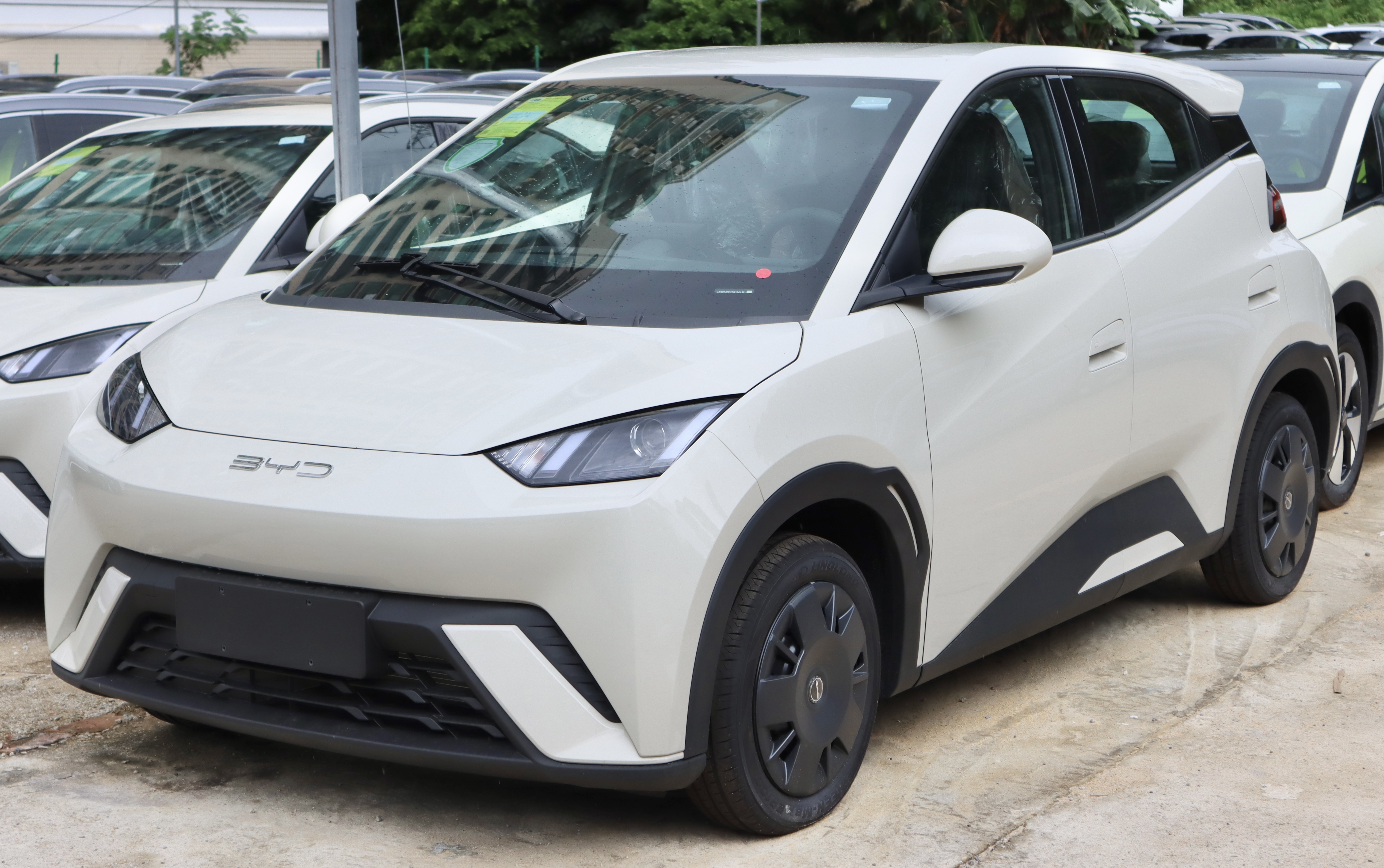
The BYD Seagull is a budget-friendly electric car from a Chinese company called BYD. It's aimed at people looking for an affordable option in the electric vehicle market.
LFP packs are batteries made from a specific type of lithium that is safe and lasts a long time. They're often used in electric cars because they're cheaper and less likely to catch fire.
Pure electric range is how far an electric car can go on just its battery power before needing to be recharged. It's important to know how far you can drive without running out of power.
LiDAR is a technology that helps cars see their surroundings by using lasers to measure distances. It's like a high-tech radar that helps self-driving cars understand where they are and what’s around them.
The Zika 8X is a new type of SUV that can use both electricity and gasoline, making it more efficient. It's part of a series of vehicles from the Zika brand.
A 2.0-litre engine is a type of car engine that has a total volume of 2.0 liters. This measurement helps determine how powerful the engine is and how much fuel it uses.
WLTC is a standard test used to see how much fuel a car uses and how much pollution it produces. It simulates real driving situations to give a better idea of a car's efficiency.
Electric motors are devices that make cars move using electricity instead of gasoline. Some electric cars use more than one motor to go faster and perform better.
The XPeng P7 Plus is a new electric car made by a Chinese company called XPeng. It's designed to be smart and efficient, making it a popular choice for people looking for electric vehicles.
Car
P7 Plus
The NIO P7 Plus is a type of electric car made by a company called NIO. It's designed to be high-tech and perform well, especially compared to other electric cars.
The Tesla Model 3 is a popular electric car that is known for being more affordable than other Tesla models. It has a good driving range and is designed for everyday use.
The Tesla Model Y is a compact SUV that is electric and offers more room than the Model 3. It's designed for families and has similar technology to other Tesla cars.
The BYD Song is a type of SUV made by a Chinese company called BYD. It comes in different versions, some that run on electricity and some that use a mix of electricity and gasoline.
LIVE
Five years ago, I was paying $65 a month for my subscriptions.
Today, those same subscriptions cost $111, and I don't even use half of them anymore.
That's why now, I use RocketMoney to manage my subscriptions for me.
The app gives you a list of all of your subscriptions and reminds you of upcoming payments,
so you're not hit with any surprise charges.
On top of that, it also sends you alerts when subscription prices go up,
so you always know the price you're paying.
If you decide you no longer want a subscription, you can cancel it right from the app.
No customer service needed.
And the best part is, RocketMoney even reaches out
and tries to get you refunded for some of the money you lost.
On average, people that cancel their subscriptions with RocketMoney save $378 a year.
And overall, RocketMoney has saved its members $880 million in canceled subscriptions.
Stop wasting money on things you don't use.
Go to rocketmoney.com slash cancel to get started.
That's rocketmoney.com slash cancel.
Capital One's tech team isn't just talking about multi-agentic AI, they are already deployed one.
It's called Chat Concierge, and it's simplifying car shopping.
Using self-reflection and layered reasoning with live API checks,
it doesn't just help buyers find a car they love, it helps schedule a test drive,
get pre-approved for financing, and estimate trading value.
Advanced, intuitive, and deployed, that's how they stack.
I didn't realize I was wasting $415 a month until I downloaded RocketMoney.
I thought I had my finances under control until the app laid out all my spending and categorized it for me.
Takeout, shopping, and unused subscriptions were quietly draining my account.
And as a result, my savings took a backseat.
But RocketMoney doesn't just tell you what you're wasting money on.
It takes action to save you money.
First, the app looks at your account.
And then, you get to know your account.
First, the app looks at your income and monthly expenses,
and calculates how much you can safely spend each day to stay under budget.
RocketMoney also finds and cancels unwanted subscriptions for you,
and even negotiates better rates on your bills, so you have more money in your pocket.
On average, RocketMoney members can save up to $740 a year
when using all the app's premium features.
Users love the app with over 186,000 five-star ratings.
It's time to simplify your finances and take control of your money.
Go to rocketmoney.com slash cancel to get started.
That's rocketmoney.com slash cancel.
Rocketmoney.com slash cancel.
Capital One's tech team isn't just talking about multi-agentic AI.
They already deployed one.
It's called Chat Concierge, and it's simplifying car shopping.
Using self-reflection and layered reasoning with live API checks,
it doesn't just help buyers find a car they love.
It helps schedule a test drive, get pre-approved for financing,
and estimate trading value.
Advanced, intuitive, and deployed.
That's how they stack.
That's technology at Capital One.
Each day I bring in the latest headlines, insights, and analysis
from the heart of China's booming EV industry
and decode how fast-moving developments in the east
are shaping the global EV landscape.
LeapMota kick us off with the news today.
The new D-19 flagship, Large SUV, due to launch in April,
showed up on the Ministry of Industry and Information Technology's catalogue.
Fair bit of news actually over the weekend,
and also the next couple of days.
I'll be talking about the latest catalogue filings,
this time revealing specifications of a huge EREV battery.
Now the model straddles both sides of China's high-end EV push.
LeapMota will sell the D-19 as a pure-bev battery electric vehicle,
and as an EREV extended-range electric vehicle,
both aimed at the upper-mid market,
with a target price of around $300,000 RMB.
That's $43,000 USD.
The filing lists six or seven seat layouts,
placing the car squarely in China's family and large fleet segment.
On the EREV side, LeapMota is stretching the battery size.
The D-19 EREV uses an 80.
Yeah, 80.3 kilowatt-hour pack.
That's just the battery.
Good for 500km of battery-only range,
paired with a 1.5-litre engine,
obviously a big fuel tank as well.
Never driving the wheels, only ever a range extender in this.
It drives dual motors,
rated at 100kW at the front, 200kW at the rear.
So not the most powerful of EVs.
We've seen big vehicles like this three-row,
large SUVs that are much more powerful.
That's not really what this is going for.
This thing is going for a huge pack.
In fact, what LeapMota claims is the largest battery pack yet,
fitted to an EREV in China.
The Bev battery electric vehicle variant
tilts further towards performance though.
It also runs dual motors,
180kW at the front and 230kW at the rear.
So much more powerful, 115kWh battery pack.
This one supplied by CATL.
I couldn't find out who supplied the pack
for the plug-in hybrid.
I will on tomorrow's podcast.
I'll get you that information.
So basically 720km of range,
CATL is listed as the sole battery supplier
for the Bev versions.
LeapMota has yet to confirm final pricing
or detailed trims,
but the filing makes one thing clear.
When the D19 reaches showrooms in April,
Chinese buyers will have a choice between pure battery power,
which I think will be plenty good enough,
bit more performance and loads of range,
or an 80kWh range extender.
When will you ever go to the fuel station
and put petrol in this thing?
Especially considering that long-distance,
high-speed public transport in China
is way better than many other places.
Are you really needing a car to do 2-3,000km journeys regularly?
Well, you've got the option.
Staying with LeapMota,
they will launch a new compact SUV,
the A10.
So this will take on things like
Zhili's Geometry, the Xingwan,
BYD's Seagull, we'll talk about that
in a little more on the podcast soon,
in the low-cost market.
So LeapMota's A10 is now open for blind pre-orders,
mass deliveries, I think sometime in the first half of the year.
A10 is the first model in LeapMota's new A-Series,
sitting alongside the A, B, C and D-Series,
plus there's the Laffer 5.
It targets the $100,000 yuan and below segment,
so that's $14,000 US dollars.
Car news China reckons the starting price
could be $10,000 US equivalent.
Adding pressure on both the state-backed groups
and the private rivals,
LeapMota claims 500 kilometers pure electric range,
LFP pack, 16 minutes, 30 to 80,
so I don't love 30 to 80 yet,
or the car makers just give us the 10 to 80 number.
So if you're new to the podcast,
I say that 10% to 80%.
So I think a lot of people who typically drive an EV,
especially if it's on a longer journey
and you're doing a mid-journey refresh,
they're a recharge, it would be down to about 10%.
My wife doesn't like going below 10%
in case charges are out of order and stuff.
She's not really charged by the seat of a pants kind of gal,
and many people are the same.
So 10 to 80 is a great metric.
They've given us 30 to 80,
which is a fudge, but it's 16 minutes.
And so that's brisk.
Single electric motor on this little LeapMota A10,
90 kilowatts, that's plenty powerful for a small car.
Plenty, by the way.
Driver assistance is the selling point though,
because in China, you get roof-mounted LiDAR,
which is not unheard of, but rare at this price level.
And for anyone listening to the podcast thinking LiDAR
was the preserve of very expensive luxury vehicles,
well, then yes, it may be in the West and it used to be.
But there's different kind of versions,
different qualities, different amounts of information
that LiDARs can detect, but still very good LiDARs.
Now on very cheap Chinese cars,
and so many people don't realize this.
And so lots of advanced driving on a 10 grand car.
Semi-hidden door handles on the side profile,
make it look a little more upmarket.
The LeapMota meets the price and delivery targets.
It will really deepen the fight
at the bottom end of the market.
A long-claimed range, fast charging, LiDAR, 10K price tag,
what's almost not to love about this thing.
Now, let's talk Zika.
We'll launch its second plug-in hybrid SUV,
the 8X in China soon.
The new model goes between the 7X and the 9X,
as plug-in hybrids already on sale in China.
It may also give Zika a way into overseas markets
like Australia, where the brand has hinted
it could add plug-in hybrids.
Filings in China give a clearer view to Zika's plan.
Images lodged with the authorities
and published by Karnoos China over the weekend
show that the 8X comes in five or six seat forms.
The filings list a 2.0-litre engine.
It's got 205 kilowatts of power
and a 70 kilowatt-hour NMC pack.
That's not RFP packs.
Big performance, really big battery pack.
That's from CATL and Gili's joint venture.
On the WLTC side, they say 256 kilometers electric
only on the smaller pack, which is, I think, 55.
But that big one I mentioned, 328 kilometers.
Zika's already flagged how quickly the pack can charge.
So this in the 9X, the bigger car,
it'll do 20 to 80 in nine minutes,
10 to 18, 10.3 minutes.
The 8X has the same platform.
So 900 volts, the SEAS platform.
Zika, therefore owned by Gili of Volvo Polestar fame,
are knocking this one out of the park.
Motor details for the 8X were unconfirmed.
But Karnoos China reports the flagship version
will use three electric motors
for over 1,000 kilowatts of power,
three seconds, not to 62 miles an hour.
Loads of AI goodness in this and driver assistance too.
That is incredible fast charging time on a plug-in hybrid.
Now, XPung have started to deliver
their new global vehicle, the P7 Plus.
Also, congratulations, the 100,000th P7 Plus
rolled off the production line last Friday, two days ago.
Just 14 months after the model launched,
the same day, chairman and chief exec,
Hu Xiaoping, handed the first units
of the new P7 Plus over
at the firm's Guangzhou factory.
The milestone shows how fast China's
mid-market EV segment is scaling,
and how intent XPung is on keeping its main sedan fresh
without raising prices.
The 2026 P7 Plus keeps the old starting tag
of 186,800 yuan, that is 26,700 US dollars equivalent,
and adds an extended range version
as well to broaden the appeal.
Quick history lesson,
the car was originally launched in China
on November 7th 2024 as a pure Bev,
then they widened it.
It now comes in two Bev versions,
the 615 and the 725 Max version.
The new P7 Plus, EREV range mirrors the pricing,
starting 186,800 RMB.
XPung plans to launch this new car
in 36 countries and regions,
while the company already operates in 60 of them,
holding the entry price level,
while adding EREV options
and pushing exports signals a bid to gain more share,
both in China and overseas as well.
If they can keep demand up for the P7 Plus
at the same pace that they got to 100,000 units
in 14 months,
this will remain a pillar of their lineup.
The firm now has to show that a broader
powertrain mix and a big overseas ambition
can work in price sensitive car markets.
Now, Tesla is stretching its loan deals in China.
Tesla has stretched car finance in China
out of seven years.
On January the 6th, it rolled out
ultra low interest plans for the Model 3,
Model Y and Model YL, a sales slide.
The offer cuts the cost of entry
without cutting the list price
for the Model 3 and the Model Y.
The down payment starts from 80,000 yuan
and monthly payments of 2,000 yuan.
For the Model YL, the down payment's 100,000 yuan
and monthly 3,000 yuan.
Buyers who order before the end of January
can opt for a five-year interest-free plan.
That's not free money to Tesla,
very much a cost to their business,
but that's what they need to do
to try and shore up falling sales in 2025.
They sold 1.636 million vehicles worldwide,
nothing to be sniffed at,
but it is down almost 9% year on year.
The Chinese market was once its growth engine,
now it's dragging Tesla down.
In the first 11 months of last year,
it registered sales of Teslas in China of 532,000,
down over 7% from the first 11 months of 2024.
They launched the Model YL to refresh the lineup,
gave it a good start actually.
Deliveries began in September,
Tesla handed over nearly 28,000 of them
before the end of the year,
an average of more than 9,000 a month,
yet they still lean on its old mainstays
in the first 11 months of last year.
Model Y was the big one, 359,000 vehicles,
and Model 3 172,000.
Easy credit may keep the volume from slipping further,
though in a Chinese EV market awash with new models,
I talk about it every day here,
it's non-stop the amount of new cars
that we talk about on this podcast.
There's so little time on EV News China
to talk about sometimes the other issues,
the wider issues, the more interesting points,
because every day the podcast is just
new car launch, new car launch, new car launch,
we can't ignore those, and that's what Tesla's playing with.
And so they're doing what they can to not fall further back.
We'll take a break, we'll come back,
some BYD news to talk about,
and also why China's priorities
may be shifting overseas.
Stick around back in a moment.
Let's do the 60 Second Savings Challenge.
Step one, download Rocket Money.
Step two, link your accounts
and see every subscription you're paying for.
Tap one you don't use and cancel it.
That's money back every month.
Step three, create a financial goal.
$50 every paycheck
or let the app automatically move small amounts of cash
when you can afford it.
In a week, you'll forget you set it up.
In a month, you'll see real dollars piling up.
In a year, you'll be shocked at how much money you've saved.
Bonus challenge, upload an internet or phone bill
and let Rocket Money try to lower it.
You only pay if they find you savings.
On average, Rocket Money members can save up to $740 a year
when using all the app's premium features.
Users love the app with over 186,000 five-star ratings.
Make saving money the resolution you actually keep.
Start the 60 Second Savings Challenge
at rocketmoney.com slash cancel.
That's rocketmoney.com slash cancel.
Rocketmoney.com slash cancel.
If you're an HVAC technician and a call comes in,
Granger knows that you need a partner
that helps you find the right product, fast and hassle-free.
And you know that when the first problem of the day
is a clanking blower motor, there's no need to break a sweat.
With Granger's easy-to-use website and product details,
you're confident you'll soon have everything humming right along.
Call 1-800-GRANGER, click Granger.com or just stop by.
Granger, for the ones who get it done.
The number one resolution for people last year
was to save more money, but nearly half gave up by February.
Don't let that be you.
Download Rocketmoney to reach your financial goals this year.
Track your spending, cut waste,
and automate savings in one simple app.
Rocketmoney shows you all your expenses and categorizes them,
so you know exactly where your money is going
and where you're overspending.
From there, the app cuts waste by cancelling
your unused subscriptions and lowering your bills.
No customer service needed.
With that money freed up,
the app will automatically set some cash aside for your goals.
Whether it's an emergency fund, paying off debt,
or saving for vacation, Rocketmoney's got you covered.
Users love the app with over 186,000 five-star ratings.
And on average, users can save up to $740 a year
when using all the app's premium features.
Make saving money a priority this year.
Go to rocketmoney.com slash cancel to get started.
That's rocketmoney.com slash cancel.
Rocketmoney.com slash cancel.
If you're the purchasing manager at a manufacturing plant,
you know having a trusted partner makes all the difference.
That's why hands down, you count on Granger for auto-reordering.
With on-time restocks,
your team will have the cut-resistant gloves
they need at the start of their shift.
And you can end your day knowing they've got safety well in hand.
Call 1-800-GRANGER.
Click Granger.com or just stop by.
Granger for the ones who get it done.
Welcome back to EV news, China.
If you like this program or this podcast,
you know somebody who might be interested in it,
staying on top of what's happening in the east,
then please just share it with them
and recommend EV news daily.
Subscribe in your podcast apps
or wherever you listen to audio podcasts.
Hit subscribe.
It'll be there next time you pick up your phone
every couple of days or whatever.
Or every day, we try and put this out about 2 a.m. UK time
because by then we're well into the day
in some parts of the time zones ahead of me.
Now, three BYD stories.
BYD will add two new models to its dynasty range
in the first half of this year, pushing up market.
It previewed its D-segment nine series versions
of the Han sedan and Tang SUV on Saturday over the weekend
and asked users to help name them.
The new cars sit at the top of their respective lines.
In China, the nine series usually marks a brand's
high-end models with the number nine seen as supreme.
BYD has floated great Han.
And Han nine as names for the sedan.
And the great Tang and Tang nine for the SUV.
But that's not official.
The Tang nine series, the SUVs, will be in production,
the production version of the Dynasty D full-size concept
shown in April last year at the Shanghai Auto Show.
Pricing, look, I said this is premium, $400,000 RMB.
That is $57,000 US dollars equivalent.
There is the Tang L, DM and DMI, the hybrid,
the all-electric versions Tang L.
These are the ones that charge ridiculously quickly.
The Han series plays the same flagship role on the sedan side
as the Dynasty lineup that currently offers the Han L, DM,
and the Han DMI hybrid.
And the pure electric versions equivalence as well, if you like.
Okay, BYD is pushing its cheaper models,
more at market as well, adding a new all-electric SUV,
the Song Ultra to its Song series.
The new model uses a single electric motor, 270 kilowatts,
top speed of 210 kph and BYD's blade battery.
The move lifts the performance ceiling of
one of China's most important mid-market SUVs.
In the current Song range, no single motor variant
comes anywhere near to 270 kilowatts of power.
The Song L, DMI, the hybrid, is 160 kilowatts.
The Song Pro, DMI is 120.
Even the Song LEV, the pure electric flagship,
is 230 kilowatts of power.
The Song Ultra creates a new performance rung
above the existing models.
In a Chinese market where volume brands sell on spec sheets
and incremental gains and new models,
270 kilowatts single motor SUV.
Let's BYD really stretch its legs
in moving the Song badge upwards, without being a halo car.
It gives the firm a clearer answer
to high-powered domestic rivals in the family EV segment,
and it reuses some familiar components.
And BYD is putting BYD on its cheapest vehicles as well.
As I mentioned with Leap Motor, BYD putting BYD
on its cheapest car.
The MIIT, the Ministry Information,
has got an update on the Seagull, the budget compact EV,
with roof-mounted BYD, exterior otherwise unchanged.
Several years ago, BYD was on high-end models in China.
Now the sensor is turning into standard kit.
I can't get over it.
It's a rival on the Seagull.
BYD's most affordable model, most value-driven model,
marks a further step down the price ladder.
The system targets advanced driver assistance,
of course, and obstacle detection.
Seeing what the human eye can't see or cameras can't see.
The revised Seagull has a single motor.
Peak power goes from 55 to 60 kilowatts.
Top speed, 130 kph.
Roof LiDAR also comes along with no other major design changes.
So very much keeping the success story going.
Why change a winning formula?
Because it notched 45,000 sales last month in December alone,
according to CNEV Post data.
Cumulative sales, 530,000 of them sold last year alone.
So you add LiDAR at scale,
and that spreads enhanced driver assistance
from what was a premium segment thing only a couple of years ago
to every segment of the EV market now.
If rivals match BYD's move, LiDAR soon becomes just commoditized.
That's just the routine.
So in China, you would expect having all the best
ADAS systems at every price point.
The West has a lot of catching up to do.
And finally, China's EV price war won't be replicated overseas.
China's car makers have stopped trying to bludgeon its rivals
with discounts alone.
And the battle is becoming more nuanced now.
The battle has moved from sticker prices to software,
range, design, what I call the bladder-busting big numbers.
The 1600, 800, 2000 kilometers of range
when you combine the petrol tank and the big battery
and some of these EREVs.
Price wars will still flare up,
but they no longer anchor so many of the strategies,
according to an auto analyst at Nomura who's called Joel Ying.
State subsidies are shrinking and regulators demand more rigor
on quality, safety and sustainability.
Selling at any cost is now harder.
Makers now lean on performance, styling, technology
to differentiate and tempt buyers.
Beijing has tightened supervision and pushed the industry
away from ruinous undercutting and frankly selling cars at below cost
just to build scale, new rules on payment terms
and pricing compliance aimed to cool the excesses somewhat.
Yet they also raise the strain.
Car makers have got to absorb higher costs
by investing in new models, new batteries, new software.
I've been talking about LiDAR.
That's a key part of it, isn't it?
And the competition, if you thought I was playing it down,
it's not easing in China or when these brands go overseas either.
It's just changing shape.
It will become more selective as firms chase market share
but tiptoe that profitability line without raising the concerns of Beijing.
Both Chinese and foreign brands have got to find sharp ways now
to stand out without just that really low headline price.
And internationally, players are speeding up localization.
German and Chinese brands in particular have spent a last couple of years
really investing in VW Duet and Mercedes Duet
with their joint venture partners in China on research and development,
investment, tapping local supply chain, striking deals
with homegrown, autonomous and intelligent driving firms as well.
The center of gravity in car technology, there's no doubt
in innovation and technology, the world is tilting east
and it's shifting towards China.
The next round of this contest, though, won't be settled in showrooms
doing a deal with a salesperson.
Increasingly, it'll be settled in labs and in software code to stand out.
And that's your podcast for today.
Thanks for listening to EV News China.
Catch you on the next one.
I didn't realize I was wasting $415 a month until I downloaded Rocket Money.
I thought I had my finances under control until the app laid out all my spending
and categorized it for me.
Takeout, shopping and unused subscriptions were quietly draining my account.
And as a result, my savings took a backseat.
But Rocket Money doesn't just tell you what you're wasting money on.
It takes action to save you money.
First, the app looks at your income and monthly expenses
and calculates how much you can safely spend each day to stay under budget.
Rocket Money also finds and cancels unwanted subscriptions for you
and even negotiates better rates on your bills.
So you have more money in your pocket.
On average, Rocket Money members can save up to $740 a year
when using all the app's premium features.
Users love the app with over 186,000 five-star ratings.
It's time to simplify your finances and take control of your money.
Go to rocketmoney.com slash cancel to get started.
That's rocketmoney.com slash cancel.
Rocketmoney.com slash cancel.
If you're an HVAC technician and a call comes in,
Granger knows that you need a partner that helps you find the right product,
fast and hassle-free.
And you know that when the first problem of the day is a clanking blower motor,
there's no need to break a sweat.
With Granger's easy-to-use website and product details,
you're confident you'll soon have everything humming right along.
Call 1-800-GRANGER, click Granger.com or just stop by.
Granger, for the ones who get it done.
If you're the purchasing manager at a manufacturing plant,
you know having a trusted partner makes all the difference.
That's why hands down, you count on Granger for auto-reordering.
With on-time restocks, your team will have the cut-resistant gloves
they need at the start of their shift.
And you can end your day knowing they've got safety well in hand.
Call 1-800-GRANGER, click Granger.com or just stop by.
Granger, for the ones who get it done.
If you're an HVAC technician and a call comes in,
Granger knows that you need a partner that helps you find the right product,
fast and hassle-free.
And you know that when the first problem of the day is a clanking blower motor,
there's no need to break a sweat.
With Granger's easy-to-use website and product details,
you're confident you'll soon have everything humming right along.
Call 1-800-GRANGER, click Granger.com
or just stop by.
Granger, for the ones who get it done.
Capital One's tech team isn't just talking about multi-agentic AI.
They already deployed one.
It's called Chat Concierge and it's simplifying car shopping.
Using self-reflection and layered reasoning with live API checks,
it doesn't just help buyers find a car they love.
It helps schedule a test drive, get pre-approved for financing,
and estimate trading value.
Advanced, intuitive and deployed.
That's how they stack.
That's technology at Capital One.
About this episode
Leapmotor's new D-19 EREV is making waves with its impressive 80.3 kWh battery, offering 500 km of electric range and dual motor options. Zeekr's 8X PHEV is set to launch, boasting a powerful 2.0-liter engine and a 70 kWh battery, while XPeng celebrates the 100,000th P7 Plus delivery, emphasizing its competitive pricing and extended range options. The episode dives into the evolving landscape of China's EV market, highlighting new models and the shift from aggressive price wars to a focus on technology and performance.