CHINA: VW’s China EV Slump, Xpeng GX Interior and Ford’s Farley Warns On China | 14 Apr 2026
EV News Daily - Technology and Business of EVs
CHINA: VW’s China EV Slump, Xpeng GX Interior and Ford’s Farley Warns On China | 14 Apr 2026EV News Daily - Technology and Business of EVs · Apr 14, 2026
Pre-approval is when a bank or lender checks your credit and tells you how much money it’s willing to lend you. It can make buying the car faster because you’re not starting from scratch at the dealership.
The Xpeng GX is an electric vehicle model from Xpeng. The podcast mentions it mainly because of its interior—what the cabin looks and feels like. It’s part of the news because EV makers are competing on more than just battery range.
A product refresh cycle is how often a car company updates its cars with improvements. The point here is that Chinese brands are updating more quickly than some joint-venture competitors.
Self-learning navigation means the car’s navigation can get better over time. Instead of always doing the same thing, it tries to learn what routes or choices work best for you.
A plug-in hybrid can run on electricity like an EV, but it also has a gasoline engine for extra range. You can charge it at home or on public chargers.
Zero-gravity seats are meant to feel extra comfortable by supporting your body in a relaxed position. In this SUV, they’re used to make the second row feel like a lounge.
Term
0.16 seconds
They’re claiming the rear windows can change tint extremely quickly—about a blink of an eye. That matters because you’d want the privacy effect to happen right when you need it.
Ford is a major American car company. Here, Ford’s CEO is speaking about concerns over Chinese EV competition in the U.S.
Concept
tariffs on Chinese EVs were 100%
A 100% tariff means the import tax could effectively double the price of Chinese EVs at the border. In practice, that can make Chinese EVs much less competitive in the US market, reducing sales until trade terms change.
The Beijing Auto Show is a major international auto event where manufacturers debut new models and technologies. In this segment, it’s the venue for Fang Cheng Bao’s first sedan/saloon reveal, making it a key milestone for the brand’s expansion.
LiDAR (Light Detection and Ranging) uses laser pulses to map the environment in 3D. When roof-mounted, it can improve the accuracy and reliability of advanced driver-assistance systems, especially in complex driving scenarios.
“Smart driving assistance” refers to driver-assistance systems that can actively help with tasks like lane keeping, adaptive cruise control, and collision avoidance. The presence of LiDAR and multiple cameras suggests the car is targeting higher-capability automation than basic safety features.
These are side mirrors that do more than just reflect what’s beside you. They can include extra features, and here they’re offered as an upgrade option.
TPMS is the system that watches your tire pressure. If you get an upgrade, it usually means the car gets better sensors or software so it can warn you when a tire is low.
Watt-hours per kilogram is a way to measure how much energy the battery can store compared to how heavy it is. Higher numbers mean more energy for the same weight.
C-rate is a simple “speed rating” for charging a battery. If a battery is rated at 1C, it would charge in about an hour. If it’s 2C or 3C, it’s aiming to charge in about half or a third of that time.
An A-sample is an early “test version” made to prove the idea and the manufacturing process. It doesn’t mean the battery is fully ready to be installed in cars at scale. Think of it like a prototype that still needs more testing.
Cycle life means how long the battery lasts—how many times you can charge and use it before it starts to degrade. Faster charging can make batteries wear out sooner, so companies test cycle life under those harsh conditions. Longer cycle life is what keeps an EV battery healthy for years.
Cost parity means the new battery type becomes about as cheap as the batteries people already use. If it’s too expensive, automakers won’t adopt it widely. The segment is saying solid-state needs to catch up on price to compete.
10-80% is another EV charging-speed benchmark that measures time from 10% to 80%. Using a wider starting range can better reflect real-world charging behavior because many drivers plug in when the battery is relatively low.
Towing means pulling a trailer. Trucks are built to do it safely, and the amount they can tow depends on the truck’s design.
LIVE
What's up, baby? It's Bretzky, and I'm here to tell you that spinquest.com is giving out free sweet coins.
All you gotta do is purchase a $10 coin pack, and guess what?
They're gonna give you the coins from a $30 coin pack.
That lets you play all your favorite games like Blackjack, Want It Dead or Wild, and we're talking real cash prizes, baby.
SpinQuest.com!
SpinQuest is a free-to-play social casino.
Boydware prohibited. Visit spinquest.com for more details.
Capital One's tech team isn't just talking about multi-agentic AI.
They already deployed one.
It's called Chat Concierge, and it's simplifying car shopping.
Using self-reflection and layered reasoning with live API checks, it doesn't just help buyers find a car they love.
It helps schedule a test drive, get pre-approved for financing, and estimate trading value.
Advanced, intuitive, and deployed.
That's how they stack.
That's technology at Capital One.
You know what? It sucks to be bored.
But when I get on my phone and play real casino games on spinquest.com, the time flies by.
That two-hour wait at the DMV seems like 10 minutes.
Play your favorite spots, live Blackjack, live Preps, with a live dealer.
New players $30 coin packs are on sale for $10.
Play spinquest.com, and you'll never be bored again.
SpinQuest is a free-to-play social casino.
Boydware prohibited. Visit spinquest.com for more details.
Capital One's tech team isn't just talking about multi-agentic AI.
They are already deployed one.
It's called Chat Concierge, and it's simplifying car shopping.
Using self-reflection and layered reasoning with live API checks, it doesn't just help buyers find a car they love.
It helps schedule a test drive, get pre-approved for financing, and estimate trading value.
Advanced, intuitive, and deployed.
That's how they stack.
That's technology at Capital One.
Welcome back to EV News, China.
Today, VW's China EV slump, X-Pung's GX interior, and Ford's Farley warns on China.
Plus, stay tuned.
Later in the show, I'll tell you how retail giant JD.com is testing whether car buying can shift further from the showroom into the app.
Welcome to EV News, China, the podcast all about the world's biggest EV market every day.
I bring you headlines, insights, and analysis from the heart of China's booming EV industry,
and decode how fast moving developments in the East shape the global landscape.
We'll start with Volkswagen Group.
I mentioned on the main podcast yesterday, they delivered 2.05 million vehicles globally in the first quarter of the year.
Now, that was down 4% year on year.
China did most of the damage.
The group's deliveries in China fell 14.8% to 548,700 units.
Its electric car deliveries in China fell harder, down 64% to 9,400 units.
That result points to a clear competitiveness gap in the world's biggest EV market.
The problem goes beyond hardware.
Domestic brands in China just keep moving faster than joint venture players on product refresh cycles.
And intelligent features, the likes of NEO and XPANG, embed advanced large model, AI voice assistance,
self-learning navigation, and continuous updates to their vehicles.
Those features create a living digital environment.
Volkswagen must compete in what is now the software-defined vehicle market, not just localizing hardware.
The group's answer is in China for China.
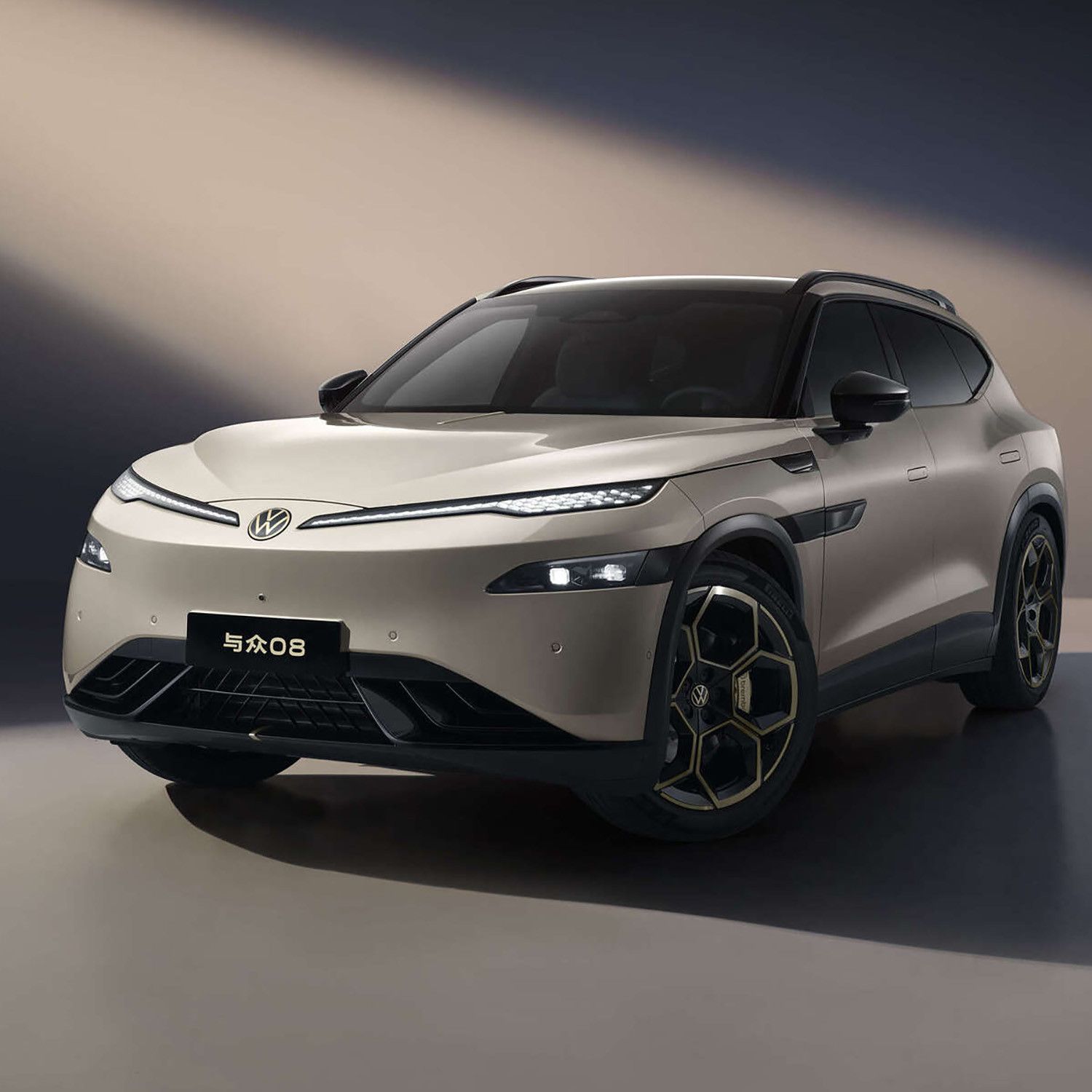
At a brand night on the 8th of April, Volkswagen unveiled the UNIX 08, the SAIC Volkswagen ID, the ERA 9X,
that's an EREV SUV, and the ID Aura T6.
The UNIX 08 matters the most probably.
Volkswagen co-developed it with XPANG under their new partnership, entering mass production.
The tie-up aims to give VW access to Chinese software and EV architecture.
Marks a strategic shift as the group tries to close its gaps.
Well, Volkswagen plans to launch 13 EVs in China this year.
That's BEV, plug-in hybrid, and EREV by 2029.
Its EV portfolio in China will be over 30 models, they say.
Talking of XPANG, let's move on.
XPANG has revealed interior images of the flagship GX overnight.
The launch will be tomorrow, on April 15th.
The new model targets the upper end of the China large SUV market.
Thinkneo ES9, Zika 9X, Ito M9, and Lyoto's L9.
The GX was shown off in 2 plus 2 plus 2.
Up front, the dashboard has a large, ultra-narrow, bezel-central scream,
dedicated instrument cluster, and augmented reality head-up display.
The center console packs wireless phone charging for two phones,
twin-cup holders, big storage compartment for umbrellas, and even backpacks.
XPANG's put most of the comfort pitch in row two, those zero-gravity seats,
with extra-long sliding rails and electric leg rests.
An overhead entertainment screen looks pretty big, couldn't find the size of that.
Folds down for secondary people to watch telly.
The third row looks less like an afterthought than some others.
The seats have independent head rests and fold completely flat.
One of the promo image they put out had the seats completely flat,
and a Chinese gentleman looking like he's about to go for a hike
with his hiking boots and his off-road, his kind of walking hat,
pitching it as a lifestyle kind of vehicle, that kind of thing.
Of the more eye-catching claims, it was the glass, actually.
The GX uses what XPANG have claimed is the world's first AI privacy glass,
because everything's AI.
Even the glass in your car is AI.
It covers... I joked that there's probably a first AI toilet,
but that probably actually exists somewhere, because everything's AI.
It's the current buzzword.
They say that the second and third rows can switch their rear window tinting
in 0.16 seconds to be tinted privacy glass.
How it's AI, I don't know, but it is.
The pure electric GX is an 800-volt vehicle, 5C charging,
0-100 kph in 4 seconds, so a big, fast barge, full of luxury.
Starting at 400,000 RMB, that is 42,000 pounds, 58,000 US dollars.
Chinese media, and the kind of forums and stuff where I'm learning about Chinese EVs,
have kind of nicknamed this the Range Rover of the Greater Bay Area.
While Chinese reports put the starting price a third of a Range Rover sticker price in China.
Yep, it does look shockingly similar to a Range Rover.
We'll see how it sells revealed tomorrow.
Moving on, Ford's CEO Jim Farley has warned against letting Chinese carmakers into the United States,
saying they'd hollow out the manufacturing and devastating jobs for the domestic market.
Farley made the remarks on Fox and Friends, a TV show on the network Fox.
He said China's auto industry has enough capacity to supply the entirety of the US.
He says manufacturing is the heart and soul of the country,
and said handing it to the Chinese would damage the United States.
He also tied the case to national security, saying modern EVs carry sensors and cameras that harvest data,
raising questions about the risks of Chinese EVs in the United States.
China accounts for 35.6% of global car supply, but 62% of global EV supply.
That leaves China carmakers with a scale that no others can match.
Washington's already moved to keep them out though.
During the Biden administration, tariffs on Chinese EVs were 100%,
went even higher amongst trade tensions.
Those tariffs effectively shut out Chinese cars for now.
BYD's Fang Cheng Bao sub-brand is going to debut its first sedan or saloon car at the Beijing Auto Show.
That runs 24th of April to 3rd of May.
And that matters because Fang Cheng Bao so far has focused on SUVs and off-road looking vehicles.
The new car would push the brand beyond its adventurey off-road SUV routes into a different part of the market.
The sedan is expected to sit in a new series, possibly called the May series.
The debut model could carry the May 7 badge.
Numbers in Chinese cars tend to indicate the kind of segment they sit in most of the time.
Fang Cheng Bao hasn't confirmed any of this by the way.
Spy shots shared on Chinese social media show the low-slung, fast-back Coupe silhouette.
The shape points to a high-performance electric sedan.
The car shown in the images carries roof-mounted LiDAR and multiple body cameras.
The hardware suggests smart driving assistance is a key feature.
Now, Chinese media reports indicate the car would use a tri-motor powertrain.
That indicates the kind of vehicle this would be.
Output of a thousand horsepower, possibly.
The reported setup would pair BYD's Dysus or Dysus M Intelligent Magneto Reological Body Control System.
BYD says the Dysus M dampers are just in under 10 milliseconds.
The sedan will use BYD's second-gen blade battery and flash charging,
described as delivering petrol-pump-rivaling charge speeds.
BYD already has all of this in other vehicles like their Denzer Z9 GT.
So, the whole tri-motor thousand horsepower thing is covered off elsewhere within BYD.
So, very believable if it's true.
Let's move on and go to Neo and their sub-brand Firefly,
launching a hardware upgrade program for existing owners,
only to rewrite it within hours after a backlash.
The program offers two upgrades.
One, a direct TPMS tire pressure monitoring system upgrade.
Firefly set a price of 1200 RMB, that's £129, $166.
The other adds multi-functional side mirrors, that is $3,500 RMB, £370, $477.
Owners attacked the prices on social media.
They said the upgrades were far more than expected.
They said limits on point redemption were too tight.
Let me explain.
Firefly's president responded six hours after the policy went live,
issuing a video statement and scrapping the limited-time points model.
Firefly replaced it with a full points payment option.
We'll get onto Neo points and Firefly points in a moment,
but an option to pay entirely in points.
Under the new policy, revised after such six hours,
owners can now cover the full cost of the upgrades with their points.
The side mirror upgrade actually needs disassembly of the wiring harness,
the instrument panel, the door trim.
That takes five and a half hours in a workshop.
The TPMS upgrade for tire pressure monitoring takes two hours.
Neo and its sub-brands have long used loyalty point systems to reward early adopters.
Analysts in China's EV forums have already debated where the Firefly's retreat.
Effectively, revalues the points economy.
Similar upgrade systems are rolling out with Neo and Envo and the Alps brands this year.
So, one to watch.
Alright, let's talk about solid state cells.
Greater Bay technology backed by GAC has rolled out its A-sample all solid state battery cells
that marks a step in its push to commercialize next-gen battery technology
and backs its composite electrolyte route as a path from lab to scale.
The company's chosen a different route from rivals chasing sometimes semi-solid or quasi-solid transitional designs.
They can call them solid state batteries when they use a gel inside as the electrolyte.
Its cells contain no liquid electrolytes.
In testing, they say they passed any nail penetration test, crushing, damage, thermal shock.
There's no fire, there's no explosion, there's nothing to ignite.
Greater Bay says the design removes the risk of thermal runaway.
The claimed energy density is impressive.
In the lab, they have it between 260 and 500 watt-hours per kilogram.
In that window, that's above many of the mainstream liquid electrolyte batteries.
It's most advanced on the market now.
The cells also fast charge between 2C and 3C.
Now, obviously we're talking BYD, flash charging, huge C-rates, 12C charging in China in some cases.
2C and 3C may seem slow.
C-rate, by the way, is a way of measuring charge and discharge of a battery if you're new to the podcast.
So a 60 kilowatt-hour battery would take one hour to charge at one C.
So 2C and 3C is very impressive for pure solid state because that is a threshold for commercial use.
So that would be maybe a 50 kilowatt-hour pack, maybe charging around 100 kilowatts or more.
Again, that might seem very slow compared to all the headlines we read out.
For pure solid state and all of the technology challenges, that's actually very, very good.
Greater base as production yield and production consistency have now hit the automotive grade standards required.
It's filed more than 50 patents covering electrolyte materials and cell manufacturing.
The target is now gigawatt-hour level mass production by the end of the year with vehicle installation in the same time frame.
That fits the broader industry window.
So still, I would point out, A-sample means concept validation.
The phrase A-sample doesn't mean drop in pack readiness.
The next tests look harder.
Cycle life at higher C-rates.
Large format consistency, putting it into a vehicle.
Cost parity, of course, with high nickel liquid cells.
Industry studies expect solid state batteries to spend the second half of this decade
moving from pilot scale to real volume.
Everyone's trying Toyota for years.
LG, BYD and loads more remain the major names pointing at mainstream deployment near 2030.
We'll take a break, come back, we'll talk Cadillac and more. Stick around.
All the table games you love with hundreds of slot games and real cash prizes.
That's at spinquest.com.
S-P-I-N-Q-U-E-S-T dot com.
SpinQuest is a free-to-play social casino.
Boyd, we're prohibited. Visit spinquest.com for more details.
In layered reasoning with live API checks, it doesn't just help buyers find a car they love.
It helps schedule a test drive, get pre-approved for financing, and estimate trading value.
Advanced, intuitive, and deployed. That's how they stack.
That's technology at Capital One.
I'm here with SpinQuest where you can play and win from the comfort of your own home
with hundreds of slot games and all of the table games you love with real cash prizes.
Right now, $30 point packs are on sale for $10 for new users.
It's all at spinquest.com. That's S-P-I-N-Q-U-E-S-T dot com.
SpinQuest is a free-to-play social casino. Boyd, we're prohibited. Visit spinquest.com for more details.
Capital One's tech team isn't just talking about multi-agentic AI. They already deployed one.
It's called Chat Concierge, and it's simplifying car shopping.
Using self-reflection and layered reasoning with live API checks, it doesn't just help buyers find a car they love.
It helps schedule a test drive, get pre-approved for financing, and estimate trading value.
Advanced, intuitive, and deployed. That's how they stack.
That's technology at Capital One.
Cadillac has given it rear axle steering to cut the turning radius in tight spaces.
Useful, given the size. The model also introduces a hidden LiDAR system.
Cadillac mounts the LiDAR along the upper inner edge of the windshield, which removes the need for the roof-mounted taxi hump.
The company says this layout cuts exposure to interference from rain, snow, and dust.
The Vistik is the first Cadillac model to use mementos smart driving.
They say it's Level 2++.
Doesn't exist, by the way.
There's either Level 1, Level 2, or Level 3. There's Level 5, obviously.
Level 2++ is what some of the car makers are using to try and say,
It's really, really, really good Level 2.
But don't say it too loudly. Not a Level 3 system.
That's what they call it.
Outside China, Cadillac pitches the Vistik as the luxury three-row EV that replaces the X-T6.
The company will set it globally in left-hand drive and right-hand drive, including the US,
obviously already Canada, Australia, and New Zealand.
For North America and Europe, the Vistik has its 102kWh dual-motor setup,
where Cadillac says the output's around 600hp, that's 460kW.
EPA range is about 300 miles, or almost 500km on that.
But this is domestically made in China.
Lepas will make its European debut at the Milan Design Week from the 20th of April, unveiling the L6.
That's a midsize SUV.
The brand, a premium SUV mark from Cherry, is all about being design-led.
They say the L6 will be either a plug-in hybrid or a purebev, both on Cherry's NEV modular platform,
coming to the UK by Q4.
For the UK, the Super Hybrid system, which is just a plug-in hybrid system.
They call it a Super Hybrid.
I don't know that it does anything that any other hybrid system doesn't do.
It's all good stuff.
The Super Hybrid system gives the five-seat C-segment model 700 miles of total range.
They say the purebev 270 miles of range, 67kWh battery.
They give the 30-80% time, which is a fudge.
We should always give 10-80.
They say 20 minutes.
Finally, JD.com, the Chinese retail giant, has partnered with Depal.
They are launching the Depal L06.
That's an E-rev, range-extended range electric vehicle.
JD.com will handle exclusive sales of the L06 and digital purchasing under their framework.
They call People's Car 2.0.
The model has gone live through JD.com's sales system and nationwide test drive bookings,
and the blind reservations are now open.
Customers can access Depal's flagship store or a JD.com Depal store through the JD.com app.
Search People's Car to find it.
The sales model leans on convenience.
Customers can book test drives, dealerships, while customers can select regions to request door-to-door trials.
Deliveries will go through Depal stores or JD.com's delivery centers.
That matters because JD.com has no interest in building cars.
It's all about consumer data, consumer insights, sales channels, and the management of that.
For Depal, the deal opens JD.com's huge logistics and e-commerce network for nationwide reach.
JD, for its part, keeps pushing its role as a middleman, if you like, with in-app flagship stores and test drives.
The People's Car initiative, launched last October with GAC and CATL, JD wants 100 People's Car delivery centers,
which gives the latest tie-up more weight than perhaps a simple online listing.
And that's your podcast for today. Thanks for listening. See you tomorrow.
SpenQuest.com is purchased a $10 coin pack, and guess what? They're going to give you the coins from a $30 coin pack.
That lets you play all your favorite games like Blackjack, Want It Dead or Wild, and we're talking real cash prizes, baby.
SpinQuest.com
Silverado and Silverado HD have the muscle to take you out for some serious, with multiple engine options and impressive towing,
while Silverado EV is the perfect combo of performance and capability,
making it a snap to hitch up this electric truck and hit the road.
Wherever the road leads, Chevy trucks are right there with you. Click to learn more.
Chevrolet, together let's drive.
SpenQuest.com
That's simplifying car shopping. Using self-reflection and layered reasoning with live API checks,
it doesn't just help buyers find a car they love. It helps schedule a test drive, get pre-approved for financing,
and estimate trading value. Advanced, intuitive, and deployed. That's how they stack.
That's technology at Capital One.
About this episode
Volkswagen’s China EV slump is getting blamed on more than hardware: deliveries in China are down sharply, and the gap is widening as local brands refresh faster and push “living” software experiences. VW is responding with new China-focused EV plans and a partnership co-developed with Xpeng. Xpeng then teases the GX flagship with a luxury, tech-heavy interior and 800V performance. Ford’s Jim Farley warns the US against Chinese EV imports over jobs and data-security concerns. The show also covers Neo’s backlash-driven upgrade pricing, Greater Bay’s solid-state battery A-sample progress, Cadillac’s Vistiq tech, and JD.com testing app-first car buying.