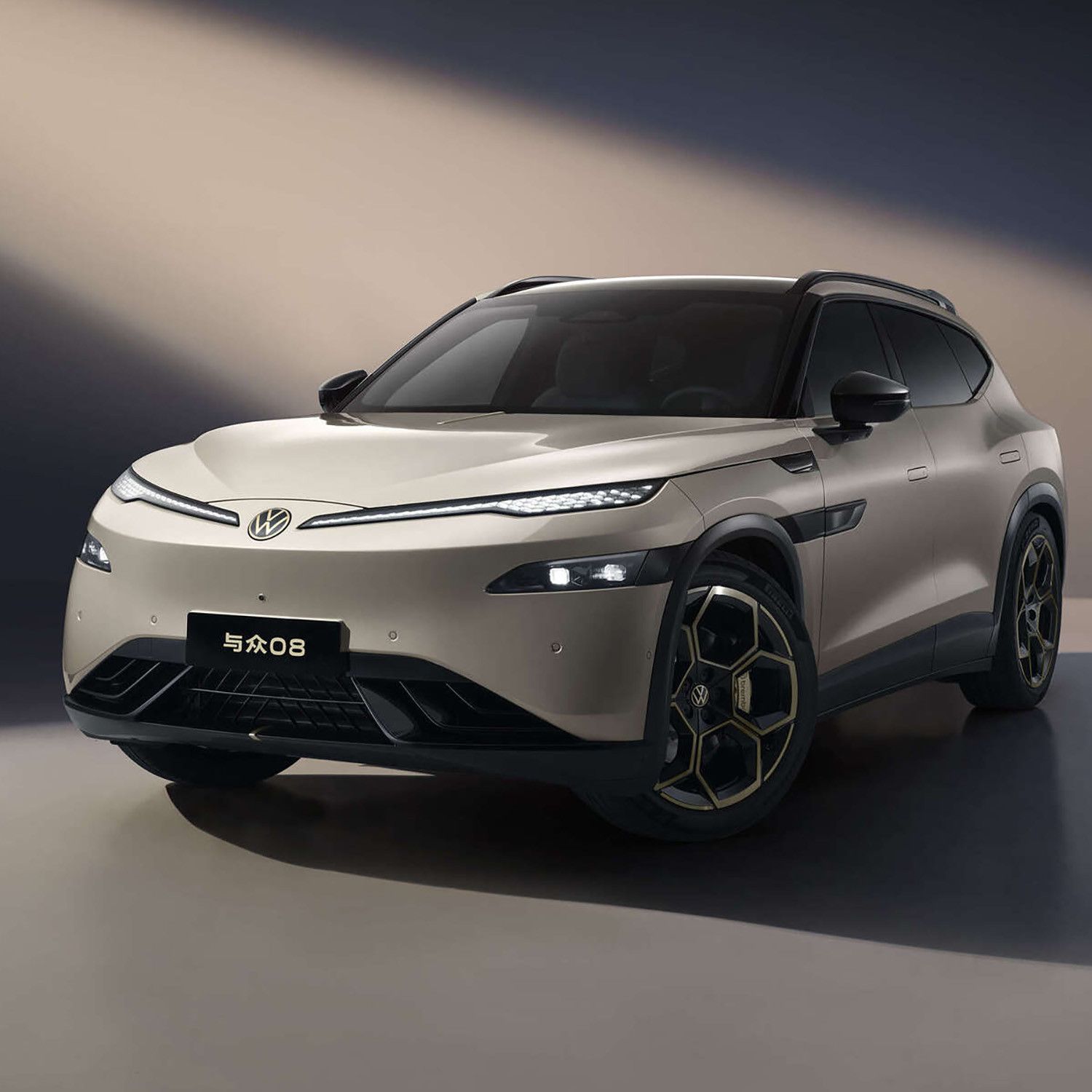
CHINA: VW’s China EV Slump, Xpeng GX Interior and Ford’s Farley Warns On China | 14 Apr 2026
About this episode
Volkswagen’s China EV slump is getting blamed on more than hardware: deliveries in China are down sharply, and the gap is widening as local brands refresh faster and push “living” software experiences. VW is responding with new China-focused EV plans and a partnership co-developed with Xpeng. Xpeng then teases the GX flagship with a luxury, tech-heavy interior and 800V performance. Ford’s Jim Farley warns the US against Chinese EV imports over jobs and data-security concerns. The show also covers Neo’s backlash-driven upgrade pricing, Greater Bay’s solid-state battery A-sample progress, Cadillac’s Vistiq tech, and JD.com testing app-first car buying.
You can read all the latest news on the blog here: https://EVne.ws/blog
Subscribe for free and listen to the podcast on audio platforms:
➤ Apple: https://EVne.ws/apple
➤ YouTube Music: https://EVne.ws/youtubemusic
➤ Spotify: https://EVne.ws/spotify
➤ TuneIn: https://EVne.ws/tunein
➤ iHeart: https://EVne.ws/iheart
VOLKSWAGEN’S CHINA EV SLUMP https://evne.ws/4elfI5u
XPENG SHOWS GX CABIN BEFORE LAUNCH https://evne.ws/41zbnUV
FARLEY WARNS ON CHINESE CARS https://evne.ws/4dLTREm
FANG CHENG BAO TO SHOW FIRST SEDAN https://evne.ws/4sqBxUF
FIREFLY BACKS DOWN ON UPGRADE PRICING https://evne.ws/4emsNvn
GREATER BAY SHOWS A-SAMPLE SOLID-STATE CELLS https://evne.ws/4dMIig8
CADILLAC SETS 22 APRIL FOR VISTIQ LAUNCH https://evne.ws/421ylnM
LEPAS L6 SET FOR UK IN 2026 https://evne.ws/4tH3DMm
JD.COM TAKES DEEPAL L06 SALES ONLINE https://evne.ws/3OBw4g0
Capital One
"Capital One's tech team isn't just talking about multi-agentic AI. They already deployed one. It's called Chat Concierge..."
Capital One is a big financial company. In this segment, they’re using AI to help people shop for cars and handle things like financing.
Capital One is a financial services company that’s described here as deploying AI tools to assist with car shopping. The segment frames it as a buyer-focused workflow: finding cars, scheduling tests, and arranging financing.
test drive
"It helps schedule a test drive, get pre-approved for financing, and estimate trading value. Advanced, intuitive, and deployed."
A test drive is when you actually drive the car to see if you like it. The software is helping set that up for you.
A test drive is the hands-on driving session where buyers evaluate how a car feels in real conditions. In the segment, the AI assistant helps schedule one as part of the shopping flow.
trading value
"It helps schedule a test drive, get pre-approved for financing, and estimate trading value."
Trading value is how much your current car is worth if you turn it in for credit toward the next one. It affects the final price you pay.
“Trading value” refers to what your current vehicle is worth when you trade it in toward a new purchase. Dealers and lenders often use it to calculate the net price you’ll pay after the trade-in.
pre-approved for financing
"It helps schedule a test drive, get pre-approved for financing, and estimate trading value."
Pre-approval is when a bank or lender checks your credit and tells you how much money it’s willing to lend you. It can make buying the car faster because you’re not starting from scratch at the dealership.
“Pre-approved for financing” means a lender evaluates your credit and offers a loan approval amount before you pick a specific car. It can speed up the purchase process and helps you compare offers more easily.

XPeng Xpungs Gx
"Welcome back to EV News, China. Today, VW's China EV slump, X-Pung's GX interior, and Ford's Farley warns on China. Plus, stay tuned."
The Xpeng GX is an electric vehicle model from Xpeng. The podcast mentions it mainly because of its interior—what the cabin looks and feels like. It’s part of the news because EV makers are competing on more than just battery range.
The XPeng GX is an Xpeng model discussed in the context of its interior design and overall product presentation. In an EV news roundup, it’s used to highlight what Xpeng is doing with cabin features and user experience. That makes it relevant when comparing how different EV makers differentiate beyond just range and charging.
product refresh cycles
"Domestic brands in China just keep moving faster than joint venture players on product refresh cycles."
A product refresh cycle is how often a car company updates its cars with improvements. The point here is that Chinese brands are updating more quickly than some joint-venture competitors.
“Product refresh cycles” are the cadence at which automakers update models with new styling, hardware, software, or features. The segment argues Chinese domestic brands are refreshing faster than joint-venture players, helping them stay competitive.
self-learning navigation
"embed advanced large model, AI voice assistance, self-learning navigation, and continuous updates to their vehicles."
Self-learning navigation means the car’s navigation can get better over time. Instead of always doing the same thing, it tries to learn what routes or choices work best for you.
“Self-learning navigation” implies a navigation system that adapts based on usage patterns, traffic behavior, or driver preferences. The goal is to improve route suggestions over time rather than relying only on static map logic.
plug-in hybrid
"Well, Volkswagen plans to launch 13 EVs in China this year. That's BEV, plug-in hybrid, and EREV by 2029."
A plug-in hybrid can run on electricity like an EV, but it also has a gasoline engine for extra range. You can charge it at home or on public chargers.
A plug-in hybrid (PHEV) combines an electric motor with a conventional engine, and it can be charged from an external power source. The segment groups it alongside BEVs and EREVs as part of Volkswagen’s China strategy.
wireless phone charging
"The center console packs wireless phone charging for two phones, twin-cup holders, big storage compartment for umbrellas, and even backpacks."
Wireless charging lets you charge your phone without plugging in a cable. In this car, they say there’s room for two phones to charge at once.
Wireless phone charging uses inductive charging pads to power compatible phones without plugging in a cable. The segment notes the XPeng GX center console includes wireless charging for two phones.
zero-gravity seats
"XPANG's put most of the comfort pitch in row two, those zero-gravity seats, with extra-long sliding rails and electric leg rests."
Zero-gravity seats are meant to feel extra comfortable by supporting your body in a relaxed position. In this SUV, they’re used to make the second row feel like a lounge.
“Zero-gravity” seats are designed to reduce pressure on the body by supporting posture in a way that mimics weightlessness. The segment ties this to the XPeng GX’s second-row comfort pitch, along with electric leg rests and long sliding rails.
0.16 seconds
"They say that the second and third rows can switch their rear window tinting in 0.16 seconds to be tinted privacy glass."
They’re claiming the rear windows can change tint extremely quickly—about a blink of an eye. That matters because you’d want the privacy effect to happen right when you need it.
This is the claimed time for the rear window tinting to switch to “privacy glass.” It’s an important spec because it indicates how quickly the system responds, which affects whether it’s usable in real-world situations (sun glare, privacy moments).
0-100 kph in 4 seconds
"The pure electric GX is an 800-volt vehicle, 5C charging, 0-100 kph in 4 seconds, so a big, fast barge, full of luxury."
This number tells you how quickly the car accelerates from a stop to 100 km/h. It’s a simple way to compare “how fast it feels” between cars.
This is a performance metric describing acceleration from 0 to 100 km/h. It’s useful for comparing how quickly different EVs feel in everyday driving and highway merging, even though it doesn’t fully capture handling or braking.
Ford
"Moving on, Ford's CEO Jim Farley has warned against letting Chinese carmakers into the United States,"
Ford is a major American car company. Here, Ford’s CEO is speaking about concerns over Chinese EV competition in the U.S.
Ford is the U.S. automaker whose CEO Jim Farley is quoted here warning about Chinese carmakers entering the U.S. market. Ford’s stance matters because it reflects how major legacy automakers view EV competition and trade dynamics.
tariffs on Chinese EVs were 100%
"During the Biden administration, tariffs on Chinese EVs were 100%... Those tariffs effectively shut out Chinese cars for now."
A 100% tariff means the import tax could effectively double the price of Chinese EVs at the border. In practice, that can make Chinese EVs much less competitive in the US market, reducing sales until trade terms change.
Beijing Auto Show
"BYD's Fang Cheng Bao sub-brand is going to debut its first sedan or saloon car at the Beijing Auto Show."
The Beijing Auto Show is a major international auto event where manufacturers debut new models and technologies. In this segment, it’s the venue for Fang Cheng Bao’s first sedan/saloon reveal, making it a key milestone for the brand’s expansion.
LiDAR
"The car shown in the images carries roof-mounted LiDAR and multiple body cameras. The hardware suggests smart driving assistance is a key feature."
LiDAR (Light Detection and Ranging) uses laser pulses to map the environment in 3D. When roof-mounted, it can improve the accuracy and reliability of advanced driver-assistance systems, especially in complex driving scenarios.
smart driving assistance
"The hardware suggests smart driving assistance is a key feature."
“Smart driving assistance” refers to driver-assistance systems that can actively help with tasks like lane keeping, adaptive cruise control, and collision avoidance. The presence of LiDAR and multiple cameras suggests the car is targeting higher-capability automation than basic safety features.
BYD
"The reported setup would pair BYD's Dysus or Dysus M Intelligent Magneto Reological Body Control System. BYD says the Dysus M dampers are just in under 10 milliseconds."
BYD is a big Chinese EV company. Here, they’re mentioned as providing parts and tech for the car’s suspension and battery/charging.
BYD is a major Chinese automaker and battery supplier, known for EVs and large-scale battery production. In this segment, BYD is tied to both the suspension technology and the battery/charging approach.
multi-functional side mirrors
"The other adds multi-functional side mirrors, that is $3,500 RMB, £370, $477. Owners attacked the prices on social media."
These are side mirrors that do more than just reflect what’s beside you. They can include extra features, and here they’re offered as an upgrade option.
Multi-functional side mirrors typically add features beyond basic mirror glass, such as integrated indicators, cameras, or heating/adjustment functions. In this segment, Firefly bundles them as a paid upgrade.
limited-time points model
"Firefly's president responded six hours after the policy went live, issuing a video statement and scrapping the limited-time points model. Firefly replaced it with a full points payment option."
This is a plan where you can use points only for a short time or under strict rules. Firefly removed it after customers complained.
A limited-time points model is a pricing/payment structure where points can only be redeemed under specific time windows or conditions. The segment says Firefly scrapped this approach after criticism.
full points payment option
"Firefly replaced it with a full points payment option. We'll get onto Neo points and Firefly points in a moment,"
This means you can pay using points alone, not just partially. It was offered as a fix after people said the earlier points rules were too strict.
A full points payment option means customers can pay entirely using loyalty points rather than mixing points with cash or being restricted by redemption limits. The segment frames this as the replacement for the earlier limited-time points approach.
TPMS upgrade
"The TPMS upgrade for tire pressure monitoring takes two hours."
TPMS is the system that watches your tire pressure. If you get an upgrade, it usually means the car gets better sensors or software so it can warn you when a tire is low.
TPMS (Tire Pressure Monitoring System) uses sensors to monitor tire pressure and alert the driver when pressure is low or abnormal. An “upgrade” typically means adding or replacing sensors/software so the car can read and display tire pressure accurately.
loyalty point systems
"Neo and its sub-brands have long used loyalty point systems to reward early adopters."
Some EV makers give you points for buying or using the car. Later, you can trade those points for upgrades or benefits.
Loyalty point systems let automakers reward early adopters and ongoing customers with credits that can later be redeemed. In the EV context, these points often tie into software-enabled upgrades and service actions, influencing customer retention and upgrade behavior.
watt-hours per kilogram
"In the lab, they have it between 260 and 500 watt-hours per kilogram."
Watt-hours per kilogram is a way to measure how much energy the battery can store compared to how heavy it is. Higher numbers mean more energy for the same weight.
Watt-hours per kilogram (Wh/kg) is a specific energy metric that normalizes energy capacity by battery mass. It’s commonly used to compare how “light” a battery is for the amount of energy it can store.
C-rate
"[782.1s] 2C and 3C may seem slow. [784.5s] C-rate, by the way, is a way of measuring charge and discharge of a battery if you're new to the podcast. [789.0s] So a 60 kilowatt-hour battery would take one hour to charge at one C."
C-rate is a simple “speed rating” for charging a battery. If a battery is rated at 1C, it would charge in about an hour. If it’s 2C or 3C, it’s aiming to charge in about half or a third of that time.
C-rate is a way to describe how fast a battery charges or discharges relative to its capacity. For example, 1C means charging a battery from empty to full in about one hour (for that capacity). Higher C-rates mean faster charging, but they can be harder on the cells and require better thermal and materials engineering.
A-sample
"[841.2s] So still, I would point out, A-sample means concept validation. [848.3s] The phrase A-sample doesn't mean drop in pack readiness. [852.3s] The next tests look harder."
An A-sample is an early “test version” made to prove the idea and the manufacturing process. It doesn’t mean the battery is fully ready to be installed in cars at scale. Think of it like a prototype that still needs more testing.
An A-sample is an early production sample used to validate a design concept and manufacturing approach before full readiness. The segment clarifies that A-samples are not the same as “drop-in pack readiness,” meaning they don’t guarantee the battery pack is ready for widespread vehicle deployment. It’s a common development-stage term in automotive supply chains.
cycle life
"[852.3s] The next tests look harder. [854.1s] Cycle life at higher C-rates. [856.8s] Large format consistency, putting it into a vehicle."
Cycle life means how long the battery lasts—how many times you can charge and use it before it starts to degrade. Faster charging can make batteries wear out sooner, so companies test cycle life under those harsh conditions. Longer cycle life is what keeps an EV battery healthy for years.
Cycle life is how many charge/discharge cycles a battery can complete before its capacity or performance drops below an acceptable level. The segment specifically calls out cycle life at higher C-rates, which is important because faster charging can accelerate wear. This is one of the key hurdles for making advanced batteries commercially durable.
cost parity
"[859.9s] Cost parity, of course, with high nickel liquid cells. [863.4s] Industry studies expect solid state batteries to spend the second half of this decade [868.6s] moving from pilot scale to real volume."
Cost parity means the new battery type becomes about as cheap as the batteries people already use. If it’s too expensive, automakers won’t adopt it widely. The segment is saying solid-state needs to catch up on price to compete.
Cost parity means the new battery technology reaches a cost level comparable to the dominant alternative—here, “high nickel liquid cells.” Achieving cost parity is crucial for mainstream adoption because automakers and consumers care about total vehicle cost, not just performance. The segment suggests solid-state needs to match the economics of current high-nickel lithium-ion cells.
rear axle steering
"Cadillac has given it rear axle steering to cut the turning radius in tight spaces."
Rear axle steering means the back wheels can turn too. That helps the car turn more easily in tight spaces, like parking lots.
Rear axle steering is a system that turns the rear wheels to improve maneuverability, especially at low speeds. By reducing the effective turning radius, it can make parking and tight turns easier.
10-80
"We should always give 10-80. They say 20 minutes. Finally, JD.com, the Chinese retail giant, has partnered with Depal."
10-80% is another EV charging-speed benchmark that measures time from 10% to 80%. Using a wider starting range can better reflect real-world charging behavior because many drivers plug in when the battery is relatively low.
JD.com
"Finally, JD.com, the Chinese retail giant, has partnered with Depal. They are launching the Depal L06. That's an E-rev, range-extended range electric vehicle."
JD.com is a big online shopping and delivery company in China. Here, they’re acting like the sales and delivery channel for a new EV program.
JD.com is a major Chinese e-commerce and logistics company. In this segment, it’s partnering with an automaker to run exclusive sales, digital purchasing, and test-drive bookings through its app ecosystem.
range-extended range electric vehicle
"That's an E-rev, range-extended range electric vehicle. JD.com will handle exclusive sales of the L06 and digital purchasing under their framework."
This means the car’s battery isn’t the only thing that helps you go farther. There’s an extra onboard method to extend the distance you can drive.
This phrase describes an EV architecture where a range-extending system helps cover longer trips. It’s typically used to address “range anxiety” by providing additional energy beyond what the battery alone can deliver.
door-to-door trials
"Customers can book test drives, dealerships, while customers can select regions to request door-to-door trials. Deliveries will go through Depal stores or JD.com's delivery centers."
Door-to-door trials mean the test drive can be arranged to start near your home. Instead of you going to a store, the process is set up for you.
Door-to-door trials describe arranging test drives that come to the customer’s location rather than requiring the customer to visit a dealership. This is part of a convenience-first sales model aimed at lowering friction in the buying journey.
towing
"Silverado and Silverado HD have the muscle to take you out for some serious, with multiple engine options and impressive towing,"
Towing means pulling a trailer. Trucks are built to do it safely, and the amount they can tow depends on the truck’s design.
Towing is the ability to pull a trailer, and it’s usually limited by the vehicle’s drivetrain, cooling capacity, and hitch setup. For trucks, towing capability is a major selling point and often tied to engine choice and axle/brake hardware.
Request an Explanation
Heard something you'd like explained? We'll add it to this episode.
Sign in to request explanations for terms you heard.
Want to learn more?
Browse our glossary for plain-English explanations of automotive terms, jargon, and concepts.
Help improve this episode
See something that's not quite right? Our annotations are AI-generated and can sometimes miss the mark. Click the flag icon on any annotation to suggest a correction.