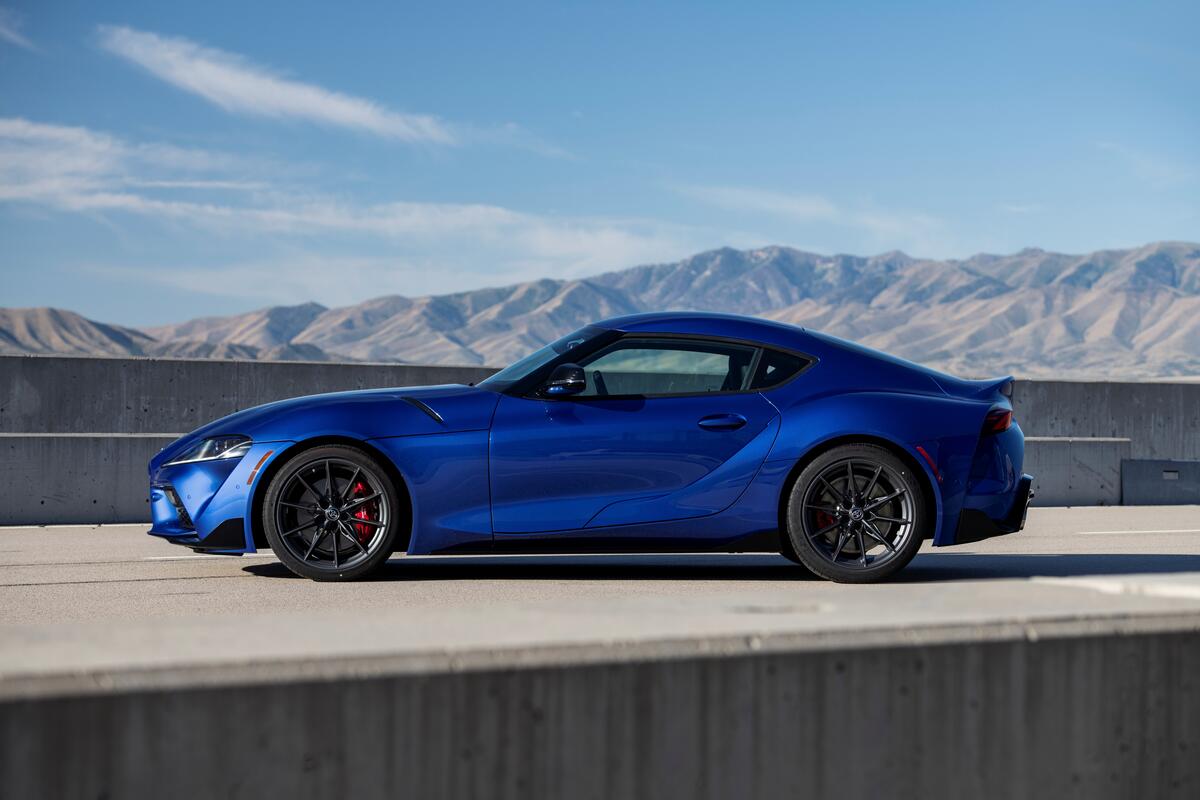
This is a BMW Z4 M, which is BMW’s more performance-oriented version of the Z4. The host is basically asking whether you’d rather own this BMW or a Toyota Supra.
The 2021 Supra is a Toyota sports car that’s known for being fun to drive and generally dependable. In this discussion, the host says it’s likely the easier ownership pick for most people.
“Ownership experience” just means how the car feels to own—whether it’s dependable and easy to keep running. Here, the host is saying the newer Supra should be the less stressful option for most people.
Car
Jaguar Convertible Type
Jaguar is a company that makes luxury cars. The podcast mention is about choosing a version that isn’t a convertible. That matters because different body styles can change what’s easiest to clean and protect.
A polisher is a machine detailers use to clean up and smooth the car’s paint. It helps remove scratches and brings back shine, especially when you use it with polishing products.
“Five inch” means the size of the polishing pad. Pad size changes how the polisher fits on different parts of the car and how evenly it works the paint.
Torque is basically the tool’s “pulling power.” For a paint polisher, more torque helps it keep working effectively instead of slowing down when you press or when the paint is tougher.
Tire shine is a product you put on tires to make them look darker and glossier (or sometimes more satin). People can be picky because different products look different and last different amounts of time.
Liquid Elements is a brand the host recommends as a middle-ground option. The idea is that it’s not the cheapest, but it’s also not the ultra-expensive level.
Harbor Freight is a store that sells tools at lower prices. The host is basically saying if you want to spend very little, you’ll likely end up shopping there.
Porter-Cable is a tool brand that used to be a go-to for inexpensive polishers. The host is saying that compared to newer choices, it may not be the best option anymore.
A rotary polisher is a machine that spins like a wheel. It can correct paint faster, but it also builds heat quickly, so you have to be careful not to damage the paint.
The “law of diminishing returns” means that as you spend more on a polisher, the improvement you get becomes smaller. In detailing, this often shows up as expensive machines offering incremental benefits that many users won’t notice or justify for their skill level and paint condition.
Concept
built in house
“Built in house” means the company makes the parts themselves instead of buying them from another manufacturer. The host is implying that can affect quality.
“Made in China” just means the product is manufactured there. The host is pointing out that some brands that used to be made in Europe are now being made in China.
Rotary polishers (often shortened to “rotaries”) use a rotating motion to drive the polishing pad. They’re known for fast defect removal, but they’re also easier to misuse than dual-action tools because heat and paint damage can happen quickly if you dwell or use too much pressure.
Tool sponsorship means a company gives tools to someone to promote them. The host is saying you should be skeptical if the person’s recommendation doesn’t match what they actually use day-to-day.
Term
run out on the pad
Runout means the pad isn’t spinning perfectly straight—it wobbles a little. More wobble can make polishing less even and harder to get a clean, consistent finish.
“Monsoon season” here just means a stretch of very humid weather. When the air is humid, glass cleaner can behave differently and you’re more likely to get streaks.
Glass cleaner is the product you use to clean car windows. The goal is to remove grime without leaving streaks, and the amount you use matters.
Term
glass cleaning
Glass cleaning means getting the windows and windshield really clean so you can see clearly. It helps remove dirt and spots that can build up over time.
Term
overload a well panel
This is the idea that using too much cleaner can backfire. If you spray too much onto the glass, your towel can’t soak it up, and you’ll wipe around a messy mixture instead of cleaning cleanly.
The Jeep Wrangler is a common SUV, and the host uses it as an example. They’re showing that you don’t need to soak the glass—just use a small amount and wipe properly.
The Nissan Rogue is a smaller SUV meant for normal daily driving. It has glass surfaces like a windshield that need cleaning and protection. Detailers may mention it because it’s easier to work on than bigger vehicles.
A finish polish is the last step in polishing—meant to make the surface look smooth and refined. The host’s point is that you shouldn’t use it like a heavy-duty cleaner if the job actually needs a different step.
A cutting step is the more aggressive part of polishing that removes problems from the surface. The host is saying that when you’re finishing glass, you shouldn’t expect a finishing cleaner to act like a strong, defect-removing step.
Term
black pad
A black pad is a type of polishing foam used in car detailing. The host is using it as an example to say the pad/product combo has a job, and you shouldn’t use a finishing setup like it’s meant to aggressively remove defects.
A smear is that cloudy, streaky film you see on glass after cleaning. The host is saying it can happen when you spread residue around, and you may keep wiping without realizing what’s still on the surface.
Range Rover is a luxury SUV made by Land Rover. The hosts mention it because when these cars get damaged, the repair cost can be high enough that people consider whether to fix it or replace the vehicle.
The S-Class is Mercedes-Benz’s top luxury car. The hosts bring it up because a front-end accident can lead to a tough decision: repair it or trade it in.
PPF is a clear film you put on your car’s paint to protect it from chips and minor damage. The hosts are talking about how to get it to stick correctly, especially on matte paint.
“Coding” here means a protective coating that’s been put on the paint. The question is whether you can take that coating off matte paint without polishing, so the PPF will still stick.
Matte paint is the flat, non-shiny type of car paint. It’s harder to fix or polish than glossy paint, so the hosts focus on careful prep so the protective film can stick.
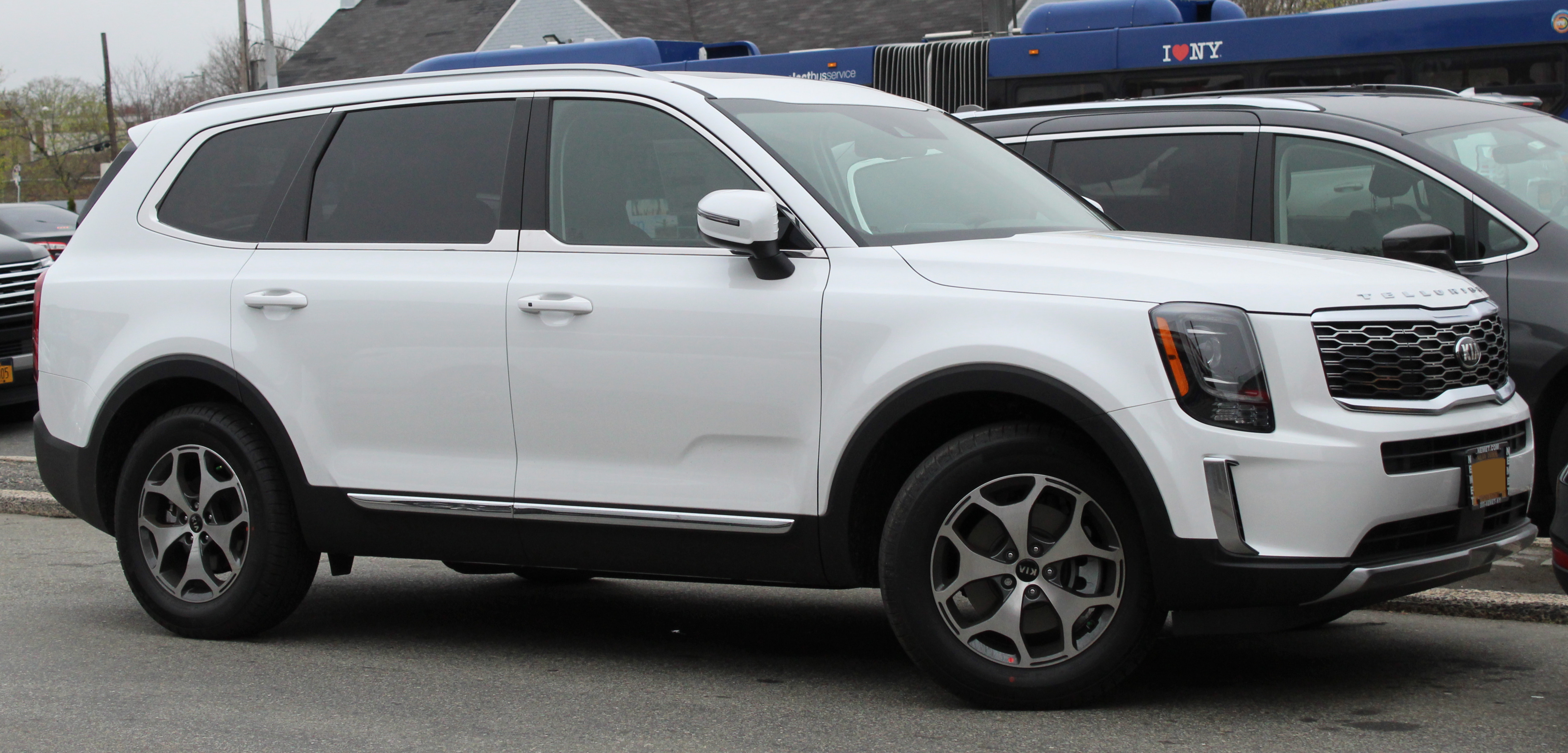
The Kia Telluride is a family SUV from Kia. The hosts talk about it because the owner wants paint protection film (PPF) and is worried about removing a coating from the matte paint first.
A heat gun is a tool that blows hot air. Detailers use it to warm PPF so it can fit better around edges, but you have to be careful not to damage the paint or film.
“Pro bond” sounds like a product detailers use for bonding/adhesion. The host is warning that you shouldn’t use it for this situation because it may cause problems with how the film sticks.
Silvering is when PPF starts to look cloudy or silvery instead of clear. It usually happens when moisture or air gets trapped or the film doesn’t bond well to tricky shapes.
Work time is how long you have to adjust and smooth the film after it’s placed. If you don’t have enough time, the film may not settle correctly and can cause visual issues.
Aggressive tack means the adhesive sticks fast. That can make it quicker to secure the film, but it can be harder to reposition if you need extra time.
A slip solution is a soapy/wet liquid used when installing protective film. It helps the film slide into position first, instead of sticking instantly. That makes it easier to align and smooth out.
Suntech is a brand of paint protection film. “Ultra tack” means the adhesive is designed to stick faster, so it can be easier to set the film edges without fighting the film.
Brand
expels film
Expel is a brand that makes paint protection film. The point here is that some Expel films are designed to stick faster, which can help during installation.
Orange peel is when the paint surface has a bumpy texture, like tiny dimples. It can make the finish look less smooth, and it can show through or affect how clear and even the film looks.
“Film clarity” is how transparent and visually crisp the installed PPF appears over the paint. It’s often discussed alongside gloss and texture effects (like orange peel) because surface imperfections and film quality both influence how clear the finish looks.
This car came from the factory with matte/satin (low-gloss) paint. Because it’s not shiny, coatings can sometimes make it look uneven, leaving lighter or darker patches.
A ceramic coating is a protective layer you apply to paint to help it resist dirt and water. On matte or satin paint, it can sometimes change the look if it’s not applied evenly, which may be why you see lighter patches.
Vinyl decals are stickers/graphics that stick onto your car’s paint. If they’re installed well they can look perfect, but if something goes wrong you might see spots, peeling, or discoloration.
Water spotting refers to mineral deposits left behind when water evaporates on a car’s surface. It can be especially noticeable on clearcoat, paint, and decal surfaces, and it often requires proper decontamination or correction to remove.
Installation here means how the decal/film was put on—how the surface was cleaned and how the sticker was applied. Small differences can cause big differences in how it looks afterward.
A paint system is the full set of layers that make up the car’s paint. If one layer is applied or reacts differently, you can end up with visible problems that look very specific and repeatable.
“Cleanse” here means doing a deep cleaning of the car. Sometimes problems aren’t obvious until you’ve cleaned everything really thoroughly.
Term
frozen paint job
“Frozen paint job” is a detailing term people use when the paint looks uneven or weird in patches. In this story, the patches weren’t obvious until later steps made the surface look darker and more uniform—so the problem spots stood out.
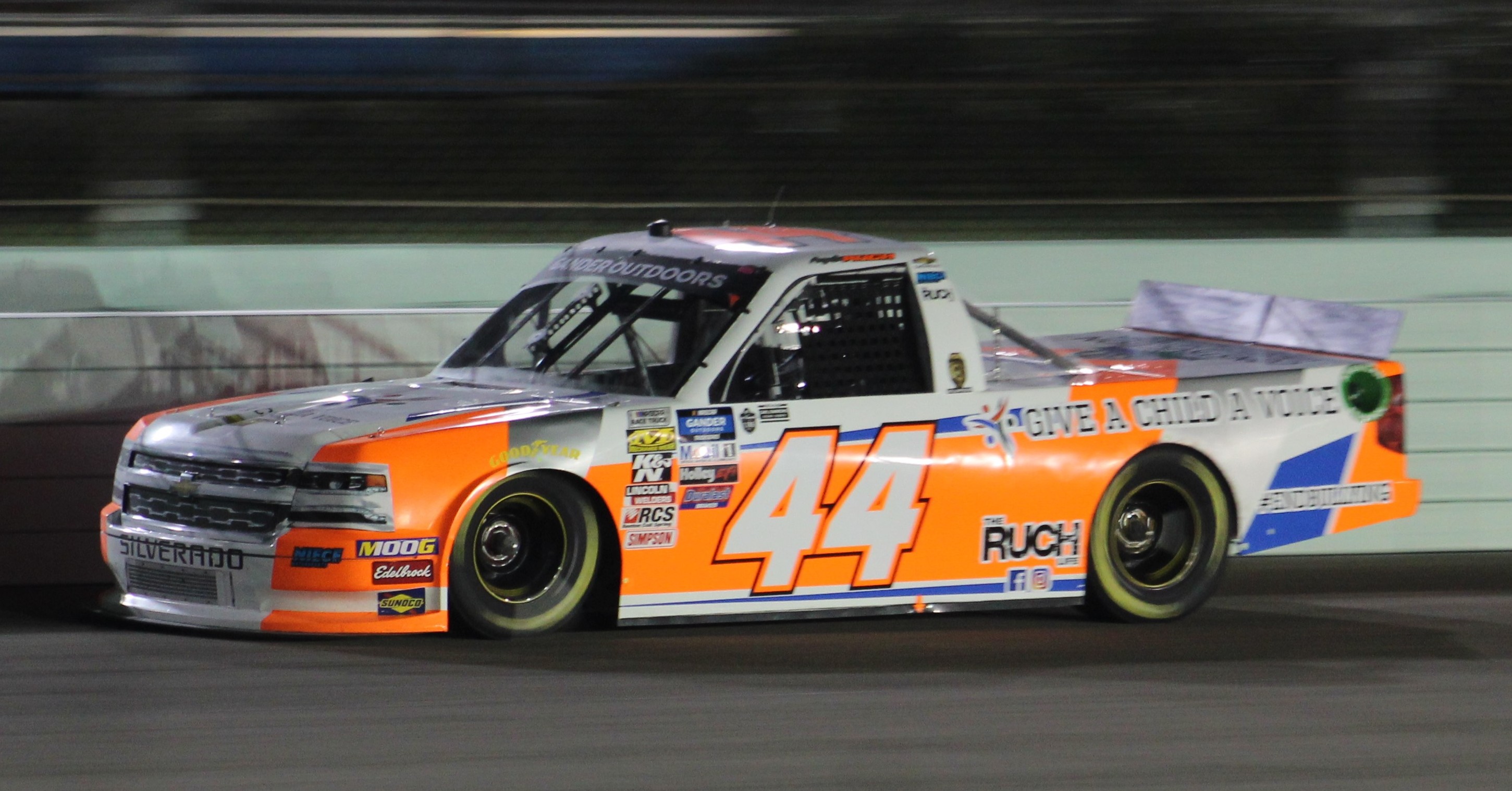
The Chevrolet Silverado is a large pickup truck used for hauling and general driving. Because it’s often used on roads and in messy conditions, it can get dirty quickly. People detail them to protect the paint, especially when it’s new.
In detailing, a “one step” usually means you use one product to both fix the paint and make it look good. The hosts are saying that even with that simpler approach, you should still do it thoroughly so the patches don’t stand out.
Prep soap is a special cleaner used before polishing so the paint surface is truly clean. The hosts are saying that a previous soap they used caused unexpected results, so they learned to rely on polishing to fix what was left behind.
“Clay stuff” is a detailing step that cleans the surface more deeply than a normal wash. It helps remove tiny stuck-on contaminants so the next products work better.
A pressure washer is a tool that sprays water at high pressure to rinse off dirt fast. They’re debating how much to rely on it versus doing extra prep steps by hand.
An imprint is the faint leftover shape you see after removing a badge. They’re trying to figure out whether it’s in the clear film or in the surface underneath.
Hyperclean is the name of a detailing product brand. They’re talking about which Hyperclean polish to use to fix the imprint after the emblem came off.
Carbon fiber is a lightweight material used on some car parts. It’s made from carbon strands bonded together with resin. Different manufacturers make it a bit differently, so the surface can react differently to polishing.
A finishing pad is the softer, last-step pad used to smooth out the surface after heavier polishing. In this context, it’s recommended because polishing PPF too aggressively can wear down the film’s protective top layer.
A top coat is the protective outer layer on the surface. Here, they’re saying that polishing PPF can wear down that outer protective layer, so the film can look worse sooner.
Abrading means rubbing material off the surface. Polishing does this, and the point here is that PPF’s protective layer can wear faster than car clear coat depending on how you polish it.
Clear coat is the transparent protective layer on top of a car’s paint. It helps protect the color underneath, and it’s also what determines how the paint reacts when you polish it.
Term
clear down to the base coat
Car paint usually has layers: a clear top layer and a colored layer underneath. If polishing cuts through the clear and reaches the colored layer, it can make the paint look worse faster and may need repainting.
A body shop is where cars go after damage for repairs and repainting. How long you wait to add coatings or film depends on how the new paint was finished.
A ceramic coating is a protective layer you apply to your car’s paint. It helps resist dirt and chemicals and can make washing easier, but you usually need to apply it only after the new paint is ready.
Wax is a protective product you spread on paint to help it shed water and look shiny. It’s usually easier to apply than longer-lasting coatings, which is why it comes up in “how soon can I protect it?” questions.
A sealant is a man-made protective coating for your car paint. It’s meant to last longer than basic wax and is often compared directly with wax and ceramic coatings.
Baking a car means the body shop heats the freshly painted panels so the paint cures/hardens properly. If it’s cured correctly, you may be able to apply protection like coatings or PPF sooner.
“Full front” means the installer is covering most of the car’s front with protective film. The goal is to protect the areas that get hit by rocks and road debris the most.
“Bake it” means putting the freshly painted car parts into a heated curing process. It helps the paint harden properly so the protective film can stick correctly.
“Wait time” is how long you have to let new paint cure before adding something on top of it. The speaker says the needed wait can change depending on how the paint was cured and the season.
“Modern paint” means today’s newer types of car paint. The speaker’s point is that newer paint systems may be ready sooner for protection like film, compared with older practices.
Term
modern baking
“Modern baking” is the body-shop oven curing process done in a more current, controlled way. The claim is that it helps the paint be ready faster for adding protection.
Concept
wives' tales
“Wives’ tales” means old, repeated advice that might not be accurate. In this case, it’s about how long you should wait before protecting fresh paint.
Term
repaint the panels
A car is made of separate metal pieces called panels (like doors and fenders). If someone “repaints the panels,” they’re putting new paint on those specific parts of the car.
“Baking” means heating the car (or the freshly painted/coated parts) in a controlled way so the product cures/hardens. It’s done to help the finish set up correctly.
Term
coat this
In detailing, “coating” usually means putting a protective layer on the paint. It helps the finish resist damage and can make washing easier.
Term
spray cares
“Spray cares” is being mentioned as another spray product option. The question is basically whether it can replace the usual wash/clay/sealant steps.
They mean a slippery product you use while drying or wiping the car. It reduces friction so you’re less likely to scratch the paint with the towel.
Term
spray code
They’re talking about a spray-on product used during washing. It helps protect the paint and makes drying easier, so you don’t have to scrub or wipe dry with a rough towel.
“Stack” here means using more than one protective product in layers. People do it to get stronger or longer-lasting protection than a single product alone.
LIVE
Welcome to the pints and polishing podcast, the most influential and listen to podcast in auto detailing. Welcome to the
community questions, questions, questions. Hey, that's today's episode, Nick. We got all kinds of questions. They're questions from other
groups, questions inside of the hyper clean specialist group. But we're going to start off with a would you rather wasn't love cooking
with Nick, send it over to me. I asked if you would talk about this on clutch culture. I said, I don't know. I find out. So here we
are, Nick. Are you going to talk about this on clutch live on the episode? But it's a great would you rather and I think it's
fun where people want to know, you know, hey, on clutch culture, could you, you know, talk about this? Right? You know, when
people inside of our, you know, community want to kind of reach over and and say, Hey, man, we'd love for you to talk about
something in clutch, clutch culture. How do they do that? Or where do they go? Or what's the process?
Clutch culture podcast at Gmail, go into the discord clutch dot club. Join that. That's where a lot of people at this
point are asking questions. But you could also DMS on Instagram clutch culture pod. Yeah, I mean anywhere where you can
really send a message or or send an email. That's basically it.
All right, well, cooking with Nick wanted to know Z four M coupe versus the 2021 Supra kind of like would you rather?
Which one would you go after?
Z four M. I just think it's a more interesting platform. Although the new Supra is a great vehicle. I would just be
inclined to buy the Z four M. I think it's just a little bit more unique. But there's no doubt about it. I mean, both of
those platforms would be, you know, fine to own. It just kind of matters what kind of experience you want. Obviously, the
newer Supra with, you know, Toyota's reliability is going to be a little bit better of an ownership experience for most
people. But more interesting to me is the Z four M.
Makes sense. Now, does it come with a convertible? That's that's what I want.
The Z four M that I would want would be the the non convertible type of vehicle. It's a true
group. Let's get into some questions that I found in some different groups. And then we'll do some that got into the
hyper clean specialist group. Alright, so it says Hey, many moons ago, I bought a, you know, and he lists this
polisher. This guy's name is Christian. I don't know him, right? He says, Obviously, with time I realized, you know, he
didn't like it, didn't like some of the stuff, not looking for anything commercial, just a reasonably priced quality
product for a dude that likes to do his own cars.
Yeah, I think look at our five inch liquid elements. I think that's right now. Price wise, everything factored in, which is
why we carry it. I think it's pretty hard to beat. I think, you know, we always have them on the site. It's one of
those things that, you know, people for some reason always want to go like, you know, how do I get something
cheaply that's as nice as the higher end stuff. And that doesn't happen. But I think liquid elements does a good
job of sort of bridging that gap where you have good features, you have pretty smooth the handle. Is it as smooth as
the top end polishers? No, it's not as smooth as those. But it does have a little bit more torque than most of
those. So you know, you have some drawbacks, a little louder, you know, things like that. But for a couple hundred
bucks, man, it's gonna be hard to beat.
Well, I'm allowed in this. I don't know why people really point that as a big deal. I really don't because most
people have headphones or something. And there's usually compressor, there's always something else, vacuums, there's
always something going on. Yeah, I mean, if you go low enough, some of those like shrill sounds come, I mean, I
get that. But that's not what liquid elements is liquid elements is, it's a good balance.
Does that shrill come from like, that harbor store, you know,
yeah, that's that would be, that would be one of them. But look, there's guys that love some of those harbor
freight tools and, and, you know, can afford the other stuff. And they're just like, I just like these better. So
the tool conversation will always come down to the same. The best tool for you is the one you're going to actually
use and put time behind. And, you know, but yeah, liquid elements is a nice balance.
I think it's kind of one of those like tire shine, everybody gets so particular about exactly what they
specifically want. You know, we saw inside, well, I did, I'm the one that deleted it, I don't know if they
all saw it. Somebody posted in our group asking about a certain polisher. It's like, well, we're not going to do
that. Because I also saw that he posted in four or five other groups, right?
Not only that, man. I'm not really you're not our group is not going to be a place where we allow
negativity on somebody else's product. And that's exactly where that one was headed.
Well, yeah, because the post inside of other groups, people commented, Oh, it's just like a knockoff and then
fill in the blank, right? And that's what they did. They just went after and they go, you know, I get it.
Everybody seems like that multiple companies feel like they need to have tools. Okay, cool. You know, I
mean, there's plenty of tools on the market. There's actually probably more today than I think I've ever
known. Yeah, I would agree. And I would that's why I say with with what you kind of said is like a kind of
whatever fits for you. Right? You know, I read this for the guy says he's just a dude that likes to do his
own cars. I mean, you could pretty much is this where you at kind of offer to somebody like him and do
you actually go and buy a couple ones? I don't know, right? Like, how do you figure out which
polisher is best for you?
Look, I would tell you this liquid elements is the good balance. Right? If you're worried about cost, you're
going to end up at harbor freight. That's where you're going to end up. I think if you're not willing to spend
a couple hundred bucks on a polisher, you probably should have pretty low expectations, right? Like if 200 250
bucks is too much, then, you know, that used to be where porter cables at. I mean, I mean, if you remember, that
was like the place, you know, if you if you wanted something cheap and easy, it was like, go get a porter
cable, right? Oh, I don't know that that's the advice anymore with with things like liquid elements. You
know, it's just imagine trying to polish now with a porter cable. I just think there's better options, but
just there's just better options. But I will say my my personal view on this is I've used a lot of high end
polishers that I'm not extremely happy with. So, you know, you start talking about spending. I mean, you and I
I know you messed around with it, you know, you start talking about a rotary that costs 600 bucks, better do some
pretty special things. And, you know, is it doing anything more than a Makita or maybe it's lighter? I guess
but, you know, we have gotten and I think you probably believe the same thing. Like, I know why some of the
expensive polishers cost what they cost. There's a law of diminishing returns with some of those that a lot of
people are not going to be happy with. And I understand that as well. But I don't bash them. You know, that's
the other thing, like, you know, you kind of said it, or you kind of alluded to it is, you know, it's just
going to turn into a bash fest. And, you know, this was made here. This is let me let me go ahead and say this.
It's very rare. Every part of a polisher is built in house by somebody. You have one of the major brands that
used to be made in a certain part of Europe that is, you know, by all accounts now being made in China.
Doesn't make it right or wrong, it just means that's where the manufacturing capacity of their parent company is
and that's where they do things and they're still selling for premium dollar. So I don't really have I think this is
just a strange hill to die on. The two things always been strange to me. I think maybe because I got handed a
DeWalt rotary and it was like, this is what you had. Like, here you go. Yeah, I mean, Makita has one, but this is the
ones we have here. And this is what you're going to use. I guess it's probably more of just the time you grew up in
the business of when you were using rotaries, it was like whatever one was there, that's the one you were going to use.
What else was out there? There was Milwaukee. Yeah, I mean, the only ones that I really remember in my was you either had
Makita or you had DeWalt. Like that that was really the only choices that I was ever given. And most of the time, I
wasn't given the choice. It was like, here you go. This is what
you had. Those are the two dominant. I'll be upfront. I wasn't exposed to enough that at that time to tell you if there
was five other tools. I mean, there could have been 50 other ones. But it was like, here's a DeWalt. And that's what
you're going to use.
Well, I shared with you and Mildren, right? I got the wonderful opportunity last week to meet a old school
detailer. When I say old school, and I'm somebody saying it, then you understand how his age and how he was talking
to me. I go, Yeah, they were way down on 11th Street, right? Like, he was confused that I knew he was that old,
right? So it was cool. But I he made a comment. I go, Oh, what'd you, it were you which one did you and he was
he was he was not the big yellow heavy one. Oh, yeah. And that's what I asked him. I said, Do you use the big yellow
heavy one? Then I joked because there's another guy there. And I was like, Yeah, man, you would have had to have some
guns. Yeah,
so I think it's interesting when you get into the tool thing. And I will say pretty readily, there's a lot of group
think about tools that you find that people don't actually know what they're talking about, right? Like, then
there's been like a lot of sponsorship in the tool business where, you know, I can tell you I was sent tools and
I can tell you other guys that quote unquote, do high end work. And they're like, I love this tool. It's like,
well, they haven't paid for one of those in like 10 years. Right? Like, so there's just a lot of funny business. So
just just find one that you like, you know, and move on with your life.
Tool companies do seem to be the ones predominantly that pick up, you know, detailers want to, you know, put in the
towel, right? Like, Oh, yeah. Well, companies do seem to be some people in the industry that will will pick up
detailers and bring them in as as employees, which you could always, you know, go tip your hat to like, Hey, man,
thanks at the same time. Yeah, well, you know, tool companies have also had a history that I can say pretty
readily is bringing in people that play detailer. So we can we can also say that, you know, have a little laugh. And by
the way, I say this to their face. So if anybody, you know, thinks that this is being said by an anyways back,
trust me, it's not it's a constant joke.
Yeah. And it's a joke that you and I love to play too.
Yeah, I mean, it's, you know, when you once detailed a car in 1985 for some money, that doesn't mean you detailed
cars for money.
Listen, I'm just happy to be the guy that also gets put on that ladder.
Yeah. Well, look, you are. Look, I mean, it's, you know, for everybody that doesn't know, I have
to take some videos and go Marty, this is exactly what I mean. You see this, you see how this and he's like, Oh,
yeah, now I see. It's like, well, I think you'd have cut on to that five years ago. But here we are. You know, so
yeah, I mean, everybody advances and does their own thing. We're good with it.
Listen, five years ago, then great, I'm gonna blame Corona on that.
That's keep going right away.
You're gonna blame you're gonna. I just magically stopped detailing five years ago.
Most important time to tell.
Yeah, no, it's but I do appreciate and I do get a lot of tool questions. I know you do too and people send stuff in or but
guys, it's buy something. That's that's all I can say buy something and mess around with it.
And difference of noise levels to a little shake. Otherwise, they're gonna get the job done. Oh, yeah. Like, could one be a
little quick? Maybe.
But yeah, one of the big things about Rotary that if you haven't used a lot of Rotary, people talk about the run out on
the pad and how long the the tool runs out. Does it have a little awkward spin to it? I mean, you can get deep down
some rabbit holes. But for most people, man, just grab something, work with it, and you're going to be fine.
Yeah. Yeah, good point. Okay, so Conrad, I saw inside the group had an early service this week, 6am
church in his, his garage. Oh, early service six, not me. What Donald doesn't know is Marty's not doing anything as
six o'clock and Marty wouldn't take a flight as six o'clock in the morning. True. That's a true. He'd rather
drive nine hours and be miserable than get up like two hours early.
By the way, this is not a joke. And this is not a bit is actually a real conversation within the last few
weeks. I was like, What are you talking about? He's like, No, I'd rather sit in the car and be miserable.
Like, this is a real conversation to all of you listening. This is exactly how it went.
So I did have the late service did not get up early like I did. But you know, part of being up a little
later, part of being that temperature gets up, you know, the sun starts shining. I, I rejoiced. I was so
thankful because there was a half second where I go crap. I got to get some of these streaks off of here. But I
didn't have to be of any concern. And this is why I bring it up like our glass cleaner. I had a half second
where I go, Oh, crap. And I go, Oh, what am I worried about? Yeah, what am I worried about? Like, I just that'll
tell you, though, Nick just joked with you about how long has been since I tell you how long I've been since
I've cleaned my wife's glass with glass cleaner. Yeah, she normally gets the rinse list, maybe some juice, right?
Because juice is really great at a drying aid. This is what I love to do, right? It's sort of my point of why I
wanted to bring it up to twofold. Again, doing rinse list and using juice as your drying aid. And then my
daughter's kind of joked about it, but you can almost get it virtually free to where the average person can't
can't know. Now, can you and I can like, Yeah, so this time I was like, Listen, I got to get some glass
cleaner here. And I was I was thrilled. I was so thankful. thankful because it didn't matter
the heat. We all know heat and alcohol typically don't mix, right? And so what we would normally do is
spray heavy, you just Oh, I got to spray a bunch or you go real fast. Right? Let me spray and then let
me let me wipe as fast as I can. Let me let me do it. And then I maybe have to spray it again in a
couple of times like heat and glass cleaner really kind of go hard against each other. But in that
moment, I could sit there, listen, easy like a Sunday morning. What's that song? There's a song
there's quote, easy like a Sunday morning. Anyway, I'm not gonna sing for you. But it made it made
it so much easier. I didn't have to cuss. It's great on a Sunday not to have to cuss. Yeah, you ain't
lying. Big news out here. Yeah, I'm gonna let everybody in on something. We have something
called monsoon season. And in the last 10 days, the humidity has risen quite a bit because that's
what creates the monsoon. People are very shocked about the monsoon season that comes every year.
And so yeah, yeah, it's look, 110 with, you know, even 20% humidity gets people bent out of shape.
So I had to had to let everybody know it's called monsoon season. Like we actually named it, you
know, so we actually know what happens. So yeah, big big news out here that we had a little bit of
humidity. How the glass cleaner do? Yeah, I don't have an issue. I mean, it's it's just like anything
else. Like, I just don't really and this is kind of one of the things we talk about with answering
questions sometimes. There's just certain things I don't struggle with. And glass cleaner would be
one of those things. Now I have I in my career, you betcha. But yeah, I don't I don't struggle with
ours. I kind of felt like that Dos Equis guy, right? And he's like, well, I never have a problem
around or I never really like to clean a glass in the sun. But when I do, yeah, yeah, no, it's it's,
if you guys haven't tried it's worth it's it's worth adding to your next order for sure. And
but yeah, big topic out here, Marty, we know we have some humid temperatures.
So we talk about the process of glass cleaning, right? And, you know, I mentioned most most people
would think, okay, well, I just got to load a bunch more spray. Actually, when you load overload a
well panel, which we talked about and other things when I hear it's glass, when you overload the glass
with glass cleaner, you can actually then, well, you overload your towel because that towel is
supposed to suck it up. Then if you got too much on your towel, and you keep trying to wipe,
hush, you got the mixture of the sun. Yeah, no, I did a video on a Jeep Wrangler,
where I showed people how little I use. I mean, that's that's the other thing is it's,
we sell more when you use more. But glass cleaners, one of those things, especially our glass cleaner,
you know, you get on, you know, you know, this like a Jeep door. That's not a lot of glass.
Don't go and, you know, pepper it with two and three sprays. It's like a half spray, you know,
like a half trigger pool is enough. I mean, if you were working on a Nissan Rogue, it's not large
glass. Like now on your windshield, give her a full spray, you know, go ahead and do each
half with a full spray. But less is more, because remember, it's at the end, you're not cutting
through grime, you're not cutting through dirt, you're not doing any of that, you're finishing,
you're finishing everything. And even when I trained people, even if you're talking about using
any type of glass cleaner, one of the things that people fight is not understanding, there's
nothing for the glass cleaner to really break through. So it's not soaking up all those cleaning
elements, right? So you're pushing it around. And you remember the old like glass cleaner
concentrates, there was so much alcohol and cleaner solution in there is that you would get streaks
and people go, I don't know why I got streaks. And then I go, because there's nothing real,
you're finishing, you're not really cleaning. It'd be like having a finish polish in a black pad
and treating it like a cutting step. So I can that's not what it's for.
It's always a game, right? Because depends on the glass environment.
Range Rover back glass brutal, brutal, brutal, always been that way. Always. So if you get range
Rover black back glass, let me give you a little tip, less is more. It's gonna, it's gonna go a
long way. And what we're talking about is the smear, and you don't even know why it's smear.
Exactly. Like, you just keep rubbing. And you're just like, Well, where is that? Why did it where
what? And you just keep like some of the Range Rover's we do is the passenger and the driver
glass would have the same problem. Yep. We apparently get to work on another range Rover
here coming up my my one major customer that we always love to talk about. Well, instead of his
his Range Rover had a little nick, instead of, instead of having to go through that process,
he just decided to get a new one. Yeah, we just had a similar situation
where somebody goes, Hey, FYI, we just had a pure Sangway SUV from Ferrari delivered. So that's
that's our tomorrow, which is nice. A little more than mine. Yeah. No, no. But I mean, I have a lot
of Range Rovers delivered to you. We just had an S class situation where the front got, you know,
somebody backed in on the front corner of the driver in the same conversation was had. Should
just go to the body shop or should just just go to, you know, let's trade this in and just get
another one. So yeah, that's that's a that's a common of certain economic classes of like,
ah, do I really want to deal with this? Yep, he had to get something because he was rolling
around in two cars that had both beings. He had his Lambo got dinged up because somebody ran a
stop sign, right? He's like, I can't do this. Yeah, just goes and trades it in. Yep, good for him.
Might as well. All right, so we got to get into some PPF, some coding questions, some of that
stuff. And when it comes to PPF, like I said to Billy, when he asked me this question,
I didn't really ever deal with PPF, never have laid it. I worked at a tent shop briefly in college,
but they didn't do PPF, right? Now does that tent shop put on PPF? Yep. But back then he didn't. So
I don't know. And I had one choice back then 3M that was like the hardest thing in the world to
stretch. So probably a good move to wait. Yeah, probably so. So a question from Billy, he said,
I coded a Matt Kia Telluride six months ago with Trey. And the guy decided he wants PPF.
How does one go about removing the coding on Matt paint without being able to polish it?
Yeah, no, you're not going to be able to remove it. You need to prep the edges to the best of
your ability. And it's going to be, you know, I would say here's the only good thing. Matt paint is
pretty grippy. You know, it's pretty easy to deal with in a lot of ways compared to gloss and
a coding. So I would get some film on it and see if you really run into major issues. So that's
what I would do. But there's a high likelihood you might not run into any issues. You know,
he said him and his buddy, I guess his partner, the concoction of alcohol to Fuego and a heat gun
with clay bar and stuff, right? Like how does concoction and he even said, though, he's like,
hey, listen, I couldn't, I don't think that they could get it all the way off. No, right. But it
was enough to where the PPF could stick. Yeah. And you can you can heat edges. I mean, there'll be
guys and this is something you shouldn't do. They'll use things like pro bond don't do that.
But yeah, I mean, something like alcohol. And really what you're trying to do is is
if you prep the underside really well, you know, you wrap the edges, most of the time you can get
it to stick down. So I mean, most people aren't coding under a hood or inside of offender and
things like that. So you should be all right. So walk us through in a sense that because I think
I think people just hearing what you say, we're gonna well, if I got a little coding on the
middle part of the hood, even though I've got it wrapped around the edges, why wouldn't it just
Yeah, so if you wanted to actually like add the most protection that you could to a car,
you could essentially you could coat everything but you know, let's say one inch from the edge
and it'll it'll seal down. But you got to realize something it's not going to like
everything is with PPF is about the adhesive. And at some point, when all the moisture comes out,
the adhesive is going to stick to whatever's there. Okay. In a matte situation, this is going
to make for easier removal. The thing you're worried about on PPF is getting the edges to
sit down and seal because that's kind of how the whole system is anchored down to the car,
so to speak. But truthfully, once it starts to cure that adhesive is going to bond to something.
So it's going to bond to you know, because like if you have deep ridges, and things like that,
like one of the ways you can get silvering is a big problem or having enough work time or things
like that, you'll see people will wax or coat like really deep, you know, or right on, you know,
steep edges and steep drops on hoods and stuff to make it easier to work. So it's going to bond.
What you're worried about with PPF is locking the edges down.
So we were talking a second ago about right differences of the polishers and high to low,
right? What's the differences on PPF high to low on that adhesive? I guess it's well tech is
it's really like some guys like aggressive tack because you can wrap edges and get done quicker
if they're edge wrapping company like and then not very many like high volume shops use low
tack because it does add that extra time. So it's all about just like how you like to install.
There is nothing like inherently right or wrong with either one of them. It's just a matter of how
you like to mix your slip solution, how you like things to bond and tack, do you want it to tack
quicker? So you're going to want a more aggressive tack. That's why a lot of people like, you know,
Suntech Ultra tack or they like expels film, historically has been a higher tack film. It's
really about personal preference and how quickly you want to be able to, you know, put your edges
down. Oh, so then quality is just the visibility. Yeah, now you're talking about orange peel in the
film clarity of the film gloss like you're talking about real personalized things in
that way. But most of them all have good tack or they don't? Well, there's just low tack and high
tack some have a medium tack. It's just a matter that's just a work ability and how you want the
film, you know, to work while you're working, right? So some guys like a soapier solution, so
they're going to, you know, they'll give a better result with a higher tack film. But it all comes
down to installation and what you like. Gotcha. All right, so I saw this question inside of a
detailing group said it's a 2026 Z four with factory matt satin paint, right? So we can see,
right? It's that cool, what like a dark, yeah, gun, it's not gun metal, but charcoal charcoal.
There you go. That's a good word. He's beautiful. It's a really beautiful look. And he says he's
ceramic coated it, not with our ceramic coating, somebody else's. And now on both sides, it has
this lighter patch under the mirrors, tried coating again, but it still looks the same.
Any thoughts, anything that you could think of if we're somebody that that runs across this and
and I mean, you could you literally can I mean, you can, you can see this giant spot right in
the middle where and in the comments, people are like, Oh, well, you didn't coat up. He's like,
not coated the whole thing. You know, is this where we go? Hey, the same as we talk about,
Ford will get plastics from five different places. Is this part of it? Maybe it could be. I mean,
this would be one of those head scratching moments that I don't know if anybody's going to have a
real answer to for it to be so for those that aren't watching for it to be so linear and so
precise. I mean, it looks like a pretty precise line. It's not even jagged. Yeah, you know,
you have something you could have had some type of, you know, when this was painted, like they just
ran into an issue right on that part. This is kind of one of the interesting things, you know,
you see a lot with like vinyl decals. Some people will get the same exact car, you know,
two days after their buddy, the vinyl decals on their car look great. The other persons are
water spotted and look like they need to be replaced. I would say that this would be one of
those things. And this is always funny to me. Anybody weighing in and saying they know exactly
why that happened, I would say I couldn't even tell you that that is a very uniform problem.
And on such a car, right? Like, whoo. Yeah, that's one of those where is this where you go, boy,
I hope they had insurance. That's one of those ones where I go. I couldn't even begin to tell you
how that could happen so precisely in the exact same spot on both doors. Factory satin paint.
Yeah. I mean, frozen paint. No, there's there's no, there is no answer here. The only problem you
run into is that without watching somebody's installation, you're really kind of guessing
if everything was really done on the level. But that's a really precise line that I would say it
looks like it's probably something to do with the paint system. I agree. I think I think in my
back pocket, I sort of was hoping we get to the end. And we go, Yeah, there's a lot of things
like we've said, like you just shit happens, right? That's, you almost don't even know why it
happens. And that's a shit happens moment. Anyway, it doesn't exist. Like we sort of just kind of
was like, I don't know what coding they used, which is even better, right? Like, you can't pinpoint
a certain and I don't know that a coding, I think it was something from the factory. Yep,
it looks like it. I mean, with that, the other thing is, did you code it not noticing that that
was already problematic? And the coding just exacerbated it. It's one of the things Dale made
a great post in the group about he was kind of seeing these very definitive lines as he was,
you know, using cleanse and really cleaning up a vehicle. And you could see took a lot of steps
with cleanse. So he's got a lot of, you know, really tearing down what was ever on the surface
of that vehicle. And sometimes what you'll run into is kind of like this. There's just things
that weren't noticeable until you've got it completely cleansed and completely clean. And
all of a sudden you go, Well, how'd this happen? Well, there's a couple of things. Maybe it didn't
happen under your watch, maybe just the cleanliness and finally stripping everything down. You found
an issue. What if on this, you know, frozen paint job we're talking about, you have a situation where
you just didn't notice these two patches because they were really light. And you went to code it
and they popped up because now everything's a little darker, a little bit more rich. And now
they stick out like a sore thumb. But my guess is they were already there.
Well, that's a great point. Bringing up Dale's post. I'm glad you brought that up. I have that in
here to talk about. But let's so since you brought it up, let's go over real quick. You know, he
had a four week old Silverado and he was going to do tray on it. It was initial, like you said,
he used cleanse, he foamed it. And people go into the hyper clean specialist group. I mean,
it does. It's got all kinds of weird, you know, foam sitting on different ways on different parts
of the the truck. That was what I originally thought too, you just look at it, you know,
what was underneath there? You know, it's odd that the the foam will sit, you know, one way looking
and then literally three inches over on the same panel, you can see the foam sitting differently
on the truck. So if we do that, we definitely have to assume, okay, well, there's something on
there. And it's it's it's countering it in one way and a nod in another. Yeah. And what I would say
is, when I see this, I assume in my career that a thorough polish is going to even all this out.
So whatever's there, you know, if you're putting tray on, you're prepping it the way he is, you're
assume you're going to a polish step, at the very least, probably a pretty thorough one step.
That stuff really, I noticed it. And I still notice when that kind of stuff happens.
But if I know I'm putting a polisher on it, I know at that point in time, you know, whatever it is,
I'm going to get it handled. So like he said in the post, it was completely flat. He had prepped
the surface. And I even mentioned in my comments, I used to get a lot of really weird behavior with
the the previous prep soap that I used before we had cleanse. And I just learned to be like,
you know, shit happens, I'm going to put a polisher on it, I'm going to be able to even all
this out. And every time everything came out flawless. But it is good to notice that stuff.
Because like I said, if you prep that BMW, and you didn't catch that there was a problem, you
kind of end up in the situation that guy was in. You're right, he got to the end, he was like zero
beatings or whatever he thought it was. I think some he or somebody I think I remember somebody
thought there was some dealership something that got put on at the dealership. Four weeks later,
you know, there he is stripping it off to go put on tray. I do love the amount of listen,
Dale, I love the amount of prep work right like agreed. I think he washed the car three times
or the truck three times. Yeah, because you have a clay stuff in there and you got you know, I mean,
we kind of talk about these points to spend. There's times to shave time and there's times
to spend time. I would say, you know, we talk about the wipe step before you coat.
Really heavily last week, we had that discussion. I would say I'm probably more on Dale's side at
the beginning, where it's like, Hey, man, the pressure washer's out, the foam's out, the soap's
out. It's like, I'm just going to do a lot of steps because once I kind of get into the bay and
get working, I don't really want to deal with anything. So I would say I lean more towards
Dale on that where it's like, I don't mind foaming it down 23 times and getting some steps
done. All right, we'll be back to the PPF discussion. Inside the hypercleaning specialist group,
Ashlyn Chris Carl asked, one of my emblems came off of my hood scoop. It's carbon fiber,
but has PPF on it. When I removed the emblem, I still left a faint imprint. Has anyone run into
this before? I'm probably going to leave it debadged. I was thinking about using hyperclean
polish, but didn't know which one or if it was a good idea. Yeah, so you would use,
you know, you would use Lux here. That would be your number one. You know, don't use Velo,
don't use level because you have chance, it's just too much cut. What it looked like to me,
and I want to say this, it's hard to get stuff on camera. It's hard to get, you know, without
being there. You could have one or two things happening. I'd probably say the second one is what
I would probably think is going on. It's very easy to think that this imprint is on the PPF.
Carbon fiber has pretty soft qualities from a lot of manufacturers. This could be something
that you're seeing underneath the PPF. So I'm kind of inclined to believe what he believes,
which is leave it debadged, get it out in the sun, and see where you are sort of six to eight
weeks after the summer. Maybe that's totally gone. It's kind of heated and expansion and contraction
and all that stuff has happened. But when you see like markings on carbon fiber in particular,
and there's PPF there, more than likely it's probably in the carbon fiber,
not just a PPF. I'm not saying that's this instance. I'm saying a lot of instances when I see carbon
fiber that's had an emblem on it, it's more than likely in the carbon fiber.
So you say this is because carbon fiber is so...
Well, and I don't, this isn't about this particular. It's very inconsistently manufactured.
There's very few high quality parts that are carbon fiber. It's sort of all over the map.
Okay, carbon fiber is one of those things that in my career has just been all over the map.
Like you get one piece, it's awesome. You see this next piece, it's not same manufacturer supposedly.
But there's just a softness to it in a lot of cases where the clear on top is soft or whatever.
So I would be, I'm right with him with voting too. I would leave it alone.
But if I feel that itch that I want to polish and just take luxe, understand, don't go crazy,
heating it up. Don't go crazy with the downward pressure because what is...
Use a finishing pad? What are we...
Yeah, use a finishing pad because you got to realize once you start to polish PPF,
you're taking off any top coat. You're starting to wear that area prematurely.
You can obviously coat over PPF to kind of reinvigorate some of that.
But you got to realize you are abrading something that has a top coat.
I mean, we can all discuss...
You know, abrade faster than clear coat on a paint.
It's not necessarily like I'd be worried about faster. It's just that,
you know, once it's gone, you're going to see it age a little worse.
Right? It's sort of be like cutting clear down to the base coat and how that area is going to react.
But I wouldn't be concerned about polishing PPF. Like I've polished plenty of PPF,
but just it's not a hyper-aggressive move. Okay? You got to go...
And carbon fiber? We're good with polishing carbon fiber?
Yeah, I have no issue with that. I would tell anybody
if you start to cut carbon fiber, then I would let the customer know
these pieces are very inconsistent. You could be re-clearing this.
So, yeah, if I cut carbon fiber, I make sure everybody knows.
There was a question inside the group, repaint wait time.
These are always great questions and a very common question, right?
Whether or not you've got a shopping cart ding or you got a full wreck, you know?
And the cars had to go to a body shop. People all want to know, okay, well, once I get my car back,
well, how soon can I put a ceramic coating on it? I think you could go into that same
like we've talked about. You could go, let's just be great time to do it.
This question has been asked for ages. You could go wax, sealant, ceramic coating.
What's the difference? Right? Like in each of these moments where I've got a car that's gone
to a body shop and I want to wax it or I want to put a polish or I want to put a ceramic coating on,
you know, where are my differences there? I'm going to go, you know, wax?
I, you know, I don't know, Nick. I mean, couldn't you wax it whenever it says?
Yeah, I mean, here's,
there's a lot of wives tales in this world, right? Of repaint. And so if somebody is properly
baking a car and with modern paints, when it comes out, you can put coating and PPF on it.
You don't have to wait because that's the purpose of properly baking the car.
If is that key word, right? Because you've got a body shop right over here that might do it.
But the one half a mile right down over here.
Yeah. And look, you're going to see different times in the summer and the winter, even if they don't,
you know, if somebody does it correctly, and this really is an opinion because, you know,
I can point to people in town that they do their own in-house PPF and when they upsell a customer
who's been in a wreck and they're putting full front on a car, they bake it, they put the PPF on
it, they deliver it to the customer, they haven't had issues in forever. Like they don't have issues.
So wait time, let's say they don't properly bake it. Let's say you wait 30 days in the summer,
you might have to wait 60 in the winter, right? Like that's a real thing. You might have to wait
90 days for some repaints. But if somebody in a body shop is telling you they're properly
in a modern way using modern paint and modern baking, you can coat immediately. That is a reality.
This is, if we give a little life lesson in a sense, this would be the time to get them on record,
though. Yeah, like it's not a phone call. Send an email. Yes, send an email. Make sure they're
on record. Make sure it's on them. But if you want to be safe, modern paints, you know, if you
want to wait 30 days to make yourself feel better, then do that. But there's a lot of wives' tales
in this world about how it works. I mean, we had an insane situation maybe 68 months ago
where a customer was told they need to wait 180 days. And they were really freaking out because
they were like, I don't drive my cars unprotected. So it became this big argument that I wasn't even
a part of until it was too late, right? Like it was one of those ones where the insurance,
the customer, the body shop are all going back and forth for weeks and on end
before I ever even know there's an issue. The customer calls me goes, I'm super frustrated.
You know, I want to bring it to you. I didn't even know the shit was going on. So
when I came on board, I just asked the body shop, I said, are you fully baking it? Yeah.
Where did 180 days come from? That wasn't even the truth.
Yeah, I mean, I don't know how long that would have been the truth probably at the beginning of my
career. Like, what are you talking about? Well, you know, safety and this. And so I just told the
customer, I said, Hey, if he's on record at 180 days, like you just got to understand,
he's not going to back down. If there's some type of interaction here, if you're willing to repaint
the panels that got repainted, then take the risk. He's like, Well, why don't you go look at his
facility? So I stopped by, I'm like, Hey, I want to look at the car or whatever. They're fully
baking the car. I'm like, Yeah, man, we can coat this. There's never been an issue like
even in the body shop world, they don't even know. It's really strange. And I'm not trying to pick
on anybody or but it's like really very outdated knowledge, very even the people that are working
with it every day seem to have this outdated. Because right when I walked in, I saw how old
everyone was. Yeah. Okay. I see what we're working on. Like, and I'm sure their paint rep has been
telling them like, No, dude, that's not why do you keep saying that? Like, you know, you just know
because you and I have been been around long enough, you know that like some things just stick
in people's heads, and doesn't really advance. And so I think if you can't get them on record,
you need to let the customer know or you need to know yourself as a customer, like you're
going to take some of this risk on yourself. All right, options for quick protection. This
question was from Jeremy. Inside the hyper clean specialist group, customer doesn't want stack yet
because they're getting a new car in a few months, but still wants to protect current car.
Can I achieve a wash clay sealant with slick? Or would I have to use spray cares? Here's,
here's the part of the question that I want to say, Jeremy, would I have to?
I mean, we're talking just a little bit of time to spray spray code. If that customer really wants
to protect it for a couple months. I mean, I, I just hear that and I just go, would I have to?
And you go, I don't know, man. I mean, why didn't the guy want stack? I don't understand.
Yeah. So my, my, my move. And, and, you know, neither one is the wrong choice. You use whatever
you want. Sort of the move that I like is because it's easy to do as I'd put spray code on and
my final wipe would leave a slick and I just feel better about myself. I talk about that. I do that
on my own cars. But if you want to use one or the other, because you only have one or the other,
there is not a right or wrong choice. They're, they're both going to add the protection it seems
you're looking for. Just pick your poison, what you like to work with. But I always tell people
like, I never dry a car without, you know, juice or slick anyway. So if I have time to just spray,
spray code on, rinse it off and then go back with juice or slick, that's kind of would be my move
more than anything. Because I don't like the feeling of like a dry towel just wiping across the
surface. So that's just not how I'm going to do it. Yeah, great point. I, and I see this Jeremy too,
if the customer doesn't want stack, because they're getting a new car in a few months.
So then is this a maintenance? Or is this a, hey, I'm only going to do this one time,
and it's supposed to last for a couple months. Okay, maybe that's a little different. I'm not
sure because I'm with you, I'd probably be putting juice or slick almost every time I touch the car.
Yeah, that's that's my move anyway. But we got to ask the question because he's asking it. Sure.
You know, if I want to do a wash clay and protect, first of all, I'm going to still go with the,
you know, why would I have to and go with why wouldn't you, right? Why wouldn't you just go
ahead and wash with ceramic snow? Why wouldn't you go ahead and spray some spray coat on?
Why wouldn't you then just dry it with slick? If the customer needs a couple months,
and he doesn't want to get stack, right? Like, that's where I kind of look into it. And this
isn't I'm not coming at Jeremy. I just think this is a common thing that people don't like.
Okay, well, how much can I can I just do this to get the customer to there? I think it's just a
matter of a mentality of what we want to do with our customers. And we go, it's not about like you
said, it's not a right or wrong here. So what a part of building, you know, bringing up this
conversation. It really is a community question of far people just chop it up back and forth with
each other because it's not right or wrong. And there was plenty of people that listed, you know,
you know, I think Mildren said he would do slick and people said things that they would do.
Yeah, that's the beauty of it. There's options. Yeah, the thing that I wouldn't do is is go the
littlest amount to try and help a customer. And if you're if you're only going to use
slick or spray coat, I want to kind of say this pretty willingly. Don't
go sparse with it. You know, at that point in time, make sure you load up the panel,
and you're there to do the right thing. Because again, you're right, this stack probably doesn't
fit him. You know, within the next three months, he's going to get rid of it, but he just takes
pride in his cars and he wants to make sure it looks good and has a little protection on it.
Then by all means, there is not a wrong. But I'm just once things become so easy, you know,
like you said, ceramic snow is easy. So even if you wash with ceramic snow and put slick on top of
it, like, I'm just sort of, it's too easy not to do it. Right. So that's why I tell people like
all my personal stuff and on customers cars, like, I just kind of like putting spray coat down,
rinsing it off, and then going back and doing my drying step with slick. At that time, I don't
have to go so crazy with slick and load up the panels and things like that. I just kind of have
this nice ecosystem. But if you choose one, and that's the opera, that's the way you want to go,
then yeah, man, choose choose whichever one you like the best. I mean, that's the that's a good
thing about options. So William inside the group you slick, what he couldn't believe is people
didn't give him give him shit about using his clay, what is he's got a clay towel? Yeah, or
aggressive with the clay bar. I don't remember if he used to borrow a towel, but he was like,
he was surprised people didn't give him shit about it. But in his defense, he also goes,
I didn't get heavy on it. And it was my own car. Yep. Oh, yeah, I'm with you, William. That's a great
time to use slick was what we talked about. Like, that is a great day if you got slick and a clay
towel. Yeah, why not? That's great. Yeah, no, I think, you know, we've had this conversation
about clay and different media you can use. And, you know, I think towels and mitts have their
place. I think clay bars have their place. And if it works, like just keep doing it that way.
Mm hmm. All right. So Lee asked question for the group. What do you guys do about rust from the
rotors getting on the wheels after the detail? He's got a Volvo t six and he cleaned it last night,
went to store it this morning and the rust was everywhere when I got back now. I think there's
there's a lot of said I know I hear you know you back a car out you put the brake and you hear
that little bit like is that what we're supposed to do to get all that off? Are we doing more
aggressive or what's your what's your yeah, I literally just go back and forward a few times
and make sure I kind of ride to break a little bit. You know, you're looking at a lot of European
vehicles that get you know can get a lot of that and if you have black wheels that can like leave
you just got freshly detailed you parked it you didn't really break it a much and then you go and
drive it all of a sudden, you know, your wheels look ugly after one drive. So yeah, I just do
the backwards and forwards thing and call it a day. Anything we need to be concerned there? I
know some if we're new into the group, you know, are new into detail. There's one thing I will
say to people that I see a lot of weird behavior around recently. There's a lot of people that spray
tire dressing with a, you know, a was HVLP gun or something like that. And they try to tell you
they don't get over spray everywhere, which we all know that they do doesn't mean it's a bad option.
But you can see the smoke coming out of the gun, you know, goes somewhere. I mean, it's, you know,
tired on the car. Yeah, never gets on the car. When you spray spray tire dressing, even if you
spray it out of a bottle. I know this sounds like something that you shouldn't have to say,
but as somebody who's trained a lot of people has dealt with a lot of people.
You don't really want to get dressing on rotors, not because you won't be able to stop, but because
you can get some ugly permanent behavior, especially if it's a little bit of a warmer rotor.
But I see a lot of irresponsible behavior out of these, these, these spray guns now,
where it's like, Oh, I don't get over spray. And then the worst of it is like, I can see some of the
overspray going on the rotor. Like that's not really what you want to do. Like, and there have been
break replacements because of dressing, getting on rotors. Really? Oh, buddy, as a guy that's hired
a lot of people, trust me, especially when you're working outside, you know, just that bill, you
know, just trust, just trust because you trust me. It sounds stupid. I get it. But yeah, I mean,
but you know, there's some things that that you you see and you go, I got
when you're using a gravity fed gun and you're spraying the interior, and you say there's no
overspray, not gonna get on the glass. I'm like, I can see the overspray. If I can, by the way,
camera hides a lot. Like, let's all say it out loud. If I can see the cloud on camera, that means
the cloud's even worse in person. Correct. And if that wind just happens to have a little gust,
that's where that's gone. So I'll say something funny about the gun that I had somebody share
this story where somebody got into the spray guns of dressings. This guy swore up and down.
Oh, no overspray the way I do it. And the customer called this person back and goes,
there's overspray all over my truck.
Nothing wrong with those guns. There's a way to use them responsibly. I get it. But there comes a
time when you go, I don't know, man, spraying out of a 32 ounce bottle as if you know what you're
doing is a pretty quick way to put on tire dressing. So you know, if we're somebody new and
we're using AWX and suddenly we go, wow, we shouldn't really be concerned and we should just
back the car back and forth a couple of times up or maybe even around the block and I've really
felt like it, you know, just to get those rotors going and clamp down with the brakes. Yeah,
and it'll it'll take it all off. Yep. All right, now we'll finish with our final question. And
this to me was interesting. I thought it was a great question from Zoros and it was also an
interesting question. All right, he wanted to know his water tank accumulates algae. I don't
really want to paint it black. Apparently that helps quote unquote or, you know, a tarp. He said,
I know treating with bleach or storage water chlorine. But is there anything else that uses
to treat tank regularly that I'm going to worry about damage of a vehicle using on the water?
Basically, can you put something in that will keep the algae from growing that then won't also
have an adverse reaction on the paint? Let's start with chlorine, Nick. That's enough.
Chlorine on a hot black paint. Let's go there. Yeah, I would say
there's a couple things I learned pretty early on is that when you get into hotter temperatures,
you need to run through and I think he was filling up at his home. If I'm not mistaken,
I think it said in the post that he moved to a new house and the new house has some
some tougher water. If you're filling up at home, just empty the tank every day. You know,
don't let water sit in the tank and you're going to be fine. Now, there's a couple things that
you maybe he's not that busy. Just empty the tank. Maybe don't fill it up. All right. If you
only know you got two or three cars, just just empty the tank. It's I have to go over it a lot
in my business. Trust me. Okay. I understand. I understand all of the pluses and minuses and
everything's when you're in the summertime. The best way to prevent algae is don't let
basically it's still water, right? Like don't let the water sit in the tank.
If you start to have real problems and it seems like there's bacteria or something
building up in there that you're not, then that's when you would fill your tank, drop in bleach,
you know, a whole bottle of bleach or, you know, if you choose the chlorine route or whatever,
drop whatever you are into a full tank, let it sit over the weekend or whatever a couple days
you're not going to, you know, detail, go ahead and drop it in there, let it clean up and then empty
the tank, kind of rinse it out, make sure you just let it flow out of the tank and then fill it up
for your next time and you've gotten rid of it. But yeah, look, man, it's I had it really bad when
I first started and I never went back. It's just like we're we're empty in the tanks. That's just
what we're doing. Yeah. And you could appreciate where he goes, you know, listening, he didn't,
he was worried about damaging the vehicle. I totally understand that. Because here's the thing,
it gets it gets ugly. But like I said, if you have an out of control growth and just emptying
the tanks, not getting rid of it, fill the tank up, dump a bottle, bleach, chlorine tabs, whatever
it is that you're going to do, don't do both. Okay, pick whichever one you're going to do.
Let it sit in there for a couple days that you're not going to be detailing empty the
tank, rinse it out, may have to scrub. If it's really bad, like get in there, maybe just a little
scrub, a little agitation in there. But yeah, if if you're running into the problem, and it hasn't
gotten out of control yet, just always empty your tank. Yeah, and that it right and or get more
customers. Yeah, it sucks. I mean, look, it's just empty the tank, it can get pretty ugly.
Yeah, great questions are on I definitely, definitely appreciate that he was was concerned
about the protection of his customers. And hey, I didn't want to seem like he had heard.
What way? What was this about the black? Well, there's, I mean, there's, there's
if you cover it with a tarp or paint it black, you know, you don't have as much sunlight getting
in there, you don't stimulate as much growth. I mean, there's a lot of things, but there's only
one way to not have growth. And that's to not have it in there. But if the growth is out of
control, you are going to have to do some type of treatment. Yeah, good call. Alright, so these
are great questions. Go into the hyper clean specialist group. That's a great place to go in
and ask your questions. And or if you're like cooking with Nick and you got a clutch culture,
go over as we said before and ask your questions over there. But great questions. Everybody loved
them. And we'll see you guys next time. See you guys.
About this episode
Episode #962 walks through how to choose a polisher that fits your budget and your habits, with practical guidance on torque, noise, pad size, and real-world use. The hosts also cover glass cleaning—why “heat and alcohol typically don't mix,” how humidity affects streaking, and why “less is more” at the finishing stage. Later, they shift to PPF: edge prep for matte paint, why “everything is with PPF is about the adhesive,” and how tack, baking, and safe polishing technique impact results.
Most car enthusiasts overlook one seemingly minor detail that can turn into a major headache—what happens when you polish or coat over factory or aftermarket paint that isn't perfectly uniform?
If you've ever dealt with weird streaks, patches, or ghosting on a vehicle’s finish, you’re not alone—and this episode is your ultimate guide to understanding and resolving these tricky paint anomalies.
Join Marshall and Nick as they dissect real-world scenarios from the Hyper Clean Specialist group—like mysterious patches on a 2026 Z4 with factory matte paint, uneven coating after a body shop repair, and what to do when emblem removal leaves an imprint behind.
Together they break down what causes ghosting and streaks, how to tell whether the issue is in the paint or the coating, and the safest steps to correct or prevent these problems without risking damage.
You’ll also hear practical advice on PPF, coatings, and carbon fiber, including when polishing is safe, when to leave something alone, and how to think about wait times after repainting. The conversation even covers quick protection options for customers who want short-term defense without committing to a full stak, plus a few real-world detailing techniques for washing, claying, drying, and wheel care.
Chapters
0:00 — Questions from the community
2:05 — Choosing the right polisher
13:36 — Glass cleaner in hot weather
21:38 — Coating removal and PPF on matte paint
26:13 — Strange paint line on factory satin finish
34:01 — Emblem imprint on carbon fiber and PPF
37:57 — Repaint wait times for coating
43:15 — Quick protection options: SLIQ vs spray coat