Classic Auto Mall Show #205 - Erik Buell, Founder of Buell Motorcycles and Erik Buell Racing + Keith Martin of Sports Car Market with host Stewart Howden
Classic Auto Mall SHOW
Classic Auto Mall Show #205 - Erik Buell, Founder of Buell Motorcycles and Erik Buell Racing + Keith Martin of Sports Car Market with host Stewart HowdenClassic Auto Mall SHOW · Aug 19, 2025
Broadcast from the studios inside the Classic Automall in Morgantown, Pennsylvania, just
one hour west of Philadelphia at Pennsylvania Turnpike Exit 298, featuring nearly 1,000 classic
vintage and barn-fine vehicles for sale under one climate-controlled roof.
Now, here's your host, Classic Automall president and the man with all the toys,
Stuart Howden.
Oh, welcome, welcome, welcome, show number 205.
In the books, we didn't do a show last week.
We did not.
Because I was gone.
Gone?
Visiting the grandchildren.
Visiting the grandchildren in a pontoon boat in Tavorock Lake, which I almost submerged.
Uh-huh.
Hit a rogue wave on the backside of a cabin cruiser doing a big U-turn in front of me,
and literally a wall of water just came right over the top of the boat.
Really?
And some sun as well.
And my son.
That's some sun.
Yeah, and some sun.
I got a little burnt.
Better boat navigator than I said, well, I'd have never done that.
You did the Leslie Nielsen and Poseid adventure.
Oh, my God, it's on the wave coming.
Well, the problem is that a pontoon boat is basically a mobile home with air changer
problems.
That's right.
You're supposed to be sitting there with a cooler.
Yeah, exactly.
Doing sufficient.
So, before we get started with our wonderful guest, how many cars in inventory right
this moment?
JR.
I have no idea.
Because we were off a week.
Of course a reference because all these nines.
Oh, OK.
In the nines.
So, you know, the nines.
968.
930.
Very close.
930 cars in inventory as we speak.
And just a quick mention, our YouTube channel is blowing up.
Yeah.
56,000 and 23 subscribers as of this morning.
Hot damn.
1,414 videos.
Thank you, Randy.
And 2.1 million views.
We are rocking it.
Hot damn.
We're going to get, I think they're going to send me a check for a quarter.
It's mailbox money, but not the same as that.
We're going to monetize that.
It's like Jerry Seinfeld's royalty checks.
Yeah, exactly.
Only with less zeros and decimal points that are too far left or whatever.
Let's get on to our guest here, please.
Joining us via Zoom, somewhere up in Wisconsin, Mr. Eric Buell, a racer, motorcycle manufacturer,
musician, actor.
I saw you may have had some acting and...
Bad acting.
Well, any acting is what is like.
Any news is good news or something along those lines, right?
Thanks for joining us this morning and hope you're doing well up there in Wisconsin.
How's the weather up there?
It's perfect right now.
It was crazy hot the other week, but now it's like in the mid-70s and the sun shining
and we're dying in Canadian smoke, but other than that...
We got that a couple of years ago and we're not getting it quite this much this year
for whatever reason, but that's crazy.
But smoke from those wildfires is just coming right down this way.
That's pretty nuts, isn't it?
We're going to Monterey next week and the highs are going to be mid-60s and the lows
like upper 50s, so that's going to be nice, too.
I'm ready for some cooler weather.
You know, if I can't bitch about the weather, then I don't know what else to do.
You can't bitch about the weather in Monterey.
No, you can't.
And if you do, nobody should listen because nobody wants to...
Mock away.
Yeah.
It's going to be a lot of fun.
It's the first time ever going, so it'll be interesting to see.
Yeah.
It'll be a lot of fun to see.
So you were born Pittsburgh area, so you're a Pennsylvania guy.
That's right, even though the other side of Pennsylvania is...
Well, yeah.
We feel isolated down here in the southwest corner or southeast corner of Pennsylvania,
but it's funny.
If you talk to people about Pennsylvania or Philadelphia area, they think urban and
lots of concrete and asphalt, but you can go 10 minutes from downtown Philadelphia
and you feel like you're in somewhere in the rolling hills of the south.
It's amazing how the change of geography is up here.
Yeah.
Just head a little west.
The mountains are just mountains.
And they're old, small mountains, but they're beautiful.
Yeah.
They really, really are.
So...
Outlations.
Yeah.
We...
And so to get a little history and background of what you've done, you worked for
Harley-Davidson back in the day, started your own motor...
I mean, I'm paraphrasing and simplifying it a little bit, and started your own
motorcycle manufacturing company, highly successful at that, then took back over the
musician side of it, which I want to talk about as well, too.
But you went to work for Harley-Davidson right out of college or right before you got out
of college?
Or when did you go there?
Yeah, right after college.
And I kind of took the long route through college.
I dropped out of college in my freshman year to play music for a couple of years.
And then like all musicians you had at the day job, my day job was a, you know, a
flat-rate mechanic in motorcycle shops.
And I got burned out on the whole club scene and trying to get the owner of the club to
pay you what he owed you and that kind of stuff and also trying to haul the guitar
player who had OD'd, the back alley.
And I just, you know, and the guys in motorcycle were just cool.
Yeah.
Then...
You know what, me?
And then, you know, being a motorcycle mechanic, I worked for all the brands.
You're like, this is a horrible design.
Right.
It's impossible to work on.
You know what?
Maybe I better go back to engineering school.
I think I could do better than that.
Isn't it amazing how poorly engineered motorcycles were up until, you know, it was pretty late
in the industry.
Of course, I see that the, you know, the AMA started in 1924, which I was surprised
that it was that early.
And their 100th anniversary was just a few years ago.
Yeah.
Isn't that cool?
Yeah, that is very cool.
And you're a Hall of Fame member of the AMA and inducted in 2002.
Yeah.
I guess that's all.
That was only, you know, a few years ago, 22, 22, I don't even, I don't want to do the
math anymore.
So you're the honored guest this year at the Radner Hunt Concorde Elegance here in Southeast
Pennsylvania.
And we're delighted to have you.
I think that's going to be a lot of fun.
And we get some great motorcycles.
John Lawless does an amazing job of curating classes of motorcycles that are just you've
hardly ever even seen.
Oh, it's going to be fantastic.
I have, you know, never been there.
I've heard about it.
I looked at pictures of it and videos of it and go into the section my first time going
and it's, you know, it's a huge East Coast event.
Sure.
Sure.
And the featured motorcycle classes this year are Eurosport, Maiden Europe, obviously, Maiden
America and Paddock to Podium competition bikes.
So we ought to see, I think John said there's about 40 bikes in the event this year.
So fantastic.
That'll be fun.
I love them all.
I love all motor vehicles.
I think that's the way it is.
Yeah.
It's between that.
It's music and cars and are like you said, motor vehicles of any type for me.
I'm the same way.
And of course, you know, going to these concours, you see bikes and cars that you've never
even heard of.
Like we have a class for Moons, M-O-O-N, this year.
And I've never even seen one.
And I've been in this business a long time.
So.
I know.
Even now, if that's being immersed in cars that are all our lives, you still
find ones.
And it's so cool to see the engineering and the thoughts and then digging a little of the
history behind those, you know, marks that you haven't heard of.
It's really cool.
Yeah.
It's amazing.
And then, of course, there's the, you know, the old standards like what you were working
for Harley Davidson.
I mean, at the time, Harley Davidson was king, right?
They were, they were, they could do no wrong, right?
They, you know, they've had rises and falls over their, you know, over their
history.
You know, they were bankrupt in the early 80s.
Right.
And then roaring success, not so much.
Yeah.
And again, when it was in the 30s or something, they were huge.
They were huge.
Yeah.
I mean, every, just about every police department and ambulance and deliveries and
everything that they were building bikes for.
So, and of course, you know, it was interesting though, I was reading about your time in
Harley and it said that because you had a racing kind of background mentality that
you took those cruisers out and did things with them that people wouldn't normally
do to test them and to make sure that they, they did what they were supposed to
do.
Yeah.
I had a lot of fun there.
We had, we had a 14 channel telemetry stuff that we had inherited from AMF.
So with this big box that we put on the back of the bike, and then it said 14
channels back to the, and it came out in a strip chart recorder.
So you had these big strip charts of, you know, sheets of, on brownish paper
with, right?
Crafts.
And you'd be looking at them and measuring them, you know, to see because, you
know, whether the front end was wobbling and all that.
And then I started adding more instrumentation to see what the chassis was
doing while they were wobbling through the major twist and all that stuff.
It was a lot of fun.
I learned, I learned a lot.
And then I would ride them because nobody wanted, they had union riders who
were good guys, but they were just guys who rode every day and put in the
miles and really, but they didn't like the high speed stuff too much.
So I would, since I had just come off a Formula One racing, it was fun
to throw a, you know, a Harley and will weave down the back straight
at validation.
And it would be going like, lock, lock.
And your first Buell motorcycle that you built was, you were in the R&D
department, Harley, and left there and built your first bike, which was the
RD750, the road warrior.
RW750, yeah.
Or RD.
That's a Yamaha bike that was a cool bike, the RD350, that just got me
thinking about that.
I must have had that in my brain.
So did it go really 178 miles per hour at Talladegar or one of those
tracks?
Yeah, we actually ran out of gearing because the guy who
rode it there, Doug Brony came down to ride it for us and he had a deal
with Michelin.
And the Michelin tires are much smaller in diameter than the
Goodyear.
And I didn't have enough gearing.
So we wound up, that's, that was, that was Pete coming out at the
beginning of the straightaway.
Wow.
He had to kill her off because he had to roll off as it was just
sitting on the red line.
It's just one of those weird stories.
I didn't have enough.
I didn't realize they were much smaller diameter than Michelin.
What, what, what would have been the top speed, you, could you
guess what?
Probably over 190.
Wow.
He had a lot of horsepower.
It was much more powerful.
I had rode TZ750s in Formula One.
Right.
It was much more powerful than a TZ750.
It was fast.
It was 165.
Wow.
And of course the...
There's power back in that day.
Wow.
And 3D aerodynamic.
Yeah.
I mean, what did the Yamaha's and the Hondas have in that
era?
Well, I don't know what Kenny said.
But the ones that we had, the normal Piazzubot production
ones, they were in the high 130s.
Right, right.
So to have 190 is just absolutely crazy.
Of course.
And Formula One, in the motorcycle class of Formula One, was it only a couple of years
that it lasted?
Did Formula One...
Well, I had just a good question.
No, it was around for quite a while.
Right.
I mean, back in the day, that's when the BSAs, you know, Dick Man and, you know, all that
kind of stuff were right in those.
And then the Yamaha had the little 350s.
Right.
But it was kind of Formula One class.
And then when Yamaha came out with the TZ700 and then the TZ750, that was actually
two RD350s basically stuck together in one water cooler.
And that was a great motorcycle because it was a great evener.
Other than...
Well, Kenny's bikes were fast, but Kenny was stupid fast, you know, himself.
But everyone was kind of on an equal play but playing field.
Right.
It was a five to tier.
I bought mine one year old for $4,000.
Wow.
And then of course...
I bought 17th for my first Daytona.
It was running ninth.
Me and Gary Scott were battling for ninth when it broke about two thirds of the
way to the very first one.
But that's my first time on a bike that I paid $4,000 and, you know, I probably
would have...
It was a good time for guys who didn't have much money.
Sure.
You could get into it reasonably.
And you didn't have to have as big of a trailer and, you know, the tires were
small.
Everything was scaled down from racing cars, right?
Oh, yeah.
Yeah, I love cars when they start out.
So I'm so excited about going to Bradford.
I'm excited about what you guys have at your place, which is crazy because I love
cars.
But I got out of it because I didn't need much money and cars were too expensive.
Well, it's like people collect motorcycles because they take up less space sometimes,
you know.
They think, oh, I can put 100 motorcycles in this building that I can only put
20 cars in.
So guys have that weird math that's going on in our heads, right?
Yeah, and the white white, you know, you'll probably notice that it's in you.
I like that thinking so.
But I remember the RD350 Yamaha was back in the day when the guys that had those
were the real guys that really knew what was going on in the motorcycle world.
You know, for those of us who rode minibike or, you know, read
minibike magazine, we knew about Jeff Ward and we knew about Bob Hannah from, you
know, in the early years when he was racing dirt bikes and we didn't
know about any of this other stuff.
You guys were so far ahead of the curve of us.
It was not even funny.
Yeah, it was fun.
But I sort of, my first, one of the cars I had, one of the last cars I had
before I got out of cars is I had a 57-cord bed.
Oh, that's not true.
But I put a 426 hand-me-in out of a 60-piece charger.
And that's no joke.
I have one photo left with the carburetor stuck through the window.
Yeah, it wasn't exactly.
I'm sure it was when I was 17 years old.
What a car.
I bet you that was a blast to drive.
Of course, we didn't know fear back then, but now when I think about it, it's like,
oh, God.
I got on a dirt bike recently and I thought, this is like a thrill ride that I don't want
to get on.
This thing is crazy fast.
Unbelievable.
Of course, back in the day, I mean, with the Hondas that they were building, the
Yamaha's that were building, and the Harleys, what are the XR 1000s, you ended up
using the engines from those, right?
Oh, the first and the first Harley-fired wheels.
My first couple of wheels were Formula One bikes, and then he eliminated that glass.
So since I had some friends at Harley, and mainly von Bielz allowed me to buy the
engines, I decided, you know, when I was at Harley, maybe I should build it, show
them that you could build a sport bike around a Harley engine.
And then I had raised the TC 750 in my Formula One.
I also raised the Ducati in Superbike, which was a class below Formula One
back then.
And I love the power band of the Ducati, although the handling was horrible.
The wheelbase was too long in the front-end cloud and all this stuff.
The Yamaha had great, but the motor was violent, you know, kind of violent.
My RW was worse.
But basically, I thought, you know, that mellow power band in a tight, good handling
chassis is kind of cool, and I don't have a connection card to you, but I do to Harley.
Yeah, that radical power band will get you in the corner, right?
If you try to accelerate too quickly or too early, I guess, in the corner?
Yeah.
I mean, it's just, you really got to be on your toes to ride something with
a harsh power band.
It's totally focused, you know, and if anything goes wrong, your sideways,
you know, there's a little dampness or any of those things, you know, happen.
So the Ducati was always very forgiving to ride, and it was the power band.
It wasn't the handling, right?
For people just on the street, the handling was good, but when you
started to race one fast, they were hard to, because they didn't have enough
weight on the front end and the front ends plowed.
So you had to climb up on the tank if you really wanted to go fast
or have to go out of work actually to ride a Ducati, but it never betrayed you.
Right.
I've never fallen off once in the rain, sliding along with my hand on the clutch.
Get to the stop, stood it up and got back on the track.
One of the only times I fell.
So it was never the violent high side.
Everything was just, you know, that violent high side is hard to watch.
It's just when you see that on on video and YouTube and in races, it's like
that's got to be a feeling that nobody wants to experience.
It's harder to experience than to watch.
Yeah, I know what's coming.
Well, it reminds me, you talk about these cars with violent power bands.
It's like the 930 turbo Porsche when they first came out.
Those things, when the turbo kicked in, you better
be hanging on because it was going whatever direction it wanted to go.
So, you know, motorcycle, I mean, you ended up doing a deal with Harley.
They sold Buell motorcycles through Harley-Davidson dealerships.
That must have been, I bet that was, was that tough to get to happen?
Or did that just happen naturally because you were using their engines and.
Well, I tried to condense the story as best as I could.
When I worked at, you know, at Harley to three and a half years, I was there.
So I came out of college, went to work for Harley and three and a half years
there, I had five promotions, which was basically because they were kept
having layoffs and I was the lone one.
So they moved the whole guy up and I'd give me any more money.
But when I left, Vaughn Beals, who was the CEO at that time, you know,
they had done the, he asked me why he said, man, you know, I want you to stay.
Oh, this is cool.
He goes, I go, I guess can't.
There's just nothing happening in engineering, just, you know,
and I'm a sport bike guy, you know, I said, I'm not even sure
about this cruiser business.
I don't, I don't know if it's going to last, you know, because I, so anyhow.
So I left, started my business struggle on for 10 years, you know,
made the first fuels that were all on my own.
10 years later, I got a call back from the leadership there.
Actually, it was Jeff Lustein, who had been headed engineering when I worked for him.
And he said, you know, we're interested in buying your company.
And he goes, yeah, I need that engineering school back skills back in here.
You know, I like your drive and that I'm sitting there going,
man, I don't want to go back to engineering Harleys.
Right.
But then Vaughn Mules called me and I started talking to him and he goes,
well, here's why I want to buy you.
He said, you remember, I actually went to meet him.
Right. We were faced with this.
He was a cool guy.
He had a big, deep voice.
Right. He was our house.
He was a powerhouse leader because he dragged him from bankrupt.
Right. And he said, so here's how I turned it around.
He said, I remember you telling me the cruiser business wouldn't work.
He said, what do you think that I got?
All right. You got me.
He said, you know, I worked.
He said, I went out and talked to customers.
I went and talked out to people.
I didn't talk to my dealers.
I didn't talk to my carnal people.
He said, I shut down all the things that the engineers wanted to do,
like the V4 Nova with some new engine project.
And he said, what my people wanted, what I heard the customers wanted,
was to reminisce.
Yeah. They wanted a classic.
They wanted to remember the old days.
And they, but they didn't want to work on them.
Right.
So they wanted the bikes full of proof.
He said, so I bought the soft tail, which he bought from a dealer.
Soft tail, perfect.
And I remember I was still in engineering when he bought it.
And all the engineers hated it because this whole, you know,
it wasn't cool and new.
It was a whole thing and nobody wanted to work on it.
And it was a huge success, of course, because it's what customers were.
Right. What the engineers wanted, you know, it wasn't because of who knows what
the dealers want. You know, they were into that.
I got to make money tomorrow.
I got to make the payroll.
Yeah. Yeah.
They're not looking out of the future.
He was a future thinker.
And he said, the reason I saw it, he said, that's cool.
Right. He said, OK, I get it.
He said, I started hog because I needed a place to get together.
And said, it'll work.
He said, but for the last two years I've been going out to,
especially last year, I went to all the road races
and I talked to people there.
And I realized what you were all about.
You have a totally different mindset.
Sure. Those people aren't going to buy Harleys.
Right. Right. That's not in there.
It's not in their wheelhouse at all.
He said, I get it.
He said, I made the brand means up to a certain group of people.
And I have a waiting list of customers.
And he said, that's what I want.
I've got a Rolex and I don't want to tarnish it because he said,
this sales boom is going to fade and go down.
And he said, if I chase that with price or if I try to take
the brand and me, have it mean something to different customers,
I'm going to tarnish it.
Sure.
And he said, but I got to make the corporation grow.
So when Harleys start sales draw, I'll just cut production,
but I won't keep waiting list.
Right.
And he said, but I need a brand that doesn't have to run
on that cachet, deeper, more affordable, also sporty,
but also stuff for entry-level riders.
And I need you to keep the corporation growing
while this jewel goes through whatever it is.
But it's always aspirational.
And I went, I'm in.
It sounds good.
When he retired, everything went to hell.
But that's another story.
It just was a slow slide.
He was a lead leader in that company.
He was, how did he get together?
Because he was right about that.
Yeah.
That had worked.
And we actually started a power train with Porsche
that wanted to become the V-Rod.
Right.
The reason we built that is he had a market research woman
named Dan Tyna who went out, who was not an old school.
She was a really bright woman.
She went out to validate.
She said, what Bill needs is a halo product.
Right.
And then young people come and that needs to be
a high-performance sport bike.
Right.
And I'm like, yes, yes, yes, yes.
Thank you.
Yes.
So we went to work with Porsche because Harley
had worked with them on the Nova.
Right.
And we started a project that was called the Revolution
Motor.
And that was a 60-degree wind, water cooled.
And it was in a tube of chassis with fuel in the frame
with split radiators just like the EBR in the 90s was later.
And that was supposed to come out in 98.
He retired and all of a sudden Harley said,
well, we ought to have that.
The mistake was nobody asked for it.
So they were already into it.
They had already forgotten.
You've got to know what your customers were.
Right.
And they didn't want that engine.
No, not really.
I mean, that doesn't mean they didn't sell them
because they had a ton of diesel.
Well, sure.
Oh, I'm sure.
Porsche.
But there was no, you know, we needed it.
Right.
The leadership inside Harley wanted it.
So it started becoming internal egos rather than driven that.
And that really is what kind of ran them into the ground.
Well, we saw that.
The only handle thing is you build, you know, for a customer.
Yeah.
Yeah, the same thing happened in the automobile industry
from Ford and Chrysler and General Motors.
They had the same problem.
They just somehow figured it out, not too terribly late.
But it was a shame.
I remember when Harley was so desirable,
when you had a really hard time even getting one.
And, you know, you just, oh, man, if you could get a Harley,
how cool was that?
And then all of a sudden they were just everywhere.
And then you could get them.
And then it kind of lost the allure.
You know, Ferrari almost kind of had that same problem
of, you know, almost building too many
or whatever the case may be.
Yeah.
You know, you've got to be careful
like that with a brand.
And I might as well not do that.
I learned that from him.
And I'm like, oh, my God, that makes so much sense.
Yeah.
Yeah.
Build less and it'll be more popular.
Right.
And then branch out and diversify into other areas.
Sure.
It's kind of like Porsche.
You remember you guys at Porsche.
Porsche is such a cool company.
I know there's, they definitely have a few struggles now.
I read somewhere, well, their busless model didn't work.
But what?
They had what I tried to do with EBR
after Bill was shut down by Harley, started EBR.
They were actually my business model,
which is go racing for cashier with somebody else's money.
Right.
Right?
Yeah.
Build small volume exotic high performance bikes
to start like the 930s.
Sure.
Right.
And do consulting engineering.
Oh, yeah.
And then Porsche has a big consulting engineering group.
Because they've got the brain power.
They have the brain power there.
And that's the cool thing.
So when they're needing their own big project to come,
like when they were doing the V8 all wheel drive,
you know, like was it Cayenne?
Yeah.
I don't remember.
Yeah.
All of a sudden they took a little less contract.
Right.
And they had a pool of engineers
to work on this thing and deliver it.
And then when that's launched, you go, oh,
what do I do with all of these engineers?
You lay them off?
Hell no.
Hell no.
You don't lose those guys.
Have them ready when the next project's needed.
So to me, that was a great business.
The only thing that happened was consulting with people
that I was doing consulting for.
I'm trying to get them screwed up on that.
Right.
Even with.
Well, I mean, you know, the funny thing
is Porsche and Mercedes work together on the 500E
Mercedes.
That was, you know, hard to even fathom
that those two companies would get together
and do something together.
But it's like Ford and General Motors
doing something together.
It's kind of surprising.
But it made a lot of sense.
You know, both had their strong suits
and it worked pretty well.
No, it does make a ton of sense.
You know, if you got, you know, your business with the company
used to keep your people employed, pay them well,
and take care of your customers.
And so, you know, if you had an internal egos
where the internal engineers go, well, we can do it ourselves.
And we had a project that harder than we were going to suppose
to have a turbo.
And we were going to buy the turbo on the outside
for the, when the XPs came out.
After the revolution became the V-Rod,
we were doing the XPs.
And as a port, the early ones have a port
through the frame, which was for a turbo.
Right.
We were buying the turbo and hardly decided
that we're going to make the turbo themselves.
Yeah, let's reinvent the wheel.
And they put a whole block shut down.
And that again, is internal egos going to stop.
All right.
Didn't Honda have a lot of making you guys happy?
Yeah.
You were here to make the customers happy.
Didn't Honda had a turbo at one point in time?
One of the CBXs, I think, had a turbo.
Was a turbo impractical for motorcycle use?
Or would it have worked, do you think?
Well, what we had was a variable vain turbo, which
was, you could change the amount of turbo charge.
Gotcha.
It had little vanes that, a ring of vanes
connected with little links.
It was done by a company called Era Charger.
And by moving these vanes, they're all connected together
with a little rod, you can change how much boost there was.
And so if you ran a full blown turbo,
if you ran it without that, it was on ride.
Right, right.
But with this, what we did, we ran it
through the engine ECU.
So in first gear, you'd have 90 horsepower.
In second gear, you'd have 105.
Right.
In third gear, you'd have 120.
Wow.
And it's so on up to 170 horsepower.
And so it was fun to drive because, you know,
when you accelerate a vehicle, it goes, run, run, run,
each one takes a little longer.
This would go, run, run, run.
Each gear went about the same speed.
It was really hard to merge.
Right.
Oh my god, I'm going to run into that truck.
I thought it was going to be good.
Yeah.
Isn't that amazing, though?
So you mentioned the V-Rod.
In your mind, what was the V-Rod?
What made the V-Rod work and not work?
The Harley Purist hated it, right?
Yeah, it basically was not a bad motorcycle.
It's heavy.
It's very durable, kind of cool.
But there wasn't a real, you know, real big demand for it.
And some Harley people hated it.
And it just broke on rules.
And by taking it away from us, it really
hurt what you could have been.
Right.
Right.
Exactly.
You know, because that bike would have been very fast,
very competitive.
It would have come out before the TL-1000 Suzuki
if people were in the V-Prins or the Honda 1000 C.
I can't remember what that was called.
CBR?
No.
It was the V-Twin.
Yeah.
Yeah.
Who raced that Colin Edwards.
I'm not sure who raced that in, I think so,
in World Superbike.
But this would have been out before that.
And it would have been fast.
And you probably would have made it a lot lighter too,
right?
Oh, yeah.
They added, when they were on the engine alone,
they added 45 pounds to the weight.
That's a huge amount of weight in a motorcycle, right?
Just adding fins and stuff, which, you know,
kind of made it look cool.
They wanted to make it look like an air-cooled,
so it has like sort of fake-looking pushrod things
up the side of it and lots of chrome and stuff.
Right.
You know, which looked kind of Harley-ish.
But again, it was something that no, a lot of the people
who own them love them, they'll yell at me and go,
but the reality of it was Harley spent $135 million on that.
And the second model cost another $30 million.
And they had knocked that back.
Got to make a lot of profit to make that kind of money back,
right?
Yeah, yeah.
They were just kind of tossing money around back then
because they thought the good times were never going to end.
And where's Harley today in terms
of their capabilities and what they're building
and what they're doing?
Is it not?
I really don't know.
I kind of, there were so many things
that they were doing wrong in my perspective.
And that's just me.
Sure.
You know, I'm a customer.
I am not a CEO.
I am not a good financial money guy and that stuff.
But you look at it as an engineer
and as kind of an overall business
and what the customers think.
I mean, one of the things that, going back to what,
one of the things they started doing with Harley
when things went bad after that,
they started getting bikes made in India
with a Harley brand name.
Right.
It's like, sell here.
And that was just the total antithesis of what Vaughn wanted.
Sure.
Oh, God, that is the last you should be doing.
Right.
They went away from that.
But I mean, they've just kind of been bouncing around
and the electric project has not worked for them
because I don't think that.
Is it going to work for anybody, do you think?
The problem with the electric is, in time that they work,
the problem with the electric is range
and the weight of the batteries.
You know, the weight per VTU of energy,
basically, stored energy is way, way, way high on batteries.
So basically, you know, a big Harley touring bike
has about the same CDA as a Tesla Model S.
Right.
The CD's lower.
I mean, the A is lower, but the CD's
are always sitting up in a big turbulence around you.
Sure.
So basically, you know, if a Tesla needs
100 kilowatt-hour battery to go 350 miles,
you know what 100 kilowatt-watt battery weighs?
And you're going to put that in a motorcycle.
That's the problem.
And you know, when they get to a point where you can refuel,
so the range is going to be hurt, you're never going to get the weight down.
Unless some new battery technology comes,
but with the current battery, and it will in time,
the work we are now is you just basically, you know,
you're going to get 100 miles of range.
Right, right.
You're quite quick on the highway.
Not to re-energize it in 10 minutes.
Right, unless you could somehow re-energize it
from friction on running down the highway
or some weird thing like that.
I don't remember those electric cars
they used to have at the fair with the big tower thing
that it was on the electricity, it just powered it.
Like Pittsburgh, the old streetcar.
So all we need is to run those wires along the top of the engine.
That's all you need.
And a piece of cake, yeah.
So we haven't gotten to the most important part
of this whole conversation is your music career.
Rock to Americana, the country from a dusty road of life.
I love that.
That's prophetic.
Yeah, I've always loved music.
And I kind of got back into it, even when fuel was going
and, you know, we're just playing, having fun and playing rock,
getting back into it and enjoying it.
And then I did an album right after Bule,
which I thought by Harley, which was a hard rock kind of album
because I was really angry.
Right, it's that angry rock.
And very later, I played with these guys in the band
and I kept going, man, I want to do some Dwight Yocum songs.
And they go, go away.
And I love country.
I'm like, guys.
So I wound up, you know, doing sort of playing
in more country and I listened to country all the time,
you know, everything from way back when to, you know,
to current.
And so I started, you know, during COVID,
I started writing more America and a country kind of stuff.
Well, that's a body out in Ventura, California,
that I called the dust settles,
which was because of the dust settling on the motorcycle.
And you're walking down the road with a bucket
and a fuel jacket over my shoulder.
And your band was the Thunderbolts, right?
Well, that was the old hard rock band.
Oh, gotcha.
Then did I record, I just called them friends out West.
But I started calling the albums, just, you know, Eric Buell,
because I'm playing with different people,
people who are friends of mine.
I'd record the album out in Ventura, you know,
in a studio, a garage studio, a very high end garage studio,
my buddy Ralph and Ralph Carter,
who was the bass player before he got his degree
and he was a bass player for 80 Money.
And he wrote like songs like Sister's Shake.
Oh, wow.
And then Gary Malibur, who was Steve Miller's drummer.
Yeah.
He's he played drums on it.
But, you know, we did one.
We're kind of one track at a time kind of stuff.
And then Ralph added.
So it's a very Californian kind of about.
It's really some really cool stuff, lots of layers.
And then the most recent one, which is called Ride Free.
I did with a really good friend of mine
who's a studio and touring drummer out of Nashville,
a guy named David Northrop.
He's on tour right now with Joe Nichols.
Oh, yeah.
And but he had I kept talking to me.
And he goes, man, I love your songs, you know.
Why don't you play with, you know, come down.
I said, I can't afford to record down in Nashville.
No, not anymore.
It's not the old days.
Two weeks out with my buddy, Ralph, just hanging out there
and being sure which was fine.
Anyhow, sure.
And he goes, so he calls me up and he goes, hey, I got a break.
They get, you know, Herb Studios,
they're going to get a cancellation next week.
And we can get in the studio for a day, you know,
for super cheap.
I'm like, for a day.
Yeah, what's that to my wife.
And I'm like, you know what?
I'm just going to go down because I love David.
It'll be fun to hang out with him.
And be in Nashville.
And if we get a song done, that'd be fun.
We've got 10 songs done today.
Very efficient.
I'm like, OK, these cats are in a different world.
They know how to churn out the tunes, right?
Oh, God, they're good.
Yeah, they're good.
So it's a whole different kind of flavor
because the album is virtually live.
Right.
You can, I mean, they go back and say,
oh, I want to throw a fiddle track in.
Just play it again real quick.
Sure.
The guy's playing mandolin, so let me put it.
I want to do a fiddle track in and or the guitar player,
you know, quick go.
Yeah, I missed a note on bar 37.
Go back and then they go back and go, OK.
Yeah, that was it.
That's great.
And you know, that was such a treat.
That was the most fun music day of my life.
Because I'm in there and my buddy David goes, OK,
you want to get a bunch of songs done.
Can't wait. He goes, here's the deal.
You're going to go in the vocal booth, talk to the guys.
You're going to give them sheets.
We have Nashville charts, you know, the song.
Right.
So give them the lyrics sheets
and you're going to talk about the song.
Tell the earth why you did the song
and that stuff and then we'll go in and record it.
And you're going in the vocal booth
because you play guitar, OK,
but we ain't going to get 10 songs in a day
if you're doing that, too.
Right, right. That makes sense.
Yeah, and you wouldn't have thought of it that way.
I wouldn't imagine if you'd left it.
First thing is, then I go, and then they start playing.
I'm like, OK, I'm going to do it.
Yeah, yeah, yeah, I see what they're doing.
And that's OK.
Just keep them doing their thing.
So I liked it.
You're banned at one time.
You were going to the Thunderbolts.
You were going to play on the fabulous Thunderbirds.
You're going to be the not half bad Thunderbolts.
Yes, that's right.
That's great.
I love that.
So and your friends with Mike Stone of Queen's Rike.
Oh, yeah. Yeah.
And he talked to you.
Talked to you into doing a guitar design as well, right?
Yeah, they made two of them.
It was going to be made by Pee-Vee.
Right.
He was all excited because of the Harley linkage.
Harley shut up.
You'll partly Pee-Vee said, I don't want to do this anymore.
Your needs can sell through Harley.
So there are only two of them made
and Mike had one and I had one
and they wound up in a showcase booth
saying in somewhere.
Gotcha.
Is that a preserver's?
And you know, that's an interesting thing,
just where you get the idea of how people are.
Like, I just never have been a guy who saves things.
Right, right.
I'm always on the glass and onto the next thing
and I just always the way I've been.
And I think about that stuff,
you know, like the 57 Corvette I left.
Right, with a hemmy.
You know, or the 62 Stratocaster
I traded for a Suzuki X6 Hustler.
You know, but that's just me, right?
And then I go, thank God for the people who preserve cars.
And preserve anything.
I mean, cars or anything collectible
that, you know, may have gotten thrown out.
Baseball cards that were in addicts
that just got tossed in the dumpster.
And we can still go and enjoy them now
because they can get thrown out.
Yeah, so many cars.
It's amazing.
It's amazing how many cars and motorcycles have survived.
All the attrition of bad weather and storms
and hurricanes and fires and floods and all that.
And yet they're still out there.
I mean, we're going to Pebble Beach next week
and we'll see all of these amazing cars
and vehicles that are just preserved.
Hopefully forever.
Hopefully we're just stewards of them
and pass them on to the next person.
Yeah.
Is that a.
I appreciate it.
It's kind of funny because I took my son, John, with me.
We were, we had gone out east to a memorial
for brother-in-law who had passed away.
And he and I, we heard him.
It's a fishy Evo.
We drove up there and then drove back.
Couldn't get flights.
Right.
But we went to the Cordalburn-Deuce emergency.
Isn't that amazing?
And, you know, Johnny is just never, he was just.
Yeah.
I ended up getting an engineering degree.
Like, I mean, we're just looking at these things going,
oh, my gosh.
Yeah.
Look at the handwork.
Look at the way they thought of, you know,
and just getting in the engineer's mind
or the creator's mind.
God, oh, my God, that's brilliant.
Well, because the cars had a little bit more license
to do stuff and design because it was a bigger medium
with a motorcycle less is better or more, right?
Yes.
Yeah, cars weren't thinking.
They weren't thinking that way with the cars.
They wanted beauty and extra space.
And I remember you could stand in engine compartments
and work on an engine and have plenty of room
to kind of stand in there with the engine.
Yeah.
It's kind of like music.
You know, it's like the complexity.
You do the things like Ralph does with, you know,
27 tracks, the layers are like in Nashville.
And then that's like, you know,
a script down basic, you know, flat track motorcycle.
You know, I love flat trackers.
God, those those 750s that used to run those Harleys
are really cool.
And they're bringing huge money at auction these days.
I mean, crazy huge money.
Oh, I believe that.
And I almost don't want actually paid 15 grand for one
at XR 750 because I always wanted one.
Right.
When Buell was still alive and and anyhow,
the guy that I never had to bill a sale,
it was with a guy who was a dealership out of Ohio.
And he got ill and passed away and nobody knew.
And I never got the bike.
But it would have been a steal at 15th grade.
Well, yeah, he would have been happy to have that today.
So I'm going to go record down in Texas
the end of the year here with another friend down there,
down in San Marcos.
And that's going to be stripped down, too.
Yeah, that's nice.
Texas. I love Red Dyrd.
Yeah, Red Dyrd is great.
We're seeing a band tonight
that I know you probably approve of.
They're going to be at Sellersville Theater here
in Pennsylvania asleep at the wheel with Ray Benson.
I'm so excited.
I suppose it's still the king.
Still the king.
Western.
I love Bob Wills and the Texas Playboys was so cool.
That was country music that was so different.
It was big band country music back in the day.
Yes. How cool is that?
Oh, unbelievably cool.
Well, we are so glad that you were able to join us today, Eric.
We'd love to have you on the show
and we can't wait to meet you in person
at Radnor Hut coming up September the 7th through the 9th.
Is that right? Fifth through the 7th, excuse me.
And we'll we'll look forward to seeing you there.
Yeah, that's going to be an awesome event.
I really look forward to seeing you.
And my last question I forgot to ask
in the more mundane, the better.
What's your daily driver?
It's my daily driver, a Buick Tour X.
Nice. Tour X.
I like it. Four man's RS6.
Right. I like it.
Now, we had a guest on the was driving one of those
Don Osborn.
Donald Osborn was driving the same car
not on a show a couple of weeks ago.
So anyway, again, Eric,
thanks so much for being on the show
and we'll we'll see you soon in Pennsylvania.
Thanks for the opportunity.
Take care. Bye. Bye.
The classic auto mall is like going to the greatest
indoor car showroom in the country
with more than 1000 classic and collectible vehicles
for sale via consignment in our eight acre
climate controlled showroom.
We've got something for everyone.
We're open to the public most days.
Plus, you can easily search our inventory online
at classic auto mall dot com.
Buying and selling via consignment
is safe, easy and secure.
Plus, we advertise, sell and ship worldwide.
Find your dream classic vehicle
at classic auto mall dot com.
This is the classic auto mall show
from our studio near Philadelphia
in Morgantown, Pennsylvania.
Admission is free.
Directions hours and more at classic auto mall dot com.
And we're back with the classic
auto mall show from the classic
auto mall studio, Eric Buell.
How cool.
And then his own motorcycle.
That's just the coolest.
I just wrote this down 190 miles an hour
on a motorcycle.
I was at 110 on I-94 in Michigan
and was terrified.
Oh, my God.
That 110 would be.
I think the fastest I've ever been
is about 80 on a motorcycle.
Well, the wind was ripping me off.
Yeah, pull me off.
Yeah, you're like hanging on, barely hanging on.
So, hey, where do we sell cars?
This past two weeks.
Where?
How about Timonium, Maryland?
Fenton, Michigan.
Elkridge, Maryland.
Perkasee, Pennsylvania.
Royersford, Pennsylvania.
Fork River, New Jersey.
I don't see the clock on.
Sioux Falls, Dakota.
Piper'sville, Pennsylvania.
Fort Lauderdale, Florida.
Cecilia, Kentucky.
Phillipsburg, New Jersey.
Eagleville, Pennsylvania.
Jackson, New Jersey.
Crossville, Tennessee.
Greenberg, Pennsylvania.
Aston, Pennsylvania.
Strasburg, Pennsylvania.
Chapin, South Carolina.
Chester Springs, Pennsylvania.
Dagsboro, Delaware.
Elton, Maryland.
San Pedro, California.
E-Maw, I don't still don't know how to say that.
Pennsylvania.
Surprise, Arizona.
Wow.
Surprise, surprise.
Schickshinney, Pennsylvania.
Monica, Pennsylvania.
Sinking Spring, Pennsylvania.
And Cardina, Australia.
Wow.
Were you saying Emmaus, Pennsylvania?
Maybe.
Is it Emmaus?
E-M-M-A-U-S.
That's Emmaus, Pennsylvania.
Lehigh Valley.
All right.
So, oh, we're not leaving.
Apologies to Emmaus.
Sorry, Emmaus.
I didn't mean to diss you.
Emmaus Metropolitan area.
E-Maw.
E-Maw.
Not a redneck.
E-Maw.
I just got back from getting burned up on the, oh my God.
We were down on the lake and Table Rock Lake down in Branson,
Missouri over the weekend with the grandkids and kids
and almost submerged the pontoon boat.
That's what I heard.
Yeah, it was crazy.
Oh, well, you know.
APB out for Stuart Helden.
Yes, thank God everybody had their life vests on,
except for me.
Oh, God.
OK.
Be careful.
So I would have been the one out the door.
And of course, I did have the clip on.
So it would take the, turn the engine off
as I went flying out into the water or something.
The key, the key.
New arrivals this week, or about two weeks, actually.
Yeah.
1986 Ford Mustang SVO, silver metallic over charcoal gray
and light gray.
Very well kept, all stock, repaint in 2023.
2.3 turbocharged inline four cylinder.
That was a, people don't realize how important that motor was
back in the mid 80s.
Yeah.
Ford Motor Company got 900 horsepower out of a four
cylinder back in the day in their racing cars
that they were doing in Imza.
And so that was an important thing.
Borg-Warner T5.
Also new arrival, the 2016 Jeep Wrangler Rubicon Unlimited,
Raptor Black Kevlar.
It is.
Over black, lots of, lots of add-ons.
Lots of add-ons.
It's one of those show truckies.
Yeah.
Five speed automatic, true lock Dana 44 axles,
96,000 actual miles.
This is a mean machine.
Really cool.
It's got the angry eyes.
Angry eyes.
That Jeep guy's like.
Yeah.
So other new arrival, the 1965 Factory 5 Shelby Cobra
Roadster, Blurple.
Is it Blurple?
It's Blurple.
All right.
Over black, five liter fuel injector V8,
Tremac five speed, four wheel disc brakes,
Cobra styling to the get-go.
Got the Mustang engine.
And a beautiful paint job on the car.
Absolutely beautiful.
Lots of chrome.
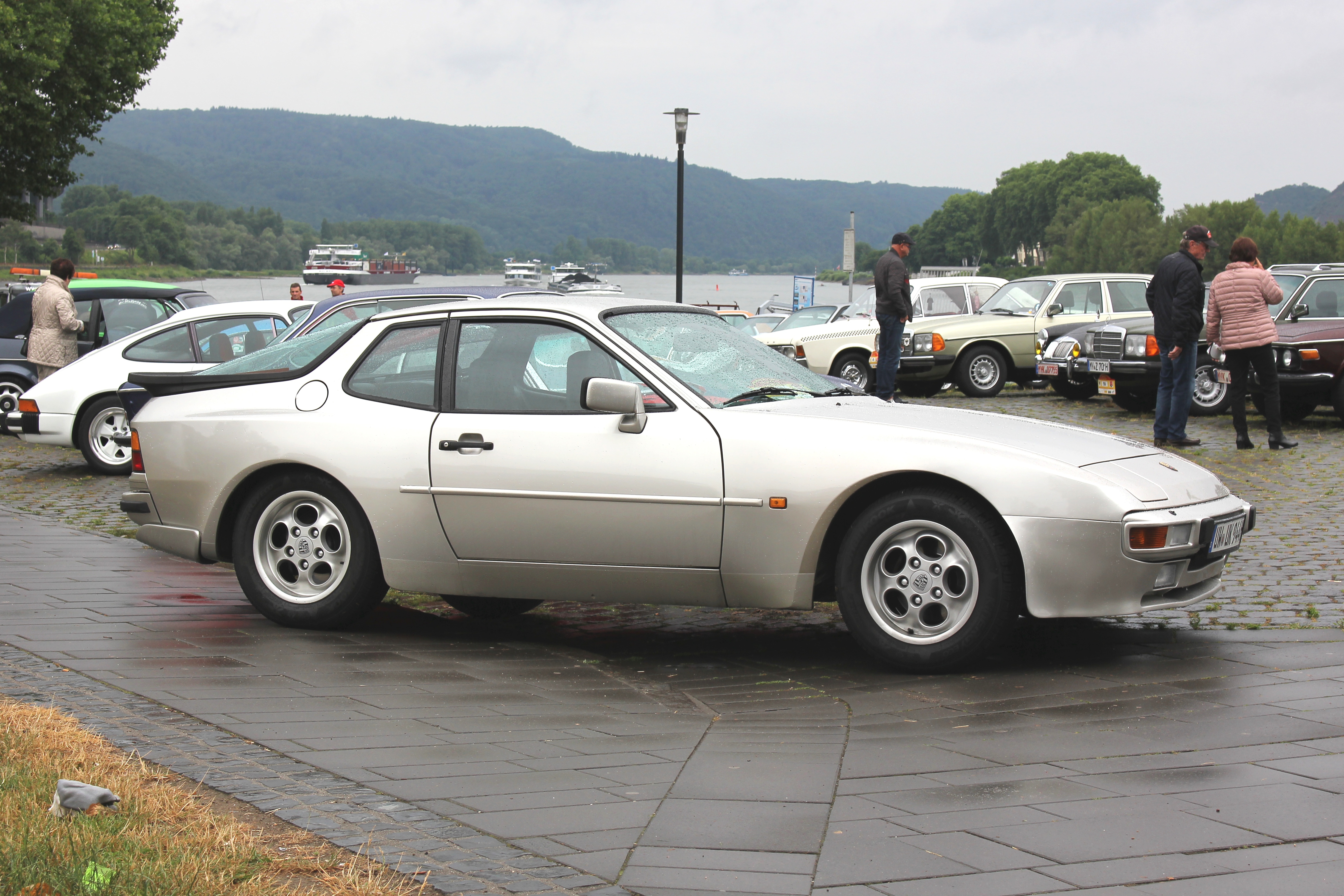
And one of my favorites, 1986 Porsche 944 Turbo,
Guard's Red, which is a very, or it's Porsche's Red.
Over black, garage cap, service and repair logbook,
2.5 liter turbo inline four, five speed manual,
timeless looks.
It's just a cool looking.
They took the 924 and made it cool.
It's just timeless design.
It really is.
It'll look at 50 years from now.
And this one is driver quality.
It's the paints a little, not perfect.
It's not in perfect cosmetic condition.
But you could just drive it and have fun with it.
Absolutely.
I mean, and it's a turbo.
So the value is there because of that.
So other new arrival, the 1935 Ford Model 48 3
window Deluxe Coupe, Royal Maroon Metallic
Overset, it's a beautiful car.
All steel build, 13,000 miles since the build.
Chop, shave and customize.
Got a 454 V8 in it.
Six speed manual transmission, which is unusual.
A lot of guys put automatic in these.
So this is a really well done hot rod, custom,
whatever you want to call it.
Turnkey show.
Turnkey ready to go.
Ready to rock.
Also last but not least, the 2017 Camaro 2SS 50th
anniversary edition convertible.
Nightfall gray metallic over ebony and gray,
27,340 actual miles.
The anniversary model, which is rare,
fully loaded 6.2 liter LT 1 V8.
Show and go, baby.
Yeah, only 800 about by 800 were produced.
Oh, wow, I didn't realize it was that low.
So next week we've been talking about,
we're going to Carmel.
Kathy and I are taking our first trip to Carmel.
Well, we were going to take you guys,
but then we found out the rooms were like one million
dollars a night.
Salinas, I'll stay in Salinas.
Good luck getting in every day for any events.
They say the traffic is just horrendous.
But we're really looking forward to it.
And we'll try to do some video reporting from there.
We'll see how it works out.
We watched the Billy Joel documentary.
Christy Brinkley was man in the camera,
so I told Kathy, you could be my Christy Brinkley.
So she didn't think that was very funny,
but I thought it was hilarious.
But I think that we're going to try
to give a perspective of somebody who's never been
to something that's pretty much the super bowl
of our industry and hobby.
Monterey car week as it's become is just,
it's auctions, it's concours, it shows,
it's Ferraris, it's Duesenbergs,
it's cars you never even heard of.
It's just, it's a melting pot of everything
going on in the car world.
And they say you can just watch and go out on
and highway one that comes into Carmel and Monterey
and just watch the cars coming in
as the car showing of itself just driving
down the highway.
Yep.
So think of the one you could have saved.
Yeah.
Exactly.
Watching on TV.
Yeah.
But you know, it's one of those things
you got to do once.
And maybe we'll go back.
Maybe we'll never go back.
Maybe this would be our one and done.
I never plan anything for a trip.
And literally I have an itinerary that's pages.
Nice.
That we're going to do where we're eating dinner,
where we're eating lunch, where we're eating breakfast.
What time we got to be there?
What time we're going to, because if you don't,
you'll find yourself, remember on New Year's Eve
when you were chasing the best party
and all of a sudden you realize it turned midnight,
you're in the car?
Yeah.
It's like, well, that didn't work out.
Yeah, if it's going to be so jammed,
you're not going to walk in anywhere.
No.
So it was some reservation.
Except Subway.
Subway is going to, yeah, Subway.
A maybe.
Hey, we were at Branson, like I said last weekend.
And it was no sales tax shopping weekend for back to school.
And of course, around here in Clothes are,
there's no sales tax in Pennsylvania on clothes.
Is that right?
Have you ever shopped here before?
Yes.
Who does your shopping?
Yeah.
But in Missouri, they have sales tax on clothing.
And they have the sales tax free weekends.
Long story short, it was really busy.
You couldn't go to Cracker Barrel or Denny's or Bob
Evans.
So but we thought, oh, go to Krispy Kreme Donut.
There was a line of like 100 people
inside the Krispy Kreme Donut.
Because the hot donut sign was on.
Oh, sure.
You got to have that.
They are good.
Krispy Kreme.
They are good.
They are delicious.
Do you think they turn that on when they're actually
ready?
Or does it just come off?
I don't know.
But they give good glaze.
Which Dunkin Donuts, in my opinion,
does not give good glaze.
I think their glaze is marginally good.
I don't even think they cook them in house.
Dunkin Donuts could be wrong.
But they're not our sponsor.
My first wife was a Dunkin Donut girl.
And she actually made them there.
But I don't know about these days.
I don't know any more.
So Hollywood Casino, Morgantown, they gave away.
They had the drawing last weekend.
They didn't take the car or the credit here.
They took the $40,000 casino credit.
But it worked out very well for the casino.
And they're happy.
And they want to have us back.
Especially because they get the $40,000 back.
Plus them.
Yeah, because you know if you're doing that.
So and don't forget, September the 19th, our auction.
We are getting lots of registered bidders.
Both online, by telephone, and in person.
We're moving the cars out to the front of our building under.
They're going to be on display all 100.
No reserve, absolute cars.
Most do not have titles, or keys, or batteries,
or anything else.
Seats.
So it is literally bring a trailer.
It's bring a trailer, baby.
That's trademark.
But we say bring a long thing to carry it.
Bring a long thing that has wheels underneath it, though.
Because it's going to be a lot of fun.
There's no charge to register to bid.
So most places charge you $25 or $50 or $400 out in Monterey.
Just to register to bid.
Plus you pay the commission, which is 10% or 12% out there.
Our commission is 8% buyer's fee in person.
10% if it's online or by telephone.
You can go to our website, classicautomall.com.
Get all the details on that.
And we're really looking forward to it.
We've got some great army trucks.
We've got some, there'll be some bargains.
And there'll be some stuff that we'll scratch our head and say,
boy, that brought more than we thought.
Some will bring exactly what we thought.
And some will think, man, that's probably a pretty good deal.
And to be clear, some actually run and have titles and keys.
Yeah, keys and batteries.
And some good ones in there.
And there are some good ones in there.
Some really interesting oddball pieces.
Most people will buy these to use for parts and stuff
like that, which they have a lot of great parts
on a lot of these.
Others will be used in parades.
And then there are ways you can get bonded and get
titles and all that.
We're not involved in that.
So we're selling them as is, where is.
With no title if they don't have it,
on a bill of sale only if they don't have a title.
If they do have a title, you'll get a title.
It'll be clearly marked.
We'll talk about it during the auction.
We'll make sure that you understand which one doesn't,
doesn't have it.
So, but get registered to bid.
We're going to a complimentary bidder's buffet
on Friday morning from 9 a.m. to 10 30 a.m.
And the auction will start at 11 a.m.
in the center hallway.
Vehicles will be staged outside.
They don't run across the block
because it's hard for some of them to run.
And they're big.
Sure.
We've got some army stuff that's huge.
It's big stuff.
It's big stuff.
Go to our website.
You'll see, just click on the auction tab up on the top
and you'll see everything.
And when we return, we'll talk to our friend,
Keith Martin from Sportscar Market Magazine.
We'll be back in a couple of minutes.
Here's a special offer from Sportscar Market Magazine.
Get a six month subscription for just $19.95
by going to sportscarmarket.com slash test drive
in the number six.
That's sportscarmarket.com slash test drive six.
If you're a buyer, a seller, or just general classic car
enthusiast, publisher Keith Martin says,
We've been around almost 40 years.
It's the Wall Street Journal of the collector car world.
Activate your six month trial of Sportscar Market Magazine
by going to sportscarmarket.com slash test drive six.
That's sportscarmarket.com slash test drive
in the number six.
Offers for a limited time.
Be in the know with Sportscar Market.
This is the Classic Automall Show.
If you have questions or comments,
write podcast at classicautomall.com.
And we're back with the Classic Automall Show.
Joining us via Zoom, our buddy out on the left coast,
Mr. Keith Martin, editor, publisher,
publisher of Sportscar Market Magazine
and our favorite magazine in the whole wide world.
I've got my copy.
I got my guide to Monterey when I go to Monterey
next week so I can do everything that you tell me to do.
Don't you think that's the best guide ever?
It is absolutely the best guide ever.
You did a fantastic job on it.
And it's only gotten better.
I like the fact that you list them chronologically
when you're writing about them.
And then you have the nice chart
that shows everything on the overlaps and things like that
so you can plan your day so much better.
That chart is one of the things
that I'm proudest of of all my year
because it took away to make Monterey comprehensible.
Right.
And it's hard to create an understandable chart.
Those things look like they're easily done
when you look at the finished product.
But try to make one.
They're very difficult to put everything in the right order
and what goes in a column and what goes in a line
and yada-yada-yada, right?
Well, I have a secret for you.
If you want to always get along with my art department,
never ask them what they think of making that chart.
Least favorite thing on their agenda, right?
Every year I get the list of contents
and there's no chart on it.
I said, what happened to the chart?
Oh, do you want the chart this year?
Oh, we didn't realize you still wanted the chart.
No, we've only been doing it for 30 years, guys.
We didn't.
We changed our mind.
So we bring your blog to life every week.
Well, we missed last week because we were out of town.
But anyway, this week your blog is
What Cut Off Year on a Collector Car Tour,
which is really relevant today
because there's a lot of cars that fit into tours
that are maybe different than the older cars, right?
Well, in the past, our tours were cut off at 74.
And we're looking to do a tour a couple years out from now.
And we've been thinking about that.
If it's 74 and back, the good thing about it
is that the performance envelope of all the cars
is pretty similar.
They all have kind of crappy brakes.
They don't really go that fast.
They have skinny tires.
They kind of hold everybody together.
If you let in cars from the 2000s and later in supercars,
now you've got a totally different mindset
and a totally different performance envelope.
Yeah.
It's one of those things that if you've
got a car that will go 200 miles an hour and a car that
will go 80 miles an hour, then that makes it difficult
to keep everybody together and to give everybody
an enjoyable experience to the event, right?
It's no fun to be in an older car
and having all these fast cars just blowing by you
like you're standing still.
It's nerve-wracking.
I can only imagine being at Le Mans or Daytona
when you're in the low on the totem pole class
and the big hypercars are coming past you five times
your speed.
That's not comfortable.
So let me tell you what I'm thinking of, Stuart,
and tell me your opinion.
I'm thinking of changing the cutoff date to 92
because 92 is the year of the NSX and would let
McLaren F1 in and running the people out in two groups.
Say we have 50 cars.
Have the guys that want to run fast and then
the newer cars go first and then half an hour later
have the older cars go as a group.
That's a great idea.
I think that that gives everybody a fun experience
because ultimately, if it's not fun,
if your nerves are shot because you're being passed
or if you just haven't enjoyed it,
then you're not coming back.
The whole reason you're doing it is for enjoyment.
Not for, there's no job, you're not getting paid
for it, it's not racing, it's enjoyable.
And if it's not enjoyable, which it wouldn't be
when you got all these fast cars going past you,
then I see your point.
I think it's a very valid point.
My rule of thumb is the comfort of the navigator
determines the pace of the driver.
Right.
If the navigator is uncomfortable in any way,
then you have to slow down because they have no control
and you're making the day uncomfortable for them
and that's not fair.
And I would venture to guess that if you were a navigator
for a rally team, then you would be a bundle
of nerves every day.
Those guys must take Xanax or something
before they get out.
Well, actually it's different.
What's happening now with technology?
I know Tim Sutter with Classic Motorsports on his tours,
they give people a Garmin that's got the route
pre-programmed into it at the start of the route,
at the start of the event,
and then collect them all at the end of the event.
That's a great idea.
I mean, how simple.
Yeah, it really is because nothing worse
than trying to figure out something, again,
if it's not fun, what's the enjoyment?
Yes, you want to make turns
and yes, you want to go on covered bridges
and you want to do all that stuff,
but you certainly don't want to be lost
and going the wrong direction
and hold everybody up and everybody's waiting
for you for lunch and all of that.
That's very well said.
And we've all been in all those positions
and you need a good route book as a point of reference
with odometer readings in the book and so forth,
but I have found in a couple of tours
I've gone on recently where they've had a GPS,
it's really quite wonderful.
Right, yeah, you can concentrate on driving
and enjoying and seeing the scenery.
I mean, the navigator shouldn't be relegated
to this the whole time.
No, that's right.
And it's important, as you said,
it's important to remember this is supposed to be fun.
Right, exactly.
So you've done, how many rallies have you all done in the past?
You've done four or five of them, haven't you?
Four SCM 1000s.
Right.
And we thought we'd take a break after the last one
and this is a top secret,
so if I say it to you, nobody else will hear, right?
Of course not, it's our little low show,
nobody's paying attention.
So my editor in chief, Jeff Sabatini, said to me,
no more rallies ever, no more rallies ever.
And I said, okay, okay, he said,
of course we do have a 40th anniversary coming up in 2028.
To me, that was like permission.
It's like when your wife says that's a pretty car,
that means you can buy it.
That means you're okay to buy it.
And it's important for those guys,
for you not to come in and say iron fist,
we're gonna do this because we've always done it.
No, you gotta let your guys ebb and flow
and feel like they're participating
and that they have a say in what goes on.
And then they tell you there's a reason
they don't wanna do it, there's a good reason
they don't wanna do it.
Yeah, I will tell you, doing a five or six day rally
for a 50 car, which is 100 people,
the overall cost of that, by the time all the dust settled
was $400,000.
Yeah, unbelievable.
And it's a lot of work.
Hotel meals are a hundred bucks a piece.
When you're banquet rooms, rooms are three to 500
bucks a piece.
I mean, it just becomes a lot of work.
And so we've really, if we do a 2028 SCM 40,
we've really got our thinking caps on
on how to reduce the cost, increase the fun factor.
I'm thinking of doing, adding an extra day as a day off
where people could either go driving
where they could do golf, whitewater rafting,
fly fishing, just something for the fun factor.
Right, exactly.
You gotta leave a little time in there
for something other than just driving.
If you're just driving for 12 hours a day every day
and through the rain and the sleet and the snow
and whatever, at some point in time,
you're gonna say, I've had about enough of that.
You said yourself, I'm paying for this?
Yeah, well, you could also, you know,
I mean, you could dumb down the menus
and take them to Applebee's and save you some money there.
Lunch on your own at McDonald's.
Exactly.
You know, it's funny that these events,
I mean, they just keep trying to outdo each other
and they become more expensive hotels,
more expensive meals, better wines.
You know, the whole nine yards before you know it,
like you said, it's $400,000
to put on an event like this.
Well, California Millie is now $15,000 as an entry fee.
Wow.
How many cars?
How many cars?
Maybe 60.
Yeah.
Think about it, if that's 15 grand,
you haven't shipped your car yet.
Right.
You haven't flown out yet and back.
Right.
So you're talking 20 grand before you even,
before you turn a wheel.
And then you got shopping, you know,
you're gonna do some shopping,
so there's another one.
Yeah, and then maybe buy a car.
Yeah, of course you're gonna buy a car, right?
I'm really working hard on this concept on 2028
to try to figure out how to keep the cost down
and the pleasure up.
Right.
I don't want it to be a Rolex lunch every day.
Right, exactly.
Because at the end of the,
when I used to do the California Millie,
it was all about the driving.
Right.
Ultimately.
And so I'm just trying to find the balance
where it's affordable, but the fun factor is high.
Right.
Well, and I think if you do that where it's,
it doesn't have to be,
nobody eats four, five star meals,
three meals a day, seven days a week.
You know, it just,
it's not, it's not realistic to have people do that
even though that's what they end up doing.
And it's, I think you're way,
I think it's wasteful.
I think that you could,
you could better plan a picnic type lunch
or something for the participants every a couple of days
and not make it so over the top every meal
and not have to outdo each meal.
Well, what do you think about this?
Like part of the big expanse is when you do
a big fancy breakfast every day.
Right.
Because it's $100 bucks a plate.
And I'm wondering if we just don't tell people
this is coffee and croissants breakfast
and get in your car and go.
And let's go.
Yeah.
And we'll get a good lunch, you know,
we'll get somewhere and get a good lunch.
And here, you know, and maybe you do that
and you give them a little bag of something,
some granola bars or something
to kind of tide them over as they go.
But don't make it such a big deal
because think about it.
If you're gone,
how many days is your rally five days?
I have to six days.
Yeah.
So, I mean, that's six breakfast times $100
or times, let's say $50 a person, you know,
and times, I mean, that's a lot of money.
It's a lot of money and you have to ask yourself
because it's not going to be a gourmet meal.
Right.
So, what you're paying for is the transportation
and the setup.
Exactly.
Yeah, I think that you can overthink these things
and I think that sounds like a much better plan
and it can save you probably thousands of dollars
and it won't change anything
because most people don't even eat breakfast anyway.
They grab a cup of coffee and go.
Well, a friend of mine said
the problem he has with tours
is he always gains weight on them.
Exactly.
So, don't bring the baby bird Thunderbird
because you'll never get an in and out of it, right?
No, that's right.
What do you think of the concept of a day off?
I think a day off is great
and I think it shouldn't be at the end.
I think it should be in the middle.
I think you should do two days and then a day off
and then three days or whatever it is.
So, yeah.
All right.
So, we've solved all the rally problems in the world.
Thank you.
You're welcome to all the rally people in the world
that we've just helped you.
Just send your money to the stores.
Yeah, just send it to me
and I'll send you half.
So, we'll cover you.
Keith Martin, everybody from Sports Car Market Magazine.
Thanks so much for joining us
and we will catch you two weeks from today
because we're going to be in Monterey next week.
So, we'll see you in two weeks.
All right, take care.
See ya.
The Classic Automall Show
with their host, Stuart Howden,
executive producer, Steve Sefair.
Produced and engineered by your truly JR Russ.
Video editor, Randy Lamby.
Available on ClassicAutomall.com,
YouTube or wherever you get your podcasts.
Music, courtesy of the Pat Travers Band
for tour dates, contact and stuff,
visit pattravers.com.
Produced by Car Smarts Media,
copyright all rights reserved.
Learn how thousands of smart homeowners
are investing about a dollar
to avoid expensive home repair bills.
John, a former non-customer said,
my air conditioner broke and I had to spend $1,900 to fix it.
Jeff, a customer wrote,
my air conditioner broke and I got a new one
at no out of pocket cost.
Mary, a former non-customer wrote,
my heating system stopped running.
I had to spend $3,000 to get a new one.
Lisa, a customer wrote, my heater stopped working.
I got it fixed at no out of pocket cost.
800-814-5615.
800-814-5615.
For about $1 a day,
you can have all the major appliances
and systems in your home guaranteed fixed or replaced.
Call now.
If the lines are busy, please call back.
Call the home warranty hotline now at 800-814-5615.
That's 800-814-5615.
About this episode
Erik Buell, founder of Buell Motorcycles and Erik Buell Racing, shares his journey from working at Harley-Davidson to creating his own motorcycle brand. He discusses the challenges of engineering, the evolution of motorcycle design, and his passion for music. Keith Martin from Sports Car Market joins to discuss the complexities of organizing car rallies and the importance of balancing cost and enjoyment for participants. The episode is filled with insights on the automotive industry, motorcycle history, and the camaraderie of car enthusiasts.
Show #205 Airdate 08-06-2025. Stewart welcomes Erik Buell, Motorcycle Designer and Manufacturer, Racer, Musician and Actor. They discuss his time at #HarleyDavidson, his own brand #Buell, corporate egos and planning and testing a motorcycle at #Talladega at 179mph! + Keith Martin of Sports Car Market's #specialoffer plus insights on classic tours and rallies. @Porsche https://www.buellmotorcycle.com https://www.sportscarmarket.com/testdrive6
Erik Buell, founder of Buell Motorcycle Company which was sold to Harley Davidson, joins Stewart to discuss his career on another great episode. Erik started as a musician, but soon grew tired of the lifestyle and became an engineer for Harley Davidson before starting Buell Motorcycle Company and then Erik Buell Racing after he sold to Harley Davidson. He is also a musician.
Buell is a member of the AMA Motorcycle Hall of Fame and was inducted in 2002. Erik is an honored guest this year at the 2025 Radnor Hunt Concours d’Elegance in Malvern, PA. They even have a class for Moon Motorcycles.
The first Buell Motorcycles were Formula One biked with Harley Davidson engines. He talks about the difference between Yamaha and Ducati and what he liked and disliked about each bike. He discusses the powerband of the bikes and how they rode.
Stewart and Erik discuss the rise and fall and ups and downs of Harley Davidson and what made them incredibly successful, as well as mistakes that hurt them and things they did that made them so popular. Harley Davidson went bankrupt in the early 1980s before rising to incredible popularity. Erik brought his racing mentality to Harley Davidson that helped their design and performance. Erik had just come off Formula One racing and really tried to put the bikes to the test.
The first Buell Motorcycle he built was the RW 750 and it did 178 miles per hour at Talladega and it could have gone faster but they ran out of gearing. The bike probably could have gone 190 miles per hour and had 165 horsepower.
Harley-Davidson sold Buell brand motorcycles through their dealerships. Harley eventually purchased Buell Motorcycle Company and Erik Buell went back to work for Harley Davidson. Jeff Bleustein who was CEO or Harley-Davidson at the time
Buell started a powertrain with Porsche that became the V-Rod and led to the Revolution motor, which was a 60 degree V-Twin. Harley executives wanted the engine, but they didn’t realize that their customer base didn’t want it.
GET OUR FREE APP: https://ClassicAutoMall.appimize.app When it opens click on the ORANGE button to install on your phone or computer for DIRECT ACCESS to our VIDEO and AUDIO shows and our website.
CONTENT NOTE: Contests, Prizes, Offers, Vehicles & other items may no longer be available or offered after each show's original broadcast or posting date.
Recorded in our Showcase Studio just inside the entrance of the Classic Auto Mall in Morgantown, PA, Host Stewart Howden, Classic Auto Mall President and Classic Car Specialist Steve Saffier talk about this unique and amazing place often with amazing guests.
YES...Classic Auto Mall is a REAL former shopping mall that covers almost EIGHT football fields with an average of nearly ONE THOUSAND classic vehicles under one, climate controlled roof and they're all FOR SALE!
Be sure to LIKE and SUBSCRIBE to be informed of new episodes and SEE them on the Classic Auto Mall YouTube Channel. We also invite you to VISIT US IN PERSON at Classic Auto Mall, one hour west of Philadelphia at PA Turnpike Exit #298, VISIT us online at ClassicAutoMall.com or talk to real, live people about visiting, buying or selling your classic on consignment at 888-227-0914.