The Toyota RAV4 Hybrid is a type of car that uses both gas and electricity to run, making it more fuel-efficient. It's a popular choice for families because it has a lot of space and safety features.
The Toyota Highlander Hybrid is a type of SUV that uses both gas and electricity to run, which helps save on fuel. The 2021 version has many modern features that make it safe and comfortable for families.
A high voltage battery is a special type of battery used in hybrid and electric cars. It stores a lot of energy to help power the car's electric motor.
A 12 volt battery is the regular battery found in most cars. It helps start the engine and powers things like the lights and radio, and it needs to be checked and replaced sometimes.
The check engine light is a light on your car's dashboard that tells you something might be wrong with the engine. It could be a small issue or something more serious, and you usually need to have it checked by a mechanic.
An O2 sensor is a part of your car that checks how much oxygen is in the exhaust. It helps the car's computer manage fuel use and keep emissions low. If it fails, it can cause the check engine light to come on.
An oil filter helps keep the oil in your car clean by removing dirt and debris. Some people wonder if it's better to use the filter made by the car's manufacturer or if other brands are just as good.
Aftermarket options are parts made by other companies that you can use instead of the original parts from the car's manufacturer. They can sometimes be cheaper or offer different benefits.
The Jeep Wrangler Unlimited is a larger version of the Jeep Wrangler that has four doors. It's designed for off-road driving and is popular for its tough look and ability to handle rough terrain.
All-wheel drive means that power goes to all four wheels of the car, which helps it grip the road better, especially in bad weather like rain or snow. It's useful for driving on different types of surfaces.
Four-wheel drive means that all four wheels of the car can get power from the engine, which helps when driving on rough or slippery surfaces. It's often used in trucks and SUVs for off-roading.
Coolant is a special liquid that helps keep your car's engine from getting too hot. It moves around the engine and radiator to keep everything running smoothly.
An EV, or electric vehicle, is a car that runs on electricity instead of gas. It uses big batteries to power the car, and you can charge it at home or at special charging spots.
Struts are parts of the car's suspension that help absorb bumps in the road and keep the car stable. They work with other parts to make the ride smoother.
Bushings are small parts in a car's suspension that help make the ride smoother by reducing noise and vibrations. They act like cushions between different metal parts.
The GMC Sierra is a large truck that's great for carrying heavy loads. The 2017 version has different engine choices and some cool tech features to help with towing.
Flushing is when you clean out the old fluids in a car to get rid of dirt and make sure everything works well. It's like giving the car's systems a fresh start.
The temperature gauge tells you how hot the engine is running. If it's showing a lower temperature than usual, it could mean there's a problem with the engine's cooling system.
A thermostat helps keep the engine at the right temperature by controlling the flow of coolant. If it doesn't work properly, the engine might not heat up enough, especially in cold weather.
The Buick Encore is a small SUV that is easy to drive and has a lot of features. It's a good option for people who want a vehicle that is practical and can fit in tight spaces.
Direct injection means the gas goes straight into the engine's combustion chamber, which helps the car use fuel more efficiently and can make it run better.
TPMS is a system that checks if your tires have enough air. If one tire is low on air, it will warn you so you can fill it up and stay safe while driving.
These are small devices in your tires that check how much air is inside. They help keep your tires at the right pressure, which is important for safety and fuel efficiency.
A three quarter ton truck is a type of pickup truck that can carry more weight than smaller trucks. It's good for hauling heavy items or towing trailers.
PSI means how much air pressure is in your tires. It's important to have the right amount of air in your tires for safe driving and better gas mileage.
A clay bar is a special tool that helps clean your car's paint by removing dirt and other stuff stuck to it. It's used before waxing to make sure the wax sticks better and the car looks smoother.
LIVE
Guys, it's no use putting it off.
The best time for an underwear refresh is now.
Tommy John Underwear is designed for a perfect fit that stays put all day.
They're zero-chave thanks to four times more stretch than competing brands,
and their innovative horizontal quick-draw fly is a game changer.
With over 30 million pairs sold, there are thousands of men out there more comfortable than you.
Don't settle for less.
Go to TommyJohn.com today for 25% off your first order with Code Comfort.
That's TommyJohn.com Code Comfort.
Tommy John. Comfort. Perfected.
Ring Central will completely transform the way you work.
It gives you built-in AI across all your business conversations.
Your phone system has an AI receptionist that answers calls 24-7.
Your video meetings have AI that takes notes instantly.
Even your contact center has AI, so you can help customers faster.
It all comes together in one reliable platform for effortless AI communications.
See for yourself at ringcentral.com.
Ring Central. Voice of your business.
This episode is brought to you by Progressive Insurance.
What if comparing car insurance rates was as easy as putting on your favorite podcast?
With Progressive, it is.
Just visit the Progressive website to quote with all the coverages you want.
You'll see Progressive's direct rate, then their tool will provide options from other companies
so you can compare.
All you need to do is choose the rate and coverage you like.
Quote today at Progressive.com to join the over 28 million drivers who trust Progressive.
Progressive Casualty Insurance Company and Affiliates.
Comparison rates not available in all states or situations.
Prices vary based on how you buy.
It's another Saturday morning in C.C.O. Atlanta, cold when now 15 below zero
here in the Twin Cities and we are just getting underway of our car care show.
Denny Long here along with AOC certified technician Nick Stoffel from Lloyds Automotive.
Nick, good morning.
I saw you just a few days ago at Lloyds on a very chilly day when I had made the appointment
to get my oil changed.
Of course, I didn't plan on it being a million below zero.
But boy, you and your crew there were pretty busy.
Yeah, we're fortunate to stay busy most of the time but this cold weather will
definitely increase our need for help with batteries and such and we'll see what
the weekend holds and come Monday and something else that'll warm up by the end of the week.
So just be patient.
It'll warm up.
This might take a few days.
We are already starting to get cold weather questions.
If you have any kind of a car care court, any kind could be related to cold weather.
Your car, your truck, your van, you're having some problems with it.
You want to know what it could be ailing before you bring them for service.
Call us or text us and you know our time goes by so quickly.
I always like to say call or text Nick sooner rather than later because Nick will take his
leave about 7.45 making way for Ted Ferrell's wine chat.
So call us, text us any kind of a car care question that is on your mind.
Here is the number for either the phone call or text 651-461-9226.
I'm looking at a text that came in earlier this morning and it's a good question.
When starting a vehicle in this cold weather is it better to crank it a few seconds at a
time or just keep cranking?
What would you recommend?
Well, I would hope that if everything's working right after a few seconds the vehicle should
start up.
So typically if it's a push button start, which most vehicles are these days, you
push the button, release it, the vehicle will crank itself and fire itself up.
If it's an older vehicle you turn in the key, you know my opinion that would
crank it through that 3-4 seconds and it should fire up.
If it's not firing up maybe pause for a few moments, try it again.
But if it's continuously doing that I think you might have something that needs a maintenance.
I'm looking at a very long text so maybe I can condense it.
It's about a 2019 Toyota RAV4 hybrid.
Driving it for a few minutes here and there yesterday, I believe it was, it was fine
and then left it for four or five hours and it wouldn't start.
A friend said there are some service bulletins out about that very product, a problem rather.
Do you have, meaning you Nick, have any knowledge of this and how do you find out
about these bulletins that this person should look into?
I'm not aware of that particular issue.
Service bulletins are readily available online.
We have subscriptions so we can get all the detailed information.
But if you're having a sudden issue, I would, you know, reach out to your dealership, your
shop, your mechanic, see what they have access to, maybe they can email and share that with
you.
But, you know, I would probably follow up on that because a lot of times with a service
bulletin it also has a recommended remedy.
So if there's a certain adjustment or a service or repair needs to be performed,
especially with the cold weather we're having, you don't want to have a situation where
you're stranded.
So I would probably come Monday morning get on somebody's schedule to have that taken care
of.
Knowing our listeners, our smart listeners, we may have other listeners who have had
similar cold weather starting problems with their RAV4 hybrid.
So maybe they've got an answer.
But I guess the question is from me, not only from the listener, is it up to the
driver, the car owner, to search for the vehicle or should the manufacturer and
or the dealer get a hold of that, the owner of that vehicle?
Well, I do believe if there's an actual recall, the owner of the vehicle is notified,
I mean if there's a postcard that notifies you that there's an open recall on the
vehicle.
But service bulletins, a lot of times there will be numerous bulletins released on
certain description of issues or situations to help the mechanic or the shop,
the dealership find a remedy.
Now not all service bulletins are particular to your market, your region.
So they're not going to over notify you of all these potential problems because your
vehicle may not have that equipment, you may not live in that part of the country.
So a lot of times if you go in and you have a problem, what we do is that we'll
take a look for service bulletins, find that information, see if it's relevant
to what we're working on and then notify the customer to deal with it
accordingly.
All right, again 6514619226, Nick Stoffel from Lloyd's answering those car care
questions.
A listener says it's sent this via text.
How do you check the battery on a 2021 Toyota Highlander hybrid?
Should it last five years and how do you access it to check it?
That comes from Phyllis.
So you know, we'll get a lot of questions about batteries and hybrids.
There are two separate batteries of the high voltage battery that operates the
hybrid system.
That's nothing that the general public, the driver of the vehicle should deal
with.
That's just to be left alone.
The 12 volt battery, which we've had in vehicles forever is something that needs
to be maintained depending on the location.
You know, as we remember, they used to be under the hood of the vehicle,
but as they've tried to balance the weight of the vehicle, you know,
they have moved the battery.
A lot of times it might be located in the rear of the vehicle in the trunk
area.
There's even underneath like a seat of the vehicle to try to balance that
weight.
And then we have our handheld tester that we can use to measure the capacity
of the battery, the impedance, which is resistance as the battery's age
that will change.
And it'll notify us whether or not that battery's paths are failed.
In our market, our climate, I think a five-year battery on a standard
battery is probably a pretty good life.
Some of the AGM, which is a little different technology, might last
longer.
That being said, there are also some vehicles that we see that maybe the
capacity of the battery was designed isn't sufficient.
So you might see only four years out of it.
So there isn't a set number, but I think if you're getting four to six
years on the battery, that's a pretty good longevity.
Yeah, I'd say.
Let's understand this in via text.
The check engine light came on.
Does not say what kind of vehicle this is.
The check engine light came on eight days ago.
I had the code read it said an O2 sensor, and then the light went
out in four days before that light came back on.
Can you give me some comments, Texas, as on a check engine light O2
sensor?
So the car does its self-testing.
And if it sees the parameters on any area of the vehicle it doesn't
like, it might flag a code, which we'll turn the light on.
Every time we restart the vehicle, every time we have that particular
drive cycle to perform that test again, it will test it again.
If it meets the parameter and says, no, there's not an issue here,
the light's going to go off.
So you might have an issue with a particular sensor component that's
on the cusp or on the verge of being out of specification.
The car's picking up on that.
The light was on.
Now it's off.
It might go another month.
It might come back on.
So I would just kind of maybe make a journal document, hey,
on these cold days in January, this is what happened.
Maybe it's good for the rest of the year.
You have no problems or you might notice again, like I said,
in a couple of weeks it pops back on.
Maybe make more of it again.
If it's becoming more regular, I'd probably get on the schedule
somewhere, have them retrieve the code and all the data that
was stored when that code was set, they can do some testing
and provide you with better information to determine what
needs to be repaired.
Very good.
Nick, we need to take a quick break.
Let's invite our listeners to join in on this conversation
at any kind of a car care question.
Maybe something you always wanted to ask a mechanic.
Now is your chance.
Get some free advice here from Nick Stoffel
from Lloyd's Automotive at 6514619226.
Right now in the Twin Cities, it is 15 below zero officially
at the airport.
And we're looking at a high, if you want to call it that,
of two below.
But believe it or not, tomorrow we're
going to get up to five above.
Again, right now in the Twin Cities, it's a minus 15.
They do not mention any wind chill, I guess,
because the wind is pretty low.
They're only southwest at three.
Again, the minus 15 from Newstalk A3OWCCO.
Have a good Saturday morning to you.
Thanks for joining us.
We're in the midst of our car care show.
We are here every Saturday.
We're right after the 7 o'clock news break.
Thanks to Nick Stoffel from Lloyd's Automotive
for helping our listeners out to every single Saturday
morning.
Nick, today is no exception.
We have a bunch of questions we want to get answered.
But for those folks that need to get in touch with you
guys at Lloyd's, how do we do that?
Yes, sir.
So if you ever have a question or need some advice
you can always call, we'll help you.
651-228-1316.
And if you're in St. Paul, we're
at 982 Grand Avenue.
That's on the corner of Grand and Chatsworth.
Stop and say hi.
And if you need more information,
please check out our website, which is LloydsAutomotive.net.
We will get you that same information before Nick
takes his leave, which is about 745.
So stay with us.
Call us, text us, 651-461-9226.
Listener sent this in.
Is the car manufacturer's oil filter a good choice?
That is a good question.
Is OEM always or not necessarily a good choice?
No, I think it's a fair, it's a known entity,
it's a known quality.
So if you're most comfortable using that filter,
I don't think there's an issue with it.
There are plenty and a lot of other options that are as good.
And that being said, there are some that may be known as that.
So a lot of times if you don't know,
you can use price point to kind of gauge that.
You can determine what the cost of the OEM filter is.
You can look at some of the aftermarket options.
You can ask the parts people, parts department,
they can kind of help navigate that.
But if you're not completely sure
and the OEM filter is an option,
it's always a safe option.
Okay, love the show.
Thank you.
Here's a 2019 Jeep Wrangler Unlimited four wheel high.
Is this like all wheel drive?
The question is, is it okay to drive
in four wheel high for long periods of time?
And at what speeds?
Yeah, I would say most vehicles on the road today,
if you're an all wheel drive or four wheel drive,
it's fine to be driven as such,
especially with the roads as they are.
Probably not a bad idea.
But as a pavement drives out
and you have the all wheel drive
or on the demand drive
or even sometimes two wheel drive might be a better option.
But I don't think you're gonna damage anything
or cause any issues,
probably affects the fuel economy, something to be honest.
So not necessary when the roads are dry,
but in the winter months,
when there's no nice covered,
probably not the worst idea.
Somebody sent in a, just a fun question for Nick.
The lowest recorded temperature in Minnesota,
60 below zero, that's six zero in tower Minnesota,
would even a modern day car start at that temperature?
If so, what about all the fluids?
My mechanic says my coolant is only good to 40 below.
How about an EV card?
Does the battery freeze up at that temperature?
Some interesting questions,
I hope we don't have to find that out.
I must say, first of all, I don't wanna know.
I don't wanna have to find out.
But the other thought too is like,
when it hit 60 below, that was a moment.
It worked its way down, worked its way back up.
That coolant is only good at certain,
or protected to a certain temperature level.
I can't imagine us having sustained temperatures
and I don't remember.
I think that was in the early nineties when that happened.
How long it was, 40 below or greater.
I know when you get to Northern Minnesota,
it will flirt with those temperatures in the winter.
So, I don't know what would happen.
Obviously, a vehicle that has a worn battery,
aged and worn spark plugs,
the coolant has to have been so original.
Going back to that whole maintenance conversation,
if the cars maintain,
I'd like to believe it's gonna start as we need it.
Obviously, the very extreme extremes, maybe not.
But if a car's not maintained,
even in the moderate temperatures, we might have problems.
So, you keep on top of your maintenance
and confident your vehicle will be there when you need it.
I feel like my timing was good for once.
I just had my vehicle, my car's oil changed at Lloyd's
when I saw you just a few days ago.
Well, it sits outside,
and I don't know if I've ever experienced this.
And another listener sent this
and does a couple of questions.
Does brake fluid freeze?
Does transmission fluid freeze?
As my car sat out there all night
and thanks to the newer battery that Lloyd's put in,
it did start.
It didn't want to, but it did kick in pretty quickly.
But that car did not want to move.
And I sat there for probably about good six minutes
of warming it up.
Maybe I shouldn't have, but I'll tell you what.
It seemed like things were just totally like glue.
Does that happen with all the fluids?
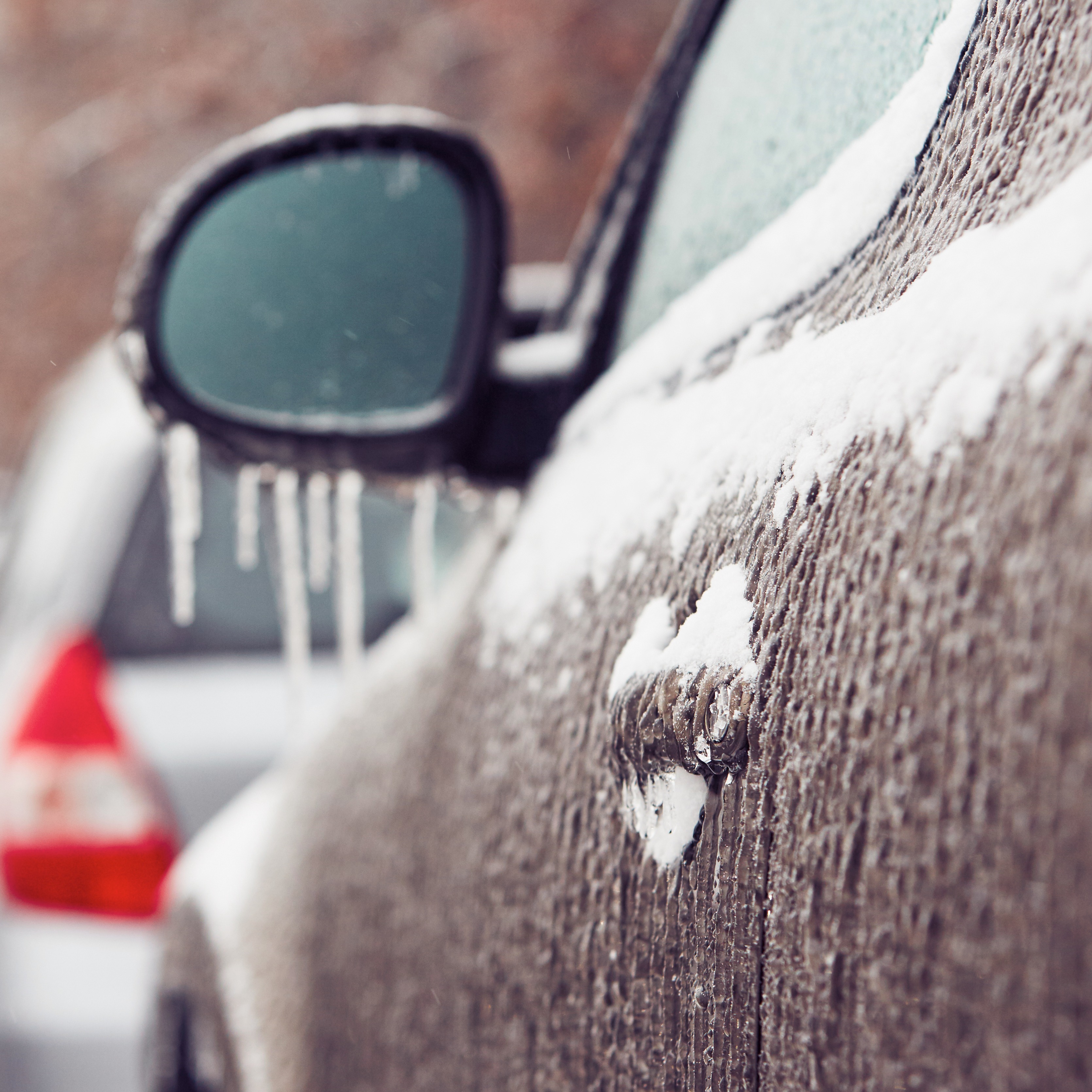
Yeah, they don't necessarily freeze,
but they definitely thicken up.
And the vehicle I've just been running for a few moments
and the things kind of loosened up with the fluids,
it's probably fine.
But the suspension, the bushings, the struts,
the seat of your car stiff, right?
I mean, so we're all kind of in the same boat.
We all have the same scenarios.
I think you let the car run as long as you need
until you're comfortable.
Definitely, the car needs to run long enough
until the windows are clear
so you can see where you're headed.
So we all know that, can we see driving down the road
with you can't see on this window
and you're thinking, oh goodness.
But honestly, I think if you let it run
until you're comfortable, the windows are clear.
The car itself is ready to go at that point.
All right.
This text here says, good morning.
The cars are full of salt.
I have a heated garage.
Next week when the temperatures hit 13,
could I wash the cars,
put them back in the heated garage,
or could I do more harm?
I worry about the salt under the car.
That comes from Ken from Hastings.
Well, I always, never used to,
but since you and I have talked on the show,
I always, when I do get a car wash,
get that underbody one.
Don't you recommend that as well, Nick?
Absolutely, that extra dollar or whatever it is,
obviously, days like today,
the car wash is probably closed
and that's for good reason.
We don't want doors freezing up
and windows freezing up,
but when the temperatures warm up a little bit,
it's still willing a few days
having the vehicle washed.
My truck sits outside also,
but I will wash it pretty much year round.
I wouldn't do it today,
but later at the end of the week here,
I will run it through the wash,
get some of that salt off,
get that underbody wash
where it sprays all the salt and stuff
out of those nooks and crannies
because that's where that salt will sit in
to start to create corrosion,
which also becomes rust.
I think temperatures allow,
if you see the line at the car wash,
that's when you should go with the line as short,
but that's when you should get in there
and have that thing rinse off and clean up.
Yeah, absolutely.
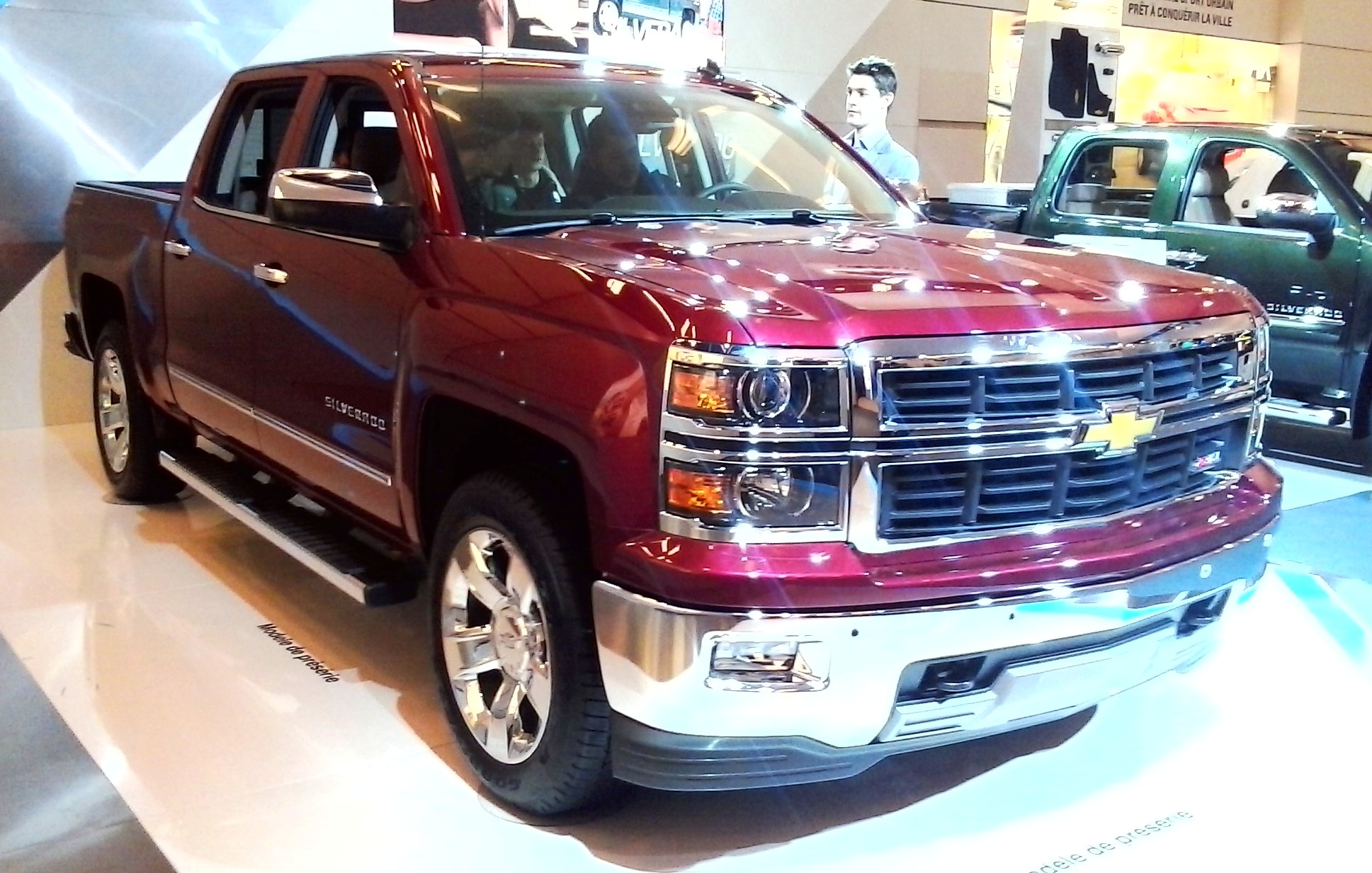
Here's the 2017 GMC Sierra,
had all the fluids flushed
and changed by a local dealership last fall.
Well, now the temperature gauge shows the engine
does not get as warm as before being flushed.
The air from the heater in the cab is not as warm also.
What could be the cause and the solution?
Well, I suspect it may be related,
but I also suspect maybe at the age of the mileage,
maybe the thermostat has seen better life
meaning that that wax pellet isn't doing its job,
but that thermostat is bypassing.
What I mean by that is it's allowing the coolant
to circulate before it's up to running temp.
It's hard, especially in the winter months,
for the engine to reach that temperature
if that thermostat's not properly regulating.
So I would take it in,
they can take actual temperature readings
before and after the thermostat,
determine if that is bypassing.
If it is, it needs to have a replacement.
You get them properly working thermostat in there.
It'll stay closed up until the right temperature
when the vehicle is at running temp.
Then you have good heat, the thermostat will open,
allow that coolant to circulate
as needed to keep it from overheating.
But for this bypassing, it's very difficult,
especially on cold days like today,
especially if you're out on the road
with all that airflow to get the vehicle
up to running temp.
So I would probably share that story
and see what they recommend.
All right, looking at a text that's kind of spread out
so bear with me.
The text just says, I'm down in Florida
listening on Odyssey app.
Thank you, good for you.
I drove here and changed my oil
and it was one and a half quarts low.
Never had this before, this trip.
Heading back soon, not that I want to.
It's too cold in Minnesota.
Could the 1700 mile drive straight only stopping for gas
cause this more than stopping along the way?
It's a 2012 Silverado half ton.
What do you think about the oil level there?
No, I don't know yet.
I guess what I would do personally
if I noticed that was a situation on your drive back
and you stopped to fill up checked oil.
Make sure you grab a cart or two
so you have the right weight of oil that you need.
And as needed, you don't need to top it up
every quarter or every half.
But if it gets down to full quarter of oil,
I would top it off.
When you get back, talk to your dealership,
share that, I mean, I drove down,
here's the situation I had.
When I left, I know I was at the full mark
on the oil dipstick.
I drove back to 1700 miles.
And it needed whatever amount of oil.
Had them do a little investigating.
Ideally, cars wouldn't use any oil,
but the reality is, if you read at Bonnet,
they will say it's okay to use a certain amount of oil
depending on the making model, the engine setup.
So within those specifications, it's probably okay.
But keep an eye on it
cause the lesson you wanna do is drive a vehicle
for extended period of time, too low on oil.
Yeah.
All right, Nick, hang on.
We're gonna take a break
and have a look at that forecast
whether you like it or not.
We'll do that.
We'll be back.
Nick will be with us for about another quarter hour or so.
We have more texts to get answered.
Here at 6514619226.
From NewsDoc A3O, this is WCCO.
Good morning.
Welcome back to this portion of our car care show.
Denny Long here, along with AOC certified technician
from Lloyd's Automotive, Nick Stoffel.
Nick Bunch of texts.
Let's see how many folks we can help out.
By the way, if we don't get to all of them,
we will pick on these ones we didn't get to
and open up the show next week
with those very texts we missed.
Well, let's see what kind of a job we can get done here.
Here's a 2019 Buick Encore.
Texas says my car's dashboard says engine has reduced power.
It's been there for a good few months already
but my vehicle is still drivable.
What eventually may go wrong with that car?
Yeah, that's a pretty good warning to let you know.
It's not happy about something,
ignoring it, probably not the best plan.
There's some information stored
in the car's computer system that needs to be retrieved.
Once you have that information and data,
you can kind of dissect through it
and make a recommendation.
But if the vehicle is unhappy to the point
where it's limiting the power,
there's something wrong that could create
quite the expense if it's ignored
and could also disable the vehicle.
So I would probably get on somebody's schedule
as soon as you can to at least have it assessed,
get a game plan and go from there.
Okay.
This listener, Nick, said I've had two vehicles
sitting for a couple of years.
I would start them for a few minutes every couple of months
but in both cases, I let them go about six months
without starting and now both are cranking
but no hint of starting.
Could be a lot of things but do electric fuel pumps
often stop working after sitting for a certain amount of time?
You know, that's not one that I hear often.
You know, I would obviously not with the weather today
but with things to warm up, you know,
maybe, you know, if you can get the vehicle outside,
maybe put the battery charger on there.
Just make sure you have a full capacity charge on it.
You know, try it a few times.
You know, there's a lot of different tricks
to the trades, the feel of it,
what you're hearing, is it firing,
is it, do we have compression?
A lot of little things that you kind of pick up on.
But I would definitely do anything in the near future,
wait till it warms up.
But I don't think electric water pump
or a fuel pump is going to freeze up or fail
just because it's been sitting necessarily.
I mean, it could happen but I don't think it's very likely.
And we've talked before, is it typical these days
over the past, you know, so many years
that fuel pumps are within the gas tank itself?
Is that very common?
Is that mostly the word?
Yeah, the vast majority or pretty much every vehicle
there's gonna be a pump in the fuel tank.
It's electric pump.
Newer vehicles have what we call direct injection,
which is a high pressure fuel system.
So there's a secondary pump up on the engine itself
kind of driven by the camshaft
that gives us a high pressure
so we can put that exact amount of fuel
at the exact time into the cylinders
for it to operate in fire.
But there is the pump, you know,
whether it's the main pump or the auxiliary pump
in the fuel tank itself.
Okay.
Question from a listener via tech says,
can a tire pressure sensor get loose?
I hit a rut and ever since the sensor stops
and starts working.
Is it difficult to fix that?
Well, I don't know if that's loose.
It's usually part of the valve stem.
So if something's coming apart there,
I'd be worried of the flat tire to be honest.
If it's starting to work in that work,
if it depends on what the information,
if your vehicle is equipped where it tells you
the pressures of the tires are just the light.
But, you know, we can ping with a little handheld tool
all four sensors or five sensors
if there's one in the spare,
determine if they're working.
A lot of times, depending on the tool,
you can see the battery life or the battery charge of it.
So you can see if it's getting weak,
if the battery's getting weak,
it may or may not send that signal accordingly,
which will make the readings kind of vary on your dash.
Trying to discern what this listener wants to find out.
I brought, the techster said,
I brought me in my vehicle
to have some work done yesterday.
The mechanic said he aired all the tires
and upon leaving a few miles down the road,
the tire light went on.
Is that normal after being inside
and then all of a sudden go out to such cold conditions?
I wouldn't think that's normal, would you?
No, and, you know,
if he adjusts the tires a little air out,
I don't know, but it happens.
I would probably take it back.
You know, obviously the temperatures would talk
as we do every fall,
going into the winter.
At the temperatures cool down,
those pressures will adjust
because the air is slowing down
so the pressure might adjust a little bit.
You know, just yesterday,
I left here bright and early,
had to run down to Farewell to get some parts
for a vehicle we're working on.
And my truck's at three quarter ton.
And so it has the higher capacity tires.
And my tires said they were at 58 PSI when I left.
By the time I got 10 miles down the highway,
they were up to 64 PSI.
So they had warmed up enough
that the air adjusted to that point.
Now that's kind of an extreme,
but every vehicle, you know,
a standard passenger vehicle might be two, three PSI
that's gonna adjust.
So if it gets just below that cost
where that light's gonna come on,
it's gonna pop on.
What we like to do in the fall and the winter months
is just add that extra two or three PSI.
Nothing significant, just to satisfy the light,
not overinflated tires,
but we don't have the light on
because we become,
we see the light, we ignore it.
In the event that we do have a really low tire,
we may not know that
because we're ignoring the light
and then we have trouble.
You're kind of addressing a question
that came in a few minutes ago
about the tire pressure during this extreme cold.
How much they wanna know,
could I overinflate from that cold temperature?
And you said what,
a couple of PSI or so is enough?
Yeah, just a couple of PSI and, you know,
you don't have to do that every time it gets cold.
I mean, usually in the fall
or the first time we hit winter
and things cool down.
Obviously when you get to 18 below or 20 below,
that's an extreme.
But when it's, you know,
around freezing or in the 20s or teens,
you know, usually that couple PSI is just efficient.
If the light is not on at this point in time,
don't worry about it.
Don't put in more air just because.
So I would say if you're out there this weekend driving,
if all the lights are off, it's running fine,
it's just fine.
It's gonna warm up then next week
and we'll keep on going from there.
Okay.
Listen, I heard us talking about car washes
and sent this in.
Good morning, Texas.
It says, do the automatic car washes with brushes
and strips of material that scrub the car exterior,
does it wear the thin layer of clear coat
on the car paint over time?
And are the manual car washes a better option
for that reason?
What do you think of that?
It's a fair question.
I feel like that the material that those scrubbers
are made out of or designed not to make,
get creamed or scratched into the exterior of the vehicle.
Obviously, you know, and they usually have a sprayer
that kind of knocks off most of the crud
before they touch the vehicle.
Obviously it's not perfect.
And I suppose over the course of however many years
or car washes, you might see something.
But that being said, the same with the rain
and the sleep, the snow, the sun,
the oxidizing from the sun.
So I think, I still think it's best practice
to wash the vehicle.
Like we always say in the winter time,
spend that extra buck to get the underbody washed.
Same thing can be said for spending that extra dollar
to have that wax that they spray on there.
It's not the same as hand wax in the vehicle,
but it definitely helps.
So I would say, you know, after a cold spell,
we've had a lot of salt on the roads.
Spend the extra dollar or two to get the premium wash
to keep your car clean and happy.
Now let me ask you something.
Do you, when you get your car washed,
do you ever during the warmer,
of course you have bays you can work in
when it's warm, do you ever wax your truck?
You know, Denny, I don't think I can get to the top
of my truck, it's too tall.
So no, I'm gonna stay safe and stay on the ground.
But there's two people I know
that regularly wax their vehicle.
And I know, you know, who two people,
the two people I'm referring to are,
it'd be you and Dan Burns.
And, you know, there's another to it.
There's a science to it.
And it's, you know, I think he'd say
it's kind of like a meditative.
I think you said the same.
You know, you go out there in the summer months
and it's kind of take the weekend in.
But I will tell you, if you do actually take the time
to hand wax your vehicle,
it will look like it's a new vehicle when you're done.
It's amazing what that little elbow grease will do.
And if you have the energy,
and maybe once a year, maybe once every couple of years,
I will clay bar my car before I wax it.
Boy, does that make a difference.
It's amazing how much stuff is embedded in that paint,
isn't it?
Yeah, absolutely.
Even after you get it washed, nice and clean.
But that's for another story.
That's for warmer weather talk.
We are just a plumb out of time, Nick,
and I appreciate all the help you give our listeners.
especially as the weather warms up in the next week
or two, stop and say hi.
We're at 982 Grand Avenue.
That's two blocks east of Lexington Parkway.
If you need any additional information,
check out our website, which is LloydsAutomotive.net.
And Nick, as you thought of this week,
you're going to join us again next Saturday.
Yes, I will be live.
I might be next Saturday.
I might be up north.
I'm taking my youngest son, Salas, ice fishing.
So hopefully it's in the teens and 20s.
I'll be a little more bearable.
But we'll be up, but I'll make sure I call in
before we go out.
All right, and you give us a weather report
when we talk next week.
Have a good trip.
Thanks so much.
Thanks, sir.
Next time from Lloyds, you bet.
Guys, it's no use putting it off.
The best time for an underwear refresh is now.
Tommy John Underwear is designed for a perfect fit
that stays put all day.
There's zero shape thanks to four times more stretch
than competing brands.
And their innovative horizontal quick draw fly
is a game changer.
With over 30 million pairs sold,
there are thousands of men out there
more comfortable than you.
Don't settle for less.
Go to TommyJohn.com today for 25% off
your first order with Code Comfort.
That's TommyJohn.com, Code Comfort.
Tommy John, Comfort Perfected.
Ring Central will completely transform the way you work.
It gives you built-in AI
across all your business conversations.
Your phone system has an AI receptionist
that answers calls 24-7.
Your video meetings have AI that takes notes instantly.
Even your contact center has AI
so you can help customers faster.
It all comes together in one reliable platform
for effortless AI communications.
See for yourself at ringcentral.com.
Ring Central, voice of your business.
This episode is brought to you by Progressive.
Most of you aren't just listening right now.
You're driving, cleaning, and even exercising.
But what if you could be saving money
by switching to Progressive?
Drivers who save by switching
save nearly $750 on average
and auto customers qualify
for an average of seven discounts.
Multi-task right now.
Quote today at Progressive.com.
Progressive Casualty Insurance Company and Affiliates,
national average 12-month savings of $744
by new customers surveyed
who saved with Progressive between June 2022 and May 2023.
Potential savings will vary.
Discounts not available in all states and situations.
With the detailed agent directory
you won't find anywhere else,
Homestock.com is the only place
to find the in-depth info homeowners want.
Very in-depth info.
Looking for a listing agent's contact info?
We've got it.
The agent with the most sales and your price range?
Easy.
Specialized agents with all the up-to-date info
on your dream neighborhood?
We'll know them.
A Pisces who enjoys long walks on the beach?
You've got other sites for that.
Homestock.com.
We've done your homework.
There are a few things more fascinating
than a child's imagination.
You'll see it in the castles, the cities,
and the spaceships they build,
turning a few blocks into entire universes.
Lego sets get to be a part of that
from the very beginning.
It's not just a toy.
It's a creative building journey
that grows alongside your child.
Starting play as early as one and a half
with Lego Duplo,
then transitioning to the smaller Lego bricks.
And suddenly, those simple builds
turn into detailed structures.
That's the magic of Lego bricks.
You're not just watching them play.
You're watching their imagination expand.
Learn more and start building today with Lego bricks.
About this episode
Cold weather brings unique challenges for vehicle maintenance, and this episode dives into listener questions about starting issues, battery checks, and the impact of frigid temperatures on car fluids. Nick Stoffel from Lloyd's Automotive provides expert advice on how to handle cold starts, the importance of monitoring battery health, and tips for maintaining tire pressure in extreme conditions. The discussion also touches on service bulletins for specific vehicle models and the best practices for washing cars in winter. Tune in for practical insights to keep your vehicle running smoothly in the cold.
Starting cars in extremely cold weather. How long does a typical battery last and how it could differ from certain vehicles? Getting a quality oil filter. How extreme cold impacts coolant. Does brake fluid freeze in this weather? Getting salt off your vehicle. Topping off your oil. Starting a car that has been sitting for some time. Malfunctioning tire pressure sensors. Ask our car care expert Nick Stoffel of Lloyds Automotive. Visit lloydsautomotive.net 651-228-1316.