The Australian Grand Prix is a major car race held in Australia, where top drivers compete. It's an important event for fans of motorsports, especially Formula 1.
The Tasman series was a racing competition that took place in Australia and New Zealand, where drivers raced different types of cars. It was popular in the 1960s and 70s.
The Kia Tasman is a car that was made to be affordable and useful for everyday driving. It was part of Kia's plan to offer more choices for people who wanted a reliable vehicle without spending too much money.
A rally car is a type of race car made for racing on different surfaces like dirt and gravel. They are built to handle tough conditions and often have special features to help them grip the road better.
The oil pump moves oil around the engine to keep everything lubricated. If it stops working, the engine can get damaged quickly because the parts won't be able to slide against each other smoothly.
Formula One is a type of car racing where specially designed cars compete in races called Grands Prix. It's very popular and known for fast cars and exciting races.
The Mitsubishi EC is a car model that was designed for racing and rallying. It was built to handle tough terrains and is recognized for its durability.
The Lakeside 1500 is a car race that takes place at a track in Australia. It's a long race, covering a distance of 1500 kilometers, and features different types of cars competing against each other.
A 12-hour race is a car race that lasts for 12 hours. It involves teams of drivers taking turns driving the same car, and it's a test of how fast and reliable the cars are over a long period.
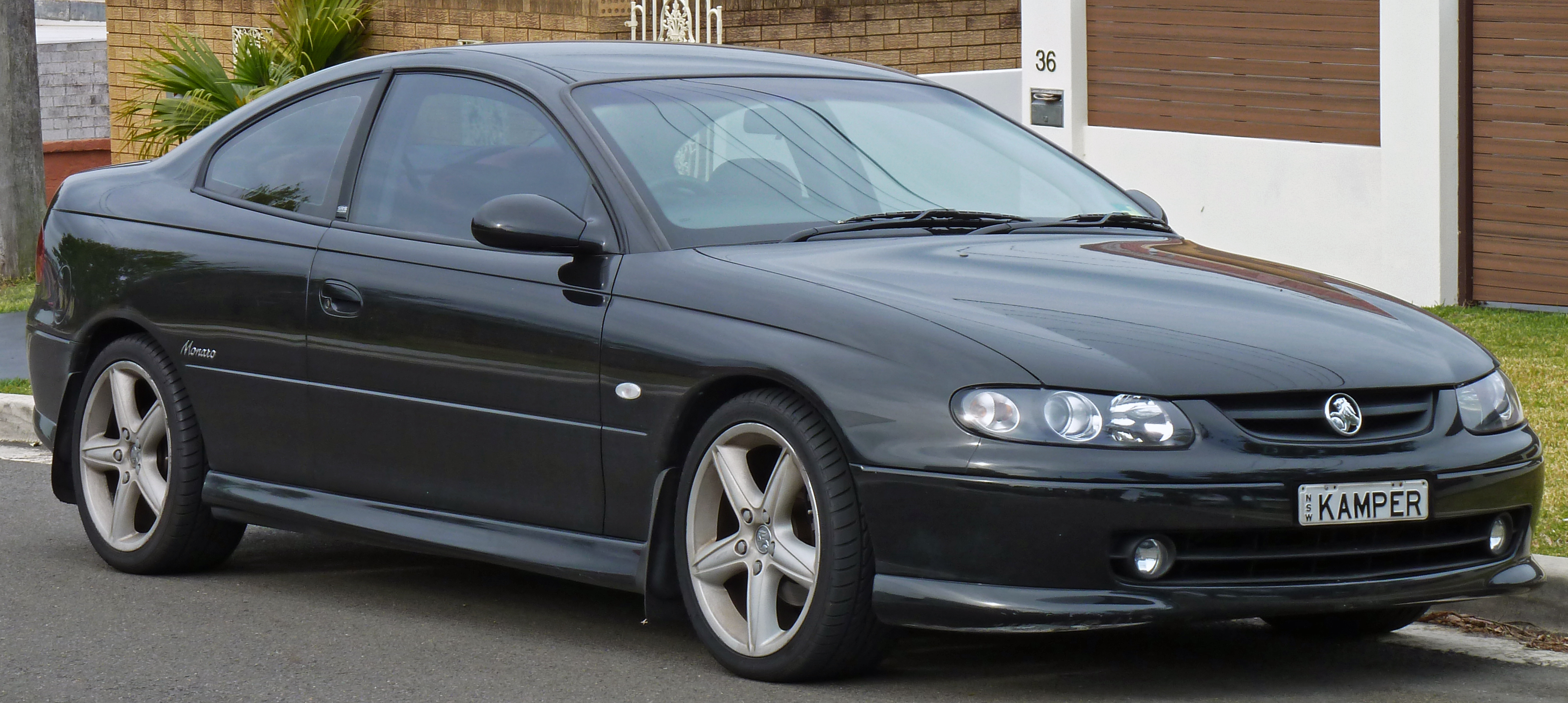
The Vauxhall Monaro is a sporty car that many people love because it has a powerful engine and looks really cool. It's often talked about by car fans who appreciate its speed and style.
Bathurst is a famous race track in Australia where a big car race called the Bathurst 1000 takes place. It's known for being very difficult because of its twists and hills.
Firestone is a brand that makes tires for cars, including special tires used in racing. They have been around for a long time and are known for their quality.
A turbocharger helps an engine produce more power by forcing in extra air, which lets it burn more fuel. This makes cars faster without needing a bigger engine.
The Chevrolet Monza was a small car made by Chevrolet in the 1970s. It was designed to be sporty and fun to drive, and it was popular during that time.
The Holden Torana XU1 is a special version of a car made by Holden, which is an Australian car company. It's known for being fast and fun to drive, especially among car lovers.
Rallying is a type of car racing that happens on different types of roads, including dirt and gravel. Drivers have to follow a specific path and deal with changing weather and road conditions.
The Ford GT40 is a famous race car from the 1960s that won the Le Mans race several times. It's known for its speed and unique shape.
Car
Porsche 956
The Porsche 956 is a famous race car from the 1980s that competed in endurance races. It was designed to be very fast and had a unique shape to help it cut through the air better.
The GM Sierra is a type of truck that people use for work and everyday driving. Some owners have found that it can sometimes have big problems that pop up unexpectedly, which is why it gets compared to a 'hand grenade.'
The clutch-facing is a part that helps connect the engine to the wheels. If it breaks or wears out, the car can't move well or at all.
LIVE
How many times have you wished you could be in two places at once?
With Wix, you practically can.
Wix's website builder is packed with powerful AI tools to make running your business online easier.
Build a full site just by talking with AI.
Get an AI agent to manage your sales and marketing.
Or work like a 10-person team, even if it's just you.
So you don't need superpowers to get everything done.
You just need Wix.
Try it now for free at wix.com.
A Listener production.
I'm automotive commentator and journalist Greg Rust,
and this is Rusty's Garage.
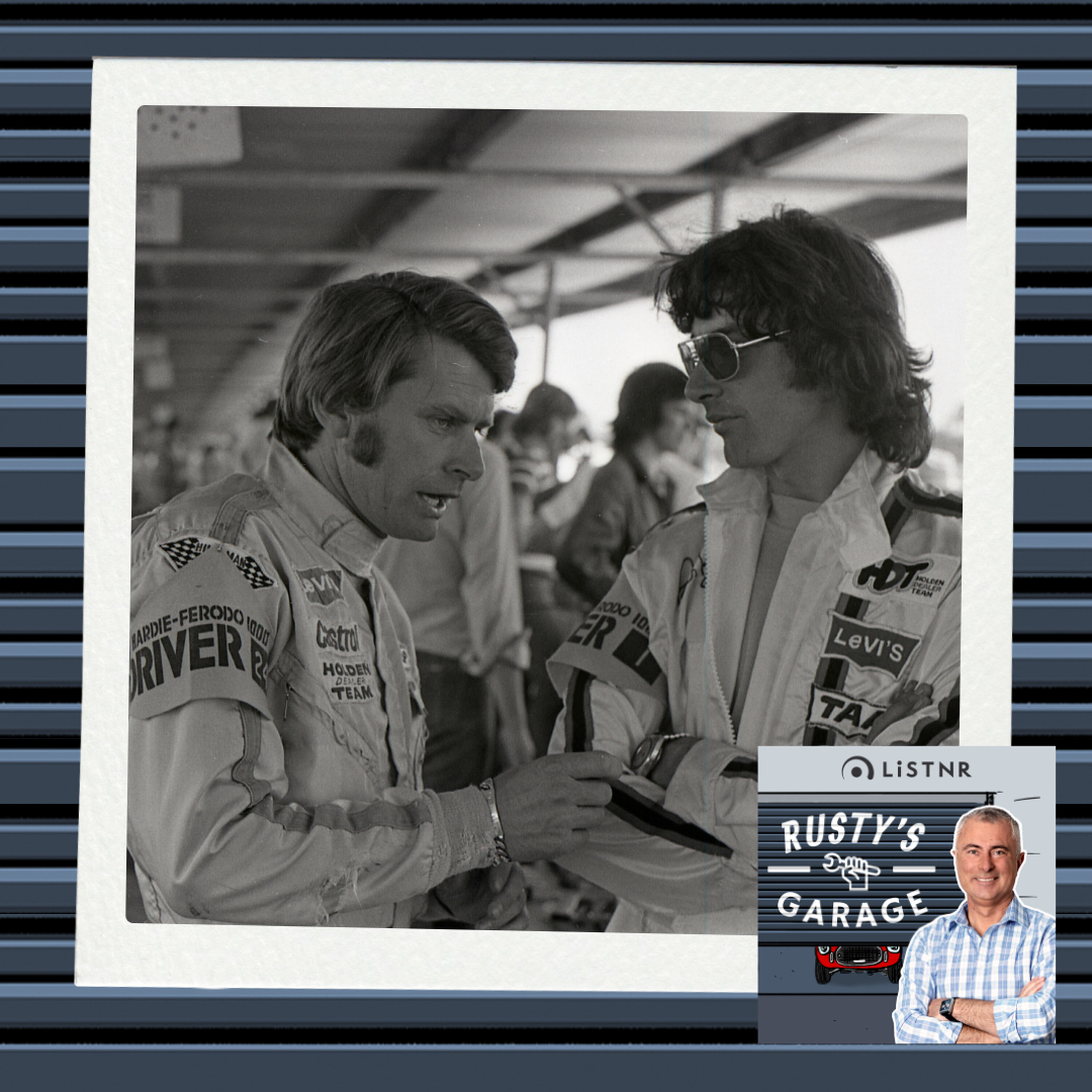
Today's Rusty Hero set for part two of my podcast
with Hall of Famer Colin Bond.
This chat is way overdue,
and I'm so glad after working at Bathurst together,
doing a couple of Q&As that we finally made it happen.
It reminded me that he's missing from our library,
and lots of you have been asking or requesting that we get him on.
If you've arrived here without checking out part one,
jump back to the library now and fire it up.
From growing up in Sydney's Lower North Shore
and finding motorsport quite by chance,
to working around cars and learning how to best prepare them
and to show the internationals
that he could build world-class competition cars
right here, down under.
There are memories of great names
and long-gone great racetracks too
that you'll enjoy as Colin climbs the ladder
across all sorts of classes,
from amateur to professional,
while staying true to his roots
and the almost signature family man quality
that came widely known in Motorsport 4.
Let's get into part two now.
Sitting in front of us, as you and I talk,
is a time sheet from the 36th Australian Grand Prix
at Warwick Farm.
We're talking 21st of November, 1971.
You are top of this practice time sheet
in a McLaren from Alan Hamilton,
Frank Madditch, Graham Lawrence, Frank Gardner is in there,
John Sertes, Kevin Bartlett, I mean, Johnny Harvey.
The list is an unbelievable roll-up of names.
I'm missing others, Alfie Costanzos further down the order
and so on.
Tell me about the story of this.
I love it because there's a bit of, I mean, it says here,
very clearly, Steady Rain.
Now tell me about what unfolds here
because this is quite a good story, isn't it?
Well, it is, but I have to go a little bit beforehand
when Frank offered me to drive.
Frank Madditch.
Frank Madditch and McLaren.
He said, look, you know, come and drive,
we'll do the Australian Grand Prix,
then we'll do the Tasman series, which meant, you know,
four races in New Zealand, four races in Australia,
then we'll go to America, do the L&M series.
Amazing.
Amazing, see?
And that Tasman series back then,
the chance to go over summer and things in the races,
it was huge, wasn't it?
And big names came out from England and so on,
didn't they?
Oh, yeah, no, no, no.
But anyway, and I said to Frank,
well, can I get a driver beforehand?
He said, oh, yeah, well, hi,
the short circuit at Warwick Farm,
you can go out there and go around, yeah?
And the short circuit's pretty short,
and it doesn't really relate to any of the corners
except two corners.
How big a step was this for you?
I mean, you've done a variety of things.
Yeah, well, see, the links was quick
and all that sort of stuff, you know, and things, so.
But this had a lot more grip,
of course, it had big, wide tires,
and, you know, it had, you know,
plenty of air as well, like wings and things.
So did you get much running beforehand
the way you were talking?
Well, I said to him afterwards, I said,
oh, Frank, that was terrific.
But I said, I'm racing the Tarana
up in surface paradise, you know,
in two weeks' time.
Why can't I take it up?
Because I wouldn't mind giving it a run,
like under the bridge and that, which is fast corners,
just to see what these things are like.
With a bit of grip and a bit of speed, you know,
because I was like, you know.
And he said, oh, OK, then I'll give,
take Tommy Narlard and you can go, you know?
So that's OK.
So if we go, and not only that,
then Brock and I are up there anyway
with the XU ones, you know?
Probably XU ones.
Anyway, and it was around the manufacturer's championship,
which we won that year anyhow.
So, you know, so driving the car
around there, I mean, I got in a race
with all the formula.
Formula, these are formula.
You ought to smoke those things.
We just went in a race that had racing cars.
I didn't know what it was.
All comers, and all comers basically.
We obviously won that one.
Anyhow.
And sort of was mentioned that, you know,
I was taking it easy up the straight,
and then trying through the corners.
And I was about two seconds slower than Frank was
in the same car at the circuit, which wasn't bad.
I was only just looking after it.
And of course, he sent Joan up as well,
just to make sure he weren't having a good time.
So anyhow, so the next meeting now was Warwick Farm, you know?
And now you're on the long circuit at Warwick Farm,
I think I'd racer got a bit, you know,
with Taranas and things.
So anyhow, the first practice session,
or not practice, it was qualifying.
It was wet.
And Frank said, look, I've only got four tyres now.
Wet tyres.
You know, I'll put them on my car.
He built the A50 thing, and I had the McLaren,
which was the car he'd previously been driving.
And I'm standing in the pitch watching,
he's got a splash around,
he's got thousands and things, so I'm thinking,
oh my God, I'm going to be 10 seconds off the pace here.
I've never driven one of these in the wet, you know?
So he goes and runs first,
and the idea is that the tyres would come off his car
and go onto yours.
The wheels.
The wheels and tyres.
Yeah, because the session was probably half an hour or something,
you know, anyway.
So I put them on, and out I go.
And I'm just convinced to my mind
that I'm going to be 10 seconds off the pace.
So I'm trying really hard.
And it's more like a rally car to me,
actually, than a race car.
And sliding and locking brakes, everything,
around the corners, you know.
But I was making it around.
And I don't think Miss Lovie's got me stuffed out.
They drive these things any faster.
But the time sheets are something so different, isn't it?
Yeah.
I mean, I couldn't believe it.
What, only two seconds or something faster?
You're over two seconds faster.
Oh, sorry, sorry.
What I missed, 148.4 for you.
Yeah.
Alan Hamilton, the next best, is a 1 minute 49.9.
Yeah.
Frank's a 1 minute 50.
I mean...
I know.
And to think today that the whole field of Bathurst last week
was within...
Top 10 were covered by two-tenths of a season.
Two-tenths, you know.
I mean, it did dry out, mind you, for the second session.
Yes.
And I finished about six.
You know, Frank put it on pole like he normally would.
And he won the race.
Yeah.
I was going quite good.
I was with KB running around.
And then the harmonic balancer came off
and took the oil pump right at it.
We had no oil pressure, so we just ground to a halt.
But Frank won it and KB finished second that day, so...
Did it prompt you...
There's a lovely forward in the book written by Alan Jones,
a 99 Formula One World Champion.
And he reflects very much about your talent
and, you know, its world class in his eyes.
Sure.
Did it...
At this point, did it prompt you to...
I mean, perhaps, you know, you were thinking about family
and whatever else.
We'll talk about Robin soon.
But did it make you think about maybe going overseas
or it didn't...?
Right, yeah.
You know, I thought, well, that sounds pretty good to me, you know.
Because I hadn't signed a deal with Holden
or any of the following year, whatever it was.
And then a couple of weeks later,
I'll get a phone call from Frank saying,
oh, by the way, I just sold your car to Frank Radici.
He's Paul Radici's dad, yes.
I was like, oh.
So that changes everything
because it was the talk of America
and everything, wasn't it?
Does that mean we're not doing the Tasman series?
Oh, no.
We'll build another A530.
And I said,
you mean we're not going to do the Tasman series?
Mm-hmm.
I'm going to go to America with you
to do the R&M series.
On tracks I've never even seen before, you know,
in a car that I've never even driven before.
Frank, I think I might just stick with Holden.
I think as it turned out, it was Robin.
Of course, he didn't go to America anyway.
He'd been in the previous year and that, but yeah.
It was one of the key points of your career.
Firstly, come back.
People will love the fact
that you were a Baptist winner in the late 60s.
What did that mean to you, that race?
Well, all of a sudden, you got no one.
You know, it was, like, it was televised in those days a bit.
And, you know, I did an ad, you know,
with, you know, the squash player, champion squash player,
Heather McIlroy or something like that.
OK, yes, that sounds right.
You know, all sorts of things.
And people all of a sudden get to know you.
Yes.
And not only that, you've been paid to drive
because you picked up prize money and things.
We didn't get a lot of money, but...
Was it 500 miles back then?
Was it not?
I try to remember the distance.
What was the distance back then?
Oh, 500 miles.
I think it wasn't much different.
But, like, I think if you converted it,
it might have been 800 and something.
Something case.
Case.
So they went to 1,000
because it was just easier,
that sort of a funny number.
Probably 100.
Well, it could have been 130 something.
Because the only reason I know that, the sand down
and Bathurst were the same number of laps.
OK.
OK.
And we had the same tile and brake wear nearly on both tracks.
Like, I used to do sand down the week
or three weeks before Bathurst.
What was the race like?
Because you've described it as being a dangerous place
in, you know, a little earlier there.
And so what was it like for that year?
Well, I mean, we'd already raced there plenty of times anyway.
So we didn't think it was dangerous.
But I can remember Hank Walters coming in
to pits afterwards in the case.
I think I just killed someone.
We were coming through McFulney Park
and there was a little Nissan.
And I think I bumped it and it disappeared off the circle.
Over the hill?
Because there was nothing there.
I mean, as it turned out, it was OK.
No walls back then is what you're talking about in that section.
But even Taney Roberts next year,
after we won in 1969 and 1970,
he drove forward there.
And with about four or five laps to go,
he ran out of Brakes Over Skyline
and disappeared.
Crash bang, bing, bang, you know.
So look, it was...
Well, as we said,
in those days, motor racing was dangerous.
But everyone accepted it.
You didn't think...
Anything more of it?
No, more of it.
So you get a little more known
from what you've achieved at Bathurst.
And what transpires then?
Because you talked about Harry and dealer team and so on.
Just take us into that period.
Well, see, as soon after Bathurst,
when we won it, it said the next thing I did
was the Southern Cross rally for Mitsubishi
for the last time.
Yeah.
And we got to in the 1500s,
EC car.
But then we went to Lakeside
and they had the Lakeside 1500.
Mm-hmm.
There were three races of some 20 laps.
I mean, I won all those.
Yeah.
And then next race, Taney and I,
the surface paradise for the 12-hour race.
Mm-hmm.
And we're back on the Michelins for that
because the tyre wear was such
a terrific surface in those days.
Mm-hmm.
And we won that.
Mm-hmm.
And then I went to Warwick Farm in the Monaro,
Moffat in the West,
and won that and set a new lap record.
So it was on a roll.
Mm-hmm.
Basically.
Mm-hmm.
And like even when we went to Lakeside.
Are you full-time motor racer by this stage?
Yeah, absolutely.
Absolutely.
And mechanic for Harry.
Yeah.
Not really.
He's just ringing A-cock.
He's better deal with Taney.
So you get yourself down if you want
to be on your own.
So look, they were good days.
They were really good days as well.
Yeah.
And not only that,
like at Lakeside and that,
like even after that,
you know, we'd go up there and Peter
would be towing his car
and I'd be towing my car.
Wow.
Mm-hmm.
And that was it.
Yeah.
That's how you did it then.
We went to Lakeside and we were changing times.
You know, the race drivers and things.
Yeah.
And Harry had turned up and that was about it, you know.
Okay.
I mean, look, it was a lot of fun.
I must admit.
And like even after the races,
we used to mix with everybody,
you know, like the Castro tent and the Shell tent
and all that sort of stuff.
You know, something that gets missed a bit today.
Yes.
I think it has become too professional
that people are packing up
and getting ready to get on a plane
or as soon as the race has finished.
Yeah.
And off they go.
But yeah, look, it was,
well, I think that whole period was a nice golden era
because the drivers,
we could actually,
you know, like I say, suggest modifications
what we should do to the car to the boys, you know.
Mm-hmm.
Whereas the day I don't think the drivers
have any input hardly in what they want on the car.
Mm-hmm.
Because everyone's watching the wiggly lines
and when you come in, they know what we're going to do.
Yeah.
And your work had taught you so much
that helping in that regard, haven't it?
Come to your lovely wife, Robyn,
who's looked after us here today when I've arrived
and so on.
There is a yarn around meeting her
and I think Harriet asked you to come down and work on the car
and you might have been staying at the captain's, were you?
Oh, yeah, yeah.
And Robyn came down
and he was in the paper or something at the time, were you?
Oh, yeah, yeah, yeah.
I mean, Jansen was something else, you know, really.
You had to be careful of Jansen, that's all.
I look,
it's really funny.
When you spoke to him,
he thought he was English
and he'd come from a very high cultured, you know.
He was actually New Zealanders.
Oh, was he?
But he kind of greet you in the sort of smoking jacket
and everything, I think, wouldn't he at the front door?
Oh, absolutely.
And the make-up bomb would be six inches thick just about,
you know, around your men.
But look,
apart from all that, he was a very good driver, actually.
Yeah, yeah.
I mean, it was fun.
At Baptist, he did quite well.
Him and Larry Perkins, you know.
Yeah.
A couple of events in it.
And I think, actually,
they were the ones that finished behind us
when I was first and second.
Yep.
And not only that,
he used to rally and things as well, you know.
Yeah.
But he was sort of a person
who was connected in a lot of aspects.
Yes.
Like, of course, when he came to Australia and that,
he was called Captain Peter Jansen
because he said he was the captain in the butane.
No, army.
Army, yeah.
Yeah, nobody in this world had been to butane.
So now I could verify this is what you're saying.
Exactly.
Robin's been an amazing support man.
I think that funny story is around him answering the door
with a glass of champagne and wanting to run a mile.
I think Graham Hill's wife had established a thing in the UK
with lots of the wives and partners
that was around supporting the drivers in safety and so on.
And Robin was heavily involved in something like that here.
Yeah, the Doghouse Club, which was called in England.
Well, in those days,
there was not a lot of fire extinguishers and things around,
you know, for the people around the track, you know.
So it was the Down Under Doghouse Club, wasn't it?
Yeah, everyone was the Down Under Doghouse Club
and a few of the wives and that got together first
and they just put on things afterwards, you know,
they had barbecues and, you know,
all sorts of things, just raised some money.
And in the end, they bought, you know,
some fire trucks and some fire extinguishers
and all this sort of stuff and jaws of life
and what have you.
Because, you know, they sort of felt that they needed it
and the actual, you know, the people, you know,
who owned all the circuits weren't supplying that type of deal.
And then, you know, I mean, it's, again,
that's all water under the bridge
compared to what they've got down here.
But it started, but I mean, it certainly helped along the way
because it was missing, wasn't it?
Absolutely, you know.
Well, not only that, I mean, even, I think,
Orin Park, was it Orin Park?
One of the guys was killed, you know,
in one of those, like Lotus 20s or something like that, you know.
And you go, you see things happening around you.
I mean, you still, you never,
and it's one of those funny things, again,
you never think about it.
I mean, even Spencer Martin, you know,
when he drove the Madaro first time down at Sandown,
ran out of brakes and went backwards
through the arm go at the end of the pit straight
and the thing caught fire
because it split the fuel tank up and everything else.
He couldn't get out of the car
because the door wouldn't open,
but the window was open
and he was a bit skinny anyway
and he got out.
He said it was that close to being a life thing.
But then, see, I was originally
supposed to go with him at Sandown.
Oh, wow.
I went to New Guinea instead,
so KB drove with him that day.
Well, didn't drive in there because the car,
but between there and Bathurst,
we got different wheels for the cars
because the wheels that were on the Madaro at the time
were solid steel wheels.
So they got some probably off an LTD
or something, one of those, which had slots in
just to get a bit more air out, right?
And then Harry cut some slots underneath
the front mud yards and things,
bumper bar, sorry, to get a bit more air into it.
So that's it.
And then the next race was Bathurst,
which, as I said, was an interesting thing
because they always drove all the cars up from Melbourne.
But Regis of Road, Regis still got the num plates
and it was amazing, you know?
And then you go.
So because Spencer didn't come at the last minute,
Harry got Peter McRow to turn up, right?
Who drove Formula 2.
And Hank Walters was there as well.
So he had them in car one.
And then Matani Roberts and myself were in car two,
and Peter Brock and Desi West were in three.
Anyhow, we go out and practice.
We had Michelin's on.
And Digby Cook was there when I'm alone.
Anyway, Moffat was on pole.
And then Digby Cook was second
because he put race tyres on.
Firestone race tyres in those days, right?
And I saw Harry had a set of firestone race tyres.
I said, Harry, can I have a go on those many firestones?
They've got to be fast. He says, no cock.
Don't worry about it.
Jesus, Harry, they've got to be better.
No cock. They won't fit your car.
I mean, look, it was the same with the forge.
You have to massage things, you know?
The forge had to grind away the top pole joint or something
and that's the good old clearance anyway.
But anyway, so, I mean,
he was three seconds left fast at me on the body,
which he should be, you know? Anyway.
So anyway, when the race started,
and, you know, that one, Billy Brown,
he had a bad practice session.
He was only on three cylinders or something.
He's coming through the field,
and he passed someone over Skyline,
and gets pushed up the bank, rolls out.
Famous vision. Famous vision, yes.
Famous vision, anyway.
We're all ahead of that.
And Moffat, going up from the start-up mountain straight,
can't sleep gears. He can't get a gear or something.
Oh, wow. Yeah.
So anyway, the race keeps continuing, you know,
and the gap through where the car is,
where I'm making it a bit bigger every lap, so that was fine.
So Pete Gagel was leading,
and I was there and Digby Cook.
And then our other, you know,
I suppose, Brock and then what must have been behind me.
So we went on, and then this is where
the forge all started blowing tires and things,
or that sort of stuff.
So anyhow, so Pete Gagel blows a rear tire,
and he goes,
Digby Cook sort of goes in and puts the car driver in.
That got a bit of both of them.
So now I'm in the lead. Wow.
Which we never lost until the end.
But at one stage,
both Seaton and
both Seaton was in the car anyway.
He was in the forward on race side.
He was catching me.
But we're just looking at the times.
No problems, no problems.
But he got reasonably close.
I could see him in the rear vision mirror.
He had a blow tire and next to me he was upside down.
You know, Freddie Gibson was with him.
So they were upside down.
And this sort of happened that particular day,
you know, on the forwards.
And it was Bruce McPhee that came second.
And Bruce McPhee was on Michelin the same as us.
Okay.
But he had a problem just at the beginning
of a pump something.
And it threw him out as far as the fuel stops went.
So we knew we still had to stop one more time
when I didn't.
So once he stopped, it was these big breeze, you know.
But it was interesting because, you know,
he always had the same car driver, Bruce McPhee,
and then Barry Mew Holland.
Barry Mew Holland has only ever done five laps
of Bathurst in the race
because he used to drive one lap and get out
and then Bruce would take over.
He's been on the dial center.
He's won two and been second or something.
I mean, it would be a record that you'd never been.
Different now with the minimum laps that the driver has.
I mean, see, it was sort of funny because
in the old days, we used to drive one by yourself.
And you still can, you know, there's no two ways about it.
Maybe the current cars, you can't.
But then the FI came out and said,
you can only drive for three and a half hours.
Maximum continuous time.
All that sort of stuff, you know.
So like with the Moffat thing, we could do it in quarters.
We had enough fuel, you know,
to do it in quarters.
One, two, three stops basically.
And you put new tyres on refueled
and you could get to the halfway before the three and a half hours.
Okay, okay.
Because we didn't have safety cars on those days.
At least it was a bit more easier to actually calculate.
Whereas today with safety cars...
There's a whole number of factors, isn't it?
...you would never know whether...
Yes, yeah.
...or whatever.
But that's just another factor that they've got to comply with now.
Anyway, so it was sort of all different.
But I still enjoyed, as I said before,
we could ask Harry, say,
Harry, we want some stiffer springs in the front
or the back or something around there,
like a cock, you know, and you would get it.
If the lap times didn't change,
but it made it safer or better,
it was still a better one.
You know what I mean?
And we used to work on that all the time.
Peter and I were goody-goody at that, I think, one thing.
And we used to talk to each other a bit, a bit.
I mean, they do it now,
but now they look at each other bloody.
Data.
Map, you know, and you go,
oh, my God, brother.
Look, it's...
The other thing I must say,
doing motorsport,
not doing any other sport,
like golf proficiency in the end,
but I get now, you know,
83 for God's sake, everything still works.
I've never broken a bone.
Lovely.
We've got the original knees and the bows,
all that sort of stuff.
Considering the period you came through,
that's quite a story.
That's quite good.
Well, not really,
but I look, I spent some heart,
and I see spent some heart in most bought knees,
you know, having coffee.
He's still there,
he's a couple years older than me,
and I was like,
and you look at most of the drivers,
they're still okay, you know?
Of course, I think the car does all the work.
Yes.
You know, I look at these rugby league players,
and I don't know how old they'll ever be.
Yeah, but I mean,
you're too bad injuries
at like 40 and things from...
Well, just, you know,
I mean, just the body is being smashed
all the time, you know?
I mean, they seem to do it,
and they seem to do it
for 200 meetings or 200 events.
I don't know.
I just sort of look at it now and think,
to me, it's a bit like boxing.
I don't think boxing should be, honestly,
in the Olympics,
because probably 300 years ago
was the only thing you could do.
But seeing now,
the idea is to knock your mate out,
and you think,
well, everyone says you shouldn't knock anyone out.
They should be...
Yeah, exactly.
It's not going to be Brian
and Brian injuries and things, yes.
Yeah, I mean,
but that's, you know,
if I said that,
they go, all the people here in boxing,
oh, come on, mate,
they're just so safty.
The book is great,
because through your eyes,
which John has captured,
you talk about the Holden Dealer Team chapter,
and you talk about the Four Chapter.
I won't get into that here,
because I think we want people to read the book
and to talk about the beaks and troughs
and all of that.
Sure.
People would be interested in the key cars,
they're in a circuit racing sense.
So let's come to XU1 first,
and maybe a fond memory of the XU1
and what that thing was like.
Well, the best thing with XU1,
which probably was the wrong thing to do at the time,
but the first time we raced it was at Warwick Farm.
And Harry drove it up from Melbourne,
and we practiced,
and it had this like problem,
I don't know what's wrong with it,
but it just let us like,
and we only qualified five, six.
And there was all these menarros ahead of us,
Bob J, Bob Morris,
you know, Vincent Martin,
and it goes on.
Anyhow,
when the race started,
every time I'm down in the creek corner,
I could get another,
I could outbrake them, you know,
boom, boom, boom.
Until I got to Bob Jane on the last lap
sort of thing and outbraked him,
and then he tried to pump me off,
come and throw the esses when I got away.
I got away enough,
and won the race.
And then Harry said,
I knew that XU1 would be the guy,
well, the XU1 was a terrific track,
most tracks,
all the flat tracks, you know,
no drama.
But at the mountain,
those bloody fords would just come out and overtake us.
Not only that,
you know, because at the end of the day,
you say, well, we need a V8 the same, you know,
because the flat track's not a problem,
but something like that,
when you've got the hill and what have you,
and the long straights, you know,
you need a V8,
well, you need the turbocharger,
like what happened later when you had XU1.
It was something, you know.
It was a great rally car,
you know, I mean,
I won three rally championships with it,
came second, two others.
That was so integral to your circuit racing with them,
and what you were doing in the rally since.
Yeah, it was.
And look, it was,
you know, it was the only thing,
what's a nice car like you doing in a sport like this?
That was one of the sluggers, you know,
that GM used to put out in those days, you know.
But, um,
yeah, look, I think in hindsight,
I always go back, I make God,
I wish we had a driven the Minaros
for the second year about this, you know,
in 1971.
Because in 1970, I mean,
because Ford didn't go any faster.
We would have been on race tires ourselves now,
you know, and all that sort of stuff,
and we were competitive with them.
Yes.
And...
Are you saying that, I mean,
it's ifs, buts and maybes, Colin,
but are you saying it could have been a back-to-back for you,
had you perhaps done that?
Oh, well, you know,
it would have been self-fulpeter or something, you know.
I just think we would have had the weapons
to actually...
To do that, yeah.
See, what actually happened to her,
even though I lived for the first five laps,
you know, in the XU1.
Often then we just look after their brakes initially,
I think, and then they just pulled out and went,
OK.
OK.
Well, goodbye.
There you go.
Look, that's the way it was.
But look...
XU1s, yeah.
Look, I just think that...
Holden wanted the XU1
because they didn't sell enough minaros
to make it sort of feasible.
Yeah.
And they could produce the XU1
and convince also GM in America
it's only a car for rallies.
Rallying.
Because this is all in the wake of Le Mans
and the incidents at Le Mans.
And people would sort of shite away from
motorcycle programs.
They shite away from that.
Yes, yes.
I think Brock stopped it in the end, you know,
because when I say that,
when he left the team in...
74, 75, right?
And even the gound hindoff car,
Harry was still feeding bits of rock, you know.
OK.
And then Tass said,
for Christ's sake, Harry, what are you doing?
You know, where do you want to win the thing?
And you're giving all the bloody bits?
Supporting.
Supporting, but...
And that year, I mean, we had a problem.
That was all.
But...
In hindsight, when he won...
Bagshaw then put on a really big thing
with the dealers.
Yes.
And he drove the car in, you know,
in the hall through the curtain or something, you know.
And everyone stood up and jeered and everything.
And he goes, Harry wasn't there.
I wasn't there.
No, no, no.
It was just Brock and then Bagshaw
and all that sort of stuff.
OK.
And I think that day the GM sort of realised
that it should be in motor racing
because Bagshaw always wanted it
because it sold cars.
Cars, yeah.
They used to say when...
Yeah.
It went on Sunday, sell on Monday, you know,
it was an old slogan.
So look, yeah, it was...
It was interesting, you know,
and when you considered Peter
when I...
Well, you know, when he won his first one in 73,
you know, I say he pinched my thighs,
but not...
That story is in the book incidentally, I think, isn't it?
Yeah, yeah.
But what's actually...
You know, like in those days,
Harry Antio once had a wetsuit
and once had a bit of meat.
And he said to me, he said,
what ones you want?
I said, I want the wetsuit, Harry.
OK.
And in those days, you know,
the boys just pushed the cars down to the grid.
You went to the bathroom or something, didn't you?
When you came back...
When you came back or was...
The cars were on the grid.
There's no warm-up laps, nothing.
You know, shh, off you go.
Anyway, I look at the room.
Jesus, Harry.
I said, I wanted the bloody wetsuit on my car.
He said, don't worry, cock, this rain won't last.
You see?
Well, he was right beneath your eye.
I mean, I was on the wrong tyres at the time
and I was locking up brakes
and going anywhere and everywhere
and I was surviving.
But Jesus, just...
I probably, if I could have done another lap,
I might have been OK.
But anyway, and as it turned out, you know,
it just went wide coming through
one of the fast corners at the top of the hill
and went up the bank and went on its roof.
You put your foot on the brake
and it's not stopping,
because the wheels were up there.
Yeah, yeah, yeah.
Got you, got you.
It's another one and a half with Pike, you know,
to the infields
and there it stayed till the end of the race
and then the tow-track driver came
and picked up by the roof
and did more damage than what I did to it.
So, anyhow.
But that was history.
What do you reckon was the secret to your success
with both the manufacturers?
Because it is such a unique thing, you know.
Oh, you're sure, sure.
Well, I think in hindsight, I mean,
the holding one was easy,
because that was the first time
we'd ever driven a competitive car or a Bathurst.
You know, only one.
Brock was third.
And what was interesting with Desi West
in those days,
and Desi had been there quite a few times, you know,
with the holding, he was a holding dealer.
And he used to smoke.
And he said to me, I said,
oh, this race is getting so proficient.
I'm having trouble getting a cigarette on the way around.
I said, why doesn't it?
Because we had patients.
Wally's driving.
Because they had a cigarette lighter in the car.
So, he'd light up his smoke gun.
And when he came past the pitch,
you'd have to hold it down or something.
I mean, you get John French
or something he used to have a sandwich in the middle.
You know, a Dick's car or something like that.
So you could have a nibble on the way around.
Yeah, look, it was different times.
And it was easy.
I mean, when you consider,
we were doing under three minutes,
but just sort of thing, you know?
Yeah.
Now the boys are nearly doing under two minutes.
Two minutes, aren't they?
Crazy.
It is.
But anyway, that was the thing.
But, you know, I enjoyed it.
It was good.
I probably, you know,
if someone said to you,
what would you do between rally and racing
if you only could do one, you know?
I said, oh, you'd probably have to go around the racing
because it was much easier.
Like, you know, you just turn up at the track
and you do five laps or something and go home or whatever.
But you had a lot of love for rallying, though, didn't you?
Just like that.
Absolutely.
But when you're broken down the middle of the road,
the side of the road, the middle of the night, whatever.
Pulling reins.
Mud up to your ear.
It's not as glamorous then, Colin, as it is.
What are we doing here?
You wouldn't be doing this
unless you're being shot at or something,
like in the war.
Look, it was, but you're right.
Look, it was all part of it, you know?
People say, well, how do you take the difference
between rallying and racing?
You don't.
I mean, even the guys overseas now,
some of the events are all tarmac, you know?
But then they build a tarmac car for it, you know?
The bigger brakes on it and lower it
and bigger tyres and all that sort of stuff.
And if it's a dirt one, well, they're a bit higher
and so on and so on.
And there's no real difference, really.
I mean, Jim Richards was terrific doing both, you know?
I mean, Brock was okay doing both, too.
Harry kept him out of it first
because he thought it was a bit dangerous for him.
You know what I mean?
And likewise, there's lots of people, you know?
Yep.
That can do either.
KB was fine.
Ever see an idea so clearly in your head
but struggle to find the time to get it all done?
Wix helps you go from...
I'll get to it.
...to...
Done.
Build a full site just by describing your idea.
Let an AI agent handle daily tasks,
plan your next marketing campaign,
or help out customers
so you can grow your business the way you want
without it taking over your life.
Try it out at Wix.com.
What about the car over our shoulder here?
There's a beautiful photo.
You know, people will fondly remember 77.
Again, I draw people to the book
because all these years on,
you have, with the benefit of time,
maybe a new take on it,
so I'd rather let people read that.
I'm more intrigued about the car
and what it was like
and perhaps your memory of that season.
As I said, it was...
When Moffat asked me, you know, to go
and he paid me 25 grand as well,
you know, and you say,
is it on, you know?
Really that much?
That was a lot in those days.
Yeah, hell yeah.
When I say a lot, you know, people say,
well, look, the first house we bought,
and I say, well, we only paid 23 grand for something.
So it's all relevant.
The kids might get a million bucks a day,
but you can't buy a house and have a sale for them.
Yeah, exactly.
But look, the first race we had was Sand Down.
You know, before we went into the season.
And I was on pole and blitzed them, you know?
I thought, gee, how good is this?
And it was a good car.
Carol Smith came out from America,
you know, and sort of engineered the car.
And what was nice with Carol,
if we went testing,
we had a program set out
that what we're going to do.
Gotcha.
And we followed the program.
With Harry, you go there,
and what do we do, Harry?
I'll put some springs in it or something.
You know, something like that.
More structured, more like pro racer.
Absolutely, more structured.
It was a more structured system, you know?
It was an American system, I suppose,
when you think about it, you know?
Because he was involved with, you know,
the cars at Le Mans and things, you know?
The GD 40s and what have you.
So it was, it comes from,
and look, even today, the guys are more structured.
Yes, yes.
You don't just turn it up and think,
What are we going to do here?
Exactly, exactly.
Anyway, it doesn't matter.
But look, and I got on very well with Carol.
He was a terrific guy, you know?
He's recently passed away, of course,
not recently, you know, back then.
He, the cars, I guess, were always,
I mean, I had a, well, initially,
the first couple of races, I had a flat tyre,
at Amaroo.
Amaroo?
Or in Park.
So I finished, say, six or something that day.
And that set the tone for the rest of the championship
because, you know, because Moffat won,
and he won the next one.
So then Carol said, well, you've got to come second.
OK, OK.
You know?
Which we did.
And it was easy, you know, you just,
you could go back and play with Johnny Harvey
back here, or something like that.
Well, then when you're there, you just wave.
Just to make him feel bad.
That's cheeky, cheeky.
No, no.
But as I said, they were the dominant car
that year.
Next year they had the A-Likes,
and they came along and they gave it to us.
Can I come to a couple of other cars in your career?
One that springs to mind is the Porsche.
There's pictures of that in the book.
I mean, what was that thing like to drive?
And what was it like in the calibre of competition
that came to it?
It was Sandown, wasn't it, that you went to?
The 956, yeah.
Bob-Jane sort of hired.
And so we had the long-wheel-based version.
Right.
But often all the others had the short walk version
for Sandown, because what they did with Sandown,
the whole thing was a disaster.
Because it was a round-of-the-world championship,
the track's supposed to be a certain distance.
They extended it, didn't they?
You can actually find the connection road
sort of still there now, where it went, can't you?
Yeah, but it was stupid because you went up the back straight,
which was in the fast corners down would have been good.
But you turned hard left, didn't you?
And you went down here, and it was like being a go-kart track.
Just to make it the distance there.
Just to get the distance, then you came back on
down the bottom corner, and then you had the rest of it.
And your mid-decky.
Anyway, then I qualified the thing OK,
because I was surprised.
And the other driver he had in those days
was the Formula One driver.
Wasn't Jonesy part of the other team as well?
Jonesy was there, like Fern Shippen was there.
Seth and Bell off, was it, no?
Yeah, Bell off with...
I don't have to look at it, at least there.
Because it's a long time ago.
But anyhow, I started the car,
and the boys had had the bonded off and things.
Beforehand, that's fine.
OK, down.
Was it Derrick Bell? No.
Yeah, Derrick Bell was there. Derrick Bell was one of them.
And there would have been...
Anyway, come back.
Derrick Bell might have been with Bell off, actually.
Anyway, it doesn't matter. The bonded has been off.
Yeah, the body's been off, and we go down to the start,
and I'll get in and everything else, and go.
And they hadn't plugged the instruments in.
Oh, so you've got no gauges, is what you're saying?
There's no gauges, no boost, there's no...
nothing, right?
So you're on pure feel, it's going,
but you're pure feel, no gauges?
Yeah, but I just thought, well,
I knew what gear I was using all the corners,
so that was it, you just went...
Off you went.
Well, not much point stopping, just to plug it in,
so until we stopped the first time when we had to,
and then Andrew probably got in and so on.
And fine, we finished up sixth, you know,
which was one point in the World Championship.
World Championship, so we said,
well, this is quite a point.
Anyhow, yeah, I mean, it was the only time.
And I guess...
Anyway,
anyway, I'll think of it later.
But that, the long world base
was more or less designed for Le Mans,
because the faster...
For that style of track, it's not ideal then,
is it, are we saying?
No, that's right, the Nariah wheel
was much more...
so they had a benefit, but...
Cool car to drive though, very cool,
you got that opportunity.
Everyone said, what was the best car you driven?
I said, it's always hard, isn't it?
I mean, it had 700 horsepower,
ground effects and all that sort of stuff, you know,
so you think, yep.
But then again, see, John had seven Formula One notices.
And I drove the 49 a lot,
which was the first of the DfE power cars,
it was a Graham Hill car.
And I still hold the record
at Amaru Park for the Grupo lap record,
which probably never be beaten,
because it was quite funny,
because Smithy was driving it recently after me.
And I looked up and I said,
Smithy, you're never going to beat my time,
you know, I realised I was only 50 when I did that.
You're much older than that now.
But John used to have a different philosophy,
he said, I like it when...
I'm not catching the guy in front
and the guy behind is not catching me,
and I can just sit there and drive, you know?
He said, when he qualified the car,
he said, oh, I look nice,
I was third on the grid,
and I looked down,
and you had the record and you were 10 seconds faster than me.
And I said, oh, yeah, but I probably had new tires.
He's a great fella.
And all that sort of stuff.
Anyway, but he also had the 73...
I think it might be...
the Murrow and Dreadiground effects car as well, right?
There's still any with a 2.0 or 3.0 litre...
sorry, Coventry Climax...
Yeah, motor.
But that was too young for you to race,
so we just practised sometimes with it.
But the car that was interesting,
it sort of reminds me an awful lot of the old photos
and footage you ever saw of the old race cars
in, say, particularly in England,
in these beautiful four-wheel drifts, you know?
Mm-hmm.
It drove the Lotus 16,
which looked like a minivan.
Well, it was a front engine 2.0 litre Climax car, right?
Mm-hmm.
With a sequential gearbox in those days.
And they had these tires,
you know, skinny tires,
and even the brakes there.
Like, to stop the front wheels doing that
when you put the brakes on,
it was a sway bar that went back to the top.
Oh, wow. Yeah.
You know, all that.
But we drove it, you know,
at Orham Park on that.
And it would just slide beautifully.
Mm-hmm.
And you could do these perfect drifts.
Lovely.
But it was at low speed in comparison.
Yes, yes.
And you sort of thought, oh, bugger me.
All those guys I used to look at,
and, um...
But when you got no grip and everything,
it was just amazing.
How well you can drive,
or just, you know...
But see, throttle response,
this is where I think the rally comes in.
I just sort of think that the throttle response
is a thing that really determines
how much oversteer you've got most of the time.
You do drive on the spot.
Which you clearly had a very deft touch for.
You had a very, very...
Absolutely. I think that's where
it comes in so important anyway.
Couple to finish here.
The Sierra.
When you and I did a function together the other night,
you turned up in a Celtic shirt,
and, man, it took me back.
And I looked at it and I thought,
is that just a copy of a team shirt
from back in the day?
And in fact, it was an original.
You kept it original, haven't you?
That's great.
And that was the Sierra days, you know?
Tell me about that car and what that...
You know, one day as a wood who races with Brody Kasticki,
they did a yarn with him with my colleague,
Chad Nailon, where they drove a road car
through town, and both of them were
just chuffed, you know,
to get the chance to be in a road car like that.
What was that thing like to race
and running that team and so on?
Yeah, look, the Sierra's, for us,
were a bit of a hand grenade,
which is annoying now,
because when I look back at it,
we could get more than
500 horsepower easily.
But once you got out of 500 horsepower,
we'd split the bores,
because we were all running
the genuine block run.
And the genuine block was thick
and then it narrowed down near the top
in the water jacket so that the water
could flow.
And it was designed mainly for just road use.
Edinburgh and them had blocks made,
which were solid all the way.
And Dick was the only one
that was getting them in Australia.
All the cars now,
I've got them.
All the ones running around,
because the guy in England
bought all the blocks
and machined them.
And all my cars I got them,
the red one, you know.
And the one that was just sold to New Zealand
the other day.
So, you know,
here we were, like all of us,
I'm sitting and everything else,
we're trying to stop these things blowing up
and you're screwing them right through
the jackets at the bottom,
you know, with head buds and things.
And the other guys were getting it
a bit easier.
So, it's a bit hard.
But, look, they were the gun car.
I still want two races with mine,
you know, in the championship.
Because we put bigger wheels on the front,
bigger tyres I mean on the front.
But Alan Jones rode with me.
You know, when we had the Sierra,
we finished third at Bathurst.
But you sort of had to compromise a bit
on power, you know, that was all
just to make sure we get through.
Then we
Wellington, Fraganman State,
you know, for the street race there,
we finished fourth there.
And all the Edinburgh Gagars were there
and that type of thing.
And the Edinburgh Gagars were quick,
you know, but then they got pinged at Bathurst,
you know, having their mudguards
and Charlie modified and all that sort of stuff.
But that wouldn't have been anything wrong with them.
OK, OK.
To finish here, it's lovely to see you still
at motor racing events now.
You have a good friendship with Charlie Schwerkhold.
You go and hang out in the garage
and you were there at Bathurst at the weekend, weren't you?
Yeah, I didn't spend much time this time.
I was going to be a bit busy.
Yeah, with the book, which is great.
Oh, I know, yeah.
I mean, look, I really appreciate Charlie's
because there's not many people
that are like that. He's just an enthusiast, you know.
Well, there are a couple of enthusiasts,
some that say, you know,
and then others just do it for a business.
Yes.
And sometimes I say to Charlie,
why do you keep doing it?
And he said, oh, I just like doing it, you know.
So, and he can afford it, I suppose.
He's got a big mission ahead of him now.
In closing, there are so many
beautiful aspects of your career
from what you did in rallying,
you know, contesting around Australia
that you talked about success in touring cars
in different marks and connections
with the factory team.
We've talked open-wheelers here as well
and all sorts. Is there a moment
for you that really stands out?
I mean, here is this young kid
who didn't necessarily grow up
in a motor racing family.
You were very good at being hands-on
with the motor car, which was a huge asset
and your driving ability,
your depth to touch with the car
and all of you in the career
which has spanned all of these decades
and you've had a chance to reflect on it now in full tilt.
Is there a moment that you think
is the peak moment for you,
the thing that you're proudest of?
What is that?
I don't know in a lot of ways, you know.
There's some races you win
and you think that was terrific
and then I remember losing one,
which is probably one I really enjoyed.
This intrigues me with racing drivers.
Sometimes it's not always...
We were at Oran Park, right?
We had a rally to do Saturday
up in Queensland, like all Saturday night.
So we did that.
Then jumped on a plane,
flew down to Sydney,
went to Oran Park,
started from back in the Greek
because we hadn't qualified.
And it was a hundred leper.
And I took off in the next year one
and I was just knocking cars off
every time I went over there.
Are you on South Circuit or Full Circuit here?
Anyway, I'm not sure. Doesn't matter.
But I was passing them all
up over the dog leg down into Enneagol, right?
Yep.
By lap 30, I was in the lead.
Amazing.
I thought, oh, shit, I've got 70 more laps to do now.
We'd know in the past, you know.
Anyway, then off I went
and on the very last lap
you wouldn't believe it coming out of Enneagol.
The clutch-facing
came off, you know.
And I couldn't get it to the finish line
and went up the hill down the hill
and got to Enneagol and went and got up the hill.
Game over.
And Robin had already bought the...
It was probably going to get, you know,
$1,000 for that race or something.
He's gone out and bought the...
Something for the house already.
Something for the house already, you know.
It never happened. But anyway,
I mean, that was...
I just like that a bit, you know.
You sort of...
It's like rallying sometimes.
It's a particular...
George Fury and I were at it.
This is down in Begar, right? Down Begarway.
Hammer and taunt.
We get to the very last stage.
It's a stage I know really well.
And it's about 80 kilometres long, you know.
It's like I say to John,
John, tighten your seatbelt, you know.
Here we go.
So off we went.
Full tilt.
Anyway.
And at one stage
I had to slide and bump the bank, but nothing.
You know, just with the bank.
Anyway, it was a fantastic
drive, you know.
Get to the end.
And in rallying normally,
they should be two minutes behind you, you know.
So then you can wait and control for a couple of minutes.
And engage.
But then sometimes they cheat a bit
and get an extra minute or two.
So we had to go before
the, you know, three minutes or something.
Because, you know,
it's a stage, you know.
So you're going hammer and taunt thinking
he'll be doing the same and then
it didn't need to.
In those days,
if you're in front, if you're behind, you would have seen it.
But anyway.
And you sort of think,
you know, you have some terrific drives like that,
you know.
And
well, you didn't have to,
but you did.
I think some of the ones we had
before we go and going back a little bit
to our Evat, then,
we missed him about coming and driving
for us, you know.
Following you, he came back after,
you know, after he'd been to Canberra and that
and he came back and he said to me,
I said, oh Colin, I must have a left-hand drive car.
If you want me to drive 10-10,
so he said, okay.
We can get all the bits for him.
Steering racks and things, so we do that.
But you didn't have one here.
You had to basically make it for him, didn't you?
That was my car.
It was already built, we just had to put the bits in.
And anyway,
and then of course when he comes,
he sits in the car and he says, oh, it's very good.
But I like my seat a bit tall, you know.
Of course, I like sitting over the bonnet, you know.
Do that.
Anyhow, and then he says,
Dave Richards says, I want my seat back
as far as possible.
More towards the centre of the car, you know.
And I thought,
oh, no wonder they're world champions.
Officer, how are you up there?
It's a little weight distribution.
But when I asked him, I said,
what are you doing here?
I just want to be as far away from the accident
as possible.
Some bright laughs in here.
Some wonderful memories.
Congratulations on everything you've achieved.
It's been wonderful.
Just pick a couple of little things along the way.
The full story is well worth
everyone reading.
And I love the fact that you've had the chance
to do all aspects of your career.
I love that. Well done.
Absolutely.
We've tried to do books before,
like everybody does.
And normal books go,
I did this in 1971.
Like a timeline.
It gets as boring as Batchy.
So,
the way that John wanted to do it this way,
and I thought, well, that sounds much better.
And not only that,
we bring the manufacturers into it as well.
And we've done a lot of work in all that sort of stuff.
And even with the busy side of it,
which was nice, you know, when you consider
where it started from and where it is now as well.
And you still have a great friendship
with Bob Riley to this day,
who was with us at the mountain and so on.
Bob was sort of even with Frank Manage
and did a lot of design stuff
on the A50s and so on.
He's got a great story of his own, doesn't he?
He does.
And there is that.
I sort of still do a lot of talks to car clubs
and I don't charge any money for talks.
I think it's nice to put back into the sport
what you've got out of it.
Of course, there are many small clubs
and things like we're doing.
The Alfred Club, I think, tomorrow night.
Nice.
And it's been a great ride.
You know, I've enjoyed every minute of it
and I think that there's probably no other sport
that I would have liked to have done
that finished up as well as I did.
Because golf was possibility initially,
but I think that would have been a hard road.
Really, at the end of the day.
Because golf, we still play golf
when you have a good day and then you have a bad day
and then you have a good day.
Golf is actually stupid going because
it's sort of...
No one, like most sports, you get better at
and then you're platter, then you slide off the edge.
Not golf.
It's up and down like you have.
But I love the fact that you're playing golf
and enjoying it at this stage of life.
I love that you've encapsulated your wonderful career.
I'm very grateful for the time that you've given us today
to talk a little bit about it.
Congratulations, Colin. Thank you very much.
Good, thank you.
We'll see you next time.
About this episode
Colin Bond shares captivating stories from his illustrious racing career, reflecting on his journey from a young motorsport enthusiast in Sydney to a Hall of Fame driver. He discusses his experiences with iconic vehicles like the XU1 and the Sierra, as well as his time in rallying and touring cars. Bond also reminisces about pivotal moments, including his Bathurst victories and the camaraderie among drivers during a golden era of motorsport. His insights into the evolution of racing and the importance of family and support in his career make for an engaging listen.
The 1980 F1 World Champion Alan Jones reckons Bondy’s talent could have taken him to global success but he chose to stay local which suited the family man.
What it was like working with the legendary Harry Firth and the differences in the way the Factory Holden and Ford Touring Car outfits went about their racing.
The world class rally cars he built here and what Ari Vatanen and David Richard’s wanted in those incredible Ford Escorts.
Staying at the Captain Peter Janson’s place in Melbourne and driving the Porsche 956 at Sandown.
Plus the important fundraising work his wife Robyn did with some of the other wives and partners to improve safety standards.
This is an overdue conversation with Colin Bond OAM the Supercars and Australian Motorsport Hall of Famer who still enjoys coming to the track and hanging out in the Team 18 garage with his good friend Charlie Schwerkolt who you can also find in the Rusty’s Garage library.