DAILY: Cadillac Optiq For Europe, ID.4/ID.5 Get Grant and Live Electrify America Data | 18 Oct 2025
EV News Daily - Technology and Business of EVs
DAILY: Cadillac Optiq For Europe, ID.4/ID.5 Get Grant and Live Electrify America Data | 18 Oct 2025 EV News Daily - Technology and Business of EVs · Oct 18, 2025
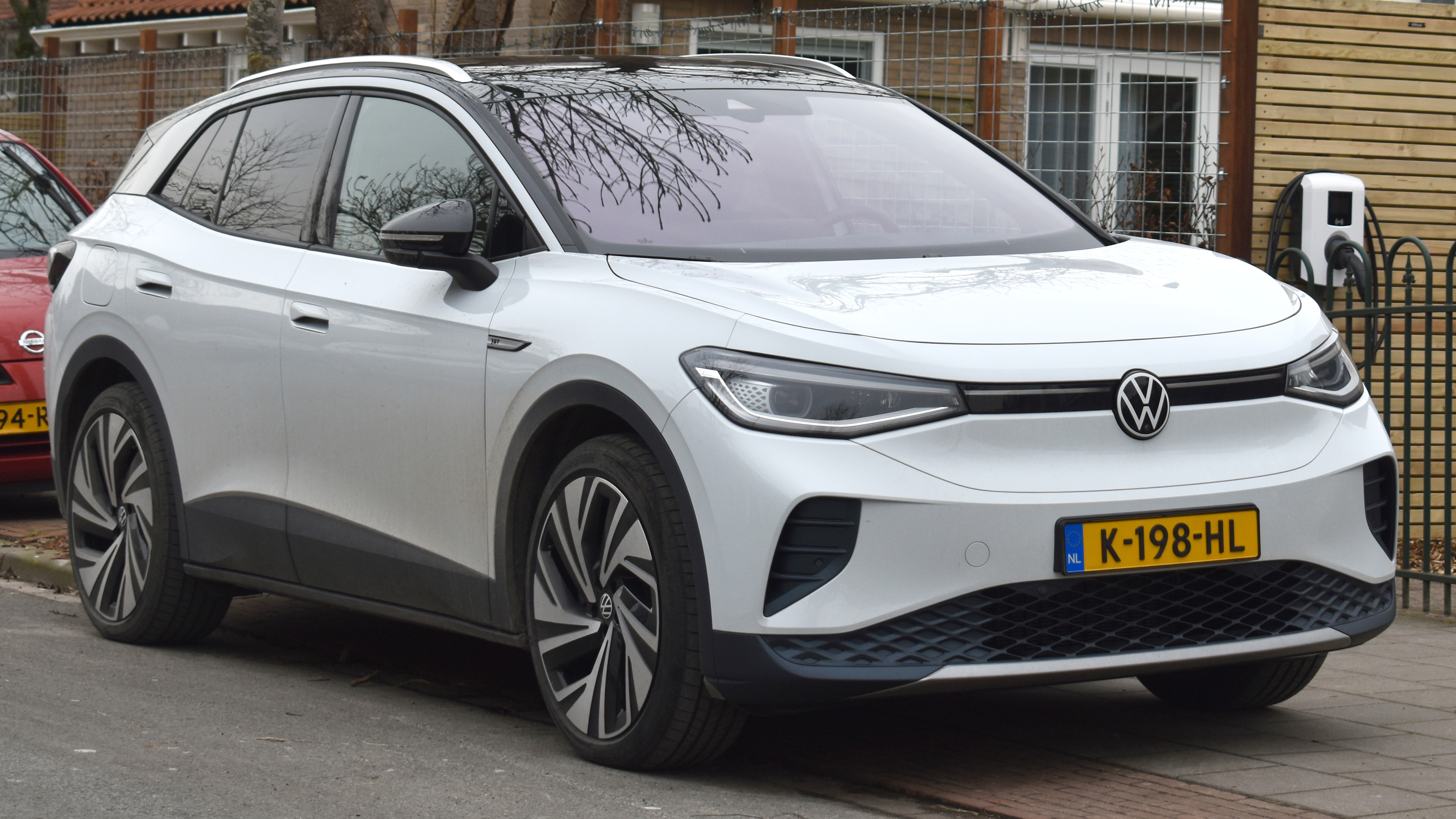
The Volkswagen ID.4 is a fully electric SUV made by Volkswagen. It's designed to be eco-friendly and has features that make it comfortable and easy to drive.
The Volkswagen ID.5 is another electric SUV from Volkswagen, but it has a sportier, coupe-like design compared to the ID.4. It's also eco-friendly and packed with modern technology.
EVs stands for electric vehicles, which are cars that run on electricity instead of gas. They are better for the environment because they don't produce harmful emissions.
Car
Cadillac Optic
The Cadillac Optic is a new electric car that Cadillac is planning to sell in Europe starting in 2026. It will be the least expensive electric car from Cadillac.
A kilowatt-hour is a way to measure energy. In electric cars, it tells you how much power the battery can store, which helps determine how far the car can go on a single charge.
The Tesla Model S is a fancy electric car that can go really fast and drive a long way on a single charge. It's important because it helps people see that electric cars can be just as good, if not better, than regular gas cars.
WLTP is a set of tests used to find out how much fuel a car uses and how much pollution it creates. It gives a better idea of real-world driving conditions than older methods.
The EPA is a U.S. government agency that helps protect the environment. They test cars to see how much fuel they use and how much pollution they produce, giving consumers important information.
A dual motor setup means the car has two electric motors instead of one. This helps the car drive better, especially in different weather conditions, and can make it faster.
DC fast charging helps electric cars charge quickly, so you don't have to wait long to get back on the road. It's faster than regular charging methods.
AC charging is a way to charge electric cars using a type of electricity that's slower than fast charging, often used at home or in some public places.
Battery electric range is how far an electric car can go on one charge. It's important to know because it tells you if the car can meet your driving needs without running out of power.
The Volkswagen ID.3 is a small electric car that is easy to drive and good for the environment. It's made to be affordable and practical for people who want to switch to electric vehicles.
Geely is another car company from China that makes various types of vehicles, including electric cars. They are growing in popularity and have bought other car brands to expand their reach.
NIO is a car company from China that makes high-end electric cars. They are known for their advanced technology and unique features like battery swapping.
Car
Polestar
Polestar is a brand that makes electric cars. It was originally part of Volvo and is now owned by a Chinese company called Geely. They aim to create fast and environmentally friendly vehicles.
The Mercedes-Benz CLA 200 is a smaller luxury car that looks stylish and has good features. It's designed to be fun to drive while still being practical.
The charge curve shows how fast an electric car's battery can be charged at different points. It helps you know how quickly you can fill up the battery when it's low or almost full.
DC fast chargers are special stations that charge electric cars much faster than regular chargers. They help you get back on the road quickly, especially on long trips.
400 kilowatts is a measure of how much power the charger can provide. More power means the electric car can charge up faster, which is really helpful when you're in a hurry.
The Citroen AMI is a tiny electric car that's perfect for driving around the city. It's special because it's small and easy to park, making it a good choice for people who want to get around without using a big car.
The Kia EV3 is a new electric car that will be cheaper than some other electric cars. It's important because it means more people will be able to buy an electric car and help the environment.
The Hyundai Ioniq 5 is a new electric car that looks cool and has lots of space inside. It's important because it shows how car companies are making more electric options for people who want to drive without using gas.
LIVE
Hey y'all, it's Kelly Clarkson with Wayfair,
my favorite thing about the holidays,
decking out my whole house.
And it's not a competition, but like if it was,
I would totally win the season with Wayfair.
Giant outdoor inflatable Santa got it on Wayfair.
Trees, lights, and ornaments in every style and color.
The UK Department of Transport adding the VW ID for ID five
to the electric car grant.
So there's now 40 EVs that get the UK grant.
If you buy the pure essential, pure match,
and pro essential trims, 1500 quid off,
no paperwork for you to do, dealer does all that.
Those variants are offered as a single or dual motor variant
with a 52 kilowatt hour pack or 77 kilowatt hour pack.
Pure essential is 35 and a half,
this is pounds, by the way, Sterling,
that's down one and a half grand.
And to qualify, cars must have at least 100 miles
of battery electric range.
Well, yep, obviously, because on the small pack,
those cars do 221 miles or so on the big pack 339.
The warranty has to be more than three years or 60,000 miles.
The battery warranty has to be eight years or 100,000 miles
to get the grant money.
With the ID four and ID five added,
VW now has three.
So the ID three, which starts at 29,000-ish,
was already in the scheme.
The grant expansion helped set a UK monthly record
of EV registrations last month.
Passenger EVs up 30% year-on-year.
Diesel down 30%.
Now, nice little story.
Electrify America has added its real-time charger data
to Google Maps, giving EV drivers
up to the minute station info across the network.
The live feed will augment Google's
real-time availability feature.
Station listings display live availability,
connector type, charging speed, and operational status.
Doesn't always mean that when you rock on up,
you'll get a perfect charge, but it's better than nothing.
You can select your charger and plan your route
with the current data.
Would be handy as well.
Increasingly, many EV charging networks
are increasingly doing time of day pricing.
Tesla have been doing that for a long time.
It would be good when live data gets fed in, by the way,
if that is also part of future live data,
like APIs and backends and things like that.
Now, let's talk a little bit about Americans.
Increasingly open to Chinese EVs,
an auto-Pacific study shows US familiarity
with Chinese car makers up 65% this year
compared to last year.
And willingness to consider buying a Chinese brand,
also climbing to 52%,
more than half of Americans who are gonna buy an EV
would consider a Chinese EV.
That's huge.
Among respondents familiar with specific brands,
it was Huawei that came out top.
All right, that doesn't necessarily make sense to me,
but either way, Huawei was top.
Then Xiaomi, then BYD,
then Great War Motors, Geely and Neo.
Concerns about data privacy and national security
eased year over year.
Perceived security risk fell from 80% to 77%
and perceived national security risk down from 82% to 79%.
Both are incredibly high.
People have asked me,
you drive a Chinese car,
Polstom owned by Geely, made in China.
You worried that the Chinese are spying on you.
No, life's too short for me to worry about that.
They're more than welcome to know everywhere I go
and what I get up to.
And if they want to, I don't know,
use the microphones to listen to me telling off my kids
for mushing yoga into the back seats.
Well, they're more than welcome to that.
Honestly, life is too short to worry about it.
I would hope not, but if it happens,
I'm not losing, I'm not losing sleep.
And I don't know, criticize me for that, if you will.
I can't stop it.
I like the car.
Not gonna stop me buying the vehicle.
Well, I don't know, but it's on people's minds
and it's a very important, very important issue
to many Americans, according to this data.
Now, Mercedes-Benz, expounding the CLA lineup.
The CLA lineups are ridiculously good, by the way.
In fact, the CLA vehicle, five miles per kilowatt hour.
A small vehicle, don't get me wrong,
compared to how fat cars are getting these days.
But now a lower priced CLA 200.
In euros, it starts at 46,950.
It's good pricing.
They position the top range to 50 plus
as a compact class kind of benchmark for range.
WLTP at 792 kilometers.
That started at 56,000 euros.
So the CLA for its RRP is six grand below that.
But that other price, I told you, is 46,950,
is a discounted price for now.
LFP pack, 58 kilowatt hours.
WLTP at 541 kilometers, still plenty for many people.
Mercedes-Benz saying that the latest LFP technology
is durable, it's safe.
Lack of cobalt, nickel or manganese.
Tolerance for fast charge cycles is higher
than the high spec battery chemistries.
Maximum DC charging, 200 kilowatts.
10 to 80 on that, 20 minutes.
Look, this is all really good.
Now, the high spec CLA's do charge at 320, isn't it?
And so, look, 320 is, again, ridiculously fast.
However, for many people that do occasional road trips,
200 still knocks your socks off.
In terms of minutes, let's always talk about minutes.
Now, a great channel to follow is my friend, Tom Logany,
from State of Charge, he does this as well.
And he'll say, oh, you know, the peak speed is this
and the charge curve is this, but in minutes,
it might be two more minutes.
I mean, come on, that's just, it's nothing, is it?
And so, the CLA 200 rear wheel drive,
165 kilowatts of power, seven and a half seconds
to do the dash, very, very appealing car
at that lower price of 46,950.
Now, FastNed will convert an old warehouse in Aberdeen.
That's Scotland.
Aberdeen's one of the most beautiful cities in the world,
by the way, if you've never been to Aberdeen,
yes, you have got the Scottish weather, but that's fine.
That's kind of part of the beauty of it as well.
Aberdeen is just an incredible place if you've never been.
I went many years ago when the oil industry was bigger
than it is now, and just the money sloshing around
at the time was incredible.
Now, FastNed, the charging operator,
is gonna convert an old warehouse there on Virginia Street
into an indoor ultra rapid EV charging hub
with a drive through facility.
Council have given it the thumbs up now.
It's all covered, it's inside a building.
We've seen this before in, I wanna say San Francisco
is a famous one for Electrify America.
So the existing warehouse gets preserved.
The architecture of it, 12 DC fast charges
inside of 400 kilowatts, and five minutes charging
and 100 miles added in many EVs.
Chargers will be arranged in a drive through layout
like a petrol station, but when you arrive,
of course, you will be inside a building and undercover.
Therefore, there's gonna be shops and seating areas
and toilets and facilities as well,
but with 400 kilowatt charging on FastNed, that's amazing.
The only thing about doing it in Aberdeen,
which is awesome, by the way, amazing city,
you're not really passing through Aberdeen.
I mean, you go to Scotland and then you keep going.
And so it's not like it's, you know, slap bang,
it's not Nottingham, is it?
Where everyone's gonna go up and down across the country.
So, but amazing news anyway.
And I love stuff like this.
What a lovely experience to have to be undercover
for 20 minutes in a nice surrounding environment.
Now, Toyota is in the news today.
A new consortium, which is led by Toyota,
is getting some UK money.
They've done a collaboration with the University of Derby
securing funding through a 2.5 billion pound UK program
to look at electric quadricycles, small vehicles,
developing a vehicle like the current production models
for the Citroën AMI and the Cylons SO4,
drawing design and concept cues from Toyota's small vehicles,
which you've seen recently.
It responds to a wider push across Europe
for possibly creating our version
of the Japanese K-Car system,
where cars have limits on size and weight
and things like that.
Now, Tesla is reintroducing Mad Max mode
to full self-driving,
restoring the speed profile called Mad Max for FSD supervised.
Release notes say that introducing a new speed profile
called Mad Max comes with higher speeds
and more frequent lane changes than hurry mode.
The mode's name refers to the Mad Max films
and aggressive driving that you'd see in those.
Mad Max appeared in autopilot back in 2018.
I think it was when Elon Musk at the time described it
as an aggressive way of handling Californian traffic,
lane changes and dense traffic.
He cited Los Angeles as an example
of where you need to drive in Mad Max mode,
even as a human.
So the relaunch arrives at an interesting time
because there is intense regulatory scrutiny
on Tesla's ADAS level two system,
legal challenges, NHTSA probes, wrongful death lawsuits,
which Tesla, by the way, have been settling more recently.
They fought one all the way to the end recently
and lost that and appealed and lost it again.
And then more recently, they've been settling out of court
to avoiding any more scrutiny,
at least through the legal system.
California DMV having a look at it as well.
Within 24 hours of relaunch,
videos cropping up on YouTube of people
going rolling through stop signs,
not stopping at a stop sign,
going 15 miles an hour, that's 25 kph,
over the posted speed limit.
I think Mad Max mode can technically go any speed
over the speed limit, correct me if I'm wrong.
Interesting time to go with the system
that is designed, not by accident,
but by design to break the law.
Again, it's a thing that you can't do in Europe
because we don't allow it,
because European regulators say,
show us your system and we'll decide if you can use it.
The American system is do a thing
and then after it's out there,
we'll decide if it's safe or not.
We do road regulations like Americans do,
aviation regulations, which is the other way around.
So you tell us what you wanna do
and then we'll think about approving it.
So Mad Max mode would never come over here
because it'd be like, oh, we've designed a system
to break the law.
European regulators would be like, jog on mate.
Now, Norway is gonna lower some thresholds,
the EVVAT threshold and then the exemption there as well.
Look, Norway's at 100% EVV
and that's like 100% pure BEV.
So removing and reducing the exemptions for passenger cars
under their new state budget for 2026,
the finance minister from the Labour Party says
that at the time 95% electric share,
it's almost 100 now, it's 98.2 last month,
that it's time to phase out benefits.
The proposal cuts the VAT exemption threshold
from around 42,000 euros equivalent
to about 25,000 euros equivalent and goes from 2027.
EVs priced at the moment up to a certain limit
are VAT exempt, VAT only applies to amounts
above the half million threshold.
The government estimates that the support now costs
about 1.5 billion euros equivalent per year.
The budget also raises the one-off registration tax
for fossil fuel passenger cars to keep incentives
for zero emission vehicles,
scaling back direct financial support
but penalizing combustion,
which has been Norway's playbook for a very long time
and it's worked incredibly well.
You won't be surprised to hear the EVA,
Electric Vehicle Association,
not behind these changes, saying it could reverse progress.
We'll wait and see.
I'm always a fan of saying, look, let's wait and see.
Everyone's got an opinion, haven't they?
But let's wait and see.
We'll take a break, we'll come back,
we'll talk about Subaru and Slate and more.
Stick around.
All right, welcome back to the podcast.
Now, let's talk about Subaru.
They'll show off two new concept cars
at the Tokyo Auto Show later this month.
One of them will be an all-electric performance E-STI,
the STI name coming back.
Their first STI, the company released
a pair of teaser images that give a look
and says the performance E-STI previews
the future of Subaru Performance at the exhibit.
They'll also debut in Japan a trail seeker EV, SUV.
Which is interesting.
Slate, the small pickup truck, Jeff Bezos' back startup
is bringing a minimalist two-door electric pickup
to the market, $27,000.
Obviously, they were talking about a $20,000 vehicle.
That was when there was an incentive.
This summer, engineers have been doing hot weather testing
in Nevada, testing battery cooling
and cabin air conditioning, up 6% grades,
fully loaded beds and fully towing their weight limit as well.
The vehicle targets a minimalist low-cost market position,
standard equipment, manual crank windows,
52 kilowatt hour pack, 150 miles, EPA range,
and then everything else is upgrade.
So speakers, bolt-on roof to make it an SUV,
a bigger battery that's 84 kilowatt hours.
Everything is an added extra,
but they're saying that all the hot weather testing
has gone fine, all that validation program
was completed successfully.
They can move on to the next stage now.
Kia in Europe is next.
They want to triple European EV production capacity
over here within two years.
They're gonna add the EV2 and EV4
to European production plans.
The company says it'll provide an EV option
for every buyer segment.
The EV2, below the EV3,
as Kia's smallest, most affordable EV,
due in 2026, Kia says it'll redefine
urban electric mobility, which is big talk.
And the EV3, my favorite car of the year, by the way,
as I've mentioned many, many times.
But the EV2, if you want to redefine
urban electric mobility, it's got to be cheap
because it ain't going to redefine anything
if it's too expensive.
And so flexible interior, lots of connectivity
and things like that.
They'll make it in Slovakia.
100,000 units are gonna be made there by 2027.
They say they have been upgrading the plant
ready for EV2 and EV4.
Production of the EV4 began in August.
Kia's first EV assembled in Europe.
Hyundai had been making EVs over here for a long time.
It's just a company, but with more than 80,000 EV4 units
planned by 2027.
If you include the Fastback and the sedan variants,
also built in Korea,
global EV4 production will be 100,000 units.
Now, Hyundai is next in the news.
Beijing, Hyundai, actually.
Hyundai in China, not really a big thing.
And the joint venture with BAIC
has opened pre-sales for a new EV,
but it's not called a Hyundai IONIQ number.
It's called the EO.
Hyundai's first China assembled electric SUV.
It's $18,000 equivalent.
Dedicated electric model.
They're gonna try and push in China
with that joint venture.
And spy photos of the camouflaged versions.
Thought it might be called the IONIQ 4.
The EO, though, as it is called, three trims.
Fun, smart, and tech.
Starting, like I say, about $18,000
going up to 21,000 for the top spec trim.
Very common in China.
What you can do is put a little deposit down.
Almost a nothing deposit, like a hundred you want.
And you get a extra set of value bundled in.
Just some more goodies.
Early buyer incentives also include cash subsidies,
different body colors, lower insurance rates,
home charging station included as well.
And finally, how close did GM get
to the long standing promise that we were made in 2021
and when to see how ever been wrong?
That GM will sell more electric cars than Tesla by 2025.
Now, 2021 was a punchy time for General Motors.
They were making some very big claims
about electric vehicles.
And one of them was we'll be bigger than Tesla by 2025.
Now, who was to doubt?
You can't say, that's a lie,
and you can't say you're wrong
because they've got four years to deliver.
And so in a way, there's no downside.
Unless in 2025, we have a look back and call them out
and say, did you do what you promised?
Well, in 2021, the CEO, Mary Barra, told CNBC,
with no hesitation, we absolutely,
that's the quote, absolutely will surpass Tesla
in the next four years.
There was some, I remember reporting at the time
on the podcast, gosh, there was some confusion,
like what globally or US or North America,
that was never spelled out.
And that's annoying because we wanted to interrogate
that claim and work out the numbers
of what have you got to get to and where will Tesla be?
And Tesla's wobbled, lately, don't get me wrong,
great last quarter, but they're not gonna be
at what they wanna be,
20 million vehicles by the end of the year,
every single year.
So look, that's Tesla themselves have not delivered
on the promises that they were making at that time.
But GM were punchy.
They said that the time Tesla had a 63% EV market share
in the US and GM was 10, CNBC's Phil LeBeau said,
can you be bigger than Tesla in 2025?
Mary Barra replied, absolutely, we will keep working
until we have number one market share in EVs.
I think we all assumed they were talking about US
because at the time, China blowing up
and things like that exploding
would have been very difficult on a global scale.
Over the next four years,
Tesla's US market share did indeed fall, which is natural.
There's just more competition around.
Legacy automakers, startups, pure EV brands.
However, as of today, Tesla is substantially larger
than GM per Cox automotive.
Tesla, at the moment, in the first nine months of the year,
according to Cox data,
Tesla is a 43.2% share of the US EV market.
That is three times the combined market share
of every GM brand, leaving GM on track
to not only miss their goal,
but miss it by a country mile.
That's your podcast for today.
Thanks to our premium partner's portion
of the village in Cincinnati,
Audi of Cincinnati East and Volvo cars of Cincinnati East.
National car charging on the US mainland
and the low hard charge in Hawaii
and octopus electroverse global public charging
made simple with one app and one map.
Have a good and soon tomorrow.
And remember, there's no such thing
as a self charging hybrid.
About this episode
Cadillac is set to launch the all-electric Optiq in Europe, featuring a smaller battery and reduced performance compared to its US counterpart. Meanwhile, VW's ID.4 and ID.5 models are now eligible for UK grants, boosting EV registrations. Electrify America introduces real-time charger data on Google Maps, enhancing EV charging convenience. The episode also discusses rising American acceptance of Chinese EVs, updates on Tesla's 'Mad Max mode', and GM's struggle to meet its ambitious EV sales targets. Notable mentions include Subaru's new concepts and Kia's plans to expand EV production in Europe.