DAILY: Mercedes Builds GLB EV, Renault EV Sales Up and Lynk&Co Set PHEV Record | 21 Jan 2026
EV News Daily - Technology and Business of EVs
DAILY: Mercedes Builds GLB EV, Renault EV Sales Up and Lynk&Co Set PHEV Record | 21 Jan 2026 EV News Daily - Technology and Business of EVs · Jan 21, 2026
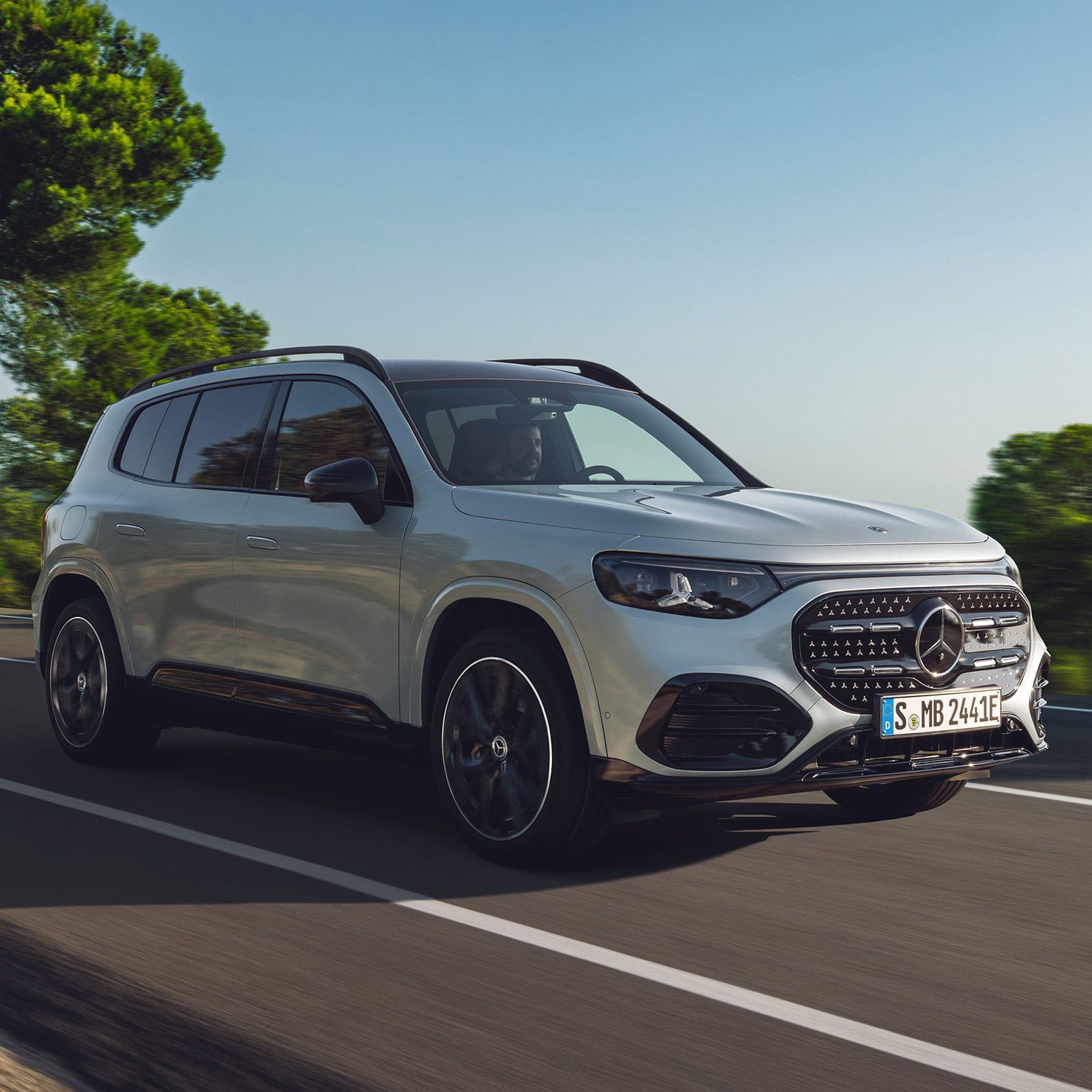
The Mercedes-Benz GLB is a small luxury SUV that has a lot of room inside for people and their stuff. It's important because it uses parts made nearby, which helps the environment and shows how car companies are changing.
Battery packs are large groups of batteries that store energy for electric cars. They help the car run and determine how far it can go on a single charge.
The Mercedes-Benz CLA is a smaller, sporty car that looks like a coupe but has four doors. It's a good option for those who want a stylish car with luxury features.
The Mercedes-Benz GLC is a stylish and comfortable small SUV that many people love to drive. It's important because it has won awards and is part of a big lineup of new cars that are coming out soon.
Electric vehicles, or EVs, are cars that run on electricity instead of gasoline. They use batteries to power an electric motor, making them more environmentally friendly.
The Renault 4 CV is an old-fashioned small car that many people remember fondly. It's becoming popular again as people are looking at classic cars, especially with more interest in electric vehicles these days.
A plug-in hybrid is a car that can use both electricity and gasoline to run. You can charge it by plugging it in, and it can drive a certain distance using just electricity before needing gasoline.
Guinness is a company that makes beer, but they are also famous for keeping track of world records, like the fastest car or the longest distance driven.
A world record is when someone does something better than anyone else has ever done it before, like driving a car a certain distance in the fastest time. Organizations like Guinness keep track of these records.
WLTP is a testing method used to measure how much fuel a car uses and how much pollution it creates. It helps give a clearer idea of a car's efficiency in real-world driving conditions.
A 40kWh pack is a battery that can store a certain amount of energy, measured in kilowatt-hours. The bigger the number, the more energy it can hold, which usually means the car can drive farther on electricity alone.
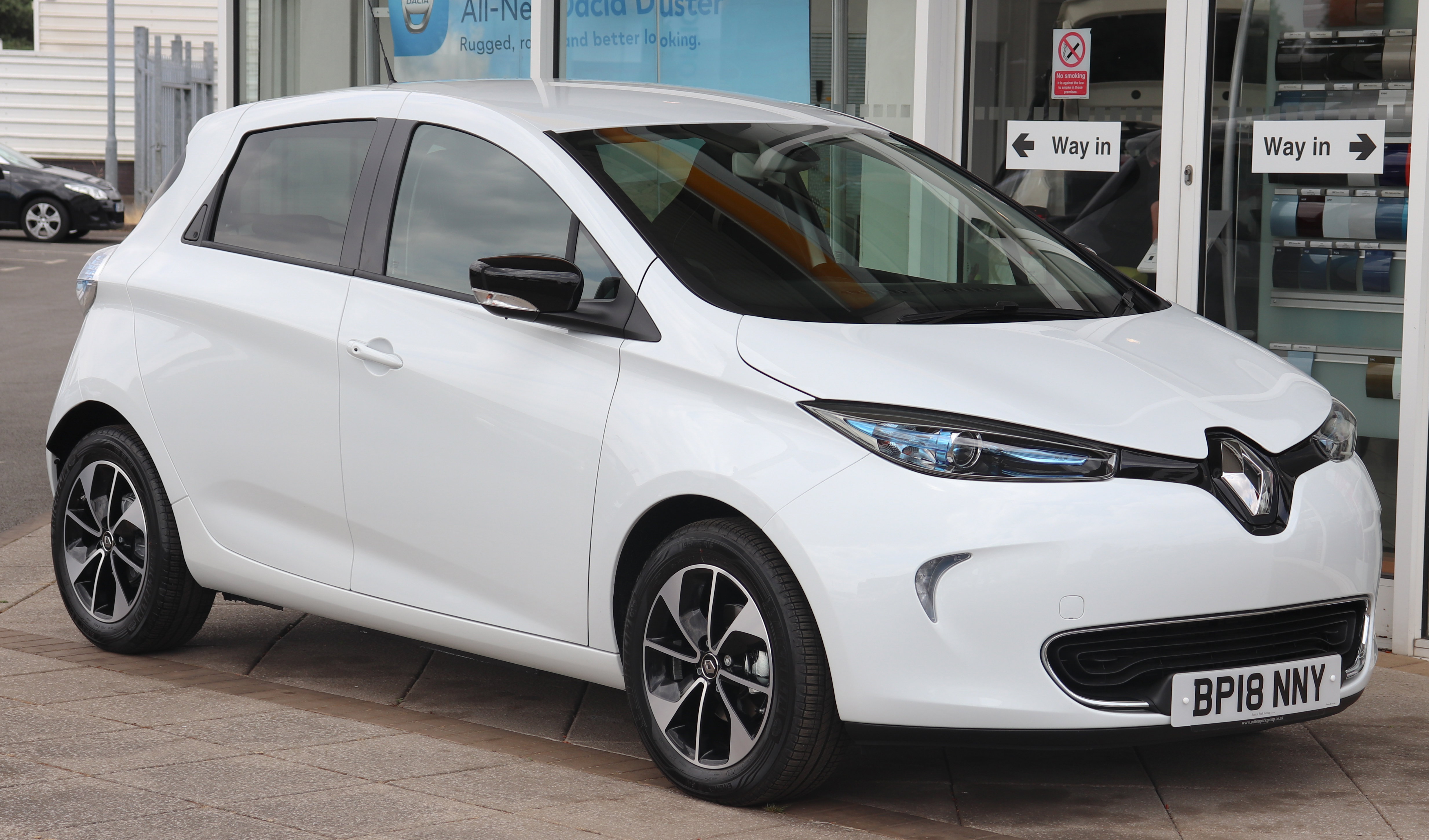
The Renault Zoe is a small electric car that is popular in Europe. It's designed to be efficient and is great for driving around the city without using gas.
The Tesla Model Y is a small electric SUV that is similar to the Model 3 but has more room inside. It's a good option for families or anyone needing extra space.
The Mercedes-Benz E-Class is a fancy car that many people like because it's comfortable and has a lot of cool features. It's important because it shows how people in Korea are choosing imported cars over others, which can change the car market.
Diesel is a type of fuel used in some cars and trucks. Diesel engines are usually more efficient but are becoming less popular because of pollution issues.
Term
AV
AV means Autonomous Vehicle, which are cars that can drive on their own without needing a driver. They're becoming more popular as technology improves.
The Ford Puma is a small SUV that people like because it's easy to drive and has a lot of space inside. It's getting a lot of attention now because many people are looking for electric cars, and the Puma is one of the popular choices.
The Polestar 4 is an electric SUV made by Polestar, which is a brand that focuses on electric cars. It's designed to be both eco-friendly and fun to drive.
An HGV charger is a special type of charging station for big trucks. It helps charge their batteries faster so they can keep working without long delays.
A battery electric car is a type of vehicle that runs only on electricity, using batteries instead of gasoline. They are better for the environment because they don't produce exhaust fumes.
Car
Mazda EZ6
The Mazda EZ6 is also an electric car made by Mazda, produced in collaboration with a Chinese company called Chang'an. It's part of Mazda's move towards electric vehicles.
A joint venture is when two companies work together on a project. Here, Mazda is teaming up with a Chinese company called Chang'an to make electric cars.
BEVs are cars that run only on electricity and don't use gas or diesel. They are considered environmentally friendly because they don't produce exhaust emissions.
Self-driving cars are vehicles that can drive themselves without needing a person to control them. They use technology like cameras and sensors to see and understand their surroundings.
Driverless cars are cars that can drive themselves without anyone behind the wheel. They use special technology to help them navigate and avoid obstacles.
LIVE
I didn't even realize I was wasting $415 a month until I downloaded Rocky Money.
I thought I had my finances under control until the app laid out all my spending and
categorized it for me.
Takeout, shopping, and unused subscriptions were quietly draining my account.
And as a result, my savings took a backseat.
But Rocky Money doesn't just tell you what you're wasting money on.
It takes action to save you money.
First, the app looks at your income and monthly expenses and calculates how much you can safely
spend each day to stay under budget.
Rocky Money also finds and cancels unwanted subscriptions for you and even negotiates
better rates on your bills so you have more money in your pocket.
On average, Rocky Money members can save up to $740 a year when using all the app's premium
features.
Users love the app, with over 186,000 5-star ratings.
It's time to simplify your finances and take control of your money.
Go to rocketmoney.com slash cancel to get started.
That's rocketmoney.com slash cancel.
5 years ago, I was paying $65 a month for my subscriptions.
Today, those same subscriptions cost $111, and I don't even use half of them anymore.
That's why now I use Rocket Money to manage my subscriptions for me.
The app gives you a list of all your subscriptions and reminds you of upcoming payments so you're
not hit with any surprise charges.
On top of that, it also sends you alerts when subscription prices go up so you always
know the price you're paying.
If you decide you no longer want a subscription, you'll have to pay for it.
You can cancel it right from the app.
No customer service needed.
And the best part is, Rocket Money even reaches out and tries to get you refunded for some
of the money you lost.
On average, people that cancel their subscriptions with Rocket Money save $378 a year.
And overall, Rocket Money has saved its members $880 million in canceled subscriptions.
Stop wasting money on things you don't use.
Go to rocketmoney.com slash cancel to get started.
That's rocketmoney.com slash cancel.
Rocketmoney.com slash cancel.
Welcome back to EV News Daily.
Coming up today, Mercedes begins building the GLB EV.
Renault sales up with electric vehicles and Lincoln Co. set a plug-in record.
Plus, stay tuned.
Later in the show, I'll tell you why one community in America who are the last people
to like new technology can't resist the lure of electrification.
On EV News China today, our spin-off podcast is dedicated to what's happening in the east.
We're talking about the Zika's upgrade of the 007.
We'll call it the 7GT when it arrives this year.
Already going to 900 volts.
Mercedes-Benz VLE van on their new platform will be made first in China and battery afterlives.
Well, let's get into the news.
Mercedes-Benz has begun building the all-electric GLB SUV in Hungary,
betting that a cheaper cost base will help it fend off tariffs and Chinese rivals.
The model is now up for order at about 59,000 euros, about 68,000 US equivalent.
The firm is shifting GLB production away from Mexico
and concentrating output at its plants in Hungary.
Now, I've got an exact location where the factory is,
but I'm kind of nervous about saying it because I'm just going to get it wrong
and upset any Hungarians.
Keskemet?
I took a run up at it.
Hungary offers lower labor costs and sits inside the European Union,
a useful mix as policymakers toy with extra duties on imports
and as Chinese EVs undercut European prices.
By tying production to a lower cost EU base,
Mercedes aims to keep some pricing power in a segment where buyers have plenty of choice now.
Battery packs for the GLB come from next door,
also on site at, um, Kezmiket?
No, no, it wouldn't be Ket, would it be Met?
Kez-ke-met?
Kez-ke-met, sorry.
Which Mercedes says cuts transport time and logistics complexity
because they build the batteries there anyway?
Local battery assembly limits exposure to global logistics snags
and trims the cost of shuttling heavy packs across borders.
For a 59,000 euro SUV, these savings matter to margins
and any room to do discounting.
The shift comes as Mercedes slips behind BMW and EV sales
after a run of product missteps.
The gap heaps pressure on the next wave of launches.
The GLC, the CLA, European car of the year, and now the GLB.
Each must carry more than its own simple profit target together.
They've got to prove a point of why Mercedes can still shape the premium end of the market.
Renault is growing.
Renault Group lifted vehicle sales by over 3% in 2025.
Renault now sells 2.34 million vehicles a year in case you were wondering.
Passenger cars pretty much do all of the work.
The volume gain looks modest, but it hides something behind the numbers.
The home market barely moved.
Europe, still Renault's core, grew 0.5%.
Yet the Group's international business was up 12%.
That's South Korea, that's Morocco, that's Latin America.
Growth is edging away from its traditional base towards markets where pricing,
regulation and brand perception differ from Europe.
The more striking change is the powertrains.
Well, you beat me to it again.
It's the electric demand, which is accelerating.
Sales of hybrids up 35%, but EV sales up 77%.
I'm not surprised that little Renault 4 and 5 are stonking cars.
That pace far outstrips the Group's headline growth volume,
pointing to a rapid shift towards high-tech, regulation-friendly cars
that buyers want to buy that are electric-powered.
Now, Lincoln Co, the geely-owned company that makes a lot of plug-in hybrids,
they make an SUV called the Lincoln Co 08.
That just ran 293km in electric-only mode.
It's a plug-in hybrid, and they had the Guinness World Records people
with their clipboards on hand.
A couple of times before, if those Guinness people didn't turn up to everything,
there'd be no book to flog you to put inside your kids' stocking at the end of the year.
Sometimes they can be a little tenuous, like this one.
They invited people along to see how far a plug-in hybrid could go.
Thanks, Guinness people. Gotta keep it going.
It was done in Korea, and they said it makes it the longest plug-in hybrid in the world.
That matters, because range can be a weak spot on plug-in hybrids,
and you might think, wow, 293km. That's really very good.
Yeah, well, the Guinness people didn't ask them to drive very fast.
The record attempt took place in Mexico City's Centro,
Dynamico, Pagasso racetrack, laid out to mimic real-world driving.
They used professional drivers for more than six hours,
and they averaged around 50km an hour.
They said, oh, that's because it mimics stop-go traffic in the real world.
Yeah, that's not how we measure range, people.
But you gotta keep setting those world records, or there'd be no book to print.
Ah, yeah, yeah, this isn't a world record. I know I'm being very tongue-in-cheek here,
but this is not a world record. They drove very slowly around a racetrack,
and then said we've got the world's farthest-going plug-in hybrid.
All right, well, the WLTP electric range is obviously a lot less,
but it's 200km, and that's very, very good.
And it sits on Geely's CMA platform, has a 40kWh pack,
which is still twice the size of my first-ever Renault Zoe.
So it's a chunky pack. I'm sure it's a world record between you and me.
Now, Tesla is turning Korea into a price war.
The South Korean discounts now make Model 3 and Model Y hard to beat on value for money.
Local data shows Tesla Korea sold just shy of 60,000 EVs last year.
That's 100% up on 2024, driven by the price-led Model Y.
The Model alone accounted for 50,000 of the 60,000.
It became Korea's best-selling imported car for 2025,
overtaking Mercedes-Benz and the E-Class.
And that shift matters because important brands have long relied on premium prices
and badge appeal to shift metal in countries like South Korea.
Otherwise, people would buy a domestic brand, which they're very proud of.
Tesla instead leans on scale and sharp prices.
By making its mass models look like bargains, it can pull buyers away.
Tesla now wants to lock in the lead.
It's running rolling discount campaigns in Korea focused on the Model Y and the Model 3.
Latest one's the Model 3, which pushes the effective price to about US$27,000 equivalent.
There's some subsidies. It's a stripped-down version.
But still, US$27,000 equivalent for a brand-new Model 3.
That's not bad.
Lease costs are falling.
Personal lease costs for new cars fell again in 2025,
as list prices rose of cars.
New data from the website leasing.com shows average personal lease payments
were down 6% to £301 per month,
while average business lease payments fell 10% to £397 a month, excluding VAT.
Why are people, and that's 20%, that's on top of 397.
Many big businesses, of course, earning more than what,
90 grand turnover have to be VAT registered.
Why is the business lease so much more?
Well, a lot of businesses will lease cars for their senior managers,
their directors.
They tend to be more premium vehicles.
Well, the gap between higher retail prices and lower monthly rentals
now shapes how Britain's access to new cars.
Leasing.com argues that leasing offers a steadier route into a new vehicle.
Well, you'd hope so.
That's kind of their business.
They've got to tell you that leasing is better than buying a good quality,
used car that's had all its depreciation,
that won't lose much more money and is better for you financially.
That wouldn't be a very good leasing company.
So they look, hey, look, here's the benefits of leasing.
It softens the impact of higher list prices for tight household budgets.
It lowers business rental costs.
And the figures sit inside leasing.com's 2025 insights report.
Now, what's interesting about this is it charts a retreat from combustion.
Petrol and diesel are in serious decline.
Petrol inquiries to leasing.com slipped 41% last year,
and AV inquiries rose 34%.
Diesel was inquired about just 2.1% of the time last year.
Wow, no one is leasing a diesel.
2% of people even inquired about one.
And that was probably just, oh, what's it going to cost me in company car tax?
Woo, no way, I'll have the EV, right?
So that's amazing.
Within the EV demand, the brand order is shifting.
The Ford Puma topped the EV inquiries.
6% of all inquiries are about that car.
Ahead of the Polestar 4 and the Leap Motors C10,
then the Tesla Model 3 and the BMW i4.
That's a mix that blends mass market familiarity
with some new Chinese stuff as well.
All right, look, we should take a break.
And I'll have a slurp of this tepid coffee.
And when we come back, we'll talk about the petrol station to EV charging station ratio.
What that can tell you about a country going EV.
And megawatt charging back in a mo.
Let's do the 60 second savings challenge.
Step one, download rocket money.
Step two, link your accounts and see every subscription you're paying for.
Tap one you don't use and cancel it.
That's money back every month.
Step three, create a financial goal.
$50 every paycheck or let the app automatically move small amounts of cash when you can afford it.
In a week, you'll forget you set it up.
In a month, you'll see real dollars piling up.
In a year, you'll be shocked at how much money you've saved.
Bonus challenge, upload an internet or phone bill and let rocket money try to lower it.
You only pay if they find you savings.
On average, rocket money members can save up to $740 a year when using all the app's premium features.
Users love the app with over 186,000 five star ratings.
Make saving money the resolution you actually keep.
Start the 60 second savings challenge at rocketmoney.com slash cancel.
That's rocketmoney.com slash cancel.
Rocketmoney.com slash cancel.
The number one resolution for people last year was to save more money, but nearly half gave up by February.
Don't let that be you.
Download rocket money to reach your financial goals this year.
Track your spending, cut waste, and automate savings in one simple app.
Rocket money shows you all your expenses and categorizes them so you know exactly where your money's going and where you're overspending.
From there, the app cuts waste by canceling your unused subscriptions and lowering your bills.
No customer service needed.
With that money freed up, the app will automatically set some cash aside for your goals.
Whether it's an emergency fund, paying off debt, or saving for vacation, rocket money's got you covered.
Users love the app with over 186,000 five star ratings.
And on average, users can save up to $740 a year when using all the app's premium features.
Make saving money a priority this year.
Go to rocketmoney.com slash cancel to get started.
Bit of a delay on the free feed, just as a little nice sweetener for the Patreon support.
But a fascinating interview.
All sorts of reasons why you would want to do an EV battery health test,
even when new coming into fleets after accidents.
And some fascinating stories like rescuing in a Porsche plug-in hybrid that was on some crazy software for some reason.
Just an amazing interview, almost 40 minutes long around that time.
Check it out on Saturday.
And of course, check out what he's doing at testev.co if you are down under,
or you want to find out more generally about EV battery health testing.
All right, let's get back to the show.
Britain is nearing Norway-style EV charge parity.
Let me explain.
Britain now has more places to plug in a car than Phil with petrol, but the real shift lies ahead.
On current trends, the public EV charging network will match Norway's charger to petrol station ratio in three years.
The electric car scheme reckons the UK's charging to petrol ratio will rise from
10.5 to 1 today to 15 to 1 in 2027.
And that's where Norway's at now.
That move would follow Britain being somewhat of an early adopter in EVs.
We have a long way to go to muddle our way towards Norway-style 98% Bev adoption,
but we're ahead of many other countries.
The numbers point towards the UK.
Getting there now has 87, 88,000 public charging connectors at 45,000 locations.
The overall network is expanding by 23% a year.
DC rapid and ultra rapid rollout is running even hotter.
There's a rollout of 30% annual growth here at the moment.
Charging locations overtook fuel pumps back in May 2019.
That was when the one to one ratio flipped over.
And the gap just keeps getting wider.
Four courts, by contrast, keep vanishing.
Petrol stations are shrinking by almost 4% a year,
extending a long slide that has already cut the UK network by 75%.
Norway shows where it's heading to 96% of new car registrations where electric over the year,
some months 98% pure Bev, not even including plug-in hybrids.
I've been saying this for a couple of years now.
I'm going to start to say it louder and more often.
So that in 10 years time, when this makes the newspapers,
you can say, ah, that idiot on the podcast used to talk about this.
You want to know what range anxiety is, not being able to fill up your car.
You want to know what owning a hydrogen car is like?
That's called range anxiety.
You want to know what owning a petrol car is like in 10 years?
It's called range anxiety.
And everyone who smugly in 2015 went, oh, your EV goes 100 miles.
Have you got range anxiety?
Right. Well, we kept receipts and we're coming for you in 2030 or 2035.
You want to know why you can't drive your car?
There's nowhere to fill it.
There's going to be probably large petrol filling hubs.
Maybe there'll be petrol diesel, there'll be at supermarkets,
or large places where people kind of congregate.
But the era of just a petrol station on the side of the road
in between a couple of convenience stores next to a block of flat, that's all gone.
And that will be gone so quickly when no one's using them.
And you can sell the land and repurpose it.
You look, think about how many, I don't know if you have the same thing
where you're listening.
I see a load of these pop up car washes, hand car washes.
All the old petrol stations, they're closing down so quickly.
All right, let's move on.
I'm going to say that one again, by the way, before the year is out.
You want to arrange anxieties, owning a petrol car.
Now, Britain has switched on our first megawatt HGV charger.
Really? I thought we had one already.
It's amazing that we've just switched it on.
For electric HGVs, a depot in the East Midlands.
The sites at East Midlands Gateway.
The East Midlands is about as far away as you can get from the beach.
If you think of the middle of the country, Robin Hood, Nottingham Territory,
that's the East Midlands.
At the East Midlands airport went live on the 15th of January.
Vol Tempo did the install and the E-Fraitz 2030 consortium is behind it.
Six DC charging bays for commercial vehicles.
But if nobody else is at the station and you've got a truck that can take it,
it will give you megawatt power.
The site shares power across all of the dispensers.
Operators can split output across several trucks at lower power
or just push a megawatt to a truck, which in half an hour
will often refill these large truck batteries.
The setup turns a logistics node into a real world charging test bed
as the first of Vol Tempo's megawatts hyperchargers.
Under the scheme, it starts a national rollout of 35 depot charging hubs.
And if the model works, large depots will treat megawatt charging as standard
rather than a pilot.
Okay, moving on.
The European Union has had to intervene.
There was a report that came out and I won't say who did it,
but somebody came out a very well-respected industry body
and said the European Union is now in talks at putting tariffs on plug-in hybrids
because the European Union added tariffs on pure bears from China.
But then all the Chinese companies went,
well, we'll just sell plug-in hybrids in the meantime.
And they've done good business in that, by the way.
Well, the European Union came out yesterday and had to make clear
we're absolutely not having official discussions about adding tariffs to plug-in hybrids.
That matters for the Chinese and the Europeans.
Hybrids are a key profit pool as the Chinese market shifts
from internal combustion to be pure Bev.
Europe's response will shape where money goes,
what kind of investment cycles happen,
and a lot of car companies still want to use with that investment in engines
add a bit of battery, sell it as an EV.
The EU's trade spokesman is Olaf Gill, or Lof Gill,
and he had to come out yesterday and say there is zero investigation
into Chinese plug-in hybrids by the European Union.
It was a press conference in Brussels, commissioners may raise issues.
He said from time to time politically,
but that doesn't create a formal trade case.
The commission must first run a defined investigation before they can even get going with that.
It still doesn't affect the truth, though, that the Chinese car makers have largely circumnavigated
a lot of the tariffs by saying,
well, we've got some plug-in hybrids we compile into Europe in the meantime.
Mazda, next in the news, their first dedicated in-house battery electric car
has been pushed back another two years, 2029, according to automotive news.
The delay underlines its choice to lean on hybrids and partnerships
rather than do the hard yards themselves.
Mazda once told investors it could account for up to 40% of its business
to be pure EV in 2030.
Well, that's all gone.
It now says 25% or lower, as both governments and car makers
are trimming spending around the world.
The firm already sells EVs, like the EZ60 and the EZ6,
but those aren't Mazdas.
Those are Chinese cars with Chang'an, the joint venture,
and they've stuck a Mazda badge on the front.
Now, that's being unkind.
It's not quite like that, but it's not far off.
Now, let's talk about Europe's new car market in 2025.
New data out today from the Car Associations themselves show
that the Chinese brands are driving the growth.
I mentioned some of these data points already.
Let's stitch it all together.
Now, I've got all the data in front of me.
The new car market in the EU, so European Union plus UK, Iceland, Norway, Switzerland,
rose 7.6% year on year for new cars.
Yet the headline number in you dig into December
is really interesting.
Chinese brands are where the action is.
December European Union volumes were up 127% for Chinese cars,
taking 10% of the market.
So 10% of European cars now sold are Chinese.
That's 10% share.
Over the year 2025, Chinese EVM makers still doubled their sales to 811,000 units.
MG from SAIC was the volume leader.
Electrified powertrain set the pace as well.
Tougher emissions rules that I've just been talking about means that BEVs
were up, but plug-in hybrids were up as well.
They stage an unexpected comeback to get around the tariffs.
Plug-in hybrid sales climbed 37% in December and 34% over the year.
The growth reshuffled, the winners and losers.
Tesla toppled down 20% and Toyota fell 10% as well.
For last year, Volkswagen was the number one.
And Volkswagen was the number one EV seller.
Even in Europe, Tesla is no longer the number one.
It was Volkswagen.
That's the group, by the way, not the brand.
And they've obviously got strengthened numbers.
Waymo's Jaguar eyepaces are still going.
The eyepace seems long in the tooth.
Now, they must have had a few job lot, a couple of stuff down the back of the sofa.
Because they've still got some eyepaces, they're going to roll out in London.
Without drivers, months before, Britons can do the same.
The American firm has now begun officially testing self-driving eyepaces in London.
And it's important timing.
Current UK rules bar driverless cars until the latter half of next year.
Yeah, a new regulation framework collects companies like Waymo and from the Spring,
Uber deploy these systems as test cars.
Waymo won't have the streets to themselves.
They'll be sharing it with Nissan and Wave as well.
Let's talk a little bit about our final story.
In Ohio's Holmes County, electric e-bikes now grind up the hills
that were once left to horse-drawn buggies and tired calves.
The terrain in that particular part of Ohio is very steep.
And pedal power is hard work.
And you don't want to walk to work because that would take a long time.
And bicycles are hard work.
That simple fact is tugging at one of America's most conservative religious communities.
The Amish groups in the area guide their tradition very tightly.
But each district is open to do their own rules.
That's why those rules have been starting to bend.
Now they realize that electrification makes everything better.
Progressive groups have now allowed electric bicycles.
In a labor-intensive low margin world, a faster trip to the market or to your job
with all the undulating terrain isn't just a nice little lifestyle improvement nice to have.
It's genuine economic gain.
And this matters for the wider EV industry because it shows how electric transport
is reaching new places all the time.
Even the Amish.
The leaders there frame the issue as not technology bad.
I don't know why I did that voice.
But you know what I mean?
Like people think, oh, Amish just reject all technology.
That's what I would think.
And that's because I don't know anything about the communities there.
But more as technology can reshape a community and they make the difference
between how the motor car, which they don't use, allowed people to move apart from each other
into the suburbs.
And when everybody got a motor car, they could move further and further apart.
It destroyed communities.
And they say, well, we're not going to do that because we believe in community.
But an electric bicycle doesn't destroy communities.
It just makes our life better.
So the stereotype that Amish life rejects all modern tools doesn't fit.
Many use modern medicine.
They work alongside mainstream industries as long as it meets the church rules.
Living off-grid doesn't mean living without electricity, either.
Amish households use limited power, often solar-generated off-grid,
for things like lighting, pumps, appliances, and these days, they're electric bikes.
What a nice way to finish.
That really made me smile that last story because how wonderful.
That's your podcast for today.
Thanks to our premium partners, National Car Charging on the US mainland,
and the Locha Charge in Hawaii, and Test TV, Avalos trusted partner for independent battery
health testing in Australia and New Zealand.
That interview going out this Saturday.
A reminder, a bonus show.
Have a good day tomorrow.
And remember, there's no such thing as a self-charging hybrid.
And I don't even use half of them anymore.
That's why now I use RocketMoney to manage my subscriptions for me.
The app gives you a list of all your subscriptions and reminds you of upcoming payments
so you're not hit with any surprise charges.
On top of that, it also sends you alerts when subscription prices go up,
so you always know the price you're paying.
If you decide you no longer want a subscription, you can cancel it right from the app.
No customer service needed.
And the best part is RocketMoney even reaches out and tries to get you refunded for some
of the money you lost.
On average, people that cancel their subscriptions with RocketMoney save $378 a year.
And overall, RocketMoney has saved its members $880 million in canceled subscriptions.
Stop wasting money on things you don't use.
Go to rocketmoney.com slash cancel to get started.
That's rocketmoney.com slash cancel.
Rocketmoney.com slash cancel.
About this episode
Mercedes has begun production of the all-electric GLB SUV in Hungary, aiming to reduce costs and compete with Chinese rivals. Meanwhile, Renault sees a significant increase in EV sales, with hybrids and electric vehicles driving growth. Lynk & Co sets a record for the longest range achieved by a plug-in hybrid, while Tesla's aggressive pricing strategy in South Korea is reshaping the market. The UK is rapidly expanding its EV charging infrastructure, nearing parity with petrol stations, and even the Amish community in Ohio is embracing electric bicycles for economic benefits.