DAILY: VW Cell Making, Mercedes S-Class Gets A Plug and Volvo Bets On America | 01 Feb 2026
EV News Daily - Technology and Business of EVs
DAILY: VW Cell Making, Mercedes S-Class Gets A Plug and Volvo Bets On America | 01 Feb 2026EV News Daily - Technology and Business of EVs · Feb 4, 2026
The Mercedes-Benz S-Class is a very fancy car that is designed to be super comfortable and full of cool technology. People talk about it because it's one of the best luxury cars you can buy, often showing off the latest in car features.
A cell-to-pack system is a way to build batteries for electric cars where the small battery cells are put directly into the pack without extra parts. This makes the battery simpler and can help it work better.
A giga-cast battery casing is a big, one-piece shell that holds the battery cells in electric cars. It helps make the car easier and cheaper to build by reducing the number of separate parts.
ADAS means Advanced Driver Assistance Systems. These are features in cars that help drivers stay safe, like warning you if you're drifting out of your lane or helping you park.
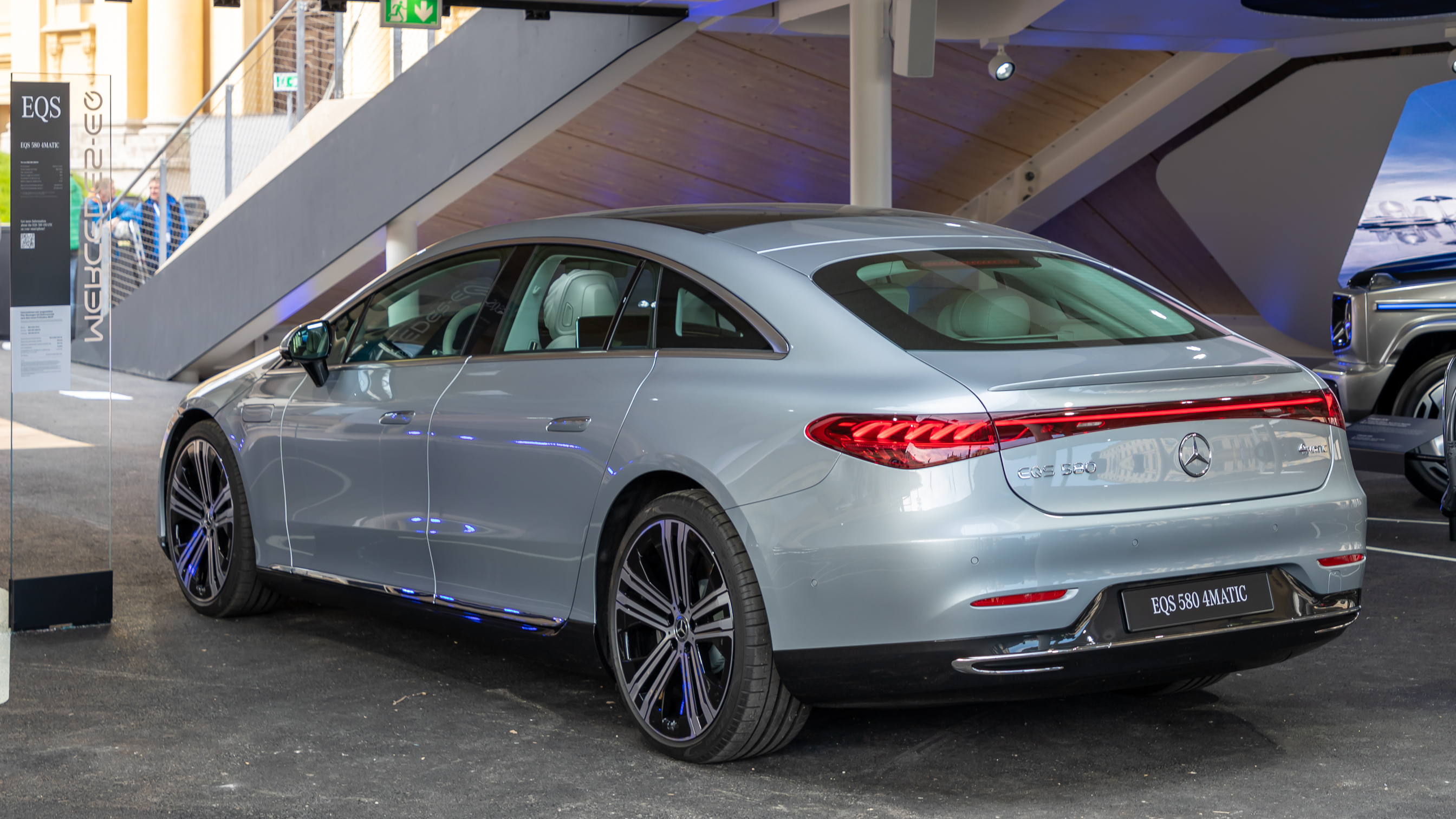
The Mercedes-Benz EQS is a fancy electric car that doesn’t use gas at all. It's designed to be very luxurious while being good for the environment, which is why it's getting a lot of attention from buyers who want to go green.
The Kia EV6 is a new electric car from Kia that doesn't use petrol. It's designed to be more environmentally friendly and has a lot of modern features.
Kilowatt hour is a way to measure how much energy a battery can store. It tells you how long the battery can power the car before needing to be recharged.
WLTP is a testing standard that helps determine how far a car can go on a full battery or tank of gas. It gives a better idea of fuel efficiency in everyday driving.
Megawatt charging is a way to quickly charge electric vehicles using a lot of power at once. It's especially important for big trucks that need to recharge fast to keep working.
The X-Peng G6 is a new electric SUV from a Chinese car company called X-Peng. It's designed to be smart and may have features that help it drive itself. This is the second version of this model.
Electric motoring means using cars that run on electricity instead of gasoline or diesel. These cars are better for the environment because they produce less pollution.
Tesla is a company that makes electric cars. They are known for their high-tech features and long-range batteries.
LIVE
Welcome back to the podcast, today VW's cell making, Mercedes S-Class gets a plug and Volvo
bets on America, plus stay tuned, later in the show I'll tell you why for many drivers
their first taste of electric motoring now comes not from a showroom, but from a rental
counter.
No EV news China today as it's the weekend, it's back tomorrow morning.
Let's get into it, Volkswagen's battery arm, Powerco, has started serious production at
its 2 billion euro gigafactory in Salt Skitter, a 69,000 square meter plant that broke ground
in July of 2022 and switched on in December 2025.
At full tilt, it'll turn out 40 gigawatt hours of cells a year, output will ramp through
this year to 20 gigawatt hours, that's enough cells for 250,000 of their EVs.
The VW Group now designs, develops and manufactures its own cells entirely in Europe.
Cells will go first into packs for the Group brands, then into its new Urban EV family vehicles
from VW Skoda and Seat, like the ID Polo, ID Cross SUV, Skoda Epic, Cooper Reval and
more, the MEB Plus platform.
Powerco aims to cover about 50% of their demand for its standardised, unified cell, with external
suppliers doing the rest.
The prismatic cell format stays the same across its brands and its regions, it's the chemistries
inside, ranging from LFP, Lithium Iron Phosphate to NMC, Nickel, Manganese Cobalt and later,
Solid State.
Initial Salt Skitter outputs focuses on NMC cells, about 10% more energy dense than the
previous cells they were using, the cells feed VW's cell-to-pack system, which many
of the western car makers have been trying to catch up with on China.
Now Volkswagen doing it, cell-to-pack accepts all chemistries, including Sodium Ion cells,
now under close review.
Modules disappear, as cells literally stack straight into a giga-cast battery casing surrounding
that replaces about 100 separate parts that cuts complexity and cost, while lifting energy
density and helping charging times and even increasing range as well.
Great news there, VW's cell production ramping up through this year for those new small vehicles
we're excited about.
Now if you'd like to waft along in luxury, Mercedes-Benz has added a plug socket to an
S-Class, but kept the fuel tank.
The latest flagship saloon comes as a plug-in hybrid, the S450E and S580E four-wheel drive,
offering an electric range of 62 miles or 100 kilometers.
Both versions have a 3.0-litre straight-six petrol and an electric motor and a battery.
Mercedes-Benz has for now declined to reveal the size of the battery, or indeed how fast
it'll charge.
Inside, the firm has gone all in, though, on computing power and onboard supercomputer.
Marshals, all the sensors required for ADAS, drive-resistance systems, performance, infotainment,
AI-powered virtual assistant, yet for all the silicon, the powertrain strategy is cautious.
The new S-Class offers petrol and diesel engines and a plug-in hybrid version as well, but
no fully electric S-Class.
Buyers who want zero emissions must still buy the EQS, that's a different platform.
The EQS has been on sale since 2021, had a facelift in 2024, and Mercedes-Benz pitching
it as the S-Class experience, but without the combustion engine.
Thanks for bearing with me, by the way, on the podcast.
I have been knocked down by whatever bug has run through the family and wasn't able to
record the podcast.
I'm going to write it.
Hey, quick question.
If I write the podcast, because I can do that in whatever state I'm in, would you like me
to post that onto Patreon and even the website, evnewsdaily.com, even without the audio, because
I just couldn't record a show for a couple of days?
Would that be okay?
I did it a couple of times recently and the Patreon fans went, oh, you've forgotten the
audio.
I didn't obviously say, like, oh, yeah, I'm just about to record that.
I put the text out first.
I can do that, by the way.
I always put the show together most days, even if I don't have a chance to record it
every single night at the weekends.
And so I can do that if you want.
Just let me know.
Now, BYD has begun trial production at its first European passenger car plant in Hungary.
Even as building work continues and the schedule has slipped, the site gives the Chinese group
a manufacturing base inside the European Union, just as the bloc's tariffs on imported Chinese
EVs imposed on October 24 now, I think it was, start to bite now.
For Brussels, the factory sits at the junction of two fights over Chinese industrial policy
and Europe's grip on investment.
By building their bevs in Hungary, BYD sidesteps the new duties and shows how global car makers
are re-rooting their supply chains rather than quitting the market.
Full production is now due in the second quarter of 2026, later than the 2025 target, and the
three-year timetable first touted when we were told about this in 2023.
Stella Lee, the group's executive vice president, has since confirmed a Q2 start this year,
with construction to finalise by the end of the year.
BYD has hired 960 staff, 70% of them Hungarian, and most from the local area.
The firm set up its European-based headquarters in R&D in Budapest last year, promising 2,000
jobs on top of their EV bus plant that opened in 2016.
If BYD reaches 200,000 vehicles a year, it will certainly have a tariff-proof European
hub.
Just as the trade row over Chinese EV seems to have peaked, Europe will then have to judge
how much it dislikes Chinese money when it arrives on European soil, with plants, jobs,
and engineering talent.
Now, Volvo's boss thinks America should be electric car heaven.
Hacken Samuelson, the old boss, new boss at Volvo, points to suburban sprawl in America,
and things like three-car garages as the ideal backdrop for home-charging electric vehicles.
Most Americans live in single-family dwellings.
Well, big suburban homes, in other words.
In the European Union, 46% of people live in apartments, 19% live in some shared building.
Those flats' apartments shape the charging over here in Europe, many Europeans park on
curbside.
Certainly, this was the first house we ever bought with a driveway, and many people face
hurdles to plug in.
That pushes governments to electrify public parking at speed, and to keep pouring money
into fast-charging networks, climate change remains uncontroversial over here in European
politics at least.
So, stricter emissions is fine to talk about.
That's not blasphemy over here, by the way, and it's moving ahead at a pace.
Even after softening its most ambitious 100% reduction on emissions by 2035 down to 90%
of the levels seen earlier this decade, the EU still keeps a target that will basically
mean everyone's driving zero-emission vehicles in 2035.
America has drifted the other way.
Regulators have shredded the emissions standards, scrapped policies that once pushed clean air,
car makers have then duly shifted resources back towards things that make them more money,
because why wouldn't you if you're a CEO delivering value and, of course, securing
your pension for when you've got your feet up?
And that is to sell petrol cars, which pollute more, yet Mr Samuelson shrugs off these worries.
He argues that consumers in America, not subsidies, will be the ones that decide on
whether they go electric.
His wager rests on domestic behavior.
Drivers who switch to electric never go back to petrol.
I saw an article recently, I didn't even open it.
It was like 50% of EV drivers say they're going to go back to petrol.
Didn't even open it.
I know it's been funded by the oil industry, it was on legacy media, it was like a newspaper
website, newspaper circulations in terminal decline, only a certain type of person buys
a newspaper these days, and I didn't even read it, I didn't even want to see the fake
data they'd made up, because seriously, you and I know a lot about EVs, 50% of people
are going back to petrol.
Nobody's going back to petrol.
I've never met someone who drove an EV and then went, I really want to go back to a diesel
car now.
Zero.
I've seen data that's like two, three, four percent, zero in my experience.
People learn that range anxiety looms larger in the headlines and the influences the content
creators funded by the oil industry than reality.
Daily use is far simpler.
Home charging is the automatic top up that you and I know that it is.
Mr. Hacken Samuelson from Volvo says that when people realize this, they'll go EV.
Don't worry about subsidies, don't worry about the politics of the green transition.
Just tell people it's easy and you save money and every morning you get into a car that's
been magically filled up overnight and people will drive EV.
And I think I agree with the boss of Volvo, one of the best things about driving an electric
car if you ask me, hey, can I ask an enormous favor?
Can you share this podcast with anyone ready, your friends, partner, someone who's learning
about EVs, someone who's super into EVs, forums, social media, anything like that?
And you might not want to because you might think it's terrible.
But if you don't think this podcast is terrible and you don't mind sharing it, I'd really
appreciate it because I could promote it on social media, Tumblr and the face.
But coming from you with people that you know, it would mean a huge amount to me.
If you can, that'd be super cool.
And we'll build the show together back in a moment.
All right, welcome back to the podcast.
Now, EU battery storage capacity grew by 45 percent last year.
Battery storage over here in the European Union is now 27.1 gigawatt hours.
According to the website PV Europe, grid storage, once a niche thing now starts
to matter for renewables and EVs.
The jump signals to linked shifts, intermittent renewables work perfectly
with battery storage because it cuts curtailment and price swings.
At the same time, the lithium ion supplied chain that feeds into electric
vehicles increasingly serves stationary projects.
Tying power markets to EV making directly.
When Europe adds 45 percent more storage in a single year, it tightens the race
for cells, materials, factories, that 27 gigawatt hour figure.
Still small next to the continent's EV demand, still gives system operators
more room to do things like smoothing out demand peaks, soaking up the cheaper
power that might be at midday when everyone's at work and support capacity
during calm dark spells.
That helps contain wholesale volatility, which in turn shapes charging
economics and time of use tariffs for EV owners and even your neighbors
that don't have an EV.
They'll pay less for electricity in the long run because the rest of us
going EV with battery storage on the grid as well makes sense for everybody.
Even if they're a never beaver, that's OK.
It's cheaper for all of us.
OK, let's go down under, which frankly I'd love to because it's their summertime.
Kia has opened orders for the EV for in Australia.
So my Aussie listeners can now get the Keer EV for.
It's the battery twin to the petrol K for down under.
And as one of the country's cheaper dedicated EV saloons, the EV for
standard range in air trim starts at 50,000 Aussie dollars.
That's about 35,000 US equivalent undercutting many rivals.
The bigger change sits under the skin, the EV for on their lower voltage
EGMP architecture rather than the more expensive 800 volt set up cuts cost
as it rains in peak charging performance.
That's OK for most buyers of those cars.
Three trims arrive in Australia, air, earth and GT line.
The EV for air standard range, single front motor, 150 kilowatts,
58.3 kilowatt hour battery, WLTP at 456 K's.
That's 283 miles.
Then the earth and the GT line get the bigger pack.
That's 81.4 kilowatt hour with WLTP range of up to 612 kilometers or 380
miles. You're knocking on 400 miles there, WLTP.
That's a win on the big battery prices.
Begin from 60,000 Aussie dollars, like I say, for the earth.
And it goes all the way up to 65,000 Aussies for the GT line.
It's about 45,000 US inside.
They all have the unified panoramic display
with that 12.3 inch digital instrument cluster,
the little five inch climate and the 12.3 inch multimedia unit.
It's got wireless Apple CarPlay, wireless Android Auto,
all standard vehicle to load as standard.
I pedal three, smart regen, all the toys.
So EV4 is a good car.
Now let's talk megawatt charging in September this year.
Magna Park in Lutterworth, UK will bolt an electric heavy goods
vehicle charging hub into the ground on its 13 million square foot logistics real
estate. The site spread across 50 buildings sold on things like sustainability
credentials at Magna Park will now gain megawatt charging.
The first phase is 32 megawatt charges, each delivering 400 kilowatts for HTVs.
They're putting 179 bays in, but only 32 kilowatt charges, megawatt charges.
Sorry. So that layout is all about vehicles being able to charge and then move.
The pull in layout fits articulated vehicles.
These are big, heavy goods, trucks, driver, welfare,
often an afterthought in the industry.
Sits well in the brief.
They'll supply hospitality for drivers at the hub,
folding in rest and refreshment into the charging stop.
But this is really important.
These are men and women who without them,
you've got nothing on your supermarket shelves and this is an industry
that I wouldn't want to do and I'm so grateful that people do.
It's a tough job as well, away from friends and family for long periods of time.
We have to make the industry better for those people, not just driving
better vehicles, but making their quality of life better, making it a job that
people, you know, an honest job that AI is not not going to kill and that people
want to get into. And the project will not only electrify Britain's fleet,
but high capacity MCS ready hubs rolling out in more places is a really good thing.
Now, I mentioned this yesterday,
X-Peng will hold its UK prices this year, completely stable.
They're releasing the new G6, which is the second gen G6 SUV.
China's onto its third one, third gen already.
They say that the new one is completely redesigned, 20,000 changes,
chassis, suspension, steering, battery, all noise, vibration, all better.
The cabin has better materials, better finishes, better tuning for European roads.
The new G6 dual motor all wheel drive performance black edition joins the range
this year as its flagship twin motors, 358 kilowatts.
Good for four seconds, not a 62 puts the car in the electric performance SUV territory.
List prices don't change, even with all the improvements, rear wheel drive standard.
That's what I would go for.
$39,990 because under a 40 K luxury tax.
That's being hopefully is that soon that goes to 50,000.
Was that definite policy?
I need to look into that when that starts, whether that was just a mooted thing.
And the long range version, 45 grand all wheel drive performance, 50 grand.
The firm still wants to threaten premium rivals on technology and pace, even without the badge.
And finally, in Britain's car hire lots, the change is happening quietly.
Petrol and diesel, which once filled almost every bay.
Now rental firms are adding an increasing amount of electric vehicles
at speed pushed by customers who want low emission travel.
Rising fuel costs and expanding cleaner zones and congestion zones
like we have in London and other big cities, more to come.
Electricity works out much cheaper on short term hires, even medium term hires.
Exemptions or lower fees for these models sweeten the deal.
What began as a green gesture by many higher companies is now a core part of their offering.
Improved charging networks ease the way as well above all on motorways in urban areas.
The automatic nature of EVs suits city driving, which is stop start.
Renters can get a quiet, smooth performance car, which is less tiring.
Demand comes on several fronts.
Enterprise research finds that Gen Z drivers in Britain want to rent EVs
when they come to rent a car, not a petrol or diesel.
Younger motorists using rental as a low risk way of doing electric motoring.
Business travellers need to do things like lower their carbon footprint
and pick battery power.
More often they say urban visitors who want to dodge congestion charges
or emissions charges pick the electric option.
Rental companies are seeing long term gains to EVs have lower maintenance costs over time.
Meet the firm's sustainability targets as well.
And according to self drive vehicle hire here in the UK,
a market once dominated by petrol and diesel is fast shifting here to low emission electric hire.
The shift in Britain's car hire bays doesn't really make the headlines.
There was a lot made of Teslas move into the Hertz rental fleet many years ago.
And then they reversed out of that very quickly when they didn't quite appreciate what they were buying.
And yes, Tesla service can be a beast of its own.
But outside of America, Germany, in the EU, here in Britain,
rental fleets are quietly going electric.
For many drivers, their first real taste of EV motoring now comes not from a showroom,
but from the rental counter.
And that's your podcast for today.
Thanks to our premium partners, National Car Charging on the US mainland
and the low-high charge in Hawaii and Test EV, Avalu's trusted partner
for independent EV battery health testing in Australia and New Zealand.
Have a good and cinema and remember, there's no such thing as a self charging hybrid.
About this episode
Volkswagen's Powerco has commenced production at its new gigafactory in Salt Skitter, aiming to produce 40 GWh of battery cells annually. The episode also covers the Mercedes S-Class's new plug-in hybrid variants, offering an electric range of 62 miles while maintaining traditional fuel options. Additionally, Volvo's CEO discusses the potential for electric vehicle adoption in America, emphasizing consumer behavior over subsidies. The episode highlights BYD's new European plant in Hungary and the growth of battery storage capacity in the EU, which surged by 45% last year.