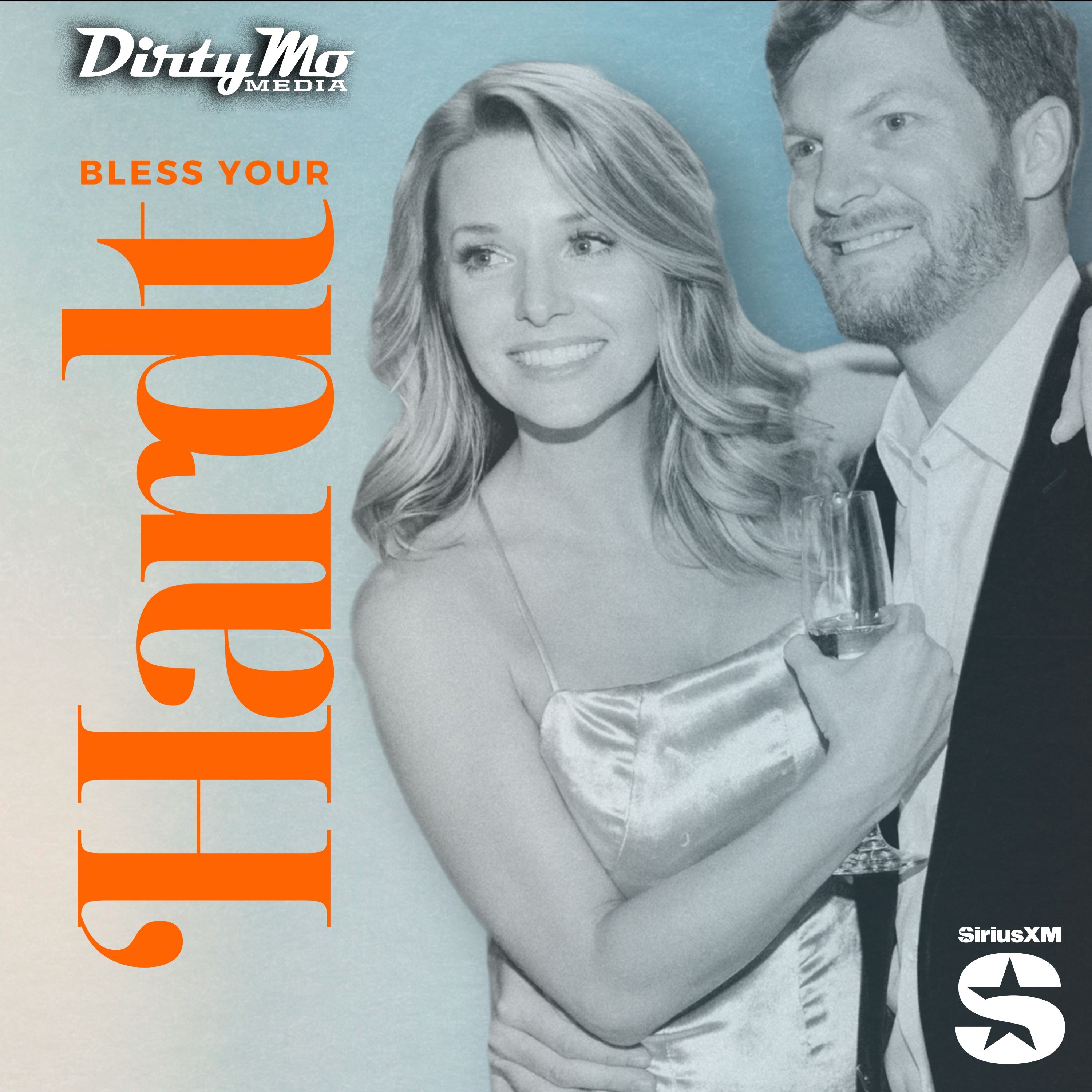
Dale And Amy Have Different Opinions On Driving Etiquette...
About this episode
Dale and Amy bounce from collectible cards and a new drink partnership into a long, funny debate about driving manners, horn etiquette, and how much gratitude is too much when someone lets you merge. The conversation keeps drifting into everyday life: a beach drive, favorite Charleston-area food, houseboat plans, kids’ elaborate fake nails, and a tense moment when a child wandered off during a sleepover. Later, they play guessing games and trade opinions on Derby picks, emojis, and the kinds of personal laws they’d make.
This week’s episode of Bless Your ‘Hardt starts with a real conversation about something everyone deals with but rarely agrees on: driving etiquette. Dale and Amy break down a specific moment where a simple courtesy on the road turns into a full discussion about how people acknowledge each other behind the wheel. They dig into what feels polite versus awkward, and how different personalities show appreciation in those split-second interactions. It turns into a funny but surprisingly thoughtful look at how small habits in traffic say more about people than you might expect.
From there, the episode moves into a mix of family life and everyday chaos. There are birthday moments, stories around the house, and the kind of random updates that always seem to pop up in between everything else. Ask Amy is back with fan-submitted questions. They cover everything from go-to beauty products and favorite hats to Derby fashion takes, emoji habits, and completely random “would you make a law for this?” hypotheticals. It’s a fast-moving mix of real life, opinions, and laughs you won’t see coming.
Check out Dirty Mo Media on YouTube: https://www.youtube.com/@DirtyMoMedia
Hosted by Simplecast, an AdsWizz company. See pcm.adswizz.com for information about our collection and use of personal data for advertising.
cards
"Is there like a bunch of cards in there? Or is it just like a couple?... There's probably about 150 cards in there."
Here, “cards” means collectible trading cards. They’re talking about how many are in a box and how much one card is worth.
In this context, “cards” refers to collectible trading cards, not vehicle-related cards like key cards or service cards. The discussion is about card counts, storage, and the value of a specific collectible.
black box
"How do I see it? Now you're curious. Now you want to see in my black box... But if you want to show your black box off, go get your black box."
A “black box” is a special device that records what a car is doing—like speed and events—so you can look back later. It’s often used after crashes or for tracking driving behavior.
A “black box” is a vehicle data recorder that logs driving events and sensor information (often used for crash investigation). In this segment, it’s being treated like a device the person wants to show off, implying it’s a specialized piece of equipment rather than a generic camera.
get it graded
"[273.0s] I think I need to send it off to get it graded. [276.3s] Wait, would you want to sign it first before you had it graded? [278.7s] I mean, you can always bust it out of the slab."
“Grading” means sending something to an expert service to check that it’s real and to rate how good its condition is. People do it because it can affect how much collectors are willing to pay.
“Grading” here refers to having a collectible evaluated and authenticated by a third-party service, typically assigning a condition score. In car-enthusiast circles this often comes up with collectible items tied to racing or automotive memorabilia, where condition and authenticity affect value.
slab
"[276.3s] Wait, would you want to sign it first before you had it graded? [278.7s] I mean, you can always bust it out of the slab. [282.5s] If you ever wanted to get it signed, you could do that."
A “slab” is the sealed, protective plastic case used by grading companies to hold an item after it’s graded. The point is to preserve condition and prevent handling damage, which is why the discussion mentions signing after or before it’s sealed.
soften the corner
"[295.5s] What if he swears it? [296.2s] Well, no, but he could, he could damage the edge or soften the corner. [301.1s] I'd be pissed."
“Softening the corner” means the sharp corner gets slightly worn down or rounded. Collectors care a lot because it can make the item look less perfect.
“Soften the corner” describes minor wear or rounding at an item’s corner, usually from handling or contact during signing. In grading contexts, even small edge/corner damage can lower the condition score.
driving home from the airport
"[509.9s] I got a random question. [512.2s] So you and I are driving home from the airport from that visit. [516.9s] And it's kind of hard getting through Troutman to turn off, [520.0s] to get home."
They’re talking about the drive home after flying in. It’s the setup for a conversation about how drivers should act on the road.
The hosts shift from talking about a restaurant partnership to a driving scenario—getting home after an airport visit. This sets up the episode’s theme about driving etiquette and how people behave on the road.
driving etiquette
"Traffic's gotten really heavy through there. Right at the Waffle House, sir? ... I'm like, wow, that was a little extra, don't you think?"
They’re talking about “driving etiquette,” meaning the little actions drivers do to be polite on the road. Here, they’re arguing about whether Dale’s extra gestures were too much.
The hosts are debating what’s considered polite or excessive behavior in traffic. In this segment, they focus on how drivers communicate thanks while letting someone merge or go first.
horn honked
"[616.8s] So listen, listen, listen. [618.4s] Like, because I don't like getting a horn honked at me. [621.4s] I gotta tell you. [621.9s] It makes me annoyed."
The horn is the car’s loud warning sound. They’re saying they don’t like being honked at, because it makes them annoyed.
A “horn” is the vehicle’s audible warning device used to alert other drivers or pedestrians. “Honked” here is about using the horn as communication, and the speaker is saying it personally annoys them even if the intent might be friendly.
behind the wheel
"Even if like, it might be a nice honk. [626.0s] This is how my life changed behind the wheel of an automobile. [632.4s] Okay."
“Behind the wheel” just means you’re driving the car. They’re saying their life changed because of what happened while they were driving.
“Behind the wheel” means driving a car—being in control of the vehicle at the driver’s seat. In this segment, it’s used to introduce how the speaker’s driving experiences shaped their attitude.
changing oil
"[750.8s] I worked at the dealership changing oil and I would drive to Marshville an hour from my house [757.1s] every Wednesday night and then back home."
Changing oil is basic car maintenance where you replace the old engine oil with new oil. It helps the engine run smoothly and protects it from wear.
“Changing oil” is routine maintenance where the engine’s oil is drained and replaced with fresh oil. It helps keep the engine lubricated and removes contaminants that build up over time.
hand up
"You get within 10 miles of the town limits. Everybody drives by, just pops his hand up... If I just put the hand up, like the basic hand up that somebody's going to think I'm flipping them off."
They’re talking about a quick hand gesture drivers make to say “thanks” or “I see you.” The problem is that some people worry it could be mistaken for something rude.
In this context, “pops his hand up” and “put the hand up” refers to a brief gesture drivers use to acknowledge or communicate. It’s not a technical driving maneuver, but it’s a recognizable social signal that some drivers interpret differently depending on local norms.
merge etiquette
"I did a guy today, let me in. [819.1s] I was downtown Charlotte driving around that damn maniac town... people trying to get over and get this, get right and get left. People trying to get, you know, and a guy let me in..."
When someone says “let me in,” they mean they’re trying to change lanes or get into traffic. Being polite and predictable helps traffic move without near-misses.
“Let me in” is a real-world description of merge etiquette—how drivers coordinate when changing lanes or entering traffic. Good etiquette reduces conflict and helps traffic flow smoothly, while bad etiquette can make everyone more stressed.
lane changing
"I was downtown Charlotte driving around that damn maniac town, all the traffic going on and people trying to get over and get this, get right and get left."
They’re describing when cars move into a different lane in busy traffic. Doing it smoothly means you pick the right moment and don’t cut people off.
The segment describes drivers “trying to get over” and “get right and get left,” which is essentially lane changing in heavy traffic. Lane changes require spacing, signaling, and timing to avoid forcing other drivers to brake or swerve.
pregnant pause
"“That's rude. Because I give you like a pregnant pause at the light. And if you're not moving, if those light, if the brake lights haven't come off.”"
A “pregnant pause” here just means a short, intentional delay—like waiting a second at a green light before you go. They’re debating whether that delay is long enough that honking feels justified or rude.
In driving etiquette, a “pregnant pause” is the deliberate, brief hesitation at a traffic light before moving or before reacting. In this conversation, it’s used to justify when someone might honk (or not) if the light has changed but the car ahead hasn’t moved yet.
brake lights
"But all I look for is if the brake lights come off, I'm good. Yeah. I don't need you to be like jumping it."
Brake lights are the red lights that turn on when someone presses the brake pedal. They’re basically a clear “I’m slowing down” signal to the cars behind.
Brake lights are the red lights on a car that illuminate when the driver applies the brakes. In the conversation, they’re using brake lights as a simple signal that the other driver has slowed down safely.
long horn
"Now I do hit the long one. Like if you're getting cut off on that highway. Yeah, yeah, yeah. Like you got to let him know."
A “long horn” is when you hold the horn for a longer beep instead of a quick tap. They’re saying it’s a clearer warning when someone cuts you off.
A “long horn” typically means holding the horn button for an extended sound to make the warning more noticeable. The hosts treat it as a safer, more communicative option when someone is cutting you off.
getting cut off
"Like if you're getting cut off on that highway. Yeah, yeah, yeah. Like you got to let him know. For safety, you can use the long horn."
“Getting cut off” is when another car slides in front of you and you have to react, like braking or changing lanes. They’re talking about how to handle that situation without making it worse.
“Getting cut off” means another driver moves into your lane in a way that forces you to slow down or change your driving. The hosts connect it to etiquette and safety—using warnings rather than escalating the situation.
gas it
"My, my go-to when somebody cuts me off is to, is to gas it and get up this item. And it's there out of."
“Gas it” means you press the gas pedal harder to speed up quickly. They’re describing it as their instinct when someone cuts them off, which can be aggressive.
“Gas it” means pressing the accelerator quickly to increase speed. In the segment, it’s described as the speaker’s go-to reaction when someone cuts them off—an aggressive response that can be risky if there’s not enough space.
mashing the gas
"And he's also mashing the gas, but looking straight out. Not looking at all where he's going."
“Mashing the gas” just means stomping on the accelerator to make the car speed up quickly. In this context, it suggests the other driver was driving aggressively.
“Mashing the gas” means pressing the accelerator pedal aggressively, usually to get rapid acceleration. In driving etiquette discussions, it often implies the driver is acting with urgency or impatience rather than smoothly merging or passing.

Dodge Challenger
"We get into Charlotte and this orange, orange Dodge Challenger kind of car, like literally raced around me. And as the lane was ending, they cut across my nose."
A Dodge Challenger is a popular American muscle car. Here it’s mentioned because it behaved aggressively—cutting across the narrator’s lane while they were driving.
The Dodge Challenger is a muscle car from Dodge, known for strong straight-line acceleration and wide availability in performance trims. In this story, it’s the specific car that cut across the narrator’s lane while they were driving into Charlotte.
lane was ending
"And as the lane was ending, they cut across my nose. And I mean, it was close and I floored it."
A lane “was ending” means the road is narrowing and you have to merge. The safe move is to merge carefully and give other drivers room instead of cutting in at the last second.
When a lane “is ending,” it’s a traffic situation where drivers must merge into the remaining lanes. Proper etiquette is to give space, signal, and merge smoothly—cutting across can force others to brake or swerve.
floored it
"And as the lane was ending, they cut across my nose. And I mean, it was close and I floored it."
“Floored it” means you pressed the gas pedal to the floor to accelerate as hard as possible. Here it sounds like the narrator did it to get away from a dangerous situation.
“Floored it” means pushing the accelerator pedal all the way down for maximum acceleration. Drivers often do this to avoid a hazard or to quickly create space when another vehicle cuts in too close.
miles per gallon
"The other one is miles per gallon. So I'll be trying to run fast while not using the gas pedal unnecessarily to try to make sure the fuel is, because if we,"
Miles per gallon (MPG) is how efficiently a car uses fuel. It tells you how far you can drive on one gallon—higher MPG usually means you spend less on gas.
“Miles per gallon” (MPG) is a fuel-economy measure that tells you how many miles a vehicle can travel for each gallon of fuel. Higher MPG generally means the car is using less fuel to cover the same distance.
gas pedal
"So I'll be trying to run fast while not using the gas pedal unnecessarily to try to make sure the fuel is, because if we, When we leave the house in South Carolina to go home,"
The gas pedal is what you press to make the car go faster. If you press it too much or too often, you usually use more gas.
The “gas pedal” is the accelerator pedal that controls engine power by regulating how much fuel and air the engine receives. In fuel-economy discussions, lighter or smarter pedal use can reduce unnecessary fuel burn.
tandem drafting
"It's like, I'm always trying to like do really good on the gas mileage. And the third thing that is entertaining is if you're, if you get, get in a, if you're with a car that's in the same, running the same pace as you and y'all are on the road for like hours, you, you never make eye contact. There is no communication whatsoever between either driver, but it's, but for some reason you feel like you both are working together. It's like tandem drafting. Unspoken team situations."
Tandem drafting is when two cars kind of “work together” by driving close enough that the air resistance for the car behind gets reduced. It can help the back car keep speed more efficiently.
“Tandem drafting” is when two cars drive close together in the same direction, using the lead car’s airflow to reduce aerodynamic drag for the trailing car. It can make it easier to maintain speed with less effort, especially on highways.
cruise control
"[1413.6s] It's not, that's perfect when you're on cruise control. [1415.6s] We've got to minimize our, our risk of, uh, [1417.7s] cruise control is not allowed because that ruins your mileage. [1420.4s] That ruins your gas mileage."
Cruise control is a feature that keeps your car at the same speed without you pressing the gas pedal. You set the speed once, and the car tries to maintain it until you turn it off or brake.
Cruise control is a driver-assistance feature that automatically holds a set speed using the car’s throttle and engine management. It can reduce workload on long drives, but it doesn’t override speed limits or account for traffic the way a careful driver does.
gas mileage
"[1417.7s] cruise control is not allowed because that ruins your mileage. [1420.4s] That ruins your gas mileage. [1421.9s] Cruise control ruins the gas mileage?"
Gas mileage is how far your car can go on a gallon of gas (or how much fuel it uses). Things like speed, traffic, and hills can make it better or worse.
Gas mileage is how efficiently a vehicle uses fuel, usually measured as miles per gallon (MPG) or liters per 100 km. Driving style and conditions (traffic, hills, speed) can change it more than cruise control itself.
speed limit
"[1432.1s] I love cruise control. [1433.2s] When you're breaking, you know, when you're speeding [1435.1s] five, 10 mile an hour over the speed limit [1437.0s] and you've got a couple of guys around you"
The speed limit is the legally posted maximum speed for a road segment, set based on safety factors like traffic density, visibility, and road design. Exceeding it—especially by several miles per hour—can increase stopping distance needs and crash risk.
Fan Day
"On the 21st of May at Junior Motorsports, Fan Day happens, which is always around Charlotte weekend. It's pretty fun. A lot of the race shops around here do it."
Fan Day is an event for racing fans. It’s usually a day where you can meet people involved in the sport and watch live shows.
“Fan Day” is a motorsports event where fans can meet personalities and often get access to team areas or live programming. In this segment, it’s tied to Junior Motorsports and the Charlotte race weekend.
Junior Motorsports
"On the 21st of May at Junior Motorsports, Fan Day happens, which is always around Charlotte weekend."
Junior Motorsports is a racing team. In this episode, they’re hosting Fan Day at their place.
Junior Motorsports is a NASCAR team organization associated with Dale Earnhardt Jr. The segment places Fan Day at their facility, indicating it’s a team-run fan event.
Charlotte weekend
"On the 21st of May at Junior Motorsports, Fan Day happens, which is always around Charlotte weekend. It's pretty fun."
“Charlotte weekend” refers to the race weekend in the Charlotte area, which is a major hub for NASCAR. The hosts connect Fan Day timing to that event schedule.
Series XM on track
"So at nine o'clock in the morning till 11 a.m. Series XM on track with Daniel Trotta and Larry McReynolds will happen here as well."
They’re mentioning a live broadcast segment during the event. It’s scheduled for the morning and includes NASCAR media personalities.
“Series XM on track” appears to describe an on-site radio/live broadcast segment during the event. It’s mentioned as happening from 9:00 to 11:00 a.m. with Daniel Trotta and Larry McReynolds.
Request an Explanation
Heard something you'd like explained? We'll add it to this episode.
Sign in to request explanations for terms you heard.
Want to learn more?
Browse our glossary for plain-English explanations of automotive terms, jargon, and concepts.
Help improve this episode
See something that's not quite right? Our annotations are AI-generated and can sometimes miss the mark. Click the flag icon on any annotation to suggest a correction.