In motorsport, retirement is often a psychological and performance decision, not just an age-based one. The host frames it as recognizing a personal internal shift—when the motivation or competitive drive changes.
Spraying champagne is a tradition people do after winning big races. The podcast is saying the driver in the story helped make it a signature celebration.
The “Gurney bubble” refers to a bulge/clearance added to a race car’s bodywork to accommodate a driver’s helmet/head height. In this segment, it’s explained as a fitment solution made after the driver was found to be too tall for the original cockpit space.
“Singapore” refers to the Singapore Grand Prix, a Formula 1 race held on a street circuit in Singapore. Street circuits are known for tight corners and limited runoff, which makes qualifying and race execution especially important.
Go-karts are small, lightweight racing vehicles that many future professional drivers start with. They’re popular because they’re relatively affordable and teach core driving skills like throttle control, racing lines, and close-quarters overtaking.
“Strap into the car” refers to the driver getting secured in the cockpit with the seatbelts and safety harnesses before going out. It’s a key mental transition in racing—once you’re strapped in, you’re committed to performance mode.
The garage is the team’s enclosed work area at an F1 event where the car is prepared and where drivers and staff gather before sessions. It’s also a place where noise management and routine can matter because the driver is transitioning from the paddock environment into race mode.
F1 stands for Formula 1, the highest level of professional race car driving. It’s not just about the driver—teams build and tune the cars, and small problems can ruin a weekend.
Racing is as much about timing as it is about speed. If you push or react at the wrong moment, the car can lose traction and you can end up in trouble.
A crash is when the car hits something or spins out and can’t continue normally. It often means repairs, lost track time, and a lot of wasted effort for the weekend.
Racing weekends are short, with only a few chances to drive and compete. If you crash or break something early, you may not get another real shot that weekend.
Even though the driver is the one you watch, F1 is really a team effort. The engineers and strategy people play a huge role in how well the car performs.
In racing, “controlling” refers to actively managing the car through inputs like steering, throttle, and braking while the vehicle is being pushed hard. That’s why the experience can feel intense—because you’re both experiencing high forces and staying in charge of them.
They’re talking about how a top driver figures out when it’s time to stop racing. Sometimes it’s not just age—it can be about safety, risk, and whether you still feel you can do the job.
When a driver ends up upside down, fuel and fumes can flow toward them differently. That can make breathing and survival more urgent during the first moments after impact.
“Back into the seat” means back behind the wheel racing again. It usually happens after someone has been out for a while due to injury or something else.
Missing multiple F1 races due to injury can disrupt a driver’s rhythm, fitness, and car development feedback loop with the team. It also creates pressure to return quickly and perform at a high level despite lost seat time.
In Formula 1, “let go” typically means a driver is released from their contract or not retained for the next season. It’s often tied to results, performance relative to teammates, and whether the team believes the driver can meet current development and performance targets.
Ford is a big car company. Here, they’re talking about what advice Daniel would give if he were the CEO of Ford—basically how to lead and stay motivated.
Off-road driving means taking a car or truck on dirt, gravel, or rough ground instead of normal roads. The idea here is that it can feel more free and less complicated than everyday driving.
“Unfiltered” here means you’re not driving on smooth, predictable roads. Off-road is messier and more real, so the driving feels more direct and less “managed.”
“No-boring cars” is basically the idea that cars should be fun and exciting to drive, not just practical. Here, they connect that to off-road because it can feel more real and less controlled.
LIVE
On that day you were the best in the world at doing a single thing and it's powerful so you're filled with this rush and this pride and this kind of almighty strength, but it's also very as high as it is, it's also very grounding.
Daniel Ricardo knows a lot about what that moment feels like. He won eight Formula One races out of more than 250 starts, which tells you something about how hard it is to get to the top of that podium in Formula One.
This is Drive, I'm Jim Farley.
In thinking back about my talk with Daniel, what really stayed with me wasn't his wins, it was how honest he was about his losses, and about that moment you realized something inside of you shifted, that it might be time just to move on.
When we talk about Formula One, we talk about ego, retirement, and that three letter word that has been his driving force, fun.
So first kind of topic I'd like to talk about is the Shoei because it was so, now the reason why I think it's cool, but everyone would be different, is that my hero racing here was Stan Gurney growing up and Dan was the first person to take champagne and spray people.
In the 1966 Le Mans when we won, he took them away.
Is that where they had to...
Yes, his bubble, he was too tall for the car, and Phil Remington took a hammer and dolly and made it big enough for the Gurney bubble.
But after he won that race, they gave them the magnum of Moe, and he wasn't sure what to do, but he was so happy, he shook it up and sprayed and the French were mortified.
And so when I saw you do the Shoei, I felt like it was the first time since Dan did that with the champagne bottle that you had been like the innovator to change the celebration in a totally different way.
And so tell us about like, was that just instantaneous or...
Because it was so unexpected and now it's one of your signatures, many signatures.
Tell us about how to come to be and what was it like the first time.
Yeah, I believe when I did it, a friend of mine kind of did some history on it and I think it was initially like a German thing or something.
So I can't remember the exact Shoei history, let's say, but it was, you know, a few of my friends in Australia were doing it.
There was a group of guys called themselves the Mad Hueys and they would just go and surf trips around the world and just drink out of their shoe and...
I see.
It was like, it was my way of show...
You know, I'd lived away from Australia for a long time, but it was my way of showing, I guess, Australia that I'm still Australian.
That's an interesting thing.
So it was definitely some of that.
And then there was also, you know, I always tried, I say in a way quite desperately to remain myself in a sport that was...
These days it's changed, but I think definitely 10 years ago it was still a little bit buttoned up and I wanted to try and...
Yeah, I say like relax the shoulders of the sport a little bit.
And so I thought the Shoei was, I was like, if the sport hater, at least my Aussie friends will give me some respect.
But then I did it and I really didn't know how it was going to go down and I was like, it'll be a one and done thing.
Were you surprised at the reaction?
Oh yeah, because a few months later I remember I was at Singapore and I got a podium.
And after I did the first one, I was like, okay, maybe this is something I just saved for when I win.
You know, a really big occasion, not just maybe a podium.
And I chose not to do it on the podium and the crowd.
I heard some like Shoei chants and then there was some booze when I didn't do it.
I was like, okay, they really want this.
So I was just like, okay, all the podiums I get now I just have to do it.
Amazing.
I'm getting the other drivers to drink out of your shoe.
Yeah, yeah, that's cool.
It's kind of like, especially if you, maybe if that other driver isn't your best friend.
Yeah, yeah.
That's a good way to like, they can't say no, like otherwise they're going to get boozed.
So you put them in a pretty compromising situation.
That's interesting.
So let's talk about racing, but maybe through a different lens, which is kind of the human side.
Being a professional athlete, having such a serious career, all the pressure coming up.
You know, what did you love about racing?
What is the part of racing that you particularly connect with?
So I still have, I would say I'm very thankful for whoever gave me a photographic memory.
So I still remember the first time I drove a go-kart, you know, at the indoor rental cart place.
I remember I wanted to go in Perth.
And I wanted to go sooner, but I didn't meet the, I would have been eight.
I wanted to go at seven, but I didn't meet the minimum height.
Do you remember that when you were eight years old?
I don't remember anything when I was eight.
I still can, now I'm picturing driving down the straight and just thinking,
like the first word that comes to mind is freedom, like the feeling of having control of something at such a young age
and not being able to be touched, I guess.
That was like the first thing I relate to with racing or driving was freedom.
And, you know, racing was the same.
And even as it got, you know, more serious and up into Formula One, you, as soon as I'll strap into the car from the outside,
everyone probably thinks, oh, this is like the hardest time for them during the weekend because this is now business.
And this is where they actually have to really switch on and perform.
But for me, it was the easiest time because it was my time.
And I could just be, you know, there's not only the team itself, but then you've got the crowd, the fans, everything.
The paddock is so full of distractions, I guess.
That when I would strap in, put the helmet on, I was like, okay, I can finally be free.
Was there a ritual you had where you switched your mind onto that?
Was it closing?
A lot of people visualize closing a visor.
I don't really buy that.
Was there a moment like when you pull away and the noise goes away other than the car?
Was there a moment when you go, now's my time?
Yeah, I think it was really putting the helmet on.
I would, you know, try to start with putting music on, you know, so maybe walking into the garage,
just to already start kind of drowning out some of the noise.
So definitely the headphones was, let's say phase one, but then phase two, I think, you know,
because I'd still be maybe laughing or joking around a bit, but then putting the helmet on,
that was also very symbolic of not only, okay, it's go time, but the helmet is a massive
bit of safety equipment.
So it was also a reminder that what I'm about to do, even though I've done it for so long
now that sometimes you can forget, it is dangerous and it's time to, yeah, switch into that gear
and let's say stop messing around.
Did you ever want to do anything else?
Is there a different version of Daniel Ricardo that we've never met?
Definitely.
That maybe you didn't even, you haven't even met?
There's, so I think what would surprise a lot of people is I, I wasn't, you know, I loved racing
since I was a kid.
I remember watching racing when I was four years old on TV and I always loved it,
but I never really thought or believed that I would make it a career, you know,
and I say that because going through school, you know, I was in my two last years of school
and I was doing work experience at places and I was just like, what, what do I do?
You know, I like racing, but, you know, I wasn't dominating the local scene or anything.
So in my head, I was like, okay, if I'm not even dominating here, how am I going to go
and dominate the world?
So I was just, I was scrambling and I wasn't really sure and I didn't have much self-belief
and I played tennis and I played other sports.
I just loved also being a kid and riding dirt bikes with friends and, and it got,
and I think, yeah, it was like the last year of school and it was, okay,
I need to really grow up and make a decision what I want to do with my life.
And I knew there wasn't really anything I was passionate about that I was studying at school
and I loved racing, but I didn't really have much belief in myself,
but I kind of just made that thing and obviously with the help of, you know,
dad maybe encouraging me a little bit was, well, it's now or never.
Let's just try.
We can, we can afford to give it a go and see what comes of it.
That was a fork in the road.
Yeah.
I mean, I was, I was 17 and four years later I was in F1, but I didn't,
there was no way I thought that was going to happen.
That's amazing.
And I just like being with my friends like I like just being a kid.
So the whole, the whole journey that I ended up taking was, you know,
I obviously embraced it and enjoyed it in the end, but it just wasn't what I thought it would be.
And I also loved home.
I loved Perth.
I, the thought of being on a plane every few days was not the life I was picturing.
Is there something about racing that people really don't, can't understand for me,
the one racing?
Like for me, I reached on the weekend just as an amateur.
And I think most people don't realize kind of how, how disappointing it is.
Like pretty much 90% of my racing is like something breaks or I make a mistake or I get in a situation
where I just make a bad decision at the wrong time and crash or whatever.
And then the weekend's over and it's a lot of money.
And, you know, and so I'm always surprised at how few people realize how much literally 90%
of my time racing ends in disappointment.
Like really like, wow, but there are a lot of other great things.
How about for you as a Formula one pilot?
Like that is a completely different thing than most people could even understand.
Like even Olympics or being an FL champion, very few people on the planet would have any idea
even to compete in Formula one, let alone winning a race or races.
I guess I'm always a little bit hesitant to talk about the disappointments or the lows
or the tough days because people see a lot of the good.
And, you know, the, yes, it gives you a lot as well.
So I don't want to dismiss that, but it's kind of like what goes up must come down.
And there are a lot of days that hurt.
You know, there's a lot of days where you're frustrated and you, there's so much that's out of your control.
And of course, I'll take accountability when I can, but there are days that just hurt and suck.
I was, as you mentioned, like one of the lucky ones, I was able to win races in Formula one.
I won eight races, but I entered over 250.
So I don't know what that works out in percentage, but it's a pretty low percentage of success rate.
You know, I compare it to a team sport, for example, maybe their record is 50%, probably better.
A lot of teams, but so the good days or the real good days are far and few between.
But there's something about it that just keeps bringing you back.
And I think it makes the highs higher because you don't win every day.
You appreciate it when you do, but there was days where I was very uninterested.
And I can tell you numerous occasions where I was, yeah, I'm done.
And especially with your disposition and you're such a wonderful person.
We all watched you as fans.
And I think it would be hard to see that, but underneath it all, there's that.
Got it.
Yeah, and that's a thing.
You try and hide a little bit of it.
Well, you definitely hide a lot of it.
I mean, again, I tried to give as much as I could.
And if I felt pain, I tried to share some of that because we are people.
And we're normal, but you do try and hide a bit of it because again, your competitors,
you know, if they see you in a vulnerable position, then that's a weakness.
Interesting, yeah.
So there's, even if it's, yeah, forget what the people think of you.
It's how you're actually going to go against the guy tomorrow or next week.
So yeah, that's like the, let's say some of the challenges.
But then I think the feeling of driving, it's, you know, as a kid, I got frustrated, you know,
when I was racing go-karts at school or even when I moved to Europe, no one could really,
no one really thought I was as cool as I thought I was, you know, because they couldn't relate.
And they're like, yeah, I drive to school or I drive this or who cares?
You drive a little bit faster.
No big deal.
But it's, it is a crazy feeling and that's, that's why we love it.
It's the best way to describe it.
I don't know.
How would you describe it?
Like a roller coaster, you get kind of thrown around.
Yeah, it's more violent, but you're doing the controlling.
So it, it's kind of like done.
For me, the way I like to describe it to people I love is you're integrated into a machine
and, and you're controlling it to the maximum.
And it's kind of like your clothes, you don't think about it as a car.
You think about it as an extension of your body.
And so what the satisfaction is that if you could control it in such an organic way,
that you don't really think about it.
You don't think about doing this or doing that.
It's just you're controlling it perfectly as you intend.
And then, you know, your, your errors are in your mind.
It's not in your physical being.
To me, that's a level.
Most people don't ever feel that about it having that kind of relationship with a device.
Yeah.
You can't think about it.
That's how I think about it.
It's a little weird.
No, it's, it's, I think I just, I did it for so many years and you're in it.
And yeah, I've never actually thought about how you, how you have and how you articulated it.
But it's, it's like that.
And the, the good days, you know, the days that, yeah, the days that I won or had a good result.
It's, it's just, it just happens.
It feels a little more effortless than you would imagine when you're trying to go fast.
And so few of us in life, billions of people on the planet, so few of us could say that
we are the best of the world in one moment at one thing.
It's very rare.
There's just a few people.
What does it feel like?
I won't lie.
It feels powerful.
You know, it's, it is, it's a weird thing.
It's, it's a weird power to have.
It's like a superpower for that moment in time.
As you said, on that day, you were the best in the world at doing a single thing.
And it's powerful.
So you're filled with this, this rush and this pride and this, yeah, this kind of almighty strength.
But it's also very, I think at the same time, it's, it's,
it's nearly as, as, as high as it is.
It's also very grounding.
And I was, I always felt maybe once the adrenaline ran down or I was on the podium and I could
actually just take a beat.
You're very, like you become very reflective and very, yeah, just appreciative of, wow,
like all the go-karting days.
And you really reflect on the bad days.
The days that dad was yelling at me, kicking my butt.
And all the days where you thought you were maybe going to not race again or just be over it.
And you're like, I'm, you know, okay, we stayed on it.
We stayed on it.
And now we're here.
And wow.
So it's like, you know, my first win when I got asked, how did it feel crossing the line?
It was relief.
You know, that, that's because you, you put so much into it and you believe you can.
But until you do, you're like, can I, can I?
Yes.
So even before the joy kicks in, it's, it's just relief.
Like I totally, I totally know exactly what you're saying.
I saw a great video of Johnny Rutherford who in our country for a period of time was the
IndyCar driver and he, he was asked once, how did you know when it was the right time to retire?
And his answer was fascinating for me.
It's something I think about almost daily in my job.
When is the right time to give someone else the chance to lead Ford?
And that's very situational.
He said he had a terrible accident, Indy, and the reporter brought it up in that context.
Did you retire because of this accident?
He was upside down.
Methanol was pouring over his body.
He had to take a big breath quickly before he's, because if there was a fire, the biggest
risk for him was inhaling the fire.
And that would burn his lungs and he saw many of his competitors do that.
So he had taught himself, as soon as you go upside down, you feel the fuel on you.
He wasn't scared of the fire.
He, he had to hold his breath.
And so the interviewer was like, was that the moment?
He goes, actually no.
I wasn't scared of that.
I retired because I came in the garage a couple of times.
And on reflection, I didn't ask the guys to make changes and always make changes.
And he said, then I knew that something had changed where I didn't want it the same level
and I was, I was voting it in.
And he said, I went right to Roger Penske in the middle of the season and said, I'm going to retire now.
Roger said, no, no, no, Indy's coming around the corner.
He said, you know, you want it more than anyone.
He said, no, I'm retiring right now.
And he said, because the accident, he said, no, I'm not scared.
It's because I know something left, something's gone and I can't get it back.
And as a professional, for me, that was one of the most insightful, helpful suggestions.
And I wanted to ask you about your retirement at a personal level.
How did it work for you?
What gave you the idea this was the right time?
Yeah, that's, I think that's extremely brave to also call it then and there, you know,
because also everyone will keep expecting you to do it.
And there'll always be someone who still believes in you that says you can.
Yes.
It's sort of, look, I definitely had to try and understand a lot the last 12 months about,
you know, the career coming to an end.
And it's like timing, you know, because you know, you're not really going to get it back.
You know, once it's gone, it's gone for the most part.
And so 2022, I had a, I struggled a lot my second year at McLaren.
They let me go.
So then 2023, I started without a seat and that was like, I was kind of, is this maybe it?
Like, do I just call it now?
But I knew there was still some burning desire in me.
And we all wanted you to race.
We're all Daniel Ricardo fans.
Like, like who didn't want you to race again and win again.
And that's, that's everyone, all of us wanted that happen.
I appreciate it.
And that's where I really needed to try and look at myself in the mirror.
And it was like, okay, forget what the people say and what they want.
It's what do you want?
And was that pretty much a personal thing?
Yeah.
I tried to make it as obviously personal as possible.
There's still obviously opinions, even if it's your parents or whatever.
But ultimately, I did my best to make sure that there was still that fire inside my gut.
But then, you know, so I got back into the seat halfway through the season.
I got a drive, second race, I think second race in or third race in.
I broke my hand and it was such a nothing accident, but I missed however many races.
I think I was out for 10 weeks or something.
So then that happened.
And I was like, well, I've never really hurt myself racing all these years.
And I haven't really crashed.
And I was like, okay, is this now a bit of a sign?
Like, should I just quit while I'm ahead nearly and whatever?
And I was like, no, there's still unfinished business, you know?
And I pushed through it.
And look, I lasted another year in F1 and then got, yeah, look, ultimately got let go.
That was the reality at the time.
But I think once that happened, you know, I'd had to, let's say, been let go twice in the last, however, two years.
And I was like, look, it had also taken a lot out of me.
You know, I'd put a lot of my soul into it.
And I did feel pretty exhausted by it.
In reflection, I was grateful that they made the decision for me.
Because I think it would have been hard to be like, I'm done because not so much for me.
I think I knew I was probably done because I knew that it was harder for me to perform at the level I could.
Whatever happens, you know, like, okay, Alonzo, these guys are still, they're in their 40s in F1 competing very highly.
For whatever reason, I lost a little bit of something and it's okay to admit it.
It's fine.
What advice would you give for the rest of us who at some point in our life,
either someone's going to tap us on the shoulder or we have to do it ourselves?
On pawn reflection all these years, what advice would you give the rest of us about that moment?
It's easier said than done, but remove any fairy tales, remove, ultimately, like, remove your ego as much as possible.
And look, there's people that love you and will still tell you that you're great and you can do it.
But as much as you love them as well, you need to just close the door and make that decision on your own and be really honest with yourself.
Look, if I would have got to the end of last year, I think I would have still had a lot of these thoughts and had the conversation with myself.
Because I knew it was becoming harder for me and I had to dig really deep to pull out a result that I was proud of.
But yeah, look, you always want to believe everyone's looking out for you.
And they probably still are, but they don't know what it's like to be you and in your situation.
So I would just stress, like, give yourself enough alone time to really, like, you'll get the answer.
If you find time, you'll get it.
And last year, so my retirement year, I gave myself a lot of time to just reflect on my career, to be at peace with it.
And if I was constantly surrounded by people, I never would have had that.
Daniel, I want to say just as the CEO is Ford, you're one of the most engaging, genuine and wonderful people in the racing business.
You have made all of our lives better because you are here.
And I ask everyone the same question at the end of the podcast, which is, what advice would you give me as the CEO of Ford?
Look, I learned a lot over the years, but I think that I would always go back to the basics and, like, ultimately, like, what got me here?
Why do I do it? Why did I do it for so long?
And I go back to a three-letter word, fun.
Yeah, yeah.
Kind of an old-fashioned concept, right?
Yeah, sometimes we do over-complicate things and we get away from that.
And I think if you're still waking up smiling and excited to go to work and when you're at work, you're still finding joy in it, then keep doing it.
Fun isn't like a smiley thing, but it can be for most people.
For me, so I love that advice because maybe the other side of that is if you're not having fun, you know, maybe that's a sign.
And also, if you are enjoying your job but you're not making it fun for others, that's also really good advice, which can be the case because the one side, I love Ford in serving our employees.
On the other side, I kind of take it so seriously that I very rarely give myself permission to have fun.
And frankly, the danger in that, which is great about your advice, is if you do it long enough, you actually forget how to do it.
And I know you have felt that in the paddock because your center of gravity is so clear in your life.
But you have to turn it off sometimes because you have to be that stone cold killer.
And I struggle with that. I really do.
And I think that's really wonderful and difficult advice to take.
I know.
And I appreciate it because it resonates with me, frankly.
Yeah.
Look, racing, I learned that, you know, I would only allow myself to have fun.
If I had a good result.
Yes.
And that's living in that black and white is, you know, in hindsight, I don't think it was a healthy way to do it and go about it.
If I would go and even have dinner with my family or friends after a race that I didn't perform well in, I would feel like, oh, I didn't deserve.
I don't deserve to be eating a nice meal tonight, for example.
And I think, yeah, we are very, I think harsh on ourselves.
And I think that, yeah, just to have some more consistency and balance and doesn't matter if you had the best day or the worst, you should still give yourself the permission to have fun on your day off or however that looks.
And I kind of think driving off-road is kind of, for me, a lot of normal folks who love cars, driving off-road is kind of getting back to that freedom thing.
It's like being on a bike for the first time, your parents aren't with you, you're with your mates and you're probably doing something you shouldn't be.
Driving off-road is a little bit of that, right?
It's a little bit of like, I'm going to go wherever the hell I want to go.
Yeah, discover.
And I think that's where the raptor kind of gets it right about our industry.
And, you know, I love the GTDs, I love all the on-road performance, but there's something about off-road that's very unfiltered and something about driving a vehicle in an off-road environment that kind of rediscovers the simplicity of freedom.
And I think you are absolutely the perfect person.
If there's one person on literally the planet of all the billions of people on the planet that could connect kind of our no-boring cars philosophy to off-road for the right reasons, it's you.
Because you're going to explain that to people what it's like.
And as a professional Formula One champion, you'll be able to explain it with credibility.
And so I'm really happy for you and the company.
I actually think you will have a much bigger impact on the company in your role than if you were a Formula One champion this year.
And so I want to thank you for that.
And I really appreciate your time.
I know you're really busy.
No, thank you.
For me, it's a way to ultimately like tap into some of that mis-childhood, you know, because I was racing.
You were a little busy.
So serious, yeah.
You were a little busy.
And I think everyone still wants to hold on to some of that no matter how old you are, you know, it's fun.
Yeah, being a kid, you can still be a kid or do kid things as an adult.
It's not even kid things, but it's, yeah, that again, being amazed by the world you see and just not being in a routine.
And I think going off-road gets you out of that.
Wow.
Thanks so much for the time.
I hope you enjoy your day.
Thank you, Jim.
Thank you.
Pleasure.
Thank you.
About this episode
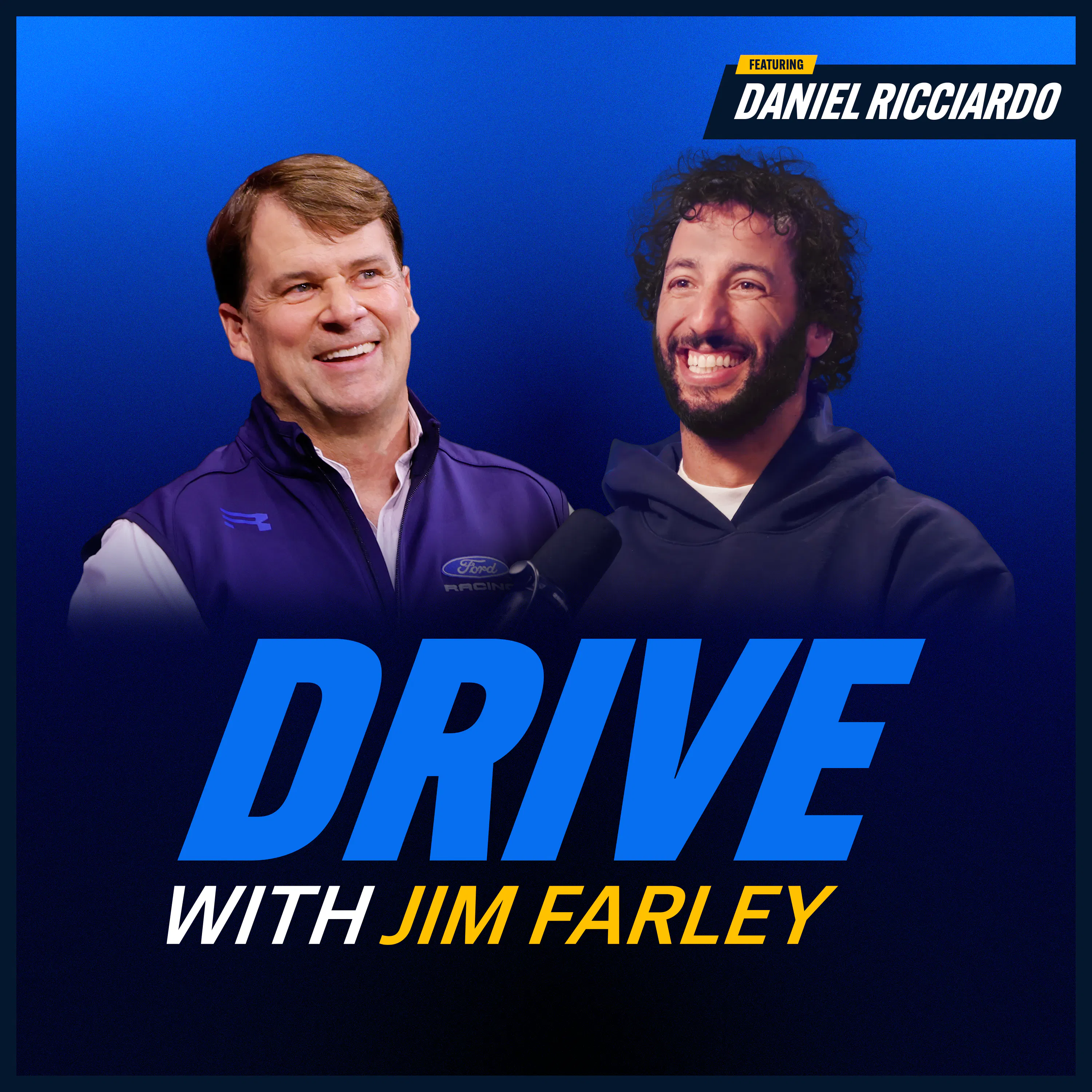
Daniel Ricciardo talks about what it really feels like to be “best in the world” for a moment—powerful, prideful, and surprisingly grounding. He gets candid about the lows of racing, noting how most weekends are disappointment due to mistakes, failures, or bad luck. The conversation also covers his iconic Shoei champagne celebration, his pre-race mental rituals (helmet on = go time), and how he decided when to retire after losing the fire. Ricciardo closes with “fun” as the core driver, plus how off-road freedom helps him stay human.
Jim Farley hosts a conversation with Daniel Ricciardo about the triumphs and challenges of Formula One, and how those moments are both powerful and grounding. Ricciardo explains the origins of his signature “shoey,” why he helped to loosen up the historically buttoned-up sport, and how fans turned it into an expectation. He describes racing as freedom, his pre-race focus rituals, and the sense of being integrated with the car at the limit.
00:00 The High of Winning
01:05 Shoey Origin Story
03:03 Making F1 Loosen Up
04:44 First Kart Freedom
06:14 Race Day Mindset Rituals
09:23 The Pain Behind the Podium
13:03 Driving as One Machine
15:42 Winning Highs And Lows
16:36 Relief After First Win
16:58 Knowing When To Retire
22:38 Honest Advice On Endings
24:18 CEO Question And “Fun”
DRIVE with Jim Farley is produced by Jesse Baker and Eric Nuzum of Magnificent Noise. Our production staff includes Sabrina Farhi and Kristen Mueller with help from Lori Arpin, Angela Brewer, Max Owen-Dunow, Anne Roberts, Samantha Singhal, Darnell Macon, Brandon Kennedy, and Mark Truby.
Follow Jim:
YouTube: https://www.youtube.com/@Jim.Farley
Instagram: https://www.instagram.com/jimfarley98/
Threads: https://www.threads.net/@jimfarley98
LinkedIn: https://www.linkedin.com/in/jim-farley/
Bluesky: https://bsky.app/profile/jimfarley.bsky.social
Twitter/X: https://twitter.com/jimfarley98
Learn more about your ad choices. Visit podcastchoices.com/adchoices