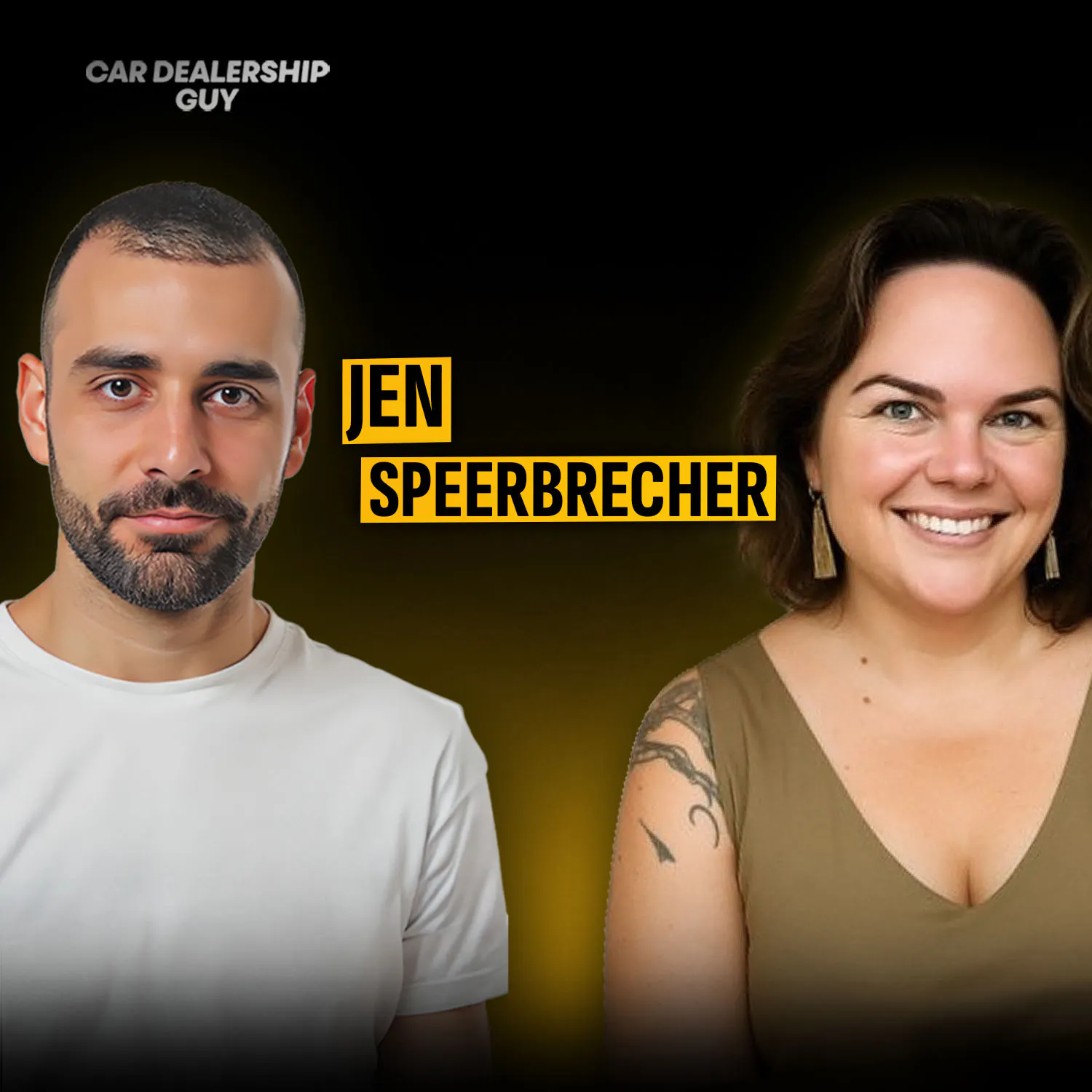
“DMS is Not the Truth!” The Unspoken Dealer Accounting Secret Costing Thousands (+ How to Fix it) | Jen Speerbrecher, Vice President at Veramatic
Car Dealership Guy Podcast
“DMS is Not the Truth!” The Unspoken Dealer Accounting Secret Costing Thousands (+ How to Fix it) | Jen Speerbrecher, Vice President at VeramaticCar Dealership Guy Podcast · Apr 2, 2026
Varimatic is the company the guest works for. Based on the episode topic, they’re involved in tools that help dealerships handle data and accounting more accurately.
A DMS is the computer system dealerships use to run day-to-day stuff like sales and service records. The point here is that the data inside it might not always be perfectly accurate, so you can’t always trust it like a single “truth” source.
High-speed automation in this context means using software to rapidly move and reconcile data between systems with minimal manual intervention. For dealerships, automation can reduce timing gaps and transcription errors that lead to incorrect accounting outputs. The episode positions it as the transition path away from manual entry.
The “back office” is the dealership’s behind-the-scenes paperwork and accounting. It’s what keeps track of the money and reports it correctly, so the business knows what’s really happening.
Dealers don’t just “sell cars and get paid.” Automotive accounting is the special way they track all the money from sales, service, and parts, plus manufacturer incentives. It’s complicated because the rules for recording that money aren’t always straightforward.
A CPA is a type of accountant who has special licensing and training. The point here is that even highly trained accountants can find dealership accounting tricky.
This phrase means the normal everyday costs of running the dealership. They’re asking whether the accounting errors are just part of that normal mess, or if they’re actually a problem.
“Material” here means the mistake is big enough to matter. If the numbers are materially wrong, it could change how people judge the dealership’s results.
Posting is when the dealership records transactions into its official accounting books. If the numbers fed into accounting are wrong, the books will reflect that mistake.
F&I means the dealership’s finance and insurance side—like arranging the loan and selling add-on coverage. Those transactions can be complicated, so the paperwork has to match the accounting records.
They’re saying the dealership gets information from several different places. If those sources don’t match each other, the dealership’s books can end up wrong.
NAPA is an auto parts store. The point is that buying parts is usually straightforward compared to dealership accounting, which has lots of different report sources.
OEM is the car company itself—the manufacturer. Dealership paperwork from the OEM can make it look like money is owed when it’s actually the other way around.
“Tribal knowledge” means the stuff people learn from experience, not from a clear manual. The speaker is saying you may need that know-how to understand what the numbers really mean. Without it, it’s easy to misread the dealership’s reports.
The service department is where the dealership does repairs and maintenance. It brings in money from labor and parts, but it also creates costs. If that information isn’t tracked correctly, the dealership’s financial reporting can be misleading.
“Manually print and hand code” describes manual, paper-based and manual-entry steps in dealership workflows. These processes increase the chance of transcription errors and create extra labor, which is why automation and validated data feeds are often pitched as cost savers.
Veramatic is the company the guest works for. They’re talking about using software to take dealer data from different places and turn it into something more reliable.
An inventory strategist is a tool or method that helps a dealer decide what to do with their cars. Instead of guessing, it uses data to suggest which vehicles to focus on and what changes to make.
VIN-level data means the tool looks at each car individually using its VIN number. That lets it tell you which specific cars are doing well or need help.
The “accounting office” is where dealership operational data (parts, body shop supplies, invoices, remittances) gets consolidated into the financial system. This is often where manual processes and handoffs introduce errors, especially when multiple departments feed different formats or levels of detail.
Veromatic is referenced as a solution that reduces manual document handling in dealership operations. The discussion frames it as removing human decision-making from tasks like coding invoices and remittances, which helps reduce accounting inaccuracies.
A parts invoice is basically the receipt/bill for car parts. The dealership has to enter it correctly in their accounting system so the money and inventory records match reality.
This describes using software to automate calculations and lookups based on multiple inputs. In dealership accounting, automation can reduce human error and speed up tasks like posting, coding, and generating reports.
“Automate” in this episode refers to using software to reduce manual steps in dealership reporting and accounting workflows. The speaker’s concern is that automation must be accurate enough to avoid breaking accounting processes tied to parts transactions.
They’re talking about creating a report from the software. If the report is wrong, it can lead to incorrect accounting or bad business decisions.
LIVE
A lot of what's happening in the accounting office
is like the back of the house at a restaurant, right?
There's recipes that are out there
and everybody understands what's supposed to be happening
and you want that dish to be delivered
exactly the way it's supposed to
so that your front of the house gets to,
you know, have the good experience for the customer.
And the reality with what's happening in the accounting,
the dealership back of the house,
is that the recipe is never clear.
Today I'm joined by Jen Speerbrecher,
Vice President at Varimatic.
Most dealers assume their financials are mostly accurate
or at least close enough.
But what's the cost if they're not?
Jen breaks down why manual accounting
is no longer sustainable for modern margins,
the fundamental difference between a DMS
and a source of truth,
and how to transition your team
from manual entry to high-speed automation.
A big thank you to our sponsors
for making this episode possible, Lotlinks.
And of course, Varimatic,
and now let's get into the show.
Jen Speerbrecher on the CDG podcast.
Jen, welcome.
Hi, thanks for having me.
Thanks for coming on.
Gonna have a conversation on some back office topics
which we don't cover often on the podcast.
And I think it's an important topic,
you know, growing up in the industry.
The thing I always heard was back office better be tight
because if the back office isn't tight, the whole ship sinks.
So with that, I actually want to kick you off
with a bit of a hot take that came from you.
And I want to understand your full thought here.
So I was reading, as I always do my pre-show prep,
I saw that there was one line that stood out to me
where you said that controllers are publishing financials
knowing they're not 100% accurate, right?
This is discretionary,
like publishing financials on a monthly basis,
but there's no real way around it, true or false.
I mean, how true is this really or is this a hyperbole?
I think it's true and I think there's variations
of the levels of, you know, how accurate
somebody thinks their financial statement is.
Automotive accounting is one of the most difficult things
out there.
You kind of go, well, it's just accounting.
How hard could it be?
It is very, very intricate.
And unfortunately, there's not automotive accounting classes
that you take, right?
You can go and you can become a CPA.
But even CPAs who are looking at our books
struggle to understand automotive accounting.
That's how complex it is.
I do have one more question on the accuracy part,
because again, you're very close to this information.
What percentage of dealers we speak with
are dealing with inaccuracy?
And the follow-up to that is like,
how inaccurate are we talking about?
Is this an inaccuracy that like, I don't care,
because it's just, there's going to be embedded
inaccuracy in everything.
And it's just, you know, cost-to-do business,
or is this very material?
I want to understand your thoughts there.
So really, you know, Yossi, you're asking about accuracy.
And I think that it's definitely something
that every single controller and CFO care about,
because without accuracy, there's a thousand things
that can go wrong downstream.
And the reality is, it's not a human problem
that we're trying to solve.
It's absolutely a systems problem
that we're trying to solve.
Your DMS doesn't care if what you're putting into it
is accurate.
And God bless the DMSes,
but it's just not what they were set up to do.
There is inaccuracy in every single thing that we do.
That's just the nature of the beast.
Think about, while the accounting office is the one
who's dealing with posting the transactional data,
they're getting that from, you know,
everybody else in the dealership,
for whom accounting is not their forte.
So absolutely 100%, we are all dealing with inaccuracies.
Then when we're talking about,
we're not using technology and we're doing things manually,
or even at a hybrid of manual,
we're making mistakes because we're human, right?
We enter something on the keyboard
and we fat finger a control number and it's wrong.
To what level do we care?
I've always taken the approach that a penny is a penny
and you better go find it.
Because a penny five times is five cents.
It just adds up and the next thing you know,
you're writing off $100 here, $10,000 there.
And that's not small money.
When we're talking about the razor thin margins
that dealerships are living off of these days,
every penny counts and you better account for every penny.
The reason that we talk about all of these inaccuracies
and the reason that we see them is,
when you think about what a dealership accounting office
is experiencing, okay?
They're dealing with factory reports,
they're dealing with banking reports,
they're dealing with F&I.
Every single thing that they get
is from a different data source, right?
They're not just getting everything from a Napa store
where it's all the same.
The factory reports are obnoxious.
They come in looking as if you owe the OEM money,
but they owe you the money, right?
And they don't care to change that for you.
They're there to get what they're gonna get from you.
And again, tribal knowledge,
you have to understand what each of these things is doing.
And the OEMs love to throw new stuff at you
every single month.
And that's not even talking about the banking
and the F&I forms and the service department,
what's happening in there and the parts department.
And so they're dealing with,
accounting offices are dealing with
this huge number of data sources,
none of which are the same,
none of which are,
we're gonna make the same entry off of ever.
Sometimes they're in Excel,
sometimes they're PDF,
sometimes you get a mail
and you have to deal with it that way.
That's a very good answer.
Now explain, you had this one quote,
which I read prior to the podcast
and I wrote this down as well,
cause I wanted to ask you about it,
which was your DMS is a system of record.
It's not a system of truth.
This to me seems like the core part of the conversation here.
How do you fix this?
First of all, yes or no?
Yeah, absolutely fully agree with that statement.
So you'll see, really think about it this way.
A lot of what's happening in the accounting office
is like the back of the house at a restaurant, right?
There's recipes that are out there
and everybody understands what's supposed to be happening
and you want that dish to be delivered
exactly the way it's supposed to,
so that your front of the house gets to,
you know, have the good experience for the customer.
And the reality with what's happening in the accounting,
the dealership back of the house,
is that the recipe is never clear.
The ingredients change every single time
they go to sit down and look at that recipe.
The people at the front of the house,
the GMs and the dealer principals of the world
think that it's just magic that's happening back there.
And they don't necessarily care what's happening
because that's what they're getting paid to do.
But one of the things that is a absolute result
of trying to find and follow those recipes
that exist for automotive accounting
is that you get a net result
and what you're losing within that process
of creating that dish, if you will,
is you're losing dollars.
You're paying people to do the same thing multiple times.
You're hoping that you're paying them
to find the mistakes that they made,
that they know that they made and correct them.
It affects your absolute bottom line
and it really makes a difference
when you're stopping those things
in getting that clear, concise recipe
and dish every single time.
And then, oh, by the way,
every single department has external tools
that help them do their job better, right?
Sales has all sorts of tools that help them sell
and track and just be able to do all of the things
that they have to manage within their day to day.
These tools don't really exist
for the accounting department, right?
The accounting department has largely been ignored.
Okay, I mean, you've got my attention.
So explain to me, I understand the source of truth part
and I was asking you about how material the inaccuracy is.
I was trying to really understand
how big of numbers are we talking about?
But what is the core problem
that you say you're solving for dealers, right?
When you work with dealers
and you implement this source of truth next to their DMS, right?
This is, you're not replacing their DMS.
You're simply a source of truth next to their DMS.
What is the core problem you're solving for them, right?
Like what's the value proposition?
Why do they spend their time to do this?
So really what we hear from our dealers is
you are saving me time on both the front end.
I no longer have to manually print and hand code
and hand enter all of these things,
but you're saving me time on the back end
where I then don't have to go cross my fingers
and hope that I find the error that was made, right?
I think when we talk about inaccuracy, really the things
that pop out are the things that are easy to find,
we know to look for them.
Where we're talking about true inaccuracies,
it's the things that you just never find.
There's things buried in financial statements
that you may never know about
because you're not trained to look for them.
And again, bringing technology in to sit next to your DMS,
you train that technology one time to do the thing
that it's supposed to do every single time.
And there will be no variations unless something changes
and we come back and we retrain that technology.
And so part of what we solve for at Varimatic
is we take all of those sources
and we really turn it into a single source of truth.
This episode is brought to you by Lotlinks.
What if you had a strategist
that could actually look at your inventory,
your pricing, your market, and real shopper behavior
and then tell you exactly what to do next?
That's LotGPT.
It's the industry's first AI-powered inventory strategist
built specifically for car dealers.
It analyzes your VIN-level data
and surfaces which vehicles are at risk,
where the opportunity is in your market
and what actions you should take.
VIN by VIN, no digging through reports, no guesswork.
And the best part, it's free for dealers.
Just head to lotlinks.com slash LotGPT and request access
or click the link in the show notes below.
So basically what you're saying to me
is that parts department is able to track their parts.
Body shop is able to track their supplies.
But what happens is when we're consolidating
everything in accounting office,
this is where the breakage happens
and we start getting inaccuracy.
And so naturally my next question to that is,
okay, I am a GM now, I'm a controller
or I'm a dealer principle.
I acknowledge that I have inaccuracies in my back office
and that my team spends lots of time
and resources trying to fix this
and make sure that things are precise.
How do I actually do it?
You're always gonna struggle to gain accuracy
when we are talking about humans being involved.
And so one of the greatest things that Veromatic does
for our clients is really removes
the human thought process, if you will,
out of what am I doing with this document?
How do I have to code this parts invoice?
Or what am I doing with this FNI remittance?
I have to remember what account this goes to
and I have to go remember what control number it goes to
and then go look up the right control number.
When a computer is processing that for you,
based on various different points of important reference,
the computer's gonna get it right
and it's gonna do it faster than an employee can.
And really, that's the how, right?
Is that you use the tools that are available
to automotive accounting to help them process
all of those things.
You gain accuracy, you get time back,
you have happier employees by doing it.
So, given you know so many controllers,
I know you're partnered with over 600 rooftops,
you personally have experience in this world.
What do you find as the best performing controllers?
What are they doing differently?
Or what are they just simply the best at?
I even just had a conversation with one today, right?
Where I was working with a client today
and really her feedback was,
if I don't use the tools that are available to me,
I'm never gonna get out of this hole that I have.
But also getting away from the manual side of accounting.
You don't have to do everything manually anymore.
Use your people in a different way
than we have really,
probably for the last 30 years in this industry.
And I think really what makes somebody a strong controller
is understanding that you're gonna have to change
what you've been doing in order to grow
and become a much more functional controller.
Somebody who's like, hey, this is the way I've always done this
and this is why I'm gonna continue to do this
for the rest of my career.
That's not a good person for that team.
You know, Jen, I put this in the bucket of
unsexy parts of the dealership
that have deep rooted issues that need to be solved.
How has it been as you've seen this grow in the industry
and more dealers adopt your technology
or this type of technology in general within their dealership?
What has been the impact?
Can you tell us about that?
Yeah, absolutely.
It's definitely a case of I had no idea
that this was really a problem.
Because a lot of what we hear is folks kind of going,
okay, but I've solved that.
I do a power post or I manipulate data
and I get it where I need it to be.
And then all of a sudden you're 90 days in
and you're using these reports and you're like,
oh my gosh, I was actually able to close my month in two days
where before it took me four days.
So, you know, really truly gaining efficiencies,
gaining confidence in the numbers that they're putting forward
to their general managers and their dealer principles
for those financial statements that they're submitting.
Having happier folks, right?
If I don't have to be at the office until 11 o'clock,
the first four days of the month,
I'm a much happier camper than if I'm working my tail off
that late every single night
to then still not really know exactly what I'm doing.
What we've heard is that it brings to light
that it was a much bigger problem
than they realized they had in the first place.
And that they feel like when they're looking
at their numbers, when they're doing their schedule cleaning,
when they're doing their financial statement verification,
they have gained confidence in those numbers
because they know it's just getting done correctly.
And they also have time to dig into those things
that maybe they haven't had the opportunity
to dig into before.
So, they're unearthing other problems
that have just kind of been sitting in the corner.
And Jen, who do you find is driving this type of change
in dealerships nowadays?
Is it more the GM and the dealer principle
who are thinking about more systematizing
and the controllers are maybe a bit more reluctant
or vice versa?
I think it's a good mix, right?
You have some really tech forward,
tech savvy general managers who see that there's tools out there
that haven't exist before and they want to engage with those.
But I really think that the controllers are the ones
who have kind of gone,
gosh, I just, something's got to change.
Something's got to get better than what we have had
for the last 30 years.
And Yossi, you ask about reluctance
and I think nothing really can kind of highlight
that better than my own personal story.
I have been in automotive industry for about 30 years
prior to being at Varimatic.
And I started as an accounts payable clerk,
really worked my way up, I've sat at all of the seats,
was most recently running a consolidated accounting office
for a 35 dealership group.
And I actually got approached by Varimatic
to be a beta client.
And I pretty much said right out of the gate,
I don't need that.
We've got this stuff dialed, we're power posting,
I've spent hours of my time training my team,
how to use Excel and be super savvy with it.
And I had a CFO who I adore,
who really challenged me and was like,
well, what about parts and voices?
Could you automate, you're not automating parts and voices,
you should see if you could use this
to automate parts and voices.
And I very reluctantly said, okay,
I'm not gonna throw a bunch of time at this,
but sure, I'll see if I can solve it.
And then once the report was built,
I spent about three months trying to prove
that it was gonna break every part of my accounting
when it came to this parts department.
And I ultimately couldn't find a single error.
And that's really what made me go,
they have something here, right?
This is actually pretty amazing.
And I wanna be a part of bringing this to the masses
because I firmly believe that this is a tool
that's a need, not a want.
You need this in order to be
a functioning accounting department.
Well said.
Jen Speerbrecher, a veermatic.
Jen, thanks so much for coming on pod.
Thanks for having us, good to chat with you.
All right, hope you enjoyed that episode.
Please give the podcast a rating,
consider subscribing to the show
and check the show notes for links
to what we talked about.
Thanks for tuning in, I'll see you guys next time.
About this episode
Jen Speerbrecher argues that dealership accounting is riddled with unavoidable “inaccuracy” and that controllers often publish monthly numbers knowing they’re not fully correct—because automotive accounting is complex and data comes from many inconsistent sources. She draws a sharp line between a DMS (system of record) and a true “source of truth,” saying manual and hybrid workflows create repeat work and hidden errors that cost real money on razor-thin margins. Varimatic’s approach automates document coding and reconciliation, saving time, improving confidence, and freeing controllers to investigate deeper issues.
Today, I'm joined by Jen Speerbrecher, Vice President at Veramatic.
We dive into the "unsexy" but critical world of the dealership back office, where tribal knowledge is disappearing, and manual errors are eating into razor-thin margins.
Jen explains why your DMS often fails as a source of truth and how top-performing controllers are using automation to cut month-end closing times in half while guaranteeing 100% accuracy.
Want learn more? Send Jen your biggest accounting challenges at [email protected]
This episode is brought to you by:
1. Lotlinx - Meet LotGPT, your AI Inventory Strategist built exclusively for car dealers. It reveals competitive insights, shopper behavior, and pricing dynamics, and even identifies underperforming VDPs with merchandising recommendations to boost conversion without cutting prices. Put LotGPT to work for your dealership today, totally free, @ here.
2. Veramatic - Every dealer wants clean closes, controlled cash flow, and confidence in true profitability. Most still operate without them. Until now. Meet Veramatic: the accuracy layer your DMS never built. Get clean, consistent, trusted accounting data, normalized before it hits the GL, automatically. Learn more @ www.veramatic.io/CDG.
Check out Car Dealership Guy’s stuff:
For dealers:
CDG Circles ➤ https://cdgcircles.com/
Industry job board ➤ http://jobs.dealershipguy.com
Dealership recruiting ➤ http://www.cdgrecruiting.com
Fix your dealership’s social media ➤ http://www.trynomad.co
Request to be a podcast guest ➤ http://www.cdgguest.com
For industry vendors:
Advertise with Car Dealership Guy ➤ http://www.cdgpartner.com
Industry job board ➤ http://jobs.dealershipguy.com
Request to be a podcast guest ➤ http://www.cdgguest.com
Topics:
01:45 The Financial Lie Controllers Live With.
02:25 Why CPAs Fail At Auto Dealerships.
03:55 How Typos Steal Thousands From Dealers.
04:25 The Penny That Reveals Hidden Losses.
05:45 Your DMS Is Lying To You.
06:00 The Recipe For Back Office Disaster.
12:20 When Experience Becomes A Liability.
13:20 What Automation Exposed After 90 Days.
15:55 The Controller Who Tried To Break Her Own Software.
Car Dealership Guy Socials:
X ➤ x.com/GuyDealership
Instagram ➤ instagram.com/cardealershipguy/
TikTok ➤ tiktok.com/@guydealership
LinkedIn ➤ linkedin.com/company/cardealershipguy
Threads ➤ threads.net/@cardealershipguy
Facebook ➤ facebook.com/profile.php?id=100077402857683
Everything else ➤ dealershipguy.com