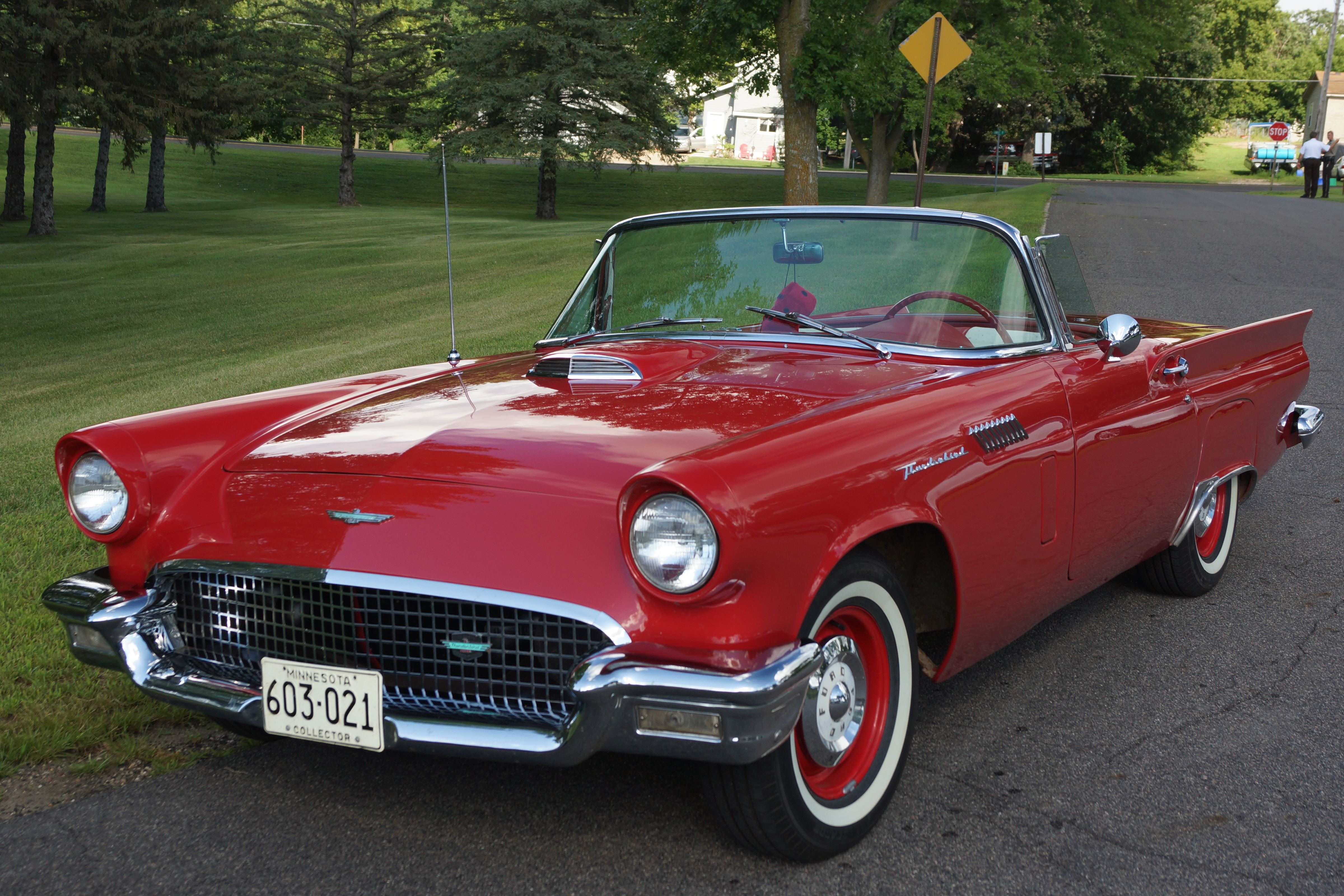
The Ford Thunderbird is a fancy car that people liked to drive for fun and style, starting back in 1955. It's known for looking good and having strong engines, making it a favorite among car lovers.
The Chevrolet Corvette is a fast sports car that many people love for its cool looks and speed. It's made in America and has been around for a long time.
The Holley 4160 is a type of carburetor that helps mix air and fuel for the engine. It's often used in older cars and performance vehicles to improve power and efficiency.
The original paint color is the color the car was painted when it was first made. Knowing this helps when fixing or repainting the car so it looks the same as it did originally.
The carburetor float bowl is a part of the engine that helps keep the right amount of fuel ready to be mixed with air for combustion. It uses a float, similar to a toilet, to control the fuel level.
The Simplex Automobile is an old car brand from the early 1900s that made fancy cars. It's important in car history because it was known for being well-made and luxurious during its time.
Brass era automobiles are old cars made between the late 1800s and early 1900s. They are called 'brass era' because many parts were made of brass, which was common at that time.
A journal bearing helps parts of a car move smoothly by reducing friction. It's like a cushion that allows a spinning rod to turn easily inside a tube.
A rod bearing is a part in an engine that helps connect different pieces so they can move without grinding against each other. It keeps everything running smoothly.
Babbitt is a type of soft metal used in some car parts to help them move smoothly without wearing out quickly. It's like a protective layer that keeps things from grinding together.
A preservation car is a classic car that hasn't been changed much from how it was originally made. People like these cars because they show what the car was really like when it was new.
'High performance' means a car is designed to be faster and handle better than regular cars. These cars often have special parts that make them more powerful and fun to drive.
America's Automotive Trust is a group that helps other organizations focused on cars and automotive culture. It brings together different nonprofits to work together and support car-related projects.
Drag racers are people who race cars in a straight line to see who can go the fastest. It's a popular type of car racing that focuses on quick speed over a short distance.
The Chevrolet Impala is a big car that many people love because it's comfortable and has a lot of space inside. The 1961 version is famous for its cool look and is often seen in movies, making it a popular choice for car enthusiasts.
The Dodge Custom 880 is a big car from the 1960s that people liked for its roomy inside and unique look. It's considered a classic and is often collected by car enthusiasts.
Car
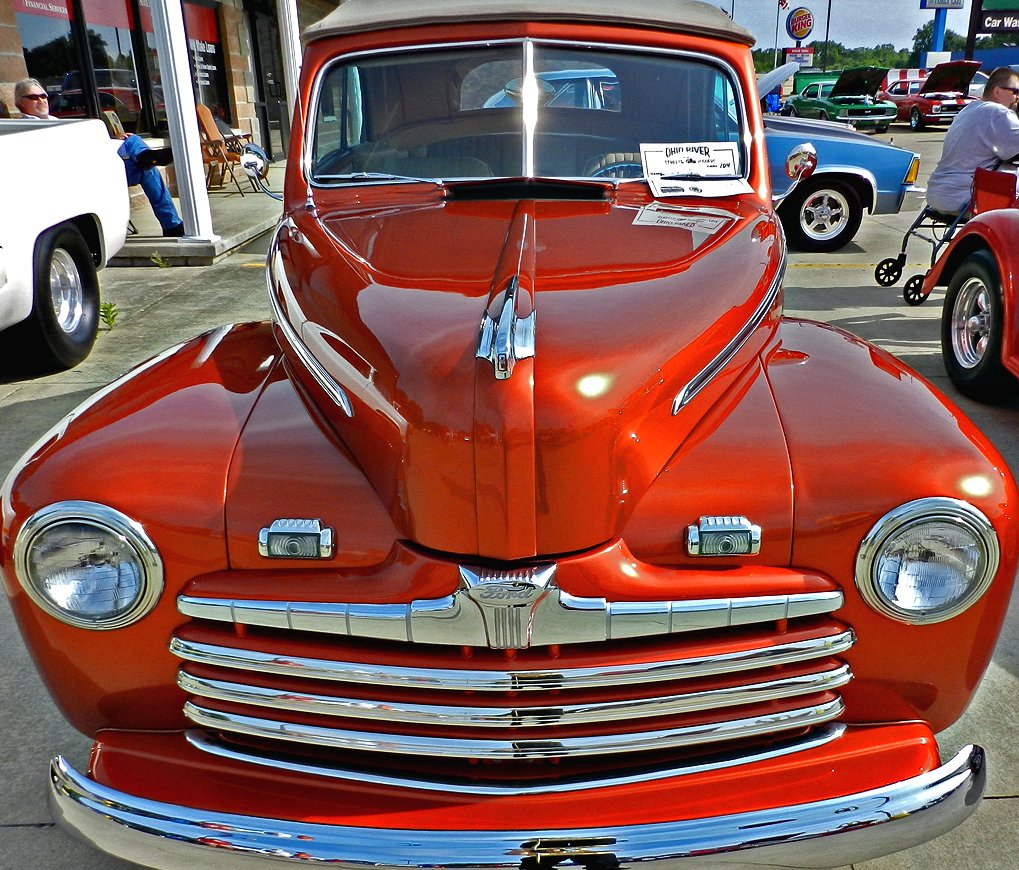
1947 Ford convertible
This is a classic car made by Ford in 1947 that has a roof that can be opened, allowing for driving with the top down.
The Buick LeSabre is a big, comfortable car that many people liked to drive, especially older folks. It was made for a long time and is known for being smooth and easy to ride in.
The Mercury Cougar is a car that was made by the Mercury brand, known for its sporty design and strong performance. The 1968 version is especially valued by collectors.
The Porsche 911 is a famous sports car that many people admire for its looks and speed. It's been around for a long time and has many different versions.
The IMS bearing is a part in some Porsche engines that helps keep the engine running smoothly. If it fails, it can cause serious engine problems, so it's important to check its condition.
The Chevrolet Chevelle is a classic car that many people love, especially because it has strong engines and a cool design. It was popular in the 1960s and 70s, and lots of people still enjoy restoring and driving them today.
The Renault Wind is a small convertible car that you can take the roof off of, making it fun to drive in nice weather. It was made for a short time and is special because of its unique design.
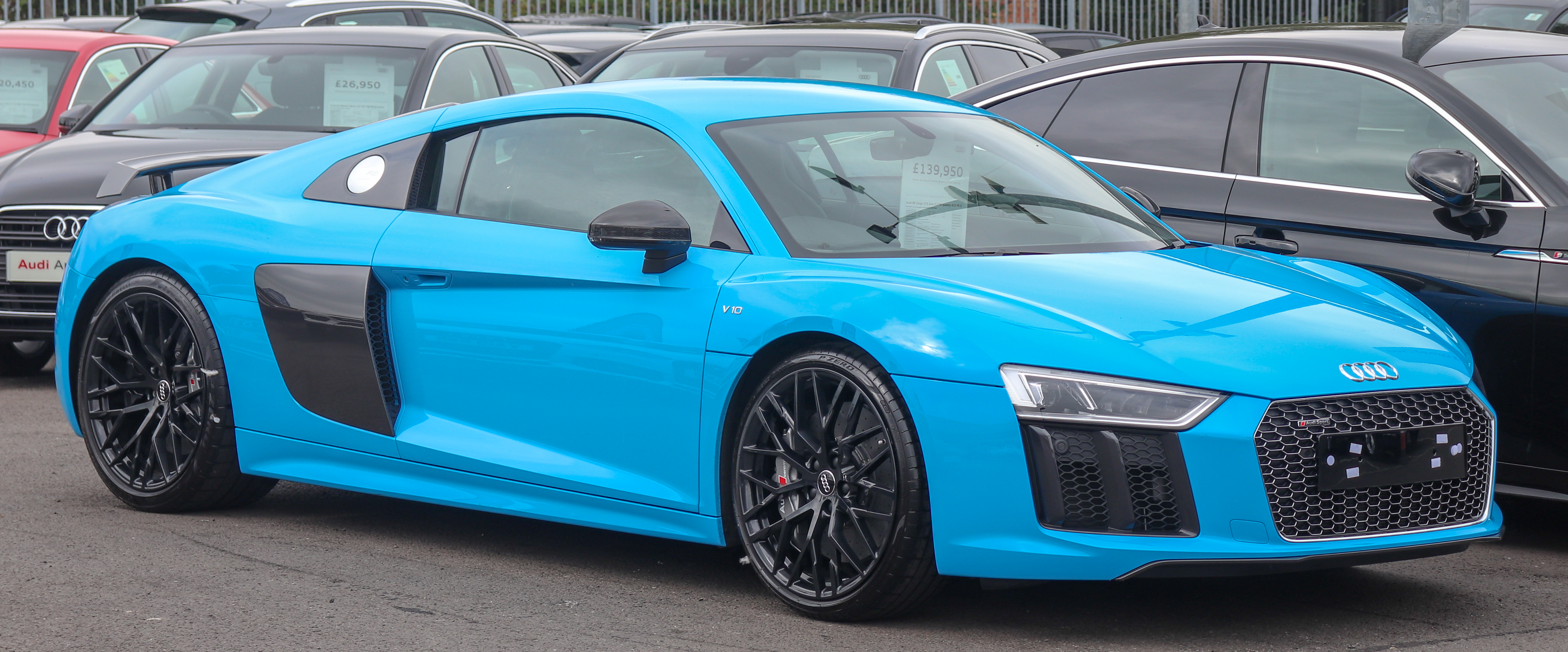
The Audi Coupe is a stylish two-door car that's fun to drive and looks really nice. It's known for being fancy inside and having good performance, which makes it popular with people who like sporty cars.
The Chevrolet Corvair is a small car that was made in the 1960s and is different because its engine is in the back instead of the front. It got a lot of attention for its unusual design and some safety discussions back in the day.
The Mercury Mountaineer is a medium-sized SUV that people used for family trips and everyday driving. It's comfortable and has a lot of space inside, which makes it good for carrying people and stuff.
The Nissan XTerra is a tough little SUV that people use for adventures and driving on rough roads. It's built to be strong and reliable, making it a good choice for outdoor activities.
LIVE
Hey, all you gear heads and car fiends, welcome to Driven Radio Show, your weekly automotive happy
hour.
I am Brett Hatfield, here with my co-host and Thunderbird owner extraordinaire, Mr. Mark
Gross.
That's me.
We are coming to you from Driven Radio Studios, where we have had very thick, heavy London
fog all stinkin' day.
Oh, and I live, you know, on Raytona Beach, the lake over in Raytown.
Oh, yeah.
So you probably got lake effect.
Dude, it was wild.
It was so thick, and I'm like, oh, this is kind of cool.
Yeah.
I can't see my neighbors.
Awesome.
Yeah, well, and here's the other thing that's weird.
Everybody, you know, a lot of the country, they're having snow, because it's Christmas,
they're gonna have a white Christmas.
I'm for the second day on the row, walkin' around in khaki shorts.
Yeah, all I wore was this hoodie, outside, and I'm actually a little warm.
It's like, they're callin' for 70 degrees on Christmas.
I'm in.
You know what?
I'm good.
I've been drivin' both the Corvettes around with the top down.
See?
It's nice.
It's so weird.
Well, that's Midwest weather for ya.
Hey, uh, speaking of Thunderbird, uh, ongoing Thunderbird Chronicles, did you get it started?
Okay, Chronicles Part II, discoveries.
Uh, I did get it titled, uh, and I want to give a shout out to, uh, the, the
courthouse in, uh, Independence, here in, in Jackson County, where I live now.
Really?
We lost, uh, you know, the Chiefs, but, uh, when we lost in the Chiefs, we gained in some
pretty darn quick and friendly service, and, uh, the people down at the, um, DMV, uh, once
again in Lee's Summit, were super-fast, super-efficient, and, uh, just props to both
of you.
Okay, first of all, the Chiefs.
It was a very good experience.
The Chiefs lease isn't up until 2031.
They ain't goin' anywhere for a minute.
And secondly, Jackson County's saying, nah, man, three-eighths of a cent.
That's way, way, way too much.
And then our governor on the Kansas side's saying, oh, hey, come on, hey, over here.
Oh, yeah.
That's the amazing thing on the Kansas side.
It's pretty cool when you can go, you know what, hey, why don't we just have our
taxpayers pay for all your stuff?
Well, I, uh, I'm not impressed with the deal, to be bluntly honest, but, uh,
you know, people seem to really love paying corporations lots of money.
I must read that they're going to take some of the Jackson County money and use it to
build the Kansas City.
Oh, that wouldn't surprise me.
That wouldn't surprise me.
And, and I, I'm going to step back, I'm going to moonwalk back out of that whole mess
right now.
I have opinions.
Yeah.
Well, we both, we both do.
And it sounds like a really convoluted, jacked-up deal.
But about the Thunderbird, uh, uh, back to the bird, um, it's, it's been interested.
I've, I've got it started.
I've driven it probably, uh, at least 3,000 feet, all told.
Um, I've got my, you haven't left your cul-de-sac, have you?
No.
Uh, I, I'm not about to take it out on a road yet.
It's, uh, it, you know, that little hesitation the guy told me that it had is, is, it's
a little more hesitant than that.
Let's say it's a pregnant pause, um, the, I got, I got that, uh, Holly 4160 in.
So I need to, you know, bite the bullet and did it mount up to your, I have no
clue.
I am terrified, but I'm going to get it done.
Okay.
Uh, I've got that.
I got the new high beam or the new headlights that are basically old school
headlights instead of the, uh, uh, the weird ones that are on it now.
And we'll, we'll see what I can, uh, get together to at least be able to maybe drive
it to a place.
I had a couple of things that I didn't notice that I'm a little concerned about.
You know, I'd, I'd have a little bit of a whitish smoke and I figured it was,
you know, burning off liquid that's in the pipes because first started up and
there's some wet that comes out, so it's got to steam it out.
And it just has cherry, uh, cherry bombs on the back.
So, you know, I figured it's that I'm waiting for any of the other three guys
on the here to say, what the hell's wrong with this to step in.
But the, uh, continue, I, you know, I had it idling for about 20, 25 minutes.
And I did take it at least for a spend during that time.
And okay.
So it was, it was idling.
You don't have a clogged fuel filter anywhere.
You know, no filters have a bent fuel line.
No, I don't have any of that crap.
No, and, uh, but it did, uh, have a lot of quite a bit of, uh, vapor.
If you want to help smoke, uh, coming out of the, oh, what the hell's it called?
It's in the valve cover.
That's where the blow by shows.
Okay.
So I'm, uh, I'm a little concerned, but you know, I'm, I'm ignorant enough
to hang on to hope and, uh, you know, and stupid enough to buy parts.
So we will see.
We'll see, uh, we'll see what it is.
But you know what, it's very pretty.
Um, I, I was waiting for you to say that you hadn't taken it out on the road yet
because you didn't have crackers on it.
No, actually, okay.
Side note on that.
And then I got all shut up.
I talked to the guy that I sold civil to and, uh, uh, I bought some, um, a
weather stripping for the trunk, but it arrived after you'd already, you know,
taken the vehicle and I'm like, well, maybe I'll get something that this
will be good on.
It's not, it's not going to work on the T road.
It's useless.
So I've got 75 bucks of weather stripping.
And I was like, Hey, his wheels, uh, I want to get a pair of older or a set
of older wheels on it and just, you know, steel rims, because I don't want
those metal Kregor like spinner hubcaps to scratch the shit out of these.
The ones that were bought for it, those red ones were bought that way.
Yeah.
Uh, so they're in really nice condition.
And I'm like, you know what, instead of scratching those, get some
old just ones and I realized the bolt pattern for the ones that I, I sent off
with same as a Chrysler, same as it.
Yeah.
Oh, interesting.
I got hold of these like, man, I'm not using them.
Yeah.
Yeah.
Let's, let's do this.
So, uh, you're getting your Kregors back.
Well, no, not the Kregors.
I'm going to get those steel rims.
Oh, the ones that he's not using.
Are you kidding?
No, I thought it isn't going to get rid of those Kregors.
I sure as hell, I was thinking you weaseled that kid out of your
old wheels, I'm excited for you.
I don't suck quite that much for the kid.
Yeah.
Could you imagine simple 64 dodge with white walls?
Ew.
So, uh, uh, we'll see what happens.
So that's, that's the catch up on the Thunderbird.
Hey, man, I'm, I'm just hopeful for you.
I'm wanting you to be able to get everything done.
So, uh, yeah, I don't, I'm sure if that kid gives over his Kregors or not.
He's a good guy.
I don't know.
Good kid.
I don't care.
Okay.
Uh, first of all, gotta give a big thanks to the, to John and the
guys at classic collision on Metropolitan Avenue in Kansas City,
Kansas, for the wonderful job they did of repairing and repainting
the front bumper cover on Rhonda's little red Mercedes.
Oh, what happened?
It turned out beautifully and they were very reasonable about it.
So much so that I had them look over the shot and Freud express.
Yeah.
And, uh, they gave me an estimate and that thing is going to classic
collision January 19th, going to get that back corner fixed.
Going to get both of the bumper covers repainted.
Going to touch up a bunch of other little stuff.
She's going to be standing tall and back to her former glory.
So I'm very excited about that.
Now, are they able to figure out the original paint color?
I mean, is it fairly easy?
Or is it like, you know, golden cream, bronze?
I think as, uh, as Matt Farah accurately identified it, you look
up Jewish racing gold in the sickens pink color book.
Hey, I, I had to quote Matt.
I didn't call it that he did.
And, uh, that's his tribe.
So he's allowed to take cracks.
Let's go.
That's perfect.
But it is headed over there.
And we're going to get everything addressed and for considerably less
nice than I thought it was going to be.
You asked me about, uh, other stuff, um, you know, if, if everything was
okay, I think the 65 Corvette must have a split or a hole in the
filler neck up toward the top.
Cause when I, well, that can't be right.
Wait a second.
I'm just now thinking of it.
That can't be it.
I'll take a look at it and give you my professional opinion.
Damn thing's got a leak when it's full.
Huh.
And, and it, it's because it's old.
It pittles onto my very nicely done garage floor.
Oh, at any rate.
Yeah.
Well, it makes a garage stink like gas, but, uh, we got a lot of warm
weather coming up here pretty quick and miracle of miracles, Christmas miracle.
I am taking off from, uh, December 25th through January 5th.
Oh, nice.
Yeah.
Well, I don't do vacations ever and ever.
Yeah.
And so I'm taking some time off and it happens to correspond with
this really warm weather we're having.
I'm going to detail every stinking thing.
Nice.
Uh, I'm even going to try to get all the bikes done.
So, uh, when was the last time, by the way, on the, uh, 60 that
you had that, uh, your gas thing looked at as a guy who's had
a monkey out with the gas tank like there's no tomorrow.
65, but I can get underneath that thing and drop the spare and pull out.
Uh, I think I have to pull out, uh, the upper shell on the spare
carrier to get a look at it.
Is the filling neck welded or does it have the grommet?
No, it's, see, that's what I was thinking about when I mentioned it.
You know that the cap is in the middle of the rear deck.
Yeah.
Oh, oh, that'll be fun to get to.
Well, no, it's easy.
Mark, it's, you can reach into the gas tank.
The stinkin, the, the hole is this big.
You could fit a baseball through it, um, because it's pre unleaded gas.
It doesn't have any kind of real filler neck.
It's just right there.
I'm just trying to, you know, now that I'm thinking about how the hell.
Okay.
Okay.
After the show.
Yeah.
Yeah.
This is, this is another time.
Hey, our special guest this week are Nick Ellis, the executive
director of RPM foundation.
David Phillips of coach craft and precision services and Brian
Corey of America's automotive trust.
Nick formerly owned a restoration and sales shop with an emphasis on
prewar Ford's and Mercury's.
He believes like we do that collector vehicles are meant to be driven
and enjoyed and is thrilled to be part of ensuring that the next generation
of craftspeople are there to keep those rolling works of art on the road.
Nick joined the RPM foundation in 2018 and assumed the executive
director position in 2021.
David Phillips is a born tinker as I can attest from watching him revive a
carburetor float bowl or float on the deck of our rental house in Monterey
for car week.
I sat one morning and just watched him fiddle with this thing endlessly
until he had it just right.
And David specializes in brass era automobiles.
He's a McPherson college auto resto program alum like me.
And David is the operations director and curator for coach craft
and precision services based in the Chicago land area.
Brian Corey.
Man, this he done so much.
I had to really chop the crap out of his bio.
Brian Corey is the digital and social media coordinator for America's
automotive trust and has previously worked on shows for motor trend and
doughnut media.
Brian produces the endangered skill series and he's the creator of this
day in automotive history as well as the drive history podcast.
Gentlemen, welcome to Driven Radio show.
Thank you.
We no longer have time for anything.
We got to go.
But thanks for being here.
We'll see you next time.
This is already Nick.
It was great to see you in Monterey.
David, it was great to see you every morning in Monterey because
we're standing in the same stinking house.
We didn't get a hang out enough.
We were going to drink beer and shoot the breeze and we just kind of saw
each other and passing and at breakfast.
So I trust everyone's doing well.
Oh, yeah, we're making it.
We're making it that float that float bowl was desperately needed
so that we could complete the pebble tour.
So yeah, I was most of that that week.
Yeah, and I watched you for an hour and a half when I was supposed
to be getting ready to go to Radwood.
Just sit there and fill that thing and blow it back out and fill that thing
and blow it back out and fill it.
And after a while, I'm thinking, Jesus, is he ever going to get it done?
You just look like you were fighting it the whole way.
Molecules of fuel at a time.
So happy to sink.
Just a little teeny tiny pinhole in that thing.
Microscopic.
So yeah, a good couple hours clearing it out and it's been fine ever since.
Nick, how you doing?
I'm good.
I was going to I was going to jump in.
David, that's not the first time you've done field work in Monterey.
Didn't you do a journal bearing in?
Oh, yeah, yeah, that was that was that was an interesting one.
I got flown out and towards that 21.
It was a bit of an emergency rescue.
Our car annihilated a rod bearing, you know, two days before the tour.
Oh, Lord.
It was nothing we could control.
It was a bad bit failure.
Sometimes you just get a bad pour on your babbit.
It happens.
And in a matter of two days, I took the motor down, sourced a machine shop
willing to help me, drew up the design, built the part, and it drove
itself on and off the show field for its awards.
So we got away with it.
That's fantastic.
That wasn't an unparalleled.
I also got to watch David on the show field with an entire crowd around him
talking about the was it the 09 Renault?
Also a 10.
Yeah, OK, I don't know the town car preservation class.
So that that car had the most spectacular history attached to it.
And it was a crowd pleaser.
I mean, because the owner Peter Kumar, he was welcoming people to sit in it
and just have the whole experience and especially a pressure preservation car
where everything is original and largely untouched.
That's a pretty big deal.
You know, it really goes to show that some guys aren't scared to get people involved.
And that car with its historical significance was was a big deal.
It was formally owned by John Jacob Astor of Titanic fame.
So that spoke to a lot of people, too.
Because, of course, you know, who hasn't seen the movie and knows the story, right?
So that was a blast.
That's definitely my favorite part about the hobby is getting getting people involved.
As it happened, David and Ronda and I were eating lunch at a place
called the London Bridge Pub in Monterey.
And we ran into Nick and Deb Pollack.
And that's just funny who you see during car week.
And that's the first time you and I have met in person.
So I was pleased to see that you're not like computer generator or anything.
If I was computer generated, wouldn't you think they would have done a better job?
I would have expected much more.
Brian, what is this day in automotive history and had you come up with the idea?
Yeah, first of all, thank you so much for having me on here.
I'm excited to be here.
This day in automotive history is started out as just my blog that I started in 2013.
And it's where I would just do daily automotive history facts.
You know, June 30th, 1953, the first Corvette rolls off the assembly line.
Right. Something about that.
That sort of situation.
And I was inspired as a young man reading those little tidbits in the newspaper.
I would always have this day in history about this, that or the other thing
and being a car person and just seem natural to kind of expand on that.
And so it started as a blog turned into a relatively
handsome Facebook following and that turned into a book actually in 2017
that you are more than welcome to go out and buy to this day.
One of the original copies that that's a very subtle way of saying
no freebies, you jerks.
I might be able to hook you up a little bit.
Now, was there a specific vehicle that brought you to that, Brian,
or a specific brand?
Or was it just like you had a wide open interest and it all came together?
Yeah, you know, I studied journalism and history and a university.
And so I was just generally interested in the things that came before us.
And then I grew up around cars.
My grandpa was a mechanic and salesman at a Volkswagen dealership.
My uncle had a variety of classics, LaSalle's air flows and that kind of thing.
And so I was always exposed to it.
I don't consider myself to be like overtly mechanical necessarily.
I'm a tinker at best, but keep things running sort of guy.
But I've always been one with words and one with research.
And so I found my passion in the car industry through telling stories.
Nice. You know, if you look in the background over Brian's shoulder,
there, there's a drum kit too.
So he really is a glutton for punishment.
To Brian's credit, after meeting him, I followed his Facebook page almost immediately.
And the scope of everything he posts about is my favorite part.
I mean, one, one post is a Hispanic, an Art Deco era,
Espanol, Suiza and the next is a sob.
And it's like, I love it.
The diversity is spectacular.
And yeah, it's definitely one of my favorite pages already.
I appreciate that, David.
I will say this, it is hard to keep up with.
The content that people want to see, right?
So these days, it's a lot of 10, 15 second videos
just to the car with minimal information.
I used to write pages and pages and pages of stuff.
And so I have the attention span for that necessarily anymore,
at least not in the mediums that I work within mostly.
So you have to learn and adapt and keep publishing.
But that's one of the interesting things about blogs.
The average time that a person spends with a blog
across the United States, 58 seconds.
Oh, my God.
So yes, reading or writing, reading.
Yeah, no doubt.
OK, chat, GBT.
It, yeah, it's because I was going to say I spend almost twice that.
It's a hard, almost a heartbreaking statistic.
But you know that if they spend more than that,
then you've you've hooked them somehow.
Oh, well done.
Well, if you've hooked them, if they spend more than that,
you've either hooked them or they're incredibly slow readers.
Or they fall asleep.
I might be door number two and three.
So how much research do you have to do to keep up with that?
You know, a lot of that was front-loaded
over the first several years of it.
I have a massive library of just dates that I've pulled from books
and just general reading on the Internet and things like that.
Oh, so now you're just plucking stuff out and going,
have I shown this one before or how can I refresh it?
Yeah. I mean, I still try to keep up with it.
But it's it's it's a lot.
They haven't seen this crap in three years.
I'll run this again. Exactly.
So it's it's fun.
It stays fresh.
Can you tell us a little bit about the Drive History podcast?
Yeah, sure.
So that started born straight out of this day in automotive history.
A friend of mine who is a car guy, Jordan Stead,
we decided to just try what I was doing with the blog in a new medium.
So we started the Drive History podcast to just do weekly
kind of broadcasts about what happened in that week in history.
We are currently on a little bit of a hiatus.
We started out with 25 episodes, taking a little bit of time off
and we'll revamp and reformat.
And we should be back in the next few weeks or months.
Hopefully it was something that sounds pretty good.
All right, Nick, now you're on the spot for the uninitiated.
Tell us a bit about RPM Foundation.
What is it and what you do?
You know, thank you.
So it's it stands for restoration, preservation and mentorship.
It was formed about 20 years ago
before my time with the organization.
But it was it was created to combat the skilled trade shortage
that we're seeing specifically within vehicle restoration and preservation.
And you know, this is the national conversation
has really started to kind of turn this way where you hear,
you know, Mike Rowe talking about the need for skilled labor.
And, you know, I know that there was the big story
with Jim Farley recently with Ford talking about how the dealerships
all need people.
But specifically with vehicle restoration and preservation,
this is a real mixture of artistry and technical knowledge
that is very, very rare to find in a in a person who
you know, is going to be successful at this.
You can't just have one side of the brain working on this.
It's got to be both.
So we formed the foundation foundation was formed
originally to provide grant funding for existing automotive programs.
Like we've got obviously MacPherson alum here.
We've given over eight hundred thousand dollars over the years
to MacPherson College and scholarships to support young people
who want to learn this.
But most recently, we've looked at, you know, those outlets
and decided that there really aren't enough seats in those programs
to accommodate the need.
You know, we've got probably about about two thousand
worker need right now across the country.
So where we've shifted focus recently
is our apprenticeship program.
So we're trying to get young people directly into these shops
so they can learn directly from the masters of these skills.
And then we have supplementary programs that complement the
the apprenticeship program.
So, you know, you mentioned the endangered skills program.
That's a video series that we've created so that
when you have people who are one of the last few people
who know how to do a specific task on a car,
we combine them, we partner them up with an RPM apprentice
and then we record the process of the master teaching the apprentice.
So now we've got a new young person who knows how to do that.
But also for the apprenticeship program, we've got a teaching tool
that the apprentices can use to learn this vanishing skill.
So our focus right now is very heavily in workforce development.
We kind of moved away from that grant giving scholarship
giving model to direct involvement in workforce development.
And what do you do directly at RPM?
Me personally? Yes.
I just kind of wait around for guys like Brian and David.
He's not lying.
All right, he's absolutely lying.
He's absolutely lying.
Do shops contact you directly saying, hey, we need help?
Do you know of anybody?
Yeah, it's kind of remarkable because when we first started this shift
about five years ago to start moving away from giving grants
and into forming the apprenticeship program,
I did have conversations with shop owners who were skeptical about this,
that, you know, if you're familiar with the shops,
it's typically smaller staffs.
You know, the quality shops have worked that schedule two years out.
They're so busy and they've got so many clients that want their cars
drawn there to two years out before they can touch your car.
So when you present them with the proposal of, hey,
let's get a young person in here who doesn't really know a lot
and you've got to spend all this time teaching them.
They say, no way, man.
The last couple years, they've seen the success
that we've had piloting this program and they're starting to reach out
and saying, hey, let's let's see if we can get an apprentice into our shop.
We certainly have shops that are looking for people with that five years
plus experience or also it's very encouraging.
We're seeing shops get used to the idea of an apprenticeship program
and looking to adopt that program.
All right, we're going to take a quick break here coming up next.
We're going to be talking about America's automotive trust.
What is it? Where is it?
How does it work?
The Endangered Skills Program, YRPM is supporting it and a lot more.
That's all here in just a minute or so on Driven Radio Show.
Let's take a break for some commercials about cool car people stuff.
Driven Radio Show will be right back.
Car guys have dreams, don't we?
The dream might be sitting in the garage waiting to be perfected.
It might be sitting on an auction site with a guy working the highest bid.
Oh, Lord, I got one of those right now.
What makes it a dream?
The potential, the goal, a perfected ride
that makes you look back at it every time before you close your garage door.
Just one more shot.
You know how they tell you you found the right car?
You can't park it in a parking lot without shooting a look back over your
shoulder as you walk away.
Amen. And at Hot Rod Express, dreams come true.
Call Hot Rod Express in Blue Springs, Missouri at 816-224-9597.
Ask for Rick Hunter, the nicest guy this side of a kick-ass burnout.
He did wonders for my 65 Corvette and he can do it for your car, too.
Whether you want your dream ride to look more original than when it rolled off
the showroom floor or you want to turn it into a high performance
meat-eating, flame-throwing street monster, Rick and his expert crew
could make that happen.
Yes, they can.
Stop dreaming, start driving.
Call Rick Hunter at Hot Rod Express, 816-224-9597
or just stop by at 5105 US 40 in Blue Springs, Missouri.
816-224-9597 at Hot Rod Express, they make friends fast.
And now back to more Driven Radio Show.
While we were talking to Nick a second ago, I was thinking about,
you know, we should put Nick together with Rick Hunter.
Oh. Oh, wait.
I was supposed to send Dad's truck to Rick's shop on Monday.
Crap. Did it get there?
No, dude. No.
No, which is probably an OK thing.
But, you know, Rick has nothing to do.
So you probably left him in a very sad state.
Well, I'm quite sure if his shop was empty, he would have given me a call.
Well, I talked to him, too.
And I was trying to browbeat him into getting the Thunderbird in.
That guy can very gently, but very firmly hold his line.
He's all right.
They are so stinking busy.
Oh, my God, yes.
And on top of that, I remember my sister and her husband were in town
and my dad probably needs that truck, too, because I'm guessing my sister
stole the Buick and took off. You know, stuff happens.
You know, that's that sort of thing.
Hey, guys, what is America's Automotive Trust?
Where is it based and how does it work?
Yeah, so the trust is a convener of like-minded nonprofits.
If you look at it as kind of an umbrella organization,
like if you look at General Motors underneath the individual brands,
America's Automotive Trust is over the RPM Foundation and LeMay America's Car
Museum in Hong Kong, Washington.
So one of the nice advantages of us being positioned this way is we share
our infrastructure with the museum and with the trust itself.
So we don't have to have our own separate accounting, human resources,
marketing departments.
It allows us to have all those services, but keep the costs low.
So more of the donated income can go directly towards the programs who support.
Is the trust. I'm sorry.
I don't I didn't mean to step on you there.
Is all right.
Is the trust based at RPM Foundation or LeMay?
It's based out of the museum at LeMay.
OK, all right. Yeah.
So Brian works within the marketing department at the trust doing our social
media and our digital digital content.
But he also has this production background.
So when we came up with the idea of the Endangered Skills Program,
Brian was the ideal person to run it.
OK, and that leads us to the next question.
What is the Endangered Skills Program?
I think we've already been touching on this along the way.
But let's go ahead and talk about that.
Yeah. So I mean, we've all kind of been there where you're at a car show
and you're looking at this, you know, maybe rare and unique car
and somebody makes the comment while so and so in Poughkeepsie
is the last person who knows how to properly braze the radiator on this car.
And you always hear the sentence and then when they're gone,
all that knowledge dies with them. Yeah.
So what we want to do is we want to combat that.
So the program, like I said before, finds people like this
and it connects them with our team of practices.
And then we're we actually come in with a full recording set up,
a full video production setup, and they record the process
of the master teaching the apprentice.
And how does it fit in with our PM's overall mission?
Yeah, so it's a complimentary program to the apprenticeship program.
When we're teaching these young people how to do
vehicle restoration and preservation properly, this can't just be,
you know, kind of a round peg into a square hole.
Let's grab a existing automotive technology apprenticeship program
and try to somehow apply it to vehicle restoration and preservation.
And David is a fantastic example
of somebody who inhabits this world where
you have artistic skill and you have technical skill.
And I even mentioned the part where he's presenting the car
on the show field at Pebble Beach.
You have to do all these different things.
And so these are very rare young people that we're trying to find
and we're trying to teach and we have to teach in a specific way.
So the content that we're creating through endangered skills
turns into a learning tool for our apprentices in this program.
It's available to really anybody who's going to want to view it.
We have the three initial episodes completed now and they're in editing.
And those are going to be on YouTube and anybody who wants to watch
them can watch them, but we created them specifically
to teach our apprentices how to do the proper restorations.
How does the application system for the endangered skills program work?
And are there age limits for applying?
Yeah, so the application system is really for our apprenticeship program.
We get young people into that program.
And then when we have an endangered skills episode, we want to record.
We use one of those apprentices for that process.
So we don't really have a age restriction on the apprentices.
I mean, we typically work with young people who are 17 to 25.
But we also want to keep this open to people who may be transitioning
out of a career in the military or somebody who's moving from one related
field to and then want to try out vehicle restoration or preservation.
So we don't really have an age limit, although I will tell you
I had a heartbreaking phone call about a year ago.
I had an 87 year old man call me and say he wanted to be an apprentice.
And I had to kind of say, you know, I'm kind of think we want somebody
who's going to be active in this a little bit longer.
So, Mark, you're just under that bar.
Maybe you can still get in.
Mark, let's talk.
I could be your poster child happily.
You know, you could start young or you could make this terrible mistake.
Me, Mark, yeah, that'll work great.
But I would I would be delighted to be an apprentice source or at least
to fly on the wall. That'd be great.
As an example, Nick, you mentioned that guys might want to come from
outside careers to to join this because it might be relatable.
And best example I have are both of my machinists were tool and
die makers in the manufacturing world.
So they and they were car guys.
But when they got older, they didn't want to be on a production
line anymore or doing that heavy duty machine work.
So they came to our world because now they're doing highly
specialized design and engineering for individual parts on rare cars.
It's a much it's a much more rewarding and slower paced
environment that I know a lot of people certainly find appealing.
Did they have a hard time transitioning from that previous
life into into the world that you're working in now?
I would say no, to be honest, they because again, both of them
are car guys, they're drag racers.
So they already had that knowledge.
Yeah, they already had what they were doing as their careers.
Well, now now I need brass era car parts built. No problem.
Right. Like David said, those guys are tool and die guys.
You're a bit of a tool. You might be.
I'm getting ready to die.
I'm sorry.
That's from the second he said to one guy.
You got a note next year.
Please, Jesus, let me get this in.
Well, David, what would you say are the top three things
that if a person is switching careers to get into one
that you would be able to appreciate and utilize?
What are what would you say are the three things
they really need to have in their suitcase?
Thirty five years in radio. Yeah.
We the biggest struggle with anyone that comes into the world
is and I this could start a whole separate conversation
but common sense and being able to actually think
through a problem on your own is a good example.
I could get the world's best dealer tech into my shop
and they are an excellent dealer tech.
They could be at Mercedes making six figures for all I know.
The problem with those guys very often
is they know how to change a part.
They don't know how to fix a part.
They cannot work themselves through repairing something
that cannot be replaced.
They sound like such similar things, but they're not.
And you got to know the difference.
You got to know the difference.
Like if you take something apart, you got to know
that if you break that coming apart,
you're not going to be able to replace it
by just running up to your parts.
So that that creates a totally different mentality
that I know a lot of these guys struggle with.
So that's definitely one major point.
Definitely not picking at you, Mark,
but you've taught yourself how to do enough stuff
working on that sixty four dodge
and just without knowing, without having the knowledge
beforehand, I think you might actually be good at this.
Well, you know, I would be absolutely stupidly educated.
But, you know, God bless YouTube
and the thirty eight hundred people who have completely
different opinions on how to change a spark plug.
You have. It works.
You have taught yourself how to do an awful lot of stuff.
A number of things.
And you are a reasonably sharp human being
and you're a problem solver. So well, that's one
of the things, David, that I was kind of leaning into,
because I work with a lot of young people at my current
my current job and, you know, the world that they're looking at,
especially with computers, etc., is a world of being replaced
because as I get smarter and better at what it does,
there's going to be a much smaller pool of future things
to be done in that arena.
And for how long, how many decades was it that computers
were, oh, my God, this is the ultimate goldmine.
We hit covid and it's like computers where your only way to
reach the world and get groceries.
And then now it's like F.U.
A.I. is coming in.
So you've got these kids that are coming out
with these degrees and educations and no way to apply them.
So understanding, in my humble opinion, and please correct me if I'm wrong.
It's not so much that, OK, you've been you've been taught all this stuff.
That's all great. But did you learn?
Were you able to use reason and learning and then apply that?
And if you have that gathering ability at this young age,
when when brains are actually more elastic,
then then you might be able to sponge in the stuff that's necessary.
Now, how far are you willing to train, David?
If somebody comes in, it's like, my God, they're sharp,
but they don't know jack shit.
What am I going to do with them?
There's definitely a certain humility to learning.
Nick knows Nick and Brian heard this when we were filming.
There's a running joke in our shop that we hate the term expert.
There I could I could learn something new every day
and see something I've never seen before on this stuff.
And, you know, a guy that knows a ton versus a guy that knows nothing.
It's all the same if they're willing to ask the right questions
and stay engaged in that manner.
As an example, our apprentice, Ronnie Kaplan, he's just a kid
and his grandfather, Kaplan Senior, was a renowned racing engineer
and one of the best in the world.
So that's the family he comes from.
But Ronnie, his grandfather died when Ronnie was very young.
So Ronnie knows nothing, but he knows he likes cars.
So he kind of sort of started on that path.
He did welding school, but when he joined us
through that connection, knowing who his grandfather was,
he was a blank slate blank.
You don't have to learn bad habits, though.
Exactly. But at the same time, he didn't know good habits either.
Hey, I'm looking for the upside here.
He's he's a wonderful kid.
And we've kind of found him a direction
with the radiator program that was also a part
was episode two of the Endangered Skills series.
So he's taken to that very well.
And that's kind of going to become his bread and butter is building our brass
era radiators. Yeah, it's going to be a long road.
It's going to be a lifetime, but he's looking like he's pretty ready for that commitment.
I was going to ask, does he seem to have an aptitude for it?
He you guys can attest you saw him on camera.
He he seems pretty comfortable,
you know, having never touched a soldering torch before and never touched, you know,
any of that stuff he he took to it.
So I thank God in the baby Jesus, there was nobody filming me when I tried to weld.
That was that was a nightmare.
Hey, we can still give her a stab.
Yeah, you got something you need a whole burn into.
I'm the guy.
There's also the magic of editing.
Yeah.
Well, there's the magic of doing it right.
And I never mastered that.
Well, you've got, hey, I've got years.
Yeah, I got opportunities.
I'd like it if we both learned.
Speaking of editing, breaking news.
I just got the cut for the second episode.
Awesome.
Just before we came online.
So I have had a first look at it and it's really impressive.
David, I got to give you props like amazing job leading us into it,
getting us through that and being our caretaker throughout this entire episode
because we had a lot of different talent that was helping us out
while we were producing this episode.
So thank you to you and well, thank you.
We hope to do more for sure.
Yeah, same here.
Who all teaches in the program?
And David, it sounds like you taught the the radiator episode of it.
I wouldn't say I taught.
I was just kind of the host guiding you through.
And talking about some core concepts.
And then the way we structured it was there you'd move on to the shop
with our resident professional or or I don't want to say expert.
But that's kind of how it flowed.
And I thought it was really, really fun and smooth.
Well, your level of expertise kind of depends on whose perspective you're seeing it from.
If you're talking about your mom watching or my mom watching me write articles.
Yeah, I'm an expert.
If you're talking about the guys who are in this conversation,
hell, I ain't using that word.
I'll never call myself an expert.
No, no, learn new stuff all the time.
And screw up all the time, too.
It's just happened.
So you realize that.
When you you realize how much, you know, when you realize how little, you know.
And that you're you're never going to know it all.
It's just not possible.
I'm really good at forgetting, so I got to go.
You see the three guys sitting around in here that all have white hair
growing out of their faces.
Oh, God, it only gets worse as you go.
It went from a skill set to an art form.
So who else teaches in the program?
Do you have a cadre of experts for every every category?
First group of episodes, we had funding to do three episodes.
So in addition to the radiator episode that we did with Brian and CPS,
we did an initial kind of foundational episode
with Travis Levine at Levine Restorations in Indiana.
And when we were talking about the skill set around this
and what it takes to be successful in this,
there's a lot of philosophy behind this.
There's a lot of when is it appropriate to restore?
When is it appropriate to conserve?
When is it appropriate to preserve?
How do we advocate both for the vehicle and for the vehicle owner?
How do we properly plan a restoration?
So we enlisted Travis to come in and kind of kick things off
and give us that background.
And he just was phenomenal.
If you're not familiar with Travis,
he had an entire previous career as an attorney
and then came back to the family business
that his parents established Levine Restorations to come in and manage that.
So he's applied all of these
principles that he learned throughout his career as an attorney
towards vehicle restoration and preservation.
And he was just a machine. Brian, am I wrong here?
We put the camera on him and he was talking for hours
and not missing a step. Right.
I mean, it was very much like he had returned to the courtroom
and he was, you know, you know, so that was
that was a great launch point for this entire series
to do the foundations of restoration theory and creating a playbook
to how to go about preserving or restoring a car
because it launches us into the actual skill based
episodes that we are now into the now recording.
But Nick, if you want to continue on to who else has helped out with this,
who we've learned from.
Yeah, sure. So we then did the radiator episode,
but we actually came back to Levine for our third episode,
which which was multi carburetor engine tuning.
And we had Ryan.
Oh, I'm blanking on the expert name.
Ryan Paderouski, Paderouski.
Yeah, taught our apprentice at Levine on a 356 speedster
and also on a Ferrari, a 63 Ferrari.
So those are two very, very cool cars to work on,
but also the Ferrari relatively complex engine.
So very interesting episode to show the sinking process of those carburetors.
I'm a little surprised that there would be a crossover
between the legal world and auto restoration.
I honestly, I just because because Travis handles
a lot of their administrative and and and customer relations side of things.
And he just has that uncanny ability to know and to talk to people.
I don't know. It's one of those things.
And but his knowledge base, his his ability to research
and dig deep into a car's history is unlike anything I've ever seen.
Well, and if you look at the process of putting together a legal case,
so here's here, the case comes in the door, you have to do your discovery period
where we're going to lay out all the facts of the case.
And we're going to dissect this and make sure that we understand
everything about it inside and out.
And I don't think there's a better metaphor when you think about
applying that to vehicle restoration and preservation.
You've got to like David said before, you can do damage on these cars
if you even try to disassemble them without completely understanding them.
So the example that I always give is when I was doing this professionally,
I had a 1927 Falcon Knight and that's got a sleeve valve engine.
And at one point, I had to pull the head off of that
and pull the cylinder block off of it.
And getting that back on to align with all that that complex sleeve valve
technology was one of the most hair raising things.
And I went in like a moron and I didn't know what I was doing.
And I just yanked the cylinder block right off of this thing.
And all the mechanics just like collapsed outside of it.
Oh, no. So if I'd done my due diligence,
the way you do when you're approaching a court case and really did research
and understood this, I could have really avoid a lot of pitfalls.
That's the philosophy that Travis was talking about in terms of really,
really doing your research and really analyzing the situation
even before you touch the car.
That makes fantastic sense.
It really does.
I was just thinking more from the standpoint of preparing a case
to being able to work with your hands.
Yeah, the point.
But if you look at their website, oh, my goodness, that opening picture.
That is extraordinary.
It's beautiful.
They obviously do quality work.
So very, very cool.
What does our PMC is the future of car restoration say in 20 years?
How do you see the intersection of heritage with new technologies?
Yeah, that's an excellent question.
And I think it directly relates to the episode we did with CPS
where we were recording these radiators.
And I'm using the wrong terminology.
I'm going to ask David to correct me in a minute.
But we used modern technology in conjunction
with the classic old school methods
to bring these pre-war radiators back to life.
I think that's going to become integral in the future.
There's this kind of...
I hate to use this term because I think it's overused,
but I think it's definitely a gatekeeping mentality where you look at,
oh, you did this on your car.
Well, then you're not a real car person or this isn't a real restoration.
But when the options are, do I have the car sitting in the garage
and I don't have these parts?
These parts are unobtainium, so now it has to sit there forever.
Or do we employ CAD technology, 3D printing, epoxy resins,
and bring these cars actually back to functionality and usability?
I'm always going to be on the side of using the car and driving the car.
So that's what I think the future of it would be.
I know David has got some thoughts on this.
I'd love to get David's input on it as well.
No, I certainly agree.
So from the radiator side of things,
what we've learned very quickly is how much we didn't know.
But fundamentally, all these radiators were hand-built
and you could have, for example,
we've already done several Brass Era Packard units
and you could have three Model 18 Packards
with three identical radiators and dimensionally,
they will all be very different.
So what you can't even interchange them between cars.
So what do you do at that point?
Well, you're going to dimension it in CAD
and you're going to come up with precise numbers.
You're basically going to have a mock-up of the car's frame rail
or the car itself and design it off of that.
Now you can template it all.
You can laser cut out your pieces.
You can form them all and it'll all be identical
and it won't be a mess to try and assemble and make work.
So that's kind of where we've blended the two ideologies
and it's worked incredibly well so far.
We finished a couple of units, one of them shipped out.
Our first ever completed radiator was the 19,
I think it was the 12 lozier and that shipped out the other day
and the customer was absolutely thrilled
and the guys were super proud of that.
So here's hoping we do a lot more.
The other thing that is worth mentioning
and I'm almost hesitant to say it is AI.
We've actually used it for modeling on a number of parts
because of that hand-built aspect.
We had to make a run of Duesenberg door handles
and those were hand-carved.
So there is no dimensional number
that a regular computer can understand
when you try and draw or construct it, but an AI program can.
So we've ran these parts through AI-generated stuff
and came out with a CAD design
that a machine could actually follow and build the parts.
So there's some integration there too
that I know most of us here probably don't love AI
but I think there might be some useful futures for that.
Well, it does amazing things.
You know, it can make the photos of your grandma dance.
But actually, I think that's kind of amazing.
Now, what data did you feed the AI generator?
Was it just pictures or pictures?
And pretty much pictures
and it can dimension out the parts accordingly.
Now you'll have to do some scaling, right?
Just photos don't necessarily scale.
But what matters is all the sweeps and curves and radiuses.
Now there's actual numbers for it.
Is it possible to laser scan?
That's what we tried first.
And Mike could not get the computer to dimension
because typically when you're drawing or tracing off of
even a laser scan, the computer still needs
your CAD program still needs plot points, right?
So you try and plot that out and dimensionally,
none of the angles and none of the radiuses
were actual like real things.
Like, for example, you could have a perfect circle.
But if it's like a degree off or if there's like a face
that's got slightly different radius in that circle,
the computer freaks out, doesn't know what to do with that.
And if they were made by hand in the first place, then yeah,
that doesn't really work.
I could be getting the terminology and stuff wrong.
I'm not a designer.
But that to my understanding is was the struggle
my co-worker Mike was going through.
And that's when he decided to try the AI.
It's interesting that everybody thought
AI would replace all of the skilled jobs.
And people like Mark and I who write for a living
would be safe.
And it looks like AI is coming for our jobs first.
And all the tradespeople are the ones
who are going to be in demand.
I'm going to be the one saying, would you like fries with that?
Before you go back to the shop.
I'm going to try to write as much as I can as fast as I can.
Now, do you do you make the parts up with a metal 3D printer, David?
Or do you have them cut from aluminum, like laser cut or water cut?
It all depends.
I'm sure you guys have heard of send cut send.
They're kind of they're kind of like the name.
And you send them a model, you tell them what material.
And in a couple of days, they send you your parts.
They are the laser water, you know, kings.
In terms of 3D metal printing, unfortunately,
the number one solution we found is China.
So they'll send you a part back.
We really want to use manufacturers in the US.
But this can kind of segue into what our PM is doing.
There's we've run into way too much red tape with them not wanting
to touch our kind of work because it's too out of their wheelhouse.
And they want to if they're going to build a part, they want to build 10,000
of them because the only way is profitable.
Yeah. Well, guess what I want to.
Yeah. Tough to do.
Tough to do economies of scale when you're making Duesenberg door handles.
Yeah. But these Chinese firms that are doing it, they don't care.
If you send them a model, they don't care.
They'll make it and they'll get back and it'll be cheap and it'll be beautiful.
That's all right. They'll make 10,000 of them, just not for you.
Yeah. But hey, you got them.
So that's awesome.
We got a guy in DeSoto, a friend of the show, Kevin Dunne,
who works with the Castle Works Motorsports, who does a whole lot
of 3D printing, he does it in metal and in plastic
and is doing like cross rams for Pontiacs and this and that
through 3D printing.
Yeah, we may need to put you together with Kevin
because he does some really remarkable stuff.
Plus take any resources for that stuff you got for sure.
OK, we'll hook you up. He's a good guy.
So who have you worked with on the Endangered Skills Program
and sounds like you've got another episode ready.
What can we look forward to in the future?
So what we're going to be doing is constantly
kind of repolling the restoration world,
determining what the need is and then responding to that.
So right now we've got these three episodes.
We hope to do engine babbling soon.
We want to do glass curving.
But I will tell you, we can't find anybody
who is currently curving glass can actually properly curve glass.
So that's one we might have to go international for.
So, you know, we're we're reaching out to our shop owners
and constantly asking them what's what's next on the list.
What should we be putting together again?
Brian actually put together a terrific website for this.
We haven't gone live with it yet,
but it lists out all the different skills out there
that we're looking to stabilize and it gives our current status.
OK, are we, you know, do we have this one planned?
Do we have this one actually completed and stabilized?
Are we looking for experts on this particular one?
Right. So to step back when I was first introduced to this project
a couple of years ago, they had already done a ton of the legwork,
sending out surveys, reaching out to different shops,
learning what the actual skills were that were disappearing
and that were in danger and we use that data to kind of dictate
what kind of which episodes we wanted to create.
Obviously, we're somewhat limited to doing the episodes for shops
that have the services that we want to display.
Like he's saying, it's hard to find people that do certain things.
And I brought in a production company that I worked with
when I was working in Motor Trend with Motor Trend on Garage Squad.
And that's Lucky Kraken, Ted Legas, the director of Garage Squad
did all eight up eight seasons of that.
And so he came in, has been incredibly beneficial to the series
with his crew, both in terms of working with us financially.
It's not like we have a giant budget to do this, but also just
upping the level of professionality that we see in the end result
you know, from production through post-production.
It looks awesome.
This website that'll go up in the next hopefully a few weeks
we'll be able to continue to revise the skills that we can
capture and what we want to capture and learn what people want to see us capture.
But also like Nick was saying, take recommendations
or or learn who the experts are, experts
for lack of a better term are in these certain fields.
And so that'll help us find find the right people to talk to.
On the curving glass front, I think
maybe we could put you together with Will Posey, who owns Big Oak Garage.
I know that every piece of glass that was in Dirty Martini,
that 61 Impala, he did, it was all custom made.
Oh, yes, please.
So he obviously knows a source for it if they're not doing it.
And I don't think they're doing it in house, but he obviously knows somebody.
So why don't we talk after the show
and we'll start seeing who we can connect
to try and find you the skill sets you're looking for.
Excellent. Thank you.
Also, Dale Chihuly has donated a couple cars to the car museum.
World renowned glass artist, I'm sure he could figure out.
You might know some people.
Yeah, you think he might?
He may be who's doing stuff for Will.
Yeah.
It's worth mentioning to your listeners,
this is literally our world.
It's just phone calls and phone calls.
Oh, yeah.
It's it's amazing that the number calls I make a week trying to source one tiny thing.
Yeah. Well, that and that has been one of the huge benefits
of writing for Sports Car Market and writing for GM Authority.
And also just doing the show is how many connections we've gotten to make.
How many cool people we've gotten to meet?
How many people we get to talk to?
And I love it when I've spoken to somebody and somebody says,
you know what we're looking for?
And I'm thinking, well, I know that a guy who does that.
Here, why don't I give you a number?
I know a guy.
Yeah. Yeah.
No one a guy has been a lot of fun.
I was going to start a handyman business called I know a guy.
Whatever you if you're going to do that, call me first.
Done deal because I am that guy.
I love it.
We're going to take a break for a couple more commercials, quick, fast and cool.
And then we'll be right back to get personal about stuff.
We want to know about what's in your personal collections
and what would you like to have in the future?
You know, heck, it's almost Christmas as we record this.
So might as well talk about what would be the best gift to.
Would you ask Santa for this year?
Yeah.
So we'll do that right here in just a minute on Driven Radio Show.
Let's take a break for some commercials about cool car people stuff.
Driven Radio Show will be right back.
Promise.
Are you driving some classical gas?
Haggerty.com can get you a real time insurance quote based on your zip code
right there online.
Have a classic 1964 Dodge Custom 880 with a tank full of oxide.
Maybe. I think you may have.
Yeah. Does fuel move in it like grape nuts through your grandpa?
Yes, it does.
You're going to need roadside services and you do.
And Haggerty's drivers club offers emergency roadside services.
Check it out. Haggerty.com.
We're proud and honored to have Dave Kinney and Greg Engold as
repeat offenders on the show.
And that's the honest God truth.
I love those guys and they always know what they're talking about.
Thank you, Haggerty, for lending them to us.
Haggerty.com, the best of car culture right at your fingertips.
And now back to more Driven Radio Show.
Nick, Brian, Dave, what do each of you have in your personal car collections?
And what do you hope and Santa brings you this year?
In my collection, I'm it's a little bittersweet.
My father passed away about two years ago now.
And he had a 1947 Ford convertible.
It looks exactly like the car at the end of Crotty Kid.
Yeah, yeah.
Mr. Miyagi gives to Daniel.
And then he had a 1960 Buick Le Sabre convertible.
I've got three brothers, none of them got the car sickness that I have.
So none of them were interested in taking them.
So I I brought those both on.
My dad was a real project guy.
He liked tinkering with cars and working on cars.
So both of them need a few things done to him.
So they'll keep me busy for a while.
But those are the ones that I've got in my collection now.
I've got a 68 Mercury Cougar that I've had just forever.
And that's just this loyal car that I abuse.
And it starts up every time I need to start it up.
And I drive that all over creation.
I actually actually took that on a 5,000 mile road trip a few years back.
Wow.
It it gave out the transmission as I was coasting into my driveway.
It's a very loyal car. Wow.
Yeah, yeah.
I in this is a departure, but oh, man, what I love a 9-11.
I would love a 9-11.
They're just so far out of my price range.
Well, yeah, that's your span.
Well, yeah, I'm starting to look at those
like if you can lower your standards to a 996.
Yeah, I I think those kind of do you think do we think they're at the bottom
of the depreciation curve or are they going to go even further?
No, I think they've turned and started to come back up.
But along with that, the ones that had deferred maintenance
and had been used, the IMS bearing, yeah, well, we could get into that
have the world's longest IMS bearing conversation.
Because I also have a thing for a 996 is I think a lot of them
that had been abused, people have found them and started to bring them back to life.
And you see an awful lot of really good 996 is out there.
Yeah, even some that got a bunch of miles, but don't show it.
And what is it? Keith Martin's birthday was today.
He treated himself to a 996, a Carrera 4.
So, you know, good enough for Keith Martin.
You guys are a bad influence.
We are enablers of the first order.
Absolutely. Brian, what have you got in your garage?
Oh, gosh. So my first car that I ever bought
was 13 years old, was a 1949 Plymouth that I still have to this day.
Oh, cool.
It's pretty much all original minus about 100 pounds of Bondo and a Maco paint job.
So it it moves it.
It's it's a good car to take out in the summers.
But I also have a 1974 Carmagia, like the little model behind me there.
And in the poster behind me, it's actually that exact car.
That's an advertisement for Seattle Times
classifieds from like the 80s or 90s.
It was my grandpa's car.
And so I bought it from him just a couple of years before he passed away.
It had been sitting for 20 years and just this past summer,
it got back on the road, took my 95 year old grandmother for a ride
for the first time. Oh, cool.
So is it clean all the way around from door seam to door seam?
It is a complete bucket right now.
No, I completely stripped it.
It was painted, but it was kind of a mad dash.
There's it's been a complete whirlwind getting that thing back together.
But I had a lot of a lot of help from House Iguia.
There's a guy in the town I live in. Oh, cool.
That runs House Iguia's Dan Stogard.
And he helped me do all the glass, get the electrical all sorted.
And yeah, I was able to chug along the road just enough to make Grandma smile.
So it still needs a lot of work, but I'm hoping to be cruising around
and in that this summer, if I'm not driving my latest acquisition,
which is the 1989 Dodge Dakota Sport.
Hey, there you go. Cool.
One of about 4,000 that came off the as well
was shipped out of the assembly line to.
And how many of you at the top off and how many of those do you think still exist?
That's a great question.
I mean, it ain't 4,000.
No, not at all.
They they do trade hands quite a bit, but this one was just parked outside
a mobile home park near where I live with the first sale sign on it.
And it was too good of a deal to pass up.
So very cool. David, what's in your garage, pal?
A lot of junk.
So for from my end, it's actually cars and boats.
I I know you're a boat guy, too.
So massively expensive.
Are you abused as a child?
Yeah, I grew up around boats.
And as as a kid that like to tinker, I grew very fond of antique
outboards, you know, just boat motors, because when you're a kid,
those are very affordable.
So and they kind of follow the styling of the cars that I loved.
For example, a 50s Johnson outboard has fins just like a 50s car.
Yeah, and I could pick one up for $75.
So I was I am still obsessed with those.
They're all over. They're littering my house.
There's just boat motors everywhere.
I have a dual cockpit racing run about
Mahogany kind of criss-crafty replica thing that was built in the 50s
by a farmer. It's a gorgeous boat that I'm working on restoring.
I bought that on the title.
Criss-crafty replica thing by a farmer.
It says, whole built.
And it's built in a hole.
It's a laugh every time, a whole built.
But I'd love to have that done in the next several decades.
We'll see the motor.
I bought that thing specifically for the motor, Nick.
It has a Mercury Marine conversion,
EAC, the Canadian 255 once.
So I saw that motor and I'm like, sold this boat's mine.
So cars, my Chevelle, that was my first ever.
I got that when I was 14.
And it was always a really, really nice original car.
It had 27,000 original miles when I got it.
It was my grocery getter, sedan.
And it still looks like a sedan,
but now it's a blown ethanol stroker.
Five hundred and sixty wheel horsepower on dog dish hubcaps.
So it looks completely stock, but will be everything I can attest to that.
It's what years that that's what David Fryeberger called a crew cab Chevelle.
Yeah, so that thing is horrifying as it is still my favorite.
And then my Somsons, the the thirty four British Somsons,
that's become quite a quite a quite a well known car across our hobby.
It's a it's a custom boat tail that was imported in the fifties
by a famous SCC a racer, Sandy MacArthur.
And I love the history that's attached to things.
And when this showed up at my work, my boss, Bob, found it.
And he has a habit of buying cars and not telling us.
So I'll just show up in the shop and this thing was sitting there.
I'm like, Bob, what what? Come on.
And so like that day, we made a deal and that's become my my baby
that I race with the pre-war guys.
And then I found its parts car took me two years of calling all over the country
to source the parts car it was imported with.
And, you know, I had a paper trail for my car,
but the parts car didn't have anything, right?
So it kind of just vanished to the winds and I found it in Pennsylvania
after a whole lot of digging.
So for the first time in about 50 years, they're sitting next to each other again.
Wow, pretty cool.
So I was able to look your car up online.
Yeah, it's pretty much the first one that pops up.
And there's a picture of you standing in front of it on the Wall Street Journal.
Yeah, me, me pre-beard.
I see that you look so baby faced.
It's had its own little
claim to fame, I would say.
So it's a wonderful car and it's a challenge.
Let me tell you something.
It's a rare twin cam hemi four cylinder that is
fragile and massively complex, as we've learned.
So, well, David, how old are you?
30. How many guys?
How many 30 year olds are into pre-war
race cars and, you know, know how to do this pre-war stuff?
I just love I just love the fact that we've got a guy this young
who knows how to do this stuff.
I was going to just I appreciate I'm still called the young guy.
Yeah, right.
Hey, hey, hey, hey, hey, enjoy that while you can.
See how long that continues.
Something something all three of you dodged.
I asked you, what would you want Santa Claus to bring you?
What are you hoping to find?
I'll say this.
I was just recently outbid by a small margin on a 1988
Callaway Corvette, so was that the Blue 87 today?
No, it was a white one a week or so ago.
Yeah, that Blue 87 with the gray interior
went on, bring a trailer today.
I watched that all the way through.
It went for twenty two.
I thought that was a pretty good price.
Yeah. Yeah, that's about what the other one went for.
But it was a hair above what I wanted to spend.
They had a lot of miles on it, so I'll say.
So how about you, David?
What do you want to find find for your collection?
I did ask for a new roll around tool cart, work cart.
So we'll see.
That'd be nice.
Right now, my tools are centrally located.
So the more projects that come my way, the more I find myself
running around, hoping I could just cart my tools with me.
So that was on my list.
We'll see.
Hey, you should listen to our gift guide episode a few weeks ago.
There's a cool cart on there and you can find it on Amazon.
We'll see. I was really fortunate this year.
I got gifted a Harbor Freight 25 percent off everything in the store.
Oh, my. Well, I was there.
It was a shopping spree.
Well, as long as you're not buying jack stands, you'll be OK.
How about you, Nick?
What is it you'd like to have in your collection that you don't yet?
I, you know, mentioned the nine nine six.
I, you know, the forty seven forward in the sixty Buick,
not really fast performance type cars.
So it would be fun to have a car that was nimble and fast.
So I'm going to go with the nine nine six and the nine nine six.
You can daily. Yeah, there you go.
Well, you can daily everything, but the nine nine six as I see in it.
So when summer decides to beat down on you,
you could actually cool yourself down.
Right. You know, it doesn't work as well.
I I've tried dailying that sixty five Stingray.
Now I work from home, so it's not like I'm going that far.
But when I do, you know, go out, I try to take that until it rains.
That soft top doesn't keep rain out of that car just for nothing.
So yeah, it's daily to a point.
All right, Nick's already answered this question before.
So he's out from under the guillotine.
David and Brian, what's the dumbest thing
either of you has ever done in a car?
You know, I was thinking about this for a while,
and I think I've played it relatively safe, to be honest.
Boring. No, I know.
But I'll say this, I did get stuck.
On a dirt road in about three feet of snow,
20 miles from civilization, thinking my Subaru 15 years ago
could handle the conditions and I had nothing but a skateboard
to dig myself out with for a good three, four hours.
I was I was completely stuck in the middle of nowhere.
Eastern Washington and property that driven out there.
And the snow is just falling, falling, falling.
And it was it was it was scary.
By some miracle, a guy in a tractor drove by and was able to pull me out.
So because there's a lot of agriculture out there.
And I think he that's what he used to get around in the snow.
But I didn't even know there was other houses around.
So. So I'm sorry, I didn't mean to laugh for the background.
But I was just about to say, were you per chance in Washington?
Yeah. And you said, oh, holy shit.
Yeah, actually. Rock and roll over.
Are you asking that because you saw him on the road and passed by him?
Yeah, Subaru Ice and Skateboard.
And in my head, Washington. Got it. Nailed it.
Also say, though, transactionally, a really dumb thing that I did was
trade an 81 Jetta Coupe for a GM panel van that didn't run.
Like the Jetta Coupe, we'd put a GLI engine in it,
done all this work to it and essentially.
So what was the situation for a for a like old mail truck, basically?
What was he about to do that?
Were you hauling something or you just thought?
Well, I was probably 19 at the time.
And I'd mentioned the skateboard and I.
You're going to hold around to create a mobile skate shop.
You're going to haul ramps around is what you're going to do.
Yeah, I had a line cooler.
Never panned out and the guy wrecked the Jetta within two weeks.
Oh, man.
That sucks. Yeah.
All right, David, you're in the spotlight.
What's the dumbest thing you've ever done in the car?
Look at him. He's sitting there pulling on his beard.
Think about it. I'm thinking pretty hard about this
because I'm fortunate I've had great luck with customer cars,
which is, you know, no, no, no, no.
Go back to McPherson days.
You know, you did something stupid
while you were at school.
The biggest one I can think of at McPherson is all
we had what was called the Sheds.
Yes. And Sheds.
Yeah, the Sheds is, as you know, the rental property.
The Sheds are glorious.
It is the most glorious place in the world.
It is where all of the auto rats, as we call ourselves,
would rent booths or shops and have their own projects
so you could walk bay to bay to bay.
And it's it's everything from, you know,
Carmen Gia's to 50s Cadillacs to, you know, to early stuff, too.
And who was the guy in the Sheds who had the
the 283 powered Corvair?
I don't remember his name, but I do know what you're talking about.
Well, I have that problem.
I never remember your name, but I'll remember your car forever.
Cars I'll remember.
But so my friends and I were in one of the main hangers
and we had a customer job.
It was a think it was a Ford tilt back like farm truck.
It was a family's truck that had been on the farm since new and blah, blah, blah, blah.
Well, it had a hydraulic tilt back and huge,
like huge Baylor type box on it, probably way.
The whole truck was probably like a two and a half ton or something.
So big rig and they she wanted it all working.
So we're like, OK, so we pumped up these hydraulics
that had moved in probably 50 years and the bed went up.
It did not come down.
And so now we had this massive bed stuck up in the air
and we were idiots and we're unsure of what to do.
So let's try bleeding off line pressure.
Yeah, it didn't come down.
So it's now it's got no line pressure and still up in the air.
So I'm like, I got an idea.
So I went in there with a pry bar and pried up on the cylinder
and the whole thing swam and I got out of the way
from between the frame and that cab just, you know, the bed just in time
because the cylinder was war.
So the cylinder came up and then it did this.
Oh, yeah. Pinched.
But you couldn't even see it.
But tweaking it, tweaking it like half a degree or less
is what let the cylinder slide back into its bore. God.
And I should have died.
Yeah, you were almost.
You were almost David X Phillips.
Of course, you know, we were drinking
many unsanctioned beverages and yeah.
Just seemed to make sense at the time.
A couple of grand grenades never hurt anybody.
Almost. I got many more.
No, I think
when I was there, it was the yellow pantero with no brakes in it.
And everybody decided it'd be a really good idea to test drive it
and just use the parking brake to stop.
Yeah, it doesn't work real well.
It didn't work.
No, no, no, show you lots of ways to pucker your behind.
But almost killed myself with a with a crowbar
and a hydraulic ram on a two and a half ton truck.
That's pretty good. That's not bad.
That'll work. That's not bad.
Digging yourself out with a skateboard.
That's awesome.
Damn glad I wasn't me, man.
This is car will move again.
I don't like shoveling snow when I got a good shovel.
Now, was this was this an all wheel drive?
Super or was it just a two wheel drive?
No, it was a all wheel drive, like 96.
But you do understand the difference
between three feet of snow and there's only about a foot
that'll go under your bumper, right?
Kind of get that dynamic now.
I watched the commercial.
I know how these drive.
No, you said it's kind of like doing the
pioneer commercial, trying to get all the leaves
to kick up behind you in fall.
We've been speaking with Nick Ellis, David Phillips
and Brian Corey, gentlemen, please take turns
and tell us where we can find each of you online
and on social media.
Start with Nick.
You can find the RPM Foundation at rpm.foundation
for the website and then just RPM Foundation
on all social media.
How about you, David?
So our shop is CPSrestaurations.com
and then our social media is a little lax,
I must be honest, I got my personal
and then our metal shop has metal edge creations
on Facebook and Instagram to see all their metal
shaping and fabricating skill at work.
So that's me.
Brian?
Yeah, be sure to check out automotivehistory.org
and you can find the Facebook page
this day in automotive history.
If you wanna follow that or carsandcopymedia.com
if you wanna make some movies.
Now, Brian, I went and looked on Amazon.
Did not find any new versions of the book.
Where can we find versions that you get the most money?
To be honest, I don't think that there are any more.
This came out in about 2017.
There was a single run book,
so there's a good few thousand copies out there.
It's an egg one if you can find one
and I'll be happy to send you a stamp.
All right, that good one, but Kipsey's gonna get mine.
Perfect.
I'm in.
Gentlemen, thank you so much for being with us.
We really appreciate you taking the time.
Thanks for having us.
This was so much fun.
You know what people don't know about
is we get done with the guests
and we talk about how great they were to have on
and it's really cool in the story
and oh, here's our website and let's look at that.
And then you and I look at 47 stinking cars
and bring a trailer in Facebook marketplace
and all that crap that people don't realize
there's a half hour between us wrapping up with the guests
and us coming in to do the show closing
because you and I are so distracted
looking at other crap.
And oh, by the way, while we're at it,
what a kick ass mug you gave me for Christmas.
That's really cool.
It's got the Driven Radio show logo on the front
and my name and I can't believe you got that made
in a drug store.
Yeah, Walgreens, by the way, for anybody who wants to know the
dude, that's really cool.
If you go to the photography section,
there's like these gifts and you can get mugs
and insulated thermoses and this and that.
I just, you know, I'm a coffee addict.
So I'm like, yeah, and they've got,
they have the smaller, you know, smaller coffee mugs.
They have that one.
And then like a couple of years ago
that I got you that gargantuan one.
Yeah, I'm so sad that thing had a crack in it.
Now all I can do is put pins in it.
I know, that may be sad.
I'm like, no, this needs to be usable.
Well, that was a big ass mug.
You could get two cups of coffee in it.
It's gotta be a daily drinker.
So, well, I'm going to go start
wearing this one out tonight.
And thank you for the Fiat Luxe.
Uh-huh.
While we were recording the show.
I notice you're trying to smell those
while we're on mic without making the sound of the package.
Yeah, don't make this too much.
I took a snort and I'm like, oh, listen.
Oh, the notes.
It's got that kind of a little bit of oak
and then it's also got some chocolate to it.
Yeah, I had one of those Sunday.
God, that was good.
I'm looking forward to that.
Professor Kinn and I were over at Ash and Anvil.
Free plug for Ash and Anvil.
Derek, if you're listening,
thank you for having us over there
and showing us around.
Now where's that, Gardner?
That was over in Gardner.
If you hang tight for just a split second,
I'll get you an address so we can plug them.
That they made a cigar shop,
a tobacco shop in an old blacksmiths brick building.
Oh, dude.
And it's so cool.
And you're really, man,
if you're in the Kansas City area,
and I know that's not much of our audience,
well, that's a good chunk of our audience.
If you're in the Kansas City area,
you really, really owe it to yourself.
Go to 204 East Park in Gardner.
They are closed right now.
Hey.
Oh, no, no, no, they're open.
They're open until 10.
Look at that.
913-558-8074 Ash and Anvil.
Coolest cigar shop you will ever see.
And they have a speakeasy that they're attached to
that's open Thursday, Friday, and Saturday,
and Derek showed us around in that,
because I hadn't seen it before.
I wonder if that's what I'm watching right now.
That was cool.
I'm on their Facebook page,
and also, by the way, their website
is ashandanvilcigars.com.
And there's a video running right now
that's got a three-piece jazz band,
kind of sax, keyboardist, and a percussionist.
I'm like, this looks cool.
Well, that's on the cigar side.
That's on the cigar side?
The cigar shop side?
Oh, my God.
But out back, they've got an open area,
and yeah, we're in winter,
even though it's not cold right this minute.
They've got those big plastic domes
with chairs inside and heaters and everything
so you can go outside.
The city was giving him a lot of grief
about building a big stage,
like he wanted to for live music.
Okay.
So he bought himself an old Chevy Farm flatbed
from the 40s.
Parked it there.
Parked it there.
But here's the best part, it still runs.
Oh, that's fantastic.
He says you can throw a battery in her
and she fires right up.
So be sure to check out
Ash and Anvil Cigar Lounge over in Gardner, Kansas,
just the coolest place.
And fantastic history,
and they've got a speakeasy that's attached to it.
And really, really, really cool.
Make sure you say hi to Derek when you go over there.
Hi, Derek.
Man, thank you for the mug.
That is really, really super cool.
You're welcome.
I bought some for myself while I was over there too.
I will, I'll be honest,
I'll probably be having one of these tomorrow afternoon
as kind of the beginning of the Christmas Eve.
Christmas Eve, yeah.
For, you folks won't hear this till Saturday morning,
but we are recording this on Christmas Eve Eve.
So for everybody out there,
Merry Christmas and happy holidays.
We wish you all the very best.
And thank you so much for spending time with Driven Radio.
We love what we do and we wouldn't be able to do it
without the support of our listeners.
You can find us online at drivenradioshow.com.
Follow us on Facebook, Twitter and Instagram
at Driven Radio Show and on LinkedIn
as Driven Radio Show podcast.
If you have a story you would like to tell
and some of you are contacting me about that
or someone you would like us to interview,
please contact me at bret at drivenradioshow.com.
I am Brett Hatfield from Mark L. Groves.
Happy holidays.
Thank you for listening and we'll see you next time
here on Driven Radio.
You know, Darryl Ossipic might just be
the most interesting man on earth.
Might be.
If you look at his collection of vehicles,
you'll realize this is a renaissance man
from weird old beaters to serious performance hot rods.
All in one place.
Owner of Ossipic Automotive, Darryl is the car whisperer
practicing voodoo that brings vehicles back from the dead.
Just for us here on this show,
Darryl has worked on Mercury Mountaineer,
classic Corvettes, Nissan Xterra,
unusual Mercedes cars,
and a 64 Dodge Custom 880.
Neither of ours anymore.
No, not no, Moe.
But you know why it ran?
Darryl Ossipic.
That's right.
In other words, we come to him with our whining issues
and he comes back to us with shiny fixed automobiles.
It is like magic.
Darryl has ASE certified mechanics
and happily gives binding estimates.
You might not know he's happy,
but that might be because he sees us come in
and it erases all of his joy.
Yeah, you'll watch that face drop.
Darryl will explain what he finds,
what he plans on doing
and lets you make your decisions.
Nothing hidden, no mechanic bait and switch.
He's straight up and even guarantees all work
for at least one month or 1,000 miles.
Ossipic Automotive, that's OSI, PIK Automotive,
5920 Merriam Drive in Merriam, Kansas,
called Darryl at 913-831-3613.
What was that number?
913-831-3613.
Don't even have to read it.
It's been in my head for a while now.
That's tattooed on the back of my skull.
Ask for the big D and tell him Brett sent you.
After he sighs heavily.
And he will.
He'll get you taken care of 913-831-3613-Ossipic Automotive.
Welcome to the house of hell, yes.
Casamigos at 159th and Merlin serves up
some of the best Mexican food this side of Mexico.
It's a driven radio show favorite for after the show.
We've been there.
And before.
Yeah.
And something during if we can get away with it.
Not wrong.
Jose Villasenor, the owner, makes food the old fashioned way.
You know, delicious.
Oh yeah, remember that?
Uh-huh.
Plus he has a little red Corvette,
so we already like them.
I saw that in your garage.
And a little brown Corvette.
Yeah, I'm helping.
I'm helping.
You're still kind.
I'm taking it out and trade for chips and salsa.
Smart man.
Did I mention the food?
Oh yeah, that huge menu and margaritas
that are pleased to meet you.
Order takeout, dine in, eat on the patio.
It's all good.
Service is awesome.
Seriously, it's the only restaurant I've been to
where the owner comes out and gives me a hug.
Make the drive to Casamigos at 159th and Merlin
in Olathe, Kansas.
Check them out online at CasamigosKC.com.
Living La Vida Local.
Yeah.
Casamigos, where flavor is your friend.
See.
See.
About this episode
A lively discussion unfolds as hosts Brett Hatfield and Mark Gross catch up on their automotive projects, including Mark's ongoing Thunderbird restoration. They welcome guests Nick Ellis, David Phillips, and Brian Corey, who share insights on the RPM Foundation's mission to preserve automotive craftsmanship and the Endangered Skills Program. The conversation touches on personal car collections, the intersection of modern technology with classic car restoration, and the importance of mentorship in the automotive industry. Listeners will appreciate the blend of humor, technical knowledge, and personal anecdotes throughout the episode.
Brett and Mark welcome Nick Ellis, David Phillips, and Brian Corey to discuss the RPM Foundation, America’s Automotive Trust, preserving automotive knowledge through the Endangered Skills series, and the Drive History Podcast. All this and much more on Driven Radio Show!