Barrett-Jackson is a big auction for collector cars. “Columbus” means the event is happening in the Columbus area, and people go there to buy and sell rare cars.
The National Corvette Museum is a museum specifically about the Chevrolet Corvette. It’s a place where Corvette fans can see important cars and learn the history of the model.
This refers to a local enthusiast club organized around Ferrari ownership and events. The “Ferrari” name here is about the community and the cars they’re likely to be discussing at the trip.
A Corvette is a famous sports car made by Chevrolet. It’s known for being fast and having a big fan following. Here, they’re talking about a raffle connected to the Corvette Museum.
The Hagerty Price Guide is a tool that helps people figure out what collectible cars are worth. This episode is about that pricing information and the people behind it.
Sell-through rate means how many cars at an auction end up getting sold. If the sell-through rate is high, it suggests buyers were actively bidding and paying.
The collector car market is where classic and enthusiast cars are bought and sold like investments or hobbies. They’re talking about how different generations have driven demand and how that can change car prices.
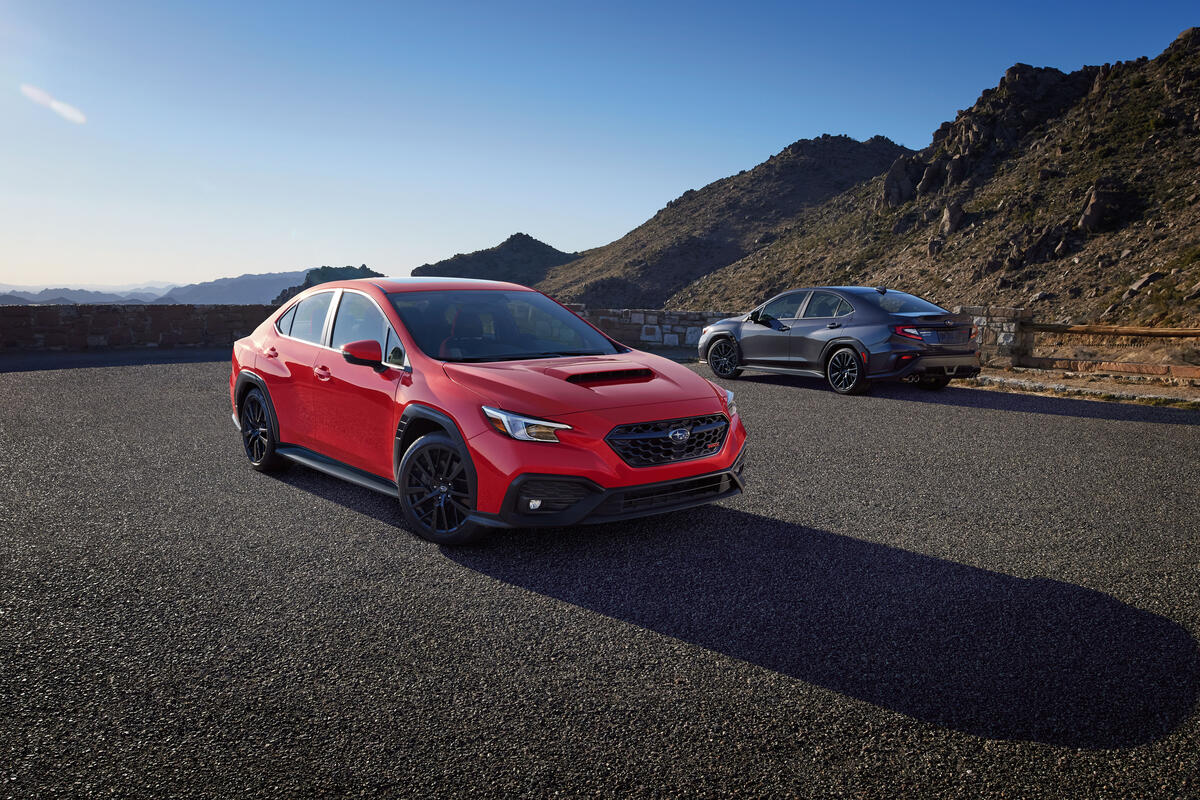
The Subaru WRX is a sporty Subaru that’s built for quick driving. Here, they’re saying some people collect cars that are still fairly new, not just super old classics.
Car
Ford
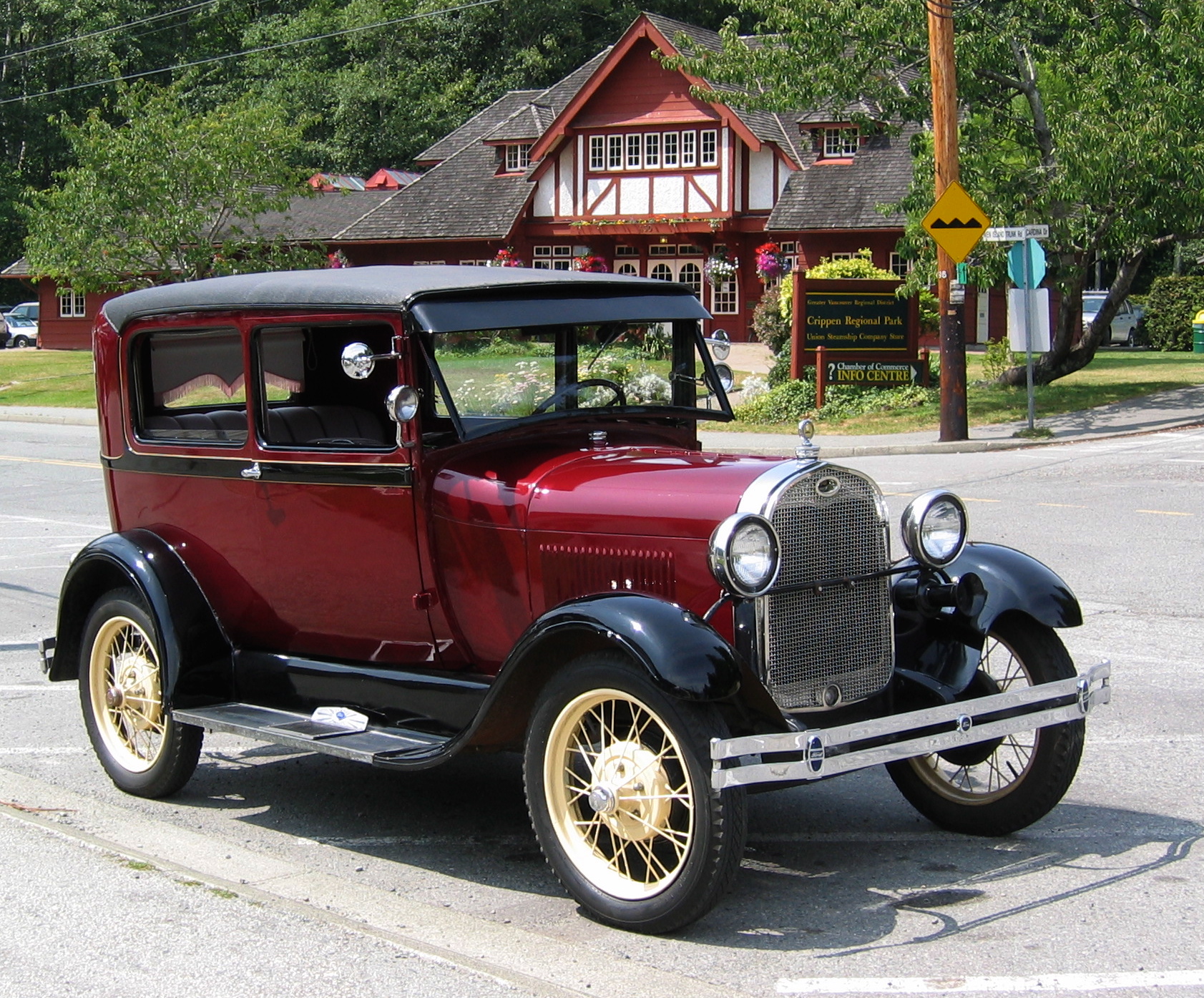
Ford is a well-known car brand. They’re using it as an example of a very old car that someone might collect.
A “bubble” is when prices get pushed way up and may not be sustainable. If the bubble “corrects,” it usually means prices stop rising so fast or start coming down.
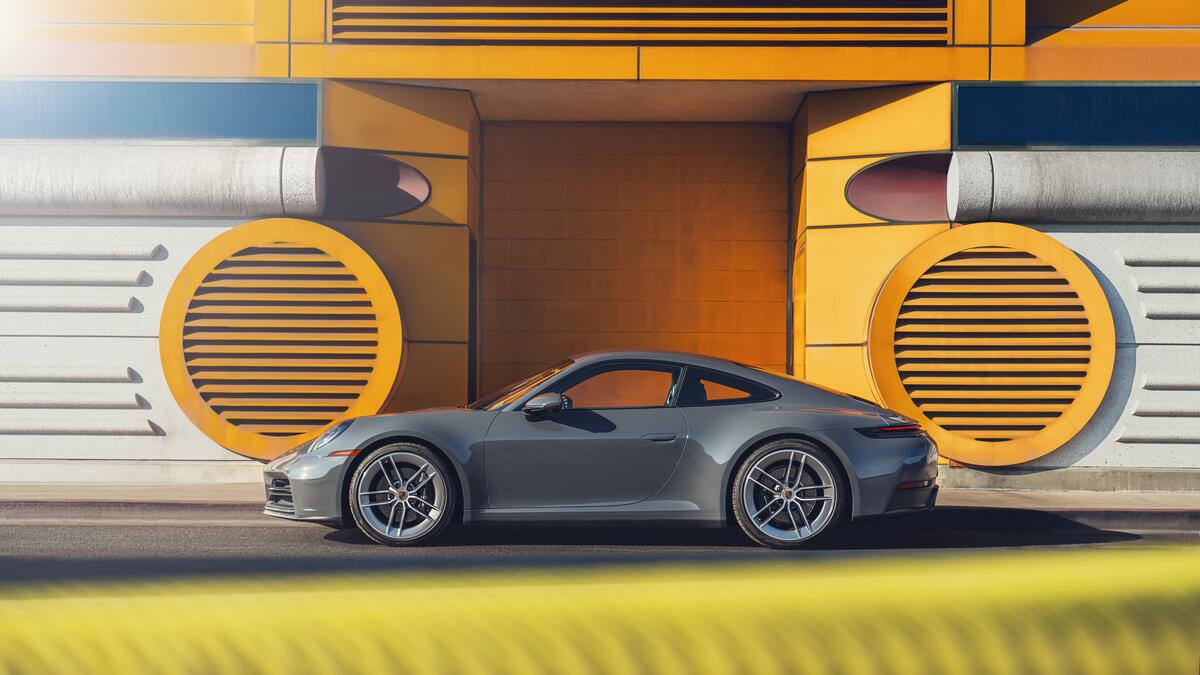
The Porsche 911 is Porsche’s famous sports car. Here, they’re talking about its prices in the collector market—like whether the value is getting too high and might come back down.
An “electric Ferrari” means a Ferrari that runs on electricity instead of gasoline. They’re debating whether people who buy Ferraris will still want it even though it’s electric.
A V12 is a type of engine with 12 cylinders arranged in a V shape. People who love V12 cars often care about the traditional feel and sound—something an electric car won’t replicate.
EV stands for electric vehicle, meaning a car that’s powered primarily by an electric motor and battery rather than a gasoline engine. Here, it’s used to describe whether new buyers are coming to the brand because they’re interested in EVs.
An all-electric car is a vehicle that uses only electric power for propulsion, typically with a battery pack and electric motor(s). The host is saying they’re not opposed to EVs in general, but they dislike the styling of Ferrari’s all-electric offering.
SUV stands for sport utility vehicle, a body style designed for higher seating position, passenger space, and typically available all-wheel-drive. The hosts argue that SUVs are driving sales volume for Porsche and Ferrari, which helps sustain their sports-car or supercar lines.
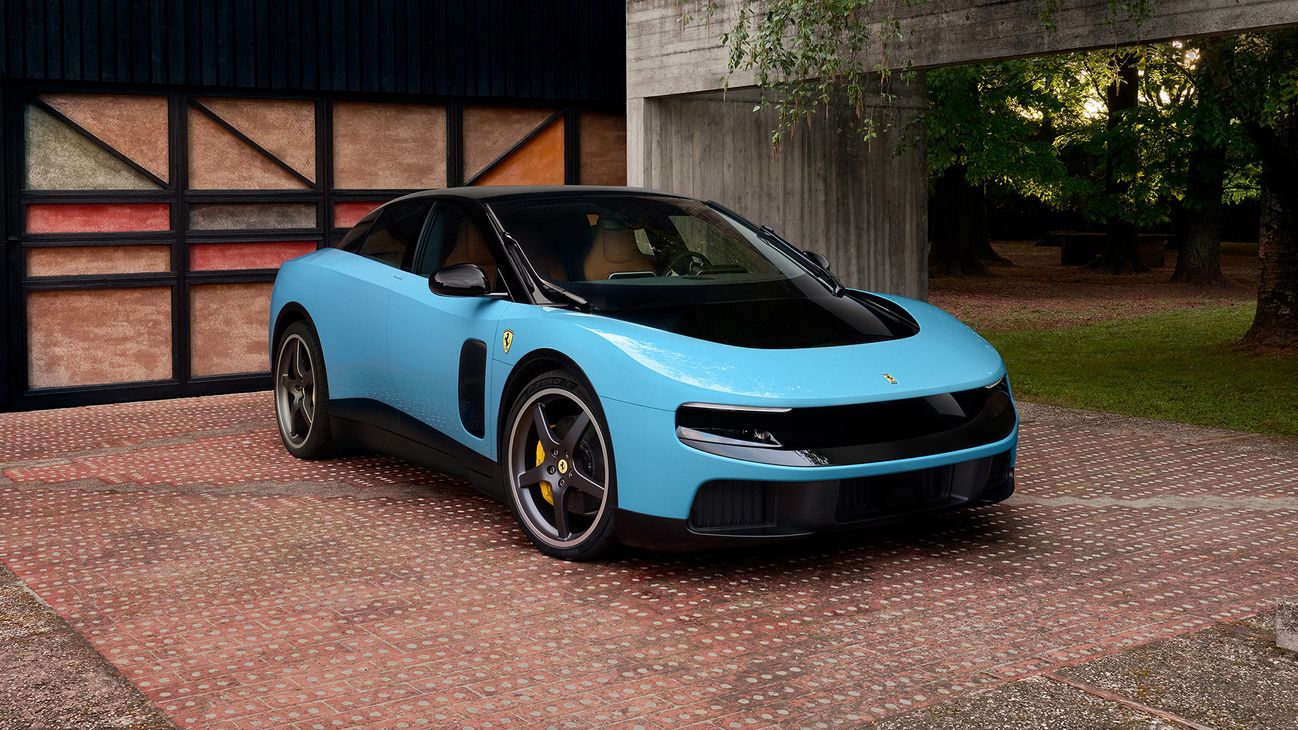
The Ferrari Luce is a specific Ferrari car that’s being discussed for its identity and details. The podcast mentions a type number to help describe which exact car they mean. That kind of detail matters most when cars are rare or historically significant.
“Scuderia” is Ferrari’s racing identity. A Scuderia badge is a logo that signals Ferrari’s motorsport connection, even if the car doesn’t have the word “Ferrari” on it.
They’re talking about a big collector-car auction during Monterey Car Week. RM Sotheby’s is the auction house, and they’re offering a very rare Corvette.
The podcast is talking about a very rare kind of Corvette called the Grand Sport from 1963. These cars are special because only a few were made. They’re being discussed in the context of an auction or sale, so people are guessing what they’ll be worth.
The Daytona Coupe is a rare, race-related version of a famous car. The podcast is pointing out that only a very small number were made. Because of that rarity, it’s a big deal for collectors and auctions.
The Ferrari 250 GTO is a legendary Ferrari from the 1960s that collectors consider extremely special. They’re mentioning how many exist and using that rarity to explain why prices are so high.
Car
Ferrari
Ferrari is an Italian car brand known for high-end sports cars. Here, they’re saying Ferrari has fans and owners in basically every part of the world, unlike some American models.
Concept
North America is the epicenter
“Epicenter” here means the main hub—where most of the interest and activity is. If a car’s biggest fan base is in North America, that can affect how and where it gets bought and sold.
Term
British component
They’re saying the Cobra has an important British influence. That helps explain why it has fans outside the U.S., not just in America.
This is a Mercedes-Benz supercar known for its “gullwing” doors that open upward. The hosts are talking about one that sold for a lot of money at auction, which is why it comes up.
Hyman and Company is a car dealership/collector-car business. In this story, it’s where the host went after the car sold and where they keep track of what’s happening in the collector market.
The SLR McLaren is a very expensive, high-performance car. In the podcast, they’re saying it often sells for a lot of money at auctions. That’s mainly because it’s rare and highly sought after.
The supercar market is the world of very expensive, special high-performance cars. They’re saying excitement about one brand can make buyers chase other supercars too, which can push prices up.
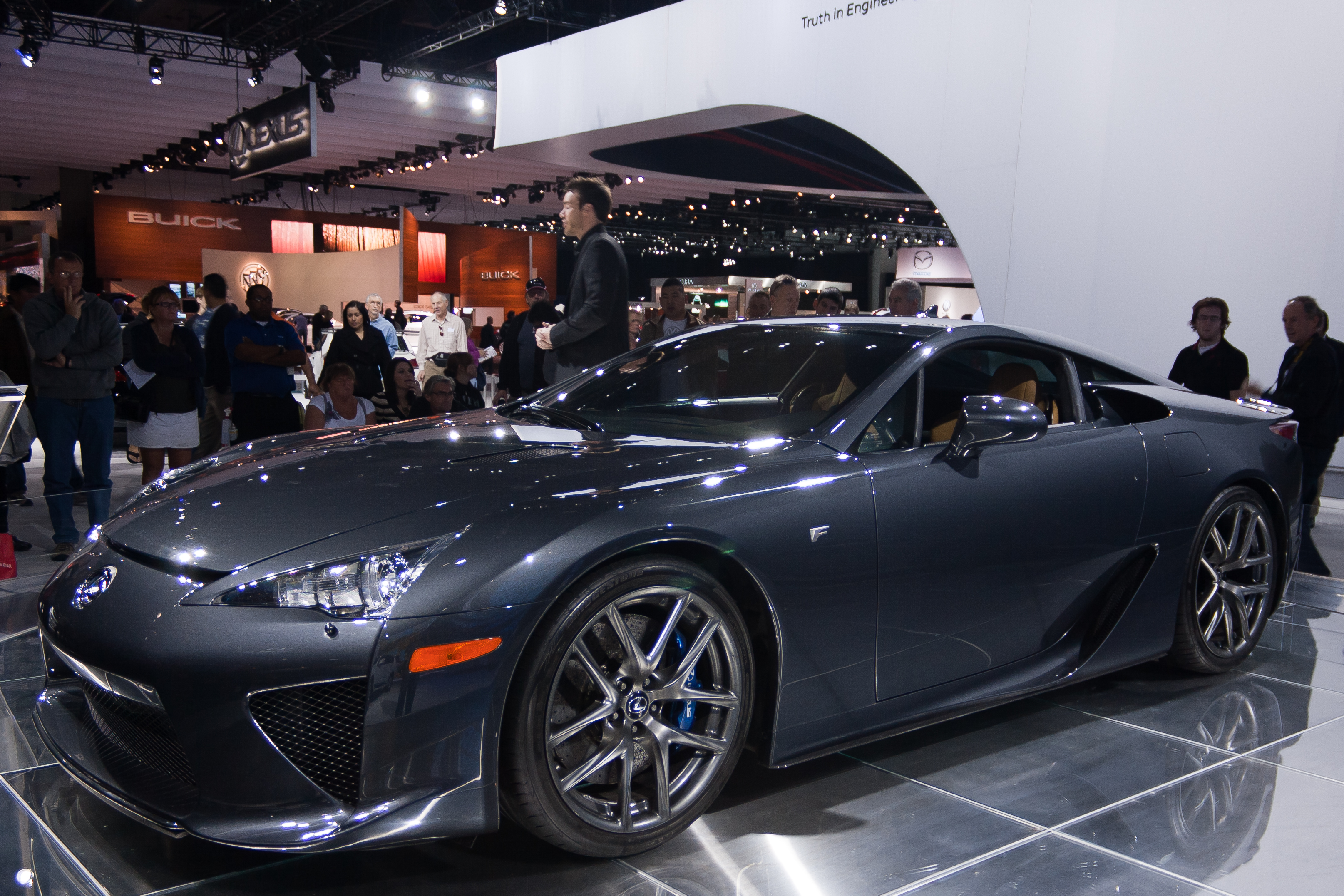
The Lexus LFA is a limited-production supercar from Lexus, built to compete with European exotic brands. Because it’s rare and highly sought after, it’s often used as a benchmark for how hype and collector demand can push prices in the supercar market.
A “K-shaped market” means the market doesn’t move evenly. Some things get more valuable while others get worse, so you see a split between winners and losers.
In collector-car pricing, “blue chips” means the most established, highly sought-after models—typically the ones buyers trust to hold value. The hosts are contrasting whether the strength they’re seeing is limited to these top-tier cars or spread across the rest of the market.
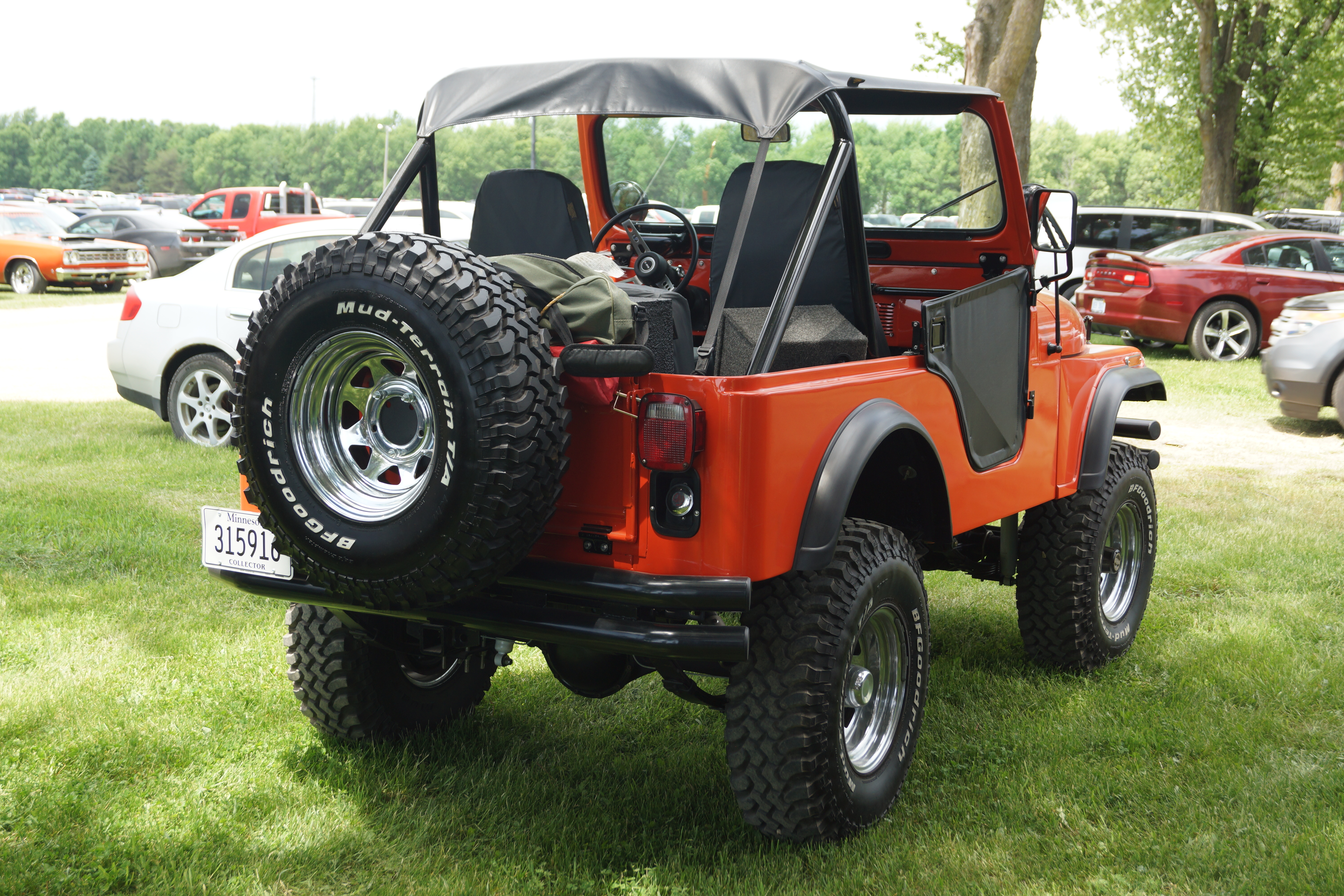
The Jeep CJ is an older Jeep made for off-road driving. The CJ7 is a specific version people talk about a lot. The podcast mentions it because it’s a well-known model that many people work on or modify.
The Ford Bronco is an SUV made for driving on rough roads and off-road trails. Many people customize them, like changing tires or suspension. That’s why it comes up when talking about modified Broncos.
“First generation Broncos” means the earliest Ford Bronco models. They’re often seen as simpler and more straightforward than newer ones, which is part of why enthusiasts like them.
Here, “agrarian” is basically a way of saying it feels like something built for farm work—simple and practical. It’s not a car feature you can measure; it’s more about the vibe.
A lifted Bronco is a Bronco that’s been raised higher than stock. People do it so it can handle rough terrain better, but it can also come with trade-offs.
The Chevrolet Blazer is an SUV made by Chevrolet. Some owners modify them to look and sit higher, often by changing the suspension and tires. That’s why the podcast mentions lifting and stance changes.
A warranty is a guarantee from the car maker that some repairs will be paid for for a certain time. Here, they’re saying buying new means you’re covered if something goes wrong.
The “F-Series” is Ford’s pickup truck line. Here they’re talking about the 1980 to 1986 versions (the “bullnose” style) and how different versions of those trucks have been changing in price.
They’re talking about Toyota pickup trucks from the 1980s. They mention that two-wheel-drive and four-wheel-drive versions have been moving closer together in price.
Two-wheel drive means the vehicle powers only two wheels. In this discussion, they’re comparing how 2WD versions are changing in price compared to 4WD versions.
Four-wheel drive means power goes to all four wheels, which helps with traction. In this segment, they’re using 4WD as the comparison point to show how prices are converging.
A “one ton truck” is a bigger, heavier pickup than the common half-ton. It’s built to haul more weight, so it often rides rougher or feels less comfortable for everyday driving.
“Half-ton” is a way people categorize pickup trucks by how much they can carry. It usually means the more common, everyday-friendly size compared with heavier one-ton trucks.
The Ford Falcon is an older Ford car model that came in different body styles. In the podcast, they’re mentioning how a Falcon-based version relates to another vehicle type. That kind of connection is often what makes older cars interesting to collectors.
The Ford Ranchero is a unique kind of pickup that’s based on the Ford Falcon. It looks and drives more like a car than a typical truck, which is why it’s a favorite among collectors.
The Ford F-100 is an older pickup truck made by Ford. It was built to be used for work, and many people still collect and restore them. The podcast is likely talking about a specific vintage year range for that truck.
Concept
long beds converting into short beds
They’re talking about changing a pickup truck’s bed length. People cut and modify the truck so it can use a shorter bed, usually because it looks better to them.
“Cutting the frames” refers to structural modification of a pickup truck’s chassis/frame to accommodate a different body/bed setup. Because the frame is a major load-bearing structure, this kind of work needs careful fabrication and alignment to avoid future drivability and safety issues.
The Ford F-150 is a popular full-size pickup truck. Here, the speaker is saying they currently drive an older one, which helps explain their taste in trucks.
The “Lightning” is a faster, more performance-focused F-150. “Crew cab” means it has four doors, so it’s easier to carry people and still use the truck like a normal daily.
A supercharger is a device that forces extra air into the engine. That extra air helps the engine make more power faster, so the car feels quicker right away.
This is a cargo cover for the truck bed that you can fold or flip out of the way. It keeps things covered when you want, but you can open it up when you need to load or unload.
Cars and Bids is a website where people auction cars to other enthusiasts. Saying it was on a Cars and Bids sale means the price came from online bidding.
The GMC Canyon Crew Cab is a mid-size pickup truck with a larger back seat area. The podcast is talking about someone planning to keep their 2022 model for a long time. That usually means they’re discussing how practical it is to live with.
The Avanti is a special model made by Studebaker. The host is talking about a particular Avanti that’s rare and historically important, including how it was recognized at Pebble Beach.
Pebble Beach is a famous classic-car show in California. The host is saying this rare Studebaker Avanti is important because it was invited and shown there in a very notable way.
Term
R3
R3 is a special version of the Avanti. The host is saying it’s rare and has a reputation, and that only a small number of these cars were made and still exist today.
A build sheet is like the car’s original factory paperwork. It can show what options the car had from the factory, which helps restorers make the car accurate.
“Original engine” means the engine that belongs with the car’s original history. Collectors often care a lot because it’s a sign the car is more authentic and can be worth more.
Topic
Hubble Beach
Hubble Beach sounds like a major car show or collector event. They’re saying the car was accepted there, which is a big deal for a restoration.
The Subaru R2 is a small car made by Subaru. It’s meant to be compact and practical, especially for city driving. The podcast is mentioning it because it’s not very common.
An air box is part of the engine’s air intake system. It helps control how air flows into the engine, which can affect how strong and responsive the car feels.
Valve covers are the top covers on an engine that protect the moving parts under them. When someone says the valve covers are different, it usually means the engine build is different in some way.
“304.5 cubic inches” is how big the engine is internally—basically how much space the pistons move through. Bigger displacement often means more potential power, assuming the engine is built to use it.
Transistor ignition is an electronic way of making the spark that ignites the fuel in the engine. They’re saying the original version they had was faulty, so they had to switch back to a more normal ignition setup.
Term
transistor box
A “transistor box” is an old-school electronics module. It’s like a small control unit that helps the car’s systems work the way they’re supposed to.
Term
air breathers
“Air breathers” are parts that help the car get more air where it needs it. More air can help the engine make more power, especially on boosted engines.
A “skunkworks project” means a special, small team working on something unusual or experimental. It’s the kind of project that gets built outside the usual routine.
Big Sur is a coastal region in California known for dramatic ocean views and winding roads. The segment mentions a drive “down the coast down to Big Sur and back,” which frames the event as both a show and a scenic driving experience.
Term
driven rate
“Driven rate” appears to be a promotional or discounted ticket rate offered through Driven media. It’s not a standard automotive term, but it’s a specific pricing reference tied to attending the event.
A “color change” means the car has been repainted a different color than its original. In classic-car pricing, repainting can be a positive or negative depending on quality and whether it matches the car’s documented history.
“Restore a car” means fixing up an older car to look and run like it should, sometimes with major work. The speaker is emphasizing that doing that can cost a lot of money.
Term
double turquoise car
They’re describing the car’s paint color as “double turquoise,” meaning it’s a very eye-catching turquoise look. The point is that it really stands out when parked on a lawn.
They’re talking about the car’s “face,” meaning how its front looks—like whether you can clearly see the grille and lights. They’re saying this car’s front doesn’t show that in the usual way.
The “grill” is the front opening on a car—usually the part with the mesh pattern. They’re saying this car hides that traditional front opening under the bumper.
They’re saying the comparison shouldn’t automatically make you think it’s an electric car. They’re separating the look from the fact that it might be EV-related.
They’re talking about Studebaker cars, which are older American vehicles made by a company that doesn’t exist today. They’re saying they’re not very familiar with that brand.
Pierce-Arrow was a famous luxury car brand from the early days of automobiles. The episode notes that Studebaker owned it for a time, which shows how car companies used to buy other brands.
EMF was an old car brand from the early days of the auto industry. Here it’s mentioned because Studebaker owned it at one point, showing how companies changed hands back then.
Flanders was an early car brand. In this episode it’s mentioned as one of the brands Studebaker owned, which helps explain why Studebaker’s story includes a lot of different automotive companies.
Concept
ups and downs
“Ups and downs” means the company had a rough history—good times and bad times. The host is using it to describe how Studebaker’s business went through major changes over the years.
The Student Baker Museum is a real museum the host recommends. They’re saying it’s a great place to learn the full story of an old car company.
LIVE
You're gonna love this.
Driven Radio Show.
Quiet, numbskulls.
I'm broadcasting.
Hey, all you gearheads and carpeans, welcome to Driven Radio Show, your weekly automotive
happy hour.
I am Brett Hatfield, here with my co-host and engineer extraordinaire, Mr. Mark Groves.
How do?
Gotta love that, AC.
We are coming to you from the Driven Radio Studios, where I'm going to pick on you for
a sec.
Oh, no.
What do I do now?
No.
Any news on the T-Bird legal front?
No, not a one.
I was going to call, there's a nice little law firm in Raytown, but God bless, Raytona
Beach never fails.
Raytona Beach never fails to this point.
Never fails to fail.
I finally found some reviews, and I'm like, no, that ain't gonna happen.
And I'm still civil court and all of this, and what am I going to get out of it?
And then also, guy may just not pay, and then what are you going to do?
Then I'd have to pay more lawyer fees and more this and that, and I'm like, how angry
am I really?
And actually, I'm mostly mad at myself, but I'll bluntly put that out there.
That was me, I don't like gambling, I don't go to casinos, don't care for it, don't like
to play poker for money, and I took a gamble on this, and I lost, and a guy got to bend
me over a little bit, and the people at the people that bring a trailer were as nice as
they could be about it, and we'll see where I go from here, but I'm losing steam on the
whole, I'm going to stick a lawyer up your tuckus, because I'm just like, and get what?
You know, sometimes people get screwed, even people who, and I know this is shocking, people
who try to be nice to the world can get effed.
It happens, and what makes you nice is how you react to it, and there's a part of me
that's, you know, is just a hundred percent.
Do you have this guy's address?
Yeah, you know, part of me is violence, but most of me is no, I just, just not.
I think you ought to just go to the Jehovah's Witness website and tell them you are dying
to hear from them.
Can I jump in here?
Oh, sure, Dave.
But you work third shift, and they really need to, you know, show up early evening, and yeah.
I'm a big fan of signing somebody up for subscriptions that are surprising.
Yes.
So, so I would say, you know, find out if he's a married guy, find out more, more about
him or a single guy or whatever, you know, maybe there'd be some, there'd be some subscriptions
that he started getting in the mail that when they came and his wife opened them up, he'd
have to ask, answer some questions.
I am 100% in favor of doing that.
The Nabila Quarterly.
Yeah.
Nabila Quarterly Review.
Well, I mean, you know, well, I'm not going to mention any, but use your imagination.
Table dancers anonymous.
Done.
Well, yeah.
Love bombs, as well.
So just send them some love bombs.
I have a friend who will anonymously send somebody a three pound package of glitter.
Oh, you can buy those on Amazon.
Yep.
You can buy, you can get them on Amazon.
Yep.
But no bag inside.
You just open it and the crap is everywhere.
There is no containing it once the box is open.
No, no, no, take, take my word on this because I might have been someone who got glittered
by a relative.
And how do I say it nicely?
It's like the line from the movie and I'm older and I have better insurance.
I'm older and I have more money.
Fried green tomatoes.
Yeah, right.
I made sure that where, you know, they got me in the area surrounding maybe the, you know,
my body in a foot.
I made sure that there wasn't an area within six feet that didn't have glitter.
So, yeah, so just saying it's possible.
Violent but dazzling.
I like it.
She had no idea who did it either.
That was fun.
So I finally owned up to it like three years later.
Yeah.
Well, we'll see.
And that's all there is to that.
I am wrapping up Barrett Jackson Columbus coverage and we are preparing for a trip to
the National Corvette Museum.
Oh, dude.
I finally get to make my hodge.
And then right after the museum, we're going to the Keeneland Concours in Lexington, Kentucky,
traveling with the Kansas City Ferrari Club and friend of the show, Christopher Parr.
And I have to thank Chris for it.
God, he just invites me to the coolest stuff.
So I'm really looking forward to the trip.
It'll be fun and I don't have to work.
Now you've danced around the idea here for a while.
We were talking about it just a week or two ago that you're kind of thinking about Corvette.
One of the new ones.
Nope.
Not going to do it.
Well, not going to pull the trigger.
No, I could pull the trigger while we're there on this trip.
I will not be driving a Corvette.
So Brett, can I ask you a question?
Go ahead.
Are you a gambler?
Why do you ask?
Because you can, when you go to the Corvette Museum, you can buy tickets for their raffle for new Corvettes.
Oh, I'll do that.
Yeah, I'll throw it.
Okay.
Well, they have all kinds of points of entry.
They have the $300 tickets and the $100 $10 tickets.
But I was at Cars and Coffee maybe four years ago.
It was maybe five years ago because it was right in the middle of a pandemic and there were actually whatever.
But there was a guy who always showed up with his vet.
A nice enough guy talked to him every once in a while.
And then one day he shows up with another vet and a woman.
And I never met his wife before.
And I said, I didn't know you had a Corvette.
And she said, I want it.
Oh, really?
I thought you were going to say you want a new wife.
No.
And they went to the Corvette Museum for delivery of his brand new whatever, 2022, 2021, whatever was Corvette.
And while they were there, she bought a couple tickets and she won a Corvette.
So now they're a three Corvette family.
Wow.
There you go.
And one of them was free.
And we're only a two Corvette family so far.
So I definitely need another one.
Yeah.
Well, you know, if you win, I get 10% of it.
I'll take the, I'll take the hard top.
I mean, I'll tell you what, I'll get one with your package and you can have the wing.
Because I can be your wingman.
Hey, look at that.
What a segue.
Speaking of.
Hey, kids, our special guest this week are Dave Kenny, who you've been listening to, and Greg Engold of the Hagerty Price Guide.
Dave Kenny is a lifelong automobile enthusiast, collector, owner of automotive valuation firm, US appraisal, contributor to the Hagerty Insider and publisher of the Hagerty Price Guide.
And he serves on the MacPherson College Auto Restoration Program Advisory Board.
Greg Engold is an avid car enthusiast, senior, freshly minted senior manager of vehicle valuations, contributor to Hagerty Media, as well as Hagerty Insider and editor of the Hagerty Price Guide.
Greg and Dave, welcome back to Driven Radio.
Happy to be here.
Good to see you.
Oh, great to see you both.
First things first, congratulations are in order as Hagerty is celebrating 20 years of ours that matter.
And that became the Hagerty Price Guide. Well done, gentlemen.
Thank you very much.
Yeah, it's been a, it's been a fun trip.
I, you know, everybody asked me, you know, what the transition was and working with Hagerty and all that it's been absolutely fun all the way through.
I've worked with great people like Greg, you know, the entire time it has literally been a blast.
And it's the, you know, it's the, it's the legacy that I created that will outlive me.
And I think that's pretty cool.
I mean, you know, so, so thank you.
And 20 years of big accomplishment.
So a lot of, you know, we went from basically, I don't know, 38 subscribers to being probably the best known automotive price guide in the world.
So lots of work is still a lot of people working with it.
We couldn't have done it.
Greg and I couldn't have done it by ourselves or with just two or three other people.
We have tons of people and they're all responsible for doing just a great job.
So thank you very much.
A week doesn't go by that I'm not online looking at the Hagerty Price Guide for something.
And it's usually to see if my damn truck is in there yet.
I'm sorry, I'm having a little trouble with my audio.
I'll help you with that later.
Thank you.
It's time for our quarterly update of the Hagerty Price Guide.
Since last we spoke, Meekamendi had their big sale and there were some pretty heavy hitters there with Ferraris, a one of one Lamborghini and race cars trading hands for big money.
Can you tell us a little bit about that sale?
Well, I wasn't there.
I do have a couple of friends who are there.
They said it was a big sale all the way through.
It's really kind of, this market is just so funny because it's kind of hit or miss.
Some things do so well in this marketplace and some things just kind of slide by.
And I think there were a lot of cars that did well there.
I don't remember what their sell-through rate was.
It wasn't spectacular, but of course Meekamendi is coming off a Kissimmee that was just in January.
And it seems like a long time ago.
It's only six months ago, but it was just a phenomenal, phenomenal time.
So they're doing well.
I think they've got Harrisburg coming up soon, which is kind of local to me here.
I'm in Virginia and it's in Pennsylvania.
But things are cruising along in the classic car world.
It's been great for Ferraris.
The later cars are doing just exceptionally well.
A lot of the cars that were 50s and 60s cars are getting more affordable.
It's the nice way to put it, but it's still a market where great cars bring great prices.
Do you think the 50s and 60s cars that are becoming more affordable are boomers or aging out?
Yeah.
Oh, yeah.
And the boomers drove the collector car market.
Hell, it was basically invented by the pre-boomers, but the boomers took a hold of it and went running with it.
It's one of the largest hobbies in the country, if not the largest hobby in the country.
And everyone knows somebody who's into collector cars of some sort.
Their collector car might be a seven-year-old Subaru WRX or it might be a almost 100-year-old Ford at this point.
But there are a whole bunch of people who identify as collector cars and it's been a huge hobby.
I think what's going to happen in a lot of the cars when the values go down,
some of the people will pick them up, other people.
And it means probably less restorations for cars from the 50s and 60s.
And that's of course why I'm involved in a restoration on cars from the 60s right now or cars from the 60s.
Because I'm not that smart, but it's okay.
I mean, you don't restore a car because you want to make money, you restore it because you love it.
So it's all good.
We are going to get to your car from the 60s here in a little bit.
Late model Ferraris seem to have shot into the stratosphere.
Any word on what's going on?
And we're starting to see a little bit of correction in the Porsche 911 bubble.
I'm curious what you think the inevitable correction on the Ferraris will be. Will it be ugly?
Greg, this one's for you. How's that?
Yeah, I mean, to be honest with you, even I would say the smartest minds in the industry are still scratching their heads to an extent as to what the heck is going on.
But yeah, late model Ferraris are inexplicably hot.
I mean, there's a bunch of different theories that you can pose on that one.
But the best one I can think of is the Ferrari keeps coming out with better and better new models and they're harder and harder to get.
So what's a better way than to pad your collection and show them that you're a major Ferrari collector and in hopes of getting that call one day for the next exclusive car?
Greg, what are your predictions on the latest Ferraris that they've been pushing so hard the electric one?
Do you think it'll become like a one off? Oh my God, that was so awful. Nobody bought it.
So there's so few left and they're worth a trillion or?
It is awful looking.
I mean, I will say that in my mind, you know, the young Greg who appreciated V12 Ferrari is not that interested in the new electric Ferrari.
But I think Ferrari is going to sell it because it is a Ferrari remains to be seen what how it's how it's going to do.
I mean, I was not not all that enamored with the pure Sangui and they seem to be doing just fine.
So I think it's going to succeed because it is Ferrari.
But we'll see if it's going to be new people coming to the brand because they're interested in EVs or if they're going to be snapped up by existing clients.
Well, that's one of the things I read about was that there were some kind of bitchy articles about Ferrari pressuring people who have big money people who are pretty much Ferrari fans for life,
telling them that if they're going to get further cars, they need to buy this one.
Is that just? No, that's part of their plan.
I mean, when you buy is very similar to what Rolex does.
You know, you start out with the lesser model and you get another one and then you get another one and you better keep it for a couple years and you better sell it back to the dealer.
And you stay in good graces with the manufacturer.
I don't believe in that, but that's, you know, other people do and it's been very rewarding for them.
I just don't know about the the all electric car.
I don't I'm not a hater.
I just don't like the styling of it because it doesn't really say Ferrari and
no one says so.
Yeah, exactly.
And and but but they might, you know, be able to sell them based on that.
I mean, keep in mind that, you know, if we were talking 20 years ago and said that Porsche sells so many more SUVs than they sell sports cars,
you know, most people wouldn't believe it, but what keeps the 911 alive?
It's the SUVs.
I mean, so the world has changed a little bit and continues to change.
And the 911, which is, you know, the longest in the long tooth of automobiles at this point, other than the Chevy's a bourbon, I guess,
it keeps on evolving.
It keeps on changing.
You know, each model is that much different.
But, you know, I don't think the 911 would exist if it weren't for the fact that they build so many SUVs and that's what they sell most of.
So Ferrari, same thing, you know, with the with the $600,000 SUV that you're assigned with, you know, not my cup of tea.
I'm not very likely to buy a $600,000 or anything that doesn't have a beachfront with it or something like that.
But I guess there's a market out there for them and more power to them.
I'm looking through the pictures of the Ferrari EV, which is what they say, Type 222 or whatever that the loose Luce, whatever they want to call it.
The blue one is awful.
It's horrible on that.
They have pictures of it in Rosso Corsa red.
It's a little easier on the eye, but it doesn't say Ferrari anywhere except for the Scuderia badge on the front fender.
It just doesn't look like a Ferrari.
It looks a lot like a lasage.
I mean, that's, you know, cheating the air, I guess is part of it.
It should say Smith Brothers on it.
Yeah, that's a that's a joke for only old people.
So, yeah, exactly.
Well, my gray is showing.
Pardon me.
Halls maybe or something like that.
Or Ricola.
That would be it.
Ricola.
Oh, there you go.
Now you got me.
Oh, what was the cherry candy one that I always liked?
What was that one?
That's a.
The Luce and the.
Oh, hell, I think.
I know which one you're talking about.
I'll think of it in 10 minutes when it doesn't matter.
So what other big auctions or big sales have you seen since the end of February?
Is there what out there is of note?
Well, I mean, I think all of everyone's everyone's focus right now is on the Pebble Beach auctions, the Monterey auctions, because the Sam Mann collection is coming up on Thursday at the Thursday of Pebble Beach week.
At RM, and that's a lot of very exceptional cars from one owner.
I know broad arrow has some incredible consignments.
It's going to be a very, very big year.
You know, we're going to see another auction house probably exceed 300 million for the weekend.
The possibilities are there.
But, you know, part of the action right now has shifted so much to the online sales of course bring a trailer is is huge and keeps going all year long.
So, you know, I mean, it's a different auction world and the auction world keeps on changing.
And just like the sales world, you know, keeps on changing in the cars that people are mostly interested in all the action right now is in cars.
You know, the biggest amount of is in cars built from 2010 up.
It's, you know, the more things change, the more they stay the same.
And so the people buying them are a different breed of people than the people who'd buy cars from the 60s, 70s, 80s, even 90s in some cases.
So, you know, the good news is that the market is still there, the market changes.
You know, I think that you have to be very, very, very, very lucky or smart to invest in automobiles.
A dealer will tell you you make your money when you buy it.
You probably shouldn't buy something to keep long term if you really want to make money on it.
But many, many people have bought a $2,000 car that they sold for $200,000.
So, you know, there's exceptions to every rule.
But, you know, my advice is always to buy what you love.
So, you know, and even if that what you love is a 2023 something or other and you're planning on keeping it and you want to want to wait for it to become a collector car.
And that's just fine.
One of the sales that's going to happen at Monterey this year is at RM Sotheby's.
They're going to be selling or auctioning one of the five Corvette Grand Sports from 1963.
Any thoughts, any predictions?
Do we know whose collection this came from?
Is this one of the semi-owned cars?
No, it's not a semi-owned car.
Greg, do you know the car?
I don't know the car.
I do know that this, this assignment is absolutely freaking huge.
I mean, the last time we've seen a 63 Grand Sport was 2009.
I thought it was further back on that.
I didn't realize I want to change hands then.
Did not change hands.
It was a no sale.
I had to dig way back into the artifacts, but it was no sale at 4.8 million.
Yeah, that was Dana Meekum's car, wasn't it?
I think it was.
I think it was.
Okay.
Now, how many Grand Sports did they make?
Five.
Five.
Yeah, a very impressive car.
Again, not a car that you could buy unless you knew somebody, all that sort of stuff.
So it's always been a very impressive collector car, always been valuable.
I know some people are talking well in excess of $10 million.
It could very, very well be one of the most expensive, if not the most expensive Corvettes ever sold.
It's going to be interesting to say.
Very hard to pin the price on that because we don't know who's going to be buying collector Corvettes from the 60s,
and we don't know who's putting together a collection necessarily.
So it'll be interesting to see what happens.
Well, and what other marketplace example are you going to find?
Yeah, I mean, that's the old joke is, okay, I'll wait for another.
The next one will come up in what?
2039.
You'll get out of your, you'll use your hurricane to walk over out of your chair and get in it.
So the enjoyment might be gone by then.
I mean, this is literally the best example of once in a lifetime opportunity.
It really is.
If you can plunk down the $10 to $15 million.
And good luck with that.
That really gets you into some rare fighter.
I know I'm the resident Corvette idiot and I'll accept that.
But to my mind, there's five of these and there were only six Cobra Daytonas,
but there were 39 Ferrari 250 GTOs.
I honest to God, I think these are cheap.
I mean, anything that's $10 million to $13 million isn't cheap.
But I think they sell for less than they should.
I would agree with that.
But remember, Ferrari has a worldwide market.
Corvette does not have a worldwide market.
I mean, yes, there are Europeans who buy them, but they're few and far between.
And you know, Ferrari, absolutely, you know, people buy them in every continent.
It was the exception, I guess, of Antarctica.
They haven't sold any of there yet that I'm aware of.
But, you know, every continent has a Ferrari club and Ferrari owners and whatever.
And, you know, although Corvette owners, you know, long suffering,
I mean, the Corvette is a much better car than the rest of the world.
And most Americans admit it's a great car.
But, you know, it's limited to North America.
Yeah, they don't have a following.
Yeah, yeah.
I'm still going to stick with what what I think on that.
God, these are just it seems like the grand sports when when they do very rarely come up.
And the Cobra Daytona's also when they do very rarely come up.
It seems like they should trade for more.
But again, like you said, they don't have the global following that Ferrari does.
And the Cobra Daytona has much more of a global following than a Corvette.
So, I mean, you know, but I mean, we are the North America is the epicenter of Cobras.
But keep in mind, they're also, I mean, we don't like to admit this,
but there's quite a large British component to those cars.
Yeah, yeah.
The very underpinnings of them.
So, oh, yeah, exactly.
The soul.
Yeah, maybe.
True.
So Hyman and Company, a group that you are very familiar with, Dave,
they had a record sale of an SLS Gullwing Benz for $775,000 on bring a trailer.
And there was a bit of pushback following the sale.
Would you like to enlighten us about that?
Yeah, it's actually kind of funny.
I was in St. Louis this weekend and I guess it would have been Thursday or Friday.
I guess it would have been Thursday.
I called Sean Dugan, who works there.
And he had told me that they just had this car sell on bring a trailer.
And actually, you know what?
Probably Wednesday.
But the car just sold on bring a trailer for $775,000.
You know, after I grabbed onto the steel and steering wheel a little harder and checked my heart,
I said, that's amazing.
You know what the story is?
He says, we don't have any idea.
I went from 500 something up to $775,000.
And I'm like, well, good for you guys.
That's going to be really interesting.
And then I wound up there two days later at Hyman.
I go out there every year.
I stop in and I check with dealers around the country.
And that was one of my check-in spots.
And while I was there, the wire transfer came in.
And I had read the bring a trailer stuff on it before.
And there were people skeptical on bring a trailer,
but there were people, a lot of people online off of bring a trailer who were much more skeptical.
And so I know these people.
So I just said, hey, Sean, show me the wire transfer.
And it had just come in like, let's say five minutes earlier.
And the woman who works in the office takes care of it.
You know, walked out and showed it to me and she had,
she had her highlighter with her and she highlighted the customer's name,
which I won't reveal.
And I didn't take a photo of it or anything,
but the amount and it matched and the car and it matched.
And so I confirmed the sale and I went on bring a trailer.
And I said, guys, you know, I happen to be there at the time.
I'm the publisher of the Hagerty Price Guide.
So I follow prices and is it an anomaly?
Yeah, absolutely.
It's an anomaly.
But is it indicative of the cars going up in value?
Yeah, absolutely.
I did an appraisal on one of these.
And, you know, I guess that it was in a state and the date of death was November.
And I'd say the cars were $200,000 more than November right now.
I think these cars have been too cheap for too long.
This is the Gullwing.
There's a Gullwing and a Roadster.
I prefer the Gullwing a little bit,
but I certainly wouldn't kick a Roadster out of bed.
They're very, very nice cars.
And, you know, at $700,000, that might be very close to fully priced,
but it, you know, for something in $500,000,
I think they're a hell of a car.
I mean, it's the Gullwing of this generation.
Sure.
You know, 2013 and around there when they were made.
And, you know, the Gullwing is quite an impact,
which of course means it's a pain in the ass to get in and out.
It's not about that.
And the Gullwing, you know, it's, it's, it's like the, you know,
the woman shoes that, you know, the, you know,
your wife or your girlfriend or whoever is in these shoes
and they're uncomfortable as hell, but boy, they look great.
So it's that kind of thing.
But you wouldn't want to, you know,
I'm saying that you wouldn't want to drive it every day.
And I know a guy who almost dailies his SLS,
which is hilarious.
Wow.
Yeah.
I mean, summertime daily, I guess would be the best way to describe it.
So now this is a 1600 mile car.
And I believe it was a radium silver,
which is a, you know, a rare and desirable color.
But this is indicative of where the market is that, you know,
that I'm, I'm just guessing that the Hyman would have been happy
at mid 500s, really happy.
And the car sold for over seven.
So they were over the moon.
Yeah, exactly.
And, and I wound up buying lunch anyway.
I have no idea why, but it was,
it was hot chicken and it was before the,
and it was before the wire transfer came in.
So no, I, you know, I,
I like the people who work there.
And I've, they've always been very friendly to the price guide
and insuring information with me.
And that should be a two way street.
So when I saw people were giving them crap,
I'm like, Hey, I can get on there and say,
I'm kind of in the middle of this because I was there.
And I'm kind of an honest broker because this is,
I don't have one for sale and probably never own one.
And so, so it was, it was nice to be able to, you know,
to lend a hand on that.
But it's always interesting.
It's always interesting.
I, you know,
I was talking with another person about it and anybody in the auction
business will tell you the same thing.
Sometimes it's unbelievable.
Sometimes you've been there probably when, when,
when an auctioneer calls a car and they say, you know,
they try and start, it was a, it's a $95,000 car,
but they started 220.
Then you know, go ahead, 220, 220.
And then it goes, how about 200?
And somebody raises a hand and they just bought the car for
double retail and it happens.
And maybe they knew what they were doing.
Maybe they were idiots.
Maybe they really wanted the car.
I mean, you know, whatever, but that's, it does happen.
I mean, it absolutely does happen.
I'm looking at the auction right now.
And here's the really remarkable part and the part that we haven't
discussed is the bid before the 775 bid.
It was 576.
Exactly.
Exactly.
So the winning bid, the winning bidder really wanted to make
the point that he wanted that car and he was going to take it
home no matter what.
Yeah.
Because he had bid 575.
Well, he or she had bid 575 and then somebody bid 576 and
then the return bid was 775.
Yeah.
Well, I will say sadly we live in a world where there are people out
there that that is lunch money for them.
I mean, you know, Mazel Tov and God bless America and all that sort
of stuff, but you know, you know, there are people who can throw
caution to the wind if they want to.
Man, even if you want powerball, that seems like a tough.
And the other thing that's kind of remarkable about this is that's
not the one that usually goes for a ton.
Usually it's the SLR McLaren.
Yeah.
Well, okay.
Well, there is a black series of the SLS that goes for that
kind of money.
And I think the SLR McLaren are incredibly underpriced.
And let me tell you why.
It's chocolate and peanut butter.
It's two companies that came together to build a car and two
great names.
Yeah.
Think about it.
Yeah.
And that really doesn't happen all that often.
You know, you don't have a McLaren.
You have a Mercedes McLaren.
You don't have a Mercedes.
You have a Mercedes McLaren, you know, whatever.
And I think that, you know, for that reason, that's a collaboration
that will probably never happen again.
And hey, I mean, what's the last couple of summers?
Every, you know, every artist is doing co-labs.
So, you know, Mercedes and McLaren did it before.
Of course.
There you are.
Well, the car that sold from Hyman is a gorgeous car.
I'm looking at it.
It is clean as a pen.
It's just 1600 miles.
Yeah.
It is absolutely brand new.
But for a car that stickered for 223, going for triple that, the
folks at Hyman must have been quite happy, I would think.
Well, I can say, I'm not going to say there was a hoot in the
holler, but when the, I was there when the, when the wire
transfer came in and they were, there might have been a couple
side bets.
I don't know that for a fact.
You know, I mean, you know, and it's true, you know, and
anybody who sold on bring a trailer or any platform is like,
you know, well, if it really happens, the smart people always
say that because then all of a sudden, yeah, I was bidding on
it, but I went away and my cat stepped on the keyboard and
that's how I wanted to bind her, you know, whatever, whatever
the excuses are.
Okay.
I ask you guys this every quarter and it's because we want
to know, we're curious about this kind of stuff.
What other market trends of note are you seeing this quarter?
Well, I mean, we've, we've sort of beaten the, the supercar
thing to death, but let's beat it a little more.
As we, as a, you know, as we look at it, the, the whole
hype around Ferrari is starting to find its way into other
areas of the supercar market.
It's not just for areas that are doing well.
It's your Lamborghinis.
It's your Lexus LFA is like everything in that segment is
starting to go bananas.
LFA's are getting hotter than they've been.
Yeah.
And we're going to, and we're going to talk about them in a
little bit, but yeah, we are, you know, when it, when it comes
to the rest of the market though, it's either stable or it's
cooling.
So, you know, that whole over, you know, K-shaped market is
happening here.
The top cars are getting richer and everything else is
really struggling.
So it's really the everything else that you see out there
in parallel.
So now it's very, it's been a very difficult update just
because it's, you can't bank on one thing going up and one
thing and everything following suit.
Now, is this older blue chips?
Like we were seeing some, some pretty hot Lamborghini
mirrors out there, or is it just all blue chips, both modern
and vintage?
Well, I will, let me just answer the Lamborghini mirror.
There was no change this book for the first time and I believe
six books.
Oh, really?
So, I mean, you know, I'm not going to say that's cooling
because they really, really jumped up and we had, you know,
quite a few, quite a few sales of mirrors in the last, in
2025 and into 2026.
But, you know, they're, you know, if they're cooling, they're
cooling at a level that was, you know, twice what they were
two years ago.
So maybe they're just taking a little break now.
But, but yeah, it was, it was a very interesting, very
interesting book to put together.
Lots of, you know, lots of work went into it.
We had things like the Jeep CJ7 went down.
The VW, VW transporters went down.
Your 7072 L21 Corvette went down and Broncos went down,
which doesn't surprise me at all.
I saw that one coming because everybody who wanted to have a
modified Bronco, with some exceptions, they've already done
it.
Yeah.
So there was a, there was kind of an overbuilding thing
where people did it.
And then, you know, you know, a lot of people buy it and then
they drive it a few times and then they realize it didn't
change their life or it's not what they really wanted.
Or it sucks.
Whatever.
Yeah, or it sucks.
Yeah, exactly.
Now that Bronco market, I cannot understand all that well.
I think they look great, but, you know, and I'll, I'll just
go ahead and say it.
I would rather have a brand new Bronco with a warranty and
things like brakes and air conditioning that actually worked.
Oh yeah.
And, you know, you get, I mean, Ford did a good job of doing the,
you know, the tribute to the early Broncos.
And I actually rented a full-size Bronco.
I was on a trip in Florida and it had the original experience
because when it rained, it did leak.
So, you know, very, very 1960s feeling.
So, yeah.
I mean, yeah, I do think that the first generation Broncos is
as cool as they are.
It's a lot of money for something with the simplicity of a
Massey Ferguson.
Yeah.
The word is agrarian.
Yes.
And it is absolutely agrarian.
Also, folks, all you guys out there listening and some girls
who think, man, my life's dream is to have a lifted Bronco.
Don't.
Freakin' don't.
Take it from a guy who'd daily won for five years.
It was the coolest looking thing around.
It rode like a lumber cart.
So just.
In short-wheel-based trucks are a real handful to get around,
especially when you start messing around with the stance.
I'm a blazer guy and I had a blazer that was slightly lifted
and boy, that was it was a cool truck.
But man, that was not a fun vehicle.
Oh, nothing looks cooler.
They look like Tonka trucks, but they also ride like Tonka trucks.
Yes, they do.
So I love my Bronco.
I really enjoyed it.
It nothing looked cooler.
I got lots of compliments on it.
It'd like to beat you to death.
Yeah.
Well, I mean, you know, you, you, we all have to acknowledge this fact
that when you're 19, nothing bothers you.
You know, you don't have the aches and pains.
You know, most people, you know, fortunate people don't have.
That's when I hit my blazer.
And in a lift, a lifted car, you got all the muscle mass you need
to lift your body into it and, you know, and all that sort of stuff.
And, you know, it is cool as hell and I get it.
But when you're 35, maybe not so much in your 65, definitely not.
So, but, you know, I get it.
And I think they're fun.
And, you know, it's just, it's just, you know, like I said, I think
that the Bronco is the, is the poster child for this because, you
know, for $55,000, you can buy one that's brand new.
You can finance that as, like I said, air conditioning and air bags,
which are not a bad thing to have.
And, you know, and, and everything's under warranty.
And that's kind of cool too.
Yeah.
Well, do yourselves a favor.
Go find a new one.
Load it up the way you like it.
Yeah.
And you won't have to finance it.
Yeah.
You won't have to put a chiropractors kid through an Ivy League school.
Yeah.
There you go.
Good way to put it.
All right, Greg, we're going to, we're going to dig into some stuff
you've been doing lately.
You've written a couple of articles about cars that are still holding
or rising in value in kind of a soft market.
And like you said, it's a difficult market to pinpoint right now.
Tell us a little bit about those articles.
Yeah.
So every time we release a new edition or a new update of our
values, which happened about two weeks ago on the first, we
highlight some of the big gainers and some of the cars that lost
value.
And this isn't a comprehensive list.
This is just picking some that are really interesting and have some
context for the market.
But, you know, as of right now, again, we had to highlight some of
the super cars.
But for those of you who have tuned out on Ferraris right now,
before we get back into those, we'll talk about the first bullnose F
series.
Those did quite well.
Specifically the, you know, the 80 through 86 F series, the heavy
duty trucks started to close the gap between the light duty trucks
by about 32%.
So, and we saw the same thing happen with 80s Toyota pickups.
We saw the two wheel drive versions closing the gap between the four
wheel drive versions by about 23%.
So what we're seeing out of this is that the, not necessarily that
there's this huge seismic event going on, but that market is starting
to mature a little bit and buyers are getting less and less picky
about what they're picking up.
I mean, anybody who's driven a one ton truck knows that they're one of
the most uncomfortable vehicles in the world to drive.
But, you know, if you want something cool and half tons are expensive
and, you know, there's a few nice one tons out there.
Are you going to kick out the garage for leaking oil?
So do you think that some people are starting to buy vintage pickups
and think maybe they can use them for dailies because they look at
new half ton trucks that are 70, 80, 90 thousand dollars and just
think, oh, screw that man.
I'll go drive something old with low miles.
You know, I got one for you.
I just completed.
I just came back today from about 3,300 miles of driving out to the Midwest.
I live in Virginia out the Midwest and back went out to St. Louis.
And I saw exactly three collector vehicles on open trailers and all
three of them were pickup trucks.
One was a C 10 long bad.
One, believe it or not, was a Ford Falcon based Ranchero.
Oh, cool.
And the other was a an F 1 50, probably about a or an F 100.
I guess probably about 1968, 69, 70.
And I got to tell you that C 10 was, you know, the, the rust monster had gotten
to that one.
I'm like, you know, what bless you, my son.
You have a winter's worth of work and probably a few more coming up.
But and I know a lot of people are taking the long beds and converting
into short beds now.
They're cutting the frames and doing that.
And the shorties look better.
There's no doubt about it.
But I thought it was, you know, of three collector cars I saw and I'm
sure I passed other collector cars and why passed, you know, two
transporters.
So I know I did.
But of the two of the three collector cars, I saw three of them were
pickup trucks.
And I wonder I'm sitting there.
Is this just because of, I mean, this is a survey of absolutely nothing,
but I thought it was funny.
All three were 60s or 70s collector trucks.
And they're probably going somewhere for their wintertime home where
they can get fixed up.
I'll tell you what, the short beds look great until you build a new fence.
They're not, they're not so much.
Yeah.
Right.
Exactly.
It's like, damn it.
Why won't the post stay in it?
So it's fun.
I, you know, I always rage, you guys, about adding my truck to the price
guide.
You're never going to do it.
That's fine.
But.
Beg.
Beg, what do you think?
He's been nice to us.
You know, I think we can seriously consider it.
You're just the Toyota Yamaha that you want, right?
That's it.
It's the Blazer Chalet.
Oh, I would kill for one of those.
Those things were so cool.
I drive a 24 year old F 150.
That's essentially a crew cab lightning.
And they're awesome.
I'm a Harley weenie.
That's fine.
I'll admit it.
I have a problem.
The first, the first step is admitting you have a problem.
Right.
But it's, I just drove that thing to Columbus to cover Barrett Jackson.
I drove it there and back.
And it is as thirsty as anything you can imagine.
But with that supercharger, it is point and shoot.
Boy, you can go wherever you want just as quickly as you want.
And the AC was ice cold the entire time.
I had plenty of room in it.
It's a comfortable truck to drive.
And it'll still haul all the crap you want to.
And I got one of those flip and fold covers on it.
So I got a monster trunk.
I think we're being sold to Craig.
Pretty sure.
Yeah.
I, I think, I think we are in, and I think it's, I think it's getting
more and more compelling, especially.
Well, my point wasn't really to sell you on the idea.
But it was.
Hey, I'll take it.
What I was driving at is we got that on a cars and bids sale for 25 grand.
It had 12,000 miles on it.
It is like new.
And it cost me a third of what a new truck would.
And, you know, does they have a screen in it?
Not on any screens and it has heated seats.
It's got great AC.
It's got power, everything.
And it's full of leather.
Why in the hell would I go look at a new truck when I can do that?
Plus.
Well, I mean, you know, it is not an old truck by definition.
It's kind of a, you know, middle-aged truck.
So as long as you can keep, you know, keep wrenching on it and keep
repairing it and keep getting the parts, why would you?
I mean, I get that.
So I mean, you know, I'm, you're right.
You know, I have a 2022 F 150 and I can't make a good use case to get a
2026 right now because I like mine that much.
So, you know, and, you know, my business owns it.
So, you know, I legitimately, I could get another one, but, you know,
like said, not going to pull the trigger anytime soon as far as I'm
concerned.
Well, I mean, and I drive a 2022 GMC Canyon and I plan on driving that thing
until it's no longer practical to own the damn thing.
Yeah.
Of course, you know, Greg, Greg lives in Northern Michigan.
So, you know, if he drives it to two more winters, it'll be.
Yeah.
Yeah.
The rust monster will catch up with you too.
It'll be canyons in your floor.
Fred Flintstone breaks.
Well, it just drive, drive until they die.
Drive until you until it's impractical to not drive them anymore.
I can't justify the price of new pickups.
I remember when I was in my 20s, I always thought if I made a hundred
thousand dollars a year, I could drive anything I wanted to.
And I wouldn't have to worry about anything.
And how's that working out for you?
Well, I kind of surpassed that, but that's not the point is I got to that
and I'm looking at 100000 dollar trucks.
Yeah, I know.
And screw that.
The problem with new all size trucks is you run into the issue of
would I rather drop 80 grand on a new pickup?
Or would I rather drop 80 grand on a Corvette?
Why would you buy the truck when you could buy a Corvette for that?
I wouldn't buy a 30 grand use truck and then
some decent Corvette.
Now, me, I just bought three air conditioners from an office building
and that was the price of a new F-150.
Yeah, if you want to be depressed, go shopping for five tone air conditioning
units right now.
I used to work in each vacuum.
Yeah.
A little piece of advice for both of you guys.
Buy a warehouse with a basement.
Lease out everything up top.
Favorite phrase in the world is triple net lease.
Oh, yeah, absolutely.
Absolutely.
And unfortunately, even with the triple net lease,
you still got to take care of the AC in the roof.
So, yeah.
Alrighty, well, we've been talking about Monterey.
We've touched on it a bit.
First thing we have to mention is Dave,
you got your Studebaker Avanti into Pebble Beach.
I know I've congratulated you on it before.
I'm going to congratulate you on it again.
What an accomplishment.
I'm so happy for you.
I can't imagine how anxious you've got to be about this.
I was just up there today.
I'm having worked on by Cornerstone Restorations
in Lettuce, Pennsylvania.
And great group.
They're great people.
It's harrowing.
I mean, there's a lot of moving pieces
and lots and lots of decisions.
We have all those little tiny bits and pieces
that we have to try and get right.
My goal was not to over restore the car,
but to restore it to an accurate,
let's say the best you could have done in 1964
when you went in to buy a Studebaker,
the best one, the best Avanti that you could find.
This will be the second post-war Studebaker
on the field ever at Pebble Beach.
It is the first Avanti ever invited.
That is so cool.
It's an R3, which are almost legendary.
They are the Avanti's Grand Sport in a way.
And there is no visual identification from the outside
that the cars in R3, they make nine.
This is the first of them.
They make nine?
Nine.
And as we say in the muscle car world,
they made nine and 222 exist today.
But the good news is that Studebaker had excellent records.
And the funny thing is there's always at least
three copies of the build sheet.
So you can't do the collusion
between all the people who have the build sheets,
including the Studebaker National Museum,
which is a pretty good resource.
So yeah, it's documented as the first of nine.
It's turquoise with turquoise interior, which is dramatic.
It was found in a basically a basement of a garage slash barn.
It was disassembled.
The engine had been taken away from the car.
One of the owners decided that he wanted to put a Chevrolet in it.
So he traded the engine out with a shop in Chicago.
But the next owner knew where the engine was when he bought the car.
And the engine had been left outside, so it didn't do well.
It had to have a lot of all the internals done.
But it now has its original engine back,
and not all of them do, and not all of the nine do.
And it's very exciting.
I'm very, very honored to have it accepted at Hubble Beach.
The dream that I never thought I'd be able to live,
it's going to go on the Tour de Elegance on Thursday beforehand.
That's a 73 mile trip.
And we're almost ready.
I'm not going to say we're ready.
We're very, very close.
Did a driving video of it today or a couple of driving videos.
I posted one to Facebook.
It sounds great.
Sounds like a million bucks.
We had a window rattle because we don't have the door panels on.
So that's the thing that always bothers you is the one little thing.
But it's got a lot of get up and go.
They were, they were the fastest production car in 1964.
Okay, so tell us first of all, what sets,
what makes the R3 so unique aside from the ultra low production numbers?
Well, it's one better than an R2.
So that's nailed it.
Yeah.
So this was a skunk skunk's work project that was done by Andy Granitelli.
The R3 was the fastest production car.
The USAC records that has something like six.
The Avani has 27 of the 60 USAC records that they set in 1962 for a pre-production model.
They have almost no differences from the outside.
But when you open the hood, it's got an air box instead of a little breather.
It has different valve covers.
It has a 304.5 cubic inch engine.
The rumor was they wouldn't let one out unless it got 400 or 450 horsepower.
They were chosen from the 289 blocks.
They said that they used the best of the 289 blocks.
It came with factory with a transistor ignition ignition, which never worked ever.
So we've had to, you know, we've had to modify it back to, you know, back to a more conventional system.
But we still have the transistor box on there and all that.
There's all kinds of air breathers that are in the thing.
There's, you know, ways to get more air to the engine, basically, with the big supercharger.
It was kind of, like I said, it was a Skunkwork project.
And the very last Avani built was an R3 car number nine, and that's at the Crawford Museum in Ohio.
And so they were important when they were new.
One of the things that kind of happened, and it's, you know, kind of a funny story.
I think a lot of the people who the original owners thought they were, they were really rapid cars.
They weren't really, you know, they weren't a quarter mile car as much as they were a long term, very, very fast car.
So, yeah, exactly.
And so they sound great.
But I think there's something like 75 differences under the hood when you go look for it.
Funny thing, the superchargers were all orange on Avani's, but this was a red with a lot of orange in it.
So the supercharger doesn't match the rest of the engine, which is kind of hilarious.
And that's the way it was from the factory.
And so we had to restore a lot of that stuff back into it, I guess is the best way to describe it.
When we got the chroming done, I didn't, you know, my idea was not to have it so that it was chrome that you could do surgery in,
but it was chrome you could shave it.
So my thought was that, you know, that the guy picking out the chrome and they almost were all guys that that part of the assembly,
you know, the interior was done by exclusively by women.
But but the guy at the chrome, you know, goes to pick out the bumper and picks out the best one out of the 30 in front of them.
But it was also the end of a dying company's, you know, production in America.
My car was made in October and the last day of production was December 21st.
So, you know, they were the some of the last cars out the door with the R of the R threes and they're all 1964s,
which means they all have the square headlights instead of the round headlights,
even though people seem to like the round headlights a little better.
But I, like I said, it's a dream come true because I never thought, you know, an Avanti would ever be on the field in, in, in Pebble.
And I think it's a it's a, you know, it's a much bigger deal for the Avanti and for the recognition of the car than it is just for me.
I'm happy to be the conduit who brings it there.
But it's very, very exciting.
I'm hoping a lot of people, I know some people who are showing up just to see it.
I hope a lot of people show up at Pebble Beach and, you know, if you can't afford the ticket for Sunday,
then come and take a look at Thursday because we'll be driving down the, down the coast down to Big Sur and back.
So there's nothing better than if you can't afford the ticket, send me an email.
We'll make you a driven rate.
I'm a driven media reporter.
I know, I know nothing.
Yeah, I can't do that.
About, about the 300th application, they're going to say, Hey.
Yeah, really?
How'd you find it?
How'd you find it?
I know you've been involved with Studebakers before you've had our ones, twos.
Brett, it's a great story.
I think it's hilarious.
I was in, I have a guy who does my restorations in outside of St. Louis in a little town called Cata Wissa.
And his name is Brad and Brad and Lou Schuchart.
Lou is the editor of the Avanti owners, the Avanti Owners Association newsletter, which is not a newsletter.
It's a full on magazine, very, very well done.
One of the best magazines for car clubs.
But anyhow, they were both out here and it was a Friday and Lou said, Hey, this guy in Illinois, not too terribly far away.
By the way, my car has every of the, I'm the fifth owner and I'm the first one outside of the state of Illinois.
And that's also one of the reasons why the engine and the car got back together because they never went too far apart.
But anyhow, they said this guy's got a hawk for sale, a 64 hawk.
And I've always kind of wanted to buy a hawk.
So I said, Sure, let's go take a look at it.
We're in the car.
We're in the car on the way there on a Saturday morning and Lou is in the backseat and he says, Yeah, you'll be able to see Randy.
The guy's name was Randy.
You'll be able to see Randy's R3.
And I said, Oh, when did he do that?
And he said, Oh, no, this is the first of nine.
And I'm like, I'm going to look at a real R3.
I've only seen two others.
And he said, Yeah, it's a real one.
And so because I am a master negotiator, I went and looked at the hawk and it was a color change.
It wasn't a bad car, but it wasn't for me.
And it was white, which is not my favorite color for most cars.
But so I looked at it for about two minutes and I wandered over to the Avani and I looked at Randy and I said, Hey, Randy, what are you doing with my Avani?
And he said, that's not your Avani.
That's my Avani.
And I said, let's make that change right now.
It took me about three months to come together on a price and my wife has been just absolutely behind me on this.
She knows it's a passion thing.
And I have proved that old adage that it cost $150,000 to restore a car to 93%.
And then to go from 93 to 99% cost another 150,000.
Absolutely.
And I'm living embodiment of that, unfortunately.
Oh, you and I are both rowing that boat right now.
But I have to tell you, I mean, it is really a dream come true for me.
And I thank you very much for that.
But it's really important for me because the Avani has been very important in my life.
And it's been kind of my touchstone car all of my, you know, since I was preteen and I first built a model of one.
So it's exciting.
And I'm hoping some, you know, some people come out there.
It will make quite a statement on the lawn because when you have a double turquoise car that, you know, kind of looks like the Jetsons were the ones with the original owners on it for people of my age.
You know, the Avani is very much polarizing styling.
People are a lot better hated.
But the good news is it's mostly people of my age, boomer generation who hated the car because it didn't have a face.
There's no, there's no outward.
It's hard to see the grill.
It's underneath the bumper.
And now what 80% of cars don't have faces on them anymore.
So it's that's no longer a thing.
Well, you look like a really early Tesla.
Yeah, there you go.
Yeah, there you go.
Yeah.
Without without the stink of being electric or or something that Elon made or looking like a bar.
So, so I don't know a ton about Studebakers.
I have one Studebaker touchstone for you.
You're not going to believe this.
My dad at an auction once upon a time bought the Tiger Oak table that was in the Studebaker auto boardroom.
Yeah.
Okay.
That's cool.
We had that and in our lumberyard for years and great big heavy oak tables or chairs.
And when he sold that lumberyard, table.
Damn it.
Oh, but it was huge.
It was it was from Studebaker motors.
That's about as close as I get.
Studebaker story is fascinating.
I'll tell you the reason why.
And I don't know how much time we have.
I'll make it as short as possible, but they made Conestoga wagons.
Yeah.
And they were German brothers who came to the United States and that, you know, they had a couple failures and like everybody else in the automobile business.
And they made electric cars at first and then they switched like a lot of other manufacturers to gasoline cars.
They owned Pierce Arrow one time.
They owned EMF.
They owned Flanders.
They had a bunch of and the company was famous for its ups and downs.
They own Pierce Arrow at one time.
Yeah.
Yeah.
Yeah.
There was a period of time when, you know, there was a lot of consolidation obviously after the 30s from the from the Depression.
And that's when they, when they own Pierce Arrow.
They also had a car called the Rockney named after new Rockney, of course.
And that he's a South Bend boy because that's that's where Notre Dame is.
And so it's really fabulous history.
I have to say that if you're anywhere near South Bend, you should go to the then that's 90 miles from Chicago.
It's not it's easy to get to the the Student Baker Museum is a unique museum that tells a great story.
And one of the reasons why it's a great story is because it has a beginning and an ending.
You know, there's a lot of car companies.
There's a lot of car companies don't have an ending yet.
And so the rest of the chapter is yet to be right to be written.
They stopped production of cars in 1964 or 1963 in the United States in 1966 in Canada.
And then it ended.
There was somebody who took over and made more Avonys, but they're called the Avonys too.
But not real ones.
Well, I mean, you know, yeah, I'm not going to go down that road because I own a couple of Avonys twos and they're pretty decent cars.
They probably they yeah, they're I own two 85s that are built on the same frame that was 1963 was built on, which happens to be a frame from 1950s.
Student Baker was the most parsimonious of all the all the car companies.
They they would, you know, they would take a dime and squeeze nine and a half cents out of it and then squeeze another five cents out of it.
They were very, very good at doing that.
The hubcaps in Avonys are a restamp from 1953.
Student Baker hubcaps.
Yeah, they they they made the 1953 hubcaps again, and then they took them in another machine and restamped them and made it look different.
And they're gorgeous.
Car was designed by Raymond Lowe.
He was very famous industrial designer and he actually was the person credited with it.
There were four other designers who worked together in a house in Palm Springs, California, rented house in Palm Springs, California.
And they made the car basically appear from a clay model in 30 days, which is amazing.
And they couldn't couldn't get the car in production unless they did it with fiberglass and they've used molded fiberglass.
Same people who you who Corvette used.
And of course, when it came right down to it, Corvette was paying the bills and and student Baker was only making a few of these things.
They had a lot of preorders and then they couldn't fulfill the preorders.
And it was a halo car and it was also a big long shot and it didn't work.
I mean, they they had production problems getting in and getting going.
And then the company got out of the automobile business, but they own Clark forklifts.
They own Paxton automotive Paxton the supercharger.
Wow.
They owned STP.
Andy Granatelli was a member of was a board member of of Studebaker.
And here's the trivia of all time.
Kirk Cacorian famous for lost for Las Vegas was also a board member.
And what does Kirk Kirk Cacorian have in common with Studebaker when which went out of business when he was on the board?
Why?
Yes, he was a board member of Chrysler when it went broke.
Kind of kind of the automotive curse to have him on the on the board.
Fascinating history of the car and have gone way, way down too many roads on this one.
But if you're in Monterey, Double Beach in August, come on and take a look.
Wasn't Kirk Corian also on the board of TWA?
Yeah, he was an airline guy.
Yeah, he's really good at writing stuff into the ground, didn't he?
But he had an airline.
He had another actually Studebaker owned an airline.
And that's how Kirk Corian got involved.
And of course, Andy Granatelli was a huge name in racing in the 1960s.
But I can't say enough about the fact that Andy Granatelli hired Paula Murphy as one of his drivers at Bonneville.
And Paula Murphy was, there's a book about her called The Fastest Woman on Wheels.
And that was her, the moniker given to her by the New York Times.
She was an amazing, amazing person.
And can you imagine being a woman driver in the 1960s?
And she had, she had it going on.
She was just a hell of driver.
So, I mean, there's a lot of great stories that go along with it.
As a matter of fact, somebody needs to poke Greg with a stick.
We kind of left him alone too long.
Hey, look, you got the book right there.
That's really cool.
I got the book.
Now, I'm happy to step aside and let Dave talk about this.
This is a tremendous thing, not just for Dave, but for the Studebaker.
It is.
And I could not be happier and more proud for Dave.
It is.
I think that this is incredible.
Really, really exceptional.
Okay, Dave, I got a couple more R3 questions and then we'll wrap this up.
First of all, aside from the extraordinarily low production,
what are the primary differences between an R2 and an R3?
You said that you can't really, you can't tell from the outside.
You literally have to look under the hood to see it.
They did some fun things.
There is no marking on the outside at all, but they did have red brakes in the back.
The brake dumps were painted red.
And the joke was because the production line workers had to get the R3 brakes,
which were a little different.
So they had to, you know, they painted them red so the guys on the production line would not put the other ones on.
That's the only exterior difference you'll see.
My car has Hallibrand mag wheels, which was an accessory that you could get on the car.
Another great story.
Like I said, the supercharger, they apparently picked the best of the crop of the superchargers.
They were a little bit different than the R2.
So they were kind of like the engineer special.
It was all about getting air into the car.
Basically, you know, part of it was there's a snorkel in the front grille that's hidden.
You can't see it.
Lots of, you know, lots of basically tuning tricks and stuff that went on.
I had a different camshaft.
My car had a 445 rear end, which made it undriveable when it was new.
I believe it was replaced.
I believe it was replaced in the first month of ownership.
Oh, it would have to be.
Yeah, I mean, the thing was the tallest axle in the world.
I mean, it was, you know, this was a car that the engine had no warranty on from the factory.
They were very specific.
They said it was a production engine, but it was also an experimental engine on a $5,000 car.
It was an $1,100 option or, you know, $4,700 car.
So it was kind of self-limiting, you know, who would get one and who wouldn't.
So, you know, I could talk all day long about it.
But it's, you know, if you have a way of doing it, I'll send it.
I'll send a photo and you can post it with the, you know, with the podcast here.
Oh, absolutely. Just email it to me.
Yeah, I will do that.
And you'll see the difference in the under the hood.
I can send an R2 photo and an R3 photo and that would be kind of the best way to do it.
But they used red a lot and red was, you know, was the, was Andy Granatelli's color basically, and it was a performance color.
So there's an awful lot of red under the hood of this.
Okay.
I mean, everything's different, different, different carburetors, Carter AFB, they're all Carter AFBs, but it was a different serial number.
And it was basically kind of like, you know, when a watch company makes a special watch and all the tolerances are different.
And of course, you know, the tolerances are laughable by, you know, 2026 standards where, you know, everything is, you know, an 18th of a micrometer, you know, whatever.
I mean, you know, the tolerances on this were, were very, very tight for 1964, but not tight at all for 19, for 2026.
So, but yeah, the dramatic difference is under the hood and the under the hood, I have to say is just freaking gorgeous.
It's just such a good looking engine.
So you'll see it.
I want to, I'm ready to see it.
All right.
You may have already said, but are all the other R3s still extant?
Every single one, and I know where everyone is.
Wow.
They're in, you know, from kind of farmer's sheds to museums.
Mine, I believe right now will be the nicest one out there and also the one of the more complete.
There were a lot of, a lot of them lost their original engine and have a replacement engine.
They built about 300, as best I can tell, two to 300 R3 engines and they put R3 engines in some larks as well.
So, and Hawks too.
But the Avani, they only made, they only made nine.
There was an R4 that was offered and they didn't build any, one single R4.
An R4 had the, you know, the R3 headers and things like that, but it had dual carburetors, but no supercharger.
The R4 was actually cheaper list price than the R3.
And they didn't build any?
Not one.
They built an R4 lark and I believe that was it.
So, yeah.
That's interesting.
Yeah.
Very small production.
So you say you're running a different ignition on it because the original ignition never worked the way it was supposed to.
When you get done with the drive and you go to display the car on the show field, will you put the original ignition back on?
The original ignition is back, is back on.
It's not visible.
It's under the, under the, the front fascia of the car.
Okay.
You have, you have to go looking for it.
And, you know, it was an early transistor ignition in 1964.
Yeah.
And I'm pretty sure the engineers did everything except for like heat tested, you know, one of those things.
They're working in South Bend all winter long on getting this thing going and they're testing it, you know, in November and December and January or something.
And then all of a sudden that came along.
It is so funny because you can find, you can find these Avanti transistor ignitions everywhere.
Buddy of mine took an MSD and, you know, took the guts out of it and put it in, in one of them.
They're, you know, they have that kind of hard shell, you know, shellac plastic on them, but we didn't do that.
They are absolutely impossible to keep running.
I know of no one that has one that works actually.
So, you know, it's a 100% failure rate.
You know, it's okay in a car. You don't want it in an airplane.
But yeah, we've put everything back in there.
The fan blades different.
I mean, everything on the car is different.
Just absolutely every little thing, every little, you know, speed trick that Granatelli, who was famous for, could come up with.
These things have a great interior.
I'm looking around online at pictures and it's really cool looking.
Yeah. Very dramatic.
Very dramatic.
I mean, it was a car that was built for airline pilots.
And, you know, that was kind of one of their target markets.
And actually, there was a brochure that they made for computer programmers in 1963, if you can believe it.
That was a brand new job out of, you know, what is now Silicon Valley.
Yeah.
And so they were going for that marketplace.
But I'm taking two Avonis to Pebble Beach, actually, one I'm driving and one I'm going to be showing.
Oh, you got one to drive around while you're there.
Well, you know, you have to have a parts car in case your cars.
That is a very, very complete parts car, sir.
Okay.
So you're both going to be in Monterey, I'm sure, hopping from sale to sale to see what's going on and what the market's doing.
Greg, what other events are you two going to go attend?
I mean, outside of the auctions, that's the only other thing I'm doing is I'm going to be on the lawn and just being moral support for Dave, watching from a distance and, you know,
for the ending fingers and hope things go extremely well.
But regardless, it's, I think it's going to be a good time for the initiated.
What are all the auctions that'll be there?
There's Meekam, R&M, Bottoms.
Broad Arrow.
Which is going to be at Laguna Seca this year.
Right.
Gooding.
Gooding Christie's.
Yeah.
Yeah.
Broad Arrow's going to be in the, in Bottoms old spot at the quail.
Okay.
That's a gorgeous spot.
Very nice.
Yeah.
So, so they're no longer at the, at the jet center.
Okay.
Which I think is going to be a really nice, nice change for that auction.
Oh, the quail is gorgeous.
So that's a great place to be.
So yeah, and any of you listeners, Meekam's going to be in the same old spot at the higher agency.
Yeah.
R&M's going to be right in old town at the, at the Portola.
Gooding's going to be at the same old spot outside of Pebble Beach, but yeah.
And Bottoms is moving to Laguna Seca.
Yeah.
I believe in the infield at Laguna Seca.
That's what I heard.
That's what I heard.
That'll be cool.
Guys.
So by the way, Brett.
Yes, sir.
You should know that the McPherson gathering for the photograph is going to take place at my car.
I believe two o'clock on Sunday.
Okay.
Well, crap.
Now I gotta go.
Now I gotta go.
Well, I know where to start looking for condos.
Hey, you gentlemen, have you had any changes in your personal collections in the last few months?
Greg, any new motorcycles?
Not for, not for me.
Just the XR100.
Yes, the my girlfriend's son has gotten into motorcycling in the past year.
So we...
Does she curse you for that?
No, no, she's actually very, very enthusiastic about that.
She rides a KTM Duke.
Oh, no kidding.
Okay.
That's cool.
Yeah, she does not.
She does not ride on the back of the motorcycle.
She has her own.
And yet her son has gotten into dirt biking.
He has a XR100 that we got through our mutual friend Kyle Smith.
Well, that's fantastic.
He's learning and he's learning very fast.
Dave, anything new aside from...
Well, you got another Avani to drive while you were out there.
You know, I'm saying I didn't, but because I am an idiot, I did buy something that is already on display at the...
Or will be on display at the Studebaker National Museum.
I was given an opportunity to buy the actual truck that Andy Granatelli used to drive the record-setting Avantis and other Studebaker cars out to Bonneville from South Bend.
And then it was used as a push truck as well at Bonneville Saw Flats.
And when that truck came up for sale, I figured that the place for it to be to end up would be, it was to museum.
So I have it on loan at the museum, but my eventual plan is to donate it to the museum.
Dave, the first step is admitting you have a problem.
I have no idea what you're talking about.
Shut your face.
Oh, gentlemen, it's always a pleasure.
I'm so very happy for both of you.
You sound like you're just having a great time.
We've been speaking with Dave Kinney and Greg Engold of the Haggerty Price Guide.
Gentlemen, please tell us where we can find each of you online and on social media.
For me, it's Facebook, Instagram and Blue Sky mostly.
For me, it's Facebook and Instagram, although I'm very spotty as far as when I'm actually on social media.
We're both linked in too.
Yeah, I forget about that one too.
Greg, Dave, thank you so much for being with us and congratulations to you both on all the great stuff that's going on in your lives.
Thanks very much.
I really appreciate it and the best to both of you as well.
Hopefully we'll see you at Monterey.
Always good to talk to Dave and Greg.
I'm so stinking happy.
For Greg, first of all, for getting that new senior manager of vehicle valuations.
I had to scroll back up and look up what it was because it's a title, man.
It's lengthy, that big promotion he got.
So congratulations, Greg.
The other thing is I'm so extraordinarily happy for Dave and having his car accepted at Pebble and then having to go through.
I'm guessing that going through the restoration and making sure everything is just right and spot on.
That's got to be hectic.
You and I fix these old cars we have, but there's no deadline.
There's no deadline and I'm not taking in front of a whole bunch of people to judge the shit out of me.
When I get done with it, if I'm happy with it, that's the grade.
That's the mark.
If people stop by and chat with me and ask me about the car, I'm cool.
You get compliments every now and then.
You talk to people, you have conversations and that's what we do.
I'm not there to have somebody go through it with a fine tooth comb and go, oh wait.
This thing is a slight less pool white than the triple pool white that was used for three cars.
How about being on the world's biggest stage with a one of nine car?
Oh my God.
I mean, I'm making fun of it because I'm jealous.
It is so freaking impressive that they even figure out and are able to keep all that in their head.
Like when he was talking about sending the pictures between the two engine bays and the differences and I'm like, oh my God.
Well, and I again, I really don't know much about Studebakers.
I know at one time, Studebakers made pickups.
Oh yeah, they're ugly as sin.
Well, wait a sec.
And you know why I know?
Because over on Neiman at 75th and Neiman.
No, wait a sec.
Yeah.
75th and Neiman.
That's the theory.
Yeah.
If you go north on Neiman on the east side of the street, there's a little ranch house that's got a long driveway on it.
And the guy who lives there used to have three Studebaker pickups.
Oh wow.
In his driveway.
And I'd never seen one before.
And then I saw that.
And he was the, it was never any other kind of Studebaker, but he had three of those pickups.
It's like they took a late 40s dodge and melted it a little.
And it just kind of went and became that little kind of weirdly humpy Studebaker pickups.
It's like the mercury pickup.
And you're like, really?
Yeah.
Yeah.
I didn't realize.
Yeah.
I didn't realize.
And then I saw one in auction.
I was like, well, no kidding.
He talked about the Studebaker Hawk too, which I think is depending upon which one you look at and like the late 50s.
Some of the Studebakers had a lot of style to them and they were really cool looking.
I was at one of the, I think the first of the three car shows I took a Sibyl to the 64 Dodge Custom 880.
Just up the ways.
It was a guy with a very nice condition.
Studebaker that had, what was it?
The supercharger in it.
You get under that hood and you're looking at all the stuff in here thinking, oh, it's a 289.
It's not the same as a Mustang 289.
Yeah.
It's not a 4289.
It's a different one.
It's proprietary.
But you're looking at all the stuff under there and you realize, oh my God, so much of this is cast iron.
Yeah.
That car had to be so heavy.
And still it's got the supercharger certainly helped to be able to push that along because it was all metal and then it had cast iron parts under the hood.
And you're like, my God, this thing, but still it's got that swoopy look.
It's kind of a danger mouse looking thing.
Well, and they had the Studebaker Hawk, the Studebaker Golden Hawk.
There's a lot of different stuff from Studebaker and I don't know a lot about it.
I really don't.
So I know that at some point everybody listening is going, would you shut up?
But the reason I kept asking Dave all these questions is because I don't know about this stuff and I wanted to hear it.
And the more he talked about it, the more fascinated I was.
And it was all fair too.
I was going to gig Dave a little bit earlier, which sent out the email saying, hey, here's what we're talking about.
Anybody have any other questions?
And I was going to gig him about an Avanti looking like a gay javelin.
Yeah.
But then I was like, before I do this, this guy really knows cars.
Yeah, I might want to look it up.
Yeah.
And then I, that's when I found out, wait a minute, AMC did not do the second generation of Avantis.
And it was a group of Avanti engineers who didn't want to see the car die.
Yes.
So after the car died, the company died, they bought the patents and a bunch of the equipment and stuff and then started making them again.
And if you read that history, and I did it one time for something I was researching, you find out that it wound up changing hands a couple times, but they kept making the Avanti.
Yeah.
And Dave, like he said tonight, he's got a couple of Vonis from the 80s.
So, you know, much like me with the Corvettes and the Harleys and all that other garbage, Dave is a true Avanti fan.
He's a true Studebaker fan.
And, you know, he said he found that truck that Andy Granatelli used to hold the cars and just, wow, man, so much cool history.
I'm so glad that we got him to talk about all that stuff.
And I'm sorry, like I said, if I really belabored the point, I apologize.
But I'm sitting here going, yeah, tell me more, tell me more.
That's cool.
It really was cool.
Oh, by the way, the 73 Vega with the dragon on it, still on Facebook.
Oh, my God.
I talked with my wife about that night or two ago because I was like, you know, this this Thunderbird, blah, blah, blah.
I'm just all sour on it.
And then I'm like, I wonder how much that would trade.
And I looked at it and said, you know, remember that vague I talked about with the dragon that wraps around it.
And I showed you the pictures and she's like, don't you dare.
I'm like, I wonder if you would trade.
And I honestly got you.
She's like, no, no.
And like, baby, come on, man, that would fit the garage.
Oh, no, no, no, no.
No, you don't.
Now I'm like, I got to figure out if he'll want a wheel and deal.
I would trade it.
Honestly, God, it's the Thunderbird, even with all the problems it has and some of them are getting rectified.
It's a pretty enough car.
And in the right hand, somebody who knows stuff that I don't at all period might be able to handle it better.
I've never got never rebuilt an engine.
And there's no way I could do it now.
I just I don't have that kind of brain.
And I don't I don't think the engine is really the big thing to worry about.
Yeah, it's to find it out if it has any, you know, frame rot, which I got a little under it a few times, trying to figure out where it was drizzling.
Well, every car's got surface rust on it.
How much how bad do you really think it is?
I don't think that here's my opinion.
I don't think there's going to be much or any frame rot.
Okay.
I think the problem is the pans.
There's no body rot around that.
And then around those rear wheel wells, I want to take the it's got the fender skirts.
So we're going to pop the fender skirts off and see how many crumbles come out with that.
And if it's not too many hell, who knows if if I can't sell it for at least a little bit of money.
You know, that's I planned on with the Dodge 880 to learn a bit about doing body work.
Hell, I'll do it with this.
And even though God bless him, James down at a Spartan hot rods.
There's just no way I'm going to be able to afford getting you know, you can afford what you can afford.
You can't which can't.
He's even talked about and I've seen it on his Facebook.
He was like, Hey, anybody interested?
What if we did some training sessions on body work?
And I'm like, well, if we use my car as the as the guinea pig.
Yes.
Yes.
The buck.
Let's go.
So we'll see.
We'll see what happens.
And but in the meantime, if somebody has a really cool trade, I mean, look at some of the stuff I say tonight.
I just I think maybe you ought to hang tight for a minute and let's see what happens.
Yeah.
Yeah.
I mean, it's already paid for so.
Yeah.
And what's the worst thing that can do and you can either throw your money at an attorney trying to chase this guy down and get blood out of a turn up, which ain't going to happen.
Yeah, that's or again, I think you should send him glitter bombs for Christmas from now on.
But we might be able to find a way around this, you know, it's not like we don't know any car guys.
Yeah.
Yeah, there is.
And there may be somebody who's willing to take you under their wing and say, you know what, Mark, let's see how you weld.
Well, you don't really burn holes and shit.
So that might be where you start learning how to cut the bad parts out.
Yeah.
Or even, you know, really actually figure out how to use a welder rather than going, oh, this is this is easy.
I got me a college education and realizing that it's not.
It's neither about the only other thing you could do is donate it to McPherson.
Take a ride off.
There's that.
And they could take one look at it and go, this is going to be comprehensive.
There is that.
So I don't think you should get rid of it.
I still think it's a really good looking car.
It does have some rod in it.
Let's figure it out.
Yeah.
Okay.
That's possible.
Worst, worst case scenario.
I got a place you can store it.
True that.
True that.
And with that kids.
Hey, thanks so much for listening to Driven Radio.
We really appreciate you spending time with us.
We love what we do and we wouldn't be able to do it without the support of our listeners.
You can find us online at drivenradioshow.com.
Follow us on Facebook, Twitter and Instagram at Driven Radio Show and on LinkedIn as Driven Radio Show podcast.
If you have a story you would like to tell or someone you would like us to interview
or a way to send somebody glitter bombs, contact me at brett.
That's B-R-E-T-T at drivenradioshow.com.
I am Brett Hatfield from Mark L. Groves.
Yo.
Thank you for listening.
We'll see you next time here on Driven Radio.
About this episode
Auction talk and market reality checks kick off the conversation, from Barrett-Jackson Columbus to the National Corvette Museum and Bring a Trailer. The hosts then dig into collector-car pricing logic with Dave Kinney and Greg Engold of the Hagerty Price Guide, including how sell-through, generational demand, and “K-shaped” market behavior affect values. The episode also swings through Pebble Beach/Monterey planning, rare Studebaker Avanti details, and practical ownership themes like rust checks and why newer trucks can make more sense.
Brett and Mark welcome Dave Kinney and Greg Ingold of the Hagerty Price Guide to celebrate twenty years of the Guide, Greg's new promotion to Senior Manager of Vehicle Valuations, Dave getting his Avanti R3 into the Pebble Beach Concours d'Elegance, and all the wild things happening in the collector car market. All this and more on Driven Radio Show!