DS No.7 Launch and Interview with Audrey Amar, Product Director with DS Automobiles, Jeep 4XE Launch and Interview with Daniele Calonaci, Head of Jeep Europe Design
Nevo EV News Podcast
DS No.7 Launch and Interview with Audrey Amar, Product Director with DS Automobiles, Jeep 4XE Launch and Interview with Daniele Calonaci, Head of Jeep Europe DesignNevo EV News Podcast · Jul 15, 2026
The Jeep Compass 4XE is a Compass that combines electricity with a drivetrain designed for all-wheel drive. The episode is highlighting how it handles grip and traction, especially on rough terrain.
Torque split is how the car decides how much “pulling force” to send to different wheels. If the road can’t grip that force, the wheels can spin, and the system then adjusts to regain traction.
It’s a system that tries to keep the wheels from spinning too much. When it detects slip, it changes how much torque the car sends so you get better grip on different roads.
Wheel slip is when the tires spin faster than the car is moving. That usually means the road is slippery, so the car has to reduce or reshape power delivery to regain grip.
Drive mode is a setting you pick in the car (like Sport or Snow). It changes how the car responds—especially how it manages grip and power on different surfaces.
Torque delivered is how much “twisting pull” the car sends to the wheels. On slippery roads, the car manages that torque so the tires can keep traction.
Four by four means power goes to all four wheels. The point is to improve grip, especially when the road is slippery.
Car
Jeep 4XE
Jeep 4XE is Jeep’s electrified all-wheel-drive system. They’re talking about how it can drive electrically for a long range and still deliver strong grip to the wheels when roads get tough.
The Dodge Avenger is a car model from Dodge. In the podcast, they’re talking about a newer version and how it fits into Dodge’s current lineup. That kind of discussion usually means changes to the car’s features or positioning.
“Design pillars” are the main goals a car company uses to decide how a vehicle should look and work. Think of them like the big priorities that guide the whole design.
Frontal storage means extra storage space up front in the vehicle, not just inside the cabin. Here they’re saying the new Jeep Compass has much more of it than the older one.
The Jeep Wrangler is a type of SUV made for driving off-road. It’s known for having a very “open-air” style, like a roof and doors that can come off. The podcast is talking about older versions of the Wrangler and how they changed over time.
The Avenger EV is an electrified model referenced as an example of translating a brand philosophy into an EV. In this segment, it’s used to connect design priorities—like aerodynamics and rugged capability—to how an EV is packaged and styled.
“Form fitting aerodynamics” means designing the car’s shape so air flows over it more smoothly. For EVs, that can help the car go farther, but it has to be balanced with keeping the Jeep’s rugged look and function.
This phrase is about keeping the classic “tough-looking” Jeep style and practical off-road usefulness. The concern is that EV efficiency often pushes designers toward smoother shapes, which can conflict with a boxy, rugged look.
Here, electrification means using electric motors to help drive the vehicle. The goal is better control and traction off-road, plus some mechanical simplifications.
It means the electric motor can give you pulling force right away when you press the pedal. Off-road situations often need quick, controllable power to keep traction.
A transfer case is a part in many 4x4 trucks/SUVs that sends power to the right wheels for off-road use. It can also provide special low-speed gearing for tough terrain.
A prop shaft is the rotating shaft that sends power to the wheels. If it has to sit at an angle under the vehicle, it can limit how high the car can be off the ground.
Ground clearance is how much space there is between the bottom of the car and the ground. More clearance helps you drive over rocks and ruts without hitting the underside.
The Jeep Avenger is a small Jeep crossover. In this part, they’re talking about the 2026 update—especially the new illuminated front design—and how they made it feel like “real Jeep,” not just a random EV-style light trick.
This is a lighting feature that makes Jeep’s grille look lit up at night. It’s meant to highlight the classic Jeep look so it doesn’t feel like a random EV light accessory.
A light bar is a long strip of lights on the front or back of a car. They’re saying lots of brands are doing this, and Jeep wanted a different, more Jeep-specific look.
The Jeep Recon is a new Jeep model that hasn’t fully arrived yet. The podcast says it will be shown soon and that it follows a similar plan to another option they discussed. It’s being talked about because it’s the next step in Jeep’s lineup.
A “halo effect” is when the lights are designed to look like a glowing ring or outline. It’s a styling trick that makes the front of the car look distinctive, especially at night.
In car design, “Easter eggs” are little hidden details you only notice when you look closely. Jeep uses them as a fun nod to its history and designers.
The Jeep Wrangler JK is a specific generation of the Wrangler SUV. They’re saying an early version of their hidden design “Easter egg” idea first appeared on the Wrangler JK.
Serigraphy is a way of printing graphics onto a surface, kind of like screen printing. They’re saying the hidden Wrangler graphic was printed using that process.
A lighting signature is the recognizable “shape” of a car’s lights. It’s how the car looks at night or in the dark so you can tell what model it is quickly.
Anti-scratch materials are coatings or plastics that are meant to resist scuffs and scratches. They help the car stay looking better even with daily wear and tear.
The Solantis Foundation refers to a shared vehicle platform/architecture used across multiple brands. Sharing dimensions and hardpoints can reduce development cost, but designers still work to keep each brand’s look and driving feel distinct.
A high-riding driving position means you sit higher up, like in an SUV. That usually helps you see the road better and gives the car a more upright, Jeep-like stance.
Rear overhang is how much the car extends behind the rear wheels. Shortening it can change the look of the car and help designers keep the right proportions.
Front overhang is how much car sticks out in front of the front wheels. Changing it can make the car look more balanced and can influence how the front end behaves over bumps.
Headroom is how much space you have above your head. If designers increase headroom, taller people can sit more comfortably without feeling cramped.
Term
glass barrel
“Glass barrel” refers to the way the car’s windows and roof glass are shaped. Changing that shape can affect how tall the cabin feels and how the car looks from the outside.
A multi-energy platform is a car “base design” that can be used with different kinds of powertrains. Instead of building a totally new car for each technology, the company tries to keep the layout similar while fitting things like batteries and hybrid hardware.
“ICE only” means the car uses only a gas engine (internal combustion). The interview is comparing that to newer versions that also include batteries and electric drive.
A battery pack is the main high-voltage battery module(s) in an EV or plug-in hybrid. Here, the speaker explains that on the Avenger the battery pack is placed between the floor area (“belly of the vehicle”) and the seats, which helps keep packaging similar across different energy versions.
An air intake is the opening and duct that brings outside air into the car’s systems. In this context, they changed it to suit the updated front-end and powertrain needs.
A modular bumper is built from separate parts instead of one solid piece. That makes it easier to adjust the front end for different versions of the car while keeping the design consistent.
An “air grid shutter” is a movable vent in the front grille that can open or close. It helps control airflow, but they’re saying it may be too easy to damage on a 4x4 used off-road.
PHEV means “plug-in hybrid,” so the car can drive using electricity and also has a gas engine. They’re saying some hardware choices can vary depending on whether the version is a PHEV.
Car
Jeep 4x4
“4x4” means power goes to all four wheels, which helps on rough roads and trails. They’re saying a certain front-air feature (an “air grid shutter”) isn’t used on the 4x4 because it could get broken when driving off-road.
In vehicle development, “modularity” means designing components and systems so they can be reused or swapped across different models or powertrains. The speaker says modularity is important to handle different engines or lineups while still meeting packaging and sensor-protection requirements.
“Vehicle radar” is a sensor that helps the car “see” things around it using radio signals. They’re placing it higher on the car so it’s less likely to get hit and damaged when driving off-road or parking close to obstacles.
“Active driver safety tech” means safety features that help prevent accidents, sometimes by automatically stepping in. They’re saying these systems depend on sensors that must stay intact, especially when the car is used off-road or parked in tight spots.
Term
radar and the camera
They’re talking about two kinds of sensors the car uses to understand the road: radar and a camera. The point is that if these sensors are mounted too low, they’re more likely to get damaged by bumps, off-road obstacles, or parking mishaps.
It’s a drivetrain part that takes the electric motor’s speed and turns it into more useful pulling power for the wheels. Think of it like a torque “multiplier” that helps the car accelerate and grip better.
A plug-in hybrid can run on electricity like an EV, but it also has a gasoline (or other) engine for longer trips. You charge it by plugging it in, so you can often drive part of your day without using fuel.
Jeep’s “seven slot” is the grille with seven vertical openings that many people associate with Jeep. The guest says it’s not the only thing that makes a Jeep look like a Jeep.
Toe hooks are strong metal points on the car meant for towing or recovery. If the car gets stuck off-road, you can hook up a rope or strap to pull it out safely.
MG Go is a concept car from MG that previews a small electric city hatchback. They say it’s roughly four meters long and should be able to drive a few hundred kilometers on one charge.
The MG3 is a smaller car from MG. In the podcast, it’s described as a hybrid, meaning it uses both an electric system and a traditional power source. They’re also talking about it as an early step toward another model (the MG2).
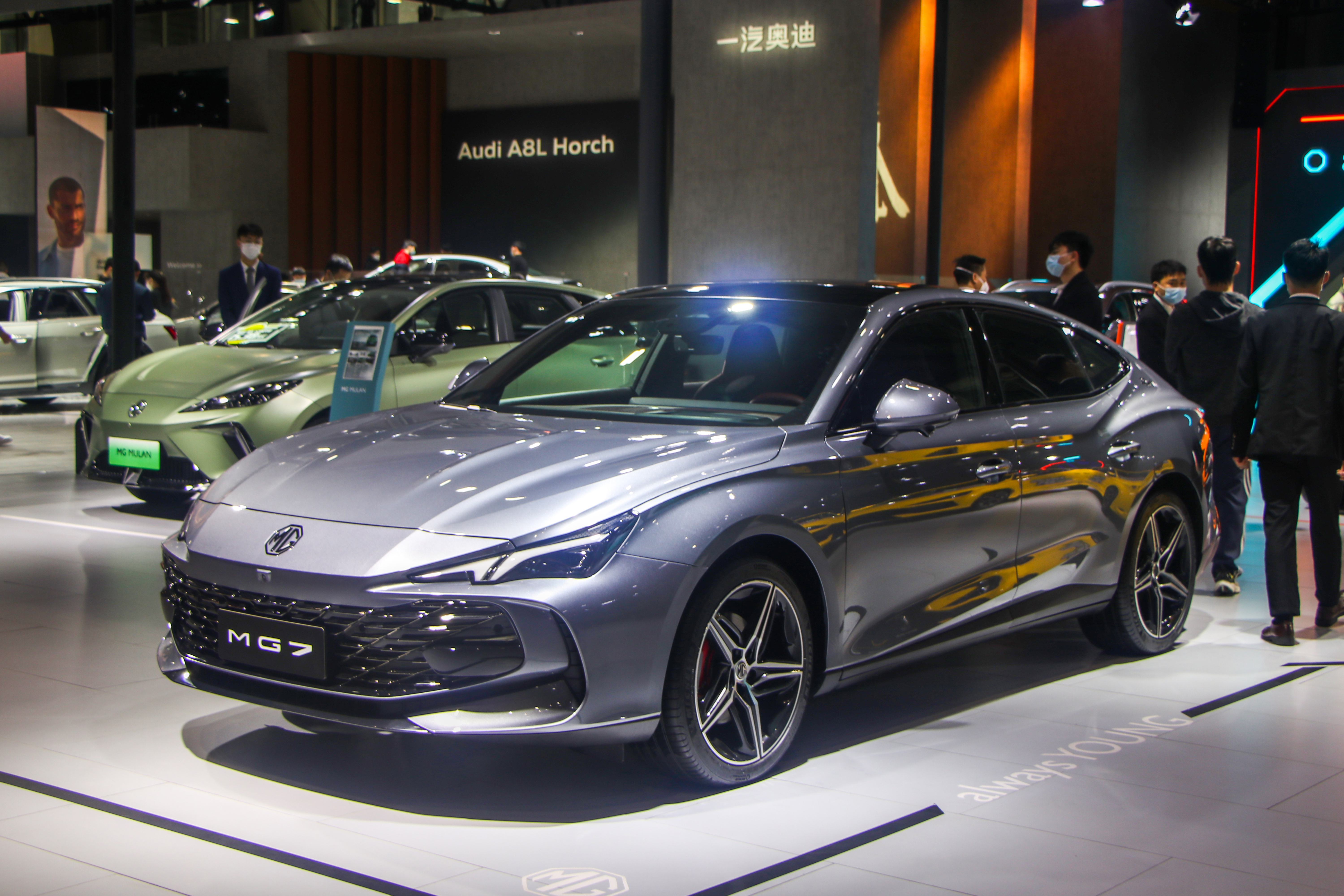
The MG4 is an electric car from MG. The podcast says it’s expected to be available in Ireland, and it also mentions an MG4 Urban version. That means there may be different versions of the same electric model depending on the market and features.
The 5 E-Tech Electric is a small electric car. The podcast is talking about how far it’s expected to go on a real-world charge and how it compares in size to a well-known small car. The goal is to show whether it’s practical for everyday driving.
MG Cyber is a concept SUV that’s meant to be big and performance-oriented. They’re describing it as a long-range electric cruiser, with a range over 550 kilometers.
The DS number seven is a DS SUV that DS is using as an important new model. It’s offered as a fully electric car, and it also comes with a mild-hybrid version.
“C segment” is a European way of grouping cars by size. A C-segment SUV is a compact crossover—bigger than the smallest class, but not a full mid-size SUV.
A mild hybrid is a car that has a small electric assist system. It helps the engine and can recover energy when slowing down, but it usually isn’t meant to run like a full electric car.
Term
premium EV buyer
A “premium EV buyer” means someone shopping for a nicer, higher-end electric car. They usually care about more than just range—things like comfort, tech, and overall refinement.
The DS 7 is a premium SUV. The podcast says people who bought it liked its design and the way it feels in terms of quality. It’s being mentioned as part of a discussion about what customers value.
“CSUV segment” means the market category for compact SUVs. They’re saying their car fits that size class but aims to feel more premium and offer more for the money.
“DSUV segment” is a bigger-SUV size category than CSUV. The speaker says their car sits between the two so it feels roomy without going all the way to the larger class.
“Fully electrified future” means moving toward electric cars instead of gas engines. The speaker is saying DS’s design/naming will evolve to match that shift.
Term
ice to bevy
“ICE” means gas or diesel cars. “Bevy” here means battery-electric cars, so “ice to bevy” is the move from driving gas to driving electric.
“740 kilometers” is the claimed distance the electric car can drive on a charge. The speaker is saying that, based on their range, it should still work for normal highway trips.
They mention a local speed limit of 120 km/h to explain that driving conditions help the car achieve its claimed range. Slower speeds generally make electric range last longer.
Term
aerodynamic team
The aerodynamic team is the group that focuses on how air moves around the car. Their goal is to make the car “cut through” the air more efficiently so it needs less energy.
The drag coefficient is a number that describes how much the air “pushes back” against the car as it moves. Lower drag usually means the car uses less energy and can travel farther on the same battery.
Term
CX
“CX” is a shorthand number that relates to how slippery the car is through the air. Lower CX/Cd usually helps the car use less energy and go farther.
The Honda Element is a compact SUV-style vehicle with a simple, box-like shape. It’s known for being practical inside, with space that’s easy to use. The podcast mentions design features on top of the vehicle that relate to how air moves around it.
The Lucid Air is an electric car (a sedan) that runs on batteries instead of gasoline. The podcast is talking about how the car’s shape and airflow features are designed to make it more efficient. That efficiency can help the car go farther on a charge.
The Ford F-150 Lightning is an electric pickup truck. The podcast is talking about the way it looks—especially the lighting design at the front and back. It’s an EV version of a popular truck model.
The STLA medium platform is the shared “car building system” from Stellantis that different models can use. It helps them design EVs efficiently while still making each model look and feel like its own brand.
DS number seven is an upcoming electric SUV from DS Automobiles. In this segment, they’re saying the car’s shape and design are meant to help it go farther on a charge, especially for longer trips.
Charging infrastructure is the set of charging stations available for EV drivers. If there are good stations along your route, you can charge faster and spend less time waiting.
Car
BMW iX2
The BMW iX2 is an electric SUV from BMW. They bring it up because they compared charging stops and real-world range against the DS No.7.
The Audi Q4 e-tron is an electric SUV from Audi. They mention it because they compared how many charging stops it takes versus the DS No.7 on the same kind of real trip.
Paris to Montpellier is a real road trip route in France. They’re using it as an example to show how far the EV can go and how many charging stops it needs.
The Audi e-tron is an electric SUV made by Audi. It’s the kind of car people compare with other electric SUVs to see which one fits their needs best. The podcast is talking about what happened when it was put side-by-side with other models.
Term
real world example
They’re talking about results from real driving, not just test numbers on paper. The goal is to show what you can expect when you actually own and drive the car.
This is DS’s new flagship EV, the DS number seven. The point they’re making is that it’s meant to go a certain distance in real life, and the inside is designed to feel premium—not just to look high-tech.
Term
3D i5 focal
They’re describing an advanced sound system meant to make music feel more immersive. Instead of just playing through speakers like normal, it’s designed to create a more “surround” feeling.
“4D sound” means the car doesn’t just play music—you can feel it too. They’re working on seat vibration so the sound becomes more physical, like you’re inside the music.
This is special car window glass designed to keep outside noise from getting into the cabin. If it’s used in the rear too, passengers should hear less road and wind noise.
“DS night vision” is a system that helps you see better at night. It uses sensors/technology to spot things like animals in the dark that you might not notice with normal headlights.
LIVE
Welcome back to the Nevo EV News podcast. If it's Tuesday, it must be Nevo EV Newsday.
On this week's episode, we are going to be unveiling two embargoed cars, the DS number seven.
I was in France the end of last week. For those of you who are following me on social media, you
can see in static, when I was filming the car, it was 47 degrees. And so we get a chance to speak
with Audrey and if you would hear from DS Automobiles, all about the DS number seven and the
DS brand in general. At Goodwoods last week, we were unfortunately not able to attend
with a nice invite from MG, but we had the MG Go and the MG Cyber concepts. And then to wrap up,
we also have an embargo lifted. If you're listening to this first thing in the morning last night,
the Jeep Compass 4XE, which is their all wheel drive variant. And we'll be able to chat to the
head of design for Jeep, Danielle. And so stay tuned for that. For those who don't know, my name
is Derek Riley. And on this podcast, we chat about all things electric vehicles. Nevo is Ireland's
home of electric motoring and we'll be covering where we were this week, what we've been driving
and what we've been doing between the podcasts. If you haven't already subscribed or followed us
wherever you're listening to this, please do so. And if you enjoyed the episode, please leave us
a rating and a comment. It really helps us out and it doesn't cost you anything. So let's get stuck
into the Jeep Compass first, actually. And the all wheel drive version, the link will be in the
description for the video. And I had probably one of the best press trips regards to they had a
off ground off, what do they call the playground for the to showcase the all wheel drive. So
go and have a look at the video. It's amazing what they have done with the system. And Jeep
are known for their all wheel drive and their four by four credentials. And they wanted to make
sure that when they did go fully electric that it wasn't going to be lacking in that department.
And by golly, that is not that as the case. And some other interesting things that they've done
with it is they have to manage that traction. They have the old logic was torque split.
And just to explain that you got to calculate a torque value was sent to eat axle. And if the
surface cannot accept it, the wheel spins, and then the system reacts after the grip is lost.
So what the new Forex eLogic is, it's a slip target control. And so if the wheel slips, the wheel
speed is above the vehicle speed, what happens is it senses if there's a slip, it sets the new
front and rear threshold in real time, and it acts afterwards then as well. So it picks up
what the road condition is plus the speed plus the drive mode. And then it understands what you
are. And so if you're in sport mode, how you want to done if you're in snow,
modern ice, modern sand, sorry, the front and rear slip threshold are set in real time with
and then the torque is delivered based on the available grip nut. The grip is then lost with
the torque spits out of things. So really, it's about predicting the high deliverable torque and
intervene full traction loss peak grip is guaranteed but without with maximum traction.
And so it's all about being a smarter four by four system. So very good to see that.
What are you getting with the 4XE? So we've already had the International Press Drive in
Barcelona. We were at the Irish launch in Slane a couple of weeks ago. And so with the 4XE,
you're getting an EV range of 606 kilometers, a torque on the front axle of 245 Newton meters,
a torque on the rear axle of 200, sorry, 345 on the front axle, 232 on the rear axle, but then
there's a reducer, 14 to 1 reducer. And so the rear wheel torque is actually 1,300, sorry,
3,100 Newton meters and an overall horsepower of 375 equivalent. So very powerful, has all the
bells and whistles, does exactly what it should. Very impressed with it. Go and have a look at
the video, but let's jump into the interview with Danielle now about the design and recent award
winning brand as well. So let's have a chat with him. I'm Daniele Calonaci, Jeep Design Director
for Jeep Europe. Thank you for joining me today in this beautiful location. First of all, congratulations
on winning the 2026 Car Design Award for Brand Design Language. The jury praised the way the
team reinterprets iconic design cues without diluting them. How did you approach the balance
of honoring Jeep 85 year heritage while introducing hypermodern updates to the 2026 Avenger and the
new Compass? Yes, exactly. It's the presentation we gave yesterday and we are giving in these days.
The idea is to stay connected with the history of our brand that has a huge history of 85 years
and trying to transform the Jeep value, not trying, but actually transforming the Jeep
values in design pillars, but always trying to push the history as a sort of baggage for our
jump in the future. So this is the main concept. The idea is to work around for design and content
pillars that are the most important is the capabilities you can imagine. Everything started
for the 4x4, the right geometry of the vehicle to face difficult roads. Then we have protection
that is really important as you can imagine when you drive in the off-road, but not only
because sometimes protection is useful in the city, parking for example. Italian drivers are known for
their... Exactly, not only Italian, but for sure Italian are one of the most famous for this topic
and versatility that for sure it's important to have the versatile interior, openable roof,
different type of lineup from between front wheel driver 4x4 and then which is the other one.
It's been a long day. Storage again is really connected with the history of Jeep. So the boxiness
of our volume is important because everything starts from the exterior. If you are boxy you are
able then to dig the interior with the design and to give a lot of storage. I think one of the most
important example is how we pushed the frontal storage of the new compass that is 34 liters in
comparison with the old one that was only 14 liters. It's crazy to see that and it's not a huge
difference in dimensions of the car, but it's how you're able to extract and you to dig out
that extra space internally in the cabin. Again, taking inspiration from the history, if you
were thinking about the IP of the TJ, the YJ that was the Wrangler of the 90s, they were negative.
For different reasons. So we took this inspiration to give this negative section to implement the
storage of the IP. So again, it's always a go on and backward with the history and how to push the
history for future need. You've frequently spoken about the guiding principle designed to function
when translating this philosophy into an electrified vehicle such as the Avenger EV or the Compass 4xE.
What are the primary challenges in ensuring that form fitting aerodynamics in the EV world
doesn't compromise the boxy rugged capability customers expect from Jeep?
Yes, it's not a difficult but complex balance that we have to manage between aerodynamics,
capability and so on. Let's start step by step. I think the electrification in the off-road world
is very welcomed. As you know, when you are in the off-road, what you need is torque and torque
on demand. I think this is the best work that an electric engine can do. So having and transforming
also the 4xE lineup with the 4xE having an electric motor on the rear will give us the
response that our customer needs to manage the vehicle in the off-road. Not only we are trying
to simplify this tractor because with an electric engine or motor on the rear, we are able to eliminate
some extra structure. You need in general transfer case, prop shaft, but that prop shaft sometimes
is inclined and has some negative effect on the ground clearance. So the electrification will
be a big help for the 4x4, for the traction and for the capability. But as you told, electrification
means sometimes for our customer, let me say, to be scared about the range. So 50 years ago,
we didn't think to make or we wouldn't think to make aerodynamic Jeep. Right now, it's really
important also to work on the aerodynamic. And as you know, on the Compass, we reached the 0.29cx
that is quite impressive for this type of vehicles to give the best range. And actually, the best
range is also nice for, let me say, hybrid vehicles. So if you can, let me say, save some gasoline,
that will be better for everyone. Very good. The updated Jeep Avenger, just to focus on that
while we're here. The 2026 Avenger update introduces some striking illuminated 7-grille
slush on select trims. Can you walk us through the design process behind lighting up such an
iconic brand signature? It's not about sticking a bulb behind every one of the seven panels,
and how you ensured it still felt authentically Jeep rather than just a modern EV gimmick.
Yes. And actually, we have a big trend in the automotive world in which you are going to
add the stripes and then you did the modern. Exactly. Everyone is making light bar. So the
idea was to make something discontinued. And we had this simple idea. Maybe we can make them
discontinued and divided by seven and we'll have the sevens a lot visible during the night. So
sometimes the most easy solutions are the best ones. So that was the choice between these.
You will see the recon in a few months that have the same approach, but with a different way.
But always discontinuing the light in the front of the vehicle. We got to see recon and the videos
up on the YouTube channel in Barcelona at the Jeep Compass launch. It had just come from the LA
Motor Show. And as you said, it's a slightly different reinterpretation. I think it's
indirect light and it's kind of a halo effect. So beautiful reinterpretation. And it's so iconic
on the road. That's seven slots. And at nighttime for people to say that's a Jeep. And you know
what? I think I always think that the sevens lot to wear and it is still a functional topic.
On the history, the idea was to cool down the engine because the radiator were high like one
meter now on the wheelie. So maybe we call that we did in the fifties. But right now the idea was
to maintain the sevens lot and also try to transform as we did on the beginning with the Jeep design
language to transform the functionality. So sevens lot now are working for lighting rather
positioning, camera positioning. So the idea is to maintain them functionality functional,
but with a different function that is connected with the modern time.
And those seven segments are being brought through the likes of the select train button.
There are seven elements in that as well. So there's a nice Easter eggs around the car as
well for people to try and find. Yes, you know, Easter eggs is also connected with the history
of Jeep. We used to make these things since more than 30 years. So the first one was introduced
on the Wrangler JK that was a small Wrangler on the on the serigraphy. But right now we decided
also to push more on the more human side of our design studio. So some of them are connected
exactly with the life of our designers. And it's really nice for me because this is probably the
fifth pillar of Jeep fun and fun is connected will always connected with the with the Jeep life.
I think what Avenger was at the telescope and one of the designers was as bring it when maybe it
was you bringing the and it was on the windscreen somewhere. Yeah, the telescope was in the Avenger.
Yes, in the left corner of the Avenger is exactly the profile of my son. At that time,
we were designing the car when he was two years old. So I would I dedicated this vehicle as my
first Jeep vehicle to my son. And right now, actually, I had to say we changed this.
But he's always him. Yes, three years later. Nice. The updated Avenger places a massive
premium on everyday resilience featuring encased lighting signatures, anti scratch materials
on the Jeep shield. As a designer, how do you balance aesthetic material quality inside the
cabin with a heavy duty washable impact resistant materials required on the exterior or the seat
backs etc. I think this is a request that we do from the very beginning. It's important to have
the beginning to really manage the timing also of evaluation of the material for production,
because you know, to evaluate and to let me say sign the material for exterior interior,
we need the long process. So you have to make many tests and so on. So I think again, we need
always to have a straight vision from the very beginning to understand where we want to act
on the vehicles. For example, the Jeep shield, the right material on the interior that has to be
washable and durable and so on. And if we start at the beginning of the project, we're able after
three or two years enough to have this in production. So I think everything comes from this
design vision that we just presented this year, but was also, let me say the topic that
makes us a winner of the designing world this year. Because it's authentic. Yes, authentic and
to really know which is your story and how to interpret this to bring it into the future.
And so you're not designing a car and then thinking about that durability after the fact,
you're thinking about durability from day one. Exactly, exactly. So everything starts together.
Last question on the Avenger. It's an incredibly popular car in Europe,
which shares the Solantis Foundation with several sister brands. How does your design team work
structurally to ensure that the vehicle retains a completely distinct high-riding driving position
and classic Jeep proportions given those shared platform dimensions? We did on the Avenger,
we did a huge work from the beginning with the engineering. So we really shortened the rear
and the front overhang of 40 mils on the front and I think 60 on the rear. Now I don't remember
exactly all the numbers. We straightened the roof to have more headroom and not only we changed the
glass barrel. So the glass barrel in comparison with all the sister of the Avenger is more straight,
not only. To give the right, let me say shape of a Jeep, we moved down the hood hinges. So we
changed completely the position of the hood hinges and also the door hinges. So moving inside and to
give this pop-out fender. Not only we improved all the PP points, let me say the perimeter of the
rear door to give a better entrance and egress. So we really changed many things on the platform,
but usually it's not really easy to change, but we worked on this also on the bigger overall
diameter as possible, raising the ground clearance. So we did so many things that makes the car,
from my point of view, perfect in terms of proportion also, not only in usability.
Going on to the Jeep Compass and specifically here to drive the 4XE and I'm about to go out
on the playground, which I'm looking forward to. The 2026 Compass boasts a significant step up in
interior utility. You talked about the 34-litre front storage compartment and the 550-litre boot,
which is very important to families. From a packaging standpoint, how do you transition
from a multi-energy platform to allow you to free up as much cabin and cargo space
compared to the outgoing generation, which was ice only?
Sorry, I didn't get very well there the last...
So the original generation was only an engine, so you were working around those restraints,
whereas now it's multi-fuel, you have to think about engine, battery, hybrid, etc., etc.
The design needs to think about all of those options and make it look the same no matter
what the platform is. Yes, in general, but sometimes it depends if the platform is smart enough.
And I think with the Avenger and also with the Compass, we were pretty lucky because we don't
have huge difference between multi-energy, BFV, and that's hybrid and NBV. On the Avenger,
the battery pack are in between the belly of the vehicle and the seats, so not change at all
between BFV and hybrid and thermic and on the Compass as well. We don't have a huge impact,
a little bit on the trunk with the 4x4, but actually it's the same car.
Yes, we changed the air intake, so for sure. So the bumper in the Compass is modular,
it's not only three pieces, but the lower fascia is other three pieces. So we can really
approach the different air intake and also the possibility to have the air grid shutter or not
because maybe you have the air grid shutter in the PHEV or not in the other one,
and for sure we didn't have the air grid shutter on the 4x4 because it should be
an expensive thing that maybe you can break in the offroad. So again modularity for us is
super important to approach the different say engine or lineup. Very good. On the exterior of
the new Compass, the vehicle radar and active driver safety tech are explicitly positioned
high to avoid damage during tight offroad maneuvers and minor urban impacts.
How closely does the styling team have to collaborate with engineering to integrate
these sensors into a rugged body cloud? Usually, because that was requested, probably started
from the design point of view, then we influenced the product planning and then product planning
was able to push with engineering because all the sister car has the radar and the camera in the
lower part, so you can break them, especially if you use in the offroad, but also in the city.
So the first request was again, let's give a functionality to the seven slot, not only lighting,
put the radar, put the camera. So let's honor, let me say, the functionality of the seven slot in a
modern way. So we spent a lot of money because you had to recalibrate all the others, but I think
this is the best thing you can do for the Jeep customer. Again, not only for the offroad,
if you are parking this car in the city, anything will break the radar, anything will break the
camera. And I think this is the right move for a technical vehicle as Jeep. Very good.
You're really thinking about offroad and on-road and not just the driver, but also other drivers.
Exactly, because sometimes now we talk a lot about freedom. Sometimes I think I live in Italy,
so someone can drive roughly, as you said at the very beginning, but also when they park.
You cannot let me say trust everyone when they are parked close to your car, so if your expensive
thing are recessed, protected and so on, someone can park in front of your bumper without breaking
nothing. And sometimes with the new trend, they see a lot of lighting in the corner of the bumper
that in my opinion are absolutely useless. I imagine on a Jeep, something like that. So
the design to function for us is primarily. Very good. The 4XE features a staggering 3,100
Nm of torque available at the rear wheels via the electric reducer. How does a vehicle
hidden mechanical and electrical capability influence its stance? Wheel arch design, overall
presence on the road. But from the suspension point of view, as I told before, we didn't
have problems in terms of stance. I think the behavior of the suspension of the different
model is actually the same, also the wheel position. So again, also the body was designed
one time for all the engines and the models, so we didn't have any problems. Brilliant.
Last two questions. Jeep is rolling out 85, 85th anniversary editions. We've got the Avenger,
we're looking at it across the driveway here. What specific historical Easter eggs or design
nods can enthusiasts look forward to finding on these models? Yes, we don't have actually Easter eggs,
but the main theme of the 85th anniversary was 85 years of outdoor. So we started this idea
from North America and in the Vrangre will be introduced the tartan effect that is very close
to the culture of the American for the outdoor, because this is, let me say, the texture and the
color that you have in your plaid when you're making a picnic. So this is 85 years of outdoor.
Then we interpret it from a European point of view in a little bit less visible, but a little
bit more elegant, let me say, approach. So the tartan is shiny black on matte black, but it's
still visible on seats and also on the hood sticker. Very good. So again, the interpretation of the
life that we used to live and we like to live outdoor, interpreted by the tartan in a little
bit more elegant way. Very nice. Last question. With your product portfolio now ranging from
compact urban EVs like the Avenger, all the way up to large plug-in hybrids and full electric,
what's the single most design element that must always remain consistent across the line
up to ensure the vehicle is instantly recognizable as the Jeep? I think I know the answer to this,
but probably you think about the seven slot. That's not the answer, Derek.
In fact, in the presentation yesterday, I don't talk about the seven slot because I think we can
recognize Jeep, but a million of other, let's say, details. Being also a passionate and a
collector, so I have two Jeeps, I'm not a big collector, but I'm very passionate on the history
of Jeep, so I'm a geek of Jeep. I would like to explain the Jeep as, let me say, an abstract
painter would like to explain his painting to someone. If you don't know the history, maybe you
can say, I like or I don't like. Stop. But if you know the history of the painter and how he did
this paint, you will be attracted by the million of details that are connected with the history.
So yes, seven slot is important, but boxing is protection, cladding, trapezoidal will arch,
dig the interior, right material in the right place, toe hooks. I think we have one hour that
we talk about many things that are based on Jeep history. Excellent. Thank you so much for your
time. Thank you to you. Thanks to Danielle. And thanks to Orla in Jeep Ireland for arranging that
interview with us. Next up then, we had the MG Go and the MG Cyber concepts at Goodwood last week.
And so both concepts and both, no, you couldn't open the doors. There were both
blacked out interiors or no interiors at all. And so what it looks like, a lot of people were
saying that the MG Go, which is going to be the precursor for the MG2. So we have the MG3,
which is a hybrid, we have the MG4, which is our daily driver currently. And the updated version
of the MG4 is coming to the UK, still to be confirmed whether it's going to come to Ireland.
And then we have MG4 Urban, which has a couple of videos up on the channel. But the MG Go concept
is going to be a preview of their future B-segment electric city car hatchback,
four meters long, and it's going to rival the likes of the Renault 5,
size real world expected range likely to land between 300 and 400 kilometers on a single charge.
And then the Cyber concept is a large D-segment high performance flagship SUV,
five meters long, it's going to be over 550 kilometers range, long distance cruiser.
So looking forward to seeing what more of these like very little information about them. But
the Cyber, a lot of people are saying, you know, very similar to Ferrari style. And then the MG
Go is very similar to Renault 5 slash electric mini, etc, etc. So lots of good stuff out there from
MG. And as always, they do a product would show at Goodwood. So I'm sorry, I missed it,
but I was at the DS event. And speaking of DS, we are the Irish, the embargo lifted on Friday.
And so we have the DS number seven, an important car to DS because the seven,
the original DS seven would have been their bestseller, that segment that C slash D segment SUV,
it is very important, the C segment in general is very important and then C SUV is very important.
When they surveyed there, I won't spoil the interview, but we talk about who the target
market is and why they go first. WLTP range, 740 kilometers, they are a pains to stress that
highway speeds in France, which is 130 kilometers an hour, 400 to 480. Technology, comfort,
refinement, the seven was 50% of DS sales altogether. So the number seven, so they've
changed the naming convention. We now have a number four, we now have a number seven, we
are now have a number eight. Listen back to the podcast where we chatted to the head of design
for DS and the number eight launch last year in Switzerland, a really good podcast as well. But
let's jump into chatting to, we don't have Irish prices on the DS seven yet, by the way,
that will be coming towards the end of this year. This will be coming to Ireland
end of this year. It'll be a 271 car and it comes in full electric and also a
M health mild hybrid as well. So let's jump into the conversation with Audrey from DS.
Audrey Amar, product director for the DS brand. Audrey, I was just saying to you,
this is the last day of three weeks of showing people around the all new DS number seven.
As we said, it's the end of a chapter because now you're moving on to the next project.
How do you feel about the press launch overall? I was super happy about this press launch because
for the moment, the feedback is very good. I say for the moment because now I'm waiting for the
press. Because you know, usually journalists are polite. So when they feedback to me,
sometimes they are sweet. Moving into the DS brand, DS automobiles has always been positioned
itself as an embodiment of French luxury. As product director, how do you balance traditional
French craftsmanship with the hyper modern tech requirements of today's premium EV buyer?
If I may, we are positioned also not like a luxury brand, but like a premium one. It's important.
We are the only French premium brand. Very good. And after the balance is natural because
from the beginning in our pillars, we always had technology, comfort and refinement. So we are used
to mix these different elements coming from our rooted and the craftsmanship, but also
increasing the technology to help the customers having a nice and quiet drive when they drive the
DS car. And when we looked at the different customer breakdown yesterday in your presentation,
when people bought DS7, it was design, it was a quality feel. And you said when you were designing
number seven, we had to have those elements as well. Yes, for sure. Because the DS7 was our
best seller, 200 sold in sales. And so we kept the great ingredients that we used to create the
DS7 to create the number seven. And it's falling between two different segments, between C segment
and D segment. It's really the sweet spot. And when you on the screen, you have the different
models that you're going to be competing against, you could see where it is longer, bigger offering
again that more premium feel versus some other brands that may be charging a bit more for this
as well. Yes, it was important for us because it's about the ratio between the roominess,
the performances, which is, as you said, between the CSUV segment and the DSUV segment. That
means that we offer more to the customers, but for fair price, yes, good value, a good value
exactly in the CSUV segment. With the transition towards fully electrified future, how does the
number naming convention and design language represent a clean break or natural evolution
for new generations of DS? For me, it's both. Because in terms of design and product, we are
talking about evolution, because as I said, we kept our pillars and historical pillars.
But I think that for the customers to go from ice to bevy, it's a break in terms of use ages.
And thanks to this range of 740 kilometers, that mean more than 400 kilometers on a highway,
we try not to create that break, to let our customer keep the habit that they have when
they drive, when they have a travel. It's interesting in Ireland, we have a maximum
speed of 120 kilometers. So even longer than 400 kilometers. I don't think we have 400 kilometers
of motorway in Ireland. So we're good, okay. The initial reveals of the DS number seven
showcased a striking, highly aerodynamic silhouette. Can you walk me through the design
for this vehicle? How closely did the product team work with the aerodynamics team
to ensure efficiency like we just talked about? We worked a lot with the aerodynamic team,
because our target was to have the best range possible. We have a CX, so the drag coefficient
of zero to 29, which is best in class for this kind of shape, because it's an SUV.
And so we worked on the roof, we worked on a specific element with blades. If you look at
the lightning signature in the front and in the rear, you have blades that cut the air and very soft
and smooth lateral side to let the flow of the air and that are elements that increase
the efficiency of the car. And if you compare to other or the top hat from Stellantis based
on the same platform, we improved by 50 kilometers the range. Thanks to all these design elements.
Audrey can't see my next question, but my next question is about the STLA medium platform.
And you utilize the same as your sister brands across, but it's interesting to hear that
you've achieved an extra 50 kilometers there, but this is down to the design team and the
aero team. It's phenomenal too. It still has to look like a DS and see what people want to want
it as well. Yes, as you said, we worked a lot and it's still a M, but very designed to be
as an electric car. Very good. Premium buyers expect seamless long distance touring with the
battery tech packed into the DS number seven. What's the real world range targets and how are
you charging infrastructure optimized to minimize downtime on the road trip? I wrote this question
before we had the presentation last night and your colleagues showed Paris Montpellier and
you put up against the Audi Q4 e-tron and the BMW iX2. You can tell me about what happened next.
Yes, in fact, we decided to have this this trip and to show it in video, not to say that the
other one are not good, but to say yes, we are good. And that means Paris to Montpellier,
it's 750 kilometers and we are able to do this trip with only one stop and the other one are not
able to do that. They had two stops. Yes, they had two stops. But this is real world examples
because your colleague talked about on a spreadsheet, you know you could do this also,
but to actually do it on the same day, the same speeds, three drivers together,
it was great to see that real world example so that people can really understand that if I buy
a DS number seven, it will do this range and I will only have to stop the ones. Moving to the
interior, Audrey, the DS family is famous for details like the watch strap leather and the
clothed Paris embossing. Yes, my friend is not very good. How have you integrated next generation
digital interfaces and screens into the number seven without losing that tactile bespoke feel?
We are not, to be honest, we are more found about great material, natural material,
leather and all the material based on the craftsmanship and the refinement than on technology
and addition of technology for nothing. When we put a display, it's because it's helpful for
the driver and the co-driver, not just to show technology but an useful technology. So it's
better for us to keep the right balance between technology and real material because in terms of
emotional experience, it's important for us to keep that. And that traditional craftsmanship
French, predominantly. We saw some of the new technology regard to a wood laminate on your
speakers, on the front of the speakers. I remember from number S, you had some beautiful
marketry on some of the trims as well. But I think as you say, people like to touch and feel
exactly. They won't remember the screen and how big it was. They remember the quality of the
steering wheel or the seats. Exactly. It's a question of sensation. You talked about touch,
but here it's important too. And it's the reason why we have this 3D i5 focal. And for the next
generation, we are going also to create more emotional comfort. Just an example we are working
on. When you are in the concert and you hear music, you feel the music in your body because you
feel some vibration. And we are working on some innovation to feel that vibration in the seat,
to have a kind of 4D sound. And this is more that kind of technology that we are looking for
than just have additional display in the cockpit. We talked about this number of different senses
and one of them as well was about the sense of silence and sound. And you're one of the only
C SUVs that has noise insulated glass in the rear for the passengers as well. So
you've really thought about offering top level luxury and premium feel in this segment. Yes,
yes, because the silence is super important. It's an important part of the comfort. And especially
when you are in the BV car, because in the I1 you hear the engine. And so you don't notice
the other kind of sound that you could have external or internal. When it's a BV car,
there is no noise from the engine. And so it was super important for us to very work on this silence
inside the inside the car. And going back to technology, I was last night, the French Morocco
match was on in the World Cup in France one, but I was lucky enough to go for a nighttime drive
to see the quality of the headlights, but also the DS night vision, which is a unique selling point
for DS. I was able to drive along the road and I had a good Anthony is sitting beside me here,
a very large rabbit. He was pretending to be in the nighttime. So I couldn't see him,
but the night vision could see him with that. And so this is an interesting feature that
your colleague was saying 20% of people in DS seven, but now you're going to roll it out in
the techno pack for DS number seven as an inclusion. Interesting safety feature and
interesting technology to offer. I'm surprised that other brands don't offer this also.
I don't know why really, because yes, 20% of customers decided to pay in DS seven to have this
feature. Because you're right, it's very, it's for it's for your safety and for the safety
of the other one around you. And so for us, it was important to keep it and to improve it
and to take care of everyone. The last couple of questions, Audrey. You talked
last night about the size of the C segment in Europe is very important. C SUV is also important
and B2B is also important. So who is your target audience for DS number seven across Europe?
Because different markets have different targets, but generally, is it an executive in a business?
Is what you said 64% of the customers are coming from the B2B. So this is naturally more a B2B car.
In terms of customers, we are waiting more or less the same customer that the one that we had on the
DS seven. And especially because it's always easier to play with the loyalty of the customer
than with the conquest. Yes, it's easier to hold on to them rather than trying to get them.
Yes, especially if they are satisfied by the car. And it's what we discussed yesterday. They said
that the car, the DS seven was comfortable with a high level of quality and a great design. And
so when you have a happy customers, for sure, you will go to the new product if
answer the expectations. We were talking last night at dinner about the influx of new brands
from other countries from outside of Europe. I think DS because of its history now and being
around over 10 years, people recognize that it's European, that craftsmanship. It also is very proud
to be produced in France and in Italy and a lot of the European manufacturers. Do you think that's
going to help with keeping those customers loyal and so that you're going to retain that because
those Chinese brands don't have that premium reputation yet? For the moment. And it's important
to say for the moment, why? Because you're right. For the moment, for the moment, they are not premium.
So we have a step away from them. But we for sure be careful of what is coming. And we are looking
at and we benchmark what is coming because we need to be sure that we will keep this advantage.
You're competitive. Last question. We have number four, number seven, number eight. Outside in the
car park here, we have DS three. Do I need to be looking to the future to see what's next for DS
or what's happening down the road that you can speak about? I won't speak about, but I will give
you a rendezvous during the Paris Motor Show. Okay, in October. I will be there, Audrey, Antony,
and Quiva. We will see you everywhere there. Thank you so much for your time. Thank you.
Thanks to Quiva in DS Ireland for arranging that interview. I really appreciate it getting access to
these top level European executives within these motor brands. And to get their insights,
to get their understanding and to bring it to the Nevo EV news audience, hopefully you do
appreciate it too. If you do appreciate it, make sure you've left us a rating and drop us a comment.
And I look forward to chatting to you next week.
About this episode
The Nevo EV News Podcast tees up the DS No.7 reveal with a look at its range and aero claims, then pivots to Jeep’s 4XE and Compass 4XE traction logic. Hosts and guests unpack how slip-target control manages wheel spin, why electrification helps off-road torque on demand, and how Jeep’s design language ties into sensors, storage, and durability. The DS interview also covers “number seven” continuity, immersive cabin tech, and night-vision packaging, plus real-world Paris-to-Montpellier results.
Welcome back to the Nevo EV News Podcast. If it's Tuesday it must be Nevo EV News Day. My name is Derek Reilly and on this podcast we chat all about EV. Nevo is Ireland's home of electric motoring and we'll be covering where we were this week, what we've been driving and what we've been doing between podcasts. If you haven't already subscribed or followed us wherever you are listening please do so and if you enjoyed the episode, please leave a rating and comment, it really helps us out and it doesn't cost you anything. Let's get stuck in.
DS No.7 Launch and Interview with Audrey Amar, Product Director with DS Automobiles
Jeep 4XE Launch and Interview with Daniele Calonaci, Head of Jeep Europe Design