The Hyundai Genesis is a fancy car that used to be called just Genesis. It's designed to be comfortable and has lots of nice features, making it a good option for people looking for a luxury vehicle.
ADAS is a set of technologies in cars that help drivers stay safe and make driving easier. It includes things like systems that can help you stay in your lane or slow down if you get too close to another car.
Autonomous driving means cars can drive themselves without needing a person to control them. They use special technology to see and understand their surroundings.
RoboTaxi is a type of taxi that can drive itself without a human driver. It's part of the trend toward self-driving cars that can pick you up and take you to your destination automatically.
FSD means Full Self-Driving, which is a feature in Tesla cars that lets them drive themselves in some situations. However, the driver still needs to pay attention and be ready to take control if needed.
Tesla Full Self-Driving is a technology that allows Tesla cars to drive themselves in some situations. It helps keep the car in its lane and can even stop at traffic lights.
Super Cruise is a technology that lets you drive without using your hands on the steering wheel, as long as you're on specific highways. It helps with steering and speed control automatically.
Level four autonomy means that a car can drive itself without needing a driver in certain situations. It's a way to measure how advanced self-driving technology is, with level five being fully self-driving everywhere.
Launch mode is a special setting in some cars that helps them start really fast from a stop. It makes sure the car uses all its power to take off quickly.
WLTP is a testing method used to measure how far a car can go on a full charge or tank of fuel. It gives a better idea of real-world driving conditions.
Wheel options are the different types of wheels you can choose for a car. They can vary in size, like 20 or 22 inches, which affects how the car looks and performs.
The Tesla Model S is a fancy electric car that can go really fast and doesn't need gas. It's known for having a lot of cool technology inside and can drive for a long time on a single charge.
Custom color options mean that you can pick different colors for your car, not just the usual ones. This is especially liked in places like China where people want their cars to look unique.
CarPlay is a feature that lets you use your iPhone in your car. It shows your phone's apps on the car's screen, making it easier to use things like maps and music while driving.
An electrochromic roof is a special car roof that can change from clear to tinted with the push of a button. This helps keep the car cooler and more comfortable by blocking sunlight.
Inductive wireless charging lets you charge your electric car without plugging it in. It works by using magnets to send energy from a charging pad to your car's battery.
The Rivian R1S is a new electric SUV that can handle rough terrains and is built for outdoor adventures. It's designed to be spacious and can go off-road without using gas.
The Lucid Gravity is a new electric SUV that promises to be very luxurious and spacious. It's made by a company that focuses on high-end electric cars and is designed to be very powerful and comfortable.
The Genesis GV60 is a fancy electric SUV that has a lot of nice features and looks great. It's designed to be comfortable and high-tech, making it a good choice for those who want a luxury electric car.
The Porsche Taycan is a super-fast electric sports car that looks really cool and drives like a dream. It's made by Porsche, a brand known for making high-performance cars.
The Tesla Cybertruck is a new type of electric truck that looks very different from regular trucks. It's designed to be tough and can do a lot of things like carry heavy loads without using gas.
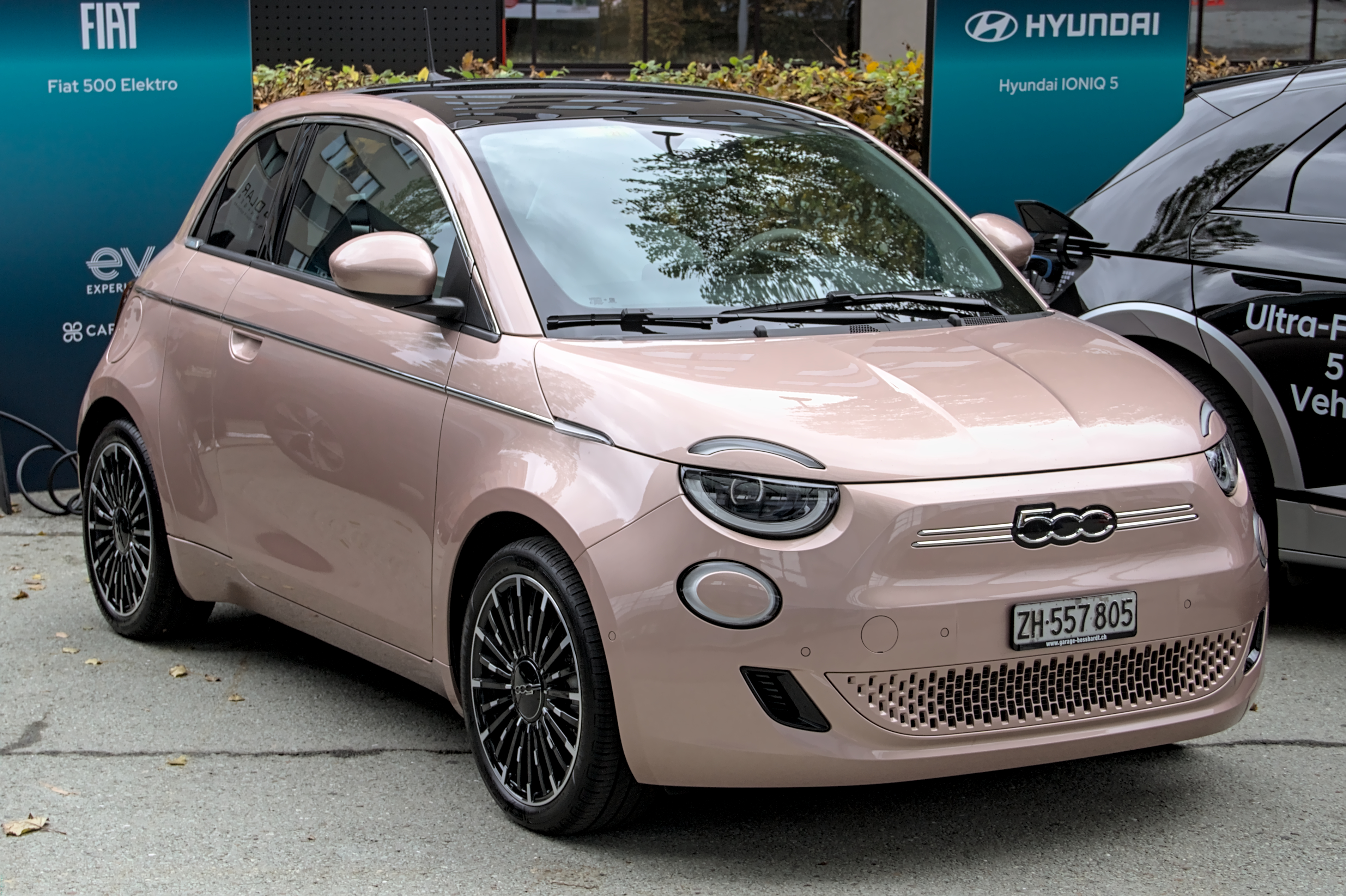
The Fiat 500e is a small electric car that's great for driving around the city. It doesn't use gas and is easy to park, making it a good choice for people who want a simple and eco-friendly car.
The Tesla Model 3 is a smaller and more affordable electric car compared to the Model S. It's popular because it can go far on a single charge and has lots of modern features.
LIVE
And we are live for a new episode of the Electric Podcast.
I am Fred Lambert, your host, and as usual, I'm joined by Wynch, how are you doing this week,
Seth?
I'm good.
All right.
We have a lot of things to talk about.
Let's get a quick overview before we jump into it.
We're going to start with some Tesla stuff as usual.
We are not that much to see news this week, so those that are getting bored of that
are going to be happy.
Three little news articles, mainly about the RoboTaxi and autonomous driving effort that
we're going to talk about.
Then we're going to talk about the competitor to that effort, which is Waymo, a big week
of announcement from Waymo here.
It's accelerating its expansion quite a bit.
Then now we checked out the Porsche Cayenne EV in all its details after you had like
a prototype review of that a few months ago, right?
That was Peter.
He was in Leipzig in Germany for that.
I helped him write it up.
Okay.
Then we have the Jeep Recon EV that was on sale this week, an off-road vehicle from
Stalentist.
Then we're going to talk a little bit about the Gravity Touring, which is a lower-hand
version of the Gravity that was just launched this week, so we have the pricing on that
and all the specs.
Then Genesis is coming up with his JV60 Magma.
It's a new performance, basically like an Ionic 5N, but with the Genesis twist to it.
Then he's staying with Hyundai Genesis.
We have a new off-road concept EV that was unveiled by them.
Then I'm going to end the show, I'll not end the show, but before we go to the Q&A
session, talk about the big article I've been working on all week and I just posted
this morning.
I'm glad I did because it was a little bit different for me.
It's kind of an op-ed about sort of a realization that I had when I was in China last week
about this new base layer of economy that I think is going to go through electricity
going forward.
I'm glad I did post it up because I've received, if I can say so myself, great
feedback on it.
A lot of people have opened up something in their mind about a new way of thinking
about this.
I'm glad we did.
We're going to discuss it a little bit on the podcast and we can get you guys' thoughts
on it too.
At the end, obviously, we do the Q&A, which I'm going to remind you of through this
show as more people join the live show.
Let's start with the Rebel Taxi.
One thing that's nice about, even though we said that the Rebel Taxi in Texas
is mostly about optics, it's Tesla trying to get a win.
We don't see a major improvement over the consumer version of FSD.
It's very much very similar.
It's just that the big difference is that Tesla moved the safety monitor from the driver's
seat to the passenger's seat and that we feel like it's purely for hop things because
for safety reasons, if you're going to have a safety monitor, it might as well
be in the driver's seat, more options to intervene quicker.
The only advantage that gives us is that by doing that, Tesla is moving officially from
the driver assistance system classification to the autonomous driving system classification.
And now we can have a slightly better idea of the accident rate of this specific system
because with the other system, the ADAS, this last thousands of accidents in there and they
are harder to track because this redacts a bunch of information on it, it is still redacted
for the Rebel Taxi ADAS crash that they have to report to NHTSA, but because there are
fewer of those and they are purely for Rebel Taxi in Austin, Texas, we were able
last month to have an actual pretty close estimate of the Rebel Taxi crash rate
because Tesla had shared the mileage which was 250,000 miles at the time and we had three
official crashes, was it three, July, July, yeah, three official crashes.
So that was adding up to, was it four at the time?
No, no, there was a fourth one that happened after that and when you divided the total
manage that it ended up to 62,000 miles between crashes, which we could compare with
Waymo system, which obviously is not a great comparison because Tesla still has the operator
inside the car with a finger or the kill switch.
So these guys do prevent a bunch of further crashes and we don't know how many.
So it's useful but not, you know, not perfect either.
But we had a big update this week.
So Tesla ended up reporting three more crashes, yeah, three more crashes for now a total
of seven crashes reported over the course of the last few months of operation in Austin.
We don't have an updated mileage on that.
I mean, we can summarize that Tesla is probably between two eighty three hundred
miles if we just divided the weeks of operation.
If we divide the 250 miles that they gave us last month by the weeks of operation
and then we add the few more weeks that happened since there.
So the crash rate is obviously increasing and decreasing, which is problematic.
Now, there's one thing that I want to emphasize on this is that.
Tesla is definitely not responsible for all these accidents.
It's clear.
And then in these three new ones that were reported, there's one that Tesla
does sound responsible, but again, based on the limited data that we have
because the it was between the passenger car that was backing up
and Tesla was moving straight, pressing straight.
So it looks like Tesla did run into a car that was backing up.
The other ones are with a cyclist where it mentioned that the pre-movement
was stopped, so maybe it's a bike that ran into the car.
I don't know. And then the same thing with an animal,
which sounds a little bit more weird like an animal just ran into the
a stop Tesla with taxi.
I don't know the thing we and why we don't know it's because of Tesla.
It's because of this section here.
If you're watching on the on the screen, I have all the crash reporting
data that Tesla released, the narrative, which explaining details,
what happened with the crash is redacted for Tesla.
All of the accident, they redacted that data.
Now, Tesla is the only automaker that does that.
All the other two makers have a clear narrative of what happened.
And for example, Waymo Waymo has way more crash than this.
Also has way more mileage and test obviously, but most of when most crashes,
you read the narrative, you look at the data that they released.
It's like, yeah, it looks like it's not the way most fall.
You know, some accidents are inevitable, especially if you're going
to drive tens of millions of miles, which is what Waymo is doing.
Now, with Tesla's issue here is that 300,000 miles is not that much.
300,000 miles normally human drivers have no accidents
or maybe one minor accident.
Tesla had seven with a supervisor preventing further accidents.
So there's definitely it's definitely not a good look for Tesla.
And the fact that they're redacting the narrative, they are the one
at fault where we cannot say they're not responsible because we don't even know.
So again, we would appreciate if Tesla was more open with transparency
and building confidence in the system by releasing more data,
but we don't see that for the maker at the same time this week.
Tesla was in was submitting its comment from the for the new autonomous
driving rules in California, along with Waymo and Uber.
And the three leader in the field right now are really not in agreement
about the new rules.
So Waymo was actually pushing California to force Tesla
if they're going to launch something called
RoboTaxi in the barrier as they did to report their disengagement
and intervention rate because they say like it's only fair.
And Tesla itself insists, hey, our RoboTaxi service is RoboTaxi only in name.
And it's actually a level to assist system just like FSD consumer vehicle.
And we're not we're not forced to report intervention
that certain in our consumer FSD vehicles.
So they're like, we don't want to do that.
Then Uber wanted to change a bit the rules on what you can call a RoboTaxi
and not what RoboTaxi to, you know, I like that a little bit
and Tesla pushed back against that too.
So Tesla basically like let us operate in the shadows
as long as we can was the message to California, which again,
doesn't build confidence to something that's potentially really dangerous.
And another thing that happened in California with RoboTaxi this week
is that one of the safety drivers was spotted
sleeping on the job, literally in the middle of a drive.
So this was posted by a editor who said that it happened three times
during the trip and the third time he filmed it there for about 10 seconds.
You can see that the driver is completely, completely asleep.
And he gets he gets to be fair.
He gets woken up by the driver assistance system like the FSD selling him.
Hey, you have to apply torque or, you know, lift your head
so that the camera sees your eyes.
But honestly, like 10 seconds of sleeping before that is kind of seems
like a flaw in the system.
And I've had a lot of other system set where
they would detect my drowsiness way before I would ever like not off completely.
Like they would they would see like the slower blinking.
They detect things like that.
I saw I really like the Volvo system.
I don't know about you, but the Volvo system was was pretty good.
They caught me at one time where I was really tired in Sweden on the road.
And it was like, you look you look like you're getting tired.
I'm like, yeah, probably right.
Thanks, mom. Yeah.
So I actually am an expert with the Tesla, at least the hardware three
sleep detection, I pushed it as far as it can go quite a bit.
In fact, you know, because I know that it's OK at this,
I've let myself drive in in conditions where I wouldn't normally drive.
But push push yourself further because you think it's going to
it's going to do two things.
It's going to stay in the lane and, you know, not hit the car in front of me,
but also it's going to wake me up if I do not off, which hopefully I won't.
But, you know.
That's not ideal.
It's not ideal, I know, I know it's not ideal, but
because, you know, I do end up doing a lot of late night driving.
I feel like the Tesla auto Tesla full self driving system.
Even though it takes up to 10 seconds like this guy is showing off here.
You know, those 10 seconds you are in the lane, you are,
you know, theoretically, you know, if you're on the highway,
it's a little bit more safer than not having that and just, you know,
kind of just driving off to the side of the road and into the ditch or across.
No, it's definitely safer than just falling asleep in a car that doesn't have that.
But I do I do think that the point here is definitely like the drive
monitoring system should kicking in a little bit sooner.
Like 10 seconds of the guy is totally sleep.
Yeah. And you don't want to like that 10 seconds you're getting deeper
and deeper into sleep.
You know, it's not like if it's like one second, you're not even asleep.
So the the wake up is going to be less jarring.
If you're like exactly it's jarring.
So you wake up and sometimes you will you will wake up and you panic
and you move the wheel even though the car already had the control
and was doing fine too.
It's dangerous. Yeah.
So it's a I mean, this is an issue.
You know, I went to a GM event last week where they were talking about
how the Cadillac Escalade L
the Longer Escalade in 2027 was going to have the
you know, super cruise or all cruise or whatever they're going to call it
where you don't have to look.
You don't have to be looking at the front.
And I was like, oh, cool, you know, like you can eat a snack.
You can read a book and you go to sleep.
And they're like, no, you can't go to sleep.
I'm like, well, why not?
Like it requires 10 seconds for you to like get back.
And I was like 10 seconds I can be in the back seat.
And if you start beeping, I can get up to the front seat in the thing.
And they're like, no, no, that's not what we're doing at all.
And I'm like, OK, well, that would be a product I would buy.
And but the idea is like they're not ready to let people sleep in the car yet.
There's nothing planned for that.
But that is I understand it.
I understand the resistance to it.
Like I get so it's basically a level three.
But with they want you to stay sharp
in case the takeover is, you know, less than 10 seconds.
I think I think that's perfectly reasonable.
Yeah, but I mean, I think what we all want, I know what I want is that I want to go.
I want to be like deep in sleep like while for hours, you know,
like I want like two or three hours of deep sleep
while this thing's just on the highway doing its thing.
That's that's the end goal.
No, obviously, I'm with you with that, especially these days now.
Like he's starting to get cold.
There's nothing that puts me to sleep more than when it's cold outside
and your your car is warm.
I don't know why. It's like, yeah, it's dark outside, the sun's dark outside, too.
Yeah, it's it puts me to sleep real quick.
So I would love to be able to just wake up at the destination.
But we're not there yet.
And the Tesla FSD for it in great improvement.
Super like it will do it most of the time.
You could technically fall asleep
and it will get you to the destination.
But it will crash at a higher rate than a human without supervision.
It's as simple as that.
I know that Tesla is quick to say, hey, we are safer than human drivers.
Like, no, that's first of all, there's plenty of other problem
with your data with the self reporting versus policy report and all that.
But it's all the main problem with that is that it's not FSD versus human.
It's FSD plus human supervision against human.
And then, yeah, it's a lot easier to be to be better than just human.
If you you have both of them combined, plus the
most of the time I would assume I would hope
heightened attention from the human, at least for my part, when I'm using FSD,
I have heightened attention, not lower attention.
All right.
Now, the last piece of this news before we move on,
it's about the AI five chip.
So the AI five chip was supposed to come
in 2026 at first.
The rollout was, I mean, at one point, you even talked about 2025, I think, yeah.
Yeah, our originally was the first timeline as of last year,
was the second half of 2025 was pushed into 2026.
And now Elon has commented this week and said, AI five will not be available
in sufficient volume to switch over Tesla production lines until mid 2027.
As we need several hundred of thousands of completed AI five board lines,
boards line side.
So basically is like, we won't switch our vehicle programs to AI five
until mid 2027, because, yes, production is going to start next year,
but then production is going to come from Samsung and TM.
As I keep forgetting the name of the TMS, TMSC, or I'm confusing the letters.
I think I get all the letters right, but sometimes they jumble up.
But anyway, the big, the big Taiwan semiconductor company
and the and Samsung Silicon
are going to be producing those starting next year, ramping up into 27
when they have enough capacity to get into the production lines, they will.
What that does mean, I mean, there's two, there's two things that means.
First of all, it's kind of good news for AI four people.
Because that means that Tesla will have to focus its FSD effort
on that for a longer period of time.
Otherwise, we know what happened to the last chip after Tesla move on to another chip.
The best example being Hardware three,
which hasn't had a significant update in a little bit more than a year.
Now I would say it was minor updates, but nothing significant since.
So the performance is not improving one bit.
It's almost a year now since you non-admitted
that order three will not support unsupervised self-driving.
But since then, there's been no plan to make it right to customers.
And in fact, we the only thing we had was last quarter, last month.
A shock saying that or was that shock.
So it was a CFO.
I don't remember who said it, but one of them said that they're not
giving up on it.
And by that, they mean that sometime next year,
they're going to release a mini FSDV 14 update.
So their solution right now is that we'll give you a mini version of something
that is still not what we promised.
So not a great situation for people.
And that would be exactly where AI4 is going towards next year.
But a little reprieve, it sounds like it's going to be until 2027.
So Tesla, I have serious, serious doubt that this is going to deliver
unsupervised self-driving to the consumers.
At least I think they're going to keep doing versions of it in geofence
every year, like the taxi thing.
But for consumers that paid for FSD long time ago, whether they have
I3 or I4 cars, I would be shocked if in 2026 Tesla released level four
autonomy as promised.
But FSD will most likely improve more now that AI5 has been delayed
into 2027.
The other interesting thing is that Cybercam, which my main hope
for Cybercam is that if it launched with AI5, it has a little bit more
potential to achieve unsupervised self-driving capabilities, especially
since it's supposed to not have pedals and steering wheel, it kinds of needs it.
Otherwise, it's a useless brick.
But now that would, Elon last quarter said Tesla is aiming to start
production of Cybercam in Q2 of 2026.
So that's a full year before they have volume production of AI5.
So that would make it launch with AI4 unless they go very low
production and they have AI5 Biden, I don't know.
But it does point to AI, Cybercam launching with AI4, which almost
guaranteed that it will launch with steering wheel and pedals.
In my opinion, otherwise it's going to be useless.
And Robin Delhaum, this is a sure woman, did hint at that.
They said we are planning to do that if we are not ready by then,
which you're not going to be ready.
So that's kind of an admission that will be.
But then Elon, a week later, shut that down.
They were like, no, no, no, we won't launch it with pedals and steering wheel.
We'll see.
We'll see if Elon is still confident about that in the next few months.
All right, we're going to move on from Tesla news.
And then at the end, we're going to take you guys comments.
I see we are already plenty of you guys commenting and being online right now.
We see Carl and San Diego is there.
We see Antonio is there.
Dying Bang, Darren Coins is there.
We are going to take you guys comments at the end.
So it can be about anything that we talked about today or any other topics
in the EV world or energy world that you want or take on.
You can put them in the comment section right now and I want to get to it
at the end of the show.
But let's move on with Waymo.
Waymo had a big week of expansion.
They had two separate announcements throughout the week, five new cities.
And then three new cities was announced yesterday.
The increasing here, we have the full list here.
So right now they operate in Atlanta, Austin, Los Angeles, Phoenix and San Francisco.
All these market have commercial Waymo operation that are right there
on Lino one in the car other than you ordering from the app.
Then this is the city where they are planning to launch soon.
But a few of them were announced this week that they're starting the official operation,
not with the commercial just yet, but the commercial is going to launch
in the early next year.
So in the next few months, really.
So that included Dallas, Austin, Miami, Minneapolis, New Orleans, San Antonio.
And Tempa, I think was on the list too, right?
The other ones on that list are mainly, no, Orlando, sorry, not Tempa, Orlando.
Those are going to be on operation in the next few weeks, commercially early next year.
And then the other ones in there, Washington, Tokyo, Seattle, San Diego,
Nashville, Detroit and Denver, Las Vegas too, I think.
Or being tested right now.
So you might see Waymo vehicle on the road, but they are still in the testing phase.
They haven't announced a commercial service just yet.
But yeah, I mean, that's a long list of big cities.
Yeah, good ones too.
Yeah, some that could use New Orleans.
Yeah, new modes of transport.
All right, let's talk about the Porsche Cayenne.
So it's the new top of the line electric vehicle, one of the best selling vehicle
program at Porsche.
And it comes with over a thousand horsepower when you have the top of the line
version, the turbo version with also you need to have launch mode activated for that.
Design wise, you have, you know, significantly updated design from the previous
generation of the Cayenne, a little bit more aggressive.
You know, still a very similar look that we're used to, especially with the headlights
and the overall shape form factor of it.
Reminds me of a little bit of like a Hyundai or Genesis, I hate to say it.
Yeah, though we're going to see a Genesis later on the show that I have a way
more reservation about the look than this.
So yeah, a thousand one hundred and thirty nine horsepower for a zero to sixteen
two point four second and a top speed of one hundred and sixty two miles per hour.
That's again with the launch mode with the top version.
You have six hundred kilowatts of regen power from that one that version rolls.
So if you're going very fast and then you're breaking very hard or you're going downhill
relatively fast, you're recharging the car at a supercharger level over
supercharger level here.
So that's that's impressive.
Then you have the base model of the Cayenne V that has four hundred and two horsepower
four hundred and thirty five.
Actually, if you have launch mode on zero to sixteen four point five second,
which is still more than respectable for an SUV and the top regions
drop down to three forty five kilowatts here, which is more than reasonable.
Both version, all version of the Cayenne have a hundred and thirteen kilowatt
hour batch pack, quite a beefy pack there for WLTP of three hundred and ninety nine
miles for the base version and three eighty seven for the little faster
turbo.
But obviously he is going to be lower, but I guess it's going to be still both
over three hundred miles of range.
So that's good.
Eight hundred volts charging technology for ten to eighty percent and sixteen
minutes on four hundred kilowatt stations.
If you're stuck at the two hundred kilowatt station, that's still thirty four
minutes, which is not bad.
So they showed us a charging curve where it charged at three twenty seven
at forty one percent, which is not bad.
Yeah, it's really good.
Next native for for North America also very good.
I mean, I think it's just wild that we have, you know, just an SUV
with over a thousand horsepower.
Like that's just a crazy time to be alive.
And something that was also like more commonly known as a luxury vehicle
more than a performance vehicle.
I mean, you could Porsche mainly makes driver centric vehicles for sure.
But the Cayenne is not what you think about when you talk about
the performance Porsche.
I wonder how to do on the Nuremberg, right?
Did they make Jamie remove his shoes to get in the car?
Maybe he didn't bring shoes.
Jamie is like no shoes thing right now.
Yeah.
Okay.
But Jamie was the one looking in the car this week and he was impressed
with the space in both the front and back.
Oh, they have a whole wide background on the on the show floor there.
That's why.
Yeah.
And remove the shoes.
Not a Jamie choice, but he was impressed both the second row
and front row of space.
No third row though, huh?
No, I mean, they're not quite there.
We have the front space here.
Nothing too big, but apparently pretty deep.
Then the storage also on the floor at the back that adds you
a little bit more space to fit at least like, you know,
mobile chargers or things like that.
This is a pretty cool feature on the turbo version though.
They have active aerial blades that come out of the air uptake
at the back.
I think it's pretty cool.
Yeah.
Probably a pretty good improvement on the aerodynamics too from
that.
20 or 22 inches wheel options.
There's going to be 13 colors, nine wheel options, 12 interior
combinations.
Yeah.
I mean, Porsche is big on customization.
Yeah.
And like that's one thing I just can't understand why Tesla
can't get outside of the, you know, white, black, gray,
red.
It should be for Model S and X and higher.
I mean, these have brown, like a nice yellow would be cool.
They kind of gave up on the Model S and X anyways.
I know, but I get why not do it on super high volume vehicles
because it complicates production too much.
But you know, if you're going to sell an $80,000 vehicle,
they should have a cool color of the year.
Like let's make an orange 2027, you know, or 2026.
And that in China, that's big.
You love like having a lot of custom color option in China.
Like the, you see it would expand now with Xiaomi.
Oh yeah, Xiaomi is great colors.
Yeah, great colors.
Some of them are inspired by Porsche.
Yeah.
The interior has this like weird like curve OLED display.
Jamie had a good point about it though.
He said that one of the, one of the good things about
the curve display that we see here is that, you know,
China has carplay.
And one of the problem with carplay is that sometimes it has
a weird integration with the native system in the vehicle,
which is still super useful for other things like, you know,
climate controls and charging and whatnot.
But with the curve system, you can have like carplay on top,
carplay at the bottom, or vice, and the 987,
Fortamen system on the other part of the screen.
So the top of the bottom.
So that's kind of separate more cleanly the two UI.
I think that's pretty smart.
Jamie was also impressed with the heads up display in the system.
Yeah, it looks good.
You get a feel of a heads up display from a video.
From a video.
Yeah.
I agree.
But it's one of the most like there's a lot of information
and you can see the field of view is quite big because that
arrow for the right turn here was showing way earlier
and more further to the left and then a closer.
I think he just missed her right there.
Yeah, you have a closer look here at the curve display.
Oh no, I think he's showing the roof here.
So that's the latest features.
You have that in the Porsche's and the Audi's where it's
an electromagnetic roof, I guess.
Yeah, clear, yeah.
Electrochromic.
Well, I started my massage thing again on purpose.
It doesn't stop.
Oh, that's worth it worse than eating.
Like you're having massages during the podcast.
Yeah, we're not professional electric one.
All right.
This is the headline grabbing feature about the client,
even though I think most of us electric agree that it's
more gimmicky than anything else.
Even though as an option, I don't mind whatsoever.
And that's inductive wireless charging.
Maybe a 7000 Euro option on this.
So it's quite expensive.
And it even kilowatt capability.
So, you know, strong capability, 90% or so efficiency,
which is not bad, but still, you know, 5%,
normally when you plug in your car,
it's about a 5% loss or something.
So 5% more is, you know, it's double.
It's a lot more.
So it's something to think about.
Like you're wasting more energy doing it.
For what?
For solving, you know, the problem of having to,
when you get out of your car,
where you're probably even walking back to your trunk
anyway to grab something,
you just like take your charger, plug it in.
Not a big deal.
But I do understand if someone's going to do it,
might as well be Porsche because wealthy customers,
they want to have like a clean looking cool garage.
Okay, well, they're going to invest in 7000 euros.
I think that is just the system, I would assume.
I think so, yeah.
The install, because the installation on this thing
probably expensive too.
Though it looks almost like it's just a mat
that they put on the floor.
So there's no need to integrate it to the ground.
So maybe not as expensive as I would have thought.
But then you're going to be driving over a cable
or you can put one of those, you know,
cable walkway top of it.
It adds 33 pounds to the vehicle weight though.
Because there's also something you need to add to the vehicles.
Also not ideal.
Anyway, it's just, it's solving a problem.
That's not really a big problem.
That's the main thing.
And then you're losing more power.
And then it costs like,
literally 10 times more than that.
And you've got to have your car.
I don't know.
Tough sell.
I think they should just do like a, you know,
you have like a cable coming down
and then like a magnet, you know,
that like clamps into a, like a port.
I mean, you can even have like a magnet
going into a Naxx port.
Where like you have like a dangling cable
and then you pull up, like you're very,
like you don't need even the snake thing.
Kind of just need like a little bit of guidance.
Especially with now the event of automated parking.
So you could tell your car exactly where to park
so that that thing can actually snap in.
And then yeah, makes sense.
So this thing is coming in the late summer of 2026.
So we're still a little bit ways away
from this coming to the U.S.
We're going to start at $109,000.
Not cheap either.
Yeah.
And then 163 if you want the nice turbo version.
Gonna wait for the used one.
Me too.
It's a little bit outside of my price ring.
But great looking car.
Yeah.
And the specs are crazy, obviously.
All right.
Also unveiled this week the Jeep Recon EV,
enough road EV from Jeep from Stalentis.
Doors.
Doors extra.
Yeah.
I don't know if they're extra, but they are removable.
They're removable.
Yeah.
Yeah.
And all the pictures, all of this one.
Okay.
Let's say most of the PR pictures are without the doors.
Because you know, it is different.
All right.
650 horsepower, 0 to 16, 3.6 seconds.
I will drive powertrain with front and back 250 kilowatt motors.
So that's interesting.
Yeah.
That's new.
Really.
You don't have the same capacity front and back.
That's going to be a fun vehicle.
Yeah.
Yeah.
I'm curious to drive that.
Souped up suspension with standard 33 inch tires,
9.1 inches of ground clearance.
Jeep signature, select terrain traction management system
is in there with five different drive mode, including rock mode,
auto, sport, snow, sand.
What else do we have in there?
Design is, you know, it's cheap.
So nothing too crazy.
They are sticking with a lot of analog buttons,
but still have the giant screen.
They go to move these days.
26 inch usable screen space, including 12.3 driver displays
and 14.5 infotainment system.
Nice, live, flat back with both the trunk and the second row.
Good for camping.
Yeah.
65.9 cubic feet of rear cargo space in that situation here
with the second row seat down.
Premium alpine audio system, a nice little 105 kilowatt hour
battery in there.
They're only quoting 250 miles of range on that thing.
So not the most efficient.
And if you want the Moab trim, this go down to 230 miles
of range.
So it's a vehicle for, you know, it's basically an entry-level
off-roading vehicle that you have here with the big
battery pack, an access standard 5 to 80% in 28 minutes.
How?
Start at $65,000.
So that's what I'm saying.
Like for like bigger SUVs that are off-road capable,
65 is not exactly crazy for a price.
Yeah.
I mean, that's going to look good against the Rivian R1S
at the moment.
Yeah.
Yeah.
But probably closer to an R2 competitor.
Right.
And the R2 should be much cheaper.
Yeah.
But at the same time, you know, Rivian is Rivian.
They're going to have an adventure version of it,
you know, probably an off-road version of it.
And, you know, those packages add up.
So maybe that's going to be competitive with that.
Even though I think Rivian is going to have the deep
on the efficiency.
Yeah.
250 miles of range on 100 kilowatt battery pack is,
you know, kind of weird way 25.
All right.
Lucid at the gravity touring.
So they had the Grand Touring already available.
Now they are launching the Touring.
So a little bit cheaper.
It's not pure yet.
I think they're going to have a pure for the gravity too,
but it's a little bit less range, a little bit less power.
So 560 horsepower on an 89 kilowatt hour battery pack
on a 700 volt system.
Nax native charge up to 300 kilowatts on a 1000 volt.
500 volt station drops down to 225 kilowatts,
237 miles of range.
Lucid is still top of the line when it comes to range.
Version says four seconds, zero to 60 time.
Very good.
You have two rows available with fire passengers.
You can also have three version for seven passengers.
What else changes?
Not that much changes.
The rest is very similar.
Maybe the interior options a little bit, but man,
it's a great looking car.
They need to get in the gravity soon.
I've been in it, but I've never driven it yet.
I'm supposed to get one soon in Montreal for the rest of the drive.
Looking forward to that.
Well, I didn't say the price, right?
It was $80,000 rather than I think 95 now for the Grand Touring.
All right.
We got showed here the Genesis GV60 Magma.
So it's the new performance EV from Genesis.
They tried to get like, you know, a Mercedes and the Vibes
kind of performance luxury vehicle,
even though they already have the performance version with the Hyundai.
Yeah, and I think it's probably the closer competitor
to this closer comparison.
What do you think about the design set?
I don't hate it.
I don't love it somewhere in the middle.
Maybe I don't know.
I kind of like it.
Yeah, I think something really cool about it,
but then there's something that clashes.
I cannot tell you why.
I don't know if it's the proportions with the back.
There's something that clashes for me,
but I cannot pinpoint it.
But there's something goes that looks really cool.
Yeah, some of these designs,
like I noticed that once I get used to it,
I can, I'm better with it,
but this is still too new to me to like make a judgment call on.
So on this, you get the 650 horsepower front end 78 kilowatts.
Just like the powertrain and the Ionic 5N, Ionic 6N.
Zero to 200 kilometers per hour,
124 miles in just 10.9 seconds.
And it is coming to the US,
so this one is coming to the US, which is nice.
Okay, we don't have the price on this,
but it's going to be more than the $72,000 GV60,
which is currently available.
Peter here is speculated 75,
but I wouldn't be surprised if it's even a little bit more than that.
This third one, sorry about that.
Moving on, still from Hyundai Genesis,
this new vehicle was unveiled this week at the LA Auto Show.
What's the name of that thing?
The creator concept.
So it kind of has a vibe of Ionic 5,
and yeah, Ionic 5 had a widened body,
sorry, and yeah, giant off-road wheels.
I don't think they reveal a ton of information about that thing.
Looks pretty badass in this picture here.
Yeah, it could be a lot of fun.
I saw some videos of the inside of that were more compelling.
Yeah, we do have that.
Here, yeah, the interior looks very much concept.
You know, suicide doors, this giant,
like two dash.
Can you click on it?
Yeah, it seems to be attached by a trap.
Part of that bar thing.
Yeah.
Yeah, it looks super-conceptive, to be honest.
And then you have the heads-up display
that goes all the way across the screen.
Yeah, which looks fake as hell in there.
But it's my idea.
Hyundai is testing things out.
So they did the same thing at first with the end,
the Ionic end.
Yeah.
All right, they showed us like a crazy performance version
of the Ionix, and then they actually made one
that's very nice car,
that's a little bit more closer to hurt.
And I would assume I wouldn't be surprised
if they do the same thing here,
where they do like an off-road version
that's closer to reality than this concept,
but that's still pretty cool.
I would like to see that.
All right, the last thing we're going to discuss
before jumping into the comments section,
if I can back up.
Is this thing here?
So I put kind of like, it's basically an essay,
a little writing exercise, a little op-ed
on sort of realization that I had
when I was in China last week,
or the last two weeks,
where I was just so impressed with Shenzhen
and the fact that there was nothing there
like 30 years ago.
In the 80s, there was 30,000 people in the city
within three decades, 17 million people,
arguably the most technology advanced city in the world.
And I'm like, how did they get there?
And obviously the quick one is like cheap labor
and there's certainly some of that
and we're not going to lie.
But I visited a bunch of factories in China
and cheap labor is not the thing anymore.
I mean, I'm sure it's part of certain industries
and everything, but in the Shenzhen's industry,
which is DJI drones, electric car with BYD,
bunch of other companies, batteries,
batteries, a big one, it's not there.
I visited those factories and people are on their phone
watching things until a robot starts beeping
and then they come up to the robot and fix the robot.
It's all highly automated.
But as I was standing there,
there's a picture where I was standing in Baishan Park
which overlooks Shenzhen.
Shenzhen has kind of a LA kind of vibe
where they have a big mountain in the middle,
kind of the Hollywood Hills.
And then if you're in the top on one side,
you see like the valley and the other side,
you see downtown LA, Santa Monica, Hollywood and all that.
In Shenzhen, in LA, if you look on the valley side,
it's a city, but it doesn't really, it's, you know,
it's not just for example.
On that top of the Baishan Park, mountain,
you look on this side and I'm looking at right now,
you look on the other side, you look at any side
and it looks like that.
It looks like it's in the whole area.
This in Tokyo has been the most impressive
like city landscape I've seen.
And from this point of view, you could see at the distance
these giant ultra high voltage power lines
that China has built coming over the mountains
and into the city, just powering the whole city,
making this, this light show that is the night sky
in Shenzhen every night.
And I started thinking like how one of the main thing
that built that is cheap electricity in high volume.
And we've seen it here, like if you see,
I put a bunch of that charts here,
here you have a new electricity generation,
all changes in electricity generation
over the last 12 months.
And you see the total over a half is China.
And this is the US in comparison,
which is less than the third of China's deployment.
Solar, they also more than a half of the world.
Wind, they are three quarter of the world,
three quarter of the world and new nuclear power.
And then they weren't a little bit up on gas.
I'm about a third of the world deployment.
A little bit down on hydro,
the rest of the world is also down on hydro.
Cold, they're way down.
They do put more coal plants in there,
but the decommission more of them that they put new on.
The new one that they put is most like peaker plants
that they put there.
They have been a little bit lagging behind
when it comes to battery energy storage.
So that's one of the things that China is lagging behind.
But they are now going all in on it.
I wouldn't be surprised if we see that going all together
and wind and solar going up even more than it already has.
They have 56% of the nation's total install capacity
was renewable energy last year,
meaning 85% of all the demand, they are deploying.
This is the total electricity generation in the US set.
So from 2000, we were just below in the US 40,000 terawatt hour.
Now we are like, you know, a few hundred terawatt hours
over that in the last 25 years.
We're efficient.
Yeah, very efficient.
Well, I mean, there's something to that.
If you have less electricity generation,
you're kind of forced to become more efficient.
Look at China.
At the same time that the US was at around 4,000 terawatt hour,
they were at about 1,000 and now they are at 10,000.
Wow.
Speaking of efficiency though, this is still less electricity
per capita than the US.
That just shows how big China is.
How many people?
Exactly.
But obviously the trend is what is important here
and the trend is absolutely insane.
It's going out like crazy.
So what got me thinking a little bit is like,
I was there and I was talking to people.
I was talking about how they see electricity there.
You walk in the street and Shenzhen is like,
it's electric scooters everywhere,
which they call electric bikes by the way,
but they have a similar situation with the US
and what they call a bike, what they don't call a bike
and they are a lot more relaxed with the laws there.
Everybody is like buy something that looks exactly
like a full-size electric scooter,
but they call it a bike and it's capped at 25 kilometers
an hour and then you just change a few buttons
and it goes to 45 and then that's it.
So everybody's driving that in Shenzhen.
Then you have electric cars everywhere,
then you have electric buses everywhere,
then you have electric trucks everywhere
and what those electric trucks do,
they carry around batteries to bring to these electric
scooter shop and then they charge in there,
plug them back in, send them out.
They have charging stations everywhere,
a thousand kilowatt charging station,
which is insane.
Everything is electric there.
And China is seeing it and it's increasing
its electricity generation like crazy
while the rest of the world is just slowly dragging
its feet to do the same thing.
And it got me thinking a concept that like,
I think they kind of figured out
that the new base layer of economy,
let's say currency,
even though it's not exactly a currency,
but the base currency is becoming electricity
because not only when everything in the industry
is going electric like transport,
like households, like industries,
but now with the advancement of AI,
almost every decision grows through
an LNM system at one point,
which LNMs at the core,
they are data centers,
they are electricity at their core,
they are powered by electricity.
And if everything becomes electric,
well, the currency of civilization
become at a certain point electricity.
Because if you go back to the old history of humanity
before governments start printing money,
controlling things with fiat money,
and now we have crypto also,
for most of the history,
the currency was the real productive output of a person.
So whether actual like resources that you took that output,
like drains, like gold, like livestock,
or actual productive output,
like your horses, like the Comensci,
your wealth was how many horses you have.
Right, and how many calories you possess.
Yeah, to a degree, that's what grain is.
Unfortunately too, it was slave or a big part of humanity,
that was your wealth was your slave,
which was also your productive output to a certain degree.
Now we've moved to this decentralized fiat currency,
but if all productive output comes from electricity now,
while the base currency becomes electricity,
that becomes what is your potential output as a person,
as a country, as a company,
everything comes from that at the beginning.
And I think, you know,
it's basically the change from the petrol dollar
to the electric dollar.
And we've seen China making that move,
and we should take note in the West,
because if we don't, I think we're going to be left behind.
And one of the things why I keep going back to calling it
like the currency, even though I understand it's not exactly that,
even though it's measurable, divisible,
storable, universal,
it has all the qualities of a currency,
and unlike fiat and crypto,
it's linked to productive output.
It's not about politics, it's not about inflation,
it's just physics.
And the China seems to have seen that
through all the electricity generation deployment
that they've been doing, as we just discussed.
But also, like, people see the next currency
as being crypto right now.
There's a $3 trillion market cap on crypto,
though it's going down by the day quite fast.
China is not doing that.
China has banned crypto a few years ago,
both crypto mining, which literally burns electricity
to create basically what is a ledger
that has no stored value whatsoever.
So you burn the value to create like a pepper receipt
of the actual value, which is only what the next moron
is willing to pay.
So that kind of burst my crypto bubble,
even though I've never been like a big crypto guy,
kind of burst my crypto bubble.
And they banned the mining of it
because it's a big energy waste.
And they also banned trading it for a Chinese citizen
because they don't want their Chinese citizen
to get involved in what could blow up in their face quite soon.
So the way I see it, basically,
and the problem with the crypto is that
there's value to it, there's a degree,
and the blockchain makes sense.
The blockchain is a technology
that I think everyone agrees has value.
So the problem with crypto is that people
assign that value to cryptocurrency also,
which is just an application of blockchain,
not blockchain itself.
So you fall in a trap of like you recognize some value there
but instead of assigning it to the core technology,
which is the blockchain, you assign it to crypto,
which is a lot more, a lot shittier.
And yeah, the way I see it,
blockchain could exist on top of the electricity layer
as basically a ledger of your electricity distribution
production and utilization.
And China, again, seems to have seen that too
because even though they do ban crypto exchanges
and crypto mining, they did approve the,
they call it a digital yen,
I think I posted somewhere here.
Yeah, the digital yen and blockchain technology behind it.
So they're already doing that.
So yeah, I basically put that together
just to get people thinking about this
and then we got a lot of good comments on it.
So I wanted to share it on the podcast
to see what you guys think about it,
but that's pretty much it for my little rant on that
and can see what you guys think.
It's certainly interesting.
I mean, it is, especially in the realm of crypto
with the backdrop of crypto
because people are spending so much energy
on actually making crypto and, you know,
like, will these things, especially after,
you know, if we have a computing
that can crack the RSA, you know, encryption
and I know Bitcoin can be updated,
but, you know, we have all these like outstanding Bitcoins
that are in, you know, easily crackable.
So like, there's a lot of questions about crypto
and then, like, is crypto actually going
to have some value in the future
because energy going to be the, you know,
and can you actually store energy
like in a battery or, you know, some other form
or can, you know, like, there's no wallet for energy.
You have to have, like, a huge battery.
Yeah.
You know, I get that.
That's not the way I'm really thinking about a currency.
Currency kind of may be a novel simplification of it.
No, no, I think it's the closest.
I agree.
Yeah.
It's close enough, but your point is correct.
Like, it's not like you can,
you're going to have a giant battery at home
and then you can just send your energy to something.
But like, if we talk about universal income, for example,
then it could make sense that some of your universal income
comes from an energy allotment that you get.
And then what do you do with this energy allotment
and then you can choose to live a more efficient life
and not use as much for your personal life
and then do something else with it,
whether it's through artificial intelligence,
which you're going to need it or somewhere else.
Obviously, in China, one of the biggest advantage of that,
which we're also having Quebec to be fair,
is that the entire grid is controlled by the state too.
So the state controlled the electricity generation
for the most part,
but all of the electricity distribution and everything.
So that helps for that front,
if we do end up in this kind of universal income future
due to AI, which, you know,
I'm not the most optimistic guy about AI,
but if you, if we do have a future as a human
with AI, it will have to have a component
that includes universal income and just some kind of obvious.
So yeah, I think for something like that,
I think electricity could make sense to be part of it.
Yeah, and there's like this whole idea of like,
you know, if you have solar panels on your roof
and you're generating electricity and sending it to the grid
and you get some money for that,
like that's a lot better system than, you know,
if you're spending electricity on computer cycles
to generate these, you know, RSA codes for Bitcoin,
like you're actually creating something of value
that you tangible value.
And so maybe people start gaming that and they're like,
oh, I'm going to buy a bunch of solar panels
and I'm going to, you know, set up a rig.
And so I like, I like this way of thinking.
I think I've heard some other people talk about this
as a thing.
So this is like the clearest, you know,
example of that concept I've seen.
So I love this.
Nice.
All right, should we get in the comments?
Yes, sir.
All right.
Greetings from the Bronx.
Not too far from me here.
Happy holidays.
I guess everybody's shopping.
It's not quite Christmas yet.
We got Thanksgiving lock-in on that.
When is Thanksgiving in the U.S.?
Yeah, it's like the last week.
About another week from yesterday, I think.
Oh, okay.
I'm going to Cuba, by the way.
So Friday might be a little bit.
Next week might be interesting.
We'll figure it out.
We'll figure it out.
All right.
We got Victoria B.C. in the house.
Antonio Hollyville 104.
I've had FSD since 2018.
I travel to work Monday through Friday to the Bronx
close to 120 miles round trip.
Not counting errands, et cetera.
I find it very useful, but still you can't stop
paying attention to the road.
Exactly my experience.
Yep.
Well, I don't do 125 friendships a day, but yeah.
All right.
What's on fire today, boys?
Hopefully nothing, but that being said,
any system that keeps the car in cruise control
and center lane is very useful among highway drives.
Yeah.
I think that's kind of the consensus now on FSD
is where it's a very nice tool,
but it's not full self-driving.
As long as you don't become complacent, it works.
All right.
Did FSD crash into a bus stop full of people?
Hopefully not.
Hopefully it won't.
Sleeping safety monitor is 100% proof that level three is a
useless model.
You cannot pay attention if you are not the driver.
Science proved it decades ago.
Takes more effort to stay attentive in AV.
Hmm.
A lot right there.
Exactly.
Yeah.
I'm not sure I agree with it.
I don't think level three is useless.
Like the GM approach makes sense.
The approach that GM is talking about is like,
okay, you cannot go to sleep,
but you can focus on something else
and then we'll tell you when you can take control,
but there's going to be a period of time with that.
It sounds like it's going to be less than 10 seconds,
but less than 10 seconds, if you are awake
and your driver's seat is really not a big deal,
like literally three seconds is plenty of times,
but probably going to be closer to five or eight, whatever.
But yeah, and there's value in that.
If GM is going to be willing to take responsibility
during that time and prove before that,
obviously that they were safer than humans
or for these specific situations,
then yeah, there's value.
I want to be doing that.
I want to do an hour trip on the highway
where I'm doing emails.
That would be fantastic.
Yeah, and then eventually sleeping.
All right, Antonio.
Also the better it gets, the more frustrating
that it is not even level three yet.
I know that feeling.
Yeah, that's specifically Tesla.
Tesla has decided to skip that.
But it was nice when they went from having to hold the wheel
with eyeballs only.
Well, it was an improvement in driver monitoring system,
which is always welcome.
Dimebag, Darren, Waymo, so much mayhem.
Is there?
Yeah, all right.
Having fallen asleep before on the highway,
I would be happy to have FSD driving the car
for 10 seconds for me if I nodded off.
It is not ideal, but the other side
is having the ADAS too intrusive.
Yeah, the balance here is like,
obviously you're right.
It was better to have that in your situation
and not have it where it becomes problematic
is like, does having it increases
the chance of you doing that?
And that's where things become messy.
Or you might not be actually decreasing
the incident rate if that happens, you see?
Or you'd be creating another accident
that one of the contributing factor
is the FSD system because the FSD system
made you go drive drowsy or whatever.
So it's not as simple as like,
oh, of course I wanted that,
otherwise I would have crashes.
Like, yes, but there's an important note to take in part.
All right, let's move on.
Carl and San Diego, Porsche is confusing,
waffle so hard on commitment to electrify,
very hard company to go electrify
because buyers are passion driven,
not necessarily practical if you don't commit to e-buyers.
Commit, e-buyers won't either.
I don't know if I'd agree with that.
Porsche's been pretty good about electrifying the Taycan.
Delay though, there was delays too.
A lot of delays.
Yeah, but I can't even try.
But the results are nice.
Like, you really love the MyKen EV.
We were being fang of the Taycan,
now they're out of the Cayenne.
I mean, I think they're going in the right direction.
Like, they've just been some delays.
Yeah, and they're certainly nice vehicles.
Yeah, they're delivering it.
And I do understand Carl's point though,
but one thing that I think is going to help a ton with that
is Ferrari.
Once Ferrari come out with their car next year,
there's no harder customer to satisfy
when it comes to moving from a commercial engine
to electric than Ferrari.
So if Ferrari can show, we can do it,
there's no one as excuses now.
You can convert your customers to electric.
You want to make the best car in the world right now,
you have to make it electric.
Agreed.
All right, FSD will warn you once it actually your eyes
have closed, that is true.
If my kitty walks between the charging pad
and the ground in the car, will they get electrocuted?
There are mice in the garage,
and I put food on the charge pad to kill off all the mice.
This guy doesn't know all the except charging worries at all.
It's pretty safe.
I agree the inductive charging is not an $8,000 problem,
but I bet Porsche will get a high buy rate
just for the high tax status credit.
Exactly.
So a lot of people, a lot of really rich people
will throw $8,000 a problem that could be probably fixed
better with $500, but I don't want to think about it.
Yeah, especially the non-techy people that just want to,
you know, I do wonder like they have that system
for like pulling in the exact right spot over the thing.
I wonder if like that extra time period
that it takes to like hit right over
is quicker than just plugging it in.
Yeah, you might be right about that
because like I parked my car by myself
and I'm pretty fast at it.
I just back up in my garage and I know exactly how to do it.
Even though my garage is full of stuff right now,
I still like do it super quickly
and I plug it in a second.
If I would back in with the auto park system right now,
it would take much longer.
Yeah.
Alright, Rivian Adventure Charging Network.
Is that a thing or just a forgotten promise?
There's certainly a lot of Rivian Chargers around,
but they're not growing anywhere near the size of Tesla.
No, no, you're exactly right.
Yeah, it's just the,
I don't think they hit their promise in terms of actual deployment,
but they're still out there
and they try to focus more on the adventure side of things.
So they try to position themselves in places
where there are no chargers and could be useful
if you want to go to a certain area.
So there's that,
but though it's not the case everywhere, to be honest,
they're not just, you know, you're like city to city travel.
Yeah, and now they got to move them to Naxe slowly.
Yeah, that too.
That probably slows things down a bit too.
Alright, Carl and San Diego,
that Genesis looks like a guaranteed speeding ticket
for a multitude of reasons,
as if insurance on EVs and pricey cars wasn't high enough.
I don't know if that's the case.
I guess orange.
Yeah.
Tracks, please.
Bertie, that's true that they're red and orange.
They do attract police a little bit.
Alright, Dimebag Darren,
will Chinese EVs and power plants be built
to the same rigorous standards as Chinese bridges?
Yes, there was a Chinese bridge recently collapsed.
Yeah.
There was some misinformation apparently about that,
where it's not like the bridge didn't collapse by itself.
There was a giant natural mudslide
on one of the side of the bridges of the bridge
that did hit.
It was like a natural disaster that basically hit the side of the bridge
and the bridge collapsed.
Now, I'm no geologist or whatever.
I'm sure that you have to do also studies about
just how safe or each side of where your bridge land.
So maybe there was some kind of thing on that,
but my understanding is that there was not
actually an enduring problem with the bridge itself.
It's a mudslide that hit the side of one end of the bridge.
Alright, Lakers Sale Lex has spread your geography knowledge
of Los Angeles is impressive.
Are you a secret local?
I did live there for two years.
I wouldn't call myself a local, but two years.
Yeah, 2019 and 2020, I spent most of those two years there.
Oh, wow.
Yeah, until like the end of the year.
I stayed like a good four or five months after COVID hit.
Yeah, most of 2020.
I've spent some time there too.
Yeah.
About a decade.
Yeah.
We know.
We know.
We know.
This is a Yavin's paradox.
If you make tech more efficient, but do not regulate
use purchasing, you will outpace the efficiency gains
with wasteful overuse of that tech.
Computers are the most obvious.
Hmm.
Okay.
I have to look into that.
Yeah.
I mean, I think the main idea behind just like
rolling out of high level of electricity generation is,
is that they can,
now it's become like the main subsidy for,
for China.
Like they're using it with the AI where they,
they tell people they're going to have half electricity rates
to run data centers that are run with Chinese chips.
So that's a way to incentivize thing is like,
we have a ton of electricity and pretty cheap right now.
Okay.
We'll take away our profit on it,
but we'll, you'll do something that we want as a country.
So that that's the main incentive rate.
And to be fair,
all countries do that.
Most countries in the U S does that.
We do that in Canada too,
where you use discounted rate as a, as an incentive.
All right.
It's very hard to talk about energy policy without talking
politics,
especially when the three biggest superpowers are USA,
China and Russia.
Yeah.
I mean, I don't want to come out as like some kind of
big China laser here.
Like I, I, I'm not thrilled about China buying a Russian oil.
I'll be quite obvious with about that.
I also understand that when you talk about cities like
Beijing, Shenzhen, Guangzhou, Shanghai,
it's, they are super impressive,
more impressive than Western cities in my opinion,
but they also have the darker side of things in the rural
regions, which is a lot closer to third world than,
than the rest of China, obviously.
So, so yeah, yeah, I understand by the same time,
you know, go to a Palatia,
go to go to some rural region of the U S and it's
pretty third world.
All right.
EVs are absolutely guilty of this.
And I'd argue that Tesla was at the tip of their spear
for ignoring efficient use of resources for electric
efficiency and model SNX,
but also in battery sort of resources.
I don't know.
I think Tesla is pretty efficient like vehicles are quite
efficient.
I think the gap is, is being smaller and smaller every
year, but it was so big that, you know,
I think against everyone other than Lucid,
Tesla has efficiency advantage.
My friend Basing has a Cybertruck and,
and so he just got it a few months ago.
So it's this first winter with it.
And he was actually very impressed now with the
temperature dropping down.
Just how efficient it is.
However, he doesn't have his winter tire just yet.
So I'm sure his efficiency is going to go down quite
a bit with the winter tires, which you need by the way.
Yeah.
We just put winter tires on the Chevy Bolt and the
mileage went down like 50 miles.
Yeah.
Yeah.
I mean, and you need them like,
you don't want to be crashing.
And it's just, I got my girlfriend back on the bus
station earlier and I saw three,
three crash on the highway like three people that were
in the, on the side of the road.
In a sense, electricity as a currency has been
happening for years, though net metering plans for,
yeah, for solar.
Yeah.
No, I know.
Definitely net metering has been part of a,
of that movement, let's say.
I wonder what economist Yanis Bar-Focus would say
about the kilowatt currency concept.
In a sense, electricity as a currency has been
taking place for years as net metering with home solar.
Yeah.
Yeah.
That's right.
Yanis has spoken about what you just said about the
blockchain tech more important than crypto.
Yeah.
I think that was obvious.
That's obvious to most people are tech oriented.
But then you make the mistake as like,
okay, what are the blockchain application right now?
It's like crypto is the main one by far.
So you're like, all right.
So blockchain, good crypto, good.
And I fell into that hole myself.
By the way, I did invest in crypto quite a bit.
Now I'm almost fully out of crypto.
And I've been, I mean, basically since,
since the trumps went all in and there,
I started investing.
Every time the trumps get into something,
I'm like, oh, okay.
Okay.
Time to back out.
So now I'm fully invested from Bitcoin,
but I still have some Ethereum,
which I think is a little bit smarter in terms of the
blockchain applications of it.
And yeah, that's it.
All right.
All right.
More on Yanis as a book in which capitalism,
we talked about this a little bit.
Like the idea of energy as currency,
because electricity has real world functions and value.
I agree.
As opposed to crypto, which uses tons of energy,
but provides no real helpful work for the energy consumed.
Yeah.
There's usability improvement with crypto over fiat.
There's the decentralization advantage of it.
So there's, there's advantage, but you're right.
There's no actual value link.
And you can say the same thing to a degree with fiat money other
than, you know, being backed by debt, government debt,
but then you're at the mercy of political decision
and inflation, which we're seeing now go out of hands
in Japan, for example,
let's situation become scary and it could be a domino effect
that affects all the world.
So yeah, crypto might sound like a safe haven from that,
but in practice, we're not seeing that.
We're seeing Bitcoin in the last year trade with the market.
It's as a security.
So it's only value is the value that the next moron
is willing to pay for it.
You could say the same thing about all securities
other than the fact that other security,
like if you buy Tesla right now,
which I think is overvalued, you know,
you pay the price that someone is willing to sell you at
and then it's worth what you're going to sell it
at some other people had.
But, and I think that price right now is way higher
than it should be,
but it's still based on the real business with real assets,
even though declining earnings and all that
electricity is electricity.
It has a ton of different functions.
You can argue it's better than gold in that sense
because even though the car city aspect is not the same,
you have more things you can do with it
actually see that you can do with gold.
So there's, and I'm not saying that gold is bad.
I think I said gold is still a better standard
than fiat or crypto, but it's different.
All right, Corey, thanks me for no longer eating
during the podcast.
I did have some almonds.
Enjoy the almonds the other day.
I didn't have the mute button.
Sorry about that.
Yeah, we got a lot of comments on YouTube last week
got to save my snacking for afterwards.
There was a failure to access the stability of the side
of the gorge bridge that was anchored into engineering boo boo.
Okay.
Yeah.
So there might have been something going on there.
The electricity becomes currency.
Will we see limits on the free movement of electrons
and parity on pricing?
I don't think we'll see limits on the free movement
of electrons.
That's, you know, it'll be a free market.
So that's the other advantage of electricity is like, yes,
for the most part, it is centralized.
Distribution is controlled, but, you know,
is there a lot that stops you from having a battery
and solar at your home?
Nope.
Is there a lot that prevents you from having battery
and windmill, like a small windmill?
No.
You can even have your own stream at your house.
You can do like hydro.
There's freedom to that.
And I think that's the biggest aspect.
But on the other side, lay bakers,
all that is right.
Like the most electrons are controlled and centralized
and limited for sure.
What do you expect some Hawaii or Puerto Rico
or similar island be 100% renewable?
I think there's a few Hawaiian small islands
that are already 100% renewable.
You're right.
There's an island in Rhode Island.
What is it called?
That just went 100% windmill.
Block Island in Rhode Island is 100% renewable.
So that's already happening.
Puerto Rico certainly isn't none of the Caribbean islands,
I don't think are yet.
But that's going to happen.
And for no other reason that, you know,
shipping diesel to the island is just not clean
and not efficient at all.
Yeah, it's expensive.
It's less expensive than the big front-end capital expenditure
of going renewable.
So that's the problem.
And those are not very rich,
although they're not Hawaiian.
I don't know per capita how rich Hawaii is,
but definitely Puerto Rico is not very rich.
So it's expensive.
It's going to take time, but it's fully doable
and could happen faster than most people think.
I think home solar is so huge in Hawaii
because the energy is so expensive
because you got to ship diesel fuel all the way out there.
So we'll have to look into that.
Will the electrons by solar panels produce
be priced at the same as gas burning power plant?
So that's the controversy, right?
Yeah, I mean, priced, it's whatever you can sell it at.
So for sure if they have more gas burning plants
producing a lot cheaper electricity,
they're not going to want to pay more
for your solar panel energy.
But that's not what we're seeing right now in the country.
We're seeing solar being cheaper than fossil fuel plants.
Yeah, and also it'll kind of force carbon capture credits
or taxing of because people will just burn
right through all the fossil fuels to make electricity.
Yeah, there's lots.
So look at early Tesla Model XS versus early Bolt I3 Fiat 500e
Tesla sucked, Model 3 changed that.
My point is that they didn't give a crap
about efficiency when they brought out Model XS.
I wouldn't say they didn't care.
I would just say they weren't great at it yet.
I think they got better at it.
I mean, Model S had huge wheels.
It was a huge vehicle.
They also were going for more like luxury,
like no compromise and everything.
So they didn't mind going with bigger battery packs.
Yeah, there was a lot of things going on.
All right.
UK values electricity based on a scheme that favors
carbon based energy production.
Oh, that's not good.
Regulation limits the ability of electricity to function
as a currency and in many markets favors carbon over solar.
In some markets, I don't know if I would say many markets,
but yeah, I mean, why did I posted this article
and why we talked about it on the podcast?
I just think people should be aware of this situation
in China right now.
And I think you should think about electricity
in a different way as like the basic economic layer
of our generation right now.
I think nothing happens without it.
So I think we need to be prepared,
because especially in the US right now
with all the talk about all these data centers
and they're going to consume so much electricity.
If you don't have a China moment
where you start deploying like crazy,
everyone's rates are going to go up.
Everyone.
And the poor people get hit the harder
when the electricity rates goes up.
It's a bigger part of their budget.
It's a problem.
So it needs to be addressed.
And to reframe the way we talk about electricity
as not just like one of your many bills,
but as the base economic layer of our civilization,
I think is a better way to approach it.
That's it.
All right.
That's it for us this week.
Thanks a lot to everyone for joining us.
Next week, we said it's going to Cuba,
so we're going to have to figure something else.
I don't know if we're going to make the podcast
at a different time or it's going to be just me.
We'll figure it out and we'll let you guys know.
Closer to the date.
If you do enjoy the podcast, please give us a like
and subscribe at whatever app you're watching right now.
If you're listening on the podcast app,
Apple Podcast, Google Podcast, Spotify,
please give us a five-star rating only.
I think we deserve it.
That helps the show more than you think.
It's free to do.
It takes a second.
And we appreciate when you do.
We'll see you same time.
Well, maybe not same place next week
for the reason I just said, but bye-bye.
About this episode
A deep dive into the latest electric vehicle news, including updates on Tesla's RoboTaxi and Waymo's expansion into new cities. The hosts discuss the newly unveiled Porsche Cayenne EV, boasting over 1,000 horsepower, and the Jeep Recon EV's off-road capabilities. They also touch on the Genesis GV60 Magma and the Lucid Gravity Touring. A thought-provoking op-ed on electricity as a new economic currency emerges from a recent trip to China, sparking discussions on the future of energy and its implications for society.
In the Electrek Podcast, we discuss the most popular news in the world of sustainable transport and energy. In this week’s episode, we discuss electricity becoming the base currency, Tesla Robotaxi crashes, the new Porsche Cayenne EV, and more.
As a reminder, we’ll have an accompanying post, like this one, on the site with an embedded link to the live stream. Head to the YouTube channel to get your questions and comments in.
After the show ends at around 5 p.m. ET, the video will be archived on YouTube and the audio on all your favorite podcast apps:
We now have a Patreon if you want to help us avoid more ads and invest more in our content. We have some awesome gifts for our Patreons and more coming.
Here are a few of the articles that we will discuss during the podcast: