
Episode 200: How To Identify A Pushy Car
About this episode
Conversation-heavy episode that blends real driving instruction with event talk and off-track banter. The hosts and guests dig into how to spot “pushy” handling by reading tire tracks, weight transfer, and how the car reacts to small steering/lift inputs. They connect those ideas to autocross/pro solo formats, cone strategy, and setup choices like sway bars and spring rate—plus practical notes on competition pressure, grip changes, and even safety gear and battery/fire risk.
Discord Link
Youtube Link
Show your lizard brains on the outside with Merch!
CLICK HERE FOR THE MERCH
Spicy Cat Racing Store
national autocrosses
"So you're basically cramming in what five to seven clients in two days instead of five and trying to do national autocrosses, which we'll get to."
Autocross is a timed driving event on a cone-marked course. “National” usually means it’s part of a bigger, more competitive series than a local event.
Autocross is a motorsport where drivers navigate a timed course marked out with cones on a closed surface, usually with lots of tight turns and short straights. “National” implies a higher-level event series with standardized rules and broader competition than local club events.
super challenge
"And you got second in the super challenge. You were almost a back-to-back super challenge winner DJ."
A “super challenge” is a special part of the event where drivers compete for an extra top spot. It’s like a separate mini-competition inside the bigger autocross weekend.
A “super challenge” is a special competition format within an autocross event—typically a higher-stakes class or bracket that determines an additional winner beyond the main results. The key idea is that it’s a distinct run group with its own ranking.
coned it
"I coned it Tom. I, I would have won by like six or seven tenths and I hit a cone and I thought it was a different cone..."
“Coned it” means you hit one of the cones on the course. That typically slows you down and can add penalty points, so it’s a big mistake in autocross.
In autocross, “coning it” means hitting a course cone, which usually costs time and can also incur penalties depending on the event’s rules. It’s a common way drivers lose position because cones are placed to force specific lines through tight sections.
ABS fluctuation
"And, uh, I, I got a little bit of ice mode or like, you know, ABS fluctuation as I was like coming into it."
ABS is the system that helps prevent your wheels from locking up during hard braking. “ABS fluctuation” means the system was working and the braking felt like it was pulsing or changing.
ABS (anti-lock braking system) “fluctuation” refers to the pulsing or modulation you feel when ABS activates to prevent wheel lockup. Drivers often manage braking and throttle inputs around ABS behavior to keep the car stable and avoid upsetting traction.
delay throttle
"So I had to delay throttle a little bit. So I didn't mow over that last cone..."
“Delay throttle” means you don’t press the gas right away. The driver is trying to wait a moment so the tires have grip and the car stays under control.
“Delay throttle” means holding off on applying power immediately—usually to regain traction or avoid upsetting the car during a transition (like turning-in or exiting a tight corner). In autocross, small throttle timing changes can prevent wheelspin and help maintain a clean line.
mow over that last cone
"So I had to delay throttle a little bit. So I didn't mow over that last cone and I thought it..."
“Mow over” means you drive over the cone. In autocross, that usually costs you time and can add penalties.
“Mow over” is slang for running over a cone with the car’s tires or body, which typically results in a penalty and can also indicate the driver missed the intended line. In cone-based events, it’s a high-impact error because it directly affects time and course compliance.
push
"part of that was the car was pretty good, but it did feel like we were like dealing with a little bit of push, but I just like, it felt balanced on entries and maybe on exit"
“Push” is a common driver way of saying the car won’t turn as sharply as you want. It’s like the front end is sliding wide instead of rotating into the turn.
In driving feedback, “push” usually means understeer—when the car doesn’t turn in as much as the driver wants. The speaker notes it felt balanced on entries, but they wanted more “push” on exit, which implies they were tuning for how the car rotates through the corner.
low grit
"but the surface is really, really low grit. And I was afraid of making a change and then we would just be chasing the car everywhere"
“Grit” is basically how rough or abrasive the track surface is. If it’s low grit, the tires don’t bite as well, so the car can feel less grippy and more unpredictable.
“Grit” is the abrasive material on the track surface that affects tire grip. A low-grit surface tends to provide less consistent traction, so the car can feel more slippery and harder to place precisely on entry and exit.
front-load drive
"I struggle with this because I mostly came from front-load drive and I could [1172.7s] tell if it was too loose because then it would be sideways, but I couldn't [1175.5s] tell if it was too tight really that well."
They’re describing a driving setup where the front tires do more of the work. With that kind of feel, it’s easier to notice when the back starts sliding, but not as easy to tell when the car is “too tight” in a turn.
“Front-load drive” appears to be the speaker’s way of describing a front-heavy or front-biased driving feel—often associated with front-wheel-drive or a car that loads the front tires more in cornering. That kind of setup can make it easier to notice when the rear is loose (sliding out) but harder to judge when the car is too tight (overly resistant to turning).
too loose
"I mostly came from front-load drive and I could [1172.7s] tell if it was too loose because then it would be sideways, but I couldn't [1175.5s] tell if it was too tight really that well."
“Too loose” means the back of the car doesn’t grip enough in the turn. The car starts to rotate and can slide sideways.
“Too loose” is a driver-facing way to describe oversteer behavior, where the rear of the car loses grip and steps out. The speaker links it to the car becoming “sideways,” which is a common symptom of the rear rotating more than the front during cornering.
rear tires are not following the front tires
"Cause it always feels like, what you just described is basically you're perceiving that the, the, the rear tires are not following the front tires. [1185.1s] They're following inside."
They’re talking about whether the back tires are “aiming” the same way as the front tires in a corner. If the rear tires don’t follow the front’s path, the car feels unbalanced and harder to control.
This describes a handling imbalance where the rear tires don’t track the same path as the front tires during a turn. When the rear follows a different line (inside or outside the front tire tracks), the car can feel “pushy” and can be prone to oversteer or understeer depending on direction and throttle/brake inputs.
corner exits
"Um, and maybe if I can pinpoint where the rear tires are ending up on average, [1228.2s] uh, on corner exits or even entries or whatever, then that will help me judge [1235.1s] what the actual balance of the car is."
“Corner exit” is the part of the turn where you start coming out of it and getting ready to accelerate. The car’s balance can feel different there, so it helps to watch where the tires end up.
“Corner exits” are the portion of a turn where the car transitions from mid-corner to accelerating out. Tire grip and balance can change here, so where the rear tires end up on exit is a useful clue to whether the car is balanced or biased toward oversteer/understeer.
decreasing-radius turn
"...you'd come in like basically on the rev limiter and it was a decreasing, uh, radius turn. And there was three like inside cones and it was a large radius all the way down."
This is a corner that gets tighter the farther you drive into it. You usually have to steer more as you go, so you can’t just set up once at the beginning.
A decreasing-radius turn tightens as you move through it, meaning the steering angle required generally increases the farther you go. Drivers often plan entry speed and steering so the car stays balanced as the corner “shrinks” toward the exit.
rev limiter
"...you'd come in like basically on the rev limiter and it was a decreasing, uh, radius turn. And there was three like inside cones..."
The rev limiter is a safety system that stops the engine from revving too high. When you reach it, the car limits power so the engine doesn’t over-rev.
A rev limiter is an engine control feature that prevents the engine from spinning faster than a safe maximum RPM. When you hit it, the car may cut fuel or spark to stop further RPM increase, which can feel like a hard “bounce” at the top of the rev range.
turn 13
"But anyways, I like crashing a car in turn 13. It wrote Atlanta, America."
“Turn 13” is just the track’s way of naming a particular corner. It helps people talk about the exact spot on the course.
“Turn 13” refers to a specific numbered corner on a race track layout. Track numbering is used so drivers can quickly communicate where something happened (like hitting a cone).
modulate the throttle
"Uh, and then you could do the same thing with like cones on the exit. Like, am I having to modulate the throttle so much where the rear of the, the car doesn't like the front doesn't hit it."
It means you don’t just floor it or lift completely—you gently adjust the gas pedal. Doing that helps the tires keep grip so the car stays pointed and you don’t clip cones.
To modulate the throttle means to smoothly vary how much you press the accelerator instead of staying at a fixed input. In autocross, small throttle changes can help control traction so the car’s rear doesn’t step out or hit cones.
tour format
"Cause you only get a couple of shots at it, uh, especially in like a tour format."
A tour format is when the autocross series goes to different places. Since you’re only there briefly, you may not get many chances to practice and adjust your setup.
A tour format means the event series travels to multiple locations, often with limited practice time at each stop. That affects how quickly drivers can learn the course and dial in suspension and driving inputs.
ST class
"So like making a change there is like, I almost like the more I play around with this ST class thing is I'm almost wondering like, all right, you showed up."
In autocross, cars are grouped into classes with rules about what changes you’re allowed to make. “ST class” is one of those groups, so the setup choices are constrained by the rules.
ST class refers to a specific autocross competition class with rules that limit modifications. The class determines what suspension and setup options are allowed, which is why the host talks about adjusting the car’s settings for that particular category.
sway bar
"So like making a change there is like, I almost like the more I play around with this ST class thing is I'm almost wondering like, all right, you showed up. You, you, like the car has its sway bar and shock and whatever settings."
A sway bar helps keep the car from leaning too much when you turn. Changing it can make the car feel more stable or more eager to rotate in autocross.
A sway bar (anti-roll bar) connects the left and right sides of the suspension to reduce body roll during cornering. In autocross, the sway bar setting can strongly affect how quickly the car transitions and how stable it feels as you change direction.
shock settings
"You, you, like the car has its sway bar and shock and whatever settings. And does that work for the course?"
Shock settings refer to how the suspension dampers are adjusted to control how the car moves over bumps and during weight transfer. In autocross, the right damping helps the tires stay in contact with the ground so you can hit the course consistently.
rear rebound change
"Like once we basically got it in the setup window, we literally never touched it. Like maybe we'd make a rear rebound change. That was basically it."
Rebound is how the suspension springs back after being pushed down. Changing the rear rebound setting adjusts how quickly the back of the car recovers, which can change how stable it feels in turns.
“Rebound” is how a suspension spring/strut returns after it compresses over bumps or during cornering. A “rear rebound change” means adjusting the rear shock’s rebound damping so the back of the car settles and recovers differently, which can affect stability and how quickly the car responds mid-corner.
front roll rate resistance
"Uh, Lugat also said, um, uh, shocks for turning only front bar for overall grip change, um, the cars pushy everywhere, drop the front roll rate resistance. So lower this front sway bar and he says rear bar increase or decrease to improve the slowest corner of the course, which I guess kind of makes sense."
When you turn, the car leans to one side. “Roll rate resistance” is basically how much the front suspension resists that leaning, and it helps determine whether the car feels like it pushes wide or rotates more in the turn.
“Roll rate” describes how quickly the car leans (rolls) when cornering. “Front roll rate resistance” refers to the front end’s resistance to that roll, which is commonly influenced by the front anti-roll bar (sway bar) and front suspension tuning; changing it can shift balance between understeer and oversteer.
rear bar
"So lower this front sway bar and he says rear bar increase or decrease to improve the slowest corner of the course, which I guess kind of makes sense. Cause you would, like, you would be like on power the most at that point."
The rear sway bar helps control how the back of the car leans in a turn. Changing it can help the car rotate and grip better in corners—especially slower ones where you’re often on power.
“Rear bar” here refers to the rear anti-roll bar (sway bar), which affects how the rear axle resists roll in corners. Adjusting it (increase/decrease) is a common way to tune balance for specific parts of a track, such as the slowest corner where traction and rotation matter most.
slowest corner of the course
"So lower this front sway bar and he says rear bar increase or decrease to improve the slowest corner of the course, which I guess kind of makes sense. Cause you would, like, you would be like on power the most at that point."
The slowest corner is the hardest part of the track to drive fast because you have less speed to work with. If your setup is tuned for that corner, the car usually accelerates better out of it.
The “slowest corner” is the section of a track where the car is forced to rely most on traction and balance at low speed. Setup changes (like sway bar and damping tweaks) can be targeted to make that corner faster because it often dictates how well you can accelerate out of it.
tire tracks
"Oh, uh, I think that the, the tire track thing is kind of an interesting idea if your brain works that way. And to put it a different way, if you picture like a perfect sheet of like the tiniest bit of snow on the ground and you were to drive a circle at five miles an hour, you would see one set of tire tracks for the front tires."
Tire tracks are the lines your tires leave on the ground. In racing, looking at how the front and rear tire paths line up can tell you how the car is behaving in a turn.
“Tire tracks” are the visible paths left by a car’s tires as they roll over the road surface. On a race track, comparing the front and rear tire tracks helps you understand how the car is rotating and whether the rear is following the front through the corner.
outside two tires
"...loaded fully to the outside two tires, they would be in the same tire track in a, in a perfect world, physical world."
“Outside two tires” are the two tires on the outside of the curve. During hard cornering, those tires carry more load, and that affects how the car tracks and turns.
“Outside two tires” refers to the two tires on the outside of the turn (the side with higher load during cornering). The speaker uses this to explain how, when the car is loaded to the outside, the front and rear can trace the same ideal path in a “perfect world.”
rotation
"Yeah. That's rotation. If you, if your brain works that way, that's great."
“Rotation” is how the car turns its body/pivot as it goes around a corner. A good rotation means the front and rear are working together instead of fighting each other.
In cornering, “rotation” describes how the car pivots around its path as weight transfers and the tires generate lateral grip. When the speaker says the rear is “following the front,” they’re describing a coordinated rotation where the car’s attitude changes smoothly through the turn.
too tight
"If you can't add any change of direction from the turn in point, from the initial outside front tire loading, then the car is too tight. And I think that that counts even as early as pre apex."
“Too tight” means the car feels like it won’t turn the way you want. You may feel like you can’t get the car to rotate/point where it needs to go through the corner.
“Too tight” is a driving/handling description meaning the car doesn’t want to rotate or change direction as needed, so it tends to understeer or feel reluctant to turn in. In this segment, the speaker links it to the inability to add direction change before and around the apex.
pre apex
"And I think that that counts even as early as pre apex. Like if you can't change direction again, pre apex by realizing you're not going to make it, and then like shifting the weight just a little bit or adding a bit of steering angle..."
“Pre apex” means before you reach the inside-most point of the turn. The idea is that you should be able to make the car change direction and feel balanced before you get to that point.
“Pre apex” is the portion of a turn before the car reaches the apex (the point closest to the inside of the corner). The speaker uses it to describe when you should be able to adjust the car’s direction and balance—if you can’t, they call the car “too tight.”
full stiff
"We're like full, like when, when the bars on full stiff, that's when I'm happiest with the car."
“Full stiff” means the sway bar is at its hardest setting. It makes the car resist leaning more, which can change how the tires feel and how the car handles.
“Full stiff” means the sway bar is set to its maximum stiffness/least compliance. That typically maximizes the sway bar’s effect on body roll and can significantly alter balance and grip feel.
low grip
"was the stiffest setting, but DC felt like it was really, really low grip."
“Low grip” means the tires aren’t getting much traction from the road. On low-grip surfaces, small setup changes can make the car feel very different and sometimes less controllable.
“Low grip” refers to reduced tire traction available from the road surface. When grip is low, setup changes (like sway bar stiffness) can have exaggerated effects, and the car may feel less predictable or more likely to understeer/oversteer.
rear spring rate
"So that's why, that's why I'm justifying like increasing the rear spring rate [1841.7s] because that will be a little bit more constant as the weight is on the edge [1846.2s] of the car."
Spring rate is basically how stiff the suspension spring is. If you make the rear springs stiffer, the back of the car will move differently when you brake and turn, which can make the car feel more predictable and easier to steer.
A car's spring rate is how stiff the spring is, usually measured as force needed per unit of wheel travel. Increasing the rear spring rate makes the rear suspension resist compressing, which changes how weight transfers and how quickly the car transitions from “door area” to the outside rear corner during cornering and braking.
weight is on the edge of the car
"because that will be a little bit more constant as the weight is on the edge [1846.2s] of the car. [1846.6s] Cause if you think about, about a car, like, okay, if you think [1850.3s] about where the weight is on a car, you hit the brakes, it's on the front [1852.5s] of the bumper, and then you're rolling it around the edge of the fender, it"
When you turn hard, the car’s weight shifts toward the outside wheels. The phrase is describing that shift—how the car “leans” and loads the tires—so the driver feels how the balance changes.
This describes how, during cornering, the car’s load shifts toward the outside tires and the outside rear corner. As the suspension compresses and the chassis rolls, the balance changes from one axle/side to the other, affecting steering feel and stability.
weight transfer
"Cause if you think about, about a car, like, okay, if you think [1850.3s] about where the weight is on a car, you hit the brakes, it's on the front [1852.5s] of the bumper, and then you're rolling it around the edge of the fender, it [1855.3s] gets to the door. [1856.1s] And then as you get in the power, it goes to the outside rear of the car."
Weight transfer means the car’s “load” moves around when you brake, turn, or accelerate. That movement changes which tires are doing more work, which is why the car can feel different mid-corner.
Weight transfer is the shift of vehicle load between axles and sides as forces act on the car (like braking, acceleration, and cornering). In the transcript, braking loads the front, and then as the car turns and you apply power, the load moves toward the outside rear corner—changing balance and steering response.

Mazda Miatas
"done because the people that have been in this class for two years, uh, maybe even three went back when they were like running with the Miata's, they're going to have like a little bit of an advantage because they've, they've seen"
The Mazda MX-5 (Miata) is a small two-seat sports car made by Mazda. It’s designed to be easy to handle and fun to drive, especially on twisty roads or track days. Because it’s popular in driving events, people who have practiced with it may feel more comfortable in competition.
The Mazda MX-5, commonly called the Miata, is a lightweight two-seat roadster known for nimble handling and driver-focused dynamics. In motorsport-style driving classes, it often comes up because its balance and predictable behavior can make it easier for drivers to learn and improve lap-to-lap. That’s why it may be mentioned when discussing advantages for people who have spent time in that same “class” of cars.
unsprung weight
"And then you could get like a, uh, a little baby break kit for the front to [2171.7s] like drop a bunch of, uh, unsprung weight. [2174.7s] Um, yeah, it was like little stuff like that."
Unsprung weight is weight on the parts that move with the wheels rather than the main body of the car. Taking weight off those parts can make the car ride and handle bumps better.
Unsprung weight is mass not supported by the suspension—typically parts like wheels, brakes, and some suspension components. Reducing unsprung weight can improve how the car responds over bumps because the suspension has less mass to control.

Toyota GR 86
"Oh, I forget it was Graver's car, uh, his lithium ion battery tripped [2182.5s] cause it got too hot and they had to like get pushed out of the, the solo [2186.8s] lanes, like the, the, the staging lanes for pro solo. [2190.1s] So they were deletion ion battery for the GR 86."
The Toyota GR 86 is a small, lightweight sports car that many people use for autocross. Here, they’re talking about a lithium-ion battery issue on a GR 86 during a pro solo event.
The Toyota GR 86 is a lightweight sports coupe built around a driver-focused chassis and balance, which is why it’s popular in autocross and pro solo events. In this segment, it’s specifically referenced in connection with a lithium-ion battery swap and heat-related issues during competition.
pro solo
"cause it got too hot and they had to like get pushed out of the, the solo [2186.8s] lanes, like the, the, the staging lanes for pro solo. [2190.1s] So they were deletion ion battery for the GR 86."
“Pro Solo” is a higher-level autocross event where drivers run timed laps on a course marked out with cones. They’re describing where the car was pushed out during the event.
“Pro Solo” refers to a higher-level autocross competition format where drivers run timed courses and compete for class and overall results. The mention here is about staging lanes and event flow, not the technical rules.
12 volt
"Yeah. [2194.4s] It's like, and it replaces the 12 volt like the, just because it's like, [2198.3s] it's lighter. [2200.7s] Oh, meaning they swapped it out."
The 12-volt system is the car’s low-voltage electrical network that powers things like lights, infotainment, and many control modules. When people swap in a lighter battery, they’re usually replacing the 12-volt battery that supplies this system.
lithium ion battery
"do not put a lithium ion battery in your race car. I've seen too many cars burned down to the ground, like literally at race tracks. We'd be like, Oh, why did that car catch on fire? Oh, it was a lithium ion battery failure."
A lithium-ion battery is a rechargeable battery type. If it fails, it can get extremely hot and catch fire, which is especially dangerous at race tracks.
A lithium-ion battery is a rechargeable battery chemistry commonly used in modern electronics and some vehicles. In a race-car context, the concern is that a failure can overheat and ignite, which can quickly turn a track day into a fire incident.
thermal runaway
"I, I've seen multiple where they like, they get too hot and then they just fail. And then they're like autocross days over because now they have to like try to find a battery."
Thermal runaway is a battery failure mode where overheating accelerates the failure, causing the battery to rapidly get hotter and potentially ignite. The transcript describes batteries getting too hot and then failing, which is consistent with this kind of runaway behavior.
AGM battery
"Just put, put an AGM battery in instead, weigh six extra pounds and put an AGM battery in the car. That is so true. No one has ever lost anything ever because of six pounds."
An AGM battery is a sealed battery type (lead-acid) that’s designed to be more stable and safer for harsh use. The hosts are recommending it as a safer alternative to lithium-ion for track/autocross use.
AGM (Absorbent Glass Mat) is a sealed lead-acid battery design that uses glass mat separators to hold the electrolyte. Compared with many lithium-ion setups, AGM batteries are often chosen for motorsports because they’re generally more tolerant of vibration and are less prone to the kind of thermal runaway fire scenario described here.
battery pack ejection on crash detection
"what if we did it where have you seen these videos of the Chinese cars where they eject the battery pack? If they're, if they detect a crash, what if you do that? You just, you detect that the ion battery in your, in your autocross"
Some vehicles use crash sensors to trigger safety actions involving the battery. The hosts are discussing whether ejecting the battery pack after a crash could prevent fires.
Battery pack ejection is a safety concept where a vehicle separates or removes the battery pack after detecting a crash. The idea is to reduce the chance of post-crash fire by isolating the battery, but the hosts raise it as something to consider carefully for autocross/race-car use.
97 degrees
"car, detects that it's over 97 degrees for, for more than too long or whatever it is, 120 degrees."
They’re talking about a temperature threshold being crossed for long enough. When things get too hot, cars and sensors can trigger warnings or protective actions to prevent damage.
The segment mentions the car or system detecting when temperatures exceed a threshold (over 97 degrees) for too long. In automotive contexts, heat thresholds can trigger protective behavior—like warnings, limp modes, or even automatic shutdowns—to prevent damage.
120 degrees
"it is, 120 degrees. And it just shoots out of the side of the car with no warning."
They mention hitting 120 degrees, which is very hot. When a car or sensor gets that hot, it may trigger a protective response to avoid damage.
The mention of 120 degrees suggests a higher heat level that the system detects and reacts to. In cars, such elevated temperatures often relate to overheating protection for electronics, sensors, or cooling-related components.
six point harness
"I'm curious if the listeners are, I have opinions or whatever, but the, the preface was I was not wearing the full six point harness in the one lap Corvette Corvette Jesus."
A six point harness is a racing safety belt with multiple straps that hold you in place at several points on your body. It’s designed to keep you from sliding around during hard driving or a crash.
A six point harness is a multi-strap racing seatbelt system that secures the driver at the shoulders, hips, and between the legs. Compared with a normal seatbelt, it helps reduce forward movement and keeps the driver positioned during high-speed cornering, braking, and impacts.

Corvette
"Tom's driving a Corvette next year for one lap. Yep."
The Corvette is a Chevrolet sports car that’s built for speed and track driving. Here, they’re talking about what safety gear you should wear when you’re only doing one lap in it.
The Chevrolet Corvette is a performance sports car known for its mid-engine layout (in recent generations) and long-running V8 heritage. In this segment, it’s mentioned as the car Tom will drive for a single lap, which frames the discussion around track-day safety gear and procedure.
three point harness
"So I was using the three point harness, not the six point harness, because mostly like Salil and I needed to different sizes and I'm like,"
A three-point harness is a racing seatbelt setup with straps that hold you in at your shoulders and lap. It’s less “complete” than a six-point harness, which uses extra straps to keep you more firmly positioned.
A three-point harness is a seatbelt system that secures the driver with three straps—typically two over the shoulders and one across the lap. It’s different from a six-point harness, which adds additional straps to better control the driver’s upper body and reduce movement during hard cornering or impacts.
Hans device
"But like your Hans device just floating around like attached to your helmet because there obviously wasn't any belts going through it,"
The HANS device is a safety support that helps protect your head and neck in a crash. It connects your helmet to your seatbelt so your head can’t jerk forward as much.
The HANS device (Head and Neck Support) is a head restraint worn with a racing helmet to reduce the chance of neck injury during sudden deceleration. It works by connecting the helmet to the harness so the head is supported and the neck isn’t forced to whip forward.
bucket seats
"Versus to, to Doug's point, the GT3RS has nice buckets that hold you in pretty well versus stock C6 or C5 Corvette seats, which are like sitting on a park bench."
Bucket seats are shaped seats with extra side support. They help keep you from sliding around when the car turns or brakes hard.
Bucket seats are contoured seats with raised side bolsters that physically support the driver’s body. They’re commonly used in performance cars because they reduce unwanted movement (like sliding or hip sway) during cornering.
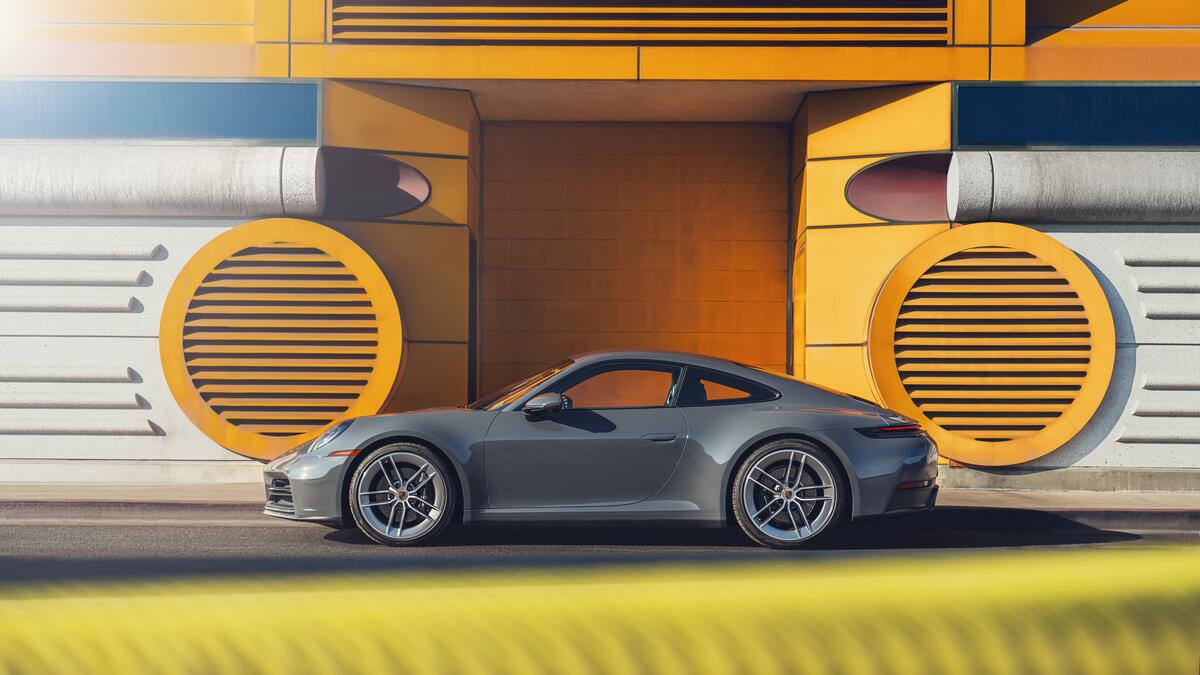
Porsche 911 GT3 RS
"Versus to, to Doug's point, the GT3RS has nice buckets that hold you in pretty well versus stock C6 or C5 Corvette seats, which are like sitting on a park bench."
The Porsche 911 GT3 RS is a track-oriented 911. Its bucket seats are shaped to keep you from sliding around, so you stay planted in the car during hard driving.
The Porsche 911 GT3 RS is a track-focused 911 variant that uses race-style bucket seats. In this context, the “buckets” are designed to physically hold you in place so your hips don’t slide around during cornering.

GT three cars
"where you're locked in and [2774.1s] especially GT three cars with the windows up and like there's, [2777.1s] there's quote unquote air conditioning and all this. [2779.1s] It's uncomfortable."
GT3 cars are race cars built for a specific racing category. They’re designed for the track, so the cabin can still feel uncomfortable—especially compared to a normal street car.
“GT3” refers to a class of race cars built for customer racing under FIA GT3 rules. They’re typically stripped-down, track-focused machines where the cockpit can feel very hot and cramped—so even features like “air conditioning” may be limited compared with a road car.

BMW E46S
"...MW GLTC class on the West Coast. There's a lot of E46s, but it reminded me super much that I'm going to ..."
The BMW 3 Series is a compact car that’s designed to feel sporty and comfortable. It’s also a popular choice for driving events, so you often see certain older versions of it in those competitions. The podcast mentions it because the speaker noticed similarities to the cars that usually show up in that class.
The BMW 3 Series is a compact luxury sedan that’s also widely used in driving events and motorsport-style classes. The podcast references a lot of E46s in a specific class and notes how it reminded the speaker of that group, which points to the 3 Series being a common platform for competition. That’s why it comes up when discussing what drivers and cars are typically present in those events.
GLTC weekend
"commentated the first ever GLTC weekend ever in 2019. [3815.0s] Okay."
GLTC is the name of a racing series or event the host is talking about. A “GLTC weekend” means the full event with multiple race sessions, not just a single race.
GLTC refers to a touring-car racing series/event name mentioned by the host in the context of broadcasting and commenting. In this segment, “GLTC weekend” functions as the same idea as other racing weekends: the multi-session event where races are held under that series’ rules.
WTCC weekend
"I've now broadcasted and commented the first ever WTCC weekend. [3820.0s] In 2026."
WTCC is a type of car racing series for “touring cars.” A “WTCC weekend” means the whole race event, not just one race—there are usually multiple sessions and races across a couple of days.
WTCC stands for World Touring Car Championship, a touring-car racing series. When someone says “WTCC weekend,” they mean the full event schedule—practice, qualifying, and multiple races—where drivers compete in touring cars under that series’ rules.
spec racing
"The other side of the weekend was spec Miata, which is like as old as it gets as far as spec racing goes and it was also incredible racing."
“Spec racing” means everyone races cars that are kept similar by rules. Because the cars can’t be wildly different, the competition tends to come down more to driving and fine-tuning within the rules.
Spec racing is a format where competitors use cars that are constrained by a common ruleset—often limiting engine, suspension, and other modifications. The goal is to reduce performance differences so racing outcomes depend more on setup within the rules and driver ability.
spec tire
"They had a spec tire. Everyone was on one set of Toyos all weekend long and it was so fascinating to watch it unfold..."
A “spec tire” is the same tire type for everyone in the race. When everyone uses the same tire, it’s easier to compare drivers and strategies because the tires aren’t the big variable.
A spec tire is a single tire model (or tightly defined tire spec) that all competitors must use. That standardization helps equalize grip and tire wear behavior, making the racing more about driving and strategy than tire choice.
one set of Toyos
"Everyone was on one set of Toyos all weekend long and it was so fascinating to watch it unfold from race 1234..."
“One set of Toyos” means the drivers used the same set of tires for the whole weekend. That makes tire wear a big part of how they plan each race.
“One set of Toyos” indicates the competitors used a single tire set for the entire event (or for the weekend’s races). Limiting tire changes forces teams to manage tire wear and grip over multiple races.
raw starting position
"...from race 1234 where it was just raw finishing position created the raw starting position for the next race."
“Raw starting position” means where you line up for the next race based directly on how you finished the previous one. So your result can strongly affect your starting spot next time.
“Raw starting position” here refers to the grid position that results directly from the previous race’s finishing order, without additional reshuffling. In multi-race formats, that can create a strong cause-and-effect between one race’s results and the next race’s starting order.
iRacing Arcade
"I want to talk about the, uh, the iRacing Arcade. I think the driving is super good. Like the way the cars interact with the curbs and like the physics behind"
iRacing Arcade is a racing video game that tries to make the cars feel realistic. The host is saying the way the cars react to curbs and the driving “feel” are good enough that it’s still fun even though it’s not a full simulator.
iRacing Arcade is a racing game mode/product built around iRacing’s focus on realistic car behavior. In this segment, the host highlights how the cars respond to curbs and how the game’s physics make driving feel believable enough to be fun.
curbs
"Like the way the cars interact with the curbs and like the physics behind it, I think it's, it's like physically enough for it to be fun and make sense. ...using the whole race track, like bombing over curbs"
Curbs are the raised edges along the track. In racing games and real cars, hitting them the right way can be fast, but hitting them wrong can upset the car.
In racing, curbs are the raised edge markings at the sides of the track. How a car interacts with curbs—grip, suspension movement, and stability—strongly affects lap times and driver confidence, especially when you “use the whole track.”
contact physics
"I can't remember what exactly what it was, but just the, the contact physics of being online with the net code."
Contact physics is how the game decides what happens when cars bump into each other. Online, it can get weird if the game can’t line up what each player sees at the same time.
Contact physics are the rules a simulation uses to model what happens when cars touch—things like how forces transfer, whether cars bounce, and how damage or separation occurs. In online racing, contact physics can feel “wrong” if the game’s networking (net code) can’t synchronize impacts cleanly.
net code
"just the, the contact physics of being online with the net code."
Net code is the online “plumbing” that keeps players in sync. If it’s not great, bumps and race timing can feel off because everyone’s game isn’t perfectly matching up.
Net code (network code) is the part of an online game that handles communication between players—how inputs and positions are sent, predicted, and corrected. If the net code is imperfect, collisions and timing can feel inconsistent because the game can’t perfectly synchronize car positions.
Request an Explanation
Heard something you'd like explained? We'll add it to this episode.
Sign in to request explanations for terms you heard.
Want to learn more?
Browse our glossary for plain-English explanations of automotive terms, jargon, and concepts.
Help improve this episode
See something that's not quite right? Our annotations are AI-generated and can sometimes miss the mark. Click the flag icon on any annotation to suggest a correction.