
Episode 202: The School of Lizards
About this episode
Coaches and racers swap stories from a busy kart/track weekend, including using onboard video and live timing to help drivers improve. The conversation then turns into “lizard brain school” lessons: how to structure practice with lead-follow, why early slalom commitment matters, and how brake release timing (plus a horizon test) changes rotation and corner balance. They also cover coaching mindset—focus on car dynamics, not body mechanics—and share event logistics, SCCA commentary plans, and even a white-water rafting trip.
Discord Link
Youtube Link
Show your lizard brains on the outside with Merch!
CLICK HERE FOR THE MERCH
Spicy Cat Racing Store
sim rig
"Next thing you know, I'm going to have a $20,000 sim rig behind me and you'll know where that money came from."
A sim rig is a home driving simulator setup, usually with a steering wheel and pedals. People use it to practice driving or race virtually, and here it’s mentioned as something someone might buy.
A sim rig is a home setup for driving simulation—typically a steering wheel, pedals, seat, and motion/VR or a monitor—used to practice driving techniques or enjoy racing games. In this context, it’s being treated like a real purchase that could be funded by the coaching/charity plan.
SCCA autocross
"SCCA autocross regions is effectively and said, Hey, we have a test in tune going on. And would you be interested or would you be willing to put on a autocross school during our test in tune?"
Autocross is a timed driving event where you drive a course made of cones in a parking lot. SCCA is the club that organizes many of these events, and you usually drive one car at a time to see who’s fastest.
SCCA autocross is a grassroots motorsport format run by the Sports Car Club of America (SCCA), where drivers compete on a temporary course marked out in a parking lot or similar open area. Cars run one at a time, and the goal is to complete the course in the fastest time while navigating tight turns and cones.
test in tune
"Hey, we have a test in tune going on. And would you be interested or would you be willing to put on a autocross school during our test in tune?"
A “test in tune” is basically a practice day. People use it to get comfortable with the course and make small changes so the car feels right before the main event.
A “test in tune” is an event day format where drivers can practice and dial in their setup before (or alongside) a more formal competition. In autocross culture, it typically means more seat time, course familiarity, and tuning adjustments rather than a strict race-style schedule.
autocross school
"And would you be interested or would you be willing to put on a autocross school during our test in tune? ... It was literally like from the jump it was who, whatever that person needed from the start, uh, we're in the car with them and then we just start there."
An autocross school is a coaching session for learning how to drive an autocross course. Instead of just lectures, instructors often ride with you and teach you what to do right away.
An autocross school is a structured coaching event where drivers learn techniques specific to cone courses, often with instructors riding along in the car. The key idea is hands-on instruction—starting with what the driver needs immediately rather than a rigid classroom curriculum.
Grissom at Peru
"So we did it once in, in Grissom at Peru, um, for the, it was a Chicago region, the tri-state sports car club."
This refers to an autocross venue in Peru, Indiana, associated with the Grissom area. Autocross events are often held at local facilities or airfields, and the specific site matters because surface, layout, and run-off areas affect how the course drives.
slalom
"So it's finger legs. So it's on a runway. So it's a very transition heavy course. And the thing that like, I think the most, the thing that like we kept talking about was either, uh, it was literally like the first two cones in a slalom was like the thing that we like kept talking about."
A slalom is a cone course where you weave left and right. Drivers practice keeping the car balanced and choosing the right speed so they don’t get “stuck” behind the cones later in the pattern.
A slalom is a driving course made of a line of cones that you weave through, requiring repeated steering inputs. In driver coaching, it’s often used to teach how to manage speed and car balance through quick direction changes.
transition heavy course
"So it's finger legs. So it's on a runway. So it's a very transition heavy course. And the thing that like, I think the most, the thing that like we kept talking about was either, uh, it was literally like the first two cones in a slalom"
A “transition heavy course” is a track layout that keeps forcing you to switch what you’re doing—slow down, turn, then speed up, over and over. It’s harder because you have to get the timing right every time you change directions or speed.
A “transition heavy course” is one where the driving repeatedly changes from one task to another—like braking/turn-in, then accelerating/straightening, then braking again. These frequent changes stress driver timing and car balance more than a course with long steady sections.
underdrive
"And what would happen is people would underdrive the first two, then they would fall behind and then they would have the car into a hustle for like the rest of the slalom, but then they were already behind."
Here, “underdrive” means you go into the cones too slowly or don’t commit enough early on. If you do that, you end up behind the pattern and it’s harder to carry speed through the rest of the slalom.
In this context, “underdrive” means entering the early part of the slalom with too little speed or too little commitment. The result is that the driver falls behind the intended rhythm, which can force awkward steering and slower progress through the rest of the cones.
overdrive
"And I think we basically had a couple sets of five cones, slaloms basically. And each one was a little different, but you said they under drove them. And I was going to say they overdrove them."
“Overdrive” here means you go in too fast or try too hard at the start. That can throw off your timing and make the rest of the cone weaving harder to do cleanly.
“Overdrive” is the opposite of underdrive: it means pushing too much speed or too much commitment early in the cone sequence. On a slalom, that can also disrupt timing and make it harder to stay smooth and fast through the later cones.
transitions
"They're people who drive slaloms and transitions almost exclusively in a way because their local site is a runway."
Transitions are the quick changes between turning one way and then the other. The idea is to shift the car’s weight smoothly so it doesn’t feel like it’s fighting you during the change.
In performance driving, “transitions” are the moments when the car changes from one steering input/turn to the opposite direction. Good transitions manage weight transfer so the car stays composed instead of getting loose mid-change.
overdrove
"So they, I was going to say they overdrove them because they would drive past the first cone and then try to start at the second cone."
To “overdrive” means you push the car harder than it’s ready for at that moment. In a cone course, that usually makes the next turn harder because you didn’t set up the car correctly.
“Overdrove” here means using too much steering/inputs too early or in the wrong place on the cone line. The result is that the car isn’t set up correctly for the next cone, so the driver has to scramble to recover.
weight transfer
"So that means turn the wheel the most, make the biggest weight transfer, get the lateral, you know, weight moving side to side lateral, like right to left, side to side movement with the steering wheel."
Weight transfer is when the car’s weight shifts from one side to the other as you turn. If it happens smoothly you get better control; if it’s abrupt you can lose grip and stability.
Weight transfer is how the car’s load shifts between tires as you steer, brake, or accelerate. In a slalom, steering-induced weight transfer is what helps the car rotate, but too much too late can make it “dance” or lose balance.
lateral weight
"get the lateral, you know, weight moving side to side lateral, like right to left, side to side movement with the steering wheel."
Lateral weight just means how much weight is on the left vs. right side of the car while you’re turning. In cone weaving, getting that side-to-side shift right helps the car track where you want it.
“Lateral weight” refers to the side-to-side distribution of the car’s mass during cornering. In a slalom, moving lateral weight in a controlled way helps the car follow the cone line instead of under-driving early cones and then over-correcting later.
back-siding
"once that energy is started and once you've done all that work early by back-siding the first cone, back-siding the, honestly, the second cone is the one that I had the hardest time with getting people like,"
“Back-siding” a cone is a driving technique where you aim to pass the cone on the “back side” (the side that keeps the car’s path tight to the intended line) rather than missing it and forcing a late correction. It’s often about steering timing so the car is already rotated for the next cone.
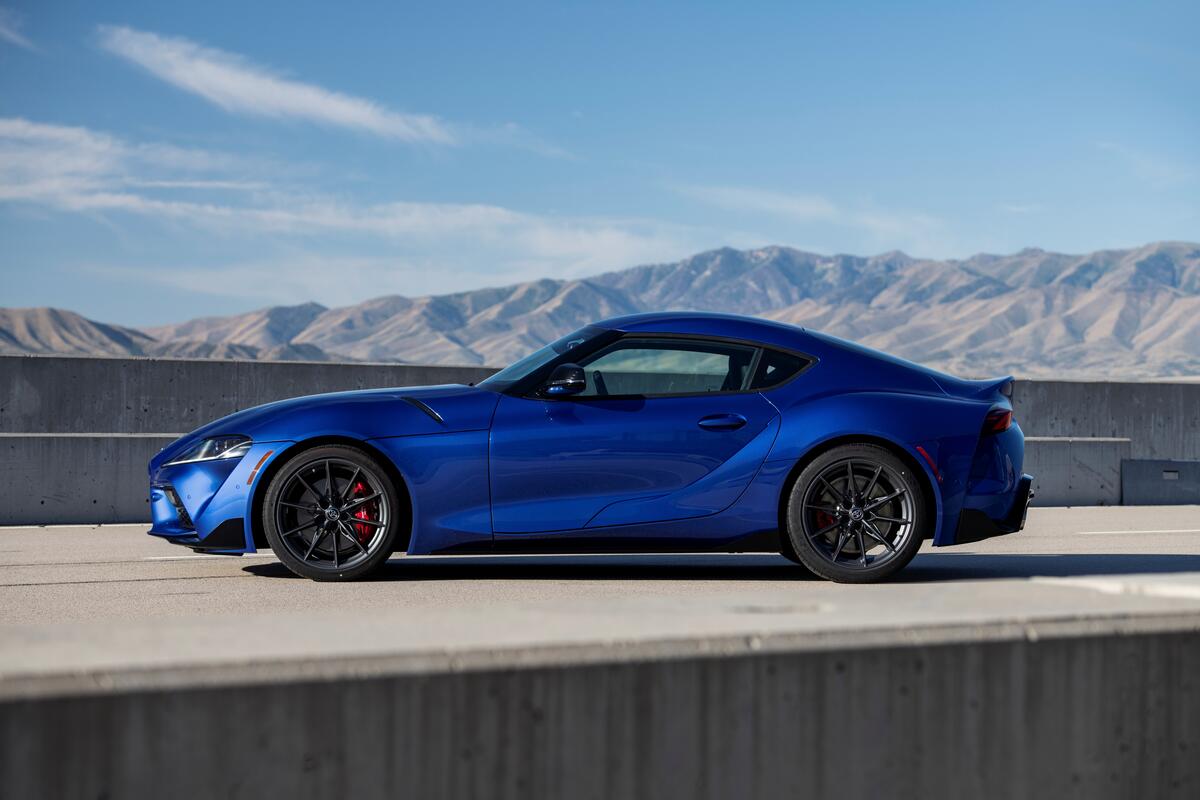
Toyota A90
"I want you to literally like, instead of driving at the slalom and turning into the slalom, I want you to like do like a 90 degree, like hand over hand, like backside it, put the car behind the first cone and then put the car behind the second, like really exaggerate the steering input so that"
The Toyota Supra is a sports car built for fast driving and responsive handling. In the podcast context, it’s being used to practice difficult maneuvers that require the driver to control the car’s direction precisely, including turning it sharply and managing the rear of the car.
The Toyota Supra is a performance sports coupe known for its strong acceleration and driver-focused design. In a driving context like the one described, it’s the kind of car people use to explore how a car responds to aggressive steering inputs and controlled oversteer. That makes it a natural topic when discussing advanced driving techniques such as backing the car into a position.
brake release
"“We'll start with brake release. I think we had mostly experienced autocrossers… they're like, break, turn. And then they just like are off the break.”"
Brake release is what you do when you stop pressing the brake and start turning. If you let off the brake too suddenly or too early, the car can lose grip and not turn the way you want.
Brake release is how a driver comes off the brake pedal at the end of braking and transitions into turning. In performance driving, releasing too abruptly or at the wrong time can unsettle the car, reduce traction, and cause the car to drift toward the outside (or even into cones).
autocross coaching
"“And this came up with maybe, maybe 30, 40% of the people I rode with… And this is a… conversation comes up a lot in iRacing coaching and racetrack coaching and then obviously autocross coaching.”"
Autocross coaching is training for autocross events, where you drive a car through a tight course with cones. Coaches help you time your braking and turning so you don’t lose control or hit cones.
Autocross coaching focuses on improving driver inputs for short, tight courses—especially braking, turn-in, and throttle timing. Because autocross cars are driven hard at low speeds with quick direction changes, mistakes in brake release show up quickly as cone hits or poor line control.
road course driving
"“...get the initial application good. And then they would just like break, break, break, pop off the pedal and try to turn which is directly related to road course driving.”"
Road course driving means driving on a track with longer corners and repeated braking. When you come off the brakes matters because it changes how the car grips and turns.
Road course driving is racing on longer circuits with repeated braking zones and sustained cornering. The transcript links brake release habits to road course driving because the timing of when you stop braking affects weight transfer and how the car turns without pushing into cones.
iRacing coaching
"“...this conversation comes up a lot in iRacing coaching and racetrack coaching and then obviously autocross coaching.”"
iRacing coaching is training using a racing video game simulator. People use it to practice real driving skills like braking and turning in a repeatable way.
iRacing coaching refers to using the iRacing simulator to teach driving technique. The simulator is often used to practice consistent braking and corner transitions, so issues like brake release show up as repeatable mistakes.
apex
"To me, if somebody is using the brake to tug the nose of the car down to the apex, that's like the most universal, like good brake release is if, if as they're getting off the brakes..."
The apex is the closest point to the inside of the turn that you try to hit. Hitting it well helps the car turn and sets you up to exit the corner faster.
The apex is the point on the inside of a corner that the driver aims to pass near. The host ties apexing to brake release and throttle timing, explaining that the brakes can help “tug the nose” toward the apex and that coming off the brakes too early can slow down rotation.
flow chart
"There's like a little bit of like a flow chart there of what like the corner shape should look like and how the brakes can help influence the corner shape."
Here, “flow chart” refers to a mental decision process for how brake release, turn-in timing, and throttle application relate to the car’s corner shape. The host’s point is that if you brake too much or too early, the car won’t rotate as quickly, and you may need to adjust turn-in timing and when you get back on throttle.
rotating
"Because the side effect of popping off the brakes too early is that you just spend more time in the corner. Like the car is not rotating or twisting as fast as you could."
Rotation is how the car pivots into the turn so it points where you want to go. If you lift off the brakes too soon, the car doesn’t pivot as quickly, so you end up spending more time in the corner.
In cornering, “rotation” is how quickly the car changes its yaw angle to point more toward the exit. The host says popping off the brakes too early keeps the car from rotating as fast as it could, which increases time spent in the corner.
horizon
"And probably the easiest way to see this is literally just watch your video and don't look at anything on course. Don't look at anything in the car. Just stare at the horizon and notice how fast the horizon moves when you're on the brakes..."
They’re using what you see outside—the horizon—as a simple way to judge how the car is turning. If the horizon moves quickly while braking, it suggests the car is changing direction effectively; when you’re off the brakes or on throttle, the movement changes.
The host uses horizon movement as a visual cue for how the car’s direction is changing under different pedal inputs. They claim the horizon shifts fastest left-to-right (or right-to-left) when braking to “tug the nose,” indicating the car’s angle is changing as quickly as possible.
SIM coaching
"I heard you explain this. I think it's very abstract. I'm curious, does this come from SIM coaching where you can watch in the SIM from the car's perspective, from the from the seat perspective?"
SIM coaching is coaching using a driving video game/simulator. Coaches can look at what the driver is doing from the driver’s viewpoint and help you adjust your braking and cornering technique.
SIM coaching means using a driving simulator to coach technique by replaying and analyzing inputs from the driver’s perspective. The host references being able to watch the process “from the seat perspective,” implying coaches can evaluate braking, turn-in, and throttle timing using simulator data and viewpoint tools.
brake pulling the car in sensation
"I mean, when I was first like figuring out like this, like the brake pulling the car in sensation,"
They’re talking about how using the brakes can make the car turn in more. Braking shifts weight to the front tires, which can help the front tires bite and help the car rotate into the corner.
The host is describing a driving technique/feel where braking helps the car “pull in” toward the turn. In vehicle dynamics terms, braking shifts weight forward and can increase front-end grip, which can help the car rotate (turn in) more effectively—up to the point where it may overwhelm traction and start to spin.
on the brakes
"like the pace that the horizon's moving. I must be on the brakes. And then you can see instantly, especially in a C3 car,"
When you’re on the brakes while turning, it changes how the car loads its tires. That can change how easily the car turns in, depending on the car and your timing.
Being “on the brakes” during corner entry affects weight transfer and tire slip angles, which changes how the car turns. The discussion contrasts cars that rotate best while braking versus cars that turn fastest when you lift off the wheel (or transition off-throttle), highlighting how braking timing can make or break turn-in behavior.
C3 car
"And then you can see instantly, especially in a C3 car, so they're so pushy and they really only turn on the brakes."
They’re referencing a specific kind of car where this braking/turning behavior is very obvious. The exact model isn’t identified here, so think of it as “that particular car.”
“C3 car” is being used as a shorthand for a specific car platform/behavior the host is familiar with, where the braking/turn-in feel is especially noticeable. Without the surrounding context naming the exact make/model, it’s best understood as “a particular car type” rather than a universal rule for all cars.
instantaneous feedback
"And it's like that instantaneous feedback thing that, that, that we talk about all the time. As soon as you put it in the context of a car that may,"
They mean you can get quick confirmation that your driving input worked. In this case, the outside view and the car’s response tell you right away what you did with the brakes and gas.
“Instantaneous feedback” refers to how quickly a driver can see or feel the result of a control input—like braking or throttle—during driving. In this segment, the host ties that feedback to video review and the horizon’s motion, arguing it makes technique corrections much easier.
rotate slash turn
"which means that the car will rotate slash turn the best when you're on the brake. Yes."
“Rotate” means the car pivots into the corner so it starts turning the way you want. They’re saying that on some cars, braking helps the front tires grip and rotate the car better.
“Rotate” (often used as “rotate/turn”) describes how a car pivots into a corner as weight transfers and tires generate grip. The host is arguing that, for certain cars, the best rotation happens while you’re still on the brakes, because braking load can increase front grip and help the car point into the turn.
weight set on the nose
"Like it, the car will always turn faster with a little bit of weight set on the nose with the brake to the point where it's just fucking spinning."
They’re talking about putting more weight on the front tires. That can help the car turn, but if you do it too aggressively the tires can lose grip and the car may spin.
“Weight set on the nose” means shifting more vehicle load toward the front axle (the “nose”)—typically via braking or deceleration. That front loading can increase front tire grip and turn-in/rotation, but if you load it too much you can exceed traction and the car can start to spin.

Hyundai Elantra N
"So let me challenge you with go back to the Hyundai Elantra N that you drove at the pro. And if you were to watch the horizon speed of the car..."
The Hyundai Elantra N is Hyundai’s sporty, track-oriented version of the Elantra. Here it’s being used to explain how the car behaves when you brake and turn—especially how the front end can feel like it wants to rotate or “spin” if you do it the wrong way.
The Hyundai Elantra N is a performance-focused compact from Hyundai’s N division, known for its track-capable chassis tuning and driver-focused dynamics. In this segment, it’s used as an example of how front-axle grip and braking/turn-in behavior can make the car feel like it wants to pivot and rotate quickly.
lift
"But if you're, if you're like focused on that, and then you do like a little lift and turn with no break, the horizon is going to move really fricking fast..."
“Lift” just means taking your foot off the gas. Doing it at the right time changes how the car settles and turns, because the engine is no longer pushing the car forward the same way.
In driving technique, “lift” means easing off the accelerator (reducing throttle) to change the car’s balance. That throttle change affects how much grip the tires have and how the car rotates during corner entry.
front axle
"because that car just wants to like pivot on the front axle and spin all the time."
The front axle is basically the front wheel connection point that helps the car steer and rotate. If the car “pivots on the front axle,” it means the front tires are doing most of the work in how the car turns.
The front axle is the assembly that connects the front wheels to the car’s drivetrain and suspension. When the speaker says the car “wants to pivot on the front axle,” they’re describing how front-end grip and load transfer can drive the car’s rotation behavior.
break release
"the temptation to want to break as late as possible and what that does to the break release."
Brake release refers to how quickly and smoothly you reduce braking pressure (how you come off the brake pedal). Rapid brake release can cause abrupt weight transfer and upset the car’s balance, making it harder to turn smoothly.
understeer
"So they came off the break super fast and that still puts the car into an understeer or it still makes you miss the"
Understeer is when you turn the steering wheel but the car doesn’t rotate enough, so it tends to go wide. Here, the idea is that braking and releasing the brake too abruptly can cause the front tires to lose grip and make understeer more likely.
Understeer is when a car turns less than the driver intends—typically the front tires lose grip first. In this segment, coming off the brake too abruptly can upset the car’s balance and lead to understeer or missed turn-in.
brake pedal
"And then getting to the cone or the apex that made them want to turn and coming off the pedal super fast."
The brake pedal is just the pedal you use to slow down. In racing, it’s not only how hard you brake—it’s also how smoothly and when you let off the pedal that affects how the car behaves in the turn.
The brake pedal is the driver’s control for deceleration, but in performance driving the key is how you modulate it—especially when you come off it. Releasing the brake too late or too abruptly can upset the car’s balance and make it harder to rotate smoothly into the apex.
weight balance
"It may feel like you're breaking slightly too early. The overall weight balance of the car is happier through the corner."
Weight balance is where the car’s weight is sitting while you drive—like how much is on the front vs. the back. In corners, moving that weight at the right time helps the tires grip and makes the car easier to steer.
Weight balance is how the car’s mass is distributed front-to-rear and side-to-side while cornering. In braking and turn-in, shifting weight changes traction and steering response, so the instructor is emphasizing that the car is “happier” when weight is managed through the corner rather than only at the last moment.
roll speed into the corner
"And that correlation between getting off the pedal in a better way to rotate the weight around the car a little bit better and, you know, roll speed into the corner so that the, the average speed stays higher"
This is about how smoothly and quickly you transition from slowing down to actually turning. If you do it well, the car stays stable and you can carry more speed through the corner.
“Roll speed into the corner” describes how quickly the car transitions from braking/straight-line behavior into the cornering phase. By managing that transition, drivers can keep the car balanced and maintain a higher average speed while still feeling like they can brake later.
average speed
"so that the, the average speed stays higher while feeling like they could be able to break later."
Average speed means how fast you go over the whole part of the track, not just at one point. The idea here is that smoother corner entry can help you be faster overall.
Average speed is the mean speed over a segment of track, not just peak speed at one moment. The instructor’s point is that better brake-release timing and smoother rotation can increase average speed even if it feels like you’re braking “earlier.”
late breaking
"I, 11 thing I see a lot is like with this like, like really heavy, like late breaking thing is it's the release is just too difficult to time up to be effective."
Late braking means you wait until the last moment to slow down before turning. It can help you carry more speed, but it’s harder to control because you have less time to smoothly let off the brakes.
“Late braking” is a driving technique where you brake as late as possible before a corner to maximize speed into the turn. The tradeoff is that you have less time to fine-tune brake release and weight transfer, which can make the car harder to balance at corner entry.
release is just too difficult to time up
"I, 11 thing I see a lot is like with this like, like really heavy, like late breaking thing is it's the release is just too difficult to time up to be effective."
Brake-release timing is about how you let off the brakes as you turn in. If you brake too aggressively, it’s harder to smoothly transition from slowing down to turning, and the car can feel less stable.
This is about brake-release timing: how smoothly and when you reduce brake pressure right before and during corner entry. If you brake too hard and too late, the release becomes harder to control, which can reduce traction and make it tougher to set up the car’s balance for the rest of the corner.
momentum is correct in the corner
"break and then getting like the release rights or the momentum is correct in the corner. It's just"
Momentum here means how fast and how smoothly the car is moving through the turn. If you brake and release at the right time, the car will flow through the corner better.
Here “momentum” refers to the car’s speed and motion through the corner—how much energy you carry and how it’s managed as you turn. The point is that getting the car’s speed right at corner entry depends heavily on how you brake and then release the brakes.
ABS
"is let's say like, let's say 50 pounds of pressure into the pedal is like just into ABS. If you're pushing 100 pounds into the pedal, then you are releasing 50 pounds of force out of the pedal until you get to the point where it's doing the same thing."
ABS is a system that stops your wheels from locking up when you brake hard. When it kicks in, it can pump or modulate the brakes, which changes how the pedal feels and makes it harder to be super precise with brake timing.
ABS (anti-lock braking system) is the car’s safety system that prevents wheel lockup during hard braking. In practice, when ABS activates, the system modulates brake pressure, which can make the brake pedal feel like it’s “releasing” in steps and can complicate precise brake-release timing.
balanced car
"Uh, like keeping the weight down on the, the nose is going to be kind of like short lived. You just need to like get there, turn around and like drive away, uh, extending the brake zone in that situation generally kind of costs more time than like having a balanced car."
A balanced car is one that feels predictable while you’re turning—front and rear tires are working together. That usually means it doesn’t suddenly understeer (push straight) or oversteer (loosen up). The idea is that balance helps you go faster more consistently than chasing tiny braking timing changes.
A “balanced car” is a vehicle setup and driving state where front and rear grip are working together predictably through the corner. When the car is balanced, it’s easier to maintain consistent steering and throttle without the car pushing wide or snapping into oversteer. The speaker contrasts extending brake zone time (which can unbalance the car) versus keeping the car balanced.
pin turn
"And then there's, uh, like the pin turn where it really doesn't matter all that much either. You think the pin turn doesn't matter?"
A pin turn is a super tight corner where you basically have to turn the car around quickly at low speed. Since the turn is short, you don’t have as much time for the “brake then release then turn” timing to make a big difference. The main goal is to get the car pointed in the right direction fast.
A pin turn is a very tight, low-speed corner where the car must rotate quickly with minimal distance traveled through the turn. Because the corner is short and slow, the timing of braking release and weight transfer can matter less than in longer corners. Drivers often focus more on getting the car rotated and pointed than on fine-tuning brake-to-turn transitions.
weight properly on the nose
"But it might be because, uh, the weight, uh, so like the, with the weight properly on the nose in a, in like a very sharp short turn like that, the weight moves so fast anyways,"
This is about how much of the car’s weight is sitting on the front tires while you turn. More front grip usually helps the car turn in and feel stable. The point here is that if you already have the car working well, tweaking front weight transfer may not be the biggest improvement left.
“Weight on the nose” refers to how much load is on the front tires during cornering, which is influenced by braking, steering input, and vehicle balance. When the speaker says “weight properly on the nose,” they mean setting the front end to have enough grip to rotate and turn-in effectively. If the weight shifts around too quickly or if everything else is already optimized, additional gains from front-load tuning can become diminishing returns.
diminishing returns
"like the weight moves so fast around the car that it like traveling around the edge of the car, it's diminishing returns. Like it still matters. It still matters, but it's not like,"
Diminishing returns means that after you’ve already optimized the biggest factors, further adjustments produce smaller and smaller improvements. In this context, the speaker argues that moving weight around the car can still help, but once the car is already doing well, that becomes a lower-priority “fine-tuning” lever. It’s a driving strategy idea about where time is realistically gained.
braking zone
"and especially in a braking zone, but just in general, if you're in a braking zone and you see like brake, brake, brake horizon doesn't move, move. Wham, it moves."
A “braking zone” is the part of the course where you’re slowing down before you turn. How you brake there affects how stable the car feels when you start the turn.
A “braking zone” is the section of track or course where you are actively slowing down before turn-in. Drivers manage brake timing and release within this zone because it determines how much load is on the front tires and how stable the car is when you transition into the corner.
brake pressure
"Yeah. I could see that popping off the brake pedal versus not versus just that's my thought. I did have a conversation with one person about brake pressure. They had it. They actually had it on data..."
“Brake pressure” is how hard the brake system is being pushed when you press the pedal. People look at it on data to understand whether they’re braking smoothly or too abruptly.
“Brake pressure” is the hydraulic pressure applied to the brake system when you press the pedal. It’s often logged on data systems because it correlates with deceleration and how abruptly the car transitions from braking to turning.
fidelity on the pedal
"And my break input was like half or slightly less because I'm not actually, it basically means that I have more fidelity on the pedal. It means that I'm like, I'm just using the brakes to turn the car."
This is about how “fine-grained” the brake pedal feels. If you can press the pedal a little bit and get a matching change in braking, it’s easier to brake smoothly and consistently.
“Pedal fidelity” is how precisely the brake pedal position translates into braking force. Higher fidelity means you can modulate brake pressure smoothly, which helps you brake consistently and use the brakes more like a tool than an on/off switch.
digital brake button
"almost nobody was just the, the digital, uh, brake button. Yep."
Think of it like a switch: you press it and the car slows down the same way every time. That makes it harder to brake smoothly for different corners.
A “digital brake button” describes braking that behaves like an on/off input rather than a smoothly controllable pedal. In driving terms, it usually means the driver (or brake system feel) lacks modulation, so braking pressure is the same every time you touch the pedal.
steering the car with the brakes
"The other conversation I had around braking was steering the car with the brakes. There were a couple of front wheel drive cars and, and, um, then I have one last thought about like apex speeds, but..."
It means using the brakes to help the car turn. By braking in a controlled way, you can make the car rotate and point more where you want it to go.
“Steering the car with the brakes” refers to using brake pressure to help rotate the car and change its direction. On many cars, braking can shift weight and affect tire grip, so the driver can influence rotation and turn-in by modulating brakes rather than relying only on steering angle.
inducing rotation
"You have to intentionally like give some of these times, uh, some of these corners, some of these spaces a bit of time to like when you feel it's almost around your shoulders, around your back, around like wherever you feel the rotation happening, you need to be inducing that, making it happen on purpose rather than just like hoping it happens."
“Inducing rotation” means deliberately setting up the car so it rotates toward the corner exit at the right time. Instead of hoping the car rotates naturally, the driver times inputs (often steering and brake/throttle balance) to make the car rotate on purpose.

Ford Mustang
"...for example, we had, we had a couple of club spec Mustangs this weekend. The Mustangs, they're soft. They're..."
The Ford Mustang is a performance car that’s designed to be fun to drive. The podcast says the Mustangs feel “soft,” which usually means the suspension and ride feel less firm, affecting how quickly the car responds when you turn and drive hard.
The Ford Mustang is a popular American muscle car that’s often discussed for how it feels on the road and track. The podcast mentions “club spec” Mustangs and notes that they feel “soft,” which points to suspension and setup characteristics that affect steering response and how the car behaves under spirited driving. That’s why it comes up in a conversation about driving technique and vehicle dynamics.
tire flex
"the, the tire flex. There's like so many extra parts that you having a death group on the wheel "
Tire flex means the tire squishes and bends as you drive. That movement helps the car communicate how much grip you have, so the driver can react sooner.
Tire flex is how the tire deforms as it rolls and loads up through steering and bumps. That deformation is part of what lets the driver “feel” grip and changes in traction through the steering wheel and seat.
death group on the wheel
"There's like so many extra parts that you having a death group on the wheel does nothing. There's all those other moving parts are still there. You're just removing "
“Death grip” (as implied here) means holding the steering wheel too tightly. Over-gripping reduces your ability to sense small changes in tire grip and suspension movement, which can slow down learning and smooth driving inputs.
hands, like where the spokes are on the wheels
"I think there's like a couple of things that is like good fundamentals for driving and having your, having like your hands, like where the spokes are on the wheels "
They’re talking about where your hands sit on the steering wheel. If your hand position is consistent, it’s easier to steer smoothly and make the car respond the way you expect.
This refers to a driver’s steering-wheel hand position (often described as “clock positions” on the wheel). Consistent hand placement helps you make repeatable steering inputs and keeps your inputs smooth, which improves car control and feedback interpretation.
turn-in and throttle timing using cones
"before I forget it by explaining that, uh, it was always the turnaround. I would lean like back into the right and like just stare at when, when their eyes would look at that first lollum cone because "
They’re describing how they use cones on a course as “checkpoints.” Watching where the car is relative to those markers helps you decide when to turn and when to start accelerating.
The host describes using a course marker (cones) as a visual reference for when to start turning and when to get on throttle. This is a common driver-coaching technique: consistent visual cues lead to more consistent timing and line choice.
break point
"give like a verbal, it probably should happen before the break point in a perfect world. But if it's a long breaking zone, it should happen maybe during the breaking zone"
The “break point” is the moment you stop braking and start the next step of the drive, like turning in or getting back on the gas. Getting that timing right helps you set up the car for where you’re going next.
In performance driving, the “break point” refers to the moment you transition from braking to the next phase of driving—typically turning in and/or beginning to apply throttle. The hosts emphasize that communication and cues should be timed so the driver knows when that transition is supposed to happen, especially in longer braking zones.
trajectories
"our brains are super, super good at trajectories. Think about it, somebody throws you a ball and it's like, you know, two feet to your right or left"
A “trajectory” is the path something is going to take. In driving, your brain predicts your path from what you see, which helps you time the gas and steering so you don’t end up too wide.
“Trajectories” here means the path an object (or the car) will follow over time. The hosts use a ball-catching example to argue that the brain predicts where something is going from early motion cues, and in driving that same prediction helps with timing—like when to get on throttle or make a quick lift if you’re going to run wider than planned.
spatial information
"but we need to have that spatial information for our brains to do that like wizard math in the background that we don't even think about."
“Spatial information” is what you see about position—where you are and where you need to go. With good cues, your brain can help you decide when to ease off the gas and when to get back on it.
“Spatial information” is the visual/positional data your brain uses to understand where things are relative to you—like where the car is in the lane, where the apex is, and how your path will evolve. The hosts connect it to throttle timing: if the driver has enough spatial cues, the brain can decide when to lift briefly and then re-apply throttle to avoid running wide.
lookaheads
"[3687.9s] but maybe it happens on the road course too, is when you have to do those, [3691.2s] those types of lookaheads while doing something else. Yes. So for example, at the school this"
“Lookaheads” just means you look farther ahead on the track so you can plan your next move. Instead of only reacting to what’s right in front of you, you’re setting up for the next turn or braking spot.
In driving instruction, “lookaheads” means planning what you’ll do next by watching farther down the course. It’s about using your vision to set up upcoming turns, braking points, and exits rather than reacting only to what’s directly in front of you.
90 degree corner
"[3696.3s] weekend, we had a five cone slalom that was also the final cone of the slalom, [3700.4s] the final two cones of the slalom were a breaking zone for a 90 degree corner."
A “90 degree corner” is a very tight turn where you basically turn the car about a right angle. These are great for learning because you have to brake and steer very precisely.
A “90 degree corner” is a tight turn where the direction change is roughly perpendicular (about a quarter turn). In autocross instruction, these corners are often used to teach precise braking and turning setup because there’s less room for error.
breaking zone
"[3700.4s] the final two cones of the slalom were a breaking zone for a 90 degree corner. [3705.4s] So you had to be ahead of the car enough that you had mental bandwidth to remember to"
A “braking zone” is a marked spot where you should slow down before you turn. The goal is to brake at the right time so the car is stable when you start steering.
A “breaking zone” (braking zone) is a designated area where you’re expected to slow the car down before turning. Autocross schools use these zones to teach consistent braking timing so you can arrive at the corner with the right speed and steering angle.
multitasking
"[3711.6s] look to the exit while finishing the slalom and breaking the car and getting the off the [3718.1s] brakes in a way that got you into the corner. It was the kind of multitasking that autocross"
Here “multitasking” means you’re not just turning the wheel—you’re also thinking about where you need to go next and when to slow down. Good autocross drivers keep planning while they’re executing the current maneuver.
In this context, “multitasking” means doing multiple driving tasks at once—like remembering the exit, braking, and steering—while still processing what the car is doing. Autocross instructors emphasize this because your brain has to manage the next move while executing the current one.
front side a tunnel
"[3792.8s] about. But at the very end, you could front side a tunnel and still like make it across the finish [3799.3s] line. And sometimes people would like get, they would just drive straight through the tunnel,"
“Front side” here is about how you aim the car as you approach a tight passage. If you set the angle right, you can drive through the “tunnel” and keep moving toward the finish instead of going straight and stalling your run.
“Front side” in autocross instruction typically refers to the side of the car you’re presenting to the obstacle/gate, which affects the line you take through a tight section. In a “tunnel,” changing your approach angle determines whether you can pass through cleanly and still accelerate toward the finish.
speed trace
"Yeah. And if you're having a hard time picturing this, think of the letter U versus the letter V and that's your speed trace. So the letter U, like your speed comes down and it spends some time towards the bottom of the trough or the bottom of the U and then it comes back up versus the V, it like comes straight down, spends a moment there and goes straight back up."
A speed trace is basically a chart of your speed as you go through a corner. The shape of the chart (like a “U” or a “V”) shows whether you slow down gradually or drop quickly and then come back up.
A speed trace is a graph (or recorded profile) of speed over time as you drive through a corner sequence. In this segment, the host uses it to compare how speed changes shape—like an “U” versus a “V”—to describe different braking/coasting/acceleration patterns.
pointing and shooting
"I talked to the all wheel drive golf about that, like pointing and shooting effectively is another way to say it, that you're willing to spend, it feels weird because on a,"
“Pointing and shooting” means you steer the car so it’s aimed at the next section, then you get on the gas quickly. It’s a common autocross idea because the course changes direction fast.
“Pointing and shooting” is a driving technique where you quickly aim the car at the next part of the course (point it), then accelerate out as soon as the car is pointed where you want it. In autocross, this often means prioritizing early throttle and clean exits over elaborate, sweeping lines.
minimum speed
"like your, your line should be like archy and, and sweepy and you should spend, you know, you come down to that minimum speed and then you just kind of accelerate away from it and everything, but an autocross course,"
“Minimum speed” is the slowest moment during a turn. The point here is that in autocross, it’s important to reach that slowest point and then start accelerating again quickly.
On a corner, “minimum speed” refers to the lowest vehicle speed you reach near the slowest point of the turn. The host argues that autocross rewards getting back to acceleration sooner after reaching that minimum speed, rather than focusing only on maximizing speed later.
braking and start the accelerating like right away
"because if you're able to end the braking and start the accelerating like right away, and it, assuming it's at the apex of the corner, which is where you would make like the, the Vs of Vs, then that tells me that we got"
This is about switching from slowing down to accelerating quickly, without lingering in the middle. The idea is that doing it cleanly helps the car turn and then pull out better.
This describes a driving transition where braking ends and throttle begins immediately, minimizing time spent in a mixed “brake while turning/then slowly add power” state. The host links it to better corner rotation and cleaner exit traction, especially on autocross where distances are short.
key cones
"Yeah. The key cones are the outside exit cones. Yeah. The limiting cones to find that. ... Like there's a debate on what the key cones are."
On a cone course, “key cones” are the cones you should focus on most because they help you figure out the correct path. If you aim for the right cones, the rest of your turns usually line up better. The tricky part is that different instructors might not agree on which cones are the “key” ones.
In cone-based driving, “key cones” are the specific cones that define the reference point for the next part of the course. They’re “key” because hitting the correct line around them is what sets up your speed and steering for the rest of the run. The host also notes there can be disagreement about which cones are considered “key,” which affects how drivers learn the course.
outside exit cones
"And the key cones are the outside exit cones. Yeah. The limiting cones to find that."
“Outside exit cones” are cones that show you where you should be when you finish a turn. They help you avoid cutting too early or running wide. Using them as targets makes it easier to drive the course smoothly.
“Outside exit cones” are cones placed on the outside of a turn that mark where you should exit the maneuver. They help drivers judge the correct steering angle and track position as they transition from one section of the course to the next. In autocross-style training, identifying these cones is part of learning the course “line.”
pop quiz
"and then they do a little pop quiz. Like what's the key cone and the other instructors like off in the distance over there..."
A “pop quiz” is a quick test to see if you really understand what you’re supposed to look for. In this case, it’s about identifying the important cone on the course. The host is using it to show how the training checks your understanding immediately.
A “pop quiz” here is a training method used to test whether drivers can correctly identify course features (specifically the “key cone”) on the fly. It reinforces visual recognition and course memorization, which are crucial in cone events where the line depends on small spatial cues. The host uses it to illustrate how structured the curriculum is.
starting line
"We're beyond Evo school. Yeah. Yeah. Yeah. [4302.4s] Yeah. You know, you got starting line, Evo school, and then you got lizard brain school."
The “starting line” is where you begin your run on a timed course. Where you line up and how you launch can change how your first turn goes. It’s basically the first step that sets up the rest of your driving.
“Starting line” in autocross training refers to the exact point where you begin your run and how you position the car before you launch. Your starting line affects your first turn’s entry angle and how quickly you can build speed without wasting motion. The host frames it as part of a curriculum progression (starting line → Evo school → lizard brain school).
autocrosser
"Like everyone there was like really good. Like everyone was already like a really proficient autocrosser."
An “autocrosser” is a person who does autocross—driving a cone course against the clock. It’s less about going fast in a straight line and more about steering well and hitting the right path. The host is saying the people there were already very good at that.
An “autocrosser” is someone who competes in autocross, a timed driving event where cars navigate a course of cones on a closed surface. Autocross emphasizes car control, line choice, and consistency more than outright top speed. The host uses the term to describe the skill level of the drivers at the school.
passenger seats of other car
"At some point people started hopping out of their car into passenger seats of other car and people started like helping each other while they were waiting..."
This is when you sit in the passenger seat of someone else’s car to learn how they drive the course. You can see their steering and where they aim the car. The host is saying the school became collaborative because people were doing this while waiting.
Riding in the passenger seat of another driver’s car is a coaching technique where you observe their line, braking/turn-in timing, and steering inputs. In autocross schools, this can speed up learning because you can compare what you’re doing to what a faster driver is doing on the same course. The host describes it as a collaborative, curriculum-like approach.
autocrossing
"And it may not even come to your brain that we talked about it last week in 2026, when you're autocrossing in 2028."
Autocrossing is a timed driving event where you drive through a course made of cones. You’re usually testing how well you can steer and control the car, not racing in a straight line.
Autocrossing is a grassroots motorsport where drivers run a car through a timed course marked out with cones, usually in a parking lot or airfield. It’s less about top speed and more about quick steering inputs, traction management, and learning how the car responds run-to-run.
holding the wheel too tight
"where it's like, you have to recognize, oh shoot, I'm holding the wheel too tight again. Okay, I got to like, concentrate on that for at least this next run or whatever."
This means gripping the steering wheel with more force than you need. If you do that, your steering can get jerky or less precise, which makes it harder to guide the car smoothly through turns.
“Holding the wheel too tight” is a common driving habit that can reduce fine control. In autocross-style driving, excess grip tension can make steering inputs less smooth, which can hurt how consistently the car stays balanced through turns.
Request an Explanation
Heard something you'd like explained? We'll add it to this episode.
Sign in to request explanations for terms you heard.
Want to learn more?
Browse our glossary for plain-English explanations of automotive terms, jargon, and concepts.
Help improve this episode
See something that's not quite right? Our annotations are AI-generated and can sometimes miss the mark. Click the flag icon on any annotation to suggest a correction.