
Episode 258: AT&T SVP Marketing + Planning Vinay Shahani
About this episode
Vinay Shahani’s path runs from “Thirty years in automotive” to becoming “Senior Vice President of Marketing and Planning at AT&T,” where he’s focused on connected-car strategy and customer experience. The conversation centers on why “the software-defined vehicle has become the thing” and why “I see in-vehicle connectivity as the frontier for competition these days.” AT&T’s approach blends segmentation and precision marketing with reliability messaging like “we're so confident in our network that we have the AT&T guarantee,” plus real-time connectivity partnerships such as Oracle Red Bull Racing.
AT&T SVP Marketing + Planning Vinay Shahani
powertrain
"I'll start with auto and you look at what's happening from a powertrain perspective. You know, at one point there was a lot of mindshare devoted towards the development of electric vehicles."
The powertrain is basically the car’s “moving system.” It’s everything that makes power and sends it to the wheels, like the engine or electric motors and the parts that connect to the drivetrain.
A powertrain is the set of components that generate and deliver power to move the car, typically including the engine (or motor), transmission, driveshaft, and final drive. In this segment, the host uses it to frame how electrification and hybridization are changing what automakers build.
EV
"You know, at one point there was a lot of mindshare devoted towards the development of electric vehicles. You had a certain perspective from the federal government which was saying, look, we expect that this is going to be the penetration and the legislation was being written in a certain way that required OEMs to develop electric vehicles."
Electric vehicles are cars that run on electricity stored in a battery. Instead of a gasoline engine, they use electric motors to drive the wheels.
Electric vehicles (EVs) are cars that use one or more electric motors powered by a battery pack instead of a gasoline engine. The speaker ties EV development to federal policy expectations and OEM (automaker) requirements, then contrasts that with later policy shifts and consumer demand.
OEM
"And then you see the administration shift and they take a different position. But you see consumers are voting with their wallets and you see a winning technology like hybrid..."
OEMs are the carmakers themselves—the companies that build the vehicles you buy. The speaker is saying laws were pushing these companies to make more electric cars.
OEMs stands for original equipment manufacturers—companies that produce vehicles (and often major subsystems) that are sold under their own brand. The speaker uses OEMs to describe who was expected by legislation to develop electric vehicles.
hybrid
"But you see consumers are voting with their wallets and you see a winning technology like hybrid, which has been around since the late 90s, become sort of the near term winner."
A hybrid car uses two kinds of power: a gasoline engine and an electric motor. It can switch between them (or use both) to improve efficiency and make the transition away from gas easier.
A hybrid vehicle combines an internal-combustion engine with an electric motor and battery, allowing the car to use both power sources depending on conditions. In the segment, the speaker argues that hybrid has become a near-term “winner” because it’s been around since the late 1990s and is gaining market share faster than pure EVs right now.
penetration
"Not to say that electric vehicles won't be commonplace in the future. But if it's six or seven or eight percentage points of penetration in this industry of 16 million cars, that's kind of the biggest that we're seeing so far."
Penetration here means how common a technology is—like what percent of cars are EVs versus other types. Higher penetration means more people are buying that technology.
Market penetration is the share of a market (here, cars) that adopts a specific technology like EVs or hybrids. The speaker quantifies EV adoption as “six or seven or eight percentage points of penetration” out of an estimated 16 million cars.
disruption
"But you see hybrid technology really racing ahead. So that's an example of a disruption because not everybody had invested in hybrid."
In this context, disruption means a major shift in the competitive landscape—new technologies or strategies that force companies to change what they build and how they market. The speaker frames hybrid electrification as a disruption because not every automaker had invested in it early.
generative AI
"And look, I think there's no bigger disruption than artificial intelligence and generative AI and embracing that as we talked about, AT&T, really trying to show through the investments we've made, I'll use fiber as the"
Generative AI is a type of computer intelligence that can create new stuff, like writing or other content, instead of only following fixed rules. The speaker is saying it’s becoming a big change in how companies operate and market.
Generative AI refers to AI systems that can create new content—such as text, images, or audio—based on patterns learned from training data. The speaker frames it as a major disruption in how AT&T invests and communicates, analogous to how powertrain tech is changing automakers.
over the air update
"the ability to upload and download information over the air updates. These are all things that are commonplace now."
Some cars can get software updates wirelessly, like your phone does. That means you don’t have to go to a dealership just to install new features or fixes.
Over-the-air (OTA) updates let a vehicle receive software updates via its cellular/wireless connection, without a dealership visit. This can update infotainment, navigation, and sometimes vehicle control software, improving features after purchase.
5G technology
"like Toyota and Lexus, Nissan, some of the newer manufacturers like Rivian that have embraced our 5G technology in their vehicle to offer the right connectivity solutions."
5G is a faster kind of mobile internet. In cars, it helps the car connect more quickly and reliably for things like online services and data features.
5G is the latest generation of cellular wireless networks, designed for faster data speeds and lower latency than older networks. In vehicles, 5G enables more responsive connectivity for features like real-time services, richer streaming, and faster data exchange for connected systems.
cars become phones on wheels
"I wonder, Vinay, whether we're entering a decade where cars become phones on wheels or our phones become the operating systems of our lives with cars just simply becoming another screen."
This phrase means the car is starting to work more like a smartphone. Instead of just driving, it’s becoming a connected device that gets new software features over time.
“Cars become phones on wheels” describes the idea that vehicles will increasingly rely on the same software-first, app-and-connectivity model as smartphones. It implies the car’s value is tied to ongoing connectivity, updates, and user interfaces rather than only mechanical hardware.
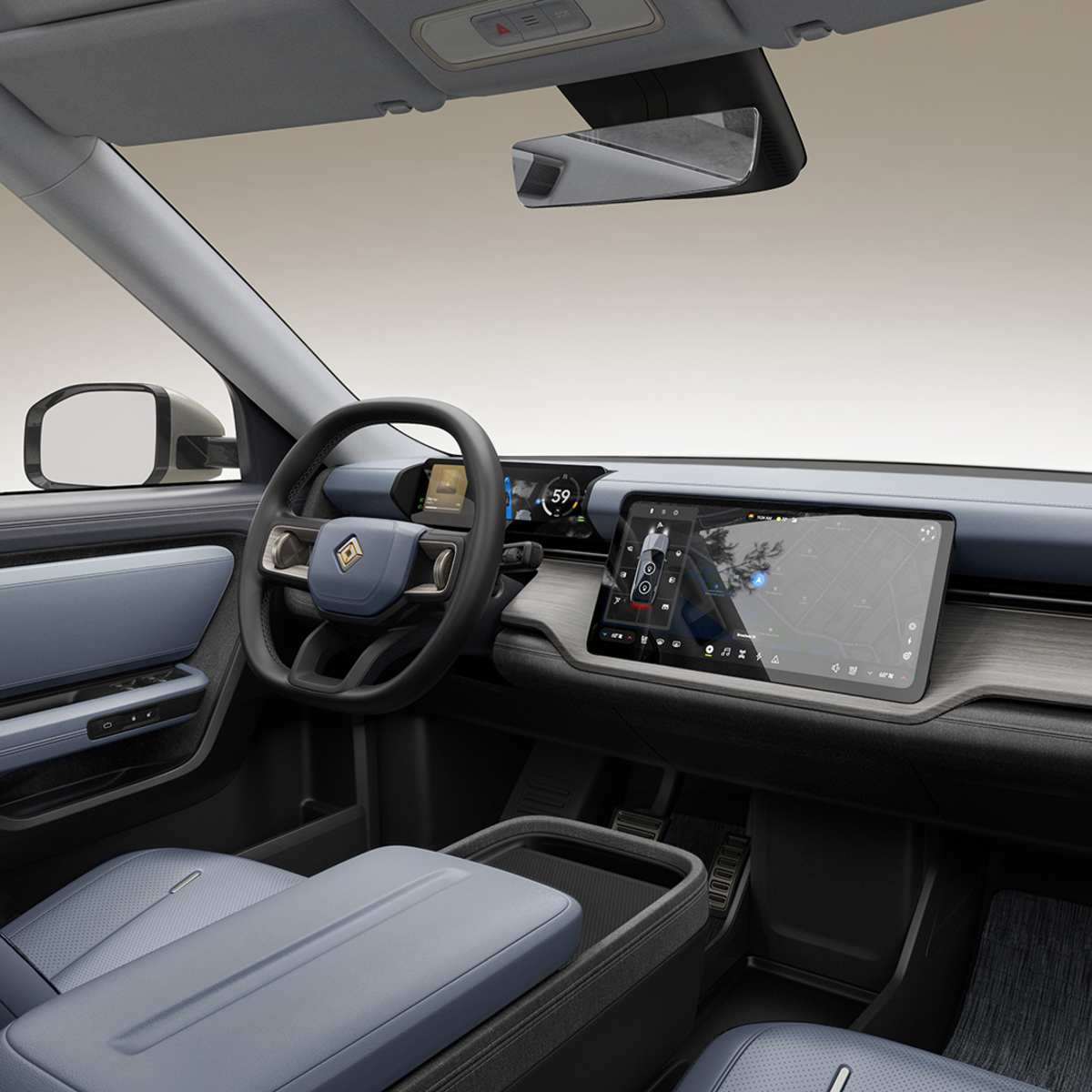
Rivian R2
"Or you can see that many are choosing to embed, whether I'll use the example, two recent examples, the Rivian R2, a very new vehicle from Rivian that's embracing 5G technology."
The Rivian R2 is an electric Rivian SUV/crossover that’s meant to bring the brand to more people. Here, the key point is that it’s designed with 5G internet built in for connected features.
The Rivian R2 is an upcoming Rivian electric vehicle positioned as a more accessible model in the brand’s lineup. In this segment, it’s specifically mentioned as embracing 5G connectivity to support modern connected-car experiences.

all new Lexus ES
"Another one that I love, because you and I even talked about this in the past, the all new Lexus ES with a brand new infotainment system called Lexus Interface, which I helped brand and work on when I was the head of marketing for Lexus."
The Lexus ES is a popular Lexus sedan. In this discussion, the new model matters because it has an updated in-car screen/software system called Lexus Interface.
The Lexus ES is a mainstream midsize sedan from Lexus, and the speaker highlights the “all new” version as having a newly designed in-car software and display experience. The segment focuses on its infotainment system, “Lexus Interface,” as a driver of customer choice.
infotainment system
"the all new Lexus ES with a brand new infotainment system called Lexus Interface, which I helped brand and work on when I was the head of marketing for Lexus."
An infotainment system is the car’s main screen and controls for things like music, navigation, and phone/internet features. It’s a big part of how people judge a car’s “tech” experience.
An infotainment system is the car’s integrated interface for entertainment and information—typically including the touchscreen, audio controls, navigation, and connectivity features. In modern cars, infotainment is increasingly central to the user experience and brand perception.
Lexus Interface
"the all new Lexus ES with a brand new infotainment system called Lexus Interface, which I helped brand and work on when I was the head of marketing for Lexus."
Lexus Interface is Lexus’s name for its in-car screen/software experience. The point here is that the way it feels and works can influence whether people choose to buy a Lexus.
Lexus Interface is the named infotainment software experience used in the “all new Lexus ES” mentioned in the segment. The speaker frames it as a key reason customers choose the brand, because the in-car interface shapes daily usability and perceived tech value.

Ford F-150 Lightning
"...ave boiled it down to two years. I mean, that's a lightning pace improvement, exponential improvement in the ..."
The Ford F-150 Lightning is a pickup truck that runs on electricity instead of gasoline. It’s designed for people who want the practicality of a truck, but with electric driving. It may come up in conversation because electric trucks have been getting better quickly.
The Ford F-150 Lightning is an all-electric version of the popular F-150 pickup truck, built to deliver the same everyday truck usefulness with an electric powertrain. It’s often discussed because it represents how quickly electric-vehicle technology and real-world capability have been improving, especially for buyers who want a truck rather than a small EV. The “Lightning pace” reference highlights that rapid progress and adoption.
development cycle
"exponential improvement in the development life cycle. Whereas five years, you used to launch a car, and a lot of times the technology may be a little bit obsolete"
The development life cycle is the whole process of designing and building a car, from the first planning stages to when it’s ready to sell. The point here is that car companies are doing it faster than before.
The development life cycle is the end-to-end timeline from early engineering and planning through validation and launch of a vehicle and its technologies. The speaker argues that this cycle has been getting shorter, meaning new tech can reach production faster.
product cycles
"Well, now these cycles are moving much, much faster. So I think the CEOs and the people who are deciding how to define the product"
Product cycles are how often car companies update and refresh their vehicles and features. The claim here is that those updates are happening faster now.
Product cycles are the recurring time windows in which automakers plan, develop, and refresh vehicle models and features. The speaker notes that these cycles are accelerating, which changes how quickly technology can be updated before it becomes outdated.
connectivity
"And I'm wondering whether one day connectivity will be will be just as important as performance styling or even brand going forward. The consumer of the future is going to say, is this how is this car connected?"
Connectivity is how a car can “talk” to things outside itself—like your phone or the internet. It matters because it enables features such as app control and remote/online services.
In modern cars, connectivity refers to the ability of the vehicle to link with external networks and devices—such as smartphones, cellular services, and cloud services. It’s increasingly treated as a core feature because it enables functions like app integration, remote services, and real-time data.
Apple CarPlay
"we made a joint decision with product at the time to be the first brand that embedded Apple CarPlay and Google Android Auto. That's right. Almost every single vehicle we sold."
Apple CarPlay lets you connect an iPhone to your car so certain apps show up on the car’s screen. You can then use things like maps, calls, and music without handling your phone as much.
Apple CarPlay is a smartphone-integration system that mirrors compatible iPhone apps onto the car’s infotainment screen. It lets drivers use navigation, calls, messages, and music through the vehicle’s controls while keeping the phone’s interface familiar.
Google Android Auto
"we made a joint decision with product at the time to be the first brand that embedded Apple CarPlay and Google Android Auto. That's right. Almost every single vehicle we sold."
Android Auto lets you connect an Android phone to your car so apps can appear on the car’s screen. It’s meant to make navigation and music easier to use while driving.
Google Android Auto is a smartphone-integration system for Android phones that brings supported apps to the car’s infotainment display. Like CarPlay, it focuses on safe, in-car access to navigation, communication, and media using the car’s interface.
autonomous emergency braking
"Obviously, some of the government mandates in terms of vehicle safety technology coming to play here in terms of autonomous emergency brake, lane keep assist, keeping all these connected cameras wired so that you have a full view of what's happening, and you can avoid certain situations."
Autonomous emergency braking is a safety feature that can automatically brake if the car thinks you’re about to hit something. It’s meant to help prevent crashes, especially when a driver doesn’t react in time.
Autonomous emergency braking (AEB) is a driver-assistance system that detects a potential collision and automatically applies the brakes to reduce speed or help avoid impact. It’s especially relevant for new drivers because it can intervene when reaction time is slower.
lane keep assist
"in terms of autonomous emergency brake, lane keep assist, keeping all these connected cameras wired so that you have a full view of what's happening, and you can avoid certain situations."
Lane keep assist is a driver-assistance system that helps keep the vehicle centered in its lane by steering corrections when it detects unintentional lane departure. It’s designed to reduce common mistakes like drifting, which matters a lot for less-experienced drivers.
connected cameras
"keeping all these connected cameras wired so that you have a full view of what's happening, and you can avoid certain situations."
Connected cameras are cameras in the car that can send information to safety systems. The idea is to help the car “see” more clearly so it can warn you or help avoid problems.
Connected cameras are vehicle-mounted cameras that can stream or share data with other systems (and sometimes the cloud) to support safety monitoring and driver-assistance functions. In this context, they’re described as part of a wired, always-on setup to give a “full view” for avoiding hazards.
Request an Explanation
Heard something you'd like explained? We'll add it to this episode.
Sign in to request explanations for terms you heard.
Want to learn more?
Browse our glossary for plain-English explanations of automotive terms, jargon, and concepts.
Help improve this episode
See something that's not quite right? Our annotations are AI-generated and can sometimes miss the mark. Click the flag icon on any annotation to suggest a correction.