The powertrain is basically the car’s “moving system.” It’s everything that makes power and sends it to the wheels, like the engine or electric motors and the parts that connect to the drivetrain.
OEMs are the carmakers themselves—the companies that build the vehicles you buy. The speaker is saying laws were pushing these companies to make more electric cars.
A hybrid car uses two kinds of power: a gasoline engine and an electric motor. It can switch between them (or use both) to improve efficiency and make the transition away from gas easier.
Penetration here means how common a technology is—like what percent of cars are EVs versus other types. Higher penetration means more people are buying that technology.
In this context, disruption means a major shift in the competitive landscape—new technologies or strategies that force companies to change what they build and how they market. The speaker frames hybrid electrification as a disruption because not every automaker had invested in it early.
Generative AI is a type of computer intelligence that can create new stuff, like writing or other content, instead of only following fixed rules. The speaker is saying it’s becoming a big change in how companies operate and market.
Some cars can get software updates wirelessly, like your phone does. That means you don’t have to go to a dealership just to install new features or fixes.
This phrase means the car is starting to work more like a smartphone. Instead of just driving, it’s becoming a connected device that gets new software features over time.
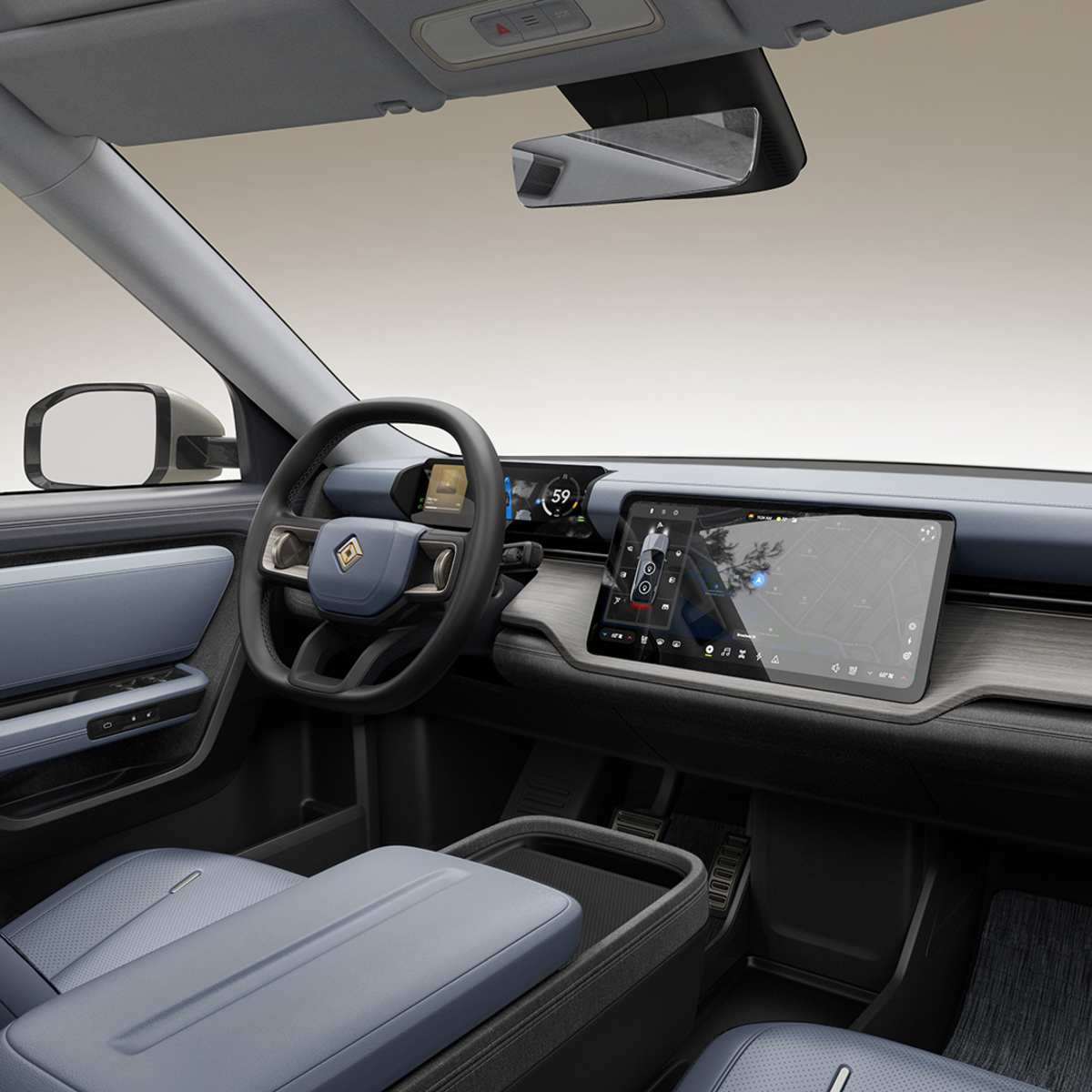
The Rivian R2 is an electric Rivian SUV/crossover that’s meant to bring the brand to more people. Here, the key point is that it’s designed with 5G internet built in for connected features.
The Lexus ES is a popular Lexus sedan. In this discussion, the new model matters because it has an updated in-car screen/software system called Lexus Interface.
An infotainment system is the car’s main screen and controls for things like music, navigation, and phone/internet features. It’s a big part of how people judge a car’s “tech” experience.
Lexus Interface is Lexus’s name for its in-car screen/software experience. The point here is that the way it feels and works can influence whether people choose to buy a Lexus.
The Ford F-150 Lightning is a pickup truck that runs on electricity instead of gasoline. It’s designed for people who want the practicality of a truck, but with electric driving. It may come up in conversation because electric trucks have been getting better quickly.
The development life cycle is the whole process of designing and building a car, from the first planning stages to when it’s ready to sell. The point here is that car companies are doing it faster than before.
Product cycles are how often car companies update and refresh their vehicles and features. The claim here is that those updates are happening faster now.
Connectivity is how a car can “talk” to things outside itself—like your phone or the internet. It matters because it enables features such as app control and remote/online services.
Apple CarPlay lets you connect an iPhone to your car so certain apps show up on the car’s screen. You can then use things like maps, calls, and music without handling your phone as much.
Android Auto lets you connect an Android phone to your car so apps can appear on the car’s screen. It’s meant to make navigation and music easier to use while driving.
Autonomous emergency braking is a safety feature that can automatically brake if the car thinks you’re about to hit something. It’s meant to help prevent crashes, especially when a driver doesn’t react in time.
Lane keep assist is a driver-assistance system that helps keep the vehicle centered in its lane by steering corrections when it detects unintentional lane departure. It’s designed to reduce common mistakes like drifting, which matters a lot for less-experienced drivers.
Connected cameras are cameras in the car that can send information to safety systems. The idea is to help the car “see” more clearly so it can warn you or help avoid problems.
LIVE
The automobile is one of the most important inventions that revolutionize the modern world.
In America, the rich history of car culture runs deep.
Technology continues to shape the future of the industry.
Jason Stein is here to share the stories of people passionate about cars,
from industry leaders and innovators to car-obsessed celebrities.
Buckle up as Jason takes you inside the boardroom, onto the track,
and around the bend on Cars and Culture on SiriusXM Business Radio.
Welcome into episode 258 of Cars and Culture with Jason Stein,
here on SiriusXM Business Channel 132.
Great to have you along for the ride again.
Every so often, a guest comes back around, and it's never for the reason you'd expect.
Today's guest has one of the most interesting resumes in the business,
because he's had a front-row seat to the transformation of not one industry, but two.
Thirty years in automotive, Volkswagen, Nissan, and Infiniti, Toyota, and Lexus,
building brands, running marketing, learning the business from the factory floor
to the dealership lot.
And then nine months ago, he did something almost nobody in this industry does.
He walked away from it.
He's now Senior Vice President of Marketing and Planning at AT&T,
and Vinay Shahani is running Acquisition, Retention, and Brand Strategy
for one of the most iconic companies in America,
a company that, by the way, predates the automobile by about 30 years.
And here's the thing.
Vinay Shahani didn't leave the car business behind,
so much as he found out it was chasing him the entire time.
the ability to upload and download information over the air updates.
These are all things that are commonplace now. These are the norms for the consumer.
And that's the beauty of what AT&T offers is we are there as a fundamental technology partner.
And you look at the list of companies for whom we are providing this service, whether it's some of
my former employers like Toyota and Lexus, Nissan, some of the newer manufacturers like Rivian that
have embraced our 5G technology in their vehicle to offer the right connectivity solutions.
Again, the fact that cars can be upgraded over the air without a dealership visit
says a lot about where we are as an industry. And I think that is what we take very seriously.
We want to be a partner to these OEMs that are putting these innovations inside their vehicles.
And we're proving that the scale, the reliability and the deep auto experience that we have as
AT&T allows us to do a great job of creating a lot of happy customers. And again, collective
ownership for those happy customers between us and the OEMs and all the other technology
providers that partner with the OEMs. But that's kind of how I see it.
I wonder, Vinay, whether we're entering a decade where cars become phones on wheels
or our phones become the operating systems of our lives with cars just simply becoming another screen.
Yeah, it's a really great question. And I would say there's a lot of different camps on this.
A lot of times you see OEMs embracing the idea that the phone that the customer is carrying in
their pocket, which is a supercomputer. It's a computer, right, exactly. Right. That should be
the centerpiece of connectivity for the vehicle. Or you can see that many are choosing to embed,
whether I'll use the example, two recent examples, the Rivian R2, a very new vehicle from Rivian
that's embracing 5G technology. Another one that I love, because you and I even talked about this
in the past, the all new Lexus ES with a brand new infotainment system called Lexus Interface,
which I helped brand and work on when I was the head of marketing for Lexus.
These experiences that customers have with these infotainment systems that are embedded in these
vehicles are becoming more and more the reason why people are choosing to buy those brands.
Because of the functionality, because of the ease of use, because of the customer experience,
the customer experience is the brand. Right. And again, we are a foundational enabler of those
experiences through the reliable connection. So it's a really, I would say, important space
to continue to help support, to drive innovation, but ultimately to drive customer experience and
customer loyalty for these brands. So I think they see us as a technological partner,
not just a technological supplier. And we have a whole team of people here at AT&T
that work in the Internet of Things that are focused on this, and they're having great success.
Yeah, it's interesting. You know, 20 years ago, Automotive and Telecom were completely separate
worlds. And now they're increasingly intertwined. And you wonder whether that convergence was
inevitable. If you were advising an Automotive CEO today, let's say you were going back to
some of your friends and having conversations, what would you tell them about connectivity
that perhaps they still underestimate, knowing what you know now after almost a year in your role?
Wow, that's a really great question, Jason. Look, I think that you've got to have your
eye on where the puck is going. And I think about the way that we interact with LLMs in
our day-to-day lives today. And obviously, that's evolving fast. It is really sort of
reduced barriers for access to information and analysis. And I look at how that's playing out
in vehicle. And, you know, I think about how LLMs and SLMs are changing how consumers interact
in the vehicle itself, right? No longer do you see that little swiggly line on the cockpit module,
and you're wondering, what does that light mean? Well, now in many vehicles, you can just simply
say, hey, what does this mean? And the car is going to give you an intelligent answer.
That kind of stuff takes computing power. And I think we're only starting to see the tip of the
iceberg here in terms of the possibilities. So I think really looking at other industries,
seeing how consumers are interacting with AI, and thinking about that in terms of upstream
product development. And the fact that, you know, the development window for cars used to be five to
six years, that was pretty standard. And now you look now, and you look at some of the Chinese
manufacturers that have boiled it down to two years. I mean, that's a lightning pace improvement,
exponential improvement in the development life cycle. Whereas five years, you used to launch a
car, and a lot of times the technology may be a little bit obsolete based on where another manufacturer
had made the right guess on what technology. Well, now these cycles are moving much, much faster.
So I think the CEOs and the people who are deciding how to define the product have to
really think about, you know, what the consumer really needs, and how do you embed that technology
in a flexible way. And I think that's what partnering with a company like AT&T early in the
development process could be a huge advantage in the future. And I'm wondering whether one day
connectivity will be will be just as important as performance styling or even brand going forward.
The consumer of the future is going to say, is this how is this car connected? How can I connect
to this vehicle rather than it's got a great spoiler? Although we like spoilers, but yeah.
Yeah, you and I like spoilers. We like horsepower. So we're really old school in that way.
Analog. Shifting. Analog. We're dinosaurs, Jason. No, but you know, it's an interesting
point you make, because I think back, you know, in 2015, when I led Volkswagen marketing,
you know, we made a joint decision with product at the time to be the first brand that embedded
Apple CarPlay and Google Android Auto. That's right. Almost every single vehicle we sold.
This was back in 2014, we made that decision. So we were ahead of the curve. And you look back at
that decision and you look at how consumers are making decisions on what cars to consider,
what cars to intend to purchase and what cars to purchase. And you see that Apple CarPlay
availability is a key differentiator. It's like some granted, very few cars don't have it anymore,
although some OEMs have decided that they're not going down that path. But that tends to be
what gets a car on the list is whether or not that that technology exists. I think that list is
going to evolve to your point in terms of having the right ways of interacting with the vehicle
and having the vehicle make your life simpler. And again, that's where we as technological
partners and innovators can really help. In the few minutes that we have left,
I can't let you go without talking about cars because the show is obviously called that.
So 230 odd episodes ago, you had some vehicles in your fleet, but I'd like to know where we are
today because now you can be completely agnostic. I mean, let's face it, you can drive whatever
you want now as long as it has AT&T in the vehicle, which it does. So what are we driving, Vinay?
Wow. You know, I have to be careful about this because I can still get in trouble because I
still have a lot of friends in the industry. But fortunately, I can say with 100% confidence that
the Shahani family fleet is very well diversified. There we go. And it includes some of the brands
that I've made stop over. So we've got a Lexus in the lineup. We've got a Nissan in the lineup.
We have a BMW in the lineup, and we have a Porsche in the lineup. And those are some of
the brands that I love. And they're all great vehicles, and they all serve very different
needs in the household. I have a son who's driving now. And I mean, I know you've gone
through it with your kids, Jason, but gosh, that's not a decision that comes easily. I mean,
you want to put your kids in the right vehicle with the right technology. You want the right
crumple zone around them. You want the right safety technology. And fortunately, again,
you look at what connectivity has done, the way that AT&T has partnered with some of these brands
to ensure that you can keep track of where your kids are. Obviously, some of the government
mandates in terms of vehicle safety technology coming to play here in terms of autonomous
emergency brake, lane keep assist, keeping all these connected cameras wired so that you have
a full view of what's happening, and you can avoid certain situations. These become really,
really important in the decision making, especially for that life stage. And I always tell people,
I hear people every so often say, oh, I've got a kid that's coming of age. I'm going to put them
in an older, cheap vehicle. And I'm like, that's the wrong strategy. You've got to put them in
the latest and greatest because that's what's going to help these new drivers. And the amount
of money and development dollars that are being invested in making these technologies more robust
just tells you that the car companies have figured that out. So anyway, long-winded answer to your
question, but that's the current portfolio. And as you and I talk all the time, there's probably
going to be other brands in the picture in the near term. As you sit here and look at the automotive
industry from a different perspective now, a different chair and a different set of responsibilities,
it is described as the most chaotic period for a lot of automakers, suppliers, and dealers.
I don't think you'd disagree, would you? No, I wouldn't disagree. Look, I'm fortunate that,
you know, having worked at a couple of major OEMs, and I'm still in touch with a lot of the
former colleagues and a lot of the dealers, you know, that was always the lifeblood of any brand
is the dealers, I don't care what you say about the marketing that we did at the OEM level,
ultimately the dealers create the experience for the customer, right? Because that's the only,
and that's another difference we didn't talk about. But in the OEM side, there was always just one
channel. It's through the dealer network. So that, you know, that was your critical partner.
Whereas in telecom today, we've got the retail network, we've got the digital channel, which is
an e-commerce engine. You've got call centers. There's a lot of different ways to become part
of the AT&T family. But I look at, you know, what the dealers are facing right now in terms of
competition. I look at what the dealers are facing right now in terms of how they reach and connect
with consumers. How do they take the leads that are generated through the OEM and really sort of
convert those into the business? It's tough now. There's a lot of competition. There's a lot of
great cars. What used to be a pretty wide gap in some of the, what I used to call the hygiene
factors in the industry, quality, reliability, durability, value for money, those gaps have
narrowed. And so I think the business is hyper competitive and they're having to work harder
to acquire customers, but more importantly, retain customers. And it's a pivotal time for the
industry, but it's great to be able to kind of relate to a lot of those challenges because I'm
seeing them in our business here at AT&T. But at the same time, just having a lot of those
connections, I can continue to learn from those folks and keep pulse of what's happening.
Well, in a related story, I upgraded my own AT&T service to the Turbo, which, you know,
who knows whether the automotive connection is brought to you by you. But this is apparently
an upgrade in the AT&T world. So I was always happy to see the crossover of at least labeling
that has gone into the service part of it now. It gives you meaning to forced induction when you
say Turbo and applying it to an AT&T service and wait till you experience Turbo live, which creates
even bigger separation when you're in a venue like a sport arena and something's happening. And
there's a lot of network traffic and our AT&T customers have the best ability to stay connected.
I've actually, I actually used Turbo live during the Super Bowl and I was looking around in the
stadium and I was one of the few people that could actually FaceTime from my seat, whereas other
people were seeing, you know, network issues and I'm sure they had other brands, they didn't have
access to this. So it was kind of cool to be able to experience that firsthand. Few people have had
the opportunity to help shape both the future of mobility and the future of connectivity.
And it's fascinating to hear how those two worlds are increasingly
becoming one. 230 episodes later, thanks for coming back on the program, Vinay. We won't
wait 230 to get you back. It has been an absolute pleasure to have you on the program, my friend.
Well, congrats to you. The pleasure is mine. I just happened to notice on your YouTube channel
almost 20 million views. Yes. That is unbelievable. And that's a testament to you
and your credibility in the industry and your relationships in the industry. So
big shout out to you and thank you as always for letting me join.
Almost as many customers as AT&T. I'm working on it. There you go.
Vinay Shahani, thank you for being on the program. Thank you.
Thank you, Jason. All right. All the best. Thank you. Bye-bye.
Big thanks again to my guest AT&T executive, Vinay Shahani. To see more cars and culture
interviews, visit the Cars and Culture YouTube channel. Subscribe, comment, check out hundreds
of conversations with the creators, collectors, and culture makers who are driving the industry
forward. That's episode number 258. I'm your host, Jason Stein. We'll see you down the road.
About this episode
Vinay Shahani’s path runs from “Thirty years in automotive” to becoming “Senior Vice President of Marketing and Planning at AT&T,” where he’s focused on connected-car strategy and customer experience. The conversation centers on why “the software-defined vehicle has become the thing” and why “I see in-vehicle connectivity as the frontier for competition these days.” AT&T’s approach blends segmentation and precision marketing with reliability messaging like “we're so confident in our network that we have the AT&T guarantee,” plus real-time connectivity partnerships such as Oracle Red Bull Racing.