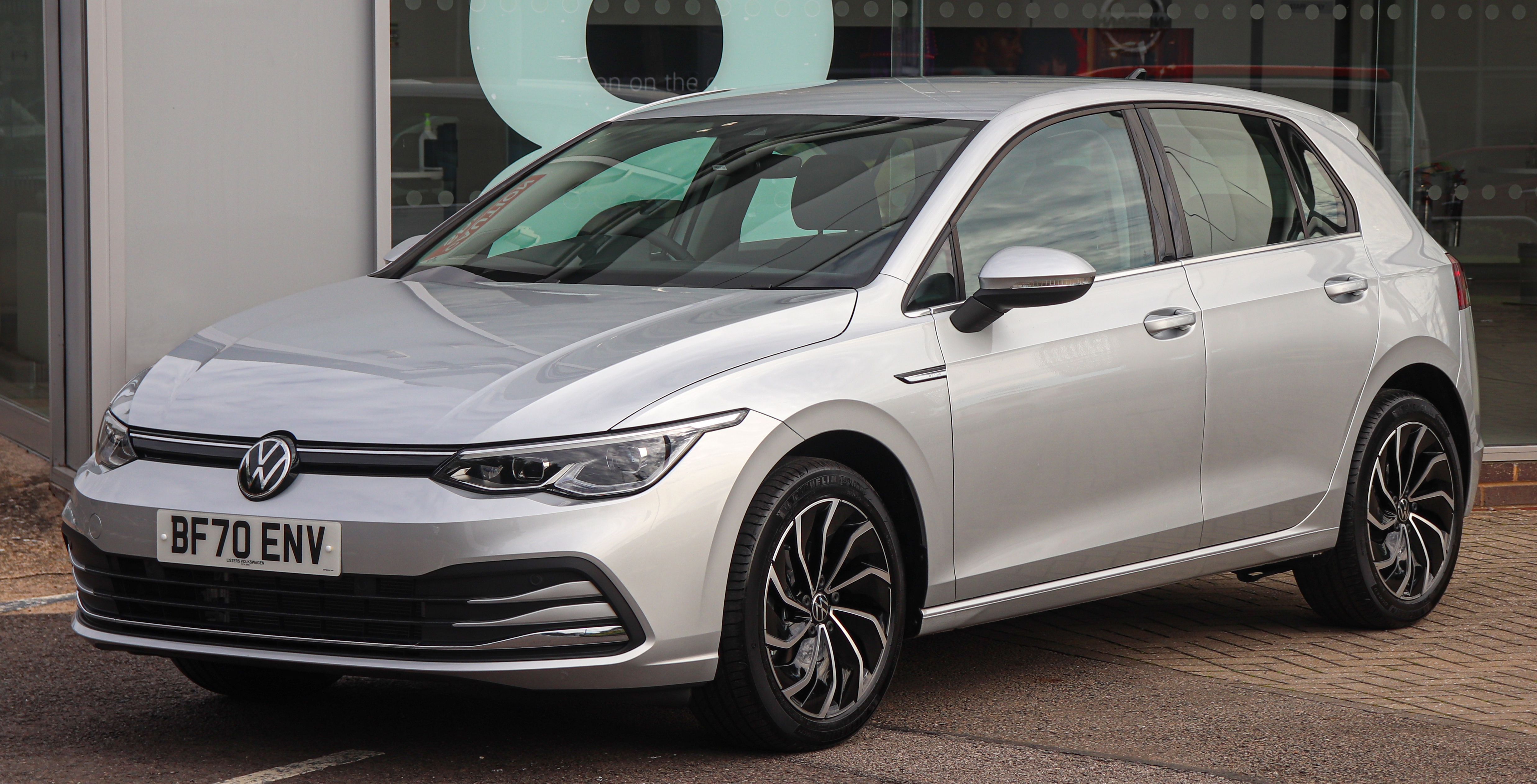
The Volkswagen Golf is a small car made by Volkswagen that has a hatchback design, meaning it has a door at the back to carry things. It is popular and easy to drive.
The Elantra N is a faster and sportier version of the Elantra car. It has a bigger turbo engine and you can get it with a manual transmission to change gears yourself.
Torsion beam suspension is a simple way the car's back wheels are connected by a bar that twists to help the car ride smoothly, but it is not as good for sharp handling.
Adaptive cruise control is a smart system in some cars that helps keep a safe distance from the car in front by slowing down or speeding up automatically. It makes driving on highways easier and safer.
Android Auto lets you use your Android phone safely while driving by showing apps like maps and music on your car's screen. You can control it by touch or voice, so you don't have to look at your phone.
This system puts together pictures from cameras all around your car to show you everything nearby, like a bird looking down. It helps you park and avoid hitting things.
LIVE
Hello, and welcome to the Unnamed Automotive Podcast.
My name is Sammy Hadjassad, and with me as always is my good friend and fellow automotive
journalist, Benjamin Hunting.
Say hi to the people, Ben.
Greetings, springtime listeners.
Greetings to wintertime listeners.
It's still winter around here.
It's cold, man.
I'm just putting the energy that I want to see in the world out into the world.
And right now, it's all about springtime for me.
This is the words and wisdom of my good friend.
Benjamin Hunting, the fact that he is my good friend is far more important than the
fact that he is a very successful automotive journalist.
He's trying to control the weather with vibes alone.
Yeah, he's so successful that in addition to his vibe powered weather control, you can
find his work all over the internet.
Ben, plug some publications.
You can find my work at the Weather Channel.
No, you can't.
The Weather Network.
Are those two different things?
Weathercars.edu.
Come on, be real.
People want to read your stuff.
Motor Trend, Harriety and Inside Hook and Driving.ca.
Let's go with those.
Also, check the weather.
The weather is important.
You don't contribute to the weather as much as you think you do.
I'm going to be clear here.
I don't want to have that conversation.
You can find my work all over the internet, while in a couple of very important places,
AutoTrader.ca and Driving.ca, as well as Driving.ca's YouTube channel.
What about their Vimeo channel?
I don't think it's where I don't think we've published to them in a long time.
That's too bad.
Vimeo is still around, right?
Like it's Vimeo.
Yeah, man, it's not Vine.
Although Vine, I think, came back.
No one uses Vimeo and yet all the Vimeos that have ever been uploaded still exist.
Like, who's paying for that?
Vimeo says 287 million users have it.
I would wager that more than that is uploaded to YouTube every day, every hour.
I don't I'm not on Vimeo.
Should I be on Vimeo?
I've been told that Vimeo is great because it has really good quality.
The only times I've been on Vimeo in recent years is apparently independent filmmakers
put like short films there.
And I don't know why versus YouTube, but it just seems to be a thing that happens.
So that's like every once in a while, I see a link and it's it's to someone's
like 13 minute film and it's Vimeo.
And that's the only time I go back there.
I also have one video on Vimeo from the 2000s of a fish tank that I made out of
a Mac 2 because my partner at the time had a Vimeo account and YouTube wasn't
really what's a Mac to Apple Mac.
Yeah, and a classic classic Mac 2 and I needed to host that video.
And there was no real YouTube in that period.
Vimeo was still like duking it out to be the de facto standard of online video.
OK, OK, I get it.
Ben, we don't usually talk about video publication.
Normally, it's climate and spring time and snowfall.
That's what you think we talk about all the time.
Yeah, I mean, before the podcast, that's all we talk about.
That's what our buildup is.
And after the podcast, after the podcast, usually we get the animometer out
and we talk about wind speed.
What about the pressure?
The barometric pressure?
Yeah, I think it's another kind of pressure.
What about the parental pressure to succeed in life?
It's 2,943 milligrams of mercury and it's dropping.
I do have a weather station on my desk and I'm looking at it.
Ben, we've got to talk about cars because that's what we do on this podcast.
Everyone is tuned out.
It's too late. It's not too late.
It's called the unnamed automotive podcast because we talk about cars
when we forgot what we forgot to name it when we first started it like 10 years ago.
So let's talk about cars.
I want to start this week because I drove a car that we haven't talked about
in a really long time.
I think I haven't even checked the numbers.
Have you checked the numbers?
The numbers on the Hyundai Elantra, Sammy.
No, no, the car I drove.
Oh, the car you drove.
Well, it's too late because we're talking about the Elantra.
Oh, OK.
Wow, I've never been rejected so hard.
That was like some matumbo stuff right there.
You know what happened is I wasn't really listening.
I know. I can tell you were still looking at your weather station.
I was fondly looking at my weather station.
And I assume we were going to start with the Elantra.
The last time we talked about the Elantra, it was the Elantra N.
And that was in 2022.
Four years ago, that same year, we also talked about the Elantra N.
Line, which is what we're talking about today.
So OK, I believe that 2022 was the last time the vehicle was redesigned.
That's not right.
There was a refresh in 24.
Yeah, there's like they changed like the headlights somehow.
Yeah, things got a little different.
But it's still pretty much the same idea.
Hyundai is doing cool stuff with most of their cars
and in a way that a lot of automakers have abandoned the compact car market.
You've got companies like Toyota, Honda and Hyundai, Mazda, I guess,
as well as right up there, they're all still in the thick of it.
And Volkswagen as well, although to a little bit of a lesser extent.
And in that sense, each of those companies, except for Toyota,
I think, offers a high performance compact sedan in this.
And when I say high performance,
I know Toyota has the the, oh, my goodness.
The GR. Yeah, but that's not really it's a hatchback.
So that's more in line with like the GTI and the Gulf and all that stuff.
OK, but there there's the Jetta GLI, which has been a long time,
you know, kind of hot sedan.
There is the Honda Civic Si, which essentially invented the segment
a long time ago, 25, 35 years ago.
And coming into the mix, the much newer competitor is the end line.
It's it's probably the newest of all of them, right?
And I don't really I've never really thought of the end line
as a competitor for the Si, even though that's what it is.
And why? No, I definitely I've always I've always looked at that.
I've always been asked to do like comparisons between Si's and the end line.
But so it is a weird thing to talk about because it just doesn't have
the same punch, I think, as like Si or GLI
or even when Mazda like Mazda three turbo, right?
Like. I love that one.
Yeah, it's it's that that weird period where
every car company decided that their performance line
was going to be represented by a single letter.
Yeah, or some some set of them. Yeah, you had to pick up.
No, it's almost always a single letter, though, right?
Like like Honda doesn't have a performance line.
They have individual performance cars.
Yeah, well, no, there was a time when Kia thought GT was their thing.
GT or GT line.
Kia, what are you talking about?
Kia Forte GT, baby.
I don't know if that's true.
OK, well, there's no like there's no like GT department.
Is there like there's an end division at Hyundai,
but is there a GT division at Kia?
Well, they said some they sent somebody with a stinger to to the Nurburgring.
At least one guy.
I think that GT was more of a trim level.
OK, in terms of marketing. OK.
Do you have a GT jacket?
No, should I? I don't know.
That would change.
So I think it was it was all done, I think, to copy BMW's M.
That seems to be like I think Cadillac did it first with V.
That was their first copy. OK.
And then we have and we have what else is out there
that's doing the same kind of thing.
One letter at a time.
Yeah, one letter at a time.
I guess you could say RS is its own thing.
That's two letters, but that wasn't really a copy.
That's Audi's thing.
I think Audi's thing it grew from trim levels.
Yeah, they had trim levels of the RS,
and then they decided to make RS its own separate deal.
Then there was like SRT.
That's three letters.
SRT actually stands for something, though.
Street racing, street race, street race technology.
But you're not supposed to be racing on the street.
It's two separate concepts, Sammy.
Oh, street.
There's a missing ampersand.
OK, OK.
Getting us back to this Elantra.
Do you have to?
What is? No, wait, hold on.
Wait, I want more.
I want more of this.
What else is there?
Ford had Ford briefly tried to have RS.
Well, Honda and we did Honda.
What about Acura and their Type S and Type R?
Ford had SVT.
Yeah, Type S is definitely a thing.
SVT. Yeah.
But SVT.
And then they changed to ST for a while, remember?
Yeah, yeah.
They still are doing ST.
But it was all under the Ford racing banner, too.
I think for a while, too.
Very complicated.
I hate these things.
I hate the unnecessary amount of sub brands.
It's just marketing.
Just call the thing the sport and be done with it.
Just call it the Honda Passport Sport.
No, it says to be the SPD.
Isn't that the Honda thing?
HPD. HPD.
What is SPD?
I don't know, but HPD is an unfortunate acronym.
It's awful.
Almost as bad as Super Roost.
Yeah, Super Roost, STI.
And then they have these other ones.
What are they called?
T.S.
Oh, that's but that's just a subset.
It's tuned by STI, right?
Like I hate these things.
It's an end line.
I don't even know.
I don't even know what we're doing here with this end line thing,
because I think you can get end line trims of the Tucson.
Are you used to it?
Yeah, it's because it's similar to like the M line.
Isn't there like an M line for BMW or is M Sport?
M Sport, M Sport and and that's it.
That gives us things like the M340.
Yeah, you know, and the M50 and the M70.
These are not so sad.
I know exactly what the cars are related
to the roof engine designations.
So where it works with the Elantra is the Elantra
is already a pretty interesting looking car.
It's definitely not boring.
It's definitely not just wallpaper,
which a lot of compact cars were for a very long time.
And then in the 2010s, they suddenly remembered
you could design an interesting looking car that was cheap to buy.
So the Elantra is cool to look at.
The Elantra N is more aggressive to look at.
It kind of has more sharp edges than the regular Elantra.
There's a different bumper, different wheels,
different bumper at the back.
I think there's also there's these twin exhaust tips
on one side of the car, which I think is a little ungainly.
It's the only part of the end line treatment
I don't particularly like.
OK, but inside the car, it looks pretty good.
You have red red piping at all the seats on the dashboard,
on the door cards.
Everything else is black, monochromatic, plasticky,
not plasticky in a negative sense, just what you would expect
from like a car at the price point of the Elantra.
But the seats are nice and the red really does spiffy things up.
But the rest of the interior is very it's very Elantra.
You know, so we're we're we're walking the line here
between an actual high performance car and a sporty compact car.
Well, no, I think that's exact.
It's a sport compact without being a high performance thing.
Something changed.
I mean, I think a long time ago, the SI was seen as the high
performance version of the Civic and then because we didn't get the type R here.
Yeah. And then like Si, I think we call it the Si R
or the type R at some point in the in the early 2000s.
Kind of came and changed that.
And then there was a bit of like a in arms race.
There was like the Mazda speed torque steer thing.
That thing was torque sear central.
And then there was like really high performance cars like the Focus RS,
the Golf R and they like really pushed this whole category.
So I'm totally comfortable calling this thing a sport compact
in the ultimate way.
This is a it's not a hot hatch or whatever because one, it's not a hatchback
and to, you know, I would call like a Golf R.
And I did never made a hot hatch, right?
Like they had the Veloster N. Oh, you're right.
I'm sorry. I was thinking Elantra with the Elantra Touring.
Oh, yeah. And they made a more fun version of that.
I think it was actually called the GT,
but it didn't have any drivetrain upgrades.
It was essentially a suspension package from what I love the Veloster N.
There's I think two in the neighborhood near me and I can always hear them fire up.
And it is a super cool car, just like the Elantra N is a super cool car.
These are fun vehicles.
I think the Veloster N was like super affordable when it came out, too.
Wasn't it? And there was also I want to say a Veloster
Turbo that was before the end came out.
That was pretty cool to drive as well.
And I think that that engine in the Veloster Turbo,
I think what's in the Elantra N line is an evolution of that.
Yeah, I think that's right.
It's like near 200 horsepower.
Yeah. So the Elantra N line, sorry,
has a 1.6 liter turbo with 201 horsepower.
Yeah, it seems like the same output as like the 1.6 we've had for the past 10 years.
It's 195 pound feet of torque.
Yeah, that's a pretty big boost over the regular Elantra.
I want to say it's like 55 pound feet or something like that.
Pretty good. Yeah.
And and 30, 35 horsepower more.
It's it's it's not nothing.
It's a front wheel drive.
The car comes with my car and I think all of them.
Seven speed dual clutch automatic.
I don't think there's a manual available for this anymore.
I think you have to get the Elantra N to get the manual.
And the Elantra N has like a two liter, 276 horsepower turbocharged four cylinder.
So it's a very different beast.
But this car is not bad to drive.
The other I've already talked about the engine being different.
I've talked about the styling.
The other key difference for this car is it has a multi link rear suspension.
Oh, OK.
All the other Elantras are torsion beam.
So that will make a difference in handling.
It can sometimes be a difference of degree because you can really do a lot
with a torsion bar, but a torsion axle is really it's a cost cutting measure.
It's an affordable thing to build.
It's more comfort oriented than handling oriented.
What I found about the Elantra was body control is pretty good.
I have a couple of roads around here that has some serious corners
and some up down action and the vertical control.
Sometimes the car would like really like move up and down,
but it would stay planted to the road in the sense that like that motion
didn't disrupt its stability. OK.
On this at the same time, the stiffer suspension on the Elantra
N line, it's sometimes I was worried that I was getting like three wheels
off the ground over bumps. Wow.
You really feel the bumps in this car and frost heaves and whatnot.
Driving normally, it's there driven aggressively.
It's like amped up by a factor of five. Interesting.
But the handling is fine. It's pretty good.
That sounds a bit too harsh.
Well, it is a definite difference.
Like this in the US,
pricing is weird for the the Elantra.
There is a model called the limited that is more luxurious
in the sense that it has like adaptive cruise control
and Hyundai driving assistance and like, you know, the hands hands free
lane change, I think, and all that stuff.
Maybe not the lane change, but like it has the the lane following.
That's not available in the US on the N line, but the N line is like $2,000 more.
So in Canada, the N line gets all of that stuff.
It gets the safety gear.
So that's that's a big difference between them.
And when I was looking at these cars, I was like, if you're going to be a computer
and you decide one of the cool things about stuff like the Honda Civic Si
is you can drive it every day and it doesn't beat you up really.
It's pretty normal to drive.
But for the Elantra N line, there is a sacrifice to make in terms of
of the comfort, I think, and also the features,
like the fact that you can't get this particular adaptive cruise control
or any adaptive cruise control in the wild.
So you're going to have to make a choice.
I'm not into the I don't know if I like that much of a.
Yeah, in Canada, you don't have to make that choice.
But in the US, you do.
And I think that is strange.
I want to I want to ask you a couple of really quick questions.
I believe in the past, the Elantra N line also dumped the
like change the transmission from a CVT to a dual clutch in.
Yeah, I mentioned that it has a seven speed.
Yeah, it's an entirely different drive train from the Elantra.
So and that feels OK.
Like it like Hyundai's had like some hit and misses with its dual clutch.
So the transmission is, as you said, OK,
it doesn't shift particularly quickly.
It will lock you out of very aggressive downshifting.
And there's a lot of rev hang.
Interesting, pretty much all the time.
And it will also automatically shift for you in manual mode,
if it thinks you're not shifting fast enough.
So there's a lot of protections built into the drive trains
that you don't like hurt yourself or incur a warranty repair of some kind.
OK, so that like starts moving it out of like
the upper tier of of like a sport compact.
Because it's nowhere near the upper tier of sport.
I mean, no, no, before we get into before we get into like hot hatch,
like like near like that 300 horsepower level of of hot of like
performance compacts, I would say, oops, I would say that
you need to make sure that the power train is really responsive
and engaging it plays with you.
And the ride quality is is more engaging than the the mainstream.
I find that this car is just the side of engaging when it comes to the drivetrain.
The chassis is good.
It's it's a good it's it, as I mentioned earlier,
I thought the handling was was, you know, above average, for sure.
But the drivetrain is not really fun.
It sounds like a vacuum.
That's too bad.
It has like the overhang, the hang, the hanging ribs, excuse me.
And the transmission response is so so.
It's also a little weird.
There's a big drive mode button on the left of the dashboard.
How big are we talking about?
Like the size of a coffee cup lid?
No, what?
It's on a little coffee cup lid, like platform.
And in the middle, there's the button.
OK, and that puts you in sport mode.
But there's also a sport mode for the transmission.
Oh, yeah. Is this BMWs thing?
I don't know.
But because BMW, you need to do like German car companies love this.
It's not quite that complicated.
But the sport mode for the transmission
lets you shift by tapping the shifter up and down
instead of using the paddle shifters.
Whereas you can, if you put it in sport mode,
you can just use the paddle shifters.
It's a little confusing either way.
Like acceleration is fine.
It's just not it's not a fun drivetrain.
And I really think they could have done a lot better with the exhaust note.
Like it's essentially not existed.
What you end up hearing is a lot of turbo noise
and that's not super pleasant.
I want to talk to you a little about that, about that.
Later, there's like a really weird line
as to what constitutes a like a sport T, a sporty car.
And it has to be like still usable for like the everyday drive.
I don't know if you've ever driven this car.
I drove this car a few years ago and I think they've removed it since.
It's called the Toyota Corolla apex edition.
I didn't drive the apex edition.
I don't think but I drove the car that came before it.
That was also a hatchback.
Was it harshest? No, the apex edition was a sedan
and it was the hardest riding car I've probably driven in so long.
It was so unexpectedly harsh that I thought something was wrong with it.
But that's what Toyota's approach to a performance
a performance oriented version of its compact car.
No drivetrain improvements.
I think it was a manual only and it was just
this super stiff, really uncomfortable car.
And I was and Toyota was like, here you go.
Here you go, enthusiasts.
We've got you.
And we were like, how am I back?
I the one thing about the drivetrain that was impressive
was the fuel mileage. OK, I got 30 miles per gallon
average during my entire week with the vehicle.
And that includes some really aggressive driving and it was cold.
So interesting.
That's seven point eight liters per hundred kilometers on average.
It's that's higher than the I believe that the factory rating
from the vehicle is thirty one miles per gallon combined.
And at one point on a cold day on a test lift that I run, I saw thirty three.
So wow, I have no idea how that's possible.
And with a DCT rather than a CVT.
Yes, so it's it's very it's either underrated from the factory
in terms of fuel mileage or I had a freak car.
But like that's impressive.
I think that's that's a really good job on Hyundai's part.
So that's the that's the one commuter friendly aspect of this vehicle.
And I guess also the drivetrain doesn't beat you up when you drive it.
Like it's not it's only the suspension.
Like the drivetrain isn't difficult to drive at a normal pace.
So then we're looking at a car that is like one of the things we talked about
in the past when it comes to this like level of performance in a compact car
is whether or not this is a engaging car or just an opportunity
to like also sell you all of like the premium features and stuff.
So obviously, this one doesn't come with all of the tech, especially when it comes with
it doesn't Canada, but not in the US.
Yeah, driver assist and stuff.
So it feels a little bit more authentic in that way.
No, it's not an engaging car.
It's it's just like a high performance.
Yeah, it's the it's the most higher.
Yeah, the most powerful engine you can get in an Elantra before buying the end.
I think that's how you have to look at this.
So but the end is a totally different.
So like, what is the point here?
You go you go into the Elantra, you go to the hundreds.
It's affordable.
You drive the Hyundai and you say, this is cool.
What's a bit boring?
They go, well, here, this one has a little bit more power and is and the steering is the point is
it doesn't cost you a lot of money.
It's like thirty one thousand dollars.
And then in order to get to the end line, it's another ten or something.
I'm sorry to get to the the actual end.
I'm sorry is how much more I don't know.
OK, I wasn't comparing it to the end because they're not comparable vehicles,
but they have the same letter.
The the base Elantra is twenty four thousand.
So it's like a seven thousand dollars stretch that covers like eight different trim levels.
OK, in Canada, the pricing for the end line is a little bit more expensive,
although it's in keeping.
Actually, it's it's cheaper again.
If you look at the the exchange rate, it's thirty five thousand and the base Elantra is twenty five.
So you have a ten thousand dollars spread here.
Again, that's not a lot of money for a car in Canada.
That is well below the average transaction price.
And there are no options on the car.
So it's not like you can push the price that much farther.
So like if you want a stylish car with a stylish car that you can afford
with a nice interior, comfortable seats and two hundred horsepower,
that's I think what the end line is offering you.
It's not going to be.
I haven't driven an SI in a while.
I don't think the car is as engaging as the SI's I've driven in the past.
But for some people, that might not matter.
I think the SI is still a high watermark for sport compacts.
It's a little bit more like.
Premium than in previous previous versions in which like there's more like a tech
heavy or or feature or like I think in the US in particular,
I think it comes with like fancier seats in different wheels or something like that.
And there was another car that I used to really enjoy driving.
It was the Mazda three, the turbocharged model, super fun.
But I guess that's that's pushing it in terms of price and performance.
Yeah. And also not really.
I don't think it's aimed at the same buyer.
I don't think it has the same kind of extroverted styling.
Yeah, that's a great point.
It really they've really changed that that sort of feel at Mazda.
There is no like the enthusiast heavy thing.
It's not a 250 horsepower car.
Yeah, maybe you're right. That's a lot.
So that's pretty much all I have to say about the Elantra and line.
I think it's worth taking a look and seeing if you can deal with the
rougher, the rougher slash differ suspension.
But it's it's I'm happy that cars like this exist, that someone's doing this.
Hyundai doesn't have to do this.
You know, I'm sure they sell way more other Elantras than they do and lines.
So it's it's not necessarily a huge profit center for them,
but they wanted to be playing in that space.
And and so they decided to do it.
I want to transition this conversation to the car that I drove,
which was the 2026 Volkswagen Atlas.
I think we should we should first point out that I believe later this year,
Volkswagen is going to introduce a new generation, a new version of within a month.
That's going to happen, dear.
So I've been driving this this, you know, last of its kind, I guess.
Lame duck Atlas.
Yeah.
And I think it's really cool to talk about the Atlas because
I frequently said that the Volkswagen Atlas was a refresh away
from being a really good product.
And now it's had that refresh.
And were you right?
I feel so it's so close to being good.
It just has one glaring problem.
And it's the same problem we've talked about in the past
when it comes to other Volkswagen's.
It's an over-reliance on touchscreen technology.
And that touchscreen, it's OK.
It's responsive and stuff.
But like you really have to get used to operating so many things
with that touchscreen and the touch buttons around the touchscreen.
So I found myself accidentally, even like the sunshade is a touch
sensitive button, and it's also next to a bunch of other touch sensitive buttons.
And so in order to try to brace my hand to touch this thing,
I accidentally called the concierge.
Wait, what?
OK, Volkswagen concierge.
When you call the concierge, were they able to activate the feature for you?
No, I was panicking once I heard the phone ringing.
I'm like, hang up.
I'm not trying to do this.
I'm trying to close the the sunshade and same thing.
Like when you're just trying to change like an app on on Android Auto,
you end up accidentally and I don't know.
Maybe it's because I live in a city right now
that has some of the worst potholes I've ever seen and I'm just like bouncing around.
I'm like, I've got to put my hand on something while I'm using this touchscreen.
Yeah, we have to hire.
We knocked a tire out of alignment on the out of out of bounds,
sorry, on the outback last week and broken axle on your personal outback.
Not the 26 26 27.
That's yeah, the potholes are awful this year.
So I'm like maybe just more often than not, I'm just holding onto
like a part of the car to try to adjust the touchscreen.
But it's it's awful.
Even like you need a stick, you need a touch sensitive stick
so you can do it from the without having to move from the driver's side.
But then just the touch, the touch out the aiming of like your fingers
onto a touch screen or touch sensitive panel is lame, right?
It just doesn't work.
You know this thing to me.
There's a there's a wand.
OK, and there's a there's an elastic that comes from the ceiling
and it like puts tension on the wand and then you can
kind of like a puppet, but it's just for the touchscreen.
OK, I'm saying. Yeah. Yeah.
No, this problem.
We we haven't solved the problem.
I think there's a safety concern with a wand floating around.
No, no, no, it's a it's a it's a rubber wand.
Is that better or worse?
I don't know. It's easier to clean.
You know, now.
Even like things that I thought were pretty like normal
fun like processes were really like cumbersome to me.
For example, this is a big car.
It's a three row crossover and I want I know that it has a surround
view or three hundred and sixty degree camera system.
I want to see how close I am to the end of my garage.
So I usually in most cars, I find the camera button.
I look at the forward facing camera in front of like where they were like
the bumper is and I can see how close I am.
I'm usually there's just like a camera button, right?
I mean, you can do that because to me, the front facing camera
is just like a fun house mirror view of the world around me.
No idea worse in the winter would have just covered in like grit and fan.
There's no perspective that tells me how close I actually am to something.
Well, I'm getting used to it.
But in this car, I was really.
Perplexed as to how to how to find it.
Like, because I know when I go in reverse, there's cameras everywhere.
But if I want the specific front facing camera while driving forward,
I had to do some sort of rigmarole, touch the screen a couple of times.
I can tell you how to get it.
I can guarantee you all you have to be doing is entering in a address
into the navigation and the front facing camera will pop up and wipe that away.
Why? Why do you think that?
Why? Why do you think that will happen?
Because it's any time I'm every time I'm trying to do something
with an entertainment screen, I get a camera view out of nowhere
that I don't need and that no one needs at any point.
And it's no one is the one car that I used to laugh so much.
Was it a Mercedes CLA or a class, which every time you came up
to the to an intersection of traffic light
would activate the front facing camera.
So you can see the traffic traffic light view and you're sitting there
like, no, this is the ideal time for me to do something on the infotainment.
It's like having a smaller windshield that just gets in your way.
That takes up your infotainment screen.
You can't do anything at this point in time.
OK, anyway, so the way I found out is you press the parking assist button,
which is usually used for like automated parking,
like perpendicular or parallel parking.
And then you have to press a parking sensor button.
And then you get this little like the sidebar of the car's top profile.
And then you have to click on the nose of the car or tap on the nose of the car.
And then you'll get that screen or you put it in reverse.
That shows you all of the cameras.
Then tap the nose of the car, then put it back into drive
and that won't get rid of the camera.
It's a really we just put a button for the camera.
Like, what's the hard problem?
Why is this so annoying?
Did you try voice commands?
Oh, no, I should have.
I really should have because every time I said Volkswagen,
this thing would pop up and be like, what do you want?
And I'm like, nothing, I'm trying to do a video here.
It was trying to offer you that camera view and you just slapped it away.
And that's why you couldn't get it ever again.
It was like, no, sorry.
Now you had your chance.
I want to be clear.
This is the major issue with the Atlas and possibly the only thing
that would stop me from recommending it.
In fact, I barely I'm barely on that line of not recommending it to somebody.
If this infotainment system thing works for you, this is all you need to do.
You just need to test this infotainment system
because the rest of the car is actually really solid.
It is super spacious.
In fact, I believe it has more cargo space than the the Hyundai Palisade
that we talked about a few weeks ago.
I think it has more passenger space than something like the Toyota Grand Highlander.
It is a superbly comfortable, practical, spacious SUV.
I'm I'm amazed at how at how this thing has kind of like slipped under the radar
after all of the the hype that the Korean cars got in terms of how spacious they are.
This thing really delivers in terms of interior space.
I was really happy with that.
Even the third row, I can put my knees, you know,
my knees don't touch the the seats in front of me when they're in a comfortable position,
which I think is really rare.
Usually like rear third row leg room is like non-existent in these in these three
row crossovers. No, for sure.
But this isn't the case.
The other thing that I really think is worth talking about is in the cabin is that it kind of is.
I don't want to say it's lacking in features.
It just doesn't have any of the weird gimmicks that other crossovers have.
There's no like PA system.
There's no in cabin camera view.
There's no ability to like modify the second row or third row seats from the driver's seat.
There's none of like this weird stuff that maybe you'd be looking.
You'd find in in a in a fully loaded Palisade.
So if those things really stand out to you, if you think that that kind of tech really changes
the driving and ownership experience, then yeah, maybe that's why the Atlas is kind of.
Fallen off.
Speaking of weird stuff, I just took a look at Atlas sales statistics for 2026
because they're 2025.
Sorry, I just want to see like how many they're selling.
That's not the weird part.
They sold seventy one thousand, which is down like from seventy five the year before.
But it's the best selling vehicle that Volkswagen has other than the Tiguan, which sells seventy eight thousand.
So they're both in the under eighty thousand dollar under eighty thousand units.
Yeah, except the Tiguan sold ninety four thousand the year before.
So that's a pretty big job for them.
But why I'm bringing this up is because the Volkswagen ID buzz.
Do you want to guess how many units they sold in the US last year?
The electric van under twenty thousand six thousand one hundred forty.
I was gonna say even under ten.
That is that is just barely less than the GTI, which was seven thousand two thirty five.
But it's double the Gulf R, which was three thousand three nineteen.
But the one statistic that is the most bizarre out of this entire thing.
Volkswagen sold twenty four.
Sorry, twenty eight Arteons last year.
Did you know the Arteon was still available?
I don't think it is.
Did you know they sold five of those in the fourth quarter?
Oh, or four.
There is not.
They don't have the Arteon on their on their on their website.
It's down ninety seven point eight percent year over.
Yeah, they sold a thousand of them in night in twenty twenty four.
I it has to be old stock, right?
Like it can't be.
It's not like a twenty twenty five Arteon.
I don't know what kind of deal you can get because they're not bad cars.
What about ID fours?
Are they not on the list?
They are, but it's not.
It's not an unsurprising number.
It's twenty two thousand, so I didn't bring it.
It's actually not bad at all, actually.
It's gone up from they've got a thirty one percent.
Something I want to talk about the interior that is positive, that is further
and positive is the gauge cluster.
This thing has one of these digital virtual cockpits.
I was not listen, virtual cockpit.
I was I didn't know your game as as good as they do as I do now.
There are three panels, essentially, of it.
There's like a center panel and two
like panels on the left and the right.
They're totally each one of them is customizable.
You can even have all three of these panels display the same thing.
I can make them all have a compass on it.
Totally totally silly thing.
But the fact that you can customize it to such an unnecessary degree
really stands out.
I love it when a car lets you like here's, you know, all of the things we can do.
This is it.
And the Atlas lets you do that.
It's a very good digital gauge cluster.
And in addition to that, it also comes with a head up display
because I had the range shopping model in the U.
In Canada, it's called the exec line and costs around sixty five thousand dollars.
In the US, it's called the SEL premium R line, which really rolls off the tongue.
Yeah, everyone looking for that SEL premium R line.
The thing that really I was worried about when I picked up the car is that I learned
that from now on, the Atlas, this three
low, this three row version of the Atlas will no longer offer a V six,
which is weird to me because the V six was like my favorite part of the old
always complain about the V six in like the pilot, for example.
Yeah, because that one did not feel good.
Like it just doesn't feel it feels like
it just does not feel responsive in the pilot.
But in the Atlas, it did.
I thought it was a really good six cylinder engine.
So I was concerned how a two liter turbocharged four cylinder engine
can really be matched to a to a three row crossover like this.
And I was I was off, man.
I think that this this four cylinder feels really solid.
It's paired with an eight speed automatic transmission.
The output is 269 horsepower and 273 pound feet of torque.
So not that bad.
Yes, can we all agree that eight speeds is the ideal number of speeds
in an automatic transmission?
You like the eight speed?
I don't think it's been bettered.
I don't think like a nine speed is better or a 10 speed is better.
And what about a seven?
No, seven is just weird to me.
It's like seven seven feels like an afterthought.
Like they're like, here's an extra gear.
Yeah, you know, but eight you think they put more thought into.
I think the spread is better.
I think the gearing in this car is perfect.
The ratios are really, really good.
However, I feel like there's sometimes when the when the transmission
can like gear up a little too early, like or and not gear down when I needed to,
especially in like like curves in the in the back roads.
Like when we shoot videos, we end up doing them in these like fairly
rural areas with lots of like curves and stuff.
And I didn't think there were curves in Ontario.
There's few.
There's very few of them.
And I am always so surprised that like throttle on through this curve.
The car is like in the wrong gear entirely.
And I'm like, what are you doing?
You've got eight. You've got eight years to choose.
What you've done is you've activated stolen car mode because no one
no one would ever like hit the throttle mid corner in an atlas.
And well, like throttle exit, I mean corner exit.
So it knows that it instantly limps.
The other thing that I found very interesting about this four cylinder
is that as a whole, the powertrain is rated to tow five thousand pounds,
which sounds like a lot for a little four cylinder to do.
But it all adds to this sort of like practicality appeal that the Atlas can
deliver. I was really impressed by this.
I just wanted to overall say that
it was much better than I was than I was anticipating.
I truly think that this deserves to be mentioned alongside
the Kia, the Hyundai and the Toyota Grand Highlander.
I think you and I have both talked about the pilot and the CX-90 before,
which are also in this class.
And I don't think those are quite.
Like overwhelmingly easy to recommend cars.
But I think about the Acadia and the Traverse and whatnot.
Yeah, the Traverse, actually, it doesn't get enough credit either,
because it's just not fancy, I think.
But I like the I like the Traverse, especially if you can get it with super
cruise, like basically any GM that you can get with super cruise immediately
puts it near the top of my list.
It could be like the most the slowest thing ever.
But anyways, in the US, you would get this car for about
you can get it for as little as $40,000, $41,000.
And then the range topping model that I had was closer to $56,000.
It's an OK bargain.
And it just doesn't what I like about that is it's not much,
much more expensive than any of the rivals.
So I think that the price range is really usually Volkswagen can like,
oh, you're getting a German car, so it's a little bit more expensive.
And that's just not the case.
I think it's right in line with the rest of the competition.
And I was pleasantly surprised.
I think I actually think that this car is very good.
But you have to deal with that infotainment system.
And you have to deal with the fact that like next month,
they're going to depreciate the value of this 26 model by introducing a 27.
So maybe wait and get it on sale.
Yeah, the rumor is I don't know if this is true or not.
But they've in last year, I went to the LA auto show to I think it was last year
to see the reveal of the new Tiguan, which is really, really pretty, really cool.
And lots of technology.
But they in an interview, they announced that they are very likely going to be
bringing hybrids and in-house hybrid technology to the
the next generation Volkswagen Atlas.
And so the new general, the new gen Atlas is coming.
So I would expect a a hybrid technology, a hybrid powertrain to come to this thing.
But that and first of all, all of its competition will the best of its
competition have a hybrid powertrain in terms of the Palisade
and the Toyota Grand Highlander.
But those cars can be much more expensive because of those powertrains.
So there goes like the Volkswagen's kind of like price to price to performance
like asset, if the price goes up with this hybrid powertrain.
So and also a new like first year of a new gen with a new powertrain
sounds like a recipe for some long term ownership headaches, right?
Is there anything else you want to talk about with the Atlas?
No, much it needed this this refresh.
It got it. And I think it's a surprisingly decent three row crossover.
So there's one last little thing I want to talk about on this big episode.
And that is some news that came out about Honda actually today,
just before we were recording Honda. What happened?
Well, they had planned to release a trio of electric vehicles
that were being built in the United States.
And these things were essentially finished and ready to go.
We're talking about the zero. What are they called, Sammy?
Yeah, I think they're zero.
Like the zero series. You know the series. What's what's it called?
Aren't they called the zero series?
I don't think that sounds weird.
But in any case, it was like two fairly out there in terms of styling
electric vehicles, but then a more normal ish RSX replacement for the for Acura.
It was going to be a electric crossover.
These three vehicles are now canceled, not only are they canceled,
but Honda is going to take a seven and a half billion dollar loss
a write down on the on the investment into these platforms.
Moli Moli.
And the executive who's writing the program,
I don't know if it's the CEO of Honda or whatever,
they're taking a pay cut to go with this for at least a period of time.
So zero saloon and zero SUV, which were unveiled at CES 2025.
We we've we've known these things to be coming for a really long time.
And these prototypes have been seen out on the road driving around.
And people have been driving.
People have driven, I think, a cord with this power train.
I'm not sure. I've read.
I have to assume that this means that the Sony, a Fila.
Oh, yeah, of course.
They forgot that they even had this whole thing being built in partnership
with Honda. That's going to be dead, too.
But I want to just mention or is it because that's like a niche vehicle.
They're probably going to make like 14 of them.
No, I think I think this would have been niche anyway.
Anyway, the point of this is the reason this is happening
is because of the changed regulatory environment in the United States,
which is being perceived by car companies as incredibly hostile to electric vehicles,
just in the sense that there's no more incentive from a tax perspective
for people to buy the cars.
There are loosening restrictions on fuel economy.
And I assume emissions is coming with that.
And what appears to be happening is some automakers in the U.S.
market and these were going to be built in the United States.
So tariffs would not have applied to Honda here.
But what would have what's happening is companies are doubling down on gas
because in a short sighted, please the shareholders kind of way.
It seems like the cheapest thing to do for them.
In a real world sense, though, what I what I think is happening
is we're seeing the very first in the first examples
of how the American market is going to become an island of internal combustion
in a world of electric vehicles, because the rest of the of the world,
Europe, especially, and Asia, especially,
are moving towards battery powered vehicles at a rapid pace.
Let's be clear, though, this Honda, this Honda story of these zero series
being canceled is just the latest because the Ioniq six in the U.S.
is being canceled, but not in Canada.
The that's because of where it's built.
The Nissan Aria as well is no longer going to be like produced going forward.
Chevrolet Bolt is being and Chevrolet Bolt.
Those are three mainstream relatively good EVs.
Now, the bolt is being canceled because GM can't build the envision
in China anymore because of tariffs and they need the plant space in the United States.
And they decided that, well, you know, we're going to have a single model year
EV because these envisions are more profitable, I guess, to build.
The bottom line, I think, is car companies are not good at planning
for the long term, especially when it comes to profit.
So if a car company looks at the market and says, right now,
it's going to be hard for us to make money selling electric vehicles
in the United States, even if 10 years from now,
it will be the de facto standard or it will be normalized to the point
where it will be profitable for us.
And GM is already profitable on Altium.
They've already talked about that.
So instead of making that long term plan,
they're like, no, shareholders demand increased value every single quarter.
So we have to focus on the ICE vehicles.
It's going to be a big problem.
I think that like you can't isolate a market like this and remain globally
competitive because car companies around the world that aren't primarily
serving the US market will be continuing to have a diversity of power plants.
Just make the Tesla like the de facto American EV, like that's it.
I don't even know how Tesla is going to move forward because I don't know.
There are companies that have decided to stop buying credits from them.
And that was their primary business was selling the the eco credits to
ICE manufacturers.
The other dimension to this is you have to wonder about Honda
because Honda does not have an EV, right?
No, no, no, nothing.
They were licensing GM.
Now they're not doing that.
Even Toyota has gotten on the EV bandwagon and they hate battery powered vehicles.
Well, they're dragging Subaru into it, which is my favorite part of the whole process.
But they're doing it, right?
So all the things I just said about American market facing companies
being left behind potentially by the rest of the world.
Honda is in a most the most precarious position out of all of these.
Mazda, too, maybe, but Mazda is a tiny company.
And I'm not super worried about them because like it's a different situation.
I think like Honda has a large presence in the United States
and a pretty large presence globally, but that's not written in stone.
There's nothing about them that says that they will continue to be a major manufacturer.
If they avoid electric vehicles altogether,
is that really a viable thing for Honda to do?
It all depends.
I mean, they want they need to make money in order to to, I guess,
maybe grow product in some way or another.
I don't know.
I don't know if this is the process that they need to do that by cutting their losses
on on this investment of EVs, which is insane.
It seems like it was like nearly finished.
And let's be clear, they sell EVs in all sorts of different markets.
Some are Chinese joint ventures, I guess.
Yeah, I don't think Honda has an internally developed electric vehicle
that's on sale anywhere. Hmm. I don't think so.
I don't know, but I don't think so.
I thought they did the or they those really cute EV.
Honda. Oh, the tiny little city thing. Yeah. Yeah, that's it.
That's true. It's called the N one or something like that.
I just called it the E. That's what I noticed. OK.
That that's a specific.
But it's out of production now.
Was that specific to the Japanese market?
And Europe, I feel like what you said about them worrying about cost.
If you take a look at nearly every company that's gone in big
on electric vehicles over the last 15 years, they all had a situation
where they were losing money on vehicles and then they stuck it out
and they became profitable, except for maybe Ford.
I don't know if Ford was ever able to really become profitable
with vehicles like the Lightning pickup.
But GM became profitable.
I would think BMW is profitable on its EVs, because I don't think
they're small enough to absorb huge losses.
And Hyundai is definitely profitable on electric vehicles.
And they all they went through that pain period
because they needed to build market share.
Honda is not doing that.
I can't believe that they're killing these.
And again, it seems like at three cars, for sure,
that are relatively mainstream in the RSX, the the SUV and the zeros
were not mainstream. They look wild.
They look wild, but they would have been.
They wouldn't have been like a hundred thousand other cars, you know.
No. Anyway.
You know, to kill them before they even have a chance.
Seven and a half billion dollars down the drain at that.
How much worse could it have gotten?
You're going to how much are you going to have to spend to catch up to yourself
five years from now?
If the market takes a turn towards electric vehicles that you didn't see.
Now, here's what I do know about Honda, is that they're planning
on delivering hybrids in the near future.
So now they're finally going to catch up to Toyota in that kind of
potentially catch up to Toyota.
They've been half. They've had hybrids a long time.
You know, we've had the hybrid Civic and the Civic and the and the CRV
and the Accord. Yeah, they're actually pretty good.
But now we're going to get we're going to get a V6 hybrid.
Oh, well, that that's right up your alley.
I don't know what to say, man.
It just feels like a stunning thing to do.
And I think that sometimes we give car companies too much credit for planning.
And then something like this happens and you realize that a very large
organization can make mistakes and sometimes those mistakes can have
super huge consequences down the road.
We're looking at Stellantis right now, right, which is a car company
that has not invested in new product in a long time.
How can you say that they have invested?
They just don't know what they're doing.
Like that Daytona, whatever it's called,
the Hornet and the the new like, remember, they were going to have a ram
that was going to be the Hornet is not new product.
It's something that came from Fiat or Alfa Romeo or whatever.
The Ram never existed.
They have Chrysler sells one vehicle.
Dodge sells two vehicles, kind of.
I guess the charger and the Durango.
The Durango hasn't changed in 15 years.
Is this Daytona not a product anymore?
The electric vehicle, I think it's gone.
But there's a there's a gas version coming or there is a gas.
I said the charger.
Oh, sorry. Right now.
Yes. Yes.
So they have not invested in new product.
You can't have two vehicles in the showroom and claim to be a full line
automaker.
Is Honda going to be in that situation with electric vehicles five years from now?
I mean, it could be a game plan that we're just seeing repeat itself.
I know it seems impossible because Honda is like, oh, they're known for
engineering and all this and they have a large base in their home country as well.
But you don't know what's going to happen.
I'm I'm not sure that they are.
I think that they will survive because they have bigger.
They have bigger markets than the US.
I mean, the Atlantis theoretically has Europe as well with Fiat.
Theoretically, yes.
And I think that in many ways.
That's a very interesting concept in that what used to be a really big cash cow
for them in America in America and a dependable market is now changing
changing to them in a couple of ways, especially in terms of, you know,
what new product you'll bring to them.
But it does seem like you're right.
The American market just really wants to stick with this internal combustion
engine thing. The V8s are probably coming back.
It's just it's an instability.
And when things are unstable, you can't plan, which I don't understand.
I want to understand the war that's happening in the Middle East now.
Can impact or probably will impact oil prices.
And it already has.
It's close to $100 a barrel, especially in North America.
You know, and these are the kinds of changes that will potentially push people
towards hybrid and gas products or at least efficient products.
And, you know, if Honda had an EV to answer to to answer those problems,
they would be able to, you know, sweep it up, right?
In any case, if you have any thoughts out there about Honda's EV problem
or what we perceive to be Honda's EV problem or any other things
that you want to talk to us about, you can reach out in a number of ways.
The easiest thing is to go to unnamed automotive podcast.com
and fill out the contact form that's on there that ends up directly in our inbox.
Or you can email the old fashioned way Benjamin at Benjamin hunting.com
or you can Pester Sammy on social media.
He's on Instagram. He's at Sammy underscore.
Ha, like you're laughing.
I love it when people head on over to our website, unnamed automotive podcast,
because there's a list of all of our previous episodes.
There's probably 10 years worth of previous episodes to listen to.
I think that's crazy.
Don't you think that's wild?
It's a lot.
You can see previous episodes.
You can subscribe to the show using some buttons at the top.
And what else can you do?
That's pretty much it.
Is that the purpose of the website?
Still pretty good.
Anything else you want to talk about?
I think we should tell people what we're going to be driving next week.
Next week, I'm going to be talking to everyone about the Genesis GV 70,
the gas version this time.
And I GV 70.
GV 70. Very cool.
I'll be talking about the Volkswagen GTI.
All right. Thanks for listening, everybody.
See you later.
About this episode
The hosts dive into the 2026 Hyundai Elantra N Line, highlighting its sporty styling, 201-hp turbo engine, and firmer suspension that sacrifices some comfort. They compare it to competitors like the Civic Si and discuss drivetrain quirks. Next, they review the 2026 Volkswagen Atlas, praising its spacious interior, solid four-cylinder powertrain, and practical features, but criticize its overly complex touchscreen infotainment system. Finally, they discuss Honda's recent $7.5 billion EV program cancellation due to shifting US regulations, reflecting on the challenges automakers face balancing electric and ICE vehicles in a volatile market.
Benjamin's takes on the 2026 Hyundai Elantra N Line, a car inspired by the sport compacts of yore. The N Line features an upgraded engine and a sportier suspension system, but is it really an enthusiast oriented model, or just an excuse to hike up the price for Hyundai's compact car?
Then Sami reviews the 2026 Volkswagen Atlas. After testing so many three-row crossovers lately, Sami turns his attention to the German family-friendly ride, which has been thoroughly refreshed in recent years. However, one glaring red flag spoils Sami's recommendation of the Atlas; can you guess what it is?
Finally, the show shares some important and interesting news about Honda's deep-in-development EVs, which are now cancelled. Sami and Benjamin discuss what this means for the EV market in the US and the automotive industry as a whole. Thanks for listening!