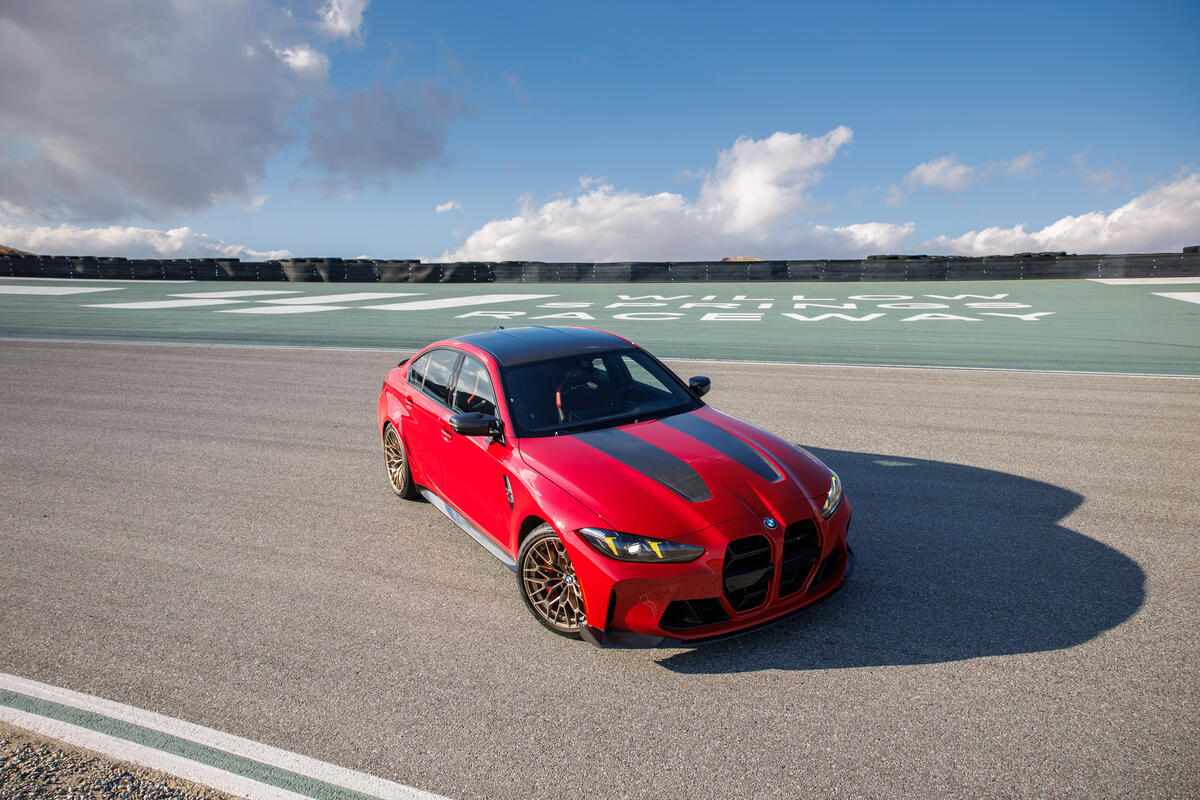
The BMW M3 is a legendary, high-performance version of BMW's standard compact luxury car. It looks like a normal sedan or coupe but has a much more powerful engine, upgraded suspension, and sharper handling designed for fast driving.
The Corvette is a famous American two-seat sports car made by Chevrolet. It is known for offering supercar-level speed and styling at a much lower price than European competitors.
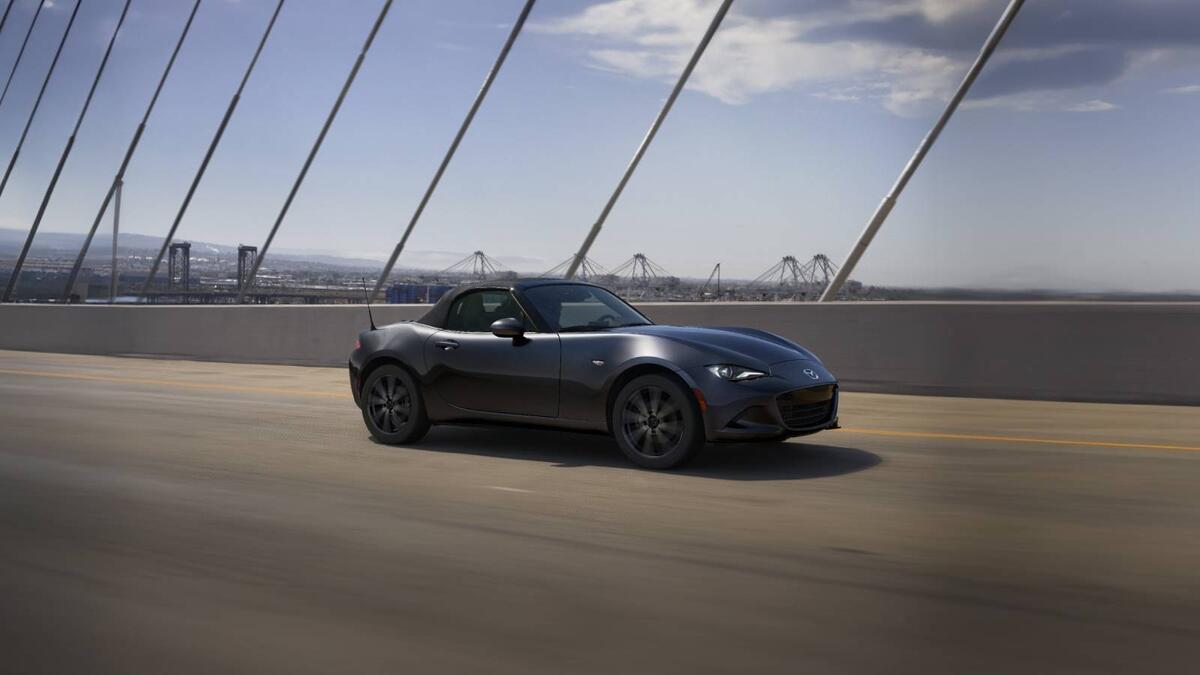
The Miata is a small, two-door convertible car made by Mazda. It is designed to be fun and easy to drive, focusing on steering feel and enjoyment rather than high speed.
The Hyundai Genesis is a large luxury sedan made by Hyundai. It was built to offer high-end comfort and features at a lower price than traditional luxury brands.
The Trax is a small, budget-friendly SUV made by Chevrolet. It is designed for city driving, offering a raised seating position and modern technology at an affordable price.
The Chicken Tax is a high tax that the U.S. government puts on imported pickup trucks and cargo vans. Because of this tax, foreign car companies build their trucks inside America so they don't have to pay it.
The X5 is a luxury midsize SUV made by the German company BMW. It is designed to offer a comfortable, high-end cabin with plenty of passenger space and a smooth, powerful ride.
This is a city in South Carolina where BMW built a massive factory. Even though BMW is a German company, most of its popular SUVs are actually built right here in America.
This is a very famous, heavy-duty V8 engine made by Ford. It was built in Canada and used to power many of Ford's classic muscle cars, trucks, and police cars because it was strong and reliable.
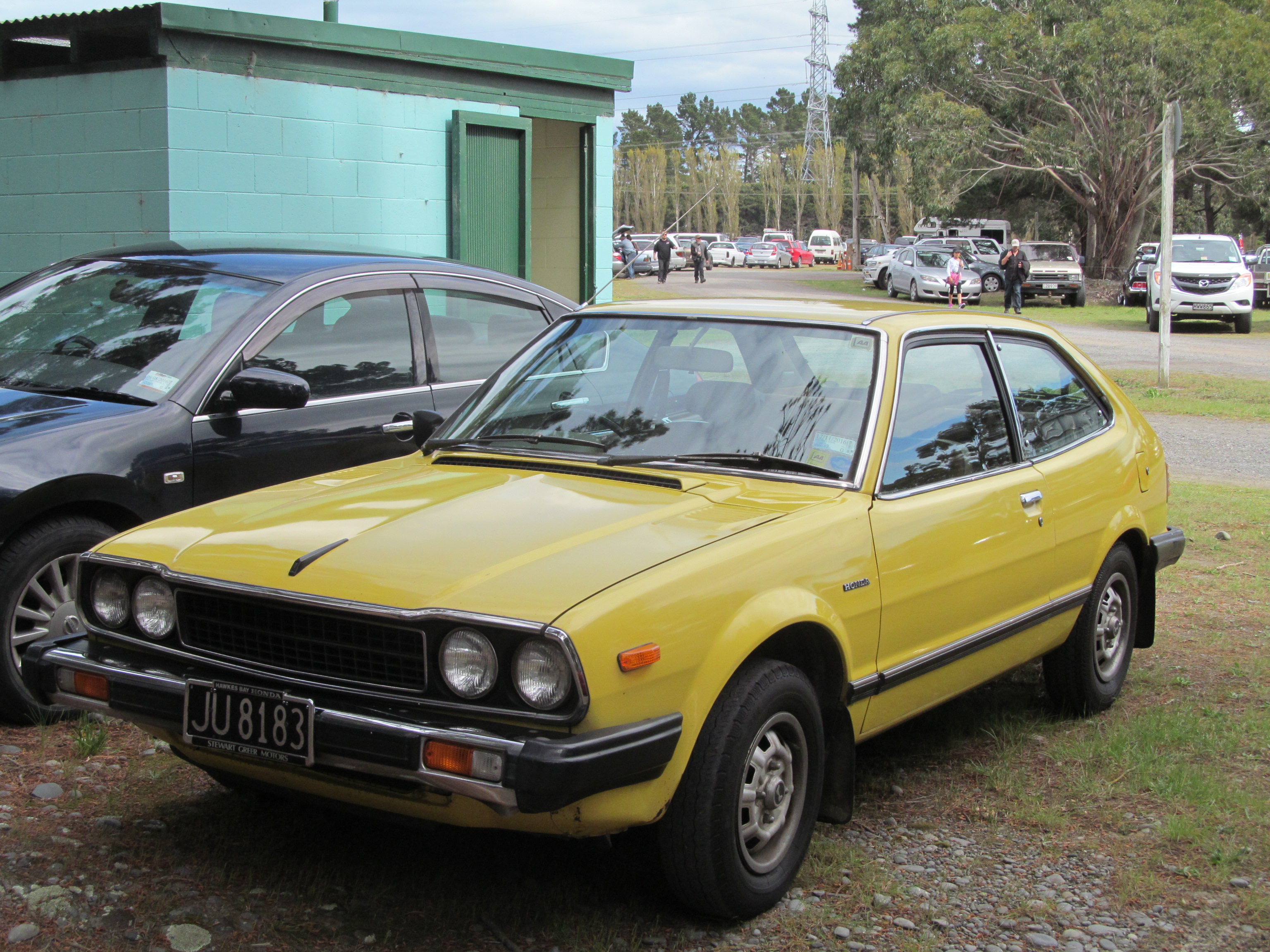
The Rabbit is a small hatchback car made by Volkswagen. It was designed to be a practical, space-efficient, and fuel-saving vehicle for everyday driving.
The Talon is a sporty two-door car from the 1990s sold by Eagle, a brand owned by Chrysler. It was built in partnership with Mitsubishi and was popular for its fast performance.
The Tracker is a small, vintage SUV made by Chevrolet in partnership with Suzuki. It was designed to be a simple, lightweight vehicle capable of driving off-road.
The Volt was a special kind of hybrid car made by Chevrolet. It ran entirely on electricity for the first 30 to 50 miles, and then a small gas engine would turn on to generate electricity so you could keep driving without stopping to plug in.
The Fiero is a small, two-seat sports car made by Pontiac in the 1980s. It was unique because its engine was located behind the seats rather than under the front hood.
The Impala is a large four-door sedan made by Chevrolet that was discontinued in 2020. It was designed to offer a very roomy interior and a comfortable, quiet ride for passengers.
The Taurus is a sedan made by Ford that was sold for over three decades before being discontinued. It was a common family car known for its spacious interior.
The EV1 was an experimental electric car made by General Motors in the late 1990s. It was very futuristic, but GM eventually took all the cars back from customers and destroyed them, which became the subject of a famous documentary called 'Who Killed the Electric Car?'
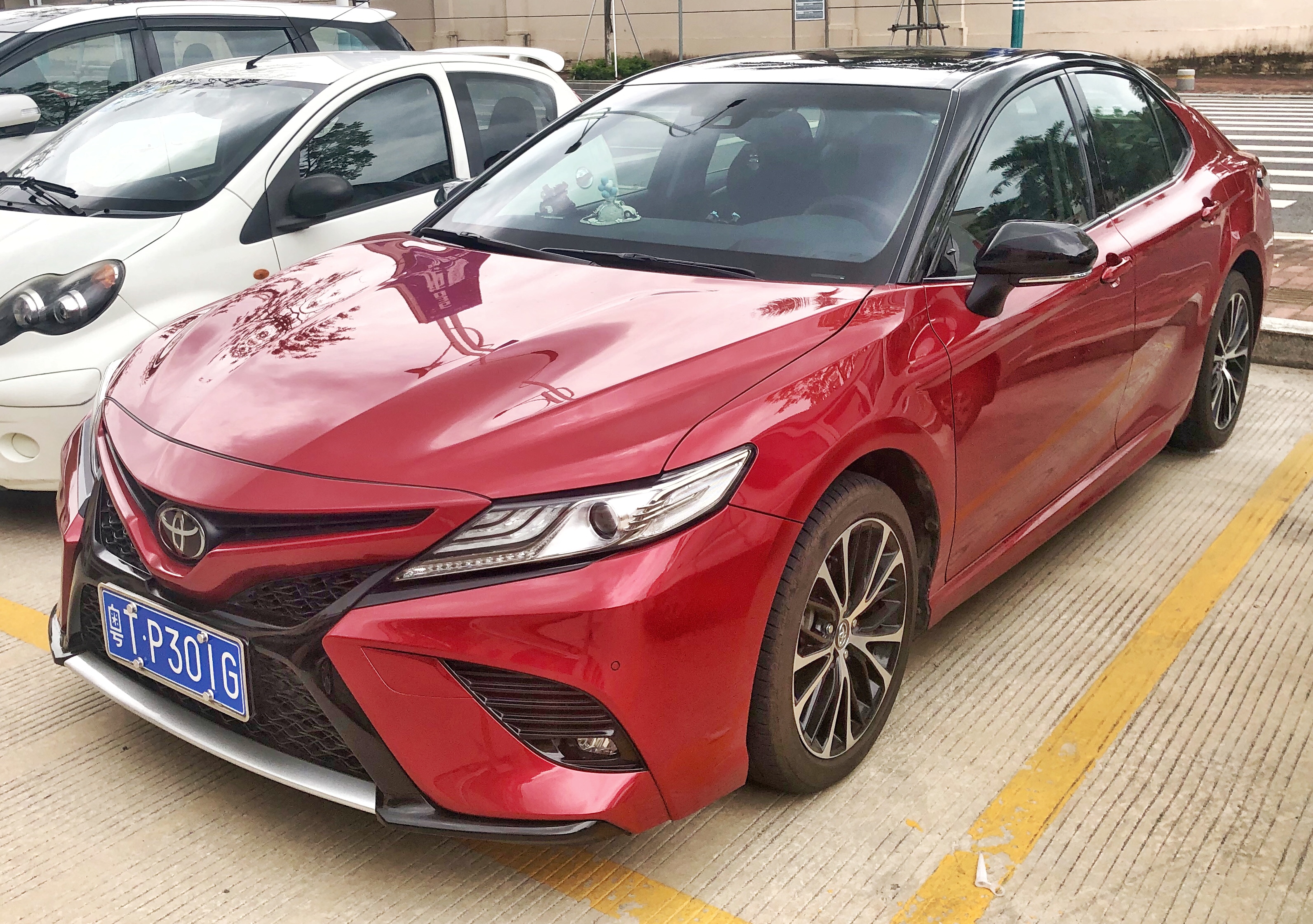
The Prius is a highly fuel-efficient hybrid car made by Toyota. It uses both a gas engine and an electric motor to get incredible gas mileage, making it very popular with commuters and taxi drivers.
F&I is the office at the car dealership where you go to sign the final paperwork. The person in this office will try to sell you extra things like extended warranties, rust protection, or key replacement insurance, which can make the car much more expensive.
These are laws in most U.S. states that say car companies cannot sell cars directly to you; they must sell them through independent dealerships. This is why you can't just buy a new Ford or Chevy directly from the factory website.
The Ioniq 5 is a fully electric family vehicle made by Hyundai. It runs entirely on battery power and is known for its unique, modern look and fast-charging capabilities.
The Corolla is a compact car made by Toyota. It is a simple, highly dependable vehicle designed to get you from point A to point B with minimal fuss and low fuel costs.
The Crosstrek is a small SUV made by Subaru. It is essentially a raised hatchback designed to handle snow, dirt roads, and outdoor adventures while remaining easy to park.
The Maverick is a small pickup truck made by Ford. Unlike traditional large trucks, it is designed to be easy to drive in cities while still offering a useful truck bed for hauling gear.
A Hemi is a famous type of V8 engine made by Chrysler. It gets its name from the dome-shaped top of its cylinders, which helps the engine breathe better and make more power, giving it a distinct, deep muscle car sound.
The Escalade is a very large, premium SUV made by Cadillac. It is designed to carry up to eight people in high comfort with lots of luxury features and cargo space.
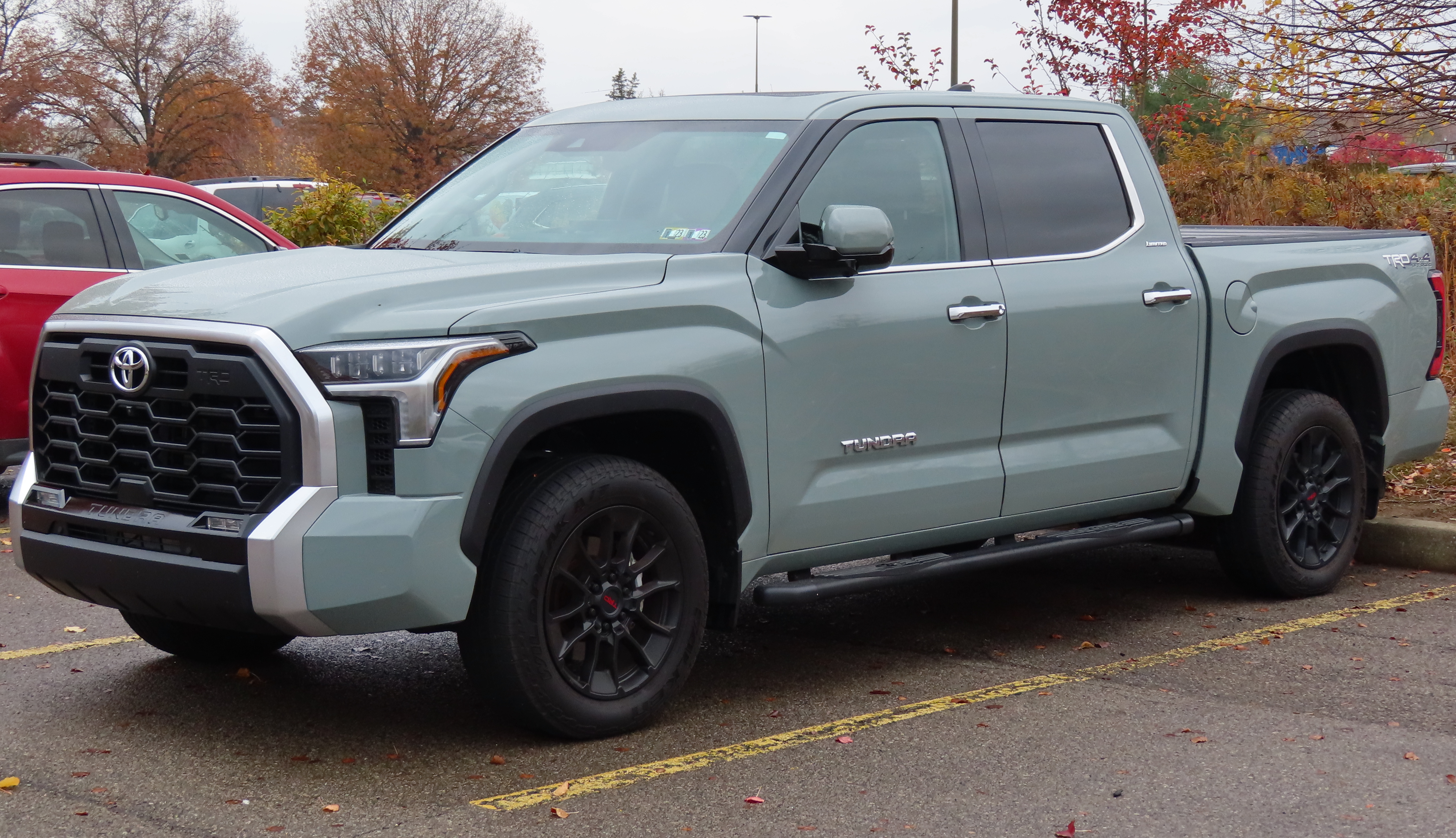
The Sequoia is Toyota's largest SUV. It is built like a truck to tow heavy trailers, but the newest version has a complicated hybrid engine that takes up some of the cargo space in the back.
Route 66 is a famous, historic highway that runs across America from Chicago to California. It is celebrated in movies and songs as the ultimate road trip highway.
LIVE
Hi and welcome back.
I'm Mike Quincey.
I'm John Lenkov and I'm Jake Fisher.
So seeing as this podcast is going to be broadcast on or around July 4th, we thought we'd take this opportunity to take a deep dive into what is going on in the American auto industry past 250 years of the American car industry.
And before we get started, I have started with horsepower, and it's all fun, right?
All that horsepower. Exactly.
How many guys times have you guys heard consumer Reports?
Hates American cars?
Let's just say 38,122.
I stopped counting. Yeah.
Why do you think that is?
Why do you think. Why do we hate America? I don't know.
Why do you even get accused of that?
I think I think we finally should come, you know, and tell the truth about why we actually hate American cars.
Yeah, I don't know. This is like this meme.
Well, I mean, here's the truth, right?
I mean, we rate vehicles.
That's what we do, and we rate them for a whole bunch of different things.
We do the testing we do on a track.
We also look at reliability and we look at a lot of different things.
The hate thing is, is misplaced because the truth is, is that we like a lot of American cars.
And actually, if you look at our ratings, you look at how they perform on our track and our testing, they actually do quite well.
Yeah.
You look at, you know, Ford versus Toyota, they're kind of nominal.
In some cases. Fords do better.
The issue is that there's less American cars that we recommend and it's based on reliability.
So it's not us.
It's what consumers are telling us about their experience with the cars, because we are kind of unique that we blend in reliability into our ratings, unlike other organizations, which does not our opinion about reliability, it's actually people in the field, 300, 350,000 cars.
And our latest survey.
And they're telling us like, truly American cars tend to be less reliable than some of the imports.
And one of the words that jumped out to me when you gave this explanation is you said, you know, we we like some of these cars and, but but that's that that to me is, is where I've gotten into discussions with other publishers because they would say, well, why don't you like so and so now this car fill in the blank car and it really isn't anything to do with, with, with how we like it.
But you can enjoy it.
I would use the word enjoy better than like because like it was almost a it's like a hot button turn, like, do you like it or you hate it, you know?
Yeah.
We enjoy driving some American vehicles and I don't enjoy driving some foreign quote unquote, depending on where they're made sure that vehicles, you know, and that's just the way it is.
But as a company, the jig's point.
No, it's it's data.
It's not personal feelings. Right. Right.
So it seems like the American public are not enjoying or not liking the reliability experience that they're having with certain American cars.
It makes Consumer Reports sort of unique because a lot of, writers and or other organizations, you know, write a car review, but but it's not then associated with an outside, survey to measure owner satisfaction, reliability, stuff like that.
It certainly would be a lot easier if we just basically were to rate the cars we like the most.
Yeah, that would be super easy.
It would be hard for families because it would be stuff like BMW, M3 coupes and corvettes and or stuff like that.
But it is always the answer is always answer. Right.
A family of seven.
Yeah, absolutely.
Fans of Talking cars just talk about their children and other Miata is behind.
You will be honest. More better. Right?
I like it, but, so John, you kind of touched on this about, you know, whether you like or dislike, you know, foreign cars and then you made the correct point of, well, tens where it's made.
So it's like what we, you know, what is an American car?
Is it just Detroit or is it a lot of other things.
So look, I, I don't I'll be very clear.
I just, Gemini on this because I didn't have time to go through and search up every data point, but the list of vehicles from foreign manufacturers, but there are built in United States is extensive.
I mean, you're talking a lot of them.
And southern plants, but they're throughout the country.
BMW is one of the first ones.
I mean, you've got Genesis Building in Montgomery, you've got Honda and Acura in Ohio, Indiana, Alabama, you know, Hyundai in Georgia, you know, the list goes on and on.
I mean, all these Mazda's building the car 50 in Alabama, you know, in a joint with Toyota.
So the final deal or may go back to Munich or stood guard or to Tokyo or wherever the companies are headquartered, but they're paying American workers.
They had American workers probably build the factories.
The American workers outfit them.
The American supply company supplying the parts, the supply chain, you know, the whole supply.
So what's what's American is American. This.
Let me just go to it.
Chevrolet Equinox, that's built in Mexico.
Is it the Chevrolet Trax built in South Korea.
Just because GM you know, well it's not the tubes anymore.
You know, because they're they're they moved out of out of there in Detroit.
But because the final dollar goes back to to their well it's again final dollar.
I mean, the truth is that those communities, they're built around these plants and supplier infrastructures that these areas have been just huge growth.
You know, there's families, there's schools, there's all of that around these industries.
Whereas like you said, a lot of the US companies are building factories in Mexico and not having a lot of employees and a lot of workers.
So so again, the final dollar, we're talking about stock price.
So, so, so certainly you may be enriching stockholders more if you buy the Americans.
And it's going to help that.
But and the companies and the health of the companies but it's it's complicated. You're totally right.
And it actually kind of a short wait.
And there's a reason why there's all these plants are here, and a lot has to do with SUVs and restrictions. It's the chicken tax, right?
I mean, basically like an SUV or something.
That's a truck.
There's a very high tax, about 25% on anything.
There's a truck that's imported into the country.
If there's built here you can avoid that.
So kind of the shorthand is if it's an SUV that's a foreign manufactured SUV that you're driving, chances are it's probably built in the United States.
In fact, a lot of them are exported.
As the SUV market is grown overseas.
They've taken the best built vehicles and they send them out.
Sure. Right. And it's not.
And we're we're looking at Consumer Reports, reliability surveys.
A lot of the vehicles manufactured here do do pretty well.
And it used to be just the knock on the American worker.
Right. The American worker can't buy a good car.
And clearly that's not the case.
BMW x5 built down Spartanburg South Carolina recommended you know but obviously a lot of these most reliable Toyotas Honda Accord.
Yeah in the United States.
So yes it is it is wrong interpretation to say that American workers can't build a car that says reliable.
The stuff that's just flat out wrong.
Can I go back to where were the where the ultimately the dollar goes?
Because oftentimes I would hear, well, you know, Toyota has a big plant in San Antonio, Texas building trucks.
But the profits go back to Japan.
But but but my counter to that always was well, you know, for General Motors they have big business going on in Europe.
Where does that profit go?
I mean, in other words, if Ford of Europe, you know, makes money and they send the profits back to Detroit, why isn't that?
You know, you're totally right. And it's very complicated.
And the truth is, is that, look, if you want to purchase a car with our American brand, there is nothing wrong with that.
You shouldn't be apologetic about it.
And you should should go ahead and do that.
If you want to buy a American brand that's headquartered in the United States, even if it might be built in China, but it's a Buick or Lincoln or something like that.
You can do that because there's a certain statement about it, right?
There's nothing wrong with that.
And look, I mean, as Consumer Reports, I mean, our goal is to give you all the information, right? Correct.
And that's why, I mean, even on our brand pages that you go and we will tell you where this where this company is headquartered, right.
Where it's because that could be important to you and that's absolutely fine.
But you can't.
The advice here is you can't just take, take it out at a cursory level.
You have to you have to dig a little bit deeper.
As you know, I don't mean to go back for it, but with with all of the, the plants, that the big three own that are not in the United States.
That's part of it.
It's it's kind of the last bastion of, of worry or concern about where something's built, because, let's be very honest, 90 x whatever percent, 80% of what we own use where consume so much, it's built overseas.
Yeah. You're right, you're right, you know. Right.
So in overseas whatever.
And everyone's fine with that.
I mean the minute you know, there's, there's a, there's talk of a tariff or something like that.
And my game plan, I'm just saying the minute there's talk of a tariff on something coming from overseas, everyone's up in arms.
Oh my God, my bicycle components can be so expensive.
My toys for my kids at Christmas, you know, at the holiday time is going to be expensive.
Cars like whoa whoa whoa whoa whoa, look what was reported by America.
And there's a reason for it because I mean, look at, you know, textile jobs.
Yeah, they're not super high paying.
You know, you look at, you know, making plastics or toys or a lot of consumer goods, not high paying the automotive jobs.
They're good jobs.
They are high paying. You could raise a family on it.
I mean, this is a different type of manufacturing that it would be terrible for us as a country to lose that manufacturing here.
And, you know, again, like these transplants, which is, you know, where like, you know, Toyota's building a plant or whatever there is a concern about, you know, what about, you know, Ford and General Motors, are they going to be healthy?
I mean, I will say this, that what is I mean, look, ultimately we're about what's good for consumers.
I would say what's good for consumers is choice.
Yes. So yeah, I mean, even if there are I mean,
not everyone should buy the absolute top pick.
You know, we have top picks and in ten different categories.
It's not for everybody.
You know, you might want a different car because a, a different style or, or whatever it is that this is, I mean car is more than just, you know, a washing machine, it's style too.
So it's like having those options there is good for a consumer.
So I've got this is story time with John and I'll tell you.
So just just bought a contract.
Yeah. So back in okay.
Like the fire we're both going to have a separate okay.
Tom just bought a used car for my daughter because she's got her license.
All right. Okay, so,
similar to Consumer Reports, we went and drove, a 2022 Volkswagen Taos.
Yeah.
And she pulled out of the dealership into the street and felt the jerky transmission and was very uncomfortable driving it, and she called that out.
I didn't just like it's hard to drive.
This is kind of weird. I don't know if I like it.
If only she knew someone that worked in consumer, but I'm not saying so.
But then we drove the 25, which has a different transmission and then a slightly more horsepower, and she liked that a lot better.
Now. Yes.
We're not I don't think we recommended Taos and such, but it's just a said foreign car, foreign car.
But it's from our process of testing.
And we're not telling you like, oh, you can't buy it because it's from Volkswagen in Germany.
No, you shouldn't buy that 22 because the transmission doesn't make it easy to drive. Right.
And it's that type of information.
So again it comes back to information giving as much information to the consumer as possible, not having a a jingoistic or a not having any kind of bias on it because of where it's from, when the company overall is making it.
So let me be very controversial here for a second here.
So, so and.
Just for a try.
So again, you're exactly right. That's what we're doing.
These are two options. Pick the best option for you.
And and I do believe that you know that there are Japanese cars that are very reliable I think they're right.
The the rising tides rise.
I mean, I believe that American cars have gotten a lot better because of the competition.
The reliability has gotten a lot better.
You look at the safety well, following oh my goodness.
I mean, when we started I mean like the interiors of American cars were all like hard plastics and they've gotten so much better.
The infotainment systems have gotten so much better.
The ride, all those things have really improved because of that competition.
What I think is interesting right now, because, I mean, we're not blind to what's going on.
The rest of the world is what's going on in China right now.
And China has is this exploding car market.
And, and but I mean hopefully not physically the car I mean, well, let's reword that. Let's reword that.
But they're on fire because I'm fine with that man.
I was on Vicky on vacation.
We go to weird places whenever we go on vacation and then, like over Christmas, went to China and actually was in a bunch of different cities there and drove in a lot of electric cars.
And, there are so many brands there. So
and they are really competitive vehicles, at least from the electric side of it.
And they are quiet and comfortable, impeccably finished, affordable.
They charge quickly.
And if these cars are now available, if they become available, we'll say, do we still say that same tune?
Just buy what best makes sense for you?
Or should you consider, you know, wait a minute.
You know, I mean, you look what's going on in Europe.
You know, these these Chinese cars are coming in and it's I don't know if the, the, the, the domestic companies are going to be able to compete at the domestic companies, but even the foreign companies.
So they will come in in Japanese, they will undercut Toyota, undercut Honda, undercut, you know, Hyundai and Kia.
So and it could be that the the saving the savior savior for it will be something similar to dealership laws in the sense of okay, I want to be another version of the chicken tax.
Maybe. Wait, you know, you have to manufacture.
Well, you know, you have to manufacture United States.
And it could be that at the volume, shipping is not affordable anymore.
And then they can't keep those prices. So.
Well I think they have the foothold here.
And part of the question is whether or not like I mean people are many people are speculating that they're really selling these at a loss. Yeah.
And the products are not fairly priced.
And if that's the case, again, you know, yes, you should make your own decisions.
But you should also consider that like, you know, where do you want to, where do you want to put your dollars and what do you believe in.
And I think more and more I think today people are I mean, even, you know, I mean, it's look, I mean, used to be like, oh, I'm not gonna buy a Japanese car because they fought in the war or whatever.
I mean, we're past that, but people are purchasing and making a statement with their dollars, whether or not they want to support certain companies that are doing good things for society or bad things in their perception.
And I think that's legitimate.
So we'll probably be able to see what happens on a micro level, because Canada is allowing imports of Chinese cars, and Canada has a very robust auto industry, very much funded by Detroit, if I may be so honest, having having assembly plants, I mean, the the the legendary Ford Windsor 351 V8 was built in Windsor, Ontario.
Okay, so there you go.
So American than that.
So and I will also say that historically speaking, when the Japanese started proliferating in the United States, there was talk about them dumping vehicles, selling them, you know, for a really cheap price just to get market share.
Now, coincidentally, in the 70s was also a real low point for American reliability and fuel economy.
Cash price of gas went up.
And here come the Japanese.
They're small, they're fuel efficient.
And lo and behold, they're reliable. So.
So in other words, there's there might be some panic right now, but historically, there's always been panic.
Yeah. Okay.
The first transplant was, was in the 1970s where Volkswagen, rolled out their first rabbit in New Stanton, Pennsylvania.
Now, again, we all survived that.
Volkswagen was building a plant here.
And, oh, that's going to be bad for American and whatnot.
But as you said, the rising tide, it raises all boats.
So, so so if the Chinese are really good at something, the rest of the world has to up their game, right?
I mean, well, as long as everyone's playing by the same rules, I mean, actually what happened?
I mean, so I talk about dumping products in the Japanese.
I mean, in the 80s and, you know, look it up on your own time. But it's like in the 80s,
there was actually changes in terms of currency policy.
So the exchange rate of the Japanese yen versus the US in the mid 80s radically changed, making the imports of the Japanese products actually much more expensive.
They retooled and figured out how to be efficient, and they're still very competitive.
But again, it's as long as everything is on the same playing field, the rising tide.
Well, well, I think that's kind of the, the question and maybe a difference.
And, and, and to be an educated consumer is the best thing you can do, because in the 70s and 80s, Detroit was complaining about the Japanese.
Correct.
But, Ford was rebranding Mazdas as Courier pickups.
Chrysler was rebranding Mitsubishi for the Dodge Colt and Eagle Talon.
A GM was rebranding Isuzu Suzuki's and Toyotas as a Chevrolet Luv, Geo Tracker and the Geo Prism.
So sometimes the their people talk about one side of their mouth and they talk different and the other side of the mouth.
So so so if you're out there buying a car and you're worried, will, where is it built and who who's in employing, you have to dig a little deeper and figure out exactly what's going on.
It's also I think everything's happening faster.
Plants are built faster, assembly lines are faster than ever.
You know, robots versus, humans and so many places we can win between the robots and humans.
You said that.
You said that so fast, you almost sounded like a robot, like a Terminator series out there.
I think it's a that it's a documentary.
It's like a four part documentary about, the history of robots and human movies.
Let's go to, The Matrix.
You know, it's good to check that one out.
You got a point in terms of your value.
It happened so quickly, you know, like getting ramped up back then was different to your point of with when, the, monetary policy changed.
Yeah.
Today. And like, okay, fine.
There's, there's available plants to be refitted to be retooled.
A lot of domestic plants that were close at that have been refitted.
But, you know, massive assembly plants and the robots make it quicker to get to market.
And, you know, that's why you see so many of the automakers now building building here to the point also when we talk about the SUVs and the in the share and where they're, you know, a number of things.
But yeah, it's happening so much faster than it would back then in the 70s or 80s to get a foothold here to start building and save money.
Right.
The plant that Tesla has in California, that where they originally started building the model that used to be a joint venture, Toyota and GM.
Oh, you knew me. You know me, right? Right.
That was that was the the the geos that I mentioned before.
I mean, they were they were molas and prison and I'm glad you also, you know, brought up automation because a lot of people talk about, you know, losing their jobs for various reasons, you know, people are going to lose their jobs.
You're going to lose it to automation robots more than like other people, if you think about that, I yeah, I believe I could do our podcast right now.
Yeah.
Pretty much super producer Dave Abrams would vastly prefer that.
I'm sure he and I trying to read into it, but are we doing it right?
Yeah, but at some point I would say like, okay, why do we have six fingers?
20 tundras is built in Indiana, you know, and I'll just say that as a as a statement of fact.
And then later on I have to say that it, you know, totally hallucinated.
So I we're not.
Yeah. Texas we make we make our error.
We make our errors because, you know, we're trying hard.
Why are we held to a higher standard I bots that people used to work for Mr.
Fisher because we're Consumer Reports.
Oh, okay. Need I remind you that makes things.
Goodness gracious.
Okay, so, so we've kind of distilled, you know, where where cars are coming from.
Good choices for, for American buyers and that.
And that's all good.
But staying with the theme kind of of the big three, why does it seem like Detroit cannot unlock the keys to consistent reliability?
I like the unlock the keys.
That was good. I mean, so just a couple of reasons.
So there's a couple reasons.
One reason is sometimes we're first.
So and what I mean by that is very often for imported cars selling their home market first.
And what we see with every car is there's growing pains.
When they have the new generation that comes out very often, they'll first sell in the home market and then they'll come here after they work out.
There's a little box that helps.
But the bigger thing is kind of not staying the course and just changing all the time.
So kind of my, my go to example as you look at Toyota and in the late 90s said we're going to do hybrids.
And guess what they've done every year since then to today, more hybrids we're going to work on perfect this and late 90s.
What did GM do.
They had an EV.
And then they said we're not doing EVs.
We're going to do what they started doing hybrids and they stopped doing hybrids.
And then they had a plug in hybrid which was the volt.
Stop doing that.
They dealt with diesels and then they were going to do diesels and flex fuel and flex, and they just keep on changing course to the whim of whether it's politics or whatnot.
But it's like if you just follow the consumer and, and the consumer is like, yeah, hybrids kind of were good.
Like they would have gotten there faster and they just keep on cycling through different technology.
It goes way back. I mean, there's
I mean, remember the Fiero, I'm going to assure myself, sure.
It started out kind of crummy.
It got really good at the end.
They got rid of it, what, 1990 or like, who's going to want a two seat sports car in this country? Why is the Miata came out right.
You know, so it's like they give up on their almost too early and they give up on tour.
Right?
When it starts kind of being something GM as soon as they say they perfected they kill it.
So but the other thing I would say and again not just to pick on GM, but what you see with a lot of the domestics is they change too much at the same time, right?
I mean, they, they you look at, you look at the foresters or you know, it's like, oh, new generation Forester came out.
Is it different?
Yeah.
You know, it's the same powertrain, same all these different things.
And they make these kind of evolution.
It's an evolution. It's not a revolution.
How many different V6 or four cylinder engines the General Motors have.
Oh my gosh. In the 80s and 90s across race.
You know, because you know, the Pontiac can't have the same one as the Chevy because, you know, blah blah blah. So it has to be this way.
Or you get to the to vehicles like the solstice and the sky, the Pontiac Solstice in the sky with like to have to you, you know, to save money, to have to use a certain platform.
But then they have to jury rig it to make it work.
So then you have this bizarro top and it doesn't fit or it's not, and it's compromise after compromise just to get into the market fast versus you're saying the staying the course type of type of sit situation.
But I mean, look, they were going to kill a Corvette.
I mean, you know, they were going to kill the Mustangs.
You know, I mean, they kill the Mustang as well. Yeah.
They're gonna make it into something else that they almost did with Mustang too.
Yeah.
But it it is very whether it's politics or whether it's financial markets driven not necessarily by the buying market.
And you also brought up a good point talk about, American reliability, like Ford, for example, had a bunch of reliable models like the fusion was, was it was a really good sedan.
It was reliable. Yeah.
And they, they they took that out of their lineup, which immediately affected their brand's overall reliability.
Total consumer reports surveys in general.
In the past, what we've seen is the cars from the domestic brands were quite reliable.
It was actually the SUVs.
And because they've gone and kind of like axed so many of the sedans in their lineups on average they're getting worse.
Well, as it was like it was like murder in the family because they promoted SUVs.
Because again, SUVs are more profitable, particularly big truck ones, you know, but they also don't have to hit the same fuel economy standards as cars.
Sure, they're they're easier, easier to build.
In that respect, cars are harder to make fuel efficient because of the rules, you know, so they're they're killing their own product to make something better, you know, to feed these.
And it's a shame because you still have.
And there's again, the sedan market is closed down for every manufacturer, but you still have a number of good sedans.
They're all just quote unquote foreign automakers, even if they're built in the United States.
I'm hoping for a sedan revival, and I will bring up a great memory of the last version of the Chevrolet Impala sedan, which was a really good car.
Yeah, and I miss it.
And it seems like GM can actually build great stuff when they feel like it.
Well, for we're not a hit with the Taurus for so long.
And then they kind of went weird with it.
And you know the 500. And then they brought back the Taurus.
But again a compromise vehicle which was as long as this room, but it had no seating capacity.
Right, right.
But I mean, but I mean like Fusion Focus was fantastic.
Fantastic. They were good cars. They were really good. Yeah.
Just just to remind the Talking Cars audience, we don't hate on American branded cars.
We really don't.
We like a lot of stuff.
I think it makes The Final Generation was incredible, because it was a great hybrid that sold for the same price as the non-hybrid version.
Very reliable.
I mean, not sorry. And.
Yeah, right, right.
That SUV is in the brain.
Well, what what what it was that that line.
But what do you think we got wrong?
They kept renaming things for guys.
Okay, but that's another thing that the Japanese do that are really consistent.
I mean, the civic, the accord, these are nameplates have been around forever.
11th generation civic.
We're on now. Okay.
The Camry been going on forever.
Yeah.
So so it's like you've got momentum going with this.
You've got goodwill, you've got all the porn, you've got repeat buyer.
And let's talk about the civic for a second.
I mean what does the civic have in common like the 11th seventh generation civic has the exact same powertrain as the the 10th generation civic, right?
I mean, they've okay, they've added the hybrid.
But again, they added hybrid kind of mid stroke.
Right? You didn't do it right when they introduced the thing.
So it's like let's gently kind of add technologies and start building.
This is not what the domestics do.
You look at I mean I think back about like the the current explorer, you know, changed everything, right?
You know, just huge everything in this car, that one shot.
I don't think any automaker could make that reliable when you change everything at the same time.
Look, Toyota, for years, the 3.5 V6, you know, Nissan with their with their
with three five and three seven V6, you know, just model after model of cam model using the same six speed automatic transmissions.
I mean, Mazda still used a six speed automatic transmission right now.
Yeah. Pro and con of that.
But they're only introducing like touch screens today right.
Yeah. But but
the changes are incremental or the refinement.
Yeah. Such like that.
And instead of yes to your point like now it's a brand new twin turbocharged V6 engine and an all wheel drive system.
But it's a Haldex based one.
So it's this, this is, you know, wholesale change.
They can't get out of there, you know, and in a new plan and with a new assembly line like it's, it's it's a recipe for disaster.
I mean, we're talking about a stroke.
You probably need to talk about the bore to, you know, the bore in the stroke.
I see.
And Dave Abrams is completely bored right now.
And he let's let let's let you, let's, let's touch on this.
So you brought up the GM, first efforts in EVs, the EV1, I believe that's the name of the vehicle.
And it's like they, they they didn't stick with it.
But you think, how far ahead would GM be in EVs if they stayed with their EV program and they committed money to it?
And that brings me to the next point is like, you know, it is the EV market in the United States cooling.
And you know, what is the big three going to going to stick with us?
I mean, I think a lot of manufacturers years ago was like, we're going to be all EV by whatever, 2030 or something like that because of politics, and they're rethinking some of that.
So what do you think Detroit is going to be doing regarding their investments in EVs?
Well, I think they're gonna have to do both.
So they're gonna have to have electric cars.
They're gonna have hybrids.
I think everyone, if they want to be successful, has to take hybrids very, very seriously.
I think if you go out five years, I would be surprised to see any introductions that are not hybrid powertrains.
And you're talking real hybrids on mild hybrid type things that, you know, starters just a big alternators on.
Yeah.
Yeah I mean it just it's just a those are compromise type of powertrain.
You don't have to change your life around it.
You get fantastic fuel economy.
You see a lot of companies even right now just scrambling just asking Toyota, please, can we use your technology until we work out our own?
But you know, you look at Honda, Honda's Honda's really getting its legs right now in hybrids. Yep.
They're doing their own way.
They're making a little sportier. They're making it more fun. One.
So your point look at all the Toyotas that are now hybrid only.
Absolutely.
Camry hybrid only you know, the Rav4, Rav4, I mean industry in vehicles, right.
Really I mean it's amazing.
So so you're talking about electrification.
You got it. You got really.
Oh yeah.
Not really strict EVs because because Detroit has had some issues bringing out their new EVs.
And you we brought up Honda and all of their you know what they did.
They actually, you know rebranded a GM product for their Prolog, which from a reliability standpoint is turned out to be not so good.
But the Mustang Mach-E, on the other hand.
Yeah, you know, success, success stories or successful, I think I think the trick is they can't just again, you can't just keep on steering the ship.
You can't just completely reverse directions.
You have to have you have to continue the development on the EVs.
You have to keep on pushing for hybrids.
You have to do both.
And you can't just again have a great example.
They were stuck with that EV1.
If they would have just had a presence and continued development, they just they discovered so many different things.
They created so much new technology for that EV1 that was almost kind of like lost in the dumped dumpster for years.
And then they kind of kind of start over.
Well, how many, how many manufacturers are now bringing out the new generation of the volt?
Yeah. Right. Right. Yeah. No. That's right.
I think a good idea wasn't it. Yeah.
You know. Yeah. I mean and
I think that we probably looked at it and said, okay, well you're carrying around all this extra weight and it's not really getting, you know, the mileage, but you could be critical of a first generation doesn't mean to kill it.
Sure. You know, because there's room for improvement.
I would not want to be driving around a first generation Prius these days.
No, that was not a very nice vehicle.
No, it was a dumpy little box on wheels.
True.
Truthfully, that doesn't mean we give up on it.
That doesn't mean it didn't get good mileage and it didn't do what?
It's kind of almost like owner satisfaction where it's like, does it deliver on its prime? On its.
Yeah. Okay.
It doesn't promise to race a mustang.
It doesn't promise to be as luxurious as a BMW.
It promises to get you to A to B at 45 miles per gallon or whatever at that time, which was incredible, right? Absolutely, absolutely.
But I think I think what we didn't realize at the time that the mainstream ization of these hybrids were just, again, I think these are fairly recent thing where it's like now we're saying we get in the hybrid, it's like, oh, it drives nicer, right?
Than the gas counterpart that was not in the cards back in the 90s.
For the look, the first Honda Accord hybrid.
What was it sold as? Performance.
It was a V6.
Yeah, V6 hybrid was the best.
It was really, really fast.
But yeah, but that's the thing.
But you know, it was how to the whole thing how to sell to the American Martino market with horsepower.
No. You know we looked at that that was a misstep.
Hopefully didn't send Honda back you know.
Or maybe it did. But that's how development works, right?
I mean, you try different things, you figure out what works.
I mean, it's like smartphones.
You go back, you know, the early days, smartphones.
Some had keyboards here, some slid out, some did all these things.
And then there was like a form factor where it's like, okay, it's a big screen, all right. With a virtual keyboard.
We're getting there.
It's like, okay, gas engines, they're two liter turbos, right.
And then you get hybrids. Yeah.
And they give you really good fuel efficiency and they're a little smoother.
So so it's like we're kind of getting to this part where like people are there's a convergence I think of like, oh this actually works.
And people like it. 2 or 3 you flip phone,
what is it?
When is that coming back?
Oh, it is, you can go. It's it's it's,
you can do a Quincy.
You know, you probably can pull one out of here.
I had one, I trust me, I had one of the little retractable antenna.
Oh, look at the big battery.
Oh, my God, my sister made fun of me when she saw the, you know, pulling out their antenna. Oh, my gosh.
Okay, so, so another part of the U.S
auto market is, retail.
And why is buying a car in the United States so terrible?
And it continues to be terrible and reminder and talking cars, we buy all of our test cars.
So we know kind of know what we're talking about.
How many cars did you bought?
I bought 171 cars since 2001.
And I trust me, I've seen it and I've heard it all.
And it's and it's depressing to me because I, I get really excited to buy a car for the test program, especially because I'm.
I think buying a car should be awesome because you've got.
It's a brand new car. The new car smell.
It's it's.
You don't have to worry about whether it's somebody else broke it or something like that, and it shouldn't be an exciting time.
But most people, I think, see it as just dreadful.
It is really interesting.
I mean, because, I mean, we are a consumer society.
I mean, like, you know, people go and you know, you're excited when you see the Amazon box on the doorstep, you know, and buying new stuff should be fun.
And yeah, it's not I mean, a recent a recent poll came out and said 83% surveyed said they really dislike the buying process.
You know what's interesting too, though, is I mean, this is not a uniquely American car problem.
And this is the problem with, with imports.
This problem with all is and it's sometimes like the imports are even worse because, you know, they built their dealerships later and there's other reasons for it.
So some of, you know, a lot of it comes down to what we're getting into is manufacturing costs and, you know, wages and price point and all that.
And you know, so where what's what's the hardest what's the hardest thing to deal with at the at the car dealership?
F and I, the finance and insurance guy who's upselling you that and the service department, which is, you know, the hourly rate.
I'm not knocking where it is, but those are the parts that are like almost now the things that you feel, unprepared for.
And you don't know if it's if you're getting ripped off there because rates of 150 200 an hour ad suggested, suggested maintenance and packages and all the stuff.
And it's when you're not and you don't have the understanding.
And I'm not saying that I'm great because I live in this world and have more expertise in it.
We're saying you're great.
Yeah, but it's like the guy who shows up to, you know, they walk up to your house and they say like, hey, we're in the neighborhood and your roof.
And all of a sudden you're like, I don't know about my room.
Oh, my roof's up there. I'm not the expert.
Maybe he should do it.
You know, when you get into a situation where you're not prepared and a lot of it is being prepared and taking your time, not buying the car because yours is dying in the driveway that day.
But being able to research and be like, okay, this is what one place says about extended warranties.
This is what they say about the the Glass coat protective package that I'm going to get up sold.
And then this is what it says about when it's time to maintain it, what you should do there.
That way you're prepared and you're not stuck making this decision where the $30,000 car becomes a $38,000 car because of all the add ons that you're financing, and it suddenly becomes unaffordable.
Right? Right.
But that's it's the pressure and it's the this and it's I have to make a decision.
I mean, I mean, I think one thing is like, look, most things that you buy, if I buy something on Amazon, if I buy something at Best Buy, I'm not necessarily negotiating. Right.
There's a price.
And sometimes they have sales and sometimes I could watch the price and but it's like to have something that big.
I mean houses are obviously that way where you go, shit.
But I mean, is this what people want?
You know, and I don't know, maybe.
Can we put our poll out?
Let's we're putting out a poll where everyone's shaking his head.
What would you prefer?
Would you prefer a fixed price?
This is what I pay.
This is what everyone pays for this car.
Tesla did that.
Saturn did that back in the day.
Or do you really want to have the situation where I could get a better deal than the other guy?
There are some dealers.
I mean, in our areas, you know, we're we're hearing, kid, there are dealers that I've experienced looking shopping for both, you know, new and used cars.
They say this is our price.
And if you look, it isn't okay.
It's between the base, mSRP and what some others are selling it for.
And it's like, this is just for our price.
We don't come in, we're not giving you blah, blah, blah. We're transparent.
It does make it an easier situation.
But but again, we talk.
We keep talking about how General Motors was kind of ahead of their time for a lot of their technology.
You could argue that they were ahead of their time with Saturn.
Absolutely.
Because they, like Saturn dealers, were supposed to just charge the same they did.
And they were they had very happy customer.
Right? Yeah.
Like it worked.
It was this experiment that people were like and actually Consumer Reports, I think if you look at back in the back issues, they used to do kind of like surveys of dealership experiences and like Saturn's were like number one.
Yeah. So why isn't it replicated today?
Why is that.
Well, I mean it's replicated by some of the online what car companies like like Tesla Rivian and Lucid.
I think it's because the dealerships there, they don't want to do that.
And some dealerships deal some but some dealerships, you can find dealerships that are like, this is our price.
Yeah.
But but yeah, I think they it's more profitable.
The dealerships do have a lot of power.
It's not they're not wholly owned by the by the car company.
So and their state franchise laws and the that protect the retails the retailers they do find that they could make more money that way.
You know I we went we still had to buy and test cars during Covid.
And I have to say for all the years that I bought cars for the test program, that was really tough because the supply was pretty low, the prices were insane.
And I hate that we had to pay like retail sometimes above retail to get a test car.
And I remember talking to a number of salespeople during that time and I said, you know, you guys, the dealers have a terrible reputation even before Covid.
You're making it worse. And like, we don't care.
We're going to make extra money now and screw you.
Well, it is very like there is a blinder aspect.
But you know, the Hyundai Ioniq nine, I bought that for our test program.
You know, they were they were firm at that price.
You know, there were there are ones that were over at other dealerships, eight, $9,000, 800, $900,000.
And yeah, four months later, they were soft.
So if you're not first on the lot, first to end the block to have it.
Yeah.
Prices will go down and you, you gain you gain a little more leverage.
But it's again making the decision when and when I think I think no one has a problem with prices changing based on market conditions.
So like I mean by covet they weren't selling a lot of cars and they got a you know it's like it's not like we're trying to like we want the the salesperson not to have dinner that night.
You're I mean everyone you should get an honest wage.
The thing is, is that you never know if you're really getting hosed or not.
Like you want to get the same deal that other people are getting.
And you know that with most things, I buy airline tickets, right?
They click on the thing.
Yeah, they're going up and down, but I don't have to go and like call up Delta and say, hey, you know, can you take 20 off?
Yeah.
It doesn't if you don't take me to Orlando for this price I'm going to go to American.
No, know peanuts and you give me 20 bucks back.
There you go.
I'll buy you.
That's our negotiation. Yeah. No, you're right.
The automotive retail is a lot of negotiation.
Some people really, really like it.
I think my dad saw it as a contact sport, but, I mean, most, most people, I don't think like it at all.
They're also more transparent. These days. And then.
Yeah, you know, when our parents, even when we were maybe buy our first cars, you know, there's there's a lot more information out there and it's a lot harder for, I think for the salesperson at that point, you know, they're the, the bonus, the commission, you know, the profit on it is is slimmer.
So it is eking out as much as possible.
And also but to move the car so that they can get the incentive from the manufacturer or from the dealer, so they can make and make money.
Yeah.
And, and Consumer Reports has a number of articles on Consumer Reports.
Dawg, on tips on how to buy, a new car, especially for, for new car buyers.
We also were always running deals, running stories on the best deals out there for recommended consumer Consumer Reports cars.
So definitely check out our website to get more advice and some ideas of where do you start with with choosing the right model?
I mean, I think that if I could interject, I think it was what John Krafcik back when he was with Hyundai or something, you said people would rather go to the dentist than buy it.
Yeah.
Oh, you know, you Google that and you will you will find lots of stories and, and even surveys that, that, that I mentioned before about why it's, it's so often, you know, just as a, as a car person.
I wish it wasn't I wish it was as joyful.
I wish everyone could, could get a sense of joy and wonder that I feel what I'm buying cars for the test program in their own lives.
But it but it's often super, super stressful.
Kind of.
Which brings us to, you know, one of the last points is, is, is what is the future of of the, the American market.
And we've kind of touched on this about planning, what are they going to go into more EVs or more hybrids or whatnot.
But so what's what's down the road?
I think EVs will have a reset.
Again, we talk about like as technology evolves because they don't have to be $90,000 EV.
They can't be.
I mean, for the market to have any future, they can all be some of that, you know, propped up by incentives as well.
You know, I mean, personally, I will say, why 90,000 our EVs were getting $7,500 back off of it.
I mean, that's my personal opinion.
But I don't think that there here to go away and just seeing what's going on with gas prices and the interest in used EVs shows that there is at the right price.
They're viable, in the United States.
But again, it might be like those that first say, look, it's not going to be a race car. It's not going to be it.
This is what it is efficient.
It has a very fast charge.
The battery, you could charge it very quickly.
It has this range.
It's not trying to be a pickup truck that can go 600 miles.
That can tow a trailer, but then it can only go 200 miles, like.
No, this is what it is.
It's kind of a stay in your lane.
And I think back to what one of your I think your predecessor said is like it could be that in certain regions, certain fuel types are better than others, you know.
Yeah, all the country, big diesel trucks are great for the distance.
But in the tight East coast, it's going to be batteries.
Yeah.
I mean I mean my answer is hybrids, hybrid drivers I always has been.
And I think if you follow the consumer that's what they're looking for are no compromise.
Efficient, low cost own reliable. Right.
I mean, this is what people are looking for and they, they deliver on it.
There is a place for EVs, but the market I mean, I mean, you think about incentives, right?
I mean, you mentioned incentives.
Incentives makes like you said, it's I just don't make sense.
A $100,000 vehicle.
Right.
Incentives make a huge difference on a low priced vehicle.
But the truth is is where the market has gone for EVs.
It's really been catered and it continues to be catered to around early adopters that people are buying these, not necessarily because they are the most efficient or or global warming is what their concern is, because very often we see someone has a Tesla and they have a they have a Jeep and they have a Tesla, and they have a diesel pickup truck.
Right.
But it's more about like, I want the latest technology and we see the stall with the market.
Right.
The EVs are filled with they gotta have a new design for their door handle.
They need the biggest screen ever.
They need karaoke lyrics going on your screen and being able to have Netflix and and fart sounds when you're, you know, in your turn signal.
But it's like it's it's it's it's focused on that early adopter technology that how you can stand out from the next person.
And and look there is there is a market here for BMW m3 is there is a market here for sports cars. Yep.
But that's where it is right now because the people who are buying these EVs, they're demanding to go zero 60 and 4.5 seconds. Right.
And they're it's a performance bargain when you think about it.
So it's it's there.
I think what's interesting is for the practical minded people, you know, who are maybe buying a Sienna hybrid or something like that.
I don't know if it's going to be a place for that.
And I don't know.
I mean, it would be interesting to see if the market goes there, but if it's a technical it depends on technology, it depends on the technology, depends on the price.
It depends on what the the availability.
What worries me about the automotive future.
Well, there's two things that worry me.
One is I want more stick shift cars, but that's, that's that's nothing to do with this conference.
You got gonna lose sleep over something that's that that assailed my sleep.
I know losing a lot of sleep every day is like it's almost all gone.
I'm. I'm done with it.
And it's like, you know, I know. No GTI.
You two. Yeah.
But anyway, I digress.
So no, the other thing that concerns me about the market is we're seeing a larger separation between the demands of a new car buyer and a used car buyer.
And this is a huge problem, because the new car buyers tend to be richer and richer, and they don't necessarily have a big family.
And they're they they care about all these, like, gizmos and all this new technology.
The used car buyer is much more practical.
And the problem is, is that if there's a disparity between those, we wind up having the I mean, look, the car market is designed around the new car buyer, right?
I mean, I'm getting into circulation.
They're talking about 16, 16.5 million units a year.
So that's that's a lot of that's a lot of, you know, brand new cars, right?
Yeah. And it's far more sales in terms of used cars.
But the problem is so it's like the minivans we're seeing not a whole lot of minivans being sold.
A new car buyer, used car buyer loves minivans, right?
I mean, they are up and the prices.
So that's why you see this.
You see the resale value of these many.
That's extremely high.
You see the resale value of these expensive EVs very low.
Well, they, they they drop like a stone.
But, but but to just to, to to hop on your point about early adopters.
These these are there's a small percentage of the market and usually they're people with money.
But again that's, that's a small percentage of the overall car buying public.
And with the average price of a car hovering around $50,000, what I mean, what kind of hope do you give for people who aren't in that 1%?
Well, I mean, I that number's bandied about.
I'm not saying it's not.
It's not true in that that is the average, but it's totally skewed.
And there are still a lot of and we have to your point list on consumer price org about new cars that are available certain price it it comes back to my rant about not running out at the last moment and buying because the dealer has on the showroom floor the premium platinum x e, you know, with the package on it.
And sorry, that Corolla is now a $42,000 Corolla.
And I'm not knocking toys.
And you're exaggerating. I'm exaggerating.
But you can still buy cars in the $20,000 range.
You just have to possibly order it right.
You just have to be patient and be patient.
They are available. Absolutely.
But the pricing is again, having just bought a pre-owned car for my daughter, like, yeah, prices are high.
It certainly is.
And to your point, I think it's a it's a a worry down the road for used cars because you know take some of the Audi we've looked at for example, you know a pre-owned Audi, they plummet blah blah blah.
Some of them have three screens across the front.
I do not want to have to repair one of those, if not all three screens in an 11 or 12 year old car.
And that's that's, I think, rating throughout where who is going to be fixing that or you just going to drive around with a blank screen with this screen, the center screens blank or whatever.
I think the EVs are very much could be that early adopters, and that's what we're seeing right now.
So so you think about EVs, you think about luxury vehicles, you think about performance cars, you care about sports cars.
I think that's where I think the EVs are kind of like pulling.
You want the ultimate luxury.
You want the ultimate performance.
The EVs are kind of in that area.
I think you're right.
There are still vehicles on the market.
And we again, you look at our top picks, you know, you look at the cross track and you look at the Camry.
You look at the civic, you look at, Maverick.
You know, I mean, these are all vehicles that are pretty affordable and pretty practical, and they're are available at a decent price.
But but but to to top on your comment about the screens, the future when you talk about the future of cars, what about whether or not we can we can, but we're trying we've always we're always working on this.
But how do we make the manufacturers make their controls simpler?
So so fewer screens, simpler controls.
Is that going to be part of the future? Yes. The industry.
Yes it is. And there's a bright spot there.
And I think the auto manufacturers are kind of seeing the light a bit.
We're seeing so many on the screen. There's so many screens.
Of course, like I said, we could tell they don't work there every day.
I mean, no, I mean, look, I mean, to be honest, I mean, look, if you have a big screen, but it's actually laid out well and you've got big buttons, you can have a bad big screen, you could have a good, good big screen.
The issue is, is that the controls are starting to improve.
We're seeing some getting worse. We're seeing some improvement.
We're seeing some car maker manufacturers moving away from capacitive switches, which don't have any kind of tactile feedback.
We're seeing the return of sometimes like, you know, hard buttons and knobs.
So I think they are seeing that this is really important to consumers.
So that's a bright spot.
And actually going back to why we were we were talking about American cars.
I think this is actually one competitive advantage of the American cars companies have that their controls tend to be simpler and better laid out and, more maybe suited to an American consumer.
Hold that thought.
Hold that thought.
I guess because we have to get to our questions, okay.
Which is really important.
But so with that in mind, we're going to do a one audience questions.
We love your questions.
Text 32nd videos.
Just go to Talking Cars at Icloud.com.
That's talking cars at Icloud.com.
If we use your question in the podcast, we'll send you a free T-shirt, some automotive swag, something like that.
So the question we have is from David not to David Abrams, who writes?
Are there any aspects of American vehicles that are superior to foreign vehicles?
Oh my God, I did a whole so, so Ryan thing that you said Chris can be fun.
Maybe.
Yeah.
I think this is somewhere where the American car companies are better.
The controls.
Well, I mean, just think about, like, sometimes I feel like I get into a new Mercedes that we're testing, and I'm like, who did you design this for?
Because, you know, I don't know if it's designed for the Chinese market where, you know, they're looking for all this technology and bright lights and all these things, but it's not designed for me.
And I think somewhere where and it's not just the controls, but it's just kind of the user general usability of cars.
I think American car companies understand American consumers, which means I need a big bin here on the center console.
I need places to put my stuff.
I need to put my cup in a place where it's not blocking everything, and I want a knob here.
And so I think they generally do, better in terms of just that general usability than we see with some of the imports.
Mine was a little more superficial in the sense that I think the domestics, they do keep their heritage and continue their heritage really well.
And maybe that's just because they're holding on to, to consumers.
You know, you don't see a side from Mazda, you don't see much heritage in, in any of the Hondas or the Toyotas.
There's there's just less heritage United States market for a Kia or a Hyundai like that.
But domestics really try to tie into that and continue it.
It's it's an interesting aspect from selling.
It's not a Consumer Reports rated thing. I totally get that.
But it's a very interesting thing to look at from a selling and a marketing standpoint.
Right.
And even, you know, digging down one level from that is I'd say V8.
So in terms of heritage, yeah, V8 in pickup trucks, V8's and Corvettes and Mustangs, I just read a story in Automotive news about, Chrysler is saying, well, we don't really care.
The price of gas is going up because we're going to be introducing V8 powered Ram trucks now, you know, Stellantis got a lot of flack because they replaced their their Hemi V8 with the straight six, which in our testing actually is a pretty nice engine.
But it's not a Hemi.
And and they actually saw a sales dip when they, they took out the V8 engine.
So so you know what what is what is uniquely what 92 uniquely American.
Something that Americans do pretty well.
I think they produce some pretty good V8.
I don't know if the competitive advantage when gas is $5 a gallon, but.
Right, right. But but but it is something they do.
Well, that's, that's that decisions are made on levels way up.
You know, at the same time, I mean, go to that point, you know, look they do trucks very well. Of course.
I mean that's very they do that, that's that, that's like almost like a duh, you know, statement.
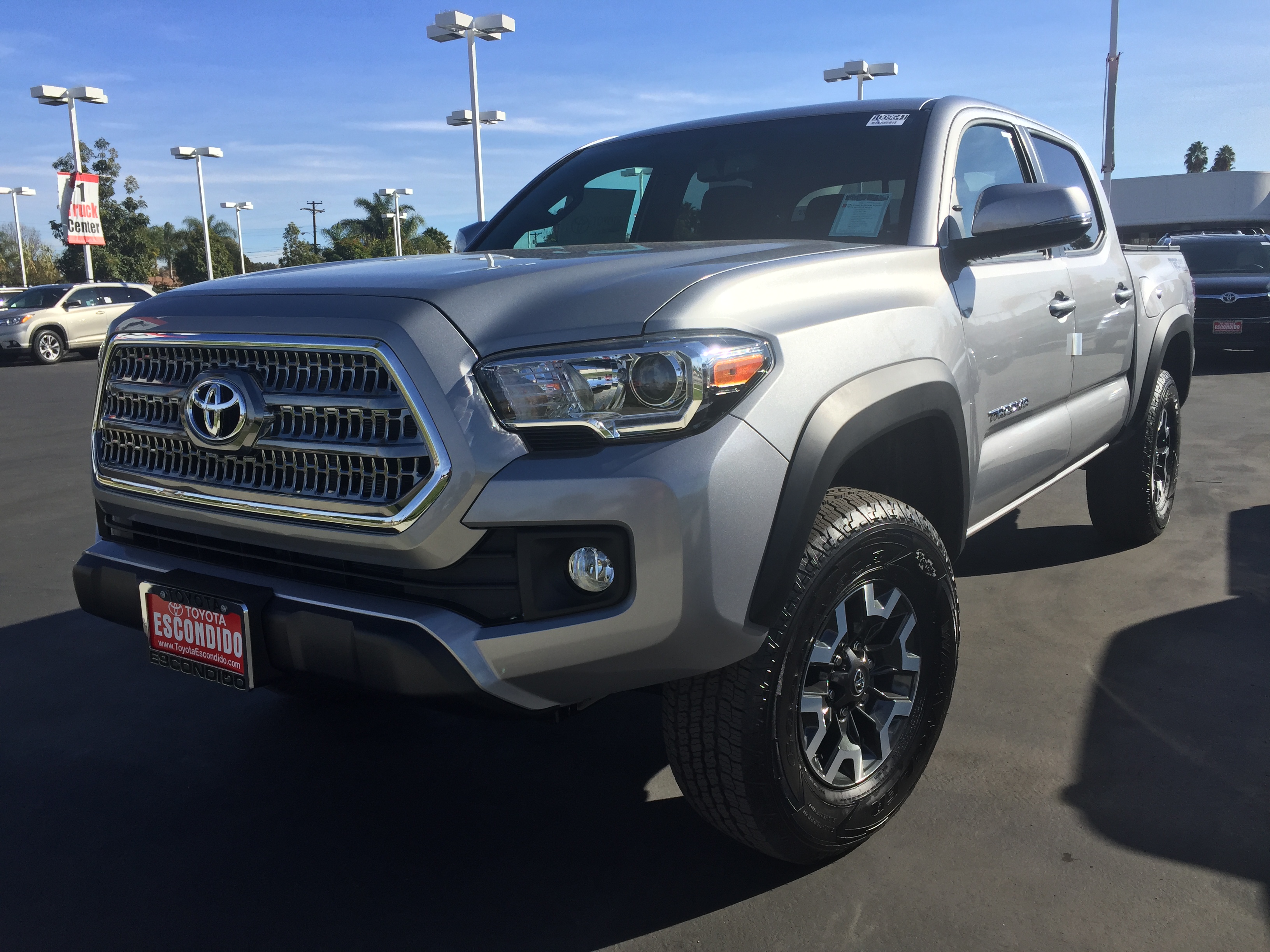
But I mean Toyota still to this day has the Tacoma is a rock solid vehicle.
But they have had a lot of issues with the tundra trying to be competitive, trying to incorporate some Toyota engine issues, engine issues and just the size.
And you know what it does, you know, and some even some respects the big V8, the big SUVs based on trucks again I mean, I'm not going to say that the Tahoe and Escalade etc.
are fantastic in all aspects, but the Sequoia is just, you know, it just just almost like a D.O.A.
type of thing because of just how it's how it is set up with the hybrid battery and all that.
There's just sometimes things that are being shoehorned in, maybe by the foreign manufacturers, that the Americans are just like, nope, we could do this.
And this is where the market is interesting, because it's almost like Toyota and GM just switched roles, because GM sticks with their basic V8 for their big trucks, and Toyota comes in with making a super complicated Sequoia.
Yeah.
So so you know, because the last Sequoia was a V8.
All right.
And and was pretty solid and pretty reliable.
But but now they're making it.
You know, Toyota has gone with smaller engines with the idea perhaps with fuel economy in mind.
But but they're having they're having some reliability issues because it's a new tech. So.
Right. Again I know almost know I'm talking all the time.
We are touching on this in other places.
But a lot of a lot of domestic, vehicles also run on regular gas.
Well, not a good point. Universally.
You know, there are ones that take premium fuel, but a lot of them run on regular gas and not so much from overseas manufacturers.
You know, you see a lot of this premium required or or premium recommended.
But in the book it says this, you know, and we're we're digging into that more.
But there are a lot the the $5 gas here.
To your point it's a huge there are not have to get premium number of vehicles that you you can you just run on regular and they're fine.
So it's kudos to the domestics.
And speaking of Americana, did you know the 2026 is the 100th anniversary of route 66?
The legend, the legendary road that goes from Chicago to Santa Monica, California.
It's 100 years old.
You know we all had kids.
What was it like to ride it when I'm old?
But I'm not bad.
But, you know, you watch we we watch the cars movie, right?
With our with our kids.
A lot of that is based on on like the rise and fall of route 66 as they built the interstates and they didn't that the road didn't go through the small towns anymore.
And let me let me throw something else out that I think you're going to be.
You know, very happy if you have a mastic branded car, if you break down on route 66 and all know where you're going to be much better.
Bill will find part for your car.
And no matter where you are, the parts are going to be much cheaper.
Yeah.
So if you want to go, I mean, even just, you know, not even breaking down, but just like, you know, you want to get a brake job on your Ford, it's going to be way cheaper than for an Audi or a Volvo or a lot of the, the foreign vehicles.
So, you know, we can we can look at this at this, podcast and genuinely say we got our kicks on route 66.
You're just building up just that's your whole reason why you got you got that right. Mr..
That's so if you're watching on YouTube, we recently added a donate button to our page.
Consumer reports is a nonprofit, so if you're able to help us keep doing this important work like talking cars, we always appreciate it.
Every little bit helps.
And that'll about do it for this episode, which was masterfully orchestrated by super producer Dave Abrams and expertly edited by Andrew.
I still play Hockey Belize and of course, Anatoly the Great Chomsky.
As always, check the show notes for more information on the vehicles and topics that we discussed.
And just a reminder, keep your questions coming.
Go to Talking Cars at Icloud.com.
Thanks so much for tuning in.
We'll see you next week.
About this episode
Debunking the persistent myth that Consumer Reports hates American cars, the hosts dive into the complex reality of the modern automotive industry. They explain how data-driven reliability ratings shape their recommendations rather than personal bias. The conversation shifts to what truly defines an "American" car today, highlighting how many foreign brands manufacture vehicles in the US while domestic brands often build overseas. They also discuss the impact of the chicken tax on SUV production, the value of manufacturing jobs, and why consumer choice remains vital.
This week's episode tackles a long-running debate: are American cars inferior to their Asian and European counterparts? We break down the truth about Ford, GM, Stellantis, and Tesla, and how they stack up to Toyota, Honda, and other top automakers, revealing how performance and reliability drive our ratings. Plus: why the American dealership model is still so frustrating, Chinese EV competition, expert tips for negotiating the best price on a new or used car, and how to avoid costly add-ons. We also answer a viewer question about what we think American cars do better than the competition.
Join CR at https://CR.org/joinviaYT to access our comprehensive ratings for items you use every day. CR is a mission-driven, independent, nonprofit organization.
SHOW NOTES
-----------------------------------
00:00 Intro
00:15 Do Consumer Reports Hate American Cars?
00:55 The Myth About American Car Reliability
03:56 What Is an "American-Made" Car?
09:33 Why Consumer Choice Matters
12:37 Chinese EVs and the Future of the Auto Industry
20:26 Why Do Detroit Automakers Struggle With Reliability?
28:05 EVs vs. Hybrids: What's Next?
33:16 Why Buying a Car Is Still So Hard
35:42 Dealership Tips: Avoid Costly Add-Ons
42:06 The Future of the U.S. Auto Market
51:13 Audience Question: What Do American Cars Do Better?