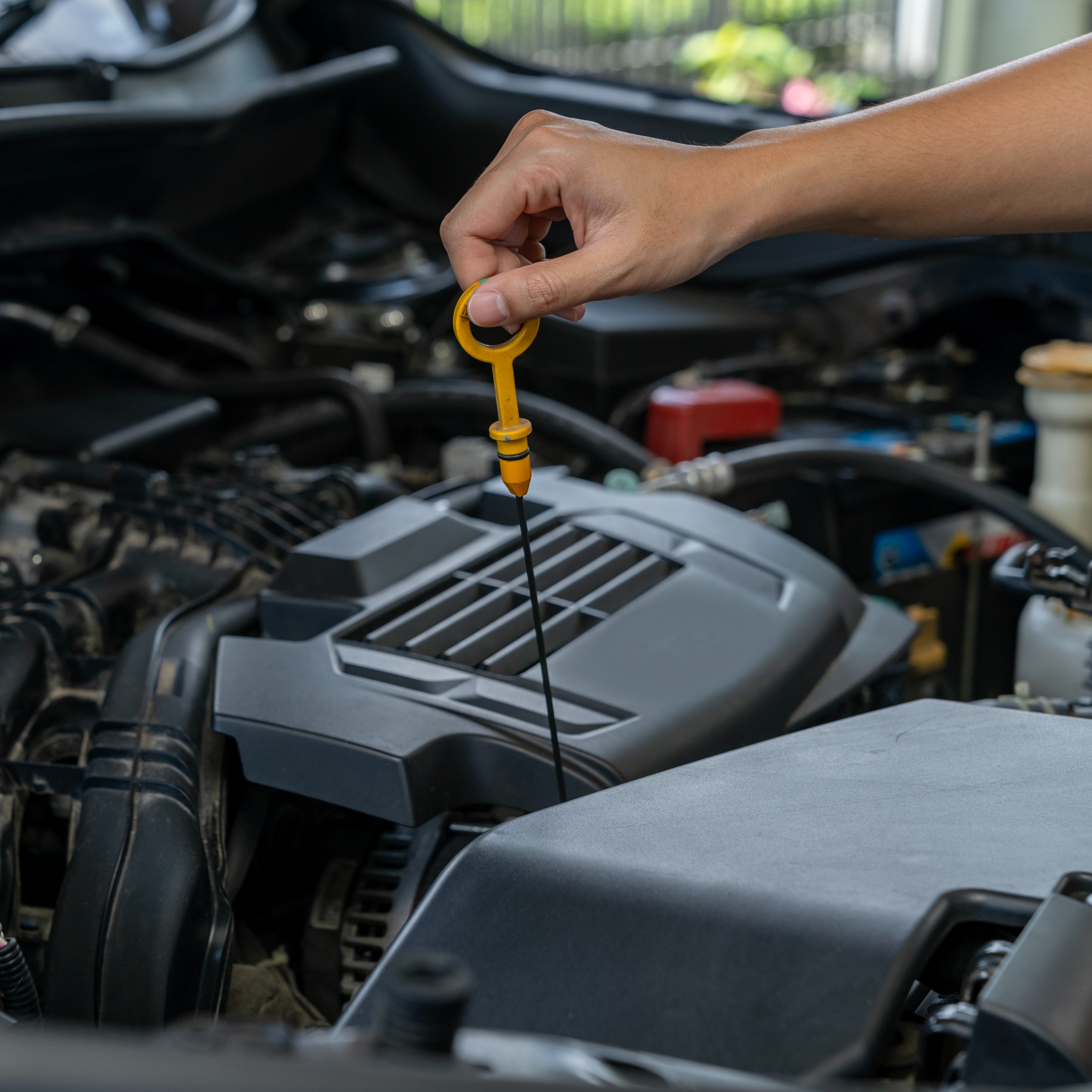
Differential fluid helps keep a car's differential working smoothly. It's important to change it regularly because it can get dirty and affect how well the car drives, especially when turning.
A maintenance schedule is like a checklist for taking care of your car. It tells you when to get things like oil changes or inspections done to keep your car running well.
Viscosity is how thick or thin a liquid is. For example, thicker oils flow slower than thinner oils, which can affect how well they work in your car's engine.
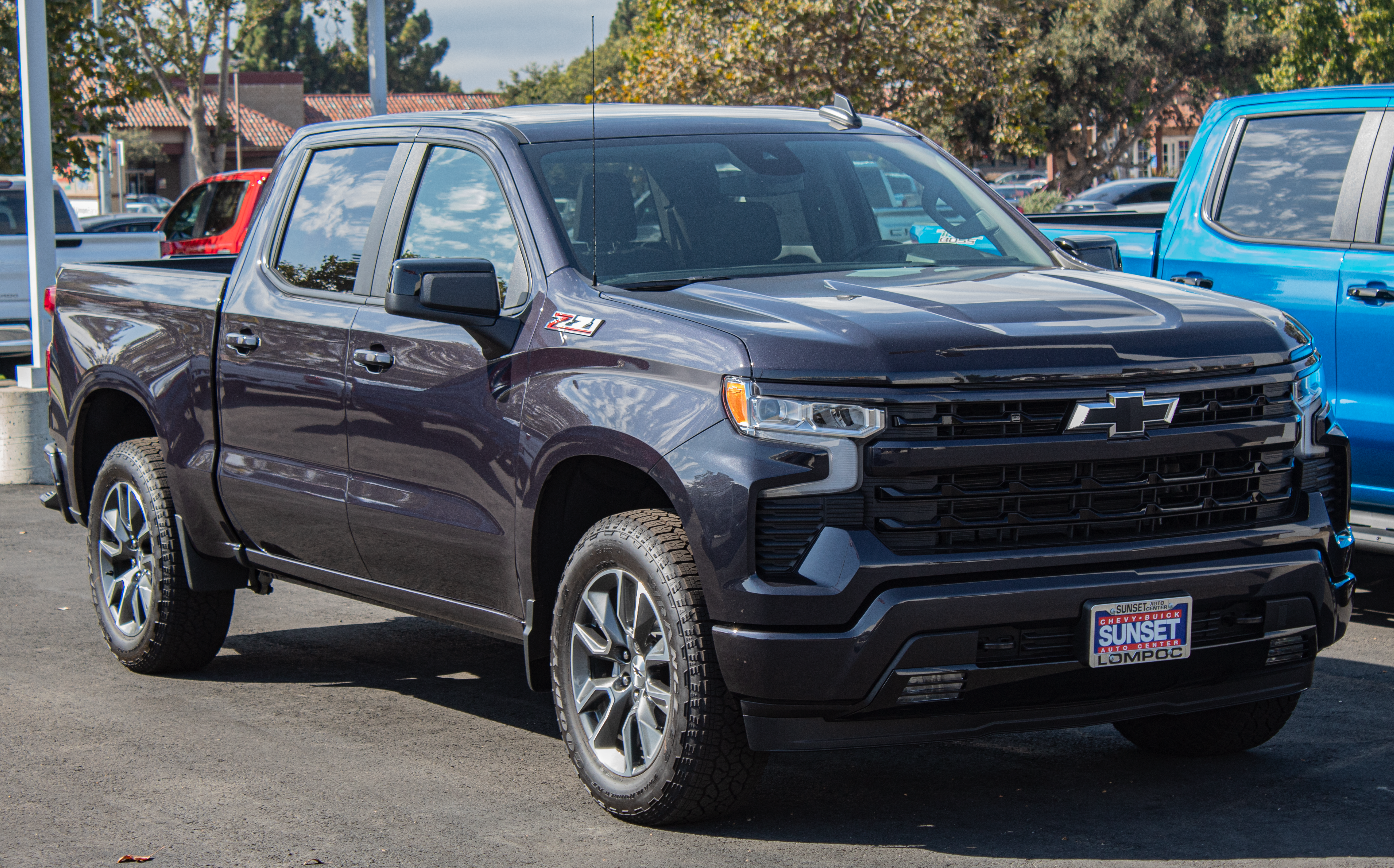
The Chevrolet Silverado is a big truck that can carry a lot of stuff and is popular for work and personal use. The 2000 version has a strong engine that helps it drive well and tow things.
A roller cam is a type of camshaft that has small wheels (rollers) to help it move more smoothly. This helps the engine work better and can make more power.
The catalytic converter is a part of your car that helps clean up the exhaust gases before they leave the car. If something goes wrong with the engine, it can hurt this part and lead to expensive repairs.
Term
E85
E85 is a type of fuel that has a lot more ethanol in it than regular gas. Cars that can use E85 are called flex-fuel vehicles, and they can run on different mixes of gasoline and ethanol.
Fluids in a car are liquids that help it run smoothly. They include oil for the engine, coolant to keep it from overheating, and transmission fluid to help change gears.
The drivetrain is the part of the car that helps it move. It includes things like the transmission and driveshaft, which work together to get power from the engine to the wheels.
The exhaust system helps get rid of gases produced by the engine. Letting it breathe means making sure those gases can flow out easily, which can help the engine run better.
The brake rotor is a flat metal disc that helps your car stop when you press the brake pedal. Sometimes, if it gets rusty from wet weather, it can make a squeaking sound when you first use the brakes, but this is usually normal and goes away quickly.
Brake pads are the parts that push against the metal discs (brake rotors) to help your car stop. If they are a bit rusty or dirty, they can make noise when you first use them, but this is usually nothing to worry about.
All-wheel drive means that the car can send power to all four wheels at the same time. This helps the car grip the road better, especially when it's slippery or wet.
The Toyota Camry is a family-friendly car that is easy to drive and very dependable. Many people like it because it lasts a long time and doesn't usually have many problems.
The Chevrolet Corvette is a fast and sporty car that many people dream of owning. The ZR1 version is even more powerful, but it can be expensive to take care of because it has special parts and needs regular maintenance.
LIVE
It's Saturday morning in C.C.O.L. and when we talk cars, or maybe more specifically your car, your truck, your van, and the problems you're having with that particular vehicle.
And before you bring it in for service, your favorite dealer, your favorite shop, you might want to know what could be ealing.
Little heads up. It's always good. And we're going to give you that information thanks to Nick Stoffel, A.S.C. Certified Technician who runs a place called Lloyd's Automotive in St. Paul, among other things.
Nick, good morning.
Good morning, Danny.
You know, I'm thinking about how many times we've done this show and how many seasons, how many winters. This is not a real bad one, is it?
No, it started kind of early and made us a little worried, but thus far it kind of milded out, I would say.
Yeah, and looking at the forecast, I heard Al say 30s, upper 30s on, was it Tuesday? And we could hit 42 Wednesday. Then kind of back to average.
So it is what it is and it doesn't change the problems people are having with their vehicles. It just might make it easier to get to Lloyd's Automotive or their favorite shop to get things done.
And that's the deal with our Saturday morning show. If you have any problems and you want to get some free information from our A.S.C. technician here, Nick Stoffel, now's your chance.
But do it earlier rather than later. Nick, our time spent here goes by so quickly. Nick takes his leave about 7.45, making a way for Ted Ferrell's wine chat.
So call us or text us with any kind of a car care question you may have, all right? You don't have to be a motorhead either, or a big do-it-yourselfer and have a shop at your house.
If you drive a car and having problems, you can get to Nick either by phone or by text. Here's the way to do it. 6514619226.
We got a text earlier this morning, we've got to get this problem solved, Nick, because it involves a recall from Toyota that affects the interference on AM radio.
So don't you agree? We've got to get to the bottom of this.
Absolutely, it must do.
The text did give this information, fortunately, and it's for RAV4. I'm not sure how many years or which ones, but nonetheless, here's the deal.
Here she said, what they said they will do at the dealer, or the Toyota manufacturer, I should say, says they will install a wire harness protector to seal the HV floor under wire connector.
Does that make sense to you?
Usually we have interference, I guess, is the best way to put it. That electric motor is putting off a frequency, and if that AM antenna is picking that up, it can create some little noise.
You remember years ago, the engine used to do that. So they probably have a different type of wrapping for that antenna wire that they're using to insulate and keep that interference from affecting the sound waves.
And the listener says, and I'm glad they sent this much information, the letter that here she got said it will take at least 90 minutes or more to repair.
And I was wondering, do you have to pull out the dash for that? And again, we're talking the various RAV4s, among other things. Does it sound like a major job?
Well, 90 minutes isn't, I mean, it's a bit of work, obviously, but you're not removing the entire dashboard. I suspect that maybe part of the council comes apart, some of that the trim and the beauty ring would come off.
Maybe the actual unit gets pulled out of the way to access the back where there's wiring and antennas located.
But at least, I mean, as I said, we've got to get this corrected.
All right. Well, if we don't have WCCO, especially Saturday mornings, I'm not sure what we're going to do. It's all about us.
Again, here's our phone number. It also happens to be the text number 6514619226. Scott's calling in this morning from Shoreview.
Scott, thanks for calling. What is your question for Nick?
Yeah, thanks, guys. I've owned Hondas for the last 10, 12 years, and right around 20,000 miles, when I take it in for an oil change, they keep saying I should change the differential fluid.
What is that about? I've never done that in my life, but they really try to talk me into changing that fluid. What's that all about?
So depending on the make and model in this vehicle in particular, there's likely a coupler or a set of friction rings in the differential.
It kind of helps with the elbow drive. That fluid will have an additive. It does. That fluid will collect a lot of dirt and debris.
So after the braking period, I suspect is what they're saying after 20,000 miles, which is a bit of a time or a year or two.
They want to change that fluid out. Not a bad service. Certain makes and models we will see where we neglect or ignore those services where it can create damage to the coupler or to the differential, which can be a costly repair.
So what I'd like to say is we'd say on a weekly basis, follow the orders manual, take the word of the dealership or your shop in consideration.
Come up with your own game plan there, but if it's on the service interval, it's something that should be done.
The manufacturers that noted it acknowledge that that's something that should be maintained on a semi-regular basis.
You know, 20,000 miles, I'm not sure if that's the right mileage interval if it's a little bit early, but there is a service interval for that fluid.
I would follow that if they're saying that they're having issues with this component and they'd like to do a little bit earlier.
I don't think that's a big concern. I would probably follow the recommendation.
I don't imagine it's horribly expensive, but I would listen to their advice, come up with your own game plan, but that fluid should be serviced.
Very good. I was just thinking, when I or anybody brings in their vehicle to Lloyd's Automotive, probably any shop, your technicians via computer,
I mean, you guys have all the information of various manufacturers that kind of tells you the maintenance schedule.
It's not like you're trying to upsell people. You're saying, you know, we noticed that, you know, just like this listener, or maybe you need this or maybe you need that.
You're not necessarily trying to upsell them. You're kind of giving them a heads up, right?
Absolutely. You know, we do have access to all those maintenance intervals, but we also have the experience of having seen situations or concerns or problems with certain vehicles.
There are certain systems within a vehicle. So we might make a recommendation that's a little bit earlier, a little bit different than what the manufacturer originally said when they made the vehicle.
So, you know, as time goes by and we have more experience, sometimes we will adjust those.
We might say, now this is a common known issue on this particular vehicle.
We'd like to do this maintenance interval or this certain repair or service a little bit sooner.
And here's the reasons why, you know, we talk about oil, you know, oil changes.
A lot of times a manufacturer might say 10,000 miles.
My opinion, I think that's way too long.
Reasons is because we see a lot more mechanical issues with engines.
We'd like to do that interval or that oil change sooner to kind of prevent any of those excessive problems that you might have.
Speaking of oil, a text wants to know basically it's kind of a long paragraph.
And we've had this issue before.
If the oil level is down, would it be okay if I added a different viscosity, not that much of a change from what's recommended, but just temporarily until I can get the oil change?
We've had that before. What would you say?
I suppose if it's 016, for example, and they're using 020, I mean, is there a point where you don't do it with a certain viscosity?
Well, case by case, obviously, if you're in a pinch and it's low on oil and you're headed on the long drive, I think topping up is just fine.
Yeah, I mean, 0 to 16 to 020, not significant.
I wouldn't make a habit of it.
If you're going in for, you have an appointment the following week and it's down a quart of oil, sure, top it up with, you know, not whatever you have, but something close, I think is just fine.
But definitely don't make a habit of it.
There's a reason they make recommendations or they have certain specifications.
We really want to try to follow the best we can.
You get in a unique situation.
I think it's better to have it full of oil versus low on oil, you know, regardless of what the recommendation is.
I think for that short window of time, it'll be just fine.
Now, when I thought, because my son's vehicle uses 016, I believe, and I thought that was like water.
Did you tell me an earlier show that there's even thinner oil than that?
Yeah, I did read something, 08, and, you know, the oil is getting thinner and thinner.
More of the reason to keep on top of those intervals.
You know, I'm not sure what the cause and effect of the later oil.
Obviously, it's a lot to do with fuel economy, emissions, and, you know, the technology is amazing.
They're making vehicles last longer, run better, but we have to be very on top of our maintenance schedules.
That thinner oil, like you said, it's like water, or it seems like it's like water.
And if you go too long, you're too low, it can create damage to that engine, and sometimes you can't reverse.
So if your vehicle, got a new vehicle, very lightweight oil, you have to stay on top of that maintenance schedule.
You know, make sure you do that oil change every 5,000 miles.
If it gets too far out of that realm, you're in the risk of having bigger problems.
Yeah, easy maintenance, easy to be done.
All right, hang on Nick, we'll take this quick break.
Invite our listeners to join in sooner rather than later.
Our time goes by so quickly.
Any kind of a car car question, we'd love to hear from you either by phone or by text.
651-461-9226 from Newstalk A3O.
This is WCCO.
And good Saturday morning to you.
Welcome back to our Car Care Show.
Danny Long here, along with ASC certified technician Nick Stoffel from Lloyd's Automotive in St. Paul.
Again, we always, Nick, like to ask you how to find Lloyd's.
Folks might need the help.
How do we find Lloyd's?
Yes, sir.
So if you ever have any questions, we are there to help.
Give us a call 651-228-1316.
If you happen to be in St. Paul, you can find us on the corner of Grand and Chatsworth,
which is two blocks east of Lexington Parkway on Grand.
If you need more information, you can use our website, which is LloydsAutomotive.net.
Very good, we'll get you that info before Nick leaves us, which is about 745 this morning.
Call us, text us 651-461-9226, any kind of a car car question.
Just like Pete in Forest Lake, I believe, has been on the arm waiting.
Thank you, Pete.
What is your question?
Well, I've got Cameron Oddball on my hands for you gentlemen.
I've got a 00 Shub Silverado long box, OK, 2000 with a 4-3 V8.
And yesterday I was driving over some bumps and I now have a gasoline smell coming in between the cab
and the box on the pickup truck I can smell it.
And if I let the truck sit in idle for like 10, 15 minutes, I get gas fumes in the passenger compartment a little bit.
I'm just wondering what it could be.
Well, it's a concern if you're smelling raw fuel, there's a leak in some extent.
No, I'm not saying that's going to make a big puddle on the ground,
but a lot of times the venting plumbing might have come loose, something might have come fractured.
I think that is a valid reason to get into the shop or your dealership, get it in the air,
have something like to get up in the air, look underneath, kind of trace those evap lines,
the fuel lines, the filler tube, figure out if there's a spot there or something to come damaged or loose
and it needs to be reinstalled or tightened.
But I think for smelling fuel, that should be a priority, have that looked at it as soon as you can.
Yeah, good luck with that.
Jerry is calling in from Minnetonka this morning.
Jerry, you're on CCO with Nick. What is your question?
Good morning, Nick. Say, Nick, I got an oddball question.
Do I recently bought a Ford Anglia 1950?
It's got a 383 stoker motor with a roller cam.
So what is the advantage of a roller cam over just a regular cam?
Thank you. I'll hang up on that.
I think in that vintage, they were trying to reduce friction,
so that the rollers with the rocker arms, with the camshafts,
instead of having that flat tap it or that flat part of the rocker,
they had a little bearing that would roller, so as a camshaft rotated, it reduced friction, less friction.
I think they deemed it to create more power.
That's going back many, many years.
So I don't know what the reasoning was at that point,
but I think at that point in time they're trying to reduce friction to create more power.
A little more horsepower made the car go a little faster.
Thank you for the call. Let's grab some more text questions.
Here's one. If my check engine light goes on and I'm four hours from home,
is it okay to drive it home and then to my service shop?
What do you think about that?
I guess there's a difference between the light coming on and a flashing engine light, right?
Correct. My rule of thumb is if the check engine light is on but it's operating fine,
get on somebody's schedule, make an appointment.
If the light is on and it's running not like it should, a little bit rough,
you need to get in quickly, but that light is ever flashing.
That's kind of your heads up. You should really stop driving that vehicle.
Have it towed somewhere because they consider the catalyst damaging misfire,
so there's something significantly wrong and by driving it you can create permanent damage.
Another thing too is if you're four hours away, I might stop somewhere,
at least have them access the code, give you a ballpark idea of where you're headed there
because what we don't want, especially in the winter months,
is between here and there, two hours away and something does change.
Now you're stranded. Where you started from, you might have a place you could stay
while that car is being assessed or repaired.
I think before I get into a long drive, even for myself,
if I had a check engine light on, I would probably at least do a basic assessment
to figure out what the risks are, then you can make a determination
if you're okay to head home or you need to have that repair where you're at.
And I brought it up, but Nick, what happens if the engine light turns out to be flashing?
What does that, fortunately I've never had that problem, but what does that mean?
What could it mean?
The computer system deems that like a catalyst damaging misfire,
meaning that whatever's going on, one of the cylinders isn't operating.
We have rough fuel making its way into the exhaust.
The converter's going to burn it off, but if it does that for an extended period of time,
you can damage that converter along with whatever was originally wrong,
creating that problem so your costs just go up, repairs become more extensive.
So if that light is flashing, like I said, you want to have that vehicle towed into your dealership or your shop,
and that's something you want to be driving around in.
Okay.
Now the texture says this, Nick.
The last time I filled up the gas pump said it contains 15% ethanol.
Is that common in today's gasoline and exactly what does ethanol do?
Well, ethanol is alcohol and it kind of replaces what we used to use heat,
you know, the isopropyl that we used to dump a can in the winter months to absorb the water.
So the ethanol will do that for us.
There's a lot of different fuels out there.
You need to make sure your vehicle is designed and equipped with all the technology to operate on those different fuels.
So if you have a E85 vehicle or a flex fuel vehicle where you're allowed to use those higher ethanol levels,
it's just fine.
If your vehicle is not designed or equipped with such, you should use what's recommended.
If you open the fuel door and where your gas cap is, it'll say E85 or it'll say regular unleaded.
You look in your owner's manual, have a recommendation on the octane level.
So you should follow those recommendations.
There's a lot of fuels out there.
You get to some of these stations and it can be a little bit confusing.
So make sure you take a minute, look at what you put it into the vehicle because you don't want to put the wrong fuel into it.
Here's one we get from time to time about adding or just additives.
This in particular one was asking, would it help or hurt what they call fuel injector cleaners
and some of these cans or bottles or, you know, aerosol, whatever the case may be.
What is your opinion on some of these additives?
Well, we do get that question from time to time.
And the one thing I will say that I truly believe in, you cannot fix a vehicle from a can,
meaning if you have something that's damaged or broken or failed, there's no additive that's going to reverse that.
Now, as far as maintenance goes, I think some of those cleaners can be helpful.
Now, some of those cleaners can be expensive.
So you need to kind of reflect that cost and you need to determine if it's the right thing for you.
But I think as a maintenance item, a lot of those additives can help clean some of these systems,
keep the vehicle running longer, better, more efficiently.
But once again, if you have some sort of failed component, you cannot fix a vehicle from a product out of a can.
Yeah, absolutely.
All right.
We have more time.
It's going by quickly, but if nonetheless, if you have any kind of a car care question,
we'd love to hear from you sooner rather than later.
Nick will be with us for about another 15 minutes.
So call us, text us 651-4619-226, and we're going to catch up on that forecast straight ahead.
News Talk 830, this is WCCO.
And a good Saturday morning to you.
Welcome back to CCO's car care show.
Denny Long here, along with ASC certified technician Nick Stauffel from Lloyd's Automotive in St. Paul.
Nick, we have some textures to help out.
We might grab a phone call or two.
We still have some time for your text or calls at 651-4619-226.
Here is another one.
This texture backed the car out of the garage yesterday.
And when putting it in drive, it felt very stiff.
I left the car in the sun for an hour or so, and then no problem putting it in gear.
The car had hardly been driven once in the past two weeks.
What do you think was going on there?
Just guesses.
Well, I think it's kind of like some mornings we wake up and we're a little bit stiffer than we'd like.
We need a little time to warm up.
You know, sometimes, you know, the linkage, the fluids, you know, whether it's something with the transmission or the drivetrain or the steering, you know.
Oftentimes, a little bit of sun will warm things up and make things a little bit freer.
So I would say if it was a one-off situation, I probably wouldn't be overly concerned about it.
If it's something you notice on a more regular basis, make note of it.
It might be one of those situations where you'll drop it off at your shop or dealership the night before.
So they could be the first ones in the morning to drive it experience what you had experienced.
But if you don't notice it for the next several days, I probably wouldn't be overly worried at this point.
Something you and your friend, our friend Dan, have always said on this show that the cars are meant to be driven, right?
Not parked and left.
Absolutely. And there's, you know, there's a happy median.
But if you have your vintage collector vehicle, obviously you want to be out in the roads in the winter months.
But, you know, people will say, you know, I don't drive as much as I used to.
I'm retired now. I just go from my church, my grocery store.
I got a small little window that I live in.
And that will say if you're comfortable on the right day, maybe take the long way.
Get a couple extra miles.
You know, let the exhaust breathe a little bit.
Let those tires warm up.
Let those brakes clean up.
So, you know, not saying you need to put yourself out on the, when the weather is bad or the roads are bad,
but on a nice day, taking the long way probably isn't the worst idea to keep that car running smoothly and running the way it should.
As far as battery charging, I'm looking at a text that occasionally we get a question about this.
And I know our friend Dan and I have talked about it.
You and I have talked about it as well.
Should I turn off all accessories when shutting off my car?
Now, I'm kind of weird that way. I do.
But does it make a difference?
I'm not sure it's necessary.
It probably doesn't hurt, right?
You know, let all that current coming from the alternator top up that battery before you shut the vehicle off.
Probably doesn't hurt.
But with the way vehicles are designed and built these days, I don't think it's necessary.
I think that goes back to yesterday years where we used to try to make sure we put as much back into that battery
to give us the best opportunity for the car to start on the coldest days.
But I think at this point in time, if you have a battery that's aged or worn out,
any of those tricks probably are not going to help.
So if it's a habit that you had, Danny, that you created a long time ago,
if you stay with it, it's part of your routine.
But I don't think it's necessary.
And it helps me sleep at night.
No, I'm just joking.
It's just a habit.
Just a habit.
Here's another one we get from time to time,
especially in wet, cold, damp type of weather.
Listener said this, brakes squeak very loudly when backing up from damp weather.
Should I do anything about it and maybe avoid a car wash?
No, if you have that little squeak the first time you pull the vehicle out
or the first time you applied the brakes, but then it goes away,
it's just that there's a little corrosion built up on the brake rotor surface.
Those brake pads are applying.
That friction makes a little bit of noise.
It cleans up, it's gone.
It's just normal.
With the higher humidity you've mentioned,
I think a lot of people might experience on a day like today,
it's a little bit mild for a winter day, a lot of humidity,
a little bit of surface corrosion on those brake rotors.
It doesn't mean something's wrong.
It's just telling you that it's cleaning them up.
But if it continues to make the noise, yes, get it looked at.
But if it's just a one-off, don't worry about it.
And I would imagine that, boy, car washes this season have been really busy.
I mean, with our rain, with our snow, with our salt, with the variety of conditions,
there have been a lot of dirty cars around, right?
Because of the weather.
Yeah, with the temperature just hovering around freezing
and like you mentioned, the salt and then the rain,
all that salt gets over the vehicle somewhere through the car wash.
Not a bad idea.
Yeah, the underbody especially if you can do that.
Good morning, Texter says,
why don't automobile manufacturers make more all-wheel drive models
in full-size pickup trucks rather than just four-wheel drive?
They want your opinion on that.
You know, part of me would say because not all regions of the country need all-wheel drive.
If you're not in a snow state or you're not a lot of off-road type operation,
they probably don't see that as a necessity and the cost of it does make it more costly.
The all-wheel drive does affect the field economy.
So I think they've done their math saying, you know, it depends on the region of the country.
You may or may not need that.
Okay, I think we have time maybe for one or two more.
This listener says, I have a 2011 Camry.
I need struts.
This obviously is brand name.
Are KYB struts plus quick struts a good choice or should I buy OEM?
What does this listener talking about there?
KYB is an aftermarket part that I think is a good quality part.
That versus original equipment, it's going to depend on cost.
Obviously, I feel that the original equipment ones is the premium choice,
but depending on the cost and your needs.
You know, the cars, you know, 2011, I think they said, you know, that's 14 years old.
If you plan to keep the car just for a couple more years, you might use an option.
It's a little more cost savings if you're going to keep the vehicle until the wheels fall off.
As we say, maybe you want to invest in the little more expensive, higher quality
to keep that original equipment ride going longer.
Finally, I think we have time for one more texture.
And that's maybe somebody even knows wondering what the annual cost would be to maintain a ZR1 Corvette.
Now, I know you, this comes from a friend of yours.
There's a backstory there.
There's a backstory, but you started to sharing.
I know we have limited time during the commercials, but I've never driven a Corvette, but you have.
So, you know, full disclosure, I have historically not been a big Corvette guy,
but that's my friend Tony Leesman who works for the Maurer Group who sent that text in.
My son, Silas, and I went out to San Diego this last fall and our situation got complicated.
We had to rent a vehicle and we ended up at, I think it was Enterprise.
And it wasn't a whole lot more money.
I think I thought it was like $150 a day.
We were able to rent a Corvette.
And of course, my 13-year-old son thought that was like winning the lottery.
And I was surprised.
I really enjoyed it, to be honest.
So, when I got back into town, I asked Tony, what is the cost for one of these scenes?
And how do you get one?
And, you know, at this point, I'm probably not in the right financial situation to do such a thing.
But I would tell you, if you have a chance to drive one of those, it's pretty sweet.
That mid-engine car just really sticks to the road.
And especially out in California where the sun's out.
And it was a beautiful day.
And it was an amazing trip that I had with my youngest son, Silas.
That sounded like a great time.
Now, you said it's a mid-engine.
It never used to be a mid-engine years ago, right?
No, no.
It was a standard front-engine rear-wheel drive.
But when they created the scene right here, with the 2020, I think it was, that they kind of reconfigured.
And they've since changed and added the ZR1 and the Z06.
And you go through the history of the Corvette there.
But it's a pretty amazing vehicle.
And obviously being with your 13-year-old son and having that little boys' trip.
You know, visiting Coronado and doing all the fun military installations and little fishing.
And it was a sweet trip.
Great memories there.
Nick, we have to run.
What do you say we do this again next week?
I think that sounds like a date, Danny.
Well, in the meantime, how do we find Lloyd's Automotive?
Yes, sir.
As always, if you have a question, we're here to help.
651-228-1316.
And if you're in St. Paul, you want to stop and say hi?
Well, we're there.
We're at the corner of Grandin Chatsworth.
It's 982 Grand Avenue.
And if you need more information, you can always check out our website, which is LloydsAutomotive.net.
Good deal, Nick.
Thank you.
Have a great week and I'll talk to you next Saturday.
Sounds good.
Thanks, Danny.
Good deal.
Next up, from Lloyd's Automotive.
About this episode
Nick Stoffel, an A.S.C. Certified Technician from Lloyd's Automotive, shares valuable insights on common car issues, including oil maintenance, check engine light concerns, and the importance of timely repairs. Listeners ask questions about differential fluid changes, the implications of using different oil viscosities, and the urgency of addressing fuel smells in vehicles. The discussion also touches on the benefits of regular maintenance and the impact of weather on vehicle performance. Nick emphasizes the importance of following manufacturer recommendations and staying proactive with car care.
AM radio issues. What does it mean to change differential fluid in a vehicle? Oil change intervals. Difference in oil viscosity. Gas smell concerns. Is it necessary to turn off all accessories before turning off a vehicle? Ask our car care expert Nick Stoffel of Lloyds Automotive. Visit lloydsautomotive.net 651-228-1316.