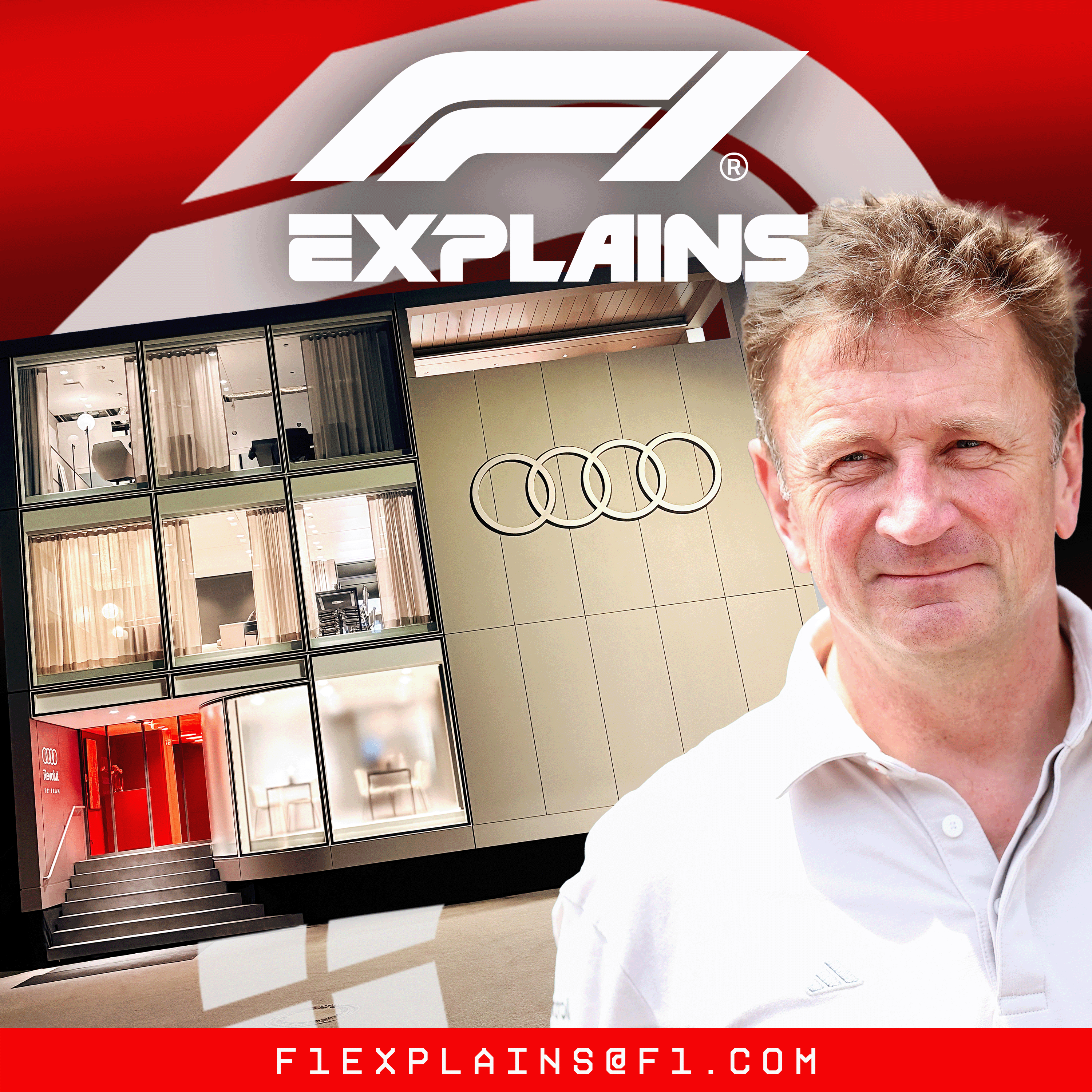
Audi is the car company behind the project being talked about. The hosts are saying Audi is aiming for a high-end, serious setup that matches what they want to do in racing.
“New regulations” means the FIA changes the rules for how F1 cars are allowed to be built. When that happens, teams often have to redesign parts of the car to comply and still be fast.
In F1, an “engine supplier” is the group that provides the engine package to a team. Some teams get engines from partners, while others are set up to develop their own.
Red Bull is mentioned because it has a partnership with Ford for engines. It’s an example of how F1 teams team up with other companies to get the power they need.
Ford is mentioned as the partner in an engine deal with Red Bull. In F1, that kind of partnership affects who builds the engine package and how the team develops it.
A “works team” is basically the automaker’s own Formula 1 team. Instead of just buying an engine from someone else, they’re heavily involved in building and developing it themselves.
Alan McNish is a well-known former Formula 1 driver. In this episode, he’s also working in a senior role with Audi’s F1 team and shows the hosts around their race-weekend setup.
Term
cold plate
A cold plate is a surface or device designed to keep things cold. In this conversation, it’s part of the team’s setup and is mentioned as something Audi does better than other teams.
A crane is a big machine used to lift heavy things. The speaker is saying teams can’t always take their hospitality setups down right away—they often have to wait for a crane.
LIVE
I am standing in the middle of the Formula One Paddock, the very heart of the sport.
This is where you'll find the drivers, the engineers, the mechanics and everyone involved
in this weekend's Grand Prix, including me, Christian Hugel. Hello. The Paddock is sort
of like a small town which moves around the world and each team has a home here. When
we race in Europe, the teams bring a motor home with them. You'll have seen them on the
TV. Huge buildings, each the size of a very big house, painted with team colours, covered
in sponsors, usually full of people sitting around and having coffee. I promise they're
doing some work as well. They are amazing bits of architecture, especially when you
consider they're temporary. They're built for every European race weekend and then
they're pulled down afterwards, put in a container and taken to the next track. So many. F1
explains listeners have questions about these motor homes and how they travel around
the world, including, get ready everybody, Leah in France, Matthew from Texas, Mike from
New York, Todd from Maryland, Rob from Maryland. Apparently there's a lot of motor home interest
in Maryland. Another Rob from Texas, Nancy from Niagara Falls, Miranda from North Dakota,
Aswin from India, Preston from Washington DC, Jocelyn from Vancouver, Paul from Calgary,
Alex from Reading, plus Jennifer and Kira, we don't know where they're from. But welcome
to F1 Explains and welcome to Audi, where outside we find Alan Mcnish. Alan, it is a total joy to
have you here. Thank you for hosting us here on F1 Explains. Yeah, thank you very much. And it's
also great to hear there's so many questions about how we travel around the world as well.
They are just questions that have come in about the motor homes specifically. They are a curious
bunch our listeners, Alan. Well, you're living in the 90s and the 2000s, if you're calling them a
motor home. Well, there you go. That's an old adage in that respect. But now these are a little bit
more than a motor home. Motor homes, for actually, there was a lot of American listeners there.
In the US, they still use physically motor homes as their base. The drivers stay in them
over the course of the weekend. That's a different situation over here in Formula One.
But at the same time as well, these are full structures, as opposed to something that you
can jump in, switch on and drive off into the distance to the next Grand Prix.
Absolutely. Well, Alan, we call this podcast F1 Explains. Explains to us. What's the
more up-to-date terminology? This is actually our hospitality unit.
Hospitality unit. Because we're very hospitable people. That's what it's all about. Very hospitable
people. Alan, you're going to take us in in a moment just for those new to Formula One.
Audi are a new name to Formula One. Explain your role, your job title and what you do here.
Well, Audi has joined Formula One at the beginning of this year. It's the first time
actually entering into Formula One itself. It's obviously got a great history in the sport
across the board from rallying through to touring car, to sports car racing, to Dakar,
to Formula E. But this is the first time into Formula One itself. I've been with Audi as a
driver since 2000. Been with the Formula One project since the very beginning of it, when it
was just an idea in a few people's heads, and then the ultimate execution of it. Now the racing
director of the team. Alan, it's lovely to see you here. Of course, one thing you've graciously
missed off that list of your skills is a Formula One driver with Toyota. Alan, as somebody who
fell in love with F1 in the late 90s and 2000s, I do like it when we have someone from my ear.
I said this the other week, we had one public on Toyota. You've driven these cars. You know
what it's like. Yeah, yeah. Definitely. It's definitely something that from any driver's
career, whether a young kid in karting or coming through the sport, you always look to see what
ideally you want to achieve at some point in your memory or your thoughts. And from a
single-seater point of view, it is Formula One. There's no question about it. And to sit in one
of those cars, strap yourself in for the first time in your career is a memory you will never
forget. There's a lot of other memories you would like to forget, but that particular one
is one you will never, ever forget. I'm sure you've had more ups than downs. Now Alan,
let's go back to these hospitality units. Are these team buildings permanent or temporary?
No, these are temporary units because effectively they go from all of the European races. We're in
Barcelona here this weekend. It's Thursday afternoon on Sunday night. I walked out of this
particular unit in Monaco at the Grand Prix. And so between that time, it's been dismantled in
Monaco, driven to Barcelona and erected here again for this weekend. It is funny, isn't it? Because
I've never been in here, but when you do go in the other teams' units, you don't feel like you're
in a temporary unit. You feel like you're in a room. And we all get used to rooms as human beings,
don't we? And therefore it's really weird stepping out of that room into a completely different
surrounding. Yeah, well, you're stepping out of France going into Spain effectively. You plug
your computer back in and it just works as if it was just literally yesterday. And it's the same
when we go from here to Spielberg to Austria. And it'll be, so for us, it is in a way, a home away
from home. It is where we work. It's our office. It's our place where we sit down and have dinner.
It's where we have our meetings. It's where we sort of relax. It's also where we host all of our VIPs
and guests that are coming through the partners of the team. And so it's a multifunctional place,
but it's one that is integral to the way that we go erasing. How long does it take to build and
deconstruct these? Because as we stand outside it, it looks so permanent. It looks like the
sort of thing that if you told me to take that down, it would take months. And yet we know that's
not the case. No, it's not. So roughly they take about two days to take down and two days to put
back up again. So back to back weekends, like we have here, are actually quite a stretch for the
teams to be able to achieve that. And it is a race in a lot of ways in the Grand Prix, but it's also
a race then to bring everything, the whole infrastructure, not just necessarily our hospitality
unit, but also the trucks and everything else to get to the next Grand Prix. And you mentioned
the next Grand Prix. How did they get there? They drive. They literally pack them on to trucks,
and then they will drive from here to wherever that Grand Prix happens to be. And so we've
effectively got like a setup unit that will come here in advance, put the base down, and then when
the rest of the structure arrives, then it's just sat on top a little bit like a Lego construction,
if you like. And then the trucks are waiting for it to go to the next Grand Prix from there.
Now, I'm fortunate enough, Alan, to have been in every other team's hospitality unit,
except for yours, because yours is new. I was in the old one. Your lovely team, as you've said
before, are very hospitable, but I've never been in this one. So we're about to have a tour
before we step inside, Alan. Let's go for a quick break.
Welcome back to F1 Explains, and today we are looking at the wonderful world of Formula One
team's hospitality units. I'm with the Audi racing director, Alan McNish. Alan, it's a shiny new
building that we're about to step inside of. I've never done this before. Are you happy to give F1
Explains a little tour of your shiny new building? I think we should. Come on, let's go inside.
Now, this could be interesting at only a number of levels, because we're not a small podcasting
unit. Producer Jamie's got a massive, great big box with him, so this should be interesting.
There's somebody waiting for us on the front desk. Hello, what's your name?
Hello, hi, nice to meet you, Nicole. Hello, Nicole. Have people been nice about your new motorhome?
Yes, they are super excited about our new motorhome. Excellent. Alan, I've done the thing again,
haven't I? I've called it a motorhome. I need to lose points for that. You're definitely not going
to get a cup of tea or coffee, that's for sure, until you get the message incorrect.
Now, we're in here in the ground floor section of it, and as you walk in, you sort of get the
feeling of Audi, the premium nature of the brand, and that brand runs through everything that we do,
and it's a clear, important point, because it's the first touch point for many people
into our world of the Audi Revolut Formula One team, and so therefore it has to look the part,
as well as be functional. On the ground floor here, it's quite an open space. There's lots of
tables. This here on the right-hand side as we come in is a lounge area, seating area,
nice and relaxed, a couple of little sort of lie-back chairs table, and actually,
I'm surprised how many people just sit down there just to take a few minutes, to take their own
breath as well, and to catch up, that's people that are either working with the team or,
alternatively, others that are just here having some fun like yourself.
Immediately after the little desk, there's a staircase to the left, there's this seating
area that Alan's just beautifully described on the right. The thing that I always enjoy,
Alan, about the detailed nature of the Formula One teams is even the seating is in the Audi
colours. You've got the Audi reds, the Audi grey, these, I don't even know what you call these,
they're like seats, but they're just very round. They look comfortable, can I? They are comfortable,
as well. It's even the tiny little details that they're in the right colour, and they're beautifully
comfortable. They have been checked. comfort checked, and they were checked as
comfortable, so you're okay there. Is that someone's job? That someone's job is checking whether they
are comfortable or not. Hello, I'm a comfort checker. Literally, that's how I'm a comfort checker for
Formula One. Behind the chairs, we've got the tables where it looks like we've just had lunch,
is that correct? Yes, it is. So, basically, here is where the team have lunch, it's where they
sometimes have dinner at night. Also, we host guests for special team dinners as well, very
exclusive ones, and it's in here with our catering service as well. Excellent, so lunch has just
been served. Do we know what was on the menu today, guys? There was a lot of salad, there was some
chicken, and there was also some spaghetti bolognese. Well, it wasn't spaghetti bolognese, it was,
what was it, Alex? It's for falle bolognese, apparently, and a vegetable curry, and so there
was a multitude of different things, depending on your appetite and your taste. Never even heard
of far falle, fantastic, excellent. There's also a coffee machine, Formula One teams get very
competitive about which coffee is the best in my experience. Well, I don't even know why you're
even saying that, which coffee is the best, you know which one it is, it's this one. Go on,
what are your credentials? Well, the best part about this one is, we had a fantastic little
machine there, and we could put your face onto the cappuccino, so then when you took your first
super cappuccino, your face was actually sitting on there, or the Audi F1 team logo, or whatever
it may be. Can I tell you something? I don't know how this is going to get down. McLaren did
that with theirs in Miami for me, and they put my dog on the coffee. Can you dog? My dog, I've got a
six month old puppy called Derek. That's very nice. Would you guys put the dog on the coffee?
Aye. Then you'll be my favourites, forget McLaren. Well, I've forgotten them already.
Exactly. You and the dog, picture of you and the dog are on there. This is the competitive nature
of Formula One. They're trying to one up themselves. Lovely. Shall we leave them to
go? Yeah, we should, and we should come round this way because then as it comes back,
there's obviously a depth to this place as well. And so, you know, there's some restrooms to our
side here. Always helpful. Yep. Very important for the guys that we've got a fridge, just different
things, and guess what, another coffee machine. And a coffee machine. I like that you've got two
coffee machines. And we've got multiples, don't worry. But this is something that I really like.
It's a cold plate. So if you think of it like a hot plate to keep your plates warm and
keep food warm, this is actually one that keeps everything cool as well.
Your level of detailed knowledge of this, I know like fundamentally your job's the motor racing
side of it, but you know every little detail about this motorhome. I'm really impressed.
Well, you kind of do when you see it being built up over a period of time. You know, these things
are not just sort of bought off the shelf and actually designed specifically for the needs.
So therefore, it went through a whole load of planning process to make sure it was exactly
as we wanted it. And that's the detail. Like in your own kitchen at home, if you're fortunate enough
to be able to sort of do a bespoke kitchen, then you will have things exactly as you want them.
I love a cold plate. I didn't think when I was watching F1 in the 2000s that Alan Mcnish would
want to talk me through the design of a cold plate, but I'm really glad you have it.
Well, we just wait till we get to the kitchen, mate.
Yeah, I'll give you a quick sneak view into the kitchen. This is where the magic actually
happens in here, in terms of that. And I don't know if you can see, but there's your faffali,
by the way. Yes, faffali. Oh, it looks lovely. It looks like pasta. It does look like spaghetti
bolognese, but apparently it isn't. It smells divine as well. It's a proper industry-grade
kitchen. Well, you wouldn't know you're at a Formula One race. No, it's a fully functional kitchen.
Apparently, the faffali's very good. Yeah, it's very good. What's in a faffali?
Faffali? You're gonna have to help me. Is it meat, is it? No, we're doing paella for tomorrow,
and I don't know. And what's your name? Nato. It's lovely to meet you. Are you one of the chefs?
Yeah. Great to meet you. Good luck with it. Thank you very much. I'm still not fully sure what
faffali is, Alan. I can't watch you. Well, you've got the pasta and then you've got the different
sauces from it. Right, fine. Excellent. Okay, great. And if we go upstairs to the first floor.
So we're moving away from out the kitchen upstairs. Yeah, this is the back stairs,
because you've got to have different stairwells, obviously, in terms of safety regulations.
And here we've got an area that is enormous that opens up. And again, a little bit like downstairs,
there's tables in front of us, different size tables, you know, you've got 10 seating tables,
you've got four seating tables, you've got a sort of bench bar where it looks onto various
television monitors that you can watch the race or whatever it may be. I've got a lot of thoughts.
Number one, it doesn't look like it's this big from the outside. I'm fairly sure this is something
like a TARDIS if you're a Doctor Who fan. You've also got like a full-on sim room with big glass
red panels separating it. It's beautiful in the Audi silver and red. It really is gorgeous. This
is lovely. Yeah, it is. You know, this sim room has got two racing sims and it's, I would say,
predominantly for guests. However, in Monaco, I did see Gabby going in there, setting up and
having a go himself. So I think there you actually see the sort of integration of it in some ways.
But it's interesting how, you know, this side of the digital world is obviously coming into our
motorsporting world and simulation and simulators are a major part about how we develop cars.
Now, it's certainly not, these are not on that particular level because the buildings that are
useful, those are significantly larger. However, you do like to bring that to the race as well.
Absolutely. It looks fantastic. And in this magical seating area on floor number one,
do you want to explain to us who's over on the far right-hand side?
We've got Gabby and Jose, who is Gabrielle Bortoletto and Jose, who is his engineer,
and Roberto on the other side is actually working with them as well. So they're having
their little team meeting at the moment. So, you know, when I said it's functional,
then drivers use it not necessarily just to sit down to have, you know, to have lunch or whatever
it may be. But actually, it's a functional unit where some of the meetings are going because
it's a quiet, calm space as well where you can think. In the truck, in the garage, it's all busy,
there's a lot of action and, you know, that absorbs your energy. So, you know, there's always a point
where you've got to try and relax and conserve a little bit of energy as well.
And as we said, Alan, you've been in Gabby's shoes. Imagine that's a difficult mix for a formula one
driver. Sometimes when you need to come in here and just have a place to talk to your team and be,
but also there are VIP guests, there might be competition winners, there might be people doing
podcasts. It must be a difficult balance when sometimes you want to switch yourself off and
talk to the world. I think motorsport is probably the only sport where you combine,
I would say, that style, as you said, and the actual sporting side. So if you think of a driver on the
grid and then think of the World Cup final that's going to be happening in the US in a few weeks'
time, you know, you don't see any of the players seven minutes before or 10 minutes before doing
an interview in live television, global TV, but actually it's natural and normal and expected
and correct in formula one. And so from that point of view, they've got a fantastic ability to detach
what they're actually doing and still keep the focus on the actual job itself. However, you know,
we try to make sure that they have got their space because ultimately racing drivers are there to
race and so therefore that's job number one. Absolutely. Now, there is something a little
bit different about your new hospitality unit speaking of the drivers because in some of the
paddock hospitality units, the drivers have their own room in these buildings that's reserved for
them. You've got that, but it's not here, is it? No, no, no, we actually have that across in our
truck area where the trucks are on the other just side, literally, you know, 55
meter walk. It's not very far, but therefore we've got a separation point and it's partly that as
well they are separated, they can go there, it's their own space. There's arguments for both sides
of things. However, for us, we have got, we feel a pretty good balance of that and ultimately,
you know, what we've tried to do here is have flexible operating areas as well. And so as you
can see with Gabby and Niko be here later with this engineering crew as well, they'll sit down
and utilize it in that flexible way. You've just touched upon it, but formula one weekends are so
intense for drivers. Even we're recording this, as you mentioned, on a Thursday of a race weekend.
He's got a whole weekend ahead of him, lots of driving. It must be nice to have those spaces to
go and sort of be in your own headspace for a little bit. Yeah, or just switch off. Yes. Actually
take 10 seconds so that you're not doing anything and then sort of reset and go on from there.
And it's very important, but it's not just necessarily them. I think everybody is flat out
all the course of a weekend from Thursday when you arrive until Sunday night when you leave
every single person in the team is, you know, flat out. And that's one of the things that I love
about this sport is that there's never really a time to rest. You've always got to be working.
Absolutely. Alan, is there anywhere else you'd like to take it? Yes, that definitely is. There's
one other place because you love the kitchen so much. If you look to your right here, we have
got an open plan kitchen as well. So the chefs will prepare the foods in front. And this because
this actually is an area where our VIPs are predominantly sitting and having lunch, then
they can see everything being prepared in front of them. And that's another thing that I personally
like a lot about it because it is that sort of, I would say brings it together as a sort of more
of a family feel than something that's now prepared and sort of then brought out from the back is
actually there in front of you. You can see it as it's evolving. And then there's another staircase
Yes, there is. So then we've got a third floor, which we can't go up to at the moment because
we've got stuff going on up there. But upstairs, we've got various meeting rooms, a boardroom,
and also a beautiful deck, which has got one of the coolest things that you will ever see in your
life. You touch a button and so this patio door just slides up. It is full Star Wars.
In a temporary building. It's ridiculous. So then there's a nice outdoor space as well,
where you can sit where you could have dinner, where you could have lunch where you can just
sit and relax a little bit. And let's just take a quick sit down before we finish because we may
have been quite light hearted with a lot of this and have fun with it and you know, gone into the
kitchen and things. But there's been something that's truly impressed me about the Audi project
ever since it was started to be spoken about. And that's the ambition of it. I'm guessing
things like this, which might on the face of it not seem as important are really important for
you guys setting your standards in this sport. I think there's two aspects to that. One is it is
definitely the way we want to go racing. And that is absolutely premium top quality from
the beginning to the end of the project. And the second factor is it's got to actually represent
us as well in Formula One, but generally. And I think this facility definitely does that. There's
design and build processes. Look at some of the core values as well that we've got as a team
and to integrate those. And that also includes the way we build it up, the way we pack it down,
the way we transport it around Europe. And it's something that I think, you know, took a long
time to be able to get it to the standard that it is in terms of design and build. But now it's here
it is that statement that we wanted to put forward. And just finally, Alan, we should talk to just
one question on the racing side of things. I think coming into these new regulations,
there was so much talk about Cadillac being a new team about new engine suppliers with the likes of
Red Bull partnering with Ford, for example. I think it sort of went a bit under the radar at
the start of the season that you guys are a totally new engine supplier being a works team as it's
called for the first time, making your own engine. And for me personally, the reason for that is
because it all seemed to go so smoothly. You were very similar levels of competitiveness to what
you were last year while making your own engine as opposed to buying one into me. That's truly
impressive. Now, I know that you'll want to push further on, but it strikes me that the start of
this works Audi journey, you must be very pleased with. Well, I think there's two parts. It's where
you start and where you end up. We're obviously very much focused where we want to end up, not
necessarily where we are today. And everybody's really working hard for that. However, at the same
time, we basically started working on the power unit because Audi was the first power unit company
to sign in to the new regulations. They were the ones that signed on the dotted line first.
And so from that point of view, that was a big commitment, but also it was a lot of work in
the background. And that's the thing because Formula One was running on for a few years
whilst this was in preparation in the background. Now, I think we've definitely shown some speed.
There's no question about it, but we're a company that and also we're a group of people
that are just not satisfied unless you're winning. And so therefore, everybody's got the energy and
focus to do that. But certainly, getting points in Melbourne in the first ever Grand Prix was a
good starter. Absolutely. And one final question. I don't think I can speak to a Scotsman on the
weekend. We're recording this where the World Cup starting without asking a football fan.
Yes. And the first games against Brazil. And we've got a Brazilian driver,
and he thinks they're going to win. But they've got no chance. Absolutely none. I've got my
Scotland top ready. I was wearing it last week. I'll be wearing it next Wednesday night. And
that's it. It's going to be a Scotland victory against Brazil.
I've got a Scotland World Cup top. Despite being an Englishman, but I'm about to marry a
Scotsman. So I'm about to consider myself an adoptive Scotsman. Are you? Yeah, I'm marrying.
Gretna Green? We're going very specific here. We're going to get married on a boat in Edinburgh.
Yeah, next year. Down the 1st or 4th. Well, a boat called Fingal, which is in Leith.
Really? Yeah. The boat doesn't go anywhere. It just sits there. It sits there. But yeah,
I don't know how controversial this is as an Englishman to be saying, because I'm about to be
married into a Scottish family. I've got more than a soft spot for the Scottish football team.
So I'll be also keeping a, I'll be wishing you well against Brazil. Put it that way.
Alan, this has been an utter pleasure. Thank you so much for being so gracious with your time
and showing us around. It's great to have Audi in the sport. Great to have you here in this role,
Alan. We really appreciate you taking the time to show us around and let everyone explain.
Thank you very much. And I look forward to seeing you all soon.
Racing director of Audi's Formula One team, Alan McNish, there. Can I be honest with you,
F1 explains listeners? Just between us. In the best possible way, that was one of the strangest
experiences of my life. And I mean that in a wonderfully strange way, because you know,
if you're a regular listener to this podcast, I bang on about it all the time. I grew up
watching F1 in the 90s and 2000s. And it was great seeing Alan McNish come in because you know,
a Scotsman coming into F1 as well as a Brit. I obviously loved that. And then all these years
later, I find myself wandering around the kitchen with him. And I was, I always get blown away by
the passion in Formula One, but they want to beat each other with absolutely everything.
The Pride X Formula One driver, Alan McNish, talks about the kitchen and the cold plate.
It's just like, yeah, we've got the best cold plate. We're doing it better than all the other
teams. The level of competitiveness in this sport is just absolutely fantastic. Alan is a
lovely man who was so gracious with his time and knows everything about this motorhome. There is,
no, not motorhome. I'll be honest with you guys, people do still call them motorhomes a lot in
the paddock. It's not just me, but hospitality units. One thing we didn't mention. Now,
something that staggers me about Formula One weekend is at the end of the weekend,
the speed of which it all gets packed away is phenomenal. I'm talking minutes after the
checkered flag. Bang, we're in packdown mode. There's no, let's have a drink, then we'll pack up.
They are packing away. But normally, the teams have to wait to take their hospitality units down
because they have to wait for a crane. They don't have a crane. So somebody comes with a crane,
like, all right, we'll go to Alpine, then we'll go to Cadillac, and they have to wait for the crane.
But Audi don't because crane fans, the new hospitality unit has got its own crane built in.
The thing takes itself down and puts itself up. I tell you what, what times we're living in.
It's unbelievable. Well, listen, I thoroughly enjoyed that. As we said at the start, we've had so
many messages about hospitality units and motorhomes and team buildings, whatever you want to call
them, so hopefully that answered all of those questions and more. But as ever, I always say
this, if we've missed anything, just email us at f1explains at f1.com, and we will put those
questions to people in Formula One. And who knows, we might well talk again in the future
about coal plates and niche pasta dishes that I'm still not 100% sure what they are. Anyway,
F1 Nation has raced previews and reviews with the wonderful Tom Clarkson and his guests.
There is Beyond the Grid as well to keep you entertained with many a tale from the land
of Formula One, from people who've been in and around the sport for a long time.
Don't forget to check those out. F1 Nation is on this feed. And producer Jamie, I believe, has,
we're not breaking Beyond the Grid news, but very slow breaking news.
Alan McNish was on Beyond the Grid last year, so do check out the Beyond the Grid feed and scroll
back for that. There you go. If you want to hear more about Alan McNish, and why would you not?
He's a lovely man. That is on the Beyond the Grid feed. F1 Nation, of course, is on this
feed. So you don't need to go anywhere. We've made it easy for you. Here on F1 Explains, we have
new episodes every Friday. It makes a huge difference to us. If you could like, follow,
subscribe, give us a nice rating, leave us a nice review. It does make a difference.
And of course, keep the questions coming in. F1explains at f1.com. My name is Christian
Hugill from the Paddock here in Barcelona. We'll speak to you again very soon. Bye for now.
About this episode
Standing in the “heart of the sport,” the hosts explain how the F1 paddock works like a moving “small town,” with teams hauling temporary motor homes and hospitality units between European races. Alan McNish then walks through Audi’s trackside home: a purpose-built hospitality setup with premium branding, a ground-floor lounge, VIP lunch viewing, and even a cappuccino machine that can print faces. Logistics are fast—“minutes after the checkered flag”—with an in-built crane and a quick two-days-up/two-days-down rhythm.
Brand new hospitality unit perfect for F1 drivers, engineers and mechanics.
Three floors, two kitchens, multiple meeting spaces, lounges, racing sim room and roof terrace.
Great central F1 Paddock location. Close to racetrack, garages and media centre.
Comes with chef and two coffee machines.
Takes just two days to build and deconstruct.
Can be moved wherever you need it (Europe only) by truck.
Ideal for European racetracks with no permanent team buildings
For inquiries please contact Christian Hewgill or Audi Racing Director Allan McNish who can answer all the questions you have about this and other Formula 1 team motorhomes hospitality units.