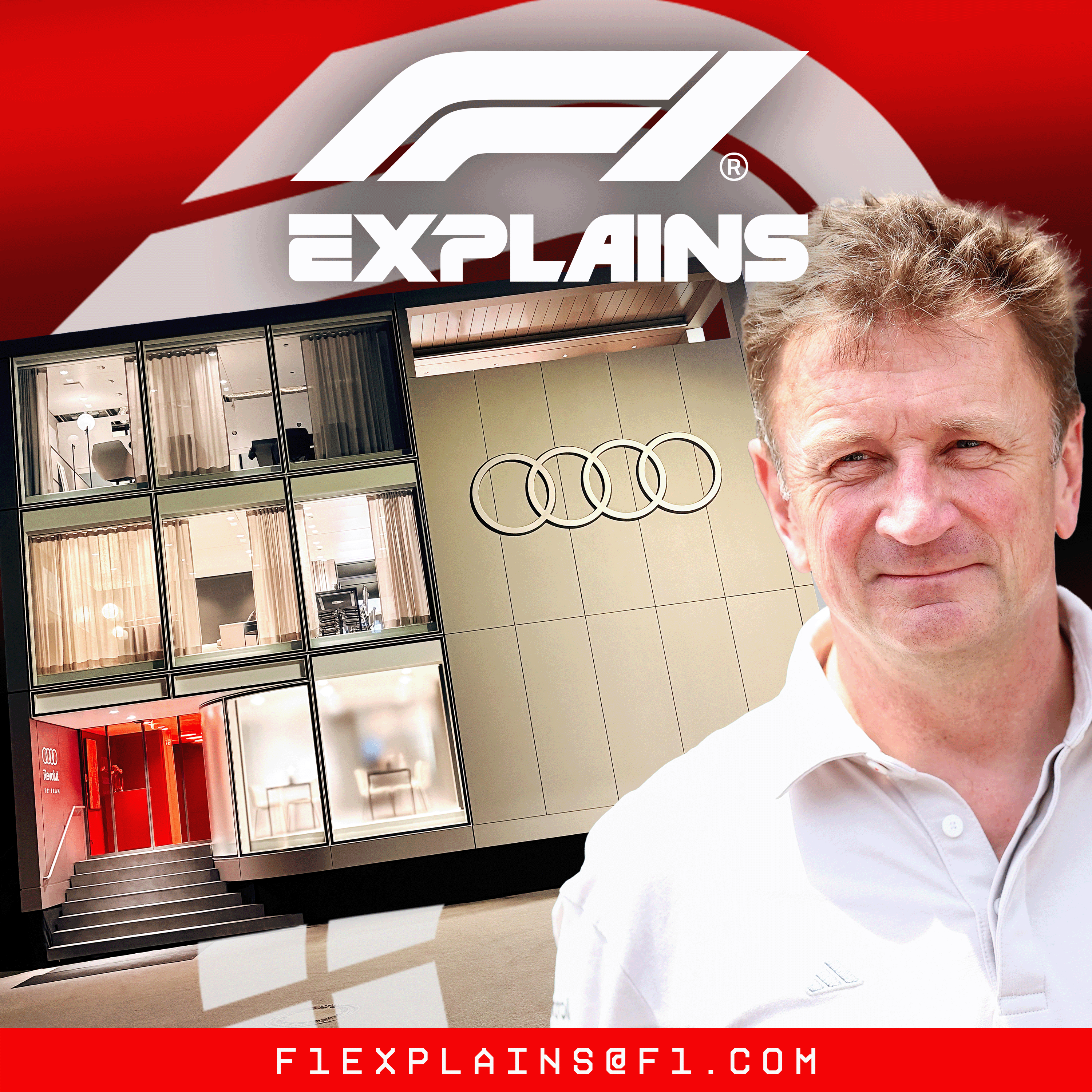
F1 Explains: inside Audi's amazing trackside home
About this episode
Standing in the “heart of the sport,” the hosts explain how the F1 paddock works like a moving “small town,” with teams hauling temporary motor homes and hospitality units between European races. Alan McNish then walks through Audi’s trackside home: a purpose-built hospitality setup with premium branding, a ground-floor lounge, VIP lunch viewing, and even a cappuccino machine that can print faces. Logistics are fast—“minutes after the checkered flag”—with an in-built crane and a quick two-days-up/two-days-down rhythm.
Brand new hospitality unit perfect for F1 drivers, engineers and mechanics.
- Three floors, two kitchens, multiple meeting spaces, lounges, racing sim room and roof terrace.
- Great central F1 Paddock location. Close to racetrack, garages and media centre.
- Comes with chef and two coffee machines.
- Takes just two days to build and deconstruct.
- Can be moved wherever you need it (Europe only) by truck.
- Ideal for European racetracks with no permanent team buildings
F1 Explains is here to answer your F1 questions
Send them to [email protected]
Listen to more official F1 podcasts
Incredible personal stories on F1 Beyond The Grid - including Allan McNish on his F1 career
Expert race previews and reviews - right here on the F1 Nation podcast feed

Toyota Alan
"director of the team. Alan, it's lovely to see you here. Of course, one thing you've graciously missed off that list of your skills is a Formula One driver with Toyota. Alan, as somebody who fell in love with F1 in the late 90s and 2000s, I do like it when we have someone from my ear."
Audi
"But there's been something that's truly impressed me about the Audi project ever since it was started to be spoken about."
Audi is the car company behind the project being talked about. The hosts are saying Audi is aiming for a high-end, serious setup that matches what they want to do in racing.
Audi is the automaker behind the “Audi project” being discussed, centered on building a top-level Formula One facility and integrating that ambition into racing. The segment frames Audi’s approach as aiming for premium, end-to-end quality and a facility that reflects the team’s identity.
new regulations
"one question on the racing side of things. I think coming into these new regulations, there was so much talk about Cadillac being a new team about new engine suppliers"
“New regulations” means the FIA changes the rules for how F1 cars are allowed to be built. When that happens, teams often have to redesign parts of the car to comply and still be fast.
“New regulations” are rule changes that affect how F1 cars are designed and built—often including the power unit and technical architecture. When regulations shift, teams and manufacturers may need to redesign major systems, which can change competitiveness quickly.
Cadillac
"I think coming into these new regulations, there was so much talk about Cadillac being a new team about new engine suppliers"
Cadillac is mentioned as a brand that’s connected to a new F1 team. The point here is that it’s part of the bigger shake-up around engines and teams.
Cadillac is mentioned as being associated with a new F1 team and new engine-supplier talk around the start of the season. In this context, it’s a brand entering or expanding its involvement in F1’s power-unit ecosystem.
engine supplier
"I think coming into these new regulations, there was so much talk about Cadillac being a new team about new engine suppliers with the likes of Red Bull partnering with Ford, for example."
In F1, an “engine supplier” is the group that provides the engine package to a team. Some teams get engines from partners, while others are set up to develop their own.
An “engine supplier” in F1 refers to the organization that provides the power unit (the engine package) to a team. Teams can either buy a power unit from a supplier or, in some cases, be part of a manufacturer program that develops and runs its own power unit.
Red Bull
"with the likes of Cadillac being a new team about new engine suppliers with the likes of Red Bull partnering with Ford, for example."
Red Bull is mentioned because it has a partnership with Ford for engines. It’s an example of how F1 teams team up with other companies to get the power they need.
Red Bull is referenced as partnering with Ford in the context of engine-supplier relationships. The mention highlights how F1 teams can align with different manufacturer partners for power units and technical development.
Ford
"Red Bull partnering with Ford, for example. I think it sort of went a bit under the radar at the start of the season"
Ford is mentioned as the partner in an engine deal with Red Bull. In F1, that kind of partnership affects who builds the engine package and how the team develops it.
Ford is mentioned as the partner in a Red Bull engine-supplier relationship. In F1, manufacturer partnerships can determine who supplies or develops the power unit and how closely the team’s engineering is integrated with the automaker.
works team
"I think it sort of went a bit under the radar at the start of the season that you guys are a totally new engine supplier being a works team as it's called for the first time, making your own engine."
A “works team” is basically the automaker’s own Formula 1 team. Instead of just buying an engine from someone else, they’re heavily involved in building and developing it themselves.
In Formula One, a “works team” is a team that is directly backed by an automaker and typically builds or develops key parts in-house. The key idea is that the car’s power unit isn’t just purchased as a generic supplier package—it’s developed as part of the manufacturer’s own engineering effort.
Alan McNish
"[1410.5s] Racing director of Audi's Formula One team, Alan McNish, there. Can I be honest with you, [1416.1s] F1 explains listeners? Just between us."
Alan McNish is a well-known former Formula 1 driver. In this episode, he’s also working in a senior role with Audi’s F1 team and shows the hosts around their race-weekend setup.
Alan McNish is a former Formula 1 driver who later became a key team figure, described here as the racing director of Audi’s Formula One team. In this segment, he’s explaining Audi’s trackside hospitality setup and how the team operates around race weekends.
cold plate
"[1454.7s] The Pride X Formula One driver, Alan McNish, talks about the kitchen and the cold plate. [1462.9s] It's just like, yeah, we've got the best cold plate. We're doing it better than all the other [1466.8s] teams."
A cold plate is a surface or device designed to keep things cold. In this conversation, it’s part of the team’s setup and is mentioned as something Audi does better than other teams.
A cold plate is a heat-management component used in high-performance racing hospitality and/or technical setups, where it helps keep equipment at a controlled temperature. In this segment, McNish uses it as an example of how Audi’s trackside operation is optimized versus other teams.
checkered flag
"[1486.5s] One thing we didn't mention. Now, [1486.5s] something that staggers me about Formula One weekend is at the end of the weekend, [1491.4s] the speed of which it all gets packed away is phenomenal. I'm talking minutes after the [1498.9s] checkered flag."
The checkered flag is what you see when a race is over. The speaker is saying teams start packing up almost immediately after that moment.
The checkered flag is the signal that a race has finished, shown at the start/finish line. McNish describes how quickly teams move into packdown mode—minutes after the checkered flag—highlighting the intense race-weekend turnaround.
packdown mode
"[1498.9s] checkered flag. Bang, we're in packdown mode. There's no, let's have a drink, then we'll pack up. [1503.3s] They are packing away."
Packdown mode is when the team starts breaking everything down and putting it away. The point is that they do it very quickly after the race ends.
Packdown mode is the operational phase where a team rapidly dismantles and stores its trackside hospitality units right after the event. Here it’s contrasted with the idea of relaxing first, emphasizing how logistics dominate immediately after the race.
crane
"[1503.3s] They are packing away. But normally, the teams have to wait to take their hospitality units down [1510.3s] because they have to wait for a crane. They don't have a crane. So somebody comes with a crane, [1515.4s] like, all right, we'll go to Alpine, then we'll go to Cadillac, and they have to wait for the crane."
A crane is a big machine used to lift heavy things. The speaker is saying teams can’t always take their hospitality setups down right away—they often have to wait for a crane.
A crane is the heavy-lifting equipment teams rely on to remove large hospitality structures from the paddock. McNish explains that teams often have to wait for a crane to take their units down, and he gives examples of scheduling around other teams’ moves.
Request an Explanation
Heard something you'd like explained? We'll add it to this episode.
Sign in to request explanations for terms you heard.
Want to learn more?
Browse our glossary for plain-English explanations of automotive terms, jargon, and concepts.
Help improve this episode
See something that's not quite right? Our annotations are AI-generated and can sometimes miss the mark. Click the flag icon on any annotation to suggest a correction.