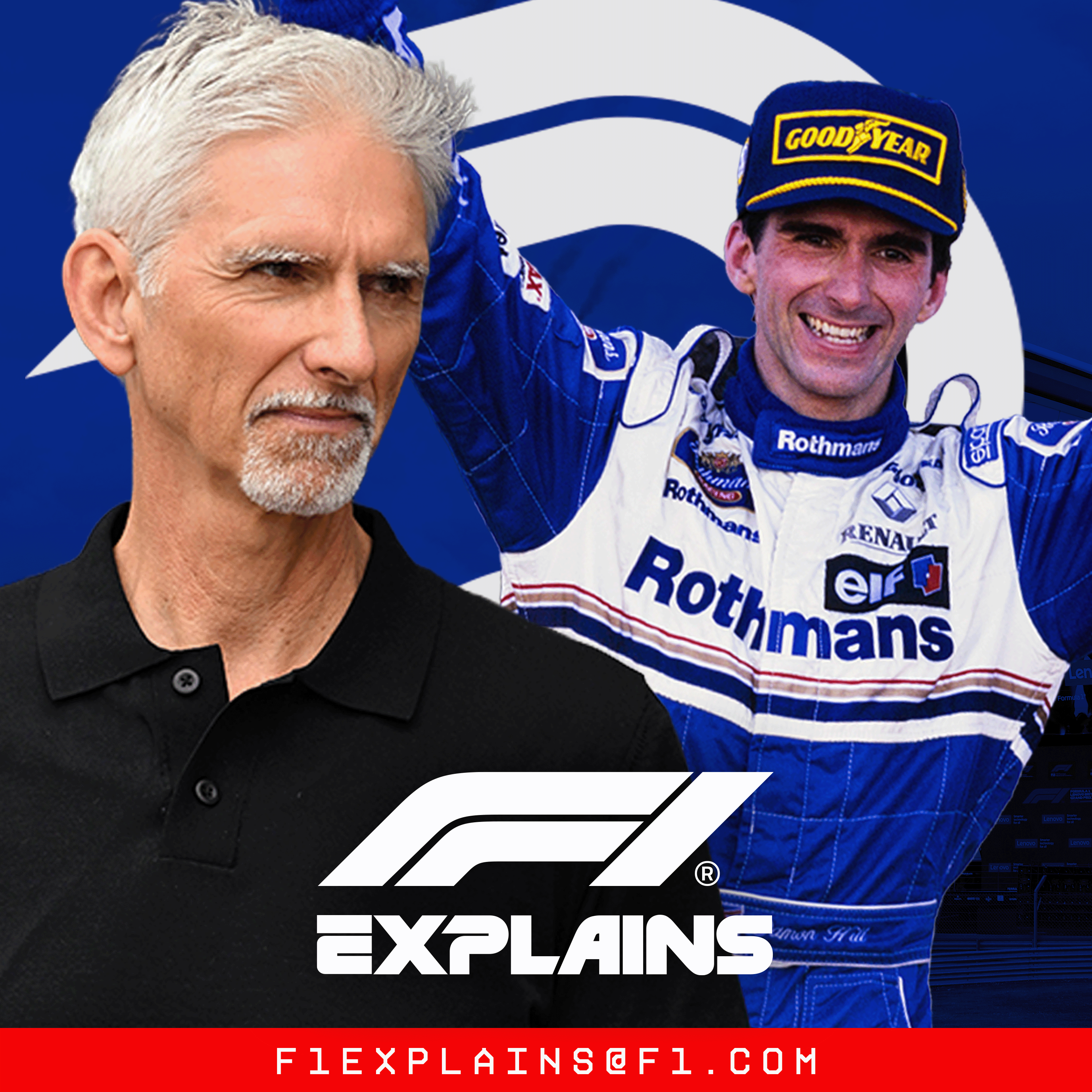
F1 Explains: racing in the 1990s, snitching on Schumacher + unusual F1 records - with Damon Hill
About this episode
Damon Hill joins F1 Explains live from the British GP fan zone to field questions on racing culture and F1 history. The chat kicks off with a “crowd gives you extra tenth” myth, where Hill credits crowd energy and mindset. He then discusses starting F1 later in life, arguing older debuts can work if drivers progress through junior ranks—though funding can be tougher. Hill also reflects on 30 years since his 1996 title, noting the core of racing is unchanged, while modern car use, regulations, and race-day driver inputs have evolved.
How has F1 changed since Damon Hill won the World Championship? What happened to make him report rival Michael Schumacher to the stewards? Why does he share an unusual car number record?
30 years after his title-winning season, Damon joins Christian Hewgill on stage at the British Grand Prix to answer these questions and more from F1 Explains listeners.
Lyndsey from Maine and Toby from Manchester ask Damon about making his F1 debut relatively late in life, and what his former team Williams need to do to return to the front of the grid.
F1 Explains LIVE at the Formula 1 Belgian Grand Prix
Special guest Yuki Tsunoda, Red Bull Racing Reserve Driver
F1 Fanzone Stage | 1025 am | Friday 17th July
Send questions to [email protected] - we could make you part of the show
Listen to more official F1 podcasts
In-depth interviews on F1 Beyond The Grid - including Damon Hill
Expert race previews and reviews - right here on the F1 Nation podcast feed
British Grand Prix
"My name is Christian Hugel, and I'm talking to you from last weekend's British Grand Prix, usually if we speak to you at a race, we're at the heart of the Formula One paddock,"
The British Grand Prix is one of Formula 1’s biggest races, held in the UK. It’s a full weekend event with practice, qualifying, and the main race.
The British Grand Prix is a Formula 1 race held in the UK and is one of the sport’s historic events. It’s often used as a reference point for how F1 weekends are structured—practice, qualifying, and the race itself.
Formula One paddock
"…usually if we speak to you at a race, we're at the heart of the Formula One paddock, but not today."
The paddock is the team-only area at an F1 race weekend. It’s where teams work on the cars and where you can see the sport’s “behind the scenes” activity.
The Formula One paddock is the restricted area where teams operate between sessions—workshops, garages, and team personnel are based there. It’s where you’d typically see team staff, cars being prepared, and the behind-the-scenes side of an F1 weekend.
Silverstone Main Stage
"And at this year's British Grand Prix, we Studs on the massive Silverstone Main Stage. It can't just be me, but I think it gets bigger every single year."
Silverstone is the famous Formula 1 track in the UK. The “Main Stage” is the big central area where fans go for live entertainment during the race weekend.
Silverstone is the UK’s most famous F1 venue, and the “Main Stage” is the central event area used for entertainment during the race weekend. It’s where fans gather for live shows and big-screen programming alongside the racing.
Damon Hill
"…myself and some wonderful F1 Explains listeners spoke to a legend of the sport, the 1996 Formula One World Champion, Damon Hill."
Damon Hill is a former Formula 1 driver who won the World Championship in 1996. In this episode, he’s there to help explain what racing in the 1990s was really like.
Damon Hill is a former Formula 1 driver and the 1996 World Champion. He’s a key voice for explaining 1990s F1 because he raced at the top level during that era and can provide firsthand context on how teams and drivers operated.
1996 Formula One World Champion
"The 1996 Formula One World Champion, Damon Hill! Well, I'm glad you're enthusiastic, but this screen in front of me says, Damon Hill not"
This phrase means the driver who won the Formula 1 championship in 1996. In this episode, that driver is Damon Hill.
“1996 Formula One World Champion” refers to the driver who won the F1 Drivers’ Championship for that season. Damon Hill is being identified here as the 1996 champion, which sets his authority for answering questions.
extra 10th
"There's been a lot of talk this weekend about whether it does give you that extra 10th when you're in the car."
In racing, an “extra 10th” means improving by 0.1 seconds. That’s a big deal in F1, where cars are often separated by tiny time gaps.
“Extra 10th” refers to gaining one-tenth of a second, a common way F1 drivers and teams talk about small performance differences. In qualifying and race pace, even a tenth can be the gap between positions.
regulations change
"The way in which you can use the cars now is different. Obviously, the regulations change, and the complexity of what the driver does is also different."
Regulations are the rules of Formula 1. When the rules change, it can change how cars are built and how races are run.
F1 regulations are the rule set that governs car design, race procedures, and what teams are allowed to do. When regulations change, it can alter car performance, driver workload, and the way teams run race strategy.
pit boards
"And there's a few pit boards that went out, which you ignored for most of the race, because you were still out there until we had refueling at one time."
Pit boards are messages the team holds up for the driver during the race. They can tell you things like what to do next or how you’re doing compared to others.
Pit boards are rectangular boards shown to a driver from the pit wall during a race. They display race instructions like lap times, warnings, or strategy cues, and they’re part of how teams communicate with the driver in real time.
refueling
"And there's a few pit boards that went out, which you ignored for most of the race, because you were still out there until we had refueling at one time. So the only thing was we did change tyres..."
Refueling means adding fuel to the car during the race while it’s stopped in the pits. It used to be a strategy tool in older F1, but today races are run without topping up mid-race.
Refueling is adding fuel to the car during a race while it’s in the pit lane. In the 1990s, this was part of race strategy, but modern F1 races generally don’t allow in-race refueling, so fuel planning works differently.
change tyres
"So the only thing was we did change tyres, but honestly, there was no strategy whatsoever. So, you know, I got told once to slow down a bit,"
Changing tyres is when the team swaps the tires during a pit stop. Tires wear out and lose grip, so teams time these stops to keep the car fast.
Tyre changes are scheduled stops where the team swaps the car’s tires during a race. In F1, tyre grip and wear strongly affect lap times, so tyre strategy can be a major part of winning—especially when refueling is involved.
strategy
"So the only thing was we did change tyres, but honestly, there was no strategy whatsoever. So, you know, I got told once to slow down a bit,"
In racing, “strategy” is the plan for how you’ll run the race. It includes decisions like when to stop and what to do to stay fast until the end.
In F1, “strategy” means the planned decisions that affect race outcome—like when to pit, what to do with tyre usage, and how to manage fuel and pace. Hill is contrasting older races (where he says there was “no strategy whatsoever”) with how strategy is more complex now.
radio silence
"So if you broadcast the radio in my era, it would have been very dull, [792.1s] because there would have been complete silence, radio silence for the whole race."
F1 teams talk to the driver using a radio. “Radio silence” means there’s basically no talking during the race, so you don’t hear lots of messages.
In Formula 1, “radio silence” refers to periods where drivers are not speaking over the team radio during the race. In the 1990s, there was often much less driver-team communication, so the broadcast would sound quiet compared with modern races.
team radio
"It's so complex, you need a team of engineers to say what button to press, you know, [806.6s] and what number to put it on, steering wheel. [808.4s] We all like hearing the team radio, don't we?"
During a race, the driver can talk to the team through a radio. The team uses it to give instructions and updates while you’re driving.
“Team radio” is the in-race communication link between the driver and the pit wall/engineers. It’s used to relay strategy, car status, and instructions, and it’s become much more frequent and detailed in modern F1.
steering wheel
"It's so complex, you need a team of engineers to say what button to press, you know, [806.6s] and what number to put it on, steering wheel."
In an F1 car, the steering wheel isn’t just for turning—it has lots of buttons. The driver uses it to change settings while racing.
In F1, the steering wheel is a control hub packed with buttons and switches for functions like mode changes and adjustments. When the hosts mention “what number to put it on, steering wheel,” they’re referring to how drivers use the wheel to interact with the car’s systems.
Michael Schumacher
"[831.3s] Well, I must confess, I did snitch on Michael Schumacher. [835.1s] Did you? [837.0s] Well, and that was in 94, because what happened was we went onto the grid,"
Michael Schumacher was one of the most famous F1 drivers ever. In this story, Damon Hill says he reported Schumacher because he thought something unusual was happening during the race.
Michael Schumacher is a legendary German Formula 1 driver known for dominating the sport in multiple eras. Here, Damon Hill describes a specific 1994 incident where he suspected Schumacher’s behavior during a restart sequence.
grid
"[837.0s] Well, and that was in 94, because what happened was we went onto the grid, [843.5s] and the way you're supposed to do it is the guy on pole position, which was me,"
The “grid” is where the cars line up before the race starts. Your position on the grid depends on qualifying results.
The “grid” is the starting formation of the cars on the track before the race begins, arranged by qualifying position. The speaker mentions going “onto the grid” and following the pole-sitter’s role, which is a specific F1 pre-start procedure.
restart
"[843.5s] and the way you're supposed to do it is the guy on pole position, which was me, [848.2s] is supposed to lead the pack around, and every time he kept overtaking me, [854.0s] and then we had a restart, and he did it again."
A “restart” is when the race stops and then starts again. Cars line up and go again, and the situation can reset in a way that affects overtakes.
A “restart” in F1 is when the race is paused (typically for an incident) and then resumed with the cars re-forming and accelerating again under the rules for the restart. The speaker describes a restart where the same overtake pattern happened again, prompting suspicion.
pole position
"[843.5s] and the way you're supposed to do it is the guy on pole position, which was me, [848.2s] is supposed to lead the pack around,"
“Pole position” means you start first on the grid. It’s given to the driver who was fastest in qualifying.
“Pole position” is the first starting spot on the grid, awarded to the driver who qualifies fastest. In the transcript, Damon Hill describes a rule/procedure where the pole-sitter leads the pack around, highlighting how starting order affects race behavior.
10-second penalty
"Anyway, that went into a protest during the race, [868.3s] and that's why he was given a 10-second penalty, which he ignored,"
A 10-second penalty is basically a punishment measured in time. If a driver breaks the rules, officials add 10 seconds to their result, which can cost them positions.
In Formula 1, a 10-second penalty is a time penalty added to a driver’s race time for a rules infringement. Depending on the exact situation, it may be served in the pits or applied after the race, and it can drop a driver behind competitors.
black flag
"and then he got a black flag for ignoring the black flag, [873.7s] and then he basically ran the whole thing."
A black flag is a serious warning from race officials. It means the driver has to stop what they’re doing and usually return to the pits right away.
A black flag in F1 is an official warning that a driver must respond immediately—typically by returning to the pits—because of a serious rules or safety issue. Ignoring it is treated as a further breach and can lead to additional penalties or disqualification.
Jody Schecter
"you and Jody Schecter are the only two drivers in F1 history to have raced with the number zero on your car."
Jody Schecter is a driver who raced in Formula 1. In this episode, he’s brought up because he’s one of the very few drivers who competed with the car number 0.
Jody Schecter is a former Formula 1 driver who, like Damon Hill, is mentioned here as one of the only drivers to have raced with car number 0. The episode uses him as a historical reference point for unusual F1 car-number records.
constructors
"the team I drove for was the constructors, the winners, winning constructor. And so they basically decided you can't give me the number one"
In F1, “constructors” means the teams. Teams can win their own championship, and in this case the team’s status affected how car numbers were assigned.
The “constructors” are the F1 teams competing for the Constructors’ Championship. In this story, Damon Hill is explaining that the winning constructors’ team had to handle car-number assignment rules when the usual number 1 wasn’t available.
Alan Prost
"So I was zero and Alan Prost was two."
Alain Prost is one of the greatest F1 drivers ever and won multiple world championships. In this story, his car number is used to explain how the numbering system worked when number 1 wasn’t available.
Alan Prost (more commonly spelled Alain Prost) is a legendary French F1 driver and multiple-time World Champion. Here, he’s referenced because the car-number assignment in that era put Prost on number 2 while Hill was assigned number 0.
team dynamics
"How does it feel when you go from racing one team to another team? How do you adjust those team dynamics?"
In racing, “team dynamics” means how the team behaves and communicates while working on the car and planning races. If you switch teams, you may need time to learn their way of doing things.
“Team dynamics” in F1 refers to how a team works day-to-day—communication between drivers, engineers, and strategists, plus how decisions get made. In the 1990s especially, changes in team structure and working methods could noticeably affect how quickly a driver adapts.
teams do have a culture
"I mean, teams do have a culture. They have a way of working."
“Team culture” is basically the team’s personality—how they work and what they expect from each other. In F1, that can change how comfortable a driver feels when they join a new team.
This is about “team culture” in motorsport: the shared habits, expectations, and working style inside an F1 organization. Culture can influence everything from engineering priorities to how feedback is delivered between the driver and the garage.
underdogs
"Underdogs? They're underdogs. So they know they've got a lot to achieve."
An underdog is the team or driver that isn’t expected to be the best. In F1, that often means the car isn’t as quick, so they have to make the best of every opportunity.
“Underdogs” refers to teams or drivers who are not expected to win because they’re behind in competitiveness. In F1, that usually means the car isn’t as fast as the front-runners, so the goal becomes maximizing results through strategy, reliability, and driver execution.
Aston Martin
"maybe Aston Martin, maybe Adrian Nui's got something up his sleeve and it's coming out in Hungary and we'll see what happens then. Yeah, the belief is there's a major update coming before the summer break."
Aston Martin is a racing team in Formula 1. The hosts are talking about whether Aston Martin will be strong soon, especially after an update before the summer break.
Aston Martin is a Formula 1 constructor (team) that competes under its own name and livery. In this segment, the hosts are discussing whether Aston Martin will be competitive and receive major upgrades, with Hungary mentioned as a potential turning point.
Hungary
"and it's coming out in Hungary and we'll see what happens then. Yeah, the belief is there's a major update coming before the summer break. Hungary is what's being rumoured, so we hope so."
Hungary is where one of the Formula 1 races is held. They’re saying an update could be ready by that race and we’ll see what changes.
Hungary is the country hosting a Formula 1 race (the Hungarian Grand Prix). The hosts use it as the expected venue for when an Aston Martin update might show results.
McLaren
"I think, Damon, I don't know about you, it seems in front of us that McLaren are the favourite team. We've got a lot of Ferrari fans, do you see that change over the years?"
McLaren is one of the famous Formula 1 teams. In this part, they’re saying McLaren currently look like the team to beat.
McLaren is a Formula 1 constructor known for its long history and distinctive branding. Here, the hosts say McLaren look like the favorite team, and they connect that to how team fandom and visual identity (like colors and merch) can shift over time.
Ferrari
"We've got a lot of Ferrari fans, do you see that change over the years? The team fandom, the dynamics, the look of the colour, of the merch in the crowd?"
Ferrari is one of the biggest Formula 1 teams, with a huge number of fans. They’re talking about how the crowd’s team support changes over time.
Ferrari is a Formula 1 constructor with a massive global fanbase and a highly recognizable identity. The hosts mention Ferrari fans and then discuss how team loyalty and visual culture in the stands (colors, merch) can change over the years.
livery
"But what do you think of this new livery? I can't even see the car. I thought it was an Aston Martin, it's got green on the front."
A livery is the car’s paint job and graphics—its look on the track. They’re talking about a new design and whether it’s easy to spot.
In Formula 1, a livery is the car’s painted design and sponsor/branding layout—essentially the visual “skin” on the race car. This segment discusses a “new livery” and how it affects what fans can recognize from the stands.
Request an Explanation
Heard something you'd like explained? We'll add it to this episode.
Sign in to request explanations for terms you heard.
Want to learn more?
Browse our glossary for plain-English explanations of automotive terms, jargon, and concepts.
Help improve this episode
See something that's not quite right? Our annotations are AI-generated and can sometimes miss the mark. Click the flag icon on any annotation to suggest a correction.