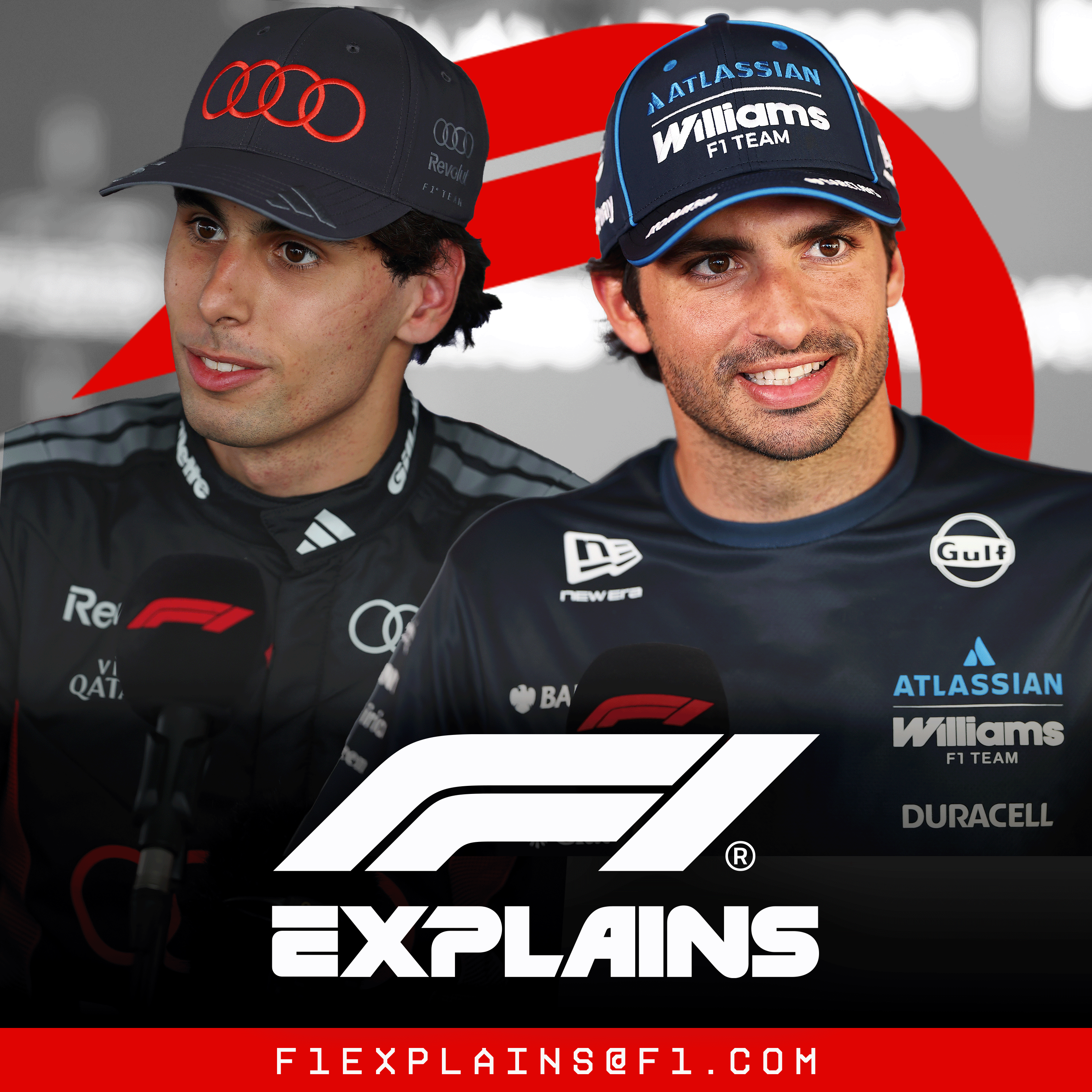
F1 Explains: Sainz + Bortoleto on flying laps, race starts + clean v dirty air
About this episode
From Spa-Francorchamps, Carlos Sainz and Gabriel Bortoleto break down what makes a flying lap and a race start work: when overtake mode and straight-line mode kick in, how the new wing-opening system differs from last year’s DRS, and why clutch timing and battery changes affect launches. They also answer a listener on clean vs dirty air, explaining when turbulence starts hurting downforce in corners—plus how track grip and setup changes can shift the car’s balance weekend to weekend.
How do drivers enable overtake mode and active aero? What’s the secret to a quick flying lap? And how do they know when to launch on a practice race start?
Carlos Sainz and Gabriel Bortoleto join Christian Hewgill in the F1 paddock to answer your questions about Formula 1.
You’ll also hear how they find the perfect balance between clean and dirty air, what a race weekend looks like for them and whether everyday normal driving in road cars has any impact on their racing.
Plus, Carlos provides a very funny response to a claim made by his manager and cousin Carlos Onoro on a recent episode.
Franconchamps
"Around 50 kilometres from the Belgian city of Liège is the small village of Franconchamps. It's home to stunning dark green spruce trees, which tower up to 50 metres high."
Franconchamps is a small place in Belgium near a famous Formula 1 race track. The track there is known for being highly respected and memorable.
Franconchamps is the village area near the Circuit de Spa-Francorchamps in Belgium. The hosts describe it as the setting for what they call one of the most respected Formula One circuits.
Belgian Grand Prix
"But Lewis Hamilton comes through and in the most extraordinary circumstances imaginable, he wins the Belgian Grand Prix. Can he do it? Yes, he's done it."
The Belgian Grand Prix is one of Formula 1’s races, run at Spa in Belgium. Here, it’s the race where Lewis Hamilton wins.
The Belgian Grand Prix is a Formula One race held at Spa-Francorchamps. In this segment, it’s used as the example race where Lewis Hamilton wins in dramatic circumstances.
Lewis Hamilton
"But Lewis Hamilton comes through and in the most extraordinary circumstances imaginable, he wins the Belgian Grand Prix."
Lewis Hamilton is one of the most famous and successful Formula 1 drivers. Here, the hosts mention him winning the Belgian Grand Prix.
Lewis Hamilton is a top-tier Formula One driver and a multiple-time World Champion. In this segment, he’s referenced as winning the Belgian Grand Prix in extraordinary circumstances.
Oscar Piastry
"Win number six of the season and championship lead extended for Oscar Piastry. But of course, a track can't create magic moments without our 22 superheroes."
The host is talking about Oscar Piastri (spelled oddly in the transcript). He’s an F1 driver, and the segment says his championship lead was extended.
Oscar Piastry is referenced as having his championship lead extended after a win. The transcript appears to be a misspelling of Oscar Piastri, who is an F1 driver.
Gabriel Bortoletto
"For the boy from Brazil, he's heading to Formula One as the champion. Yes, Gabriel Bortoletto, the 21-year-old who's now firmly established himself in F1 with Audi."
The guest mentioned here is a young Brazilian driver expected to move up into Formula 1. The transcript spelling looks off, but the idea is that he’s a rising star.
Gabriel Bortoletto is presented as a young Brazilian driver moving into Formula One. The transcript likely intends Gabriel Bortoleto, who is known as a rising F1 prospect.
Audi
"Yes, Gabriel Bortoletto, the 21-year-old who's now firmly established himself in F1 with Audi. This is better than driving the car itself, right, doing podcasting."
Audi is a major car brand mentioned here in connection with an F1 driver. In Formula 1, big brands like Audi can bring extra money and engineering to the team.
Audi is referenced as the team/constructor connection for Gabriel Bortoleto. In F1, Audi’s involvement matters because it signals manufacturer-backed performance development and resources.
Carlos Sainz
"Carlos Sainz wins the Mexico City Grand Prix. He's trying to help Williams take their place back among F1's elite. Hello, Carlos Sainz. Welcome to F1 Explains."
Carlos Sainz is a Formula 1 driver who has won races. Here, they mention his Mexico City win and that he’s working to help Williams compete with the best teams.
Carlos Sainz is a current Formula One driver and race winner. The segment notes his win at the Mexico City Grand Prix and frames him as helping Williams return to the front of the grid.
Mexico City Grand Prix
"And also on the way, a race winner. Carlos Sainz wins the Mexico City Grand Prix. He's trying to help Williams take their place back among F1's elite."
The Mexico City Grand Prix is a Formula 1 race in Mexico City. The segment notes that Carlos Sainz won it.
The Mexico City Grand Prix is a Formula One race held in Mexico City. The host mentions Carlos Sainz winning it, tying the discussion to recent results and championship momentum.
Williams
"He's trying to help Williams take their place back among F1's elite. Hello, Carlos Sainz. Welcome to F1 Explains."
Williams is one of the long-running Formula 1 teams. The segment suggests they’re trying to return to being one of the top teams.
Williams is a historic Formula One team. The host says Sainz is trying to help Williams get back among F1’s elite, which is a performance-and-results benchmark in the sport.
active aero components
"My question is, how do the drivers know when they can enable overtake modes and the active aero components? ... So there are two different things."
Active aero components are parts on the car that can adjust their shape while you drive. They help the car generate the right amount of grip and speed depending on what’s happening on track.
Active aero components are aerodynamic parts that can change their configuration while the car is running. In F1, they’re used to manage downforce and drag so the car can be faster in specific moments like overtakes or different track sections.
overtake mode
"My question is, how do the drivers know when they can enable overtake modes and the active aero components? ... Overtake mode, you don't enable it. You get automatic when you are within one second of the car ahead."
An overtake mode is a special “push harder” setting in an F1 car. When it’s active, the driver can use extra power/energy to help get past another car.
In modern F1, an overtake mode is a driver-selectable energy/power setting that boosts performance for passing. It’s not just “more throttle”—it’s tied to the car’s energy management and only becomes available under specific conditions.
one second
"You get automatic when you are within one second of the car ahead. So you have a zone normally before the last corner. And then when you cross this line, if you are within one second to the car ahead, you get the overtake."
They use a timing gap to decide when the car should allow extra passing power. If you’re close enough—about one second behind the car in front—the system lets you use the overtake boost.
The “one second” rule here is a timing threshold used by the car’s systems to decide when overtaking power/energy can be activated. If the driver is within that gap to the car ahead, the overtake mode becomes available automatically.
megajoule
"And then the overtake mode, you gain like half mega joule more to recover and spend. So basically, in a simple way, you get more energy to spend in the next lap."
A mega joule is a way to measure energy. In F1, the car has a limited “energy budget,” and the team/driver manage how much of that energy gets used and saved.
A mega joule (MJ) is a unit of energy. In F1’s energy management, the car allocates a certain amount of energy (measured in MJ) that can be recovered and spent to control how much extra power is available lap-to-lap.
SLM zone
"The SLM zone, the SM, the straight line mode, is basically you can use every lap anytime you just need to press the button. That in my case, I have behind my wheel."
The SLM zone is a specific part of the track where the car allows a special straight-line boost. It’s basically the “when you’re allowed to press the button” area.
The SLM zone refers to a specific track/activation window where the car’s Straight Line Mode (SLM) can be used. It’s part of the rules-based energy/power strategy that determines when the driver can press for extra performance.
straight line mode
"The SLM zone, the SM, the straight line mode, is basically you can use every lap anytime you just need to press the button. That in my case, I have behind my wheel."
Straight line mode is a boost setting meant for when you’re accelerating down a straight. The driver can activate it with a button when the rules allow.
Straight line mode (SLM) is a power/energy setting intended for maximum efficiency when accelerating in a straight line. It’s distinct from overtake mode and is activated via a driver button when the car is in the appropriate zone.
FIA set
"And as soon as you press it in this specific zone's FIA set, the wings open it."
The FIA set is the official F1 rule area that tells you exactly when you’re allowed to use certain car settings. If you use it at the wrong time, it can mess up the car’s balance and speed.
The FIA set refers to the FIA-defined activation zone and rules for when the aerodynamic device can be opened or closed. Drivers must follow these constraints, or they can lose performance or even cause unsafe behavior.
DRS
"And when this came in at the start of the season, obviously last year we had DRS, [326.4s] the drag reduction system."
DRS is a button in F1 that makes the car less “wind-resistant” for a short time. It opens a wing so the car can go faster, usually on straights, when the rules allow it.
DRS (drag reduction system) is a Formula 1 feature that reduces aerodynamic drag by opening a wing element. Lower drag helps the car gain speed on straights, especially when used within specific activation rules.
drag reduction system
"And when this came in at the start of the season, obviously last year we had DRS, [326.4s] the drag reduction system."
The drag reduction system is the official name for DRS. It changes the car’s wing setup to reduce wind resistance so the car can accelerate more on straights.
Drag reduction system is the full name for DRS: an F1 aerodynamic device that temporarily reduces drag by altering wing configuration. In this segment, the speaker contrasts how the new system affects both front and rear wings versus DRS opening only the rear wing.
rear wing
"The only thing is that the DRS was only opening the rear wing and not the front wing."
The rear wing is the big wing on the back of the F1 car. It helps the car stick to the track, and changing it can also change how much drag the car has.
The rear wing is the aerodynamic element at the back of an F1 car that strongly affects downforce and drag. In this segment, the speaker notes that last year’s DRS opened only the rear wing, while the new system behaves differently.
practice starts
"Obviously in practice sessions, you guys do practice starts. We all know how crucial the race start is on a Sunday."
Practice starts are practice runs where drivers rehearse how to launch the car at the beginning of a race. The goal is to get the timing right so the car accelerates cleanly instead of slipping or bogging down.
In Formula One, practice starts are repeated launch drills done during practice sessions to rehearse the exact sequence of a race start. Drivers and teams use them to learn timing, clutch release, and how the car hooks up to the track.
start lights
"No, sorry, the start lights that we have, the 1, 2, 3, 4, 5 and then out. And that's how you do it."
The start lights are the signal system at the beginning of the race. Drivers watch the sequence and time their launch so they’re ready to go the instant the lights go out.
The start lights are the five red lights used to signal the exact moment the race start begins. Drivers time their launch so the car is ready to accelerate immediately when the lights go out.
clutch drop
"you understand how much you have grip available on the tarmac, how much you need to set up your clutch drop because that's how we do it."
A clutch drop is when the driver releases the clutch quickly but precisely at the start. Doing it at the right moment helps the car get traction instead of spinning the wheels or losing acceleration.
A clutch drop is the controlled release of the clutch at the start to transfer engine torque to the drivetrain. In F1, the timing and depth of the clutch release strongly affect traction and how much grip the car can use off the line.
grid box
"if we drop a bit too deep or too shy, we basically have a good run out of the grid box or we have a very bad one."
The grid box is the exact spot on the starting grid where your car is supposed to be. A good start gets you out of that box smoothly and quickly; a bad one can leave you struggling to accelerate.
The grid box is the marked starting position on the grid where each car lines up before the race. Getting the clutch release and launch timing right helps the car move out of the grid box cleanly without losing momentum or causing a poor start.
bigger batteries
"once again, it's something that's been changed for this season, the start procedure. Has there been much to get used to from a driver's perspective? Because we've got the bigger batteries."
F1 cars use batteries to store electrical energy that can be used for extra power. If the batteries are bigger, the car’s energy behavior changes, which can affect how the team prepares for the start.
In modern F1, the car’s energy system includes batteries used to store and deploy electrical energy. “Bigger batteries” implies a regulation-driven change that affects how the team manages energy around the start procedure.
charging up
"Because we've got the bigger batteries. They require some almost charging up at the start, don't they?"
Charging up means getting the car’s battery ready before the race start. The idea is to make sure the car has the energy it needs at the moment you launch.
“Charging up” refers to preparing the battery/energy system before the start so the car has the right energy state when it launches. In F1, that preparation can be part of the revised start procedure due to changes in the energy system.
quali lab
"So I will go into the quali lab with knowing what I want to achieve and how I want to play"
“Quali lab” is basically the qualifying game plan. It’s where the team figures out how to get the car performing best for a single fast lap.
“Quali lab” is a team/driver shorthand for the qualifying-focused preparation and simulation work. In practice, it refers to how drivers and engineers plan and refine the car’s setup and run plan specifically for one-lap pace.
FP1
"why do drivers occasionally say the car feels different in FP1? When they may have raced the same car just five days earlier"
FP1 is the first practice session teams do before qualifying and the race. It’s when they test how the car behaves so they can adjust for the rest of the weekend.
FP1 means the first Formula 1 practice session of a race weekend. Teams use it to get baseline setup information, check tire behavior, and understand how the car feels on that track and conditions.
tarmac
"So for us tarmac is where the tyre touches the ground. So if the tarmac changes and there's a completely different level of grip"
Tarmac is the asphalt track surface. If the surface grip changes, the tires don’t behave the same way, and the car can feel noticeably different.
Tarmac is the asphalt surface the tires run on, and in F1 it strongly affects grip. Changes in surface texture, rubbering-in, and resurfacing can alter tire temperatures and the car’s balance, so the same car can feel very different.
Silverstone
"So for example Silverstone, we had an amazing levels of grip here, it's the highest grip of the season."
Silverstone is an F1 track in the UK. The point here is that at Silverstone the track grip was particularly high, so the car felt better/more predictable.
Silverstone is a Formula 1 circuit in the UK known for high-speed corners and a surface that can provide strong grip. The speaker uses it as an example of a weekend where grip levels were especially high, changing how the car feels.
Suzuka
"Together with the Jeda and the new tarmac in Suzuka."
Suzuka is an F1 track in Japan. Here they’re saying that when Suzuka gets new asphalt, the grip changes and the car can feel different.
Suzuka is a Formula 1 circuit in Japan famous for its distinctive layout and long history on the calendar. The speaker specifically mentions “new tarmac in Suzuka,” highlighting how resurfacing can change grip and therefore car feel.
Bahrain
"But then you go to other tarmacs that are a lot rougher, older, Bahrain, Barcelona, Austria last week and the car immediately slides more."
Bahrain is one of the F1 race locations. Different tracks make the tires grip differently, so the car can feel better or worse depending on the surface.
Bahrain is a venue on the F1 calendar (Sakhir). Track-surface and layout differences can change tire grip and how a car’s setup translates into balance and traction.
Austria
"I had exactly that situation in Austria. We were coming off Barcelona where the car, car wasn't competitive but the balance was okay."
Austria is an F1 race location (the Red Bull Ring). The track can make the car behave differently, so a setup that felt good elsewhere might not feel as good there.
Austria refers to the Austrian Grand Prix venue (Red Bull Ring). The driver describes how the car’s balance and traction changed there compared with Barcelona, highlighting how circuit-to-circuit surface differences affect setup.
Barcelona
"But then you go to other tarmacs that are a lot rougher, older, Bahrain, Barcelona, Austria last week and the car immediately slides more."
Barcelona is an F1 track location. The surface and grip can be different from other races, so the car may need tuning to feel right.
Barcelona refers to the Circuit de Barcelona-Catalunya area used for F1 testing and racing. Changes in surface and grip characteristics can force teams to adjust setup to maintain the same balance and feel.
balance
"So the balance is already, doesn't matter if you have good balance, you have the feeling that the car is worse."
“Balance” means whether the car feels like it has the right grip at the front and rear. If it’s not balanced, the car can slide more and feel unpredictable.
“Balance” in F1 is how the car’s grip and handling are distributed—especially between front and rear. If the balance is off, the car can slide more or feel “strange,” even if the driver previously had a great-feeling car.
setup
"And then sometimes you always start with a bit of a different setup because you try and adapt the setup to each truck characteristic."
A “setup” is how the team tunes the car for a specific track. Small changes can make the car feel balanced and predictable instead of sliding around.
A “setup” is the specific configuration of an F1 car—things like wing angles, suspension settings, and other adjustments—that determines how the car balances and responds. Because each circuit and even track surface differs, drivers often need to adapt the setup to get the same feel and grip.
front wing
"Or sometimes you put in a new front wing that the team has produced over those two weeks."
The front wing is the big aero piece at the nose. It helps press the front tires onto the road so the car turns better—but if it’s changed, the car’s balance can feel totally different.
The “front wing” is an aerodynamic component that generates downforce and helps control the car’s balance. Changing it can shift grip between the front and rear, which is why a new front wing can suddenly make the car feel too “front-loaded” or not as expected.
front load
"And the new front wing is delivering a bit too much front load, a bit less front load and the balance is not as you expected."
“Front load” is basically how much the car is “pushing” on the front tires. If the front gets too much (or too little) grip, the car won’t turn or feel the way you expect.
In F1 setup talk, “front load” is how much weight/load the car is effectively carrying at the front axle. More front load generally increases front grip and changes steering feel, but too much can make the balance worse and cause the car to behave differently than expected.
clean air
"Steph is in Utah and Steph says, my question is about clean air and dirty air. This is one of our most frequently asked questions this car lost."
“Clean air” means the air flowing smoothly over your car. If another car isn’t right in front of you, your wings “see” better airflow and the car makes more grip from aerodynamics.
In Formula 1, “clean air” is relatively undisturbed airflow that reaches your car when there’s no car directly ahead. It matters because the front wing and overall aero surfaces work best when the air is smooth and predictable.
dirty air
"my question is about clean air and dirty air. This is one of our most frequently asked questions this car lost. When you're catching another car, when does the air stop being clean and start to become dirty or turbulent"
“Dirty air” is messy airflow caused by the car ahead. When it reaches your car, it can reduce the aerodynamic grip you rely on to turn and stay stable.
“Dirty air” is disturbed, turbulent airflow created by the car in front, which then hits your car’s aerodynamic surfaces. It reduces downforce and makes the car harder to drive because the airflow over wings and bodywork becomes less effective.
catching another car
"When you're catching another car, when does the air stop being clean and start to become dirty or turbulent"
This means you’re driving up to a car in front. The closer you get, the more the air disturbed by that car affects how your car grips and handles.
“Catching another car” describes closing the gap to a car ahead, which changes the airflow your car experiences. As you get closer, the wake from the leading car increasingly affects your downforce and handling.
turbulent
"when does the air stop being clean and start to become dirty or turbulent and therefore bad for the aerodynamics of your car?"
Turbulent air is air that’s not flowing smoothly. In racing, that usually means your wings don’t work as well, so the car loses grip.
Turbulent airflow means the air is chaotic and fluctuating rather than smooth. In F1, turbulence is a key reason “dirty air” hurts aerodynamic performance, because it disrupts how wings generate downforce.
aerodynamics
"and start to become dirty or turbulent and therefore bad for the aerodynamics of your car? It's one of these phrases that gets thrown around"
In F1, aerodynamics is how the shape and wings of the car interact with the air. If the air is disturbed, the car can lose grip and feel less balanced.
Aerodynamics in F1 refers to how airflow around the car creates forces like downforce and drag. When dirty air reaches your car, it can reduce downforce and change balance, making the car less stable and slower through corners.
race weekend
"It's one of these phrases that gets thrown around in an FP1 race weekend all the time. They're good, our listeners."
FP1 is the first practice session on a race weekend. Teams use it to try things and figure out how the car will behave before qualifying and the race.
FP1 is the first free practice session of an F1 race weekend. Teams use it to test setups and learn how the car behaves, including how sensitive performance is to factors like traffic and airflow.
downforce
"So you have a tiny, tiny, tiny bit less downforce in the corner... you will not have as much pure downforce..."
Downforce is the “suction” effect of the wings and bodywork that presses the tires harder onto the road. If it drops, the car can feel less grippy in the turns.
Downforce is the aerodynamic force that pushes the car downward to increase tire grip. In this segment, the speaker explains that dirty air can reduce downforce in the corners, which affects how much grip the car has when turning.
qualifying lap
"our simulation suggests the ideal more or less to do at the qualifying lap is seven seconds behind the car... Which gives you a tiny bit of slipstream..."
They’re talking about the ideal distance to the car ahead during qualifying. Too close or too far changes how much grip you lose in corners versus how much speed you gain on straights.
The segment discusses how far behind another car you ideally want to be on a qualifying lap to balance aerodynamic loss in corners against aerodynamic gain on straights. The speaker uses a “seconds behind” gap to describe when dirty air effects are minimized while still getting some slipstream.
puncturing a hole
"never wanting to be first car out. Because first car out, you're punching a hole."
It means the first car out changes the airflow for everyone behind it. That can make the following cars slightly slower because their aerodynamic grip and efficiency aren’t as good.
The phrase describes the aerodynamic “wake” effect when a car is the first one out on track for qualifying. By being ahead of everyone, it disturbs the airflow for the cars behind, reducing their aerodynamic efficiency until the track has more cars and more consistent airflow.
slipstream
"And we should say on a straight that's a slipstream [1389.3s] but almost the same air can become a disadvantage on a corner [1393.9s] when that air becomes turbulence."
A slipstream is the effect of riding behind another car and getting pulled along by the airflow. It often helps on straight lines, but it can hurt when you need grip in corners.
A slipstream is the aerodynamic “draft” you get behind a car on a straight. The air pressure and flow conditions change so the trailing car can gain speed, but the same disturbed flow can become harmful in corners.
turbulence
"but almost the same air can become a disadvantage on a corner [1393.9s] when that air becomes turbulence. [1396.1s] So in the straights that turbulent air is always going to help you."
Turbulence is when the air becomes chaotic instead of smooth. Behind another car, that messy air can make it harder for your tires and wings to work properly, especially in turns.
Turbulence is chaotic, swirling airflow that disrupts how the car’s aerodynamic surfaces work. In F1, turbulence in the wake can reduce the downforce and grip you need in corners, even if it may help on straights.
wind tunnel
"That's why an F1 car is designed to be that driven in cleaner. [1430.7s] That's where you have the wind in the wind tunnel, cleaner."
A wind tunnel is a lab where engineers test cars by blowing air around them in a controlled way. It helps them design wings and shapes, but real racing has disturbed airflow from other cars.
A wind tunnel is a facility that tests how air flows around a car or wing by running controlled airflow. The speakers connect it to F1 design because wind-tunnel testing is done with cleaner, more predictable airflow than what you experience in traffic.
Request an Explanation
Heard something you'd like explained? We'll add it to this episode.
Sign in to request explanations for terms you heard.
Want to learn more?
Browse our glossary for plain-English explanations of automotive terms, jargon, and concepts.
Help improve this episode
See something that's not quite right? Our annotations are AI-generated and can sometimes miss the mark. Click the flag icon on any annotation to suggest a correction.