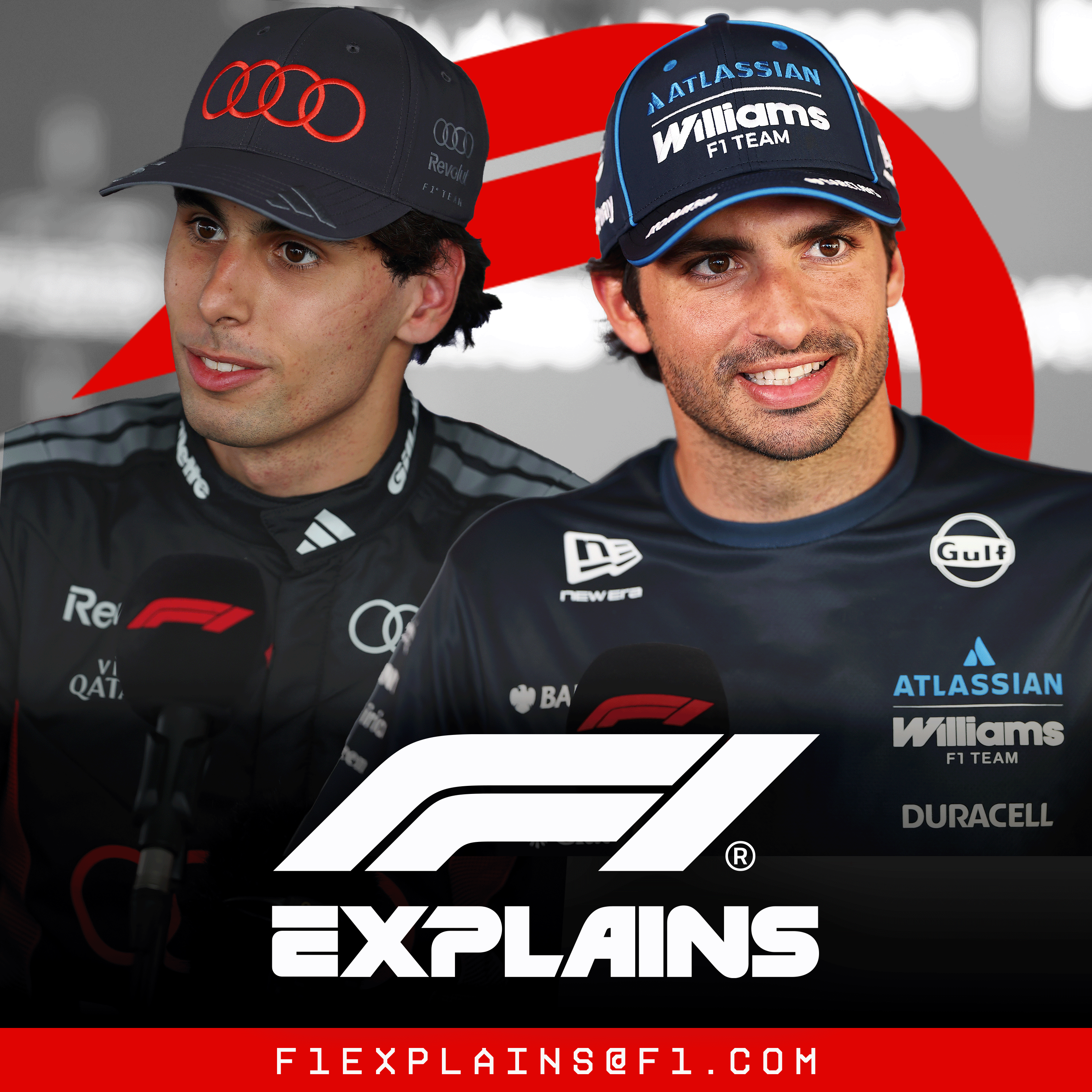
The guest mentioned here is a young Brazilian driver expected to move up into Formula 1. The transcript spelling looks off, but the idea is that he’s a rising star.
Audi is a major car brand mentioned here in connection with an F1 driver. In Formula 1, big brands like Audi can bring extra money and engineering to the team.
Carlos Sainz is a Formula 1 driver who has won races. Here, they mention his Mexico City win and that he’s working to help Williams compete with the best teams.
Active aero components are parts on the car that can adjust their shape while you drive. They help the car generate the right amount of grip and speed depending on what’s happening on track.
An overtake mode is a special “push harder” setting in an F1 car. When it’s active, the driver can use extra power/energy to help get past another car.
They use a timing gap to decide when the car should allow extra passing power. If you’re close enough—about one second behind the car in front—the system lets you use the overtake boost.
A mega joule is a way to measure energy. In F1, the car has a limited “energy budget,” and the team/driver manage how much of that energy gets used and saved.
The SLM zone is a specific part of the track where the car allows a special straight-line boost. It’s basically the “when you’re allowed to press the button” area.
Straight line mode is a boost setting meant for when you’re accelerating down a straight. The driver can activate it with a button when the rules allow.
Term
FIA set
The FIA set is the official F1 rule area that tells you exactly when you’re allowed to use certain car settings. If you use it at the wrong time, it can mess up the car’s balance and speed.
DRS is a button in F1 that makes the car less “wind-resistant” for a short time. It opens a wing so the car can go faster, usually on straights, when the rules allow it.
The drag reduction system is the official name for DRS. It changes the car’s wing setup to reduce wind resistance so the car can accelerate more on straights.
The rear wing is the big wing on the back of the F1 car. It helps the car stick to the track, and changing it can also change how much drag the car has.
Practice starts are practice runs where drivers rehearse how to launch the car at the beginning of a race. The goal is to get the timing right so the car accelerates cleanly instead of slipping or bogging down.
The start lights are the signal system at the beginning of the race. Drivers watch the sequence and time their launch so they’re ready to go the instant the lights go out.
A clutch drop is when the driver releases the clutch quickly but precisely at the start. Doing it at the right moment helps the car get traction instead of spinning the wheels or losing acceleration.
The grid box is the exact spot on the starting grid where your car is supposed to be. A good start gets you out of that box smoothly and quickly; a bad one can leave you struggling to accelerate.
F1 cars use batteries to store electrical energy that can be used for extra power. If the batteries are bigger, the car’s energy behavior changes, which can affect how the team prepares for the start.
Charging up means getting the car’s battery ready before the race start. The idea is to make sure the car has the energy it needs at the moment you launch.
Term
quali lab
“Quali lab” is basically the qualifying game plan. It’s where the team figures out how to get the car performing best for a single fast lap.
FP1 is the first practice session teams do before qualifying and the race. It’s when they test how the car behaves so they can adjust for the rest of the weekend.
Silverstone is an F1 track in the UK. The point here is that at Silverstone the track grip was particularly high, so the car felt better/more predictable.
Bahrain is one of the F1 race locations. Different tracks make the tires grip differently, so the car can feel better or worse depending on the surface.
Austria is an F1 race location (the Red Bull Ring). The track can make the car behave differently, so a setup that felt good elsewhere might not feel as good there.
“Balance” means whether the car feels like it has the right grip at the front and rear. If it’s not balanced, the car can slide more and feel unpredictable.
The front wing is the big aero piece at the nose. It helps press the front tires onto the road so the car turns better—but if it’s changed, the car’s balance can feel totally different.
“Front load” is basically how much the car is “pushing” on the front tires. If the front gets too much (or too little) grip, the car won’t turn or feel the way you expect.
“Clean air” means the air flowing smoothly over your car. If another car isn’t right in front of you, your wings “see” better airflow and the car makes more grip from aerodynamics.
“Dirty air” is messy airflow caused by the car ahead. When it reaches your car, it can reduce the aerodynamic grip you rely on to turn and stay stable.
In F1, aerodynamics is how the shape and wings of the car interact with the air. If the air is disturbed, the car can lose grip and feel less balanced.
Downforce is the “suction” effect of the wings and bodywork that presses the tires harder onto the road. If it drops, the car can feel less grippy in the turns.
They’re talking about the ideal distance to the car ahead during qualifying. Too close or too far changes how much grip you lose in corners versus how much speed you gain on straights.
Term
puncturing a hole
It means the first car out changes the airflow for everyone behind it. That can make the following cars slightly slower because their aerodynamic grip and efficiency aren’t as good.
A slipstream is the effect of riding behind another car and getting pulled along by the airflow. It often helps on straight lines, but it can hurt when you need grip in corners.
Turbulence is when the air becomes chaotic instead of smooth. Behind another car, that messy air can make it harder for your tires and wings to work properly, especially in turns.
A wind tunnel is a lab where engineers test cars by blowing air around them in a controlled way. It helps them design wings and shapes, but real racing has disturbed airflow from other cars.
LIVE
Around 50 kilometres from the Belgian city of Liège is the small village of Franconchamps.
It's home to stunning dark green spruce trees, which tower up to 50 metres high.
There's rolling hills, stunning scenery, gorgeous countryside, and what some say is
the greatest racetrack in the world.
Shortest name, longest lap, and the most respected circuit on Formula One's calendar.
But Lewis Hamilton comes through and in the most extraordinary circumstances imaginable,
he wins the Belgian Grand Prix.
Can he do it? Yes, he's done it. A brilliant move there.
Either side of Zonta and Hackenard brilliantly takes the lead.
Win number six of the season and championship lead extended for Oscar Piastry.
But of course, a track can't create magic moments without our 22 superheroes.
And this week on F1 explains it's all about them.
Although when is it not?
We're putting your questions to two F1 drivers and in the hot seat,
one of the sport's most promising young stars.
Back to back titles in F3 and F2.
For the boy from Brazil, he's heading to Formula One as the champion.
Yes, Gabriel Bortoletto, the 21-year-old who's now firmly established himself in F1 with Audi.
This is better than driving the car itself, right, doing podcasting.
Yeah, it's crazy. I love it.
And also on the way, a race winner.
Carlos Sainz wins the Mexico City Grand Prix.
He's trying to help Williams take their place back among F1's elite.
Hello, Carlos Sainz. Welcome to F1 Explains.
Let's do it.
Let's do it. It's time to ask the drivers. Welcome to F1 Explains.
I'm Christian Hugel and welcome to the Formula One paddock here in Belgium.
If you've been following Formula One for a while, you will know that this racetrack,
beautiful spa, is known for, well, over the course of a four-day race weekend,
having four different seasons.
Europe's in the middle of a bit of a heat wave at the moment.
And that seems to be the weather we're going to get this weekend.
It is baking hot. There's a slight chance of rain on Friday.
But other than that, it looks like we're going to have sunny skies in spa this weekend.
My first time here. What a thrill to be at what we've just said
is one of the greatest racetracks in the world.
And what a cool thing we're doing.
We're putting your questions directly to Formula One drivers as one walks past us now
in the paddock. Arvid Lindblad looking cool and chilled in the heat as cameras follow him.
Arvid Lindblad is not one of the drivers answering your questions on this week's F1 Explains,
but we do wish him well nonetheless. Instead, as we've just said, it's Carlos Sainz.
He's on the way in just a second. We spoke to him at Silverstone a couple of weeks ago.
Carlos on absolutely great form.
And we also put some F1 Explains admin to him.
If you were listening to the episode we did with his manager a couple of weeks ago,
you'll know what we're talking about there. That's on the way.
But first, we stood outside Audi where we had a tour just a few weeks ago on this very podcast
with Alan McNich. Now we're going back inside to speak to the driver who scored all of their
points so far this season. The very impressive Gabriel Bortoletto.
Gabriel Bortoletto, welcome back to F1 Explains, a second appearance in two seasons for you.
We enjoy having you here.
Thank you. I enjoy being here.
That is good. Well, thank you for having us at Audi in your lovely motor home,
which we got a tour around the other week on this podcast.
We've got some questions for you, the first being from Sean,
who is from Southern California, where I'm going on holiday in the summer.
So I'm excited for that. Nice.
You didn't know that, did you?
Sean says, newer F1 fan here and huge fan of the show.
Thank you, Sean.
My question is, how do the drivers know when they can enable overtake modes
and the active aero components?
Great question. How on earth do you know, Gaby?
So there are two different things.
Overtake mode, you don't enable it.
You get automatic when you are within one second of the car ahead.
So you have a zone normally before the last corner.
And then when you cross this line, if you are within one second to the car ahead,
you get the overtake.
And then the overtake mode, you gain like half mega joule more to recover and spend.
So basically, in a simple way, you get more energy to spend in the next lap.
So you can just use more power of your engine, basically.
The SLM zone, the SM, the straight line mode,
is basically you can use every lap anytime you just need to press the button.
That in my case, I have behind my wheel.
And as soon as you press it in this specific zone's FIA set, the wings open it.
And then you just press it again to close and it closes and you brake.
You have to remember to press it again to close.
Well, it happened a few times that I forgot and then I locked up massively and I went straight.
So it's not ideal.
Ideally, you close, yeah.
No, sure.
And when this came in at the start of the season, obviously last year we had DRS,
the drag reduction system.
How long did it take you as a driver to get used to this new way of working?
To be honest, it's not massively different because the DRS was trying to do basically
the same thing.
The only thing is that the DRS was only opening the rear wing and not the front wing.
So this is just like a mix of both.
And you have a bit more through the lap.
Last year we had a few less zones.
And you mentioned that your button is behind the steering wheel.
Can you guys choose where your button goes?
Absolutely.
You can choose anywhere in the steering.
What made you choose there?
It was already my DRS button from last year, so I just kept it there.
Our next question is from Lewis in South Australia.
This is a brilliant question.
I particularly like our questions for things I'd never thought of before.
Obviously in practice sessions, you guys do practice starts.
We all know how crucial the race start is on a Sunday.
Lewis asks, I want to know how do drivers know when to go on a practice start?
Do their engineers say go or is there a sign somewhere?
No, so basically we wait the car ahead to clear if we have no one ahead as well.
So we press a button in the steering as well that simulates like the start line,
you know, the start line.
No, sorry, the start lights that we have, the 1, 2, 3, 4, 5 and then out.
And that's how you do it.
How important are those practice race starts?
We know how important it is on a Sunday.
Obviously you do so much simulation work in Formula One to simulate the real thing.
How helpful are the practice starts on Friday to simulate what you're actually doing on a Sunday?
Yeah, super important.
I think also because from this practice start,
you understand how much you have grip available on the tarmac,
how much you need to set up your clutch drop because that's how we do it.
Now we have like basically the drop.
Now we need to drop to a very precise point and then if we drop a bit too deep or too shy,
we basically have a good run out of the grid box or we have a very bad one.
So you need to nail this and with practice you just understand a bit better.
And once again, it's something that's been changed for this season, the start procedure.
Has there been much to get used to from a driver's perspective?
Because we've got the bigger batteries.
They require some almost charging up at the start, don't they?
How has it changed for you at the start this year compared to last?
It changed a lot.
Yeah, you'd need to spend a bit more time loading the boost of the engine in the starts and loading,
you know, the whole putting again in a simplistic way.
You have this, you know, this engine this year is much more complex.
So you need to spend a bit more time loading everything to work and then you just, yeah,
spend a bit more time.
Last year was basically 23 seconds and this year you need about 78 seconds
to have the full procedure done.
It's such a lot of stuff to think about, but I'm guessing it becomes second nature to you
so that you're not actually thinking about it.
Do you go into a sort of autopilot mode with this sort of thing?
You try to.
Sometimes it becomes a bit too much as well.
And then if one thing of the procedure goes wrong,
you can really mess up your whole thing.
So ideally it's autopilot.
Yes, we hope that doesn't happen, of course.
Ben is in Ottawa in Canada.
Ben says, hi, everyone, explains team.
I love the podcast.
Thanks for all the great episodes.
I'd love to hear what a typical Formula One drivers race weekend looks like from start to finish.
It will be fascinating to hear what it's really like behind the scenes.
Thanks again for making such an informative and entertaining podcast.
Ben, we appreciate you.
Thank you.
We have a Formula One driver here.
I appreciate you could describe your weekend in great detail,
but we've got a limited amount of time.
So a sharp summary.
Guide us to a race weekend.
So let's put it this way.
Wednesday, sometimes we have events for sponsors.
So we arrive somewhere in the world where we need to do these events.
Normally they try to put us close to the track.
Then we do these events for, I don't know, 3456 hours on a Wednesday.
And then we go relax in the hotel.
Thursday we arrive at the track in the morning.
We have all the media commitments, the podcast, interviews with journalists,
explain a little bit of how the team has been doing and everything.
We have time with engineers to organize the weekend and what's the plan for the weekends.
Meetings with engineers, jump in the car, driver check, test everything as a ride.
Then leave to the hotel, sleep, wake up, Friday arrive, few meeting grids sometimes,
you know, with sponsors.
Then we have time with engineer, then pre-practice one, debrief,
pre-practice two, debrief, understand if we need to improve the car.
Back to the hotel, sleep, Saturday, come back.
Meetings, more meetings.
FP3, meetings.
Quali, meetings.
You love a meeting.
A lot of meetings, yes, we have a lot of meetings.
And then Sunday, driver's parades, meetings, strategy meetings, race,
post-race meeting, and then home.
Of all of that, what would you say is your favorite meeting?
I don't like any.
Oh, shame.
I think the strategy meeting is always interesting.
You decide what you're going to do on Sunday, it's cool.
And on your favorite day of the weekend, I'm guessing it's Thursdays
because you get to talk to the likes of me.
Absolutely.
You could read me so well, my friend.
Exactly.
This is better than driving the car itself, right?
Doing podcasts at ease.
Yeah, it's crazy.
I love it.
And yeah, I can tell you're lying.
Excellent.
Right, our next one is from Kayla from New Jersey.
She says, does every day driving in a normal car
affect a driver's ability to race?
So if they drive a normal car often, will they get used to it
and it negatively impacts their racing skills?
Is it hard to adjust from driving an F1 car to a normal road car
or are professional drivers able to separate the two?
I'd love to hear how your brain adapts to the different types of driving.
Thank you.
I love the podcast.
How often are you in a normal car?
Quite a bit.
I like to drive, but no, it doesn't affect you because it's so different.
It's a completely different world.
You are not racing.
You are not fully squeezed by the belts and in a tight seat
and pushing to the limit.
You are just going around that is so different.
That is like, you don't even correlate things, you know?
It's not that I'm driving like another racing car
and then I need to jump in a Formula One.
It's like a road car with a Formula One car.
It's completely two different beasts.
When I was very young, I raced cars.
I wasn't very good.
People like you who are very good climb the motorsport ladder.
People like me drop out the motorsport ladder
and end up talking about it.
The one little...
I'm sure I had more opportunities there.
This is well, but it's very kind of you.
But the one tiny little thing I got was when I was racing cars,
I'd get into my car for a split second
and the likeness of the steering would,
for a split second, take some getting used to.
Do you ever have little moments like that where it's like,
this is different to the car?
Yes, the brake pedal, as you know, very well.
The brake pedals can be very hard in race cars
and then in the road cars, you tap it a little bit
and the thing is already like...
Yes.
...pushing your head straight to the steering wheel.
So, yeah, this type of things, maybe you...
But you already know as well.
Like, I jump in my road car.
I've driven it so many times
that I know how the brake pedal there works.
So I just know I don't need to press it as hard as a race car, you know.
But yeah, you get the feeling a bit different, for sure.
Finally, Gaby, before we let you go,
a couple of weeks ago when everyone explains,
we had a tour of your shiny new hospitality building
that we're sat in now that comes with you
to all the race weekends in Europe
from your boss, Alan McNish.
We got a tour into the kitchen
and me and Alan didn't know what faffale pasta was, I'm ashamed to say.
This got quite a lot of traction on social media.
A lot of traction.
Elena, from Audi, is giving you something.
Would you just like to explain what this is, Gaby?
It's a type of pasta.
This one.
What specific pasta is it?
It is.
It's like the one you have here on the smoking.
Yes, it is faffale pasta.
Firstly, thank you to Audi for presenting this to us
in an honorary way, given all the furor that was caused
by me and Alan not knowing what faffale meant.
Obviously, you're Brazilian, but I understand you lived in Italy.
So you should know pasta really well.
So you're going to be our voice of authority on this subject.
How do you pronounce faffale?
In Italian?
Well, yeah, just because this has been causing great controversy.
Go again?
Faffale.
Faffale.
Elena at the back, who is actually Italian.
Faffale is nodding her head.
Faffale.
I've got it.
For the voice of doubt, I now know what it is, and I know how to pronounce it.
Have I done okay?
Unbelievable.
Great.
It's like crazy how good your Italian is.
Thank you.
I appreciate that because we've come a long way in the last few weeks.
You do look slightly bemused, but I appreciate you playing along with us here.
Everything, man, to make you happy.
Enjoy, thank you.
You do make me happy.
Enjoy the Belgian Grand Prix.
Thank you for coming back on everyone Explains.
We've enjoyed your time a lot.
Thanks for all.
Appreciate it.
It was great to speak to Gabby.
He's such a nice guy.
He's as nice as he comes across.
Thank you to Team Audi for my pasta.
That's really appreciated.
Hopefully we can put that one to bed now after all the conflicting emails of how to pronounce it.
Good Lord.
It's amazing what captures you.
Lots of attention.
Gabrielle was amazing, and we've got another Formula One driver for you.
Carlos Sainz coming up in just a moment.
Welcome back to F1 Explains from a baking hot spa here in Belgium.
Before the break, we heard Gabrielle bought a letter,
but he is not the only Formula One driver answering your questions on this week's F1 Explains,
because a couple of weeks ago at Silverstone,
we had a chat to the smooth operator that is Mr Carlos Sainz.
Hello, Carlos Sainz.
Hello. Welcome to F1 Explains.
Let's do it.
Let's do it.
Our listeners have been asking us questions about driving a Formula One car.
This to me seems a topic you're quite well qualified to answer them on.
I think so. I should be able to help on this.
I hope so. Let's go for it.
I really like our first question.
It comes from Pravi, and it says,
Hi Carlos, how does a flat out flying lap in qualifying really feel?
It's a combination of taking a lot of risks,
but at the same time, if you know how to play an instrument and you just want to play a certain song,
and you need to memorize what you want to do through that minute and a half.
So you know what a perfect lap looks like in your head.
You know exactly where to brake, where to release the brake, where to go and throttle.
So you need to memorize and let's say focus on hitting those points.
But then at the same time, if you can find something extra by taking a bit more risk
in a high speed corner or breaking a bit later than what your plan is,
then that's where field comes into place, where risk and reward comes into place,
into play and where you need to balance playing the instrument, like I call it.
At the same time that you take probably a bit more risk than what at the beginning you were going to
think you were going to do.
I think that's my favorite analogy for driving a Formula One car I've ever heard,
playing an instrument. It's quite a romantic way of describing it.
It is because the way we've done so many laps during the weekend,
we know what a perfect corner should be like.
We know that corner, if you turn in at the exact point like here, turn nine, cops,
sometimes you can do it flat.
If you turn in, you get a bit of a gust of headwind at the apex,
you know the perfect lap, the perfect corner is flat out.
So you know you need to play the instrument and turning at that point,
downshift or whatever you know.
But most of the times you rely more on feel and you say I'm not having the right tire temperature,
the right balance, this lap and you have to lift a bit more or less.
So there's a level of improvisation plus a level of trying to do what you want to do.
What instruments would it be?
What do you need to use feet and hands, piano maybe?
Piano is good, yeah.
No, the drums, yeah.
Patricia Jamie's doing drums and analogy there, yeah.
I think about the piano because the piano is playing the notes with the fingers
and you have in front of you like you read through the sheet,
know that you have to play and don't get me wrong,
I've never played the piano in my life, you can ask these more to Charles.
I think about it like that, that I know what I need to do to do a perfect lap.
So I will go into the quali lab with knowing what I want to achieve and how I want to play,
but then I leave it a bit too instinct to know how much I want to push it.
I love this analogy, I'm going to be using this again,
I'll be quoting this for many years to come.
Steffi is from New Zealand and says,
why do drivers occasionally say the car feels different in FP1?
When they may have raced the same car just five days earlier,
what changes between the end of one race weekend
and the start of the next that make the same car feel so different?
It's a great question.
Great question, it could be various things.
So for us tarmac is where the tyre touches the ground.
So if the tarmac changes and there's a completely different level of grip
and the change in tarmac changes the feel of the car a lot.
So for example Silverstone, we had an amazing levels of grip here,
it's the highest grip of the season.
Together with the Jeda and the new tarmac in Suzuka.
Like we have a lot of grip here and the car feels amazing pretty much straight out of the box.
But then you go to other tarmacs that are a lot rougher, older, Bahrain,
Barcelona, Austria last week and the car immediately slides more.
So the balance is already,
doesn't matter if you have good balance,
you have the feeling that the car is worse.
And then sometimes you always start with a bit of a different setup
because you try and adapt the setup to each truck characteristic.
You haven't nailed that setup and the car feels strange.
Or sometimes you put in a new front wing that the team has produced over those two weeks.
And the new front wing is delivering a bit too much front load,
a bit less front load and the balance is not as you expected.
So multiple factors.
It must be so irritating when you've had a really great weekend
and the cars felt amazing and if it's a double head for example
and then a few days later you're like,
oh no, I want it to feel like it did the other day.
I had exactly that situation in Austria.
We were coming off Barcelona where the car,
car wasn't competitive but the balance was okay.
I was happy with balance.
And then put the car on track in Austria.
I didn't do FP1.
Look who was in the car in FP1.
It was already complaining a bit about the balance.
And I go and do my first lap to Austria and I'm like,
what the hell is this?
Like this has nothing to do with what I drove.
Is this the same car?
Exactly that.
And we ended up finding out why
developed during the weekend.
We managed to find what was wrong
and why was it not delivering the same kind of balance.
But yeah, interestingly that situation happened to me just a week ago.
Steph is in Utah and Steph says,
my question is about clean air and dirty air.
This is one of our most frequently asked questions this car lost.
When you're catching another car,
when does the air stop being clean
and start to become dirty or turbulent
and therefore bad for the aerodynamics of your car?
It's one of these phrases that gets thrown around
in an FP1 race weekend all the time.
They're good, our listeners.
Yeah.
And this is probably what you guys
is going to surprise you the most, this answer.
So we start feeling dirty air around
eight to nine seconds of the car in front.
Which doesn't sound long but that looks a long way away.
You don't see the car.
Okay, so the car might already done a corner.
Count to nine seconds.
Then I go through the corner.
Okay, that's the gap that there is.
I'm not saying that it's detrimental for performance
but you feel it.
You feel it's giving you one KPH on the straights
because he's breaking the air on the straights
but he's also breaking the air in the corners.
So you have a tiny, tiny, tiny bit less downforce in the corner.
Nothing, probably around a track like Silverstone,
our simulation suggests the ideal more or less to do
at the qualifying lap is seven seconds behind the car.
Which gives you a tiny bit of slipstream,
maybe like one or two KPH on the straights.
And then even though in the corners
you will not have as much pure downforce,
you don't lose as much as what you're gaining on the straights.
So seven seconds is still at distance, which is huge.
And that is more or less why you will see us in qualifying,
never wanting to be first car out.
Because first car out, you're punching a hole.
You're punching a hole over
and then everyone behind you benefits from you punching a hole.
And then you will also not want to be closer than five seconds
because then five seconds down,
you are suffering the dirty air in the corners too much.
And you're not, and you're still gaining on the streets
but suffering too much in the corners.
And we should say on a straight that's a slipstream
but almost the same air can become a disadvantage on a corner
when that air becomes turbulence.
So in the straights that turbulent air is always going to help you.
But on the corners it doesn't.
But in the corners it's always going to make you worse.
Yes.
Because it's downforce, you're removing downforce from the car
which in the straights is what you want.
But in the corners you're removing downforce from the corners.
It's something we get asked a lot,
the difference between clean air and dirty air
and turbulence in a slipstream.
And fundamentally it's just you get the turbulent air on the corners.
It's the same amount of turbulence.
It's just one is in the corner, one is in the straights.
But it's the same effect.
That's why an F1 car is designed to be that driven in cleaner.
That's where you have the wind in the wind tunnel, cleaner.
And the moment it's turbulent and it's slipstream it's difficult.
Carlos just before I let you go,
a few weeks ago on this podcast,
our special guest was Carlos Anoro.
Who you will know.
Yes.
He is your manager.
Yes.
And of course your cousin.
He gave us absolutely fascinating insights.
For those that weren't listening, he said this.
He knows perfectly well that when we are working
I treat him exactly the same way that I would treat my partners
when I was working for a big consultancy firm back in the day.
But then if we are having lunch on a Sunday in August in Mallorca
and I run out of coke and I want another one,
he's my younger cousin.
You know, stand up and go get me another coke please.
And it's funny because he does it and he loves, you know,
and that's the sort of good relationship that we have
and we maintain and I think it's key.
Carlos, you're a sponsor to this.
It's absolutely true.
The cabrón like I would say in Spain, it's a little insult,
you know, that we use in a familiar, in a polite way.
So it's not swear word or anything?
It's a swear word but it's like the, but in a nice way.
Fine.
The problem with insults in Spanish
is that you can use them in a cute way.
Sure.
Okay, so it all depends on the tone
and the tone is cute like a amicable tone.
Okay, so to get back on track of Carlos,
you can confirm despite the fact that he is your manager
and you are one of the world's most elite athletes,
you are still sent to get him a refill on his drink?
Yes, especially when I was younger.
And now that I'm 31 a bit bigger and I can face him head to head,
I can maybe say, no, it's your turn.
Or, but if I'm normally being a nice cousin,
I know it's my role as a younger cousin to normally obey
what the older cousin says.
And it's how in my family, how we were brought up,
you always respect the older ones, you know.
And yeah, he's seven years older.
So I need to, I need to respect the ranks, you know.
And it's obviously working.
You work well together.
You still talk to each other when you're on cousin's time.
Whatever you're doing, it's working.
Yeah, when we were younger, he didn't bully me,
but he was, I'm for legal reasons, we should say, definitely didn't.
He was, he was using that advantage for himself
to get even more, more coax, let's say.
Like, yeah, he meant my older, older cousin,
that was his age, both to male of seven years older than me.
They were, I remember, yeah, they were,
they were being quite sometimes.
Hmm. Yeah, not bully, but you know what I mean.
Just being the older brother, the older cousin.
Rascals, we'd say, in the UK.
It's quite a George Russell word, that, but rascals.
Lovely. Carlos, insight in many ways.
This has been a pleasure as always.
Thank you.
Thank you.
And there you go.
When we recorded that interview with Carlos and Otto,
we didn't know we'd be talking to his baby cousin
just a few weeks later.
And the absolute smile that was on his face
as he heard what his cousin had said about him,
it's clear how well the two guys get on.
Oh, and we've had on this podcast this week
two of the Paddock's most classy operators as another one.
Walks Pastas, Carlos' ex-teammate, Charlotte Claire.
But one thing I don't understand about Charlotte Claire is,
I keep banging on on this podcast how hot it is today.
It's absolutely baking.
Charlotte never looks hot and bothered.
I mean, maybe just when he's come out the car,
but he walks into the Paddock looking cool, relaxed, calm,
and sunkissed, but not hot and sweaty.
A manager always looks effortlessly good.
Charlotte Claire there, Carlos' former teammate.
We wish him well this weekend.
I hope you've enjoyed this episode
where we put your questions to Formula One drivers.
Of course, keep sending in those questions.
F1 Explains at f1.com.
We'll be answering those questions for you
all the way through to the end of the season.
One more episode next week before the summer break
when the F1 circus rolls into hunger.
Then we're having a few weeks off for a holiday.
As I mentioned to Gabby, I'm off to the stage
for a little bit of a holiday.
I'm sure he was delighted to hear about my plans.
And then we're back after the summer break,
answering your questions right through to the end of the season.
So we need those emails to keep coming.
F1 Explains at f1.com.
Of course, you can check out our other podcast as well,
F1 Nation, which will have a debrief of all the action here
in Belgium on Sunday and into Monday.
And there is, of course, beyond the grid.
Producer Jamie has been out recording one this morning with...
Alan Permane, Racing Bulls team principal.
Alan Permane was on good form, I presume.
Excellent form.
As good form as Racing Bulls are on at the moment.
Lovely, Jamie. They're on a good run, as you say.
An exciting podcast for you to listen to.
That's the Permane thing.
Anyway, that's probably enough from us, I think.
Back next week, f1explains at f1.com.
Is the email address from me, Christian Higiel here in Belgium.
Enjoy the Grand Prix and we'll see you next time.
Bye for now.
About this episode
From Spa-Francorchamps, Carlos Sainz and Gabriel Bortoleto break down what makes a flying lap and a race start work: when overtake mode and straight-line mode kick in, how the new wing-opening system differs from last year’s DRS, and why clutch timing and battery changes affect launches. They also answer a listener on clean vs dirty air, explaining when turbulence starts hurting downforce in corners—plus how track grip and setup changes can shift the car’s balance weekend to weekend.
How do drivers enable overtake mode and active aero? What’s the secret to a quick flying lap? And how do they know when to launch on a practice race start?
Carlos Sainz and Gabriel Bortoleto join Christian Hewgill in the F1 paddock to answer your questions about Formula 1.
You’ll also hear how they find the perfect balance between clean and dirty air, what a race weekend looks like for them and whether everyday normal driving in road cars has any impact on their racing.
Plus, Carlos provides a very funny response to a claim made by his manager and cousin Carlos Onoro on a recent episode.