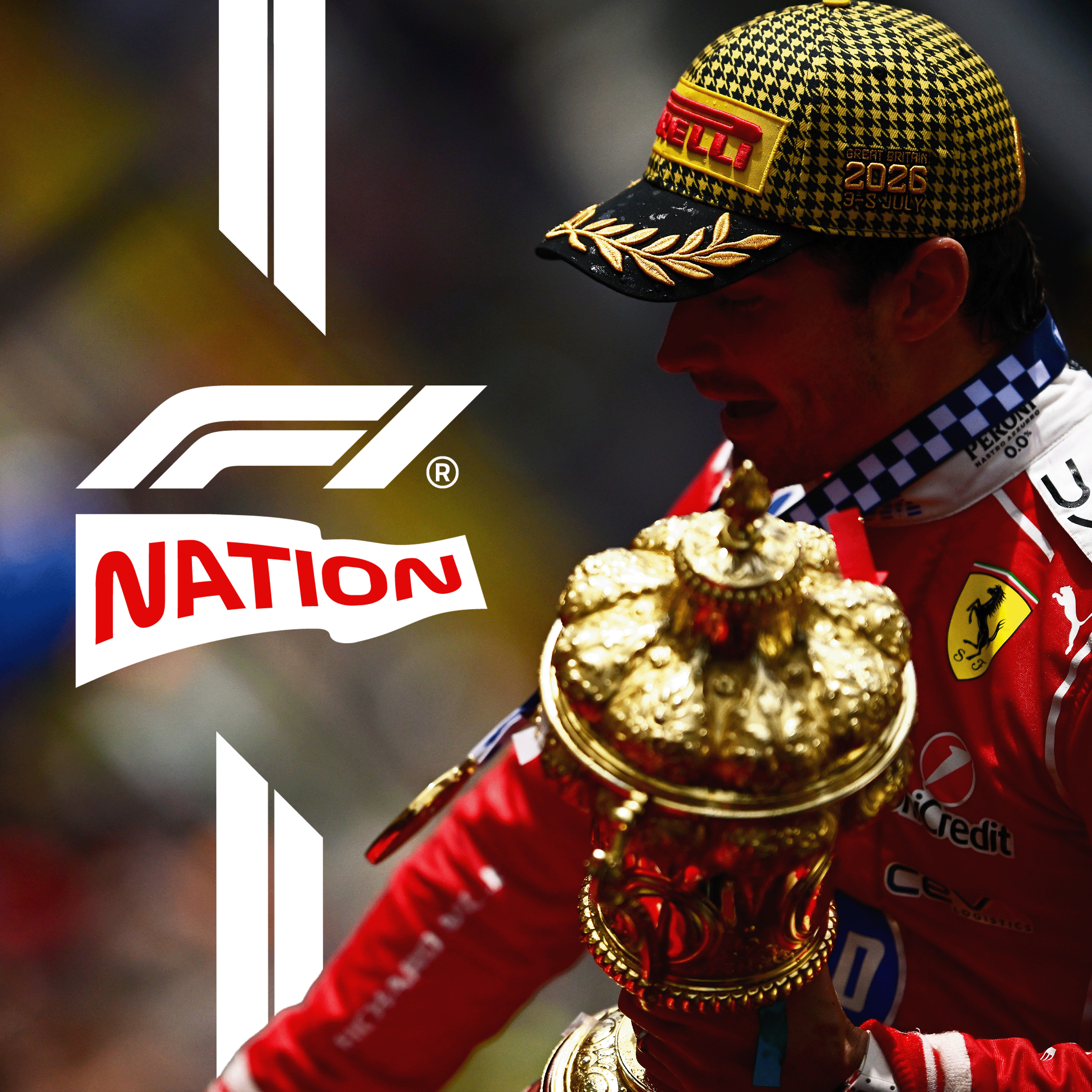
Leclerc ‘transforms the narrative’ + more Mercedes drama – British GP Review
About this episode
Leclerc’s British GP win is framed as a full narrative turnaround, with Ferrari finally converting strong qualifying into race control at Silverstone. The panel highlights how Lewis Hamilton’s post-race reaction suggested the “jab” was answered—Ferrari looks back on top, and Leclerc’s consistency returned. Behind the scenes, Mercedes drama looms: Kimmi Antonelli suffered another reliability/steering-related failure, turning what looked like a points haul into a major swing, while George Russell benefited. The discussion also weighs whether Ferrari’s sprint-to-race pace is real or a temporary shift.
Tom Clarkson is joined by F1TV commentary duo, former F1 driver Jolyon Palmer and lead commentator Alex Jacques, to reflect on a dramatic British Grand Prix.
Charles Leclerc capitalised on more misfortune for championship leader Kimi Antonelli to take his first victory since Austin in 2024. After such a difficult run of races, why was he back to his best and how significant is this win for Charles?
Reliability issues mean Antonelli has seen his championship lead cut from 66 points to just 25 over the last three rounds, but is he leaving Silverstone happier than George Russell despite the Brit taking home P2 and closing the gap to Kimi? Jolyon, Alex and Tom share their thoughts on George’s continuing struggles against his teammate and the team radio message from Mercedes Team Principal Toto Wolff at the end of the race.
Plus, the guys discuss why Lewis Hamilton might be ‘scratching his head’ despite securing a fourth podium finish of the season and gaining more ground on Antonelli.
Listen to more official F1 podcasts
Lando Norris on F1 Beyond The Grid
Your questions answered by experts on F1 Explains - right here on the F1 Nation podcast feed
This episode is sponsored by
BetterHelp - Don’t let stigma stand in the way of support. Start therapy with BetterHelp. Sign up and get 10% off at betterhelp.com/f1nation
Shopify: You put in the work. Time to get paid like it. Free trial at shopify.com/nation
Give your body what it deserves with IM8! Go to IM8HEALTH.com/NATION and use code NATION for a Free Welcome Kit, five free travel sachets plus ten percent off your order.
Anthropic: For problems worth solving — get started with Claude at Claude.ai/nation
Charles Leclerc
"Leclerc was back to his best and it was Lewis that was left scratching his head. ... He had Charles Leclerc on the end of the jab and that's now vanished."
Charles Leclerc is a Ferrari Formula 1 driver. Here, the hosts say he bounced back strongly and won the British Grand Prix.
Charles Leclerc is a top Formula 1 driver for Ferrari. In this segment, he’s credited with “transforming the narrative” by winning the British Grand Prix and returning to his best form.
Lewis
"Leclerc was back to his best and it was Lewis that was left scratching his head. I think Lewis's reaction afterwards said a lot."
“Lewis” here is Lewis Hamilton, a very famous F1 driver. The discussion suggests he struggled to match what Leclerc was doing in this race.
“Lewis” refers to Lewis Hamilton, a multiple-time World Champion and one of F1’s most experienced drivers. The hosts contrast his race outcome with Leclerc’s, describing Hamilton as “scratching his head” after Leclerc’s performance.
Ferrari
"It's not Ferrari the Mercedes is it? It's Ferrari the Antonelli."
Ferrari is one of the biggest F1 teams. Here, the hosts are talking about how Ferrari’s driver lineup and results relate to the Mercedes drama.
Ferrari is the storied Italian Formula 1 team and constructor that employs Charles Leclerc. In this segment, the hosts play on the idea that the rivalry isn’t just “Ferrari vs Mercedes,” but also involves Ferrari’s driver situation and expectations.
straight line
"Yeah George, I think straight line was okay in the race."
“Straight line” means how fast the car is when it’s not turning—more about top speed than cornering. The host is saying Mercedes seemed fine in that area.
“Straight line” is shorthand for a car’s speed and stability on non-cornering sections—essentially top speed and acceleration without the complexity of braking/turn-in. In F1 analysis, it’s often used to judge whether a team’s car is strong on power and low-drag setup.
Victory Lap radio
"The spiciest slapback on a Victory Lap radio since Mark Webber said not bad for a number two driver. It wasn't a Victory Lap."
“Victory Lap radio” means what the driver and team say over the radio while the driver is celebrating after winning. The hosts are joking that this message was especially spicy.
A “Victory Lap radio” refers to the driver-to-team radio chatter that often happens during the celebratory lap after a race. The segment uses it as a reference point for how sharp or memorable the team’s messages can be.
Mark Webber
"The spiciest slapback on a Victory Lap radio since Mark Webber said not bad for a number two driver."
Mark Webber is a former F1 driver. The hosts mention him because he’s known for memorable radio moments, and they’re comparing this one to that style of comment.
Mark Webber is a former Formula 1 driver who raced for Red Bull. The hosts reference a past Webber radio quote to compare the “spiciest” nature of the current slapback message.
Silverstone
"There's always drama at Silverstone. Hello everyone and welcome to F1 Nation's review of the British Grand Prix."
Silverstone is the famous UK race track that hosts the British Grand Prix. The hosts are saying it tends to produce lots of action and drama.
Silverstone is the home of the British Grand Prix and a historic F1 circuit in the UK. The hosts note it’s a track where drama is common, and they frame the race’s chaos as being especially visible there.
paddock
"Hello everyone and welcome to F1 Nation's review of the British Grand Prix. I'm Tom Clarkson and joining me in the paddock in the Ferrari Motorhome..."
The “paddock” is the team area at an F1 weekend where the garages and staff are. It’s where you’ll see interviews and behind-the-scenes activity.
The “paddock” is the secured area at an F1 event where teams operate between sessions—garage spaces, hospitality, and team personnel. It’s where interviews and team-related commentary often happen.
podium fight
"There were just drama from the front to the podium fight probably further back, but we didn't get to see so much of it because there was loads going on at the front."
A “podium fight” means the race battles for the top three spots. The hosts are saying there was drama not just at the very front, but also around the positions that decide who gets on the podium.
A “podium fight” is the on-track battle for the top three finishing positions (P1–P3). The hosts say most of the action they saw was at the front, but there was also drama further back involving the podium positions.
safety car
"obviously having his own issue, late safety car, shame. We didn't get one last lap of racing, but yeah, great race at Silverstone... Look, we had hoped the safety car would come in on the penultimate lap, but it went round again..."
A safety car is when F1 slows down the whole race because something unsafe happened on track. It keeps everyone together, so it can completely change who has a chance in the final laps.
A safety car is deployed in Formula 1 to slow the field when there’s danger on track (like debris or an incident). It bunches cars up behind it, which can erase gaps and dramatically change tire strategy and the chances of a late overtake.
last lap shootout
"You rarely get a last lap shootout. I used to get excited when it's a last lap shootout in Formula Three to win the British Grand Prix."
A “last lap shootout” means the race is decided in the final lap with cars right next to each other. It often depends on who has the best grip from their tires at that moment.
A “last lap shootout” is an informal way to describe a race finish where multiple cars are close enough to fight for position right at the end. In F1, it usually comes down to who has the freshest tires and the best grip for the final braking zones.
three wide
"if you get racing around here with one to go, you knew you were going to be into three wide action cars going through. It would have been a melee like we had at the start of the sprint race."
“Three wide” means three cars are trying to pass each other at the same time in the same corner or straight. It’s risky because there’s very little space if someone has to brake or change line.
“Three wide” describes three cars running side-by-side through the same section of track. It’s high-risk in F1 because there’s less room to avoid contact, and it can trigger a chain reaction into the next corner.
medium tyres
"He was out there on pretty old medium tyres. Everyone behind him was on new softs."
“Medium tyres” are one of the tire types F1 teams choose from. They’re usually a middle ground between lasting a long time and giving strong grip—so if they’re worn, the car can feel less sharp at the end.
In F1, “medium tyres” refers to a specific compound in the tire range provided for the weekend. Mediums are typically a balance between grip and durability, but if they’re old, they can lose performance—especially when the car needs traction for late-race overtakes.
softs
"He was out there on pretty old medium tyres. Everyone behind him was on new softs."
“Softs” are the grippier F1 tires. They help you go faster, but they don’t last as long, so teams use them when they want maximum traction for a limited time.
“Softs” are the softer tire compound option in F1’s range, designed to provide higher grip. The tradeoff is that they generally wear faster, so they’re often used when a team expects to need peak performance for a shorter window—like the final laps.
tyres were feeling cold
"I was fascinated to hear Charles actually talk about tyres were feeling cold, one lap."
If tyres are “feeling cold,” they’re not warm enough to work at their best. That usually means less grip, so the car can feel harder to control until the tires heat up.
When a driver says the tyres are “feeling cold,” it means they haven’t reached their ideal operating temperature yet. Cold tyres provide less grip and can make the car feel unstable, which is why teams manage warm-up laps, pace, and safety-car restarts.
George Russell
"that's really tricky for George. So I think he'd been gobbled up actually in a lap. ... You've got George running fourth, which you would say is probably where he's most likely to end up,"
George Russell is an F1 driver for Mercedes. This part explains how race timing and problems with the car can cost him points even when he’s in a strong position.
George Russell is a Mercedes F1 driver, and the segment focuses on how race events and reliability problems affected his points and championship position. They mention him running fourth and losing a potential points haul due to circumstances beyond pure pace.
reliability issue
"But perhaps the biggest headline surrounds Kimmy Antonelli, who suffered his second reliability issue in the last three races when he was closing in on Leclerc."
A “reliability issue” is when something mechanical goes wrong with the car. In F1, even one problem can cost big points because you might lose position or not finish where you should.
A “reliability issue” in F1 means a mechanical or systems problem that forces a driver to lose time, retire, or finish with reduced performance. Because races are short and points are valuable, reliability problems can swing the championship by removing results that were otherwise likely.
Kimmy Antonelli
"But perhaps the biggest headline surrounds Kimmy Antonelli, who suffered his second reliability issue in the last three races when he was closing in on Leclerc."
“Kimmy Antonelli” is Kimi Antonelli, an F1 driver linked to Mercedes. They’re saying his car has had reliability problems recently, which has hurt his results.
“Kimmy Antonelli” refers to Kimi Antonelli, an F1 driver associated with Mercedes. The hosts highlight his recent reliability setbacks and how they cost him points during races where he was closing on Leclerc.
British Grand Prix
"He'd passed him on track to beat him in Barcelona. He was going to extend the championship lead by, let's be honest, winning the British Grand Prix and those results slipping through his fingers."
The British Grand Prix is the main F1 race in the UK. Here, they’re talking about how a result at that race could have changed the championship.
The British Grand Prix is the Formula 1 race held in the UK. In this segment, it’s used as the specific event where Russell’s potential points and championship lead could have been extended.
31 point swing
"George has had the disappointment of Canada. So I think there's a 31 point swing in that moment."
A “31 point swing” means the championship points changed a lot because of one key moment. In F1, that can happen if a driver loses a strong result due to problems or bad timing.
A “31 point swing” means a large difference in championship points caused by a specific moment—like losing a win, podium, or finishing position. In F1, swings like this can happen when reliability or race incidents remove results that were otherwise likely.
aerodynamic damage
"That looked from the outside as to be quite a small bit of aerodynamic damage on the front left. And yet it had massive ramifications."
It means the car’s shape got slightly damaged, so the air doesn’t flow over it as intended. In racing, that can make the car harder to control and slower.
Aerodynamic damage means the car’s bodywork or wings are damaged in a way that disrupts airflow. In F1, even small damage can reduce downforce and stability, which then affects lap times and drivability.
carbon fibre component
"Well, it seemed like it was just a physical, it was obviously a carbon fibre component on the inside of the wheel that must have got lodged to actually stop him being able to turn the wheel."
Carbon fibre is a very strong, lightweight material used a lot in race cars. If a carbon part gets stuck or fails, it can stop the car from steering properly.
Carbon fibre components are parts made from carbon-fiber composites, chosen in racing for high stiffness and low weight. If one lodges or breaks, it can directly interfere with wheel movement or steering geometry.
steering arm
"So he was, or turn the wheel, but not affecting the steering arm, so he's not able to actually turn the car."
The steering arm is a mechanical link that turns the wheel when you turn the steering wheel. If it’s blocked or affected, the car can’t respond to your steering input.
The steering arm is part of the steering linkage that transmits driver input to the wheel. If something interferes with it, the driver may be able to move the wheel but the car won’t actually steer.
final part
"and then he really couldn't turn the car when he had to do it at the final part."
The final part is the last stretch when everything is most intense. If something goes wrong at the end, it’s harder to fix before the session is over.
In qualifying or race stints, the “final part” is the last segment where drivers are pushing hardest and margins are smallest. Mechanical issues that appear late can be especially damaging because there’s less time to recover or correct.
reliability part
"So you realise straight away there was a problem, thought maybe it was a puncture because of what was happening to George, but in so many of these, any reliability part is so often a tiny part that has bigger consequences."
A reliability part is something on the car that’s meant to keep working all weekend. If it fails, it can cause a much bigger problem than you’d expect.
A reliability part is a component whose failure can end a session or cause major damage. In F1, even a small failure can trigger a chain reaction—like losing steering or forcing an early retirement.
balance
"He laid the foundation for it in qualifying by finding a balance good enough to beat Lewis Hamilton."
In racing, “balance” is how well the car feels and handles. If the balance is right, the driver can push harder and get faster lap times.
“Balance” in F1 usually means how the car behaves across different conditions—how stable it is and how well it turns under braking, corner entry, and corner exit. Finding the right balance is key to extracting lap time in qualifying.
deployment of the yellow
"He was obviously ahead of him in Austria, but there was a mitigating factor with the deployment of the yellow and the crash of a Stappen."
When race control brings out yellow flags, it means there’s danger on the track. Drivers have to slow down and teams often adjust strategy because the race conditions change.
“Deployment of the yellow” refers to the race control using yellow flags, which signal a hazard on track. Yellow-flag periods change how teams manage pace and strategy because overtaking and speed are affected.
Stappen
"but there was a mitigating factor with the deployment of the yellow and the crash of a Stappen. So to get to the front row on merit was huge."
“Stappen” means Max Verstappen. They’re saying a crash involving him affected how the race played out earlier.
“Stappen” is a reference to Max Verstappen. The transcript mentions a crash involving him as part of why results earlier in the season were different.
front row
"So to get to the front row on merit was huge. First time he's ever done that had the British Grand Prix around Silverstone, despite the pace he's had here in the past."
The front row means starting in the two best spots on the grid (first and second). It usually helps because you’re less likely to get stuck in traffic right away.
The front row is the starting positions P1 and P2 on the grid. In F1, starting from the front row often reduces traffic risk and gives cleaner air, which can be crucial for converting qualifying pace into points.
qualifying
"So he did a great job yesterday in qualifying. He's spoken quite a lot about making big changes with the car..."
Qualifying is the part of the F1 weekend where drivers try to set the fastest lap. The results decide where they start the race.
Qualifying is the session where teams set their fastest lap to determine the starting order for the race. A strong qualifying performance usually means the car is quick over a single lap and can help with track position.
data
"making big changes with the car, having looked at something from Friday, a bit of data... finding something in the data on Friday night"
In F1, “data” means the performance information the team measures from the car. They use it to figure out what’s not working and what to adjust.
In F1, “data” refers to the telemetry and performance information teams collect during practice and the race weekend. Teams use it to identify what’s holding the car back and to decide what to change in the setup.
consistency
"unlike in Austria... where he just out-qualified Lewis... where the consistency of Lewis' ability to put out of time is shown over multiple laps"
“Consistency” here means staying fast and stable lap after lap during the race. It’s about not dropping off as the tires and conditions change.
In race terms, “consistency” means maintaining competitive performance across many laps rather than only being fast for a short burst. The hosts contrast Leclerc’s weekend with earlier races where Hamilton’s ability to stay consistent over multiple laps was the key advantage.
boxing analogy
"Just to continue the boxing analogy, Jake, I thought there was an interesting moment in the press conference afterwards"
They’re using a boxing metaphor to describe the rivalry and mind games. It’s not a technical car term—more about the drama and momentum between the drivers.
A “boxing analogy” is a metaphor the hosts use to describe the back-and-forth momentum and psychological dynamics between drivers and teams. Here it frames the post-qualifying/post-race comments as a kind of competitive exchange.
setup
"Lewis then spoke and said, well, he migrated towards my setup. I very much felt it was Lewis just saying, hang on, it's me. It's my ideas that's driving this team forward."
A “setup” is how the team adjusts the car to make it handle and feel right. If someone says the car moved toward their setup, they mean it started behaving more like what they prefer.
A car “setup” is the collection of adjustments—like suspension, aerodynamics, and balance settings—that determine how the car behaves. When Lewis says Leclerc “migrated towards my setup,” it suggests the team’s changes moved toward Hamilton’s preferred configuration.
Kimi Antonelli
"I know JP, you were saying that this was Kimi Antonelli's race until he had his problems, [634.9s] but Ferrari have now won two of the last three races, right? ... so you've got Antonelli in two of the last three races not finishing."
Kimi Antonelli is a Mercedes driver discussed here as being “until he had his problems.” The hosts frame his recent run as a sign of Mercedes’ reliability issues affecting whether he can finish races.
reliability blows
"So Mercedes are having obviously these reliability blows, [658.8s] so you've got Antonelli in two of the last three races not finishing."
They mean the car has had unexpected problems that stop it from finishing. The hosts are using it to explain why Mercedes hasn’t been getting consistent race results.
“Reliability blows” refers to unexpected mechanical or technical failures that force an F1 car to retire or suffer major setbacks. The hosts connect these failures to Mercedes’ recent results and to Antonelli not finishing races.
Degradation
"Degradation was not a factor here. [684.2s] When it's a factor again, we might see Mercedes just have that advantage once more."
Degradation means the car’s tires lose grip and performance as the race goes on. They’re saying this time the tires didn’t fall off much, so Ferrari could keep the pace.
Degradation in F1 usually refers to how tires (and sometimes brakes) lose performance over a stint due to heat and wear. The hosts say degradation “was not a factor here,” implying Ferrari’s pace wasn’t being limited by tire drop-off in this race.
translation of performance
"What I was really impressed with Ferrari was the translation of performance [693.2s] from the sprint to the Grand Prix."
They’re talking about whether the car that was fast in the sprint stays fast in the main race. Ferrari apparently did a good job carrying that speed over into the Grand Prix.
“Translation of performance” means how well a team’s speed in one session carries over to another. Here, the hosts praise Ferrari for matching their sprint pace in the Grand Prix, suggesting their setup and tire management carried through.
sprint
"What I was really impressed with Ferrari was the translation of performance [693.2s] from the sprint to the Grand Prix."
A sprint is a shorter race during the F1 weekend. It helps set up where cars start for the main Grand Prix, so teams care a lot about how they do in it.
A sprint is a shorter F1 race held on a weekend that affects grid positions for the Grand Prix. The hosts compare Ferrari’s sprint speed to their Grand Prix results to judge whether the team’s performance is consistent.
wheel-to-wheel battle
"Whereas in the Grand Prix, the deployment looked better for the Ferrari in wheel-to-wheel battle to the extent that Kimi was on the radio saying,"
A “wheel-to-wheel battle” means two cars are racing extremely close together, often side-by-side. The host is saying Ferrari looked stronger during those tight, competitive moments.
A “wheel-to-wheel battle” is close racing where two cars run side-by-side with minimal gap, often forcing drivers to defend or attack at the limit. In this segment, the host says Ferrari’s strategy/deployment looked better during these tight, direct fights.
traffic
"to the extent that Kimi was on the radio saying, please don't drop me back into traffic. That was hard work."
“Traffic” here means slower cars getting in the way. The host is saying Kimi didn’t want to be pushed back behind other cars, because it makes it harder to go fast and pass.
In F1, “traffic” means being stuck behind slower cars (or caught in the middle of the field) rather than running in clean air. The host highlights Kimi’s radio request not to be dropped back into traffic, because it can ruin lap times and make overtaking harder.
Charlotte Clair
"Victory lap for Charlotte Clair. The spiciest one for a second place."
This sounds like a transcription error for Charles Leclerc, a Ferrari driver. The hosts are saying the celebratory radio moment was for him after the race.
“Charlotte Clair” appears to be a mis-transcription of Charles Leclerc, Ferrari’s driver. The context (“Victory lap for Charlotte Clair” and “spiciest one for a second place”) indicates they’re discussing Leclerc’s race result and the radio banter around it.
Toto Wolf
"But obviously, Toto Wolf wasn't interested in that becoming a line for him to use."
Toto Wolf is the boss of Mercedes in Formula 1. He’s the person who helps decide what the team does during races and how they handle situations on track.
Toto Wolf is the team principal of Mercedes-AMG Formula 1. In F1, the team principal is the top decision-maker for race strategy, team operations, and how the team responds to on-track incidents.
in-lap
"And he was trying to do the same on the in-lap."
An in-lap is the lap where a driver comes into the pits for a pit stop. It’s important because it can affect how quickly the tires are ready and how much time the stop costs.
An in-lap is the lap a driver uses to return to the pits, typically to change tires or make a strategy stop. In F1, the in-lap matters because it affects tire warm-up, traffic, and how much time you lose versus rivals.
World Championship
"George said that I'm not performing at the level to win the World Championship."
The World Championship is the big season-long race for points in Formula 1. If someone says they can’t fight for it, they mean they likely won’t score enough points to win the title.
The World Championship in F1 refers to the season-long points battle for the Drivers’ title (and separately the Constructors’ title). When a driver says they won’t fight for the World Championship, they mean their results aren’t strong enough to realistically earn enough points over the remaining races.
P2
"Then I am today standing P2 just because I probably deserved the win in Canada."
P2 means the driver finished second. In Formula 1, that position matters because it earns a lot of championship points.
P2 means second place in the race classification. In F1, finishing P2 is significant because it determines how many championship points the driver earns and how much momentum they gain versus rivals.
points gap
"He was then asked, well, do you think the points gap between you and Kimmy"
The points gap is how many points one driver has more than another in the championship standings. A smaller gap means it’s easier to catch up.
A points gap is the difference in championship points between two drivers (or teams). It’s a key metric in F1 because it tells you how many positions or results you need to close the distance over upcoming races.
26 spec cars
"maybe right here in the Ferrari motorhome and say, guys, you two have struggled with the 26 spec cars."
“26 spec cars” means the F1 cars built to the rules for the 2026 season. When the rules change, the car can handle very differently, so teams and drivers have to adjust. This segment is saying they’re having trouble with how those 2026-rule cars are working.
“26 spec cars” refers to the Formula 1 cars built to the 2026 technical regulations. In F1, each major regulation change can alter aerodynamics, tires, and overall car balance, so drivers and teams often need time to learn the new behavior. The discussion implies George and Charl are struggling specifically under that new ruleset.
Q3 laps
"It's fascinating that they're the ones that have been capable of great Q3 laps at the end, find it when it matters."
Q3 is the last part of F1 qualifying, where the top cars set their best times. “Q3 laps” are the laps they do to try to win pole position or secure a front-row start. The point here is that they can still be fast when it really counts in qualifying.
Q3 is the final qualifying session in F1, where the fastest cars fight for the top grid positions. “Q3 laps” refers to the specific laps driven in that session, which often require peak tire grip and optimal car balance under pressure. The segment suggests some drivers can produce strong Q3 performance even if they struggle elsewhere.
ground effect cars
"In ground effect cars, Jason. And then you had someone like Lewis Hamilton who just hated the ground effect cars from day one."
These are race cars that stick to the track using airflow under the car. Instead of relying only on wings, the shape under the car creates a low-pressure area that pulls the car downward. If the car doesn’t work well with that system, it can feel very different to drive.
“Ground effect cars” are F1 cars that generate downforce by using the airflow under the car. The floor and sidepods are shaped to create low pressure beneath the chassis, effectively “sucking” the car toward the track. When the rules or car setup change, drivers can feel it immediately in how the car behaves in corners.
suspension update
"is Lando Norris last year, after they had the suspension update to the front of that McLaren Lando a few races later, mind you, was able to find his best again."
A suspension update is a change to the car’s suspension setup or parts. Since the suspension affects how the tires contact the road, it can make the car feel more stable and faster. In F1, even targeted updates can quickly improve results.
A suspension update in F1 means changing parts or settings of the suspension system to improve ride, grip, and balance. Because the suspension controls how the tires stay loaded through bumps and cornering forces, updates can noticeably change lap times and tire wear. The segment uses it as an example of how performance can return after a technical fix.
Mercedes
"[1229.9s] Do you think George can get there with the car as it is now, [1233.8s] or will it require an upgrade from Mercedes [1236.3s] to take it more in the direction that he wants? [1239.8s] He doesn't seem to have a huge explanation for what's going on. [1244.1s] I was speaking to the guys at Mercedes and they were saying,"
Mercedes is the Formula 1 team George Russell drives for. The hosts are asking whether Mercedes needs to bring improvements to the car to help him perform better.
Mercedes here is the Mercedes-AMG Petronas Formula 1 team, which supplies the car, engineering, and race strategy. The discussion centers on whether the team needs to deliver an upgrade package to move the car in the direction George Russell wants.
upgrade
"[1229.9s] Do you think George can get there with the car as it is now, [1233.8s] or will it require an upgrade from Mercedes [1236.3s] to take it more in the direction that he wants?"
In Formula 1, an upgrade is a planned improvement to the car—often new aerodynamic parts, cooling changes, or other technical revisions—introduced at a race or over a series of races. The hosts are asking whether the current Mercedes package is enough for George Russell, or if additional upgrades are required to improve performance.
limit of grip
"well, it just feels like Kimmy's able to drive it [1248.6s] more on the limit of grip than George."
It means the tires are working as hard as they can. When you push past that point, the car can start to lose traction and slide.
The “limit of grip” is the point where a tire can no longer generate enough traction for the driver’s inputs. Near that edge, the car starts to slide, and small changes in throttle, steering, or braking can quickly change the balance.
car sliding
"[1250.9s] So he gets to what he feels is the car sliding around. [1254.7s] And unless it's a Q3 lap or everything,"
When the tires don’t grip enough, the car can start to slide instead of turning or accelerating as planned. Drivers try to control that slide rather than let it spin out.
“Car sliding” refers to the car losing traction so the tires can’t follow the intended path. In racing, drivers manage this with throttle and steering to keep the car controllable while still going fast.
new tyre
"If you look through the data, [1284.5s] a lot of the time you see through this weekend as well, [1287.7s] first lap on a new tyre, Kimmy's able to execute the lap."
A “new tyre” is fresh rubber. Fresh tires can feel grippier or behave differently at first, so the first lap can be better or more consistent than later laps.
A “new tyre” is a fresh set of tires at the start of a stint or after a pit stop. Tires often have a different grip level and temperature behavior early on, which can make the first lap noticeably different from later laps.
second lap on the tyre
"[1287.7s] first lap on a new tyre, Kimmy's able to execute the lap. [1291.8s] Second lap on the tyre, George gets much closer."
It means how the tire feels after the first lap. Tires heat up and start to wear, so the grip and handling can change by the second lap.
“Second lap on the tyre” highlights how tire performance evolves over consecutive laps. In F1, grip and balance can change as the tire heats up and the tread wears, so the car can feel different lap-to-lap.
taking more out of the tyre
"[1297.0s] maybe Kimmy is taking that little bit more in the first lap, [1300.8s] more risk when there's a bit more grip around, [1302.9s] taking more out of the tyre."
It means getting more grip and performance from the tire for longer. Instead of the tire feeling worse quickly, the driver can keep using it effectively.
“Taking more out of the tyre” means extracting more usable performance from the tire before it degrades. It’s about maintaining grip and lap consistency as the tire heats up and wears.
Q3
"George invariably gets there for that last lap of Q3, [1318.1s] but Antonelli gets there on lap one."
Q3 is the last part of F1 qualifying. The drivers who make it there set the times that decide the front of the starting grid.
Q3 is the final segment of Formula 1 qualifying where the fastest drivers set the times that determine the top grid positions. It’s the session where small differences in car setup and driver execution matter most.
ground effect era
"Even in the ground effect era of being able to turn up [1334.0s] to a racetrack that he'd never seen before"
“Ground effect” is when a race car makes downforce by shaping the air under it. In this era, the cars are designed to use that under-car airflow a lot, so small setup changes can make a big difference.
“Ground effect” refers to aerodynamic designs that generate downforce by using the airflow under the car. In the “ground effect era,” cars rely heavily on underbody tunnels/diffusers, so setup and ride height become especially sensitive to track conditions.
Pandora's box
"has almost opened to Pandora's box of what's possible [1371.8s] and doesn't have an answer."
It’s a metaphor meaning “once you start looking, you might find a lot more problems.” In racing terms, chasing one fix can lead to discovering other things that also need attention.
“Pandora’s box” here is a metaphor for opening up a deeper set of potential causes. In an F1 context, it suggests that once you start chasing setup/performance variables, you can uncover more issues than you expected.
parachuted in
"and when you have these talents coming through so quick, [1404.1s] obviously you're thinking Max, you're thinking various other drivers [1406.6s] that parachuted in a generational."
It means a driver is thrown into the spotlight quickly. They may not have had much time to learn how the car and team work before being judged at the highest level.
In F1 talk, “parachuted in” means a driver is brought into the top level quickly—often with little time to adapt to the team and car. It’s usually used to describe rookies or young talents arriving before they’ve fully settled into the current car’s behavior.
previous regs
"They need to be driven slightly differently [1413.9s] than the previous regs, as we've already mentioned."
“Regs” means the rules. “Previous regs” means the rules from earlier seasons, which change how the cars are built and how drivers have to drive them.
“Regs” is short for regulations. “Previous regs” refers to the rule set from the prior season or rule package, which affects car design, setup, and driving techniques.
troubleshooting
"so maybe it is a bit of troubleshooting for George, [1432.0s] and maybe as the cars evolve in this era or change again,"
It means figuring out what’s not working and trying fixes step by step. In racing, that can be changes to the car and how the driver handles it until it feels right.
In racing, troubleshooting is the iterative process of diagnosing why a car isn’t working as expected and then adjusting setup and driving approach. It often involves changes to how the car is balanced and how the driver manages traction and tire behavior.
understeer
"[1466.4s] He wasn't happy with the setup, [1467.9s] the direction he went from the sprint to the Grand Prix. [1470.6s] He said he was struggling a lot with understeer in the race."
Understeer means the car doesn’t rotate enough in a turn. Instead of turning in, it tends to slide toward the outside of the corner.
Understeer is when a car turns less than the driver expects—typically because the front tires lose grip before the rear. The result is the car pushes wide toward the outside of the corner.
oversteer
"[1470.6s] He said he was struggling a lot with understeer in the race. [1474.0s] It actually looked like he was limited by oversteer, [1476.0s] looking through qualifying in the end."
Oversteer means the rear of the car loses traction first. The car can spin or rotate more than you want when you’re turning.
Oversteer is when a car turns more than the driver expects—often because the rear tires lose grip first. That can make the car rotate aggressively or feel unstable mid-corner.
jumping the start
"[1508.6s] Bizarre. [1509.3s] I've never had that. [1510.5s] And he's never done it, [1511.0s] or he very rarely jumps the start. [1513.2s] I can't remember him doing it before, to be honest."
“Jumping the start” means you get going before the race start is officially called. In F1 that’s not allowed and can be punished.
“Jumping the start” means reacting too early to the start signal—moving before the official start. In F1 it’s typically detected by timing systems and can lead to penalties.
power unit issues
"So yeah, power unit issues for Max, wasn't happy with the balance, then has this recurring issue"
In F1, the “power unit” is the car’s main engine system, including the hybrid parts that store and reuse energy. If there are “power unit issues,” something in that system isn’t working right, which can hurt performance or cause problems on track.
In Formula 1, the power unit is the complete engine-and-hybrid system that provides propulsion, including the internal combustion engine and energy recovery components. When commentators say “power unit issues,” they mean a malfunction or performance problem that can affect speed, reliability, or drivability.
active aero
"then has this recurring issue of his active aero not closing properly on the rear wing, which is what sent him off."
“Active aero” means parts of the car’s wings that can move or adjust while you’re driving to help the car grip the road. If it doesn’t work correctly, the car can lose stability or downforce when you need it most.
Active aero refers to aerodynamic elements that can change their configuration dynamically during the lap, rather than being fixed. In this context, it’s linked to the rear wing mechanism, where improper operation can reduce downforce or destabilize the car.
stove
"when he finds the corner, which is a high speed at stove. It's pretty bad."
“Stove” is the name of a specific fast corner on the track being referenced. Fast corners need the car to be stable and gripping well—so aero problems can cause a big mistake quickly.
“Stove” here refers to a high-speed corner at the Austrian circuit layout being discussed. High-speed corners demand stable aerodynamics and consistent downforce; if an aero device doesn’t reattach or close correctly, the car can lose grip and go off.
downforce on the rear
"And you can't, [1771.2s] there's no chance to save a car [1772.8s] when you haven't got the downforce on the rear."
Downforce is how the car’s shape and wings press it onto the road. “On the rear” means the back of the car is getting the grip it needs from aero. If that grip isn’t there, the car can become hard to control and may spin or crash.
Downforce is the aerodynamic force that pushes the car toward the track. When the speaker says “downforce on the rear,” they mean the rear of the car generates grip through aero, which is crucial for stability and traction under braking and cornering. Without it, the car can’t be saved when things go wrong.
grid
"He was actually not wanting to start [1777.1s] the race from the grid. [1779.9s] He wanted to go to take a new power unit."
The “grid” is where the cars line up to start the race based on qualifying. Where you start matters because it affects your track position and how much traffic you’ll deal with. The speaker is saying he didn’t want to start from his assigned spot.
The “grid” is the starting positions layout for an F1 race, determined by qualifying results. Starting from the grid affects track position, clean air, and the ability to avoid traffic and incidents. The speaker discusses a driver being unhappy about starting from the grid versus taking a new power unit.
pit lane
"because the thought of him doing better [1799.9s] than that from the pit lane is difficult."
The pit lane is the lane next to the track where the team works on the car during the race. Pit stops can change your position a lot, depending on timing and how quickly the team can service the car. It’s basically where strategy happens during the race.
The “pit lane” is the area beside the track where teams perform service during a race, including pit stops for tires and sometimes mechanical changes. In F1 strategy, the pit lane is also where you can gain or lose time depending on traffic and the timing of stops. The speaker contrasts “pit lane” improvement versus staying on the grid.
sent backwards
"And when you're sent backwards off high speed consecutive weekends, you're going to be questioning things."
“Sent backwards” in F1 usually means a driver’s starting position or race progress is compromised—commonly due to penalties, grid drops, or incidents that force them to lose track position. The hosts link this to why a driver would start questioning the situation after consecutive weekends.
Isaac Hajar
"it's not often that someone like Isaac Hajar out qualifies Max Verstappen... And to be fair to Isaac, he's been doing a really good job."
Isaac Hajar is referenced as a driver who out-qualified Max Verstappen at Silverstone. The hosts use his performance as context for why Verstappen might be questioning things and feeling disgruntled.
energy management
"You just can't compete because, again, straight line speed, unless you're doing something weird in the corners with energy management and all of that jazz,"
Energy management is how an F1 team controls the use of limited energy resources during a lap and across the race. It typically involves deploying power from the hybrid system and managing battery/ERS usage so the car stays fast without running out of usable energy at the wrong time.
upshift
"if it's just pure grunt, you can't do anything more than just upshift and wait for the next braking zone."
An upshift is when the transmission changes to a higher gear to keep the engine in its effective power band. In F1, the timing of upshifts affects acceleration, traction, and how quickly the car can reach the speed needed for the next braking zone.
Laura Mechiez
"Laura Mechiez, team principal, came on sister podcast to this beyond the grid earlier in the year"
Laura Mechiez is a senior leader in an F1 team. In this segment, she’s quoted explaining how the team’s development choices affected how competitive they were at the start of the season.
Laura Mechiez is a team principal in Formula 1, discussed here in the context of Mercedes’ internal strategy and development priorities. Her comments are used to explain why the team’s car development timeline affected early-season competitiveness.
prioritizing a title challenge
"we are paying the price for prioritizing a title challenge with Max last year. We developed that car way later than we otherwise would have done"
Prioritizing a title challenge means the team spent more effort trying to win the championship that year. The trade-off is that the next season’s car might not be as ready at the beginning.
Prioritizing a title challenge means focusing development resources and design effort on maximizing championship-winning performance rather than optimizing for the next season’s baseline. In F1, that can shift when key upgrades are introduced, sometimes leaving the team with a weaker start if the next-year car is developed later.
developed that car way later
"We developed that car way later than we otherwise would have done and hence we're on the back foot at the start of this year."
If the team develops the car later than planned, it usually means fewer improvements are ready at the start. Then they have to play catch-up with upgrades during the season.
Developing a car later than planned affects how quickly a team can introduce performance upgrades and how well the car is sorted before the season begins. In F1, late development often shows up as early-season performance gaps until the team catches up with upgrades.
fast corners
"[1950.6s] That's not something that can be improved overall. [1952.6s] I think he's committing to fast corners. [1955.8s] And safety standards are high, right? [1957.3s] But it's still not something that he wants to be experiencing."
“Fast corners” are turns you take at higher speed, where the car has to stay planted. The discussion is linking that to how the driver is trying to push the car despite recent scary moments.
“Fast corners” are high-speed turns where the car must maintain stability and grip while carrying significant lateral load. The speaker connects the driver’s commitment to these corners with the car’s behavior and the driver’s confidence after recent incidents.
rear wing attaching
" [1962.9s] What's the next track? [1963.8s] Oh, great, Spa. [1965.6s] It's the rear wing attaching. [1966.7s] Here we go. Let's see what's happening at Puol."
The rear wing is the big aero part on the back of an F1 car that helps it stick to the track. “Attaching” here means the team is putting it back on or adjusting it so it’s secure and in the right position.
The rear wing is an aerodynamic device mounted at the back of an F1 car. “Attaching” refers to the team fitting or securing it—often after a change, damage, or a setup/parts swap—so it’s correctly aligned and fastened for the next stint.
Spa
"we're going to Spa next. [2044.2s] So if it doesn't work here, what are the chances of it working properly at Spa?"
Spa is a famous Formula 1 track in Belgium. It’s a tough test because it mixes very fast corners with slower, braking-heavy sections.
Spa refers to the Belgian Grand Prix venue, Circuit de Spa-Francorchamps, which is known for a mix of very fast corners and heavy braking zones. That combination makes aero efficiency and downforce delivery across different speeds a key performance factor.
flippy wing
"which is now the, whatever you want to call it, flippy wing, macarena wing, rotisserie wing."
“Flippy wing” is a nickname for a rear-wing concept that uses a movable or flexible element to change aerodynamic behavior. The idea is to improve how the wing produces downforce across different conditions, but it can be tricky to get consistent performance and repeatability.
sharp properly
"It's got to go through a lot of work to sharp properly again. [2071.8s] It was always going to be the issue."
Here, “sharp properly” means the wing needs to work the way it’s designed to, quickly and consistently. The worry is that it might not behave the same once the car is actually running at speed.
In this context, “sharp properly” refers to how quickly and accurately the wing/wing element responds and achieves its intended aerodynamic state. The concern is that even if the concept looks good on paper, it may not deliver the same performance consistently once it’s on track.
drag
"it looks like it's going to be minimizing your drag, [2077.6s] but how quickly and effectively can it sharp?"
Drag is the air resistance that makes the car slow down. In racing, you want low drag for speed, but you also need enough downforce for grip in corners.
Drag is the aerodynamic resistance that slows a car down as it moves through the air. In F1, reducing drag can improve top speed, but too little downforce can hurt cornering—so teams trade off drag versus grip.
McLaren
"And it kind of reminds me of McLaren and Ferrari in 2009."
McLaren is another major Formula 1 team. The host is comparing this situation to something that happened with McLaren and Ferrari back in 2009.
McLaren is an F1 constructor referenced as a historical comparison point for how similar aerodynamic ideas played out. The speaker is drawing a parallel to earlier McLaren/Ferrari experiences from 2009.
radio days
"Buying time like a pro, everyone. [2137.5s] Those radio days coming into... [2139.6s] I'm just bringing some drama."
“Radio days” is when the driver is constantly talking to the team during the race. The team uses that to give instructions and strategy updates as the race unfolds.
In F1, “radio days” refers to the periods when the driver and team communicate frequently via the in-car radio. Those calls often cover strategy timing, tire and fuel management, and how to respond to changing race conditions.
padded for time
"That's a knock, knock, knock padded for time at all. [2144.4s] If you listen, I just want to say really loud and clear"
“Padded for time” means building in a little extra time buffer with strategy. The goal is usually to avoid falling behind or having to pit at the worst moment.
“Padded for time” describes adding extra time buffer—often through strategy calls—so the driver can stay within race timing constraints. In F1 context, it’s typically about managing gaps to avoid losing track position or being forced into suboptimal pit timing.
momentum
"and if Lewis Hamilton gets momentum, he's not going to lose it. [2204.1s] We were talking about it earlier."
In racing commentary, “momentum” means a driver/team has gained a run of advantage—better pace, track position, or confidence—so they’re more likely to keep improving lap after lap. The hosts use it to argue that if Hamilton gets into that rhythm, he can sustain pressure and control the race.
Isaac Hadja
"[2214.0s] Also shout out to Isaac Hadja, who's seemingly getting closer"
Isaac Hadja is someone the hosts are watching because they think he’s improving. They’re saying he’s getting closer to the front or to better results.
Isaac Hadja is referenced as a driver/competitor who the hosts believe is “getting closer,” implying improving performance or results. The segment doesn’t provide enough detail to identify his exact series role, but it’s still a named person worth tracking for fans.
Red Bull
"[2218.4s] and closer to ending that second-seat Red Bull curse. [2221.1s] He's done very, very well this year. [2222.5s] Go on, TC."
Red Bull is one of the top Formula 1 teams. “Second seat” means the team’s other driver, and they’re joking about a run of bad luck that they think is finally improving.
Red Bull is the F1 team and constructor referenced here, associated with a “second-seat” narrative and a “curse” the hosts say is ending. In F1 terms, “second seat” usually means the team’s other driver besides the lead contender.
TC
"[2221.1s] He's done very, very well this year. [2222.5s] Go on, TC. [2223.3s] You're going to throw in a Franco-Colopinto curve for here."
“TC” is traction control. It helps the car avoid spinning its wheels when you put power down, especially on slippery or low-grip surfaces.
In F1, “TC” usually refers to traction control, a driver-assist system that helps prevent wheelspin by reducing engine power when the car loses grip. It can affect how aggressively a driver can accelerate out of slow corners.
Franco-Colopinto
"[2222.5s] Go on, TC. [2223.3s] You're going to throw in a Franco-Colopinto curve for here. [2226.3s] Points for Alpine."
Franco Colapinto is a Formula 1 driver. In this part of the show, they’re talking about how well he did in the race and why it mattered for points.
Franco Colapinto is an F1 driver being discussed here in the context of points and race results. The host is setting up a “curve” (a playful aside) tied to Colapinto’s performance.
Alpine
"[2226.3s] Points for Alpine. [2227.4s] It was a great P9 for Colopinto. [2231.8s] Points for Audi."
Alpine is the Formula 1 team. They’re being praised because their driver scored points with a strong finish, which helps the team in the championship standings.
Alpine is the F1 team being credited with “points” and a strong finish (P9) for Colapinto. In F1, converting a good qualifying or race position into points is crucial for the Constructors’ Championship.
Audi
"[2227.4s] It was a great P9 for Colopinto. [2231.8s] Points for Audi. [2233.4s] You've got to say well done to them again."
Audi is mentioned as scoring points in the race. In Formula 1, points are awarded based on finishing position, and scoring them helps in the season standings.
Audi is referenced as a team/constructor scoring points here. In F1 coverage, “points for Audi” implies their car finished high enough to earn championship points.
Kimmy Antonini
"[2245.8s] He did everything required, perfect start, disappears off [2249.8s] and it's not his fault that Kimmy Antonini had issues, is it? [2253.4s] He did everything required and was faster than his teammate."
Kimmy Antonini is another driver in the story here. The host says she had problems during the race, which changed how the situation played out.
Kimmy Antonini is the other driver being discussed as having “issues,” which affected the race outcome. The host is contrasting what the lead driver did with what happened to Antonini.
swashbuckling elbows-out defence
"[2257.3s] and maybe against the odds, even if Kimmy didn't have the issue, [2260.3s] he's going to produce some swashbuckling elbows-out defence [2263.8s] that we were deprived of."
They’re describing very aggressive defending—staying right next to the other car and making it hard to overtake. It’s basically “no easy pass” driving.
This is a descriptive phrase for aggressive, close-quarters defensive driving—holding position and challenging an attacker side-by-side. In F1, it typically means the driver is making repeated, committed moves to prevent a pass.
Lawson
"[2270.5s] You can't criticise that. [2272.2s] I'm also going to give a shout out to Lawson. [2274.6s] I love the work that Lawson's doing this year, Liam Lawson."
Liam Lawson is another Formula 1 driver. The host is saying he’s been doing great this year and deserves credit for his performance.
Liam Lawson is the driver the host is praising for his work this season. The mention is tied to the race review and suggests Lawson’s performance stood out to the commentators.
Request an Explanation
Heard something you'd like explained? We'll add it to this episode.
Sign in to request explanations for terms you heard.
Want to learn more?
Browse our glossary for plain-English explanations of automotive terms, jargon, and concepts.
Help improve this episode
See something that's not quite right? Our annotations are AI-generated and can sometimes miss the mark. Click the flag icon on any annotation to suggest a correction.