“Straight line” means how fast the car is when it’s not turning—more about top speed than cornering. The host is saying Mercedes seemed fine in that area.
“Victory Lap radio” means what the driver and team say over the radio while the driver is celebrating after winning. The hosts are joking that this message was especially spicy.
Mark Webber is a former F1 driver. The hosts mention him because he’s known for memorable radio moments, and they’re comparing this one to that style of comment.
A “podium fight” means the race battles for the top three spots. The hosts are saying there was drama not just at the very front, but also around the positions that decide who gets on the podium.
A safety car is when F1 slows down the whole race because something unsafe happened on track. It keeps everyone together, so it can completely change who has a chance in the final laps.
A “last lap shootout” means the race is decided in the final lap with cars right next to each other. It often depends on who has the best grip from their tires at that moment.
“Three wide” means three cars are trying to pass each other at the same time in the same corner or straight. It’s risky because there’s very little space if someone has to brake or change line.
“Medium tyres” are one of the tire types F1 teams choose from. They’re usually a middle ground between lasting a long time and giving strong grip—so if they’re worn, the car can feel less sharp at the end.
“Softs” are the grippier F1 tires. They help you go faster, but they don’t last as long, so teams use them when they want maximum traction for a limited time.
If tyres are “feeling cold,” they’re not warm enough to work at their best. That usually means less grip, so the car can feel harder to control until the tires heat up.
George Russell is an F1 driver for Mercedes. This part explains how race timing and problems with the car can cost him points even when he’s in a strong position.
A “reliability issue” is when something mechanical goes wrong with the car. In F1, even one problem can cost big points because you might lose position or not finish where you should.
“Kimmy Antonelli” is Kimi Antonelli, an F1 driver linked to Mercedes. They’re saying his car has had reliability problems recently, which has hurt his results.
A “31 point swing” means the championship points changed a lot because of one key moment. In F1, that can happen if a driver loses a strong result due to problems or bad timing.
It means the car’s shape got slightly damaged, so the air doesn’t flow over it as intended. In racing, that can make the car harder to control and slower.
Carbon fibre is a very strong, lightweight material used a lot in race cars. If a carbon part gets stuck or fails, it can stop the car from steering properly.
The steering arm is a mechanical link that turns the wheel when you turn the steering wheel. If it’s blocked or affected, the car can’t respond to your steering input.
Term
final part
The final part is the last stretch when everything is most intense. If something goes wrong at the end, it’s harder to fix before the session is over.
A reliability part is something on the car that’s meant to keep working all weekend. If it fails, it can cause a much bigger problem than you’d expect.
In racing, “balance” is how well the car feels and handles. If the balance is right, the driver can push harder and get faster lap times.
Term
deployment of the yellow
When race control brings out yellow flags, it means there’s danger on the track. Drivers have to slow down and teams often adjust strategy because the race conditions change.
The front row means starting in the two best spots on the grid (first and second). It usually helps because you’re less likely to get stuck in traffic right away.
“Consistency” here means staying fast and stable lap after lap during the race. It’s about not dropping off as the tires and conditions change.
Concept
boxing analogy
They’re using a boxing metaphor to describe the rivalry and mind games. It’s not a technical car term—more about the drama and momentum between the drivers.
A “setup” is how the team adjusts the car to make it handle and feel right. If someone says the car moved toward their setup, they mean it started behaving more like what they prefer.
Kimi Antonelli is a Mercedes driver discussed here as being “until he had his problems.” The hosts frame his recent run as a sign of Mercedes’ reliability issues affecting whether he can finish races.
Term
reliability blows
They mean the car has had unexpected problems that stop it from finishing. The hosts are using it to explain why Mercedes hasn’t been getting consistent race results.
Degradation means the car’s tires lose grip and performance as the race goes on. They’re saying this time the tires didn’t fall off much, so Ferrari could keep the pace.
They’re talking about whether the car that was fast in the sprint stays fast in the main race. Ferrari apparently did a good job carrying that speed over into the Grand Prix.
A sprint is a shorter race during the F1 weekend. It helps set up where cars start for the main Grand Prix, so teams care a lot about how they do in it.
A “wheel-to-wheel battle” means two cars are racing extremely close together, often side-by-side. The host is saying Ferrari looked stronger during those tight, competitive moments.
“Traffic” here means slower cars getting in the way. The host is saying Kimi didn’t want to be pushed back behind other cars, because it makes it harder to go fast and pass.
Person
Charlotte Clair
This sounds like a transcription error for Charles Leclerc, a Ferrari driver. The hosts are saying the celebratory radio moment was for him after the race.
Toto Wolf is the boss of Mercedes in Formula 1. He’s the person who helps decide what the team does during races and how they handle situations on track.
An in-lap is the lap where a driver comes into the pits for a pit stop. It’s important because it can affect how quickly the tires are ready and how much time the stop costs.
The World Championship is the big season-long race for points in Formula 1. If someone says they can’t fight for it, they mean they likely won’t score enough points to win the title.
Term
P2
P2 means the driver finished second. In Formula 1, that position matters because it earns a lot of championship points.
“26 spec cars” means the F1 cars built to the rules for the 2026 season. When the rules change, the car can handle very differently, so teams and drivers have to adjust. This segment is saying they’re having trouble with how those 2026-rule cars are working.
Q3 is the last part of F1 qualifying, where the top cars set their best times. “Q3 laps” are the laps they do to try to win pole position or secure a front-row start. The point here is that they can still be fast when it really counts in qualifying.
These are race cars that stick to the track using airflow under the car. Instead of relying only on wings, the shape under the car creates a low-pressure area that pulls the car downward. If the car doesn’t work well with that system, it can feel very different to drive.
A suspension update is a change to the car’s suspension setup or parts. Since the suspension affects how the tires contact the road, it can make the car feel more stable and faster. In F1, even targeted updates can quickly improve results.
Mercedes is the Formula 1 team George Russell drives for. The hosts are asking whether Mercedes needs to bring improvements to the car to help him perform better.
In Formula 1, an upgrade is a planned improvement to the car—often new aerodynamic parts, cooling changes, or other technical revisions—introduced at a race or over a series of races. The hosts are asking whether the current Mercedes package is enough for George Russell, or if additional upgrades are required to improve performance.
When the tires don’t grip enough, the car can start to slide instead of turning or accelerating as planned. Drivers try to control that slide rather than let it spin out.
A “new tyre” is fresh rubber. Fresh tires can feel grippier or behave differently at first, so the first lap can be better or more consistent than later laps.
It means how the tire feels after the first lap. Tires heat up and start to wear, so the grip and handling can change by the second lap.
Term
taking more out of the tyre
It means getting more grip and performance from the tire for longer. Instead of the tire feeling worse quickly, the driver can keep using it effectively.
Topic
Q3
Q3 is the last part of F1 qualifying. The drivers who make it there set the times that decide the front of the starting grid.
“Ground effect” is when a race car makes downforce by shaping the air under it. In this era, the cars are designed to use that under-car airflow a lot, so small setup changes can make a big difference.
It’s a metaphor meaning “once you start looking, you might find a lot more problems.” In racing terms, chasing one fix can lead to discovering other things that also need attention.
It means a driver is thrown into the spotlight quickly. They may not have had much time to learn how the car and team work before being judged at the highest level.
It means figuring out what’s not working and trying fixes step by step. In racing, that can be changes to the car and how the driver handles it until it feels right.
In F1, the “power unit” is the car’s main engine system, including the hybrid parts that store and reuse energy. If there are “power unit issues,” something in that system isn’t working right, which can hurt performance or cause problems on track.
“Active aero” means parts of the car’s wings that can move or adjust while you’re driving to help the car grip the road. If it doesn’t work correctly, the car can lose stability or downforce when you need it most.
Place
stove
“Stove” is the name of a specific fast corner on the track being referenced. Fast corners need the car to be stable and gripping well—so aero problems can cause a big mistake quickly.
Term
downforce on the rear
Downforce is how the car’s shape and wings press it onto the road. “On the rear” means the back of the car is getting the grip it needs from aero. If that grip isn’t there, the car can become hard to control and may spin or crash.
The “grid” is where the cars line up to start the race based on qualifying. Where you start matters because it affects your track position and how much traffic you’ll deal with. The speaker is saying he didn’t want to start from his assigned spot.
The pit lane is the lane next to the track where the team works on the car during the race. Pit stops can change your position a lot, depending on timing and how quickly the team can service the car. It’s basically where strategy happens during the race.
Concept
sent backwards
“Sent backwards” in F1 usually means a driver’s starting position or race progress is compromised—commonly due to penalties, grid drops, or incidents that force them to lose track position. The hosts link this to why a driver would start questioning the situation after consecutive weekends.
Person
Isaac Hajar
Isaac Hajar is referenced as a driver who out-qualified Max Verstappen at Silverstone. The hosts use his performance as context for why Verstappen might be questioning things and feeling disgruntled.
Energy management is how an F1 team controls the use of limited energy resources during a lap and across the race. It typically involves deploying power from the hybrid system and managing battery/ERS usage so the car stays fast without running out of usable energy at the wrong time.
An upshift is when the transmission changes to a higher gear to keep the engine in its effective power band. In F1, the timing of upshifts affects acceleration, traction, and how quickly the car can reach the speed needed for the next braking zone.
Laura Mechiez is a senior leader in an F1 team. In this segment, she’s quoted explaining how the team’s development choices affected how competitive they were at the start of the season.
Prioritizing a title challenge means the team spent more effort trying to win the championship that year. The trade-off is that the next season’s car might not be as ready at the beginning.
If the team develops the car later than planned, it usually means fewer improvements are ready at the start. Then they have to play catch-up with upgrades during the season.
“Fast corners” are turns you take at higher speed, where the car has to stay planted. The discussion is linking that to how the driver is trying to push the car despite recent scary moments.
The rear wing is the big aero part on the back of an F1 car that helps it stick to the track. “Attaching” here means the team is putting it back on or adjusting it so it’s secure and in the right position.
“Flippy wing” is a nickname for a rear-wing concept that uses a movable or flexible element to change aerodynamic behavior. The idea is to improve how the wing produces downforce across different conditions, but it can be tricky to get consistent performance and repeatability.
Concept
sharp properly
Here, “sharp properly” means the wing needs to work the way it’s designed to, quickly and consistently. The worry is that it might not behave the same once the car is actually running at speed.
Drag is the air resistance that makes the car slow down. In racing, you want low drag for speed, but you also need enough downforce for grip in corners.
McLaren is another major Formula 1 team. The host is comparing this situation to something that happened with McLaren and Ferrari back in 2009.
Term
radio days
“Radio days” is when the driver is constantly talking to the team during the race. The team uses that to give instructions and strategy updates as the race unfolds.
Term
padded for time
“Padded for time” means building in a little extra time buffer with strategy. The goal is usually to avoid falling behind or having to pit at the worst moment.
In racing commentary, “momentum” means a driver/team has gained a run of advantage—better pace, track position, or confidence—so they’re more likely to keep improving lap after lap. The hosts use it to argue that if Hamilton gets into that rhythm, he can sustain pressure and control the race.
Person
Isaac Hadja
Isaac Hadja is someone the hosts are watching because they think he’s improving. They’re saying he’s getting closer to the front or to better results.
Red Bull is one of the top Formula 1 teams. “Second seat” means the team’s other driver, and they’re joking about a run of bad luck that they think is finally improving.
Term
TC
“TC” is traction control. It helps the car avoid spinning its wheels when you put power down, especially on slippery or low-grip surfaces.
Alpine is the Formula 1 team. They’re being praised because their driver scored points with a strong finish, which helps the team in the championship standings.
Audi is mentioned as scoring points in the race. In Formula 1, points are awarded based on finishing position, and scoring them helps in the season standings.
Person
Kimmy Antonini
Kimmy Antonini is another driver in the story here. The host says she had problems during the race, which changed how the situation played out.
Term
swashbuckling elbows-out defence
They’re describing very aggressive defending—staying right next to the other car and making it hard to overtake. It’s basically “no easy pass” driving.
Liam Lawson is another Formula 1 driver. The host is saying he’s been doing great this year and deserves credit for his performance.
LIVE
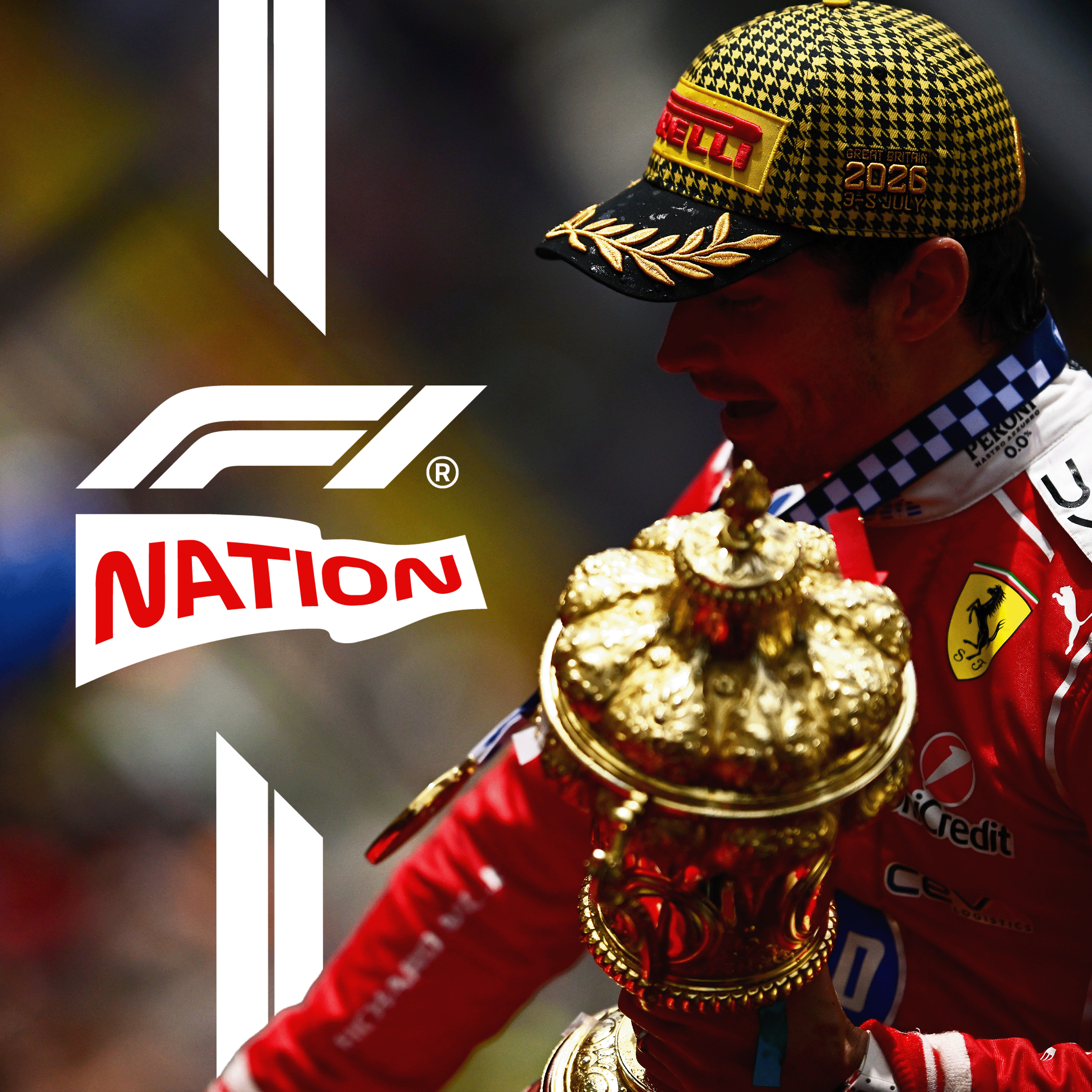
Show Leclerc wins the British Grand Prix. Let's go!
Finally.
How big a win was this for you?
A complete transformation of the narrative.
Till the start of the last, only till the people left.
Leclerc was back to his best and it was Lewis that was left scratching his head.
It was a fantastic drive.
I think Lewis's reaction afterwards said a lot.
He had Charles Leclerc on the end of the jab and that's now vanished.
The fascinating thing to me was after the race, Kimmy wasn't demoralised.
It's not Ferrari the Mercedes is it? It's Ferrari the Antonelli.
Yeah George, I think straight line was okay in the race.
My interpretation of that comment was, mate, look in the mirror.
The spiciest slapback on a Victory Lap radio since Mark Webber said not bad for a number two driver.
It wasn't a Victory Lap.
Oh, come on.
There's always drama at Silverstone.
Hello everyone and welcome to F1 Nation's review of the British Grand Prix.
I'm Tom Clarkson and joining me in the paddock in the Ferrari Motorhome I should add
are F1 TV commentary teammates, former F1 driver Jolien Palmer and lead commentator Alex Jakes.
Now guys, what a race.
Really enjoyed it. I have to say, yeah, it was a great race.
There were just drama from the front to the podium fight probably further back,
but we didn't get to see so much of it because there was loads going on at the front.
And then, yeah, you've got the Mercedes duo both having issues for Stappen,
obviously having his own issue, late safety car, shame.
We didn't get one last lap of racing, but yeah, great race at Silverstone.
Jakesy, were you warming up for a last lap dash in the commentary booth?
Doing lunges.
Doing stretches.
You rarely get a last lap shootout.
I used to get excited when it's a last lap shootout in Formula Three to win the British Grand Prix.
And you just, if you get racing around here with one to go,
you knew you were going to be into three wide action cars going through.
It would have been a melee like we had at the start of the sprint race.
Oh, well.
Look, we had hoped the safety car would come in on the penultimate lap,
but it went round again as the FIA were actually just following the rule book to the letter.
But even, you talk about three wide, Jakesy, even if we'd had that lap,
do you think it would have changed the result or do you think Charles Leclerc had it in the bag?
I think Charles Leclerc had it in the bag.
He was nervous, and for all of his worry that he had to go through that final moment,
I think he was going to win the Grand Prix regardless.
I think the melee would have been caused by George Russell trying to hang on to second.
And do you think he would have done?
No, I think Russell was the man that was breathing the biggest sigh of relief
because he's obviously collected some good points.
He was out there on pretty old medium tyres.
Everyone behind him was on new softs.
I was fascinated to hear Charles actually talk about tyres were feeling cold, one lap.
Obviously the leader's jitters when he had the race in the bag.
But if you imagine if Charles worried on a new soft, on a used medium,
that's really tricky for George.
So I think he'd been gobbled up actually in a lap.
Lewis Daphne would have had a chance to come through.
I even wonder if Lando's coming through for a podium just with one lap of racing for George.
It would have been so tricky.
We've also seen few times this year safety car resarts,
even when he's on the right tyres have been tricky if you think back to Japan and China.
So he is a very lucky man today.
Well look, Charles won brilliantly and it had been 624 days since his last win at Austin in 2024.
But perhaps the biggest headline surrounds Kimmy Antonelli,
who suffered his second reliability issue in the last three races
when he was closing in on Leclerc.
I mean, these reliability issues have cost him in particular a load of points.
He's not sleeping easy tonight.
Two times in three races, he's been on for hugely demoralising moments for George Russell
with the result he was about to score.
He'd passed him on track to beat him in Barcelona.
He was going to extend the championship lead by, let's be honest, winning the British Grand Prix
and those results slipping through his fingers.
He's now had two big ones slip away.
George has had the disappointment of Canada.
So I think there's a 31 point swing in that moment.
You've got George running fourth, which you would say is probably where he's most likely to end up,
whether he passes Max or gets done by Lewis.
He was in the middle of that three car sandwich with the pace to be in the middle of that three car sandwich.
So he's fourth.
You've got Kimmy certainly heading to victory with the pace advantage he had on Charles.
I don't think there was a chance that Leclerc holds on to that.
And in the moment, you've suddenly got Kimmy getting no points
and George getting up to second place.
So it's 31 points.
On the one hand, you say that, yeah, he's not sleeping well
because all of those points have slipped through his fingers.
There was another, what was it, 21 point swing that he had in Barcelona
where he retired and George inherited three more points for second place.
So it's hugely damaging.
Obviously, George had his own moment in Canada.
But the fascinating thing to me was after the race, Kimmy wasn't demoralised.
He wasn't, you know, at his wit's end.
He was quite calm about it.
He probably had a few laps to process it, but nonetheless, he has pace.
We spoke about it already on this podcast a few times where George gets a good result,
but he doesn't have the pace.
And for me, that's the bigger question.
I think George even mentioned it after the race where it was almost easier Sunday night in Canada for him
because he felt like he deserved to win the race there.
Whereas here you inherit second, but you're still worried about kind of your inherent skill
or your ability to get performance out of this car that he needs to win a championship.
JP, put your helmet back on and put us in the driving seat of that Mercedes of Kimmy Antonelli, right?
That looked from the outside as to be quite a small bit of aerodynamic damage on the front left.
And yet it had massive ramifications.
Can you just tell us how that might have felt behind the wheel?
Well, it seemed like it was just a physical, it was obviously a carbon fibre component
on the inside of the wheel that must have got lodged to actually stop him being able to turn the wheel.
So he was, or turn the wheel, but not affecting the steering arm, so he's not able to actually turn the car.
Yeah, we were on board with him at the time and he was kind of slow into magnets and beckets,
and then he really couldn't turn the car when he had to do it at the final part.
So you realise straight away there was a problem, thought maybe it was a puncture because of what was happening to George,
but in so many of these, any reliability part is so often a tiny part that has bigger consequences.
And I think just the way that that part failed was even more unlucky because obviously when they ripped it off,
he managed to at least continue. And if they'd done that at the first time of asking in the pits,
probably he could have held on to a sixth place or something and got a few more points.
Well, let's now celebrate the winner, right? Charles Leclerc, his first win, as I said earlier, for 624 days.
Given all of his problems, particularly in recent races, how big a win was this for him?
A complete transformation of the narrative. He laid the foundation for it in qualifying by finding a balance good enough to beat Lewis Hamilton.
That's not been easy of late. He was obviously ahead of him in Austria,
but there was a mitigating factor with the deployment of the yellow and the crash of a Stappen.
So to get to the front row on merit was huge. First time he's ever done that had the British Grand Prix around Silverstone,
despite the pace he's had here in the past. And then to convert it on a day where it could have easily got away from him,
very, very strong. And I think Lewis's reaction afterwards said a lot.
He had Charles Leclerc on the end of the jab, and that's now vanished with this result today.
Even yesterday after qualifying, he was circumspect, because I think he's been through the ring quite a lot recently.
You've had Lewis rise back to his greatest level, I would say.
And meanwhile, Charles, who's had this team pretty much where he wants it for recent years,
forever actually at Ferrari, even when Seb was here, Charles came in and had the pace on him,
suddenly he's having to have some sort of deep inner thoughts on how do I go?
Am I good enough? How do I get more out of myself? And it was weak in, weak out,
even if it was small details, the consistency was with Hamilton.
So he did a great job yesterday in qualifying. He's spoken quite a lot about making big changes with the car,
having looked at something from Friday, a bit of data.
And it seems to have translated, because in the race, unlike in Austria,
where he just out-qualified Lewis or other recent races where the consistency of Lewis' ability to put out of time
is shown over multiple laps, here it was the role reversal. Leclerc was back to his best,
and it was Lewis that was left scratching his head. It was a fantastic drive.
Just to continue the boxing analogy, Jake, I thought there was an interesting moment in the press conference afterwards
where Charles had just been discussing about finding something in the data on Friday night,
and then Lewis then spoke and said, well, he migrated towards my setup.
I very much felt it was Lewis just saying, hang on, it's me. It's my ideas that's driving this team forward.
Fascinating moment. Lewis was incredibly downbeat.
He was next to the press conference room, leads to the commentary box,
and he was outside the commentary box, just on his phone, in his own thoughts afterwards.
I think watching you guys, by the way, on F1 TV, looking at your analysis.
Yeah, that's why he was so downbeat, bless.
I think just to suddenly be getting Ferrari around you, and when it's always been Charles' team,
when he's suffered that 2025 moment where he was just worst season of his career,
suddenly to turn the page and have Charles Leclerc struggling, that has vanished with this weekend.
It's interesting that he's vocalising that, though, to everyone with Charles next to him.
That's a flex, isn't it?
It's a jab. I think he's hit him.
Yeah, yeah, it's interesting. While he was saying this, Charles was talking to George,
so I don't even know if Charles was listening.
He'll know when everyone writes it up.
Yeah.
Charles will listen into this podcast right now.
Look, what about the pace of Ferrari?
I know JP, you were saying that this was Kimi Antonelli's race until he had his problems,
but Ferrari have now won two of the last three races, right?
We're going to spar next.
I mean, just in terms of pace between Mercedes and Ferrari, who has the faster car now?
Mercedes, but emphatically.
With enough, I think, but what's brilliant is it's close.
So Mercedes are having obviously these reliability blows,
so you've got Antonelli in two of the last three races not finishing.
Austria is the massive blip for Ferrari in between.
I think they're so encouraged by their ability this weekend
when they came in doom and gloom about what they were going to do off the back of last week.
The power unit suddenly looks like it's working much more aligned
to what they thought they were going to bring when they put it on the car in Austria.
Degradation was not a factor here.
When it's a factor again, we might see Mercedes just have that advantage once more.
What I was really impressed with Ferrari was the translation of performance
from the sprint to the Grand Prix.
Even if you look at Hamilton and Viantonelli,
it felt like Kimi was having to work a lot harder to clear Lewis.
In the sprint, it felt like he was catching, catching, catching past really easily.
Whereas in the Grand Prix, the deployment looked better for the Ferrari in wheel-to-wheel battle
to the extent that Kimi was on the radio saying,
please don't drop me back into traffic.
That was hard work.
So that's encouraging for them.
But when we say Ferrari v Mercedes, it's not Ferrari v Mercedes, is it?
It's Ferrari v Antonelli.
I think Antonelli has not only Ferrari, but I think he's got George under control.
If you had two George Russells in the car, I think Ferrari would be cock-a-hoot.
I think they'd be absolutely fine with life.
But Kimi's making the difference.
This is a paid advertisement for better help.
Most Brits believe seeking support is a good thing in principle.
Yet BetterHelp's latest research suggests many still feel there are barriers
that stop people from actually taking that step.
BetterHelp's 2026 State of Stigma report surveyed 2,000 Brits
and revealed that 84% believe getting support is wise,
yet 67% say society discourages people from doing so.
That's quite a sobering statistic, isn't it?
And it just goes to show that despite attitudes towards mental health
having come a long way over the years,
there's still a lot of work to do to remove the stigma around seeking support.
I know that if a friend or loved one was struggling and needed extra help,
I'd encourage them to take that step and point them in the right direction.
And BetterHelp is one of the leading online therapy platforms,
having served more than 6 million people globally.
And what I like is that they guide you through the first step
with a short questionnaire to help match you
with a fully qualified therapist based on your needs and preferences.
And if for any reason you aren't happy with your match,
you can switch to a different therapist at any time.
Back to George then.
Did we see any improvement from George this weekend compared to Austria?
Let's not forget, he won the last race.
Yeah, he was worse this weekend.
He was pole and he won in Austria, so...
And interestingly, after the race in Austria,
he was saying, yeah, this isn't even my kind of track.
The Red Bull ring is not my kind of track.
Just you wait till we get to Silverstone and you're saying he was worse.
Well, he was, wasn't he?
It's not too hard to work that out.
Pole to the win versus P4 on the grid to a lucky second place.
It's not to say that he was great in Austria either.
So his comments were valid,
but he just didn't translate to the performance here.
Look, while we're talking about jabs,
I thought it was...
Don't bring that up.
I'm jabbing George.
No, no, no.
I was wondering where the Toto Wolf was, right?
Because George has been quite outspoken this weekend
about the lack of straight line speed
and he even talked about it on the radio
and Toto came straight back at him and said,
no, the straight line speed's fine.
My interpretation of that comment was,
mate, look in the mirror.
The spiciest slapback on a victory lap radio
since Mark Webber said not bad for a number two driver.
Wasn't a victory lap.
Victory lap for Charlotte Clair.
The spiciest one for a second place.
Yeah.
For the...
Oh, come on.
The start plays out.
No, like, sorry.
It's the end of the race.
He's not...
I know he's not won, but like, that was...
I thought that was Toto Wolf saying you find the answer.
But you know what George is?
He should have a future.
I'm sure he will not want to,
but if he wants to go to politics, he'd be brilliant.
Because not only does he know the rule book very well,
which we saw in Austria,
we saw him immediately explain why it was fine.
I backed off single yellows, all that.
He knows the rule book, he plays the games.
But we also hear him get what he wants to say across
all the time and he's thinking about it.
He knows he's not performing at a level good enough
to win the championship.
He knows that.
As a driver, you're realising if you're having to fight
11 tenths of your potential to get close to your teammate.
But he's trying to find...
He's trying to get, once again, his message across.
So if you're saying you're down on the straights,
that means it's not the driver.
That means it's something wrong with the car.
Toto Wolf swatted it away, didn't he?
It was, no, you need to find more.
Stop blaming us, the team.
But even if you look at Austria,
he did have a solid enough race.
He won the Grand Prix.
I didn't think it was swashbuckling.
I thought the two behind were a little bit quicker.
But he came across the line and told us on the radio
once he did it without a drink,
went to a cool-down room,
and immediately, I found it almost comical.
Sorry mate, it wasn't the cool-down room.
It was actually a spare cupboard.
Sorry, no need.
You two have spent a lot of time together this week.
It's been a long week.
It's been a long week.
Went to the spare cupboard.
And it was almost the way that he was like,
Max, sorry, just checking.
Did you have a drink for the race?
Yeah.
Kimmy, did you have a drink?
I didn't have a drink, guys.
And it was very much like, yeah,
he's making his point of there was a little bit more in there.
He was slightly uncomfortable.
And he's very good at just getting across
what he wants to get across.
And he was trying to do the same on the in-lap.
But obviously, Toto Wolf wasn't interested in that
becoming a line for him to use.
And yeah, it was a bit spicy.
And George said that I'm not performing at the level
to win the World Championship.
It's important just to keep on fighting,
but the truth is, there's been a lot of things this weekend
we don't really understand.
Straight line speed issues yesterday and on Friday.
I think it was better today,
but the performance wasn't good enough.
And if I'm being brutally honest,
I'm not going to fight for a championship
if the performance is continued like that.
So I'm not coming away from this weekend satisfied.
I'll take the result.
I was probably more satisfied leaving Canada
when I broke down from the lead.
Then I am today standing P2 just because
I probably deserved the win in Canada.
And today I didn't deserve to stand where I stood.
He was then asked,
well, do you think the points gap between you and Kimmy
is an accurate reflection of your season?
Because do you feel the bad luck that you've had is now,
Kimmy's had his bad luck.
So were even Stevens.
And he said that the points gap up to now,
he should be behind.
He said anything between 10 and 30 points is what he thought
was an accurate reflection of their two seasons.
I don't know whether you two agree on that.
Across the board, regardless of how it's shaken out,
if he can't find an answer
of how to access his talent in this regulation set,
it doesn't really matter,
which is why his mood is in one place
and Antonelli's is another despite where they finished.
Like Antonelli, at the current level of performance
compared to George Russell,
would need an extraordinary run of bad fortune.
He's clear against all expectations, but he is.
And Russell knows this.
When was the last time George was quicker than Kimmy
on a race?
I mean, Melbourne, right?
Melbourne?
Yeah.
That's a huge problem.
It's difficult.
25 points is so generous that George is this close to Kimmy
to be honest, given their relative performance.
Do you know what I think would be a fascinating conversation?
Would be to sit George and Charl down together,
maybe right here in the Ferrari motorhome and say,
guys, you two have struggled with the 26 spec cars.
Are the problems the same?
It's fascinating that they're the ones
that have been capable of great Q3 laps at the end,
find it when it matters.
In ground effect cars, Jason.
And then you had someone like Lewis Hamilton
who just hated the ground effect cars from day one.
And he's probably going, I sat through the regs
that didn't suit my driving style.
And now you have to sit through the regs
that don't suit your driving style.
They've got to find an answer to the problem.
The one thing that maybe George can take
is Lando Norris last year, after they had the suspension
update to the front of that McLaren Lando a few races later,
mind you, was able to find his best again.
So it's not over.
But if he doesn't answer that question,
it's going to be Antonelli.
And I still think that's the one thing
that we'll be sitting on easily with Kimmy,
is his level of performance is so good,
but he only has 25 points on the board.
George is a driver that's fully capable
of finding his feet again and dishing out
three wins on the bounce and having that swagger back.
So for all that, the reality right now isn't great for him,
even if he's scrabbling around for results.
It might be like Lando.
It might be that he comes on good.
There's so much of the season to go.
And Oscar might have felt a similar thing
when he lost the Grand Prix win here at Silverstone last year.
No worries.
I'm still feeling great.
It went away from him.
And Kimmy still has plenty to prove over the season.
Do you think George can get there with the car as it is now,
or will it require an upgrade from Mercedes
to take it more in the direction that he wants?
He doesn't seem to have a huge explanation for what's going on.
I was speaking to the guys at Mercedes and they were saying,
well, it just feels like Kimmy's able to drive it
more on the limit of grip than George.
So he gets to what he feels is the car sliding around.
And unless it's a Q3 lap or everything,
something's just talking to him that extra bit
and he's going to take some risk,
he's not able to take it to that level,
basically 100% of the car.
And so they were almost saying that he's kind of under driving it slightly,
whereas you get Kimmy there that's so in tune with what the car's doing.
He's got some feeling inside him that's basically,
you're an eight skill to feel the car
and he's able to do that more consistently.
If you look through the data,
a lot of the time you see through this weekend as well,
first lap on a new tyre, Kimmy's able to execute the lap.
Second lap on the tyre, George gets much closer.
So maybe Kimmy is just taking, this is in qualifying mode,
maybe Kimmy is taking that little bit more in the first lap,
more risk when there's a bit more grip around,
taking more out of the tyre.
So it's a feeling that George is getting.
And I don't know how easy that is to fix.
Jake, so you made the point on the preview on Thursday
that if you look at the season as a whole,
George invariably gets there for that last lap of Q3,
but Antonelli gets there on lap one.
And this might be an unpopular thing to say,
but are we just seeing Antonelli,
is he just a faster racing driver?
Is that an unpopular opinion?
Well, he did have flashes last year, didn't he?
Even in the ground effect era of being able to turn up
to a racetrack that he'd never seen before,
Miami Sprint put it on Sprint Pole after one hour of practice.
So he's had that, and then obviously with the experience
of going round again, he's had that way more consistently.
I think the strange thing for Russell is that,
and Geraldine can speak to this in detail,
it feels like Charles Leclerc and George Russell
started digging into the data in the gap
as to why it wasn't particularly working.
Russell especially has said that he dug into why he was lacking
and has almost opened to Pandora's box of what's possible
and doesn't have an answer.
So it could be quicker, but if you get lost with the setup
and you have to start altering your driving,
does that not become the conditions that we're seeing?
Kimmy's very comfortable, he's basically a hundred,
George is almost having to process the thought of what to do.
Yeah, he's in a difficult spot.
The only thing I would say is the sample size isn't huge
to say Kimmy is just the better driver.
He's young, he's obviously a prodigy,
Mercedes have seen him from such a young age,
and when you have these talents coming through so quick,
obviously you're thinking Max, you're thinking various other drivers
that parachuted in a generational.
It feels that at the moment, but is it a quirk of the car?
They need to be driven slightly differently
than the previous regs, as we've already mentioned.
Is it that you see other drivers,
even Max doesn't seem as comfortable with this car.
Charles certainly isn't, Lewis has come back.
Different driving styles may be working,
so maybe it is a bit of troubleshooting for George,
and maybe as the cars evolve in this era or change again,
maybe we'll see that iron out.
I feel like the sample size is quite small,
that we're seeing Kimmy in an absolute sweet spot,
and until things evolve,
then we'll see if he's a champion and a generational talent
and all the rest.
Hamilton was definitely down after the race.
The high of sprint qualifying on Friday afternoon,
he was buzzing, wasn't he?
That was as good as it got all weekend,
and it seemed to just slip away from him thereafter, really.
He wasn't happy with the setup,
the direction he went from the sprint to the Grand Prix.
He said he was struggling a lot with understeer in the race.
It actually looked like he was limited by oversteer,
looking through qualifying in the end.
Inevitably when your teammate wins,
and it's on your home soil where you're an absolute legend,
then it's going to hurt a bit more,
but I think he can still be encouraged
by the overall pace of Ferrari.
He's narrowed the gap to Kimmy, playing the long game,
things are still in play.
Come see, come see.
He was very interesting about the full start
in that he totally held his hand up and said,
yes, it happened, but he said,
I didn't ask my hand to do that.
Bizarre.
I've never had that.
And he's never done it,
or he very rarely jumps the start.
I can't remember him doing it before, to be honest.
He's done so many races.
He's had so many great successes at Silverstone.
It was something wishing him
to just launch into the lead at his home race.
He actually got a great start,
which is surprising given he jumped before,
which normally catches you out,
then you hit the brakes and you're all out of kilter.
I can't imagine that, you know,
the occasion got to Lewis.
That's how it sounds,
but he's done so many, so many great races here.
Just sounds strange.
They'd love to turn into something more,
but somehow life just gets in the way
and it never quite gets off the ground.
That's exactly what I like about Shopify.
It removes so many of those barriers
by giving you everything you need to build your store
and start selling from day one.
Listeners of the show can start a free trial today
at Shopify.com forward slash nation.
And it's not just easier for you either.
Shopify's checkout is designed to remove friction
at the point where it matters most
when someone's ready to make a purchase.
It helps more customers complete that first purchase,
and when they come back, their details are already saved,
so checking out again just takes one tap.
And because Shopify takes care of
so much of the setup and checkout,
you've got more time to focus on growing your business.
With Shopify, nothing stands between your idea
and a real business, so go make it one.
Start your free trial today
at Shopify.com forward slash nation.
That's Shopify.com slash nation.
This episode is sponsored by Anthropic.
One thing I've learned from spending so many years
in the world of Formula One is that the best people
never stop asking questions.
Engineers, team principals, drivers,
they're constantly looking for better ways
to understand a problem and find an edge.
That's why I find Claude so interesting.
It's designed for people who don't settle
for the first answer, but want to think more deeply
about the challenges they're trying to solve.
Claude is the AI for minds that don't stop at good enough.
It's the collaborator that actually understands
your entire workflow and thinks with you.
Whether you're debugging code at midnight
or strategizing your next business move,
Claude extends your thinking
to tackle the problems that matter.
Whatever your job happens to be,
one feature I can certainly see the value in
is Claude's deep research.
Rather than just pointing you
towards a handful of search results,
it's designed to pull together information
from multiple sources, complete with citations,
which could save a huge amount of time
if your work involves tackling complex subjects.
And you can go one step further by connecting it
with the professional tools you already use,
like Notion and Google Workspace.
So instead of jumping between different apps and documents,
you've got everything working together in one place,
making it much easier to keep everything organized.
For problems worth solving,
get started with Claude at Claude.ai.
Now what of Red Bull and Max Verstappen?
I think they rolled out of one of their home races
in Austria last week,
all cock-a-hoop thinking brilliant,
the upgrades working,
just you wait till we get to Silverstone.
Another home race.
And it's like they never turned up.
Max was even saying after qualifying,
I can't wait to go home.
Yeah, that's as bad as it gets.
Sorry, that was after qualifying.
Well, then it got worse.
It's not as bad as it gets.
That was Sunday night.
So yeah, power unit issues for Max,
wasn't happy with the balance,
then has this recurring issue
of his active aero not closing properly
on the rear wing,
which is what sent him off.
It transpires in Austria qualifying.
And it's again,
it's not reattaching properly
when he finds the corner,
which is a high speed at stove.
It's pretty bad.
He worked so hard.
He actually did a great race
to be in position to get a podium
at the end of that.
And you can't,
there's no chance to save a car
when you haven't got the downforce on the rear.
So bad.
He was actually not wanting to start
the race from the grid.
He wanted to go to take a new power unit.
He was, he was that unhappy
with his straight line performance.
So...
And unhappy with the decisions
being made by Red Bull.
Yeah.
I actually think when you look at it,
the fact that he was due to finish third
before his next failure,
it kind of actually justifies
Red Bull's decision to keep him on the grid
because the thought of him doing better
than that from the pit lane is difficult.
Obviously, then it have a new power unit
in the pool.
So maybe that's a benefit later down the line.
But the fact that he's even vocalizing
all of this and he's not happy,
we know Max's contract situation
and is he looking around elsewhere,
he's clearly disgruntled again with things.
And when you're sent backwards
off high speed consecutive weekends,
you're going to be questioning things.
And it's not often that someone like
Isaac Hajar out qualifies Max Verstappen
around a driver's track like Silverstone.
Don't say his name is so much disdain.
I didn't mean to.
A young guy versus a full-time world champion.
No, you are right, yeah.
And to be fair to Isaac,
he's been doing a really good job.
He wasn't far away in spring qualifying.
And it hurts any driver
when you're beaten by your teammate.
You know, mentioned George and Monnington
tell people that his straight line speed was down.
Max was saying that already through
qualifying that his speed wasn't there.
You get back into the garage in qualifying.
You look at your data trace.
If you see your straight line speed isn't there,
you're trying to fight with one hand tied behind your back.
You just can't compete because, again,
straight line speed,
unless you're doing something weird in the corners
with energy management and all of that jazz,
if it's just pure grunt,
you can't do anything more than just upshift
and wait for the next braking zone.
If you're losing time there, it's an impossible fight.
Laura Mechiez, team principal,
came on sister podcast to this
beyond the grid earlier in the year
in which she said,
we are paying the price for prioritizing
a title challenge with Max last year.
We developed that car way later than we otherwise would have done
and hence we're on the back foot at the start of this year.
Now, you assume that Max would have bought into that philosophy,
that chronology, if you like,
prioritized end of 25, difficult start to 26.
Yeah, he seems to have a very short memory
because he seems to be incredibly frustrated
for what seems to have been a roadmap
that he would have known about.
It is July, though.
Like, I think he would have...
What, race nine?
He was expecting more from the upgrade last week.
Well, I think after that was brought in
and he was straight back into the fight to then...
I think it's more the fact that he highlighted
that he's been pitched off the road at high speed
twice in eight days.
I think that is probably, in the modern age,
not a nice place to be for a driver.
And that's fundamental.
That's not something that can be improved overall.
I think he's committing to fast corners.
And safety standards are high, right?
But it's still not something that he wants to be experiencing.
And then you're doubting the next time you turn it.
What's the next track?
Oh, great, Spa.
It's the rear wing attaching.
Here we go. Let's see what's happening at Puol.
No, thanks.
Can we go back to the old one?
That's much slower,
but at least I know I'm not going to hurtle into the barriers.
It's a big concern for a driver.
You need to have the fundamentals right.
And if you're now doubting that the new part you've got on
has just inherent flaws that mean occasionally,
once in a while, it won't shut.
It doesn't matter if it's once every 50 laps.
That one time you will be off into the barriers
or you'll be skittling off into the gravel
if there's enough runoff.
So I can see that that is such a big issue for any driver.
And it happens to be maxed on both occasions here.
We shouldn't forget he nearly won the race in Austria, though.
So the upgrades, they didn't work out that well.
There is some deployment.
It's a different circuit.
Spa maybe is not going to be great for them
because, again, the deployment is going to be important
and there's really long straights.
But other circuits, the upgrades,
they obviously are slowly but surely coming good.
So I don't think we should necessarily beat up on them too hard.
Probably more galling having been back into the fight
for the first time all season
and then suddenly back to this,
back to trying to scrap for a podium,
hoping things go wrong for other people,
having been two seconds away from the Grand Prix win in Austria.
And I suppose what's a little bit scary for them
is that the fast corners of Silverstone,
as you say, JP, we're going to Spa next.
So if it doesn't work here,
what are the chances of it working properly at Spa?
Where, of course, it's a kind of home-grown pre-fam.
It's the orange army, isn't it?
And how do you test it without putting it on the car?
It's so difficult to put the load on the car
when it's stationary to work out
the force is required for that rear wing,
which is now the, whatever you want to call it,
flippy wing, macarena wing, rotisserie wing.
It's got to go through a lot of work to sharp properly again.
It was always going to be the issue.
When I saw it first on the car of Ferrari, you think,
okay, great, it looks like it's going to be minimizing your drag,
but how quickly and effectively can it sharp?
I don't know how easily they're going to replicate that
before they put it back on the track.
And it kind of reminds me of McLaren and Ferrari in 2009.
Both of those teams developed late into 2008.
There was a big regulation change the winter of 08 into 09.
And of course, they struggled the following year.
It feels like we've been there before
and Red Bull are experiencing that now.
Well, guys, it's been an amazing weekend.
564,000 fans have crammed themselves into Silverstone.
It's been a festival, not only a motor race.
Huge success.
It's been a privilege to be here.
Driver of the day.
Come on, we're going to end it the usual way.
JP, who's the guy?
Yeah, I'm glad, considering that we had a really decent race,
even if we didn't get the final lap.
For me, the driver of the day, it has to go to Charles Leclerc.
I just think from where he's been...
Buying time like a pro, everyone.
Those radio days coming into...
I'm just bringing some drama.
That's a knock, knock, knock padded for time at all.
If you listen, I just want to say really loud and clear
that it has to be, once again, Charles Leclerc.
I think just from where he's been to turn it around into Saturday,
deliver it on Sunday.
Obviously, Kimmy could have had the win,
but the fact that Charles was even making it a race
in the Ferrari today, I thought was admirable.
If Kimmy hadn't had his issues and had won the race,
who would have been your driver of the day?
Charles Leclerc.
But it would have been close.
So you've got to say Kimmy's there as well.
For me, I just think very strong from Charles.
Hey, I'm just used to Kimmy being amazing.
So when Charles has been in a difficult time
and then he's amazing, then I'll give it to Charles just for once.
Charles Leclerc as well.
It could have turned into a...
I don't use all that time for that coffee mug.
You just made very good argument.
You look at the whole result and it's got to be Charles Leclerc
because that could have turned into an entire summer worth
and if Lewis Hamilton gets momentum, he's not going to lose it.
We were talking about it earlier.
He's had pressure before.
He's had a champion team alongside him before.
He's never had Lewis Hamilton before, get on a roll.
So he had to find an answer and he did.
Also shout out to Isaac Hadja, who's seemingly getting closer
and closer to ending that second-seat Red Bull curse.
He's done very, very well this year.
Go on, TC.
You're going to throw in a Franco-Colopinto curve for here.
Points for Alpine.
It was a great P9 for Colopinto.
Points for Audi.
You've got to say well done to them again.
Well done to Gabby for getting what, P8 first points since Melbourne.
That was a genuinely great result.
But if you're asking me for my driver of the day,
I'm afraid all three of us are going to say the same thing
because it was a great result.
He did everything required, perfect start, disappears off
and it's not his fault that Kimmy Antonini had issues, is it?
He did everything required and was faster than his teammate.
And maybe against the odds, even if Kimmy didn't have the issue,
he's going to produce some swashbuckling elbows-out defence
that we were deprived of.
I don't think so.
I think a mention into Spatch is...
But maybe.
You can't criticise that.
I'm also going to give a shout out to Lawson.
I love the work that Lawson's doing this year, Liam Lawson.
Coming home today in P6.
That racing pulls is a really good car.
I think if you were at Alpine now, yes, they finished 9th and 10th.
Clearly the faster car now is the racing bulls.
No one wants to finish 5th, do they?
Earlier on we were eulogising Haas.
Then it went to Alpine as sure-fire 5th place.
Now it's racing bulls.
It's an intense old battle.
Well, it's one point between Alpine and racing bulls now.
What a stunning weekend, guys.
Thank you both very much.
Safe travels back and let's do this all again at Spa.
Brilliant work.
Cheers, TC.
Cheers, TC.
For more reaction and analysis from Silverstone,
please go to f1.com, the F1 app, or at F1 on social media,
and do check out F1's other official podcast.
My guest on the latest episode of F1 Beyond the Grid
is Lando Norris.
That's out now on the Beyond the Grid feed,
and you can watch our chat on the F1 YouTube channel.
And on the latest episode of F1 Explains,
Haas team principal Io Kamatsu
answers your questions about Formula One.
That's just below this episode on the F1 Nation feed.
Thank you very much for listening.
We will, of course, be back on Monday with our preview
of the Belgian Grand Prix.
But for now, F1 Nation is produced by Formula One
and AudioBoom Studios.
About this episode
Leclerc’s British GP win is framed as a full narrative turnaround, with Ferrari finally converting strong qualifying into race control at Silverstone. The panel highlights how Lewis Hamilton’s post-race reaction suggested the “jab” was answered—Ferrari looks back on top, and Leclerc’s consistency returned. Behind the scenes, Mercedes drama looms: Kimmi Antonelli suffered another reliability/steering-related failure, turning what looked like a points haul into a major swing, while George Russell benefited. The discussion also weighs whether Ferrari’s sprint-to-race pace is real or a temporary shift.
Tom Clarkson is joined by F1TV commentary duo, former F1 driver Jolyon Palmer and lead commentator Alex Jacques, to reflect on a dramatic British Grand Prix.
Charles Leclerc capitalised on more misfortune for championship leader Kimi Antonelli to take his first victory since Austin in 2024. After such a difficult run of races, why was he back to his best and how significant is this win for Charles?
Reliability issues mean Antonelli has seen his championship lead cut from 66 points to just 25 over the last three rounds, but is he leaving Silverstone happier than George Russell despite the Brit taking home P2 and closing the gap to Kimi? Jolyon, Alex and Tom share their thoughts on George’s continuing struggles against his teammate and the team radio message from Mercedes Team Principal Toto Wolff at the end of the race.
Plus, the guys discuss why Lewis Hamilton might be ‘scratching his head’ despite securing a fourth podium finish of the season and gaining more ground on Antonelli.
Listen to more official F1 podcasts Lando Norris on F1 Beyond The Grid Your questions answered by experts on F1 Explains - right here on the F1 Nation podcast feed
This episode is sponsored by BetterHelp - Don’t let stigma stand in the way of support. Start therapy with BetterHelp. Sign up and get 10% off at betterhelp.com/f1nation Shopify: You put in the work. Time to get paid like it. Free trial at shopify.com/nation
Give your body what it deserves with IM8! Go to IM8HEALTH.com/NATION and use code NATION for a Free Welcome Kit, five free travel sachets plus ten percent off your order.
Anthropic: For problems worth solving — get started with Claude at Claude.ai/nation