A race engineer is the person in F1 who talks to the driver during the race. They use information from the car to help the driver make the right decisions while driving.
The cockpit is the driver’s seat area inside the race car. It’s where the driver sits and operates the car.
Topic
new era of Formula One
The “new era” means F1 has changed its rules and car technology. Those changes can make the engineer’s job harder because the cars behave differently and strategy is different too.
F1 cars have a system that can “store” energy. This part uses the car’s movement—especially when slowing down—to capture energy and then release it later for extra acceleration.
Horsepower is a way to describe how much power the car can make. Here, it matters because the energy system has to provide enough extra power to keep the car fast.
Energy management means deciding when to save energy and when to use it to go faster. In F1, you can’t always recharge or deploy energy everywhere on the track, so strategy and driving have to match those limits.
“Deploy” means using the stored extra energy to make the car accelerate harder. The goal is to use it at the right moments so you don’t run out too early.
“Efficiency” means using the car’s limited energy in the smartest way. Instead of just being the fastest, you try to avoid wasting energy so you keep the car quick lap after lap.
F1 cars don’t just use fuel—they also store energy in batteries. The team tries to make sure the battery has enough charge so the driver can use the car’s best power for the one quick lap that counts.
“Launch” here is the critical moment when the car starts accelerating hard. The team wants it timed perfectly so the driver can use the car’s power efficiently right away.
“Full throttle” means the driver is requesting maximum engine power by fully opening the throttle. In qualifying, engineers coordinate full-throttle moments with energy limits so the car accelerates strongly without violating deployment rules.
Term
partial
“Partial” means not using the car at its absolute maximum power all the time. The team uses gentler power in some sections so the driver can save the best performance for later in the lap.
“Car setup” means tuning the race car for a particular track and driver. Engineers change settings so the car turns, grips, and brakes the way the driver wants.
Suspension setup is how the car’s shock absorbers and related settings are adjusted. It changes how the tires stay in contact with the road, which affects handling and tire life.
Term
ride hides
This sounds like a mis-heard phrase for “ride height.” Ride height is how high the car sits off the ground, and it can change both handling and aerodynamics.
Downforce is the “suction” effect from the car’s shape and wings that presses the car onto the track. More downforce usually means better grip in corners, but it can slow the car down on straights.
Term
mechanical loads
Mechanical loads are the physical forces the car has to handle while driving—like when you brake hard or turn hard. Engineers try to balance these forces so the car stays stable and the tires work properly. It’s about making sure the car isn’t being stressed in the wrong way.
Tyre degradation means the tires get worse as the race goes on—usually because they heat up and wear. That means grip can drop over time. Engineers plan strategy around how fast that happens.
In racing, “data” means the numbers and signals the team gets from sensors on the car. Engineers use it to understand what the car is doing in real time. It helps them make better decisions than guessing by feel alone.
The safety car is used to slow everyone down when the track isn’t fully safe. Because the whole field is going slower, it can make pit stops happen at a better moment than usual.
Time loss is how much time you give up when you go into the pits. Under a safety car, the other cars are going slower too, so your pit stop can hurt less than it would during normal racing.
In F1, tire performance is central to pace and grip, and teams constantly monitor how tires are “holding up” as the race progresses. Tire condition affects lap times, braking stability, and how aggressively the driver can push.
“Strategy guys” are the people on the team who plan when to make calls during the race. They help decide things like when to pit and what to do next based on what’s happening on track.
“Pit now” means the team wants the car to come into the pits right away. Teams do this mainly to change tires, and the timing can be especially important during a safety car.
LIVE
While out on track, Formula One drivers hear just one voice.
Unless Toto Wolf has got excited and gone on the radio to speak to his drivers, or a
team principal is congratulating them on a win, usually the only person to speak to a
driver while they're in the cockpit is their race engineer.
It's one of the trickiest jobs in the sport, so you really need your wits about you.
But now in this new era of Formula One, has it become even more challenging?
Welcome to F1 Explains.
Yes, this is F1 Explains and my name is Christian Hugill, talking to you as live as a podcast
will ever be and direct from the Formula One paddock.
And as we say, we're talking about race engineers this week, and who better to talk
to than Esteban Ocon's race engineer, Laura Muller, who made her debut on this podcast
last year.
And if we were giving out prizes for biggest impact on debut, I think Laura would be right
up there.
Our listeners absolutely loved her, you emailed us to tell us so.
So of course, we had to get her back on.
I'm always very intrigued by the role of the race engineer.
It fascinates me and as someone that struggles to multitask, I think it might be one of the
things I'd be least good at in Formula One.
I mean, to be honest, I don't think there's anything I'd be good at in Formula One.
They're all extremely clever people.
Some would say I'm not particularly good at this, but Laura's job is absolutely fascinating.
So we're going to talk to her a little bit about the role in general and how different
is it in this new era of Formula One?
Ladies and gentlemen, it's time to welcome back to F1 Explains, Laura Muller.
Laura Muller, welcome back to F1 Explains.
What a joy to have you back.
Thank you.
The last time you were on this podcast, I seem to remember you making yourself laugh
quite a lot, which I really enjoyed.
Can we expect any more of the same?
Yeah, it's like that every day.
Is that true?
Yes.
I look forward to that greatly.
It was a joyous experience for all concerned.
I'm worried now.
Just know you've got permission to make yourself laugh at any given opportunity.
We are explaining the role of the race engineer.
We're also looking into what's different in this new era of Formula One.
Just firstly, and briefly, starters from way back when, what made you want to become a
race engineer?
How did you get into all of this?
The favourite story of everybody.
So I used to be a Michael Schumacher fan when I was growing up, which made me want to be
in Formula One.
Then as I was getting into motorsports and all of these things, at some point I realised
race engineer seems like a pretty cool job.
So I kind of angled myself towards that, and then somehow I achieved it.
And here you are somehow by being really good at what you do.
Is it a job?
I'm always fascinated by this in Formula One.
Is it a job you can enjoy?
Because there's so much pressure in all areas, but can you say, no, I really enjoy it?
Or is it just too much pressure?
You just sort of have to get through it.
Do you do any exercise like endurance exercising, cycling or running or something?
I sometimes run, but I've currently got an injured Achilles.
Oh, OK.
So to tell you that, I go to the gym, that's about it.
I'm not a talented sports person.
Do you enjoy that while you're doing it, or are you just happy afterwards of what you've
achieved in that session?
Excellent question.
I don't know how you've got on to interviewing me, but I'm happy with it.
I enjoy the gym a little bit, but no, when it's like a long run, you just want to get
through it, don't you?
Yeah.
So being a race engineer, a lot of times it's just like it's quite hard to go through the
actual thing.
But then afterwards, you're kind of chuffed with what you've achieved because you get
the results in qualifying in the race.
So the build up to it, you know, I enjoy the job, but it's not like joyous.
I get what you mean.
The joy comes when you've got something out of it.
Yeah.
No, I get that.
And when you've had that great result, when Estaband's got in the points, or you've made
up positions from qualifying into the race, I guess that's the feeling you're sort of
craving.
Yeah.
And you can be happy with what you've done, like, you know, sometimes you come out of
the race weekend and it was terrible, but you're happy with what you've done, like you've
done everything towards what you wanted to.
No, sure.
Sure.
That makes sense.
That makes sense.
Right.
Our listeners have been sending you some questions.
Would you like to answer them?
I'm so excited for that.
OK, that's good.
And our first one is from Lou in Germany.
Lou says, hi, F1 Explains team.
I'm so excited you've got Laura on.
Get this right.
I'm a Laura fan first and a Hass fan second.
Lou from Germany is loving you, Laura Muller.
Anyway, here's my question for her.
We've heard the drivers talk about getting used to the new regs, but how is it for race
engineers?
Thank you so much.
I can't wait for the podcast.
Lots of love and good lords.
And Lieber Grußer from Germany.
Well done.
I think I might have had some help, particularly from producer Chris's pronunciation guide.
What does that mean, please?
Like happy greetings or with love.
That's nice.
Thanks, Lou, from Germany.
You can come on again.
Anyway, yes.
Lou's question.
Laura, we should answer the question, shouldn't we?
What are these new regs like for race engineers?
I think they're quite similar, difficult or interesting as for the drivers because, you
know, we used to have an engine.
We used to have a K, but now like the proportions have completely changed.
So you need to focus.
Just before you go on, you say you used to have a K.
What does that mean?
So this is how deep I'm into this thing.
OK, so you have an MG UK, which is a electrical motor.
Motor generator unit kinetic.
So you've got that.
So we've used to have that.
We still have it.
It's just it's increased in priority because obviously it has to deliver more of your horsepower.
So, you know, now you just have to focus yourself away from your engine power more to your kinetic
power. And, yeah, it's just, you know, your focus changes a bit.
You're still trying to make the fastest car now, of course, with the limitations of where
you're recharging, where you're charging and all this stuff.
So you just you've just added another limitation or option to how you set up your car.
And how much of that new stuff falls on you and how much of it falls on the driver?
Because for those new to F1, we should remind our listeners that the race engineer is the
only person the driver can hear when they're out on track.
Should hear or being well.
So I'd say a lot falls on the driver as well, because they have to kind of understand how
to work with this new regulations, you know, where to deploy more or this stuff.
They have to kind of organically understand what loses them time and what doesn't, because
like a lot of times now it's not about how fast you can exit a corner, but how efficient
and all these kind of things.
So they definitely need to have a feel for it.
But yeah, we spend a lot of time like, you know, ploying strategies and just thinking,
oh, what about if we add a little bit more here and there?
So like, I do spend much more time now thinking about energy than I did last year.
And how's that been to get used to?
You know, you just need to find more hours in the day.
It's perfectly fine.
Well, if you just got up two hours earlier now, is that it?
We'll go to bed two hours later.
We were told that qualifying was also going to be a more intense experience for driver,
for race engineer, particularly with making sure the batteries charge before the hot lap.
How's qualifying been?
So it has been quite difficult because at some tracks, you really have to to get the
moment right where you we call it launch.
So where you go on full throttle, just because of, you know, the deployment regulations,
you don't want to deploy any energy before you actually need it.
So the driver had to literally like find a part on track where he knows now I have to
go full throttle, but now with the new ranks, they've changed out.
So that kind of happens automatically.
So they don't have to worry about that so much.
So that was like the intense bit of qualifying up until now.
Sure.
But yeah, it's also like now, you know, you have to follow quite a detailed plan on
where to, you know, go on full throttle, where to, you know, do partial and all this
kind of stuff. And then the driver does like one single thing that's slightly
different and all you lose like half a second.
There's a lot of pressure on them.
Did you and Esteban have to have a conversation at any point that goes right?
This is how we're going to tackle these new regs or was that several conversations?
How did you approach it from a communication perspective between the two of you?
I think we're still approaching it.
It's like, because everything keeps changing.
So, you know, you kind of have to discuss all the time, how much do we talk about it?
You know, because you also don't in the race, for example, you don't want to tell
everybody else what you're going to do and all these things.
So it's still kind of ongoing to find out how to talk about this the best way,
because you also have to wait until they've, you know, caught up with what they
would organically do and then how much you talk to them.
But I mean, I'm sure you've noticed there's so much more talking now during
the race to the drivers.
It's insane.
So by the end of the race, with the greatest of respect,
is Esteban a bit fed up of your voice now?
Oh, I am, too.
It's just like, OK, Laura, yes, try at seven.
OK, do that.
OK, I get it.
Excellent. Right.
Our next question is a voice note.
Hi, my name is Kylie.
I'm listening from Brisbane, Queensland, Australia.
I'm a long time listener of the pod, but a first time question asker.
I've just been listening to the latest episode with Bernie Collins,
and she mentioned car setup.
And it made me wonder, what does she mean by car setup
and what's involved in setting up the cars?
Laura has just said, I don't know if that was caught on, Mike,
but what are they setting up?
Laura just said the car.
Thank you very much, Laura Muller there.
That's join us next week.
We have to do it every time I come on there,
so we have to do one of those jokes.
Yes, I think I do.
I think I do.
Thank you, Kylie from Australia.
I wonder if it's the Kylie Minogue.
Kylie from Australia.
But I've just told a really mean joke.
If it is, well, regardless, we apologise for the joke.
You weren't offensive.
It's absolutely fine.
Talk to us about car setup
and where your role as a race engineer comes into it.
What are you guys discussing between you?
What is there to set up?
So the setup of the car broadly means
the suspension setup of the car,
the ride hides, the downforce, all these kind of things.
So everything you can kind of see that's attached to the chassis.
So, you know, the boat in the middle, that's what you can set up.
So, yeah, there's there's a lot to do.
I mean, this year we obviously have a lot less downforce.
The whole arrow is a bit less complicated, at least for us.
Don't know if it's the same for everybody else.
I'm sure it is.
So we talk a lot more about like suspension stuff and all these things.
But you decide like how to how to balance your your error loads,
how to balance your mechanical loads and stuff.
I don't know how deep you want me to go into it.
But basically is basically normally the lower the car is,
the better it is for error performance.
The lower to the floor. Yes.
This year less so, but that definitely used to be the case.
And then you also have to balance out your tyre degradation
with, you know, one lamp performance, all these kind of things.
So you need to think a lot not what's like best right now,
but also what's best for the race and all these things.
So there's a lot of little screws to turn because to talk more broadly
about the role of the race engineer, we hear a lot in the race.
As we said earlier, you're the the point of contact for the driver.
But a lot of it is taking what the driver said, feeding it back to the team.
Right. And that that must have a big impact on car set up.
That must be a really important part of the job, especially during the session,
because you obviously have data.
So you look at squiggly lines, you see what's happening on the car.
Does this align with the driver comments?
But if you have a very short turnaround in session,
you just sometimes have to just listen to what the driver says.
Like if they say, oh, I can't turn the car, you just need to do something for that.
Sure. You don't you don't have five minutes to be like,
oh, yeah, in terms of no, you can definitely see that.
It's got to be quick. Yeah.
So yeah, you rely on, you know, their feeling because they're also driving the car.
So you just react up on that.
And that reaction comes, I mean, I get suggestions,
but in the end, I have to decide what to do.
Yeah, of course, of course.
And for those newer to Formula One, not being able to turn the car doesn't help, does it?
No, no, it's usually slow.
Yeah, it's not good.
Famously, lots of corners on Formula One circuits.
Next question is from Caroline from Wisconsin.
We're recording this episode in Miami, as we've mentioned, and the sun's now so bright.
I'm struggling to read the question.
So bear with me. Caroline from Wisconsin.
My question, I look like a nana.
I'm so ashamed this is a podcast because I look like a nana squinting at a television.
My question is about pit strategy specific.
Thank you, Laura's sheltering the sun from me specifically around safety cars.
During the Japanese Grand Prix,
Kimmy Antonelli mentioned on the radio that he got lucky with the safety car
because of when Oscar pitted, but I don't fully understand what he meant.
Could you explain the strategy and frustration around pit timing during safety cars?
When and why would a driver choose to pit or not pit when the safety car is deployed?
Thanks so much. I love the show and all the insight you share.
That's a lovely email. Thank you very much, Caroline.
Laura, why is the safety car both friends and foe for you guys during the race?
Should have asked that to Bernie.
Fortunately, Bernie was on a couple of weeks ago.
So yeah, we miss it.
You can answer that as good as Bernie.
I mean, that's that's my favorite question.
What you don't want to do when the safety car comes out is to have pitted the lap before.
That's that's the biggest problem.
Yes, which usually we somehow managed to do that.
Especially when it's our car that then crushes.
Yeah, it's not ideal. Yeah, that wasn't great.
But basically, so under a safety car,
the time loss for a pit stop decreases by around about 10 seconds.
So, you know, if everybody is pitted already
and you can then pit, you gain 10 seconds on everybody.
And that's quite simply because under a safety car, everybody goes slower.
Everybody goes slower.
So if you can dive in the pits and get your pit stop out of the way,
you're going to save time because the rest of the field is going slower.
Yes. And as the race engineer, when that sort of thing happens,
how much do you have to be on your game?
Because I'm guessing you might be about to receive a lot of information
because you're the only one talking to the driver,
but you must have a lot of people talking to you at that point
about what to say to Estabelle, if there's been a safety car, for example.
So during a safety car, you have a lot of time to talk to the driver,
which is nice and terrible at the same time,
because you try to just pump all the information into him that you can,
which means I get a lot of information.
Yeah, of course.
But a lot of it is just like, you know, where are we in the race?
What's, you know, what's to gain?
You know, who's pitted?
What we're thinking, how the tires are holding up, this kind of stuff.
But for me, like as soon as a safety car comes out,
my first call is to the strategy guys to be like, do we pit now or not?
If we haven't just pitted.
Or I say, well, that's great.
Yes, or you shout at them or just into the void.
Bernie said this, actually.
Bernie said to us on the podcast that sometimes it's a bit like, yes,
I'm not a miracle worker, guys.
I can't help that we've just pitted.
It's like, that's not my fault.
Yeah, sometimes you just open the channel
and you just scream the F word really loud.
And that just it's not directed at anyone.
It's outside of you.
It's just nice to get it out, I imagine.
And you'll be surprised to know, Laura, that us watching at home,
that gets edited out.
We don't hear that so much.
I hope not.
No, there are broadcast regulations.
There really are lovely questions.
Thank you very much, Caroline.
The next one is from Lucy in North Carolina,
which I shall now attempt to read again.
Lucy says, given how secretive Formula One teams are,
what criteria is used to judge which car will be the fastest early in the season?
Where does that information come from?
And how much of those predictions is data driven versus informed guesswork?
Obviously, before you even get there, there's not much data.
And there's just, you know, talk, you know, of course,
then you've got Tota saying, oh, yeah, we're really struggling.
And then, you know, that's on motorsport.com.
And then everybody's like, oh, yeah, Mark's really behind,
even though he probably just said that.
So far this season, Mercedes haven't been struggling famously.
They're doing all right.
But it's basically before the season started,
everybody was like, oh, yeah, I think Ferrari's doing really well.
Oh, no, I think Mark's really ahead.
That's just gossip, really.
But then like after the first race, you can obviously see who has stuff
a bit more under control.
It's not really who has the best, the fastest car per se,
but who's got the most control of the regulations and all this kind of stuff.
You get a better idea.
But every time you've got like an upgrade package from somebody coming,
you don't know, they could just be two 10s faster all of a sudden.
And you never know until you get the little sheet
that from the FIA that says this car has added this little winglet or something
like that. But also, sometimes a car could look quick and qualifying
and then not have the race pace.
Sometimes you just don't know until the green.
Well, there aren't green lights in Formula One.
Are they famously the lights just go out?
How long have I been covering the sport for?
Lights out and away we go. Lights out and away we go.
Doesn't say green light.
Doesn't say green light.
Croft did be furious with me, wouldn't they?
Absolutely furious.
Until the lights go out or they turn green or they light up,
whatever they do nowadays.
You just don't know until the race starts sometimes, do you?
Good news for you, Laura.
We've got another Laura Muller fan.
Bazma from London sent us capital letters.
You've just done a little jig there, which I enjoyed saying,
I'm Laura Muller's biggest fan.
And Bazma says you have an inspiration to girls around the globe.
Thank you to your contributions to this wonderful chaotic sports.
Would you like to address your adoring public directly?
It's very cute. Isn't it cute?
I like the wonderful chaotic sports thing as well.
Yeah. Yeah.
I think she got that very right.
Oh, she doesn't suggest. Weird and wonderful.
Weird and wonderful.
She's also asked a question. She's not just...
OK, she's not just telling me how great I am.
That's really unfortunate.
Listen, I'm all for her saying how great you are.
But for a question-based podcast,
it helps that she's sent in a question.
Thank you, Bazma.
Bazma says, how long did it take you to move up the ranks in Formula One?
How many positions did you have
before you're current one of race engineer and what were they?
Also, do you have any...
He's laughing before the question, which is always a good sign.
Also, do you have any general advice for young girls
aspiring to have a career in the competitive world of F1?
Let's do that in two parts.
Firstly, and you started laughing at this,
how many positions did you have before this one?
Just because I was looking at Jess.
So...
Why was Jess from Housemaking Laugh?
Because she obviously knows my story at this place.
OK.
So, how many positions did I have?
I had three.
Two of them were basically the same,
but they just called it differently.
Sure. Oh, there's a lot of that in F1.
People love a creative job title, don't they?
Yeah, Head of Nothing.
Yeah, yeah, yeah.
Head of...
Hello, I'm Head of Nothing.
Who's to meet you?
I've heard stranger. I really have.
But yeah, I basically started as a simulator performance engineer.
But, you know, I wanted to be a performance engineer on the car,
so I just worked towards that.
So then I became a performance engineer at some point,
much later than I was already doing the job,
which is also something completely normal in Formula One.
And just briefly explain the difference.
We've done this on the podcast before,
but between performance engineer and race engineer.
OK, so this depends on the team as well.
Sure.
So the race engineer, obviously, I think in most teams,
is the person who talks to the driver.
That's the main difference.
The performance engineer works towards the race engineer,
gives options, does all these things.
But in some teams, they're more setup-based.
And in other teams, they're more tools-based.
So we're talking about differential,
setup and brakes and all these kind of things.
Sure.
So in our team, they're a lot more setup-based
because we have an additional controls engineer,
which is another position that works in, like, my very close team.
And we've also had Tom Stallard on the podcast before,
who is currently Oscar Piazza's race engineer,
but has previously been a performance engineer.
And he was saying to us, a lot of his time as a performance engineer
was working with the drivers.
Just one example, you know, we've seen on the Dati Lando,
for example, might be breaking a bit later here.
So you can do that a little bit working,
almost like a driver coach in some ways with some of the teams.
And then the second part of the question,
and presumably before I do that,
you went from performance engineer to then race engineer.
Yes, I did.
It's actually quite funny because sometimes,
like, my performance engineer asked me something
and then I forwarded him an email from, like, two years ago
and I was still, like, a simulator engineer
and he's like, this is weird.
And then the second part of the lovely question
that we had from Basma was,
what advice you'd give to young girls
who aspire to have a career in Formula One?
That always is a very difficult question
because every person's path is very different.
And every goal is different, of course.
Yes, so it very much depends on what you want to do.
Some areas are more difficult than others,
but also, like, a lot of people think you have to, like,
immediately, like, direct yourself into engineering,
into motorsport, all these kind of things.
But, like, you know, a lot of paths lead to Rome.
So for me, yes, you should probably study mechanical engineering
if you want to do something in F1,
but you can do aerospace engineering.
You can also do material sciences
because there's a lot of tire people
who need to be an expert in that.
So there's a lot of paths to go to different roles.
And then for strategy roles,
a lot of people are just mathematicians
because it's probability.
So, yeah, you just look what you're actually interested in,
then you study that and then, yeah, depending which country you're in,
you should just do some low-level motorsport stuff,
like, you know, Formula 4, all these kind of things.
And you just... How to get a job there?
You go to the track as a fan,
and then you just, like, go to the teams and you're like,
oh, hey, do you have a data engineer or something like that?
And then you just, like, offer your services.
It's really good advice because it's not the case in Formula 1
for obvious, mainly security reasons,
but there are motorsport series
where you can walk through the paddock as a fan quite happily
and you can do that. It's really good advice.
Laura, you've got to go in just a second.
Just finally, we've got time for one more voice note.
Hi, Christian. My name is Sean Demers from Nashville, Tennessee.
I'm a relatively new listener to the podcast
after getting into F1 over the last year.
My question is, why do the race engineers tell the drivers to box
instead of telling them to pit? Thank you.
Laura, I think this is one of the most frequently asked questions
that I've asked of race engineers over the years.
So why box instead of pit?
I think it's just because it's just more obvious on the radio
because pit, you know, you can misinterpret it,
but box is very obvious, just one specific thing.
Yeah, absolutely. And pit is a smaller word,
even though it's not a smaller word to box,
but it's a smaller sound.
They could think you're saying hits and they're like,
who? Front or behind?
And also, apparently, it gets confused for radio static
and things like that, whereas box is clearer,
is the theory anyway.
I should have talked to our retail guy before this.
Laura, what's the frequency of pits?
The frequency of pits compared to box.
Here, we're going very geeky.
But listen, if there's any place to do it,
it's on a Formula One podcast, isn't it?
Yeah, maybe the next question of somebody
could be more deep into the frequency.
That is a challenge for our listeners.
If you think you can go even deeper geekiness than that,
email f1explained at f1.com.
Laura, thanks for coming back on.
It's so much fun to talk to you.
Our listeners, as we've said, there are certain names
that we say in previous episodes to say,
coming up, and all of a sudden, the inbox lights up,
and your name is definitely one of those.
Our listeners really do like you.
So thank you for coming on the podcast
and explaining the role of the race engineer
and how it's changed in this new era of Formula One.
Laura, thank you.
Thank you.
It sounds like we're like middle ages now or something.
From the Roman Empire.
I really like Laura Muller.
I think you could probably tell in that interview
which was just absolute brilliance chaos.
I said to producer Jamie after we'd finished recording,
and I stand by this, the reason I love speaking to Laura
is because when I'm interviewing her,
I feel like I've barely got control
of the interview and the podcast.
I'm sort of, I think they call it
flying by the seat of your pants broadcasting,
and that's what it feels like interviewing Laura Muller.
You don't fully know where she's going to go
or what she's just going to laugh at,
because last time we spoke a lot about her laughing at herself,
I think she's just one of life's gigglers, and it's lovely.
Listen, Formula One's a very serious sport,
but we all should appreciate the total madness of it
and not be afraid to have a good laugh,
and that is what Laura does.
And she's got a wonderful working relationship
with Esteban Ocon, who last year on this podcast said to us
that Laura is the hardest working person
Esteban has ever come across in motorsport,
and that is high praise indeed for Esteban Ocon,
who said hello to me at the Miami Grand Prix last weekend.
Lovely man, I was sat editing,
sat editing away in the stadium section,
and he tapped me on the shoulder and said,
hello, friend of the podcast, Esteban Ocon.
I think if he's tapping me on the shoulder and saying hello,
I'm officially classing him as friend of the podcast.
Fair producer, Jamie.
I think that's absolutely spot on.
Yeah, it's nice that someone says hello to you, isn't it?
It is. It's a rare occurrence.
Yeah, exactly.
Esteban was the only person I spoke to
other than you on weekend.
Lucky us, eh?
Other than Laura, of course, as you've just heard,
in all seriousness, thank you so much to Haas,
who are great supporters of this podcast, and to Laura.
Coming soon on F1 Explains,
we're going to be tackling one of the topics
that you've emailed us most about
in our years of doing this podcast.
This is the start of season four now, yes?
And we've never got round to it until now.
We're going to be talking about the role
of the media and press officers in Formula One
with a legend of the position.
Sophie Arg, who used to be at Williams
and used to be at McLaren.
So that's coming soon.
And I'm also very excited
that also coming soon to the podcast
to explain how to rise effectively
through the motorsport ladder to get to Formula One.
And the various routes you can take
is Juan Pablo Montoya.
And as an early 2000s baby of Formula One,
someone that grew up loving the sport in the 2000s,
speaking to Juan Pablo is exciting for me.
So coming soon, Al Famboy,
Juan Pablo Montoya on the podcast.
That'll be fun.
Of course, now racing is back.
You can get previews and reviews with F1 Nation
with Tom Clarkson and the gang right here on this feed.
And we've got F1 beyond the grid
for fascinating stories from fascinating people
from in and around the Formula One world.
We, of course, here on F1 Explains
have new episodes every Friday.
So please don't forget to hit follow, like or subscribe
to get a little handy notification
whenever we pop up with a new episode.
And until then, we shall speak to you next week.
For more of us on F1 Explains from the F1 Paddock,
bye for now.
About this episode
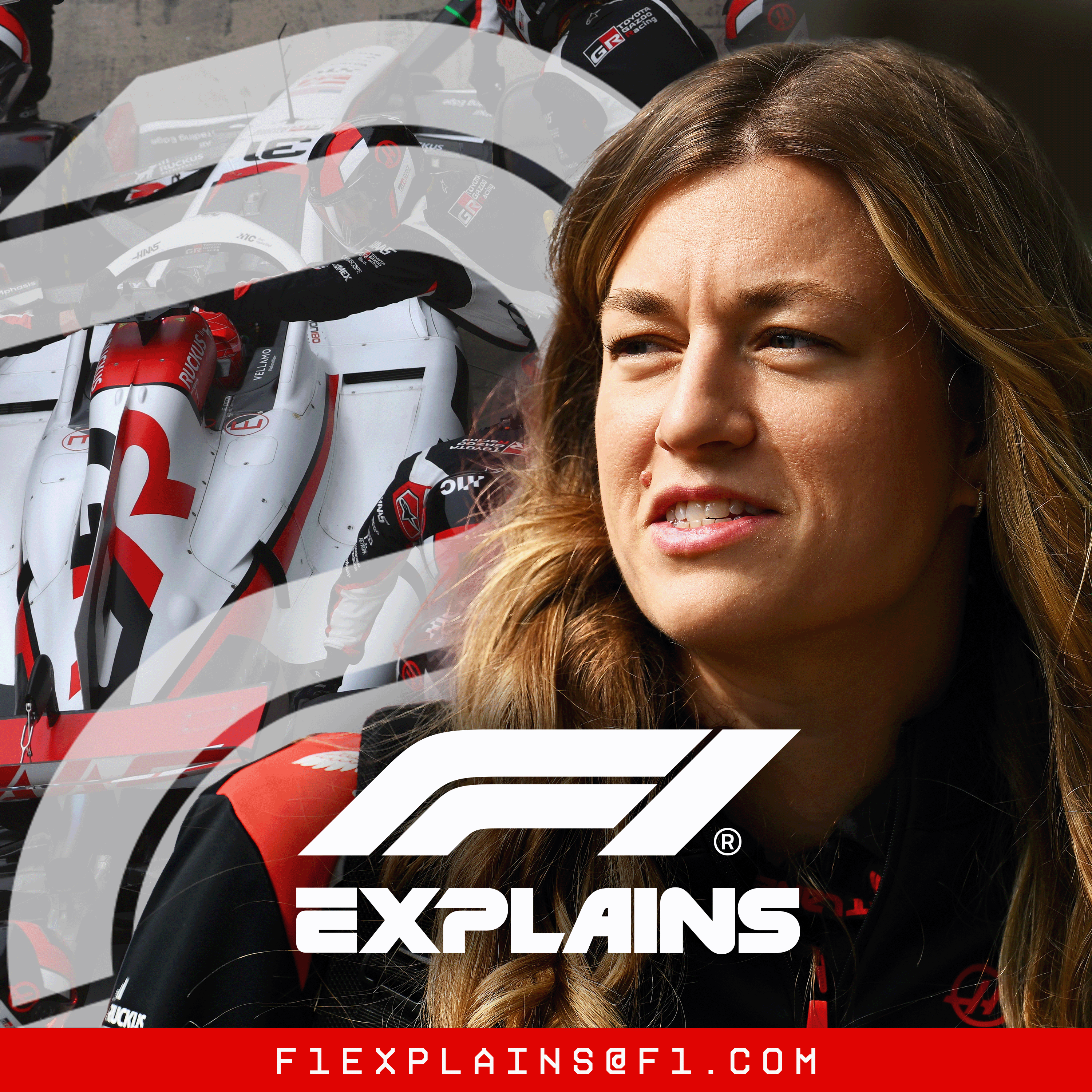
Laura Müller breaks down what a race engineer actually does, from being the main voice a driver hears on track to shaping car setup, strategy, and qualifying execution. The conversation digs into how Formula One’s new regulations have changed the job, especially around hybrid energy management, downforce, and tyre degradation. Listener questions steer the discussion through safety-car pit calls, why engineers say “box,” and how people can build a career path into F1 engineering.
Why do they say 'box, box, box', not 'pit, pit, pit'? What makes them fume on the radio? How has their job changed in 2026? F1 Race Engineers are the voice in the driver's ear, passing on information, listening to feedback, working together to get the best result possible.
Laura Müller, Race Engineer for Esteban Ocon at Haas, joins Christian Hewgill to laugh a lot and also to answer your questions on F1 car set-up, how teams know how fast their rivals are, how she became a race engineer and why a Safety Car can make her very happy or very annoyed...
Expert opinion every race weekend on F1 Nation - find the latest episode here on this podcast feed
This November, F1 takes over Las Vegas The Las Vegas Grand Prix returns November 19 - 21, 2026 — and tickets are on sale now! Be there for the fastest weekend of the year. Click here for tickets