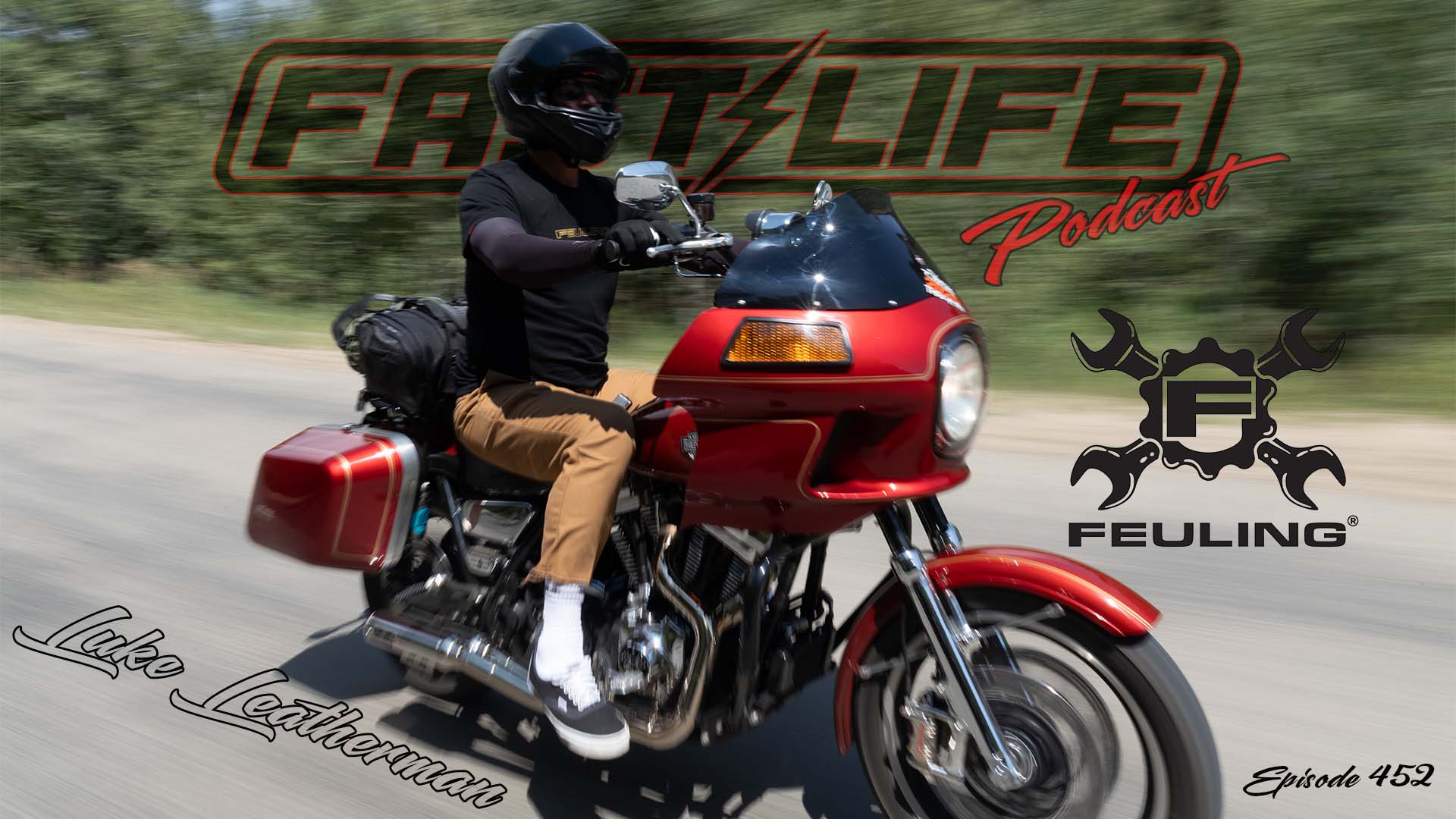
Luke Leatherman shares the fascinating journey of Feuling, detailing its origins and evolution in the performance parts industry. The conversation dives into the company's innovative approach to engine technology, particularly focusing on exhaust systems and their impact on overall performance. With insights into the balance of engine components and the importance of a complete package for motorcycle enthusiasts, this episode highlights the blend of passion and engineering that drives the aftermarket scene. Luke's personal anecdotes and experiences add a relatable touch to the technical discussions.
n this episode, we're sitting down with Luke Leatherman to get the full backstory of Feuling, along with a deep dive into what they offer!
Feuling, the American-made powerhouse that's been pushing the limits of V-Twin performance for years. From their legendary oil pumps and cam chest kits to Reaper cams, beehive valve springs, exhaust systems, and full engine upgrades, Feuling delivers billet precision that fixes factory flaws and unleashes serious horsepower, better oiling, and reliability on the street or strip.
Whether you're running a Milwaukee-Eight, Twin Cam, or building a high-compression beast, Feuling's HP+ Race Series oil pumps, OE+ upgrades, cam plates, and advanced components eliminate common pressure/scavenge issues and give you the edge you need to ride harder, cooler, and longer.
Proudly hand-crafted in small batches in the USA (Oceanside, CA) – no guesswork, just proven performance trusted by builders and racers nationwide.
"But I got a degree in automotive aftermarket, which kind of an interesting degree. But what does that entail, like a degree of that?"
The automotive aftermarket is all about the parts and services you can buy for your car after you purchase it. This includes things like replacement parts, upgrades, and accessories that aren't made by the original car manufacturer.
The automotive aftermarket refers to the secondary market of the automotive industry, which includes the manufacturing, distribution, and sale of parts, accessories, and services for vehicles after the original sale. This sector encompasses everything from replacement parts to performance upgrades and customizations.
"I ended up going out to Ventura because that's where Jim Fueling was based at that time. And I mean, I think we're talking 27, 28 years ago now."
Jim Fueling is a person who started a business related to cars and motorcycles, especially focusing on parts that make them perform better. His company has been around since the early 1970s.
Jim Fueling is known for his work in the automotive industry, particularly in the field of performance parts and exhaust systems. His business has a long history, dating back to the early 1970s, focusing on enhancing vehicle performance.
Exhaust systems are parts of cars that help get rid of the gases produced by the engine. They can affect how the car sounds and how clean it is for the environment.
Exhaust systems are crucial components of a vehicle that manage the flow of exhaust gases from the engine. They play a significant role in performance, sound, and emissions control.
"And you taking that class, you go to SEMA and that's how you said the introduction was made, essentially."
SEMA is a big car show where companies show off parts and accessories for cars. It's a place where people in the car industry meet and learn about new products.
SEMA stands for the Specialty Equipment Market Association, which hosts an annual trade show in Las Vegas showcasing aftermarket automotive products and innovations. It's a key event for industry professionals to network and discover new trends.
"They had a booth set up at SEMA where they were displaying big block Chevrolet and Ford cylinder heads."
A big block is a type of car engine that is larger and can produce more power. It's often used in fast cars and trucks to give them better performance.
A big block refers to a type of engine design characterized by a larger displacement and size, typically found in high-performance vehicles. These engines are known for producing more power and torque compared to smaller engines.
Ford is another well-known car brand in the U.S. that makes a variety of vehicles, including popular trucks and cars.
Ford is a major American automotive manufacturer known for its trucks, SUVs, and performance vehicles. Founded by Henry Ford, the brand has a rich history and is recognized for innovations in manufacturing and design.
Chevrolet is a popular car brand in the United States that makes many different types of vehicles, including trucks and cars.
Chevrolet is an American automobile brand known for producing a wide range of vehicles, from trucks to sports cars. It's a division of General Motors and has a strong presence in both the domestic and international markets.
Term
454
"It was a bolt on, 100 horsepower and 100 foot pounds of torque with pump gas onto say a 454. And like the late 90s, those things were all turds because of the emissions stuff on them."
The 454 is a big V8 engine made by Chevrolet that is famous for being very powerful. It's often found in trucks and some sports cars from the past.
The 454 refers to a 7.4-liter V8 engine produced by Chevrolet, known for its power and torque, commonly used in trucks and muscle cars. It was popular in the late 20th century, especially in the Chevrolet Corvette and various full-size trucks.
"...the technology that he created with the exhaust system and what it did to the performance of the engine then led to cylinder head development..."
The cylinder head is the part of the engine that covers the cylinders. It helps control the air and fuel that go into the engine and the exhaust that comes out.
The cylinder head is a critical component of an engine that sits on top of the cylinders. It houses the intake and exhaust valves and plays a key role in the engine's combustion process.
"...which then more or less led to complete engine development. Yeah, but those all kind of go hand in hand, right?"
Engine development is about making engines better and more powerful. It includes improving different parts of the engine to help it run smoother and last longer.
Engine development refers to the process of designing and improving engine performance, efficiency, and reliability. It often involves advancements in various components, including the cylinder head, intake, and exhaust systems.
"...if you're building a head, then you have intake and the exhaust port. So you want to make sure that all these things are running flowing right."
The exhaust port is where the gases from the engine leave after the fuel has burned. It needs to work well so that the engine can get rid of waste gases quickly.
The exhaust port is the passageway through which exhaust gases exit the engine after combustion. Like the intake port, its design affects engine performance by influencing how efficiently exhaust gases can be expelled.
"...if you're building a head, then you have intake and the exhaust port. So you want to make sure that all these things are running flowing right."
The intake port is the part of the engine that lets air and fuel in. It needs to be designed well so that the engine can get enough air to run properly.
The intake port is the passageway through which air and fuel enter the engine's combustion chamber. Proper design and flow of the intake port are essential for optimal engine performance.
"best exhaust and the best intake for it, correct? 100%. And when you really look at it..."
The intake system helps bring air into the engine so it can mix with fuel and create power. A good intake system can make the engine run better.
The intake system is responsible for drawing air into the engine, mixing it with fuel, and delivering it to the combustion chamber. A well-designed intake system can significantly improve engine performance.
"You need the camshaft, you need the valve springs..."
Valve springs help close the engine's valves after they open. They make sure the valves seal correctly so the engine can work well.
Valve springs are components that close the engine's valves after they have been opened by the camshaft. They ensure that the valves seal properly, which is essential for engine performance.
"You need the camshaft, you need the valve springs..."
The camshaft is a part that helps open and close the engine's valves at the right times. This is important for how well the engine runs.
The camshaft controls the opening and closing of the engine's valves. It plays a crucial role in the engine's performance characteristics, including power and efficiency.
"If it's a, you know, pushrod engine, you want to make sure that, you know, the pushrods..."
A pushrod engine is a kind of engine where rods are used to open and close the valves. This setup is often found in V8 engines.
A pushrod engine is a type of internal combustion engine where the camshaft is located in the engine block, and pushrods are used to operate the valves. This design is common in V8 engines.
"That's one thing that we see a lot in this industry where we've got poor pushrods that are flexing. We don't have valve springs that are set up necessarily properly."
Pushrods are parts that help move the valves in the engine up and down, allowing air and fuel to enter and exhaust to exit.
Pushrods are components in an engine that transfer motion from the camshaft to the rocker arms, which then open and close the engine's valves. They are essential for the proper functioning of overhead valve (OHV) engines.
"Well, generally, General Motors kind of, you know, put his name on the map. He developed and I know there are some of you guys out there that are familiar with..."
General Motors, often called GM, is a big car company that makes many different types of vehicles, including trucks and cars.
General Motors is one of the largest automotive manufacturers in the world, known for producing a wide range of vehicles under various brands such as Chevrolet, GMC, Buick, and Cadillac.
"...and I know there are some of you guys out there that are familiar with like the Quad 4 and the Aerotech program, but you know, I even think to this date..."
The Aerotech program was a project by General Motors to create better car technologies, especially to make cars faster and more efficient by focusing on how air flows around them.
The Aerotech program was an initiative by General Motors focused on developing advanced automotive technologies, including aerodynamics and lightweight materials, to improve vehicle performance and efficiency.
"...he developed and I know there are some of you guys out there that are familiar with like the Quad 4 and the Aerotech program, but you know, I even think to this date..."
The Quad 4 is a type of engine made by General Motors that has four cylinders. It was designed to be powerful and efficient, and it was used in many GM cars in the past.
The Quad 4 is a four-cylinder engine developed by General Motors in the late 1980s, known for its high performance and efficiency. It was used in various GM vehicles during the 1990s.
"...but you know, I even think to this date, I think he holds the most horsepower per cubic inch at just over 10 horsepower per cubic inch. And then that led into some more programs."
Horsepower per cubic inch tells you how much power an engine makes for every cubic inch of its size. A higher number means the engine is more powerful for its size.
Horsepower per cubic inch is a measurement of an engine's power output relative to its size. It indicates how efficiently an engine produces power based on its displacement.
"But when does it like start to kind of roll into like the V-Twin stuff?"
A V-Twin engine has two cylinders that are shaped like a 'V'. It's commonly used in motorcycles and is known for its strong performance and distinctive sound.
A V-Twin engine is a type of internal combustion engine with two cylinders arranged in a V configuration. This design is popular in motorcycles, particularly by brands like Harley-Davidson, as it provides a good balance of power and torque.
"the V-Twin stuff really, you know, kind of goes back to the four valve heads for the evolution engines."
Four valve heads have four openings for air and fuel to enter and exhaust gases to exit each cylinder. This helps the engine run better and produce more power.
Four valve heads refer to cylinder heads that have four valves per cylinder, which can improve airflow and performance in an engine. This design is often found in high-performance engines, allowing for better combustion and efficiency.
"And really what we found with the Milwaukee 8 and the oiling system issues, for one, and something that feeling was instrumental in with the Twin Cam engine..."
The Milwaukee 8 is a type of engine made by Harley-Davidson that offers better performance and reliability compared to older models.
The Milwaukee 8 is a V-twin engine developed by Harley-Davidson, introduced in 2016. It features an improved oiling system and performance enhancements over the previous Twin Cam engine.
Select text to request an explanation
What's up everyone and welcome back to the Fast Life Podcast.
In today's episode, we're sitting down with Luke Leatherman to get the full backstory
on fueling, along with a deep dive into their parts line from the cam chest, exhaust systems
and everything in between.
Before we dive into this podcast, please take a moment to check out our sponsors.
If you're ready to take your bike to the next level, then Arlen S Motorcycles has you covered.
Link down in the description below.
Use offer code fastlife10, you're going to save 10% off.
They're going to get you taken care of.
Check them out.
My guys over at Cowboy Harley-Davidson, they just got me dialed in on another new bike.
I've bought them five for them in the past 10 years.
They're going to get you taken care of as well.
Check them out.
Also, 1-800-LAWTIGERS.
If you or someone you know has been in an accident, they're going to get you dialed in and on the
right path.
Check them out.
Link's in the description below.
And last but not least, my guys over at Kabuto Americas, the best helmet I've ever worn and
I've been rocking them for about a year and you're going to be hearing more about them
on this podcast.
So stay tuned.
So now let's get into this episode with Luke Leatherman.
Hey guys, you ready to let the dogs out?
Well first off, this has been the most elaborate help ever going to someone else's shop and
them setting things up.
Unfortunately, you got a good team over there that shoot, film, and you have great lighting
here.
So I mean, this might even look better than my studio.
So I'm kind of jealous.
I don't know about that.
But I want, first of all, I want to say thank you, man.
It's known of your brand for a long time.
I've ran products of yours over the course of many years and seeing like your friendship
with like the thrashing, doing life is something I kind of envy.
I wish I lived out here so I could tag along on some of the adventures you guys have been
doing for the last handful of years riding the Sturgers and stuff.
But yeah, doing this podcast has been it's been it's been a long time coming.
So, you know, well, I appreciate, you know, I appreciate you coming out.
This is really not in my wheelhouse.
And I got it and I got to let everybody know this is my first.
So, you know, we've got to do some hand holding here.
But oh, it's all good.
So see what I did there.
I did not introduce you because it's a conversation.
Not so much a hey, guys, this is Luke Leatherman Leatherman Leatherman, which that's a pretty
sick ass last name stage name or is that that's legit, you know, it's kind of funny
going back to like childhood sports and stuff.
I was, you know, my football coach always called it the the adventures of Leatherman.
But, you know, maybe there's a comic hero there, but anyways, that's, you know, I guess
I'm pumped to kind of tell there's, you know, a story here.
Yeah.
And where does that start?
Like, are you, are you native to this area, San Diego area?
I'm native to the Midwest, Michigan, so I grew up back in the, in the Midwest up there by
the Great Lakes.
It kind of explains as we get into further on, it kind of explains that's kind of like,
I think it's in the water there that you start to tinker with motors and stuff like that.
Without a doubt, I grew up in the automotive side of things.
My father had a little independent repair shop and, you know, he's had little side projects,
gear head stuff, and that's kind of where I got, you know, my interest, you know, peaked
with it, you know, whether it be a, you know, boat, because we all grew up on the water
back there.
Were you closer to like Michigan or?
Yeah, we're right over by Lake Michigan.
You've got Grand Haven, Muskegon area, which is west of Grand Rapids.
But, you know, a lot of water sports in the summertime, and then, you know, in the winter
time there, you know, everybody's outside, you know, anyways, you don't know, you don't
know the difference.
So you just dress for it.
So you're out ice fishing or snowmobiling or, you know, what have you.
It's crazy how the snowmobiles are up there.
Like when you're riding through the areas, they have the trails for it.
And then there's markings on the road too.
So you can see where they cross and everything, which that was kind of different for me being
from Texas, where we see snow every two or three years.
And then you're up in this area where they park the bikes and pull the track motor or
whatever you, you know, the snowmobiles out, you know what I mean.
So repair shop, I mean, is that where you get your forced childhood labor kind of thing
going on?
Yeah, mostly, right?
You know what I mean?
But not just being around it and, you know, had an interest in it.
And then I spun off and went to kind of a specialty school more based on the business
and the side of things.
But I got a degree in automotive aftermarket, which kind of an interesting degree.
But what does that entail, like a degree of that?
It kind of covers everything outside of the dealership world and really neat school.
And I still do business with quite a few of my friends that, you know, that I made there
in school, roommates, et cetera.
So it's just kind of a different school, you know, situation, small classes.
There's no way I would have survived in a big classroom setting.
And then that kind of led to the introduction to fueling because part of the school that
I went to, we were required to go out to the Seaman, the APEC show out in Las Vegas over
here.
And that's where my introduction to fueling was.
And there was a guy that was working for Jim Fueling who went to the same school that
I did and kind of grew up in, we had some, ended up turning out that we had some like
friends together and I ended up going out to Ventura because that's where Jim Fueling
was based at that time.
And I mean, I think we're talking 27, 28 years ago now.
Yeah.
So how, like he had already had fueling kind of like running, essentially, but was that
more automotive based?
Well, it was motorcycles for, for Jim were always like a passion side of things.
But the business really goes back to the early 70s, 73, 74, when he started it.
And I think one thing that's unknown out there is the business really started around exhaust
systems.
It was Jim's, one of his first patents.
And I guess for those that are unfamiliar with Jim Fueling as he really was an innovator
of really engine technology.
And it didn't matter if it was a motorcycle or a car or an airplane.
He had his hands involved with a lot of things.
And he was working for a lot of the major manufacturers once they realized that he was
ahead of the Skunk Works facility and the ability to really problem solve.
And then what he would do is focus on a patenting technology.
And then when he'd work with the original or OE manufacturers, the game plan would be
to license patent technology and then work out license agreements for when vehicles
start rolling off the production line.
That makes sense.
And you taking that class, you go to SEMA and that's how you said the introduction was
made, essentially.
Feeling was displaying.
They had a booth set up at SEMA where they were displaying big block Chevrolet and Ford
cylinder heads.
Oh, shit.
And in fact, when I ended up moving out from Michigan to Ventura, that was kind of one
of the first programs that I took on.
And looking back, talking 27 years ago, Jim always wanted to have an aftermarket performance
parts company.
But he was also the type of guy being the inventor that he was.
His once kind of like the proof of concept was done.
He was moved on.
Oh, he was looking for the next challenge.
And I've realized now I've got a little piece of that in me.
But we're doing the big block Chevy cylinder heads.
And this is what, late 90s, early 2000s.
His concept, the cylinder heads were bitchin'.
It was a bolt on, 100 horsepower and 100 foot pounds of torque with pump gas onto say a 454.
And like the late 90s, those things were all turds because of the emissions stuff on them.
But the program was never finished because you needed alternative brackets or cruise control
brackets.
And Jim would be, tell the guys you've got to make it himself when you're selling a package.
And especially like this day and age, I remember that conversation.
And it's like people now more than ever want a complete package.
Yeah, exactly.
And that was a lot of what the motorcycle industry was in that same timeframe.
It's a fender that you need to make mounting stuff for.
There was a lot of like, hey, we got the gist of it done,
but you're going to have to retrofit this to your bike kind of situation.
You know, like even the bagger world, Ness had the old covers they used to put on the rear fender
to make it long.
And then you glued the extensions on the bags.
That was the first stretch of bags back in the day.
You know, but there was no buy it bolted on situation in a lot of those areas.
People were used to doing, you know, fab work.
Yeah, yeah.
So I guess to get back to, I guess, some of the history Jim worked or he first started
with exhaust system side of things, which not too many people realize that that's where
this business really started was exhaust systems.
And what Jim realized is the technology that he created with the exhaust system and what
it did to the performance of the engine then led to cylinder head development, which then
more or less led to complete engine development.
Yeah, but those all kind of go hand in hand, right?
Because if you're building a head, then you have intake and the exhaust port.
So you want to make sure that all these things are running flowing right.
And so it would make sense that to get the most out of the head, you need to have the
best exhaust and the best intake for it, correct?
100%.
Yeah.
And when you really look at it, and it's one thing that we preach today is ultimately
you got to have a balance system, right?
You need, you know, the heads need to work together with the intake and exhaust systems.
You need the camshaft, you need the valve springs.
If it's a, you know, pushrod engine, you want to make sure that, you know, the pushrods,
you know, are the right setup.
Yeah.
You know, it really comes into play to where if all of that is working together as a balance
system, you no longer have to run these giant camshafts.
That's one thing that we see a lot in this industry where we've got poor pushrods that
are flexing.
We don't have valve springs that are set up necessarily properly.
So then we just over cam it and that's how we're getting the power out of it.
Versus if you, you know, set up the valve springs correctly to the cam, you've got pushrods
that, you know, are good, they're rigid, you know, rigid and they're not flexing.
Now, all of a sudden, you can run a smaller cam.
Now, the engine's happier.
You know, it's more of a balance system.
And you get more reliability out of something you're not, you know, stressing.
100%.
Yeah.
Yeah.
So as you're, you know, as the exhaust systems are being made, and of course there was no
kind, was the regulation still pretty, obviously not as intense as they are now with exhaust
stuff, but like it was still California.
So what was that kind of world like back then trying to get performance mods to the general
public out there?
Was that a thing?
Well, he was more based on the technology side of things.
And then that's when it kind of turned into a company that was a skunkworks facility where
these manufacturers could come and then work on, you know, developing technologies that
worked for their said program.
So what kind of, what kind of OEs were you all working with there?
Well, generally, General Motors kind of, you know, put his name on the map.
He developed and I know there are some of you guys out there that are familiar with
like the Quad 4 and the Aerotech program, but you know, I even think to this date, I think
he holds the most horsepower per cubic inch at just over 10 horsepower per cubic inch.
And then that led into some more programs.
And when I got involved, he had Harley-Davidson and Ford Motor Company in the building where
Jim was responsible, you know, kind of hands on with the Ford, the modular engines, which
also led into some of the, you know, crazy, you know, Harley-Davidson stuff.
You know, it's a, it was a very, it's a fun business.
And it's one thing that, you know, I was really attracted to, but it's also a very tough business
because there's nobody out there that pleases technology and or pleases patents and trademarks.
You have to do it yourself.
And you work with the big guys and they don't necessarily want to pay you when it comes to the,
you know, the end of the deal.
But, you know, also on the flip side of that, being that there's nobody to police the technology
or police patents and, you know, your trademarks, et cetera, other people, other companies will see
that something's working and then they'll start using it.
And then, you know, so you've got a license agreement with, you know, said manufacturer.
And you've got these guys that start using it.
Now all of a sudden, hey, we're not necessarily going to pay you because they're not paying you
and they're using the technology.
Oh, OK. So it's not even that the original person is trying to screw you over.
It's just that I mean, they are technically, but, you know,
Well, it's their loophole to get out of it.
So, you know, at the end of the day, your technology, your license agreements
and your patents are only as good as your law firm.
Yeah. I mean, I could be completely wrong on this, but isn't it like you like some something of the 10% margin of change
or whatever can kind of be in the like around a loophole of a patent?
Or do you have to be so specific when you make a patent that you're really dialing
into every little nook and cranny of the product? You know what I mean?
I mean, it comes down to how well you write the patent and really what you're looking to get the coverage on.
Sounds like you're writing an AI fucking prompt.
It's like the better you write an AI prompt, the better it works.
The better results you get, right?
So, which I don't like AI, by the way, I'm against all that Skynet stuff.
But yeah, so you're basically making these products.
But when does it like start to kind of roll into like the V-Twin stuff?
And you said that it was kind of like a passion project of his.
But I mean, here we are sitting in, you know, this place, you know what I mean?
So how does that transition and how do you get at the helm of all this?
Well, I mean, the V-Twin stuff really, you know, kind of goes back to the four valve heads for the evolution engines.
There's one in the back over here, but that kind of, you know, was, you know, revolutionary for, you know, the time.
We're going back to the 80s, you know, four valve per cylinder, which is kind of interesting because we've gone full circle now.
Harley's, you know, back at it.
But, you know, that was, it was a good product, worked very well.
But it was also, you know, we touched base on kind of back in that day where, you know, customers were used to having to do some of their own fab work.
This bike here is equipped with them, very complicated to, you know, put together the oil tank like on the FXRs had to get moved.
The exhaust ports are in different positions, you know, so feeling would include either an exhaust system in or the spickets and you'd be on your own to build your own exhaust.
But they really took off on the drag racing scene and virtually everybody that was competing and, you know, the, you know, the top fuel stuff was running the four valve heads.
So it's kind of like where the, I guess the work with the Harley-Davidson stuff, you know, came onto the scene and that was strictly aftermarket that was not associated with the factory.
Didn't Elderbrock or however you say it used to have like a heads that was on these older bikes as well?
Edelbrock did some stuff in the early Twin Cam days.
Twin Cam days, okay.
The feeling four valve heads, I mean, another interesting note on that is they were actually developed for Volkswagen stuff because feeling was really big into the Volkswagen engines.
And so then kind of what he was really known for was making stuff modular.
So he's like, hey, if we're doing this, the Volkswagen's, it's very close to the evolution engine.
So let's make sure that the castings and everything are retrofittable to either engine.
Yeah, yeah, makes sense.
And then this was when feeling was in Ventura.
Rivera was kind of a big thing, big deal back then.
And Rivera wanted to take on the distribution of the four valve heads.
And that's kind of, kind of where the branding, feeling Rivera went back to.
In fact, a lot of people think that Rivera did the heads, but it was actually feelings heads and they were distributed by Rivera.
But not to say a huge program, I think there was probably somewhere in the neighborhood of 6,000 sets that were put together and out floating around out there.
Yeah, well, if it's anything like these FXR nerds are doing now, like they're going to find a set and then it's going to be a big thing on there to be YouTube video about it and stuff like that.
So in that area, like you said, you came in with the business of aftermarket and like what were you specifically doing in this like area of it?
Like liaison between things or?
Well, I got brought in kind of towards the end of the Harley contract stuff and so kind of like to backtrack a little bit.
When Harley was developing the twin cam engine, so we're going back to the late 90s, they started doing their hot weather testing and they were actually melting the aluminum down on it.
So they're having some, you know, some, some pretty big problems with it and they were really far along with it as far as the money that they already had invested into the program.
The chief of engineering for Harley at the time was familiar with Jim and worked with him on some programs back when he was with General Motors.
And Jim, being the guy that he was, says, you know, I'll fix your problem for X amount of money and if I don't have it fixed within X amount of days, you know, you guys don't have to pay me.
Confident.
So very confident. And I mean, it was really one of the only places at the time in the United States where you could do what they call like a clean slate engine where from design to the CAD work to machining to the assembly to the testing that you could do all under one roof.
Yeah.
So there was, you know, a lot of talent in the building was a small group, very talented.
So anyways, they fixed the issues with the twin cam engine that led to quite a few other engines for Harley.
And then one of them being this three cylinder engine that you see flown out there.
And the idea of the W3 engine was that it was modular to the twin cam.
So kind of this piggybacks off of Ford being in the building at the same time with the modular Ford engines, which means the four, the six, the eight, the 10, all used the main or same main components like the connecting rods, the bell springs, push rods, things like that.
You had different blocks, you had different crankshafts and cams because of the length, but all the internals were virtually the same.
So it really brings the cost of production.
So if you look at the W3, it's modular to the twin cam other than it's just one more cylinder.
Same crankshaft.
But I think at the time it was set up based off of all the Harley engine components.
It wouldn't really need like eight or nine new new part numbers to manufacture.
So I mean, you're obviously putting two new cases on there to accept that third cylinder, but you're able to use a factory crank on that somehow?
Or is it just the connecting rod has an extra?
Yeah, basically the connecting rod is what's different and it's based off of like a radial aircraft engine.
That's what I was wondering when you said the airplane stuff earlier, I was like, you know, you think of those engines that are all in a circle, which I don't know the term, but you know.
Well, they're radial and they're in line.
And so what you end up with is you've got a master rod, which on the W3 we put in the middle cylinder, then you have link rods off of it.
So if you picture like the Pratt and Whitney engines, the big 11 cylinder radials, you've got one master rod that connects to the crankshaft and then the rest of them are all link rods.
They're kind of along for a ride.
So that technology, you know, put into a Harley engine allowed the cylinders to stay in line because there have been some multiple cylinder engines, but they end up staggering them because they're running the connecting rods.
Yeah, staggered.
Yeah, I know exactly what you mean there.
If you're ready to take your motorcycle to the next level with style, performance and quality.
This is where Arlen S motorcycles comes in for over 50 years.
The legends at Arlen S have been building the boldest customs and crafting premium parts that turn heads and stand the test of time from the classic big sucker air cleaners to the new carbon fiber parts line to bars, risers, wheels, brakes, the list goes on.
Nest even has a full parts line for the 2024 and up touring models.
Whether you're pushing a Harley, Indian or a custom build, Arlen S delivers with quality parts that I personally run on all my bikes from my choppers to the new 2026 bagger.
I just picked up this year.
Head on over to Arlen S dot com and check out the new drops for 2026 and don't forget to drop the fast life 10 offer code to save yourself 10% off your order.
Your helmet better be as serious as you are.
Kabuto motorcycle helmets brings Japan's legendary helmet craftsmanship with cutting edge technology that keeps you ahead of the game.
With advanced aerodynamics like the wake stabilizer and crest spoiler, you will slice through wind with rock solid stability at triple digit speeds, all while boasting a lightweight composite shell with ACT tech and MIPS safety standards.
For the last year, I have been exclusively wearing the F 17, which is a full face Moto GP race helmet that has an aggressive profile while having some proper ventilation to help with these extremely hot Texas summer days.
Kabuto helmets are new to America and I'm very honored to stand beside them this year.
You can check out these helmets and find out more information at kabutoamericas.com and don't forget to give my friends a follow at Kabuto underscore Americas on Instagram.
So, like I said, you came in at, well, are you able to talk about what it was that you were solving for the early twin cams as far as heat?
Well, feeling went in and changed the cylinder heads around and there was a ton of work on the oiling system.
And so that kind of turned in for us to create an aftermarket parts business, specializing on oiling system stuff.
Okay, that makes sense. That's the birth of this by solving that.
So, I mean, you solved it for Harley, but then there's still an upgraded part. How does that work?
Well, they didn't quite, and of course, they're already along so far in production at this point, right?
So there's massive amounts of money into tooling.
And there's other, I mean, I think something interesting to talk about is when you're doing like blueprinted prototype engines,
you're going through and everything's, you know, dialed in, it's measured, it's blueprinted, you're, you know, assembling the thing together like, you know, the way it's supposed to be.
Then you take that and you go into production.
And that's why, you know, I don't care if we're talking cars, we're talking motorcycles, generally the first year of anything is probably the worst year because, you know, they're figuring that out.
I mean, obviously things are a hell of a lot better than what they were 20, 30, 40 years ago.
But now, all of a sudden, and for those of you that remember the twin cam that came out, you know, feeling advised that the oiling system was marginal at best for a stock engine.
Well, they ended up having all those oiling system problems.
On the twin cam?
On the twin cam engine.
And what you did is you went from blueprinted oil pumps and oiling systems to production.
And now all of a sudden production tolerances come in the range where everything gets larger and, you know, you've got this wide variance that you didn't test.
And those were cast plates back then.
They were cast, which the factory still uses.
Still uses.
And cast plates.
And, you know, it's not like that's a, you know, bad thing because, you know, they have the money to step up and do, you know, all the tooling.
So as far as kind of like to backtrack to put us into the oiling system business is when we did the W3, we knew that the oiling system of the twin cam engine was marginal at best for a stock 88 inch.
So we knew that that wasn't going to work in this 150 cubic inch engine, which in the day go back to 2,150 cubic inches was massive.
Yeah.
Now you say it.
Yeah.
You know, guys are doing it with two cylinders.
Yeah.
So anyways, we made an oil pump and we did lifters for the W3 and we made sure that that was retrofitable back to the twin cam.
And something that's kind of crazy about the W3 is, and this is something that, you know, Jim said, it's crazy that you design a whole engine.
And the only thing that comes out of it's an oil pump.
And that's virtually what came out of that engine just because of how things work with the factory and.
That's a good, I mean, it's a good insight though.
I mean, you guys brought in the.
Yeah, I brought the connecting rod in for the three cylinder for the W3.
So you can see that this would be the master rod right here.
And you've got the link rods right here.
Yeah.
And it's just the first one's kind of going up and it's pulling one down.
I've seen the like on like a meme or some kind of thing online where to have like an airplane engine, you see the crank or the firing order of all that stuff.
And it was pretty interesting to watch.
So when you said it was on one main shaft, that's that little thing started playing in my head.
Yeah, it's pretty crazy.
If you picture like an 11-cylinder Pratt and Whitney, you just have more of these Ganorps and.
Yeah.
And link rods.
Funny story about this when, when this design went back to Harley, because this was, you know, designed for Harley, the three cylinder is.
This was called a master rod, which was very standardized for the, for the time.
Yeah.
And these were called slave rods.
And they said, no, no, no, no, no.
That's it.
That's a master rod.
And we got a.
Yeah.
The link rods.
But anyways, you know, proven technology.
Yeah.
You know.
Yeah.
I mean, you've ridden that thing across the country.
I've seen, did you ride it with the, with the thrashing boys one year?
Yeah.
We rode the bagger a couple of times.
Not quite as adventurous to ride the one of the carbureted ones with, you know, three carbureters hanging off of that.
It's always fun.
The, so, you know, like I said, the, the cam plate comes out and, and that kind of kick starts your aftermarket business within the motorcycle industry.
What year?
So this is like late nineties or moving into 2000.
We're rolling into 2000 when we have the oil pump and, and lifter set.
Okay.
So we had worked with quite a few different lifter designs with the twin cam trying to help remove temperature out of it.
And that was the whole goal of it, of working with the oiling system and with the cylinder heads was basically to reduce the temperature.
Feeling change, the exhaust port where, and one thing that he was really known for was small, short exhaust ports to get that heat out.
You want high velocity ports, get the heat out.
And then we played with the oil flow through there to get temperature taken out.
Yeah.
Some of you guys may are probably familiar with the baffle that's inside the twin cam and even the, the M8's.
Baffle.
Inside the oil tank, like all the stunt guys out there, they take and put the, you know, extension on it and so forth.
That was the feeling design for the idea of that baffle was to route the oil around, keep it into the oil tank a little bit longer, which, you know, help reduce, you know, engine temperatures.
Yeah.
You know, between, you know, the oil pump, the lifters, getting the proper oil flow to the top end to get heat out, changing the combustion chamber and the exhaust port around a little bit.
And once again, go back to that balance system statement where, you know, it's all got to work together.
Sounds like your brand should be called oiling.
I mean, it's got to be a joke, right?
That y'all have said at some point in time because it sounds like that's the problem that you're solving in a lot of these cases is obviously the oiling system.
Was the twin cam not always known to be a very hot motor?
I mean, wasn't that the big problem with the 120R's when those things came out and then the 120R ST or however they acronym that thing back in the day, you know?
I just, that's what I remember about those things.
They've always kind of been plagued with temperature issues.
And I guess that's another, you know, another thing going back to that twin cam development, even if you look at the evolution and if you kind of look at some of the engines around here, go and look at other air cooled engines, you know, go back years.
And you know what you'll find is they have massive thin packs on them.
And when fueling gave the twin cam back to Harley after doing a lot of the, you know, the testing and development work, it had larger fin packs on it.
And then Willy G didn't really care for the styling of it, so they trimmed it back down, which also, you know, creates more, you know, heat issues.
So it's kind of a give and take between the aesthetics of it and, you know, functionality.
Yeah, and Harley's always been known by, I guess, maybe not always been known, but I feel like the motors over the years have a look to it that makes it really feel authentic to what Harley is.
And when you look at, yes, like you're talking about, I'm just thinking of some of my head older air cooled stuff looked very more practicality first, aesthetic second, which when it's something that's exposed, you kind of like want it to look good, you know what I mean?
For sure.
Yeah.
And you look at, you know, Harley's done a very good job with that through the years.
And it's something like, you know, we put on our instruction sheets, you know, from the, you know, upper right hand corner, just a little small picture of the engine, whether it's an evolution or a twin cam Milwaukee, they're very distinctive.
And you know, just by a quick glance, you know, what it is.
Yeah, exactly.
So early 2000s, I mean, they were also, I'm thinking of cam plates, you had the issues with the tensioners on those things from Harley, which were you guys already producing hydraulic in that time?
Or when did the hydraulic tensioner thing come into play?
That came into play much later.
When it kind of going back to talking about that mechanical tensioner setup, the original W3s to make the modular actually had two rows of the chains with the mechanical tensioners.
Okay.
So that way you could keep, you know, all the inventory the same.
But, you know, and once again, you go from prototype engines where you're measuring everything.
You've got good crankshaft runouts.
The crankshaft is good.
The sprockets are good.
And the chains are good.
And all of a sudden you go to production and you've got a crankshaft that has run out on it.
All of a sudden.
Yeah, but so the first cranks were the Timkin bearing bottom ends, which those are known to stay pretty true for a lot longer, right?
Correct.
Would the tensioner problem just be something over time that, you know, the plastic is breaking down and it's fucking molecule level?
I don't know what the scientific turn would be.
But and then you get the guys that are picking these bikes up and dogging them, you know, performance and stunting and shit like that.
And it's causing a lot more problems than these things early, you know, 10, 15 years ago.
I mean, that's what I'm kind of thinking of that that might be a case.
I mean, it's an accumulation of things what we found that tears up the tensioners.
You've got once in your right, the early crankshafts are known for being the better ones, but you still would get crankshaft run out, you know, with those.
So as soon as you get the crankshaft moving around, now all of a sudden you've got, you know, run out on the sprocket.
It's also saying that the sprocket also doesn't have some run out in it.
Okay.
You have some burrs on the chain.
And then all of a sudden you've got with that run out, now the chain's twisting back and forth and it's acting like a chainsaw cutting through the tensioners.
Now you combine that with somebody that's not very good at maintaining their oils.
And, you know, it's kind of a recipe for disaster.
But you've got a lot of those early ones out there that, you know, do have the longevity out of them.
Okay.
Yeah.
You know, and that was kind of like there was no rhyme or reason you had some that would go, you know, 75,000 miles, then you had some that could make it, you know, 10,000 miles.
Yeah.
And that's part of course, a lot of products coming out, you know.
So I did is technically the, the, the hydraulic tensioners better, like in general, or marginally, or you know what I mean?
They're better because you don't have the, like the original ones had the spring tensioner called mechanical spring tensioners.
And they put a ton of force on the chains.
So it's almost pulling as that thing's spinning.
It's eating up horsepower as well, creating heat.
In fact, SNS got a patent on their chain drive cams.
That was a big thing in the early twin cam days is to switch them over to gear drive cams.
For one, you got rid of the tensioner problems.
But second of all, it freed up some power in it.
But that, the tolerance on that is so tight.
Like correct.
And you're, no matter what, you're going to generate some form of a run out, correct?
Over the course of riding or, you know, running the engine.
I mean, even a good crankshaft setup and you always have to take the measurement inside the case too, right?
So you've got the crankshaft on the bench.
And then by the time you get it in between the bearings, depending on how the line, you know, hone is of the two crankcase halves.
Yeah.
And then you take the flex and the bearings.
I mean, if you have one that's under two and a half thousand, you have a really good crankshaft.
But now all of a sudden you stretch that out, you have five, six thousandth crankshaft run out.
It makes it almost impossible to do the gears.
And of course, that was a learning curve in the day.
You know, guys are taking the, the, you know, cam chain tensioners out, replacing them with the gear drives.
And then all of a sudden, you know, gears are breaking.
Yeah.
Because you end up with that tight bind with the excessive crankshaft run out.
Yeah.
I was always nervous about that.
I remember my ignorance and all this stuff.
Like the first time I ever did a cam chest, I didn't even know that checking the run out was something I should probably do.
And I did a whole, and fortunately I got away with it.
I just did a whole cam chest, like a whole scream and eagle one.
It's like the first time I ever did any of that stuff.
And then I became friends with mechanic dudes.
I'm mechanically inclined, but I'm not trained.
I'm more of a in the garage, you know, 13 millimeter also fits on a half inch.
Kind of things.
Not now.
I'm, I'm, I'm trained now, but that's what it was like back in the day.
And so I started to get to learn about the run outs.
And then, then I get worried.
So every time I fuck with a motor, I'm checking it.
And the last one, you know, you were talking about checking the run out on the, what do you call those, the races of the crank on the inner.
Like you're, like you're checking it on the bench.
Yeah, yeah.
So you're checking like on a truing stand.
So, well, I don't have that, but my guy does.
I'm checking this EVO that looked, I thought I had this perfect, but like $2,000 score of an FXR.
And once you wipe the dirt off, everything's fresh and clean.
And I checked the run out on it and it was gnarly.
It was 12,000s or something like that.
But then I took it to the dude to have it rebuilt and then we're on the stand and on the crank.
It's written what it is on the truing stand.
So I guess it was part of the course for the EVO of that 1991 or whatever.
But that kind of weirded me out.
So I don't know if there's a tall, if the tolerances in an EVO motor can be a lot more on that, on that outer part of it.
With the, you know, your traditional little checker or whatever the hell it's called.
Well, you, you transition into the, the twin cam and now of a sudden it's much more of a concern because you have the oil pump in the cam plate on the end of that crankshaft.
To whereas, you really didn't have, I mean, obviously you don't want to be running an engine with a bunch of crankshaft run out.
And yeah, you know, like kind of our testing shows for every like two to two and a half thousands of crankshaft run out, you're looking at three, four horsepower loss.
So, you know, you get some of these engines with excessive crankshaft run out.
You, you add all this vibration to it, but you're also, you know, you're beating the components up and you get less power.
And that makes sense because with those type of worm gears, is that what they're called?
They're called Geroder gears.
And so it's like you go and they're very, they're much more delicate than what a gear type pump is.
So it's like you go to the evolution engines.
I don't know what kind of jumping around here, but I'm learning.
The Geroder gears are very prone to, you know, breaking out there and a lot of it just because they bind up with the crankshaft run out.
You know, whereas if you go back to the evolution engines, you rarely ever saw gear problem, but you'd see the oil pump shaft snap.
And what that really means is when you have debris flowing through the oil pump, like the gears stop for a second on the evos that snap the shaft.
Well, in the twin cam, you've got the crankshaft that's turning it and the crankshaft is not going to break.
So the gears break.
And so that's one thing that makes the oil pumps tricky in both the Milwaukee eight and the twin cam is the oil goes through the oiling system twice before it goes to the filter.
So now not only do you have to have enough clearance in the oil pump to allow for this excessive crankshaft run out.
You also have to have extra clearance in it to run debris through it because the debris is going to go through both sets of gears before it goes to the oil filter,
which is tricky and which is why if you go next door, you can see the guys assembling the oil pumps.
We do everything by hand precision measured and because you got to have enough clearance and tolerance in there to allow for the debris in the excessive run out.
But yet you still got to make the oil pump work.
Yeah, yeah.
Complicated stuff.
But yeah, that was completely eluded my mind thinking about the, you know, you probably have more of a tolerance acceptance in the Evo because it's not like that on the shaft there.
But the, yeah, I kind of lost where we were on the evolution of everything.
But your, like, what are you doing back then on this?
I think that was the original question we got talking about oil and stuff like that.
Well, the kind of like the introduction to, you know, feeling parts, at least the aftermarket side of things really was the oil pump that we came out with for the W3 engine.
And then we had a lifter set that matched, which we felt optimized the oil flow to the top end.
And that lifter recommendation was actually sent back to the factory for the twin cam engine.
And they opted to not use that lifter, at least that formula of oil flow rate because they wanted to restrict the oil because they felt that that helped reduce temperatures.
There's a big discussion there.
But so anyways, we had full availability to run this set up as far as lifters go.
So, you know, we started with an oil pump and a set of lifters for the twin cam engine and then kind of piece by piece, you know, grew the business.
You know, also at the same time, the company went through some struggles because Jim Feeling passed away in 02, kind of as this business was getting going.
And I guess to, you know, kind of stay focused on the feeling side of things.
Now you have at this time, the Harley-Davidson stuff, contract work has kind of come to an end.
They also had kind of cut back on their R&D budget because they were so heavily invested into the V-Rod program.
For those of you guys that remember the V-Rod.
But then Jim was also heavily invested in some pretty big lawsuits.
I mentioned Ford Motor Company earlier, so he had contracts and license agreements with Ford.
And then Daimler Chrysler started using some of the technology where he developed a three valve cylinder head, which is really good for emissions.
It's actually a ton of benefits.
So Daimler Chrysler started using it and they couldn't even pass California emissions without it, which is why they started using it.
But anyways, Jim got into this huge lawsuit between those two because the technology was licensed to Ford and then you've got Chrysler, Daimler Chrysler using it.
He also had lawsuits going.
At the time, I don't think too many people realized the helmet technology that Jim did.
Aerodynamic stuff.
Any helmet that you really see, whether it's a bicycle helmet, ND, F1 helmet, motorcycle helmet that has the arrow spoiler stuff on it, was all designed by Jim.
Did he just have access to wind type? Where is he getting this kind of, where is he able to develop all these type of things from?
Well, some wind tunnel testing, for sure.
He was really big into Bonneville land speed racing.
So that's where a lot of the external aerodynamics came from.
And he had Gene Sheehan on his team, who actually after he passed, Gene, Alan McBee and myself became partners.
The three of us kind of ran the parts business for quite some time.
But he was still involved, we still call on him for his expertise, but a hell of a guy with aerodynamics.
So Gene would make the engines go and Gene would make the stuff slippery.
So then you have all these lawsuits, is it just helmet companies just literally just ripping it off?
Yeah.
Okay, yeah, that makes sense.
Yeah, I think that's changed the platform out there for technology, really.
Because it kind of slows some technology down because you've got companies that are good at developing stuff, but without the support,
it's really hard to continue to be a leader in the technology space.
Yeah, that makes sense.
Here in Texas, when you're ready to level up your ride, there's only one dealership that I go to, and that's Cowboy Harley Davidson of Austin.
Whether you're looking to jump on a new 2026 model or a certified pre-owned Harley that's ready to go, Cowboy has you covered.
Genuine Harley parts, expert service by factory trained technicians, finance options, all from the dealership that I have trusted to buy my last five motorcycles in the past 10 years.
Swing by or hit them up at CowboyHarleyAustin.com and don't forget Cowboy host weekly events, so follow them on Instagram at CowboyHDAustin to get real time updates.
In one split second, your ride can turn into a fight for your life, your bike, and your future.
That's when you want law tigers and motorcycle lawyers to have your back.
They're not just attorneys, they're riders, real ones.
They've been in the win, they understand it, they know the risks, they've fought for thousands of injured riders across the country to get the compensation they deserve.
1-800-LawTigers needs to be the first call you make.
They will get you on the right path with free case evaluations 24-7, call LawTigers before the insurance company starts spinning their wheels.
Again, 1-800-LawTigers or hit up LawTigers.com to get on the right path and give them a follow on Instagram at LawTigers.
And once again, 1-800-LawTigers, the first call you make.
And so when do you start to introduce like camshafts into the gambit of other thing you guys carry?
I mean it was a real slow process because we were dealing with the business where Jim had passed away.
He had a trust that kind of came in and took over stuff after he passed away.
He had these lawsuits going on.
Gene, Alan, myself, our interest was really into the W3 program.
We wanted to see that go and that was kind of a big deal back in the day.
You go back to the early 2000s.
I mean it kind of graced every magazine that was out there and it was definitely something to be reckoned with.
So our interest was in to making that thing go.
And before Jim passed away, all the castings were made so we were going into the motorcycle manufacturing business.
So we got our manufacturing license.
But that's a pretty big undertaking for an R&D company to do a complete motorcycle because you're talking.
The frame was special because it had to be wishbone to fit the front cylinder, electronics.
There really wasn't a whole lot that you could just take off the shelf and bolt onto it.
I mean I think at the time frame though people were very open minded to custom motorcycles like that
because of how big the choppers and your big dogs and Iron Horse and everybody was kind of developing these kind of,
not everybody, but there was aftermarket influence that had a lot of market share as opposed to just being Harley Davidson.
Yeah, 100%.
There was a lot of, you know, the custom bike scene was huge back at the late 90s, early 2000s.
It's huge and open minded is what I think.
Which now, and I think that that's just the tell the times or whatnot, maybe social media,
but we're very, I think the markets now are very niche, like very laser focused.
Like this is what I'm into and not that, you know, as opposed to back then it was like a dude would pull up
and go to the chopper show on his bagger because he loved choppers, but this was practical, you know.
Or they had a soft tail that they did chopper shit too, you know what I mean?
So it just feels like now it's like, you know, hey, I'm into this and they have blinders on too in FXR or, you know,
another, you know, XR or something like that, you know, but that's just my take on it nowadays.
No, I mean, I think you've got different customers now too.
Yes.
You know, one thing is going back to the W3 story is Jim, you know, the idea was to base the W3 around an FXR frame
just because of all that power you need to make sure that this bike handles.
Yeah, yeah.
So we released this thing.
I think we're at the, I want to say like the V-Twin show in Cincinnati, which is the big show.
And it's like, that was during all the custom bike craze with all the soft tails, everybody's like,
why would you use an FXR frame?
You know, now it's like, you know, come full circle, everybody's, you know, crazy about the FXRs.
Yeah.
Yeah.
I mean, that was, it was crazy to me because I came into the industry around 2003, 2004.
And I didn't even hear shit about it, especially out in Texas.
I didn't hear shit about an FXR until maybe sons of anarchy.
You know, it just wasn't a bike that was very popular amongst the people that rode out there.
You know, it was, it was all, and we had a manufacturer Iron Horse in our town.
So you, in the paint world, we were painting those bikes, big dogs, Borgettes.
And then, you know, when the bagger, the big will stuff for the early days of the big one, when it was just like a 21, 23,
that was a big part of like the Midwest or South where we're at in Texas.
So then like I said, you know, the FXR thing just blew up or it finally reached us, if you will.
And that, we have a lot of them out there.
We still do.
So we get good deals on them out there still.
But we're not going to find too many good deals on them out here.
And now we sell them here.
Fix them up there.
You know, I think there was a turn, and that's really one thing like the business of today,
as far as their parts business, you know, we really focus on, you know, rideability.
And I think that's one thing that came out of that custom bike scene is these bikes were, you know, crazy.
You had the crazy paint jobs.
You had these 300 tires on the back.
I mean, I remember when 200 was huge.
Holy cow, you've got a 200 on that.
And, you know, the bikes, they were great for going up to the bar.
Turn on coming back.
But, you know, you weren't heading out going, you know, to Sturgis now.
And I think, you know, it, you know, by default kind of created this, you know, which is why you saw the FXRs come out of it.
Because you guys started getting back into riding their motorcycles.
And I think there was also enough time between all the wild and crazy shit that the TV chopper era became.
Like you said, the 300, 400, the monster tires, and then the big wheel stuff and how kind of ridiculous that got over time.
That, yeah, the main focus is usability and functionality now that I think is just the opposite of what the big wheel bagger was.
You know what I mean?
Even though I come from that world, I made a lot of money in that industry, you know, but, and I did ride them across the country.
But I will tell you this, that it was harder to do PCH with 14 inch bags stretched out versus doing it on the, you know, performance baggers and things like that.
So, yeah, I agree to that.
I definitely think that, you know, a lot of people ask me this and I'll get your take on it is because we, I think these last two eras of styles of bikes,
we've gotten to witness its transition on social media from like the big wheel stuff as Facebook and or as Instagram first kind of comes around.
And then around that same time as when the dyna culture and the FXR culture gets huge because I think it's exposing through Instagram to the rest of the country.
And then you, of course, Sons of Anarchy was in every TV show, every biker's household across America.
I don't give a fuck what you say.
Everybody watched that shit.
And then it kind of ushered, like we got to watch the rise of all this through social media in a sense.
And fuck, I forgot what I was going to, where the question was going to come into that one.
But I was going to say, like out here, it's always kind of been that, right?
It's like the FXR world is, I mean, this is the hotbed for EAR in San Diego.
You know what I mean?
I mean, it's it's definitely always been here, but you definitely went through, you know, that whole, you know, cycle of, you know, the custom bikes.
I mean, you named all the names, right?
You guys are, you know, with the big wheel stuff.
But, you know, we've always, you know, outside of doing the W3 where, you know, we went through the manufactured license and, you know, trying to do that, you know, whole deal.
You know, we've really been just focused kind of, you know, in our lane focused on the engine.
So it's like even when, you know, the stereo thing hit and the big wheel baggers and stuff.
We really didn't, you know, so much get involved with like the bike build type stuff, you know, in that era where we just stayed focused on developing, you know, engine components.
And, you know, we're there to provide, you know, bitching packages, good, reliable, you know, as crazy as you want to get.
But, you know, we really didn't get involved with, you know, the big wheel stuff.
Yeah, it makes sense. It's not, it was rarely talked about.
If you couldn't see it on the bike, it was not, Turbos got big on those.
But, you know, it probably just helps move it along the road, you know what I mean?
As opposed to, yeah, I get it.
I think, you know, my boy Nick was definitely instrumental in the big wheel stuff too, you know what I mean?
So I think it went hand in hand and, you know, it was great for him.
Yeah.
You know, we just really just stayed focused.
But, of course, those same engines needed oil pumps, they needed camshafts and lifters.
And, you know, we just, you know, kept creeping along and, you know, adding to the product line.
Yeah.
So when did you guys kind of like shift away from, you know, the manufacturing or the, you know, development?
The development of it, yeah.
You know, really the, you know, the early 2000s, you know, after Jim died, trust came in.
And basically the company kind of split up where you had, you know, the patents and the license agreements go into, you know, the trust side and the family side of the business.
And then Gene Allen and myself ran the, you know, the parts business.
And we were together for, I mean, we're still together.
In fact, Allen was just down here last week helping on the race bike and, you know, we have a good team.
We've got, you know, a very talented team.
And in the businesses, you know, we just keep piggybacking off of, you know, off what Harley sends us, right?
So, you know, we go to the Twin Cam engine, you've got the Milwaukee 8, which now has turned into the Gen 1 Milwaukee 8.
Now we're on to the Gen 2s.
And when the Milwaukee 8 first came out, they had massive problems, right, with the oil pumps and stuff on those things.
And was it complete oiling system stuff?
Or was it mainly just the problem in the pump area?
Because I honestly, this day I knew there was a problem.
I don't know, or at least I don't remember much of what the gist of what was having a problem on the bikes.
I mean, I think there's a lot of, you know, voodoo work going on in there, but kind of going back to, you know, talking about the balance system.
And really what we found with the Milwaukee 8 and the oiling system issues, for one, and something that feeling was instrumental in with the Twin Cam engine,
if you dig into the inside of the engine case, the pickup port for the scavenge port inside the engine case is centered inside the crank cases.
You go to the Milwaukee 8, they've changed that where it's off to one side.
And that hole size in the Twin Cam is something that feeling spent a ton of time on developing the right size hole to get the proper amount of suction for the oiling system.
In fact, Allen worked, they had a hole in the engine case, and they were just screwing jets in and out of that port to figure out what was the right hole size for, you know, the pickup port.
So now you go to the Milwaukee 8, and it's off to the one side, and it's a giant hole where it's not even a precision machined area.
They're just breaking it through when they machine the bottom port for the sump plug.
So you've got that.
So now all of a sudden on the Milwaukee 8, anytime you run one on the kickstand, you automatically sump it because the oiling system can't pick up.
And so what you have is a lot of guys, especially in the garage, the end user guy, right?
He's going to check his oil before he goes out for a ride, right?
He runs the thing on the kickstand, and now the engine's sumped, he pulls his dipstick out to check his oil level, and it's low.
So what does he do?
You add oil to it.
Now you go out for a ride, and you've got a half quart or whatever it is, too much oil in the system, and you create problems.
And it's basically putting it out of the head breathers, right?
So you take that little facet, you take a, I'm going to say mediocre at best oil pump into the situation,
and then something else that we also found, which is why it's not, you weren't really able to pinpoint it per se,
but we found the connecting rod tolerance, the side clearance of the connecting rod to the crankshaft was all over the place.
And so when you have a wider clearance, if you look at this connecting rod, the space that you have on the sides of the connecting rod,
I think these things we were setting up at like maybe 18,000 side clearance, we found some of the Milwaukee 8 ones upwards into the 40s.
And so now you're dumping a ton more oil into the engine case or into the sump of the engine.
So, you know, once again, talk about the balance system, but you take, you know, somebody that's checking their oil on the kickstand,
you take an excessively wide clearance here on the crankshaft, and then you take a, you know, marginal oil pump,
and now all of a sudden you kind of have a recipe for disaster.
So this thing's oiling the shaft of the crankshaft, right?
And so with that tolerance, it was able to slip oil out of it basically?
Correct, yeah.
Okay, that makes sense.
So what you have, like you've got the cam plate here, you can see the little piss hole right there.
Yeah.
That's what feeds the crankshaft, which ends up feeding the connecting rod, and then you get the overflow into the sump,
you get the splash oil, that's oil in the cylinder walls and stuff like that, but, you know, it's accumulation of, you know, multiple things.
So it wasn't like one product that was causing it, it was just a merry-out of all of them to working together, you know, causing issues.
And it seems like a lot of the early solutions to it, even though you knew the solution,
but maybe the end user in the garage was, you know, the dipstick or something like that to kind of vent things out of it or whatnot,
or vent back to it, right?
And how it works?
Well, and I think also in one thing that we really kind of pushed with our product line across the board is education, you know?
So we came out with the vented dipstick because one thing that we found is that the cylinder head breathers in the Gen 1 Milwaukee 8s,
there were plastic parts and they were very prone to problems, whether they cracked and or they had leakage issues at the cylinder head as far as how they went in.
And we had some little fixes for it.
In fact, we still have in our instruction sheet and we include extra O-rings so guys can double O-ring those, yeah, those breathers.
But it's really an education, you know, process of, you know, just going down to the simple things like checking your oil properly.
Okay. Checking it up on, like, upright, basically.
Yeah, you want to check the, you want to take your bike out. Ideally, you take the bike out, get it up to operating temperature,
and then you make sure that you shut it off while it's still upright so it's shut off before it goes down to the kickstand.
Then check your oil level.
Okay.
And then you re-dry it, you don't overfill it, and then it's not shooting out the air clean.
Fortunately, I guess because I've a lift and every time I would do an oil changer and run it, it was on the lift.
So I was sitting upright.
So yeah, I've never had the issue in the, in all the ones that I've had over the years.
So when I would see everybody getting the dip sticks, I was like, man, I don't feel like I have that problem.
You know, could have had it to some degree, but not on the level that I think some people were complaining about.
So, and I, man, I can't tell you, there was a year where I felt like a lot of people bought CVOs and they were popping like 50 to 100 miles.
You know, and I'm sure it's obviously something to do with all that, you know.
Yeah.
I think, you know, a combination and, you know, going back to the dipstick, you know, all engines can benefit from that dipstick.
Yeah.
It still helps.
You're releasing pressure.
The engine's a little bit freer because you have, you know, the pressure removed and it's also controlled.
So there's a valve in it.
So it's just not an open dump, you know, it's actually being controlled.
So when you have the pressure built up, it can, you know, release, you know, another little product, simple product that we came out with.
There's a short sump plug and one thing I just mentioned about the pickup ports inside the engine cases from the Twin Cam to the Milwaukee 8.
Well, one thing that we found is on the Milwaukee 8, the plug was partially blocking off that pickup port.
And so automatically you were increasing the oil level in the sump because the plug was screwing up in there and kind of blocking that.
So by putting a short sump plug in, then allowed the system to, you know, pull even if it's an extra, you know, three ounces or something to be able to pull out of there.
Yeah, that makes sense on that.
What, uh, as far as like what you're seeing as far, you know, like the early inmate stuff, I mean, it seemed like that motor was garnering a lot more power with a simple Cam upgrade as opposed to what you were having to do to a Twin Cam.
But in all your experience of working on both, like, is that, that's not to say that Twin Cam was like where you at on like what's good about a Twin Cam versus M8 and things like that?
Well, I mean, it took quite a few years for the Milwaukee 8 to beat out like the horsepower per cubic inch of a Twin Cam.
Okay.
You know, Twin Cam's, you know, really a monster for, you know, what it is.
They were typically smaller engines.
Well, that's, now all of a sudden you go from an 88 inch and now you're up to 107s, 114s, now we're 117s and 121s, but that's a huge difference from, you know, an 88.
Yeah, huge.
And one thing that comes automatically with that cubic inch is going to be your torque.
And then you combine that with the four valve cylinder head.
And I think, you know, one thing that is kind of a misconception about the four valve cylinder heads is they're really a torque head.
They're really, really good at low flow, which, you know, really is a perfect combination for the big bore stuff.
You know, they're not really known as a, you know, high horsepower cylinder head per se.
They're much more practical for low flow and, you know, big torque.
And, but on a twin cam, it was, I mean, I think when, for us idiots out there, like when they went from two cams to one, a lot of people were like, well, isn't more better, you know, and that kind of mindset.
Does it make more sense to have two cams or one?
Well, the geometry of the valve trains a hell of a lot better with two cams.
Okay.
So that was really even a surprise for us when we saw the single cam come back out.
Yeah.
I would also bet to say that the factory had a couple sets of the feeling four valve heads laying around the engine, the engineering department when they came out with the new M8 heads.
But 100% when you have the two cams, like the twin cam engine doesn't, that's why they went to the twin cam from the evolution engine.
And for those evil guys out there, everybody knows that the like the front exhaust push rods kind of a nightmare because you end up with that length and the angle on it.
Yeah.
And so they went kind of back to that with the M8.
I think they just went back to that because that's what they knew.
Yeah.
But the valve train definitely becomes much more of a nightmare with the single cam versus two.
But yeah, I mean, I feel like it's a good point you made that like horsepower per cubic inch is definitely better in a twin cam world.
I guess for us on the outside of the consumer level, like we looked at it as to get a hundred and, you know, 110 horsepower out of a twin cam.
Like for us, at least on the consumer level, it felt like it was a lot of products we had to buy.
We're five grain into this motor, if not more, as opposed to now it feels like as soon as you put a cam into an M8 gen one, you completely open it up to that hundred and ten range and stuff like that.
So it felt like such a less like we were spending less money and getting more for it.
Even though on your end, I think you're saying that we're getting more for we're getting that.
But it's like the motors are kind of robbing themselves of it, if that makes sense.
Right.
And I think one thing that, you know, and this kind of plays into our at least our camshaft development and engine package packages through the years is we really push right ability.
And that's one thing that this Milwaukee eight brought in is the cubic inch, the torque and the four valve heads.
And I think when you feel like you say you go out to a cam job, yeah, you get that, you know, 110.
And I mean, the numbers are crazy now with, you know, what's being produced out of Milwaukee, which is really bitching.
But what you ride is that idle to, you know, four grand, right?
3,500.
That's where everybody spends the majority of their time.
And when you have that cubic inch and you have the, you know, the low flow characteristics of the four valve head, you got the power, you know, right now.
And that's what you feel.
And I mean, obviously people that ride their bikes, you wanted to feel more than you wanted to see numbers on a sheet.
Like how it feels when you ride your bike, whether it is a torque and the horsepower, but that's kind of what I want.
Like I'm not used to going to get dyno tunes.
I've kind of ran with Thundermax for many years and it just solves a problem for me to be able to go ride and, you know, feel good on it.
But I never really understood the guys that are just out there like, you know, trying to squeeze basically like, like, you know, bragging rights basically.
And that's what it is.
And that kind of brings in, you know, a whole new topic because, you know, you take two different dinos and you're going to get two different readings on them.
Yeah.
And, you know, like, at the end of the day, what are you riding?
What is your riding style?
How do you ride?
Are you going to feel an extra six horsepower at 6400 RPM?
Or are you going to feel that extra 10 foot pounds of torque at 3500 RPM?
You know what I mean?
So, you know, where do you want, where do you want the power?
And, you know, we always say, take your dyno graph, fold the thing in half and, you know, where do you really, where do you want your power?
You want it on the bottom half because that's where you spend all your time riding.
Yeah.
Yeah.
And the cams that you offer for like, let's just say M8s, let's say Gen 1 M8s, like the number system and how you do it.
Like, what does that entail?
And like, obviously it's just a profile of the cam as to, you know, opening it up more and things like that.
But what do you find is like the best for like the everyday rider, the commuter, the, you know, the guy that will take it, you know, go here to Vegas or something.
But, you know, wants to also have fun around here.
Like, where do you, where do you think your cam is for that?
Well, we really have a set package for, you know, really each one of these.
So you've got the original 107s that had the short stroke in them, which have different characteristics than the 114s.
And we're talking the Gen 1 stuff.
Yeah.
Different crank shafts.
And then you also have the CVOs that had the 117s in them at the time.
And I mean, it's really not a cut and dry answer where I can just say, hey, the 107s, you know, the 460, you know, feeling 465 cam, which, you know, probably is if I'm just going to make a blanket statement.
But then it really comes into questions like, well, how do you ride?
Are you riding one up all the time?
Do you ride two up more?
You know, you're throwing, you know, we're doing a lot of luggage in it.
So really what's your riding style?
Because if it's just you, you know, your, your bags have a couple of things in them and you're looking to go, you know, throttle jockey around with your buddies.
I'd put you into, you know, our 472 cam.
But if you're looking at putting the lady on the back and some extra gear, I'm going to put you in like the 465 cam.
Yeah.
So what are the characteristics of it doing like in the, like what's it doing in the motor?
Like is the 460 or 465 versus the other one?
Is it basically a torque or horsepower difference?
There's always, there's always a tradeoff, right?
If you want, you know, more of this, you're going to have, you know, less of that.
And, you know, we try to do our best with producing what we call wide power bands.
We want to see the width of the power band.
We're not into the, like the peaky stuff.
There are some cams that came out for the, at least the original gen one Milwaukee eights where guys really got into this chop sound.
Yeah.
And they were very like peaky type camshafts.
And that's one thing you start playing with the valve timing to get the noise out of it.
And that's another loss out there, right?
So you either you want more power up top, you want more torque, you want, you know, the chop out of it.
And it's always a give and take.
I mean, a chop does sound sick, but I, it does make sense that like what you really want out of the power band is just as big and wide as you possibly can get.
You know what I mean?
For experience on it, not just sitting in a parking lot, you know, especially the baggers, right?
Because you've got, you know, what's a factory baggers, 825 pounds rolls off the line.
Then you throw your gear on it.
And, you know, I can't remember the gen ones, they were already pretty high torque out of the box.
It was the horsepower that was kind of detuned.
So bringing a horsepower cam into it kind of levels it all out.
But I mean, you got to say, this is out of my wheelhouse.
That's why I kind of sound like an idiot asking these probably basic bits questions.
I'm asking it like maybe someone who listens to this stuff that doesn't know shit about cams.
You know, but, you know, wants to know, okay, what do I really need?
And why would I need that?
You know what I'm saying?
You know, I think, you know, as far as to, you know, to the listeners out there is, you know, for one, how are we going to, how are we going to tune it?
Like, are you going to do Thunder Max or do you have a shop that you work with?
And they've got, you know, a certain tuner that they, you know, recommend using.
And I think at the end of the day, when we're talking about tuning the motorcycles,
you always want to go with whatever, whoever you're going to have, you know, tune the bike, what they're comfortable with.
But, you know, get ahold of us or get ahold of whoever it is of, you know, components that you're looking at.
And I think ultimately have a conversation with them about your riding style.
You know, one up, two up, you know, we're doing long distance or we're just around town.
You know, and there's the guys out there that have, you know, their cruiser bike, they're fortunate enough to have their cruiser long distance bike.
And then they have another one that's a little bar hopper.
Yeah.
You know, something ultimately you want to have that conversation.
So that way you're getting, you know, the right package for your riding style.
So to just say, you know, hey, this is the magic, you know, cam for you.
That's, you know, it's really hard to do that without having a conversation.
Well, it's probably the same can be said about suspension, right?
You know, there's a lot of variables that go into that and how it's set up and what necessities you need on it.
I guess if that makes sense.
But when you start opening up into the gen two, what do you think are the things that they really solve?
Between gen one and gen two?
Well, the biggest thing that they, you know, I guess out of the gate that they fixed is going to be the cylinder head breathing issue.
And so what they did is they got rid of the cylinder head breathers that are in the cylinder head that were so problematic with the gen ones.
So there's now in the gen two, there's no more cylinder head breathers.
And they did a transmission top cover, which is basically like what Trask did for the top cover basically does the same exact thing as what our dipstick does.
So it vents out the backside of the oil tank and then they run it back in through the air cleaner.
Much better setup.
The dipstick also still works very well with that because it does meant to atmosphere and does get the excessive pressure out.
But that was a big fix.
And then they took the cylinder heads, they redesigned the cylinder heads where they added a little bit more squish area into the combustion chamber,
which is a bonus because it allows you to run more compression and still stay octane tolerant.
And then they raised the ports up on the intake side.
And anytime you can raise those ports on both the, you know, intake and exhaust, you're going to increase performance out of it.
Were they more just round port?
Round port before.
Okay, yeah.
And they do that.
They did that basically because of your restraints with moving everything up.
Oh, okay.
And, you know, whether it's a round port, oval port, you know, I mean, you can get the flow numbers out of, you know, either setup.
But once again, you got to have the balance system.
So I got to work together.
So the VVT stuff, how beneficial is that like performance wise?
Like, I mean, you see it on the CVO, but not the ST, right?
I think it's, you know, personally, I think the main goal of it is, you know, emissions, but yeah, there's definitely a performance gain there.
However, like you start talking into the performance world, like where we want to do, you know, aftermarket camshafts and we're doing, you know, bigger bore compression or whatever that we're doing to it.
Things become a lot more complicated with what you can get away with with the cam because there is such a big sweep in the camshaft, you know, numbers really complicates things along with the electronics.
Okay.
You know, that's something else like you have to be careful there because if you get, you know, a sensor that goes bad, now all of a sudden you've got stuff colliding into one another.
And I mean, you kind of can look at the automotive world where the V-Twin industry, you know, is quite a few years behind the automotive world.
They did the, you know, the VVT in the performance side of things, everybody just kind of locked it out.
And that's really what we're seeing now is those that want to performance hot rod the VVT are taking the VVT cam out and putting in the regular, the regular cam.
Just kind of getting rid of it, kind of bypass all that stuff. Yeah, that makes sense.
What, uh, is the camshaft just in the gen two different than the gen ones?
No. And I mean, I think there's some mystery out there as well.
And I think maybe some people are using it more from, you know, marketing than, than not.
But, you know, all of our cams, existing cams for the gen one still work in the gen two.
And you know, balance we've got, you know, we've seen excellent results, you know, running them.
We are working on a couple of new grinds.
I'm getting ready to release them.
And like I said, it's more so for, you know, marketing purposes just because everybody else is, you know, out there doing.
I hate saying that, but we did get a little, you know, some, some more benefits out of it.
But, you know, we've got a couple grinds.
I asked that because I feel like I heard that.
I heard, oh, these are gen twos.
And I'm like, well, is there, you know, that's why I just asked the question.
You know what I mean?
The big difference when I guess we're talking cams and we're talking about somebody that's looking at doing a bolt in cam, the gen twos have higher lift valve springs in them.
So now all of a sudden you can go to the some bigger lift cams and you don't have to worry about taking the heads off to remove the valve springs.
That was kind of a limiting factor with the gen ones is, you know, we're really limited in what you could do for valve or, you know, peak cam lift because of the shorter valve springs.
So that 465 range is kind of like where you wanted to be on a gen one.
We did the gen one.
I think we were maxed out.
I think we actually have the largest lift for a gen one at 487.
Oh, damn.
And now with the new gen twos, you can go up to, I want to say 557 ish, something like that.
That's a pretty big difference.
Yeah.
Yeah.
That being saying, what kind have you, I mean, I know we've been talking the opposite of this, but like what kind of power numbers and stuff.
Are you seeing on like, say your cams with the gen two and basic air cleaner exhaust tune?
I mean, I'm only seeing an increase on the gen two just because the new cylinder head design and, you know, what's that and what that has done.
You know, I kind of like talking about the automotive side of things with, you know, the VVT stuff.
If you look at the automotive side of cylinder heads, they kind of went through that whole gamut where, you know, they went, you know, 23 degree heads and they went to 18 degree heads.
And the closer that you can get to zero degree valves, the better the performance you're going to get out of it because, you know, the flow numbers that you're going to pull out of it.
Yeah.
Y'all, y'all did a stint in racing.
How was, you know, that was a, seemed like in 20, was it 2020, right?
Yeah.
It was great.
Great.
You know, during the COVID deal, which I think that put a, like it was obviously it was in development before COVID had been happened.
But what was that experience like getting out there on that first, the first, you know, Laguna Seca would have been bossing with that.
You know what I mean?
A fucking legend in motorcycle racing.
I mean, really what a neat deal and where it, you know, started and where it is, you know, today is just crazy.
But really it was kind of like the brainchild of Rob Bydos who, you know, he's commentary for the, you know, super cross stuff.
And, you know, it's been with drag specialties for parts for years.
It was, you know, his idea to, you know, take some baggers and head up to Laguna Seca.
The original plan was that we were supposed to all ride up there.
And then COVID hit and there was a little bit of laps and some of the guys, Dave Eckert, being one of them with saddlemen just went, you know, balls through the wall, crazy with what he built.
And, you know, that kind of started off the, you know, the beggar racing deal.
Yeah.
You know, what's funny about that is I do remember seeing that there were some bikes that were coming out that were just to the nines of like, you know, they'd done a lot of, they put a lot into it, right?
But then there was like certain like races that happened within that race, like in fifth and sixth place, it was fun to watch.
Like, I think it was Willy Pig and like Tucker Speed or something like that.
Just watching these dudes go at it, you know, even though they might have been fifth and sixth place, you know what I mean?
It was just fun to watch that.
They were still racing.
But it was, and I will agree that like seeing the closer to seeing it as a normal road glider, you know, street glider, whatever, made if you had a lot more of a connection to it.
Not to say that like where it's gone, it's developed a lot more products and parts and opened the pathways for a lot of this custom performance stuff that's been going on, you know?
And we definitely used it as a, you know, a path for, you know, development and, you know, we have quite a few components that have, you know, come from it.
But yeah, it's crazy.
You know, you start looking at the original bikes and, you know, Willy Pig, I mean, he was out there listening to his radio as he's going around the track, you know?
So where it, you know, came from, I mean, the things were, they were fat, they were wide, they were short.
And, you know, really the evolution has been, you know, pretty crazy.
I mean, because you had, you didn't have any ground clearance, right?
So it's tink, tink, tink, you're, you know, you're dragging to where so then everybody went way up with the bikes.
And then, you know, everybody started getting, you know, thinner with the motorcycles by bringing everything in, bringing it up like exhaust pipes and making the primary thinner.
And then they're able to drop them back down.
So right now the bikes are kind of back down to really where we originally started.
Oh, nice.
But they've been able to kind of get that all figured out with like the, I mean, the primary was always the biggest problem for what I remember.
Yeah, you would think that that was just what they needed to solve.
It's like redesigned a whole primary system somehow that would, but you got that huge ass clutch and you need to lock up and all this stuff out there, you know?
Well, now in some of that, we were kind of instrumental in here last year developing as a dry clutch.
So then you eliminate that heat out of the primary because, you know, and, you know, I guess to step back here, these things just, you know, got crazy.
And then you keep looking at each aspect, you know, you fix one issue and then that just, you know, takes you to the next week link, right?
So you take the primary, for example, and you thin out the cover and you thin out the area in there.
Well, now you change the oil flow characteristics in there.
You start eating the temperature or eating the tensioners up, the extreme temperatures from the clutch.
But it's really gotten crazy to, you know, where it's starting, where it is now.
I mean, the power numbers that are being developed out of these 131s is you're just crazy.
I mean, you know, I think the factory is up over 200 horsepower out of 131s.
It's pretty impressive and, you know, the amount of technology and development that's being dumped in it.
But I think what I think, you know, you have the racing and that's kind of it's become it's a completely different, not different thing,
but it's evolved into a much different thing than what it was in 2020 when we saw essentially like the dudes we ride with out on the track.
You know what I mean?
But what I still love and I've always admired this about you thrashing Tulane life is just like watching y'all's trips back and forth and surges every year.
And to me, I've always been more of a travel guy.
Like I want to jump on the bike and ride some states and, you know, just I love that experience that journey to the destination kind of thing.
And I think that with, you know, Lance and I'm getting heavy into YouTube along with Tulane life, you guys being a part of it,
it illuminates like that joy as part of riding motorcycles that I think anybody could do as opposed to like that track is a little bit different.
And you might be able to do it on the track, but you can't afford it.
You know what I mean?
And so this is 100% the race stuff got, you know, really out of control,
especially if you're looking at the motor America side of things.
I mean, heck, they're building, you know, nine, 10 lap engines now.
Right.
So I mean, you're not going there as a privateer and, you know, going to do much damage because, you know, you got to show up with, you know, a truck full of engines.
But, you know, touching base on the, you know, like our sturd annual sturdish trip.
You know, I mean, I think, you know, we all got into this industry and we do what we do because we love motorcycles, right?
But, you know, you're doing the daily, you know, the daily grind, you know, within the business.
And, you know, sometimes it's, it's easy to lose focus on, hey, we all like to ride, right?
So, you know, getting together with the thrashing and the tooling life boys, you know, just something that we always have on our calendar is the sturdish trip.
Right.
It's the time of year where, you know, it's on the calendar.
Yeah.
Everybody knows, hey, we're going to get together and we're going to go, you know, ride motorcycles for, you know, two weeks and we're going to go have some fun.
Yeah.
But this year was a, you know, I thought it was awesome because I went through that same transition where I wanted to start doing my traveling on, you know, carburetors and less practical bikes to travel the country with and watching all you guys go to.
I mean, pretty much Dom just stole the show.
I mean, everybody everywhere you went, but it was, it was cool to see you guys do that and kind of do it in a way that showed like, hey, you can travel on older carburetors and FXRs and stuff like that.
And I thought that was a pretty good.
I enjoyed it.
I mean, all the content you guys all put out of that whole experience of I was pretty glued to it, just, you know, watching all the shenanigans and shit like that.
But yeah, I mean, to your point of like riding these things, you know, over the years of doing this podcast stuff, you might find some people that's been here for a lot of years that they're really, they've been in it.
They big names, but this stuff becomes a source of all their stress and their headaches.
And when they get a moment of free time, they don't associate these bikes with fun and joy anymore.
It's work.
You're right.
You know.
You know, that's, that's why we, you know, get out and do it.
You know, I mean, that's part of, you know, that's the benefit of being in this, you know, industry, right?
And get out and you can do it.
And, you know, I think it was really neat to, you know, showcase some of the older bikes this year.
And, you know, there's so many, some of your listeners out there, you know, shit, those aren't very old bikes.
Yeah, yeah.
You know, I mean, I look at, you know, kind of relate it back to our product line.
Evolution lifters is still in our top five products.
So, you know what that tells me?
There's a lot of guys out there riding evolution engines.
Yeah.
You know what I mean?
And so, you know, to jump on a, you know, an EVO and ride it, you know, across country is, you know, I mean, that's reality, right?
Yeah.
I think it's good to show that, you know, you can do this.
And, you know, you're going to have some issues out there, right?
And we had some issues.
Don kept everybody, you know, busy on that hand, but, you know, Don steals the show no matter where you go.
Yeah.
Trust me, I got a poster.
So, it's a good fucking time with those guys.
But yeah, so you're, what all do you make for the EVO engines, you know?
I mean, we're fairly, you know, limited with what we do for the evolutions, but we do the valve train stuff where we do valve springs.
We do push rods, the camshafts, you know, and lifters.
We kind of cover, you know, that gamut, you know, of them.
And, you know, one thing that we do see with the evolutions, especially the age of them, just like we're starting to see with really the early twin cam engines, you know, is the need for valve spring updates just because of the age of them,
especially if it's been sitting.
Yeah.
You think about an engine that's been shut off sitting for years, you know, not all the valves are closed, right?
So, you've got some valve springs that are, you know, sitting wide open and, you know, reeks a little bit of havoc just for the, you know, the age and what they've, you know, what they've been through.
Yeah.
I didn't even think about that shit.
If I got the FXR I'm on now, I had it completely rebuilt, but it was sitting for 16 years and we didn't change the valve springs on that thing.
So, we took them out and did some work, but I don't know, maybe you did.
I doubt you did.
I don't remember seeing that on the sheet.
Yeah, maybe you checked them out, but, you know, the biggest deal what you would see is, you know, excessive noise in it, which you end up getting is what, you know, they call harmonics when you get the valve train, you know, separation and, you know, starting to go in some weird directions.
So, I mean, it's January right now.
What do you, what do you think is on the books for you this year?
Like any kind of like projects you got going on or like goals that you guys are trying to hit this year?
Well, we're hot and heavy right now putting our race bike back together, the road glide.
We went to the Gen 2 cylinder heads in it and just wrapped up an exhaust pipe here a week or two ago.
Yeah, your exhaust stuff that you have now, like what is, what is, what's y'all's taking all that?
I mean, it's unique.
You have the AR anti-reverb, right?
Is that what it is?
Yeah, it's kind of a nod to Jim feeling his original technology was the anti-reversion stuff.
It's a bitching exhaust system.
It works, you know, very well.
We do it in very low production, which is why you see a price tag listed, you know, where it's out.
But, you know, it's a quality piece.
You're kind of getting, you know, you're getting a handcrafted exhaust system.
And, you know, the benefits of the anti-reversion that the AR chambers that are in it is, you know, the engines get smoother because you smooth out the exhaust, the exhaust pulses in there.
It's really apical to especially like road racing because where they really work well is when you're in and out of the throttle and you stop that reversion from going back up into the combustion chamber.
So, like, as soon as you let off on the bike or, you know, your engine, whether it's a car or a motorcycle, you get that big rush wanting to return back into the combustion chamber.
And so the AR chamber blocks it.
As the reversion is going back up into the combustion chamber, it hugs the side of the wall of the exhaust tube.
And so by putting that chamber in there, you're able to trap it.
And so now you keep the combustion chamber cleaner.
Yeah.
You don't have the, you know, the sweat gases back.
And so now you're able to run a cleaner tune, leaner tune, and, you know, really smooths out the impulses, especially in these V-twin engines.
Yeah.
And so basically you guys provide a exhaust for the touring models.
And then I think that the thrashing is more for the, you know, Dyna's softies and FXRs.
Right.
Right.
Yeah.
We worked together, you know, Lance and I have been working together for, you know, quite a few years.
In fact, I guess our relationship really started through a joint friend of ours, Johnny Jump, who was with K&N at the time.
Johnny, hey, we just saw you here at the trade show the other day, but you know, Lance started our social media for us.
Like he opened up the Instagram page and the Facebook stuff.
But so we ended up working together.
We, you know, created that anti-reversion AR system for the Dyna's and FXRs.
And then, you know, did it with the, you know, the new soft hills.
Yeah.
And then we worked with Bassani because we were really tight with Darrell Bassani and we did a lot together.
So, you know, it was a good relationship.
Yeah.
And they just finally sold, I guess, I think lifestyle cycles bought it.
I just heard that.
Yeah.
I guess they announced it at the, we were at that after party for AIM Expo and they had announced it, but I texted my guy that works.
I was like, hey, you still got a job?
Like how's this, like what, he's like, right now everything's as it was.
So we'll see how that transpires.
And yeah, I had, I had Darrell Bassani on probably, fuck, it had to be 2022.
Yeah, we went out there and a close friend of mine, we were on a month long bike trip.
And we had rode through here and went up to Washington and Idaho and Montana.
And then we broke off, me and one buddy broke off and went back to NorCal and did podcasts all down the coast.
And we sat there, we spent the whole day with them and he was, it was pretty cool, man.
He, he, he kind of went through the back of the day, you know, the pipes and his theories behind it.
But he really paid a lot of, uh, like respects and, and whatnot to the dyna culture coming around and kind of revitalizing their brand.
And he got emotional on it, which was pretty insane.
But what I love about those kind of podcasts is like being able to provide that for them, you know, for the family and for the people that worked there.
So when he did pass away a couple of years ago, they were using the podcast to play at one of the, you know, memorials or something like that for him, which is heavy.
Yeah, very, very heavy.
And Darrell's, Darrell's OG.
Yeah.
And Darrell's always good at getting a little emotional.
And, you know, the, him and I did a lot of presentations together going back some years.
And, you know, there was some of the guys that would have bets going on in the back to, you know, is Darrell going to get emotional?
Or how's it going to go?
But, um, no, absolutely, absolutely loved Darrell.
That's cool.
Um, so y'all have any crazy ideas for like surgery this year?
You're going to do it on a generator motors now?
Well, I don't think I can, you know, say too much.
But, you know, I say, you know, for surely stay tuned and there's going to be some shenanigans as, as usual.
But, you know, bottom line, we just like it, you know, getting together and, you know, getting out and writing.
You know what I mean?
And, um, you know, it's, you get on the little bikes, you know, I wrote a T this past year.
So I still had a little bit of wind coverage.
Well, there was, what was different?
Like it's off my head right now, but you guys, there was something special that was at the dual.
We did, um, well, like I have, I've had that bike for, you know, quite some time.
It's just been sitting.
It was all, all original.
Yeah.
And it's like, Hey, if we're really going to do this build and the last that we got to do something, you know, pretty cool.
So we really, we took two of the cylinder heads from the W3 engine, which were more or less based off of two front cylinder heads.
Yeah.
And so you end up with exhaust on one side and you end up with the carburetion.
That's what we did with two carburetors.
Yeah.
Carbs on the left and exhaust on the right.
And so when you look at the bike, because normally everybody's looking at the right side, because that's the pretty side of the Harley, right?
Cause you have both the intake and the exhaust on it.
And you're looking at just, you know, it's a little bit different because you're missing, you know, the carburetion.
And then you go to the left side and you know, it's carburetors hanging off of that.
Yeah.
You do a Makuni.
Is that what it was?
No, we did the key and flat slides.
Oh, the flat.
Okay.
That's kind of what we've been putting on, you know, majority of the,
I guess I'm, I'm mistaken because I think all the two lane life guys did the Makuni stuff.
So that's cool.
You know, that I think I saw the, you guys kind of, do y'all have like an installation or something that y'all set up at Deadwood?
Cause that's where I saw like,
We did a little, you know, a little deal up there.
We've been working with Jason Muck up there for, you know, quite a few years.
Great guy does a lot of, you know, a lot of crazy builds.
In fact, he just did the Drake Specialties old bike build.
Oh, okay.
That was on display at the AIM show.
Yeah, but it's always good to go up there and, you know, say, hang out for a little bit.
It's a good spot.
I mean, you're right there.
Deadwood, I mean, Deadwood's one of my favorite towns to kick it in when I'm up there.
So I avoided the, the, um, what's the, the, the ride where everybody came in to do the tacos and stuff.
Cause.
Yeah.
Yeah.
It was, it was madness.
Bunch of air-cooled motors just in traffic.
The ride from Sturges up to, you know, Deadwood up to the, to the Outlaw Square and.
I mean, it's badass.
I'm, can't, couldn't be more proud of Lance and all that stuff that they built, but, you know, it's still traffic.
It's still just sitting there kind of, and depending on which, uh, which, uh, group you got to go with and whatnot.
Right.
Now they had an excellent turnout.
And so did, uh, you know, two lane boys, um, up at the, uh, the Boards Nest.
Which has kind of transformed that, that place.
Yeah.
They've been talking about that place for years.
It's been a, it's become a staple for those guys.
So, yeah.
And you know, we're all, we're all praying for Galen and everything to go good with him and stuff like that.
100%.
Galen's strong willed.
So, uh, you know, no doubt for me there.
I am glad though I got to get you on the podcast before them though.
So I'm going to hold that over their head.
But, uh, well, I think we kind of covered a lot of the, the, the brand, the business, the, the products that you offer.
Why and where those products came from in development.
I, I didn't know that the W three motor was so instrumental in the basics of your guys' product line.
Yeah.
So that's pretty interesting.
Yeah.
So, you know, you know, I think just, you know, shed and light on, you know, the aerodynamics aspect of it, the helmets.
I don't think people associate the fueling brand with helmets or, you know, exhaust systems like that.
You know.
Um, and I didn't honestly know that Jim's last thing was fueling and that's where that came from, which is, it seems to be a trend here.
Dudes having like really sick last names.
It kind of.
Yeah.
Pretty bitching last name to get into engine development stuff on speed racing.
Um, yeah.
So we got some crazy, you know, projects in the works, you know, continuing to, you know, push the limit.
We got the gen two stuff going on.
You know, I'd really like to get back up to, you know, Bonneville Bonneville.
Um, last time we were up there.
Uh, I had the car ran over 400 miles an hour and I know the record right now.
I think it's going to take 500 to break the, um, you know, piston powered wheel driven record.
But that's something I'd like to get out there.
Yeah, that's scary.
You got to make, you got to make sure that the aerodynamics are right at that level.
It really boils down to, you know, the aerodynamics.
I guess like, now that I'm thinking about like how, how is it, you know, not talking
any kind of politics, but like with the kind of stuff that you produce being here in California now,
has there any been pushed back on existence or things like that because of, you know, all the engine upgrades and shit like that?
I mean, you really have to mind your P's and Q's as, you know, manufacturer and, you know, at the dealer, you know, level.
Um, you know, we've been trying to get, you know, more carb approved stuff.
You know, our air cleaner from the walkie-ates are 50 state legal.
We've got three of our camshafts, bolt-in cams for the gen ones that are 50 state legal.
You know, it's a process to go through and, you know, it adds expense, time, you know, energy for, you know, from the company.
And it's not necessarily the easiest process to go through, but it's something that we're, you know,
continuing to push forward on because we want to provide, you know, 50 state legal stuff that comes to the performance market.
And, you know, we're also doing our homework and, you know, generating more 49 state, you know, items.
Yeah, yeah. Well, that's good. I just didn't know how it was with like just, you know, in general, like a bit,
because there's, you know, Bassani, I'm sure they're probably grandfathered in, you know, as an exhaust maker or something like that.
But how some of the guys, because a lot of the industry is based out of California,
so how does it for them to produce the products that goes out?
And it's like some of them can make them here, but they can't sell them here kind of thing.
Yeah, it's not being able to sell here is pretty brutal just because of the market size of California, right?
And, you know, we're also blessed with, you know, being able to ride year-round versus, you know, you go back,
Eastern riding seasons, you know, cut down. But, you know, you got to definitely got to be careful.
And, you know, we'll see where it goes.
I know Daddy Trump's working away over there, but, you know, I don't know if we're going to see.
Yeah, they're getting that oil. Yeah.
But, you know, gas prices in Texas right now around 215.
So I just want to rub that in.
Yeah, I think we're paid over five for some diesel the other day.
Goddamn. Yeah.
Yeah, I don't know how that's going to go. You know, no politics. I'm too ignorant and all that stuff to ever have an opinion.
So, but, you know, like I said, in pertaining to the motorcycle stuff and the regulations they have out here.
And what was it like that whole?
It was a big fuss on like a lot of the motorcycle forms about a year or two ago about the dealers or something.
Like when they would sell your product, they had to like put it on a list or something like that.
Like they sell exhaust.
It had to go like they had to have some kind of a, I don't know, like some guy to be able to buy parts.
Some of the distributors out there and or, you know, manufacturers have like waivers for the dealers to sign off on.
But, you know, I'm not so sure that that's, you know, worth the paper that it's written on anymore.
Yeah, I don't think you got to, you know, you got to be very mindful of what you're doing.
And I also, you know, say to, I mean, you know, the the engines, you know, of today and the power that we're putting out of them,
if you're riding them on on the road, I mean, they're pretty clean.
If you're going to jump on the motorcycle and you're going to ride over to Vegas or you're going to ride to Sturgis and you've got to have that bike tuned right.
Yeah, it's got to be running well. It's got to be tuned right.
So, you know, how much is that really pollutant out there as opposed to you go back to, you know, the 80s and 90s?
You know, I mean, you could get away, you know, you got the carburetors on there and you can get away with some pretty nasty, you know, running,
whether it's a car or motorcycle that, you know, you can take from point A to point B, but they're dirty.
You know, the whole, you know, fuel injection and, you know, how these things have to be tuned now.
I mean, they're all pretty clean running.
But, you know, I think everybody also needs to do a better job of, you know, providing, you know, products that are, you know, 50 state, 49 state.
You know, I think one thing the industry needs is, you know, whether it's, you know, EPA, carb, California Air Resource Board,
it would be nice to have, you know, a little bit more clarity and an easier program for us to get products through approval.
Yeah, yeah. You just, just more information, just a clear path, right?
Yeah, I had a kind of illuminated question that just kind of jumped off of me.
Fuck.
Now, I'm not going to remember to edit this part out, so I'm just going to be standing over here saying,
fuck, I don't remember.
Yeah, it's all good, so.
But, oh, yeah, so how do, I mean, obviously you guys are in drag, but how is, are you able, are people able to go to your website and purchase and things like that?
We do sell, you know, offer that through the website.
I mean, majority of our business and our business model here is to use distribution.
You know, drag specialties in combination with parts Canada and parts Europe is definitely main part of our, you know, business model.
In fact, they, you know, really dictate our business model being, you know, three step distribution.
Yeah.
And the main reason for that is because, especially our product line, like I'm going to compare ours to, you know, say Trashin, for an example,
our stuff is very technical and it needs to be installed by professionals.
And that's one reason why we like, you know, the relationship and how the, you know, the business model works with, say, drag specialties because in order to buy from drag specialties,
you know, you've got to be in the business, right?
You've got a brick and mortar store.
You're in the business of working on motorcycles versus, you know, Bob's your uncle down there calling up.
Hey, I want to buy, you know, CamChiskit for myself and, you know, my brother-in-law.
And I mean, that's great.
But the problem that we end up with is you end up spending so much time on the tech support side of things with the technical nature of these items.
Yeah, yeah.
Versus having the professional installer, you know, taking care of the business.
Yeah, which completely makes sense.
And it goes back to what you were saying about tuning.
I mean, a lot of the individual shops that work on bikes, they've kind of got their go-tos, you know, whether it's the tuner, the cams, the type of products.
And, you know, it makes sense to be educating those guys on all your, you know, what you have to offer.
It's like how I used to say, it's like if half the people that run dinos learned on DinoJet, you know what I mean?
So when you add a new system to them, they're kind of not used to that.
Right.
That's one of the things that we talked with Thundermax with a long time ago.
When I would go to the shop and I would try to help push the idea of Thundermax on people, it's like every Dino guy learned on DinoJet.
And so when you got a guy coming in.
It's a new learning experience for me.
And Joe Blow off the street did listen to my podcast and bought a Thundermax that now is taking it to that shop to have it installed.
The dude's like, I don't know how to tune these things.
Right.
And so it creates a lot of, you know, narratives of like one's better than the other.
And it might be for that guy in that situation, you know, or, you know, it usually is that just where someone's trained on stuff like that.
So I don't know.
I think, again, it's just about trying to find all these different ways to educate people on your products.
You know what I mean?
I mean, that's what it boils down to is, you know, education.
And no matter if we're talking tuners, we're talking handlebars or, you know, camshafts and all these systems.
And, you know, you've got shops, you know, especially, you know, looking at our product line, they've got packages that they do, right?
And they've got their tuner that they use, whether it's the best, you know, whether they, you know, they can use another system and create more power out of it or maybe more better reliability.
They have something that they know that works and, you know, they understand it and they feel confident with it.
Right?
So that's what, you know, that's what they want to push themselves because they're confident with it.
Well, again, and I applaud, you know, to bring them back up, Lance and Thrashen, because when you're using products and showing them being used across the country on these events, on these rides, it's the proof and the pudding, right?
There's a lot of guys out there that build motors or have their combinations and they might just be bar hopping.
And so you don't really get to see the proof of concept as to what these things can do.
And I personally believe you're either banging it on the Rev limiter on one end with like, you know, Sea Bear and those guys or you're putting it through the desert in the middle of the summer on the way to Sturgis.
Yeah, on a 115 degree weather.
Exactly.
So those are proof of concepts to me.
And what I've always told people about the products that we try to run on our bikes to make sure that, you know, I don't want my Sturgis trip to be a new motor and a U-Haul ride home trip.
You know what I mean?
No.
You know, Sea Bear out there beating them up.
You've got Gabe and Sal with the East Coast in and, you know, the two lane life guys, you know, Galen and Lads out there just pounding miles on them.
And, you know, before we even get to that level, we're beating the shit out of this stuff on the dyno.
I mean, you've got, you know, the paperwork side of development where we're using the flow bench and, you know, you're doing your CAD work, your design work.
And, you know, then we go to the dyno and then, you know, then you got to get real world testing, racetrack, you know, stunning, you know, desert riding.
It's where it's at, man.
All those things are covered.
So, well shit, man.
This is good.
We're good.
I think so.
I don't know how long that was.
I didn't start a timer.
All right.
Well, I do appreciate this, man.
Hey, thanks for coming out.
You know, this is my first go at one of these and, you know, thank you.
The rest of them aren't this informative.
It's more just a beer.
We're talking shit and we're really getting, you know, we do these because we will come back through at some point in time, but it might just be a sitting on a couch.
You know, this one looks real good because you got a great team over here with good lighting and stuff.
But, you know, sometimes it's just some lawn chairs and a 12 pack.
We can do that, too.
We're pretty good with that.
Well, I do appreciate it, man.
Thank you for all this stuff.
Likewise, man.
Thank you guys as well.
Have a good time.
Appreciate it.
Well, guys, I hope you enjoyed that.
I want to thank Luke and his entire staff over there for helping make this podcast what it was.
I want to thank Gabe from Law Tiger San Diego for flying me out so that I can actually do this podcast.
Had a great time in San Diego and kind of becoming a place I like to hang out.
San Diego is pretty nice.
I've never really had a lot of friends down there to make that a place that I go very often.
So it's a nice change of scenery.
You guys, if you appreciate these podcasts or like them or dig them or want to support it, there's links down in the description to our Patreon where you can join this group of people that keep this show alive.
Also, the sponsors that you've heard on this podcast, using them, checking out the products, the services, things like that also help keep this podcast alive, moving and grooving.
So I appreciate all that.
I think that's about it.
We got a couple more podcasts dropping this month.
Obviously, it's the very beginning of February.
So yeah, we'll see you on the next one and y'all have a good one.
All right, peace.
Request an explanation for:
Request an Explanation
Heard something you'd like explained? We'll add it to this episode.
Sign in to request explanations for terms you heard.
Want to learn more?
Browse our glossary for plain-English explanations of automotive terms, jargon, and concepts.
See something that's not quite right? Our annotations are AI-generated and can sometimes miss the mark.
Click the flag icon on any annotation to suggest a correction.