They’re saying that when there are lots of programs, it can be hard to tell which ones you qualify for. Part of the goal is helping people figure out where to go for the right kind of help.
The “Global Epicenter of Mobility” is described as a group that brings people together and helps create resources. It’s basically a hub meant to connect people to opportunities in the mobility space.
Cultureship Team is a company the hosts say they hired to help with community outreach. The point is that they brought in specialists to listen to people and help shape how resources are shared.
Community engagement means reaching out to people in the community and listening to what they need. Here, it’s used to figure out where people can get help and information.
They’re talking about how new organizations keep showing up, and it can be confusing to know who to contact. That’s why they want a clear place to find information.
Social network analysis is a way to look at how different groups are connected—who works with whom and how information spreads. The speaker is saying they studied the community connections to understand the scale of resources.
“SNAs” means social network analyses. It’s a way to study how people and organizations are connected so you can understand how information and support move through a community.
An “advanced mobility ecosystem” is basically the whole system around modern transportation. It includes the tech, organizations, and people working together, and it creates new opportunities as transportation changes.
GM stands for General Motors, a major car company. The guest worked there for a long time on electronics and audio systems—basically the tech inside today’s cars.
Cars today are packed with electronics, and the audio system is one of the big user-facing parts. This phrase points to the kind of tech work that makes modern cars feel “smart” and feature-rich.
Volkswagen is a big car company. The guest says he helped them start up a research lab in Palo Alto, which shows how car tech development overlaps with tech industry work.
Fiat Chrysler was a major automaker group (now part of Stellantis). The guest says he worked there on advanced technologies, connecting car development with tech innovation.
FCA was a big car company group. When someone says they worked at FCA, they usually mean they worked in a large, established automaker with lots of corporate structure and resources.
A startup is a newer company that’s trying to build something quickly, often with less money and fewer people. The speaker is saying startups need experienced people who can work well with others and help the team move fast.
The “auto industry” just means the world of cars and car companies. The speaker is saying their long experience in that field helped them transition into smaller organizations and a university setting.
General Motors is a major U.S. car manufacturer. The point here is that big companies like GM have lots of support and systems, while smaller groups have to move faster and be more creative with limited resources.
Concept
EVs and EV chargers
“EV” means electric cars. “EV chargers” are the stations that plug in to charge those cars. The podcast is talking about how people and resources connect to support EV businesses.
They mention a program called the “GEM initiative.” It’s basically a support effort that helps people get connected and turn ideas into real businesses, including EV-related ones.
Mobility sectors are different types of ways people and goods get around. The point here is that planning and support gets harder when you’re dealing with many kinds of transportation at once.
Drones are small flying machines that can be controlled from the ground or fly on their own. In mobility, people often think about using them for delivery or other services.
Electric vehicles are cars (and sometimes trucks) that run on electricity instead of gasoline. People talk about them a lot because charging and battery technology affect how practical they are day to day.
This means how city leaders and local government decisions affect how people move around. Things like rules, infrastructure projects, and planning can change transportation a lot.
A PAC is a group that helps support political candidates or causes. The idea is to influence laws and decisions that can affect the automotive industry.
The “aftermarket” is the part of the automotive industry that supplies replacement parts, accessories, and upgrades for vehicles after they’re sold new. The speaker connects it to used cars, emphasizing that aftermarket support is as important as new-car supply chains.
SEMA is a big industry group for companies that make car parts and accessories. In this episode, it’s mentioned because they also get involved in politics that affect the industry.
Used cars are cars that have already been owned before. The used-car market is important because it drives demand for repairs, parts, and services.
LIVE
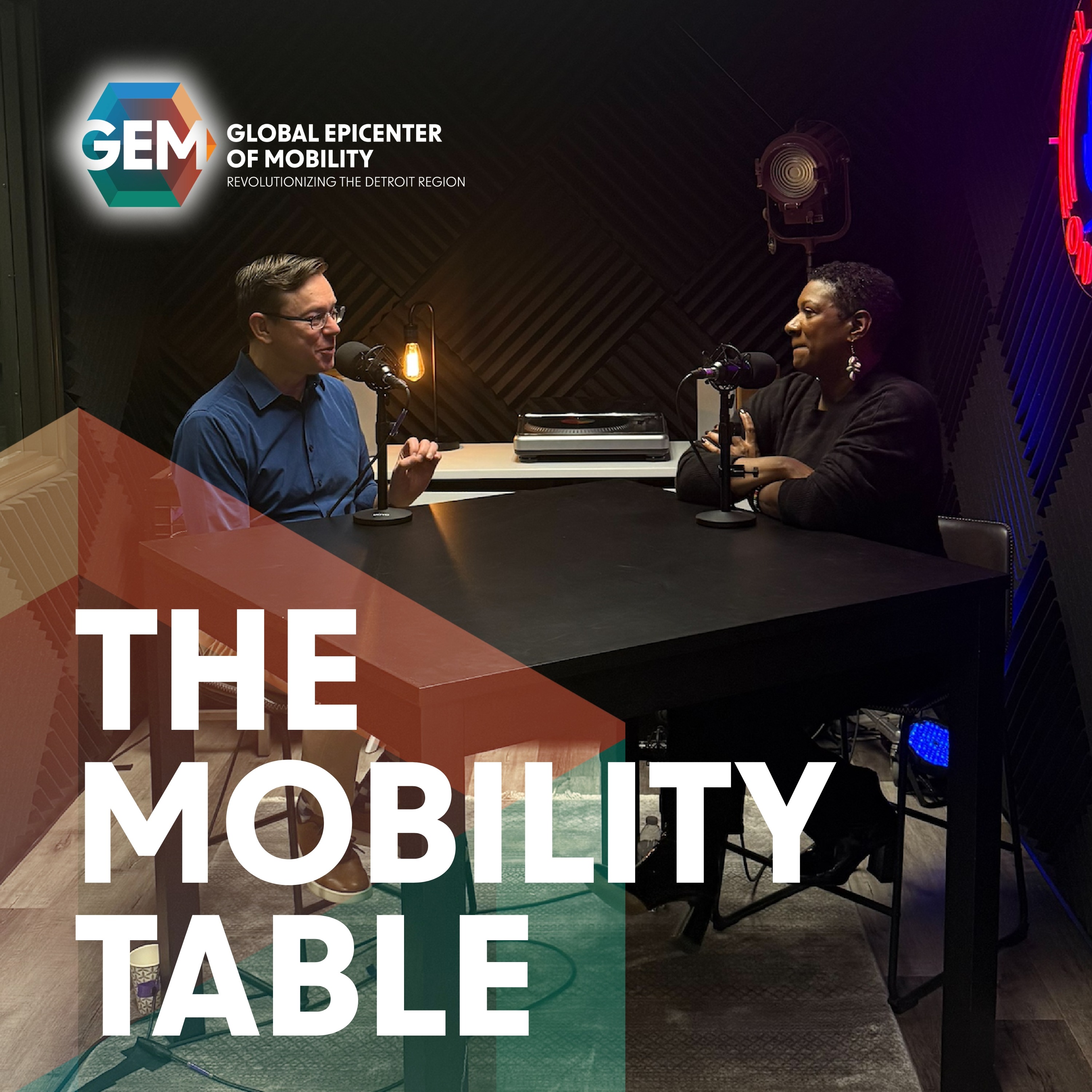
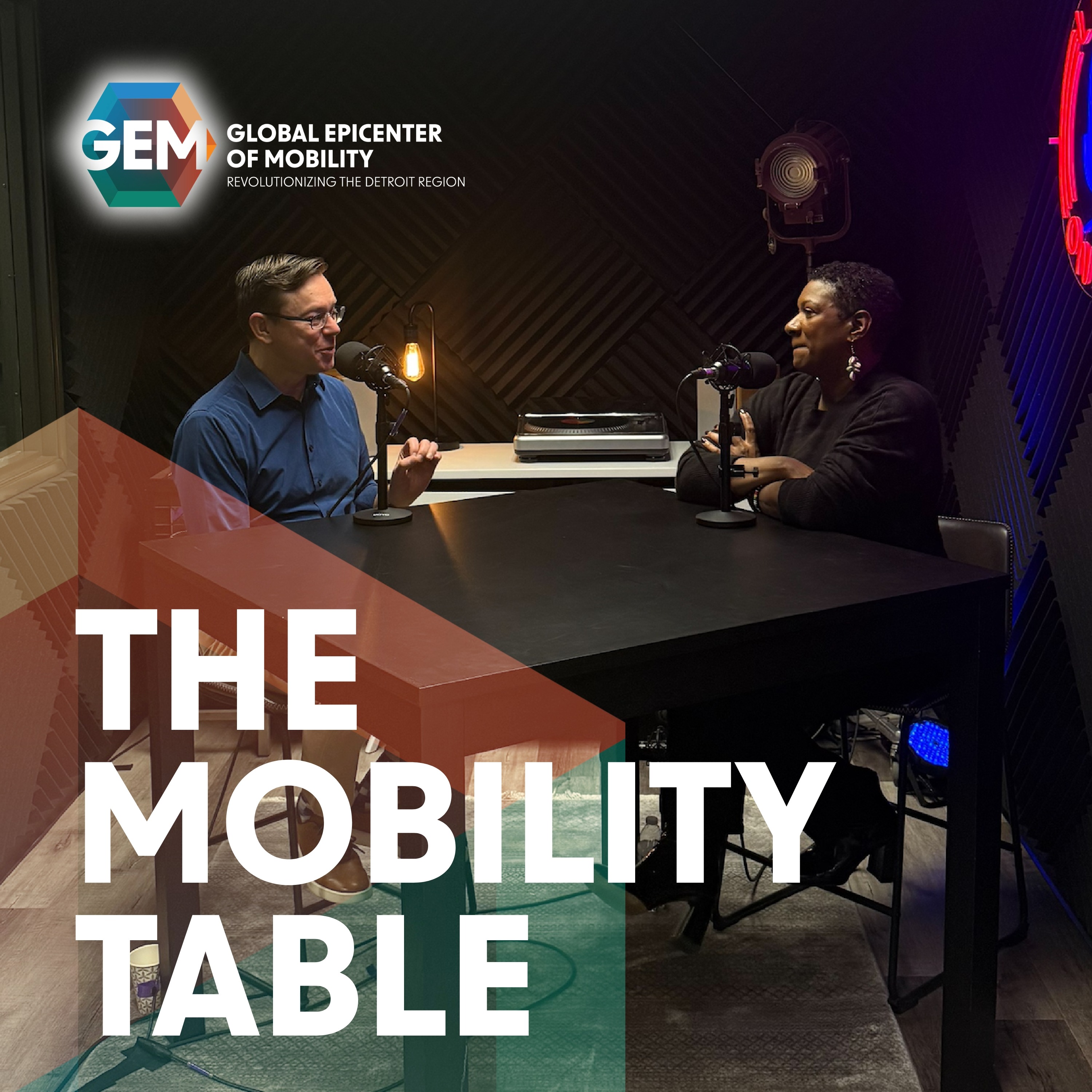
Hey, welcome, welcome to the mobility table.
I am Janine Gantt, the Mobility Engagement Officer for the Global Epicenter of Mobility with my co-host,
Bernard Swicky, VP of Mobility and Research, also at the DRP.
And we are so glad you've joined us today for another episode.
Or depending on where you're picking up this episode, it could be your first episode.
But anyway, we're here creating a table to talk about advanced mobility in the Detroit region
and all that might entail from workforce, to suppliers, to manufacturing, to trends, to headwinds, to tailwinds,
to just all kinds of things so that people can understand what's happening in our region
so that they can see themselves as a part of all this excitement that's happening in Detroit.
Yeah, and Janine, you know, we've talked about the ecosystem here in the Detroit region
and how broad and expansive it is and all the assets that we have.
And frankly, sometimes that can work against you. Sometimes there are so many choices, so many options
that people really don't know where to turn and it's difficult to know that you are eligible for help from a given source.
And whether you're an entrepreneur, whether you're a student, you know, we need ways to help people navigate this.
And that's what this episode is about and that's exactly what our featured guest does.
Well, you know, this is actually perfect. So some work that we did last year with the Global Epicenter Mobility,
we actually used this amazing company called Cultureship Team and brought them on to do some community engagement, right?
So what does community engagement look like? It is having conversations with folks in the community, having listening sessions.
And we talk with a variety of different stakeholders from suppliers to innovators to people in the educational system
and they're like, hey, this is great, we love this, but where do we go? What's the one place we can go to get information?
Because you're right, as you have an emerging ecosystem, there are lots of new players and people popping up
and you really don't know where do I go. If I have an idea, where do I go, right?
And so the Global Epicenter Mobility was, you know, we were brought together to do that.
We were brought together to create resources and opportunities for people so that they know where they can go in to this new ecosystem to get involved.
No, and as you know, as I like to say, Jim did not add any new capacity to actually serve people or companies or entrepreneurs, right?
Our capacity that we added is for information alignment, getting everyone steering in that same direction.
Because there are already so many fantastic people, entities, companies that are serving this region.
And frankly, it's a byproduct of awesomeness, if you think about it, right?
Oh, I love that.
Because, you know, we would not have this complex, evolved ecosystem if it weren't, you know, in some ways an embarrassment of riches.
So now that we've got it, now that we've got it, we have to help people navigate it.
Yeah, we really do. And I think, you know, this mobility table again is about bringing people to the table to talk about what they're doing,
talk about resources that might be available to, you know, share some insight in terms of how do you get involved?
This is, you know, something that you want to do.
But I love that whole idea of awesomeness.
I call it Detroit grit, right?
But that is awesomeness is included in all of that.
And we want to make sure, again, that people see themselves as a part of this because this is the future of Detroit, right?
Yeah, no, and it's a critical part of frankly uplifting the people in the communities is, you know, as someone who grew up in Detroit myself,
I know about the perceived chasm that you can sense or perhaps just believe is there that maybe isn't as strong as you thought, you know, from, you know,
the streets of, you know, wherever you live to, you know, that skyscraper of somewhere, you know, in that nice neighborhood.
And frankly, we have a lot of ways to help people get there.
If you're an entrepreneur, you're starting something new.
We have ways to help you do that.
But frankly, with every one of these efforts that we add, we also make it more difficult to choose what's right for me, right?
And so it's a byproduct of being a place where so much is available, right?
And that goes, you know, decades, maybe a century back to having the educational institutions, having this full, what we call ecosystem, you know, what does that really mean, right?
And it's having all those players in place.
And frankly, we did analyze it and study it in our social network analyses, the SNAs with Orange Sparkleball, which is a separate episode, I know, of the mobility table, you know, but we have a measurement, right?
We sense the scale.
And now it's just a question of where do I start?
And there's an open door that we're going to talk about.
Absolutely. And the other thing, too, is just because you are in the ecosystem doesn't necessarily mean that you know what the other players within the ecosystem mean.
100%.
And that's something else I've been seeing, because one of the things we've talked about in the past is kind of like the traditional manufacturing ecosystem had information flowing, you know, kind of in more of a vertical direction, right?
And it flowed to the same people.
But as this ecosystem emerges, you've got like this, it's more of this horizontal thing happening, right?
You've got all these different mini ecosystems that are developing many times around a particular founder or a particular supplier, right?
All those kind of things.
And so this group over here may not have any idea of the resources that are being offered in some of the other spaces.
No, and Janine, to your point.
I remember the first in-person meeting of all the GEM partners together.
So 24 different entities, and they're part of the same initiative. They're part of GEM.
But leaving that meeting, it was remarkable how many of them actually said, I didn't know that that's what HEX does.
I didn't know, you know, and if that's true for entities in which you are part of one movement, one program like GEM, you know, if that awareness isn't there for that, how much can there be for the entities you're not affiliated with?
That are even further removed and even know they're just across town or maybe on the same block.
But, you know, we had this conversation recently, but it's the idea of intentionality, right?
I mean, so if you take a look at our partners from a couple years ago, you're right.
In many cases, we're working in the same space together, but everyone's in a silo.
People are working kind of on their own, but I think what we're seeing is, you know, of course, we're stronger together, right?
There's no need to reinvent the wheel. There's lots of overlap.
And I think we as an entity of the Global Weather Center Mobility have really begun to see a strengthening of those relationships, of sharing of information and resources.
And I know I've been challenging everyone within our coalition to say, now you've got to be branching out, expanding your reach to so many other folks so that they know what resources are available in our region.
And that's really what this mobility table is about in many ways.
It's bringing some of that information to the table so that folks can understand what's happening and what's out there for people.
And I do want to say this because I know we have a fantastic guest coming on in a little bit.
And I think he is a great example. And I would say myself as well, you know, if you have worked in a particular industry for a long time and you may think, oh, well, that's it.
I'm going to retire. That's going to be it for me or there's no other pathway for me.
But this innovation space, this advanced mobility ecosystem is providing an opportunity for people to bring all their different tools to the table, right?
Because we really don't know what we might need as this thing emerges.
But I've been pulling all kinds of tools out of my toolbox that have made me really successful in helping to bridge the gap and helping to create awareness and all that kind of stuff.
So I know that our guest coming up who is a friend of yours, I'd love for you to introduce him.
But I think he has a similar journey in terms of his automotive background and where he is now.
So really talking about opportunities that exist for everyone in this advanced mobility space.
All right. It's my pleasure to introduce the guest for today's episode, Brett Scott, the director of WSU Open at Wayne State University.
Welcome back to the mobility table. We are here with Brett Scott. Brett, welcome.
Thank you very much.
All right. So thank you for joining us. And can we start by just having you tell us a little bit about your journey and what brought you here?
Sure. It's really interesting how things come together sometimes.
I started in Pontiac, Michigan. I was born in Pontiac, Michigan.
Pontiac Motor Division had a special program for high school students.
And so I started at Pontiac Motor in 1983 where, you know, I learned computer science and how to play Uker because I was third shit, you know, at Pontiac Motor.
And I spent 20 years at GM working on advanced electronics and audio systems and things.
I left there to help Volkswagen spool up their research lab in Palo Alto.
And that electronics research lab I stayed in for several years, they moved me back to Michigan and then moved to Fiat Chrysler for some years to work on advanced technologies in Silicon Valley.
And then left FCA and started working at startup companies, automotive related startup companies.
And then a mutual friend reached out and had suggested I apply for a job at a university which would never in a million years have crossed my mind.
It seems so far removed. I was used to being on the other side of the table of those conversations working with universities.
But it's turned out to be very fulfilling.
I love it.
So you've said so much and I do want to get to what you're currently doing now.
But in your introduction, you said something that I thought was really interesting and I think where many people may be considering or they found themselves or there may be an interest.
You went from working at the corporate organization like FCA and then you went to startups.
Tell me about that transition.
You know, it's another other side of the table, kind of other side of the table.
There is so much invention right now and a lot of the startup companies just need somebody with some background, some really good grounding and how business works and how to collaborate.
And that opportunity opened for me.
And with, you know, 30 plus years of experience in the auto industry, it made it easy to sort of make that jump to something smaller.
But working for something smaller has its challenges.
You know, when you're working for a Fortune One company like General Motors, it's...
They have all kinds of resources.
They have all kinds of resources.
You have to learn how to be a little more scrappy about it.
But that was a great experience and it's helped me in this university environment.
I mean, Wayne State University is a nonprofit organization of its own.
So as you know, it's a challenge making sure that the INS are meeting out every year and that we provide good educations for students at a reasonable price.
And it's been very interesting.
And Brett, you also serve as a mayor locally as well, which gives you kind of an implementation look at how all of this fits together.
Yeah, I started in the Pleasant Ridge City Commission in 2013 and got elected as mayor of the city in 2021.
I just recently signed up again for another four years.
I was elected in graduation and it's a really great experience.
And it also that experience with government relations and understanding how to just read people and see what they need.
You know, these basic needs of people helps in the university environment.
It also helps in the corporate environment to know what's really driving people's thoughts and emotions right now.
So I'm loving that experience.
And that fits so well in terms of as I hear your journey, that idea of understanding what people need feels very much like an innovator.
And how an innovator might think about something as they're designing something.
Right. And you know, one of the interesting things about innovation is that we're all sort of getting used to thinking about the next minute or five minutes or 10 minutes.
But innovation can have a lifelong impact on people, you know, thinking about the decade or decades of influence that your invention might have will help you decide what to do in this moment.
So that's certainly a part of what we hope to do at Wayne State is to ground people in those basics so that they're solving problems that are important now,
but also those things that have a lifelong impact on people.
A lot of the folks that go to school at Wayne State are first generation college students.
No one else in their family has gone or they're among the first generation.
And giving them that grounding is really important and I'm happy to be a part of it.
Well, I appreciate that you're lifting up that about Wayne State University, you know, our our through the Global Office of Mobility.
We have many university partners because we know that universities play a critical role in terms of innovation.
And then, you know, hopefully we can then commercialize what's been innovative.
But Wayne State, which I did get my master's from Wayne, I feel like doesn't get the same kind of recognition as some of the universities.
And I when I used to work at Wayne State in the School of Business and one of the big things I would always hear from from folks who would hire Wayne State graduates is they were a little bit more scrappy.
And no, we keep coming up with that word like a little more scrappy that little more hands on.
Because they were first generation, many of them and they did work while they were going to school, right?
So it's just like a different mindset.
And I think that mindset is really what's needed.
It's not necessarily mindset of privilege, right?
But it's a mindset of I've got to have the agency to be able to, you know, move my career forward, my idea forward.
And that's the same thing in the innovation space, right?
You've got to have that same kind of mindset.
Exactly.
There's such a strong entrepreneurial spirit in the Detroit area that if you can give students a little bit of that as they're going through their college experience.
And so many of Wayne State students actually have to work while they're going to school.
So, you know, being able to get a college education, keep food on the table and also think about what it might mean to have your own business
or to help another small business get off the ground is a very big deal.
We've at Wayne State, I think last numbers I looked at, I think we've helped 800 small businesses in the Detroit area,
200 of which are student-based small businesses and had about two and three quarters billion dollars of economic impact on the surrounding area.
So, you know, we've worked really hard to, you know, to help do our part for the Detroit area.
A lot of that is in the mobility space, but a lot of this are other things.
I mean, we're a great food capital.
I don't know a single person that's moved to Detroit that hasn't said, I found my favorite dish of XYZ right here in Detroit.
And it's a good place to connect with people.
And that's, you know, that's the WSU Open function, really.
And Brett, I feel like that's the perfect segue.
So, now as director of WSU Open, you get to bring people, companies, students into the fold, right?
Into that whole ecosystem at Wayne State, but also beyond as well.
Right.
So, I'm curious if you could just give us a little bit of a primer on how it is, how does that happen?
Yeah, I'll take a step back.
So, about 14 years ago, maybe about 15, the university saw it necessary to create this office of economic development.
It's now called the Division of Entrepreneurship and Economic Development,
whose function is to sort of spool up these businesses to help the region and to help our students, our faculty,
the whole university be an integral part of how business works in Metro Detroit.
And not many universities around the country have a function like this.
It was actually rather inventive when it was created and we see other universities creating this function.
We have a sister department that does technology commercialization within Wayne State that takes the invention.
We know them well.
Yeah.
You know, they take the inventions that come from the university either through departments or through faculty
and turn those into viable products, you know, with all of the notices of invention and all of that work that has to happen
to turn an idea into a real thing that could sell or might have some social impact.
And so, with a deed, the department, excuse me, the Division of Entrepreneurship and Economic Development.
Thank you for not spelling that out for us.
We were talking about acronyms, so thank you.
I know.
Those people that know me know I'm very acronym deficient, so I have to usually spell it out for myself.
And frankly, as you were saying it, I thought, hey, that says deed.
Yeah, deed.
So I'm glad you actually called it that.
Yeah, so the WSU Open function fits underneath deed.
Okay.
And it's a really simple concept.
So we're doing all these great things at the university.
We're one of the top 100 research universities in the country.
But how do people find us?
How do they reach us?
How do they get to the right department?
So WSU Open was created in 2024 to address that problem.
It's like any big organization.
It's not always easy to know who to contact.
So since its creation, we've had more than 200 points of outreach.
I think we've gotten through about half of them already.
There's another third that we're sort of working through.
We try to get back to everyone within 24 hours, which is an interesting thing to try to do when you're not actually sure what department or school or person it fits to.
But that's what we aim for.
And we found some really interesting things that people have brought to us and some really simple things that would have spun for weeks if they had reached the wrong person.
So that's, you know, part of what we try to do.
Yeah.
I'm curious.
Sorry to go ahead.
No, what I was just going to say, I mean, that's what, you know, innovation needs to be able to have that connector to that bridge builder.
That's very much the role of the global epicenter mobility is really kind of serving as that point, that place that knows where direct people, right?
Yes, we're convening folks, but, you know, where are we helping to bridge, to build bridges for people that don't necessarily know, you know, where to go.
So I love this.
I love this idea.
And there's just so much expertise on a university campus, particularly in the mobility space, that being able to connect the two things and to make it easier for them to work together is one of the things that actually just makes me just really happy when I see it happen.
I'll give you an example.
That was actually going to be my question.
You know, we had a company, Batch Brewery.
Oh, yeah.
I know Batch.
Yeah.
So they were coming out with a new formulation, some new flavors, but they needed a label to understand the caloric intake and all the things that you see on the side of a can of, you know, any beverage.
So they reached out to Wayne State.
We were able to connect them with our college of our department of nutritional science.
The students got an excellent opportunity to work on a project that they could literally go to the store and see their output, you know, what they worked on and to Batch had a great experience.
They got what they needed and will probably do this again with other companies where it gives the university the opportunity to give students a real world experience.
That's something that the students can actually put on their resume when they're out looking for a job.
We actually know how to make a label and what it means to operate the equipment and it keeps us connected with Detroit business.
I love that.
We have a founder through the GEM initiative, Brittany, who has started a business related to EVs and EV chargers.
Not a technician.
That wasn't her background.
She was a business major and this was a class assignment.
And so from that class assignment has emerged this business.
Exactly.
And she's hiring people.
She's training people.
She's building those connections and relationships.
But she was a Wayne State grad.
Exactly.
That's the kind of...
Wayne State grad and connection to Tech Town.
Right, exactly.
Tech Town and then we were able to connect her with talent.
So we had SEMCA, which is our partner for workforce development, was able to partner her in terms of talent that she might need.
I love that.
So yes, all these things connect together.
So you knowing what you need from the university perspective and then knowing where to connect within the broader ecosystem.
And then also then having these industry relationships and kind of knowing what founders have startups might need.
I mean, you're like so well positioned at the work that you're doing.
Well, and the experience you bring to it, right?
You have an understanding of what it takes to accomplish this.
And it's true again for any big organization where you might not even know the connections you have inside.
I'd say about two thirds of our inquiries come from outside world, but a third are now starting to come.
We didn't expect this, but it's happened this way are coming from inside where different departments are wanting to do things together on a common project.
And, you know, we have 13 schools and colleges.
They might not even realize that there is a colleague doing something similar where they could benefit from each other and work together with, you know, an outside entity.
So we're starting to get into those projects as well.
Yeah, and I thought that was a perfect point to make because you mentioned that being the case just within departments of one entity.
Never mind all of the entities that we have in this region that could be helping each other or helping a company or helping an individual.
So if it's happening within them, imagine how many opportunities we're losing for interaction between them.
Right.
So I love the fact that you are helping address some of this gap, frankly, because an asset unused might as well not be there.
Right.
One of the things that I really enjoy about the job is that I manage our relationship with Michigan Central and New Lab.
I was just going to ask him.
And this is like changing.
It's an example of where we don't actually know which of the 13 schools and colleges will benefit working with, I think it's about 180 or so founders at New Lab.
The number could be off a little bit.
But it's just a phenomenal opportunity for the students and it's also a phenomenal opportunity for startups.
And, you know, if you think about a startup company that's never hired an employee or or doesn't know how to do an internship or just needs temporary labor to get a job done.
This is a great opportunity.
So we're opening this up to students interned at Michigan Central and New Lab.
And it's a wonderful opportunity for various of the schools and colleges to work together to provide internships to students.
Well, you know, the cool thing about Wayne State, and this isn't like a Wayne State promo y'all, it just happens to be the conversation.
But it's an urban university.
Yeah.
I mean, it is an urban university in the middle of Detroit, right?
And so I think I see Wayne State University certainly as a trusted connector for people within the Detroit area for sure.
But, you know, within the region as well to be able to come in and know someone's got your back, but they see you and they want to make sure that you are connected.
Right.
It's an interesting thing for me having lived in Silicon Valley that distinction between Detroit and, say, Santa Clara is not that big.
They work very similarly.
A lot of these personal connections and the outreach is very similar.
Certainly there are different kinds of companies that have landed in one or the other place.
But the way that it works is not that different.
And so a lot of the things that have sparked, you know, ingenuity and innovation in Silicon Valley can work here and do work here because the way we work isn't all that entirely different.
So I can see why companies might have an outpost, even if they're a Bay Area company might have an outpost here because it's actually not that hard to figure out how Detroit works if you are used to making those connections and things.
And Brett, you mentioned, you know, your own extensive automotive experience, three different automakers plus everything else.
But I'm curious about this.
Detroit is now, and we say Detroit, but we mean the Detroit region, specifically the 11 counties around it.
So basically Southeast Michigan, but, you know, we're now getting into vehicles that float, fly, air, land and sea and space.
And so, you know, if navigating this environment was complex when it was more one mobility sector, you know, I think we need people like you and functions like you that much more now that we're also serving all these other mobility sectors.
Oh, for sure.
And we're, you know, trying to find a gap or maybe a connection between this technology as it goes on to a vehicle and as it goes on to a drone.
Yeah, right.
And it's a whole different bag than what we're used to.
Yeah, it's a, we are going to see, you know, how many meetings have we been in where we've all tried to predict the future of electric vehicles of the future of drones and all these things and it's a really difficult task.
We don't actually have a handle with all the geopolitical things going on.
But, but we do know that the innovation is going to continue.
I mean, one of the companies we've worked with at Wayne State by providing internships is Mott Mott.
Some of you here may know Mott Mott.
It's a form of mobility, although you won't see it as it's crawling through, you know, city infrastructure underground, but it is a form of mobility.
And we know that the technologies that they're creating are applicable to other spaces within mobility and is, it's going to be, and we're hoping to, you know, build a strong relationship with them.
They're also located at New Lab.
So it's made an awesome opportunity to provide them with interns through our Warrior Impact Program.
And a great example.
Yeah.
Yeah.
Thank you.
I know we've got to get ready to wrap up.
I really enjoyed and I feel like we should, like, we need another half hour.
We did.
Because we didn't even talk about the fact that he's the mayor of Plazent Ridge, right?
Correct.
Yeah, I encourage everyone.
If you've ever had this, this thought like I'm, you know, of a certain age, you know, I have enjoyed a good healthy career in the auto industry.
There are other things that you can do and still be a part of the auto industry of the mobility space.
And this notion of getting elected is a part of that and understanding the municipal and political aspects of mobility have been very interesting.
I'm also a member of the Specialty Equipment Manufacturers Association Political Action Committee because we know that the aftermarket and dealing with used cars is as important as dealing with new cars.
So there's all, there are all these ways to be involved and it has been, I have to say, I'm just, I'm so excited to be at Wayne State to do this and then also help my city and help the auto community in general.
You know, we talked about this, this idea, and that's what this table is all about, right?
It really is about helping people to see themselves in this space that we as a region, I always say that our assets are our people.
Like, yeah, we have all the other tremendous assets, but there are people and for someone like yourself to be able to kind of step back and say, you know, I'm not ready to stop yet.
I don't want to do that anymore, but I want to take all the tools I have and lead into a different purpose.
And so how do I repurpose, rewire the things that I have done to be a benefit to this new emerging space?
And I'm one of those folks too, and it's just so exciting to see all the technology and the energy and, you know, and to know that we have the experience and connections to be able to play an important role, right?
That's bridging the gap and bridging resources and bridging people and organizations together.
We're going through a moment in the history of humans that is unlike most other histories of humans, and I don't mean to get, you know, all too editorial about it, but seriously, it is a major change.
And this mobility space, how people move, how people contact each other, relate to each other is all sort of, you know, somebody hit a big reset switch.
And we're all figuring that out. So there's so much opportunity out there to be a part of that invention of how we, you know, get through and improve and expand upon what we do with each other.
That also makes it a time of opportunity.
A total time of opportunity.
It's time to seize it.
And thank you for your work in actually helping people to seize it.
Brett, thank you.
It was a pleasure talking to you.
Yeah.
It was a pleasure having you on.
Enjoyed it.
Our guest today has been Brett Scott.
Thank you very much for joining us for the mobility table and we will see you next time.
About this episode
Wayne State’s Brett Scott joins Janine Gantt and Bernard Swicky to unpack how Detroit’s advanced mobility ecosystem can be hard to navigate—too many programs, partners, and eligibility rules, with organizations often unaware of each other. Scott explains WSU’s “WSU Open” (created in 2024) as a fast outreach and routing hub that connects students, startups, and companies to the right campus resources, complementing tech commercialization and internship pathways. He shares his GM-to-startups-to-university journey, plus real examples like Batch Brewery and EV founder support, and ties it to broader mobility beyond cars.
Bret Scott sat down with Jeannine and Bernard at The Mobility Table to discuss getting connected to resources in the mobility industry. They explored the challenges in navigating the mobility industry’s assets and explored the way WSU Open acts as a connector for mobility stakeholders to navigate the knowledge and support available in the Detroit region’s advanced mobility ecosystem.
Bret Scott is the Director of WSU Open at Wayne State University. He is also the Mayor of Pleasant Ridge, a position he has held since 2019. Prior to his position at Wayne State, he worked in roles across the automotive industry and at mobility-related startups.