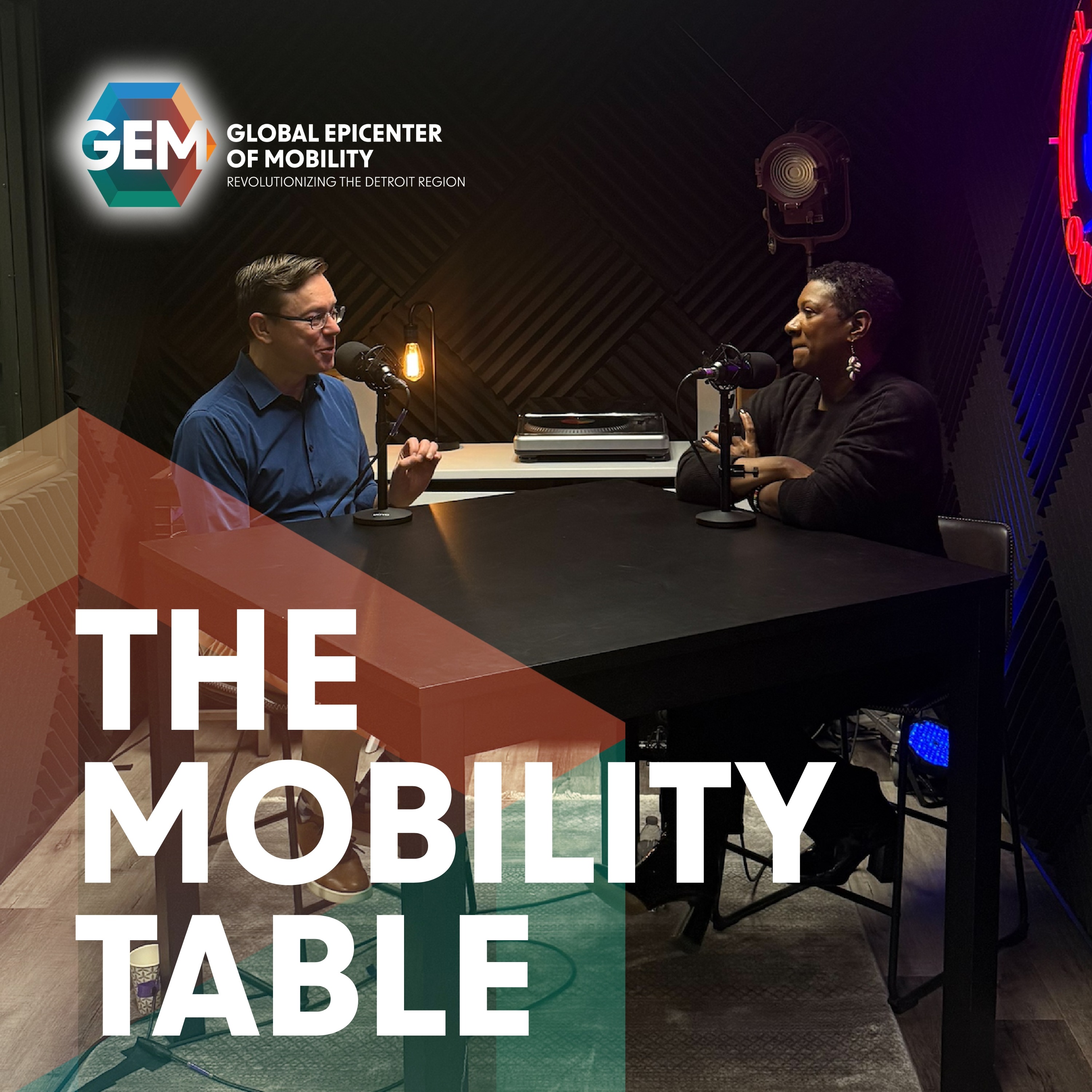
Finding Resources in the Mobility Ecosystem with Bret Scott, Director of WSU Open at Wayne State University
About this episode
Wayne State’s Brett Scott joins Janine Gantt and Bernard Swicky to unpack how Detroit’s advanced mobility ecosystem can be hard to navigate—too many programs, partners, and eligibility rules, with organizations often unaware of each other. Scott explains WSU’s “WSU Open” (created in 2024) as a fast outreach and routing hub that connects students, startups, and companies to the right campus resources, complementing tech commercialization and internship pathways. He shares his GM-to-startups-to-university journey, plus real examples like Batch Brewery and EV founder support, and ties it to broader mobility beyond cars.
Bret Scott sat down with Jeannine and Bernard at The Mobility Table to discuss getting connected to resources in the mobility industry. They explored the challenges in navigating the mobility industry’s assets and explored the way WSU Open acts as a connector for mobility stakeholders to navigate the knowledge and support available in the Detroit region’s advanced mobility ecosystem.
Bret Scott is the Director of WSU Open at Wayne State University. He is also the Mayor of Pleasant Ridge, a position he has held since 2019. Prior to his position at Wayne State, he worked in roles across the automotive industry and at mobility-related startups.
eligible for help
"there are so many choices, so many options that people really don't know where to turn and it's difficult to know that you are eligible for help from a given source."
They’re saying that when there are lots of programs, it can be hard to tell which ones you qualify for. Part of the goal is helping people figure out where to go for the right kind of help.
The episode highlights a common barrier in emerging ecosystems: people may not know whether they qualify for assistance from a given program or organization. This is framed as a navigation problem that community engagement and centralized resources can help solve.
Global Epicenter of Mobility
"So some work that we did last year with the Global Epicenter Mobility... And so the Global Epicenter Mobility was, you know, we were brought together to do that. We were brought together to create resources and opportunities for people..."
The “Global Epicenter of Mobility” is described as a group that brings people together and helps create resources. It’s basically a hub meant to connect people to opportunities in the mobility space.
The “Global Epicenter of Mobility” is referenced as an organization that convenes stakeholders and creates resources and opportunities. In the episode, it’s positioned as a hub for connecting people to the broader Detroit mobility ecosystem.
Cultureship Team
"So some work that we did last year with the Global Epicenter Mobility, we actually used this amazing company called Cultureship Team and brought them on to do some community engagement, right?"
Cultureship Team is a company the hosts say they hired to help with community outreach. The point is that they brought in specialists to listen to people and help shape how resources are shared.
Cultureship Team is referenced as a company brought in to support community engagement activities. The episode uses it as an example of using external partners to gather input and help people find resources.
community engagement
"So what does community engagement look like? It is having conversations with folks in the community, having listening sessions. And we talk with a variety of different stakeholders from suppliers to innovators..."
Community engagement means reaching out to people in the community and listening to what they need. Here, it’s used to figure out where people can get help and information.
Community engagement is the process of involving local residents and stakeholders through conversations, listening sessions, and feedback. In the episode, it’s presented as a way to understand what people need and where they should go for information and support.
new players popping up
"Because you're right, as you have an emerging ecosystem, there are lots of new players and people popping up and you really don't know where do I go. If I have an idea, where do I go, right?"
They’re talking about how new organizations keep showing up, and it can be confusing to know who to contact. That’s why they want a clear place to find information.
“New players popping up” describes how rapidly changing ecosystems can create confusion about where to go for information or support. The episode uses this to justify the need for navigation tools and a centralized place to learn about opportunities.
social network analyses
"And frankly, we did analyze it and study it in our social network analyses, the SNAs with Orange Sparkleball, which is a separate episode, I know, of the mobility table, you know, but we have a measurement, right? [319.3s] We sense the scale."
Social network analysis is a way to look at how different groups are connected—who works with whom and how information spreads. The speaker is saying they studied the community connections to understand the scale of resources.
“Social network analyses” (SNA) are methods used to map relationships between people or organizations and measure how information and influence flow through a network. Here, it’s used to study the structure and reach of the local ecosystem of resources.
SNAs
"And frankly, we did analyze it and study it in our social network analyses, the SNAs with Orange Sparkleball, which is a separate episode, I know, of the mobility table, you know, but we have a measurement, right? [319.3s] We sense the scale."
“SNAs” means social network analyses. It’s a way to study how people and organizations are connected so you can understand how information and support move through a community.
“SNAs” is shorthand for “social network analyses,” a technique for quantifying and visualizing relationships in a network. In this episode, it’s referenced as a measurement tool used to understand the mobility-resource ecosystem’s scale and connectivity.
advanced mobility ecosystem
"But this innovation space, this advanced mobility ecosystem is providing an opportunity for people to bring all their different tools to the table, right? Because we really don't know what we might need as this thing emerges."
An “advanced mobility ecosystem” is basically the whole system around modern transportation. It includes the tech, organizations, and people working together, and it creates new opportunities as transportation changes.
An “advanced mobility ecosystem” refers to the network of people, technologies, and organizations working together around modern transportation—often including connected vehicles, electrification, software, and mobility services. The speaker frames it as a space where different tools and pathways can help people adapt as mobility needs evolve.
Pontiac
"I started in Pontiac, Michigan. I was born in Pontiac, Michigan. Pontiac Motor Division had a special program for high school students."
Pontiac was a car brand under General Motors. Here, it’s mentioned because the guest began working at the Pontiac division in Michigan.
Pontiac was a GM (General Motors) brand known for passenger cars and performance-oriented models. In the transcript, it’s referenced as the location and employer division where the guest started his career.
GM
"And I spent 20 years at GM working on advanced electronics and audio systems and things. I left there to help Volkswagen spool up their research lab in Palo Alto."
GM stands for General Motors, a major car company. The guest worked there for a long time on electronics and audio systems—basically the tech inside today’s cars.
GM (General Motors) is one of the world’s largest automakers. The guest says he spent 20 years at GM working on advanced electronics and audio systems, which ties directly to how modern cars increasingly rely on software and electronics.
advanced electronics and audio systems
"And I spent 20 years at GM working on advanced electronics and audio systems and things. I left there to help Volkswagen spool up their research lab in Palo Alto."
Cars today are packed with electronics, and the audio system is one of the big user-facing parts. This phrase points to the kind of tech work that makes modern cars feel “smart” and feature-rich.
Modern vehicles rely heavily on electronics—everything from infotainment to vehicle control modules—and audio systems are a major part of the in-cabin experience. The guest’s background suggests expertise in the hardware/software integration that supports today’s connected and feature-rich cars.
Volkswagen
"I left there to help Volkswagen spool up their research lab in Palo Alto. And that electronics research lab I stayed in for several years, they moved me back to Michigan and then moved to Fiat Chrysler for some years to work on advanced technologies in Silicon Valley."
Volkswagen is a big car company. The guest says he helped them start up a research lab in Palo Alto, which shows how car tech development overlaps with tech industry work.
Volkswagen (VW) is a major global automaker. The transcript mentions the guest helping Volkswagen “spool up” a research lab in Palo Alto, highlighting the role of automotive R&D in Silicon Valley-style tech development.
Fiat Chrysler
"And that electronics research lab I stayed in for several years, they moved me back to Michigan and then moved to Fiat Chrysler for some years to work on advanced technologies in Silicon Valley."
Fiat Chrysler was a major automaker group (now part of Stellantis). The guest says he worked there on advanced technologies, connecting car development with tech innovation.
Fiat Chrysler Automobiles (FCA) was the predecessor company to Stellantis, formed from Fiat and Chrysler. In the segment, it’s where the guest worked on advanced technologies in Silicon Valley, again emphasizing electronics/software-focused automotive work.
FCA
"You went from working at the corporate organization like FCA and then you went to startups."
FCA was a big car company group. When someone says they worked at FCA, they usually mean they worked in a large, established automaker with lots of corporate structure and resources.
FCA refers to Fiat Chrysler Automobiles, a major automaker group that operated for many years before later restructuring. In the auto industry, “FCA” is often shorthand for corporate roles, large-scale engineering, and big-company supply-chain and compliance processes.
startup companies
"There is so much invention right now and a lot of the startup companies just need somebody with some background, some really good grounding and how business works and how to collaborate."
A startup is a newer company that’s trying to build something quickly, often with less money and fewer people. The speaker is saying startups need experienced people who can work well with others and help the team move fast.
The transcript contrasts corporate automaker environments with startups, emphasizing that startups often need people who understand both the auto industry and how to collaborate and execute with fewer resources. This is a common theme in mobility and automotive innovation ecosystems.
auto industry
"With, you know, 30 plus years of experience in the auto industry, it made it easy to sort of make that jump to something smaller."
The “auto industry” just means the world of cars and car companies. The speaker is saying their long experience in that field helped them transition into smaller organizations and a university setting.
The “auto industry” is referenced as the speaker’s domain expertise built over 30+ years. In mobility discussions, this typically includes manufacturing, supply chain, corporate strategy, and how large organizations operate—skills that can transfer to education and public-sector initiatives.
General Motors
"When you're working for a Fortune One company like General Motors, it's... They have all kinds of resources."
General Motors is a major U.S. car manufacturer. The point here is that big companies like GM have lots of support and systems, while smaller groups have to move faster and be more creative with limited resources.
General Motors (GM) is one of the “Big Three” automakers in the U.S. The transcript uses GM to contrast large corporate environments—where resources and processes are plentiful—with the need to be more flexible and resourceful in smaller organizations.
EVs and EV chargers
"We have a founder through the GEM initiative, Brittany, who has started a business related to EVs and EV chargers. Not a technician."
“EV” means electric cars. “EV chargers” are the stations that plug in to charge those cars. The podcast is talking about how people and resources connect to support EV businesses.
The term “EV” refers to electric vehicles, and “EV chargers” are the infrastructure used to supply electricity to recharge them. In an ecosystem context, charger availability and workforce training are often key to making EV adoption practical for businesses and communities.
GEM initiative
"We have a founder through the GEM initiative, Brittany, who has started a business related to EVs and EV chargers."
They mention a program called the “GEM initiative.” It’s basically a support effort that helps people get connected and turn ideas into real businesses, including EV-related ones.
The “GEM initiative” is referenced as a program that supports or connects founders to opportunities in the EV space. In this segment, it’s used to explain how a business idea can grow out of an educational or institutional pathway.
mobility sectors
"And so, you know, if navigating this environment was complex when it was more one mobility sector, you know, I think we need people like you and functions like you that much more now that we're also serving all these other mobility sectors."
Mobility sectors are different types of ways people and goods get around. The point here is that planning and support gets harder when you’re dealing with many kinds of transportation at once.
“Mobility sectors” refers to different categories of transportation and movement—such as personal vehicles, public transit, micromobility, logistics, and emerging modes like drones or autonomous systems. The speaker is framing the challenge as coordinating resources across multiple transportation domains rather than just one.
drones
"Yeah, right. And it's a whole different bag than what we're used to. Yeah, it's a, we are going to see, you know, how many meetings have we been in where we've all tried to predict the future of electric vehicles of the future of drones and all these things and it's a really difficult task."
Drones are small flying machines that can be controlled from the ground or fly on their own. In mobility, people often think about using them for delivery or other services.
Drones are unmanned aerial vehicles controlled remotely or autonomously. When mobility ecosystems discuss drones alongside EVs, they’re usually talking about logistics, last-mile delivery, and the supporting systems (airspace rules, safety, and communications).
electric vehicles
"Yeah, right. And it's a whole different bag than what we're used to. Yeah, it's a, we are going to see, you know, how many meetings have we been in where we've all tried to predict the future of electric vehicles of the future of drones and all these things and it's a really difficult task."
Electric vehicles are cars (and sometimes trucks) that run on electricity instead of gasoline. People talk about them a lot because charging and battery technology affect how practical they are day to day.
The term “electric vehicles” (EVs) refers to cars and other road vehicles powered primarily by electric motors and rechargeable batteries. In mobility discussions, EVs often come with topics like charging infrastructure, battery supply chains, and software/controls as much as traditional mechanical engineering.
municipal and political aspects of mobility
"And this notion of getting elected is a part of that and understanding the municipal and political aspects of mobility have been very interesting."
This means how city leaders and local government decisions affect how people move around. Things like rules, infrastructure projects, and planning can change transportation a lot.
This phrase points to how cities and local governments shape transportation through policy, permitting, infrastructure planning, and regulation. It frames mobility as something influenced by elected officials and municipal decision-making, not just engineers and automakers.
Political Action Committee (PAC)
"I'm also a member of the Specialty Equipment Manufacturers Association Political Action Committee because we know that the aftermarket and dealing with used cars is as important as dealing with new cars."
A PAC is a group that helps support political candidates or causes. The idea is to influence laws and decisions that can affect the automotive industry.
A Political Action Committee (PAC) is an organization that raises and spends money to influence elections and public policy. The speaker’s point is that automotive specialty/aftermarket stakeholders use PACs to advocate for regulations and legislation affecting their businesses.
aftermarket
"I'm also a member of the Specialty Equipment Manufacturers Association Political Action Committee because we know that the aftermarket and dealing with used cars is as important as dealing with new cars."
The “aftermarket” is the part of the automotive industry that supplies replacement parts, accessories, and upgrades for vehicles after they’re sold new. The speaker connects it to used cars, emphasizing that aftermarket support is as important as new-car supply chains.
Specialty Equipment Manufacturers Association
"I'm also a member of the Specialty Equipment Manufacturers Association Political Action Committee because we know that the aftermarket and dealing with used cars is as important as dealing with new cars."
SEMA is a big industry group for companies that make car parts and accessories. In this episode, it’s mentioned because they also get involved in politics that affect the industry.
The Specialty Equipment Manufacturers Association (SEMA) is a major U.S. trade organization representing companies that make automotive specialty equipment, parts, and accessories. Here, it’s referenced through its Political Action Committee, highlighting how the industry engages in policy.
used cars
"I'm also a member of the Specialty Equipment Manufacturers Association Political Action Committee because we know that the aftermarket and dealing with used cars is as important as dealing with new cars."
Used cars are cars that have already been owned before. The used-car market is important because it drives demand for repairs, parts, and services.
“Used cars” are vehicles sold after their original purchase, which creates a large secondary market for parts, repair, and financing. The speaker emphasizes that the aftermarket ecosystem and used-car dealing are critical parts of the broader mobility industry, not just new-vehicle sales.
Request an Explanation
Heard something you'd like explained? We'll add it to this episode.
Sign in to request explanations for terms you heard.
Want to learn more?
Browse our glossary for plain-English explanations of automotive terms, jargon, and concepts.
Help improve this episode
See something that's not quite right? Our annotations are AI-generated and can sometimes miss the mark. Click the flag icon on any annotation to suggest a correction.