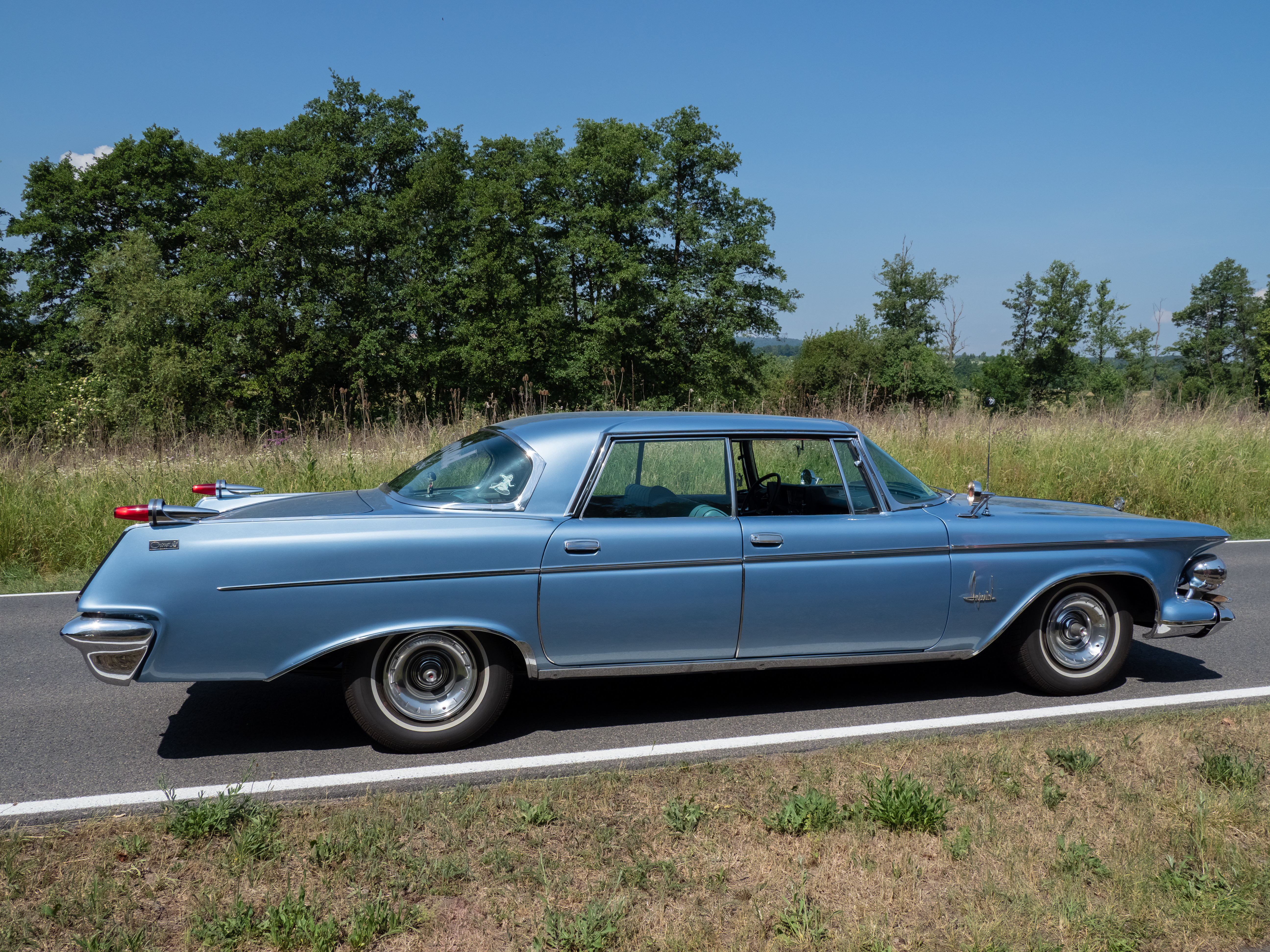
The Chrysler Imperial is a fancy car that was made for many years, known for being comfortable and stylish. It was one of Chrysler's top models and is often compared to other high-end cars. People mention it because of its luxurious features and classic design.
Car
Spinner
The Spinner is a made-up flying car from the movie Blade Runner. It's shown as a way people get around in the future, flying above the ground instead of driving on roads.
The Volkswagen Beetle is a famous car that many people recognize. The 1968 version is known for being cute and was featured in a popular movie called 'The Love Bug'.
The Volkswagen Bus is a well-known van that became popular in the 1960s, especially among people who liked to travel and camp. It has a unique shape and lots of space inside, making it great for families. People love to talk about it because it represents a fun and free-spirited time in history.
'Herbie Fully Loaded' is a movie about a magical Volkswagen Beetle that can drive itself and has a personality. It's a fun family film that shows the car in exciting races and adventures.
Cinema Vehicle Services is a company that makes special cars for movies. They help create the vehicles that you see on screen, making sure they look just right for the film.
NASCAR is a type of car racing that takes place on oval tracks. The cars are designed to go really fast and are built specifically for racing, making them different from regular cars you see on the road.
The Ford Mustang is a popular sports car that has been around since the 1960s. It's known for being fast and stylish, and many people love it for its classic design and powerful engines.
Car
Mercury
Mercury was a car brand that made various models, and the '50th Mercury' suggests a special version of one of their cars.
The Shelby Cobra is a fast and stylish sports car made in the 1960s. It's famous for being powerful and is loved by car enthusiasts. People talk about it because it's a classic example of American muscle cars.
The Ferrari 308 GTSi is a classic sports car from the early 1980s. It's famous for its sleek design and powerful engine, and many car enthusiasts love it for its history and performance.
The Rolls Royce Phantom is a very expensive and luxurious car. It's known for being one of the best cars in the world, made with high-quality materials and a lot of attention to detail.
The Chevrolet Beretta is a small car that was made in the late 1980s and 1990s, designed to look sporty and be affordable. It was popular among younger drivers who wanted a fun car without spending too much money. People mention it because it represents a certain style of cars from that time.
A buck is a model of a car that's only partially built, used in movies to help filmmakers shoot scenes easily. It helps them show the car without needing a whole vehicle.
The Dodge Charger SRT is a fast and powerful car that many people love for its speed and sporty look. It's part of the Charger lineup, which is known for being a muscle car.
Stellantis is a big company that makes cars. It was created when two car companies, Fiat Chrysler and PSA Group, joined together. They own many car brands you might know.
Muscle cars are a type of car that is very powerful and fast, usually made in America. They are designed to go really fast in a straight line and have a strong engine.
Car
Dodge Scat Pack
The Dodge Scat Pack is a special version of some Dodge cars that makes them faster and more fun to drive. It has a strong engine and cool features.
MSRP is the price that the car maker suggests you should pay for a car. It can be different from what you actually pay.
LIVE
Well, when the movie came out, that's when I graduated, but I did this car, probably
the tail end of 87, something like that.
And there was just a thing on the wall in the transportation area that said design a
movie car, like you were going to rent an apartment, I ripped off the number.
Come on, roommate wanted.
Yeah, exactly.
I ripped off the number called, it was Anton First, who was the production designer.
I said that they were thinking about doing this new Batman film, and he needed some sketches.
So I got to work.
I was a paid designer.
I think I got 250 bucks, which is big bucks.
And and then I got a call maybe a year later, you know, that J.
Orberg had put this thing together.
Hello and welcome to Cars That Matter.
I'm your host, Robert Ross.
On this episode, Fireball Tim, the concept artist and designer behind cars like the Batmobile,
leads us on a tour of unique movie cars at the Peterson Automotive Museum.
Stick around for the stories behind Grease Lightning, Herbie and even a cop car from Blade Runner.
This is Robert Ross.
Welcome to another episode of Cars That Matter.
We're here at the Peterson Automotive Museum on Wilshire Boulevard in Los Angeles, probably
the most popular museum, certainly in America, for cars.
And I'm here with my friend Fireball Tim Lawrence.
Fireball, nice to see you.
Thanks for having me.
You know, this museum has hundreds and hundreds of cars on display.
But when it comes to icons, it's some of the movie cars that are the most
memorable and the most well known.
Now, icons and overused word.
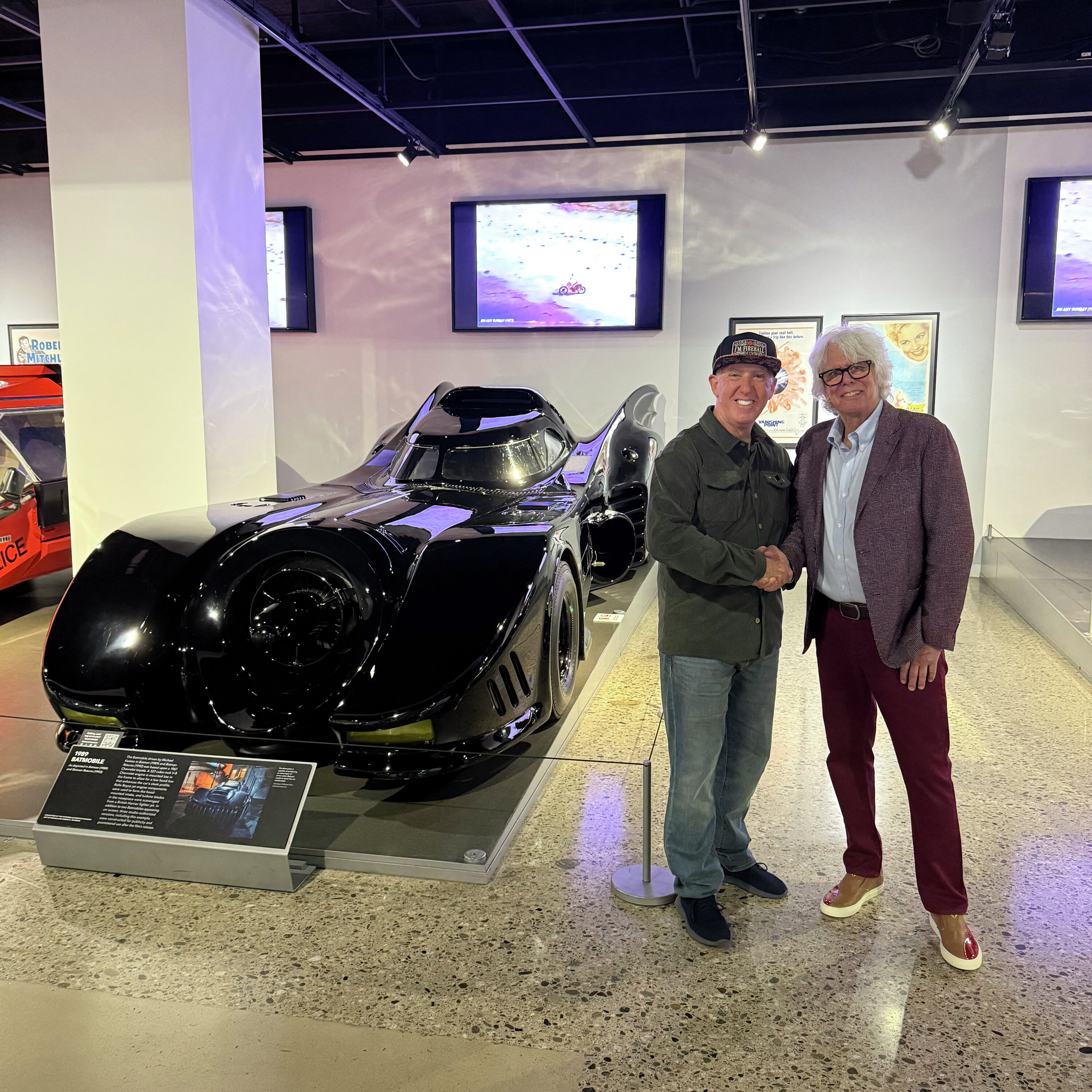
But if there were ever an iconic movie car, it would probably be Batman's
car from the 1989 film.
And guess what?
That's your car.
You know, it was it kind of came at a time.
The 80s was a hotbed of so many unique things that came out.
But it was really probably one of the first times that the the movie used the car as a
promotional aspect for the film when it premiered in Westwood.
They had the car on display.
And there was more people crowded around the car than around Michael Keaton and anything else from the movie.
I don't doubt that for a minute.
You know, you you were obviously in a very unique position, Fireball,
because you were in school at the time.
You were at Park Center College of Design in Pasadena.
Well, when the movie came out, that's when I graduated.
But but I did this car and probably the tail end of 87, something like that.
And there was just a thing on the wall in the transportation area that said design a movie car
like you were going to rent a apartment.
I ripped off the room.
They wanted. Yeah, exactly.
I ripped off the number called it was Anton first,
who was the production designer, said that they were thinking about doing this new Batman film.
And he needed some sketches.
So I got to work.
I was a paid designer.
I think I got two hundred and fifty bucks, which is a lot of big bucks.
Absolutely. And and then I got a call maybe a year later,
you know, that J.R.
Berg had put this thing together.
And it was really the first big Batman movie, right?
Because before that, it was the 66 series.
Sure. Everything was kind of campy and colorful.
Really. And it just did really well.
It just took off.
I think they've done 20 or 30 hot wheels since then of this car in different colors.
This is the hero car.
It's fully drivable.
Unbelievable. Super cool.
You know, if someone if someone could actually stand next to this car,
they realized that the scale and proportion is enormous.
This car is what, twenty seven feet?
Yeah, makes us feel half scale.
It's a monster.
I mean, there's no 59 Cadillac on the planet that's half this big, it seems.
And to be around the car is to really sense the gravitas of the character in the film,
the film itself, the action.
What an amazing thing.
Where do you start when it comes to designing a car like this?
Well, the first the first thing obviously, you know, a production designer or a director
will send me a screenplay.
And in most cases, I design, you know, weapons, sets, props,
vehicles, spaceships, things like that.
But it's kind of all of you.
In a way, yeah, it has kind of encompasses all of those things.
But you have to break down the script and you understand that movie cars are the same
as actors in the movie.
They have certain characteristics, certain things they have to achieve throughout the movie.
But in the case for the script, you know, it's described like something big and black.
That was about it.
You know, with some things, not not a lot of stuff like a scavenger.
Right. But the idea was that it wasn't like the original campy series.
It had to be something that wasn't identifiable as being a Chrysler Imperial
or a Cadillac or something.
It had to be something that truly on its own.
And I just started sketching and coming up with ideas.
It got locked in and and voila, it kind of showed up.
You know, but I tell you, there's nothing better for me as the notion of concept
to completion, to be able to draw something on a piece of paper.
And then a year or a half later, go to the movies and watch that in action.
You know, that's a tremendous, tremendous force.
That's really incredible.
It's like hatching an ostrich egg.
And this thing, apropos, the ostrich egg is about as big as a car can get.
Yeah. I mean, this thing is truly a monster.
And there are all kinds of anthropomorphic aspects about the car.
I mean, you see these vents and the scoops and you think of all kinds of, you know,
everything from animals to the heaven forbid vacuum cleaners.
I mean, there's all kinds of stuff going on.
Well, the notion was kind of that things have to look functional.
It has to look like there's their purpose built for something that it does something,
but it's never quite called out in many cases.
Like for certain vents, obviously that's a big air intake for what could be a
massive motor, but the motors appear.
So, you know, what exactly is this?
We don't really know, but you don't want to stand next to it because you get sucked in there.
That's right. That's right.
So a lot of it has to look like, you know, kind of like something has to look aerodynamic.
It may not be aerodynamic, but the selling point is has to look that way.
In this case, this was a character.
If Batman had anything, if he had a phone, if he had clothing, if he had something,
you know, generally it would be black.
It would be big and bold and menacing.
That was kind of the approach for this car.
And boy, when it comes to fins, I guess those probably take the award for the biggest
fins in the history of Ottawa.
Did they say, I want my fins bigger?
Well, you know, the bat was the bat 21.
The original concept that had some big fins, you know, unfortunately on the car.
But makes it go faster.
It makes it go faster. I think so.
Yeah, that's fantastic.
That's fantastic.
And my question would be, how long did it take to actually get from sketch pad
to finished lock up?
Well, they went directly into the bill.
There wasn't any scale model done.
It was, you know, they had sketches.
Then they created plan drawings.
The difference between a concept artist and, let's say, an architect is that most
architects design from the standpoint that this has to be built, has to be
practical, functional, has to fall within the budget.
And that could be good when you have a limited time.
You can't be blue sky concept, right?
But a concept artist working in film, we have no restraints, no constraints on budget,
no constraints on what can or can't be done.
It's all blue sky.
And then once it gets designed, they have to figure out a way to make it.
That's right.
Right, because the director has approved it and the architects are the art directors,
their sweat bullets because they don't know how they're going to make this thing.
Yeah, but of course there's budget.
Oh, wait, that's just Hollywood.
There is no budget.
Nowadays, we can, well, CG will do all that in post, the joke in my day was
we'll do that in post, right?
But nowadays, everything can be done in CG.
It's very rare to see practical stuff.
Well, you know that's actually an interesting point.
Let's talk about that for a moment.
When you were at art center in the mid the late 80s,
technology was just coming online.
I mean, the computer aided design was happening.
But there was certainly none of the kind of digital manipulation AI or any of the tools that designers have today
You actually still had to draw and build and think about these as man-made objects
As opposed to computer-made objects
Everything was done from the sense that we had to build it
The highest tech at that time was like Tron had come out in 1984 and you saw what that looked like
It was very minimal and the tanks and everything
But the CG was very minimal
Even some of the movies I did Lawnmower Man
I did a few other movies where the CG was very crude and looked that great
But it was the sign of the times, right?
And it would progressively get better
But anytime you design something, whether it was weapons or it was sets or it was some vehicles or spaceships
You were under the assumption that it was going to get built
So we did the movie Escape from LA and the helicopter
Those were like wild cars
So they built that and the props were CG and those were crude and bad
But you know what's amazing, talk about this, especially this disbelief
Viewers didn't mind that because they were so engaged in the story
So much storytelling and narrative with everything
But as long as the story is solid, people love it
Well, this was obviously the beginning of a great movie car design career
You've done probably hundreds of cars and vehicles for films, TV commercials
You know, all kinds of things
We've got some more of them here
Shall we take a look?
Let's go
We'll talk about a vision of the future
This car is from the 1982 film Blade Runner
Which the irony is not lost on me
That it was about a dystopian Los Angeles
Just a few years in back of us, 2019
So it's quite a prescient image of our city today
Well, maybe not quite this diabolical
It's really a remarkable looking car
And it was designed by a friend and mentor of yours, Fireball
Tell us about Sidney
Yeah, so Sid was a gentleman that I met back in the early 80s
About the tail end of 80, 1981
I was working at a bookstore in Ventura
I saw his first book was called Sentinel
Saw his address on the back
I was enthralled with the book so much that the bookstore said
You can keep the book, but you're fired
So I left
And I went down to Hollywood where he lived
And I met Sid and I decided to just kind of shadow him
And I went down to his place every Friday for a year
And I spent the entire day watching him design
And it became a mission for me
And he was working on Blade Runner at the time
This is Deckard's police car
That Harrison Ford drove
In the rainy scene
And then the spinner comes down and asks him why he's there
He was kind of surveilling things
But this car was originally built by Gene Winfield
As well as a bunch of other movie cars including the spinner
But Sid was, he was a force
An absolute force, you know
As a visionary, as a futurist, as a concept guy
When I saw him do these things
I said, that's it for me
That's what I want to work on
And when I left ArtCenter, I went to Imagineering
And then for a few years
And then I went into film right after that
And didn't look back
But when they were doing cars like this
For these movies, I said, I got to get into that
And that became my mission at that point
Well, this is an amazing thing
You know, you think about car designers
Who are actually creating new models
That will be produced in a few years
That are actually a part of the public consciousness
The automotive landscape things we see on the road
That's one aspect of looking into the future
But guys like Sid and guys like you
Are actually looking well into the future
So here fantasy and imagination
Takes on a completely different level of intensity
I mean, we're looking at the
Look at the transmission tunnel here
You've got these resistors and capacitors
Kind of, you know, soldered on here
And you've got these weird materials
And condensers and exposed pipes
This is really a vision of a world
That in the case of this film
Nobody would want to live in
Amazing, amazing
When you project, you know, Sid was a master
Projecting 100, 200, 300, 400 years into the future
Where instead of upgrading things that we had
You had to re-envision ideas
You know, he had the vision of what was called the dricks
And the dricks was the emergence of a dog
And a bird on a molecular level
And what that would be
Or if a human merged with a dog
What would that look like?
And then we mastered that biology
And he would create these abundant vision paintings
Of these worlds that existed that were extraordinary
And you could look at them for hours
And then he would apply that to Blade Runner
And you could look at his paintings
And you could see, what's going on up here?
What is all that?
And he goes, I don't know what that does
But it has to look like it does something
And those kind of visions
Blade Runner did not do well when it came out
Nobody liked it
But over time
It was too ahead of its time
And it was also dystopian
It wasn't a good vision of the future
But eventually it affected every movie since then
And still does to this day
And this car was certainly an iconic example of that
It's a remarkable thing
What is it actually? Can you tell us what it is?
I don't know
I think it's from the ground up
This is not something that you could say
It was originally a Chevy, originally anything else
There's a lot of stuff in here
And Gene did a fabulous job at creating
So many of these iconic cars
We just lost him recently
Amazing friend, amazing guy
Over the years as well
I feel very fortunate to have known a lot of these icons
And I just do my best to try to live up to that
To what those guys originally set forth
Well, that's incredible inspiration
And you were very fortunate to be able to spend
Your formative years as a designer with them
Because those guys, those are one of a kind
And then there'll be a generation younger than me
That will do the same thing
So I got to get busy doing my stuff until then
Time for a break, but we'll be right back
And now back to my conversation with Fireball
Well, I think I was about 13 years old
When the first love bug came out in 1968
It was a phenomenal film
And it really had some heart, that little car
You had to love it
Of course, Volkswagen bugs were ubiquitous back then
Now there's certainly not a common sight on the road
But this is a whole new car for a whole new movie
Isn't that right?
Yeah, this was done for the 2005 film
Herbie Fully Loaded
I did this car with Cinema Vehicle Services
They're the ones that built it
And they actually built a lot of them for the movie
At that time, you could have the budget
To build multiples for different things
And just as backups, just in case something bad happened
So they had a fleet of bugs
Yeah, they did have a fleet of bugs
Because they would race it
And if something bad happened while they were racing
They could continue to shoot
And take, scoot someone to the hospital
Whatever it was
But this was the NASCAR version
And a few sketches on that
We did a lot of cars there at Cinema Vehicle Services
Including some of the couple cars we're about to see
We just did a lot of different things
And it was all really that personality
Once again, being able to solve that problem
Of matching how the character was described in the script
To the final build
Well, Herbie here certainly wasn't the underdog
This is actually kind of a monster, isn't it?
Yeah, absolutely
This was purpose built
So in essence, this is really a NASCAR
And it was as fast as a lot of them
And had to do the things that needed to get done for the film
And to feel real, to feel authentic
And it just had to look like a Volkswagen
Exactly
It's a lot wider than any bug really
That's out there
But I live up in the 805 in Ventura
And there's bugs everywhere
And they're all unique, modified
It's very rare to see a classic, original bug
Anywhere, anymore
That's right
A 40 horsepower bug
Yeah, exactly
You need an extra 400 and then you could go
Well, you've certainly been drawing these cars
For a long time
And you've got a really fun series of all things
Coloring books for kids too
Tell us about that
And what movie cars
Yeah, well, I tried to figure out a way
To be able to connect with kids
And the way that I was connected with
And the books I enjoyed were by Richard Scarry
You remember those cars and trucks and things that go
Back in the Stone Age
And for years, Coloring books were gone
Nobody was doing Coloring books
Because there just really wasn't anything cool
There was rainbows and ponies and all that stuff
And I decided to
I gave those up
Yeah, exactly
My first book was a Mustang book about 10 years ago
Now we have about 35 Coloring books
But we're the only company in the nation
That does full custom branded AI Coloring books
That's unbelievable tech available now
So we're doing books for car museums, aquariums
Natural history museums, movie cars, all kinds of stuff
And all that's available on my website at fireraultim.com
Oh, that's so fun
You know, here at the Peterson
There is certainly no shortage of movie cars
And we've got three other stars right behind us
One instantly recognizable
Eleanor from Gone in 60 Seconds
And the car from Cobra, 50th Mercury
I mean, these are really remarkable things
And fantastic to see them together
Yeah, it's like standing with Dwayne Johnson
And a couple of other big celebrities
But it's just us Schmos hanging out right now
These guys are icons for sure
You know, this is a 50 Mercury from the movie Cobra
Belonged to Stallone for a long time
We had this car at the LA Auto Show many years ago
You know, the Mercury's were actually
I mean, those were sort of the bread and butter
Customized back in the 50s
I mean, those were, you know, everything from the hero
You know, merc down to through the decades
I mean, they were really, really popular
Beautiful cars, beautiful cars
You see a lot of them still at car shows
And they do apply a lot of different techniques to them
Whether they're chopping, channeling, or pancake
Or anything else
You know, there's so many things you could do to these
They were perfect for that
And obviously, Eleanor from Gone in 60 Seconds
Did you know that Eleanor had a sister?
No, what did you think?
Ron L
Oh, you designed Ron L
Which was Eleanor backwards
Well, the interesting thing about Ron L
Was the idea that Gone in 60 Seconds
Would have a sequel, which they didn't do
But the movie did well
These cars were worth a fortune now
Because the movie did well
Absolutely
In fact, I mean, there are replicas of Eleanor's
And all kinds of legal issues with that
Yeah, selling excess from a million dollars each
I think about four or five of these were built
And most of them were bucks
And then they had the hero car
Which is the Go Baby Go car
Which is this one
Is this physical car?
Yeah, exactly
So, you know, to look at this car
I immediately think of a 1968 Shelby GT 500
The king of the road
Those are remarkable cars back then
And this has obviously a
Very, very close relationship to that
But there are some things that have been changed
I'm sure under the hood as well as
Cosmetically, can you tell us about some of them?
Well, you know, the thing about
Movie cars that are done nowadays
Versus back then
There was no luxury in that
There was no ability to CG versions
Of these cars
So you had to look at the script
And you had to see that everything was practical
If they had a car jumping and doing things
The car was actually going to do that
And I think Gone is 60 Seconds
Was the first time they really used CG
For the jump on the Long Beach Bridge
Or the San Pedro Bridge
I forget what it was
But people could tell
It's still, the CG wasn't there
Quite there, right?
And so it still
It didn't suspend that disbelief
It was called a leap of faith
It was a leap of faith, right?
But people remember the jump
But they remember it because it wasn't real
You know, versus if you go back to the original
Gone is 60 Seconds
Everything about that movie was practical
No permits, no nothing
And they destroyed things
And then ran
Like cockroaches everywhere, right?
And it's a movie making
Is an adventure in that way
In that sense
Each movie has some of those things
The one thing they don't have here
Is the cars from the Flintstones
Which we did all those cars at CBS also
Those were remarkable
And someone had to say
Well, how do these cars get around
Because we can't have gas-powered
Cars from the Stone Age
So they had to all be electric
Electric scooter-driven, you know
Fred had to use his feet
Yeah, he used his feet
But we've gotten to see a lot of amazing cars
Really truly icons
But there's one special place that we could go
Still that we haven't gone to yet
What do you think that is?
The vault, I've heard about that
You got a key?
I do, let's go
So we're downstairs at the Peterson Vault
Kind of an inner sanctum
That most people don't get to see
And indeed there are well over
100 incredible cars down here
Yeah
You know, obviously some of our viewers
Are old enough to remember this car
It's famous, obviously, from the film
John for a Volta's Ride
Cars like this start as real cars
And they come something else
What is this?
This is a 46 Ford
And I'm not sure
I never saw the original sketches
In a lot of ways
A lot of movie cars are done
Without necessarily drawing something up
They just go to a shop
And say, hey, we need something really cool
And there might be something
That's in the back
That they can retrofit
Or something that completely customers
Just have some ideas
Talk about it
And just start building
Make the fins bigger
Yeah, exactly
All of a sudden you turn
What could be a caricature
Or a cartoon character
Into a living, breathing automobile
Obviously that's what you've done
In your career
Some of it, a lot of times
It's budget constraints
It's like we got X number of dollars
So we have a certain amount of time
What can you build in this time?
They're like, ah, we don't care
We got all this other stuff to do
Just build the car
And we'll come back
And they'll look at it and say
That's really great
But yeah, the fins should be a little bit bigger
Or they might see pictures of it over time
It used to be that you take pictures
And then you had to go to the place
And get the pictures developed
A week later
And then put them in the mail
Send it to them
Yeah, it took real time
Now kids have it easy
So they just take a picture
And bam, it's already there
And things move a lot faster
But back when this was built
They probably didn't have much budget
But it had some very innovative ideas
Primarily with the clear hood
For sure
To be able to see the motors
It also had to be structurally sound
Because the guys were dancing all over it
Remember those?
These cars were bulletproof as it was
That's right
Well, this is an amazing car
Obviously the Garrish paint job and all that
Was developed precisely for film
Things are more exciting behind the camera
But you get up close on this
And it's kind of remarkable that I got built at all
One thing they do in film a lot
Is they tend to lean more towards
Matte cars versus glossy
Because glossy reflects everything
Sure
And if you're on set at night time
And you've got all these big boom lights
And stuff everywhere
There's a lot of stuff that's going on
So when I did the original Batmobile
They went for a sat matte look
Because they didn't want to see any reflections
If it was sitting in a corner
That it could hide in the dark
And since then it's been kind of a stable
And obviously since then
That's the $6,000 option
So many cars now
The matte finish and all that
Back then you were the...
You were the style leader
Yeah
Well, if you look at the Batmobile now
That we just looked at
Then it's super glossy
But it wasn't done that way for the film
So interesting
A little dulling spray
Never heard anybody
Yeah, exactly
Cheap
Exactly
We'll be right back after this quick break
Welcome back to my interview with Fireball
Now we're talking about a Ferrari
It's a 1982 Ferrari 308 GTSi
A ubiquitous car today
At collector car shows
But back then you have to understand
In the early 80s
Ferrari was not necessarily the household name
That it is today
This car probably did more
To put Ferrari on the map
The public consciousness
Not only in America
But around the world
With the TV show Magnum Fi
Tom Sellecher struck a pose in this
Yeah, you know, I mean
I think anybody who would see this car in person
The tune from the show
Would immediately start in their mind
So this is the 82 308 GTS
Ferrari that Magnum drove
They had to modify the seat
To fit him in there obviously
And drop it down
You rarely ever saw it drive with the top on
Because his head would always stick out
Right, you know, it has that blow dryer
Going on all the time
But it's iconic
This really did change the course of Ferrari's history
Oh yeah, absolutely
It really did
And that goes with most
Movies where they have a sponsor
Vehicle or something like that
You know, when you have the new
Commodity in the world is attention
It's no longer cash
As it used to be
I don't carry cash with me anymore
But attention is the big deal
Right, when you have a show
Like we did the show street turn challenge
That went out to 700 million viewers
Ultimately a billion viewers
And that's that kind of attention
You can't put a number to
There's no price tag on that
And for a show a series like this
That does so well right out of the gate
And then goes for, you know, five or six seasons
I'm not sure exactly how many seasons it's did
But for a brand like Ferrari
To receive that is amazing
It was incredible
You did another thing too
Maybe for the first time ever
It kind of made the co-star of the show
A machine and not a person
So here you got Tom Selleck
The Magnum PI
And his car was his sidekick
They were inseparable
And it really set the stage
For a formula that as you said
Has worked ever since
When you're dealing with a movie car
You are dealing with a character
You have to read the script
And if you have a lead actor
Like Dwayne Johnson or something
There's certain things that he would say and do
That are characteristic to him, obviously
But when you have a movie car
It's the same kind of thing
You're talking about the different things
That the car has to do in the episode
That builds its character
And people start to fall in love with that character
Just like a regular actor
And when they see it, it's your starstruck
You're just walking up to the movie star
And it's like, oh, I want to get a selfie with the car
It's no different than with an actor
So Fireball, is this actually
Just a plain 308 out of the box?
Were there any modifications made at all?
Suddenly in this because
It was part of Ferrari's deal
To not change anything
That would affect their brand
So they'll give you the vehicle for the movie
But they're very high end
And their brand standards are very particular
So the only thing that they changed
On this car to my recollection
Was that they dropped the seat down
And moved it back as far as I can
Which is not much
And they never drove with the top on it
Because it was something that could fit the actor
But they didn't want the sound modified
They wanted it to be the sound of the Ferrari
They were very particular about that
But at the same time was in the early days
And Ferrari needed it
And they got it
They were smart, they made it red
Yeah, exactly
Let's take a look at another car
That is a little bit older
And a little bit wilder
That's super iconic
Well, now we're in front of a car
That I remember when I was a kid
And you might, you might have been older
This is a 66 Chrysler Imperial
That's been modified highly
For a film that started this guy in the backseat
Yeah, yeah
So this Imperial
The Green Hornet came out in 1966
Which was, I was born in 65
But I'm pretty sure I was watching this show
At one years old, I don't recall
Certainly when you grew up
Nobody else, just Dean and his team
Is that they lengthened the car
So you can see how long this is here
It's about twice as long as what it normally was
So it's about right here, what's the original Imperial
And then there's so many gadgets on this car
That you can't even possibly name them all
You know, they seem so corny today
But back then they were just so cool
So cool
And not including the brooms under the rear wheel
Right, right
And I did years ago
Over at Paramount
We started production for a new Green Hornet movie
It was a different cast and crew
And everything was unusual
And they wanted the same approach
That we did for the 89 Batmobile
So I did a lot of concepts for that
But ultimately that shut down
And it started up again
With a whole different group of people
And they went with the original concept
Although they didn't lengthen this
If you watch the movie
It'll be a regular sized one
It wasn't as long and as big
But I had a lot of doohickeys
And a lot of power
A lot of machine guns
And a lot of things like that
But one of the biggest, most fun parts
About designing a movie car
Is all the gadgets that you have to come up with
Absolutely
I mean, Bond wasn't the only one
That got all the cute accessories and options
Every hero, villain
Everybody in between
Got some pretty neat stuff
In their cars
And this, you know
Intrinsically as a design
Right out of the showroom
This was a beautiful, beautiful car
It was
I mean, in many ways
You know, this has the stature
And the comportment of any Rolls Royce Phantom
For sure
Really, it was an amazing time
In automotive design
The difference probably with, you know
James Bond had his Beretta
And he had his ability to kind of be Bond
Swab and those things
But these guys were different
These guys did a lot of stuff
Had a lot of gadgets
A lot of things built in
You know, especially Kato
Obviously was very unique
But the car had to match
The complexity of those characters
Right, the fact
Just in the way of intro
Remember how it opened up in the series
It's that they had a regular
A regular Imperial in the garage
And the whole thing would flip over
And would become this
Right, that was very iconic
No one had ever done that before
That was an incredible thing
What a great opportunity
To actually be up close
And personal to the car
Yeah
If it wasn't parked in here
I'd say we'd go take it for a ride
I'd be tempted
We'd get arrested
So
So, Fireball
There's a little suspension of this belief
When you watch these films
And you see machine guns
Popping out of the hood
Or, you know, sprays of oil
Coming out of the taillights
Yes
How do these actually get engineered
Into the movie cars?
And how far can you take
The suspension of disbelief?
You can go pretty far
Because, you know
The suspension of disbelief
Is more difficult
In the beginning of a show
Right, so if you spent
Like the movie Batman Begins
Was a great example
Of a superhero movie
Because he didn't become Batman
Until two-thirds of the way
Through the movie
So they established the credibility
And the validity all up front
Right
So when you have a car like this
And you see it for the first time
And it does start doing things
Eventually it starts doing
Kind of whack-a-doodle things
That get a little crazy
Which is why they build
Multiple vehicles
Right, so many times
They'll build what's called a hero car
Which is the primary car
What the actors can get in
Do the driving and great stuff
But if they have to shoot inside
Sometimes it can be complex
And be difficult to get inside
So they'll build what's called a buck
Which is a half car
So just the back half exists
So they can shoot from the front half
Without having to fit the whole camera
And back then cameras were huge
Right
To be able to do that
And then like if the engine
In the engine there's the machine gun
That pops out
It's like, well how would that fit in there
With the engine and everything else
A lot of times they'll just kind of shoot that
As a separate piece
They'll build that as a separate piece
And they'll put the front end
On the back of a truck
And film it as it opens up
Right
So you kind of go like
Okay, well that's
There's no way that would fit
But most people never ask that question
Most people are having too much fun
Watching the movie
And it's going by so quickly
In the real time
That you just get all the action
And no other problem
I mean the only time
For storytelling
You want to do everything you can
To not take people out of the story
So if the car was yellow
As it came around the corner
And then saw it was pink
You'd go like
What's going on?
It would be too much of a change
Or the continuity has to be somewhat
Yeah, so you know
When you start some of these gadgets
That something pops out of the back
Or out of the rear deck
Or something that flies away
Then it doesn't seem to be too bad
Maybe a little less than
As it is now
That's right
What a great car
Well Fireball, what a great tour
What a great conversation
Thanks so much for being on cars now
My pleasure
Down at the Peterson Museum
And we look forward to having you back
Are you thinking about
Building a car collection
But aren't sure where to start?
Here's a car within reach from Hemings
That could become your garage gold
The 2023 Dodge Charger SRT
Hellcat and Scat Pack
It's been well over a year
Since Stellantis ended
Charger production
But there are still examples
Sitting at dealer showrooms
Waiting for buyers
Who want one of the last
Pure all-American muscle cars
Ever produced
The Scat Pack delivers a
Normally aspirated 485 horsepower
Wallop from its 6.4-liter
Hemi V8 engine
While the Supercharged Hellcat
Versions are rated from 717
To 807 horsepower
We've seen Scat Pack models
Listed in the low $50,000 range
And Hellcat models
In the mid $80,000 range enough
There is no better dollar
Per horsepower value on the
New car market
Than one of these leftover chargers
Cars that matter is a Kurt Go
Media production
I'm your host Robert Ross
The show is produced by
Bill Curtis and Stuart Halpern
With audio and video production
By Ness Smith Sabadoff
And additional support from
Melody Larson
Lindsay Davis
Debra Smith
And AJ Mosley
To listen to more episodes
Of Cars That Matter
Follow us on Apple Podcasts
Amazon Music
Spotify
Or wherever you listen to podcasts
If you like this episode
Be sure to rate us 5 stars
To help other listeners
About this episode
Fireball Tim Lawrence, the creative mind behind iconic movie cars like the Batmobile, shares his journey and insights on designing legendary vehicles in Hollywood. Joined by host Robert Ross at the Peterson Automotive Museum, Tim recounts his experiences with famous cars from films such as 'Grease Lightning', 'Herbie', and 'Blade Runner'. He discusses the creative process, the evolution of technology in car design, and the unique challenges of bringing fantastical vehicles to life on screen. This episode is packed with fascinating stories and behind-the-scenes details from the world of automotive film design.
Robert Ross and artist Fireball Tim Lawrence met at the world-renowned Peterson Automotive Museum for a tour of Hollywood's Cars That Matter. From the imposing Batmobile to Herbie the Love Bug's NASCAR makeover, Fireball reveals the fascinating process of bringing these cinematic characters to life. He shares how his career was sparked by legendary futurist Syd Mead, whose vision for the dystopian world of Blade Runner shaped an entire genre of film. These movie cars are more than just props; they're characters with purpose and personality. Also in this episode, Eleanor from Gone in 60 Seconds, the 1950 Mercury from Cobra, and the 1946 Ford from Grease.
A special thank you to our sponsors, Hemmings and MCQ Markets. Visit Hemmings.com to learn more about their online automotive marketplace and claim your seat for Hemmings Motor Club. For MCQ Markets - Before investing, you must review the offering circular available at https://on.mcqmarkets.com/offering-circular. Investing involves risk, including the potential loss of principal. Past performance is not indicative of future results. For important disclosures and additional information, please visit https://www.mcqmarkets.com/disclosure.