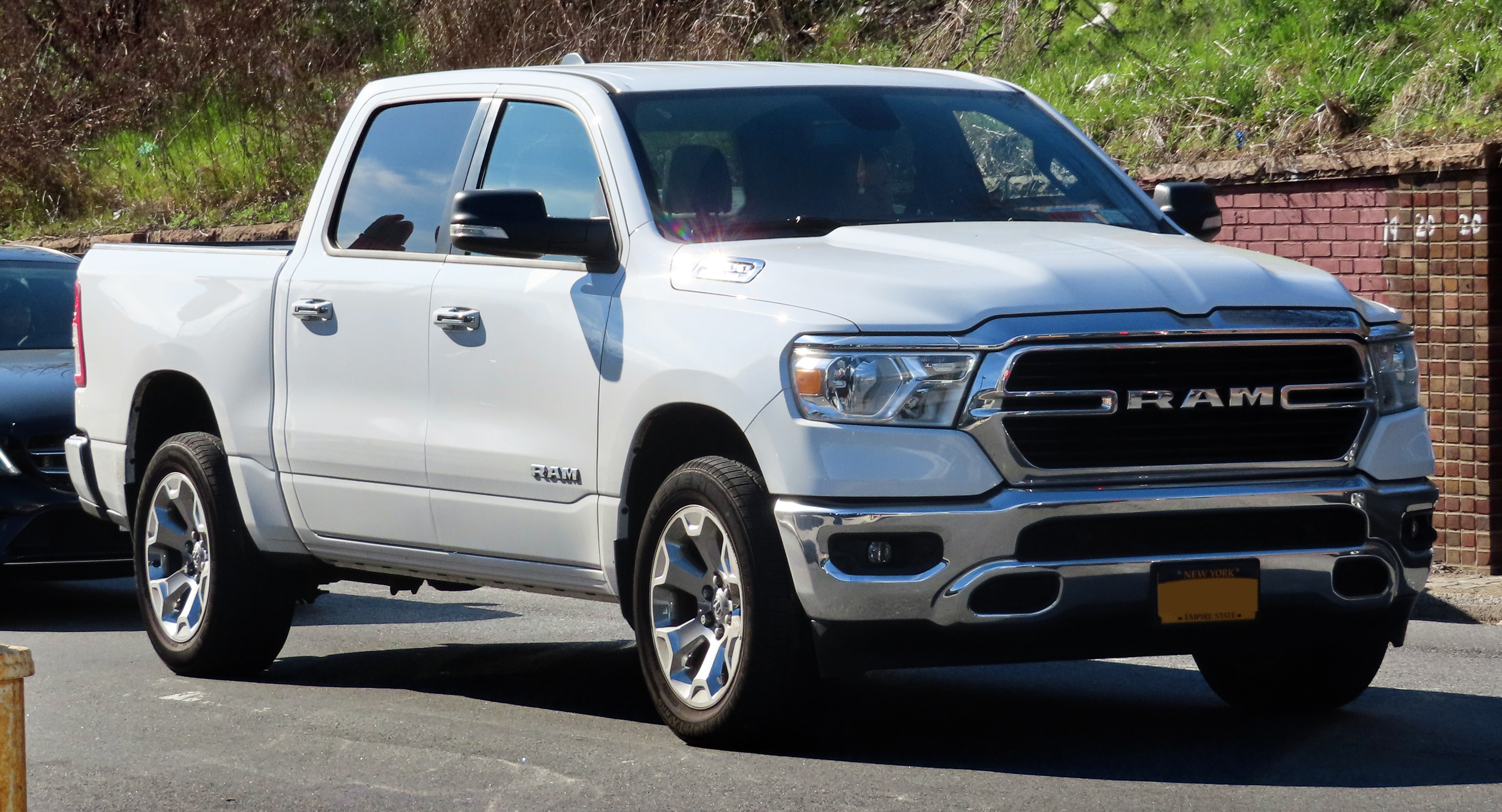
The Dodge Ram is a large pickup truck. It’s built for hauling and towing, but it can also be used like a normal truck for daily driving. The podcast mentions a specific high-performance Ram version with a Hemi engine.
The Ineos Grenadier is a new off-road vehicle meant to feel like the old-school Land Rover Defender. It’s built to be tough and capable, but with modern engineering.
A Hemi V8 is a type of V8 engine design. The “Hemi” shape inside the engine helps it breathe better, which can make more power.
Car
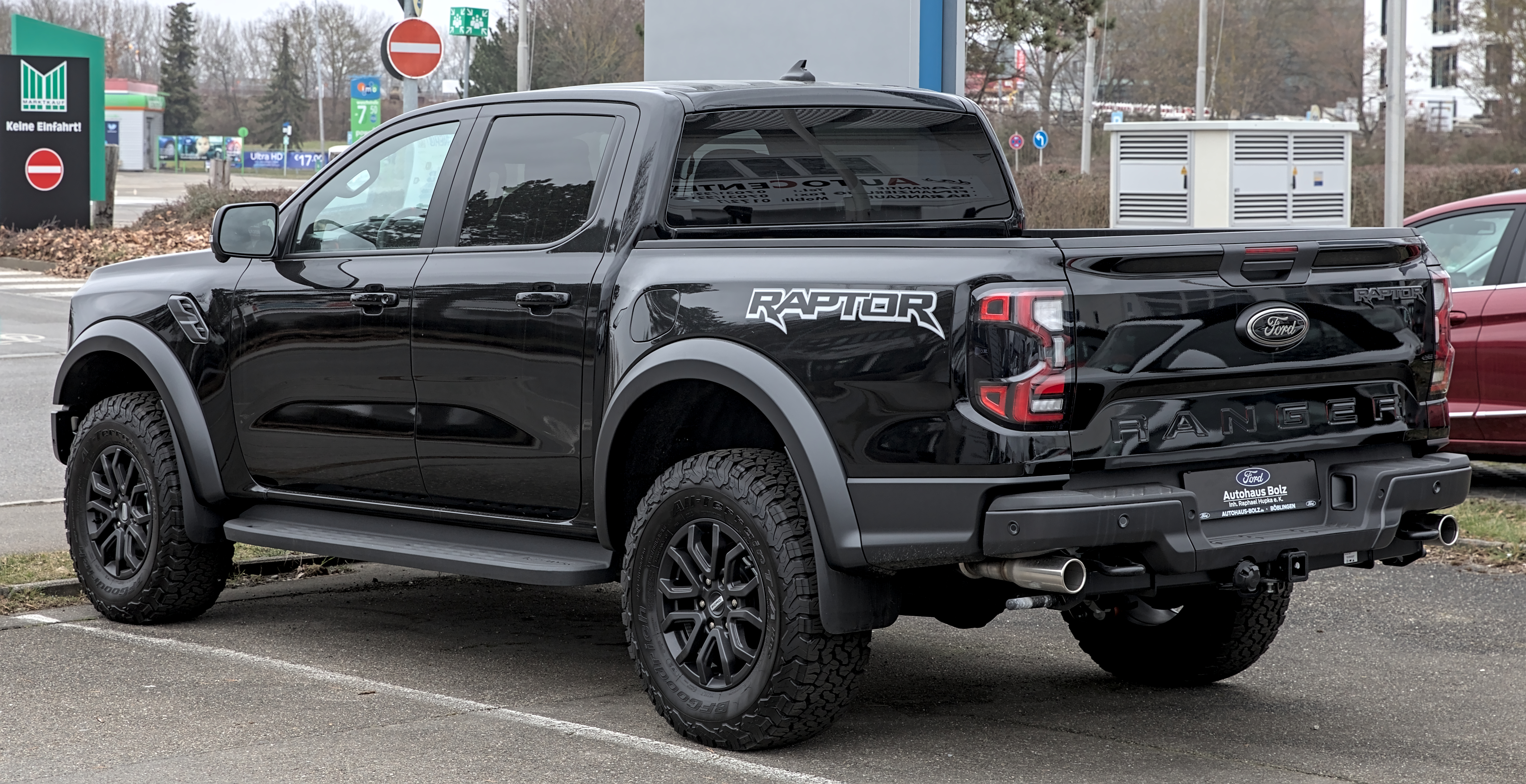
Ford Raptor
The Ford Raptor is a pickup designed specifically for rough off-road driving. It’s known for being able to handle things like rocks and also move fast over desert terrain.
The Ram TRX is a super-powerful pickup truck. It’s designed to handle off-road driving better than a normal truck. The podcast mentions it because it has extremely high horsepower.
Car
Raptor R
Raptor R is a more extreme, higher-performance version of the Ford Raptor. The host brings it up to show how truck makers keep pushing harder in off-road performance.
The Ford F-150 Lightning is an electric pickup truck. It’s built on the F-150 truck body style, but it uses a battery instead of gasoline. The podcast mentions it as a notable electric truck variant.
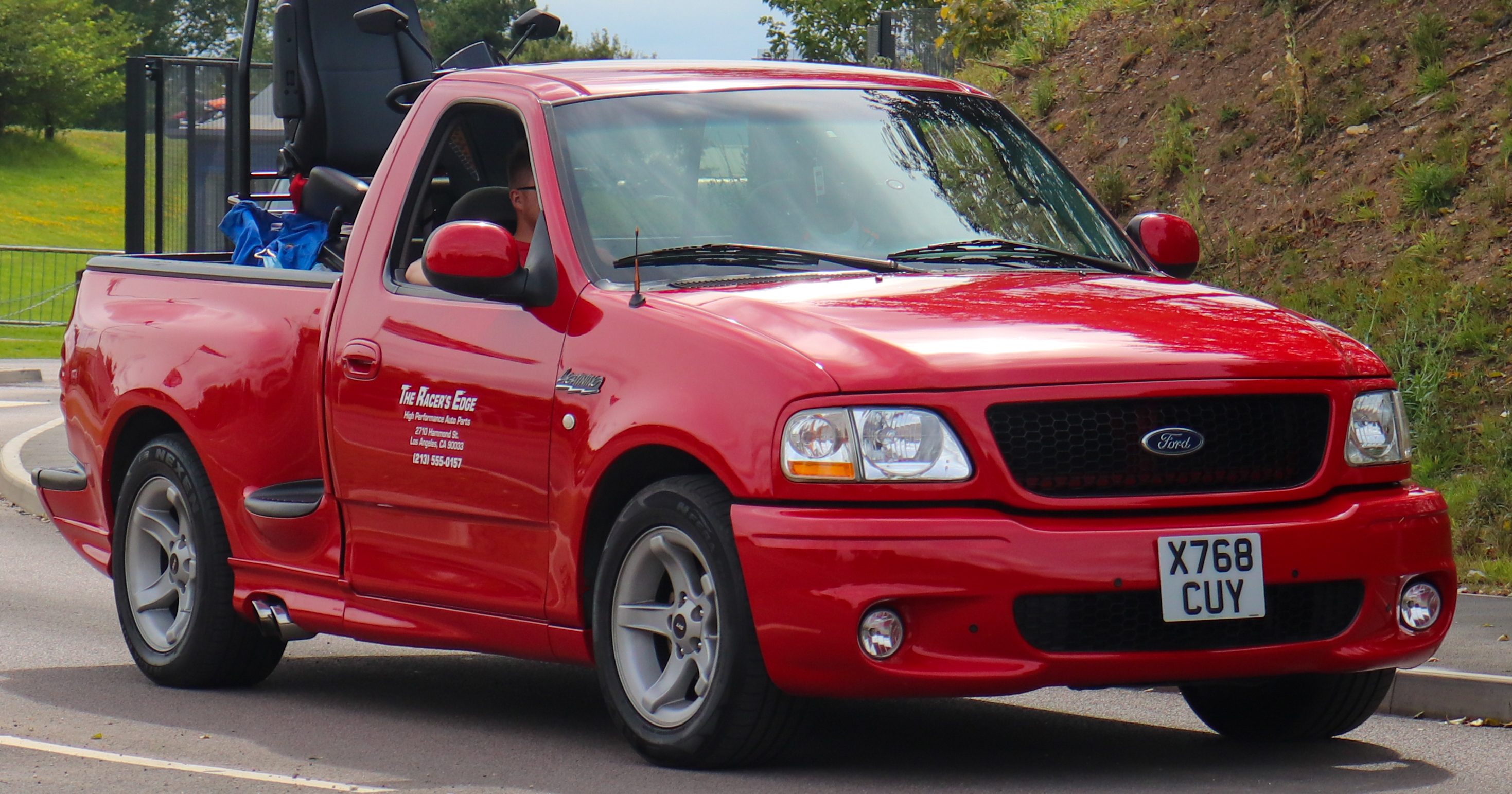
The Ford SVT Lightning is a faster, more performance-focused version of the F-150 pickup. It’s meant to feel more powerful than a typical truck. The podcast brings it up because the Lightning name has a performance history.
Car
Chevy 454 SS
This was a Chevy pickup that used a big V8 engine (the 454) and was tuned to be quicker than a normal truck. It’s remembered as part of the 1990s performance-truck trend.
Car
Ram SRT-10
This was a Ram pickup built by SRT for performance, and it used the same basic engine family as the Dodge Viper. It was meant to be a fast truck, not just a regular work truck.
Car
2027 Rumblebee
The 2027 Rumblebee is a special Ram 1500 pickup tuned to look and drive more like a performance vehicle. It gets a shorter wheelbase, sits lower, and is made wider so it feels more planted and aggressive.
“Slammed” means the truck is lowered so it sits closer to the ground. People do it for a more aggressive look and often to help it feel more stable when driving.
This is a NASCAR racing series that uses pickup trucks as the basis for the cars on track. The host is saying the Rumblebee’s look is inspired by that kind of setup.
The RAM 1500 Rumble Bee is a special RAM pickup that’s meant to feel sporty. It’s built with a powerful Hemi V8 and a more “enthusiast” driving setup, not just a plain truck.
A “5.7 liter Hemi” is the name for a V8 engine in the RAM lineup. “5.7 liter” is how big the engine is, and “Hemi” is Chrysler’s design that helps it breathe and make power.
A “quad cab” is a pickup cab style with seats for more than just the driver and front passenger. It’s basically a way to get rear seating, but usually with smaller rear doors than a full crew cab.
A “short bed” means the truck’s cargo area is shorter than the longer-bed versions. It affects how much you can carry and how the truck feels in tight spaces.
“Tow 9,000 pounds” is the maximum weight the truck is rated to pull. It’s a practical measure of whether the vehicle can haul trailers, not just look fast.
“Soft suspension” means the truck’s suspension is tuned to ride more smoothly and absorb bumps. The host is connecting that to towing, saying the truck may not be rated to tow as much because it’s tuned more for ride comfort/off-road use.
An “actual shifter” means the truck uses a normal gear lever you move by hand. The host is saying it’s not using a dial-style selector, which can feel less direct.
Car
Rumblebee 392
This is a special Ram pickup version that’s meant to feel more like a performance truck. It uses a bigger Hemi V8, and the host says it’s the first time that specific engine shows up in a Ram pickup.
This is a big V8 engine that’s “supercharged,” meaning it uses a compressor to push more air in. More air usually means a lot more power, which is why Hellcat versions are so strong.
The Dodge Challenger is a muscle car built for performance. Different versions can have much bigger engines and more power. The podcast mentions a high-performance SRT/“Hellcat” type setup to explain how the power increases.
A front splitter is an aerodynamic extension at the front of the car/truck that helps control airflow under the vehicle. By shaping the airflow, it can generate downforce and improve high-speed stability.
Infotainment is the car’s main screen-and-controls system for things like music, maps, and connecting your phone. Higher trims often include a better or more complete infotainment setup.
The Dodge Charger is a car that’s built for performance, not just commuting. It’s known for having powerful engine options and a sporty look. The podcast brings it up because the name is strongly tied to performance.
This means the truck can normally use power to all wheels, but it can switch to just the rear wheels when it makes sense. It’s a way to get better efficiency without losing traction.
All-wheel drive means the car can send power to all four wheels. That helps it grip better on slippery roads.
Term
hub extensions
“Hub extensions” are modifications that change how far the wheels sit out from the truck. People do it to change the look or to fit bigger wheels/tires.
Term
special lighting
“Special lighting” here likely refers to distinctive front lighting elements (such as unique headlamp/DRL designs) used to differentiate a performance trim. Lighting packages are often part of the visual identity on performance models, even when the underlying mechanical changes are the main story.
“325 tires” means the tires are very wide—about 325 millimeters. Wider tires can grip the road better, but they can also be heavier and more expensive.
They’re using a metaphor: “a brick through the wind” means the truck is shaped in a way that catches a lot of air. That makes it harder to move fast because the air pushes back. They’re about to explain how the truck’s body changes to improve airflow.
Term
aerowaves
“Aerowaves” is the name they’re using for body shapes meant to improve how air flows around the truck. Better airflow can make the truck easier to drive fast and more stable. It’s basically fancy bodywork for aerodynamics.
The Defender 110 is a Land Rover model with two rows of seats. It’s used here as a size comparison—basically, the new truck feels like it’s in the same “longer Defender” category.
Overlanding is like road-tripping, but with a focus on going far and being able to handle rough roads or trails. It usually means you want a vehicle that can keep going for long trips off the pavement.
Self-centering means the steering wheel naturally comes back toward straight ahead after you turn. It helps the car feel easier and more stable to drive.
Recirculating ball is a way the steering system turns your steering-wheel input into wheel movement. It uses little balls inside the steering mechanism, and it often feels a bit heavier or less precise than newer steering designs.
Hydraulically assisted steering means the car uses fluid pressure to help you turn the wheel. It reduces the effort you feel, especially when you’re moving slowly or turning a lot.
Rock crawling is off-roading at very low speed over rocks and rough obstacles. The idea is to go carefully and keep control so bumps don’t throw the steering around.
Rack-and-pinion is a steering setup that turns the wheels using a gear and a bar. People mention it because it can make steering feel more direct and responsive.
Ground clearance is how much space there is between the bottom of the car and the ground. More clearance usually makes the car sit higher, which can make it lean more in turns.
This describes an engine with six cylinders in a line, plus a turbo that helps it make more power. The turbo boosts performance by pushing extra air into the engine.
Torque is the engine’s twisting pull. Higher torque usually means the car feels stronger when you start moving or accelerate without needing to rev as high.
Term
ZF-8Smeane Automatic
This is the car’s 8-speed automatic transmission from ZF. It controls how the engine’s power is delivered through different gears, and that can make the car feel fast right away.
On a 4x4 truck, the transfer case sends power to both the front and rear wheels. “Two-speed” means it can switch between a normal gear for everyday driving (high range) and a slower, stronger gear for tough off-road situations (low range).
A manual parking brake is the traditional hand lever you pull to keep the car from rolling. It’s a more old-school way to secure the vehicle when parked.
A locker helps the truck keep traction when wheels start slipping. A “center locker” locks the front and rear drive together so both ends pull at the same time.
Lockers can prevent one wheel from spinning uselessly. Having lockers on both the front and rear axles helps the truck stay hooked up in mud, snow, or uneven terrain.
A solid frame means the truck has a separate “skeleton” underneath that carries the weight. This is a traditional truck design that tends to be tough for off-road driving.
ECUs are the car’s little computers that control different systems. If a design uses fewer of them, the car can be simpler to manage and may be easier to maintain.
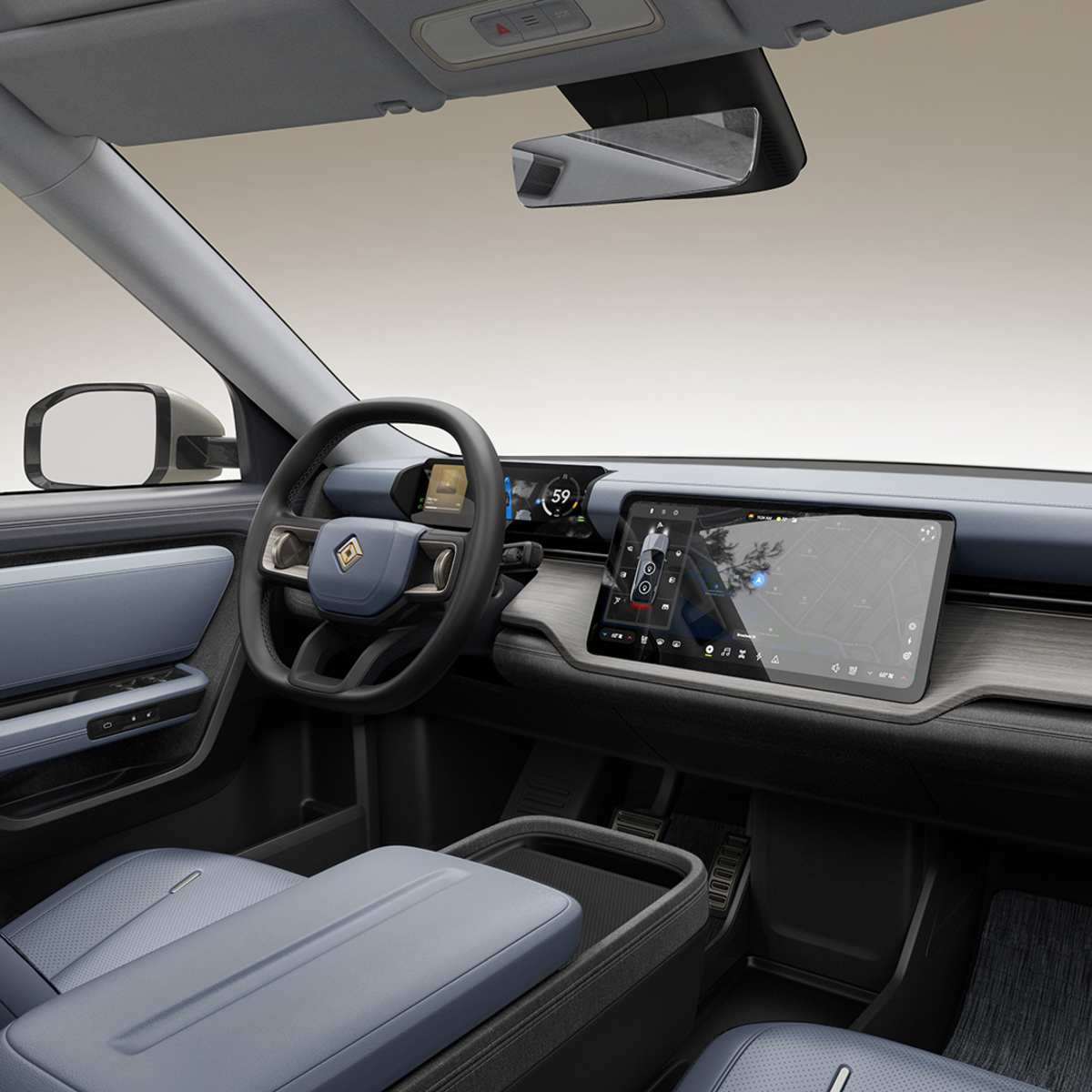
A center hub is the main screen/control area in the middle of the dash. Instead of lots of separate gauges, the car’s important info and controls are gathered there.
Emergency lane keep is a driver-assistance feature that helps keep the car within its lane when it detects a potential loss of lane position. It’s typically more intervention-focused than normal lane-keeping, aiming to reduce the chance of a crash during sudden distraction or drift.
Driver attention monitoring uses sensors (often cameras and/or steering/behavior analysis) to detect whether the driver is paying attention. If it thinks you’re distracted, it can trigger alerts and may influence driver-assistance behavior, like lane-keeping prompts.
Term
role
“Role” means the car leaning over in a turn. When the road gets twistier, the suspension has to shift the car’s weight, and you can feel the lean.
Recaro makes seats designed to keep you supported when the car turns. Even if they’re not the deepest “bucket” style, they’re meant to hold you in place so you don’t slide around.
Sport bucket seats are seats with deeper sides that “hug” you in turns. They’re saying these Recaro seats are supportive, but not the most extreme bucket style.
“Piano black” is that shiny black trim that looks like a glossy surface. It tends to show smudges and minor scratches more easily than duller finishes.
A “water line” is basically the level in the cabin below which water is expected to be okay. They’re saying you can rinse the interior after muddy/off-road use without ruining the important stuff underneath.
It’s a weight limit for things you mount on the roof or carry in that area. “Static” is when the vehicle is still, and “dynamic” is when you’re driving over bumps—so the driving limit is usually lower.
The Mini Cooper is a small car brand/model. The host is using it as an example of a dashboard design where the gauges are centered so they’re easy to see no matter which side of the road you drive on.
Concept
old style
“Old style” means the car is using a more traditional dashboard layout instead of relying on newer, more complicated screen setups.
The Land Rover Defender is a tough, off-road SUV with a classic, boxy design. The host is talking about older Defenders that have been updated so they look great but drive more modern.
A restomod is when someone brings an older car back to life, but also updates key parts so it drives better and feels more modern. It’s basically “classic looks, modern improvements.”
The G-Class is a luxury SUV with a very distinctive boxy shape. It’s known for being tough enough for rough roads while still offering comfort. The podcast mentions it in a comparison about pricing.
A niche vehicle is a car made for a specific kind of customer, not everyone. The host is saying the Defender was originally built for military and police work, so it’s always been aimed at a particular purpose.
Place
Sully Hill
They mention “Sully Hill” as a place where the vehicles were assembled. The point is that the factory’s output was largely meant for military and police use.
They’re describing a factory process that doesn’t follow the usual step-by-step assembly order. Workers move between stations as the car is built in a different sequence than normal.
Concept
all conquering terrain vehicle
This phrase means the vehicle is meant to handle lots of different kinds of rough terrain. It’s more about off-road ability than luxury.
EVs are cars that run mostly on electricity from a battery. When rules push automakers to sell more EVs, they often change what kinds of engines and cars they build.
Hybrids use two power sources: a gas engine and an electric motor. They help reduce fuel use compared with a pure gas car, especially in stop-and-go driving.
A “trickle down effect” means one thing causes other things to happen later. They’re basically saying they’re not sure if what Ram does at events actually leads to noticeable changes for buyers in the real world.
Concept
tow a boat
To “tow a boat” means pulling a boat trailer behind the truck. They’re saying some people buy big trucks mostly for convenience and occasional trips, not because they tow all the time.
Concept
dirt road or a gravel road
A dirt or gravel road is an unpaved road. They’re saying that once you get off the highway and onto rougher roads, having a truck can feel more useful and capable.
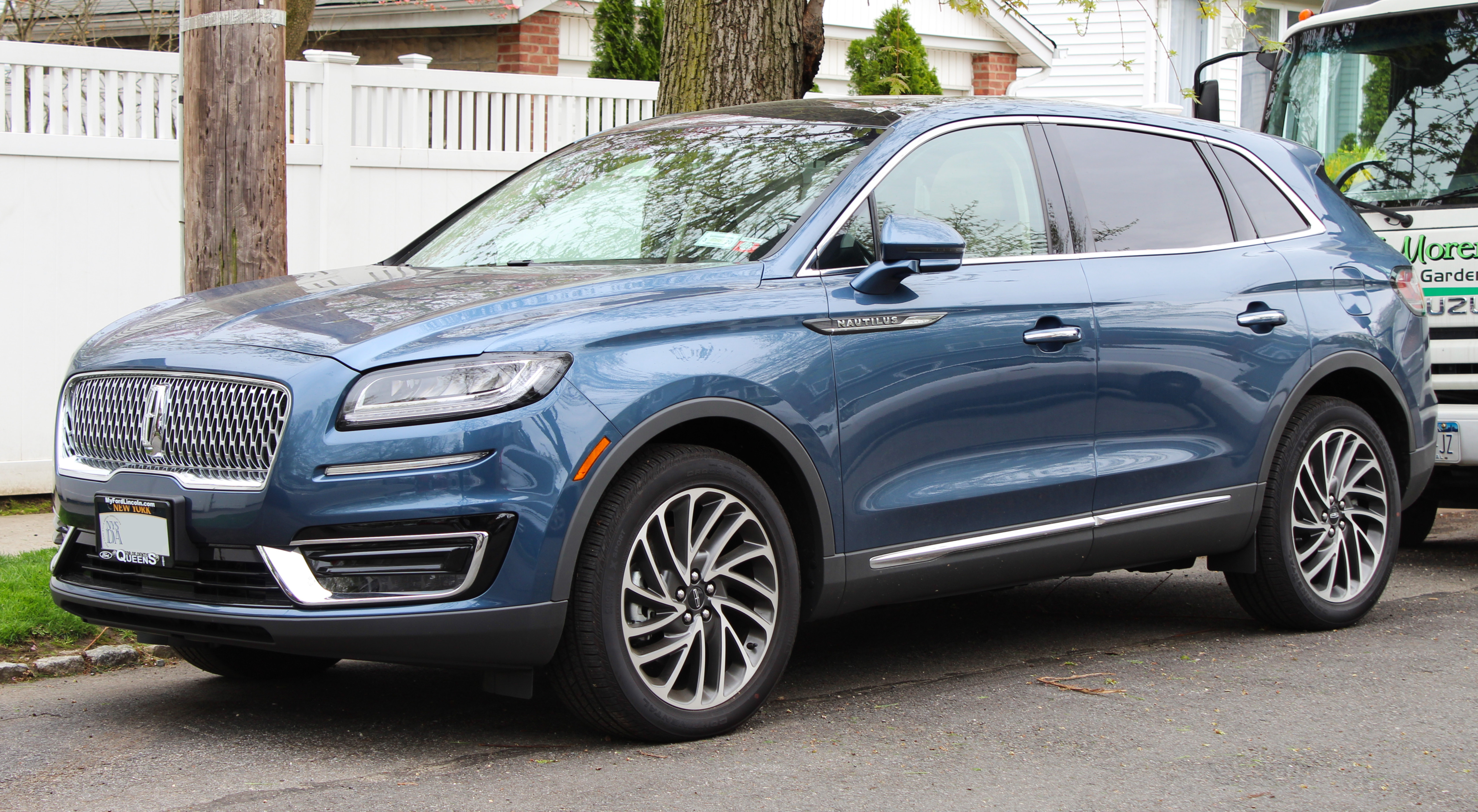
The Lincoln Nautilus is a luxury SUV. The podcast talks about what fuel type it should use, comparing 87 octane to 93 octane. This matters because the car’s engine is tuned based on the fuel it’s designed for.
The Ford Mustang GT is a fast version of the Mustang. The fuel you use matters because the car’s computer may change how the engine runs based on the fuel’s octane rating.
Term
93
“93” is the octane number on premium gas. It can let the engine run more aggressively without knocking, which may add power, but it usually doesn’t dramatically improve gas mileage.
Term
87
“87” is the octane number on regular gas. Higher octane helps prevent knocking, and the car may run differently depending on what fuel you put in.
The Mazda CX-50 turbo is a small SUV with a turbo engine. The host is saying Mazda’s tune can make more power when you use higher-octane fuel like 93 instead of 87.
Octane rating tells you how resistant the fuel is to knocking or pinging inside the engine. Higher octane usually lets the engine run more spark timing safely.
Term
predetination
The idea here is that the fuel can start burning too early. When that happens, the engine can run rough or knock, and higher-octane fuel helps reduce that risk.
Knock is when the fuel-air mixture starts burning at the wrong time, causing a harsh rattling/pinging. The car’s computer protects the engine by backing off timing when it senses risk.
Detune here means the car’s computer dials back the engine’s “aggressive” settings to avoid problems with lower-quality fuel. That can reduce power and change how the engine feels.
The Ford Mustang SVO is a special Mustang from the mid-1980s that had a switch to tell the computer what fuel you were using. The car then adjusted timing so it wouldn’t knock.
Timing is when the spark happens in the engine cycle. If the spark happens too early for the fuel you’re using, the engine can knock, so the computer adjusts it.
The Rivian R2 is a smaller, cheaper Rivian electric SUV than the R1 models. The big question is whether it can help Rivian sell more cars and make the business work.
The Tesla Model 3 is an all-electric car that runs on a battery instead of gasoline. It’s one of Tesla’s more mainstream, lower-cost models. The podcast mentions it as an example of how an EV can become profitable and widely sold.
This is the business goal of scaling sales and margins so the automaker can earn profit. The host frames it as a “Model 3 effect” for Rivian—using a lower-priced model to increase volume and improve financial performance.
The Rivian R3 is mentioned as a smaller future model that Rivian plans alongside the R2. The host’s point is that Rivian is building a multi-model strategy, with R2 and eventually R3 aimed at mainstream crossover buyers.
The Tesla Model Y is an all-electric SUV. It’s designed to be a practical size for everyday driving. The podcast mentions it as part of Tesla’s plan to offer multiple EV sizes.
“Cross shopping” means you’re looking at several different cars before deciding. The host is saying Rivian wants the R2 to be one of the cars people compare against other mainstream options.
The Rivian R1S is a bigger Rivian electric SUV. The host is saying the R2 will be noticeably shorter than the R1S, so it should be easier to park and fit in a garage.
The Toyota RAV4 is a very common compact crossover. The host is using it as a reference point to say the Rivian R2 should be about the same size, so it should feel familiar and easier to live with.
A “compact crossover” is a smaller SUV-shaped car that’s built more like a regular car than a truck. The host is saying the labels can be confusing now because what counts as “compact” has changed over the years.
Center of gravity is basically where the car’s weight “balances.” If it’s lower, the car usually feels steadier when you turn or change direction quickly.
A pass-through is a gap/opening that lets you slide long gear from the back storage area into the cabin. It helps you carry things like skis or long boards more easily.
Rivian OS 2.0 is the software that powers the screens and controls in the Rivian R2. The host is saying it was designed specifically for the R2, so the interface and features are meant to fit the car well.
A “software driven vehicle” means the car’s features and how it feels to use—like menus, settings, and some behaviors—are controlled mainly by software. The host is saying Rivian designed the R2 so its overall experience lines up with the R1S.
Halo wheels are physical knobs/dials on the steering wheel. They let you control things like the volume and climate settings without tapping the touchscreen.
Climate control is what keeps the cabin comfortable—heat in cold weather and cooling in hot weather. In this case, the controls can change the temperature and how strong the fan blows.
Concept
software, inspired or driven aspect
They’re saying Rivian is using software to add or improve features. The idea is that you can do more with software even while the car’s hardware gets simpler.
A wiring harness is the car’s organized bundle of wires that connects all the electronics. The point here is that Rivian made the R2’s wiring simpler/smaller than the previous generation.
Mass production is when a manufacturer ramps up to build large numbers of vehicles efficiently, usually using dedicated factories and assembly processes. In this segment, the hosts connect Rivian’s production ramp to when the R2 can be sold at scale.
The Hyundai Palisade is a family SUV with three rows of seats. It’s made to carry more people and gear than a typical two-row SUV. The podcast brings it up mainly to talk about how big it is.
Semi-active dampers are shocks that can change how stiff they feel while you drive. That helps the car stay comfortable over rough pavement but still feel more controlled when you turn or hit uneven roads.
Passive suspension uses fixed shock absorber settings, so the damping doesn’t change dynamically as conditions change. In contrast to semi-active dampers, it can’t fine-tune ride/handling balance on the fly.
Drive modes are different “personalities” you can pick for the car. They can change how heavy the steering feels, how the car responds to your pedal, and sometimes how the suspension acts.
Horsepower is a way to describe how much power the vehicle can produce. 656 horsepower is a lot, and the host is saying it helps the car feel lively and responsive as you drive.
Sport mode is the car’s “go faster” setting. It usually makes steering and power delivery feel more responsive, and in this case it also makes the suspension feel firmer for more confident cornering.
Heated seats warm you up, and ventilated seats blow air to help cool you down. It’s a convenience feature that makes the car more comfortable in both hot and cold weather.
BFG KO2s are a specific brand/model of all-terrain tires. The host is saying the R2 can be equipped with KO2 tires made to fit it, which helps for rougher trails.
Rear-drive means the power goes to the back wheels. It can be simpler and efficient, but it may not grip as well as all-wheel drive on snow or wet roads.
The Rivian R1T is an electric pickup truck. It’s meant to be useful like a regular truck, but powered by electricity. The podcast talks about how big it is compared to what people expect from a pickup.
Matrix headlights are high-tech headlights made of lots of tiny light sections. They can adjust which parts are on so you can see farther without blinding other drivers.
Lane splitting is when a motorcycle moves between lanes when cars are stuck in traffic. It’s allowed in some areas and not in others, and it can be controversial because it changes how cars and bikes share the road.
So this is this is the surprising thing, I think starts at $71,000, which is less
than a current Land Rover Defender.
The Fieldmaster starts at 80.
So the specific addition that we had started around 80.
And then if you option it out like ours, you're looking closer to $90,000.
And there's the various price points throughout and stuff that you can get.
I actually went to the UK.
Bill Baker was the PR guy at Land Rover for the press drive for the original
Defender 110.
And when I got into this, the feeling on the outside was deja vu.
When I got inside, it was like, this is not the 110.
This is full of all the modern conveniences.
Now, some of them confusing.
I actually never did figure out how to operate the radio to get just broadcast
radio.
But so it's very different.
It does adhere to the old style, say, Mini Cooper thing about putting all the
gauges in the middle so you don't have to make it left or right, depending on
which side of the road you drive on.
But I love the way it rode.
I thought it was amazingly civilized.
Sucks gas like, you know what?
But I could not like it.
I could not really like it.
But I'm curious to see to hear what everybody else says.
Well, I'm actually curious of Brian's opinion.
As somebody, I think we both probably drive vehicles on the daily that are much
more akin to the Grenadier than most other people.
So for me, I definitely found it, like Alex said, like quite charming and almost
reminiscent of being a Jeep lady.
So you've got a direct comparison.
You both are.
Being an old soul, I like old things.
And I love the idea of what they have here.
I'm not sure I really love the vehicle itself as Alex.
It's a chore to drive, which, you know, I don't mind.
I don't mind that.
But it'd be good to have in your in a big garage full of other things.
I'm OK with a chore to drive when I'm not paying $80,000 for something.
If I just paid $10,000 for something, I expect to be a chore to drive.
My my opinion of it is like, I think there are a lot of people, I don't know.
But I can see a lot of people going out and buying this because they go, oh,
this is so cool.
They get very tired of it very quickly after a year or two.
Yeah, they're going to be tired of this.
There's quite a few used ones on the market.
Right. Yeah.
Because people, they see it, they get it for the vanity of it,
but they're never going to use it for what it's built for.
But if you are someone who's actually going to use this for what it's built for,
or you just you love this kind of thing, you don't care about having to
commute in it because it's worth it to have this on the weekends.
This is like to me, this is like as hardcore as you can get on a consumer level.
Yeah, my commute is probably like around 12 miles.
So that's that's a gallon.
That's two gallons of gas for your commute.
Yeah, basically, yeah, because it's about it's like 15 miles per gallon combined
in this thing. And I felt like, you know, I wasn't getting over,
you know, 50 miles per hour.
And I felt like that was enough, you know, like just driving that.
It's another brick. Yeah.
I mean, it was great, you know, you put all the windows down, you're driving around.
People are, I mean, everybody turns heads.
Oh, yeah. Oh, yeah.
I mean, it is like I whenever I see an old school Land Rover or Defender,
my head always turns, especially the ones that have been restomotted
and look just fantastic.
So it's definitely
it's definitely like a very specific vehicle for a very specific purpose.
For a very specific.
Yeah, if you need to make sure you know what you're getting into,
I think a lot of people look at it as like a bargain G wagon, right?
Yes. Well, yes, less than half the price as that.
Right. But you're not that's not at all B.
What you're doing. B.
What G wagon, a B wagon.
Well, you know what, I do think too, when we look in the context of like,
you know, it kind of goes to show why the current Land Rover Defender
is what it is, right?
Well, it had to evolve over the times for volume.
Yeah. Yes. But also like when there's a reason like this is a niche vehicle.
When they built these because we went to Sully Hill, I think it was the assembly plant.
When they built these, the majority of them were being built for military
and police forces around the world.
And the assembly line was not even an assembly line.
Every vehicle that came down that line was basically different
and had to be custom made.
And the workers would transition from one station to the next.
It was a very, it was like a assembly line backwards.
So it was built to be this all conquering terrain vehicle.
And we're talking what, early 80s, I've forgotten when.
So it was built for an entirely different purpose.
It was never built for this mass market luxury aspect that the defender is today.
And this vehicle goes back and does that.
While giving you the modern accoutrements as somebody with a lot of money these days
would like to have, I can see that if you it is probably one of the
the easiest buys that if you want something rare to be that you're not going to see
coming down the block for a long time.
And I agree with everybody.
It's not something I want to drive every day.
But I loved, loved it.
I loved driving, even having to crawl up into it, which for me was difficult.
Yes, it's definitely high.
Oh, it is. And there's not as much to grab on to as you would think there would be.
You climb onto the roof.
You didn't know.
No, I'm afraid my roof climbing up latter days to the roof
of something those days are over with.
Anything you want to find and finish up with?
I could talk about this car forever, but I won't.
Well, I know.
I know my limits.
But so in the end, yeah, did you like it?
I liked it for what it is, and it didn't shy away from what it's trying to be.
But just to kind of reiterate, I would not want to daily drive this.
I would not buy this as my daily commuter.
Some people would, and that's great.
I'm happy for.
But when you went out to get into it, did you say to yourself in your head?
I geeked out over it.
OK, all right.
You know, like, I don't want to get in that.
No, like, I drove it and I enjoyed it.
And I thought it was such a novelty to drive.
I think it's pretty pretty amazing that it exists at all.
Yeah. And kudos for them.
And yeah, it's not perfect, but boy, it was special.
OK, moving on.
Thanks very much, Alex and everybody.
I want to thank our sponsors of this podcast and of everything Motor Week,
Auto Value and Bumper to Bumper.
Thank you very much.
And the great folks over at tireact.com.
We know our viewers and listeners appreciate your dedication to Motor Week.
OK, it is now time for our lightning round,
where still have come the R2 coming up, so don't go away.
This one caught my attention.
A recent report from JD Powers finds that vehicle sales in Texas
are currently on the upward trend to match and even eventually surpass
California in the overall market share.
And that's interesting because California has for decades
been the bellwether state for American car
fashion, shall we say Toyota climbed 10.8 percent.
Rather, Texas climbed to 10.8 percent of all vehicle sales
last year while California fell to 11.4.
So they've narrowed the gap.
Unsurprisingly, 27 percent of those Texas vehicles were pickup trucks
and Texans are paying about $3,400 more than the national average
transaction price for a vehicle.
Also should point out that California is primarily a lease market
and Texas is primarily a finance or cash market.
If the Texas market share continues to increase,
how might this affect the overall car market and automotive trends?
Are we all going to be driving pickup trucks?
Seems like we are now.
Do you think this is meaningful?
Do you think it doesn't mean a darn thing?
I mean, we do have car makers like Texas,
like Toyota and Tesla moving to Texas.
What do you think?
I think this will just mean sedans are just becoming less and less relevant.
I mean, right now, no American company is building a sedan for anybody.
These the smallest cars that even American companies are building
are not that small when you think about them.
Or it's just continuing as two smaller SUVs and putting everybody in.
I mean, the smallest American, it's not even American made,
but American company vehicle is a tracks at this point.
If I'm not mistaken.
No, you're right.
And that's not even that small of a car.
It is an entry.
It's still entry level prices.
I know it's under under and around $25,000, which is kind of where everybody else is.
But yeah, I do think this could potentially if if we are catering.
You're saying we're going bigger.
Everything is going bigger.
But at two point was like, how much bigger can we get?
You know, there will this will this trend of Texas gaining more market share
mean that everything goes bigger?
Because we're catering to the people in Texas.
But what about everybody else in the country?
Well, we did that with California.
They basically but there they let they have small and inefficient in California.
Yeah, but it was more of the luxury aspect.
They led the luxury trend, which now means that, you know, almost every vehicle
has got features in it that 510 years ago, you thought were in a luxury vehicle.
That is true.
Brian, any.
Well, if you've been to Texas spent any time in any major cities in Texas,
you know that Texas is growing like crazy and they are building like crazy all over the state.
And people are moving from all over the country, but mainly California,
to Texas.
And so it makes sense that their sales numbers would be up in California's would be down.
Texas is the new boom area like California was in like the 1950s, right?
Everyone's everyone's moving there.
Go West, young man.
So it makes as far as specific to pickup trucks.
I don't know.
It depends.
Numbers make whatever you want on numbers.
I mean, recently in automotive news, their headline was Americans finally tired of pickup trucks.
Question mark because sales are down in a lot of places.
So I don't know that it really means anything for the pickup truck market as a whole.
Is there a trend, though, if we're turning away from, say, efficiency and luxury that
have been the highlights of California to more rugged, which we use that word all the time.
Do you think that what we're seeing in newer vehicles is somehow a byproduct of that?
Now, I think it goes more with regulations, right?
When you have regulations and you say everything's got to be electric by 2035.
Everyone's making EVs and making things more efficient or whatever hybrids.
But when you remove all those and people can make V8s again, they're going to make V8s.
So it really, to me, it ties more with regulations.
Brian, I mean, Brian, Alex, any any comment on this?
So just last week I was in Texas and it was at a truck event for Ram.
That's right. We said something.
Well, they always do so many truck events and they have the big truck rodeo area.
And yeah, I mean, like if anything, this might mean we get another Texas inspired
theme like Lone Star or something like that.
Yeah, something. But you know, I don't know.
You don't see a trickle down effect.
That's not obvious.
No, I mean, maybe, I don't know.
Like I think around here, there's a lot of people that like buy pickup trucks.
And I mean, I've said it before, like they buy trucks and they don't really need it,
but they buy it because they want they need to be able to carry people around
so they get the big truck and they might occasionally one or twice,
maybe three times in their life, tow a boat or something.
I don't know. But I mean, down there in Texas, I was driving around and I,
you know, I actually had the same thought when we were in Georgia for robling this
year, I had to go pick up a ram at a dealership.
And I was like, yeah, if I had to drive these massive highways all day,
like, yeah, I'd probably want a truck.
And then because then you get off the highway, then before you know what
you're on a dirt road or a gravel road and you're like, OK, well,
it's nice to have something like this.
I'll be honest, I kind of forgot what the question was because I don't have
to run to me. I think it's really about whether or not
shifting to Texas is going to have a trend in the vehicles.
The rest of us have to buy.
In other words, and I think it really comes down to size, size and power.
Are we on a bigger, is better kick again?
And Brian seems to think we are.
And if you look at what's available in the smaller vehicle market,
it certainly says a lot.
So, you know, are we going to get away from?
I think cars are like fashion.
It changes every what it comes back every 20 years is what they say.
But California has been the leader in that.
And now we, you know, is this shift going to be meaningful?
I mean, who knows? But we're just guessing.
Clearly, I don't know.
Well, I just hope I hope it doesn't end up being all of a sudden
take a midsize SUV and all of a sudden we start seeing
them add another six inches of link to it.
I mean, every time they do an update.
At a certain point, I think we're going to be held back by the infrastructure
and parking spaces.
I agree with that.
I can't keep making them bigger and bigger and bigger.
John, what are your thoughts on, I think, too, a thing like you had mentioned
that, you know, California is very much a lease leasing state.
Texas is more of a financing and cash.
I think that could potentially have repercussions
because we're already seeing, you know, post COVID and the supply shortage,
least good lease deals on gas powered cars
have been very, very hard to find.
Yeah. And that's pretty amazing because I think nationally,
even before COVID, they were about 36 percent.
They were over a third of the market if you had any kind of luxurious pretensions.
Oh, I think actually if you had a luxury, a luxury vehicle is up to 50 percent.
Now we seem to be moving away from that and more to these long financing deals,
which I have to admit, the dealers make a lot more money on.
So that could be a part of that equation.
Is that good or bad?
Yeah, I don't know.
A lot of people just don't like leasing.
They don't like the idea that they've got to be extra careful with the vehicle
for, you know, two to three years.
And they just don't like that.
And yet if you're worried about driving something that's going to be trouble
free or, you know, keeping up with the Joneses, it actually makes a lot of sense.
I knew some people who leased because they couldn't afford to.
Well, that's the whole idea.
Yeah, you could get a lot more vehicle for a smaller monthly payment.
So, you know, a lot of entry level vehicles, they would they would lease them
because, you know, they could get a 150 dollar a month payment versus a 200.
Especially if they're not putting them.
I mean, the trick with leasing is and you have to be careful.
It used to, you know, ten years ago, the typical lease was 12 to 15,000 miles a year.
Now it's 10.
So you've really got to be aware of how many miles you drive a year
because that extra mileage charge can be significant.
I mean, I think I've seen easily seen somewhere 75 to 85 cents a mile over there.
Quite a quite a bit of negotiating your dealership.
And that's the other thing.
People don't know how to negotiate a lease.
Everything's negotiable.
They somehow think because it's lease, it's all set in stone, which is not.
So I don't know. It's back to the Texas thing.
It'll be interesting to see how this pan out.
I think it's going to be subtle.
I don't think it's going to be any as California was subtle.
But it is fascinating to see where the shift, the shift that is happening.
And I should point out that states in the east might be affected more
than anywhere else, because the east, especially from Maryland,
to New England has followed California's trends and trying to then follow
Texas trends. That might be a tough nut for a lot of people to crack.
Anyway, OK, we now are going to go from our lightning round to another
chat with a viewer question.
And this is from Joe Appap. Is that right?
I believe so. We think that's right, Joe.
I hope we didn't butcher your last name.
OK, Joe heard that if you use premium gas in your car,
you'll get better gas mileage.
For example, on a long trip, manufacturers suggest 87 octane
for his 2019 Lincoln Nautilus.
Is it true that if he went up to 93, he'd get better mileage?
What happens when you revert back to 87 after the trip?
Does it cause a problem?
And what do we think about switching around octane ratings?
This is a vehicle that the manufacturer suggests.
And we use that word, 87 octane regular.
So I did look up the owner's manual for 2019 Nautilus.
I felt like that he gave us an example.
And so the best thing to do, obviously, is look in your owner's manual.
And like a lot of Ford's and Lincoln's Alex knows this, he owns a Ford.
I've got a good answer for this one.
Oftentimes they tell you it's written in this owner's manual.
It said 87 is the minimum amount that you should be putting in your vehicle.
But you can use premium, so 91, 93, if you are towing or it's like hot outside.
And your car will automatically adjust for it.
Yes. So that's very specific to this vehicle.
Well, what about fuel economy?
No.
You're not maybe a tiny bit.
Such a small amount that you're not even.
And I've seen tests where premium has actually been worse in some vehicles.
It OK, the short answer, the TLDR is no, you're not going to get better fuel economy.
If you do, it's such a miniscule amount, it's probably not going to make a difference.
But I have notes.
I can't hear both of you.
Because he would be very interested in this because he has he has.
Right. My car also says the minimum of Ford Mustang GT,
bring it up every podcast.
So you probably know by now.
It says I only need to run 87, but I run 93 in it.
The computer in your car, unless it states otherwise or there's something going on,
the computer, like John has said, will adjust for it.
What's interesting, it like take a Mazda.
I think they're the only brand actually that does this.
But I bring them up as an example, a CX 50 turbo.
It's got a 2.5 liter.
You can get it naturally aspirated, but specifically with the turbocharged model.
They tell you you can run 87 in there.
You'll get 227 horsepower in it.
But if you step up to 93, you'll get 256 horsepower.
You also get 10 pound feet of torque more.
You will get more performance.
Not every single car is going to have drastic numbers like that.
And I don't know exactly the top end, probably two.
Yeah. And I don't know exactly why the Mazdas are this way.
But if I had to guess, it's that their engines, specifically the turbocharged ones,
are engineered to operate at that higher threshold.
Having a higher grade of gas or higher octane rating just makes the the fuel
or the engine more resistant to predetination.
It can run at a higher threshold.
My assumption here is that Mazda is they've tuned their engines to operate
at that higher peak threshold, but they understand that it's more attractive
to have something that can operate at 87.
So they say, look, you can, but we've had to detune the engine to hopefully
stave away any knock.
The other example, and I've brought it up on this podcast before, is another Ford product,
the 84 to 86 Mustang SVO, which we road tested back in the day,
one of my favorite cars of all time.
That actually had a switch on the dash, whether you ran premium or not.
You had to tell the computer what grade of fuel you put in there
so that it could then change the timing.
It would not do it for you.
Obviously cars these days will.
I run 93 in mine.
Sometimes I put 87 in there because the wallet be hurting a little bit.
And I do notice a little bit of a difference.
I can tell the idle is different.
It idles a little funny to me.
That's why I run 93 in there.
So to answer the second part of the question, if you go back to 87,
if you're like me and you've been running 93 for years now at this point,
you go back to 87, you might notice, especially at first, when you switch,
the computer might still be figuring it out, might run a little funny,
but you shouldn't have any problems as long as the manual says, hey, you can run 87.
Mr. Robinson, I have nothing to add other than just save your money and put 87.
I should flip this around because we get this question most often.
If I've got a vehicle that's supposed to run on premium, can I run regular?
And the key thing there is the wording.
If the manufacturer says they recommend premium,
that's different than if they say they require premium.
If they recommend premium, chances are very good.
You can run 87 without a problem.
It'll probably say minimum octane 87.
If they require premium, then if you go lower,
you're probably doing long term damage.
Yeah. And I feel like we're seeing this more and more with
turbochargers being put in engines.
I mean, just having to care for that.
That's another thing.
So just the way these engines are operating now,
we're seeing more delineation from manufacturers saying, you know,
we recommend this or we require this.
It also is like it depends on what the engine is doing.
So I know like Acura, they in a lot of their models,
they're recommended not required situation.
But then you kind of go up into like,
which I might add is sometimes just a marketing thing potentially.
But then you have say GM and their full sizes, all of like, if you bought a Tahoe,
there's two different engine options.
And one of the there, so you get up to a point where they are also as well
recommended that you run premium.
It's not required, but I do think you look in that owner's manual.
And if they say, you know, if you're going to do like towing or anything like that.
And high heat as well, the in, you know, temperatures like 90 degrees and higher.
They say also run it.
So, but just to do it, I think going back to the initial question,
just to do it to get better fuel economy.
No.
I think we covered that very well.
Thank you very much.
And now we're going to turn our attention to a vehicle that some of you may not
have heard a lot about yet, but you will.
The Rivian R2, the smaller addition to the Rivian R1 line, I should say the first
of two smaller additions to the Rivian R1 line since there is going to be an R3
even smaller.
But the R2, I actually think it was years before we actually heard the unveiling
in March of 2024 that we got the hint that the R2 was coming.
Will the more affordable R2 do for Rivian with the Model 3 did for Tesla?
In other words, make it profitable.
That and other details, we turn to the one and only Jessica Ray, who has gotten
to know the R2 quite well.
Yes.
I think, you know, Rivian is looking to make the R2 and eventually the smaller R3
into their versions of the Model Y and the Model 3.
They are looking to make sure that this vehicle is accessible and, you know,
people are cross shopping it with and everything in that class, not just being
like, I want an electric car.
They're just like, I want a new car and a Rivian R2.
They want the R2 to be on those people's radar.
And I think that it's a very good, a very good vehicle.
So this is going to be the third model from their brand.
It is 15 inches shorter in length than an R1S and much more garageable, way
garageable and honestly, I was looking at the dimensions and it is very close
in size to a RAV4.
So just picture that.
It's a five-seater.
This is the market segment that encompasses a majority of the market.
Right.
I would never call, do they technically call these compact crossover?
The term doesn't mean as much as you used to since compacts are often what
government says mid-size should be.
But I think for most people, when they see a Rivian R1, they don't necessarily
think full-size pickup.
So they're saying mid-size.
So it would kind of make sense if this thing gets called a compact, although it's
not small.
No, it's not small.
And also because of the packaging of the fact that it's an electric vehicle, they
mount the battery nice and low, although it still does have 9.6 inches of ground
clearance.
So it has a low center of gravity, but also that helps create just so much more
interior space.
I believe it has like 40 inches of leg room for the rear passengers, which is
pretty respectable.
Pretty respectable.
And then with the seats up, I believe it's like 28 cubic feet of storage.
But then the seats can, the rear seat can fold down in a 40-20-40 split.
So of course, if you're an outdoorsy person, you like to ski, surf, it
has that like pass through that they think that they're buyers.
So you still carry two people back there plus something along your longboard.
Absolutely.
So super roomy.
And I'll stay on the interior a little bit too, because before getting like into
some of the more performance details, I thought going into it, like a lot of brands
would do is that they would just take an R1S and they would sort of just cheapen it
and make it smaller and then offer it at a lower cost.
Because these start at $45,000 before destination.
But you can't get that one yet.
Well, that doesn't come till next summer.
But we'll just say the spread is like just from 45,000 to just under 60 grand,
which when we look at the market is very close to the annual transaction price.
But my point being is that this isn't a cheap version of the R1S.
It is its own very good product.
You get inside that the vehicle and I was driving around the R2 performance with the launch package,
which is this is the first one that they're building.
This one is pretty loaded.
So this one goes for like $59,000.
And but I even got to sit in an R2 standard, which is the base model.
They are still the quality and it was still so good.
It was very similar to what I found in the in the R1S.
It wasn't like this stark difference that we kind of see in other brands.
Part of that, I do think is helped with the fact that Rivian has this very minimalistic dashboard design
where it's just a dashboard, a small display above you for the instrument cluster and a display in the middle.
There's no buttons.
There's no knobs.
It's just it's just two screens.
And they're a little smaller here in the R2 naturally, but they fit in really well.
And they're running Rivian OS 2.0, which the engineers at Rivian told me that they built from the ground up for the R2.
So because this is a very what they refer to as I think they call it software driven vehicle,
we call them software defined.
Right.
They were referring it to as software driven.
They basically designed it so that it would be on par with the R1S.
The whole just every every aspect of it was very similar.
And the experience inside was very similar.
You weren't they didn't design it as a down market vehicle.
They designed it as a smaller vehicle that is equivalent to the larger vehicle.
And they added a couple cool features, which I'm sure you're going to get to.
Yeah, I'll talk a little bit about that.
They're called Halo wheels.
And so now Rivian is not going to go back from their statement of like they don't want to do buttons.
They don't want to do knobs.
They like this minimalistic break vibe.
But they did take some owner feedback, which was like, there are some little things that owners wanted to do without having to use the touch screen.
And two of those big things are temperature, climate control and the volume.
So they have these two Halo wheels on the steering wheel that they're these pretty big moving wheels that you can sort of like push in, push out, push to the right, to the left to sort of toggle through a very small menu.
But they allow you to change the volume, which is great.
They also allow you to like change the temperature and also change the fan speed.
Now, you know, Rivian's like, we there's so much we can do with this, you know, we could always add more capability in that.
That's where the software, you know, inspired or driven aspect comes in.
Yes.
And from from what it seems, you know, when they did the refresh of the R1 models for they have what what they call R1 Gen 1 and R1 Gen 2, which we tested in 2025.
The R1 Gen 2 models.
They really tried to simplify a lot of the tech inside the vehicle.
Like, and when I say that, I'm talking about wiring harnesses.
I'm talking about the the the boards, actual hardware of the vehicle.
And they've done even more of that here in the R2.
They showed us literally they compared the R1 Gen 2 wiring harness versus the R2s.
And it's significantly smaller.
They're just I feel like they're just always constantly trying to innovate how to one cut costs.
That's a huge thing for them.
They are always having to figure out how to cut costs without cutting quality.
Because even this vehicle, they've admitted apparently to some reporters that they're going to lose money on initially.
Potentially.
I mean, certainly it's going to take some time for them to really get production started at any sort of real mass production.
They did tell me they can produce 160,000 vehicles total at their plant in normal Illinois.
So imagine the spread across the R the two R1 models.
They're also producing Amazon vans.
They have that that contract with Amazon that they that runs, I think, till 2030 to continue giving them vans.
And then, of course, they have to build the R2s.
The real big mass production will happen when they open their plant down in Georgia.
That will eventually be capable of creating 300,000 vehicles.
But that's their goal.
They want to sell 250,000 R2s a year like Tesla is selling Model 3.
OK, let's get into the actual driving aspect of this vehicle.
I was shocked by how good this drove.
Now, Brian, correct me if I'm wrong.
But I remember driving the R1, specifically the R1S.
And it drove very nicely, but it was very clear that it was a truck.
I mean, it drove like a four runner, like much closer to a four runner than maybe a palisade.
We'll say that.
They this R2 drives exactly how you would expect a crossover to drive, which is what you said before.
They're aiming it at the wide crossover market, not necessarily the EV market.
Yes. So while this is still incredibly capable, it's more car like.
It's far more car like.
So it's way more appealing on a wider scale.
I drove the, like I said, the performance model, which has semi-active dampers, which none of the other trims get.
So we haven't driven one with just a passive suspension quite yet.
We will eventually.
But it handled itself really well on the highway.
But it also was surprisingly nimble on curvy roads.
You were able to dial in the steering far more than I ever expected you'd be able to do on a vehicle like this.
They have a bunch of different drive modes.
They have like an all-purpose mode, which in my mind kept the steering like really nice and light and very easy to drive.
You got a little bit of feedback, not a ton, but enough feedback from the road to kind of give you that.
Connected feel.
A little bit of a connected feel, especially because this vehicle had 656 horsepower, which is a lot.
And you can tap into that by using their sport mode, which really dials in the steering even more and stiffens the suspension a little bit to kind of allow you to be far more spirited on a curvy road than you would expect.
But I mean, they're saying 330 miles of range out of this 88 kilowatt hour battery pack, which is, I think, pretty respectable.
And it comes incredibly well loaded, like heated and ventilated seats.
A few other fun little features, I should say, is that you get a rear window that rolls down.
Oh, that's a big thing, I think.
That comes on both the R2 Performance and the R2 Premium, which are the two top trims.
It's a four-runner aspect.
Yes, so you get this open air feel.
It was shocking.
They took us even on an off-road course.
Like, where we were on a pretty intense trail, you can get options.
Some all-terrain tires onto the R2.
So they actually have custom-made BFG KO2s that you can get for the R2.
So they're made to be more efficient, but also incredibly capable.
And I was shocked at something that wasn't like a purpose-built 4x4, like how capable it was.
And they want their buyers to be very comfortable and be able to take this vehicle.
Sort of on any adventure.
Or at least know that they can.
Exactly.
So, yeah, the R2 Performance you can get now.
They're making deliveries now.
The order books are open.
So they will be coming out with the R2 Premium, which is a little detuned.
It's still got the dual-motor all-wheel drive system that you're going to get in the R2 Performance.
That one's going to come at the end of the year, but it still has pretty much
all of the features that you're going to get in this higher performance version.
And then next year, you will have to wait for the two R2 Standard models.
They come standard with a rear-drive setup with one of them has...
They both have 350 horsepower, but one of them has the same 88 kWh battery pack for 345 miles of range.
And eventually next summer, we'll see the base base model, which will have a much smaller battery pack that they have not announced quite yet.
And they're eyeing about 275 miles for that $45,000 start price.
Well, that was very thorough, thanks.
Alex or Brian?
I didn't even get the half of what was new about the R2.
You can tell that she was rather enthusiastic about this first drive.
Actually, I should point out that Jessica has a lot more about the R2 on our app and on our website.
Yeah, I have a first drive out that anybody...
Yeah, and it's a good summary.
Alex, any comment?
Well, on the bright side, you don't have to decide between 87 and 93, so that's cool.
No, I mean, I think this is incredibly smart of them to do.
I really like the Rivians that we've had in, but the sticking point for me was always the price.
Yeah.
Just to be honest, and for a brand that is a startup, and I'm convinced now at this point,
we will always technically call it a startup.
It's such a good vehicle, and they look cool, they drive really well.
Like, I like that they rode kind of trucky and all of that, but it just didn't have as wide of a market appeal
because of that sticker price.
But to get an R2 that is smaller, so you're diving into that crucial segment, you get it at lower price points.
I mean, even the top trim being about $60,000 or so is not bad.
It's not that much above the normal transaction price.
Yeah, so I mean, obviously I'll hold my final judgment until we get one in and we test it.
But yeah, I just think this is a really good direction for them to go.
And with the R3 eventually arriving as well, I mean, that should make it even better.
Brian.
That was very comprehensive, but a few questions.
Is there any chance there would be an R2T pickup truck version?
I find it quite unlikely just because I feel like that would be expensive.
And they, I think somebody jokingly asked them about it, and they were like,
well, we're not taking anything off the table, which sort of made me think, yeah, no.
Well, you know what's interesting about Brian's question is I was talking at the beginning about...
First time ever, folks.
Well, not first time, maybe second.
Lengthwise, the R1T, we may call it a mid-sized truck, but if you look at full-size truck stats,
it's within the range of the length of some of the shorter full-size trucks.
So you could technically say easily that an R2T would be more of a true mid-sized truck.
Probably, because I do think Alex Drattle is aligned.
So you have the cartoon guy that keeps watch over your vehicle?
Yes.
All right, good deal.
Yeah, they said he's a Yeti.
Okay.
There's like this little cartoon Yeti.
They don't have a name for him, but I think internally they call him Gary.
Oh, Gary.
And I'm going to start 3D printing some R2D2 logos.
Oh.
If anyone is interested, just hit up my Facebook.
You can get on early on this.
Oh, my.
There was a lot of jokes made about that.
R2D2.
It's very futuristic.
And I didn't even talk about that.
And actually, you look at the headlights.
The headlights kind of remind you of something like a robot.
It does.
I will say it also gets the matrix, the new matrix headlights that adapt the adaptive headlights.
And one point back to what Alex was mentioning about the price for the R1s.
Like I said, the R2 tops out at $60,000, and R1 starts at $76,000.
So there's a big sizable gap there.
And when you think most people will probably be spending like $54,000 or something for these,
I think that's sort of right in the market.
Thank you, ma'am.
Thank you very much, gentlemen.
We're going to move on only because we're making this a very long podcast.
I do want to remind everybody before we get to our last segment that I mentioned briefly
that we do have our Motor Week app.
It is free for download.
It works on all of your mobile devices.
And in it is a very unique power tab that allows you to quickly search for the specs
on every clean fuel vehicle, including EVs that's on sale, both new and used.
It has all the Motor Week information on it, all of our road tests, our first drives, you name it.
Also, you can do this with our app.
And frankly, you'll never miss a mile of Motor Week, so it's a good idea.
OK, our rant and rave is going to wrap things up on this podcast.
And I'm actually going to start.
Brian Robinson is our resident two-wheel-in motorcycle.
He's a real time hero.
Genius.
And our live on air.
Let me finish.
I have been annoyed recently with what seems like an uptick in what is called lane splitting,
even though it is illegal in our home state in Maryland.
And if you're not familiar with that term, it's basically a motorcycle on a four-lane highway
where you've got two lanes going in each direction, someone on a motorcycle using the white line,
preferably not a yellow line, to drive past you.
That's one thing.
But what we are seeing, obviously, more and more is they drive past you at great speed
and they're weaving in and out of traffic.
And it's just annoying to me from a lot of angles.
You worry about the driver basically doing something stupid and getting completely spread all over the highway.
If you're stuck in traffic and you happen to open your door for any reason, they could come up behind you.
Maybe it's good that so far I haven't encountered an electric bike doing that.
But I am curious, with Brian Robinson here, to understand what lane splitting means
and what it's supposed to be allowed in the states that allow it.
So Brian, why don't you take it from there?
Yeah, when it's performed as intended, I think it's awesome.
The whole idea is when traffic is moving below 30 miles per hour,
you on a motorcycle can maintain 30 miles an hour by splitting the lane,
riding the white line in between vehicles.
This is not weaving all through traffic in and out.
This is just maintaining your speed in between vehicles on a white line.
And I think when people know what's going on, like in California,
I think most people are pretty educated on how that works.
And I think it works beautifully.
Obviously, we're not talking about weaving in and out of traffic.
But I think people that aren't aware of it get freaked out by it.
And you definitely, when you're doing it in California, you need to...
First time it happened to me, I was not aware of it.
It did freak me out.
Actually, it was the California Highway Patrolman that did it.
So it requires people to pay more attention,
which not everyone really enjoys doing these days.
But I think when it's done properly, I think it works well.
Anybody else?
Does this strike your meter?
No, just me?
I mean, just I've always felt that, like, yeah, I've done safely.
I think it's fine.
And I've actually always thought that, like, especially in heavy traffic,
like if a motorcyclist gets into the shoulder and goes a slow pace,
because you're out there, especially in the summer,
like you're geared up, padded up, you're on a hot bike, baking in the sun,
you should be able to find some way of...
Like, that's the advantage to having a bike, right?
The shoulder, to me, it would be a lot more preferable, I guess.
But even in lane split, that's a no-go, because that's for emergency vehicles.
That's a good point.
Yeah, exactly.
If there's a wreck and you come up on that wreck,
then you've got to get back over its whole thing.
So I have no issue with lane splitting as long as it's done.
And you're using 93 octane.
Yeah, well, preferably.
It's recommended, okay?
My thought on lane splitting, I think it's one of those things that...
What do they call it?
Like, harm reduction.
You know, it's like, it's one of those things that, like,
you wouldn't think it's helpful, but it actually is.
And I do think drivers love to villainize bikers, 100%.
They love to hate on them when we're on the roads.
For lots of reasons.
For lots of reasons.
And sure, there's definitely some bikers out there who give those reasons to us car drivers.
But, you know, I'm of the opinion of, doesn't matter who's on the road,
whether it's a bad driver or a bad biker, I'm giving anybody a wide berth.
I have nothing to prove on the road.
And I'm quite aware of lane splitting as illegal in Maryland.
I see it sometimes, absolutely.
We all see it.
I'm not going to go out of my way to make sure that I don't do anything.
That would make what they're doing worse.
Because...
Like opening the door.
I mean, it's inherently dangerous.
I mean, biking is dangerous, and we know that.
And I have no desire to be...
But the citizen policeman.
Exactly.
There's no point in that.
If a cop wants to pull somebody over for illegally lane splitting, by all means do.
But I do think there's probably some reasoning, especially we've had a far more traffic on
our highways with the bridge being gone now.
Francis Scott Key Bridge.
I would argue that it could be time to look into changing our laws here in Maryland to
allow for it.
And potentially that could make it safer for everyone on the road.
If it was done properly.
Well, changing a law would make more people aware of it.
And that could help with safety.
Wouldn't worry about that.
Maryland drivers do everything properly.
Or is it they do nothing properly?
That's another rant, Ray.
Thank you, everybody.
Thanks for listening to our podcast today.
Thanks obviously to our staff writer, Alex Kellam, our digital producer, Jessica Ray,
and our writer producer, Brian Robinson.
It was fun today, folks.
Thanks very much.
Thank you out there for listening.
If you're wondering what time motor we can be seeing in your local public television
station.
Go to our website, MotorWeek.org, click on the tab, watch MotorWeek, and then pray.
Now you can enter your zip code for the days and time in your area.
You can also watch current episodes of MotorWeek and other great PBS programming on the free
PBS app.
And we're happy to note that we're in MotorWeek's archive series are available on most free
streaming services, including Tubi, Roku, Pluto, Plex, and Zoom-O.
And all of our individual road tests and feature segments are also available along with our
Remember, the fastest way to find car reviews, be sure to include MotorWeek in your search
engine.
I'm John Davis.
Thanks for being a part of MotorWeek.
You've been listening to the podcast of MotorWeek, television's original automotive magazine.
MotorWeek is made possible by AutoValue and Bumper the Bumper and Tyrex.com.
Visit our website at MotorWeek.org for more car reviews and the latest automotive news.
And watch MotorWeek, television's longest running automotive magazine series, each week
on your local PBS station or the MotorWeek app.
About this episode
Rivian R2 gets the spotlight with a first-drive look at its smaller, more garage-friendly size, low-mounted battery packaging, and minimalist, screen-based cabin—plus Performance trim details like semi-active dampers and a claimed 330-mile range. The hosts also cover the Ram 1500 Rumblebee SRT’s 777-hp, aero-focused push toward production speed records, and the INEOS Grenadier’s Defender-inspired off-road approach, steering feel, and Rough Pack hardware. The conversation widens to market trends and even lane-splitting debate.
In Podcast #380, John Davis and the MotorWeek crew are all about trucks and SUVs today! We start things off with the recently unveiled HEMI-powered RAM 1500 Rumble Bee SRT. Then a vehicle that might not be on your radar, the INEOS Grenadier, which is one man’s modern take on the classic Land Rover Defender 110. Then we finish up with our first drive report on the long-awaited Rivian R2, smaller kin to the familiar R1S. Plus, we have a Lightning Round that analyzes Texas’s increasing overall market share in the country and how it could impact what vehicles we see on sale. Plus a viewer question about whether premium fuel helps with fuel efficiency in any vehicle.