The FTC is a government agency that watches for unfair or misleading business practices. If it thinks dealers aren’t being clear with customers, it can send warning letters about what needs to change.
Cox Automotive is a company that tracks and reports on car-industry trends. In this segment, they’re providing research numbers about dealership service and parts performance.
A software update is like updating the car’s computer program. In this case, Hyundai used an update to fix a seat-related problem before dealers could sell the cars again.
A tailgate is the rear door of a truck or SUV. Opening it lets you access the back cargo area, and here it’s also tied to how the vehicle allows certain features to work.
“Sell what’s needed” is the idea of making recommendations based on actual vehicle condition and customer priorities rather than chasing quotas. The speaker frames this as the approach that improves retention and keeps customers happy.
Term
magnets
“Magnets” here sounds like a small add-on item the dealership sells with service. The speaker is saying that selling more of these add-ons can change the profit numbers.
Roman Toyota is the Toyota dealership mentioned in the story. They’re the example of a store running a cheap oil-change offer to bring in more customers.
Concept
$50 oil changes
They’re talking about advertising a cheap oil change price to get more people in the door. The goal isn’t just the oil change—it’s to turn those visitors into regular customers.
Term
AI
AI here means computer software that watches the video and checks it against a set of rules. It’s used to see whether the technician did the right steps on camera.
Snowflake is a cloud service that helps companies store and analyze data. Here, it’s being used to power the dealership’s customer-data and marketing efforts.
The Laundry Guide is a business that helps other companies manage their uniform rental service. The dealership angle here is that it can help them spend less and follow the rules.
Sintas is a company that provides uniforms and related services. The big news here is that it’s involved in a large acquisition that could change contracts.
It means keeping close control over outside companies that supply things to the dealership. If you don’t manage them well, you can end up paying too much without realizing it.
CTE programs are classes that teach practical job skills, not just theory. For future mechanics, they often include hands-on training that helps students be ready for real shop work.
They’re calling a job-recruiting event “draft day.” It’s like a sports draft, but instead of picking players, shops pick from students who want to become auto techs.
“Grow our own” is a workforce strategy where employers develop talent internally by hiring and training from local communities and existing programs. In this context, dealerships and shops want to hire technicians from nearby automotive classes rather than recruiting from out of state.
They’re talking about the people who work on cars—mechanics/techs. The point is that there aren’t enough of them, which makes it harder for shops to keep up with work.
A shop assistant is an entry-level helper in a car repair shop. They usually do support work while learning the job, and the dealership watches to see if they actually want to build a career in cars.
Flat-rate pay means you’re paid a fixed amount for each type of repair. Even if the job takes you longer or shorter, the pay is based on the standard time.
EV stands for electric vehicle. It’s a car that runs on electricity instead of gasoline, and it usually needs extra training and safety steps before people can work on it.
OEM means the car maker. When technicians get OEM training, they learn how that specific brand wants repairs and diagnostics done. It can make them faster and more accurate on that brand’s cars.
They’re talking about jobs at a car dealership and why it can be a good career. Some dealership jobs pay based on results, so your effort can directly affect your income.
LIVE
Hey everybody, welcome back to another episode of The Daily Dealer Live.
I'm your host Sam Dark and thanks for choosing to be here on this Friday, April 10th.
So the FTC, they sent out warning letters to 97 dealer groups last month and the industry is still
looking for answers to uniform dock disclosure just as one example. NADA's Mike Stanton talked about
their webinar this past Monday and they said that webinar left too many questions on the table. In
Friday, so coming up on a Friday, the FTC's own director of consumer protection is sitting down
with NADA to go on the record Friday, April 17th, 3 p.m. Eastern to be exact. So if you were on the
first webinar, thought it left something to be desired, check out the next one Friday, April
17th, 3 p.m. Eastern. And as an aside, thanks to Mike Stanton for stepping off the DDL time slot
Monday, Wednesday, Friday, 1 p.m. Eastern. Appreciate you on that. Register today at NADA.org in the
webinar section. As for today's show, have we got a full show coming up for you? Tully Williams,
fixed ops director at The Needle Company is here to talk about why dealerships are bleeding service
customers to the competition and how he's stopping it. Plus, Tully's focused on creating elite video,
MPI technician video. So he's going to give us some tips, break that down. Darren Spence from the
Laundry Guy rejoins the show to break down what the $5.5 billion Centus Uniforced
merger actually means for your store. And Renee Crisler is making the case that your next best
technician is sitting in a high school classroom right now. You just don't have the system to
find them. It's all live. It's all real. Today, we're going to get in it. Post your comments
to social media everywhere where a car dealership guy is. We've got a couple of comments coming
already in. Angelica Surprise says, happy fixed ops Friday. That makes us happy. So thank you.
First up, though, let's go into today's auto industry headlines.
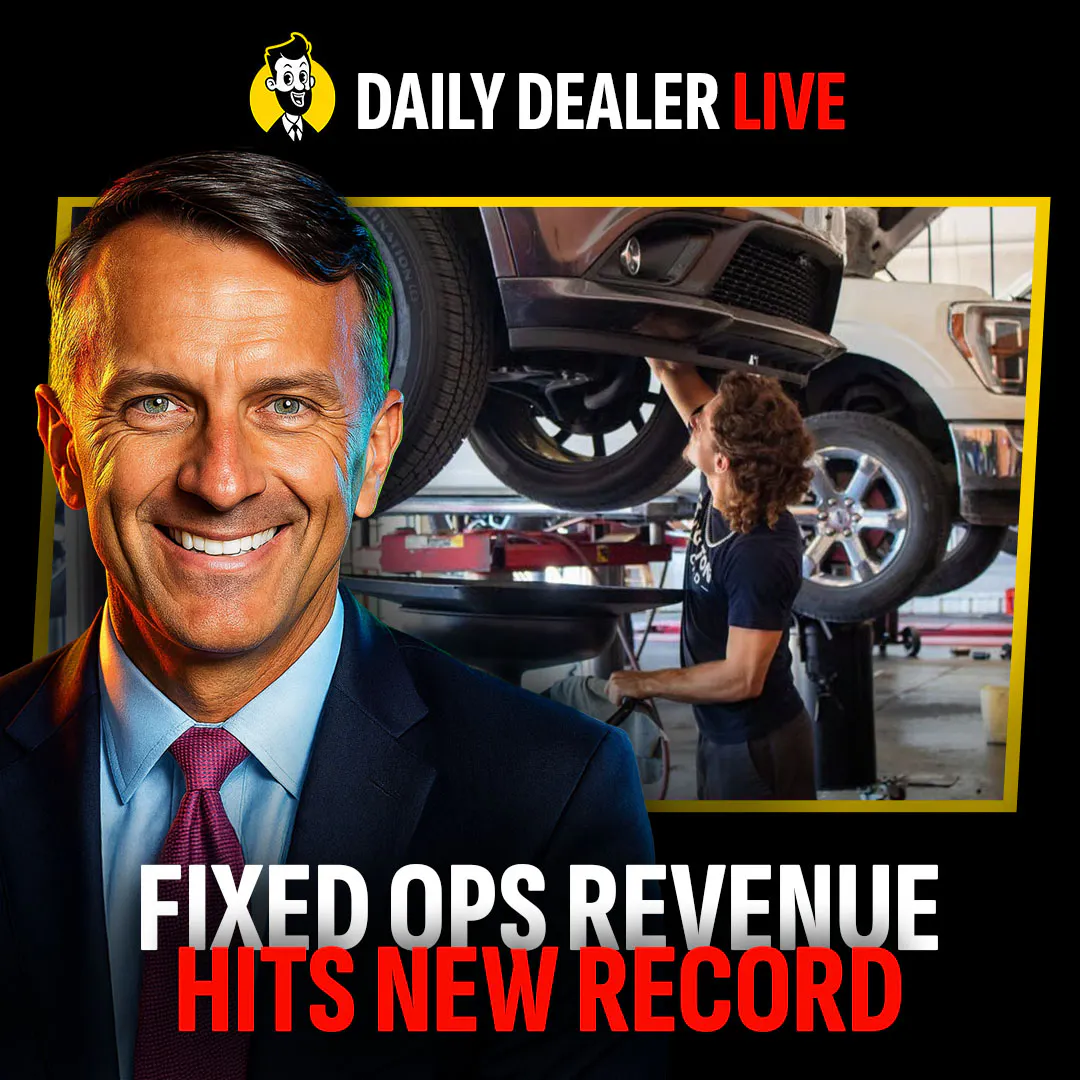
All right. First up today, Cox Automotive's 2026 fixed operation study shows average dealer service
and parts revenue hit $9.23 million in 2025. That's up 33% over eight years. We'll be interested
to hear what our guests have to say about that as consumers hold on to those vehicles longer.
That said, Cox Automotive's latest study shows dealers are still leaving significant money behind
because only about one in four new vehicle buyers had a first service appointment scheduled at
purchase. One in four. What? Just 14% of service customers were ever offered a trade-in appraisal
and dealerships share of service visits has slipped from 33 to 29% as independent and mobile
providers gain ground. I'll be interested to talk to our guests today about that. In other words,
the stores that make service more convenient, more transparent and connected to the sales side of the
business stand to capture more revenue today while strengthening customer retention for the next
purchase. Next up today, Kia, Toyota, and now Nissan. They have all issued memos this week,
reinforcing their broker policies. This is a story we've much talked about on Daily Dealer Live.
And for dealers in markets where illegal brokering is a persistent problem, particularly in the
Northeast, the reaction was overwhelmingly positive. Kia's letter was the most comprehensive.
and they must be flagged with the BRKR sales type. And violations, including conducting sales at
unauthorized locations or delegating to a third party, well, those violations can lead to termination.
Toyota's memo addressed its New York region, added a revision clarifying that sales
to brokers without an immediate ultimate consumer won't qualify as valid transactions.
And Toyota also reminded dealers the allocation can be adjusted if the system is manipulated.
As if that was all, a third OEM joined the debate. Nissan came in today tying its notice
to Q1 sales results and restating that broker deals are ineligible for incentive payouts
under Nissan's program. That misreporting triggers consequences and that dealer principles
must acknowledge the updated Full Year 26 program rules by May 6th.
Three OEMs moving in the same direction in the same week is notable. Dealers say these are some
of the strongest stances they've seen on this issue, and the expectation now is that others
will feel pressure to follow. Next up today in other OEM news, Hyundai has cleared dealers
to resume sales of the 2026 Palisade and Palisade Hybrid in limited and calligraphy trims after
completing a software update addressing the power seat issue linked to a two-year-old's death in
Ohio last month. The fix requires the tailgate to be open for seat slow functions, disables folding
controls on the infotainment system, and includes updated occupant detection logic. The broader
And as some have pointed out in our comments, this raises concerns about how shoppers view
a brand's competence when designing and building these vehicles. It also, as an aside, exposes
the fact that vehicles are incredibly complex technological creations. These vehicles have
so much technology in them, which by the way is a great lead into a service contract sale.
No matter how quickly the issue is fixed. Alright, next up today, closing out today's
news, credit card processing costs are now among dealers' top 10 expenses. And how stores manage
payments is increasingly a direct line to profitability. Legacy systems have also caused
outages that stop dealers from writing repair orders or completing sales entirely. And while
surcharging is gaining traction as a way to offset costs, transparency with the customer is,
well, it's everything done right. It supports margin, done poorly, it drives people away.
The mechanic is simple, treat payments as a strategic function, communicate options early
and make sure whatever approach you use, make sure it's compliant. And that is a wrap on today's
auto industry headlines. And welcome to Fixed Ops Friday, everybody.
Alright, going into the chat as we start off today's Fixed Ops Friday, you're okay. Good
afternoon, Sam and community. Just finished up my day at Mannheim. Values are still hiking up
while quality of cars we see they're getting worse. This is Eager's opinion and good quality
vehicles are fetching premium value bids. Eager K also says Toyota used car market was already
crazy, but just got worse if you're in the market for a three year old or newer Toyota,
but new. So thanks Eager for being our roving Mannheim reporter live from the field. So
we appreciate your perspectives on that. Alright, let's dive into Fixed Ops Friday.
First up today, Toley Williams, Fixed Ops director at the Nilo Company. Toley, welcome back to the
show. Thank you very much for having me. I love Fixed Ops Friday as my friend.
You know what? Thank you. So it's fun to have you here. You're one of our repeat return guests,
and it's always fun to catch up with you. What do you think of this Cox data? Just as first up,
I was astonished to read this. It's hot off the press. So Cox talking about how as vehicles age out,
there is 33% more revenue as vehicles hold on to as customers hold on to the vehicles longer,
but service visits visits are declining. The instance of trade appraisal offering according
to Cox is declining. What is going on? How do you make sense of that, Toley? So here's the thing,
I think. I think stores are looking at the short-term gain and they're not looking at the
long-term gain. Are you in the repeat and referral business? Are you in looking at your retention
number on a monthly basis? And stores are after that short-term dollar are the ones that are
losing this battle. I am so proud of our team. We went up 2% to 72%. Retention rate for our
average of our 10 stores is a win for us. So we are having increases in fixed. Why? Because we're
keeping people happy and in the store. And guess what we get to do with them? We're going to sell
them their next car to their friends and family. So are you focused on retention at your store?
Are you selling things that keep people in, brakes, batteries, and tires? That should be
your focus every day, not ELR and gross per RO and all those other horse manure that 20 groups
trying to bullshit beyond. This is what we have to be on. At some point, those 20 group ideas
must have been cogent. What was the economic factor that changed in automotive that made us
go from ELR and ROs and whatnot to, you say batteries, brakes, tires. You want those three
items sold in the service department. Why? And I focus on 100%. So I focus on hours. So I don't
care about the money, as I said before, I care about selling hours. I think what happens if you're
after key metrics and what those key metrics do is drive overselling. What do you want to do?
Do you want to come on the last day of the month that the guy is 0.1 off of his hours per O goal?
You're going to get sold a bunch of baloney. So I think that you want to take away that and drive
our advisors to sell what's needed. Recommendations, we'd sell our family members. And I think that
we're getting away from that and looking at that point, because when we sell more magnets and sell
tires, what happens to our gross, it drops. As I like to say, my goal is to drive my effective
labor rate, which I never say very often down. So I love this. Jim Sabino says,
totally is creating elite MPI videos and sending his techs home tired and rich. So we're going to
come into that in just a second. I want to explore that, but I want to share a funny story with you.
So you watched Daily Deal Live. You watch our fixed ops Friday. We had the GM from Roman Toyota on
recently in Lafayette, Indiana. And he said, dude, I've got a great new strategy. He said,
we are crushing it with $50 oil changes. And we talked about what a great strategy that was.
He's offering it to all of his employees. He's offering it to everybody in the community.
And then that effect is he's bringing everybody from that community in on that oil change. Good
idea, right? Totally. Magnificent idea. In fact, we are doing that at our Volkswagen because
Volkswagen stores are challenged at this very moment. So we've lowered our oil change. But
what are we doing? We're gaining more appointments, more traffic, more opportunities. If we gain
and keep our retention high, guess what we've done? We've turned these people into regular
Nilo customers and hopefully potentially buy their car, trade that car and buy another one.
All right. I got to tell you the funny side of the story. So Lafayette, Indiana is very close
to Kalamazoo, Michigan. Zach Terrell is one of our elite GMs at the Kalamazoo campus. If you can
believe this, a couple of weeks ago, he launched a similar oil change campaign. Now, I got to give
props to Roman, $49.99. That's catchy. It sticks. I think our Ziggler oil change, it's a little more
than that, but it's still catchy. Although, come on, Zach, text me. Tell me what the dollar man is.
I forget what it is. But he came out with that about two weeks after Roman was on the show. And
Zach, everybody was given a Zach crap online saying, dude, you copied them. Not true. It's a
standard best practice. Is it not totally? So there is no copying an automotive. There is no
copying an automotive, like no crying. You know what I say is that, you know, I have no problems
stealing people's ideas. That's a compliment to that store, right? So he should be complimenting.
He didn't really steal it. He tells me he already had the idea. It was just short of execution, right?
Here, he's going to dig himself a hole in the ground if he talks about it too much.
The issue is how do we get people to call us? How do we get people to come in every day? And
that's what drives that number. Services is what it's all about. And that's the reason why all
these old metrics don't work is we talk about selling hours every day. I want to sell a bunch
of oil changes. I want to sell a whole bunch of tires. I want to sell a whole bunch of batteries
and brakes. And we focus on that all the time. So before we go into the video MPI, we talk about
all those things that you're focused on. The Cox data is showing an astounding number of dollars
going outside of the franchise system, going to independent repair facilities.
Why would a customer choose to go to an independent over us? What is the problem in
automotive today in fixed operations, fixed departments that's creating that pull for the
consumer to an independent repair facility where they don't have the same certifications that
franchised auto has? Well, first thing is that we get to say is that we're not practicing on
your car as an aftermarket does. We are trained professionals. But here's the thing is your
dealership focused on profit. It's a bad word when it comes to the service drive. Are you not
focused on retention because what happens is what we do? Oh, here comes the dealer. Here comes the
inspection. It's $4,000 for a break job. Oh, it's every time I come in, am I going to get flushed
to death or not? And the goal is going to be is that they don't trust us. And when your store has
great CSI, when your store has great retention, what you find out is customers are not leaving
because you know what? They're finding out that we will do what's right for your car. We are
transparent. And there's stores across this great United States that have unbelievable retention
and growth because they're not letting customers go. It costs too much to let a customer go.
So, you know, to me, it's what's all about. That's the business that I'm in is repeat refer.
All right. So you've decided to focus this month, this quarter, this year on quality of video MPI
going out to that consumer. Why did you decide to focus on it? And what are you doing?
Great question. So, you know, we've been doing videos here at the Neil Company since I've been
here. I've been doing it probably for 10 or 15 years. You know, X time came in that with a long
time ago. But one thing that we've not been able to do is monitor those videos. And you can say,
hey, tell me you should look at every one of them. I'm not going to look at 10,000 videos. My service
managers are not going to look at 10,000 videos. And humans, you know, they are the shop is sometimes
a noisy, loud place. And when we have that technology for phone calls, we can have AI agents
look at it. I say, you know, I don't sleep at night because what are we sending our customers
every day? And we know that the inspection is such a crucial element. I am so blessed that
our good friend Joe Schaefer from True Video has come up with a way to analyze that video.
And see, are we asking for the brakes? Are we checking the tires? Are we showing underneath
the car? Are we being pleasant? Are we saying thank yous? Not just sell, sell, sell, but advise,
advise, and recommend the key things that we believe that we should do at the Neil Company.
When he told me about that in 8088, I was like jumping up and down like, dude, I got to get
in on this. And I am so blessed that Cox and them are working together. I get to look at my first
set of videos next week. You know, I'm a little worried, but guess what? What we measure, we fix
right away. And, you know, we've had a great time with that. So what we used to do is we used to do
tech video contests, which would bring attention to it. We did that. We did that. Don't bash the
contest. We had a nationwide video contest. We crowned a winner, Cavender Auto Group. It was
awesome, right? So you used to do a contest, and now you're allowing the AI to judge the
way. Correct. Now, I'm still going to do contests. We had a $5,000 winner we had last year. We do it
once a year. That's a big deal. You know, our goal is that we, you know, each store has a winner
every week. And then we put it into a hopper and we looked at the best one. And it was some
sleeper guy at our Porsche store that made the money. We're like, wow, how cool is that?
You don't need a Steven Spielberg technician doing a video. You know, it needs to be short
and sweet and to the point and so forth. So quality of videos is going to help you drive
retention and have that honesty and integrity. So when the customer thinks, well, should I really
buy it or not? Did my doctor of my car say so? And he can actually, he or she look at that. So
we're very, very excited. So what are the key metrics that this AI searches for in the video?
And since you implemented it, tell us how long ago, what are the things that are getting flagged
most others might learn from? So great question. Are they doing the process right? You know,
as we are just getting started, we get a score, right? And that score of our first score comes
out on Monday morning. But what we're looking at is, did we raise the car? Did we talk about the
brakes and show the brakes? Did we talk and show the batteries? Right? Did we talk about filters?
And the nice thing about what Joe has done is allowed us to tailor it to the Nilo way,
not the Joe way, right? Because every store might have a little bit of different ways. So we can
tailor to it where I want brakes and tires. I want to say thank you and welcome. And I want to
mention their store in it, which you know, and I would love the technician to say his name. That's
a gray area, of course. But the goal is going to be is that are we doing the process the same way?
You know, we have cheat sheets and we're doing everything right. But you know, humans vary. So
we want to go is that we're just going to keep an eye on it. And then of course, we're going to have
contests. And we're going to publish those over 64 television sets to tell everybody how they're
doing. How long have you been doing the process where AI has been watching every video and giving
that feedback? Four weeks. Okay. And in the four weeks, what is the most common flag that you're
seeing that needs correction? I think that the process of doing it the same way every time.
And that's going to be our biggest fix like that. And to me, that's an easy fix. The good thing about
it is as we go into our first deep dive on Monday is that we're going to see is that, you know,
is there any horrible ones? And the good news is we're not seeing that at all, which is good.
And so I guess this tool is getting a little bit of free ad time. So we'll just give it to them,
right? But how what what is the feedback look like? If I'm a technician, I record the video,
I send it to the customer. Does it somehow tell me after the videos created how I did? Or is there
like a longer feedback loop? How quickly does that feedback happen? Great question. So what I want
is instant feedback, like we have on phone calls. Joe's promised me that's coming soon. But right
now it's what now we're taking. We take clumps of videos. And we I know Liza's them and tell us
about it. He's hoping by the next quarter, he'll have live date. Because what I would like is that
we do a video, it gets analyzed before we send it out. Wouldn't that be the best thing we can
find? Hey, we're not so we're not going to that's coming. So there's a bunch of different video
technologies that are out there. So this one's called what tell me this one. True video. True
video. There's something called and we might there's a my karma product that we use in quite
a few of our stores. Is this similar to that? It I also understand the only reason I know this
is because a couple of our GMs have said, Hey, you might have had a tech technician standing
around somebody through an F bomb, you obviously don't want that in a customer video. It actually
has the intelligence to detect that or see the poster that should never have been put up in the
shop in the first place. And it can either crop it out to leave it change it whatever right similar
very similar to that. And that's the exciting part. So the thing with true video is that they're
the OEM one for X time rentals and CDK that his product is built into that. So he does 26 million
videos a month. And so he's got great practice on that. But it's very similar to a my karma product.
You know, who's does a great job with this company. And he is doing the same kind of technology,
which is something that we have not had in a long time. And tech videos are so important for us
for that honesty and integrity. I think that this is the next big thing. And I'm super excited to
be pushing this for the next month for this next year. Yeah, what percent of your repair orders
get an MPI in April of 2026 at the Neal auto group 100%. If it has a mile or a million miles,
it's getting an inspection. And guess what? I pay the technician to do that quality inspection
and video. Oh, you pay him. Okay. Oh, yes, I do. Because if I pay them, what can I do? So you want
100%. But what do you get? Nobody's perfect. Totally. You can't tell me 100%. I refuse to accept
that. I'll be more than happy to share my screen. It's 99. Wow. And I will tell you, as I, you know,
I'm a very quiet to do person. If you're not at 99 or 100, I'm, I am loud. Yeah. Yeah. Hey, last
time we were on the show, you know, retention is your big North star. We talked a little bit about
CSI. What are your thoughts on CSI? I think I've heard you say CSI is kind of dying away. Retention
is a better metric because it's more active. How do you think about CSI at the Neville Auto Group?
Well, our CSI is, you know, it's a staple. I don't, you know, we have a little payment to it,
but our goal is going to be as if you have bad CSI, you're not going to work for us.
I would hope that the manufacturers would go to more, would go to a retention number because CSI
is manipulative. As you all know, you know, some of you can't talk to the customer. You can do
whatever you want for your customer. And guess what we do? We are marketing all of our CSI customers
on a daily basis, right? Now, I don't mind calling all of our customers to see how they're doing.
But when you're trying to push it, you know, this is my report card, please say yes. You know,
I just feel that we're not getting your real number. A real number are the customers coming
back to your store and doing service and buying the next car. Honestly, that's the real number to me.
And that's the number that we should be chasing. Now CSI is, you know, I don't see it going away.
I would just hope OEMs would look at it a different way because they're in the repeat
referral business too. Sometimes I don't think they remember that, but you know,
my goal is going to be as we have to work together. Yeah, it's a little bit of a tug of war.
At some point, right? Between some of the different tensions, but when everyone works
together, it is better. Going back to a topic we've talked with you in the past, you've talked
loudly about your CDP strategy to drive retention. Last we talked, you hadn't executed on it yet,
but you're getting close. Where are you today and what does that actually look like if it's
implemented currently in use? So great question. So we are super excited. So Dennis and myself,
when we're working hard, Dennis has been spearheading that our variable director, but
we are partnering with our drive-centric company to make it for us. We have not had it in place.
We're getting our data lake set up. We're using a snowflake. So we are super excited of building
all those networks. When you look at the fixed offside of a CDP, this is where I believe that
we're going to get the biggest bang for our buck. Now, I know Dennis has all kinds of great
visions for variable. God bless him for that. But for fixed, I'm sending out 20 emails to the same
customer because he bought 20 different cars. I just feel like we're doing stupid things. Two is
that if you didn't buy breaks, guess what I should be marketing when following you around the internet
on? A breaks fashion. I think that we'll be much more hyper focused on that and give customers
a better service. And then the last thing, because we have 10 stores, we're also going to have a
great database when the customer comes in. We can say, Mr. Williams, thank you for buying 12
cars from us. I really appreciate it. I'm glad this is your first time in our Volkswagen store.
I think that we are not giving that information to our service advisors, and I think that's a
great thing to have. As we go to hotels and we go to airlines, what are the first thing that comes
out of their mouths? Thank you, Mr. Williams, for being a Gold member for a customer for 27 years.
That's what we have to have in the service drive. So when does it go active? When does the CDP
Data Lake all that? When is it active in the group? That's Dennis. We'll get Dennis back.
But the issue is that we're hoping for, I think we're hoping for third quarter. We're building a
foundation today. We're very excited about having the drive center come out June 10th or coming out
to visit us or pop up with it. So we're working hard on that and getting that set up. But third
quarter is our target. Okay. Were you involved enough in those conversations to answer something?
I was in a vendor meeting recently and the guy was like, look, you're looking at the CDP all
wrong. He's like, you do not want to create a CDP. Actually, he said you don't create a CDP,
you create the Data Lake, and you want to cleanse all your data with a completely independent third
party. You don't want to go with a CRM. You don't want to go with your DMS provider. You don't want,
you want it to be completely independent from every other provider so that you completely
own that data and that you've got complete command control over that. Do you have any thoughts on that
before we go into the lightning round? I cannot tell you that is exactly correct. I think what
happens a lot is that these companies are all out there selling a CDP because that's the new word
now, right? You know, and I think the issue is going to be is that they want to control your data
and the answer is absolutely not. We want to own our data. We want to have our own Data Lake. We
want to clean our data and do whatever we want with it. Then that turns and we're going to give
that Data Lake to a CDP to do what we wish on our command. So the goal is going to be is if you're
setting up a CDP, make your own Data Lake. It's not that hard. There's companies out there that do
that for you and help you with that. AWS forever, right? Yep, 100%. And I think that your goal is
going to be is that how do you bring all the data into it, right? And that's a challenge because
in the automotive industry, we don't like to talk to each other, right? Companies just don't work
very well. So now you have to have a server that puts it in here. There's all kinds of different
ways but the goal is going to be is that you own the data, own it. And then how much information
we put in there? Can we get recall data in there? Are you making a deal with Recall Masters to help
you out with that or whatever it takes to help you with that situation? Or you can bring in
Experian data to help you with that. There's all kinds of different ways but we want to do it.
And then we're going to push it out to CDP for the campaigns that we want to ask them to do for us.
Well, I want to stay close to you guys on that and follow the evolution as you go down the road
on it because I really do think it's a project and a process that everybody knows they need to do.
But there's so many different variations on it. There's so many different paths and routes.
I hate to think you go too far down the wrong road. You want to make sure you pick the right
strategy. And I do like that independent strategy but it is a significant, it seems like it's a
little bit of a price difference. So we'd love to have that debate. You know, it'd be interesting.
It'd be interesting to get three or four different companies that do these processes come on and just
talk about the, you know, hey, tie it to your CRM, tie it to another, tie it to your DMS or
do it completely independent and let them all go at it. So maybe you can help me host that
totally at some point. I would love that. But think about that piece of the puzzle,
is your CRM and your DMS have the worst data of all, right? That's right.
So we don't want them nothing. Now, we need that data set in, but then we clean it up. But they are
not the people that we want to hand work towards. Now, yes, dry centric is doing it, but there's
going to be a separate thing on that. But our goal is going to be is it has to be clean data. I'd
love to do that. I think Dennis and I would, it'd be a challenge for us because we have learned so
much going down this road path as we started last year, as you know, you know, Dennis did
pretty well. And it's, it candidly, it's a, it's a, it's a topic that's changing so quickly.
Like I've done, I can't tell you how many industry spotlight pods we've done on this,
and it just, it seems to be just, just evolving. All right. Quick lightning round, two, three
questions. And then we'll have you back at the end for our wrap up at the very end.
What is the biggest lie told in fixed ops April of 2026, Tully?
Carl will be done tomorrow.
Oh, okay. Very good. Very good. Best performing metric in your department right now. One number.
Don't say retention, without retention.
Over and out.
You can't say retention.
Are you selling your hours capacity on a daily basis?
Hours? Okay. All right. And what's that? Are you?
So, so, so every technician is worth nine hours. We're 130% store. So the average technician at
the needle company is 12 hours per day. We all talk about hours. Every pay plan is on hours.
Parts people are paid on hours. Counter people are paid on hours. Service riders, service managers,
parts managers, anybody that gets a bonus is paid on our hours forecast. All we talk about
is how many hours we sold yesterday, and are we selling our capacity for the month?
And if you're not a 130, you're embarrassed to talk about it.
And that's customer pay hours, or does it matter?
Oh, total. It doesn't matter to me. Hey, warranty is customer pay. The warranty is just paying for
it, and we don't discount.
Yeah. Last question. What's the one hire, Tully, that moved the needle for you most
in the last 12 months? One hire?
Cool. Service riders.
Okay. Well, you plural, right? You're going to lump them all together.
Finding the right service riders.
At each store, I mean, when you have a great service rider get hired at a store that is saying,
okay, the store changes when that changes it. We don't want pre-Madonna's,
but all of a sudden, they're like, oh, wow, we can do that by asking, because what are service
advisors do? They say, would you like to buy it? No. Okay, the car is ready. And, you know, we're
not salespeople, right? Yeah.
You know, and that makes biggest change in the service drive 100%. And it affects the bottom
line overall. Yeah. Scott Pyle comes in, says, CDP and Auto equals Wizard of Oz, MVPs, aka Paper
Tigers. YogaCar says, you own the data, but have to pay DMS to get it. True until you create it,
and then it's yours. DanC says, Tully being quiet. I think that's a side, a funny comment.
Scott Pyle says, shout out, Dennis Gingrich. And with that, Tully Williams, fixed obstrector
at the Newell Company. Thanks for viewing on. We'll have you back as part of the roundtable,
surely. Thank you much. All right. All right. Let's talk, let's talk CDG circles, the digital peer
group for top auto dealers, private dealer chats, vendor reviews, real insights, confidential,
compliant, no travel required, join dealers representing 3000 plus rooftops at CDGcircles.com.
From my own perspective, an invaluable resource to get into the most important conversations
happening in automotive. And it's all about speed to delivery of news and information,
speed to execution. I love it. So thank you, CDG circles for supporting today's content,
including that cool conversation we just had with Tully on all things video. We ventured
into a little bit of the CDP data lake and then topped it off with the importance of the right
hires in the auto or in service rider category. So thank you, CDG circles. All right. Let's turn
now to Darren Spence, founder and CEO of The Laundry Guide. Darren, welcome back to the show.
Thank you so much, Sam, for having us back. We're pumped to have you back. You were on just recently.
Hey, give us the world of The Laundry Guide. What do you do and why does a car dealer care
about what The Laundry Guide does in April of 2026? That's a great question. So I started this business
probably half that twice as much as that now. So The Laundry Guide started in 2004. We're a family
owned and operated company. And we help companies understand this very complex industry of uniform
rental. And over the years, it's gotten more and more complicated, but it's becoming consolidated
as we'll talk about here soon. And so our job at the end of the day is to help dealership groups,
which have been an amazing group for us and our company over the years. And through COVID,
they were amazing to us. But what we try and do is we save clients on average around 30 to 35%
of what they're spending. And we're not looking to switch. We're not, we're actually there to make
things easier and simpler. And one of the words that people use is visibility. This is a cost
that's kind of way down there, but there's just something going on. And so what we do is we've
built software around that. We're the only company out there that has developed software that we use
internally. And my son has done an amazing job at developing that. So we help dealerships save a lot
of money. And then we hold the the actual companies accountable every single month to ensure that
everything is compliant. And so that's that's what we've been doing. But it's really changed a lot.
All right, so two big names in the business, Sintas and Unifer, Unifers, they just closed
a $5.5 billion acquisition, Sintas of Unifers. It's the third time they tried and finally got it done.
For the dealer sitting at home who has a contract with one of the two companies,
is there anything they need to know or be thinking about as they move forward?
Absolutely. And here's a really interesting time. This quiet industry, if you throw Vestis in there
as well, Sintas and Unifers have, like you said, have been going back and forth and they're competitors.
One is basically buying three. So what do you do if you're a Unifers customer or if you're a
Sintas customer, right? What do we do now? And so the FTC will make the final decision on where
this happens. But what we're seeing in the industry is there's no better time than there's no better
leverage for customers right now. If you're a Unifers customer, they're incentivized to get
agreements signed. Okay, so let's say you signed eight months ago, I'm telling you in the past,
you probably wouldn't want to look at it. Now you definitely want to look at it. The closer you
are to your expiration date, let's say you're over 50% of your term, Sam, you want to discuss it.
The other thing is what happens when Unifers is off the table and Sintas, now you're sitting with
Sintas and you don't have any leverage anymore. So Sintas is going to change how they do business
because they bought the third largest company in the industry. That'll put them over 50,
60% of the marketplace. So there's strategic things that you can do to ensure how it's the
best time to be a customer right now. Yeah. So you work with some big groups. What was a moment
you realized that those groups had a problem we're solving in the material, the uniform space?
Yeah, it's a great question. It's sort of like, you know, when your car isn't running well and
you're like, I don't know what it is. Like I'm not a tech. And so you're like, I know there's
something going on with my uniform invoice and bill, but I don't have the time knowledge or really
to do it. So you take it in and we find like Willis Automotive Group, Fred Beans Auto Group,
Lee Johnson companies like that who end up working with us. I will tell you when it happens is when
we do our initial analysis, when we're able to dive into their invoices and explain to them,
there's five ways to charge for a shop towel. The light goes off and they go, okay, I knew there
was something there, but I didn't actually know exactly. And so when we do our analysis or diagnostic
on your invoices at the end of the day, we bring to light everything that's happening. And at the
end, they were not out to get the laundry companies were out to help our customer at the end of the
day. That's who we work for. And that's who we're going to take care of. All right. So you talked
about the technology, your son created some that helps dealers get their arms around the invoicing
for a for a dealer that's been with the same provider for the past 10 years, you probably hear
this a lot. Hey, I've had the same provider for the past 10 years. Everything's fine. I mean,
I don't need to re look at it. What do you say to them? What are they missing the boat?
All I ever have said is compared to what? Sam, what they don't have the availability to do
is compare where they are. Okay, it's an industry like you guys were just talking you and totally
but you know, dealerships don't talk that much. Well, we have all this data. You guys talked about
data. We have all this data and information now. My son has developed a product called Linelint
that we run all our invoices through. And what it does is it takes everything apart, but it gives
us exact information on every single item. Now, wouldn't it be nice to know what you should be
paying for a shop towel, what you should be paying for the inventory maintenance of that
shop towel and the price of that again, talking about those five different things. When we bring
that visibility to smart people like fixed obstacles and different people like that, they're
like, okay, this makes a lot of sense. All right, let's do that. Once you have the knowledge,
you can't go back. Once you know, Sam, you can't go back. Yeah, yeah, yeah. It's such an interesting,
you know, as we wrap up today, it's it is an interesting industry. It's one area where,
you know, most dealers, I think it's it's an expense that you see on the financial statement,
you see it, and it does grow over time. And it's something that every now and again, annually,
a couple times a year, every other year, you've got to kind of like bat it back down. And, you
know, I know there's contract language that can help do that over term if you make sure it's written
into your contract. But it's it's a challenge. It's definitely a bill that can get creeped up over
time if you're not watching it. So Paul Salisman comes into the comments, he says, I wonder what
other services just slipped through the cracks and the cost rise unnoticed seems like a whole
platform of opportunity for cost control. And Paul, I'd say to you, I think there's there's
consultant groups out there all over the country that make an entire business off that one notion
that in automotive, you know, you think about all the different vendors that exist in this automotive
space, like it's it could be a full staff's job, just managing contracts and and watching expense
rise. We've got a great team at our group that does that. But, you know, the better solution,
Darren would be just, you know, agree to a price, keep it to the price and don't allow that creep
to happen over time. What is it about the uniform business that prevents that from happening? You
think Darren handshake and move on? Yes, well, you know, invoices change, contracts don't.
And that's what happens, right, is the inception of the contract does not change. And what it says
in there is that they can raise prices. I'm telling you, Sam, even when you put that in there and
you do exactly what you do, it still happens. And so that we have different regions, different goals,
comp plans, they throw mats on the truck, the guy has to put them, they'll throw them on invoices.
I'm not here to talk bad about it as much as these things happen. They're not up to me to
happen. But I'm telling you, I know what happens. And developing software to help support auto
groups run their business better. They don't have a solution like that. Now we built that solution
in this category. And we're knocking on the doors of auto groups, and we're going to educate them,
work with them and help them because margins are tight in every business, especially in the auto
business as well. And we want to help people get fair market pricing for this. I agree with you,
a handshake should be enough. But I've been doing this for 22 years. And I think my son will be
doing it for another 22 years. So we want to help people out, because there's not as many choices,
right? If I go to the car dealership, and there's only two options, it's a lot different than having
five, right? And this is what we're getting to is it's a very small pool. And it's not advantage
to the client, it's advantage to the supplier. And so what we're trying to do is just even those odds,
Sam. Yeah, Dan C comes into the comments says not enough attention is paid to third party vendor
management, potentially having a lot of money on the table if you aren't careful.
Totally agreed with that. So just in about 30 seconds here, Darren, if I'm a dealer and I'm
engaged with the software you're talking about helps manage those expenses and rising costs,
all that. What do I get on my side as an output from that software that helps me to better
manage that expense as it relates to uniforms and supplies in the shop?
Very simple inventory, let's say shop tells, let's say that guy doesn't work here anymore.
The amount of things that stick on invoices for weeks and months is crazy. So it comes back to
visibility. Someone needs to be watching it. We built a software that does that. And our job
at the end of the day is we work for clients, and we only make money if we can save you money. So if
we can't do that, we walk. And that's how we've been doing it since 2004. And that's how we're
going to continue to do it. But we're going to do it with better solutions and better tools.
Awesome. All right, Darren Spence, founder and CEO of The Laundry Guy. Thanks for joining the
show to share your perspectives on managing that all important bill in the shop of supplies,
uniforms, and the other, and also giving us a little bit of an insight on that acquisition.
Darren Spence, thanks for being here. Thanks, Sam. The best to you. Thank you.
All right. And we are headed straight into a conversation on all things, finding technicians
in the service department, which is an all important problem in automotive today.
Renee Chrysler, owner, founder of Riley Chrysler Jumpstart Memorial Fund. Renee, welcome to the show.
Hey, thanks for having me. Glad I could jump in the passenger seat. So yeah.
Renee, did I get your last name correct? Is it Chrysler, Chrysler? I mean, it sounds
Chrysler like the car, but it's completely wrong. So. Oh, it is dang it. All right. Well,
how do you pronounce it? What's the real? So Chrysler. Yeah. Okay. Very good. Excellent. All
right. So we got it. So, hey, so talk to us a little bit about, tell us who you are and what
you do out there, Renee. Sure. So I am the owner and founder of our nonprofit, Riley Chrysler Jumpstart
Memorial Fund. We started it five years ago after our son Riley was in a motorcycle accident, and
it was a fatal motorcycle accident. But he was, I want to say car nut, but he was a car fanatic.
Quite frankly, he had a passion for anything fast, airplanes, motorcycles, cars. And after his
accident, we just wanted to find a way to kind of stay connected to him in a unique way and kind
of connect others. And so we came up with the idea of a draft day for students. And it didn't start
in automotive, but it's kind of progressed to that, which has been great, because that's near and
dear to our heart, because that was who he was. And that's what he was passionate about. And so
that's how we began. And so now we really focus on auto students and connecting them with industry
for, and jobs as techs and start a career pathway. Well, first of all, sorry to hear about your son,
but what a great legacy he's leaving by helping to create and inspire this. So there are dealers
who are watching right now that have open technician positions in their dealership. And
maybe they've had those positions posted for six months or more. And it's a challenge in automotive.
What are most dealers doing wrong in recruitment that, that, you know, the efforts of this memorial
fund and what your son started, it could fix in a week. Well, I think what you said is one of the
things they're doing wrong is they're posting it maybe, you know, on whatever platform it might be
versus looking to see what's like right under their noses, which I would say anywhere in the US,
there's auto programs in most high schools, most districts. And oftentimes an under 18 year old
kind of gets written off like, eh, we don't want a 17 or 18 year old in our shop. And this generation
kind of has a bad rap for not wanting to work. But I think that we've definitely proven that to be
wrong. We, we go into the classrooms, we talk to students that are in CTE career and technical
education classes for automotive. And they are, they can't wait for a shot at a real job. And
whenever you hire a 17 or 18 year old, you don't have to undo some of the habits that a little
more experienced technician might, you know, have developed, not that they're wrong, they just may
not fit that culture. But when you have, you know, a younger, you know, kind of newbie that's
there to prove themselves, then they're, yeah, they're more trainable.
So, so what do you, how do you approach these high school students? Because I also think what,
you know, I think there could be some reticence on the auto dealer side to hire out of high
school. Although in our world, we've got a great program very similar to what you're talking about
where we created our own training program, we grow them up from, from whatever point they want.
And they have an interest in automotive, but here's one thing I see, not every high school kid
wants to become a technician. And there's a lot of things that are misunderstood about the technician
path and career, a lot of stereotypes you've got to fight. What are you looking for as that ideal
candidate from a high school age that best works in your program and ends up being a great technician
later on down the road? Will the most the first question we ask is, is this true? I mean, let's
just be real. They're 17 or 18 and sometimes even 16. So when you ask them the question,
hey, is this something you want to do? Well, sure. When I'm 17 or 18, I thought I wanted to be a vet.
So, right. I'm doing something completely on the opposite of the spectrum. But I also didn't have
an opportunity to go and work in a veterinary clinic when I was 17 or 18. So I think the very
first thing that we try to do is just talk to them and coach them even a little bit about,
do you really want this? Do you know what it's like to work in a shop? It's one thing to be in
an environment in a classroom that's a shop. But like, it's a little bit different whenever you
actually walk to a store or a shop and get into that culture and work environment. And so we kind
of ask hard questions and take a minute to kind of get to know the students. And we always talk
to their instructors like, hey, these guys all say they want to do it. What do you think? Like,
what are you seeing in the classroom? Like, do you see them have the aptitude and the drive and
quite frankly, can they grind? Like, that's a big question all of our people talk about.
But what is the aptitude for becoming a technician in 2026? Like, I think even a lot of really good,
we're going to bring Tony back in at the very end. I think a lot of good service directors don't
know what the aptitude is because we're at the crossroads of two sides. One, technicians working
on EVs and it's a highly technical technology based skill set. And the other one is changing oil
filters. What is the aptitude in high school that shows I can become a successful technician later?
So one thing that most CTE programs has is certifications, right? So like, if they're working
on an electrical certification and they get it, then right there you can see, okay, check the box,
that aptitude is met, right? And so they have a variety of certifications that they work on and
complete during their whole program. And so yes, you can check the box for a lot of different
certifications. But oftentimes it's just there, like at least from what I understand here in
our market in Colorado, most of our shops just want to know that they're going to show up and work
and they're willing to learn the ways of that manufacturer. And so if you just find someone
that's hardworking that has a passion, I say passion, but someone that is just willing to like
commit. That's another big word that comes up. They're willing to commit to the job.
So you do something called draft day, right? Yeah. All right. So how does draft day actually
work? And what does a dealer have to do to participate in draft day?
Well, they kind of just have to show up. I mean, but draft day, it's kind of like how you would
envision a sports draft day. We go and recruit students in the high school programs. And most
of them are the CTE students, but we do like to be able to reach out to kids that because there's
a wait list for almost all the CTE auto shop classes here in Colorado. So sometimes we'll
dip into even that wait list and just talk to students who maybe have experience working on
their, you know, in their dad shop or a family shop. We couldn't get into the class. So we recruit
them and do a lot of what I just said. We ask some questions and we just talked to their instructors.
And so they're invited to come to the draft day. And then of course we go out and recruit some
partnerships with local dealerships or stores or even, you know, independent shops
that have openings or that at least want to get a look of what's out there. So when they do have an
opening, they know what's available to them. And we just talk about how we're trying to
grow our own. We want to hire from our community. We don't want to hire from outside, you know,
the borders of our state, whenever we have literally hundreds of kids right here that are in the shop
class or automotive classes trying to do technicians. You gave us some examples of
placements that were successful. So you had a Kennedy for a long Carson at Calibur collisions.
What does that success actually look like? What do those stories mean to you?
Oh, so they're like finding a Riley, right? Yeah.
And so the fun story with Kennedy is that she had multiple offers. And the store that actually
hired her kind of bent the rules because they typically start with an unpaid internship,
but they wanted her so badly that they figured out a way to pay her for her 60 hours of probation.
And so her story is just really inspiring because she had so many offers and the store
she wanted wasn't going to pay her and then they worked it out and she got hired as a paid intern.
And then Carson is like opposite end of the spectrum didn't have a ton of offers. He was kind
of the more quiet student whenever he came for the interviews at draft day. But now he's knocking
it out of the park. Like everyone at the shop loves him and he's one like a grinder. Like he can
just put his nose to the grindstone and produce, produce, produce. And he's just those are two
like just very recent placements we've had from some of our draft days just back in the fall.
And so yeah. So for me, it's like we're finding the Riley's whenever we have these big success
stories like Kennedy and Carson. That's awesome. And for those kids, it's got to be in a lot to
your son, but for those kids as well, to know that a group has kind of, I mean, bent the rules
as a stretch, right? In a private organization, you can do whatever you want, right? But to a kid
coming into an organization to see that they've gone the extra mile to help them or her, like
that really has got to create some loyalty from that kid to the organization. And that's what
you want. We're going to talk to Tully here in just a minute on his perspective on this, but
you want kids that really want to become successful and that want that desire. That's the toughest
part to teach and train either sort of have it or you don't. And I love what you're doing,
because from your perspective, this comes from heart. You're giving in a truly meaningful way
and helping to change the world in a way that it needs changing. Technicians, there's just not
enough, but in honor of your son, putting people into roles that help them become great. So that
is both of those stories. Thanks for sharing Kennedy's story and Carson's story as well.
How can dealers get involved? How can they reach out to you? And then we'll go to our roundtable.
Sure. Well, we obviously have a website and there is, it's a very simplified, it's very simple
form. They just fill it out and say, Hey, we're interested in participating or sponsoring a draft
day. And we, and then we take it from there. We ask lots of questions about how many, you know,
openings you have and what are you looking for? Because sometimes it's not always a technician.
Sometimes it's in parts. And we just have to figure out what their needs are. And then we
get to the classrooms and start recruiting kids. And then we have our draft day and do interviews.
And it's great. I mean, it's pretty fast-paced. So we're, we're in Colorado. Are you based
your nationwide, I would suppose, but you're in Colorado Springs. That's where we are. And
our focus is definitely here in the Springs and in Denver. There's a lot of shops here, obviously,
that we can serve and help. So yeah. Colin Kubic comes into the comments,
his beautiful story shared. Love the work you're doing, Renee. Youth development is incredibly
admirable, admirable and necessary. And then eager K comes in. So, so sorry to hear in reference to
your son, prayers go out to you. So Renee, thank you for sharing your strategy and how you're
looking to change the world by bringing more trained technicians from the high school world
into the automotive space. And we're going to actually transition right into our power operator
round table with Tully Williams. Thanks for being here. And I forgot they've given me a new
transition. So I go to a one shot and then we go back to the two. But anyway, I'm excited to bring
to you Tully Williams and Renee Chrysler, Chrysler, both here ready to talk about all things fixed
ops and all things hiring and recruitment. Tully, you heard the story thoughts about ways to find
great technicians. What thoughts about what Renee's doing?
Unbelievable. You know, in the needle company, we don't really have a tech shortage because of what
things that she does. You know, I believe that a superstar tech is not going to come and say,
I want to work for you. They're already busy. They're already happy. And we believe that the
needle company is that we build our own, right? We start in high schools in junior colleges. Are you
in those environments? Are you there? You know, our dealer association for California has a big
presence in our state. Are you there supporting that, right? So when we were up speaking in front
of these kids, you know, we want to tell them that you can make two, three, $400,000 as a technician
if you decide to make this your career. I think one of the things that you brought up is that,
how do we know it's the right tech or not? And that's the hardest part. You know, I honestly
believe it's in their heart or not. And that's what we call shop assistants. And we pay for those
people hourly, but they were in the shop. There's no hours forecast tied to them. There's no
responsibility except we have like a three to six month window to find out if they really want to
be in the car business because, you know, I just want to work on cars. Okay, not everybody wants
to be in the car business. Yeah. Yeah. What do you think are the characteristics? Because you
would take a risk on a high school kid, right? What do you think the characteristics? What are
you looking for when you're looking to potentially hire one of those apprentice roles? Slowly showing
up on time and have respect. And I think that, you know, and do you feel, do you see the drive in
them, right? Do they really want the job or like I was told to come here? And, you know,
unfortunately, that's just the way it is. And, you know, when you go to these college programs,
like our junior college and our high school programs, there's a lot of kids in there because
it's a babysitting center. I get that. But you know what, the top 10% of those people really
want that job. And when you, when you sit there and talk to them, you can feel the passion. And
then you have the teacher come over and says, you know, that kid's doing a really good job. You
know, I would love you to give them a chance. So then we'll hand all those resumes out and they
get priority at all of our stores when we're looking for shop assistants because we need to have
shop assistants in all of our stores as we can develop that. We have it in writing. We show the
path to $58 an hour. We can show them how they go in to become an hourly, an hourly with a bonus,
and then become a flat rate, and then how they get up to $58 an hour. And it gets exciting.
All right, Toli, you heard me ask Renee the question, how does EVs and the technology that
is infused with EVs, it changes the definition of technician. We heard Renee's perspective on that,
which is we're still looking for some of the basic characteristics. How does recruiting for an EV
world tech change your recruitment efforts, if at all? I think that now that junior colleges,
especially, are really focusing on EV cars and the fun part of a car. So now what we're seeing is
the kids coming up like, I'm an EV professional, slow down a little. But what we're seeing is that
that is what's driving people into the industry, not the nuts and bolts of it anymore, but the
excitement of what's going on. So when we have to calm them down and say, listen, we're not going
to let you touch an EV, that takes time, but I'm so excited that you want to be. We would love to
get you in here. And then we tell them the career path. I'm sorry, you're going to bus tires and
change oil for a while, but we've got to make sure you're not going to screw a car up. And then
too is what we're going to do. We're going to send you to all these great schools that the
manufacturer has for you. And we're going to make you a whole ton of money. Renee thoughts on Toli's
approach. No, I love that. It's so true. I mean, I hear that all the time. Like, we're not going to
let you just break everything. We know you're going to make mistakes, but we just don't want you
to break stuff. And so I just, that was funny to me that you said. Yeah. All right, Renee, we're in
the lightning round. So I'm going to ask both of you a question. We'll start with you, Renee. What's
the biggest lie dealers tell themselves about hiring in April of 2026? 17 year old can't do the job.
Very good. Which they can and you've proved it over and over and over again.
I've proven it. We've proven it. I have. Toli, what's the biggest lie dealers tell themselves
about hiring in April of 2026? It's too hard to hire a kid, right? He'll never make it.
All we want to do is go home and game in their basement of their parents' house.
I mean, it's hard to get over that just so you know.
In what ways are hard to get over that? Because I mean, we get stuck in their brains,
you know, and I can't go out and yell it because I'm not going to be hiring these kids. I want our
service managers and our foremen to do it. And sometimes foremen's going to be a little aggressive.
But our goal is going to be is that they have to understand that you were a kid one day,
you made mistakes, right? And we're giving this person a chance. They get to work here for three
to six months and not really work on a car and work with a mentor. We're going to know if they
can fix cars and they show up for work. And I finally tell, especially when I'm in high schools,
I mean, sometimes I can be a little probably too abrupt. If you show up late, I'm firing you.
If you run into something, I'm going to fire you. You need to be here. You need to dress to work.
I mean, you know, I'm trying to be a dad a little bit, right? But the thing of it is,
is that that's what gets you ahead. And if they want to be ahead and want to make big money,
they have to be in the business. They got to be ready to go. And we'll train them.
Let's talk about that too. They have to be ready to compete. It's kind of a competition.
Yeah, you know, what we have is that we have one thing is that the OEMs have programs for
these young kids that we'll send them away for three to six months that cost us $10,000 to $20,000.
But if you can get into that, who doesn't want to go to a courses school for six months?
Who doesn't want to go to these great OEM classes, right? But you've got to earn it.
All right. I'm going to ask you a question, Talia, as it relates to Renee's program,
this great development program, bringing kids from high school and post high school into the
technician world. You heard her cause, which is awesome. It really connects, I think,
with a lot of our audience. What is Renee's, I'm going to ask one of each of you, and producers,
let me go along. Just give me two minutes, two extra minutes. They're in my ear. All right,
Tolia, what does Renee's program need more of to scale? And then I'm going to ask Renee the same
question. I think that you need relationships with junior colleges and high school programs,
because those are the ones that touch the kids the most. So when we go to those facilities,
the teachers there are the ones that you can connect with, because then she can go in there
and talk to those teachers and say, Hey, I know that all 30 kids are not going to make it, but
these five kids have great potential. How do we help these get these five kids in front of great
companies like the needle company? All right, Renee, you've heard Tolia,
top of the show, and during this segment, what does Tolia shop need to do better to keep young
talent? I think it's just taking a chance. I mean, it sounds like he is, but
I think that just take a chance and hire more. All right, producers. This is my last question
for both of you. Whoever wants to go first, you go first. A 17 year old comes to you and says,
why should I work at a car dealership? 10 seconds. What do you say?
Great career. We have it. We have your career in path and you can make two,
$300,000. I want you to get married, buy a boat, buy a house and have kids.
All right, Renee, what do you say? 10 seconds. I say the same. It's a great career path, great
potential earnings, and you'll have people around you that want you to succeed.
Tolia, can I get a job application, by the way, to either one of y'all?
With that, Tolia Williams, fixed obstrector at the Neela group, Renee Chrysler, owner,
founder of the Riley Chrysler Jumpstart Memorial Foundation. Thank you both for being on today's
Daily Dealing Live. Thank you. We have a ton of great comments in the text and that we just
can't get to all of them. So guess what? The best way to go do that is check out CDG social media
properties all across. We appreciate all of our participants today. Tolia, Renee, awesome
round table conversations as we wrap up. And tonight, Artemis II is headed back to the earth
after having traveled farther than anyone else did. I love visions. I love big things.
We do them in automotive. To you doing big things, watching Daily Dealing Live.
Thanks for watching where you break down the biggest moves in the car business
as they happen. Don't forget, we are here live every Monday, Wednesday, Friday,
1 p.m. Eastern. So if this is your world, hit like, hit subscribe, turn on those notifications
so you never, ever, ever miss a beat. Thanks everybody. We'll see you next episode.
About this episode
Dealerships are losing service customers while OEMs tighten rules on brokered sales, and the show digs into why both issues come down to trust, transparency, and execution. Tully Williams (The Needle Company) argues retention beats vanity metrics, using elite MPI technician videos plus AI scoring to standardize quality and improve CSI/return behavior. Darren Spence (The Laundry Guide) breaks down the $5.5B Sintas–Unifirst merger and what it means for dealer uniform contracts. Renee Crisler (Riley Chrysler Jumpstart Memorial Fund) makes the case that the next great tech is often in a high school classroom—if dealers recruit and train the right way.
Today's show features:
- Tully Williams, Fixed Operations Director at The Niello Company
- Darren Spenst, Founder and CEO of The Laundry Guy
- Renee Crisler, Owner/Founder of Reilly Crisler Jumpstart Memorial Fund
This episode is brought to you by:
CDG Circles – A digital peer group for top auto dealers. Private dealer chats. Vendor reviews. Real insights — confidential, compliant, no travel required. Join dealers representing 3,000+ rooftops at https://cdgcircles.com
The Laundry Guy – A cost-reduction partner for automotive groups, specializing in uniform, linen, and facility service contracts. Our team audits invoices and renegotiates agreements to drive 30–50% savings while improving contract terms. Send us your most recent invoice and we will do a free audit based on our industry data. https://thelaundryguy.com
My Socials:
X ➤ https://www.twitter.com/GuyDealership
Instagram ➤ https://www.instagram.com/cardealershipguy/
TikTok ➤ https://www.tiktok.com/@guydealership
LinkedIn ➤ https://www.linkedin.com/company/cardealershipguy/
Threads ➤ https://www.threads.net/@cardealershipguy
Facebook ➤ https://www.facebook.com/profile.php?id=100077402857683