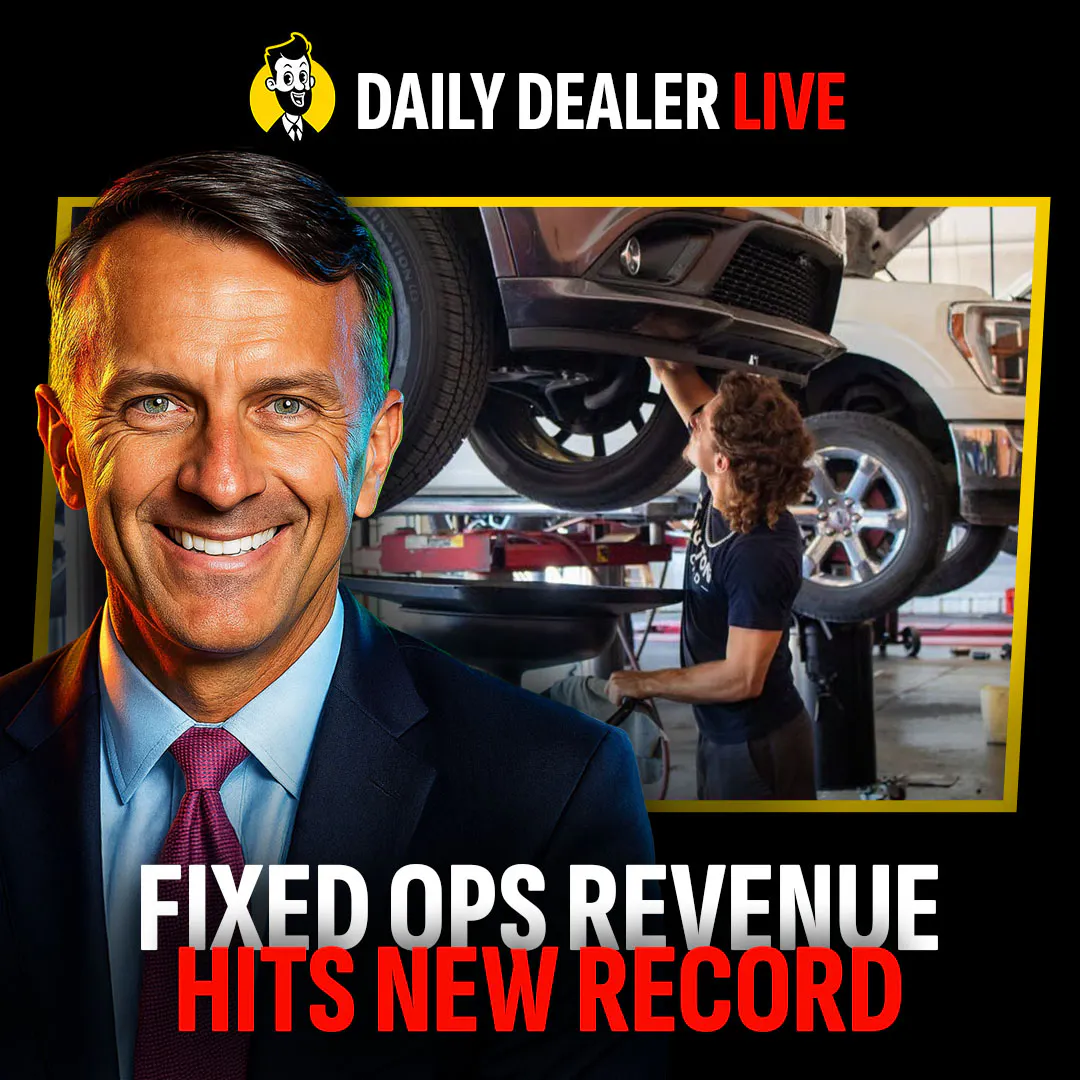
Fixed Ops Friday w/ Tully Williams, Darren Spenst, Renee Crisler | Daily Dealer Live
About this episode
Dealerships are losing service customers while OEMs tighten rules on brokered sales, and the show digs into why both issues come down to trust, transparency, and execution. Tully Williams (The Needle Company) argues retention beats vanity metrics, using elite MPI technician videos plus AI scoring to standardize quality and improve CSI/return behavior. Darren Spence (The Laundry Guide) breaks down the $5.5B Sintas–Unifirst merger and what it means for dealer uniform contracts. Renee Crisler (Riley Chrysler Jumpstart Memorial Fund) makes the case that the next great tech is often in a high school classroom—if dealers recruit and train the right way.
FTC warning letters
"So the FTC, they sent out warning letters to 97 dealer groups last month and the industry is still looking for answers to uniform dock disclosure just as one example."
The FTC is a government agency that watches for unfair or misleading business practices. If it thinks dealers aren’t being clear with customers, it can send warning letters about what needs to change.
The FTC (Federal Trade Commission) can send warning letters to companies it believes may be violating consumer-protection rules. In the dealership context, these letters often relate to how dealers disclose pricing, fees, or vehicle information to shoppers.
NADA
"NADA's Mike Stanton talked about their webinar this past Monday and they said that webinar left too many questions on the table."
NADA is an organization that represents car dealers. They often host events and share guidance on rules that affect how dealerships operate.
NADA (National Automobile Dealers Association) is a major trade group representing U.S. car dealerships. The episode references NADA’s involvement in webinars and discussions with the FTC about dealership compliance and disclosure expectations.
Cox Automotive
"All right. First up today, Cox Automotive's 2026 fixed operation study shows average dealer service and parts revenue hit $9.23 million in 2025."
Cox Automotive is a company that tracks and reports on car-industry trends. In this segment, they’re providing research numbers about dealership service and parts performance.
Cox Automotive is a large automotive data and services company that publishes industry research and benchmarks. Here, it’s cited for its 2026 fixed operations study, including service and parts revenue trends.
service and parts revenue
"Cox Automotive's 2026 fixed operation study shows average dealer service and parts revenue hit $9.23 million in 2025."
This is the dealership’s income from fixing cars and selling parts. Strong service and parts revenue usually means customers keep coming back.
Service and parts revenue is the money a dealership earns from repairs, maintenance, and replacement parts sold through the service department. It’s a key metric because it reflects customer loyalty and the strength of the aftersales operation.
Hyundai
"Next up today in other OEM news, Hyundai has cleared dealers to resume sales of the 2026 Palisade and Palisade Hybrid..."
Hyundai is the brand that’s allowing dealers to start selling a certain model again after fixing a problem.
Hyundai is mentioned in a separate OEM update about dealer permissions and a specific model’s sales restart. It’s tied to resolving a safety-related software issue.
software update
"after completing a software update addressing the power seat issue linked to a two-year-old's death in"
A software update is like updating the car’s computer program. In this case, Hyundai used an update to fix a seat-related problem before dealers could sell the cars again.
A software update is a change to the vehicle’s electronic control software, often delivered through dealer service or an over-the-air process. Here, Hyundai used a software update to resolve a safety-related power seat problem before resuming sales.
tailgate
"Ohio last month. The fix requires the tailgate to be open for seat slow functions, disables folding controls on the infotainment system, and includes updated occupant detection logic."
A tailgate is the rear door of a truck or SUV. Opening it lets you access the back cargo area, and here it’s also tied to how the vehicle allows certain features to work.
The tailgate is the rear door on many SUVs and trucks that swings open to access the cargo area. In this context, it’s part of a safety/vehicle-software fix that changes how certain functions can be used.
sell what's needed
"So I think that you want to take away that and drive our advisors to sell what's needed. Recommendations, we'd sell our family members."
“Sell what’s needed” is the idea of making recommendations based on actual vehicle condition and customer priorities rather than chasing quotas. The speaker frames this as the approach that improves retention and keeps customers happy.
magnets
"...because when we sell more magnets and sell tires, what happens to our gross, it drops."
“Magnets” here sounds like a small add-on item the dealership sells with service. The speaker is saying that selling more of these add-ons can change the profit numbers.
“Magnets” likely refers to a dealership add-on product category (possibly branded accessories) sold during service visits. The transcript doesn’t provide enough context to confirm what product is meant, but it’s being treated like an attach item that affects gross.
Roman Toyota
"We had the GM from Roman Toyota on recently in Lafayette, Indiana. And he said, dude, I've got a great new strategy."
Roman Toyota is the Toyota dealership mentioned in the story. They’re the example of a store running a cheap oil-change offer to bring in more customers.
Roman Toyota is referenced as the dealership whose GM shared the oil-change pricing strategy. It’s used as a real-world example of how one store’s promotion can influence nearby competitors.
$50 oil changes
"And he said, dude, I've got a great new strategy. He said, we are crushing it with $50 oil changes. And we talked about what a great strategy that was."
They’re talking about advertising a cheap oil change price to get more people in the door. The goal isn’t just the oil change—it’s to turn those visitors into regular customers.
The episode discusses using a low, fixed-price oil change as a marketing offer. The idea is to attract customers who might not otherwise book service, then convert them into repeat service clients.
AI
"we're very, very excited. So what are the key metrics that this AI searches for in the video? And since you implemented it, tell us how long ago, what are the things that are getting flagged"
AI here means computer software that watches the video and checks it against a set of rules. It’s used to see whether the technician did the right steps on camera.
They’re using artificial intelligence to review dealership videos and score whether the process was followed. In this context, AI is acting like an automated compliance/checklist reviewer rather than a human auditor.
instant feedback
"So what I want is instant feedback, like we have on phone calls. Joe's promised me that's coming soon. But right"
Instant feedback means the technician finds out right away how they did. That makes it easier to fix issues before the next videos.
“Instant feedback” means the AI would provide results quickly after (or during) the video workflow, similar to how they get feedback on phone calls. This is important because it reduces the time between mistakes and correction.
retention is your big North star
"last time we were on the show, you know, retention is your big North star. We talked a little bit about"
Retention means getting customers to return to the dealership again and again. They’re saying it’s the main goal they use to guide decisions.
“Retention” refers to keeping customers coming back for repeat service and purchases. The phrase “North star” indicates the dealership’s primary guiding metric or strategy focus.
Snowflake
"We're getting our data lake set up. We're using a snowflake."
Snowflake is a cloud service that helps companies store and analyze data. Here, it’s being used to power the dealership’s customer-data and marketing efforts.
Snowflake is a cloud data-warehouse platform used to store and analyze data at scale. In this context, it’s part of the dealership’s data setup to support CDP networks and retention-focused marketing.
The Laundry Guide
"Hey, give us the world of The Laundry Guide. What do you do and why does a car dealer care about what The Laundry Guide does in April of 2026?"
The Laundry Guide is a business that helps other companies manage their uniform rental service. The dealership angle here is that it can help them spend less and follow the rules.
The Laundry Guide is a company that provides software and services to help businesses manage uniform rental programs. In this episode, it’s framed as a vendor that helps car dealership groups control costs and stay compliant.
Sintas
"All right, so two big names in the business, Sintas and Unifer, Unifers, they just closed a $5.5 billion acquisition, Sintas of Unifers."
Sintas is a company that provides uniforms and related services. The big news here is that it’s involved in a large acquisition that could change contracts.
Sintas is a major uniform rental and services provider. The episode discusses its acquisition activity and how dealership customers with contracts may be affected by industry consolidation.
third party vendor management
"Dan C comes into the comments says not enough attention is paid to third party vendor management, potentially having a lot of money on the table if you aren't careful."
It means keeping close control over outside companies that supply things to the dealership. If you don’t manage them well, you can end up paying too much without realizing it.
Third-party vendor management is the process of controlling and monitoring external suppliers to ensure costs, billing, and service levels stay aligned with expectations. The episode suggests that poor vendor management can leave money “on the table” through avoidable expenses or billing issues.
service department
"All right, Darren Spence, founder and CEO of The Laundry Guy. Thanks for joining the show to share your perspectives on managing that all important bill in the shop... All right, and we are headed straight into a conversation on all things, finding technicians in the service department..."
This is the part of a car dealership that fixes cars and does maintenance. It relies on having enough qualified mechanics to keep work moving.
The service department is the dealership area responsible for vehicle maintenance and repairs, typically including technicians, service advisors, parts sourcing, and warranty work. Staffing and technician availability are major constraints because service volume depends on having enough skilled labor.
EVs
"One, technicians working on EVs and it's a highly technical technology based skill set. And the other one is changing oil filters."
EVs are electric cars. Working on them takes different skills and extra safety knowledge compared to gas cars.
EVs (electric vehicles) require different technician skills than traditional internal-combustion cars, including high-voltage safety and specialized diagnostics. The segment highlights that service departments are now split between EV work and conventional maintenance tasks.
CTE programs
"So one thing that most CTE programs has is certifications, right? So like, if they're working on an electrical certification and they get it, then right there you can see, okay, check the box, that aptitude is met, right?"
CTE programs are classes that teach practical job skills, not just theory. For future mechanics, they often include hands-on training that helps students be ready for real shop work.
CTE (Career and Technical Education) programs are school-based training pathways that teach job skills—often with hands-on shop/lab time. In automotive contexts, they’re commonly used to build technician readiness before students enter dealerships or independent shops.
draft day
"So you do something called draft day, right? Yeah. All right. So how does draft day actually work? And what does a dealer have to do to participate in draft day?"
They’re calling a job-recruiting event “draft day.” It’s like a sports draft, but instead of picking players, shops pick from students who want to become auto techs.
“Draft day” here is a recruiting event modeled after a sports draft, but focused on hiring automotive technicians. Dealers and shops participate by showing up, meeting candidates, and learning what openings exist so they can hire from local training programs.
grow our own
"And we just talk about how we're trying to grow our own. We want to hire from our community. We don't want to hire from outside, you know, the borders of our state..."
“Grow our own” is a workforce strategy where employers develop talent internally by hiring and training from local communities and existing programs. In this context, dealerships and shops want to hire technicians from nearby automotive classes rather than recruiting from out of state.
paid intern
"...they worked it out and she got hired as a paid intern."
A paid intern is someone who works as a trainee and gets paid. The idea here is that it can lead to a real job later.
A paid internship is being used as a pathway into employment—turning an opportunity into a paid role after the student’s initial involvement. For dealerships, this is a common strategy to build a pipeline of future technicians.
technicians
"Technicians, there's just not enough, but in honor of your son, putting people into roles that help them become great."
They’re talking about the people who work on cars—mechanics/techs. The point is that there aren’t enough of them, which makes it harder for shops to keep up with work.
The speaker is emphasizing a labor-market issue: there aren’t enough automotive technicians to meet demand. In dealership terms, this affects service department capacity, turnaround times, and profitability.
shop assistants
"believe it's in their heart or not. And that's what we call shop assistants. And we pay for those people hourly, but they were in the shop."
A shop assistant is an entry-level helper in a car repair shop. They usually do support work while learning the job, and the dealership watches to see if they actually want to build a career in cars.
“Shop assistants” are entry-level people who help in the service department, often doing non-diagnostic tasks and supporting technicians. In this episode, they’re discussed as a recruiting pipeline with a probation-like window to see if they truly want the car business.
hourly
"And we pay for those people hourly, but they were in the shop. There's no hours forecast tied to them."
Hourly pay means you get paid based on how many hours you work. It’s different from pay that depends on how many repairs you complete.
“Hourly” pay means technicians or assistants are paid based on time worked, not on the number of jobs completed. The episode contrasts this with later pay structures like hourly-with-bonus and flat rate.
flat rate
"We can show them how they go in to become an hourly, an hourly with a bonus, and then become a flat rate, and then how they get up to $58 an hour."
Flat-rate pay means you’re paid a fixed amount for each type of repair. Even if the job takes you longer or shorter, the pay is based on the standard time.
“Flat rate” is a pay system where technicians earn a set amount per repair based on published labor times, regardless of how long the job actually takes. The episode describes a career path from hourly to flat rate as technicians develop.
EV
"...say, listen, we're not going to let you touch an EV, that takes time, but I'm so excited that you want to be. We would love to get you in here."
EV stands for electric vehicle. It’s a car that runs on electricity instead of gasoline, and it usually needs extra training and safety steps before people can work on it.
EV means electric vehicle. In dealership/service training, the point is that EVs often require extra safety procedures and technical knowledge before new hires can work on them.
OEM
"Yeah, you know, what we have is that we have one thing is that the OEMs have programs for these young kids that we'll send them away for three to six months that cost us $10,000 to $20,000."
OEM means the car maker. When technicians get OEM training, they learn how that specific brand wants repairs and diagnostics done. It can make them faster and more accurate on that brand’s cars.
OEM stands for original equipment manufacturer—meaning the automaker that builds the vehicles and designs the systems technicians service. OEM training is typically brand-specific and can cover diagnostic procedures, service procedures, and tools used for that manufacturer’s vehicles.
car dealership
"why should I work at a car dealership? 10 seconds. What do you say? [3603.6s] Great career. We have it. We have your career in path and you can make two,"
They’re talking about jobs at a car dealership and why it can be a good career. Some dealership jobs pay based on results, so your effort can directly affect your income.
The discussion is about working at a car dealership, framing it as a career path with earning potential. In dealership culture, roles often include sales, finance, service, and customer-facing positions that can be commission- or performance-driven.
Request an Explanation
Heard something you'd like explained? We'll add it to this episode.
Sign in to request explanations for terms you heard.
Want to learn more?
Browse our glossary for plain-English explanations of automotive terms, jargon, and concepts.
Help improve this episode
See something that's not quite right? Our annotations are AI-generated and can sometimes miss the mark. Click the flag icon on any annotation to suggest a correction.