Reinsurance is basically insurance companies sharing the risk with each other. In dealership finance, it can be part of how dealers get paid back or earn profit from certain insurance products.
This is a deal where the dealer gets a share of the money made from certain finance-and-insurance products. The host is saying many dealers don’t get clear, real-time information about how that money is being calculated.
Term
F&I PVR
F&I PVR is a metric dealers use to measure how much money the finance-and-insurance department brings in. The point here is that when regular car sales profit shrinks, F&I has to make up the difference.
Front-end gross is the profit from selling the car. If it’s “compressing,” that means dealers are making less money per car sale, so they need other income sources like finance and insurance.
Zurich is an insurance company. Since the episode is about reinsurance and dealer profit participation, Zurich’s role is relevant to how the insurance side of the deal works.
Subaru is a car brand. If someone is a “Subaru retailer,” it means they sell and service Subaru cars at their dealership.
Concept
independent visibility
They’re saying they didn’t always have clear, direct information to track how things were going. Better visibility helps you spot problems sooner instead of finding out after costs rise.
A portfolio is just a bundle of all the coverage plans being managed. If big claims happen, they can raise costs for the whole bundle, not just one customer.
In a dealership, FNI usually means the finance-and-insurance side—where they sell things like warranties and protection plans. The FNI manager runs that area and manages how those products perform.
These are agreements that last for a long time with the rules and pricing set upfront. If the real-world costs (like claims) change, a long contract can make it harder to adjust.
This means you set things up once and then you don’t have to keep checking them. In this case, the dealer expects the insurance/reinsurance company to handle the paperwork and updates without constant back-and-forth.
Labor inflation means the cost of paying mechanics and doing repairs is going up. Since repairs take time, higher labor rates can make claims more expensive.
Term
use cars are costing more
If used cars get more expensive, then the value of a customer’s car is higher. That can change how much insurance or coverage pays out when there’s damage.
Real-time data is information you can see right now, not months later. The idea is that if you can spot problems quickly, you can adjust sooner instead of waiting for the next big report.
Quarterly reporting means you’re reviewing performance every few months. If you only check that often, you might miss early warning signs and lose money before you can act.
A reactive approach means you wait until you see the problem in reports, instead of checking earlier. That can make it harder to fix things before they cost more.
Metrics are the specific numbers you track to see how things are going. Instead of guessing, you watch the right stats regularly so you can catch problems early.
Concept
hold the right company accountable
It means making sure the company responsible for the program is actually doing what it should. The idea is to use evidence (reports and numbers) to push for fair outcomes.
Use car reconditioning (often called “recon”) is the work dealers do to bring a pre-owned vehicle up to sale-ready condition—repairs, detailing, and sometimes mechanical fixes. The hosts tie recon to claim outcomes, implying that better visibility into recon and claim timing can show where costs truly originate.
A dashboard is a reporting screen that shows key numbers clearly. Here, it’s being used to see claims and recon-related activity sooner, so dealers can spot problems they didn’t notice before.
They’re talking about claims that happen soon after someone buys the car—within about four months. If lots of problems show up that early, it can suggest the car needed more attention before sale, or that the dealer should be responsible for those costs.
Reconditioning is what a dealership does to a used car before it’s sold. It can include repairs and making it look and function right, and the podcast is saying how strict that process is can change who pays for problems.
Thresholds are the dealership’s cutoffs for deciding when something is bad enough to replace. If you’re too lenient, you might pay more later when claims come in.
A used-car inspection is the dealership’s way of checking the car’s condition before selling it. The podcast is basically asking whether the dealer can be less careful if insurance/reinsurance will cover the issues anyway.
Concept
multiple investors in the dealership
If more than one group owns the dealership, they may not all have the same incentives. The podcast is saying that can make it harder to agree on who should be responsible for costs when insurance coverage is involved.
CSI is a score that measures how satisfied customers are. If the dealership does a better job inspecting and fixing used cars before sale, customers are less likely to complain, so the CSI score goes up.
They’re using tires as an example of a part that can be “almost good enough.” If the dealership has a clear rule for when tires get replaced, it prevents arguments and helps ensure customers feel the car was properly prepared.
Dealers usually have a team that sells used cars, and another team that “reconditions” them first. Recon is the work done to fix and prepare the car so it’s ready to be sold.
A dealership is usually split into departments. The “new car department” is the part that sells brand-new cars, and the host is using it as an example of how profit should be measured.
The “service department” is the dealership’s maintenance and repair operation, typically generating steady revenue through labor and parts sales. The host’s comparison implies that profit participation tied to reinsurance should be treated as a meaningful contributor to dealership performance.
This is the dealership’s step-by-step check of a used car before selling it. Doing it well helps avoid problems later and can make sales and customer confidence better.
The FTC is the U.S. government agency that enforces consumer protection rules. The hosts are pointing to a letter sent to many dealer groups, suggesting there are compliance and trust issues dealers need to pay attention to.
“Net net on sales” refers to how much profit a dealer keeps from each sales dollar after expenses and other costs. The hosts treat it as a key performance metric because it directly reflects dealership profitability rather than just gross sales volume.
NADA is an industry group that provides pricing/benchmark information for car dealers. Here, they’re saying dealers can use NADA guidance to judge whether their results are in a healthy range.
Chargebacks are financial reversals or repayments that occur when a claim or contract outcome doesn’t go the way it was originally priced for. In the segment, chargebacks are used alongside PVR to evaluate program performance, but the hosts argue dealers should also track retention/profitability metrics like return on premium.
This is the report from the insurance company (Zurich) that shows the dealer’s insurance results. If you don’t have it, the hosts say you should ask your provider so you can see what’s really happening.
The hosts are talking about whether dealers can actually see the information they need. If you don’t get complete data regularly, it’s harder to track what’s happening and make good decisions.
In a dealership, the “front end” is the car sale itself, while the “back end” is the extra money from things like financing add-ons and coverage products. The hosts say the back end is being asked to do more than before.
It means the program is only paying back about 70% of what you put in. If you’re paying for coverage but getting less back, it can hurt the dealership’s finances.
A loss ratio is basically: “How much money did we lose compared to how much we collected in premiums?” If it’s high, the costs from claims are eating up the money; if it’s low, the coverage is performing better.
Fragmented reporting means the information you need is scattered or handled by different people/systems. That can slow you down because you spend more time collecting and understanding the data before you can make changes.
Term
FNI provider
They mention an outside provider that helps dealers get the information they need. The point is that when reporting is split across parties, it can take more time and effort to understand what the numbers really mean.
Premiums are the regular payments you make to keep insurance coverage active. The hosts are saying that the overall cost isn’t just theoretical—it shows up in the money paid out for coverage.
Concept
loss calls
A “loss call” is basically a call or meeting related to an insurance claim after something goes wrong. The point here is that too many of these take time, which makes it harder to react quickly.
A dashboard is a reporting screen that shows the important numbers clearly. In this case, it helps you see how your insurance program is doing instead of guessing.
Written premium is the total price of insurance policies you sold for a time period. Earned premium is the part of that price that “counts” as the coverage time has passed.
Contract count is the number of active or issued insurance contracts being tracked in the portfolio. It’s important because it affects how premiums and losses scale—more contracts can mean more total premium and potentially more total claims.
Earned premium is the part of the insurance cost that matches the time the policy has actually been in effect. It’s used to judge how the insurance is performing over time.
Average premium per contract is the typical cost of coverage for each policy. It helps you see whether your pricing changes are working across all the policies you sell.
A “line item” approach means each insurance product is tracked separately rather than bundled together. That granularity lets you apply targeted premium increases and manage performance by product line instead of relying on one blended number.
“Lifetime” here likely means looking at how costs/claims add up over the whole time the coverage applies. That gives a more accurate picture than only looking at what happened so far.
They’re saying you can’t make good decisions if you can’t see the real numbers. When the data is clear, you can spot patterns and respond instead of guessing.
The “term of the contract” is the length and structure of the agreement between the dealer and the provider. It matters because pricing, coverage, and how claims are handled can vary by time period and renewal cycle.
Term
30, 60, 90 media claims
“30, 60, 90” is a way to sort claims by timing—like whether something shows up within 30 days, 60 days, or 90 days. That timing can affect how much risk the insurer thinks you’re taking on.
Term
multiple causal laws
This phrase sounds like a rule-set for figuring out what caused a problem when there are multiple contributing factors. It matters because it can change how a claim is classified and who pays.
“Recon” is short for reconditioning, the work a dealership performs to prepare used vehicles for sale (repairs, detailing, and safety/condition fixes). The transcript ties recon to insurance risk and underwriting outcomes, implying that consistent, well-documented recon can improve how insurers view the dealership’s portfolio.
Term
premium that's being seeded
“Premium seeding” means the insurance cost is being influenced or set up based on certain inputs. The host is saying the dealership’s actions—like how cars are reconditioned—can change what the insurer charges. So it’s not just paperwork; operations can affect the bill.
A profit center is an area of the business that makes money by itself. The hosts are saying insurance-related revenue can be big enough that it shouldn’t be left only to one group—it should involve more of the dealership.
Retention is how much of a claim cost you agree to pay yourself. If you keep more (higher retention), you may pay less to the insurer—but you take on more risk.
F&I is the part of the dealership that handles financing and optional protection products. They help decide what coverage and deductibles customers are offered, which can change how claims are paid.
A deductible is the amount you pay out of pocket before insurance coverage kicks in. Choosing different deductible levels can shift how much risk and cost the dealer keeps.
Collaborative optimization means both sides work together to improve results, using the same information. Instead of guessing, they use data to make the program work better.
Instead of checking the numbers once a year, the hosts say you should review them every month. That way, you notice problems sooner and can adjust before they get expensive.
Labor rates are what shops charge per hour to do repairs. If those rates go up, warranty/coverage costs can rise too, so any coverage pricing needs to keep up.
Company
Ziegler
Ziegler is the company the speaker moved to after working at Zurich. It’s mentioned to show they’re speaking from hands-on experience in the insurance side of the business.
This means you can see the full story in the numbers—like what’s happening with claims and costs. When you can see it clearly, it’s easier to make smarter decisions instead of guessing.
In this context, transparency means having clear visibility into pricing, coverage terms, and performance data from both the dealer team and the reinsurance/provider partner. That visibility lets dealers spot issues earlier and make better decisions instead of operating on assumptions.
It means don’t just accept what the provider says—use the information you have to ask for proof and push back when things don’t add up. Over time, that can reduce wasted spend and improve outcomes.
Clean data just means the numbers are trustworthy and easy to understand. If the data is messy or outdated, it’s hard to tell what you’re really paying for.
Term
section statement
Think of a statement as a receipt and report for your account. Asking for the latest one helps you see exactly what’s being charged and what’s happening with your money.
A bank statement is the bank’s official log of deposits and withdrawals. It’s a good way to double-check that what you’re being told matches what actually happened.
The idea is simple: if it’s your money, you should be able to see what’s happening. Access to your account helps you catch mistakes and ask better questions.
Concept
benchmark of north of 80%
They’re talking about a target performance level—something like “you want to be above 80%.” The takeaway is that you should compare your results to a real standard, not just guess that things are fine.
Benchmarks are like scorecards or target numbers. They help you see whether your dealership is doing better or worse than expected. Without them, you might not realize you could be earning more.
LIVE
Hey everybody, welcome to another industry spotlight.
I'm your host, Sam Darkin.
If you're a dealer watching today,
I want you to do something for me before we get going.
Pull up the last report you got
on your profit participation program.
We all know what that is, reinsurance.
If you can't find it, that's the first tell.
If you can find it, but it came from your F&I provider
in a PDF once a quarter, that's the second tell.
Here's the uncomfortable truth in 2026.
Front-end gross is compressing, F&I PVR,
it's doing the real work to carry the store.
And most dealers, and I mean most,
have no live independent view
into the reinsurance portfolio that they themselves own.
They're flying a plane without instruments,
and they're trusting the guy who sold them the plane
to tell them how it's running.
That's what today's show is about.
Joining me today, Michael, named VP of the East Division
for Direct Markets at Zurich, North America,
and Jeff Glansman, dealer principal at Glansman, Subaru,
a store that's been family run since 1973
in the Philadelphia market.
Gentlemen, welcome to the industry spotlight.
Thanks, Sam.
Good to be here.
Before we dive in, before we talk about Zurich,
and before we talk about dashboards,
I want the audience to meet you as an operator.
Jeff, give me a 60-second version.
What's your background,
and what does Glansman, Subaru look like today?
Yeah, so as you mentioned,
been a Subaru retailer since 1973.
Third generation came into the business in 2002,
so what's that, 24 years now?
Started out as a driver, just doing dealer trades,
running cars to auction.
That summer, a sales position opened up,
so I figured I'd give it a shot,
took it on and fell in love with it,
and been doing the auto business ever since.
Moved into sales manager position,
then eventually general manager position
as Subaru started its upward growth,
and have really worked every position in the dealership
from general manager to title clerk,
service advisor, service manager,
and that's something that certainly served me well.
I love that, by the way, that's how I started.
I started in the Suzuki dealership in the 90s,
and you just kind of progressed
through the entire organization,
and gained a true appreciation for the operation
and how complex these operations are.
So you're in this Subaru rooftop,
you've got a huge service footprint.
I think the public facility specs are noting,
they're north of 100,000 square feet on the service side,
50 plus bays, you've got a significant size Subaru store,
which makes the next question an interesting one.
Before you had real independent visibility
into your professional participation portfolio
that we were talking about, how are you running it?
How are you managing your reinsurance program?
Knowing what I know now,
I can say that I really wasn't managing
the reinsurance program.
You know, I'd look at what most dealers do,
you know, you look at your loss ratio from time to time
and kind of make sure that that wasn't creeping up too high.
But in order to do that, it would either be a,
quarterly meeting with the rep,
or you'd have to email the rep to get a report,
probably take a few days to get back to you with that report.
And then maybe a couple of times a year,
the rep would show maybe some bigger claims
that hit the portfolio,
or maybe an FNI manager that was relying too heavily
on longer term contracts.
So it was sort of this kind of,
you could get the information
when it was convenient for your provider,
or when you had to specifically request certain things.
So overall, I'd say I had a,
what would you, like I said it and forget it operation
with my reinsurance company.
Which it's interesting,
you think about all the different verticals
in your operations, sales, service parts,
all the different operations.
There's no other entity that operates quite like that,
where it's so reactionary.
And listen, today's show isn't about bagging on reps
that are in the FNI space,
because they're some really great people.
But it is about the tools and resources
that those folks have at their disposal
to bring to help you manage the business.
It's tough to manage it so reactively, right?
If you see a trend a year down the road,
you can't work to fix that,
especially in an environment where parts are experiencing
inflation, labor is inflating,
use cars are costing more.
It's a tough way to run that business so reactionary.
Right, and with all the pressures
that you just mentioned,
it makes your reinsurance company
that much more important to be focusing on the data.
And really, it really becomes something,
when you have that real time data,
something that you can manage day to day,
rather than quarter to quarter or year to year.
And you really can start to,
as you get educated on the data,
really start to impact the numbers
and really affect the return
on in your profit participation program.
So it's interesting,
and this is where I wanna push a little bit.
A lot of dealers who watch this program right now,
they say, hey, you know what?
The reinsurance program I have, it's fine.
My agent's fine, I get a statement.
They walk me through it on a quarterly basis.
Walk us through the moment you realized fine
just wasn't good enough.
That having that reactive look,
three months, six months, 12 months,
it was a crack in the wall of that business
and it could significantly impact your overall operation.
Yeah, I think it was for me when the premium
really started to earn out
and become some significant dollars.
And I saw that I really didn't have a whole lot
of ability to affect those numbers
and that kind of just ate away at me.
Like I'm a data driven person by nature.
So what I wanted to do was really kind of run
the reinsurance company like I do,
any other department in the dealership,
pay attention to it on a daily, weekly, monthly basis,
have specific metrics that I'm looking at.
And when I was able to start doing that,
I could kind of put in processes in the dealership
that would kind of safeguard the reinsurance a little bit,
but also hold the right company accountable.
Whether it was a claim that came through
that maybe that was something that the dealership
really should have paid for rather than
the reinsurance company and vice versa.
Yeah, because use car reconditioning in 2026
is a real challenge, right?
So use car managers seeking to maximize their ability
may or may not recon as aggressively
if they know that's part of your program
if they're held to account for that.
So walk us through when you finally got that clean visibility
through reporting through a dashboard
and let's be specific, what surprised you most?
Was it that use car recon?
What did you see in your own books
that you didn't know was there?
Well, that's absolutely, you know,
the use car recon is where we were able to have
the biggest impact by seeing this data real time.
And the biggest surprise when I actually got the data
was seeing how many claims were actually coming through
within the first 120 days of the customer's ownership.
So that got me looking at, okay, well,
one, should this really be something
that the reinsurance company is having to lay out for?
Or is it really a use car policy issue?
And then that led us back to, okay,
well, what's our reconditioning process?
And we had a good reconditioning process,
but maybe, well, in seeing this,
what it allowed us to do was sort of raise our thresholds
for what we would replace
and what we would sort of say is okay.
Well, what do you say to the dealer that says, well, look,
you know, whether it's in, you know,
on recon or whether it's in the reinsurance,
it's coming from the same business.
So do I really need to get disciplined
behind my use car inspection process or am I okay
if it's a little sloppy into the reinsurance?
Yeah, so I take the approach that, you know, yes,
it may be, you know, interchangeable between, you know,
ultimately where it's coming out of your own pocket.
Yeah.
But I want the company,
each company to be held accountable properly, right?
But when you have maybe multiple investors
in the dealership and they're different
from who's in the reinsurance company,
well, then it becomes a much more serious conversation
about, you know, where the money should be coming out of.
Yeah, so I want to push back just a little bit
on that use car recon comment or point.
So in our own group, here's something I believe,
I think when we hold people accountable to a process
and we ask for discipline,
they actually get better at doing what they're doing.
So to your point, asking use car managers
to run a healthy, vibrant use car operation
with great execution on use car recon,
that improves CSI to the consumer,
it improves our profit margin overall,
and it protects the reinsurance portfolio.
Does that resonate when you took steps
to kind of clean up that use car inspection process?
Did that yield results even beyond the reinsurance?
I mean, we absolutely saw our customer satisfaction go up.
Our sales team was actually invigorated a little bit more
because they didn't have to really defend like they used to.
If something was kind of on the borderline
of whether it should have been replaced or not,
let's say tires, for example.
We don't have that anymore.
We're just in the recon process,
we have our threshold, it gets replaced,
and the sales people know that they can stand behind
this car confidently.
Yeah, so I mean, having the process and clear guidelines,
it's certainly improved customer satisfaction.
It built up that sales person's confidence.
And then we also had the presentation to the customer
of, look, this is everything we did to the car,
you're good, you're not gonna be coming back for a while.
So what's interesting is that one insight,
that one business practice was revealed
with elite reporting on the reinsurance side.
Are you able to quantify reinsurance aside
the impact of that one secured process to the operation?
Do you have any guess what that might have benefited?
No, I mean, I can't say how many more units we sell
because of it, or how much more profit there is
in any one specific deal, but I just know
that it certainly helped the culture in the store as well,
especially in our used car department
and in our recon department.
That's a solid takeaway, and actually on that,
I wanna transition and bring Michael's name in.
Mike, Jeff's story isn't unique, is it?
I wanna hear it from the provider side.
What's the biggest misconception, Mike, you run into
when you sit down with a new dealer
about their profit participation program?
Thank you, Sam, and thanks for having me.
Good question right out the gate.
There's a lot of misconceptions,
but if I have to really point out to one,
is the biggest misconception I see when individuals
are looking for profit participation programs
and providers is that the most important thing
in that realm is the fee structure
or the admin fee of the provider.
When in reality, the most important thing
is the results of the program's gonna deliver for you.
And one thing that I always like to compare it to is,
like Jeff said, the re-insurance profit participation
is it stand on its own silo like any new car department
or used car department or service department.
It's very important to the business.
So one thing I like to say is think about this.
If you were to have a procedure done,
a spinal procedure done,
spine's pretty important to the body.
Would you be researching which facility
could get it done for the least amount of money?
Or would you be researching which facility
would get it done with the best results?
And I think that that's an important comparison
because as important as the re-insurance is
to the profitability of any dealer principal
or dealer group, it's gotta be looked at
as what the results are going to be
and who can deliver those results,
not whose fees a couple of dollars
up and down on this or that product.
So that's what I see a lot about there.
All right, so you see a lot of the fee challenged.
And to Jeff's point, it's interesting,
you get a few insights that can impact
the rest of your operation positively
like your used car inspection process.
Those benefits cascade across the organization.
So not only does it lift the re-insurance,
but it also lifts your used cars.
It lifts your sales.
It lifts probably employee satisfaction
with trust in the product,
which by the way, not a topic for this show,
but with, we've talked a lot on Daily Deal Alive,
the FTC letter that went out to 97 dealer groups
a couple months ago.
I think dealers across the country
are really focused on how do we hone in our processes
so we create a great product for the customer
with less focus on the price and more on the experience.
And so Jeff props to you for focusing on that
at your operation.
Mike, you've also talked elsewhere
about this, set it and forget it.
You can't set it and forget it in re-insurance in 2026.
Why not?
That's been the approach of a lot of people
in investment vehicles.
Re-insurance is unlike your traditional investment vehicle
because you can't set it and forget it, can you?
No, I mean, you could.
It's just not gonna be as profitable as it needs to be.
And we see a lot of that out there too.
So the way I like to correlate that is,
one of the most important metrics
I think everybody listening can agree on
in the automotive industry is net net on sales.
For every dollar you make in the dealership,
how much do you keep?
Everybody knows how to calculate that.
There's an NADA guide that tells you what a good number is.
With the set it and forget it,
nobody really knows what that is
in their profit participation program.
So when we're having conversations
about a profit participation program is,
what is the net net on sales
in your profit participation program?
For every dollar of premium you're putting in,
what are you retaining and what are you keeping?
Because at the end this all matters.
You call that return on premium.
It's called return on premium.
Every dollar you're putting in,
what are you keeping in similar to net net on sales?
How do you calculate it?
So do you have a standard for those dealers watching today
that they should be expecting?
And if they haven't heard about that
from their providers, that a problem?
I think if you haven't heard about that, it's a problem
because at the end of the day,
just like your dealership or your dealer group,
you're looking at for every dollar that you made,
how much are you keeping?
The same thing should be
for your profit participation program.
For every dollar of premium you put in,
regardless of what the fees and the structures
and all that is, for every dollar you put in,
how much did you keep?
Not enough people are talking
about how to calculate that number.
That's interesting, Mike, because in our world,
we focus a lot on PVR.
We focus a lot on chargebacks and net PVR.
So you're saying the number that most dealers brag
about that PVR isn't actually showing
whether or not the program is working.
It's that return on sales that,
or I'm sorry, it's the return on premium
that we need to get focused on.
And that's something I need to think about differently
because we do, we talk a lot about PVR,
we don't talk as much about return on, or net on sales.
Yeah, well, at the end of the day,
like anything in our industry,
it's about the profitability
and how do you create more profitability?
So if you're not tracking how much you're retaining
for every dollar or premium you put in,
hey, who is and be where's it going?
So, I mean, even with Jeff,
I mean, we can bring Jeff in if you'd like.
We calculate this with Jeff
and he's got tremendous results
on return on premium for every dollar he's putting in.
And you asked earlier about what is the standard.
I think Jeff's number is a phenomenal number
that we look at month to month.
Before we go there though, Jeff, let's test this.
Visibility, no visibility.
In the two years prior to your switch to Zurich,
did you know what that number was with your prior company?
And then what is that number today
and what's been the change?
Yeah, no, I did not know that number
prior to being with Zurich.
And it's an interesting way to think about it.
To Mike's point, in the dealership world,
we look at net to sale every month
off of our financial statement.
We wanna run the reinsurance,
I wanna run the reinsurance company
like I would any other department in the dealership.
So when I look at my net on premium,
it's north of, last time it looked it was north of 70%,
which I mean, I'll take that.
On the retail side, NADA says,
guide is, last time I looked at it was 4%.
We're talking 70%.
There's a big variance there.
So for every dollar of premium Jeff's putting in,
he's keeping 70 cents on the dollar.
I would imagine that most if not all dealers listening,
Abe would wanna know what their number is
and then see how to get it to 70% if not higher.
By the way, you just found a great reason
to make sure used car departments
aren't reconning off your reinsurance.
70 cents on the dollar,
it's cleaner going through it there
than the used car department.
So Mike, what advice would you give to a dealer
that doesn't have a Zurich statement in front of them?
How can I go find that number?
Who do I need to get that from?
Well, I think it all starts with a conversation.
I would reach out to your provider,
maybe ask why I don't have a dashboard
or why you don't have a statement
or why it's been six months since you've seen the statement.
And in some experiences we see too,
is when you request something,
you're not getting 100% of the data you requested.
So make sure that everything you're requesting,
you're getting and it's on at least a good cadence.
But more importantly, if we walk down the road
and put $50 on a check and account at a bank in 2026,
we can download the app and log in and check the $50
and then see what happens to it.
In a proper participation program
with seven, eight, sometimes nine figures in it,
wouldn't you expect the same level of transparency and access?
Seems pretty basic to me.
So I would get that.
So Jeff, let's have you jump in here.
When you think about the last 18 to 24 months,
we've seen pressure in automotive.
Like there is more pressure today for the back end
to carry more and do more in an automobile dealership
than probably has ever been.
How does that pressure match up
with the 70 cents on the dollar return
you're getting in reinsurance?
I don't think you're gonna get those types of returns
unless you're paying attention.
You can maybe be looking at your reinsurance
and see that your loss ratio,
it's an acceptable range,
but maybe your investment side is lagging.
So you gotta jump in and change that.
You gotta adjust, you gotta pivot there.
Or vice versa, your investments might be doing okay,
but your loss ratio is dropping.
So you gotta jump in and do there.
So let's widen the lens another notch, right?
Fragmented reporting, the dealer relying on the FNI provider
or the agent to pull the data,
interpret the data, explain the data,
what does it actually cost a dealer?
Not in theory, but in real terms, Mike.
Well, I mean, it's gonna cost them a lot of premiums
that are going out, multiple calls of loss,
lack of time and how soon they're making pivots
and adjustments to maximizing the profitability.
I know that a lot of dealers lately
are with the compressed margins,
are really looking into increasing premiums.
It's April of 2026.
We were doing that in April of 2021 and 2022,
coming out of COVID with the labor rates increasing,
with the shipping prices increasing,
with the parts increasing.
We were way ahead of that
because we could see those trends in the dashboard.
Because when you have access to the dashboard,
you're seeing everything in full transparency.
It's every product, the contract count, the written premium,
the earned premium, the losses and the loss ratio,
and then the average premium per contract.
So when you're increasing premiums at a certain percent,
wouldn't it be nice to see what your average premium is
in your portfolio so you can increase it
with the right number?
And then one level above that is
when you're looking into the dashboard that we offer is,
every product is a line item.
It's not an all in one.
So that way you can do target increases
and shift things methodically with that line of business
because you never know.
I know where Jeff is located about two years ago,
the turnpipe was under construction for about 10 miles.
Well, that may have led to higher losses in Tyron Real.
It'd be nice to see that lifetime
so we can adjust accordingly as a quick example.
So Mike, you make an interesting point.
It's not just a transparency problem.
It's a decision-making problem is all
because without transparency behind the data,
being able to see the trends,
you can't then take action on the data
that impacts the producer or the program.
It is an interesting thing as you described this,
the old school FNI mentality was not a lot of transparency.
The rep kind of owns the transparency into the program
and you rely on that person to give you visibility behind it.
Now Jeff or dealers like myself can go in,
look at the data, make decisions based on the data.
Jeff did that in the UCI.
Does that put less emphasis on the producer or the agent?
And if the agent's my best friend,
does that put that best friend at risk
in terms of my relationship with that person
or does it strengthen it?
I guess that's one of the things I always hear in automotive.
For some reason, the FNI, it's very relationship-based.
Do I need that person less if I've got access to the data
and I can make conclusions about the data real time
and quickly react and respond to it?
The way I see it is if our dealers and Jeff being one of them,
if they know their reinsurance company
as well as I understand the subject,
then we're gonna be in good shape
because the more educated I believe our dealers are
in 2026 and forward,
they're gonna know to make educated decisions.
And I believe when making educated decisions,
then we're gonna be just fine as a company and as a provider.
And that comes with the access
and that actually strengthens the bond of our relationship
because it leads to deeper discussions, further discussions
and discussions more often, frankly, on a monthly basis
when you're looking at the term of the contract sold
or the multiple causal laws or the 30, 60, 90 media claims,
at least even more conversations versus the,
hey, how was your month or how's it going conversations?
It's a little bit more behind that.
So Jeff, you made the transition over to Zurich
a couple of years ago and they came in
and they probably had some sort of an installation process
where they trained everybody on the products
and got the contracts up and running and all that.
At some point you got access to this dashboard
that gave you the visibility.
Talk to us, I know we had the used car inspection,
that was one conversation,
but when that dashboard actually got live
and you and your team could see the portfolio
the ways Zurich sees it,
what conversations did you start having with your team
that you couldn't have before?
One of my regrets at the outset
was not bringing my management team into full education
on reinsurance and how it affects
the overall portfolio of the dealership.
But as time went on and I saw this data,
that's when I started to incorporate them
in the conversations,
because a lot of times this conversation happens
from the dealer level directly to the reinsurance agent.
But now by incorporating my team,
they have a better understanding of how the overall portfolio
of the dealership is affected by what they're doing,
whether it be the recon process or the PVR
or the premium that's being seeded.
So they have kind of full transparency
into really all of that.
And I think what it really did was
by bringing them into the fold,
it was just another layer of alignment
between me and my management team,
just for the overall interest of both companies.
Why is it that in the past, that hasn't happened?
So I don't think we do it well enough
bringing other departments in.
I'll give you my thought, I love yours, Jeff.
I think there's enough profit potential in that,
that I think some dealers shy away from sharing it
because they're worried that others will want
to participate in a way.
But to your point, if you get a return on premium of 70%,
that's such a significant profit center,
you can't not help but want to bring other people
in to help maximize that.
I think historically, dealers have taken the mindset
that my managers don't need to know that side of it.
They're here running their departments,
it doesn't really affect them.
I'm fortunate enough to have a management team
that has been with me for quite some time.
And I, but I also think it's our culture
that has driven them to really not
resent profitability of the dealership,
but really kind of embrace it.
They know the healthier that the company is,
the better off that them and their teams
are gonna be overall.
That's interesting.
So you've got the dashboard, you've got the data,
you've got your team engaged now.
Initially you didn't start that way, but you have now.
I wanna turn back to Mike,
because this is where I wanna dig in a little more.
You talk about collaborative optimization.
It's a phrase that can mean anything
or it can also mean nothing.
What does it mean in the Zurich model?
What does collaborative optimization look like?
What does the cadence look like with a dealer
who's engaged and what does your role look like
with that data as the dealer seeks to optimize
the impact of reinsurance throughout the organization
like Jeff has?
Well, I think collaborative optimization is a word
that you introduced to me, not the other way around.
It might be.
Yeah, I'm still trying to figure that one out.
But no, I think it really comes down
to the portfolio and active management of the portfolio.
A lot of this really goes to the active management portion
of it because it's good to have access.
But if you don't log in, you don't do anything with it,
then it's just as good as not having access to it.
So by having the access to it,
one thing that we do with the collaborative optimization
that you mentioned earlier,
is we look at the multiple calls of loss
on a monthly basis with Jeff.
We'll look at early claims, immediate claims,
30, 60, 90, 120 to what Jeff alluded to earlier.
We'll look at the labor rates.
We'll look at the claims retentions.
Where are the claims going?
How much are you retaining?
We'll then work with the F&I departments
on which contracts they're selling the terms
and the deductible options to then make sure
we're increasing the claims retention portion of it.
It's all one big circle that we look at on a monthly basis.
The cadence is up to whatever the dealer wants to have it,
whether it's weekly, bi-weekly, bi-monthly, monthly, so on.
Jeff and I will normally sit down monthly and go over it.
And then we have our quarterly reviews.
We are the insurance company.
So when it comes to reinsurance,
has the word insurance in it, it's kind of what we do.
So because of that,
the active management portion of it is really important.
And the ongoing active management portion
of that's gonna be very important to any of this.
All right, I wanna see if collaborative optimization lands.
It's way too long.
It won't work.
Your version is a heck of a lot better.
But at the end of the day,
it kind of points to the dashboard isn't the product.
The dashboard in a way is the shared language
that you as a vendor partner have with a dealer.
And then working together, you can help to optimize it.
So Jeff, let me ask you a question.
I think everybody,
every dealer is probably quietly asking as they watch this.
A lot of dealer principals are afraid to look
under the hood of their reinsurance
because sometimes we're worried about what we'll find
in terms of decreasing loss ratios, decreasing returns.
What do you tell those dealers that are kind of like,
I'm a little concerned to look under the hood
because I don't wanna know what's down there
because I'm not sure I have the energy to go deal with it
with everything else that's going on, Jeff.
Yeah, I guess what I would say to them is,
is that how you would operate
any one of your other departments within your dealership?
Because that's what it really comes down to.
This is a profit center for you.
And yet you may not have all the vocabulary or language
or understanding of everything
that's going into your reinsurance company.
So that's why I would just encourage getting an education
from your provider.
And then asking for the data so that you can look
and make sure that it's being managed properly.
Especially today, like you alluded to earlier
with the downward pressures,
you really need to be managing this on a monthly basis
because where as you might have before looked at
the amount of premium you're seating into the company,
maybe once a year,
you really need it with the way labor rates
have climbed pretty drastically and pretty quickly.
You may have adjusted your labor rate two or three times
over the last couple of years,
but never adjusted your premium.
And that's just gonna tank your reinsurance company.
And I gotta tell you to our audience,
today's industry spotlight's a little bit different.
I have a 17 year career.
I worked for Zurich before I came over to Ziegler.
And I see, I saw this,
I saw the need for active management, active collaboration.
I saw the need for total visibility
behind the data to drive it.
And it is, Jeff, it's such a big profit center
inside the dealership,
probably the single most important,
both in the reinsurance side,
but even just in the side that generates profit
for the dealership that it can't be ignored in 2026
because of all those pressures you're talking about.
So, Mike, let's turn back to you
and just talk about some of the things
that separate elite from average in automotive today.
You see a lot of dealers,
you see the top of the distribution,
you see the middle,
and you see dealers that are underperforming
in their own portfolio.
What do those top performers actually do differently?
So, Mike, let's turn to what separates
top from average, right?
I think it goes back to active portfolio management.
They want to be active, they want to be involved,
they want to have the meetings,
they want to set the time aside to have us come in
and go over it on a monthly or quarterly basis like Jeff does.
And it doesn't stop at just what's my loss ratio
and what's my premium going in.
It's to take the time
and look at the multiple calls of loss reports,
is to take the time and have access
to the immediate claims reports.
And then to take the time
and look at the claims retention
and what we're retaining, what we're not retaining and why.
And then work together with us on the active side
to put procedures in place as far as the training goes
to their FNI managers and so on, so forth.
So it's definitely an active management part on both ends.
So basically the opposite of the set-in forgetting
that we talked about in the beginning.
This is where I get to drop one of my favorite quotes.
The difference between elite and ordinary is execution, right?
So it's not about knowing, dashboards help,
all the information helps,
your team can serve up data that helps.
But if it was just about knowing,
this is the quote I love,
we'd all be billionaires, right?
Because we could watch those late night TV commercials
and have the rock hard abs or billionaires
because we would see it, we'd know all the things to do.
It's about executing on that
and that, Jeff, is in part what separated you from others.
So you've run the operation the old ways
it relates to reinsurance.
And now the new way, if you are mentoring a dealer principal
watching the show, sitting across the table from you,
what's the behavioral change they need to make
in order to have the success you're having today?
70%, that's extraordinary.
Yeah, I think it's, one, it's embracing transparency.
All right, so transparent with your team,
transparency coming from,
requiring transparency coming from your provider.
That's where I think the biggest opportunity
for retailers is to, if you get educated,
you can then hold your provider accountable.
And it's sort of like that collaborative optimization term
that you used earlier, that allows both of us
to identify opportunities.
So like, if I know that I'm looking at the data,
my provider knows that I'm looking at the data.
So if they know that they need to be providing me
the information because I'm looking at it as well.
So like, you know, it's a,
it holds them accountable by being educated on the subject.
Well, so Mike, a dealer watching today
as we wrap up, no dashboard, no clean data.
They've been running their program the old way
for the past 10, 15 years.
What would step one be tomorrow morning or today?
Step one would be to stop and make a phone call
to your provider, to your rep.
And just ask the questions,
ask for the most recent section statement,
ask for the most recent bank statement,
ask for a breakout of all the fees and all,
and ask how the investments are doing.
Access is the first step, have an access to your account.
Because I can't stress enough, it's their money.
How would you be okay if you didn't have access to,
you know, the checking account at your own dealership?
It's a little odd to me.
So access is first, tomorrow morning, start from scratch,
make the phone call, ask the questions,
and then demand them to come through on it.
If they don't, I don't want to use the word demand,
but, you know, make sure it's followed through it
and you get everything that you requested.
It's your money, it's your account.
And if that dealer can't get a straight answer
on a return on premium or access or visibility,
that's probably the same.
They can call me.
All right, as we wrap up,
we're gonna do a little lightning round.
This has become a new tradition
within the Daily Dealer Live show
and we're gonna bring it over here to the industry spotlight.
So let's close up with lightning rounds,
short answers, short questions.
Jeff, what's one thing you wish you'd done sooner
on profit participation?
Engage my team into the process.
I like that, I like that.
I need to do a better job on my side on that.
Mike, what's the single biggest mistake you see dealers
making with their reinsurance program, April, 2026?
Focusing on the fee structure.
Jeff, is profit participation a revenue line
or is it an asset in 2026?
Technically both, but yeah, I mean it's...
We'll take both, you can say.
Yeah, I think it's both.
All right, Mike, if a dealer only measures one number
in their program, go forward.
What should that one number be, Mike?
Return on premium for every dollar you put in,
what are you keeping?
It's all that matters.
All right, now one sentence, last question we wrapped.
Jeff, pitch your fellow dealers in one sentence
on why they should actually look under the hood
of their reinsurance program.
I can't do it in one sentence,
but I'll equate it to the service department, right?
A lot of our profit participation programs
appear to be performing fine, right?
You can have a service department
that is operating at a gross as a percent of sale
on customer at 70% and it can be
a profitable service department.
But if you can get up to benchmark of north of 80%,
you're making a lot more money.
So I equate the profit participation program to that.
You might still be performing okay,
but if you don't know the data and what the benchmarks are,
you don't know what you're leaving on the table.
Yeah, I learned something today.
Getting your team involved in engaging in that data,
that's something I'm gonna do as a big takeaway.
It's the old Seinfeld line.
Anybody can make a reservation.
You gotta hold the reservation.
Anybody can have the information.
You gotta engage your team to help make decisions
to help better the operation.
I think as we get better operationally in automotive,
I like your comparison back to the service department.
It actually rises, the rising tide raises all boats, right?
So we're gonna get better across the entire organization
and service is the focus in 2026
and this absolutely touches all those departments.
So Jeff and Mike, thank you both
for being on the Cardiola Ship Guy Industry Spotlight.
Appreciate your perspectives
and thanks for having a fun show with us today.
Thank you, Sam.
Thanks for having me.
About this episode
The conversation makes a strong case that dealer reinsurance can’t be treated like a passive side program anymore. Jeff and Mike focus on dashboards, monthly reviews, and transparency so dealers can see claims, retention, and return on premium in real time. Jeff also explains how better data changed his store’s reconditioning standards, improved customer satisfaction, and gave sales staff more confidence in the vehicles they sold.
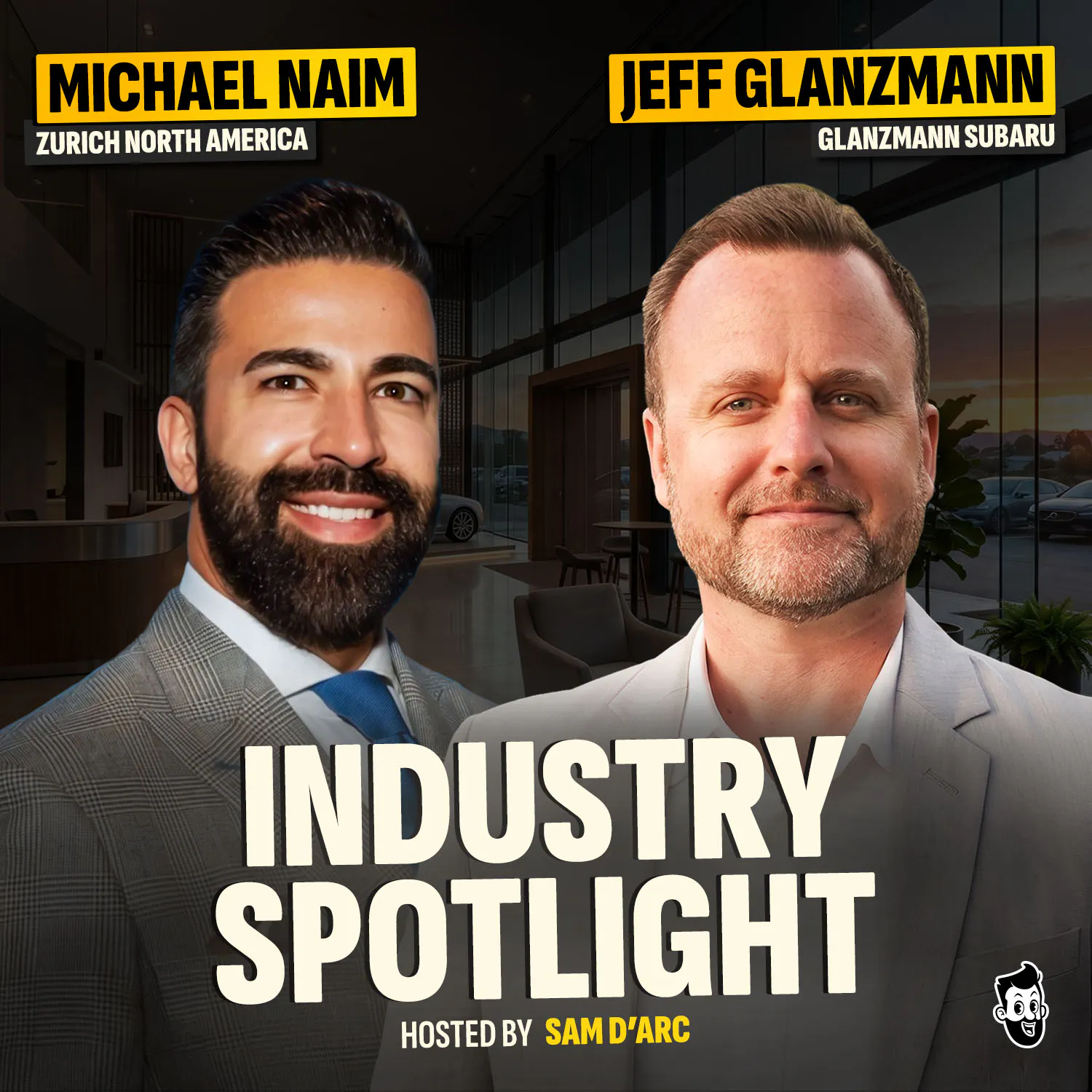
In this episode of the Industry Spotlight, joining host Sam D’Arc are Michael Naim, VP at Zurich North America, and Jeff Glanzmann, Dealer Principal at Glanzmann Subaru, to discuss why many dealers are "flying blind" by relying on quarterly PDFs for their most valuable profit centers.
This conversation breaks down how to move from a reactive "set it and forget it" mentality to a data-driven operation that yields massive returns on premium.
Michael and Jeff reveal why transparency in reinsurance is no longer optional and how real-time visibility can actually fix your used car reconditioning and CSI.
This episode of the Car Dealership Guy Podcast is brought to you by Zurich North America.
Zurich.Insurance - Zurich delivers The Zurich Advantage to dealerships nationwide by combining comprehensive F&I products, consultative training, revenue‑generating programs, and wealth‑building profit participation strategies. Grounded in our mission to provide clarity, confidence, and certainty, we help dealers protect what matters, strengthen performance, and build a legacy for the road ahead. Learn more @ here.
Check out Car Dealership Guy’s stuff:
For dealers:
CDG Circles ➤ https://cdgcircles.com/
Industry job board ➤ http://jobs.dealershipguy.com
Dealership recruiting ➤ http://www.cdgrecruiting.com
Fix your dealership’s social media ➤ http://www.trynomad.co
Request to be a podcast guest ➤ http://www.cdgguest.com
For industry vendors:
Advertise with Car Dealership Guy ➤ http://www.cdgpartner.com
Industry job board ➤ http://jobs.dealershipguy.com
Request to be a podcast guest ➤ http://www.cdgguest.com
Topics:
03:00 Why Dealers Fly Blind On Reinsurance.
04:35 The Quarterly PDF Trap.
06:45 The 120-Day Claim Surprise.
08:30 Why Sloppy Recon Destroys Profits.
10:00 The CSI Boost Nobody Saw Coming.
12:00 The Spinal Surgery Test.
16:30 The 70% Return Dealers Miss.
20:30 Why Your CRM Won't Save You.
22:15 The Dashboard That Forces Honesty.
24:20 Why Keeping Managers Dark Was A Mistake.
33:55 The One Call Every Dealer Must Make.
35:15 The One Number That Matters.
Car Dealership Guy Socials:
X ➤ x.com/GuyDealership
Instagram ➤ instagram.com/cardealershipguy/
TikTok ➤ tiktok.com/@guydealership
LinkedIn ➤ linkedin.com/company/cardealershipguy
Threads ➤ threads.net/@cardealershipguy
Facebook ➤ facebook.com/profile.php?id=100077402857683
Everything else ➤ dealershipguy.com