A go-kart is a small race car you sit in low to the ground. People use them to learn racing because they’re easier to get into than full-size cars, and you can race them competitively.
Daytona is a well-known racing area in Florida. People associate it with major races, and the host is saying even go-kart racing there can be a big, serious event.
Ocala is a place in Florida. The speaker is saying it’s known for karting, and Florida’s winter weather helps people race when other places are too cold.
An 18-wheeler is a big truck with a trailer. The speaker is using it to show that even kart races can have serious logistics, like teams bringing lots of equipment.
The Bush Series was an older name for NASCAR’s “middle” series—basically the level below the top Cup Series. It’s where many drivers prove themselves before moving up.
A truck race is a NASCAR series where the cars are built to look like pickup trucks. The drivers compete on the same kinds of tracks, but in truck-style race vehicles.
Safeway Driving is a driving school that teaches safe driving. The speaker says it’s more about learning the rules and habits for everyday driving than about racing fast.
A driving school is an organized program that teaches driving skills and safety practices, often tied to helping students pass licensing requirements. The speaker raises a concern that some schools may focus more on getting a license than on teaching safe driving habits.
Distracted driving is when you’re not fully paying attention to the road. It often happens when someone uses a phone, and it can make you crash because your reaction time gets worse.
A simulator is a kind of training setup that lets you practice driving in a safe, pretend environment. In this story, students can see how distractions cause mistakes without actually crashing on the road.
Impaired driving means you’re driving when you’re not fully able to think and react—usually because of alcohol or drugs. It’s dangerous because it slows your responses and affects judgment.
Advanced driver training is a step up from basic driver lessons. It usually includes both classroom learning and hands-on practice to help you drive more safely.
Crash avoidance means learning how to prevent accidents, not just how to pass the test. You practice spotting danger early and choosing safer moves so you don’t end up in a crash.
Distraction means not paying full attention to driving. Driver training tries to help people avoid things that slow down their reactions or make them miss what’s happening around them.
The speaker is saying that teen brains aren’t fully developed yet, especially for judging risk and making good decisions. That’s why they argue for extra training to help prevent risky behavior.
Sebring, Florida is where a well-known race track is located. It’s the kind of place where endurance racing happens, and teams pay close attention to tires and driving data.
Scrubbing tires means you’re wasting tire grip, usually by sliding or braking/turning in a way that makes the tire fight the road. It can wear the tires out faster and hurt performance.
Tire temperature is how hot the tires get during driving. Racing teams watch it because it tells them whether the tires are getting the right amount of grip and stress, or if something about driving or setup is off.
Chassis height is how high the car sits off the ground. In racing, that height can change how the car handles and how the airflow under and around it behaves, so teams track it closely.
Here, “brakes” means how the driver slows down before a turn—when they start braking and how hard. The story is about using data to check what actually happened versus what the driver remembers.
Throttle means how much you press the gas pedal. In racing, teams look at throttle timing because it affects how the car accelerates out of corners.
Term
laptop
The laptop here is where the team looks at the recorded driving data. It’s used to confirm what the driver actually did—like braking timing—rather than relying on memory.
Driver's ed is a course that helps new drivers learn how to drive safely. Some places teach it in a classroom, some focus more on practice in the car, and the rules differ depending on where you live.
Place
auto bond
They’re talking about the Autobahn in Germany, a highway system known for very high speeds. It’s famous because some parts don’t have a posted speed limit, so it feels like a different driving experience.
On roads with multiple lanes, the left lane is usually meant for passing. If you stay in it while going slowly, faster cars can’t get around easily, which can make driving less safe.
Texting while driving means using your phone to send or read messages while you’re driving. It pulls your eyes and attention away from the road, which can cause accidents.
The speaker is describing how driving rules and driver-licensing requirements can vary by U.S. state. That means some states may require more training and testing, while others have fewer requirements, leading to uneven driver skill and education.
iRacing is a realistic video game for racing that tries to mimic real cars and tracks. People use it to practice driving skills and learn how cars react when you steer or press the gas and brakes.
Car
NASCAR Racing 2003
NASCAR Racing 2003 is an older NASCAR racing video game. The guest is saying it was one of the first racing sims that taught them the basics.
Car
NASCAR Racing 2002
NASCAR Racing 2002 is an older NASCAR racing video game. The guest is saying it helped them learn how racing sims feel before iRacing existed.
The “Lobo” is a special version of the Ford Maverick. It’s meant to change the look and/or add features compared with a standard Maverick. The podcast is saying they’ll cover that specific Lobo edition in more detail.
The Ford Maverick is a small pickup truck that was designed to be cheaper than most trucks. The host is talking about the early version that used a hybrid setup and cost about $20,000.
This means the car uses a hybrid system (gas + electric) and it sends power to the front wheels. That’s different from hybrids that drive all four wheels.
This is Ford’s 2026 Maverick Lobo, a small pickup that’s been tuned to drive more like a sporty street vehicle than a typical truck. Even though it has all-wheel drive, it’s set up more for everyday roads than rough off-road use.
A seven-speed automatic is an automatic gearbox with seven different gear ratios. It helps the engine stay in the right “sweet spot” so the car accelerates smoothly and feels responsive.
Term
shuffle torque from side to side
This means the AWD system can send more power to the wheels that have better grip on each side. When you turn hard, that can help the truck stick and not slide as much.
Recalibrated steering means the steering feel has been adjusted so it responds more directly to your inputs. That can make the vehicle feel more nimble and less “truck-like.”
“Performance-tuned” means the car’s suspension and brakes are set up to handle more aggressively. The goal is better control when you drive quickly or take corners.
Sport mode is a button setting that makes the car feel more eager. It usually changes shifting and how the truck responds so it feels quicker when you drive it.
The Ford Ranger is a popular midsize pickup truck. Here, the host compares it to another Ford truck by talking about how tall it feels and how you get into it.
“19-inch wheels” means the wheel size is 19 inches across. Bigger wheels can make the truck look more athletic and change how the tires sit on the road.
ActiveX is a Ford-branded name for a synthetic leather-like upholstery material used on some trims. It’s typically chosen for a more premium look and easier care than real leather, while still giving a styled interior.
The “backup system” is a feature that helps you back up more easily. The host says you can use a knob to assist with the maneuver, which is especially helpful when backing a boat or trailer.
An infotainment system is the dashboard system that handles things like music and other info. Here, the host is saying the modern touchscreen setup is distracting.
Apple CarPlay is a way to connect your iPhone to the car so you can use certain apps on the car’s screen. The host is saying that if you use CarPlay (instead of relying only on the car’s own menus), the experience feels better.
Android Auto lets you connect an Android phone to the car and use supported apps through the car’s screen. The host is basically saying that with Android Auto, the touchscreen setup feels less annoying.
Over-the-air updates are software updates the car downloads wirelessly. Instead of going to a shop, the car can get improvements or fixes through its connection.
Rock crawling is hardcore off-roading where you drive slowly over rocks and rough terrain. The host is saying this truck isn’t built for that kind of extreme off-road use.
MSRP is the price the manufacturer lists on the sticker. The host is using it to explain that this truck costs around $40,000 before you factor in everything else.
A two-liter turbo is a smaller engine that uses a turbo to make more power than you’d expect from its size. The host is saying the cheaper Maverick didn’t have this stronger engine, while the Lobo does.
Cruise control lets you set a speed and the car keeps it steady for you. The host is saying the cheaper version didn’t include this convenience feature.
A 1965 Ford Mustang convertible is a classic Mustang from the mid-1960s, and “convertible” means the roof can open. The host is planning to discuss questions about this exact 1965 model, not just any Mustang.
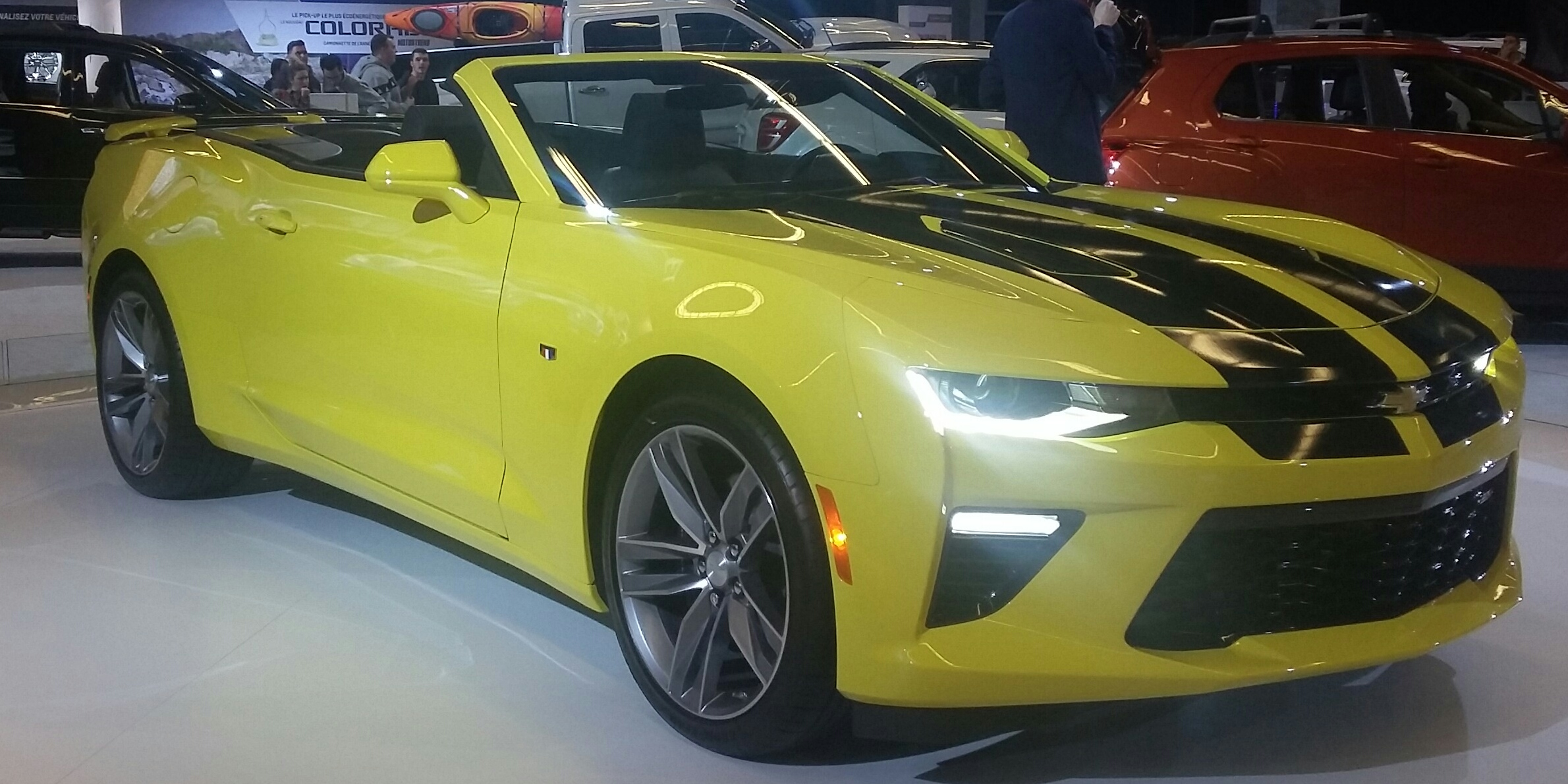
The Chevrolet Camaro is a sports car that can be a coupe or a convertible. It’s known for its distinctive look and driving feel. In the podcast, the key point is that a car with a certain exterior style was actually built on a Camaro base underneath.
A Ram Air hood is a special hood shape with openings meant to bring more air to the engine. It’s both functional (airflow) and a classic muscle-car look.
The gauge package is the dashboard instrument cluster. It includes the speed and other driving info, and in this story it helps tell whether the car is really a 1970 Chevelle or just a replica.
The 1970 Chevelle is a famous classic Chevrolet muscle car. They’re talking about a replica that looks like one, but the dashboard details don’t match the real thing.
A moonroof is a glass opening in the roof that lets in light and sometimes fresh air. They’re saying their car has one, but it’s missing other features.
A power liftgate is the trunk door that opens and closes by itself with a button. They’re saying their car doesn’t have that, but they can still open it manually.
Heated mirrors are mirrors with a built-in heater to help melt frost or fog. They’re useful in winter, and the speaker says their car doesn’t have them.
A car cover is a protective cover you put over a car when it’s parked. It helps keep rain, dust, and sun off the paint, but it should also avoid trapping moisture underneath.
This is a Volkswagen Beetle, and the speaker specifically means the convertible (roof-down) version. It’s a classic car shape, and convertibles can be harder to protect if they’re left outside.
Empire is the name of a car cover product. The idea is that it helps protect a car from weather and dirt while it’s parked.
Term
rodents out
Some car covers are made to discourage animals like rodents from getting underneath and making nests. The speaker tried one meant to block rodents, but didn’t like it because it seemed to trap moisture or not ventilate well.
Budge is a brand name used for car covers, and in this segment it’s described as the parent company of Empire. The speaker uses it as the source of the cover they bought for outdoor Florida parking.
A hurricane is a severe tropical storm with extremely strong winds and heavy rain. In the context of car covers, it’s used to explain why cover anchoring and paint-safe fit matter—covers can be torn off or flap violently.
Built-in straps are the tie-down parts on the cover that keep it from blowing around. That matters because a cover that flaps can rub and wear the paint.
Dash Shield Ultimum is the specific car-cover product name the speaker recommends. They describe it as having three straps underneath that help hold the cover tight and reduce movement in wind.
LIVE
W-A-T-T presents John Paul, the car doctor, All Things Automotive.
Have questions? Call or text 7-8-1-837-4900.
Now, here's John Paul, the car doctor.
Good Sunday morning everyone and welcome to another edition of the car doctor program on 959 W-A-T-D.
I hope you enjoyed the program previously. I learned a little bit while I was listening.
Also, never be in the brain tree parade is one of the things I learned.
Apparently, it's a 12 hour long parade or something like that.
But anyway, welcome to the car doctor program where we can give you answers about all kinds of things,
about your cars, transportation in general. Just trying to help you.
You heard the news where they were quoting AAA, me partially, about how this is a busy travel time.
Because the holiday is falling on Saturday, a lot of people, their day off is on Friday.
The first two weeks in July are traditional vacation weeks still for a lot of people.
It goes back to the beginning of time, I think working in factories or something when factories would shut down for two weeks at a time.
That sort of stays with a lot of people with work from home.
It allows more people to change and change up their vacation time.
So if you're on the road between now and next weekend, expect a lot of other people to be there with you.
And just pack your patience while you're there is a good idea.
With us on the phone is Brad Coleman.
Brad is a retired NASCAR driver who now serves as CEO of Safeway Driving.
I've seen NASCAR and kind of wonder about how all of it works together.
Brad, good morning and welcome to the car doctor program.
Hey John, good morning. Thanks for having me on.
Absolutely, a pleasure.
Let's talk a little bit before we talk about the business side.
Let's talk a little bit about you. What got you into NASCAR?
What did you do? How did you start off with that?
Oh man, I mean it goes back to all the way to where I was a little kid playing with little model cars on the floor and watching them on TV and just love cars and everything about them and wanted to race them.
And I learned that you can actually race go-karts.
I always thought you just went to like a little recreational place and drove bad go-karts around and that was it.
I didn't know you could actually race and do it competitively.
So once I learned that, it got me set on the journey to eventually racing in NASCAR, which was a lot of fun.
And a lot of professional drivers race go-karts, didn't they?
Oh yeah, that's where the majority of them get their start, whether it's a go-kart on a traditional road course on asphalt or if it's a go-kart on a dirt oval, it's how you get in when you're a little kid before you could drive a car.
Yeah, and then it goes into the more professional go-kart series where I think they still have a big go-kart race down at Daytona, don't they?
Oh yeah, yeah, it's huge, especially in Florida in the winter where everywhere else it's too cold, everyone goes to Florida and they race down there.
So you've got it at Daytona, I know Ocala, Florida is a big spot when I was doing it and it's intense.
Like you said, professional go-kart racing, it really is that.
I mean, you've got these teams bringing these 18-wheelers and unloading a ton of carts and it looks like a full-on professional racing event.
And I remember I was, somebody I know did that and I took their cart for a ride and it was one of the fastest things from, I think, 0 to 60 I'd ever been in.
It was remarkably fast.
Yeah, if you've never done it before and you just hop in it and go, it'll blow you away at how fast it goes.
It's actually quite scary, especially considering you're less than an inch off the ground when you're sitting in it.
So you feel really low to the ground and you even scrape the ground sometimes.
You look at the bottom of the seat after a race and it's not round, it's worn flat.
So you're on the ground doing, man, the fastest I went a go-kart was about 100 miles an hour, which feels like 200 when you're that low.
Oh, I can only imagine.
And then you moved on to NASCAR. What division did you race in? What did you do with NASCAR?
Yeah, I went all the way up to the Cup Series where I raced for Hall of Fame racing in the Cup Series.
But the majority of my time was spent, what do they call it now? The O'Reilly Series.
Well, when I started, it was the Bush Series. That's how old I'm getting.
And it was a Joe Gibbs racing for the majority of my career there.
So I was very fortunate to race with some really good teams and have a lot of fun doing that.
Now, are you still active in NASCAR either as a spectator or as someone who can help people out?
I am. I am very active as a spectator. And that's about it.
I'm a fan of NASCAR as I'm a fan of all forms of motorsports on any given Sunday.
Like I just finished watching the Formula One race in Austria.
And when we're done here, I'll probably get my kids and watch the MotoGP motorcycle race there in the Netherlands.
And it's, I love all forms of motorsports. It's just, it's so fun to me to watch.
Just people go as fast as they can on the limit and race each other. I love it.
Yeah, when I mentioned the guy in the go-kart, his name, somebody I don't see anymore,
but I knew him for a very long time, Dale Quarterly.
And he started off on go-karts, went to motorcycles, went to, I don't remember what they called it,
some form of NASCAR, then went to ARCA. And he's still, he still races and it's sort of, it's sort of funny.
Last year, I think he raced in the ARCA race and also raced in the truck race.
And it was sort of funny because the truck race drivers are all in their teens and twenties.
And they're like, Ann, 63-year-old, Dale Quarterly. And he, he, and what was amazing to me was at his age,
he ran two back-to-back races with about an hour in between, which tells me how good people like you and him,
what kind of shape you have to be in, to be in a race car.
Oh yeah. I mean, the fact that he did that is, is incredible.
Because even in, when I was doing it in my early twenties, I mean, after one race, I'd be, I'd be pretty spent.
So the fact that he did that and then went an hour later to do another shows that he's actually in really good shape.
So that's impressive.
And the second race, he actually came in seventh, which was pretty impressive too.
So, yeah. But, and then you decided to go from professional road course track racing to Safeway.
Tell us about the Safeway driving.
Yeah. Safeway driving, it's the driving school and not a performance driving school like you might think a race car driver would do.
But it's a driver that learned how to get your license and drive safe school, which a lot of people are curious as to why they would want to learn how to drive safe
from somebody who used to just go as fast as they could and would crash on a racetrack and stuff like that, which it's a valid question.
And how I got there was, while I was racing NASCAR, Nationwide Insurance was one of our big sponsors at the time.
And they had different obligations that drivers would have to do at the different race tracks we traveled around the country.
So what they would have us do is go to the local high schools in the area where we were racing and speak to the teams there about the dangers of driving distracted.
And I did not want to do it.
I was fresh out of high school at the time when I was racing and I did not want to go back to a high school.
It's not a very fun experience for me, but when I started doing it, I realized that these kids, we were starting to make a difference.
There would be a kid who'd come in and he'd grab a phone and hop in the simulator and drive and he'd try to be really cool in front of his friends and he would start crashing.
And you could see something in their eyes where, oh, they're starting to realize that this is actually impacting their driving.
And it really sparked a passion in me that really fueled me to figure out how can I do more of this?
How can I do more of these events or what about when I'm done racing one day? I want to do something with this.
So as a graduate of Safeway Driving myself in Houston, Texas, I went back to my old coach who taught me how to drive and get my license.
Coach Walker and told him about this passion I had and what we were doing on the race circuit.
And it turns out that he was wanting to retire and sell the school.
So it actually worked out great to where I ended up buying Safeway Driving from him and kept racing while I had it,
but was also teaching people how to be safe drivers at the same time, which is an interesting juxtaposition.
Yeah, absolutely. And you mentioned distracted driving and between impaired driving.
Those are some of the two of the biggest causes of crashes on the road.
And the idea that you're very beginning with this was going into schools almost as somebody who just got out of school
to talk about distracted driving. So I'm guessing your school focuses on that as much as...
And as somebody who works for AAA and we own probably the largest driving school in the area,
you know, sometimes I even wonder, are we really teaching people how to drive or are we teaching them how to get their license?
But it's really all the classroom part and really just understanding that there are all these distractions on the road, right?
Yeah, and what you just said is you hit the nail on the head that when parents call in and ask,
because parent taught drivers that is a thing that's available now in a lot of states where the parent can just get an online course
and then get in the car and teach their kid how to drive when they ask,
why should I come pay to come to this driving school versus do it myself?
And I'll actually ask them exactly what you just said, which is, well, do you want them to learn how to drive
or do you want them to just get their license? Because those are two very different things.
And at Safeway Driving, we're about teaching people how to drive.
If you get your license also, because, you know, the reason you came to us is you need your license.
But what's cool is we're in the state of Texas right now and the state of Texas releases on driving schools in the state
and how successful their graduates are.
And the data shows that Safeway Driving graduates' chances of getting in a crash is nearly half of your average driving school.
So we're really big on teaching people how to drive instead of just getting their license.
So, yeah, you nailed it.
Yeah. And, you know, in Massachusetts, we have something called in control advanced driver training.
And it's advanced driving school.
It's a four hour long program, two hours of classroom, two hours behind the wheel.
And they teach something similar that it's really about crash avoidance, distraction.
And it sounds like you're doing a lot of the same thing.
And, you know, we know and you know as well that, you know, between the time you're a teenager and 25,
your brain hasn't fully developed yet and that is a case for people even older than that.
But that idea they take more risk where somebody who's 35 or 40 years old would go,
I'm not going to do that, but you see, in fact, I saw somebody in a beach parking lot one day
and they were literally sitting on the windowsill of their car trying to steer with their feet
while somebody was pushing the gas pedal for them so they could drive along and wave to, you know, the girls on the beach.
You know, when you're 40 years old, you wouldn't do that because it's stupid.
But when you're 19 years old, it kind of makes sense. Okay.
Yeah, as you said that, I was thinking of having flashbacks to when I was between the ages of 16 and 25
and the stupid stuff I did on the street.
And then you told the story of that. I have never sat on the car and tried to steer with my feet.
So I feel better about myself and the decisions I made.
You're spot on on that. I mean, it's just a scientific thing.
Like our brain is still developing at that age and the female brains develop, seem to develop quicker
with that reasoning and logic.
My wife would agree with that.
Yeah, mine too. I'm 38. I'm still waiting for mine to fully develop.
So hopefully one day soon we'll get there.
But I mean, all you can do is do the best you can in teaching the teenagers and new drivers
the risk of the decisions they make.
And I mean, it's up to them to determine if they're going to make them or not.
But I think if you do a really good job of showing them, it sets them up to be just safer in general.
But they're going to do what they want.
Tell us about Safeway Driving. It started off as one school. Where is it today?
Yeah, it started off as one school 53 years ago. We're in Texas right now, started in Houston.
So we're all across Houston. We're in Dallas. We're in San Antonio and call station Texas.
So we are we are a Texas company quite kind of far away from you.
Yeah, that's okay. And is it a franchise?
It is, it is. That's one thing that I did when after acquiring it from the original owner who had it for close to 40 years is
is look at it and go, well, how can we get this in front of more people?
Because when I was told about that crash statistics I shared earlier where our graduates are
statistically safer than your average driving school in Texas, I was like, okay, we got to get this in front of more people.
And instead of just opening a bunch of corporate locations that that felt like a big company with corporate stores,
I wanted to look at getting partners that were local in the communities that lived in the community that knew the people there
and wanted to see them be safer on the roads and make a difference in their community.
And so that's why we decided to go with the franchise model because it allows people that have lived with their neighbors
for decades and their kids have gone through school to make a real difference in their community with the people they know and love.
So that's why we did that.
Now back probably a couple of months ago, we had a woman on from the Phoenix area and she started a automotive repair business.
And part of her business model was not just opening more locations, but also helping people with, you know, learning about how franchises work,
learning how maybe their business could be franchised out.
Have you ever done any franchise coaching because of what you're doing?
I have not. That's a good question.
I do a lot of franchise coaching with my my franchisees and guiding them and giving them assistance,
but I've never done franchise coaching with with other companies.
So that's interesting.
Well, you know, my super producer Jesse owns a music school and a pizza shop.
So, you know, maybe maybe he's going to start to franchise one of those.
So, you know, maybe may reach out to you at some point with a little bit of help for that.
But, you know, as you know, one of the things about and I don't I don't pretend to know anything about racing,
but I know a little bit about how teamwork works and the driver and, you know, whether it's the, you know, crew chief,
you know, the rest of the mechanic staff, even the owner of the car sometimes,
it's all about teamwork and working together and being clear about knowing what your job is.
Is that kind of what you take to safely driving?
Yeah, I mean, you make a really good point on that.
Most people that don't really understand motor sports and how it works that have ever been involved will be race on the weekend
and they see the driver and they sometimes see the pit crew.
And when you tell people racing as a team sport, they go, what are you talking about?
There's just one driver and one car, but it went behind the scenes.
Like, for example, a joke of racing when I was there, there were 700 people on staff that worked for that racing.
All of them had different areas of the car that they were specialists in.
So all that work just to get that one driver and that one car on the weekend and there's a lot of coordination.
There's a lot of systems you have to have in place and you really have to look at data and know how to read it.
So being a part of that was really, really helpful in eye-opening and when you bring that to business or driver's ed,
you can use the same approach with systems and looking at data and how do we adjust based off of what we're seeing and just make it better
because the data doesn't lie.
It reminds me of a story.
I went to go see a friend of mine race his BMW in Sebring, Florida and he's friends with another guy who races Porsches
and they had his tech guy there and I said, what are you doing?
Well, I tell Fizzi and Mike, they said they slowed down but they didn't slow down and that's why they're scrubbing their tires.
I can look at chassis height, I can look at tire temperature, I can look at all kinds of things and they can't really argue with that.
They come back and they look at the same videos and the same information and go, oh yeah, I guess I maybe should have been harder on the brakes in this corner
or harder on the throttle here in the F1 movie.
This guy's job was to tell Brad Pitt to slow down because apparently Brad Pitt's contract was he couldn't go more than 160 miles an hour.
So he had to keep on the radio going, Brad, you need to slow down, you're going too fast.
He goes, I'm not going fast, you're going too fast.
So it is about that.
The data side of it, that was one of the, I mean the data is so helpful and it shows you where you're not as good as other drivers
or where you could be better or where you may be a little better but as a driver it's also frustrating because it doesn't lie.
So you could be like, no, I did brake deeper and then they go, okay, and they look at the laptop.
No, you actually hit the brakes 20 feet sooner than before.
Ah, shoot.
And is that kind of the same thing when you have your different franchise locations now and maybe some school isn't doing as well?
Can you take like that same ability to dig into data with a race car?
Can you dig into data with someone's school and help them kind of do better with that?
Oh, absolutely.
You know, it's called telemetry and racing when you download all the data and you read the telemetry.
I mean, we do the same thing with our franchise partners because of course we want all of them to be successful and to have a bunch of students come through.
So we can look at everything from, well, what percentage of the phone calls are you answering?
Okay, how often are you going out to high schools and speaking?
Okay, how many hours have you sold versus delivered?
Oh, you need more instructors and that's why, you know, there's so many things you could look at.
We handle the curriculum side.
We develop the curriculum.
We're always updating it based off of the latest methods and whatever laws are changing.
But when it comes to boots on the ground, just getting in the community, that's where our franchise either are out and just meeting people and sharing why they should be.
Coming through us versus doing it themselves and that stuff.
So we have different data and we have coaches that help them should they have any questions.
So that's a big part of what we do is just the support data driven support.
Well, you know, we're in the middle of, well, I guess not the middle of summer summer just started a week ago.
But, you know, this is considered, you know, the hundred deadliest days, this kind of Memorial Day to Labor Day, where, you know, there's more road crashes, there's more fatalities on the road in this hundred days.
And it's really driver's education.
And like you pointed out, why would a parent want to do that?
You know, pay to have somebody teach their kids how to drive versus doing it themselves.
And the problem is that same kid, and this is not 100% true if they did it correctly, but that same kid watched their parents drive since the day they came home from the hospital.
Hopefully they're in a rear facing car seat and that wasn't the case.
But still, their parents have been modeling what is probably not always the best behavior when they're behind the wheel.
And for the kids sometimes, they're going to follow the same thing.
So that's where you really need a professional, right?
Yeah, absolutely.
And sadly, we'll still have parents that sign up with us with their teams.
But when they drive up to the school to drop them off, the parents looking at their phone as they pull up to drop them off.
So they're still, I mean, your kids are watching everything you do when you drive.
I'm very aware of that when my kids comment, you know, if one hand comes off the wheel, they're like, Daddy, two hands on the wheel.
I'm like, okay, I get it.
Yes, thank you.
But, you know, you talk about this summer being such a deadly hundred days.
And there's so many different aspects of that.
And there's people going on summer breaks and they've got cars loaded with family.
So there's distractions with dealing with your kids in the back or talking to your spouse or your partner and the other seat.
And then there's, well, we're driving a long distance.
We just want to get there.
So you drive more than you should and you're tired.
So there's drowdy driving, there's distracted driving.
And then, of course, you talked about it earlier intoxicated driving has been a thing for a long time and still is unfortunately.
So there's just, I would hope that anyone listening that's going on a road trip, remember the whole point is to get where you're going safely.
Like you wanted to go somewhere.
If it takes longer to get there, do that.
Like the most you should drive in one spin, as we call it in racing is two hours at a time drive those two hours.
You're not, you know, stop at a gas station, stop at a rest stop, get out, stretch your legs.
It's way better for you physically.
It'll help you stay more aware and it'll keep you fresh and safer.
So please do that.
Yeah, absolutely.
And, you know, the idea of again, you know, the things that can be distracted while you're on the road.
You know, and I had the opportunity once and before I get into that, you know, you look at, you know, driver's ed and driving tests in Massachusetts versus maybe driving tests in Texas versus driving tests in California.
You know, there's 50 different drivers manuals, there's 50 different types of tests that, you know, some states do something completely different.
Some states require just behind the wheel lessons and that could be voluntary.
They don't have a classroom component.
Some only have a classroom component.
And that's one of the kind of, I think, challenges too, that there's no standardized driver's ed throughout the country.
And I had the opportunity to drive with a guy from Germany once.
And I was in the United States, but I was in a German market BMW.
And I think I brought a Coke with me or something.
I'm looking for a cup holder and he goes, there's no cup holders.
I said, what do you mean there's no cup holders?
And he goes, we don't drink, we don't drink while we're driving.
And I don't think in the hour I was in the car, he ever said a word and never had the radio on.
You know, it's like, no, we don't, that's not the way we learned how to drive.
And there is, you know, there was a time where the United States was one of the, you know, had the safest driving record in the world.
And now I think we're in like 27th place or something.
Yeah, that's a great point on that.
And funny you talk about Germany because I actually got to go over for a friend's wedding.
He's German a couple of years ago.
And for the first time, got the drive over there, got a rental car at the airport and got to go on the auto bond, which if you've never done that and you're a car guy, you got to do it.
It's incredible being able to go as fast as you want.
Just make sure you're comfortable.
And one of the things I noticed super fast was how good the drivers were there, how organized they were, how aware they were of what was going on.
Something here in the United States that you get all the time is people going slow in the left lane.
So you'll be passing people on the right, you'll be passing people on the left and people are really aren't aware of what's going on.
They're just kind of worried about themselves and that's about it.
But you go to Germany, I mean, they're very strict.
Like you only get in the left lane to pass and then you get right back over because if you don't, there's a Porsche doing 180 miles an hour.
That's coming up behind you and there's going to be a big crash.
So everyone was very organized in the way they drove and it felt safe when they have speed limit.
They don't go over the speed limit.
The speed limit's there for a reason and they all do the speed limit.
So it just feels very organized and when you talk to one of them about, oh, do people hear text while driving?
They look disgusted and confused because that's something that people in Europe are like, no, why would you do that?
That's not safe and they have big consequences for doing it yet.
Here in the United States, we're texting and driving, going slow in the left lane.
All these things and one thing you pointed out was how the drivers regulations are different state to state.
But you may have a state like Texas that has classroom component and then behind the wheel that's required.
And then you go to another state where there's no requirement to do any of it whatsoever.
But people will do an online course because you get an insurance discount.
So the mix of driving is all over the place on the skill level and the education level.
I'm not sure why we can't have a more cohesive state to state, at least minimum requirement.
And if some states want to have more, great.
If you want to get your license in Germany or in England, it takes a long time.
And you have to do a lot of hours behind the wheel because their tests to get their license are so hard.
You're talking about how tests are different state to state.
They're not that hard these days here in the United States to pass that last test to get your license.
And the data showing like you're talking about that we've flipped down in safety on the roads compared to other countries.
And all you have to do is go drive in those countries and you can instantly see like, oh, it's just different here.
People drive differently.
And I've definitely driven in countries where it feels way more dangerous than here.
So we're not the worst, but we're not the best and I think we could improve for sure.
I remember talking to somebody from, and I don't remember, he might have been from Russia or the Ukraine or something.
And he was talking about what you had to do to get your license.
But you also had to, before your license was granted to you, whoever's in charge of it,
went and actually talked to your teachers and your parents to see if you were mature enough to get your license.
Which I thought was sort of interesting.
I'm like, really? And he goes, yeah, you have to have somebody at the school you go to say,
no, this guy's a knucklehead and, you know, he shouldn't ever be behind the wheel.
Or no, he's a mature teenager and yeah, he should have his driver's license.
So I thought that was all pretty interesting.
Brad, if people want to find out a little bit more information or maybe just find some safety tips, where can they go?
Yeah, well, if you go to our website at faithwaydriving.com, we've got blogs with different tips on there.
Then that's where you can find more information about us.
Other safety tips.
Man, there's so much on the internet on how to be a safe driver and yeah, please just look up safety tips.
And you said you don't race anymore, but do you sim race?
Oh, yeah. Oh, yes, sir. All the time. I love it. I got it out of my system somehow.
So, you know, here in the Boston area, John Henry, who owns the Red Sox and a bunch of other things, I think he's the owner of iRacing.
Is that what you use?
Oh, yes. I've been a member of iRacing since the beta days.
Dale Earnhardt Jr. is a big part of iRacing, so he got me early access back when I was still racing.
Man, I love iRacing. I'll do the 24 hours of Daytona with some friends where you're doing the whole 24 hour race.
You switch off and you take turns and iRacing's an incredible platform and such a useful tool.
So many drivers these days are getting into racing cars, skipping go-karts and just because they've been doing iRacing.
And they have such a jump ahead of even when I started, I still played.
Before iRacing came out, that same group made NASCAR Racing 2003, NASCAR Racing 2002, and that's where I cut my teeth there doing those.
They're so helpful to just get the visuals and start to feel how a car acts when you do certain inputs with the wheel or the gas or the brake.
And you get to skip the hardest part of racing, which is the feeling when you hit the wall.
So you just have a reset button. It's really good to learn on.
So if any of our listeners are on iRacing, you race under your own name?
I race under my own name. If you are listening and you're on there and you see me, don't hit me and then say hi.
Alright, there we go. Hey Brad, thanks for taking some time out of your Sunday and joining us on the Car Doctor radio program.
And be safe this week. There's going to be 71 million people out there traveling. So be safe.
I'll be 7 million and 1. So yeah, you stay safe out there too.
Alright, take care. Bye-bye. We need to take a break. Pay some bills.
You're listening to the Car Doctor program at 959WATD.
When we come back, we're going to talk about the Maverick Ford Maverick, but the Lobo Edition.
We'll talk about that when we come back. You'll listen to the Car Doctor program on 959WATD.
Get a special membership offer today at aaa.com slash join. That's
Again, not a person. Just an online tool that helps you find great home coverage.
A real pioneer.
Okay, fine. Just do the thing.
A recipe, cash, and insurance company affiliates and their party insurance comparison rates on a fill ball in all states or situations.
In a world, parched for excitement, one drink will emerge. Twisted tea, the refreshing thrill ride of flavor.
Recreating its classic role as the hard iced tea that goes down smooth.
Twisted tea doesn't just taste like real iced tea. It's made with real brewed tea and a 5% kick of alcohol.
Taste the adventure with Twisted Tea Hard Ice Tea. Keep it twisted.
Have a question for our host, Miss Last Week Show, or just want to share a great sports story you can find us on Twitter, at SE, on WATD.
But remember, mark your calendar, folks, and we'll see you Sunday night at 5 for the sports exchange on 959WATD.
Make an appointment Sunday morning at 11 for John Paul, the Car Doctor, on 959WATD.
Now, back to the Car Doctor.
And welcome back to the Car Doctor program on 959WATD. Again, multiple award-winning WATD.
All kinds of people won awards, including, you know, I think Rob Hackle got something.
Audrey got some award. Bethany Builders got a podcast award. Car Doctor program, we got nothing.
We got to work on that, Jesse.
I didn't get anything either. I've never won an award.
Not even like for best paper mache tree or anything?
No, I mean, I'm not even that good at that. They don't give awards out for the most OK at his job guy, so I don't know.
Well, you know, I always set my expectations low for everything. I tell people to do the same for me, so they don't.
Maybe if there was like a usually on time award, I'd win that.
There you go. Yeah, fine. That sounds good. I have actually, oddly, since I'm...
I guess I've been writing for a really long time, but I don't consider myself a writer.
I don't consider myself a broadcaster either, for that matter.
But I have won two awards for writing, which was sort of fun, I guess, but no.
Anyway, speaking of writing, I wrote about the Maverick logo, the Lobo.
And the Ford Maverick, you know, I've always liked the Ford Maverick because it started off as literally a $20,000 pickup truck.
It was a front wheel drive hybrid, steel wheels, no cruise control, and it was 20 grand.
And that lasted until they sold them all in the first day, I think.
And then prices went up and now you can get a hybrid and the all-wheel drive and a different engine.
But then they came out with the Maverick Lobo, and all I knew was I got an email and said,
you'll be getting the Maverick Lobo to try out.
And I was thinking it was some sort of outdoorsy sort of vehicle.
I guess I was thinking a Lobo like Wolf, I don't know, something.
And I was completely wrong.
And the 2026 Maverick Lobo is what happens when Ford decides a small truck should be like fun to drive,
something you almost could take to a cruise night and not just like a truck workhorse off-road or kind of thing.
It's really street-focused.
It's not, although it's all-wheel drive, it's not something that you wouldn't take this off-road
because it sits a little too low to the ground.
It's really a street-focused truck.
In my opinion, it doesn't take itself that seriously.
But under the hood, you'll find the same 2-liter EcoBoost Turbo 4 that a lot of people know.
It makes 250 horsepower and 280 foot-pounds of torque.
It doesn't sound like a lot, but this is relatively lightweight.
And it scoots along pretty well.
Ford hooked it up to a quick-shifting seven-speed automatic.
Like I said, it's all-wheel drive and it can actually shuffle torque from side to side.
So it actually, you know, if you push it into a corner, it actually digs in pretty well.
The real magic is really underneath.
The suspension sits lower.
The springs and shocks are performance-tuned and the brakes are bigger.
The steering's been recalibrated.
It feels less like a truck and more like kind of a tall hatchback.
So it feels more car-like, I guess, European hatch feeling kind of thing.
There's even a dedicated Lobo mode, which kind of sharpens throttle response.
Think of it as sport mode, that's what it really is.
But it holds the gears a little bit longer and it kind of tightens everything up.
Ford says it's actually for track use.
Yeah, maybe.
Likewise, it's really easier to spot because it's got this lowered stance compared to my neighbor's Ranger,
which you actually sort of step up into.
This is not that at all.
This is sedan height almost.
It's got a more aggressive front end, black roof, 19-inch wheels.
That gives it that sort of sport truck look.
You get the ActiveX trim seats in contrast stitching.
It's very pretty truck-inside.
A few sporty trim bits remind you there isn't a base Maverick with a bunch of stickers all over it.
It's a different truck, absolutely.
It's still a Maverick at heart.
Day-to-day usefulness doesn't disappear.
We went and bought some potting soil and plants and stuff at the local store.
It was kind of handy to have a pickup truck to do that in.
It has toes about 2,000 pounds.
This one has a hitch on it and it comes with Ford's backup system where you can just turn a knob to back up and make backing up a little bit easier.
I would like to try that someday, trying to back my boat into the ramp, which I'm terrible at.
The infotainment system, it's modern and it's annoying.
It's got this large 13-inch touchscreen.
If you've listened to me forever, you know that I get bothered by touchscreen-based systems that are just too distracting.
Maybe because I like to constantly change stations, find something different to listen to, adjust the fan on the climate control,
and push-button stuff I think just works better than touchscreen.
It does have all the stuff you expect, Apple CarPlay, Android Auto, voice controls, over-the-air updates.
It's just a little too touchscreen heavy, even what's sort of weird in a way, the volume knob for the radio.
There's some redundant controls on the steering wheel, but the volume knob for the radio is kind of on the right side of where you would expect it to be.
I expect the volume knob to be kind of near where I'm sitting.
It's kind of a reach over from that.
Not any big deal, but if you do have Apple CarPlay or Android Auto, it actually seems like it improves it a bit.
Fuel economy sits around 20 miles per gallon in the city, 30 miles per gallon on the highway, which isn't fantastic,
but it's pretty reasonable for a performance-oriented all-wheel-drive compact truck.
I was reading a little bit about this, and I saw somebody mention that they thought the materials didn't feel as quality as they should.
I didn't seem to notice that. I thought it was good, and to me everything seemed, the seats seemed good, the materials in the dash seemed good.
I think they did a nice job with the overall quality fit and finish of the inside of the vehicle. It seemed good.
You don't buy this Maverick Lobo to go rock crawling. You buy it because you want a compact, stylish truck that is actually fun to drive.
Many trucks seem to be making a comeback. Back 15 or 20 years ago, many trucks were a big deal.
Whether it was anything from the original Ford Rangers to Datsun pickups to the Toyota pickup to the Chevy Love truck.
I think there was even a mini truck magazine once, and then it sort of faded away, but many trucks are starting to make a comeback.
This is probably something that is probably out there.
If you're not ready to go out and fly a Datsun or a Toyota or a Love truck, but you want a versatile truck that has the ability to accelerate and feel good on the way to the hardware store,
this one's a serious look. It's also not cheap. I think the MSRP on this is around $40,000.
So it's certainly at the very high end of what a Maverick is.
Like I said, when the Maverick first came out for the cost of this, you could probably buy two base Mavericks.
But that base Maverick didn't run on 19-inch wheels. It didn't have the two-liter turbo that made 250 horsepower.
It didn't have cruise control. It was a very basic truck where this is what happens when you want to take that truck and still have it be a truck.
Still have it where you can put bikes in the back and stuff in the back of it, carry a little bit of weight, and still make something that's fun to drive and wash it, clean it, bring it to a car show.
I think people like looking at it.
So there's our review of the Maverick Lobo.
Next week, 4th of July weekend, I guess. 4th of July is Saturday, I believe, and we will be on Sunday.
We'll be live as always, but we'll be talking to Ford historian Ted Ryan about they have a new display going in, and I was actually kind of happy.
I heard he actually wants to talk to me. So, you know, hey, how about that?
Which is different than me wanting to talk to him, which I always like talking to him. Ford historian, always good.
And that is, if you remember back, the Heritage Vault, Ford Heritage Vault, you can find some amazing stuff.
And he was the one who sort of put all that together, and you can find stuff like original copies of things like window stickers and owner's manuals and advertising and all kinds of stuff.
So if you have a Ford, you want to really do that, really deep dive into it, good stuff.
And I think we've talked to Ted Ryan in a variety of station locations.
In fact, if you listen to me when I was on the AM station, you may have remembered Merida, my producer at the time.
I want to congratulate her. She just had twins.
So now she has three children in her family, and so congratulations to her as well.
Why don't we take another break when we come back? We'll talk about some of the questions that came in.
One of them is about a 1965 Ford Mustang convertible.
And I also want to talk about a vehicle that I saw last week at a car show called the Imposter.
Why don't we take that quick break when we come back? We'll talk about that.
And much more, you'll listen to the Car Doctor program on 959WATD. We'll be right back.
That's aaa.com.
We'll be right back.
We'll be right back.
Now, back to the Car Doctor.
And welcome back to the Car Doctor program. Before we get into the Mustang and before we get to Robert and Tingsboro,
I want to talk about this car called the Imposter that I saw last Saturday at a Saturday Night Car Show.
And it looked like a 70 Chevelle convertible, but it was really a Camaro underneath.
And it had 1970s looking Fenders hood, Ram Air hood, everything looked perfect.
Until you looked on the inside, then you could tell the rear seats a little too tight.
The gauge package a little bit different. You knew it wasn't a 70 Chevelle.
It was made by a company called Transium and the starting price was $259,000.
I'm like, holy cow. I mean, it was beautiful, but $259,000 for a replica looking Chevelle.
It was nice. It was nice, but $259,000.
But let's talk to Robert and Tingsboro, maybe about his Maverick. Robert?
Good morning, John. It's been a while since I spoke to you, and I just missed your review of the logo,
which I really do like, which I had awaited, but maybe another time. Did you actually drive one?
Oh, yeah. I've been driving it for a week.
Awesome. Where do you think?
It would be a way better truck to drive in Florida than it would be to drive in Massachusetts,
because it hits every pothole really hard.
So every break in the pavement is like boom, boom, boom.
Where if it was in Florida where there's no frost heaves and the roads are relatively flat, it'd be a balder drive.
But here it's a little tough to drive because the suspension lowered has got these big 19-inch wheels and tires on it.
So it does ride a little hard because of that.
Yeah, I don't doubt it. Now, is this the lowered one? It's like $24,000.
Oh, yeah. It's a $40,000 truck.
Yeah, that's the way I'd go if I wouldn't get the base one. It's $37,000, but there's a lot of things missing that I'd be used to.
But yeah, I was just curious if you were...
Like the last Hyundai I bought, I just bought the Hyundai SE back when I bought it a bunch of years ago.
And I'm like, yeah, it does have a moonroof, so what? It doesn't have a power liftgate.
I don't really care about that. I can still manage to open and close the liftgate.
And it would have been nicer if it had a better backup camera.
But it's missing things like heated mirrors and heated seats.
And I'm like, well, I don't live that often where it's cold anymore.
So I'm like, I don't really need heated seats in a heated mirror. So I can live without that.
Yeah, I mean, my three-year-old Malvik now, it was $37,500 when I ordered everything but the moonroof.
So something that's $43,000 doesn't shock me. I didn't go for the entry level.
It's nice that they have it because I am seeing a lot of them out there.
Excells, well, Larry, it seems like one or the other is a lower script.
Yeah, and when I first drove the Maverick when it first came out and it was the cheap one, the base model one,
I actually tried to buy one. I called a local dealer and then I called the PR person at Ford and I said,
is there anything you can do to get me on the list by the Maverick?
And she said to me, I can't even get on the list by the Maverick.
She said, you know, she said, no, she said, you just got to try to work with your dealer and see what they have.
But only because it was such, you know, at the time we were kind of thinking we needed another car.
And it was like, this is a really good deal for something that's brand new.
And since then, it's funny, somebody else I know just bought a 2,500 GMC pickup truck and I'm like,
why would you want anything that big unless you go tow something?
Why do you want this, you know, what amounts?
Gas hog.
Well, a gas hog and something that, you know, you can't park in every parking space.
Yeah.
Yeah.
Well, it's good talking here again, John.
I hope I can do it again.
Have a great day.
Anytime.
Take care.
Bye-bye.
Somebody said they recently purchased a dream car with 65 Mustang convertible.
It's not perfect.
It's in good condition in the winter.
They'll store it in a friend's garage.
Be nice to have a friend like Jesse.
You don't have an open garage.
You don't have an open bay in a garage that I can use for the winter, do you?
No, I could use a garage.
Yeah, I know.
If anyone's got one, they just want to drop it off.
Yeah.
Yeah.
But during the rest of the year, it'll be outside.
Is there a car cover you can recommend?
The Volkswagen that we keep here and oddly, the other Volkswagen that we used to keep
in Florida, which is now here, it's odd to see two Volkswagen Beetle convertibles in
the same yard.
People must walk by and go, what's wrong with him?
But I was getting Empire car covers.
They were good car covers.
They did their job.
I did try the cover seal cover, the one that's supposed to keep rodents out.
I wasn't as happy with that.
First off, it weighed a ton and I thought it didn't breathe quite enough.
So since then, I understand they put vents in it, which probably makes a real difference.
But the Empire covers, I thought were really good.
Well, I left my Hyundai in Florida and I was looking for a car cover and I looked at Empire
and I didn't see what I was looking for.
So I went to Walmart.com or something and they had a cover made by Budge, which is the parent
company of Empire.
Empire's been around for a bunch of years, but Budge has been around since the 40s.
So I got it.
I thought it was a good price.
It seemed to stay well during windy weather.
But what was interesting is apparently I wind enough about trying to find a car cover that,
I don't know how things happen, but US car covers sent me an email about their car cover
and I said, hey, you want to send me one?
Try it out.
I said it's going to be a good test because it's going to sit in Florida, basically outside,
although in a car port, and it gets pretty hurricane-y in Florida.
And if you have something that has built-in straps and won't damage the paint, love to try it.
Well, I bought the Budge car cover and a couple of days later this other one showed up.
So it's on the car.
You know what I recommend it?
It's a very nice car cover.
It's called a Dash Shield Ultimum and it seems that it has three straps underneath that hold it tight.
I did put a rope over the top of it lengthwise, kind of hold it in place just in case.
The Empire car covers, I think of the couple I bought, one of them didn't make it through the hurricane.
I don't know where that one went.
But it did, you know, the Volkswagen that it was on kind of survived three hurricanes.
So there you go.
We're just about out of time.
Jesse, are we out of time?
We getting close?
We are.
We are.
All right.
Because we went over last week.
I don't want to do that again.
So for all of you out there, Fourth of July is coming up.
Remember if you like fireworks, put them on the ground first.
Don't light them in your hand and don't like fireworks.
Probably the better idea.
And until next week, make sure you wear your seatbelts.
Drive safely.
Be good to your car.
And if you do see an emergency vehicle by the side of the road, slow down or move over.
Save lives.
Have a great Fourth of July.
Talk to you next Sunday.
Bye-bye.
About this episode
Brad Coleman—retired NASCAR driver and CEO of Safeway Driving—joins The Car Doctor Podcast to connect racing instincts to real-world road safety. They trace his path from karting to the Cup Series, then dig into Safeway’s distracted- and impaired-driving lessons using school outreach and simulator crashes. The hosts compare Texas and Massachusetts driver training outcomes, discuss teen risk and “hundred deadliest days,” and add a racing-inspired two-hour road-trip limit. The conversation also pivots to sim racing (iRacing) and a Ford Maverick Lobo review, plus car-cover and Fourth of July safety reminders.
In this episode, we take a deep dive into the Maverick Lobo, breaking down its performance, design, and real-world driving capabilities. From handling and efficiency to safety features and overall value, we explore what makes this vehicle stand out—and where it leaves room for improvement.
The conversation then shifts from the road to the racetrack as we sit down with Brad Coleman, CEO of Safeway Driving and former NASCAR driver. Brad shares insights from his racing career and how those high-speed experiences have shaped his approach to traffic safety, driver education, and leadership.