The transmission is a part of the car that helps it move by changing gears. It connects the engine to the wheels and makes it possible for the car to go faster or slower.
A stage five transmission is a type of car part that has been upgraded to handle a lot more power than the original. It's built to be stronger and perform better in high-performance situations.
Turbo kits are parts you can add to a car to make the engine more powerful. They help the engine get more air, which means it can burn more fuel and go faster.
Firepunk is a company that makes special parts and upgrades for diesel engines, especially for trucks. They are well-known for their work in making these engines perform better.
The LS engine is a type of V8 engine made by General Motors. It's often used in different cars because it gives a lot of power for the money you spend.
LS Fest is a big gathering for fans of a specific type of engine made by General Motors. People come together to show off their cars, race, and enjoy activities related to these engines.
R&D means Research and Development, which is the process of creating and testing new products. In cars, this means making sure new parts or oils work well before they are sold to customers.
A dyno is a machine that measures how powerful an engine is. It helps people see how much strength their car's engine has, which is important for tuning and improving performance.
Anti-jail is a product added to fuel to stop it from freezing in very cold weather. This helps your vehicle start and run smoothly even in winter conditions.
A diesel driver is a person who drives a vehicle that runs on diesel fuel. Diesel engines are often found in trucks and larger vehicles because they are very efficient and powerful.
Coolant is a liquid that helps keep the engine of a car from getting too hot. It moves around the engine and helps remove heat so everything runs smoothly.
Motor oil is a liquid that helps keep your car's engine running smoothly by reducing friction and preventing damage. It's important for keeping the engine cool and clean.
Poly-alpha olefins are a type of synthetic oil that helps engines run better and last longer. They can handle high temperatures and cold weather, which is why they're used in some racing oils.
200,000 mile oil intervals mean that some engines can go a very long time without needing an oil change, thanks to special oils that keep the engine clean and working well.
Synthetic oil is a specially made motor oil that helps engines run better and last longer. It's different from regular oil because it's made in a lab and can handle heat and cold better.
The Chevrolet Corvette is a famous sports car that many people love for its speed and style. It's been around for a long time and is known for being very powerful.
The Ford Mustang Mach 1 is a special version of the Mustang sports car that was made in 1969. It's popular among car lovers because it's fast and has a cool design.
'Numbers matching' means that the important parts of the car, like the engine, are the original ones that came with it. This is good for collectors because it shows the car is authentic and can be worth more.
LIVE
Hey, want a cookie?
Oh, I know you just ate, so you're craving something a little sweet.
Besides, one cookie isn't going to kill you.
How about half? Just a bite? Bite it. Bite it. Bite it.
Food noise isn't fair, but Mochi Health is your affordable GLP1 source that puts you on a path to successful weight loss by quieting food noise.
Bite it!
Learn more at JoinMochi.com. Mochi members have access to licensed physicians and nutritionists. Results may vary.
Hey, Stacey David here with the Tales of a Gearhead podcast.
Now, what is this? Well, it's a podcast that covers everything automotive, everything mechanical, everything that's just cool about the automotive lifestyle.
And since that's just about everything, you're going to love it.
Today's podcast is brought to you by Hot Shot Secret. Let's get rolling.
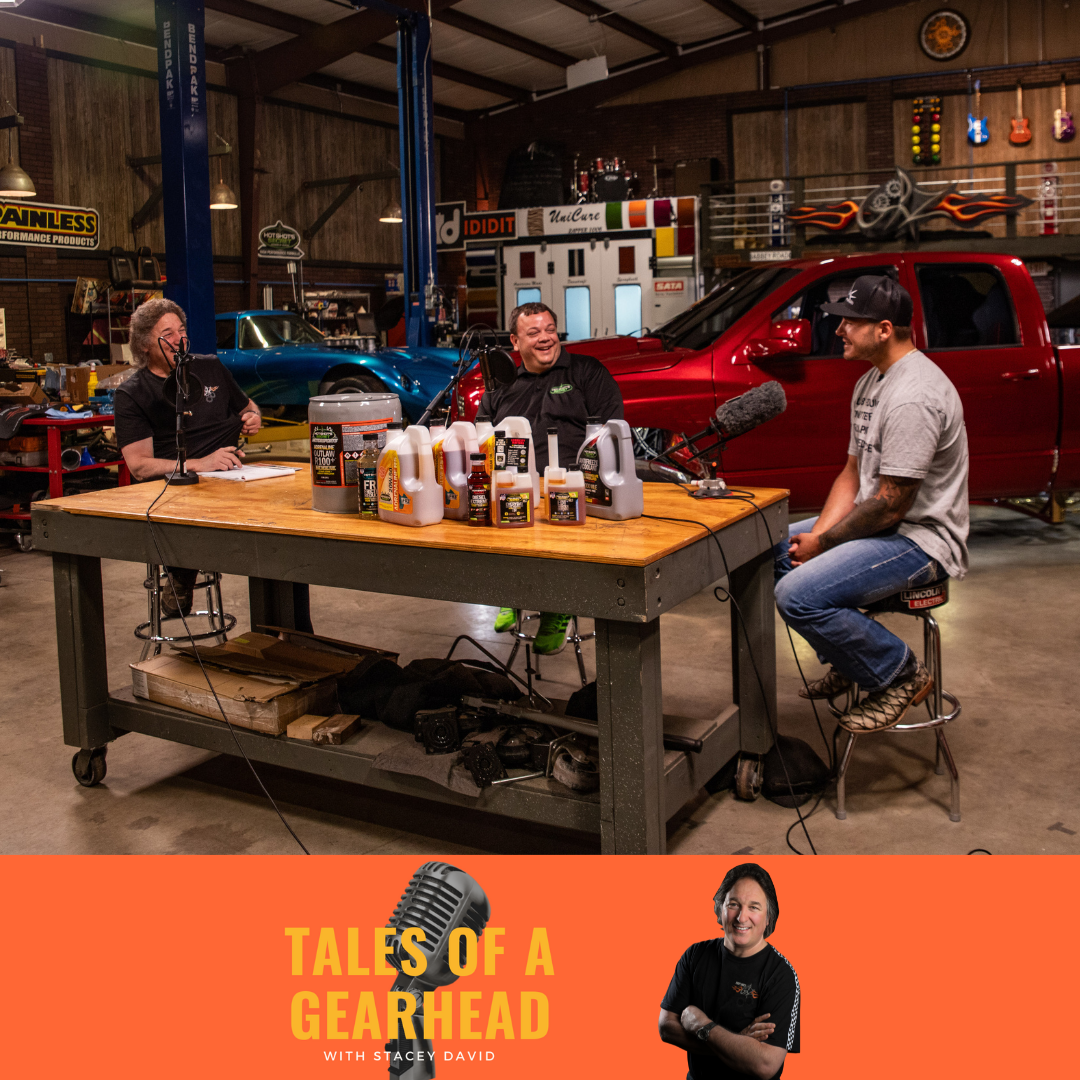
Alright, welcome to the podcast. I've got a couple of guests here today. One you've heard before.
Got Kyle Fisher here from Hot Shot Secret. He was back in town. He's getting ready to go up to a race, so we grabbed him.
But we also have Garrett Ness, and you probably haven't heard of Garrett, but you're going to now.
And you're also going to hear about his truck because he's got an 06 Dodge that is going to blow your mind.
We're going to talk about it a little bit, but you're also going to see it on the show. So guys, welcome to the podcast.
Thanks, Stacey.
Thanks, Stacey.
Alright. Okay, Garrett, you got this diesel truck here, but it looks like a full-on show vehicle.
So let's talk about this thing a little bit. What possessed you to do this to a Dodge?
And what do you do with it now that it's done?
Really, I just wanted to create something that was more of a work of art.
I could have chose a lot of different platforms, but with this being my first ever truck, it was an easy decision to really do that to this truck.
And the state that it's in today wasn't the original plan by any means.
Okay, so what was the original plan? Do you even want to say it?
We're going to start somewhere. You'll sell it to the lady and say, that's where we're going, and then you finish there.
Absolutely. As most Dodge guys know, it typically always starts with the transmission.
So the tranny went out how many times?
I think we were going on the fourth one. So I think it was just about the third one started slipping and it was like, okay, let's pull this out.
And then we were just going to do like a stage five trans.
And from there, it turned into turbo kits. And next thing I knew, the five nine was coming out and we were going to put a six seven in it.
And then that's just kept snowballing from there.
That's typical. Now, Kyle, you knew about this build pretty much from the beginning, right?
Well, not at the very beginning. This has been a long build, but
So when did you first hear about it?
I first heard about it when I was over at Firepunk and I saw kind of the plans.
Because they were doing the chassis, weren't they?
Yeah, Firepunk did.
They did a lot of fabrication on it.
Now, did you have to rein them in a little bit because Levan and those guys are always building race vehicles.
And so, I mean, we look at this in the back, it's pretty much a racing back half on this thing.
Absolutely. And that was always the goal.
It's a fully functional truck. It could easily go down the drag.
So the goal was to have a drag truck or just something that was capable like a street truck that can drag or a drag truck that you might run on the street once a while.
There's because there's a difference.
I would say a street truck that is how big is its turbo?
Pretty large.
Yeah, it is. It's sticking out the front. We'll talk about that in a minute.
Matter of fact, how big is that turbo?
It's a 5.3 inch mimer, so like 134 millimeter.
That's huge.
Yeah.
It looks awesome.
And for you guys that don't know, when this truck is coming at you, there's no radiator in the front.
So you look through the gold grill and you see all this gold plated engine just coming at you.
All the belts are spinning and the pulleys and the turbos whining.
I mean, it looks like it would suck small children into there.
If you're not careful, it could.
And it's beautiful too.
I mean, the etching, the gold work, it's so over the top, but yet done so nicely.
And what I love, not only that it's this first truck, which is cool.
We always could have our first truck again.
Oh my gosh, your first truck?
Imagine if you had it and you did this with it.
And now you're keeping this forever.
Absolutely.
Are you really?
I am.
When somebody comes up and offers you half a million dollars for that thing, are you going to sell it?
Sold.
Yeah, Kyle and I were like, why? Where do I sign?
We have a car device.
Yeah, exactly.
And now it would take a lot more than that for me to let it go.
Really, as it started getting more extensive, it became the goal in mind to keep it as like something that I can pass down in my family.
Absolutely.
And really that's when, when I made that decision in my mind is when it really was like, okay, let's not put much of a budget on it and really try to make the goal where it's so custom that it would be impossible to replicate, really raise the bar.
And as I always say, like make it a work of art.
Yes.
Now obviously you're not married or have kids, correct?
Correct.
Because that would probably change a little bit.
It might, so I'm glad I got it out of the way now.
It's too late to go back.
Okay, so Kyle, we were talking about some stuff a little bit earlier and you dropped a bomb here about some of this stuff that you're doing for the LS engine.
Yeah.
Now, right now, you know, everybody's ears just perked up because obviously the LS is kind of the swap engine out there.
You can't argue with the amount of power you can get for the bucks that you spend.
But the LS has got some problems, you know, lifter tick, this kind of stuff.
You've got a product that is, well, tell me about this that is going to solve that, correct?
Yeah.
So we're really excited about this.
And, you know, we're largely known on the diesel side of things.
But at our core, we're a problem-solving company.
That's what we do.
We don't make any commodity-style lubricants.
If it's not for a performance gain or solving a specific problem, we just stay away from it.
We leave that to the big boys to do.
And there's no question your stuff works.
It's proven.
It's a fact.
It's scientific.
We won't put it out unless we can test and show that it works 100% better than anything on the market and fixes your problem.
And that's why we have 100% money back guarantee on all of our products, which is rare for a lubricant company.
But we have a lot of stuff that dies in R&D.
I mean, you know, we put a lot of money in R&D.
So sometimes we go down rabbit holes.
And if we can't get there, it's a loss.
We just chalk it up and we keep working.
The LS thing and the Hemi thing, I know you're interested in.
Yeah, because the Hemi's are Gen 3's.
I've been to three Hemi engines in my truck.
Yep.
Yep.
And they have similar issues.
Lipter based issues.
A lot of it is multiple displacement.
A lot of it is the engine shutting down some cylinders.
And, you know, anytime you've got a hot engine with half the cylinder shutting down, nobody can look me now and say, yeah, nothing's happening there.
So, and so we studied this pretty hard.
We've been working on it for years.
We went to LS Fest last year here, Bowling Green nearby and set up part of our booth and our whole goal of going there was to get our test product in the hands of LS enthusiasts.
So we kind of set up a testing site and allowed people to come up and sign up for a free bottle of this oil additive.
Yeah.
It was a R&D test formula and, you know, allowed them to rank the loudness of their noise of their lifters and so forth.
And then try the product.
And that's kind of when you see a sampling product for R&D testing, you know, we're pretty close to the end.
Yeah, yeah.
Because we do everything in the lab first, then we do dyno, and then when it gets out to the real world, we don't want to put a product out until the real world has shown us.
Sure.
Oh, yeah, you can't.
So last year was our big launch into getting in a lot of LS engines and we saw a lot of what we wanted to see.
Very good.
And so now we're finalizing the formula and yeah, it's breaking news here.
I'm not giving you a date yet.
Don't hold me to it.
Oh, I was going to say, when's the date and what's it called?
Well, I know a guy, so I might be able to give you a little pre-production bottle.
We were opening names.
We talked about that at lunch.
Yeah.
It's tough to name a product these days.
It is, especially something with LS.
Yep.
But, well, we'll be looking for that.
And speaking of the hotshot stuff, Garrett, how much of this stuff do you actually run in your truck?
In the wintertime, especially being in Ohio, the anti-jail is a must-have.
Yeah.
And the everyday fuel treatment.
Outside of that, I'm probably not as religious about it as I should be.
That's on it.
That's what we want them to do.
There's always treating the fuel.
Oh, yeah.
That's your number one job as a diesel driver is to treat the fuel.
Yeah.
And another thing, too, that was a lot of people look at you, obviously, as a diesel company,
but you've got stuff for gasoline.
You've got differential stuff.
You've got coolant, all of that stuff.
And your motor oil, I try to tell people just how good your motor oil is.
And you always just kind of downplay that a little bit because you're like, well, we're not really an oil company,
but you are, man.
The oil that you have is phenomenal.
Strangely, the oil we make is probably the best oil made by any manufacturer.
Oh.
It's incredibly over-engineered to the point where, and that's what really gave us the
lead in to the motorsport side of things, was we sharpen our teeth over the road trucking.
Yeah.
Coming up on the diesel side.
And that's about as rough as you can be on an engine.
It is.
It is.
Those guys are looking for savings and making their investment worth it.
So we were using some very unique base oils, some poly-alpha olefin, PAO Group 4 stuff
that allowed these guys to go extremely long intervals, have big rigs now running 200,000
mile oil intervals on the same oil.
So once we got into this motorsport side of things, fortunately, we're not a racing oil
company.
That's why I pushed back on it.
I know.
I get it.
It's tough.
Because if you're making a good product like that, it's tough to sell because it costs
so much to make.
So it's more of a playground where we get to let R&D to really test products, you know,
tractor-pollen that you're going to be visiting, and you've been to a lot of our drag racing
stuff.
Oh, my gosh.
Yeah.
And that allows us to really make oils like this for these guys pushing these extremes,
but testing stuff like the FR3 that's our friction reducer for the everyday guy.
And that's the same stuff that we're using in our racing oils.
Yeah.
Yeah, that's awesome.
Okay, so Garrett, what is the future of the truck now that you've, because it was at SEMA
last year, you're going back to SEMA this year.
So right now it's kind of in its show truck life.
So it'll make that full revolution from SEMA 24 to SEMA 25.
And then I think next year at UCC will probably be the event that it gets introduced to some
nitrous on the dyno and goes for a decent size pool.
You're going to fire it up and rock and roll, huh?
Absolutely.
So are you running nitrous now just to spool that big turbo?
No.
So it is set up, there is nitrous set up for it, but it is only using air.
That's impressive that thing starts.
Oh yeah, exactly.
Now that's going to be great.
And you talked earlier about you, kind of the main goals that you always had in the
truck was to roll coal and to do burnouts.
So are you going to do a little bit with this?
I would love to see you roll coal on somebody.
We're going to stay away from the burnouts with this truck.
I don't really want to clean up that much rubber.
And that's a lot of tire.
That costs a lot to burn those things up.
Absolutely.
Well, the commitment, once you do this, that's what I was saying earlier when I saw him setting
up, man, you have to clean everything.
Like this is a lot to clean because it's not just the spots where we normally clean.
Every time I see this truck, I find something new I've never seen before.
And it's usually when you're underneath, you know, and it's like every nut and bolt is
like gold plated on this thing.
So it's a job to keep this thing clean, I'm sure.
It is.
And I have one of those car capsule bubble things in my shop and I still managed to
just find a coat of dust all over the truck.
So, you know, when I first built the Sergeant Rock truck, I did the same sort of detail
underneath it.
So it was like street rod level.
So everything smoothed up underneath.
But I had intentions of burying it in a mud hole and doing all this fun stuff.
And after doing all that, I looked at those mud holes going, no, because I would never
get it clean.
You'd never get it clean again.
All that mud up in there in the wiring.
No.
I just crushed stuff with it.
That's better.
It's much cleaner.
All right, guys.
Thanks for dropping by.
Listen, anytime you're in town, drop by.
We will be watching for this LS product.
And I'll get some down to you.
Yeah.
So I see an LS over there.
I know.
We need to do something with it.
All right.
You just call it tick off.
Hey.
LS tick off.
Let's run that by the lawyer.
See if that's got a copyright audit.
All right.
Thanks.
We'll see you again.
Thanks, Daisy.
You know, one of the biggest arguments that happens in the automotive world is oil.
I mean, you see it plaster on the sides of race cars and people are like, I'm Penn's
oil.
I'm Castro.
I'm synthetic.
I'm this and that.
And listen, there's all kinds of oils out there.
And the quality of oil has gone up so much.
The old stuff that they used back in the 60s and 70s is nothing like we've got today.
But it's not just about the oil.
It's about the ingredients.
And the problem is, and the things that nobody tells you, things that I have seen on the
backside, talking to people behind the scenes, the big oil companies have problems putting
out the best product because there's costs involved.
There's politics involved.
There's a lot of things involved that dictate what goes into that model of motor oil.
That's why we talk about using additives all the time, like the ones from Hot Shot Secret.
Everybody can claim something.
And I encourage you, anytime somebody's claiming something, go to the science.
Go to what's behind it.
And if you go to Hot Shot Secret's website, you look at the science.
You look at how they're developing this stuff.
So if you're looking to use additives in your oil, in your fuel, and other parts of your
automobile, car, or truck, you need to check out Hot Shot Secret because when you put that
stuff to the test, it'll outperform anything I've seen.
And there's a lot of racers that say the same thing.
That whole world records because of it.
Check them out.
You won't be disappointed.
Okay, I got a special podcast guest here today.
His name is Kai Smith, and that is KAI.
So immediately you're thinking he's from Hawaii, but he's not.
He's from Tennessee.
But the thing that's important about Kai is that he's got a business called Mid-10 Media
Blasting.
And he just turned 30 years old, and he's got a media blasting business.
He's doing well.
And it's just a lot of people don't realize how important all these other parts are to
this industry.
You know, it's kind of like the old proverbs that said, a body has to all work together.
The hands, the feet, and everything.
If you take one of those away, it doesn't work right.
And media blasting is so important.
And he's such a great guy because he started this business.
So Kai, welcome to the podcast.
Thank you for having me.
How did you get into media blasting?
Why that?
That's like such a strange career choice.
Because it's so glamorous, right?
No, I always wanted to own my own business.
I just never really knew what I wanted to do.
So you didn't really like working for other people?
No, I didn't.
Not that there's anything wrong with that.
Yeah, it's not for everybody.
I knew I wanted to be my own boss one day.
I wanted to have something I was proud of.
You know, I did the whole thing.
I went to college.
I got a business degree.
I got an office job and I just kept feeling this like, I don't know.
There's probably a word for it.
But what I was doing didn't matter.
Doom.
Yeah, I was there every day.
I was, you know, clocking in.
It didn't matter.
You're sitting here at a computer probably.
And if I wasn't there, the company was still going to still the lights were coming on.
The company was still going to keep functioning.
And that's great.
You know, that's some people that they can do that.
But I couldn't sit in an office and I've always loved cars.
My grandpa was a he worked at a Chevy dealership is pretty much his whole life.
He had every pretty much every year Corvette.
Oh, my gosh.
I've always been around cars and I've loved them.
We've got several of them.
And so if I could tie the two together, that was kind of always the goal for me was to own a business
and have it be automotive.
I knew I didn't want to be a mechanic because if you ask any mechanic, they never
they don't like working on cars anymore, because all they do is work on cars.
It can take the fun out of you.
Not careful, sure.
So I didn't want to go that route and, you know, sitting down watching the Sunday morning
car shows, and I saw an advertising for the sandblasting.
And so I was like, huh, I've never seen that before.
And so this was, I mean, four or five years ago.
I'd never seen it done with the mobile setup and all that.
So I started doing some research and I was like, well, there's nobody really around here that's doing it.
There's not.
There was blast from the past and they're on out of town, but they weren't mobile.
Correct. And so, you know, in the greater Nashville area, I didn't see anybody besides
hobbyists that were doing anything, especially no like advertisements or anything like that.
So, you know, did the research some more and I said, man, I think I can make this make sense.
And so talk to my parents and talk to my wife and thank God I've got a good support system.
And they were like, you know, if you want to do it, go for it.
And so I said, OK, so, you know, I sat down and I had a five year goal.
And I was like, if I can make this make sense in five years,
yeah, I would like to be my own boss.
This was in twenty twenty two.
Yeah. So, you know, I did it for about six months.
And after about six months of trying to have an actual job and do this on the side,
it just started getting real messy on both ends.
I wasn't it wasn't fair to who I was working for and also wasn't fair to the business that I was trying to grow.
Yeah. And so I went to my wife and I was like, and keep in mind,
we had at this point a three month old baby at home.
Oh, yeah. Always add that in. Yeah.
I told her, I said, I think I'm going to quit my job.
And she looked at me like, OK, you know, we have a baby, right?
And I just told her, I said, I think I can make this work.
And I think if I don't take the leap now, I'll never do it. Smart guy.
And so, well, I don't know, it depends on who you ask, I think.
So I did it. And, you know, now we're going on year three of full time.
The business being full time. So yeah, that's kind of how it came to fruition.
And then the car stuff, like I said, that's that's why I started it.
And I don't do as much car stuff as I would as I would like to do.
And I think a lot of that is because you mean now car building or just car blasting blasting.
You know, I love I love keeping the cars on the road and hearing the stories about them.
And I don't know if I showed you pictures of the mock one I did.
It was an all original numbers matching one owner, 69 Mach 1.
Oh, my God.
This guy had bought it and he stole the car for the price and he brought it to me
and he was like, I want you to blast the whole thing. Yeah.
I was like, all right, man, so we talked numbers and we figured something out.
And I said, if I, you know, if I run into any problems, I'll call you.
Well, I start blasting this thing and it had been smashed on the whole back end.
I mean, pushed in and it was down a long time ago, too,
because you start seeing all the lead filler.
Oh, at least they use lead.
So right. And so anyway, we got it blasted.
And he was just so thankful because it was something him and his dad were doing together.
They were building the car together.
Now, granted, it's going to take a little longer than he thought.
Oh, yeah.
We found some some stuff that he wasn't prepared for.
But most of the time they're not running anymore.
Sure, they bring to you a shell. Yeah.
This Apache that's in pieces.
I mean, you just see them and it's like they don't make those anymore.
Yeah.
So anything I can do to help keep them on the road and keep them going is
that's why I wanted to do it. That's why I still do it.
So anytime I get to to blast the car, it's awesome.
I like talking to the owners and hearing their stories.
And sometimes it's a family car.
You so you don't do a lot of cars.
What is a lot of your clientele like rod iron furniture?
Yeah, rod iron furniture or just anything that people want.
Yeah, railings, OK, believe it or not, like log cabins.
I did a lot of those.
And your mobile, you go to a person's location.
Correct. Or don't you have room at your own place?
Correct. I've got a space here in White House, Tennessee that if
because it is a very messy and noisy process.
So if you live in a cul-de-sac, for instance, and you've got,
you know, a car that you're restoring in your garage and you've got
you want to get the frame powder coated, let's say.
Yeah. Well, I can't come to you and do it
if you've got an HOA or if you just don't want the mess or the noise.
So I've got a space where I can blast it.
And if you need me to, I can pick it up and bring it back to you.
But I wanted to be able to offer that to people, too, because that's great.
That is definitely very loud and very dusty.
And yeah, not everybody's cup of tea.
No, definitely not.
Not on these hot summer days, because you have the full gear on, right?
Full gear and every I don't know if you've ever been wet and at the beach.
But when you get out of the ocean and then you go sit in the sand
and all the sand sticks to you, that's my daily life.
So I'm just covered in sand.
So in the winter, it stinks because it's so cold.
But in the summer, it also stinks because everything just sticks to you.
So yeah, Bondo dust kicked on your arms.
Oh, my gosh, cars and yeah.
Now, what kind of media do you use?
Obviously, you know, when you're stripping cars,
stripping something delicate like brass or something, you use a different media.
So what what media do you use or what do you specialize in?
Or does it does it matters?
It definitely matters.
The machine I use can use you can shoot anything you want.
You can do corn cob, walnut, what have you.
But I use recycled glass.
So primarily it's 40 80 is the grit.
Yeah. And it's recycled windshields is what it is.
They take windshields from all these safe light or wherever
they recycle these windshields from and they ground them up into angular glass.
And then I use a 40 80, which I have found.
I've tried all of them, but I found 40 80 is a perfect balance
of being able to strip, paint, rust, Bondo, but not so aggressive
that you've got to come back and do a bunch of body work to it
before you can even hit it with prime. And it doesn't warp the metal.
That's the big question.
It can. Yeah.
Anything you shoot can warp the metal.
You definitely have to take your time.
And I always tell people the the metal will tell you when it's getting too hot.
You can anytime I'm doing a car that has any sort of flat panel,
you start blasting on it, pick a corner or something,
then start blasting and then just touch it.
And if it's too hot for you to touch, then it's time to move on to you.
You don't need to be blasting that.
And I'll tell people that, too, like a truck hood or the top of a truck cab
or a trunk, anything that has a lot of flat space.
I always tell people, I'll do the edges for you.
And then as I start to work in, if that metal starts to talk to me
and say it's getting too hot or it looks like I might warp or a lot of times
the structures come apart that they use.
I'll just stop and then you can come back with a D.A.
Or your body guy can come back with a D.A.
And that saves you from having to get a new roof scan or a hood or something like that.
Yeah. Back in the day, you went to the sandblaster and he used sand
and you got back what you got back.
Right. And then like you were saying on some of the more delicate stuff
like brass or something, I'll I'll switch over to like a glass bead.
And then that's where I'll introduce water and I'll wet blast that kind of stuff.
And then the water will keep the heat down and yeah, definitely.
People say, well, why don't you use the water on cars?
Well, you can and then you can put a chemical in it and it might work for you.
But yeah, bare metal water, they don't go together no matter what.
And then also now I've got to explain to you and then your painter
that I've just put a chemical in this and it might react to your paint in a weird way.
I don't know. I don't know what you're using.
So I just dry blast when I can, if it's aluminum or brass or something
more, more delicate than I'll introduce water to.
Yeah. Yeah.
So what is the response been?
I mean, that's one of the big questions that people have
when they start a new business, whether they young or old.
It's like, how do you make it through that first year?
How do you get the word out?
How do you get the clientele?
How are you able to do that?
Oh, a lot of prayers and yeah, yeah, a great wife, I would say.
But yeah, you just I did it.
The first year I worked pretty much seven days a week and I would talk
to anybody that would listen to me about what I was doing.
I called. Did you go to the car shows and stuff?
Because it's a huge deal.
I call I called every power coding shop around.
I would go if I couldn't get a response like there's a hot rod shop in town
and I couldn't get a response from him.
So I just showed up with some cards and I said, hey, I was very upfront.
I said, I'm not trying to step on anybody's toes.
If you already have somebody you're working with, that's great.
But if anything ever happens or they can't get to you, here's my cards.
And so I did that to anybody, anybody that would listen.
And eventually, you know, you get a couple of jobs.
And at first, I didn't know what I was doing.
So you can Google all you want.
But when it comes to pricing stuff, you kind of just have to figure it out
how long it takes.
And yeah, I didn't make a lot of money that first year, but I learned a lot.
So I learned, you know, how long it takes to blast a car or how long it takes
to blast, you know, what have you.
But yeah, that was pretty much the whole.
I mean, I still do.
I still have stuff that I don't know.
Yeah.
And I'll tell people right up front, like, hey, I've never
blasted this for it doesn't happen very often.
But if I get something I I want to do right by the people.
Yeah.
And that's I mean, that's going to serve you well.
Do you charge by the hour or by the project?
So if it's if it's like or both, both.
Yeah.
So if it's off the street, like if it's a car, I don't price per
panel because every car is different.
So everything's by the hour.
And I try and work with people like, because I get it, it's expensive.
And I'll try and if if there's any kind of rebuttal up front, I'll try and say,
like, look, if you've got a budget, yeah, I'll work with you.
I get it.
Like, I'm not I'm not rich.
A half stripped fender.
Yeah, I'm not rich.
Like I get it.
Like stuff is expensive.
Everybody's trying to make it.
So if you've got like this Mustang right here, for instance, and you know
that the the front fender has Bondo and the whole lower half, I can outline
that metal for you, show you where the good metal is, and it'll save you, you know,
a couple hundred bucks.
So yeah, I'm afraid if you blasted that Mustang, it would just fall into a pile of dust.
Man, I've seen it.
I've seen a few of them.
And I hate on Mustangs, but they do seem to be used and abused in their days.
There is a saying, you know, the the rust free Southern car.
Well, they're not really talking about around here.
They're talking about Arizona, New Mexico.
We don't get as much rust, obviously, as Minnesota and those places.
But because of the humidity, man, it's and the cars rest from the bottom up.
So they look good on the outside and the floors are gone.
So you don't buy something from out in the field.
Oh, every every snake.
Yeah, every Chevy truck that I get, it's got some something hidden somewhere.
You know, the doors held together with license plates and Bondo.
Yeah. Oh, yeah. Yeah.
I just think it's great.
You know, one of the reasons I wanted to have you on here is because, you know,
like I said, a lot of people want to get into automotive industry
and they want to be a fabricator or a builder, you know, and those are kind of
like there's nothing wrong with that.
But that's kind of like being the driver of the race car.
It's kind of a prestigious thing.
And they overlook the fact that there needs to be an engine builder.
There needs to be a machinist.
There needs to be a guy changing the wheels and tires.
There needs to be a guy sweeping up the shop.
And a media blaster is kind of one of those jobs that nobody really thinks about.
It's not glamorous, like you said, but man, is it important
for the automotive industry.
So you're really doing a great service, you know, for us.
I've got some vehicles here.
We'll have you on the show and we'll let people be introduced to you
that way as well.
But I just think it's great.
What is your goal moving forward?
You got your five year goal.
OK, so when you meet that, what are you going to do?
You're going to build a bigger place.
You're going to have multiple vehicles going out.
Man, if you'd asked me three years ago, I would say, yeah, I'm going to have two
or three trucks run in and we're going to be doing this, that and the other.
But the one thing I've found is it's hard to find people to work for you, man.
Wow, really?
Surprise.
So hard, especially when you're doing something as glamorous as a
sandblasting. Yeah, it's hard work to do it.
So it's hard work.
That's what's so unique about you, because you're that age.
Like I said, you just turn 30.
And a lot of times, you know, people your age, it's hard to find with a good work ethic.
You know, that's willing to do what you're doing.
And I just think that's so commendable.
And I mean, you will, you'll prosper because of that.
So you're just going to kind of focus on keeping moving forward.
What you're going to focus on.
I said this at the beginning of the year.
One of my goals for 2025 was to quit thinking about what's next year
and kind of just focus on this year.
So I want to grow what I have.
Yeah, I would like to be able to build my own shop
kind of on something like this, my own property that has a shop on it
and it's spaced out from the house.
And I'd like to invest in, you know, reliable equipment.
Yeah, I have a forklift that I call Big Bertha and she, I don't know.
I don't know how to say it nicely, but it's a great forklift.
When it's a great forklift when it runs, never works.
I'm always working on it.
It's never working for me.
I'd like to invest in some better equipment and I'd like to work inside.
So all of my blasting is done outside, whether it's on the road or at the shop.
So the weather is I'm at the mercy of the weather every single day of my life.
So being indoors would be great.
And then, you know, if all that goes well, and I'm just looking for things to do,
which I don't think anybody is, but I'd like to expand, you know,
because I do offer like priming and stuff.
If somebody can't do it, I'll offer to prime.
So I'd like to get better at behind the paint gun and then
maybe expand into power coating one day or that's a big jump.
But that's that's that's natural step though.
Yeah, because you do a lot with Mr. Speed, don't you?
You strip for them.
Correct. Yeah.
And I work with a few other ones, so I don't want to shoot myself in the foot.
But I just love the process of powder coating.
I think it's so fascinating.
All right.
So how do people connect with you?
How do they get in touch with you if they want you to do work for them?
So you can Google us.
You can go to our website, midtenmediablasting.com, mid TENN as in Tennessee.
Yeah, you can go to Facebook if you want to try and put all of our projects
on there, but you can also submit a message or whatever on there.
The website does have a submission form.
My wife created, she went through and redid everything.
So my wife put on there where you can submit what your project is.
You can add pictures.
You can put a brief description and then you can also select
if you want to bring it to me or if I need to go to you.
Well, thanks for dropping by.
You're welcome to come by any time and we will be keeping in touch with you.
And, man, the best of luck to you.
I appreciate it very much.
All right.
That's our show for today, which means you need to get out there
and start working on something.
Spend some time turning wrenches.
You might be surprised how much you like it.
Make sure you check out our website, StaceyDavid.com,
because we've got all kinds of new products and some other great stuff
that you're just going to love.
Also, make sure to check out our social media.
That's Instagram, TikTok, Facebook, YouTube, all at official StaceyDavid.
Our social media is where you're going to find all of the bonus content,
the giveaways, the contests, the trivia.
We even have extra viewer projects that focus on what you are working on.
Also, the new season of Gears will be on MAVTV
and YouTube will be the place that you can view all of your favorite Gears episodes,
as well as the full project builds that follow the project from beginning to end.
All right, that's all the announcements.
We're all up to date.
We'll see you next time.
About this episode
Kyle Fischer from Hot Shot's Secret and Garrett Niss share insights on Garrett's stunning 2006 Dodge truck build, which evolved from a simple transmission replacement to a full show vehicle with a massive turbo. They discuss the challenges of building a custom truck, the importance of quality lubricants, and the upcoming LS engine product from Hot Shot's Secret. Additionally, Kai Smith from Mid-Tenn Media Blasting talks about his journey into the media blasting business, emphasizing the significance of this often-overlooked service in the automotive industry.
Garrett Niss and Kyle Fischer are in the shop to talk about Garrett's one of a kind custom turbo diesel '06 Dodge Ram and a very cool new product that Hot Shot's Secret has coming out for LS engines.
After that, Kai Smith from Mid-Tenn Media Blasting talks with Stacey about his mobile media blasting company and having the grit to decide to leave his desk job at age 30 - with a wife & newborn baby - to start his own business from the ground up.