The Chevrolet Equinox is a common everyday SUV. Here, it’s mentioned because its back cargo area isn’t wide enough for the two speakers the caller needs to carry together.
The Kia Sportage is a popular compact SUV. In this case, the problem is that the back seats don’t fold down to make a perfectly flat cargo area, which matters for fitting large gear.
The cargo floor is the flat platform in the back where you put stuff. If the seats don’t fold down so it’s all level, bulky items can’t sit as easily or may not fit the way you want.
MIRP is a measurement the host uses to estimate cargo-space usefulness by focusing on the largest single item that can fit in the vehicle. In other words, it’s a practical “can this big box fit?” metric rather than just total volume.
The Ford Expedition is a large SUV designed to carry more people and cargo than smaller cars. It’s often used by families or anyone who needs extra space. The podcast brings it up as an example of a big, practical vehicle.
The Toyota Grand Highlander is a bigger Toyota SUV with more room in the back. The hosts think it could work because its cargo area dimensions line up with the speaker setup the caller needs.
Gas mileage means how far the vehicle can go on a gallon of gas. The host is saying cargo vans often get much worse gas mileage than minivans, especially when you’re carrying a lot of stuff.
The 1999 Dodge Caravan is an older minivan model. The host is using it as a memory of what minivans from their time looked like and why they can be more fun and useful than people think.
The Kia Carnival is a minivan, but it’s designed to look more like an SUV. The hosts are basically saying it’s a minivan that doesn’t look “minivan-ish,” which could make more people actually want one.
MPV stands for “multi-purpose vehicle,” a label often used for vehicles that blend minivan practicality with SUV-like styling. In the segment, the host uses MPV to explain why the Kia Carnival can look like an SUV even though it’s fundamentally a minivan-type vehicle.
The Challenger is a two-door car built for performance, with a focus on strong acceleration. People often talk about different high-performance versions of it. The podcast mentions it in the context of what a “Hellcat” style version could look like in concept form.
The Chrysler Pacifica is a family minivan. The host is talking about a special lifted version that looks more off-road, with tougher tires and extra gear on the outside. It’s basically a minivan turned into something that looks like an adventure vehicle.
All-terrain tires are tires made to work on both regular roads and rougher surfaces. They usually have a tougher tread pattern for better grip when the road isn’t perfect. They’re common on trucks and off-road-style vehicles.
“Hellcat” is a nickname for a very powerful Dodge engine. The host is basically saying it would be cool to put that kind of performance into a minivan. It’s a fun way to talk about making a family vehicle feel fast.
Lucid is an electric car company. The question here is about why Lucid seems to be struggling financially compared to another EV startup. It’s less about the car’s features and more about the business side of making EVs.
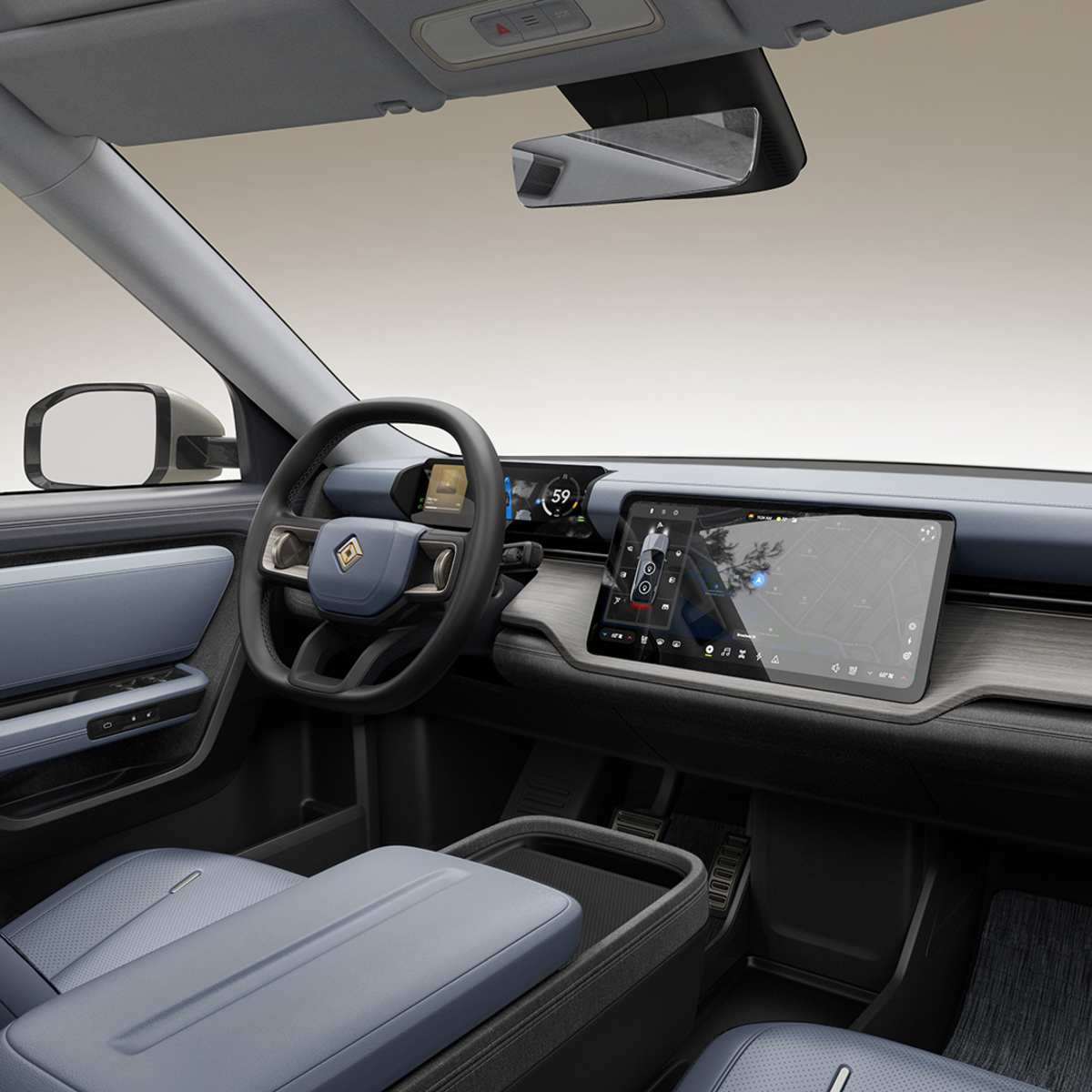
Rivian is an electric car company that makes EVs aimed at outdoor/adventure use. The listener is asking why Rivian seems to be doing better than Lucid financially. It’s a business-and-strategy question tied to EV products.
Concept
CR vehicle tester
A “vehicle tester” is someone whose job is to evaluate cars. They drive them and check how well everything works—like comfort, safety, and performance. The question is basically: what job path should you follow to get into that kind of testing work?
Owner satisfaction is basically how pleased owners are with their cars after living with them. The hosts are saying Rivian and Lucid may not be very reliable, but owners still tend to like them.
Concept
financials
“Financials” means how the company is doing financially—whether it’s making money or losing it. The hosts are saying both companies are struggling and that Rivian’s future sales plans matter a lot.
The Rivian R2 is an upcoming electric vehicle from Rivian. It’s meant to be positioned for everyday buyers, and the podcast also talks about how Rivian is considering different types of customers. The R2 is mentioned as the next model they’re bringing out.
“Off-road” means the car is designed to handle rough roads or dirt trails better than a typical street car. The hosts are saying Rivian leans into that image and it shows up in the trims they tested.
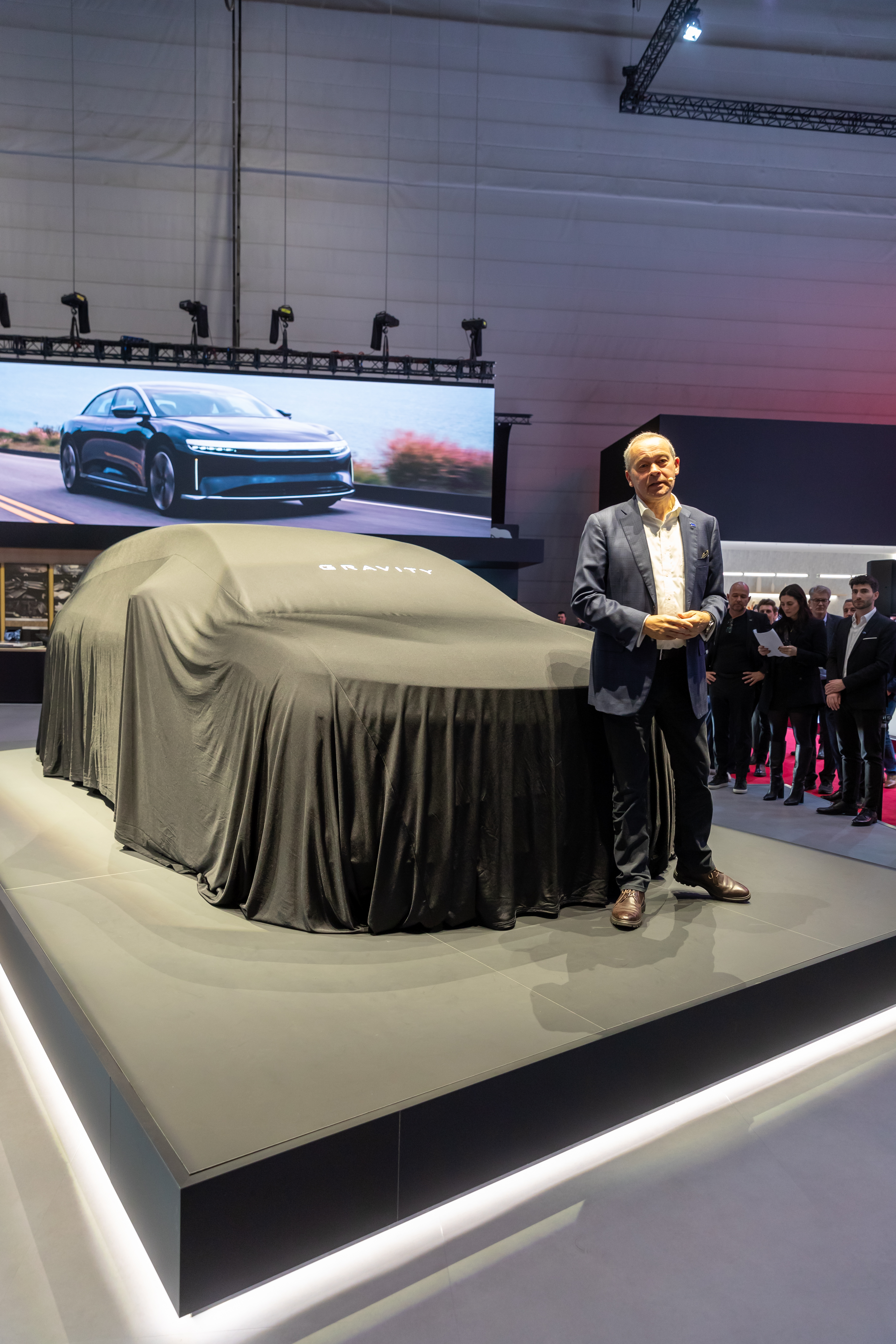
Lucid Gravity is Lucid’s electric vehicle positioned with a crossover/minivan-like practicality. The hosts describe it as “kind of a minivan,” emphasizing its shape and usability, and even joke that it just needs a sliding door to be a true minivan.
Autocross is a timed driving event on a course made of cones. You’re trying to drive the car quickly and accurately through tight turns, usually on a flat surface like a lot or airfield.
In this context, modifications means changing parts or settings on a car (like suspension, tires, or software) to see how it affects behavior. The speaker is emphasizing cause-and-effect: what changes, and how the car responds dynamically.
Track days are when people bring their cars to a race track to drive them hard in a safe, organized setting. It’s more about practice and learning than formal competition.
Human factors is about designing things so people can use them easily and correctly. In cars, it means making screens and controls understandable and comfortable to use while driving.
Usability means how easy something is to use. In a car, it’s about whether the driver can quickly figure out what to do with the screens and controls.
Concept
testing here
In this context, testing means running structured checks on cars and collecting results. Then you analyze what you found so the car or its software can be improved.
Data analytics means taking lots of test numbers and figuring out what they actually mean. In car testing, it helps people understand what the results say about how the car is performing.
The Tesla Model Y is an electric SUV that runs on a battery instead of gasoline. Because it’s electric, charging habits matter, and Tesla provides instructions on how to plug it in. The podcast mentions those recommendations from someone who previously owned a Model 3.
The Tesla Model 3 is an electric car. With electric cars, how you charge the battery can affect how long the battery lasts. The question here is about whether charging right away every night is better than waiting until later.
The host references a 2023 BMW iX as the specific test vehicle whose owner’s manual they consulted. BMW’s guidance includes setting a daily charge limit (commonly around 80%) to reduce battery stress from staying near full charge.
A charge limit is the maximum percentage your electric car will charge the battery to. Setting it lower (like 80% instead of 100%) can help the battery age more slowly.
Battery degradation means the battery slowly gets worse over time. Charging habits can affect how fast that happens, especially if the battery is kept near full or fast-charged often.
Fast charging is when you charge an EV quickly using a high-power charger. It’s convenient, but doing it a lot can make the battery wear out faster than slower charging.
Fast charging is the quickest way to charge an EV. It uses a lot of power, so it’s usually better to save it for road trips instead of charging that way every day.
Slow charging is charging your EV with a lower power level, usually at home. It’s gentler on the battery, so it’s commonly recommended for everyday use.
A highway range test measures how far an EV can go when you drive at highway speeds. It helps predict real-world range, not just the optimistic numbers from marketing tests.
Cost per mile means “how much it costs to drive one mile.” For EVs, that cost depends on your electricity price and how efficiently the car charges and uses energy.
Gasoline has taxes added to the price, and those taxes can come from both the federal government and your state. If you’re comparing EVs to gas cars, you have to account for those tax differences.
They’re saying it’s hard to compare gas and electricity directly because they’re priced and measured differently. The goal is to convert them into a common comparison so the numbers mean the same thing.
V2X means cars talking wirelessly to things around them. That can include other cars and road infrastructure like signals or sensors. The goal is to make driving safer and smoother by sharing information.
The FCC is a U.S. government agency that manages radio and wireless frequencies. It decides which parts of the spectrum are reserved for technologies like car-to-car communication. Those rules can make it easier or harder for the tech to work well.
5.9 gigahertz is a specific wireless “channel” frequency. Car communication systems use particular frequencies so their radios can talk reliably. The podcast is saying this frequency band was set aside for car-to-car communication.
Bandwidth here refers to the amount of radio spectrum (data-carrying capacity) available for V2X communications. When regulators reduce the allocated spectrum—like cutting a 75 MHz band down to 30 MHz—it can limit how much data vehicles can exchange and how reliably the system can operate. That can slow real-world deployment and development.
V2V means one car can talk directly to other cars nearby. It can share things like where it is and what it’s about to do. For it to help, other cars on the road need to be able to communicate too.
LIVE
Welcome back to Talking Cars. I'm Michael Croson. I'm Joe Veselak. And I'm Steve Ellick.
So we have a special episode this week. We are taking questions from the audience. We
get so many questions emailed to us at TalkingCarsaticloud.com. People send in written questions, video
questions. And if we pick your question, read it on the podcast, which we always do one
or two on every podcast. You get a shirt, kind of like the shirt I'm wearing or the shirt Joe's
wearing. But we decided that we get so many questions that we would do a full questions
episode. So here we go. Our first one is a video question from John in Texas.
Hey guys, it's John in North Texas. I want you to help me find a unicorn. I'm a mobile DJ. I've got
two subwoofers, each are just under 25 inches tall and just under 21 inches wide. Ideally,
I'd love to find a vehicle in which I can place those side by side at the rear of the vehicles.
We've got a 2012 Equinox. It's not wide enough. We have a 2023 Sportage. And for some strange
reason, the rear seats don't fold down to become flush with the cargo floor. I'd be willing to
look at a small cargo van. Not really interested in a mini van because you know, they're just not
very cool. So any help you could pass my way would be great. Cool. So thank you, John. Basically,
John has certain space requirements, probably knows he needs a van but would prefer an SUV. So
Steve, being our data guy, what should he get? So I wrote a query against the database where we
measure MIRP, which is basically the cargo space in a vehicle. That's like how one big box will
fit, right? The largest single item will fit. Exactly. So this is actually the perfect requirement.
And John specified that the width he's looking for is over 42 inches because 21 inch and 21
inch for the two subwoofers. And then the height, he's looking for greater than 25 inches. That's
the height of the subwoofers. So that's actually perfect to query the database with because I
pulled up a list of cars. Unfortunately, it is mostly mini vans and large SUVs such as the
Expedition, the Kia Carnival. One interesting one that does fit the space requirement here is the
Grand Highlander. So that's not a bad choice because you know, pretty everyday, good to drive
vehicle that you can fit a bunch of stuff in the back. Yeah, that was the first thing I went to
seeing that the Grand Highlander actually made it on this list. It was like immediate go to that
where it's like you're going to get the best blend of just the driving experience as well as all the
cargo capability. And it's just a nice reliable car to drive. Yeah. I mean, I totally thought the
same thing. Grand Highlander, if you don't want a mini van, but he did say he's open to a cargo
van, we don't test those, but that'd be a good option as well. So I actually maybe in another life
have family that was in the wedding in the mobile DJ business. So I have some experience with this
exactly. And John wants a mini van. He just doesn't know it yet. So my take on it is subwoofers are
heavy, amplifiers are heavy, all that kind of stuff. All those SUVs have higher like cargo floors,
right? The floor is higher. So you're having to lift up, you're having to reach way inside
the mini van. You can actually kind of step up in there yourself, move the stuff around.
That's a good point. You know, again, they're still nice to drive, like a Sienna or an Odyssey
are all great to drive. And you can get them pretty well optioned, like with heated and
cooled seats and all that kind of stuff. So you're nice and relaxed when you get to the wedding or
whatever it is that you're doing. And then easy to unload, easy to load after. Cargo vans are
okay too. But there's not as pleasant to drive. Oh, yeah, you're going to lose the driving experience
like terrible gas mileage. So actually, I owned a cargo van, a 2500 GMC with a six liter. It was
kind of awesome. But I mean, it gets like nine miles to the gallon in the real world. I'm
then loaded up, it gets a little bit worse. And it's just not pleasant to drive. Like it's fine
going to the gig. But then if you're just driving it on a Tuesday, it kind of stinks. So yeah,
you can take the Grand Highlander home and do your normal life stuff. It really
or the mini van for that matter too. So when you're in a cargo van, I get it. But that's
really just purpose driven for a lot of that stuff. But yeah, vans are so versatile. They're
kind of cool. I think they're underrated. Yeah. So yeah, I was thinking of like just
thinking mini vans, you go back to like, what was the cooler mini vans of our generation or,
and I remember there was a 1999 Dodge caravan on a T concept that came out has some,
you have to Google it has some decal, you know, graphics on the side, it looks extreme. I remember
it's like something you'd want your parents to buy. You had nice wheels on it and look sharp.
Later down the road, you know, I definitely am glad, you know, I would never buy something
like that. But just like it's a pretty novel idea, you know. Yeah, I think it's useful. But
certainly, you know, there are some choices here for John, right? So basically looking at big,
three row SUVs with enough room in the back to put these subwoofers and then maybe people too,
you know, as you need. So cool. Thank you for running that query for Steve because I have
absolutely no idea how to do that in the database. So speaking of mini vans, our next question is
from Anthony in Maryland. And Anthony says, my fiance and I were driving around town the other
day and passed what appeared to be the newest Kia Carnival. I had to convince my fiance that the
arguably decent looking car was in fact a minivan. My question for you is this, are we likely to see
other auto manufacturers follow Kia's lead and finally make a good looking minivan? Or is this
a one off? I think you guys mentioned seeing something at the New York Auto Show this year.
Just wanted your take. Thanks a bunch. So what do we think about minivans? Yeah, that's a funny
thing that he brings up the Kia Carnival because my neighbor actually just got a Kia Carnival.
And we have a similar conversation where she's like, this actually looks good. I was like,
oh, you got a minivan. Nice. And she's like, no, actually, it's an MPV. It's closer to an SUV.
And so, you know, we joke about this all the time because the Kia Carnival does
sort of have some SUV looking characteristics. And I like that about it. My neighbor likes
that about it. And it seems like they're moving away from that traditional minivan type look.
But that said, even I like minivans, they're so versatile as we just talked about in the
previous question. Like they're so useful. Yeah, yeah, I know. I was just like, I was saying,
going back to concepts like that 1999, you know, 1999 caravan concept, just thinking how that's
pretty cool. But yeah, you'd like to see, I think there'd come up other concepts, renderings,
you would see like the Hellcat version of that. That would be awesome. You'd see someone lowering
an odyssey or something like that. It's like, once you see, I guess usually the better looking ones
are a little lower to the ground. And, you know, but yeah, it's a novel idea. But in the end,
I go, I'm just going to get a car that's like, you know, a sports car. If I want, you know,
a high performance minivan, I'll sure. Wasn't there that Pacifica? So yeah, Chrysler had a
lifted Pacifica. I think they called it the Grizzly, but it was on all terrain tires,
and I think it had some racks and maybe like a ladder on the side or the back, something like
that. And it looked neat. I don't know if it was actually functional. There wasn't a lot of like
fender to tire clearance and bumper to tire clearance. So I think as things would turn and
articulate, you might run into some trouble, but it certainly was neat looking. And I certainly
think it kind of stirs the imagination a little bit. I, however, I still love minivans. I think
the Kia does look cool. And my argument is the wheels. I think most minivans don't have great
looking wheels. I think if you put a really nice set of wheels on a minivan, you'd have like a cool
family hauler that, you know, you wouldn't be embarrassed pulling up places in. And of course,
we know minivans ride well and they move people better than really anything. So yeah, yeah, I
think, I think hopefully there's a market for minivans, cool looking minivans, maybe even
performance or fast minivans would be awesome. But I don't know. All the renderings I see,
it's usually larger, cool looking wheels with, you know, some body kit on there, but put a
Hellcat motor in it. Yeah. I mean, I think they should, right? Yeah. That's probably
the way to sell a few extra, I think. And they put, they put that motor and everything else,
so why not a minivan, right? All right, perfect. Our next question is from Andrew in Oklahoma.
Andrew says, Hi, my name is Andrew and I'm 13 years old. I really like your show. My questions
are the following. Recently, I heard that Lucid is losing a lot of money. What marks the difference
between the upstarts of Rivian and Lucid? They both have cool cars, impressive range and unique
features. But why is Rivian prospering when Lucid is not? Also, what career should I pursue if I
want to be a CR vehicle tester? So first, let's take the Lucid Rivian thing. What do we think about
that? I think in terms of reliability, Steve, you can back me on this. It's not looking so great,
right? Well, that goes for both of them. Exactly. Yeah. I want to say I love how Andrew submitted
this question in the first place. He's like, this is like all of us when we were 13. Exactly. And I
love that. But back to Rivian, their reliability, not great. Owner satisfaction, very good. Lucid
reliability also not great. But in terms of their financials, neither company is printing money per
say. Like Rivian's, I don't know that Rivian has been profitable yet. They just are backed by Amazon
because they build those commercial vans as well. So they have a lot of money coming in. And I think
that's where Rivian has excelled as they've diversified their lineup a little bit and moved into
commercial versus just retail. Then they have the R2 coming. And I think, I mean, I don't know
personally, but it seems like financially their company is probably dependent on the uptake of
this R2 and R3X coming soon. So hopefully that will work out. Lucid is just the only person
they're going after is someone who's looking for a luxury EV. That's a tough market. So yeah, yeah.
No wonder it's not doing well financially. But good observation, Andrew, for both of these really.
Yeah, I think that's great observation. And we know Rivian is building a new factory to build
this R2. And that costs a lot of money. So they have money coming in, there's money going out.
And Steve, I agree with you. I think the Lucids are like ultra luxury, not that the Rivians aren't.
I mean, they're certainly expensive. But you know, they've got the off-road thing going with them,
whether people use it or not. But we know people like it, right? We just tested all those
off-road trims of the common SUVs. And arguably, they look better. We all thought they looked
pretty cool. And they still function pretty well. And I hate to bring it back to minivans,
but the Lucid Gravity is kind of a minivan. All it needs is a sliding door and it's pretty much
a minivan. So if you want a good-looking minivan, you make it look like that kind of, right?
Exactly. So yeah. And now what career advice would we have for someone who wants to test cars
the way we do? Yeah. So I don't know. From my perspective, there's a lot of paths you can take.
You know, you can either be into dynamics, something that I was into. And I learned that,
you know, once I started driving that I was passionate about that or good at that.
So I started autocrossing. And then I was like, wow, you know, then I did track days. And then
it just really evolved from there. From there, I start working on my own vehicle, doing these
modifications. Now I'm seeing what changes and actually the impact that happens on the vehicle
and dynamically, everything like that. So you can go that route. You can go route similar to
Mike, you here, you know, you can be just passionate about working on cars, cars in general,
and just have a very ton of knowledge, especially about fixing cars, repairing how they work,
so many areas. Or you can be like Maddie behind me. You go to college for human factors, you know,
you get a degree in that and you can just be an expert in usability. It's kind of fine.
Now, yeah, these things are huge in the tech side computers and have the screens and all that.
Yeah, it's a much larger door that you can walk through to get into this industry or even within
testing here. So really, it's, I guess at the end, it's like find something that really drives you
that, you know, that you're passionate about makes you happy and really kind of obsess over that.
And then, you know, one day you could be sitting here with us. And then I mean, on Steve, your side,
you're a data guy, which is all the stuff that we create when we test cars.
Sorry, Steve, I didn't, yeah, you can be a data guy too.
Yeah, you do have to crunch the numbers that you collect too and analyze them and see what the data,
you know, what story is the data telling. So I, computer science or data analytics,
programming that track, and you could apply that to cars as well.
Oh, you can argue your job, you know, you're getting everything, you know,
you're getting all the data, this is everything we're producing. And then,
you know, you're responsible for compiling it, sending it off to the places it needs to go.
But yeah, exactly. So many components and like various aspects of a car that you really,
it's, it's a well rounded industry where you really need a lot of professionals in different
aspects to bring it all together. Yeah. Yeah, I would say being well rounded
yourself, being able to kind of do more than one thing. And I would even think about the things
that aren't so obvious, like knowing how to use spreadsheets and things like that.
For the audience, just the other day, we have a digital keyboard that logs all the cars,
who's in what mileage, and I pretty much nuked the thing the other day. And it was like 930
in the morning when everyone's kind of doing their thing. So in a panic, I called Steve,
I'm like, can you fix the keyboard? I don't know what I did. And Steve had it fixed in like two
minutes. So, you know, know how to use those things to end up like me. That's very important.
Yeah. Also, one thing too is just getting tons of driving experience. If you're passionate about
cars, you're driving different cars, getting in and out of your friends' cars, it's just like,
you know, you got to live and breathe that if it's something you want to pursue.
Very good advice. Thank you guys. All right. Our next question is from Robin from Parts Unknown.
Robin says, when I had a Tesla Model 3, the company recommended always plugging the car
into charge at the end of the day. They've never gotten a definitive answer on a question from
their BMW dealer regarding their 2024 IX. Assuming one isn't planning a lot of driving the next day,
where are the pros and cons of taking the Tesla approach versus letting the battery go to a lower
level of charge before plugging it in? So an interesting EV question, right? And this is always
kind of the debate. How do you maintain the battery? Yeah, I don't know, Mike. How do you
maintain the battery? Well, so I looked this up because the right answer is always refer to the
owner's manual, right? Go off of what the manufacturer says. So in our test program,
we had a 2023 BMW IX. So I pulled the owner's manual. And basically what BMW says is 80% is
sort of the target value for day to day driving, right? So you can set your charge limit to that
80%. And that allows just a little bit of a buffer so the battery is not always maxed out.
But they go on to say that over time, the performance of the life of one of these
high performance batteries is what they call them does degrade. And the more you use it and the more
you charge it specifically fast charging it, the more it can degrade. So you kind of want to manage
that. You don't want to fast charge on a day to day basis. So you're better off slow charging at home,
things like that. But they say ideally, 10% to 80% when possible. Then of course, if you need more,
you're going on a trip charge to 100. And if you do go below 10, it's not the end of the world.
We know from our highway range test that most of these cars will go past zero. You don't want to
do it. I wouldn't recommend it because it kind of puts you into situations for terms of recovery
of the vehicle. But 10 to 80 for day to day use is what BMW claims. And I would say that seems
pretty reasonable based off of what we've seen kind of with our cars and testing and things like
that. That's what my phone, that's where my phone operates. I mean, yeah, generally, right? It does
recommend that on your phone. Yeah, limited to 80%. And most of these phones also have lithium ion
batteries as well. So similar technology, you know, they don't have the cooling systems and
things like that, the way these cars do certainly. But same idea, right? Yeah. Yeah. All right,
our next question is from John, also from parts unknown. John says, how would the cost per mile
of driving be affected if gasoline and electricity costs were normalized, given the federal and state
taxes on gasoline? That is, if the cost of filling an EV were adjusted to include the equivalent per
gallon federal and state tax in kilowatt hours, how do the numbers compare? So that is quite the
question. It is quite the technical question. But basically, basically, we're trying to compare
apples to oranges, but an apples to apples kind of a way in terms of pricing, right?
It is. And yes, I, you could get real into the weeds with this question, or you can
kind of think about it at a higher level, where if so, electric rates are different by every state.
And that's why actually a friend of the podcast, Keith Berry, he wrote an article on this and said,
in some states, you're probably better off buying a hybrid versus an EV because the electric rates
are so high. And in other states, you're better off even buying a EV because the electric rates
are low, and then you can fill up during certain times, off peak times. So there's so many variables
to this to actually calculate an equivalent. I'm not sure how the government would tax electricity
so that it is on an apples to apples basis per gallon, just because electricity is being produced
by so many different ways in every state you are. And that's what regulates the electrical price.
So it's a very technical question. And I tried to calculate this, or like conceptually,
but I wish I had a better exact answer with actual numbers. What a good question to think about.
Yeah, I know, like local governments talking about doing an EV tax or even a plug-in hybrid tax or
a hybrid tax, you know, for the gas that these cars are not using, because normally there is the gas
tax, right? And thinking about, you know, here in Connecticut, we have whatever you pay for electricity,
plus you have your delivery charge, which I never think about. But that can almost double your bill,
at least here in the state of Connecticut. You're paying almost more for delivery charge than you
are for the actual electricity. So that goes into it. But to bring it back to Keith's story,
which we're going to link down in the description, there is a calculator on there. So you can actually
put in what your local gas cost is, what your local electricity cost is. And then there's a slider
where you can dial in the miles you drive, and it will show you across all these different platforms
approximately what you would spend. So you can kind of balance it out and see in your area,
you know, as of today, because obviously all these prices can change, you know, what it would be. So
that calculator is pretty handy. And it's pretty common that hybrids are the answer. It seems like
they are like the sweet spot for spending less money. Yeah, yeah, exactly. If you look at it,
you're like, well, you want to be on this end of the spectrum or that and really the hybrid's falling
right in the middle. Yeah, just get a nice hybrid. Yep. All right. And Terry from St. Louis, Missouri
says, it was not long ago in discussing self-driving vehicles that there was talk about the need for
vehicle to vehicle and vehicle to infrastructure communication. Vehicles would know when stop
lights were changing, know where other cars are, know the presence of emergency situations well
in advance, etc. But now I hear nothing about it. So what gives? Yeah, this is a great question. And
I had high hopes for this technology when we were talking about it maybe five years ago. It's impressive
that Terry remembers this even because they don't talk about this a lot. And the idea of cars talking
to other cars or cars talking to the street lights, it's such a good idea when you think about it.
But for some reason, it never gained traction. And what happened was that the FCC originally
designated the 5.9 gigahertz bandwidth to the V2X. But what happened was there was a 75 megahertz band
that was allocated to V2X. And that has been now dropped to 30 megahertz. So 45 megahertz has been
taken out of there. And that's not really enough for this technology to operate. So while it was
getting to the point where V2X was gaining traction, they cut it in half and sort of got rid of any
chance of it moving into the future. So it remains to be seen what will happen. Maybe cellular wool,
it'll get popular on cellular again, I'm not sure. But that is why you don't hear that much
about it. So basically, they narrowed up the window that these cars can communicate in, right?
The bandwidth where the communication can happen car to car and car to infrastructure.
Yes. So it's just a very narrow window. And there's a lot of cars on the road, right?
So I think it probably took the wind out of their sails, so to speak, in terms of developing this.
Yeah, being a person who loves to drive cars just this is very just mind blowing or just to think
about how what life would be like, you know, mingling with if there's V2V and people out there
that are not, you know, communicating V2V. Yeah, I think you'd have to have everybody
on board, right? Because if you have one road car that's out there doing something that the rest
are not, or a pack of them out there, that would cause a problem, I would think. But I'm certainly
not the expert in this. Yeah, neither am I. And I just worry, you know, we have enough trouble
connecting phones to cars, never mind connecting car to car. So I'm always worried about that.
And we're getting enough, I think a thumbs up for Maddie. She's watching from her desk. And
I don't think we said anything wrong here, so we might be good to go.
All right, well, I think that's going to do it for this All Questions episode of Talking Cars.
I want to thank our producer, David Abrams. He was filmed and edited by Andrew Belise and
Anatoly Shumsky. If you want to get your questions in, email them, written questions,
video questions to TalkingCarsaticloud.com. If we select your questions for the podcast,
we'll send you out some kind of a shirt, whatever we have in stock at the front desk
on available. Dave will get those sent out to you. And I also want to bring up our audience
watching on YouTube. They might notice there's a green fundraiser, little clickable icon next to
all of our videos. And what that is, is consumer reports is a nonprofit. So, you know, we operate
on pretty thin margins. And if a viewer wants to help contribute to doing the important work that
we do, they can click on that fundraiser button and make a donation. And of course, we certainly
appreciate it. That's going to do it for us. Thank you so very much for watching and hanging out
with us and we'll see you next week.
About this episode
A listener needs cargo space for two big subwoofers, so the hosts use a database metric—MIRP—to find the Toyota Grand Highlander. They debate why minivans (and even SUV-like MPVs) can be the smarter everyday compromise than cargo vans, then pivot to EVs: Rivian vs. Lucid, with reliability and owner satisfaction, plus Lucid’s minivan-like Gravity. The show also covers how to get into vehicle testing, EV charging habits, and why V2X communication faded.
Consumer Reports experts discuss the financial viability of EV startups like Rivian and Lucid, share EV charging best practices, give advice for hauling large audio equipment, the future of the minivan, vehicle-to-vehicle communication. We also discuss what it takes to become a Consumer Reports vehicle tester, and compare the real-world costs of driving EVs vs. hybrids and gas-powered vehicles.
Have a question for a future episode? Send us your questions or a 30-second video to [email protected]
SHOW NOTES:
0:00 - Intro
0:37 - Question #1: What's the best vehicle for hauling DJ equipment (no minivans please)?
5:17 - Question #2: Are we likely to see automakers produce more minivans like the Kia Carnival?
8:13- Question #3: Why does Rivian seem more financially successful than Lucid? What should you study to become a CR Tester?
13:34 - Question #4: What are the best practices for charging an EV?
15:31 - Question #5: Is it possible to calculate the cost-per-mile of an EV vs. a gas-powered vehicle?
18:13 - Question #6: What happened to vehicle-to-vehicle (V2V) and vehicle-to-infrastructure (V2X) technology that was being developed by the federal government?