
GET (Jim) SMART: What’s Mustang’s True Anniversary Car Start Date -- 1964 or '65
About this episode
Jim Smart and the hosts untangle Mustang’s anniversary confusion by separating model-year convention from launch timing. They reject the idea of a true 1964 VIN, note that Mustang debuted as a 1965 model in April 1964, and argue Ford’s anniversary math has been inconsistent ever since. The conversation also revisits the 20th and 25th anniversary cars, including the repurposed 7-Up specials, before landing on how Ford should handle a future 65th anniversary.
When Mustang celebrated its 60 th birthday with a special Anniversary Edition model for 2025, John and Mike fielded an email that asked why Ford counted the 60 years from 1965, just the way the company counted it for the 50th anniversary. First, it just seemed logical since first- generation Mustangs were all 1965 models. But when you consider that all previous Mustang Anniversary cars were counted from 1964 – the year that Mustang was introduced to the general public – it begs the question, Why the change? From that first Mustang 20 th Anniversary model back in 1984 all the way through the 45 th Anniversary Edition in 2009, the start date had been 1964. So John and Mike decided to “Get Smart” – as in reaching out to longtime Mustang author and expert Jim Smart – to help figure out which date is correct. Listen in as Jim and the guys explore some possible answers, and reveal Jim’s claim that he may have influenced the whole “Anniversary Car” idea that spawned the 1984 Mustang GT350 20 th Anniversary model.
Don’t forget to Like, Subscribe and leave a Comment. Plus, show that you’re a true Mustang insider by wearing Mustang Owner’s Podcast branded apparel, available on TheSVTstore.com!
Mustang's true anniversary car start date (1964 or '65)
"Hello Mustang fans and welcome to another episode of The Mustang Owners Podcast. ... We just have to get smarter about history... when people ask this question like,"
They’re debating when the Mustang should officially be considered to have started—1964 or 1965. It’s a history question about the car’s launch timing and how people count the anniversary.
The hosts are discussing the “true” start date for the Ford Mustang’s anniversary—whether it should be tied to 1964 or 1965. This matters because the Mustang’s launch timing and model-year labeling can differ depending on how you define the start of production and sales.
The Mustang Owners Podcast
"Jim, thanks for joining us again on another episode of The Mustang Owners Podcast."
This is the name of the podcast you’re listening to. It’s focused on Mustang owners and Mustang history questions like the anniversary start date.
“The Mustang Owners Podcast” is the show’s brand identity, and it signals the episode’s focus on Mustang ownership and history. Listener context matters here because the segment is about Mustang’s anniversary start date.
93 octane
"Well, they're gonna get gas on this one. I don't mean 93 octane."
Octane is a rating that tells you how resistant the fuel is to engine knocking. “93 octane” is just a specific fuel grade people can choose at the pump.
“Octane” is a measure of a fuel’s resistance to knocking (uncontrolled combustion) in an engine. “93 octane” refers to a specific fuel grade commonly used in many modern engines to match their compression and ignition needs.
100 low lead
"Well, no, 100 low lead."
“100 low lead” is a type of older-style gasoline rating. Classic cars sometimes mention it because older engines were built around fuels that were different from what’s common today.
“100 low lead” refers to a high-octane gasoline grade that historically contained reduced lead content compared with older leaded fuels. Classic-car owners sometimes reference it because certain vintage engines and ignition setups were designed around leaded or low-lead fuel availability.

Mustang Fox Body
"...ith that? I think the first one, Jim, was the 84 Fox Body GT350, that Edsel Ford and Carol Shelby"
“Mustang” means the Ford Mustang car line. The episode is using the word to talk about the different versions and history of the Mustang. It’s the main car topic of the show.
“Mustang” refers to the Ford Mustang model line as a whole, spanning many generations and variations. In the podcast context, it’s used to talk about early Mustang history and specific special editions like the GT350-related styling and naming. It’s the umbrella term for everything the episode is discussing.
Mustang Monthly
"[191.9s] In June of 83, I interviewed Edsel at the Wren Sen, [199.4s] and we did a long interview for Mustang Monthly [204.1s] about the Mustang and his involvement, his memories,"
Mustang Monthly is a Mustang magazine. They’re saying the host interviewed Edsel Ford for that publication.
Mustang Monthly is a Mustang-focused publication, and the host says the Edsel Ford interview was conducted for that magazine. This matters because it frames the historical sourcing behind the anniversary-car story.
Ford Motor Company
"[211.2s] And then I asked Mr. Ford [214.9s] what Ford Motor Company was doing for the 20th anniversary, [219.6s] and it was a little bit of a deer in the headlights"
They mention Ford Motor Company because Ford is the company that makes the Mustang. The discussion is about what Ford was doing for the anniversary.
Ford Motor Company is the automaker behind the Mustang, and the host is describing how Ford handled the planning for a Mustang anniversary. This is relevant because the episode is about why the anniversary timing and commemorative models were chosen the way they were.
Ford Public Affairs
"he looked at Bob Bierman, [249.7s] who was Ford Public Affairs, [251.4s] you probably knew Bob Bierman, right?"
This is Ford’s communications/public-relations group. The speaker is saying someone from that team was involved in the discussion.
“Ford Public Affairs” refers to the communications/public-relations function within Ford. In the conversation, it’s tied to how internal stakeholders helped shape or promote the anniversary Mustang idea.

Ford Gt350
"but he had the 20th anniversary and then the GT350 stripes were kind of an afterthought. Well, Mike..."
Ford is the company that makes the Mustang. In this episode, Ford is mentioned because the discussion is about how Mustang versions were made and presented. It’s part of the background for the Mustang story.
Ford is the automaker behind the Mustang and many other performance and mainstream models. In the podcast context, the mention of Ford relates to anniversary and model-detail discussion, including how certain graphics or packages were handled on specific Mustang variants. It’s included because the episode is covering Mustang history and how Ford marketed or packaged it.
sticker package
"That was a sticker package. That was not real on GT350, but that caused some problems because Carole Shelby thought, wait a minute, that's my trademark"
A “sticker package” here means a cosmetic branding/appearance kit—typically decals and graphics—rather than a mechanical or model-specific build. The hosts use it to argue that the GT350 look was applied without making the car a genuine GT350.

Shelby GT350
"...That was a sticker package. That was not real on GT350, but that caused some problems because Carole Sh..."
The Shelby GT350 is a performance version of the Mustang with Shelby branding. The episode says some cars had GT350-style graphics or packages that weren’t the real GT350. That can lead to confusion about what you’re actually buying.
The Shelby GT350 is a high-performance Mustang variant associated with Shelby branding and performance-focused tuning. The podcast notes that some “sticker package” elements were not truly representative of a real GT350, and that confusion could cause problems for buyers or owners. It’s discussed because it ties into how to identify authentic GT350 features versus look-alike packages.
trademark
"but that caused some problems because Carole Shelby thought, wait a minute, that's my trademark and Ford's putting it on a car"
A trademark is a legally protected brand name or logo. The point is that Shelby felt Ford was using her trademarked name on a car.
A trademark is a legally protected brand identifier (like a name or logo) that others can’t use without permission. Here, Carole Shelby is described as objecting because Ford used the “Cobra”/GT350-related branding on a car.

Shelby Cobra
"... ways before that. Ford bought the rights to the Cobra name, but they didn't get the GT350 name."
The Shelby Cobra is a famous sports car name tied to performance history. The episode mentions that Ford later bought the rights to use the Cobra name. That matters because it connects the name to future cars and expectations.
The Shelby Cobra is a legendary performance car associated with racing heritage and the Shelby name. The podcast notes that Ford bought the rights to the Cobra name, which is significant because it affects how the name can be used and what people expect from cars carrying it. It’s mentioned as part of the history and branding story around performance models.

Ford Mustang GTD
"...the GT350 name. And really, if you look at an 84 Mustang GT, the GT350 Stripes are just a graphics thing."
The Ford Mustang GTD is a high-performance version of the Mustang. The episode is talking about how GT350-style stripes can be just graphics on some cars, not necessarily the real GT350 package. That helps explain what to look for when identifying a specific Mustang.
The Ford Mustang GTD is a performance-focused Mustang variant discussed in relation to the GT350 name and styling cues. The podcast points out that the GT350 stripes can be treated as graphics on some cars, which matters when people try to understand what’s actually part of a specific model. It’s mentioned because it connects modern Mustang branding to older GT350 identity.
GT350 Stripes
"And really, if you look at an 84 Mustang GT, the GT350 Stripes are just a graphics thing. There's nothing unique about it."
“GT350 Stripes” refers to the distinctive stripe graphics associated with the Shelby GT350. In this episode, the stripes are discussed as a visual identifier that were applied to an 1984 Mustang GT, leading to confusion about whether the car was truly a GT350.
anniversary edition
"So, okay, so we make this anniversary car, but Jim and Mike, let's face it, we know how people are, when they see it's an anniversary edition, they go, oh, I should get one of those because that's gonna be a special edition."
An “anniversary edition” is a special version of a car made to celebrate a big date. It usually has some unique looks or features, and people may treat it as more collectible because it’s tied to the anniversary.
An “anniversary edition” is a model trim or package created to commemorate a milestone (like a brand’s founding year). In the Mustang world, it often comes with unique styling cues and sometimes specific options, which can affect how collectors value the car.
Mustang special editions
"I mean, I liked special edition books. You know, we have Brad Bowling and Jerry Heasley. They did Mustang special editions. That was such a fun book to read because that was just the crazy stuff."
They’re talking about special Mustang versions that were sold with unique themes or limited availability. The episode uses this as context for why anniversary cars get attention from collectors.
The hosts reference “Mustang special editions” as a recurring theme in enthusiast literature—cars that were marketed with distinctive themes, options, or regional/limited availability. This is relevant to how people talk about what makes certain Mustangs “special” beyond the standard lineup.
7-up
"For 89, John. Well, the 89, no, that's the whole 7-up thing, Jim. Well, the 7-up was technically a 90, right?"
“7-up” sounds like a nickname for a particular Mustang special edition. They’re discussing what year it really belongs to and how that matters for the anniversary conversation.
“7-up” appears to be a nickname for a specific Mustang special edition tied to a particular year’s theme and branding. The hosts connect it to the next-year model timing (“technically a 90”) and discuss how that affects the anniversary/edition timeline.
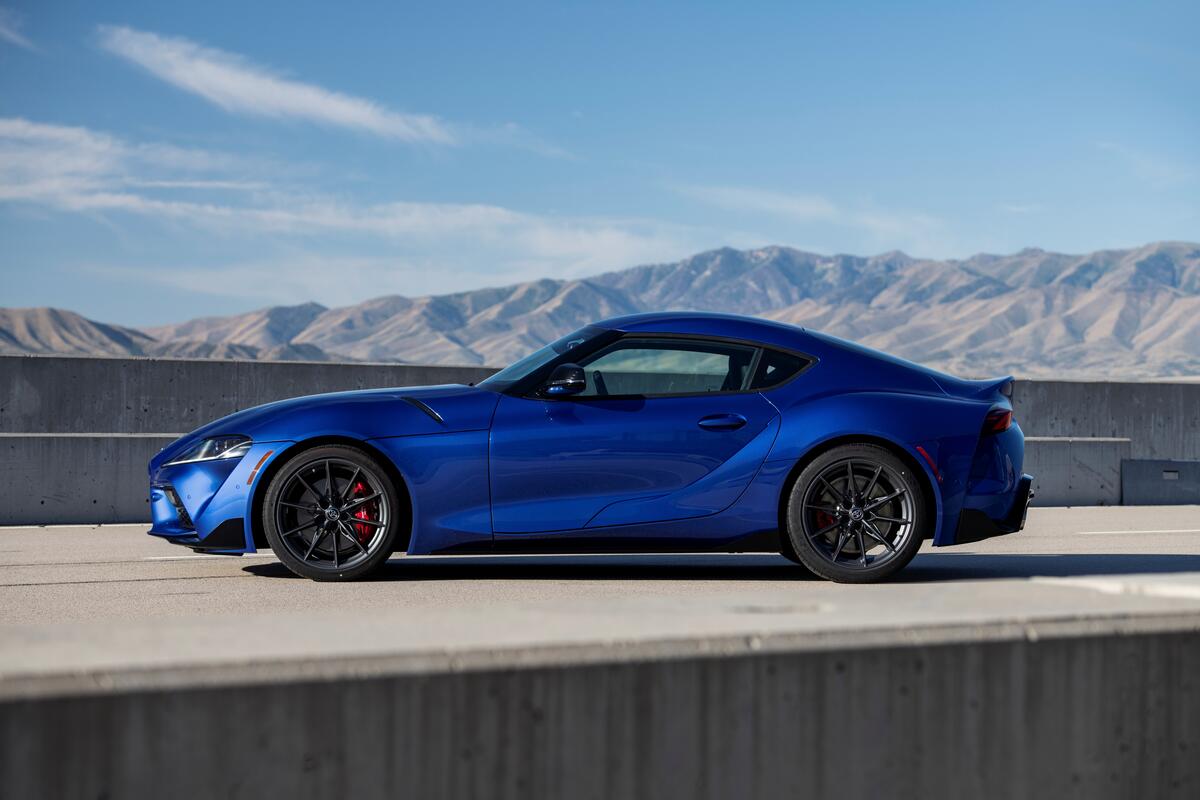
Toyota A90
"Well, the 89, no, that's the whole 7-up thing, Jim. Well, the 7-up was technically a 90, right? But, right, so here we go back with that again."
The Toyota Supra is a sports car made by Toyota. It’s designed to feel quick and fun to drive. The episode mentions it because it’s a well-known performance model.
The Toyota Supra is a performance sports coupe known for its strong driving character and enthusiast following. It comes up in conversations about iconic sports cars and how different models earned reputations over time. In this episode, it’s mentioned as part of the broader sports-car discussion.
tri bar
"... how they just had the little tri bar that they put on the dash on the inside of the car."
A “tri bar” is a small interior design feature—basically a set of three bars—on the dashboard. They’re using it as a clue for which Mustang edition/year they’re talking about.
A “tri bar” is a distinctive interior trim detail—typically three-bar styling—used as a visual cue on certain Mustang dashboards. In this segment, they mention it as a feature used to mark or celebrate a specific anniversary/edition era.
Dearborn Assembly
"[552.1s] And the ones produced at Dearborn Assembly [555.8s] as anniversary cars, I think, are numbered, right? [559.6s] There's like 5,260 of them."
Dearborn Assembly is a Ford factory. The host is saying some of the official anniversary Mustangs were built there, which helps confirm they’re the real limited cars.
Dearborn Assembly is Ford’s manufacturing facility in Dearborn, Michigan. When the host says anniversary Mustangs were “produced at Dearborn Assembly,” they’re pointing to where the official limited-run cars were built, which can matter for authenticity and production tracking.
numbered (production)
"[555.8s] as anniversary cars, I think, are numbered, right? [559.6s] There's like 5,260 of them. [563.3s] And then there were like 260 produced for Ford executives,"
“Numbered” means the car has a specific spot in the limited run, like “#123 of 5,260.” It’s a way to show it’s part of a real limited production.
“Numbered” refers to limited-edition cars being assigned a specific production number (e.g., 1 of X). The host uses it to distinguish official anniversary cars with tracked quantities from dealer-created “anniversary” packages.
Ford Brass
"And I think there was a 25th anniversary cake at Dearborn Assembly and Ford Brass all year."
“Ford Brass” means the top executives at Ford. They’re mentioned as being involved with the 25th anniversary celebration and planning.
“Ford Brass” is a reference to senior leadership at Ford. The transcript suggests these executives were involved in the 25th anniversary cake and broader planning around the anniversary promotion.
failed campaign
"And I forget how many of them were produced... But yeah, the 25th anniversary cars were all failed seven up campaign cars. I don't understand."
They’re using “failed campaign” to mean a promotion that didn’t work out the way Ford hoped. Because it didn’t land, the cars connected to it ended up being reused for the anniversary idea.
A “failed campaign” here means a marketing promotion that didn’t achieve its intended results. The hosts imply Ford had planned a big promotion, but it didn’t go as expected, leading to the cars being repurposed as 25th anniversary vehicles.
paced cars
"That was another one of these flops for American raceways or whatever, paced cars for all their planned tracks, and then they went bankrupt and under..."
A “paced car” is a car that leads or sets the speed for other cars during an event. Here, they’re talking about Mustangs being used as part of track promotions.
A “paced car” is a vehicle used to set the speed or lead the field during an event, often to help manage timing and flow on track. In this segment, the hosts connect paced cars to a planned raceway promotion involving special Mustangs.
American raceways
"That was another one of these flops for American raceways or whatever, paced cars for all their planned tracks, and then they went bankrupt and under..."
They mention “American raceways” as the group that had plans for tracks and events. The hosts say that group went bankrupt, which changed what happened with the cars tied to that plan.
“American raceways” is referenced as the organization behind the track plans that were supposed to use paced cars. The hosts say the effort collapsed when the group went bankrupt, which affected what happened to certain Mustangs.
Ford Mustang
"[761.5s] something happened at Ford, [763.3s] and someone thought, well, wait a minute, [766.2s] the Mustang is a 65 Mustang, [768.4s] so the anniversaries should be changed"
They’re talking about the Ford Mustang and when its “anniversary” should start. The discussion centers on what year Ford treated as the beginning, based on the badges and markings on certain cars.
The Ford Mustang is the car line being discussed, and the episode is about its anniversary dating. The hosts reference how Ford used specific markings (like a fender badge) to celebrate an anniversary tied to the early 1960s Mustang launch.
VIN
"[772.3s] Now, Mike, you claimed to know [773.2s] there was someone who sent you, [774.2s] I have a 1964 and a half car that's titled, [778.9s] but it can't be VIN that way, Mike."
VIN means Vehicle Identification Number. It’s the unique ID number for a car, and they’re saying you can’t really have a “half-year” VIN the way you might think—at least not in the normal way.
VIN (Vehicle Identification Number) is the unique code used to identify a specific vehicle. The hosts are debating whether a “1964 and a half” Mustang could exist as a legal title/registration entry, which would require a VIN that matches that concept.
pilot vehicles
"[790.3s] There were pilot vehicles stamped with a 4S, [798.1s] as, I mean, they were destroyed, [800.9s] you know, there was only, I think, [802.2s] only one surviving pilot car,"
Pilot vehicles are early test cars made before the real production cars. They’re used to check that everything works and is built correctly, and the hosts say these were mostly destroyed.
Pilot vehicles are early pre-production cars built to test fit, function, and manufacturing processes before full production begins. The hosts mention pilot cars stamped with a “4S” and note that most were destroyed, with only one surviving example.
warranty plate
"I've seen a lot of inner fender VINs versus the warranty plate on the driver's door. There were a couple of numbers off."
A warranty plate is a label on the door jamb with key info about the car. Collectors compare it to other markings to see if the car was built or stamped correctly.
A warranty plate is a manufacturer label (often on the driver’s door jamb) that lists vehicle information used for identification and warranty/registration purposes. Here, the hosts use it as a reference point against inner-fender stamping to determine whether the car’s markings are correct or erroneous.
date code
"Well, the thing is pre-production units have an O5C date code, no exceptions. Pre-production units were all date coded O5C,"
A date code is a mark that tells you when something was made. In this discussion, it’s used to confirm how early these prototype cars were built.
A date code is a stamped/printed code that indicates when a part or vehicle component was produced. The hosts say pre-production units have an “O5C” date code, using it as evidence for early build timing and authenticity when discussing Mustang anniversary/start-date claims.
pre-production units
"Well, the thing is pre-production units have an O5C date code, no exceptions. Pre-production units were all date coded O5C,"
Pre-production units are early versions of a car made before the factory starts regular production. They can have different details than the final cars, so collectors use them to understand what’s “really” early.
Pre-production units are early cars built before full production begins, often used for validation, testing, and finalizing details. The segment treats these early Mustangs as having specific identification traits (like the “O5C” date code) that can help separate fact from misconceptions about build dates.
pre-production cars
"[895.0s] But the pre-production cars are just that. [898.3s] Pre-production units, and again, we're wandering off course, [902.8s] but each of the pre-production units"
Pre-production cars are early test/preview versions built before the factory starts making the regular cars. The hosts are using them to explain why some “year” stories people tell don’t match the evidence.
Pre-production cars are early vehicles built before full production starts, often used for validation and final checks. The hosts use pre-production Mustangs to explain why certain date/ID claims (like “built March 5th” or “VIN’d as a 64”) can be misleading.
serial number
"[898.3s] Pre-production units, and again, we're wandering off course, [902.8s] but each of the pre-production units [904.9s] has a serial number, a serial number, [907.7s] a sequence number on the radiator support."
A serial number is a manufacturer-assigned identifier for a specific vehicle or component. Here, the discussion is about pre-production Mustangs having serial numbers and sequence markings on the radiator support, which can be used to verify authenticity.
radiator support
"[904.9s] has a serial number, a serial number, [907.7s] a sequence number on the radiator support. [911.6s] And some people in restoring these cars sanded it off."
The radiator support is the front metal structure that the radiator mounts to. Some cars have stamped or written identification numbers on that area.
The radiator support is the structural panel at the front of the car that holds the radiator and related cooling components. The hosts mention a sequence number located on the radiator support, which matters for verifying early Mustang builds.
model-year
"But when the car came out and launched, the model was a 2015 vehicle. Okay, so Jim, something happened there."
A model-year is the year the car is sold and labeled as. Sometimes the car is announced or celebrated earlier, but it still gets assigned to a later model-year when it actually goes on sale.
A model-year is the production/sales year a vehicle is marketed under, which doesn’t always match the calendar date of its announcement or the VIN year. Here, they point out that when the car launched, it was a 2015 model—even though it was being treated as a 50th anniversary Mustang.
wheelbase
"The wheelbase was changed, the design was changed and it barely made it to Charlotte and Las Vegas, Mike."
Wheelbase is the distance between the front and rear wheels. If it changes, it can change how the car rides and how much room it has inside.
Wheelbase is the distance between the front and rear axles. Changing the wheelbase can affect ride comfort, interior packaging, and how the car behaves dynamically, so it’s a meaningful engineering change when a car is being redesigned midstream.
Iacocca
"No, very few, they said that was an Iacocca genius move because everybody waited till the fall when the cars arrived at the dealerships"
Lee Iacocca was a famous car-industry leader. The host is saying his marketing/announcement timing was smart and had long-lasting effects.
Lee Iacocca was a major automotive executive who helped shape marketing and product strategy at Chrysler. In this episode, the host calls his approach a “genius move” tied to how and when cars were announced to the public.
anniversary car dating debate (1964 vs 1965)
"Rather than, so Jim, you're saying the anniversary should have been on its birthday, which was 64, and that's when we celebrate."
They’re arguing about what year counts as the Mustang’s “true” anniversary—1964 or 1965. That choice affects which newer Mustang gets labeled as the anniversary car.
The hosts are debating how to “date” a model-line anniversary: whether to tie it to the Mustang’s original 1964 start (when the car was introduced) or to 1965 (when many buyers associate the first full model year). This matters because it determines which modern model year gets marketed as the anniversary edition.
Ford marketing
"I'll say it in two words. You ready? Ford marketing. ... After 30 years with Ford marketing, it's just, and Jim, before we got online..."
They’re blaming the Mustang’s “official” date confusion on Ford’s marketing—how Ford promoted the car when it was launched. That can lead to different dates showing up in books and online sources.
“Ford marketing” refers to the brand’s internal marketing team and how they presented the Mustang’s launch timing to the public. In this episode, it’s used to explain why different sources claim different “start” or “birthday” dates for the Mustang.
continuity of something
"After 30 years with Ford marketing, it's just, and Jim, before we got online, what are we talking about? Sometimes the continuity of something"
They’re talking about whether the story of the Mustang’s dates stays consistent across different sources. Some references may not match, so the “birthday” debate keeps coming up.
“Continuity” here means how consistent the Mustang’s documented history is across different references over time. The hosts are implying that records and explanations may not line up cleanly, especially once you compare older print sources to newer online information.
flagship brand
"And in the years since, Mustang is Ford's flagship brand... for being the flagship of Ford Motor Company..."
A “flagship brand” is the main brand a company uses to represent itself. In this conversation, they’re saying Mustang is Ford’s main identity.
A “flagship brand” is the company’s top, most representative brand—often the one that defines the lineup’s identity and marketing focus. Here, the speaker claims Mustang serves that role for Ford.

Ford Thunderbird
"...is Ford's flagship brand, and I think a one-time Thunderbird was, but Mustang definitely holds the crown"
The Ford Thunderbird was a major, high-profile car from Ford. It was meant to be one of the brand’s top models at the time. The podcast mentions it to compare Ford’s earlier flagship status with the Mustang’s popularity.
The Ford Thunderbird is a former flagship model from Ford, historically positioned as a top-tier personal luxury and performance-oriented car. The podcast references it to highlight Ford’s past “top” status in the lineup and how Mustang later became the standout. It’s brought up as part of the Mustang’s place in Ford history.
heritage remains pure
"...making sure that Mustang's heritage remains pure, that you stick with, the car has got certain attributes... and you don't just try to change that around..."
They’re talking about keeping the Mustang true to what it has always been. The idea is that fans want updates to respect the car’s history instead of changing it in a way that feels like it’s losing its identity.
“Heritage remains pure” is an enthusiast concept meaning the car’s identity should stay true to its original character—design cues, spirit, and lineage—rather than being altered to chase trends. The speaker frames this as important to Mustang club members when Ford updates the model.
purists
"Well, so Jim, now we got the purists, and I would consider, sorry, I would consider you Jim Smart as a purist."
“Purists” are fans who want the Mustang to stay as close as possible to what they consider the “real” Mustang. They often disagree with changes like new body styles or big departures from the original formula.
“Purists” refers to fans who believe a car should stay true to the original definition of the model—its core design, layout, and identity. In Mustang debates, this often comes up when new variants (like different body styles or powertrains) challenge the classic “pony car” formula.

Mach E
"Yeah. Yeah. So then there were people that went, when the Mach E came out, they figured, well, you can't get the toothpaste back in the tube now..."
The Mach-E is a Mustang that’s fully electric and looks more like a crossover than the classic Mustang. Some fans argue it dilutes what a “real” Mustang is, because it’s a different kind of car.
The Ford Mustang Mach-E is an all-electric Mustang-branded crossover. It’s a key flashpoint in Mustang “purist” debates because it shares the Mustang name but not the classic pony-car formula (engine layout, body style, and driving feel).
four-door Mustang
"...if we had an S650 and it had four doors on it... so maybe there is a marketing reason, Jim, to sell a four door Mustang..."
A “four-door Mustang” would be a Mustang with two extra doors for the back seat. The hosts are debating whether that kind of change would hurt what makes the Mustang special.
A “four-door Mustang” is a hypothetical or debated variant that would add rear doors to the Mustang nameplate. The argument in the segment is about whether changing the body style for marketing reasons would “ruin” the Mustang’s icon status or keep it alive.

Dodge Charger
"...people who liked the Dodge Charger, not the one that chased the bullet down, but they grew two doors on it..."
The Dodge Charger is a well-known American performance car that’s existed for decades. Here it’s mentioned as an example of a brand that changed its shape (including door count) over time.
The Dodge Charger is a long-running American performance sedan/large car that has been offered in multiple generations and body styles. In this discussion, it’s used as a comparison point for how a brand can expand into different door counts and still keep a performance identity.
anniversary years
"...how much changing the anniversary years or changing the purity of what the car is goes towards ruining the icon or keeping it going?"
“Anniversary years” here refers to the debate over which model year should be treated as the official start of the Mustang’s history. That matters because it affects how the brand celebrates milestones and which cars are considered the “true” beginning.
pony car market
"[1611.7s] I feel like the pony car market is beginning to subside [1617.7s] because what people want changes, [1620.6s] and Mustang has had a good run for over,"
A “pony car” is a type of American sporty car—usually stylish and fun to drive, but not necessarily a hardcore race car. They’re saying fewer people want that exact formula lately.
A “pony car” is a style of American performance car that emphasizes sporty looks, relatively affordable pricing, and a personal/driver-focused vibe rather than full-track racing hardware. The hosts say the pony car market is “subside[ing]” because buyer preferences are shifting.
Mustang badge on an SUV
"that own several Mustangs are not bothered with a four door on an S650 as much as they were bothered on a Mustang badge on an SUV."
This refers to the practice of using the “Mustang” name/badge on a vehicle that isn’t a traditional Mustang body style. The segment frames it as something purists disliked, because it blurs the brand’s heritage and expectations.

Ford Fusion
"...ng. So there's no more tourists, there's no more fusions or focuses or fiestas, it's only Mustang."
The Ford Fusion is a regular passenger car model made by Ford. The podcast is saying that it’s no longer part of the lineup being discussed, and that Mustang is what’s left as the focus. It’s mentioned for context about which cars Ford is selling.
The Ford Fusion is a mid-size car model that the podcast references in the context of Ford’s lineup changes. The key point in the episode is that the lineup is being narrowed so that Mustang becomes the focus. It’s mentioned to explain what models were removed or replaced in Ford’s offerings.

Chevrolet Corvette
"... had a hellacious run, only exceeded by, I think, Corvette. Except for, really, because Corvette didn't pro..."
The Chevrolet Corvette is a sports car made by Chevrolet. It’s built for performance and has a reputation among car fans. The podcast brings it up when talking about which cars have had the biggest impact.
The Chevrolet Corvette is a high-performance sports car from Chevrolet, often used as a benchmark for American performance. It’s discussed because it has had a long history of strong performance and a dedicated fan base. In the podcast context, it’s referenced in a comparison about how one car’s “run” was measured against another’s.
prototype
"About Jim too, was that a prototype? Because it wasn't a production car for sale, correct?"
A prototype is a one-off or early test car made before the final version goes into regular production. The host is wondering if the surviving Corvette was a prototype instead of a normal customer car.
A prototype is an early, experimental version of a vehicle built to test ideas before mass production. The host is questioning whether the surviving “83” Corvette was a prototype rather than a production car sold to customers.
Mustang 65th anniversary timing (1964 vs 1965)
"[1837.7s] If Ford is going to do a 65th anniversary, [1840.8s] it's got to be based on the 65, [1843.4s] and it's got to come out in 2029, not in 2030. ... [1872.0s] Well, folks, I hope you enjoyed that little walk [1873.9s] on what the heck happened with the anniversaries of the 04s and 09s or the 5s and 10s."
They’re debating when the Mustang’s anniversary should really start—1964 or 1965—and what year Ford should celebrate the 65th anniversary.
This segment is about what the “true” start date should be for the Mustang’s anniversary—1964 or 1965—and how that affects a 65th-anniversary release. The hosts argue the anniversary should be tied to the 1965 basis and released in 2029 rather than 2030.
Request an Explanation
Heard something you'd like explained? We'll add it to this episode.
Sign in to request explanations for terms you heard.
Want to learn more?
Browse our glossary for plain-English explanations of automotive terms, jargon, and concepts.
Help improve this episode
See something that's not quite right? Our annotations are AI-generated and can sometimes miss the mark. Click the flag icon on any annotation to suggest a correction.