The Corolla is a small, everyday car made by Toyota. People talk about it a lot because it’s usually affordable to run and easy to live with. It’s the kind of car many people see on the road every day.
The Hyundai Kona is a small SUV/crossover for daily driving. It’s made to be practical and easy to live with, not a race car. People may mention it because it’s a common model that younger drivers are curious about.
Hennessy is a company that takes some cars and makes them even more powerful. At car events, people often want to see the special Hennessy-built cars.
Car
Porsche 288 GTO
The Porsche 288 GTO is a very special, limited Porsche from the early 1980s. It was made with racing in mind, and it’s famous because it’s turbocharged and extremely collectible today.
The Lamborghini Countach is a legendary supercar, famous for its wild, angular look. It’s the kind of car people grew up seeing in posters and dreaming about.
The Porsche 959 is an iconic Porsche supercar from the 1980s. People talk about it because it was packed with cutting-edge tech for its time, and it became a collector favorite.
The pedal box is the space and mounting area for the gas, brake, and clutch pedals. They’re saying the car’s shape pushes that area over, so your feet have to sit in a weird position.
They’re saying the car makes it hard to see where you’re going. That can happen in very low, wide supercars where the windshield and seating position don’t give you great sightlines.
The Lamborghini Diablo is a supercar made by Lamborghini. It’s known for its bold, eye-catching design and high performance. People often talk about it because it’s a recognizable classic Lamborghini.
“Brass era” is a nickname collectors use for the very early period of car history. It usually refers to cars from the early 1900s that had lots of brass details and were part of the first wave of automotive development.
Term
classic era
“Classic era” is a collector term for a certain time period in car history that people treat as a distinct group. It generally means the cars from that period have recognizable classic styling and are part of what collectors chase.
The Mercedes-Benz 300 SL “Gullwing” is a famous classic car known for its doors that open upward like a bird’s wings. Collectors love it because it’s both historically important and instantly recognizable.
A “collector’s ladder” is the idea that collectors usually start with more affordable cars and work their way up to the big dream models. It also means you can collect cars from the same time period even if you’re not buying the most expensive one right away.
Porsche is a famous German car brand that makes sports cars. Here, the host is saying the next book will focus on Porsche cars. That’s relevant to collectors because Porsche models can have very different prices depending on which generation you’re talking about.
Ferrari is a well-known Italian brand famous for high-end sports cars. The host is saying the next book after Porsche will be about Ferrari cars. Ferrari models are especially popular with collectors, so they often show up in big auction conversations.
The Cadillac V16 is an old luxury car that used a very large engine with 16 cylinders. It was built to be powerful and smooth for its time. People talk about it because it’s rare and represents a unique period of car engineering.
Pebble Beach refers to Pebble Beach Concours d’Elegance, one of the most prestigious collector-car events in the U.S. It’s known for showcasing top-condition, historically significant cars—so references to “the best of the best” are about concours-level judging and curation.
The Lamborghini Miura is a famous old supercar from Lamborghini. It’s special because the engine sits in the middle of the car, which helps it handle well, and it’s known for its iconic looks.
Car
Talbot Lago Teardrop
The Talbot Lago Teardrop is an extremely rare classic car known for its very smooth, teardrop-like shape. People love it because the design looks futuristic and it was also meant to be more aerodynamic.
Bruce Myers is mentioned as an example of someone with a really cool car garage. The speaker is saying the situation feels similar to walking around his collection.
The Ferrari 250 GTO is one of the most famous and valuable classic Ferraris. It’s rare and has a strong racing background, which is why collectors chase it.
“Short wheelbase” means the car’s front-to-rear distance is shorter than normal. That can make the car feel a bit more nimble, and collectors care because it identifies a specific version.
Car
Ferrari GTO
“Ferrari GTO” is a very rare, very valuable Ferrari model that collectors chase. The hosts are discussing one that sold for tens of millions of dollars at auction.
“Racing history” means the car’s past in competitions—what races it entered and how it did. Collectors care because it helps prove the car’s story and can make it more valuable.
In collector car terms, provenance is the car’s documented background—who owned it and what it did. A car with a stronger, well-documented history usually gets treated as more valuable by serious collectors.
A serial number is like a car’s unique ID. It’s used to prove which exact car you’re looking at, and collectors care because it can confirm the car’s history.
The Ferrari 330 LM was a Ferrari race car built with Le Mans in mind. The idea was to use a big engine and a race-ready design to compete in long-distance endurance events.
“Scoops” are openings on the body that help move air where it’s needed. On race cars, they can be functional for cooling or airflow, and they also make the front end look aggressive.
That phrase is describing the shape of the car’s front end. Collectors use nicknames like “duck bill” and “mail slot” to point to the exact nose design, because different versions can look noticeably different.
“Four speed” means the car has a transmission with four gears. Different gearboxes can change how the car drives, and collectors care because the original setup can be part of the car’s history.
“Five speed” means the transmission has five gears. The speaker is saying that when the car was sold, it had this five-gear setup rather than the earlier configuration.
“First 36” is a collector shorthand for an early, limited group of cars. The speaker is saying this particular car isn’t as valuable because it wasn’t part of that first batch.
This means the car was built as one of a small number of extra prototype versions. Collectors care a lot about how many prototypes exist and which ones were built, because that affects rarity and value.
This means the car had two different engine setups as part of its factory history. Collectors like that because it’s unusual and helps prove what the car has been through over time.
This is talking about Shelby’s famous race cars from the Daytona era. Even though they were just “race cars” at the time, today the surviving ones are worth a lot and collectors chase them.
Pete Brock was a well-known racing and car designer. Here, he’s mentioned because he told a story about how people viewed certain Shelby race cars right after they finished racing.
They’re saying that in the 1960s, people didn’t think about these race cars as future collector items. Only later did collectors realize how rare and important they were, which made them valuable.
Right-hand drive means the steering wheel is on the right side of the car. Some collectors prefer it because it can be closer to how the car was originally set up for certain places or racing.
Collectors care a lot about whether the car still has its original engine. If it doesn’t, some buyers see it as less authentic, which can change the price.
The hosts discuss how Ferrari GTO values move through the collector market, including comparisons across decades (50s vs 60s Ferraris) and what a “front of the pack” GTO might fetch at auction. This is essentially a pricing-and-demand discussion tied to auction timing and car specifics.
The Ferrari 288 GTO is a rare Ferrari supercar. It’s known for being very fast and for having a special place in Ferrari history. People mention it because it’s a recognizable, highly desired classic performance car.
A restomod is a classic car that gets restored, but also improved with newer parts or technology. The goal is usually to make it more fun and easier to drive than the original, while keeping the classic look.
A Ferrari Dino is a famous Ferrari model line known for being a lightweight, sporty, enthusiast favorite. Here, the host is talking about a special custom Dino build that was shown at Pebble Beach and is now listed for sale.
Covered headlights are headlights that sit behind a cover or housing. They change the front of the car a lot, and collectors notice them because they can look very “period correct.”
The F40 is a famous Ferrari supercar. When they say “F40 engine,” they mean they’re checking whether this other car has an F40’s engine inside, which would be a major upgrade and could affect value.
The Ferrari F40 is a very famous, very fast supercar. People pay attention to it because it’s known for being exciting and because its design and engine are closely tied to its identity. It’s the kind of car collectors recognize immediately.
MoTeC is a brand of aftermarket engine computer. A “standalone EFI system” means the car’s fuel injection is controlled by its own dedicated computer, which can make an older car run smoother and more reliably.
A “preservation class” is a category where judges prefer cars that look more original and not overly restored. The idea is to keep the car’s history visible, even if it isn’t perfectly clean.
Bring a Trailer is a popular website where car enthusiasts buy and sell cars through auctions. They’re referencing it because the listing photos and presentation matter a lot there.
A package tray is the panel behind the back seats. If it’s dirty, damaged, or poorly finished, it can be a sign the car wasn’t cleaned or restored carefully.
Fuel lines are the tubes that move gas from the tank to the engine. If the connections look wrong, it can suggest the car wasn’t put together carefully.
A crimp is how a hose connection is clamped and sealed. If the crimp looks wrong, it can mean the connection wasn’t made correctly or with the right parts.
Broad Arrow is a company that runs high-end collector car auctions. The host mentions it as one of the big auction players where cars are judged closely.
RM Sotheby’s is a famous auction company that sells collector cars. The host brings it up to compare the big auctions where details and preparation can really matter.
Barrett-Jackson is a famous auction where lots of collector cars are sold. The host uses it to show that big auctions can still sell hundreds of cars in a short time.
Meekum is a collector-car auction the host mentions as an example of a big, well-known auction. The point is that even famous auctions can include cars with different levels of prep.
The Civic is a small car made by Honda. It’s designed to be efficient and easy to use for daily driving. People may mention it in auctions when they find one with low miles or good condition.
They’re talking about how much work you should do to a car before selling it at auction. The idea is to balance “make it look great” with “don’t overspend” on restoration.
A frame-off restoration is the most extreme kind of restoration, where the car is taken apart down to the frame and rebuilt. The point here is that you might not need to go that far just to make the car look its best for sale.
Dry ice blasting is a cleaning technique that uses tiny pellets of dry ice to knock off grime. It’s used in car detailing/restoration to clean without soaking or aggressive abrasion.
Term
spread stitches
“Spread stitches” means the seams in the upholstery aren’t tight anymore. Repairing them helps the interior look clean and professionally finished.
They’re referencing a major collector-car auction scene around Monterey Car Week. Because the buyers are different (and often wealthier), the same car can sell for more or less depending on where it’s auctioned.
Topic
Milly Island auction
They mention another big auction event besides Monterey. The main idea is that different auction venues have different buyers, which changes how much a car might sell for.
They’re talking about two ways to sell collector cars: bidding online or bidding in person. Some cars are easier to judge from photos and listings, while others really need a live viewing to get the best money.
“Fluffing buff” describes superficial prep for auction—cleaning and detailing without addressing mechanical or structural issues. In collector-car terms, it can mislead buyers and hurt trust, even if the car looks great in photos.
They’re saying the car should at least be able to start and move under its own power. At auction, that matters because buyers feel safer bidding when the car isn’t a non-running project.
They’re talking about balancing how much money you put into getting the car ready versus what you can realistically get back at auction. Spend too little and it sells cheap; spend too much and you won’t recover the cost.
The 1957 Ford Thunderbird is a famous classic Ford from the 1950s. Collectors care a lot whether it runs and how complete it is, because that affects what people will pay.
Car
Duesenberg
Duesenberg is a famous old luxury car brand that collectors really want. The host is using it as an example of how certain big-name classics can sell differently at auction.
“Restomod” (spoken here as “rest of mod”) describes a classic car that’s been restored and modified with modern upgrades—often to improve drivability, reliability, and performance. In collector pricing, a restomod can command a premium if the upgrades are high-quality and tastefully executed.
A “964” is a specific Porsche 911 generation. Singer is a company that takes classic Porsches and rebuilds them to a very high standard, which can make them worth far more than a regular version.
Car
Singer engines
Singer is a company that takes certain Porsche cars and upgrades them a lot. So “Singer engines” means the engine has been modified and improved beyond what it was from the factory.
This is basically “what are these cars selling for lately?” Instead of guessing one price, you look at recent sales and trends to estimate what the market thinks it’s worth.
“Traded publicly” here means the cars are changing hands in visible, documented ways—like auctions or dealer sales—rather than only private deals. Public trading creates more price data, which can tighten valuation ranges for a specific collector-car niche.
In plain terms, “entry point” is the first price you’d pay to get into that kind of car. The host is saying Singer was cheaper to start with than some other cars people compare it to.
A hot rod is an older car that someone modifies to make it faster and more exciting. Here, it’s used as an example of how custom builders can become more valuable over time.
Brand
Boyd Cottington
This is a well-known custom car builder. The host is saying that early on, builders like him didn’t always get paid what their work would be worth later.
Brand
bear Jackson
This refers to a major collector car auction brand. The host is using it to illustrate how custom cars can be undervalued early and then become more valuable later.
Ring Brothers is a company that builds and sells high-end custom cars. The host is saying that big-name builders can end up buying cars and then selling them later as the market matures.
The Bronco is a type of SUV built for rough roads and off-road adventures. Some Broncos are especially sought after by collectors, so they can sell strongly at auctions. People talk about them because they’re known for being tough and capable.
The aftermarket is the “after you buy it” market—things like upgrades, modifications, and resale demand. The host is using it to say that some collector cars keep gaining value even after they’ve been built and sold.
The Corvette is a sports car from Chevrolet. Different years and generations have different looks and features, and some are especially popular with collectors. It’s discussed a lot because it’s built for performance and has a big fan community.
The Hagerty Evaluation Index is a tool that tries to measure how collectible car prices move over time. The host is saying it may need to account for who built the car, because that can change the value a lot.
The Hagerty Price Guide is like a pricing reference for collectible cars. The host is saying that “Singer” cars might need their own category in that guide because their prices can follow a different pattern.
“Eleanor” is a nickname collectors use for a specific famous car style. Some are built really well, and others are put together cheaply, so the quality matters a lot for price.
This is talking about replica cars that were made with permission (a license). Collectors often care because licensed cars usually come with better documentation and more consistent build quality.
“Appraise” means to estimate what a car is worth. For collector cars, the price can swing a lot depending on how good the build is and what records exist.
LIVE
Hello, welcome to CarCast, I'm Matt, the moderator, D'Andrea.
All right, before we get into it, a word from Fanduil, and right now, new Fanduil customers
can bet $5 and get 150 and bonus bets if your first bet wins.
That's right.
Turn five bucks into 150 and bonus bets just for getting started.
And when every possession matters in the playoffs, Fanduil makes it easy to get closer
to the action, from player props and your favorite stars to all the tools you need to
back them up.
Fanduil puts player research at your fingertips so you can check the stats, trends, and matchups
all in one place and make your picks with confidence.
It's everything you need all in one app, so don't miss your shot.
Head to Fanduil.com slash believe to get started.
That's Fanduil.com slash B-L-E-A-V to get started.
It's Fanduil.
Play your game.
Must be 21 and over and present in select states.
Gambling problem, call 1-800-Gambler.
Goldberg's out this week, but I brought in my friend Greg.
Greg Stanley, how are you doing today?
Fantastic, as always.
Anytime we talk about cars, it's a good day.
Thanks for joining me.
Greg, we met a long time ago.
I think you were at RM, Sotheby's still at the time, right?
So you were a car specialist at RM?
Yeah, and we met at the quail.
That's right.
My first time at quail, I'm sitting right across from you and your son.
I'm like, man, that guy looks familiar.
Oh, I think I just asked you, are you Matt the moderator?
You're like, yes, I am.
Yes, except that was sunny Corolla, not my son.
I don't know. That's right.
That's what Adam wasn't there.
Adam was getting food or getting a drink or something like that.
And that's not sure afterwards.
But sunny was very young.
So you'll be back this year and sunny is will be with us.
And now he's 20 and he's like six foot two.
He's as big as his dad.
And so I think he's going on like 11 or 12 years.
I forget he was like nine or something
when we started bringing him to Monterey.
And he was super interested, right?
He just like a lot of the young kids are like, I want to see Pagani
and I want to see Kona's egg and I want to see, you know, a Bugatti
and I want to see Hennessy and learning about some of those things
for the first time or even walking around and going, oh, what's that?
And it's like Pagani wire or something at the time.
And he's like, wow, you know, that's really interesting
because I never thought of this before.
But the reason I'm in love with cars is because they weren't available to see.
And if you saw one, it was like a moment in time that was there
and then gone, and it was like forbidden fruit,
which just amped up the desire to see the cars in person.
Now, if you see the cars every any time you want online, in person,
local cars and coffee, does that increase the enthusiasm or I don't know.
It's just interesting because it's the opposite of why I got involved in cars.
I'd love cars, you know?
Yeah. Well, right.
So for me, there wasn't social media and I never saw these cars at car shows.
You know, you would go into like a Spencer Gifts in the mall
and you get the poster, you know, the Kuntas or the 959 or,
you know, or maybe even a 288 GTO.
That wasn't even quite poster material yet.
I can't remember the first time I even saw some of those cars.
Like, what was the first Kuntas that I've seen?
I can't remember, but I feel like I was an adult.
Like I was an adult when I first saw like my first 959 Porsche
and my first Kuntas, my, you know, but, you know,
I probably even saw some of the modern day supercars before.
I mean, there is a little bit of drive around L.A. as an adult
and you'll you'll see some things like that on the road, the modern day stuff.
But yeah, there's there was no I mean, without social media,
without YouTube, without any of that stuff, like being as exposed to them.
You just hear about the cars.
You can see the car magazines, get the posters.
That's why the posters are such a big deal, because that's the picture
that you dreamt about that car you didn't have.
You couldn't flip through your phone for 20 other pictures of it from yesterday.
You know, yeah. And I actually do remember the first Kuntas,
because it was the first car, first real car ever saw in person.
I was like, it was a new car.
It was like 1980 through 1984
And I would ride my bike up to this Kmart to buy like bow and arrows.
You know, you're like twelve years old.
You're like, I'll get whatever slushie or whatever.
And there's a there's a place called Racket Power back when racquetball was huge.
And across the street was a Latins arcade.
And then across from that was the main street was State Road 13.
Well, there's a skating or skate rink called Skate Road 13,
which I thought was the best name ever for a skating rink.
And it was at Racket Power in the parking lot.
It was a new Kuntas and it was white with red interior just parked there.
And it looked like a freaking spaceship.
You know, and I'll never forget that.
So when I see a white Kuntas with a red interior, I absolutely love it.
If I had all the money in the world, I'd buy a white Kuntas with red interior.
I I'm down with that.
I'm at that age where I watched a lot of Miami Vice back in the day.
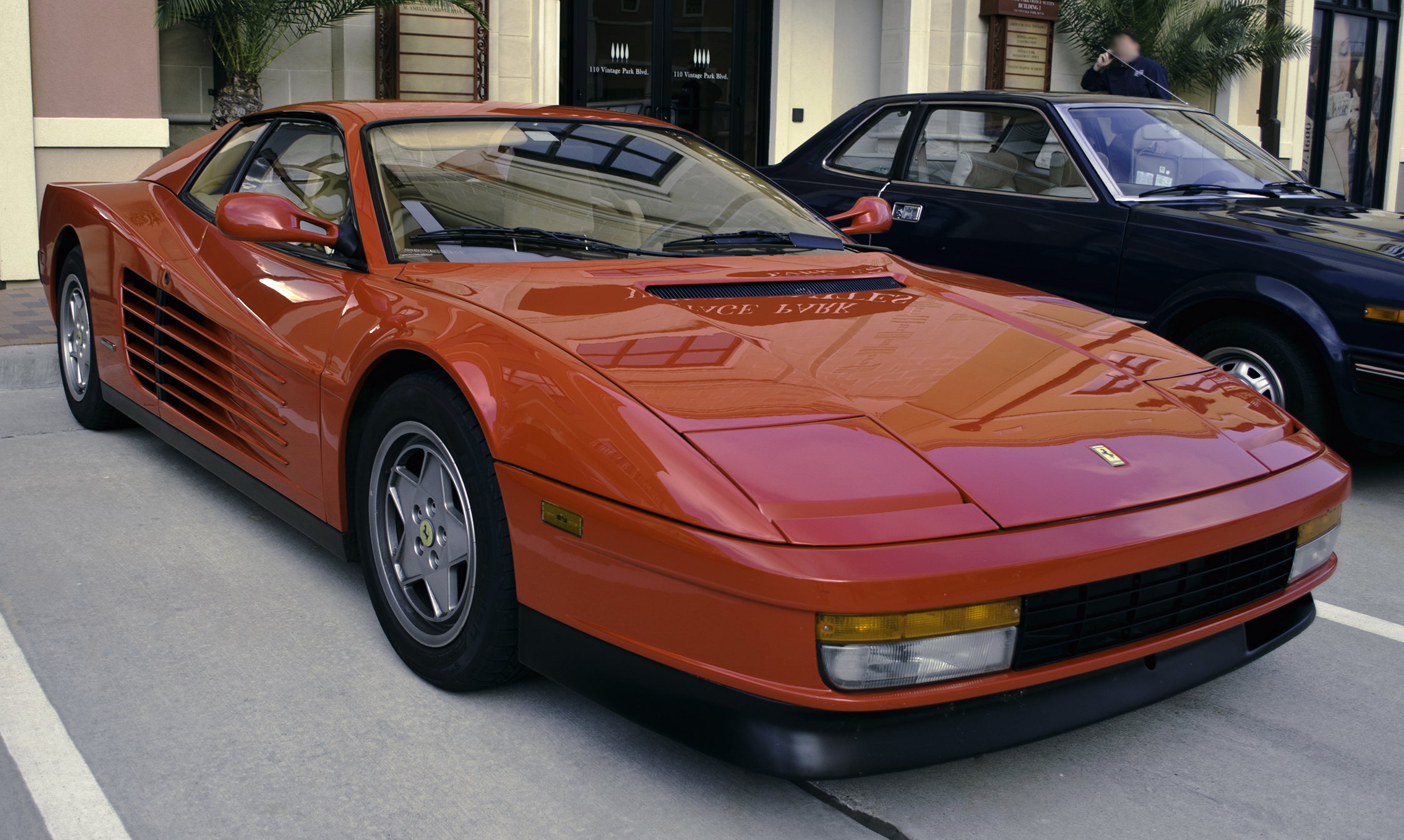
So I'm down with the Testerosa and the Kuntas.
I mean, horrible cars, but man, they're gorgeous.
You know, I talk about first time seeing those cars in person,
but being able to drive some of those cars.
When I drove a Kuntas,
you're right, like you're in it and and the like the door sill area,
it's like it really kind of comes in and moves the pedal box over to the right.
You kind of sit at an angle and and the the accelerator pedal is very thin,
but the clutch is really heavy and you can't literally like get much of a shoe in between
your the brake and the gas pedal, right?
So you kind of almost have to drive with like no shoe on your right foot,
but a heavy boot on your left foot because it's a big heavy clutch in that car.
And you realize you can't see out of it.
So I was driving it around and I was like, man, I can't see out of this thing.
But I was like, but I'm driving a red Kuntas.
So everybody sees me.
So I was like a little less worried about it because everyone is staring at you in that car.
I don't know, it was good.
It was a good time to be able to drive that around for a bit.
Yeah. And I speak from limit.
I just speak from limited experience, but I do have an own client and he has quite a few Lamborghinis.
And he said, if I sold everything, the last car I would sell is the Kuntas.
And I was like, why?
And it was because of the design.
He's like, the thing drives like a freaking grain truck.
It's horrible.
And he was the one that said, you know, the build quality is really bad.
You know, obviously there's reasons he would keep it forever, mostly because of the design.
But he's like, that Diablo is so much better of a car than the Kuntas,
even though it's just one generation removed.
Yeah. So I would still love to have one.
I agree. I'd love to have one.
And it would be a financial nightmare.
Maybe it would go up in value, but what I'd have to put into any of those cars.
Maybe not enough.
Like so many of those cars.
All right. So step it back.
So we met at the quail.
You were at RM or just finishing at RM.
But you have the collector car podcast,
which you've been doing for many years now.
You're hundreds of episodes in.
I've been lucky enough to be a guest on the show as well.
I think we talked most about documentaries,
about the films that we were producing over there as well.
And a car show judge, author, you're kind of all over the place,
especially in the collector car world.
But let's talk a little bit about that real quick.
So tell us about the podcast
and what you guys are doing differently over there.
Yeah. You know, it's funny because I try to,
it was called something else initially,
and I changed it to the collector car podcast
because I wanted people to know,
this is a podcast about collector cars.
You know, you want to make it as clear as possible.
And so what I try to do is I try to interview folks
like yourself, which we would go,
I think we went on a deep tangent
on Fox body Mustangs at the time.
But you know, not your traditional guests.
You know, yes, sometimes I'll have some folks
that have been on the circuit, I guess before.
But like to have some interesting guests, I have Sean,
I'm sorry, Shan Fanon,
automotive artist coming up tomorrow,
or as we record this a week or two ago.
And you know, I'm a failed artist.
So I love interviewing artists that, you know,
document incredible cars or whatever it might be.
But you know, I'll, I'll interview the Wayne Carini's,
you know, I'll, I'll, I'll do everything.
Oh, I had Jay Leno on at one time.
I'll do valuation trends.
I'd like to interview owners at car events too.
You know, when you're at a cool car event,
I think it's always fun to find out
why do they love this particular car.
And one thing I started recently,
which has been fun is I started a guest,
guess the growl.
I'm still trying to figure out the name or guess the exhaust.
So I'm going to put up five or six exhaust sounds
and you can guess which car it's from.
So trying to make it, you know, involved and fun
and different and something you don't see every time.
You know, it's just such a crazy world we live in.
Try to bring some of that to folks through a podcast.
I think is a fun thing to try to do.
Yeah. Yeah, I agree.
And then the, the books that you're working on,
it's a, it's a series of books.
Yes, I've got one here, got one behind me.
So I just, like eight weeks ago or so.
Yeah, there you go.
I just launched the enthusiast guide to collector cars.
Man, you're technically savvy.
I love it.
And yeah, so it's, I call it like, you know,
get your toe wet in the collector car world.
It could be either you're a new enthusiast,
maybe you're a tolerant spouse that goes to a lot of car shows
with your car fanatic spouse.
Just a way to kind of understand this car world
from a broad perspective.
So like there's a chapter on brass era cars.
There's a chapter on classic era.
Basically every era there's a chapter.
And in the chapter I go from, you know, like
what defines this category?
What's the technology of the era?
Why do these cars matter to someone
who doesn't know anything about them?
You know, and I pick out some key collectible models.
I don't talk about every car of that era, just a few.
Then it also is the collector's ladder.
So if you want to, if you aspire to have a 300 SL
Gullwing, that's, you know, $2 million.
But what's like a mid tier and an entry level
of that same era that might give you,
maybe not the same experience,
but you know, at least you're in the era.
And then I go in all sorts of stuff,
like the timeline of the era,
what inventions may have occurred
that made driving better, more enjoyable.
And then I'll also do fun stuff like auction highlights.
You know, so yeah, we talked about brass era cars,
but what are these actually trade for?
What's some of the world record prices
for some of these crazy cars?
So it's meant to be easily digestible,
a lot of fun facts.
And I provide quotes as well from experts.
So like, I'm not a brass era expert.
So I did the bones of the chapter, so to speak.
But then I asked for two experts to review it
and they provided a quote.
So it starts with a brass era expert
giving a quote at the beginning of the chapter
and it closes with one at the end.
And just having other people's voices is really cool.
I had, I think 55 contributors from, you know,
why cars matter or why that era matters for the book.
And that has been tremendously fun
to see what they have to say about cars.
And like I said, it's first of a series.
So the next one's about Porsches.
I hope to have 40 to 55 contributors to that book.
After that, I believe it's Ferrari.
So anyways, it's meant to be ongoing, at least five or six books.
And each one will have experts of that brand or era piping into it.
So it's been a lot of fun.
I get to meet a lot of cool people that way too.
Yes, I imagine you do.
The amount of research that must go into those things
to make sure you're getting everything correct.
Like you can always recall things and go,
I want to talk about this particular Porsche
or this particular Ferrari in the book
because I know that car is special.
But now that I'm going to write it down and make it official,
I got to make sure it's right, you know?
Because there's also like,
we were just talking a minute ago off the air,
there are stories that have sort of grown
and even ended up at the corporate level
that aren't necessarily factual.
Right, right.
Bring that up or no.
Yeah, no, that's, yeah.
Listen, that was a good example.
We were talking about the 4GT.
We were talking about the lights in the 4GT
that looked like it says 100 in the light, right?
And was that intentional?
Was that not intentional?
And for a long time,
this story was that was an Easter egg,
that it was intentional.
But not necessarily the case.
If you talk to the designer on the car,
he would say, no, that wasn't intentional.
That was just a happy coincidence.
But you're right, there are people within Ford,
for example, saying that was intentional.
It's like...
Recently on major shows.
Well, it's funny you said it,
because like I don't know a lot about classic era cars.
Like you go to Pebble Beach,
they're all like 1928, 1948 classic era.
And that's what you mostly see forever at Pebble Beach.
And you know, people would even give them grief about that.
Like, why don't you have coontashes?
Why don't you, you know,
it's all pre-war stuff.
And I was always kind of in that camp.
But when I researched the classic era,
it was such a special moment in time in the automotive world
that you really had tremendous, unbelievable things.
I mean, there were no rules, you know,
and it was after the war,
and after the first world war,
and then obviously into the second.
But, you know, design was nuts.
You know, you could basically build whatever powertrain,
you know, V16s, you know, you had these...
You had these coachwork firms
that would just make the most stunning stuff
that would never pass anyone's mustard today
from a safety standard.
So it really was like custom tailored suits
for the rich and famous back in the 30s and the 40s.
And so I have a much greater appreciation for that era
because of where it fits in the overall automotive world
and how it was kind of a snapshot in time
that's unrepeatable.
And so I'm like, wow, okay,
I need to look at those cars a little bit closer.
Because, man, it was quite a time.
So I learned a lot while putting this book together.
And it took a number of years.
And as you know, when you...
Some of it's osmosis, you know,
you do 425 podcast episodes,
you bound to pick up something.
So, yeah, it's been a fun, fun journey so far.
I was, you know, I was thinking as well, like,
not necessarily the biggest fan of the pre-war cars.
And there are often quite a few at Pebble.
And if you go to Pebble, you will see,
obviously, you'll see the best of the best.
So I was talking to a friend of mine
that is bringing two cars out to Pebble
for contention this year.
And but what an incredible mix of car.
Talk about two beautiful cars.
He's bringing a Lamborghini Miura,
which can't go wrong with that,
and a 38 Talbot Lago Teardrop.
Wow. Yeah.
And pretty, pretty amazing car.
Now, everyone knows what the Miura looks like.
I'll just, here's a little...
This isn't necessarily his car.
This is just what the Talbot Lago Teardrop looks like.
I think RM had one.
Oh, they're actually stunning cars.
It really is amazing, some of these cars.
Yeah, and they're not cheap.
I want to say the last one sold for around $13 million or so.
Yeah.
Yeah, they're stunning.
They're very limited, like you said, hand-built,
absolutely gorgeous.
I think the earlier one you showed,
the Maroon with the Silver,
that was at a museum exhibit that Ken Gross set up.
And I actually covered it on my podcast
as a walk and talk through the museum,
and that was one of the cars that was there.
This one, interesting, because I don't see the same...
Like this one up here has the headlights on it,
and then the others don't.
Well, that one does.
Maybe that's the same car, but the Maroon one doesn't.
See, I don't know enough about the cars to know,
and I don't know what this guy's car is going to look like,
but I do know the guy.
And if I know the guy,
it will be more than just a Talbot Logo teardrop.
It will be the Talbot Logo teardrop.
A little like walking around Bruce Myers' garage.
That's a Cobra?
It is, but it's the...
The first Cobra.
It's the first Cobra.
It's like, you know, or like,
oh, you've got the so-and-so car.
It's like, yeah, but that's the Le Mans winning.
Yeah, that one was Le Mans.
Yeah, that one was Le Mans.
And so did that car.
And so did that car.
And so did that car.
And he's got an affinity for Le Mans winners in his garage
in Bruce Myers.
Yeah, the 300 Coupe.
Oh, that's Clark Gables.
Oh, and the luggage in the trunk is his wife's,
and her luggage tag in her handwriting is still on it.
Yeah, it's just crazy.
What's the big money Ferrari?
The 250 GTO?
She's got the Testerosa.
Yeah, the Silver Testerosa.
And it's the...
Oh, short wheelbase.
He's got the short wheelbase one, yeah.
The race car, though.
I'm thinking of the race car.
Not the California or anything.
I'm thinking of the...
What's the $70 million Ferrari race?
Yeah, the GTO.
I don't think he doesn't have a GTO.
I think he does.
Oh, you do?
Okay.
Oh, I'm sorry, not Bruce Meyer.
The other guy that I'm talking to,
and I'm not gonna...
It's up to him to kind of show me.
So he is a GTO.
And a few years ago, a GTO came up for auction.
It might have been RM.
And I forgot what it was, $50 million or something like that.
It was like...
That was the one I represented for RM.
Actually, you can see it.
Right there, those pictures are all the number seven.
Okay.
So what was the history on that car?
Because there's a funny story that my guys were telling me.
But the history like...
Well, I wanna hear his funny story first.
Okay, and it's good.
But maybe not necessarily the racing history.
So it was funny because this guy that I know,
he's got a 250 GTO.
And he's a super nice guy.
And he's in the club of the few people
that have the 250 GTO and races it.
And I was like,
what do you think this car's gonna go to?
Is this a $70 million car?
And he's like, no, no.
And he goes, well, why not?
He's like, look, it's a nice 250 GTO.
It's still a 250 GTO,
but it doesn't necessarily have the best racing history.
There was something a little interesting about it.
And he goes, so it gets you to the table,
but it doesn't get you to the head of the table.
That's totally right.
And I was like, where's your car?
He's like, head of the table.
Yeah, so that's a great thing.
So I don't think you can see it,
but over the shoulder here, there's a little die cast model.
They only made 144 of them.
So I ordered one of the exact car that I helped consign.
And it's actually serial number seven.
Like they may, you know, numbered them.
And I got number seven, which is cool.
And that's actually the reason why there's a GTO
on the cover of this book.
And it's also in the book.
We have this incredible car.
So you have the 36 GTOs, the 250 GTOs.
No question asked.
Those are them.
Yeah.
But then you also had three prototype cars that were,
Enzo said, you know what, we did so well.
What if we take the GTO body and chassis, you know,
and let's beef it up and let's put a bigger engine in it
and let's race it in some other, you know, formats.
And so Le Mans was one of those.
So the one I represented, it was born as a 330 LM,
which it was designed with a four liter engine to race at Le Mans.
And it's so interesting because it had the traditional
3D scoops on the front, which is the sexiest front end
you've ever seen on a car in your life.
And it didn't do well at Le Mans.
Like it got stuck in the sand.
There's famous pictures of it with the driver trying
to shovel it out to get it back on the track.
And a year later, the factory, by request of a client,
changed it to a 250 GTO.
And in doing so, they changed the front end.
Actually, I might have that back.
Anyways, so I had a different front end.
It had a duck bill mail slot front end that is super ugly.
And it was a three liter out of a P3.
So the engine had tremendous race history,
but the car didn't.
And then it was used for hill climbs and such.
And so the original four liter was lost to time,
unfortunately, same with the four speed.
The three liter and the five speed is what was in the car
when it was sold.
There was a spare four liter that came with the car.
So the reason it was not a $70 million car
is because it was not one of the first 36.
It was one of the additional three prototypes.
But it's pretty interesting because it's the only one
that came from the factory
with two different engine configurations.
And that's why when we promoted it, it was called the one
because it's the only one that was like that.
So yeah, yeah, very, very cool car.
I had a chance to drive it and it's on my YouTube channel
to go back far enough, two years.
And as I'm driving it, the sun is filming me
for like four minutes.
And all of a sudden he yells, slow down, slow down.
And there was three deer crossing the road.
And can you imagine wrecking a $50 million car
three weeks before it sells?
Yeah.
But thankfully it did not.
Yeah, that's good, right?
So years ago, so I was at Goodwood with Adam Corolla
and I were there and we were filming our show.
We had a show called Adam Corolla Goes Racing
or Going Racing with Adam Corolla.
I should probably really know the name of it,
but it was Going Racing with Adam Corolla
because we did a couple of different iterations of the show.
So we went over and we interviewed Nick Mason,
the drummer of Pink Floyd,
and he's got a Ferrari 250 GTO,
which by the way, he was there and he was racing.
And then he had another driver with him
that would also go out and race his car for him
when he was like, you know, I want the car to be out there.
I want it to be raced.
I don't want to race it the whole time.
I got a couple of cars.
So he brings somebody else to race it with him.
I know that sounds weird to most people,
but you go to Monterey Car Week,
you go to a lot of these events.
There are people that own these cars
and then they have other people even drive them for them.
And some of them get paid for that.
It seems like you would be paying the owner.
You would pay.
Yeah, like how about I'll give you five grand
and you let me drive your 250 GTO around the racetrack.
And then you cover like anything
that ever happens to the car.
So here you go.
So he brought a driver out there.
So we were talking to Nick Mason,
and I believe he was telling us that
that he bought it pretty much new at the time,
like right after its racing history, after its thing.
And don't quote me on the number.
We were like, when did you buy it?
He's like, maybe he bought it like 70 something.
It wasn't quite.
It was a few years after because what's the car like 62?
Maybe he bought it and 62 to 64.
Yeah, he might even bought it like 68 or something, right?
And so many, you hear stories of so many of these racing cars
that after they race some, you know, Shelby's famous story,
we're racing cars, it's in Lamont,
it's too expensive to bring them home.
Let's just throw them in the ocean or something like,
I don't want to bring them home, right?
And those are, you know,
Shelby Daytona coupes that are worth a ton of money now.
Pete Brock tells a story about how
Shelby didn't want to bring it home and he offered it to him for sale.
And he's like, I had an opportunity to buy one of these things for like two grand,
you know, right after the race.
And I didn't do it at the time because, you know,
they're just thinking it's a job, it's a race car.
Yeah, it's the whole technology, nobody wants it.
And we didn't think about the collectability back in the day of the 60s,
like what they are today.
So Nick Mason said something like, he's like, yeah, I got the car,
60 something early 70s, paid $40,000 or $46,000,
something with $40,000 range in it.
And I'm like, well, what do you think it's worth now?
50 million?
And he's like, maybe thumb up, maybe a little higher, maybe 60 million.
And I'm like, well, the racing history and his Nick Mason's car,
he did campaign it well, which is part of the value of the car, right?
And go, all right, well, maybe it's 70 million dollar car.
And it's like, did you ever think that you would like
buy a car and have it be worth 70 million today?
Like all you've done with Pink Floyd, have you had that kind of like
turnover? And he's like, well, Pink Floyd was a lot more work for my entire life.
This was, I bought a car once, it was a lot of money at the time,
but now look at it. And lucky for him, he's been successful in his career
that he never had to sell it and go, oh, listen, I'm getting divorced.
I need $40 million to get rid of that problem.
Yeah, no kidding.
Yeah, but he didn't have to.
He was out there so driving it, racing it.
And it was such a great interview, such a fun time talking to him about it,
and his driver who jumped in and that guy was like, I can't even believe I'm here
and I'm driving the car. He's like, this is the best day ever.
He goes, actually, I've driven it a few times, but how amazing to drive a car like that.
Yeah, I was at Velocity Invitational doing some media for them.
And they had two GTOs there on the track.
And I almost got a chance to ride in one, which it just didn't come through
at the last second. But yeah, it was amazing.
What's interesting about these GTOs is that the one famously just sold for 38.5 all in at Mecom.
Yeah.
I think that was appropriate price, mostly because it's a right hand drive,
which if you're going to race it in period, that's desirable.
It's white. I don't think it looks as good as white.
And then it wasn't the original engine.
It's interesting to see because from a market trend perspective,
50s Ferraris have definitely declined. 60s have as well.
So when one of those quote unquote front of the pack GTOs come to a public sale,
I'm really curious to see, will it be a $70 million car? Will it be a $60 million car?
It will be interesting to see whenever one pops up again.
Yeah. I agree. I think that was well bought and probably well sold.
I think it was the right number for that car.
It was. Stanley was very happy.
And it went to a really good owner, an owner that would take that car out, drive it around,
bring it to events, trailer to events, have a good time, enjoy it. It's in a wonderful car
collection. It's no secret that David Lee is a big Ferrari collector. He's the one who bought it.
And I think right when he had it delivered, they unloaded it from the truck and he fired it up and
drove it around Beverly Hills in the parking in his garage. And he's like, this is awesome.
What I love most about him buying that car is that he's sharing it and his audience is the
young guys that love the Enzo's and the 288 GTOs and all the hypercars. And so I love the fact
that he's sharing it with that audience of his and he's driving it. And just to go back to the
price, I have a picture of the number seven GTO in the early 70s with a for sale sign on it for
$3,500. This whole black and white photo. And then the owner, he bought it in 85 for $525,000,
which at the time everybody thought he was crazy because that was a world record price.
And then he said like a year and a half later, everyone thought he was brilliant because they
had more than doubled in a year and a half. And he didn't buy it from an investment perspective.
He bought it to drive it. He's always wanted one. They're always wanted a racing
street legal racing GTA or car, you know, short wheelbase would have worked then as well. It just
happened. The GTO popped up. I'm going to get your thoughts on another car that David Lee has.
But let's just take a quick break. We'll be right back. I wanted to tell you about Bio Pro Plus,
a liquid formula packed with naturally occurring growth factors and peptides that support your
body's energy, metabolism and lean muscle. Fast and 100% drug free. There's no pills,
no injections, no prescriptions. Just one quick daily step that works directly at the cellular
level. Bio Pro Plus is clinically backed and trusted by pro athletes, physicians and everyday men.
I've been taking it because I'm over 40 and I want to feel like I did 10 years ago.
Go to bioproteintech.com slash car cast for $100 off your first order. There's no commitment and
you can cancel at any time. That's bioproteintech.com slash car cast. Just a quick reminder if you're
looking to make the game even more exciting. Fandal makes it easy, whether you're betting on the
big game, building same game parlays or just backing your favorite team. Fandal has tons of
ways to get in on the action. Download the Fandal app and place your first bet today.
Okay, we're back. One of the cars that I really liked was a custom build, if you will. A modified
car. His Dino. He had his black Dino with the red interior. I saw it at Pebble Beach one year.
Just really interesting, cool and probably built
before everyone was, not everyone, but before we had this trend. We had Singer,
but now there's Avaludo, there's Superleggera. All these companies are doing
Volvos, FIATs. They're doing these high-end rest-o-mod reimagining of vehicles, but he did
this Ferrari Dino. The Dino is up on Bring a Trailer. As we're recording this, there's about a
day left. Maybe even by the time you hear it, you'll see the car. I'm going to bring it up here
as well. It's sitting at $900,000 for this car. Now, what is your feeling on the price of this
car so far? First of all, do you like the car? What do you think of this car? Then give me your
idea on the price of this car. It's a tough one. I actually really like the car. I actually have
judged Dinos quite a bit at Covelino. I just judged them at the Philly Concor. I like it because
he kept the exterior looks pretty, pretty factory, a couple liberties. Obviously, the covered headlights,
which that looks stunningly gorgeous. I know Kip Wesenko, most of you probably know him. He's
a head judge at a lot of Concor events. He has a Dino. He bought it in 1974, used,
and it had the covered headlights on it. From a design perspective, man, that just looks
tremendously well. It looks really, really nice. The fender flares, they're not too
egregious. They're the chairs and flares look. I just think it's nice. It's tastefully done.
Isn't that a F40 engine in there? Is that what's in there?
Yes, I thought that's what it is. He has...
Oh, no, it's 328. So I saw it on, I think Jay Leno had it on his show one time,
and I thought it was really cool. I really liked it a lot. It's interesting, though, because
I don't know. I mean, he's got to have more... The engine was rebuilt with great parts. It's got a
complete MoTeC fuel injection standalone EFI system. Probably one of the only Ferraris of this
era that actually runs well. And also, we've got to talk about presentation. So I see this all the
time at auctions. Now, there is a preservation class. You walk into the auction, you look at
the preview, and you find the one with the bird's nest sitting in between on the manifold, and it's
full of dirt and whatever. Okay, I get it. It's a preservation class. Now, I am not necessarily a
fan of that class. And I bring it up because this car, by the way, on Bring a Trailer, photographed
well, so well, presents so well, everything. This is how you should sell the car. This is so, so
well done that this thing is incredible, right?
Who is selling it? It looks like the 911R guy is the photography, or is it David selling it?
I believe David is selling it. I don't remember if this is his account.
Oh, no. Yeah, yeah. They do a great job as well. Yeah, Wobb. Yeah, every time you see their stuff,
because it's on that elevated platform, it is so nice. Yeah, so maybe he's going through this
broker. There's authorized Bring a Trailer brokers. Yeah, they do a great job. They do a
and you'll see like you'll see something like would catch our attention. I would see like
a 400 GT Lamborghini, right? And then you'd go, you look at it, it's clean. It's pretty good shape.
But then you start looking at it going, you know what, like the package tray in the back
was never really cleaned. And it's got like a speaker grill and it's cracked. And, you know,
the fuel lines have, you know, the wrong crimps on it. But overall, like pretty nice.
We're sort of the fine line of going, why not finish the car and present it well? Or who's
selling it? Like that's my first question is, did you inherit this car? You don't have the money.
You can't finish it. You just brought it to auction to see if you can get some money off of it. Like
thinking back to sort of the clientele at auctions. I'm talking about the, you know,
the big live auctions, Broad Arrow, RM Sotheby's, Gooding, Bonhams, like the ones you'd see all
around. This isn't, you know, there are auctions where it's just about volume as well. It's like
how many, you know, hey, we've got 400 cars. And even the famous ones, like you think of every
Meekum auction, Barrett Jackson auction, they get really good cars. You know, David Lee's $38
million purchase over there. They get good cars, but they also sold 500 cars that week. And some
of them are like a stock on the Civic. This is kind of low miles. You know,
what's your feeling on the presentation of bringing a car to auction? Like how far do you go? Do you
look at it and go, let's make sure everything is done correctly to the best of our ability.
Maybe I don't have to do a frame off restoration, but let's clean this car. Let's maybe dry ice
blast this car. Let's fix any, you know, tears or spread stitches and stuff on the interior and,
you know, speaker grills and hose clamps. Like how much do you invest in all of those things to
finalize the sort of complete fixing up the car for the right presentation versus just bring it
to auction and let it go? Yeah, I think it depends on the auction. So I remember, you know, like
in the past, Aaron Sotheby's had Auburn, which is in Indiana, you know, it's during Labor Day
weekend during the big festival up there. And that's where, you know what, you might see a Shelby,
you might see, I remember at Lamborghini, Shiappa was there, you know, and that's where you kind of
bring what you got and you sell it and you kind of roll the dice and I hope it goes well, you know.
But then if you're going to like, you know, a Monterey auction or a Milly Island auction or
whatever, it just depends on the price point, I would say, and then what your hopes are. I tell
people, you know, if you're looking between online auction or live auction, to me, it depends on
the car. Some cars you just have to see in person. Someone has to see it in person to see how amazing
it really is. Now, I think that's gotten, I mean, you saw those pictures. I mean, I think that is,
that gap has gotten smaller, you know, like you can get a pretty good idea of an outstanding car
without seeing it in person just because of the technology and the skill and the, you know,
the things they're doing on these types of online auctions. So some cars, you know, like
Talbot logo, you know, that's got to go to a live auction, you know, you don't want to,
you don't want to see that on an online form, you know, people need to see that thing in the right
setting for Pebble Beach, you know, weekend when you have all the millionaires and billionaires are
in the room, you know, and they're seeing that thing. So I think it depends on, you know, the
auction format, what is the car, you know, for years, they were just fluffing buff, throw them
out there, don't fix anything, you know. But I always tell people, we want to get the car up
and running at minimum, because sometimes you'll run into a situation with a widow and she has a car
that's 12 years old and I'm like, get at least running and driving. It's a desirable car. Let's
bring it to the right format and see what we can get done. So it really, really does depend. I mean,
you could go crazy, you know, spending money and fortune to get it just right, that would never
be realized. So it is kind of like a fine line. You need to figure out what exactly you want to do
to realize, you know, the best return. What's the kiss of death on a car bringing it to auction?
Like if it doesn't run, now you don't know if that's a $10,000 rebuild or a distributor cap, but
like you, I don't know, you inherited the car. If it doesn't run, is it just kind of came over?
Like you're going to lose 40% of your value? Yeah, I think that's a big one, obviously. And
then I think it's also having the wrong car at the wrong auction. And that's even tougher nowadays,
because we're going through a big generational shift. And this is, you know, anyone who dreamt of a
57 Thunderbird is selling their 57 Thunderbird, right? You know, because they're of the age,
they need to liquidate. And so, you know, if you take not a Duesenberg, but like, you know,
a pre-war Lincoln to Monterey at no reserve, you might get hit, you know? You know, maybe you need
to go on a smaller, not as prestigious auction format that you can set an appropriate reserve,
you know? So there's a lot of things to factor in. I mean, I've seen some cars that,
in theory, no reserve will get you more eyeballs, will get you more excited,
excitement, you know, and it should bring a market appropriate price. But every once in a while,
I'll see one of those fall through. And typically, it's because it's of an era model or generation
that people are not chasing right now. And then going back to the David Lee Daytona,
what do you think this car sells for? I would be surprised if it goes over 1.2.
Okay.
I'm kind of saying that without digging super deep in it, obviously, because you're...
But also, we're looking at it, it's already at 900,000.
At 900, yeah.
I mean, now, this could pop at the end or it could be a no sale. Like, we don't know.
Does it get to 901 and that's it? Are we done at 900? Or does it get to 1.2, 1.1, 1.0?
I mean, the best factory Dino chairs and flares in the world, you know, recently,
one of them recently hit a million dollars. So as a rest of mod one worth that much more,
you could look at 964 Porsches with Singer and say, yes, they are.
But I think it kind of comes down to the engine, honestly, a little bit.
Singer engines are just over the top, incredible, really beefed up compared to the factory one.
I'm not quite sure on this one. It looks like it's been beefed up quite a bit, pretty cool.
But there's not, I don't know, it's tough. Like, Singers, you have a market trend valuation
because there's quite a few of them out there now that have traded publicly.
This one will be interesting. I think it's a good sign it's already at 900.
I don't think it would, I'd be surprised if it hits 1.5. I'd like it though.
You know, I mean, you're seeing 355s get the rest of my treatment.
Yeah.
It's interesting.
Cannabis doing is 9.59.
Yeah. What's so brilliant about Singer is your entry point was so much cheaper
than what these other ones are, right?
You know, because he was taking Porsches that were probably weren't, you know, put away wet,
you know, because he's going through the whole thing. So maybe you got them early,
you know, for 50, 60, 80 grand. And now, yeah, at the time, now granted, they were selling for,
what, 350, 400 when they first came out. Well, now they're a 2000000
So it's a different thing and the prices have gone up accordingly.
But you're right. All those early singers, and this is what every one of those
those aftermarket companies want is, you know, for the longest time, you know, you're Boyd
Cottington in the 80s and the 90s, you build a hot rod 10 years later to bear Jackson for,
you know, 30 cents on the dollar if you're lucky. You know, now people are starting to recognize
and appreciate the builders more. Boyd cars are becoming more collectible, especially now that
they've changed hands a few times. Some of them are lost and they're getting picked up, put in
nice collections. If you're, you know, if you're the Ring Brothers, you're, you know, you're not,
you're not paying the Ring Brothers and then selling it to bear Jackson and making money,
but you're getting closer to not losing money, right? And that's actually really,
really incredible. So, you know, an icon Bronco does well at auction, you know,
in the aftermarket when what you paid for it versus what it's selling for.
But those early singer porches, they're all million dollar cars now, you know,
and they were not million dollars when you were buying them, you know.
What's who's the Corvette guy, the C2 guy that Jeff Hayes or Mays, he does a really nice C2
Corvette builds and I went to, I won't say where, but I went to this collection and I think it was
Barrett and sold two of them that matched a Roadster and a 63 Coupe and I walk into this
collection and they're both there front in the lobby like a week later and he paid like 600
grand each for them. And that's because that builder to your point, he has a reputation for
quality, you know, craftsmanship, materials, you know, everything else. And so that car is worth a
lot more, even as a fresh build, and even in the aftermarket, it's worth a lot more than maybe it
was originally because of the name associated with it, which is really interesting. I'm curious
to see how the, you know, you look at the Hagerty Evaluation Index, if it's going to have
Restama is broken out by builder in the future because it is such a wide range of quality out
there. That does throw off the analytics, right? You go, hey, there's a bunch of cars, like in
this example, like, you know, with the Dino, like, oh, Dino is rescuing up because one sold recently
for $1.2 million. Okay, but what was it? Who built it? Who owned it? Like, there's a story there.
So it does kind of change things. You're right. Singers probably becoming its own
category in something like the Hagerty Price Guide. But what about, you know, some of the other
builders that are starting to do things like, and cars that velocity, you know, velocity has
got a bunch of cars, icons got a bunch of cars. And then are we looking at like the icon one-offs
versus the icon Broncos or one of the icon trucks? Like, what does that do? So you have to kind of
look at that, not just who's building it. In the instance of the Dino, David Lee's Dino,
you do have to look at that and go, all right, he's not a builder. He commissioned somebody to
do the work on this. Maybe they sort of brainstormed this was his vision. But you do look at and go,
the owner is very detailed and he's well funded. So you can assume it's one of the best taken
care of cars out there, right? His modified Dino is probably in better condition than most other
Dino's, you know, because of who he is and his resources that he has available to himself. So in
that regard, I would look at that car and go, I would have no problem buying that car.
Right. Yeah. Now, the opposite of that would be look at the like the B's nest of the Eleanor cars.
It's like, oh my gosh, you got to have a guy wrenching in his garage. He's now asking $350,000,
you know, versus one of the, I think they're called CR officially licensed recreations,
you know, but you know, it's like I was asked to appraise one the other day and I'm like,
man, this could be a $150,000 car. This could be a $350,000 car. It comes down to the quality of
the materials, you know, I also want to know, what is it based on? Is it based on a six cylinder
coupe? They cut the roof off to make it into a fastback or was it actually a born fastback
or not? You know, like that's a whole lot. I agree on that car and the history there is so
convoluted. There was a license and then the court ruled that you don't need the license and then
everybody can make them. And then whoever bought the licensed one, is that still special? But is
it not anymore? Because it's a CR 500. Does that make it more than a non-CR 500?
Right. You know, and then the group out of Texas that like had the license and they're
building those things, they were all terrible by the way. And there are builders out there that
have built really nice ones. So this is a good example. And I'm glad you brought this up. Talk
about a car or version of a car that you should see in person versus just looking at the pictures.
Don't get me wrong. You can go online, especially on the site, like bring a trailer hundreds of
pictures, but there's still kind of creative ways to find, to sort of hide some of the flaws,
unless you're really open and want to expose every one of them, which bring a trailer and carriages.
But you're right. I've been to Barrett Jackson events. I would go there. I would see three or
four Eleanor's. It seems like every Barrett, there's three or four of those things. And
you'll look at one of them and go, it's not that good. The paint is weak. The bodywork is wobbly.
It's got a push rod, small block forward in it. And it goes up there and it's $120,000.
But from the grandstands, it looks just like the next one that comes up that is on a full chassis.
The paint and bodywork is immaculate. It's got a supercharged Coyote engine in it.
Like I said, like roadster shop chassis or something. And you're like, why did that one
sell for $350,000? Because you've got to see that car in person versus the other one.
It's really not so much about seeing the good car in person. It's seeing the bad car in person.
You're going, oh, I'm going to steal this thing for $150,000. Well, you're in for a nightmare of
problems and no real resale value. The amount of money you're going to have to put into that car
to get it up to that $300,000. Because by the way, the one that sells for $350,000, he's got $500
into it. Well, yeah. And those really annoy me because there's only a handful of 67 factory
mustangs. If you restore them to factory spec, there's only like a very few that are worth 120
grand. So if you were to have, if you had a Mustang that was a fastback that was built to the same
standard as that $100,000 crappy Eleanor, it would bring 45 grand. But you're bringing,
that's why you see so many of them out there is because people can do a shoddy recreation of this
car in those examples and make a ton of money. That's why you're seeing. Now, I will say I did
see probably the best one I've ever seen. I guess it was Velocity now. They were out at Hilton Head
Concord last year. I was like, man, that Eleanor 67 Shelby GT350 looks good. It wasn't an Eleanor
clone, but now people are, the rest of them are in the GT350s for 67. I mean, Ravology has been
doing it for a while, but it was stunning. And it was all carbon fiber. And you could see the
carbon fiber through the maroon glaze. And it was nice. That's a classic recreations car. And
they got a Shelby license. They do those carbon fiber bodies. And then classic recreations was
bought by Velocity. Yeah. And it was gorgeous. But I want to say the price tag was like 650 or
750. It was very expensive. Yeah. Because the body alone was like $200,000, $250,000. It was gorgeous.
It was pretty crazy. Well, Greg, I know we could sit here and talk all day. So we're going to have
to have you back on again. But we're going to wrap things up for today. At the very least,
I'm sure I will see you up around a Monterey car week. We're coming up on that pretty quickly,
coming up in August. So do you make it out to the track when you get out there?
Yes. I think I'll be doing a launch event there. I'm waiting to find out. I will be in your neck
of the woods in LA coming up in a couple of weeks at Auto Books, Arrow Books, doing an event there
for the book launch. So I'm not quite sure how soon this is going to post. But that is going to be
July the 10th, or I'm sorry, July the 11th, that morning at the Cars and Coffee. So I'll be in
your neck of the woods for that. Awesome. The Collector Car Podcast, check it out wherever you
listen to podcasts and on YouTube. And you can go to thecollectorcarpodcast.com and get
up information about your book, your book tour, all kinds of great stuff. Thanks, buddy. Thanks,
guys. Until next time, keep the air and the spare and the bag and the wheel.
If you liked the show, please take a moment to rate, review, and subscribe. It really does help
the show to grow. Thank you for listening.
About this episode
Greg Stanley, a former RM Sotheby’s car specialist, joins CarCast to unpack how the collector car market works—from first-person “forbidden fruit” sightings to today’s auction and provenance-driven pricing. The conversation moves through his podcast and interactive listener ideas, plus a book series built around automotive eras and a “collector’s ladder.” They also trade stories about Countach ergonomics, Pebble Beach highlights, and why racing history, originality, and even auction prep details can swing values dramatically.