VSC (Virtual Safety Car) is when race control tells drivers to slow down using race rules, without bringing out the real safety car. It can change who has the best track position and can affect pit-stop timing.
“Soft tires” are the grippier tire option in F1. They help you go faster, but they usually don’t last as long, so you have to plan your race around that.
In F1, the “engine” is the main power system that makes the car go. If someone says it’s not powerful enough, it means the car doesn’t have enough speed/energy to compete as strongly as rivals.
In F1, the “power unit” is the whole high-tech engine package. It includes the main engine plus systems that capture and reuse energy, which helps the car go faster and manage energy over a race.
In F1, upgrades are improvements to the race car that teams add during the season. Better upgrades can help the car go faster, especially as conditions and rivals change.
A “full reset” here means the team is basically hitting the restart button. Instead of relying on what worked before, they switch direction and come back with a new plan and new parts.
A “new package” means the team brings a group of improvements at the same time. It’s not just one tweak—it's several changes that can make the car feel and perform differently.
Winning with three different teams means the driver managed to be successful in multiple cars and team setups. In F1, that’s hard because each team’s car is different.
Barcelona here means the race track in Spain where the Grand Prix is held. The track’s corners and braking zones make it a good test of how well the car is set up.
Qualifying in F1 determines the starting grid for the race. Performance in qualifying is crucial because it affects track position, which can strongly influence race strategy and overtaking chances.
In F1, brakes are more than slowing down—they affect how fast and confidently a driver can enter corners. Changing the brake setup can help the car feel more predictable.
Mercedes is the F1 team in this discussion. They’re talking about how Mercedes planned the race—especially pit stops and tyre use—and how that affected how fast their cars were.
“Pole position” is where the fastest qualifier starts the race—right at the front. It’s helpful because you can lead early and usually have cleaner air and fewer cars to deal with.
“Clean air” means the car isn’t being affected by other cars’ airflow. That usually helps the car grip better and behave more consistently, especially with the tyres.
In F1, “tyres” are the tires the car runs on during the race. They wear down and lose grip over time, so drivers and teams have to plan when to pit and how hard to drive.
A “three stopper” means the team plans to pit three times during the race to change tyres. More tyre changes can help the car grip better later, but each pit stop takes time.
In F1, “strategy” is the plan for when to pit and how to manage tyres during the race. The timing matters because it affects both speed and track position.
The Mitsubishi Lancer is a regular compact car made by Mitsubishi. Some Lancers are also known for being sporty, which is why you might hear the name in a racing conversation. In this podcast moment, it’s being referenced as part of the story during qualifying.
In F1, the PU is the whole power system that makes the car go, including the engine and the hybrid energy parts. A “PU failure” means that power system broke or malfunctioned badly, and the car may have to stop early and can get penalties.
Term
battery of the electronic
That phrase is about the hybrid battery and the control electronics in the F1 power system. If that part is weak, the car can lose reliability because the hybrid energy can’t be used or managed correctly.
Penalties in F1 are punishments for breaking the rules—often related to using too many engine or hybrid components. If a team has repeated power-unit problems, they can be forced to take penalties later in the season.
Term
PU
In F1, “PU” means the power unit—the car’s main engine system. If the PU has problems, the team may have to adjust the car or replace parts, which can hurt speed and reliability.
The front wing is the aerodynamic “wing” at the front of the F1 car. It helps push the car down onto the track so the tires can grip better, especially when turning.
The “nose” is the front shape of the car. When teams fit a new nose, it’s usually to change how air flows around the car so it can stick to the track better and be more efficient.
Unreliability means the car isn’t consistently working right. In F1, that can lead to retirements or poor results, which hurts the championship even if the car is quick.
The “gap” is how far behind one team is compared to another. If it’s not too big in time, it means they’re not losing by a huge amount and could catch up.
Correlation is whether what the team predicts (from testing and computer models) matches what the car actually does on track. If it doesn’t match, it’s harder to know which future upgrades will help.
Monaco is the famous street track in Monaco where it’s very hard to overtake. Because it’s so tight and slow, the car’s grip and how predictable it feels can make a huge difference.
Canada refers to the Canadian Grand Prix circuit (typically Circuit Gilles Villeneuve in Montreal). It’s characterized by slower corners and traction demands that can highlight differences in how well cars manage grip and aerodynamic balance.
“Piastri” is Oscar Piastri, another F1 driver. The host is saying something about his results or situation feels unusual, especially compared with how well Norris is doing.
“Lando” is Lando Norris, an F1 driver. The host is saying he seems calmer and more confident this year, and that confidence shows up both in his driving and how he carries himself.
“Onboard” means the camera view from inside the race car, usually from the driver’s perspective. It helps you see how confidently the driver is steering and handling the car.
LIVE
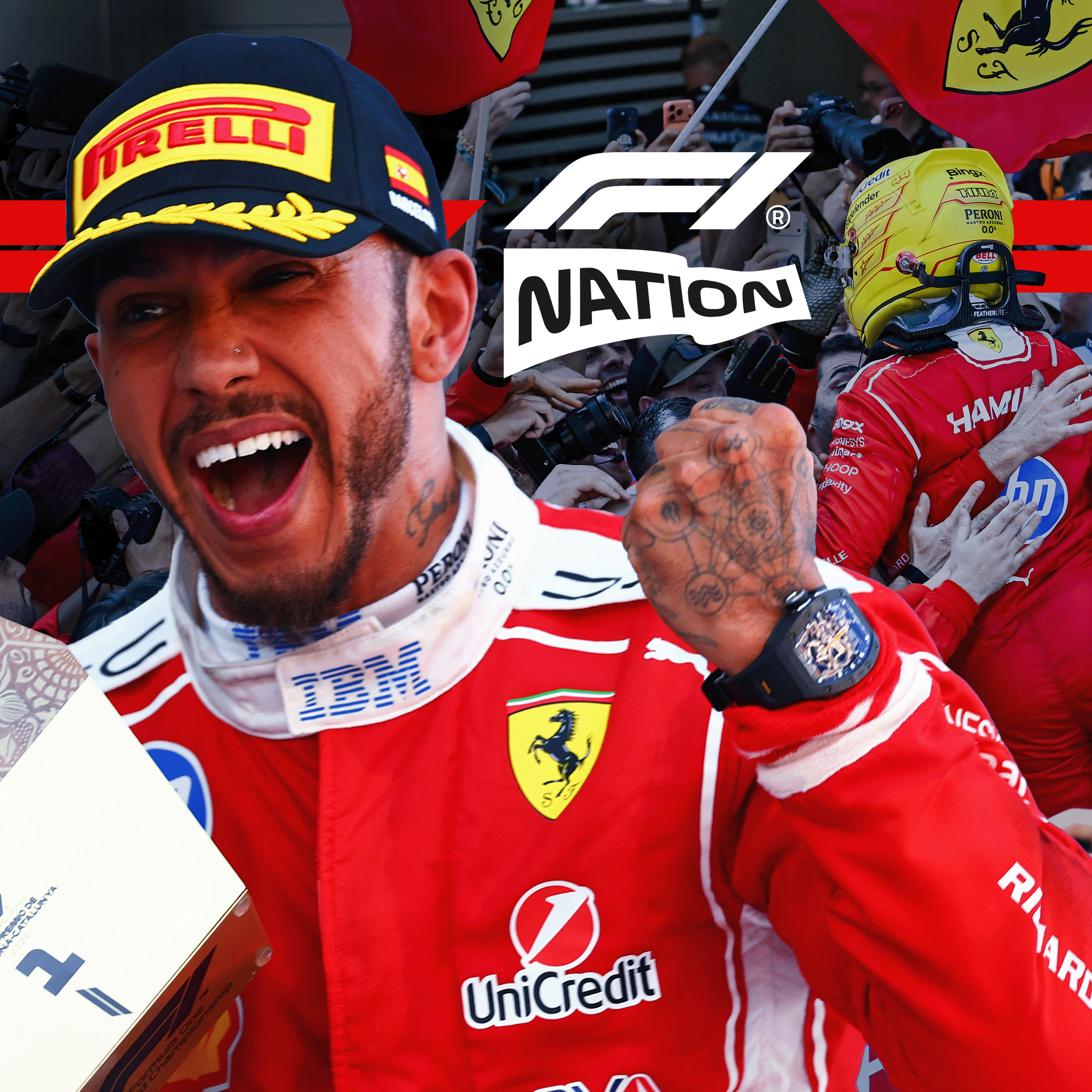
It's more history for Hamilton, Lewis Hamilton wins a Grand Prix for Ferrari, a legend forged
in silver, resumes in red.
Let's go for the Ferrari, for the Ferrari.
Thanks to the fans, thank you for continuing to remind me who I am.
Even one of the greatest ever can fail, can doubt and can go back stronger.
I think that today he was fighting against his fears.
I feel Lewis has really pushed them to not be afraid.
He smells blood and if the blood is there, he will go for it.
I see Fred as an enabler of what Lewis can achieve here.
I think he's changing a little bit the history and the mentality of Ferrari.
Although George has closed the gap, do you think he's actually left Barcelona slightly worried?
Yes, very much.
I'm sure that he's not heavy right now.
Lewis Hamilton is back.
Welcome everyone to Spain for F1 Nation's review of the Barcelona, Catalonia Grand Prix.
I'm Tom Clarkson and joining me in the paddock, or perhaps I should say in the Ferrari motorhome,
is ESPN's Albert Fabrega and Brazilian journalist Julian Serresoli.
What an extraordinary day, guys, for Hamilton, for Ferrari.
I think we can say for Formula One as well.
Can we start by getting your reactions to what happened?
What can I say about this?
I wouldn't say it was unexpected because this win has been coming closer and closer and closer.
It's not coming out of the blue.
Lewis is second in the championship, but I didn't expect it to be today.
I thought today was going to be all about tired degradation and Mercedes was going to walk with it.
And then since the beginning, since the first stint, it wasn't.
And then it was becoming clearer and clearer that Lewis was doing exactly what he needed to do to win.
I don't think he needed the VSC to win.
And it's just a remarkable moment and his emotions just, it goes on to show that even one of the greatest
ever in all sports can fail, can doubt and can go back stronger.
Yeah, 100% agree.
It's not only the race.
I think the whole weekend has been fantastic for the sport, for Lewis.
I admire Lewis as I admire the 22 drivers, but especially when he was a year ago in a very difficult moment
to see how he has recovered that moment and he's winning for his own merits, not because of third factors.
Because I'm agree with Julianne what he said about the virtual safety car.
He was deserving this.
And the thing that I appreciate very much is that he was going for it since the start with the soft tires.
It's an statement of what I want to do in this race.
It's not just to take the podium.
I want to win this race and he achieved it.
So it's very good for the sport, I would say, for the Formula One.
As a fan, it's good for everyone.
It was a very emotional win.
Let's hear from the man himself.
How do you find the right words to express an emotion that's beyond your wildest dreams?
You know, I truly believed in my decision and joining Ferrari.
I truly believed what this team could achieve, what we could achieve together.
I know it started out with lots of excitement and then lots of doubt and lots of negativity
that followed through a whole year.
You know, I really feel like my fans really rescued me last year.
My family also and friends that stuck with me through it all.
And started into a new season, a new year where lots and lots of changes in the background enabled
me to get to this position that I'm in today.
And I just feel a lot of gratitude, pride and very, very proud of the people that I work with.
After a year like last year, there was definitely moments that I was like,
maybe it is true that, you know, when you get to a certain point, you lose it,
but I've proven that you don't.
I wouldn't be in this team without Fred.
Fred is the one that made it happen.
I think last year was really, really, really tough for him.
To deal with me coming was a big shock to the system because I am very, very vocal.
If I see something that I don't think is right, I push, but he continued to believe,
continued to be a good friend and really supportive and, you know, ultimately really listened at the end.
I had to really ask, really, really ask for some of the changes and he enabled them to happen,
which I'm forever grateful for because this wouldn't have happened without those changes.
So big, big thank you to him.
I think there was a lot of relief in his voice listening to him then.
After everything he's been through over the last 18 months.
And not only from him.
I got to hear the Total Wolf saying, I feel relieved for him to come back winning,
for him and for Fred as well.
Instead of Fred annoys me sometimes, but he's my friend.
And I'm glad that they got through a lot of really bad stuff.
What Lewis has done by going to Ferrari is just, he didn't need to do this.
He didn't need to take this step and he wanted to.
As you said about the race, he went for it.
He went for it with this decision as well.
And it was not an easy one.
And it's just, it's just amazing.
And that's why it was a very long press conference.
He deserved it.
But Albert, there's a lovely symmetry because it was 30 years ago here at the Circuit de Catalonia,
as it was called then, that Michael Schumacher won his first race for Ferrari.
A heavy rain.
Today was a heavy sun, I would say.
Luckily we are in a Ferrari motorhome with a nice icon now.
But yeah, there is a lot of similar points on that.
Maybe a bit different, but it was a challenge.
As she said, it was a challenge to come to Ferrari.
We know that Ferrari has not been capable to win with champions like Sebastian Betel,
like Fernando Alonso.
So it's not easy.
It's a completely different team than the others.
Obviously being used to work with a British emberoi man and going to an Italian,
a proper Italian concept like Ferrari is built from, it was a massive challenge for him.
And I think the last year he showed to us that he is so emotional in everything he does.
And he was capable to record himself.
It's not a matter only that he is now connected with the car,
that he feels better with the generation of cars.
It's not only that.
I think he was capable to rebuild himself again from zero and this year to smile
and to compete.
That is the thing as a driver you want.
He only had one complaint when he made a comparison with Michael.
That Michael's cockpit was red and his is white.
And in his dreams he would be driving and seeing red all over him and he sees white
from where he stands.
That's the only complaint.
You mentioned that he started on the soft tyre and that he was aggressive and wanted
to win this race from the start.
I feel there is a significance behind him starting on the soft tyre because I think
there's been a period here at Ferrari where they might have been a bit afraid to do something
different like that at the start.
All the cars around him were on the medium tyre but I feel Lewis has really pushed them
to not be afraid to go for the Macarena wing, to change the brakes, to be adventurous with
the design, to go be aggressive with the soft tyre.
Do you guys agree that that's significant?
It is.
It is.
I think that Ferrari still have this difference between them and the other teams where the
consequences of having a mistake like this could affect the whole scooter.
You know, I think that in this sense Fred has done a good job taking weight of the things
that are not relevant for the team and whatever is set outside.
I think that he's trying to introduce to the team that they have to be a little bit
away of what is going on, away of the team or outside the team and what the people say about
it and be confident with their work.
And I think that having a man like Lewis Hamilton that has been one of the greatest of the sport
within the team, it gives that confidence to them to do this kind of strategies.
Saying, okay, well, let's go for it.
And if it doesn't work, nothing happened.
We will be fighting for the podium anyway, but giving them the opportunity to win,
I think it's enough to take the risk and they're doing it.
I see Fred as an enabler, enabler of what Lewis can achieve here.
In his first day of Ferrari, he went to his office and there was all the newspapers from
the day before, from the morning probably.
And he said, from tomorrow onwards, I don't want this.
I don't want to know what others are talking about this team.
What matters is what is inside this team.
And I think this leads to decisions like this.
It leads to let's just do our best here and not be afraid of what the papers will say
or what we are going to say in the podcast or something like that.
It all comes together and having Lewis, a guy who has won so much, telling the guys,
just go for it and having a boss saying, okay, let's go for it.
If we fail, we fail trying.
And of course, they are in also a much better position than Mercedes to try something like
that because they are far off from the championship.
They don't have power and that is still a problem and nothing that has happened today
has made them have more power in their engine, right?
It doesn't solve their problem.
But at least they won.
They got this first step.
They are on a different kind of path than Mercedes is.
I think that Fred Basel has been the first team member of Ferrari
who has said that the engine is not powerful enough.
I don't know.
That would never have come out of Enzo Ferrari.
He's been brave since the first race of this season says,
our engine, our power unit is not powerful enough.
So I think that never happened that before in Ferrari.
Well, why don't we listen to the boss now?
This is Fred Basel.
You know that we opened down the last 18 months and sometimes it was tough,
but it's, I think, a good reward for everybody.
When I say everybody, the first one is Lewis and the team in Maranello and the team on track that
after 18 months to be able to win and to have this kind of race today.
It's not the target.
I want to win more, but it's a good milestone and a good reward for everybody.
He praised you.
He thanked you after the race for believing in him and sticking by him during the difficult times last year.
Yeah, but we are working as a team, including Charles, including Lewis,
the guys in the factory, the guys on track,
that we have to react in the positive and negative moment as a group, not as individuals.
You say you want to win more.
You had the fastest racing car today on a track that is a real car test.
How much confidence does that give you?
It's a good one, but honestly, I think this season is a bit different.
It will be all based on the capacity to develop and to bring upgrades.
It means that we will do a full reset soon when the others and us,
we will bring a new package on track and it will be perhaps today we had an advantage,
but perhaps in one week it will be different.
We talk about what a facilitator Fred is.
I thought it was interesting in that short interview,
just how even in what is probably the highlight of his Ferrari career so far,
seeing Lewis Hamilton win in red, he's still very measured.
You know, he's always said, I don't want to get too excited when we win.
I don't want to get too low when we lose and he's just proven that.
Yeah, and he's a racer because he's a man who's all his career
is being related to motorsport in the GP2 and Formula 3, then in Formula 1,
but he's a proper racer.
He's a man of the motorsport, a man of the motorsport,
and he knows that these up-and-downs happen and the emotions that are very high
in a day like today, it can be very low in the day after or the race after.
So, balancing all these highly points and low points, I think it gives you
the moment, it gives you energy and it gives you the calm and the quiet situation
in order to make the team work on the right way.
And yeah, I think he's doing well.
He's doing well and I think he's changing a little bit the history and the mentality of Ferrari.
This is important because there are some drivers that are changing the sport
or changing the mentality of a team principal like him that he's coming alone.
It's not different than Jean Taud that arrived there with a lot of engineers,
with relevant people and changed the whole board of the company.
Fred Baset arrived there alone and he said,
I'm coming and when he said the Lewis was going to come to the team
and he is changing us slowly but on the right way, the way that Ferrari is working as a team
and he's achieving very good things.
This was win number 106 for Lewis.
What does a win in red mean for Lewis Hamilton's legacy in this sport?
Well, it means winning in three different teams is not easy.
I don't know if there are many drivers who have achieved that.
And mainly when no one was saying that he could achieve it with the Scuderia.
No one was thinking, okay, this year is going to be Lewis Hamilton's year,
he's going to recover himself.
He was more comfortable with the car but from that point to win races
and to beat both Mercedes, I think there was a long distance.
But then after the two or three first races,
we saw that he has the capability to achieve the pace enough.
He was happy with the car, he was connected, everything was in place with even that power unit.
But I think that it reaches him in Barcelona at a very emotional moment
when you see that he's achieving the result,
mainly with a car that shouldn't perform that well here, for example.
So I think it has double value.
The thing with Lewis is that I can only imagine that maybe tonight he's going to be thinking,
oh, this is great, I finally won with Ferrari.
And tomorrow he's going to be thinking, okay, what else can I do?
How far can I go?
Can I fight for this championship?
Can I become champion with Ferrari?
I think he's already thinking that.
With Kimi Antonelli not finishing this race,
the gap is down to 41 points now between Lewis and Kimi.
He was asked in the press conference, is it game on?
And he was batting it away, not wanting to put pressure on him or the team,
saying it's one race at a time.
But when you look at the performance of the car and how many races we have left,
I feel it's game on, do you?
Are we going to Silverstone soon?
That is always a place where he's performing very well.
Well, Toto was saying I really don't want him to be fighting for the championship
because I know him.
I know if he can smell blood, he's going to go for it.
And I really don't want to have him in this fight
because I know he's capable of.
He's relentless, isn't he?
Yes, yes.
And the good thing is that these situations,
it makes us remember that it's not an easy job what the drivers are doing.
It means that you have to have everything on your side.
So it gives a special value for him winning this first race.
But I think that more are to come.
And when you see how his teammate is,
that Charles is not performing well,
and I'm pretty much sure that he's very disappointed with the results we can.
You think that Leo is now in another status
and that he smells blood and if the blood is there,
and he's red, of course, like the Ferrari, he will go for it.
And I have no doubt of that.
There will be difficult situations for him again.
That happens always.
But when there is an opportunity, he always takes it.
This episode is sponsored by Lisa.
You know, we spend so much time talking about performance in Formula One.
The tiny details that can make a difference over the course of a race weekend.
But it's funny how often we overlook the basics in our own lives.
And for me, one of those basics turned out to be sleep.
A few weeks ago, I finally replaced the mattress we'd been sleeping on for years
with a Sapira Hybrid from Lisa.
And honestly, it's been one of those upgrades
where you wonder why you didn't do it sooner.
I hadn't realised quite how much our old mattress was affecting my sleep until I switched.
I usually just blame the jet lag.
But the Sapira Hybrid has just the right balance of support
from the springs and comfort from the memory foam.
And from the very first night, I slept right through
and woke up feeling much more refreshed than usual.
The only downside is that I don't actually get to sleep in it every night.
One thing I really liked was how easy Lisa made the whole process.
Their online sleep quiz asks about things like your sleep position,
preferred firmness and the sort of support that you need
before giving you tailored recommendations in less than two minutes.
Lisa mattresses are designed and assembled in the USA
and they've been awarded Best Hybrid and Best Memory Foam mattresses
by the New York Times Wirecutter.
Plus, they offer free shipping, easy returns and a 120 night sleep trial.
So go to lisa.com for 25% off select mattresses plus
get an extra $50 off with the promo coordination exclusive for our listeners.
That's lisa, l-e-e-s-a dot com promo coordination
for 25% off select mattresses plus an extra $50 off.
Support our show and let them know we sent you after checkout.
That's lisa.com promo code nation.
The juxtaposition of Lewis celebrating on a Sunday and and Charlotte Claire saying
how ashamed he was, his word not mine, of his crash in qualifying.
It's a really difficult moment, I feel this for Charles.
I think he's generous enough to be pleased for Lewis and for the team that they're winning again
for the first time in a couple of years.
But how does he drag himself back into into the conversation?
Funnily enough, going back to Fred.
Fred was saying that I'm less worried about Charles now than I was two weeks ago.
That's what he said in the press conference after the race.
Actually, Charles drove a good race.
Everything went downwards yesterday.
But at least what the team is feeling is that this weekend was better for him.
Let's remember that he was actually doing better than Lewis until the qualifying.
And Lewis, throughout this weekend, I saw him after FP3 leaving the track
and I thought, what was wrong?
Why is he leaving the track?
And I thought about saying, Lewis, what are you doing here?
Just to make a joke, but he looked tense.
And then he sat afterwards.
I went to my motor home because I wanted to put my act together.
It was not as if he destroyed Charles for the whole weekend.
And then it was only Saturday qualifying and everything went wrong for Charles.
And then his race was actually a good race.
So I think there's more to come from Charles.
He just made an important change with the brakes this weekend.
I think that the same process that Lewis needed to get to this point here,
I think that's the process that Charles is going through right now.
How much has Charles learned technically this weekend about the brakes?
Because there aren't any really big stops here in Barcelona.
No, definitely not.
But not sure if he already tested in the precision.
I'm not sure about that.
But anyway, he needed it mentally, I think.
More the technical thing, I think he needed it mentally,
just to be sure that he had the same car as his teammate.
The talent is there.
He hasn't forgot to drive the car.
So I think it's more a mental job, what Charles has to do,
to recover the confidence in himself, to see what he's doing wrong.
Because there's obviously something doing wrong
and recover the speed that we have seen in past years.
Maybe the thing that from Charles, I wouldn't say I don't like,
but I see that this is penalizing him,
is that the low points, when he doesn't start, well, the Fridays,
he's not capable to be on the pace,
and he's not confident with him and the car, he's connected with the car.
It's like it's difficult for him to recover that point,
where he sees that his teammate is quicker than him.
I think he's entering in a moment that is difficult for him,
to release all this pressure and let all the speed go in through.
But interestingly, isn't that what we saw from Lewis last year?
And therefore, Lewis then got them to make loads of changes,
changes the race engineer, changes bits on the car, and it came back.
I just wonder when the show...
Because you don't have answers to your questions.
When you start asking questions, why I'm not that quick,
or why I'm not capable to be connected with the car and showing my speed,
and you don't have the answers, your answers yourself,
you have to start looking around yourself, say,
well, maybe the problem is this, or maybe the problem is that,
and you're starting to change whatever you think is not right for you,
to see if that gives you the confidence to exploit or to exploit all your speed.
But it's difficult, it's difficult, definitely, to recover that confidence.
Let's talk about Mercedes now, one and three on the grid.
When George Russell got away from the line in the lead,
I think there were a lot of people, myself included,
who thought, well, George Russell's got this in the bag.
25 of the 35 racists here in Barcelona have been won from pole position.
He's done the difficult bit.
How surprised were you guys by the relative pace of Mercedes versus Ferrari?
Yeah, I thought after a few laps with clean air, he was going to disappear.
What seems to have happened, if we listen to George's radio,
was that he was managing the tyres, and he was surprised,
and he was called with Lewis for the first stop.
Like, oh, I had more tyres here, should have told me.
What I think is that Mercedes, they just reacted to what Ferrari was doing,
instead of doing your own race, that's what happened in the first part of the race.
And then in the second part of the race, they changed that.
They realized, okay, Lewis is on the three stopper.
We are not.
And then they seem to not be very decisive with the strategy.
Are we covering him, or are we not covering him?
And I think that was bad for George's pace.
First time in a while that Ferrari have out-strategized Mercedes, right?
I'm actually being serious.
That's a good reaction, I agree.
For me, that was another reaction from them.
And it was clear from the beginning before the race,
who was starting in soft side, he was going to three stops,
and the others could go to a stop following the simulator.
You know, the simulator normally, more or less,
are on the right way and matching what happened later.
But yeah, for me, it was another reaction moment,
because they say, okay, let's cover Lewis, and that's it.
And but I was hoping them to split the strategy a little bit more.
Maybe they could have Antonio out for longer.
I don't know, but then again, if you do that,
if you do that, you create attention within the team.
And this is not good.
So not easy, but for me, it was an overreaction.
If the tire was behaving good, that's what we understand from his comments.
I think it was an overreaction moment, yes.
I did wonder whether them battling,
Kimmy and George battling in that middle stint would have cost
them time in their battle with Lewis, but actually George batted that away.
How significant was it that Antonelli overtook Russell?
Okay, he then retired less than a lap later or whatever.
But to have that extra pace over George,
do you think, although George has closed the gap to his teammate by 18 points,
do you think he's actually left Barcelona slightly worried?
Yes, very much.
Because I'm pretty much sure that yesterday he was happy.
He was okay, I'm back.
I didn't forget to drive a Formula One.
I have the speed again here, and this is going to change from now onwards.
And today, even him cutting points to his teammate,
I think that that moment has an impact to his confidence for sure.
For sure, because he was quicker and he overtook in a not aggressive,
but intense situation where even they touch.
But yeah, I'm sure that he's not happy right now.
Yeah, Toto is not happy as well.
He said there are a few things we have to review.
Imagine Toto.
No, Barcelona again.
No, no, no, no, no.
10 years on.
Oh my God.
Going on turn three side by side.
He goes, no, no.
Maybe another table just suffered another hit or something like that.
But yeah, Kim did really well today, really aggressively.
But what caught my attention was how Bono was trying to stop him.
Wasn't he?
Bono was trying to know.
Because of the track limits, right?
Yeah, track limits.
You know, just stay there, think about Lewis.
You know, all the messages that the engineer says to trying to calm down,
but just to stop him from fighting.
And he went there and did it.
Nothing can stop Kimi, I think.
But isn't that what we love?
Isn't that what we love about Kimi?
Of course, really.
I was surprised about his radio message yesterday on Free Practice 3, I think,
when they sent him in traffic and he had not a chance,
but a moment with Lancer's Troll.
That was quali, wasn't it?
Yeah, was it quali?
Or was Free Practice 3?
Maybe Free Practice 3.
And he went a little bit over Lancer's Troll.
And his message on the radio.
Was strong.
Was strong.
And I said, whoa, that's not the nice Kimi that we know.
And he was getting upset with the wall.
And then Bono was a little bit like calm down, mate.
But that's a really interesting point.
The change in mindset after five consecutive wins from Kimi Antonelli.
And, you know, we talk about Lewis Hamilton's smelling blood,
but I wonder whether the 19-year-old can see it, can see the championship.
There's a change in mentality.
You remember that moment where Toto went to him when he did a mistake?
I don't know, was it in Australia?
Or when he said, keep the confidence.
I feel so confident.
And Toto said to him, yes, keep the confidence, keep the confidence.
Look at the mistake, but keep the confidence.
And the confidence is still there.
And it's bigger.
And it's growing with more confidence.
And I think he's realizing that he has a big opportunity for him.
So yeah, I've seen a different Kimi this weekend, I would say.
It was a very different circuit as well.
So I think on George's perspective, he had everything on his side to prove that
what happened in the last two or three races is not going to happen again.
Because we have the track temperature being a lot higher.
We have more energy on the tire.
We have everything.
Then maybe we'll help a driver who was not as aggressive as Antonelli in the car.
And this is it.
I just found something that was him yesterday.
And today Kimi, remember yesterday he said,
I think of being over aggressive over one lap and everything.
And this guy, 19-year-old, in one day he finds solutions.
And then when he could completely destroy the tires in a race like this,
51 degrees of track temperature, he does it.
And I think George would be very, we're talking about Lewis being relieved.
George would be very relieved that he didn't lose out points this weekend.
And Antonelli was pretty ill this weekend.
Too much jumping in the harbour after the win in Monaco.
Too much partying with the Prince at the palace on Sunday night.
I don't know what the reason is.
But he was actually really ill.
I don't know whether you heard him speak,
but proper cold going on and didn't affect him at all in the cockpit.
And he didn't do the free practice one.
But it's a track that they know.
They know the car, the simulator is better and better.
I don't know if Lewis did simulator before this race.
No, no, no, no.
No simulator at all?
Because he was.
Probably, yes.
He didn't have time.
No, no, no.
But yeah, yeah, still surprising me, Kimi Antonelli.
I was very, very happy with his result in,
because what he did in Monaco was exceptional, I would say.
I said that this kind of wins gives you cocodrial skin,
you know, a very hard skin.
And I think that today he showed that again.
So the car is not perfect for me.
The situation, the qualifying was not fantastic.
I'm not 100% happy with the car.
I don't start from pole.
There is a lot of tight degradation and whatever and so on on.
But then during the race, I am capable to perform well
and to overtake my teammate in a difficult situation,
where another track limit situation gives you a five seconds penalty
and listening to the engineer because saying, as Julian said,
he was in a very polite way saying,
maybe be careful, don't take any risk.
I don't know if it was a team order.
And I don't think it was a team order.
I don't think so.
But if it was not, it was politely close to it.
I think they're just being careful because they didn't want them to crash
and they didn't want a penalty as well.
Landau was close as well.
So it makes sense.
I'm not saying that all.
They are trying to stop Kimmy and they want George to win.
It made sense for the team.
But it did sound to me that he was just trying to calm him down.
Last time they met in a race, he was in Canada.
It was already an intense situation.
Yeah.
Look, one cloud above Mercedes after this race is yet another PU failure.
Still there.
It's still there, isn't it?
Exactly that.
Do we know the cause of the problem Albert?
I'm not sure.
But it was shut down as it was for George in Canada
and probably coming from the battery of the electronic
that is the weakest point of the power unit
that has been affecting not only them, also the customers.
So yeah, it's one of the weakest points.
And I think it will not surprise me if they have penalties
before the end of the year in this sense.
So it's something that also I'm pretty much sure that Ferrari is looking at.
OK.
Let's talk about one of the customers now.
McLaren, Lando Norris benefits from Antonelli's retirement.
I think Lando was pretty upbeat after the race.
He was happy with that race pace.
It shouldn't be.
He was very, very close to them.
I didn't see that at all in free practice or anything
that McLaren could be that close.
Of course, they were leading the sheets, but it for one lap pace
and they knew that the others were going to come.
They did really well in the race.
And let's remember it's been a couple of weeks
that have been really tough for McLaren.
Maybe even a month has been really tough with reliability problems
that are not connected.
And they are not sure if it's because of the way they run the PU
or if they are doing something wrong.
So they stripped down his car on Friday.
The whole thing and put it all together.
That's why they broke the curfew.
And because they are trying to find answers
that they don't have with the car.
And even with all this extra work trying to find these solutions,
they can still be with this kind of pace.
And let's remember that Ferrari upgraded the car
and they didn't bring a lot of things for this race.
So they have reasons to be upbeat.
They ran this front wing.
The new nose.
Yeah, yeah, finally, finally.
Tell us about the front wing.
That's been on, off, on, off for the last couple of races.
They ran it here.
Why here?
Why did they suddenly see the light?
I think because you have three free practice here.
You can do a good scan of different setups
and different configurations of the car.
And then you have data to support.
They had to try it in a free practice one
before spring weekend in Miami.
Same thing in Canada and then to Monaco.
Both races, if the drivers are not 100% confident with the car,
you are lost.
You lost the whole weekend.
You lose the whole weekend.
So I think they were in the conservative mode saying,
okay, we are not 100% that is giving more performance
and it's not giving more confidence to the drivers.
So this is not the race to use it.
I think it was a conservative approach,
but it's a good approach to do.
And for sure that here they have more opportunities
of scanning different ride highs, different setups.
Different aero configurations to put the car on the optimum
on the optimum performance for these nose
and they are happier with it.
So and the results are there.
And mainly on a no-reside than PSD
that I think is suffering more that lack of confidence.
The interesting thing about this front wing
is that what Andrea has been saying,
it's only the beginning.
So that front wing, that's why it took them so long
to put it in the car.
It's going to show a different path
for them to develop a car.
And I heard some very people saying that
there's something really interesting in there from wing.
I still don't know what that is.
But what McLaren says is that it's not that wing
that will change everything,
but it will be the start of a change.
They are really confident in it.
Championship wise, do you still believe in McLaren
or do you think they've just had too much unreliability?
Think of the neither car starting in China
and then all the problems Lando's had
at the last couple of races.
Do you think the gap is too big?
It's not too big in terms of time maybe,
but probably the time they lost with the reliability problems
or with this front wing that are not accomplishing
what they were expecting at the beginning.
Not sure if this affects the correlation
on the future designs.
I'm not sure, but obviously they had a step behind.
And I'm really worried about maybe not for Norris
because he's recovering the speed,
but I see that maybe his teammate
is not in a good shape right now.
He's not feeling good with the car.
He's not feeling confident.
And yeah, I see him a little bit far away.
Oscar was on pole at this race last year, wasn't he?
The gap between him and Lando,
it feels like it's, as you say,
has been growing as the season's gone on, actually.
And I don't see a point where I'm saying,
okay, I'm pretty mature that Oscar is not performing better
than Lando circuits where there's low grip,
as Miami, Canada, Monaco.
It happened last year.
You remember the up and downs of the season
between him and Lando.
But here was a track that I was expecting a bit more,
so it means that he's not confident with the car,
he's not happy, he doesn't feel connected to it.
Trying to be logical about it,
if Mercedes find solutions for the PU
and then McLaren will find solutions as well,
of course, it's not always like that
because it's different cars.
But if they don't have reliability problems, Mercedes,
and then McLaren are not gonna have as well,
and the gap is gonna stay the same, it makes sense.
But yeah, about Piastri, it's really, really strange, isn't it?
But on the other hand,
I think Lando's been driving really well.
When you see the onboard, he looks so confident.
I think the fact that he's now a world champion
and he's not driving with a lot of pressure this year,
whatever he does is fine because the car is a bit behind.
And I think that has given him a few tents
that it's been hard for Oscar to catch up.
I wonder, I think there's a looseness about Lando,
both in the car and out of the car.
You remember, there were points last year
where he was so tense and nervous in and out of the car.
I feel like he's a completely different man this year.
He's achieved his lifetime ambition and
the team is seeing the benefits in the car.
It's just sad for him that the car is not as quick
relative to the opposition.
Another car that's not as quick relative to the opposition
as it was last year is the Red Bull.
Max Verstappen takes P4.
Where do you guys feel he's at?
Is he on top of that car now?
Or is he, you know, he was complaining
about the ride in Monaco and the kerbs.
Do you feel they're making progress?
Not as the point that he needs to and he wants to.
And I think everyone in Red Bull is not happy with the car.
I think they were doing some,
they've been through already big upgrades
since we started the season in Bahrain,
or the precision in Bahrain.
And I think that they are not having yet that point
where they can reach a weekend saying,
okay, we go for it and we know that we can reach.
And other weekends last year he was taking the rabbit
from the hat as a magician on Friday night,
or just before the qualifying.
And he was setting up the car in a magic way
that where the car was confident
and the car was competitive there.
And, you know, this year these situations
looks that are not happening.
So I think Monaco was one off because Max,
obviously because of the car, team, of course.
But yeah, we haven't seen here or on the following tracks
the speed that we are expecting from them.
And another poor start.
Okay, that was for Isaac Hajo,
but still they're having problems
getting away from the line, aren't they?
Yeah, this track, the fact that they are still heavy counts a lot.
We're gonna have a better idea when the new package,
the new weight loss package comes in Austria
and how well they will do there.
But they still have a lot of problems with the software.
If they don't get on top of the software and of the weight,
we're gonna see these ups and downs
when sometimes Max is more comfortable
and then we know that he can take 99% of the car.
It was a typical Barcelona race, a wonderful race.
It was a chess game.
It was a strategic game.
And it was a little bit of Noah's Ark as well.
They went two by two, didn't they?
We saw a lot of the teams, both cars,
very close to each other on track.
A quick shout out to Alpine and RacingBalls,
who 7, 8, 9, 10 in the finishing order.
Alpine were nowhere on Friday.
And yet they've come away with another double points finish.
I found out this weekend for the first time
that Danny Kivia is now the sim driver at Endstone.
I wonder how much of an impact he's able to make on the performance.
Obviously, if you have an experienced driver on the simulator,
it gives you a good feedback to the engineers.
But not sure if this is only because of the work on the simulator.
On Friday, we saw already that Alpine has a good race pace.
They didn't have the speed for one lap for the qualifying.
But in terms of race pace, it was not that bad.
They were complaining because everyone was complaining.
But then the numbers, if you look into the numbers,
the race pace was not that bad.
So we were expecting them to fight for the points,
but it's been very, very strong race.
Even with some strategic decisions,
they were not happy or making happy both drivers.
Because Franco was complaining.
But it's been a strong weekend for them again.
And a weekend where they have given back the podium from Monaco.
Yeah, they finished third.
Yes, seventh and eighth.
The three result this weekend.
Incredible.
A lot of points this weekend.
First time ever in every one history.
And they are starting really well as well.
And that gives a lot of confidence to the drivers.
And once again, the two of them, they did a very good start.
So they started out of the top 10,
and they quickly were inside the top 10.
And then it was just a matter of making the right calls
and using the pace.
Guys, what a wonderful chat.
Thank you both very much for coming on the show.
A brilliant Grand Prix,
which means we now have our driver of the day to discuss.
Easier.
Lewis Hamilton got it on the TV.
Come on, give me a driver of the day.
Is there anyone who deserves it more than Lewis Hamilton?
No, I don't think so.
And it's not only for today.
It's for everything that this means.
This was a historical day.
Yes.
Historical day for Formula One, for Ferrari, for him.
And it doesn't even make any sense to look for alternatives
as for the driver of the day.
You know how we've talked a lot this year about
how Hamilton looks much happier in the car.
Just look at the body language of the car when he's on the track.
Do you think we're seeing a Lewis Hamilton
in a Grand Prix like today as good as 10 years ago?
Was this race as good as anything we've ever seen from him?
You know what I was thinking during the race?
That race against Max,
I know he was actually a race here in Spain in 21
when he does a different strategy.
And it was just like I was going back to one of those races
when he was doing a different strategy
and he needed to do a warm-up stop and his pace was relentless.
And my memory is really bad as bad as Lewis.
But I do remember this happen and we've seen that again.
I think the big difference is that years ago
he was fighting against Max,
against Alonso at the time of McLaren, against a driver.
And I think that today he was fighting against his fears of himself
to prove that he's still capable to win.
And I think he achieved it.
He was not worried about Antonelli or Russell or any other driver.
He was just competing for himself to prove that he can still win.
And he can win with the Ferrari.
And he has proved it.
Yes.
So just how high can the peak get from here going forward?
Guys, thank you very much.
Great to have you both on the show.
And welcome to Barcelona and Catalonia.
Of course.
Home race.
Yes, it is.
Back for some home cooking tonight for you.
Okay, if you want to.
You're invited.
I wasn't actually inviting myself.
Yeah, you did.
But you can try.
I cannot guarantee good results on that for the following days for yourself.
I think we'll leave it there.
Guys, thank you very much.
Really good to have you on the show.
And for more reaction and analysis from here in Barcelona,
please go to f1.com, the F1 app, or at F1 on social media.
And don't forget to check out F1's other official podcasts.
My latest guest on F1 Beyond the Grid is Alex Albon.
After he surpassed Nigel Mansell for the most race starts in Williams history
with his 96th race for the team today.
And the latest episode of F1 Explains is all about the race start procedure
with the woman responsible for lights out and getting the race underway,
the FIA's Rebecca Lee.
So thanks very much for listening.
We'll be back next week with our preview of the Austrian Grand Prix.
But for now, F1 Nation is produced by Formula One and Audio Boom Studios.
About this episode
Lewis Hamilton’s Ferrari win at Barcelona-Catalunya sparks a wide-ranging debate on whether it flips the championship picture. The hosts highlight the surprise of a soft-tyre, go-for-it start, the role (or lack) of VSC, and Ferrari’s newfound willingness to experiment—down to setup risks like the “Macarena wing” and brake changes. They also weigh title-fight realism via points swings, power-unit reliability worries for Mercedes, and how quickly upgrades can change outcomes.
Tom Clarkson is joined by ESPN’s Albert Fabrega and Brazilian journalist Julianne Cerasoli to reflect on Lewis Hamilton’s first Grand Prix victory for Ferrari in Barcelona.
What does this victory tell us about Lewis after such a challenging first year with Ferrari? Why did their three-stop strategy get the better of Mercedes? And are Ferrari now a big threat to them in the title race?
You’ll hear reaction from Hamilton and Ferrari Team Principal Fred Vasseur.
George Russell came home in second place, closing the gap to teammate and championship leader Kimi Antonelli after the Italian suffered a late retirement. But after starting on pole and being the lead Mercedes driver for the majority of the race, George was overtaken by Kimi late on before his DNF. So while George did make some much-needed progress, will he leave Barcelona worried? And how costly could Mercedes’ continuing reliability issues be in their season?
This episode is sponsored by Leesa - upgrade your sleep with an award-winning mattress, designed and assembled in the USA Go to Leesa.com for 25% off select mattresses PLUS get an extra $50 off with promo code NATION, exclusive for our listeners.