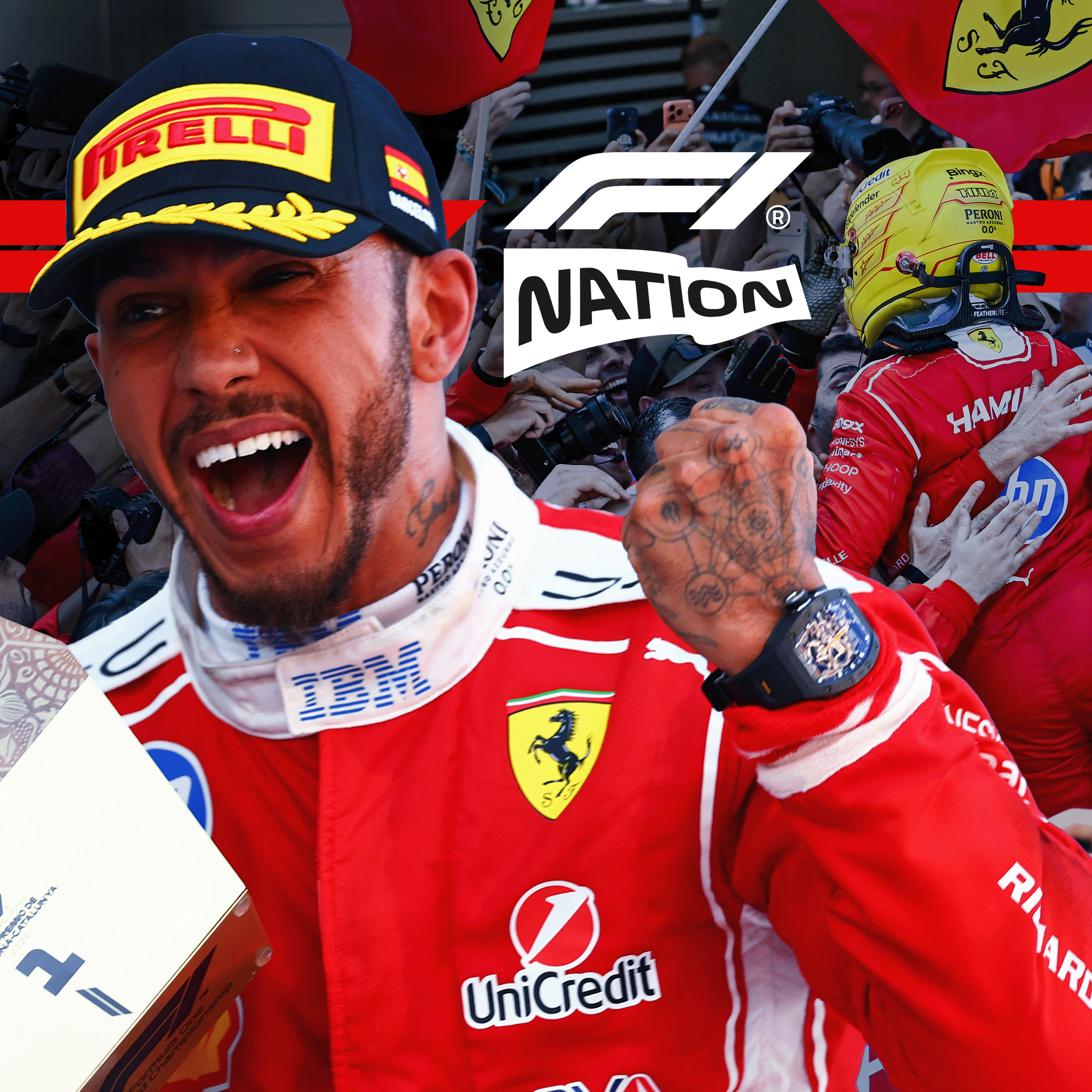
Has Hamilton’s ‘historic day’ put Ferrari in title fight? – Barcelona-Catalunya GP Review
About this episode
Lewis Hamilton’s Ferrari win at Barcelona-Catalunya sparks a wide-ranging debate on whether it flips the championship picture. The hosts highlight the surprise of a soft-tyre, go-for-it start, the role (or lack) of VSC, and Ferrari’s newfound willingness to experiment—down to setup risks like the “Macarena wing” and brake changes. They also weigh title-fight realism via points swings, power-unit reliability worries for Mercedes, and how quickly upgrades can change outcomes.
Tom Clarkson is joined by ESPN’s Albert Fabrega and Brazilian journalist Julianne Cerasoli to reflect on Lewis Hamilton’s first Grand Prix victory for Ferrari in Barcelona.
What does this victory tell us about Lewis after such a challenging first year with Ferrari? Why did their three-stop strategy get the better of Mercedes? And are Ferrari now a big threat to them in the title race?
You’ll hear reaction from Hamilton and Ferrari Team Principal Fred Vasseur.
George Russell came home in second place, closing the gap to teammate and championship leader Kimi Antonelli after the Italian suffered a late retirement. But after starting on pole and being the lead Mercedes driver for the majority of the race, George was overtaken by Kimi late on before his DNF. So while George did make some much-needed progress, will he leave Barcelona worried? And how costly could Mercedes’ continuing reliability issues be in their season?
Listen to more official F1 podcasts
Alex Albon talks making Williams history on F1 Beyond The Grid
F1 Explains explores the race start procedure - on this feed now
This episode is sponsored by
Leesa - upgrade your sleep with an award-winning mattress, designed and assembled in the USA
Go to Leesa.com for 25% off select mattresses PLUS get an extra $50 off with promo code NATION, exclusive for our listeners.
VSC
"[124.0s] And then it was becoming clearer and clearer that Lewis was doing exactly what he needed to do to win. [129.1s] I don't think he needed the VSC to win. [132.5s] And it's just a remarkable moment and his emotions just, it goes on to show that even one of the greatest"
VSC (Virtual Safety Car) is when race control tells drivers to slow down using race rules, without bringing out the real safety car. It can change who has the best track position and can affect pit-stop timing.
VSC stands for Virtual Safety Car, a race control mode used in Formula 1 to slow cars down without deploying the physical safety car. It’s enforced via timing/telemetry rules so drivers must lift and maintain a controlled pace, which can shuffle track position and strategy.
soft tires
"[172.5s] Because I'm agree with Julianne what he said about the virtual safety car. [176.1s] He was deserving this. [177.9s] And the thing that I appreciate very much is that he was going for it since the start with the soft tires. [184.7s] It's an statement of what I want to do in this race."
“Soft tires” are the grippier tire option in F1. They help you go faster, but they usually don’t last as long, so you have to plan your race around that.
In F1, “soft tires” refers to a softer compound in the tire range, designed for higher grip and faster lap times. The tradeoff is that they typically wear out sooner, so teams must manage when to use them and how long a stint can be.
engine
"I think that Fred Basel has been the first team member of Ferrari who has said that the engine is not powerful enough... our engine, our power unit is not powerful enough."
In F1, the “engine” is the main power system that makes the car go. If someone says it’s not powerful enough, it means the car doesn’t have enough speed/energy to compete as strongly as rivals.
In Formula 1, “engine” is often shorthand for the car’s power unit, which is the core system that produces the car’s usable energy for propulsion. When a team says the engine isn’t powerful enough, they’re usually talking about overall output and how effectively it translates into lap time.
power unit
"our engine, our power unit is not powerful enough."
In F1, the “power unit” is the whole high-tech engine package. It includes the main engine plus systems that capture and reuse energy, which helps the car go faster and manage energy over a race.
A Formula 1 “power unit” is the complete hybrid propulsion system, not just a traditional engine. It combines an internal-combustion component with energy-recovery and deployment systems that affect acceleration, efficiency, and race strategy.
Maranello
"When I say everybody, the first one is Lewis and the team in Maranello and the team on track that... after 18 months to be able to win."
Maranello is where Ferrari’s main factory and team operations are based. It’s the “at the factory” part of the team, not the drivers on track.
Maranello is Ferrari’s historic home base in Italy, where much of the team’s engineering and factory work is centered. When the speaker mentions “the team in Maranello,” they’re referring to the factory side supporting the race team.
upgrades
"It will be all based on the capacity to develop and to bring upgrades. [718.3s] It means that we will do a full reset soon when the others and us, [722.8s] we will bring a new package on track..."
In F1, upgrades are improvements to the race car that teams add during the season. Better upgrades can help the car go faster, especially as conditions and rivals change.
In Formula 1, upgrades are development changes to the car—like aerodynamic parts, cooling improvements, or other technical revisions—introduced over the season. The idea here is that championship outcomes can hinge on which team can bring effective upgrades to track at the right time.
full reset
"It means that we will do a full reset soon when the others and us, [722.8s] we will bring a new package on track and it will be perhaps today we had an advantage..."
A “full reset” here means the team is basically hitting the restart button. Instead of relying on what worked before, they switch direction and come back with a new plan and new parts.
A “full reset” in F1 usually means a major shift in approach after a phase of development—often involving re-evaluating direction, changing setups/strategies, and preparing a new technical package. The host frames it as something teams do when rivals and themselves are about to bring different updates.
new package
"we will do a full reset soon when the others and us, [722.8s] we will bring a new package on track and it will be perhaps today we had an advantage, [727.7s] but perhaps in one week it will be different."
A “new package” means the team brings a group of improvements at the same time. It’s not just one tweak—it's several changes that can make the car feel and perform differently.
A “new package” in Formula 1 is a bundled set of updates—multiple parts and/or software changes—delivered together for a race or test window. The point is that performance can swing quickly once a different package is on track.
Ferrari
"just how even in what is probably the highlight of his Ferrari career so far, [741.5s] seeing Lewis Hamilton win in red, he's still very measured... [798.3s] He's doing well and I think he's changing a little bit the history and the mentality of Ferrari."
Ferrari is the famous racing team in Formula 1. Here, they’re talking about how Hamilton’s win is affecting how Ferrari thinks and approaches races.
Ferrari is the Italian Formula 1 team and car brand that competes in the sport’s constructors’ and drivers’ championships. In this segment, the hosts discuss how Lewis Hamilton’s performance is influencing Ferrari’s internal mindset and title-fight expectations.
win number 106
"This was win number 106 for Lewis."
“Win number 106” means this was Lewis Hamilton’s 106th F1 race win. It’s a big career milestone being highlighted in the discussion.
“Win number 106” is a milestone count of Lewis Hamilton’s Formula 1 race victories. It’s used to frame how significant the Ferrari win is relative to his overall career achievements.
three different teams
"Well, it means winning in three different teams is not easy."
Winning with three different teams means the driver managed to be successful in multiple cars and team setups. In F1, that’s hard because each team’s car is different.
Winning with “three different teams” highlights how rare it is for a driver to adapt and succeed across multiple constructors with different cars, engineering groups, and development directions. In F1, that’s a strong indicator of both driver skill and the ability to work with changing technical setups.
Scuderia
"And mainly when no one was saying that he could achieve it with the Scuderia."
Scuderia is what people call Ferrari’s F1 racing team. In this context, it means Ferrari’s team and how well they were expected to do.
Scuderia is the Italian name for Ferrari’s racing team (literally “stable”), and it’s commonly used in F1 to mean the Ferrari team operation. When the speaker says nobody was thinking it would be Hamilton’s year with the Scuderia, they mean Ferrari’s team performance and setup.
Barcelona
"But I think that it reaches him in Barcelona at a very emotional moment"
Barcelona here means the race track in Spain where the Grand Prix is held. The track’s corners and braking zones make it a good test of how well the car is set up.
Barcelona refers to the Circuit de Barcelona-Catalunya venue used for the Spanish Grand Prix. It’s known for a mix of high-speed sections and heavy braking zones, which makes setup and car balance especially important.
qualifying
"Let's remember that he was actually doing better than Lewis until the qualifying. [1207.3s] And Lewis, throughout this weekend, I saw him after FP3 leaving the track"
Qualifying in F1 determines the starting grid for the race. Performance in qualifying is crucial because it affects track position, which can strongly influence race strategy and overtaking chances.
FP3
"And Lewis, throughout this weekend, I saw him after FP3 leaving the track [1215.2s] and I thought, what was wrong?"
In F1, FP3 is the last practice session before qualifying. Teams use it to test changes and get the car ready for the weekend’s important sessions.
FP3 means “third practice” during an F1 race weekend. It’s the final on-track session before qualifying, so teams use it to fine-tune setup and running plans.
brakes
"He just made an important change with the brakes this weekend. [1252.4s] I think that the same process that Lewis needed to get to this point here,"
In F1, brakes are more than slowing down—they affect how fast and confidently a driver can enter corners. Changing the brake setup can help the car feel more predictable.
In F1, “brakes” aren’t just about stopping—they’re a key part of lap-time and tire management. Small brake setup changes (like balance and how the car decelerates) can affect confidence, corner entry, and consistency.
Mercedes
"Let's talk about Mercedes now, one and three on the grid... What I think is that Mercedes, they just reacted to what Ferrari was doing... And then in the second part of the race, they changed that."
Mercedes is the F1 team in this discussion. They’re talking about how Mercedes planned the race—especially pit stops and tyre use—and how that affected how fast their cars were.
Mercedes is the Formula 1 constructor being discussed here, and the key point is how its race strategy and tyre management compared with Ferrari. The hosts argue Mercedes reacted to Ferrari’s plan early, then changed approach later, but not decisively enough for Russell’s pace.
pole position
"25 of the 35 racists here in Barcelona have been won from pole position. He's done the difficult bit."
“Pole position” is where the fastest qualifier starts the race—right at the front. It’s helpful because you can lead early and usually have cleaner air and fewer cars to deal with.
“Pole position” is the starting spot on the front row awarded to the driver who qualifies fastest. Starting from pole often gives a big advantage because you can control the race pace early and avoid getting stuck behind slower cars.
clean air
"Yeah, I thought after a few laps with clean air, he was going to disappear."
“Clean air” means the car isn’t being affected by other cars’ airflow. That usually helps the car grip better and behave more consistently, especially with the tyres.
“Clean air” in F1 means air that isn’t disturbed by other cars’ aerodynamic wake. When a driver has clean air, the car’s downforce and tyre performance tend to be more consistent, which can make the car feel faster and more predictable.
tyres
"What seems to have happened, if we listen to George's radio, was that he was managing the tyres, and he was surprised, and he was called with Lewis for the first stop."
In F1, “tyres” are the tires the car runs on during the race. They wear down and lose grip over time, so drivers and teams have to plan when to pit and how hard to drive.
In Formula 1, “tyres” are the race tires that wear out and change grip as the stint goes on. Teams manage tyre temperature and degradation by choosing when to pit and how hard to push, which can make a driver feel like they have more or less pace than expected.
three stopper
"Like, oh, I had more tyres here, should have told me. What I think is that Mercedes, they just reacted to what Ferrari was doing... And then in the second part of the race, they changed that. They realized, okay, Lewis is on the three stopper."
A “three stopper” means the team plans to pit three times during the race to change tyres. More tyre changes can help the car grip better later, but each pit stop takes time.
A “three stopper” is a pit-stop strategy where a car makes three separate tyre-change stops during the race. It’s a way to balance tyre wear and performance: more stops can mean fresher tyres later, but it also costs time in the pits and traffic.
strategy
"What I think is that Mercedes, they just reacted to what Ferrari was doing... And then in the second part of the race, they changed that. They realized, okay, Lewis is on the three stopper... And I think that was bad for George's pace."
In F1, “strategy” is the plan for when to pit and how to manage tyres during the race. The timing matters because it affects both speed and track position.
In F1, “strategy” is how the team plans the race around pit stops, tyre choices, and timing to manage track position versus tyre performance. Small timing decisions can swing pace because tyre wear and traffic interact with when you pit.

Mitsubishi Lancer
"when they sent him in traffic and he had not a chance, but a moment with Lancer's Troll. That was quali, wasn't it?"
The Mitsubishi Lancer is a regular compact car made by Mitsubishi. Some Lancers are also known for being sporty, which is why you might hear the name in a racing conversation. In this podcast moment, it’s being referenced as part of the story during qualifying.
The Mitsubishi Lancer is a compact car from Japan that’s known for being used in both everyday driving and motorsport. In a racing or “qualifying” context, it may come up as a recognizable example of the kind of car people associate with performance and rally-style heritage. That’s why it could be mentioned alongside talk of a driver getting stuck in traffic but having a brief opportunity during qualifying.
PU failure
"Look, one cloud above Mercedes after this race is yet another PU failure. Still there."
In F1, the PU is the whole power system that makes the car go, including the engine and the hybrid energy parts. A “PU failure” means that power system broke or malfunctioned badly, and the car may have to stop early and can get penalties.
In F1, the PU (power unit) is the car’s hybrid engine system, including the internal-combustion engine plus energy-recovery components. A “PU failure” means that system malfunctioned enough that the team had to shut it down or retire the car, often triggering penalties.
battery of the electronic
"and probably coming from the battery of the electronic that is the weakest point of the power unit"
That phrase is about the hybrid battery and the control electronics in the F1 power system. If that part is weak, the car can lose reliability because the hybrid energy can’t be used or managed correctly.
This refers to the battery and electronics used in the PU’s hybrid energy system. In F1, the battery stores energy recovered during braking and other phases, and the electronics manage how that energy is deployed—so a weakness there can cause repeated reliability issues.
penalties
"And I think it will not surprise me if they have penalties before the end of the year in this sense."
Penalties in F1 are punishments for breaking the rules—often related to using too many engine or hybrid components. If a team has repeated power-unit problems, they can be forced to take penalties later in the season.
In F1, “penalties” typically refer to grid or race penalties applied when teams exceed component limits or suffer reliability-related issues with regulated parts like the power unit. The host’s expectation of penalties “before the end of the year” suggests repeated PU problems could trigger additional sanctions.
PU
"And they are not sure if it's because of the way they run the PU or if they are doing something wrong. So they stripped down his car on Friday."
In F1, “PU” means the power unit—the car’s main engine system. If the PU has problems, the team may have to adjust the car or replace parts, which can hurt speed and reliability.
In Formula 1, PU stands for power unit, the hybrid engine package that includes the internal-combustion engine plus energy-recovery systems. Reliability issues with the PU can force teams to change parts or alter how the car is run, which affects performance and race strategy.
front wing
"They ran this front wing. The new nose. Yeah, yeah, finally, finally. Tell us about the front wing."
The front wing is the aerodynamic “wing” at the front of the F1 car. It helps push the car down onto the track so the tires can grip better, especially when turning.
The front wing is a major aerodynamic component that shapes airflow around the front tires and helps generate downforce for grip. In F1, small front-wing changes can noticeably affect cornering balance, tire wear, and how quickly the car responds to steering inputs.
new nose
"They ran this front wing. The new nose. Yeah, yeah, finally, finally."
The “nose” is the front shape of the car. When teams fit a new nose, it’s usually to change how air flows around the car so it can stick to the track better and be more efficient.
In F1, the “nose” is the front bodywork that channels airflow toward the car’s underbody and rear aerodynamics. A new nose is usually part of an aerodynamic update, aiming to improve downforce distribution and reduce drag while keeping the car stable at high speed.
unreliability
"Championship wise, do you still believe in McLaren [2155.2s] or do you think they've just had too much unreliability?"
Unreliability means the car isn’t consistently working right. In F1, that can lead to retirements or poor results, which hurts the championship even if the car is quick.
In racing, unreliability means the car has mechanical or systems problems that prevent it from finishing or performing as expected. In F1 title fights, unreliability can erase points even if the car is fast, because DNFs and performance drops cost championship positions.
gap
"Do you think the gap is too big? [2167.4s] It's not too big in terms of time maybe,"
The “gap” is how far behind one team is compared to another. If it’s not too big in time, it means they’re not losing by a huge amount and could catch up.
The “gap” refers to how much time (or points) separates cars or teams over a race weekend. When someone says the gap isn’t too big “in terms of time,” they mean the performance difference is small enough that development could close it.
correlation
"Not sure if this affects the correlation [2191.2s] on the future designs."
Correlation is whether what the team predicts (from testing and computer models) matches what the car actually does on track. If it doesn’t match, it’s harder to know which future upgrades will help.
In motorsport engineering, correlation is how well simulation and wind-tunnel/track data match real on-track behavior. If correlation is off, it can mean the team’s future design changes won’t predictably improve performance.
Monaco
"than Lando circuits where there's low grip, [2245.2s] as Miami, Canada, Monaco. [2248.5s] It happened last year."
Monaco is the famous street track in Monaco where it’s very hard to overtake. Because it’s so tight and slow, the car’s grip and how predictable it feels can make a huge difference.
Monaco is the Monaco Grand Prix venue, famous for tight corners, low average speeds, and limited overtaking. Because of the street-circuit nature, small setup and aerodynamic changes can strongly affect traction and driver confidence.
Miami
"than Lando circuits where there's low grip, [2245.2s] as Miami, Canada, Monaco."
Miami is where the F1 race is held in Florida. It’s a track where grip and car balance can make a big difference to how fast drivers feel.
Miami is the Miami Grand Prix venue, known for a mix of high-speed sections and heavy braking that can expose aerodynamic and tire grip weaknesses. It’s often discussed as a circuit where low grip and setup balance matter a lot.
Canada
"than Lando circuits where there's low grip, [2245.2s] as Miami, Canada, Monaco."
Canada refers to the Canadian Grand Prix circuit (typically Circuit Gilles Villeneuve in Montreal). It’s characterized by slower corners and traction demands that can highlight differences in how well cars manage grip and aerodynamic balance.
Piastri
"But yeah, about Piastri, it's really, really strange, isn't it? But on the other hand,"
“Piastri” is Oscar Piastri, another F1 driver. The host is saying something about his results or situation feels unusual, especially compared with how well Norris is doing.
“Piastri” refers to Oscar Piastri, and the host calls his situation “really, really strange,” implying an unexpected gap in competitiveness or adaptation. The discussion then shifts to Norris’s form and why it may be harder for Piastri to catch up.
Lando
"But on the other hand, I think Lando's been driving really well. When you see the onboard, he looks so confident."
“Lando” is Lando Norris, an F1 driver. The host is saying he seems calmer and more confident this year, and that confidence shows up both in his driving and how he carries himself.
“Lando” refers to Lando Norris, who the host discusses as driving confidently and benefiting from reduced pressure after becoming world champion. The segment contrasts his on-track composure with how he previously looked tense “in and out of the car.”
onboard
"But on the other hand, I think Lando's been driving really well. When you see the onboard, he looks so confident."
“Onboard” means the camera view from inside the race car, usually from the driver’s perspective. It helps you see how confidently the driver is steering and handling the car.
“Onboard” refers to the in-car camera footage (and often telemetry overlays) recorded from the driver’s perspective. When the host says “When you see the onboard, he looks so confident,” they’re pointing to how the driver appears to manage inputs and pace from inside the cockpit.
Request an Explanation
Heard something you'd like explained? We'll add it to this episode.
Sign in to request explanations for terms you heard.
Want to learn more?
Browse our glossary for plain-English explanations of automotive terms, jargon, and concepts.
Help improve this episode
See something that's not quite right? Our annotations are AI-generated and can sometimes miss the mark. Click the flag icon on any annotation to suggest a correction.